Showing posts with label Ocean. Show all posts

Ocean Warming on Steroids

SUBHEAD: Humans adding a half dozen Hiroshima A-bombs of heat per second to oceans.

By Eong Higgins on 14 January 2020 for Common Dreams -
(https://www.commondreams.org/news/2020/01/14/adding-five-six-hiroshima-bombs-heat-each-second-study-shows-oceans-warming-record)


Image above: Illustration for article "Three Times The World Almost Entered A Nuclear War". From (https://www.thefactsite.com/nuclear-war/).

A new study published Monday shows that the Earth's oceans reached the highest temperatures and warmed the fastest since records began, highlighting the urgent need for global action to address the climate crisis before it's too late.

The study (pdf), "Record-Setting Ocean Warmth Continued in 2019," which was published in Advances in Atmospheric Studies, found the oceans have warmed by around 0.075 degrees C above the average of 1981-2010.

That level of warming, the paper found, is equal to:
 228,000,000,000,000,000,000,000 (228 Sextillion) Joules of heat. 

Study lead author Lijing Cheng, associate professor with the International Center for Climate and Environmental Sciences at the Institute of Atmospheric Physics of the Chinese Academy of Sciences analogized the level of heating to something more manageable for the human mind.

"The amount of heat we have put in the world's oceans in the past 25 years equals to 3.6 billion Hiroshima atom-bomb explosions," said Cheng. 

"This measured ocean warming is irrefutable and is further proof of global warming. There are no reasonable alternatives aside from the human emissions of heat trapping gases to explain this heating."

The warming is speeding up, the scientists found.

"We are now at five to six Hiroshima bombs of heat each second," study co-author John Abraham, a professor of mechanical engineering at the University of St. Thomas, told CNN.

Abraham said in a statement Monday announcing the study's publication that the public needs to be aware "how fast things are changing."

"The key to answering this question is in the oceans—that's where the vast majority of heat ends up," said Abraham. "If you want to understand global warming, you have to measure ocean warming."

The ocean warms slowly, said Cheng, but due to its vast size has dire consequences.

"The price we pay is the reduction of ocean-dissolved oxygen, the harmed marine lives, strengthening storms and reduced fisheries and ocean-related economies," Cheng said. "However, the more we reduce greenhouse gasses, the less the ocean will warm."
.

Fragile

SUBHEAD: To recover from ecological crisis, we must transform our who we are in relation to the Earth.

By Peter Reason on 31 May 2017 for Dark Mountain -
(http://dark-mountain.net/blog/fragile/)


Image above: A small sailboat anchored in the lee of a small island east of Ireland. From original article.

[Dark Mountain Editor's note: ‘To recover from ecological crisis, we humans must transform our sense of who we are in relation to the Earth.’ In 2011 Peter Reason sailed his little yacht Coral from the south coast of England to the west coast of Ireland, a journey recorded in his book Spindrift: A Wilderness Journey at Sea. This week we bring you an excerpt from his latest book In Search of Grace: An Ecological Pilgrimage, which follows the further voyages of Coral to the far north of Scotland.]
 
I steered my little yacht Coral through the confused water of the tidal stream that poured out between Garbh Eilean and Eilean Mhuire. The calm pool opened in front of me, littered with specks of white as if some giant had cast handfuls of torn up paper across the surface.

Soon Coral was surrounded by puffins, with their startling white breasts, the distinctive markings around their eyes and brightly coloured beaks. The air was full of puffins too, so full they seemed more like a cloud of mosquitoes than a flock of birds.

I was in the final stages of my travels, which over two summers had taken me and Coral from the south coast of England, round the west coast of Ireland and through the Western Isles to the far north of Scotland, mainly single handed.

As I turned southward, I made for the small archipelago of the Shiant Islands, an isolated group, separated from Lewis by the Sound of Shiant, notorious for its strong tides, overfalls and underwater hazards.


I saw my travels as an ecological pilgrimage. There is a longstanding tradition in most human societies of making a journey, more or less arduous, away from the comforts of home in search of new insights and deeper understandings.

This practice may be as old as the human species: Mesolithic peoples in Europe certainly made long journeys to the sacred sites marked by stone circles; the Aboriginal people of Australia take extended walks along ‘songlines’, re-enacting the journeys of ‘creator-beings’ during the Dream Time.

The idea and practice of pilgrimage developed in a religious context. One thinks of the requirement of good Muslims to undertake the Hajj at least once in their lives; of the Christian pilgrimages of the Middle Ages and the continuing contemporary practices; of the vast numbers of Hindu devotees who travel to sacred sites on the River Ganges; and of Buddhists who walk the difficult path to circumnambulate Mount Kailash.

In its fullest sense, pilgrimage entails a long journey in search of qualities of moral or spiritual significance, a journey across both outer physical and inner spiritual landscapes. Pilgrims separate themselves from home and familiars, maybe joining a group of like-minded seekers and wearing special clothes or other marks to indicate their pilgrim status.

The pilgrimage journey offers a fluid and imaginative space between the everyday and the eternal, a liminal zone between body and soul, heaven and Earth, humanity and divinity. For it is not easy to move across the boundaries between these worlds when locked in the familiarity of the everyday.

Religious pilgrimages are taken to sacred sites in order to encounter a holy realm for worship and the affirmation of faith, in search of illumination and for healing.

As I conceive it, the ecological pilgrimage seeks a primal, heartfelt connection with the Earth itself and the community of life that has evolved on Earth.

It is also a celebration and an act of homage, honouring the Earth as the more-than-human world of which we are a part, existing for itself rather than for human use.

By taking the pilgrim away from the habits of civilization and by disrupting the patterns of everyday life, pilgrimage offers an opening to a different view of the Earth of which we are a part.


Before I left for Scotland, I read about the Shiant Islands and studied the sailing directions. I learned to pronounce the name properly, in one softened syllable: ‘Shant’.

The little archipelago is made up of three rugged islands: to the west Garbh Eilean and Eilean an Tighe are joined by a natural boulder isthmus; across an open pool to the northeast lies Eilean Mhuire.

Adam Nicolson, whose family have owned the islands for many years writes; 
‘The rest of the world thinks there is nothing much to them. Even on a map of the Hebrides the tip of your little finger would blot them out. But the Shiants… are not modest. They stand out high and undoubtable.’ 
Although keen to visit, I doubted whether it would be possible, for they are very exposed and offer little shelter. But it seemed I was lucky: the weather was quiet, with a smooth sea yet enough wind to sail.

Nevertheless, I approached them with caution, keeping an eye on the tidal streams and carefully noting landmarks.

Once I was safely in the pool and had got over the thrill of seeing so many puffins, I turned my attention to getting Coral settled.

The recommended anchorage is by the isthmus that connects Garbh Eilean and Eilean an Tighe.
This is protected from the prevailing westerly winds, but open to the light easterlies blowing that morning.

Since these volcanic islands rise abruptly from the seabed, the bottom shoals steeply and consists of boulders, so there is sediment of mud or sand into which the anchor can sink and get a good grip.

It took a little while before I was happy that the anchor was holding, with Coral tucked into the corner between the isthmus and the precipitous cliffs of Eilean an Tighe.

With Coral safely anchored, I could look around. I soon realised that there were nearly as many razorbills as puffins in the pool.

They are also auks, but rather bigger, distinguished by a black beak with a white line across it, joining a similar line across the face to the eye.

The razorbills seem on the whole less nervous than the puffins: I watched one swimming within a couple of yards of Coral, quite undisturbed as I moved about the deck.

When it decided to dive I was able to watch it turn tail up and, once underwater, open its wings to fly down beneath Coral’s keel, the bubbles of air around its feathers gleaming as they caught the sunlight.

Looking up again across the pool, I realized that there were tens of thousands of puffins and razorbills, for this is one of the major nesting places in the North Atlantic.

There were, of course, other birds: shags, black-backed gulls, kittiwakes, fulmars, guillemots, and the odd gannet.

For me the most impressive were the skuas, big, heavily built seabirds, brown, with two white stripes on their wing. Skuas are known as ‘kleptoparasites’ because of their habit of stealing food from other birds: I watched one attack a gull, hanging onto its wing as they tumbled together to the water to make it regurgitate its meal.

I am sure that given half a chance they would snatch a puffin chick, as would the big gulls. I imagined the links in the local food chain: marine plankton feeding sand-eels, sand-eels feeding baby birds and baby birds feeding skuas and gulls.

I spent the afternoon sitting in the cockpit watching the birds and enjoying the changing light. A few yachts visited, but none stayed for long; a couple of fishing boats chugged through the pool.

As the long northern evening drew in I began preparations for the night. The weather was calm enough for it to be safe to stay overnight at the islands, but I wanted to move to a more secure anchorage.

The dark cliffs and the stony isthmus looked too close, and if the anchor were to drag Coral would soon be ashore. Even if the light winds persisted through the night, it felt unseamanlike to sleep while she was anchored off a lee shore where there was poor holding.

So I hauled up the anchor and motored round the end of Eilean an Tighe to the western side of the isthmus. This anchorage is open to the swell of the Little Minch and disturbed by the tidal movement through the Sound of Shiant.

Despite this, with the light wind blowing Coral away from the islands, she felt safer. Two Danish yachts had already taken the best positions but I was able to find a spot where the anchor held closer inshore.

In the early evening the crews of the Danish yachts returned from their expeditions ashore, and soon there was a whiff of diesel and rattle of anchor chains as they left the anchorage and disappeared north round the end of Garbh Eilean.

With their departure I felt suddenly alone and vulnerable. I checked the forecast on my iPhone yet again, even though that meant waiting ages for the weak signal to load the page.

I looked again at the anchor chain – it was hanging almost vertical, I had plenty of scope out, so all was well there. I looked about me and consulted the chart to see how I would leave the anchorage in the dark if I needed to – there was sea room to the southwest.

There was no rational reason why I should not stay safely overnight, so I took myself in hand, sat down quietly, made myself breath properly and look out at the world around me rather than inwards to my anxieties. I might feel exposed, just a speck in a vast sky and expanse of sea, but I could relax and appreciate it.

The evening wore on, the light faded and I became enveloped in the quiet mystery of twilight. Coral pitched gently on the light swell. Little waves rolled continuously up to the stony shore and broke with a hollow crash on the boulders.

The mound of Garbh Eilean loomed above me, dark against the evening sky, the details of the basalt columns obscured. Nicolson’s little cottage on Eilean an Tighe stood out ghostly white, then, as the light faded away, merged with the hillside behind.

 Looking over Coral’s stern, past the line of rocks and islets that stretches toward the mainland, I searched the surface of the Sound for a glimpse of the flashing green light on the buoy that marks Damhag. All I could see was the grey sea and the distant hazy line of Lewis.

Through the evening the inexhaustible stream of puffins flew overhead; the skuas and black-backed gulls continued their patrols around the cliff tops. If I peered out to sea I could just make out the white flash of gannets on a late search for fish. I sat out late, enchanted by my surroundings while still feeling strangely vulnerable, reluctant to go to bed.


The word that keeps coming to my mind to describe this evening is ‘fragile’. It captures both the strength and the vulnerability of my situation, of the puffins and of the islands themselves. The Shiants are the nesting ground of one of the last flourishing populations for puffins: huge populations in Iceland and elsewhere have quite suddenly disappeared as climate change has brought warm waters that have disturbed the delicate ecological balance on which they depend.

The basalt columns that form the Shiant Islands appear strong and stable, but are weakly jointed; over time, wind and waves penetrate the joints, allowing large chunks to break away. And indeed of all of us, despite the veneer of civilization, are at root unprotected in a wild world and the wild universe.

Our attention has been drawn to the fragility of Planet Earth by the space program. Ever since the early Apollo missions, pictures of planet Earth from space have been widely available, starting with the most famous ‘Earth Rising’, taken as Apollo 8 emerged from behind the moon.


Image above: Earthrise on Christmas Eve 1968. This photo was taken in black and white from the Apollo Command Module orbiting the Moon. NASA has colorized it from available data. From (https://earthobservatory.nasa.gov/IOTD/view.php?id=82693).

This has been called ‘the most influential environmental photograph ever taken’. For, it is argued, now that humanity can see the Earth alone within the vast reaches of space, we will realise her beauty, fragility and significance and band together to protect and preserve her as our home.

Astronauts report that they spend much of their spare time on missions simply ‘Earthgazing’.

NASA engineer Nicole Stott tells us;
‘I think you start out with this idea of what its going to be like, and then when you do finally look at the Earth for the first time you’re overwhelmed by how much more beautiful it really is…’
Shuttle astronaut Jeff Hoffman goes further;
'Earth looks like a living, breathing organism, but it also at the same time looks extremely fragile’. 
And Ron Garon, who served on the International Space Station, remembers;
 ‘When we look down on the Earth from space we see this amazing, indescribably beautiful planet… It’s really striking and its sobering to see this paper thin layer and to realize that that little paper thin layer is all that protects every living thing on Earth from death’.
Edgar Mitchell, who was the Lunar Module pilot on Apollo 14 and the sixth person to walk on the moon, is one of many astronauts to reflect deeply on their experience. His view is that it is not just that you get see the beauty and fragility from space, but there is also a shift in consciousness which he describes a close to the ancient accounts of savikalpa samādhi.

There is as a direct experience of interconnection:
‘You see things as you see them with your eyes but you experience them emotionally and viscerally as ecstasy and a sense of total unity and oneness…
It’s rather clear to me as I studied this that is was not anything new, but was something that was very important to the way we humans were put together’.
I wonder if the experience of the astronauts was so very far from my own as I sat in the long northern twilight off the Shiant Islands: it was just this kind of direct interconnection that I was seeking on my ecological pilgrimage.

Of course, I am not among those who first saw Earth rising from behind the moon; I have not watched the shadow of night move across the face of the Earth; nor I have experienced the thin blue line of the biosphere clinging to the curve of the planet.

And yet, as Mitchell points out, the astronauts’ experience of oneness is nothing new. I think we may idealize their experience and in doing so see the capability of experiencing oneness as something special, something extraordinary, something for which we have to go outside the planet.

Maybe it is better to see it as a dimension of human consciousness that we modern humans have neglected and marginalised, rather than something only available from outer space.

Maybe a better way to celebrate the astronauts’ experience, the way that ‘Earth Rising’ might change human consciousnesses, the way it might kick-start a true environmental movement, is realise our own capacity for such experiences.

Zen masters teach us not to seek the extraordinary, not to look for special or ‘sacred’ places. To seek that seeking prevents us from seeing what is before our eyes – the specialness of the everyday, how everything rolls together in being and nonbeing, how we are every moment part of a living planet.

These are capabilities that we must bring back to ourselves, and not just to our pilgrimages into the wild, but into our homes, our gardens, our cities, the everyday world around us and our relationships with other humans.


As the darkness finally gathered off the Shiants and day finally rolled into night, my long watch was rewarded by the waxing crescent moon rising, a deep red, between the two dark humps of the islands. The overhead stream of puffins ceased, and I too was at last content to climb down the companionway and sleep.

[Dark Mountain Editor's note: In Search of Grace is the story of an ecological pilgrimage undertaken by the author from the south coast of England, round the west coast of Ireland to the far north of Scotland. It explores themes of pilgrimage, the overall pattern of separation from the everyday, venturing forth and returning home. It tells of meeting wildlife, visiting sacred places, confronting danger, expanding and deepening the experience of time, of silence, of fragility.
It will be published in October 2017 by Earth Books. You can read pre-publication reviews, more excerpts from the book and watch a video describing the journey here.]


.

The missing ocean plastic

SUBHEAD: Newly-evolved microbes may be breaking down ocean plastics more than we know.

By Michael LePage on 25 May 2017 for new Scientist -
(https://www.newscientist.com/article/2132650-newly-evolved-microbes-may-be-breaking-down-ocean-plastics/)


Image above: Plastic simply continues to evolve into new ecosystems. From (http://www.techtimes.com/articles/9538/20140702/plastic-debris-covers-88-percent-of-worlds-oceans-much-lower-than-expected-say-scientists.htm).

Plastic. There should be hundreds of thousands of tonnes of the stuff floating around in our oceans. But we are finding less than expected – perhaps because living organisms are evolving the ability to break it down.

Plastic production is rising exponentially, so ever more of it should be ending up in the oceans, says Ricard Sole, who studies complex systems at the Universitat Pompeu Fabra in Barcelona.

.
But surveys of areas where floating plastic accumulates, such as the North Atlantic gyre, are not finding nearly as much plastic as expected.

Mystery of the missing plastics

In fact, there’s only a tenth to a hundredth as much plastic as expected – and the amount of floating plastic does not appear to be increasing. “The trend should be there,” Sole says.

This lack of trend cannot be explained by physical processes, according to his team’s mathematical models. Instead, they propose that there has been a population boom in microbes that have evolved the ability to biodegrade plastic.

Other researchers agree that surveys are finding far less plastic in the oceans than expected. However, they say there are several other possible explanations for this “missing plastic”.

Surprisingly, even if ocean plastic is being degraded much faster than thought, it is not clear that this is a good thing. “It is difficult to say,” says Matthew Cole of Exeter University in the UK.

For instance, biodegradation could be speeding up the breakdown of large pieces of plastic into lots of very tiny pieces, which might have a greater overall impact.

Plastic also contains various additives that could get released and enter the food chain if the plastic part biodegrades, says environmental chemist Alexandra Ter Halle of the Laboratoire des IMRCP in France.

“To really tackle the plastic problem, we need to stop it getting into the oceans in the first place,” Cole says.

The ‘platisphere’

In theory it is possible that some microbes have evolved the ability to break down plastics. Studies by Linda Amaral-Zettler of the Netherlands Institute for Sea Research show that the microbes colonizing floating plastic are quite distinct from those in the surrounding water, and suggest some are feeding on pollutants.

In effect, the plastic is creating a whole new ecosystem that Amaral-Zettler and colleagues call “the plastisphere”.

But when Ter Halle looked at the DNA of the organisms on floating plastic in the North Atlantic, she didn’t find any microbes known to be capable of breaking down plastic. That could be because they have not yet been discovered of course – there could be millions of unknown microbes still.

Amaral-Zettler and Ter Halle think it is more likely that floating plastic is simply sinking to the seafloor as colonising organisms weigh it down, or breaking into such microscopic pieces that it is not being caught in the nets of research vessels. It could also be being swallowed by living organisms, or carried by currents to unexpected parts of the ocean.

The sinking explanation might also be compatible with his findings, says Sole. His study does not prove that microbes are metabolising plastic, but the lack of an upward trend can only be explained by a biological response that can increase in proportion to the amount of plastic.

If a physical process was responsible, there would still be an upward trend, he says.

It is possible that some plastic is being biodegraded, Amaral-Zettler says, but it could be over too long time-scale – a hundred years, say – to explain the missing plastic. And even if it is happening much faster, there would still be a problem.

Plastics are polluting every part of the ocean, from the beaches of remote islands to the deepest parts of the sea. Large pieces of plastic can accumulate in the stomach of animals such as turtles, which then starve to death.

While there may be less than expected, large amounts of floating plastic are found in the subtropical gyres where surface waters circle.

While terms such as the “Great Pacific Garbage Patch” conjure up visions of litter-covered seas, much of the floating plastic in the ocean consists of tiny pieces just a few millimetres wide or smaller, which are not obvious to the naked eye at all. Its impact on marine life is not clear, either.

Various schemes have been proposed to remove this plastic from the oceans, but trying to clean up the oceans is impractical, says Amaral-Zettler. “We need to look at prevention and reduction at the start.”

Journal reference: Biorxiv, DOI: 10.1101/135582

.

By 2050 no living coral reefs?

SOURCE: Katherine Muzik PHD (kmuzik@gmail.com)
SUBHEAD: In a generation all ocean reefs may succumb to Global Warming from human activity. 

By Dahr Jamail on 15 May 2017 for Truth Out! -
(http://www.truth-out.org/news/item/40579-coral-reefs-generate-half-of-earth-s-oxygen-and-they-could-all-die-off-by-2050)

http://www.islandbreath.org/2017Year/05/170516reefbig.jpg
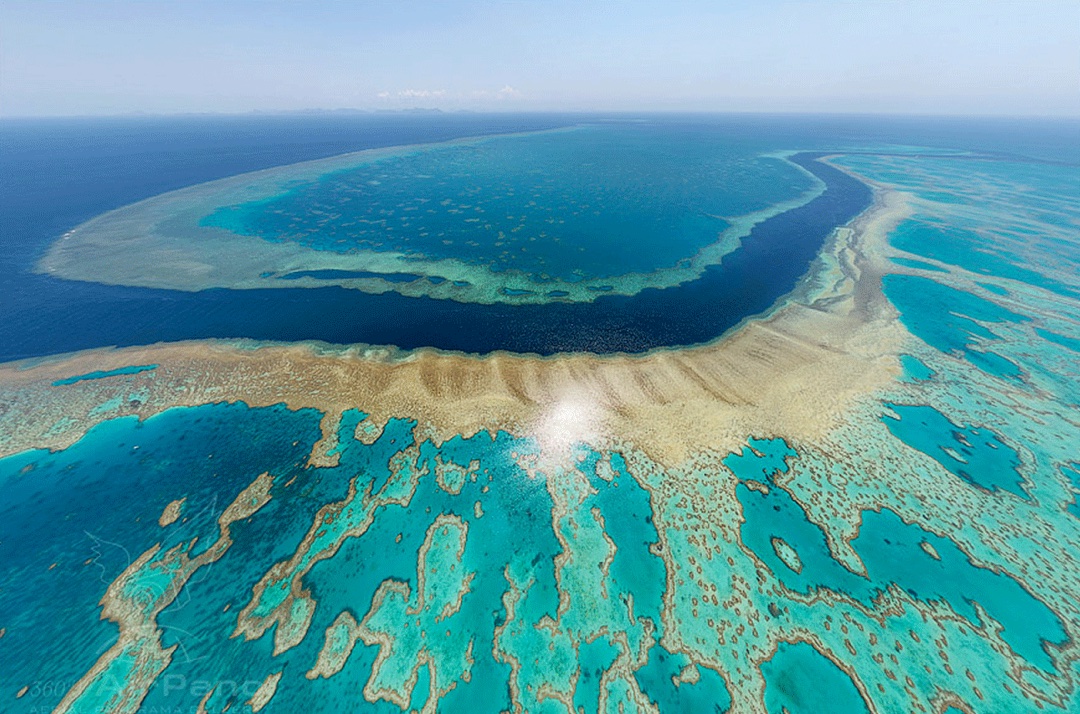
Image above: An aerial photograph of a small portion of the Great Barrier Reef in northeast Australia. From (http://www.businessinsider.com/australias-great-barrier-reef-will-disappear-within-two-decades-with-no-intervention-2014-3) Click to enlarge.

When he was six years old, Dean Miller already knew he wanted to be a marine biologist. At that time, growing up in Australia, the world of marine biology seemed both spectacular and limitless, he says.

"I wanted to study the wonders of the Great Barrier Reef, the intricate and complex connections between the thousands of different life-forms that represent the most diverse ecosystem on the planet," Miller told Truthout.

But in the last two years, this has all changed for him.
 
"I now look at the reef as an ecosystem that is suffering from our actions and I feel guilty beyond belief that this is happening in my backyard, on our generation's watch," he explained. "I no longer dream of the kaleidoscope of life, color and movement that represents the world's coral reefs.

Instead, I worry and fight for the actual existence of coral reefs as we know them, as the changes I see are happening all too quickly -- much quicker than the reef can adapt."

This is because over the last two years, the Great Barrier Reef, which is so dear to Miller and countless others who revel in the beauty and mysteries of the oceans, has been dying off at an unprecedented rate due primarily to warming ocean waters.

Coral bleaching occurs when corals become stressed by warmer-than-normal water, causing them to expel symbiotic algae that live in their tissues, from which they get their energy. Coral turns completely white when it bleaches. If it remains bleached long enough, it dies.

One scientist has already gone so far as to declare the Great Barrier Reef is now in a "terminal stage." Most of those studying the reef agree that what is happening is unprecedented. This is because, at a minimum, two-thirds of the 1,400-mile long reef bleached out last year, which led to 22 percent of it dying. Now another bleaching event has resulted in at least two-thirds of the reef bleached again.

"The bleaching this year has moved much farther south and has taken scientists by surprise in its severity and extent," Miller said. And he fears the state of the reef could be even worse than scientists realize, since only aerial surveys have been conducted to assess the damage and no research vessel is currently active on the reef to provide finer details.

With ocean temperatures rising across the globe as anthropogenic climate disruption (ACD) continues to pick up speed, the Great Barrier Reef, the largest coral ecosystem on Earth, may well be an example of what is happening to all of the coral on the planet.

"This Is New for All of Us"
Marine biologist David Burdick coordinates a NOAA-funded long-term coral reef monitoring program out of the University of Guam Marine Laboratory, and has been conducting field studies of Guam's coral reefs for more than a decade.

"In 2013, we had a moderate to severe bleaching event that came out of nowhere and lasted for three months, and we lost a quarter of the coral that was impacted from the 80 percent of the coral species that bleached," Burdick told Truthout during a recent interview on Guam.

Then, less than seven months later, what he called "an unusual sea-surface temperature spike" caused another moderate to severe bleaching event. "Corals that were already weakened by the 2013 event -- many of them died," he explained. "The event was fairly widespread, and corals that survived the 2013 event did not survive this one."

Fifty percent of the coral that bleached during the 2014 event died.

"Then, while we were still analysing all of our data from that event, we had another large bleaching event in 2016," Burdick said. "So we had three major bleaching events, essentially having one per year, which is a pattern now, apparently."

Prior to these events, they'd never seen anything on Guam that would be classified beyond a "moderate" coral bleaching event.

"This is all new for us," Burdick said.

Miller is equally stunned by what he is seeing along the Great Barrier Reef, which is eerily similar to what Burdick is seeing on Guam.

"Parts of the reef that didn't bleach last year are now under immense pressure, and this is totally different because this is back-to-back bleaching," Miller explained. "The system was already stressed, and this is a new stress event. We are seeing much mortality on reefs in our area…. What didn't die last year is dying this year."

In addition to the new bleaching in this year's event, southern portions of the reef that are typically in cooler waters are now also bleaching out.

"It's heartbreaking to see," Miller added. "Seventy thousand direct tourism-related jobs and a $6 billion tourism industry are all at risk, especially on top of the recent damage from Cyclone Debbie."

study published this March in the journal Nature found that last year's bleaching of the Great Barrier Reef was so severe that there was no similar analog in the thousands of years of ancient coral cores scientists use to study past climates.

Another study published in Nature projected that by the year 2050, more than 98 percent of global coral reefs will be afflicted by "bleaching-level thermal stress" every single year.

However, the prognosis could be even worse: The scientists involved in the study from this March speculated that the era of never-ending global coral bleaching may have already arrived, albeit several decades earlier than was predicted even just last year.

They explained that the Great Barrier Reef needs 10 to 15 years between bleaching events in order to fully recover, and that recovery time period is "no longer realistic."

"We Don't Even Know What We Are Losing"
Laurie Raymundo is a coral ecologist at the University of Guam Marine Lab who has worked closely with Burdick for years.

Similar to Miller, she knew when she was 11 years old that she wanted to study coral. She now teaches at the University of Guam, and is designing a course in coral reef ecology and management that will include ACD impacts. She has lived in Guam since 2004 and is a co-author of the 2016 Paris Climate Agreement.

Like the other scientists Truthout spoke with, Raymundo is deeply troubled by what she is seeing.

If we lose coral reefs, Raymundo warned Truthout, "We will lose all our sensitive species, and we will have lower diversity."

Equally worrying to her is the fact that there is still so much we don't know about the importance of coral reefs.

"We don't even know what we are losing, and we don't understand what a loss of biodiversity fully means, for pharmaceuticals, ecologically, and in so many other ways," she said. "We are losing things before we even actually know, fully, what we are losing."

One crucial function we do know we're losing: While coral reefs only cover 0.0025 percent of the oceanic floor, absorb nearly one-third of the carbon dioxide generated from burning fossil fuels.

report by the UN's Food and Agriculture Organization shows that coral reefs are responsible for producing 17 percent of all globally consumed protein, with that ratio being 70 percent or greater in island and coastal countries like those of Micronesia.

At the time of this writing, Earth has lost nearly half of its coral, and oceanic warming only continues to accelerate.

"We are finding that reefs living under anthropogenic stresses for many years have already lost their more sensitive coral species, and the ones that are there now are already the tough bastards," Raymundo said. "And when reefs have lower diversity, there is less ecological redundancy; hence, they are more likely to collapse."

A Future Without Coral?
2012 study revealed that half of the Great Barrier Reef had already vanished in just the previous 27 years. Two years later, the world's most qualified coral reef experts released a report showing that, without dramatic intervention, the Great Barrier Reef would disappear completely by 2030.

Furthermore, a study published and released by NOAA in 2011 warned that, "unless action is taken now to reduce the threats," 90 percent of all reefs will be "threatened" by 2030, and all of Earth's coral reefs could be completely gone by 2050.

The study, "Reefs at Risk Revisited," listed human-caused climate disruption, warmer water temperatures, ocean acidification, shipping, overfishing, coastal development and agricultural runoff as the contributing factors.

While that might sound extreme, Miller told Truthout he thought the report actually didn't go far enough.

"I think it's too conservative," he explained. "Corals need many years to adjust to the warmer ocean waters, and we don't have that kind of time anymore. The warming we are seeing now is happening far too fast to allow for evolution…. So what we're seeing now is death. That's what bleaching is."
Burdick, who described Guam's reefs as "getting clobbered," agreed.

"Various factors will buy some areas some time, so some coral species might eek out a bit longer, for a while," he said. "But [with] bleaching events every five to 10 years, you won't give coral enough time to come back to where it was. It is all about the rate of change. And right now, that rate is increasing, and rapidly at that."

Back in Australia, Miller is dismayed by the fact that his government is doing very little, if anything, to mitigate the crisis.

Truthout asked Miller what steps the Australian government is taking to save the Great Barrier Reef.
"From what I can tell, virtually nothing," he answered. "They are not focussed on this at all, but rather are pushing for the Adani Coal Mine to go ahead. We here in Australia can hardly believe it, to be honest. In fact, the government has had almost no comment on the bleaching at all."

The coal mine he referred to is looking like it is going to move forward, which will, according to Miller, bring an additional 500 ships carrying coal across the Great Barrier Reef every single year.
Truthout interviewed Miller's colleague, John Rumney, the managing director of Great Barrier Reef Legacy in February, when this year's bleaching event began.

"This coral is in big trouble," Rumney said at the time. Like Miller, Burdick and Raymundo, Rumney warned of the extreme loss of biodiversity that comes with the disappearance of reefs.

"When all that coral goes, all that diversity of fish that depends on it goes," Rumney told Truthout. "The entire food chain is in big trouble."

Miller concurred, saying, "We might see ecosystem collapse as we know it."

The need for independent research on the Great Barrier Reef during this second mass-bleaching event is needed more than ever, according to Miller. His and Rumney's organization is striving to get more scientists out to the reef as quickly as possible.

"The world's greatest natural icon and largest living structure needs our help more than ever, and unless we act as a concerned global population, nothing will be done," he concluded. "It is not too late. The reef is worth saving -- and our actions now will determine the fate of coral reefs in as little as 5 to 10 years. We must act."
.

Zuckerberg retreats some

SUBHEAD: Protesters Plotted "Border Wall" rally For at Zuckerberg's sprawling 100 million north shore Kauai property.

By Tyler Durden on 27 January 2017 for Zero Hedge -
(http://www.zerohedge.com/news/2017-01-27/zuckerberg-retreats-protesters-set-rally-border-wall-surrounding-his-hawaiian-estate)


Image above: During construction of the six foot high "Zuckerberg Zombie Wall" that blocked landscape and ocean view along a long stretch of main road that fronted Mark Zuckerberg's elitist retreat. It is as high as the County regulations permit. From (http://blogqpot.com/images/zuckerberg%20hawaii%20property%20wall).

Back in 2014 Mark Zuckerberg paid $100 million to purchase 700 acres of beachfront property on the North Shore of Kauai. The estate includes 1,000's of feet of pristine shoreline providing the perfect "safe space" for the 30-year-old Silicon Valley Billionaire and his family.

Unfortunately, there was just one little problem with the purchase...technically the sellers didn't own the title to all of that land due to the so-called Kuleana Act, a Hawaiian law established in 1850 that for the first time gave natives the right to own the land that they lived on.

So now, according to the Honolulu Star Advertiser, the Facebook billionaire sued a few hundred Hawaiians who still have legal-ownership claims to parts of his vacation estate through their ancestors. Per Yahoo Finance:
Three holding companies controlled by Zuckerberg filed eight lawsuits in local court on December 30 against families who collectively inherited 14 parcels of land through the Kuleana Act, a Hawaiian law established in 1850 that for the first time gave natives the right to own the land that they lived on.

The 14 parcels total just 8.04 of the 700 acres Zuckerberg owns, but the law gives any direct family member of a parcel's original owner the right to enter the otherwise private compound.
And while Zuckerberg's lawyer attempted to downplay the lawsuits as a common practice in Hawaii, we suspect the idea of defending your private property rights against one of the top 10 richest people in the world is somewhat intimidating and slightly less than "normal."
The quiet-title suits filed are designed to identify all property owners and give them the ability to sell their ownership stakes at auction, according to Keoni Shultz, an attorney representing Zuckerberg.

Because the ownership stakes are passed down and divided among family descendants by the state, many people don't realize they have a claim until action is taken against them in court.

“It is common in Hawaii to have small parcels of land within the boundaries of a larger tract, and for the title to these smaller parcels to have become broken or clouded over time," Shultz told Business Insider in a statement. "In some cases, co-owners may not even be aware of their interests.

Quiet title actions are the standard and prescribed process to identify all potential co-owners, determine ownership, and ensure that, if there are other co-owners, each receives appropriate value for their ownership share.”

Of course, the pompous dismissal of property rights isn't the only thing riling up Hawaiian natives regarding Zuckerberg's estate. As The Garden Island pointed out, residents are also slightly less than ecstatic about a massive, 6 foot rock wall erected around the estate and blocking the "view that’s been available and appreciative by the community here for years."

“The feeling of it is really oppressive. It’s immense,” Hall said. “It’s really sad that somebody would come in, and buy a huge piece of land and the first thing they do is cut off this view that’s been available and appreciative by the community here for years.”

"It’s hot behind that wall. Because it’s up on a berm, there’s not a breath of air on this side from the ocean,” Chantara said. “You take a solid wall that’s 10 or more feet above the road level; the breeze can’t go through.”

Another Kilauea resident, Donna Mcmillen, calls the wall a “monstrosity.”

"I’m super unhappy about that. I know that land belongs to Zuckerberg. Money is no option for him. I’m 5’8” and when I’m walking, I see nothing but wall,” Mcmillen said. “It just doesn’t fit in with the natural beauty that we have here. There are people on the island who money can pay for anything. These kind of things that they do take away what Kauai is all about.”
Over the past couple of weeks, intense public backlash over the lawsuit and "immense, oppressive" wall has caused Zuckerberg to backtrack on his plans. Earlier today he published a note to residents in The Garden Island announcing his intentions to drop his litigation saying that "upon reflection, it's clear we made a mistake."
We've heard from many in the community and learned more about the cultural and historical significance of this land. Over the past week, we've spoken with community leaders and shared that our intention is to achieve an outcome that preserves the environment, respects local traditions, and is fair to those with kuleana lands.

To find a better path forward, we are dropping our quiet title actions and will work together with the community on a new approach. We understand that for native Hawaiians, kuleana are sacred and the quiet title process can be difficult. We want to make this right, talk with the community, and find a better approach.

Upon reflection, I regret that I did not take the time to fully understand the quiet title process and its history before we moved ahead. Now that I understand the issues better, it's clear we made a mistake.

The right path is to sit down and discuss how to best move forward. We will continue to speak with community leaders that represent different groups, including native Hawaiians and environmentalists, to find the best path.

Beyond this process, we are also looking for more ways to support the community as neighbors. We have contributed to community organizations and will continue to do so. We work with wildlife experts to preserve endangered species. We hope to do much more in the future.

We love Kaua`i and we want to be good members of the community for the long term. Thank you for welcoming our family into your community.
But, a local farmer, Joe Hart says that Zuckerberg's retreat isn't sufficient and, as of now, vows that the mass protest planned for tomorrow will move forward as "people are furious down here with him."  Per McClatchey:
“People are furious down here with him,” Hart, a local farmer told Business Insider. “We just want to bring this issue to light. He’s made his money stealing everyone’s information, which we’ve let him do, but to come down here and start suing everyone, that’s not going to fly down here.”
Alas, in the end we're sure Zuckerberg will have his way.  After all, what fun is billions of dollars if you can't buy expansive swaths of entire states and trample on the private property rights of some little people?

See also:
Ea O Ka Aina: Zuckerberg sues Hawaiians 1/19/17


.

Navy says Depleted Uranium okay

SUBHEAD: It says its spent depleted uranium ordinance is not a problem laying in coastal waters.

By Dahr Jamail on 31 October 2016 for Truth Out -
(http://www.truth-out.org/news/item/38185-the-navy-s-use-of-depleted-uranium-in-our-coastal-waters-threatens-humans-wildlife)


Image above: Naval gunners inspect ammunition containing depleted uranium in a photo taken on November 1, 1987. Photo by US Navy. From original article.

Earlier this month, Truthout reported that the US Navy is knowingly introducing toxic metals and chemicals into the environment during its war game exercises.

Sheila Murray with the Navy Region Northwest's public affairs office, when asked what the Navy was doing to mitigate environmental contamination from the large numbers of Depleted Uranium (DU) rounds it left on the seabed off the Pacific Northwest Coast claimed current research "does not suggest short- or long-term effects" from the release of DU to the environment that could result in its uptake by marine organisms."

She also said that DU rounds "are extremely stable in sea water and pose no greater threat than any other metal."

In response to this, Mozhgan Savabieasfahani, an environmental toxicologist and winner of the 2015 Rachel Carson Prize environmental award for her work on DU and heavy metal contamination, told Truthout, "The US Navy representative's views exhibit an alarming level of amnesia."

She said this because Murray's statement has been one that has been recycled by the Navy for years. Reuters reported in January 2003 that the Navy confirmed its use of DU shells in arms tests off the Washington State coast, at which time the Navy claimed, "The DU rounds dissolve so slowly that they would not contribute to naturally occurring (radiation) levels ... and do not pose a significant risk."

Meanwhile, ample scientific reports -- including Savabieasfahani's own research -- demonstrate the deleterious health impacts caused by DU.

"When those bullets and bombs explode, dangerous nanoparticles of metals, including uranium nanoparticles, are released into the environment," she explained to Truthout. "Laboratory research has already established that exposure to environmentally relevant concentrations of uranium has negative impacts on fish embryogenesis, and on the reproductive success of fish."

Naval documents show that as much as 34 tons of DU could be present on the seabed just 12 miles from the outer coast of Washington State.

Even more distressing, the Navy's own documents reveal that the extent of its use of DU off the coast of the US is far more pervasive than it admits to the public.

And results of a Freedom of Information Act filing provided to Truthout show that the Navy, which claims in its environmental impact statements it has not used DU since 2008, has actually shipped it from a Puget Sound munitions area as recently as 2011.

A Bogus Study
The Navy's public affairs officer, Murray, also told Truthout that a "recent study" of an area off the south coast of England that was used for test firing DU rounds "did not show presence of DU in sample of intertidal and ocean bottom sediments, seaweed, mussels, and locally caught lobster and scallops. (Toque, 2006)."

However, the study Murray cites -- and which the Navy consistently cites when arguing that DU is not harmful -- is heavily disputed.

Carol Van Strum, an Oregon-based environmental advocate who has researched DU for years, told Truthout that Murray's statement is "an out-and-out lie."

Van Strum, who has read the Toque study closely and knows it well, pointed out that, for starters, the study's author works for a British military contractor. She went on to point out two very serious flaws in the study.

"While the study relied on 'locally caught' lobster and scallops as samples for testing for depleted uranium, the samples were never 'caught' but rather bought in a local market, and thus could have come from anywhere," Van Strum explained. "Second, and most worrisome ... the actual study reports depleted uranium contamination in nearly all of the samples."

The Navy's Environmental Impact Statement (EIS) on the matter claims "the survey results show no evidence of DU being present in any marine environmental sample collected in the year 2004."

But Van Strum called their claim "incontrovertibly false" because the study itself stated it had found DU contamination in the soil in many areas where the military was operating cannons, in the soil where ordnance had been fired, and in the soil, sea water and marine life where the ordnance they had fired had landed.

"The study's methodology would not pass muster for even a high school science project," Van Strum said.

Karen Sullivan, a retired endangered species biologist who co-founded the website West Coast Action Alliance that acts as a watchdog of Naval activities in the Pacific Northwest, questioned why the Navy would open itself up to accusations of bias by relying on only a single study done by someone who works for a group affiliated with the British military.

"Why would the Navy rely on such a flawed and obviously biased study to 'prove' that DU in seawater poses no threat greater than any other metal?" Sullivan, who worked at the US Fish and Wildlife Service for more than 15 years and who is an expert in the bureaucratic procedures the Navy is supposed to be following, asked in an interview with Truthout. "Probably because the enormous body of properly conducted and unbiased science completely refutes it."

Van Strum went on to point out additional significant problems with the study, including the almost laughable procurement and use of the samples.

"For starters, the entire sampling of marine organisms consisted of a bucket of mussels, 0.9 kg of shelled scallops, and three lobsters," Van Strum explained.

"In a section straight out of Monty Python, named 'Seafood purchase methodology,' the author reports with a straight face that the three lobsters and the scallops were bought in a shop in Kirkcudbright, 'and boiled within a day of purchase'."

Yet even in what was obviously a bogus sample, both uranium and DU were found.

"Not even truly creative data contortions support the [Navy's] 'no evidence of DU' conclusion," Van Strum said.

"For example, all uranium found in the shelled, cooked mussels was attributed by legerdemain [sleight of hand] to bits of uranium-contaminated sediment or shell that 'may have accidentally contaminated' the meat.

And even after the high level of uranium in one of three lobsters was reduced 81 percent -- applying a completely unreferenced and phenomenally high dry/wet weight ratio -- the level was still twice the mean for all of the UK, at which point the author simply concludes that 'such a low concentration is not deemed significant'."

Additionally, a 2007 Naval Budget Proposal, shows a gun being upgraded to fire 25mm DU rounds (see page 32).  According to the proposal, there were over 100 guns of this type for that year. These facts beg the question: How could the Navy possibly be "phasing out" DU, as it claims to be doing?

Human Health Impacts of DU "Quite Relevant" to Naval Exercises
"Navy exercises in the waters of the Pacific Northwest will release contaminants into the marine environment, with an undeniable potential to harm human health," Savabieasfahani said, noting that this would apply even to low-level amounts of DU being introduced into the oceans. "It is long established that explosives can contaminate soil, sediment and water and thereby impact environmental and human health."

She explained that the human and environmental impacts of the Navy's use of DU in past exercises is "quite relevant," and cited a report that showed how DU exposure has been linked to lower cognitive ability in adults.

"This leads us to expect much worse impacts on growing children, newborns and infants -- to say nothing of unborn babies," Savabieasfahani added.

"Furthermore, epidemiological evidence is also consistent with an increased risk of birth defects in the children of people exposed to DU."

She also heavily emphasized the fact that the internalization of uranium in any form will result in both chemical and radiation exposure.

"Once inside a living body, DU and uranium's effects are virtually the same," Savabieasfahani explained. "This is a point worth repeating."

Moreover, Savabieasfahani emphasized that it's dangerous to guesstimate "safe" levels of DU, whether or not it reaches levels determined to be "toxic."

"Our knowledge of the human health impacts of DU is consistent with laboratory studies of other mammals," she said. "DU exposure affects neurogenesis during prenatal and postnatal brain development by disrupting patterns of cell proliferation and cell death. Even sub-toxic levels of DU have been shown to alter brain function."

She also took issue with Murray's argument, which Savabieasfahani described as, essentially, "the solution to pollution is dilution." This is the nuclear industry's default argument about radiation and other forms of pollution, and has been for decades, despite the fact that this logic was "decisively rejected" more than 40 years ago.

Savabieasfahani pointed out that even Richard Nixon's EPA administrator, William Ruckelshaus, rejected the dilution argument in a 1972 Congressional testimony regarding the Clean Water Act.

Savabieasfahani noted that any upcoming Naval exercises that introduce heavy metals and other pollutants, regardless of whether they use DU, will increase the environmental "background burden" of DU and other pollutants.

"Increasing that burden is simply irresponsible," Savabieasfahani said. "Seabed pollutants have already found their way into our bodies. Those pollutants will continue to impact the most vulnerable populations -- infants, newborns and growing children -- most profoundly, and their imprint will be found in the baby teeth of our children."

Other Instances of DU
Problems with DU in the Pacific Northwest are not limited to the Navy.

At Washington's Joint Base Lewis-McChord, as well as the Yakima Training Center, there has not been any cleanup of contaminated areas or disposal of dangerous rounds, despite confirmed reports of contamination in nearby areas. I

t is also worth noting that, while no direct link has been proven, the lung cancer rate for Pierce County, Washington, where Lewis-McChord Base is located, is among the highest in the entire state.

Truthout asked Sullivan to comment on this. She pointed out that rather than cleaning up these areas, the US Army requested a "master permit" from the Nuclear Regulatory Commission (NRC) "to leave in place -- laying on the surface -- all the DU munitions and bombs it has ever fired, since 1960, at nearly 20 bases throughout the United States."

That permit was granted in March. It includes Joint Base Lewis-McChord, where, according to Sullivan, 750 pounds of pure DU are lying on open grounds, in fragments and inhalable dust. This is significant: DU dust tends to blow around and leach into groundwater, contaminating both soil and drinking water.

According to the permit, 12,566 pounds of DU fragments and dust remain, lying out in the open, across military bases throughout the US.

Furthermore, a March 2016 "Safety Report" by the NRC shows that the commission never required the Army to collect and dispose of DU debris. It also noted that the Army asked to not be required to disclose the qualifications of each base's Garrison Radiation Safety Officer (RSO) any time there was a change in personnel, "for privacy and administrative burden reasons."

The NRC agreed to forego that requirement. This means that the NRC will not know the qualifications of each base's RSO unless it specifically asks for it, so it is possible that an RSO may not even be qualified as a radiation safety expert.

All of these factors add up to an extremely disconcerting situation, given that a recent independent study states clearly, "The annual dose limit for the population can be exceeded within a few years from DU deposition for soil inhalation."

Sullivan is concerned that, while the Army takes at least some precautions towards preventing troop exposure, "actual public health is given short shrift."

"For what it's worth, the phrase 'public health' is mentioned only once in the entire Safety Report, in reference to a regulation," Sullivan said. "The phrase 'public dose' is mentioned 10 times."

Lastly, to screen for groundwater contamination, the Army has proposed to sample some wells near its bases. However, the NRC noted, "The Army states that the DU concentration in groundwater coming from soil depends on several factors, which they have not measured for any RCA (Radiation Controlled Area)."

Sullivan expressed grave concern over the fact that the Army has not measured for radiation in these areas.

"Then how would they know?" she asked. "Perhaps it's a way to justify the perennial statement the public has come to expect from so-called 'public processes' that always end in false platitudes like the one the Army delivered: They concluded that groundwater or any other contamination is 'not significant'."

While it remains unclear if DU is still being used by the Navy or Army, what is clear is that they are not sufficiently cleaning up the DU they have already introduced into the environment, nor are they taking steps to mitigate its potential harm to their own soldiers, the general population, and the environment.

• Dahr Jamail, a Truthout staff reporter, is the author of The Will to Resist: Soldiers Who Refuse to Fight in Iraq and Afghanistan (Haymarket Books, 2009), and Beyond the Green Zone: Dispatches From an Unembedded Journalist in Occupied Iraq (Haymarket Books, 2007). Jamail reported from Iraq for more than a year, as well as from Lebanon, Syria, Jordan and Turkey over the last 10 years, and has won the Martha Gellhorn Award for Investigative Journalism, among other awards.
His third book, The Mass Destruction of Iraq: Why It Is Happening, and Who Is Responsible, co-written with William Rivers Pitt, is available now on Amazon.


.

Sea Shepherd patrols Atlantic

SUBHEAD: In partnership with marines from Gabon the Sea Shepherd boarded and commandeered boat with illegal catch. 

By Peter Hammarstedt on 9 August 2016 for Sea Shepherd Global -
(http://www.seashepherdglobal.org/news-and-commentary/news/operation-albacore-results-in-detention-of-spanish-long-liner-in-sao-tome.html)


Image above: A 2006 photo of the Sea Shepherd ship "Bob Barker". From (http://teakdoor.com/world-news/115479-japan-wont-go-awhaling-year-cant-6.html).

On the 6th of August, the Spanish long-line fishing vessel Alemar Primero was boarded in waters belonging to the Central African island state of São Tomé and Príncipe by São Toméan authorities, assisted by Sea Shepherd crew and law enforcement officers from Gabon.

Although the long-liner was licensed to fish for 'tuna and similar species' inspections revealed that their fish holds were filled with sharks, predominately blue sharks that are classified as 'near-threatened' by the IUCN.

Many of the shark's fins had already been detached from their bodies, a suspected violation of the European Union Finning Ban (1185/2003) and its amendment (605/2013), which requires sharks to be landed with their Fins Naturally Attached (FNA).

São Toméan authorities ordered the long-liner to retrieve their fishing gear, release their catch and proceed to São Tomé for investigation. With four marines remaining on board for security, the long-liner was escorted to São Tomé by the Sea Shepherd vessel M/Y Bob Barker.

On the 7th of August, the Alemar Primero arrived in the fishing village of Neves where it will remain, pending investigations, while the M/Y Bob Barker resumes patrols.

Since April 2016, under the name Operation Albacore, Sea Shepherd has been assisting the Government of Gabon to tackle Illegal, Unreported and Unregulated (IUU) fishing by providing the use of the M/Y Bob Barker as a civilian offshore patrol vessel operating in Gabonese waters, under the direction of the Gabonese Government.

In August São Tomé and Príncipe partnered with Operation Albacore, sending two marines and one fisheries observer from São Tomé to join Sea Shepherd crew, Gabonese marines and Gabonese fisheries enforcement officers on board the M/Y Bob Barker, to further detect and deter IUU fishing in the Gulf of Guinea.

Sea Shepherd Global was established in 1977, Sea Shepherd is an international non-profit, marine wildlife conservation organization. Our mission is to end the destruction of habitat and slaughter of wildlife in the world's oceans in order to conserve and protect ecosystems and species.

Sea Shepherd uses innovative direct-action tactics to investigate, document, and take action when necessary to expose and confront illegal activities on the high seas. By safeguarding the biodiversity of our delicately-balanced ocean ecosystems, Sea Shepherd works to ensure their survival for future generations. For more information, visit: (http://www.seashepherdglobal.org)


.

Humpbacks rescue others from orcas

SUBHEAD: These whales rescue other species from hunting killer whale packs.

By Bryan Nelson on 30 July 2016 for Mother Nature Network -
(http://www.mnn.com/earth-matters/animals/stories/humpback-whales-around-globe-are-mysteriously-rescuing-animals-orcas)


Image above: A humpback whale breaches the ocean surface. From (http://www.mnn.com/earth-matters/animals/blogs/weird-new-sound-heard-among-humpback-whales).

Humans might not be the only creatures that care about the welfare of other animals. Scientists are beginning to recognize a pattern in humpback whale behavior around the world, a seemingly intentional effort to rescue animals that are being hunted by killer whales.

Marine ecologist Robert Pitman observed a particularly dramatic example of this behavior back in 2009, while observing a pod of killer whales hunting a Weddell seal trapped on an ice floe off Antarctica.

The orcas were able to successfully knock the seal off the ice, and just as they were closing in for the kill, a magnificent humpback whale suddenly rose up out of the water beneath the seal.

This was no mere accident. In order to better protect the seal, the whale placed it safely on its upturned belly to keep it out of the water.

As the seal slipped down the whale's side, the humpback appeared to use its flippers to carefully help the seal back aboard. Finally, when the coast was clear, the seal was able to safely swim off to another, more secure ice floe.

Another event, involving a pair of humpback whales attempting to save a gray whale calf from a hunting pod of orcas after it had become separated from its mother, was captured by BBC filmmakers. You can watch the dramatic footage here:


Image above: From (https://youtu.be/-lw8_SAtX8o).

Perhaps the most stunning aspect of this behavior is that it's not just a few isolated incidents. Humpback whale rescue teams have been witnessed foiling killer whale hunts from Antarctica to the North Pacific. It's as if humpback whales everywhere are saying to killer whales: pick on someone your own size! It seems to be a global effort; an inherent feature of humpback whale behavior.

After witnessing one of these events himself back in 2009, Pitman was compelled to investigate further. He began collecting accounts of humpback whales interacting with orcas, and found nothing short of 115 documented interactions, reported by 54 different observers between 1951 and 2012. The details of this surprising survey can be found in the journal Marine Mammal Science.

In 89 percent of the recorded incidents, the humpbacks seemed to intervene only as the killer whales began their hunt, or when they were already engaged in a hunt. It seems clear from the data that the humpback whales are choosing to interact with the orcas specifically to interrupt their hunts. Among the animals that have been observed being rescued by humpback whales were California sea lions, ocean sunfish, harbor seals, and gray whales.

So the question is: Why are humpback whales doing this? Since the humpbacks seem to be risking their own well being to save animals of completely different species, it's hard to deny that this behavior seems altruistic.

There is also some reason to believe that the behavior isn't entirely selfless. Mature humpback whales are too large and too formidable to be hunted by orcas themselves, but their calves are vulnerable.

Orcas have been witnessed hunting humpback whale calves in much the same way that they hunt gray whale calves. So, by proactively foiling orca hunts, perhaps the humpbacks are hoping to make them think twice about messing with their own calves.

Then again, maybe it's just as simple as revenge. Even if it has more to do with revenge than altruism, though, the behavior would represent evidence of an intense and complicated emotional life among humpbacks that is unprecedented in the animal world, outside of primates.

One common feature among many humpback whale rescue efforts is that the humpbacks often work in pairs. Scientists will need to do more research into this behavior, though, to truly understand the significance of it.

Until then, these beautiful animals, which are perhaps best known for their majestic songs, have certainly earned some additional respect. They might just be the ocean's most ferocious and selfless first-responders.
.

A houseboat that sails

SUBHEAD: Progress report on the design and engineering of the future home of Dmitry Orlov.

By Dmitry Orlov on 9 July 2016 for Club Orlov -
(http://quidnon.blogspot.com/2016/07/progress-report.html)


Image above: Starboard side elevation of the Quidnon houseboat. From original article.

Much of the design work has been completed over the past few months. The 3D model, drafted in Rhino 3D, is largely complete. Construction techniques, including materials selection, joinery techniques and order of assembly have been largely worked out.

The cockpit design, the deck arches, the tiller linkage, tanks and lockers and many other details have been worked out in detail. We have designed a very strong structure for stepping the mast tabernacles, constructed out of 4x4 hardwood timbers glued and bolted together.

This structure, fastened and glued to the deck, bottom and sides of the hull, will also provide plenty of resistance to torsional loads, side loads when docked and strengthen the foredeck.

We are still working out such minor details as tiller design, hatches, interior cabinetry, wiring and plumbing, and running rigging.

The model has been hydrostatically tested using Orca3D software. (We are very grateful that Orca3D has agreed to sponsor our project, and has donated two seats of their excellent software for our use.) Hydrodynamic tests will have to wait until we build a 1:12 scale model, and conduct towing tests and other types of in-the-water testing.

The good news is: there are no surprises at all. The hydrostatic tests have confirmed the initial calculations: QUIDNON, ballasted as initially designed, is going to be seaworthy and reasonably fast.

Moreover, it will be able to carry considerable freight. Here is a table of draft (with centerboards and rudder blades retracted) vs. load.

LoadDraft
012.9 inches
10 tons25.3 inches
20 tons34.6 inches


Image above: Computer generated perspective of the cockpit of Quidnon. From original article.

At the stern are two 20 lb. propane cylinders in an ABYC-compliant propane locker with an overboard drain, a 100-gallon gasoline tank below it, and a 40 hp outboard engine forward of it in an inboard outboard well.

According to results from Orca3D analysis, fuel consumption and speed will be as expected. As the above chart shows, even when loaded with 20 tons of freight, QUIDNON will do a comfortable 7 knots with a 40hp outboard at half-throttle, burning 2 gallons per hour, for a 350 nm cruising range. Without freight, its cruising range increases to over 600 nm.

It is interesting to note that when QUIDNON isn't loaded, as speed increases from 7 kt, power requirement shoots up. This is because the hull form is a compromise, and at 0 load the transom bogs down faster than when loaded. But this effect will be pronounced mostly when motoring; when sailing the center of force will be further forward, keeping the bow down and presenting a smaller profile to the water.

And so it is safe to conclude that QUIDNON will work very well as a live-aboard boat. You pay for a 36-foot slip and you get around 540 square feet of interior living space, plus just as much space on deck, which is plenty of space for living aboard and for throwing dockside parties. It is fast and economical enough to make a good canal boat, and with a 20-ton cargo capacity it can be used to bring back a year’s worth of harvest from wherever you hunt, gather or grow it back to your winter quarters.


Image above: Computer generated perspective of stern of Quidnon. From original article.

But is it seaworthy?

But, you probably still want to know, Is it seaworthy? To an engineer, this is a fairly annoying question, because there is no technical definition of seaworthiness. And so I will apply my own definition. Seaworthiness is the ability to survive arbitrary conditions at sea. By “arbitrary conditions” I mean something that includes arbitrarily high, almost vertical walls of very angry water, with spindrift blowing from the wave tops at well over 100 miles an hour.

By this standard, few boats are actually seaworthy. We can immediately rule out all catamarans and trimarans: they are more stable floating upside-down than right-side-up, and once a rogue wave flips them over, it’s game over every time.

We can also rule out most yachts, large and small, with tall masts: once the masts hit the water, more often than not they snap off, and, again, it’s game over, every time. So masts have to kept quite stubby. In QUIDNON’s case, the masts measure exactly 36 feet from the mast tabernacle hinges, because they can’t overhang the bow or the transom when the masts are dropped and secured to the deck arches (for canal work, to pass under bridges). And the reason they can’t overhang is because that would increase QUIDNON’s overall length (LOA), incurring increased slip fees at marinas, and we can’t have that.

Secondly, we can rule out all large commercial ships: tankers, cruise ships, dry bulk carriers, container ships, etc. All of them are designed for a maximum wave height, and a big enough wave will capsize them, break them in half, or both. Over a hundred ships are lost every year in just this manner. But “fixing” this problem would be too expensive, and rogue waves are rare enough to keep marine insurers in business.

But we who sail around in small boats do like them to be able to survive almost arbitrary sea conditions. And if you try to design something that is completely seaworthy, by this definition, you end up with a coconut every time. But who wants to sail around in a coconut? (Actually, QUIDNON’s hull shape comes pretty close.)


Image above: Computer generated perspective of bow of Quidnon. From original article.

Hydrostatic analysis shows that QUIDNON is self-righting up to 130º. It is very tender when level, and just walking across the deck is enough to make it list a few degrees. But beyond 10º it puts up a very serious fight. In fact, while sailing, it is probably not possible to make it list more than about 25º, in any sort of useful wind. It continues to put up a very serious fight until about 70º. Thus, any sort of sudden squall will lay it over for a bit, but with no serious consequences (unless you fall overboard, but that's verboten).

At around 90º, it gets ready for Round Two, because at that point the masts are in the water, and they are buoyant because they are filled with foam, weighing in at negative 8.5 lb. per foot of length, with a huge lever arm. Only beyond 130º does QUIDNON develop a propensity to turn turtle and settle.

When inverted, it is only about half as stable as when it is floating right-side-up, and if it lists by more than 50º it will right itself. Thus, if a big enough wave flips it over, leaving it floating at some arbitrary angle, there is only a 27% chance that it will be left floating upside-down.

And if a wave big enough to capsize it comes along, there is about a 50% chance that the following wave will be at least half as big, enough to lean it over by at least 65º, and since 65>50, QUIDNON will then right itself. And so the chance of QUIDNON remaining bottoms-up after a rogue wave event is no more than 15%.

This, I would think, is quite seaworthy—for a houseboat. However, we must keep in mind that it is a houseboat, and even though we can take it out on the Big Wobbly with quite a lot of confidence, we should still remember that we are just moving house, not embarking on an extreme survivalist adventure at sea. And so, we should take certain precautions. These are divided into strategy and tactics.

The strategy is to avoid storms by carefully picking weather windows. For longer passages, on which storms are impossible to avoid completely, the strategy is to carefully pick weather windows for getting away from land, and for making landfall. The idea is to be nowhere near anything at all when bad weather hits. Rocks and shoals kill boats; wind and water—not so much. This is the sort of advice you can get from any number of books.

Another part of the strategy is preparing QUIDNON for bad weather, and it is QUIDNON-specific. QUIDNON can sail just fine with unstayed masts, but when making ready for the open ocean a bit of standing rigging makes a lot of sense.

A triatic line is connected between the mast-tops, and two running stays are connected to each of the mast-tops and tensioned, the two from the foremast running forward, and the two from the mainmast running back. This set-up is traditional; Tom Colvin had lots of luck with this arrangement. Also, obviously, anything that could possibly shift in a capsize should be secured, both above and below deck.

The tactic is simply to ride out the weather, in the usual sequence: heave to, lie ahull, lie to a drogue, scud off under bare poles. Make a pot of stew, batten down the hatches and hunker down. Again, you can get this sort of advice from any number of books. Unless you are particularly unlucky, seriously bad weather generally passes in 2-3 days, and so with QUIDNON drifting at about 1 knot you’ll need about a 100 nautical mile offing from the nearest hard object to drift safely.

Since this is much more seaworthiness than one has any right to expect from a houseboat, and since it comes at very little additional expense (filling the masts with foam and rigging some running stays is pretty cheap) we will consider this aspect of the design handled.


Image above: A Philip C. Bolger designed "Box Boat", the Luna. She was an inspiration for Quidnon. From (http://islandbreath.org/2008Year/09-access_transport/0809-08Sailing_Ships.html).

Excerpt below is from article by Dmitry Orlov from 15 August 2006  about boxboats like his former Hogfish From (http://culturechange.org/cms/index.php?option=com_content&task=view&id=151&Itemid=43).

The Simplest Solution that Works
Since almost all contemporary sailboats are designed for either sport or luxury, we can start with a blank slate, and dispense with most of the preconceived notions of what a sailboat must be like. However, there is an established style of boat that is so close to what we want that there seems to be no reason not to start with it. It is called the square boat, or the Bolger Box, after Phil Bolger, a naval architect from Gloucester, Massachusetts, who is a renowned designer of square boats and other unusual craft.


See also:
Club Orlov: Hogfish for sale 11/13/13
Club Orlov: Boat Bits 10/15/13
Club Orlov: Our Brave Experiment 6/12/12
Club Orlov: Sailing craft for a post-collapse world 6/8/11
Club Orlov: Ocean voyaging for the accident prone 3/7/11
Ea O Ka Aina: A solution to Brexit? - Tall ships 6/26/16
Ea O Ka Aina: Delivering freight by schooner 8/7/15
Ea O Ka Aina: Captain Erikson's Equation 3/29/14
Ea O Ka Aina: Moving local goods by boat 3/7/12
Ea O Ka Aina: Polyneisans again tour the Pacific 8/15/11
Ea O Ka Aina: Clear Sky over Polynesian canoes 7/12/11
Ea O Ka Aina: The Sail Transport Network 6/4/11
Island Breath: Sail Technology Reemerges 12/25/07
Island Breath: THe Polynesian Package 8/24/07
Island Breath: The Future of Ocean Sailing 8/15/06

.

Don't expand Papahanaumokuakea

SOURCE: Lynn McNut (zensea1@gmail.com)
SUBHEAD: Marine conservation is being used to justify a new wave of foreign intervention across the Pacific.

By Peter Apo on 24 June 20016 fir Civil Beat -
(http://www.civilbeat.org/2016/06/peter-apo-obama-should-say-no-to-expanded-marine-monument/)

http://www.islandbreath.org/2016Year/06/160624papabig.jpg
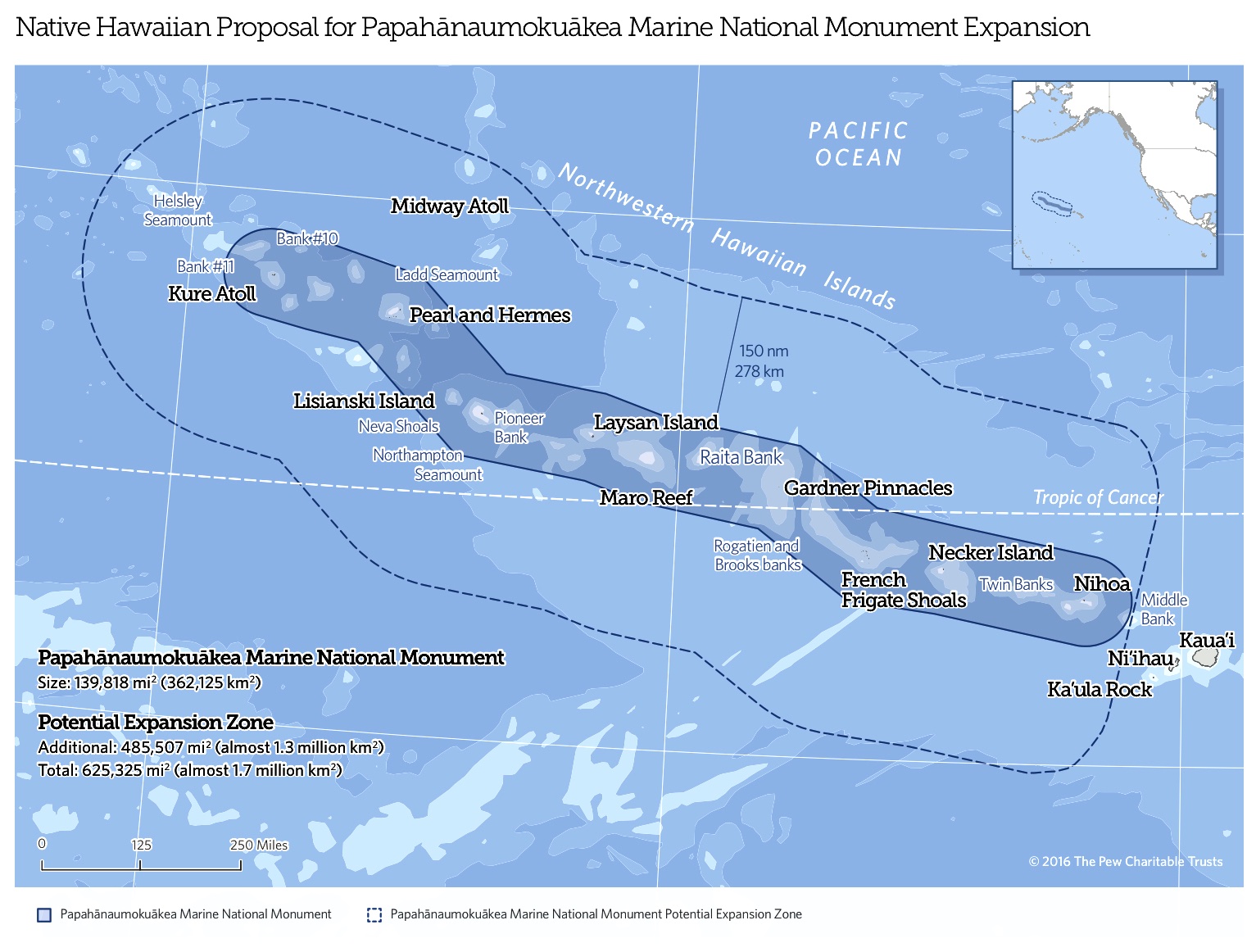
Image above: This map shows the proposed expansion of Papahanaumokuakea Marine National Monument. Click to enlarge. From original article.

President Obama is considering a request to more than quadruple the size of the Papahanaumokuakea Marine National Monument in the Northwestern Hawaiian Islands to 580,000 square miles – an area as large as the states of Texas, California and Montana.

If Obama takes this step, the federal government essentially would assert control over hundreds of thousands of miles of ocean around Hawaii with no public discussion.

According to the Antiquities Act of 1906, the trigger to designate an area as a national monument is simply the president’s signature. No discussion required — not by Congress, not by state government and not by citizens who rely on the targeted geo-cultural area.

What’s The Antiquities Act?
The original intent of the Antiquities Act was to give the president the authority to quickly protect certain Native American archeological sites, structures and artifacts from looting, by declaring an area within designated boundaries to be a national monument. Such a declaration gives the president authority to impose a wide range of federal restrictions on access to the area and its resources.

The act served an important purpose in the 1900s. But since then, a whole body of congressionally generated laws has evolved to protect and manage such areas and objects. These newer laws render the act antiquated when it is applied in some situations.

The historical record suggests that, over the years, the Antiquities Act and national monument designations have been abused by presidents from both parties to place arbitrary restrictions on land use, reduce economic opportunity and strictly limit access to such designated areas – all without input from Congress, the impacted states or the affected citizens.

I would note the difference between national monuments and national parks is that the latter require congressional approval.

I also note that while the act directs the president to limit the designation to the “smallest area compatible with proper care and management of what is to be protected,” presidents have used their own discretion in determining the size and levels of protection.

A subject that warrants mention here but requires more inquiry is how the Antiquities Act, seemingly intended for presidential proclamations of
land-based national monument status, somehow got transferred to the ocean environment.

The Big Picture
The push to expand the Papahanaumokuakea Marine National Monument is part of a larger global strategy to bring millions of square miles of the world’s oceans under a common umbrella of environmental protective governance that would designate vast expanses as marine sanctuaries, monuments or conservation areas.

The intent of such a sweeping global objective seems noble, given global warming and the degradation of the ocean environment. No doubt we need to manage our ocean resources better. But the zealousness with 
which a loose global coalition of ultra-conservative scientists and marine environmentalists are pushing to create new marine conservation areas is imposing draconian restrictions on human access to vast expanses of the ocean.

These restrictions work by installing a gatekeeper permit application process subject to a blanket of government regulations, some of which don’t make sense.

For instance, in Hawaii’s Papahanaumokuakea National Marine Monument, Native;Hawaiians can practice subsistence fishing. So Hawaiians, with a conditional permit, can access the area and fish – but they have to eat the fish before leaving the zone to go home.

To this writer, clearly the analysis of the ultra-conservative wing of marine conservation scientists and environmentalists is: The less human access, the better;.

The Long Shadow Of Uncle Sam
The federal government already controls access to 850 square miles of Hawaii’s lands and is the second largest land owner in Hawaii. The inventory of lands under federal control, either by lease or title, includes some of the most important historic, cultural and strategically positioned lands, inland waterways and coastal waters in the state.

The list includes Pearl Harbor, Hickam Field, Bellows Air Force Station, Kaneohe Marine base, Pohakuloa Training Area, upper reaches of Waimea Valley, Pililaau Army Recreation Center, Lualualei Naval ammunition depot, Fort Shafter, Tripler Army Medical Center, Camp H.M. Smith, Wheeler Army Airfield, Makua Valley, Volcanoes National Park, Haleakala National Park and a number of other less high-profile locations. [IB Publisher's note: Not to mention the nearly 2,000 acres of thevPacific Missile Range Facility on the Mana Plain of Kauai and in hundreds of square miles of adjacent ocean].

To this writer, as onerous as the degree of federal control over Hawaii lands might be, it pales compared to the tightening of the federal grip on hundreds of thousands of square miles of Hawaii’s Northwestern seas being put on the table by the request to expand the current boundaries of Papahanaumokuakea.

I can’t help but suspect that, somewhere in the motive for federal control over ingress to and egress from hundreds of thousands of square miles of the Hawaiian archipelago, there has to be some inkling of a military objective in the name of conservation.

So as not to be misunderstood, I believe the federal presence in Hawaii and the national security role the state plays in the U.S. presence in the Pacific Asian region is important. And if the extension of federal control over new expanses of Hawaii is warranted, I ask that those proposing and supporting an extension of federal authority do so with transparency and with all the cards on the table.

I can’t repeat the theme of transparency enough. There must be a legitimate and formal opportunity for the state and the citizens of Hawaii and all the stakeholders to weigh in. It would help a lot if the leaders of our state and our congressional delegation would talk to us.

The Colonial Effect
One of the disturbing aspects of the “global” strategy of proliferating these marine reserves-monuments-sanctuaries is that, so far, it looks like the Pacific has been heavily targeted.

When I look at a map of the locations of these marine protected areas, there are already three designated national monuments: in the Marianas, the Pacific Remote Islands and Hawaii. There are marine reserves in New Caledonia and Palau.

Moving forward, there are five more locations in various stages of being established in French Polynesia, Pitcairn Islands, Easter Island, Kermode Ocean and a second marine reserve proposed for New Caledonia.

Some people will say it’s a stretch for me to conclude that all of these Pacific Island proposals are triggered by third parties who come from faraway places. But I have good reason to say that, because foreign intervention has been the Pacific Island experience ever since the first Europeans crossed into the Pacific and stumbled on to the Mariana Islands.

When I gaze at the spread of existing and proposed marine reserves, monuments and sanctuaries that span the Pacific Ocean, I can’t help but view it as a clandestine new wave of colonization of the Pacific Islands flying the flag of marine conservation.

Papahanaumokuakea Marine National Monument
The existing Papahanaumokuakea Marine National Monument was established by President George W. Bush in June 2006 under the Antiquities Act.

The rumored back story to Bush’s surprise designation of the Northwestern Hawaiian Islands for national monument status, late in his last term, was that he was motivated by the opportunity, as with all presidents, to establish a presidential legacy of marine environmental and conservation achievement.

The monument’s purpose, oversimplified here, is to perpetuate the ecological integrity and ecosystems of the areas within the monument’s boundaries by largely federalizing its governance.

The trustees of the monument are the U.S. Department of Commerce, U.S. Department of Interior, and the State of Hawaii.

Obama And The Ticking Clock
Fast forward to January 2016. President Obama is asked in a letter signed by several prominent Native Hawaiian leaders to consider expanding the Papahanaumokuakea Marine National Monument.

Monument status would increase federal oversight over the Northwestern Hawaiian Islands by quadrupling the size of the existing area to 580,000 square miles.

Talk in the street is that President Obama already was considering the proposal, but that it was given important momentum when prominent Native Hawaiian leaders sent him their letter.

I have to believe he is seriously considering the proposal, perhaps taking a page from President Bush and his shortcut to a presidential legacy.

It occurs to me that a clock is ticking for the president and supporters of the expanded monument because, in September of this year, Hawaii is hosting the prestigious IUCN World Conservation Congress. The conservation congress meets every four years and brings together several thousand government and civic leaders from all over the world.

The 2016 IUCN congress would be the perfect global opportunity to roll out this dramatic proposal of placing hundreds of thousands of square miles of Hawaii’s seas into a conservation bank, making it the largest marine national monument in the world. That gives the president two months to complete the authorization process.

The two-month time frame does not bode well for public discussion. I hope I am wrong about the president’s intent and the ticking clock.

The Public’s Need To Know
Regardless of intent behind the proposed monument expansion, the people of Hawaii should be concerned that, with only the president’s signature and without public discussion, federal control over access to Hawaii’s oceans will expand by 75 percent.

The exercise of such presidential authority in the absence of a full public vetting would seem disrespectful of Hawaii’s people, unless there is an inclusive public discussion period. That period should include statewide public hearings.


Hawaii is an archipelago of islands that rise from a submerged mountain range stretching for 1,300 miles from Kure Atoll to Hawaii Island.  That’s the distance from Seattle to Baja California.

Drawing a line around the entire archipelago creating the outward boundary of the state would make Hawaii the largest state in the union except for Alaska.

The essence of Hawaii’s global identity – as the most famous set of islands in the world – and its history, culture, politics and economy are tied to the ocean. So any major changes in governmental jurisdiction over the Hawaiian Islands and its surrounding seas begs heavy doses of caution and rational thinking.

Stay Tuned
My next column will delve into the consequences for Hawaii of an expanded monument.

The impact on Hawaii’s fishing is a huge flash point. Other very important issues include military objectives, the international law of the sea and archipelagic claims, Native Hawaiian rights, federal laws and oversight already in place providing protection without expansion, impacts relating to submerged lands and native Hawaiian self-determination, restrictive access permitting system and more.


.