Showing posts with label Health. Show all posts

World after the COVID-19 Pandemic

SUBHEAD: The pandemic will changes the world. Here are the thoughts of several global thinkers.

By contributors to Foreign Policy Magazine on 20 March 2020 -
(https://foreignpolicy.com/2020/03/20/world-order-after-coroanvirus-pandemic/)


Image above: Illustration of fight against 2019 Novel Coronavirus pandemic. From original article.

Like the fall of the Berlin Wall or the collapse of Lehman Brothers, the coronavirus pandemic is a world-shattering event whose far-ranging consequences we can only begin to imagine today.

This much is certain: Just as this disease has shattered lives, disrupted markets and exposed the competence (or lack thereof) of governments, it will lead to permanent shifts in political and economic power in ways that will become apparent only later.

To help us make sense of the ground shifting beneath our feet as this crisis unfolds, Foreign Policy asked 12 leading thinkers from around the world to weigh in with their predictions for the global order after the pandemic.


A World Less Open, Prosperous, and Free

By Stephen M. Walt

The pandemic will strengthen the state and reinforce nationalism. Governments of all types will adopt emergency measures to manage the crisis, and many will be loath to relinquish these new powers when the crisis is over.

COVID-19 will also accelerate the shift in power and influence from West to East. South Korea and Singapore have responded best, and China has reacted well after its early mistakes. The response in Europe and America has been slow and haphazard by comparison, further tarnishing the aura of the Western “brand.”

What won’t change is the fundamentally conflictive nature of world politics.

Previous plagues—including the influenza epidemic of 1918-1919—did not end great-power rivalry nor usher in a new era of global cooperation. Neither will COVID-19. We will see a further retreat from hyperglobalization, as citizens look to national governments to protect them and as states and firms seek to reduce future vulnerabilities.

In short, COVID-19 will create a world that is less open, less prosperous, and less free. It did not have to be this way, but the combination of a deadly virus, inadequate planning, and incompetent leadership has placed humanity on a new and worrisome path.


The End of Globalization as We Know It

By Robin Niblett

The coronavirus pandemic could be the straw that breaks the camel’s back of economic globalization.

China’s growing economic and military power had already provoked a bipartisan determination in the United States to decouple China from U.S.-sourced high technology and intellectual property and try to force allies to follow suit.

Increasing public and political pressure to meet carbon emissions reduction targets had already called into question many companies’ reliance on long-distance supply chains. Now, COVID-19 is forcing governments, companies, and societies to strengthen their capacity to cope with extended periods of economic self-isolation.

It seems highly unlikely in this context that the world will return to the idea of mutually beneficial globalization that defined the early 21st century. And without the incentive to protect the shared gains from global economic integration, the architecture of global economic governance established in the 20th century will quickly atrophy.

It will then take enormous self-discipline for political leaders to sustain international cooperation and not retreat into overt geopolitical competition.

Proving to their citizens that they can manage the COVID-19 crisis will buy leaders some political capital. But those who fail will find it hard to resist the temptation to blame others for their failure.


A More China-Centric Globalization

By Kishore Mahbubani

The COVID-19 pandemic will not fundamentally alter global economic directions. It will only accelerate a change that had already begun: a move away from U.S.-centric globalization to a more China-centric globalization.

Why will this trend continue? The American population has lost faith in globalization and international trade. Free trade agreements are toxic, with or without U.S. President Donald Trump. By contrast, China has not lost faith.

Why not?

There are deeper historical reasons. Chinese leaders now know well that China’s century of humiliation from 1842 to 1949 was a result of its own complacency and a futile effort by its leaders to cut it off from the world. By contrast, the past few decades of economic resurgence were a result of global engagement.

The Chinese people have also experienced an explosion of cultural confidence. They believe they can compete anywhere.

Consequently, as I document in my new book, Has China Won?, the United States has two choices. If its primary goal is to maintain global primacy, it will have to engage in a zero-sum geopolitical contest, politically and economically, with China.

However, if the goal of the United States is to improve the well-being of the American people—whose social condition has deteriorated—it should cooperate with China. Wiser counsel would suggest that cooperation would be the better choice. However, given the toxic U.S. political environment toward China, wiser counsel may not prevail.


Democracies Will Come out of Their Shell

By G. John Ikenberry

In the short term, the crisis will give fuel to all the various camps in the Western grand strategy debate. The nationalists and anti-globalists, the China hawks, and even the liberal internationalists will all see new evidence for the urgency of their views.

Given the economic damage and social collapse that is unfolding, it is hard to see anything other than a reinforcement of the movement toward nationalism, great-power rivalry, strategic decoupling, and the like.

But just like in the 1930s and ’40s, there might also be a slower-evolving countercurrent, a sort of hardheaded internationalism similar to the one that Franklin D. Roosevelt and a few other statesmen began to articulate before and during the war. The 1930s collapse of the world economy showed how connected modern societies were and how vulnerable they were to what FDR called contagion.

The United States was less threatened by other great powers than by the deep forces—and Dr. Jekyll and Mr. Hyde character—of modernity. What FDR and other internationalists conjured was a postwar order that would rebuild an open system with new forms of protection and capacities to manage interdependence.

The United States couldn’t simply hide within its borders, but to operate in an open postwar order required the building of a global infrastructure of multilateral cooperation.

So the United States and other Western democracies might travel through this same sequence of reactions driven by a cascading sense of vulnerability; the response might be more nationalist at first, but over the longer term, the democracies will come out of their shells to find a new type of pragmatic and protective internationalism.


Lower Profits, but More Stability

By Shannon K. O’Neil

COVID-19 is undermining the basic tenets of global manufacturing. Companies will now rethink and shrink the multistep, multicountry supply chains that dominate production today.

Global supply chains were already coming under fire—economically, due to rising Chinese labor costs, U.S. President Donald Trump’s trade war, and advances in robotics, automation, and 3D printing, as well as politically, due to real and perceived job losses, especially in mature economies.

COVID-19 has now broken many of these links: Factory closings in afflicted areas have left other manufacturers—as well as hospitals, pharmacies, supermarkets, and retail stores—bereft of inventories and products.

On the other side of the pandemic, more companies will demand to know more about where their supplies come from and will trade off efficiency for redundancy. Governments will intervene as well, forcing what they consider strategic industries to have domestic backup plans and reserves. Profitability will fall, but supply stability should rise.


This Pandemic Can Serve a Useful Purpose

By Shivshankar Menon

It is early days yet, but three things seem apparent. First, the coronavirus pandemic will change our politics, both within states and between them. It is to the power of government that societies—even libertarians—have turned.

Government’s relative success in overcoming the pandemic and its economic effects will exacerbate or diminish security issues and the recent polarization within societies

Either way, government is back. Experience so far shows that authoritarians or populists are no better at handling the pandemic. Indeed, the countries that responded early and successfully, such as Korea and Taiwan, have been democracies—not those run by populist or authoritarian leaders.

Secondly, this is not yet the end of an interconnected world. The pandemic itself is proof of our interdependence.

But in all polities, there is already a turning inward, a search for autonomy and control of one’s own fate. We are headed for a poorer, meaner, and smaller world.

Finally, there are signs of hope and good sense. India took the initiative to convene a video conference of all South Asian leaders to craft a common regional response to the threat. If the pandemic shocks us into recognizing our real interest in cooperating multilaterally on the big global issues facing us, it will have served a useful purpose.


American Power Will Need a New Strategy

By Joseph S. Nye, Jr.

In 2017, U.S. President Donald Trump announced a new national security strategy that focuses on great-power competition. COVID-19 shows this strategy to be inadequate. Even if the United States prevails as a great power, it cannot protect its security by acting alone.

As Richard Danzig summarized the problem in 2018: “Twenty-first century technologies are global not just in their distribution, but also in their consequences.

Pathogens, AI systems, computer viruses, and radiation that others may accidentally release could become as much our problem as theirs. Agreed reporting systems, shared controls, common contingency plans, norms, and treaties must be pursued as means of moderating our numerous mutual risks.”

On transnational threats like COVID-19 and climate change, it is not enough to think of American power over other nations. The key to success is also learning the importance of power with others. Every country puts its national interest first; the important question is how broadly or narrowly this interest is defined. COVID-19 shows we are failing to adjust our strategy to this new world.


The History of COVID-19 Will Be Written by the Victors

By John Allen

As it has always been, history will be written by the “victors” of the COVID-19 crisis. Every nation, and increasingly every individual, is experiencing the societal strain of this disease in new and powerful ways.

Inevitably, those nations that persevere—both by virtue of their unique political and economic systems, as well as from a public health perspective—will claim success over those who experience a different, more devastating outcome.

To some, this will appear as a great and definitive triumph for democracy, multilateralism, and universal health care. To others, it will showcase the clear “benefits” of decisive, authoritarian rule.

Either way, this crisis will reshuffle the international power structure in ways we can only begin to imagine. COVID-19 will continue to depress economic activity and increase tension between countries.

Over the long term, the pandemic will likely significantly reduce the productive capacity of the global economy, especially if businesses close and individuals detach from the labor force. This risk of dislocation is especially great for developing nations and others with a large share of economically vulnerable workers.

The international system will, in turn, come under great pressure, resulting in instability and widespread conflict within and across countries.


A Dramatic New Stage in Global Capitalism

By Laurie Garrett

The fundamental shock to the world’s financial and economic system is the recognition that global supply chains and distribution networks are deeply vulnerable to disruption. The coronavirus pandemic will therefore not only have long-lasting economic effects, but lead to a more fundamental change.

Globalization allowed companies to farm out manufacturing all over the world and deliver their products to markets on a just-in-time basis, bypassing the costs of warehousing. Inventories that sat on shelves for more than a few days were considered market failures

Supply had to be sourced and shipped on a carefully orchestrated, global level. COVID-19 has proven that pathogens can not only infect people but poison the entire just-in-time system.

Given the scale of financial market losses the world has experienced since February, companies are likely to come out of this pandemic decidedly gun-shy about the just-in-time model and about globally dispersed production.

The result could be a dramatic new stage in global capitalism, in which supply chains are brought closer to home and filled with redundancies to protect against future disruption. That may cut into companies’ near-term profits but render the entire system more resilient.


More Failed States

By Richard N. Haass

Permanent is not a word I am fond of, as little or nothing is, but I would think the coronavirus crisis will ​at least for a few years lead most governments ​to turn inward, focusing on what takes place within their borders rather than ​on what happens beyond them.

I anticipate greater moves toward selective self-sufficiency (and, as a result, decoupling) given supply chain vulnerability; even greater opposition to large-scale immigration; and a reduced ​willingness or commitment to tackle regional or global problems (including climate change) given the perceived need to dedicate resources to rebuild at home and deal with economic consequences of the crisis​.
I would expect many countries will have difficulty recovering from the crisis, with state weakness and failed states becoming an even more prevalent feature of the world. The crisis will likely contribute to the ongoing deterioration of Sino-American relations and the weakening of European integration.

On the positive side, we should see some modest strengthening of global public health governance. But overall, a crisis rooted in globalization will weaken rather than add to the world’s willingness and ability to deal with it.


The United States Has Failed the Leadership Test

By Kori Schake


The United States will no longer be seen as an international leader because of its government’s narrow self-interest and bungling incompetence.

The global effects of this pandemic could have been greatly attenuated by having international organizations provide more and earlier information, which would have given governments time to prepare and direct resources to where they’re most needed.

This is something the United States could have organized, showing that while it is self-interested, it is not solely self-interested. Washington has failed the leadership test, and the world is worse off for it.


In Every Country, We See the Power of the Human Spirit

By Nicholas Burns

The COVID-19 pandemic is the greatest global crisis of this century. Its depth and scale are enormous. The public health crisis threatens each of the 7.8 billion people on Earth. The financial and economic crisis could exceed in its impact the Great Recession of 2008-2009.

Each crisis alone could provide a seismic shock that permanently changes the international system and balance of power as we know it.

To date, international collaboration has been woefully insufficient. If the United States and China, the world’s most powerful countries, cannot put aside their war of words over which of them is responsible for the crisis and lead more effectively, both countries’ credibility may be significantly diminished.

If the European Union cannot provide more targeted assistance to its 500 million citizens, national governments might take back more power from Brussels in the future. In the United States, what is most at stake is the ability of the federal government to provide effective measures to stem the crisis.

In every country, however, there are many examples of the power of the human spirit—of doctors, nurses, political leaders, and ordinary citizens demonstrating resilience, effectiveness, and leadership. That provides hope that men and women around the world can prevail in response to this extraordinary challenge.

Going Down with Books

SUBHEAD: It is getting clearer as to how the complex and poisonous system we are riding will fail. 

By Juan Wilson on 4 March 2020 for Island Breath -
(https://islandbreath.blogspot.com/2020/03/going-down-with-books.html)


Image above: View from a full wall home library. It's a start. From (https://images.app.goo.gl/634TXyX3moM2Fcvt5).

Don't count on a last minute reprieve, a bailout, or escape from our current condition. The impending failure of the system we depend on is an on-going process has been accelerated now by a worldwide virus pandemic.

We have become blind to our total dependence on "The System" (or "The Grid") that we see no alternative reality.

As we have discovered the "System" requires massive inputs of resources ans energy and, as a result, huge outputs of waste and pollution.  It also requires that we have no scalable substitutions or alternatives to this dependency but turning to total collapse.

There is simply too many of us and too much our stuff and too little of everything else. Kicking and screaming we will be dragged to the consequences.

How blind are we? Is the best we can come up with for our next president is a contest between Trump and Biden?

These are two fossils who either have no clue of the existential challenge we face or are counting on fleeing with the billionaires to the Alps or some inaccessible tropical island.

Three elements of the perfect storm we are sailing into are:
  • Loss of individual, family, or group knowledge of fending for one's own. 
  • Uncontrolled debt inflation to finance industrialization and economic growth.
  • Ravaging of the Earth for settlements, agland, resources, and places to toss garbage.
For the few who get through the breakdown of the delicate networks of interdependent systems providing us shelter, food, water, and energy it will be best you acquire skills in self-maintained off-grid living.

That would include skills growing food and procuring potable water; experience with building and maintaining the home; knowledge of medical care; and an idea of the principals of general science.

At some point in the not so distant future your iPhone will be about useful as a drink coaster for acquiring and storing these, instructions, and techniques in independent living.

Yes, fifty years ago young people were seriously considering getting "Off the Grid" and taking actions to get back to "The Land" and be self-sustainable. The mantra was from our guru Timothy Leary was "Tune In, Turn On and Drop Out!"

They almost made it but traded bluejeans for polyester bell-bottoms and LSD for cocaine.

It's a good idea to keep acid free paper books on the principals of all of these subjects.

Half a century ago this kind of information was widely published and identified in "The Whole Earth Catalog" and can still be found in  "Back to the Land" books and other publications from the Hippy-Trippy1970's.

Fortunately, not all has been forgotten of the knowledge of the earlier Urban Hippie diaspora.
This survival knowledge can still be obtained from bookstores and online.

Having a printed book library of basic techniques is a crucial resource, just as much as a toolshed of wood working, metal working and garden implements.

Vital information can be found in publications like the US Army Survival Field Manuals and tomes with specifics on the knowledge  required for basic survival, and sustained living independently of the sprawl of suburbia, office parks,  malls, hospitals and supermarkets.

Many libraries offers free older hardcover books of fiction and non fiction as they are rotated off their shelves. Many libraries are still getting rid of entire sets of hardcover encyclopedias.

I recommend that you start building a library of crucial information and reference books... but also collect classic reading material for entertainment. Much is available and there won't be any Netflix, Hulu or Amazon Prime.

Author's note:
One little book (3"x 5" x 3/4")  I would suggest everyone own is "Pocket Ref" by Thomas J. Glover by Sequoia Press. My version is the Third Edition (ISBN 978-1-885071-33-0). It is an encyclopedia of information showing everything from illustrations of a wide variety of rope knots and bends to a listing of all the phone area code numbers by state in North America to the friction loss in pipes of various materials, to the square, cubes, square roots, and cube root of all numbers from 1 to 1,000 to five place accuracy... plus much, much more. You'll be amazed what's in this tiny gem. I got mine at my local Ace Hardware Store.

.

Bayer Battered

SUBHEAD: After buying Monsanto Bayer suffers major blow losing second RoundUp cancer trial.

By Tyler Durden on 20 March 2019 for Zero Hedge -
(https://www.zerohedge.com/news/2019-03-20/bayer-battered-after-suffering-major-blow-second-roundup-cancer-trial-loss)


Image above: Plaintiff DeWayne Johnson looks on at the start of the Monsanto trial in San Francisco, California on July, 09, 2018. From (https://www.sfgate.com/nation/article/Does-Roundup-cause-cancer-Patient-s-case-13061244.php).

Bayer AG shares are down over 12% in European trading - the biggest drop since 2003 - after a U.S. jury found the RoundUp weed killer was a substantial factor in a California man's cancer. This is the second case that has gone against manufacturer Monsanto, acquired by Bayer last year.

On Tuesday, a federal court jury in San Francisco ruled unanimously for plaintiff DeWayne Johnson,  in a lawsuit against Monsanto. Attorneys say the trial, which will determine in a second phase whether the company is liable and if so, for how much, could help determine the fate of hundreds of similar lawsuits.

The plaintiff's attorneys said he developed non-Hodgkin lymphoma after 26 years of regularly using Roundup to tackle weeds and poison oak, according to the Wall Street Journal. The active ingredient in Roundup and Ranger Pro is glyphosate, a herbicide.

Hardeman’s case is considered a “bellwether” trial for hundreds of other plaintiffs in the US with similar claims, which means the verdict could affect future litigation and other cancer patients and families. Monsanto, now owned by the German pharmaceutical company Bayer, is facing more than 9,000 similar lawsuits across the US.

The decision strikes another blow to the German pharmaceuticals group. In August, a jury ordered its Monsanto unit to pay $289 millionafter determining it failed to warn customers of the potential cancer risks of two of its weedkillers, Roundup and Ranger Pro. The verdict was cut to $78.5 million on appeal.

Analysts are broadly negative on the news, BUT appear to be buyers of any dip... and today's a big dip.
News is a “major blow,” according to Baader (buy, PT EU123), which says Bayer shares might move towards EU60 in the short-term. If stock falls toward 2018 lows, probability of Bayer becoming a target for activists or a takeover will increase.
Morgan Stanley (overweight, PT EU82) says there was “budding enthusiasm” among investors for either a potential “surprise” verdict in favor, or a hung jury, given multiple days elapsing during deliberations.
Overhang on Bayer shares “could be significant” as outcome was considered by some investors to be a potential bellwether for ~765 outstanding glyphosate cases, Goldman Sachs analyst Keyur Parekh (buy, PT EU78) writes.
Citi says “steady heads required” as >EU20b of litigation risk is already priced into the shares. Says legal checks instruct bank to be more focused on the upcoming Hall vs Monsanto trial being held in St Louis from April 1. St Louis result will better determine whether the estimate of a potential settlement liability of $1-6b needs to be refined.
Any extreme weakness is an opportunity to buy, according to Bernstein (outperform, PT EU86) as an ultimate liability well above the $5b is already “baked-in
Monsanto says studies have established that Roundup's active ingredient, glyphosate, is safe. It has appealed a separate U.S. court decision last year in favor of a man who used Roundup.
"We are disappointed with the jury's initial decision, but we continue to believe firmly that the science confirms that glyphosate-based herbicides do not cause cancer," Bayer said in a press release.
"Bayer stands behind these products and will vigorously defend them."


.

RoundUp and honey bee decline

SUBHEAD: Millions of bees mysteriously disappeared, leaving farms with fewer pollinators for crops.

By Tyler Durden on 26 September 3018 for Zero Hedge -
(https://www.zerohedge.com/news/2018-09-25/weed-killer-linked-colony-collapse-disorder-honey-bees)

http://www.islandbreath.org/2018Year/09/180927roundupbig.jpg
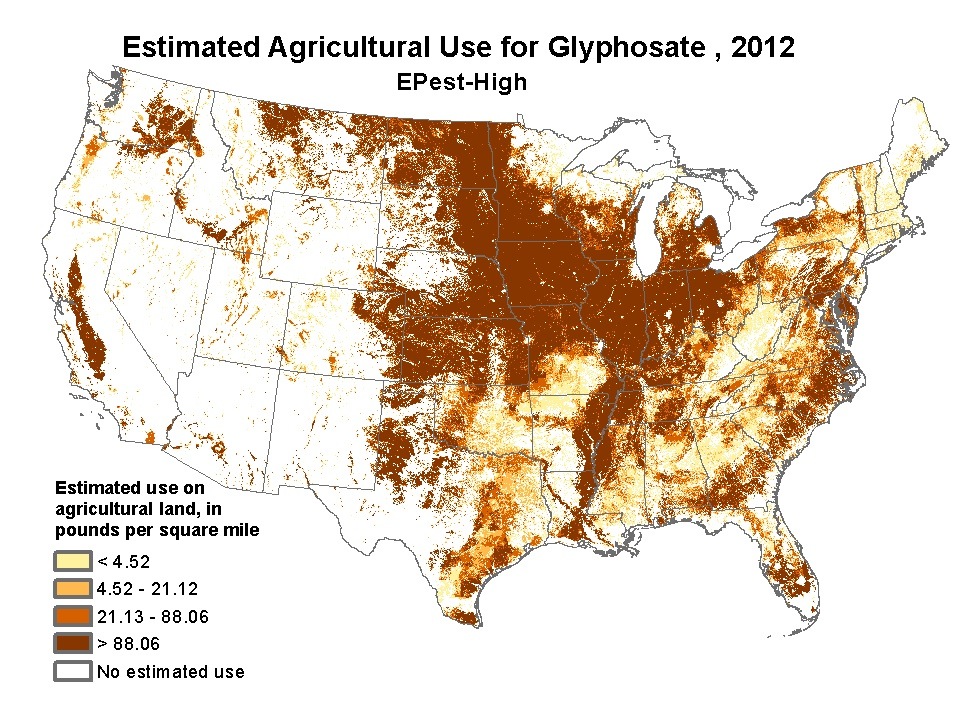
Image above: United State Geological Survey map of the continental states showing extent and intensity of the use of glyphsoates applied to cropland in 2012. Click to enlarge.  From (https://water.usgs.gov/nawqa/pnsp/usage/maps/show_map.php?year=2012&map=GLYPHOSATE&hilo=L).

Glyphosate, the world's most common weed killer, has caused significant concerns over its potential risk to human health, animals, and the environment for several decades. Earlier this month, a US court awarded a groundskeeper $289 million who claimed Bayer AG unit Monsanto's glyphosate-based weed-killers, including Roundup, gave him terminal cancer.

Now, a new report from PNAS alleges that glyphosate may be indirectly killing honey bees around the world, a threat that could potentially also leave a major mark on the global economy.
“We need better guidelines for glyphosate use, especially regarding bee exposure, because right now the guidelines assume bees are not harmed by the herbicide.
Our study shows that’s not true.” said Erick Motta, the graduate student who led the research, along with professor Nancy Moran.
UT News of The University of Texas at Austin says that glyphosate interferes with an important enzyme found in plants and microorganisms, but not in animals, it has long been assumed to be nontoxic to animals, including humans and bees.

However, the latest study reveals that by altering a bee’s gut microbiome — the ecosystem of bacteria living in the bee’s digestive tract, including those that protect it from harmful bacteria — glyphosate jeopardizes its ability to fight infection.

For this study, scientists exposed honeybees to glyphosate at normal levels found on farms. The researchers painted the bees' backs with colored dots so they could be tracked and later recaptured.

Three days later, they saw that the honeybees exposed to glyphosate suffered a significant loss of bacteria in their guts and were more susceptible to infection and death from harmful bacteria.
“Studies in humans, bees and other animals have shown that the gut microbiome is a stable community that resists infection by opportunistic invaders,” Moran said. “So if you disrupt the normal, stable community, you are more susceptible to this invasion of pathogens.”
In recent times, US beekeepers have reported a massive loss of bees or Colony Collapse Disorder (CCD). Millions of bees mysteriously disappeared, leaving farms with fewer pollinators for crops. Officials have been baffled, and the media has been quiet about the bee population collapse.

Explanations for the phenomenon have included exposure to pesticides or antibiotics, habitat loss, and bacterial infections. The latest study now adds herbicides to the list as a possible contributing factor.
“It’s not the only thing causing all these bee deaths, but it is definitely something people should worry about because glyphosate is used everywhere,” said Motta.
Among the nuts, almond growers have the largest need for bee pollination. Bee pollination is worth $15 billion to the US farming industry.

Any sharp change in global bee populations could affect the beef and dairy industries. Bees pollinate clover, hay, and other forage crops. As the bee population dwindles, it increases the cost of feedstock.

That forces inflation into beef and milk prices at the grocery store and ultimately hurts the American consumer. This could then lead to increased imports of produce from foreign countries where bee populations are healthy, further widening the trade deficit.

Couple this with the current trade war and this particular "black swan" - or rather "black bee" - problem, may be just the tipping point that finally forces the US economy to catch down to the rest of the world.


Image above: United State Geological Survey map of the continental states showing extent and intensity of the use of glyphsoates applied to cropland in 1992, twenty years earlier than map above. Note that  at that time the Central Valley in California was the densest and most intense use of glyphosates on food crops.  From (https://water.usgs.gov/nawqa/pnsp/usage/maps/show_map.php?year=1992&hilo=H&map=GLYPHOSATE).

See also:
Ea O Ka Aina: Bayer Beware! 9/11/18
Ea O Ka Aina: Side effect of Monsanto's Roundup 6/24/17
Ea O Ka Aina: Glyphosate harms gut enzyme 6/21/17
Ea O Ka Aina: RoundUp for Breakfast 4/20/16
Ea O Ka Aina: RoundUp carcenogenic in California 9/14/15
Ea O Ka Aina: Roundup Threatens Coral Reefs 12/30/14
Ea O Ka Aina: Word out on Roundup soaked wheat 11/24/14
Ea O Ka Aina: Gluten or Glyphosate Intolerance? 11/18/14
Ea O Ka Aina: Roundup and Lymphoma 6/10/14
Ea O Ka Aina: Roundup and human health 4/25/13
.

Bayer Beware!

SUBHEAD: Lawyers claim to have "Explosive" documents concerning Monsanto and RoundUp.

By Tyler Durden on 11 September 2018 for Zero Hedge -
(https://www.zerohedge.com/news/2018-09-07/bayer-beware-lawyers-claim-have-explosive-monsanto-documents)


Image above: Common Ragweed is becoming resistant to glyphsate applications in Nebraska. Ragweed plants from a glyphosate-resistant (left) and susceptible population (right) three weeks after application of 44 ounces per acre of Roundup PowerMax (that is one ounce per thousand square feet). From (https://cropwatch.unl.edu/glyphosate-resistant-common-ragweed-confirmed-nebraska).

Lawyers involved in a California lawsuit against Monsanto claim to have "explosive" documents concerning the Bayer-owned agrochemical giant's activities in Europe, according to Euronews.
"What we have is the tip of the iceberg. And in fact we have documents now in our possession, several hundreds documents, that have not been declassified and some of those are explosive," said US lawyer Robert Kennedy Jr, adding - "And many of them are pertinent to what Monsanto did here in Europe. And that's just the beginning."
Monsanto - bought by Germany's Bayer AG in June for $66 billion, was ordered in August to pay a historic $289 million to a former school groundskeeper, Dewayne Johnson, who said Monsanto's Roundup weedkiller gave him terminal cancer. Monsanto says it will appeal the verdict.

Environmental lawyers have been in Brussels in order to address a European Parliament special committee on the issue.
"They are fighting a fight for more democracy and for transparency and to get a better insight in how big corporation such as Monsanto act and try to manipulate the facts," said Belgium MEP Bart Staes.
Last November EU approved the use of glyphosate - a key chemical in Roundup, following five years of heated debate over whether it causes cancer. While it was approved for just five years until 2022 vs. the usual 15 years, there are now rumors that they will withdraw Roundup's license this year altogether.

Labeled a carcinogen by the EPA in 1985, the agency reversed its stance on glyphosate in 1991. The World Health Organization's cancer research agency, however, classified the compound as "probably carcinogenic to humans" in 2015. California, meanwhile, has the chemical listed in its Proposition 65 registry of chemicals known to cause cancer. 

See also:
Ea O Ka Aina: A MAtch Made in Hell 6/30/18

.

Distributed nuclear mini-reactors

SUBHEAD: Energy Department teams up with Bill Gates to move mini-nuclear plants into your neighborhood.

By John Siciliano on 23 August 2018 for Washington Examiner -
(https://www.washingtonexaminer.com/policy/energy/energy-department-teams-up-with-bill-gates-to-move-mini-nuclear-plants-to-market)


Image above: Bullshit Alert! Is this what TerraPower showed the Energy Department to get their 2016 $40 million go ahead money. On the TerraPower website this image is labeled "first phase of system-level simulator". To me it looks like somebody closed the windowblinds,  added a soft-warm spotlight on the wall, and found an unemployed busdriver to sit in as a "nuclear engineer" working a touch screen that was ganged with two LCD flat displays for promo purposes.  From (http://terrapower.com/technologies/progress).

The Energy Department is participating in major push with electric utility Southern and a company founded by Microsoft founder Bill Gates to develop small nuclear power reactors that are less expensive and more efficient than their much larger cousins.

“Molten salt reactors are getting a reboot,” the Energy Department tweeted late Wednesday, offering a schematic of a battery-like power plant module that “could power America’s energy.”

On Thursday, the nuclear industry showed its support for the effort. The new nuclear reactors “could be the energy systems of the future” as companies like TerraPower, backed by Gates, are working to build design and build them, the Nuclear Energy Institute tweeted.

The Department of Energy linked to a detailed description of how its Oak Ridge National Laboratory and other federal labs are teaming up with Southern Company, a big coal utility with several nuclear plants, and Gates’ TerraPower to test and develop a type of reactor that uses liquefied sodium “as both coolant and fuel.”


Image above: Old wrinkled billionaire monopolist, Bill Gates, trying to use a nuclear magic wand to save capitalism from energy and resource depletion. From original article.

These liquid-metal reactors are sometimes referred to as nuclear batteries because they are small, self-contained units, which theoretically can be deployed anywhere, although the version being tested at Oak Ridge appears to be one requiring a permanent structure and housing.

TerraPower was awarded a $40 million award by the Energy Department in 2016 to pursue the project.

Almost 60 years after the first designs for this type of reactor were unveiled, several companies are now starting to develop them as “energy systems of the future,” the agency explained.

The Department of Energy has so far invested over $28 million in cost-shared funds for the project to identify and test materials used in the reactor.

Southern Company and TerraPower are currently in the early design phase of testing, supported by Oak Ridge, Idaho National Laboratory, Vanderbilt University and the Electric Power Research Institute, a utility industry-funded research group, to assess the viability of liquid-sodium reactor’s for commercial use.

The companies expect to begin testing at a $20 million test facility in 2019, which will help validate the reactor’s safety systems for license certification by the Nuclear Regulatory Commission.

After testing, Southern Company and TerraPower plan to develop and license a test reactor before developing a 1,100-megawatt prototype by 2030.

See also more news of the collapse of the nuclear energy industry:
Ea O Ka Aina: Tepco Fukushima ice Wall Failing 3/8/18
Ea O Ka Aina: Fukushima Coverup 11/14/17
Ea O Ka Aina: Fukushima Hot particle update 7/27/17
Ea O Ka Aina: E-Fukushima bosses on trial 6/25/17
Ea O Ka Aina: Tepco plan to dump tainted water 7/14/17
Ea O Ka Aina: Stop Fukushima as Olympic venue 5/10/17
Ea O Ka Aina: Continuing Fukushima danger 4/14/17
Ea O Ka Aina: Stop Fukushima as Olympic venue 4/8/17 
Ea O Ka Aina: Fukushima worse than ever 2/5/17
Ea O Ka Aina: Fukushima radiation on West Coast 1/13/17
Ea O Ka Aina: Fukushima cleanup cost to double 12/9/16
Ea O Ka Aina: Tokyo damaged by nuclear pellet rain 9/24/16
Ea O Ka Aina: Nuclear Power and Climate Failure 8/24/16
Ea O Ka Aina: High radioactivity in Tokyo 8/22/16
Ea O Ka Aina: Nuclear Blinders 8/18/16
Ea O Ka Aina: Fukushima and Chernobyl 5/29/16
Ea O Ka Aina: Fukushima radiation damages Japan 4/14/16
Ea O Ka Aina: Fukushima's Nuclear Nightmare 3/13/16
Ea O Ka Aina: Fifth Fukushima Anniversary 3/11/16
Green Road Jounral: Balls filled with Uranium, Plutonium 2/19/16
Ea O Ka Aina: Fukushima impacts are ongoing 11/8/15
Ea O Ka Aina: Petroleum and Nuclear Coverups 10/21/15
Ea O Ka Aina: Fukushima Radiation Contamination 10/13/15
Ea O Ka Aina: Radioactive floods damage Japan 9/22/15
Ea O Ka Aina: Fir trees damaged by Fukushima 8/30/15
Ea O Ka Aina: Japan restarts a nuclear plant 8/11/15
Ea O Ka Aina: Fukushima disaster will continue 7/21/15
Ea O Ka Aina: Too many fish in the sea? 6/22/15
Ea O Ka Aina: Fukushima prefecture uninhabitable 6/6/15
Ea O Ka Aina: In case you've forgotten Fukushima 5/27/15
Ea O Ka Aina: Radiation damages top predator bird 4/24/15
Ea O Ka Aina: Fukshima die-offs occurring 4/17/15
Ea O Ka Aina: Fukushima Impact Update 4/13/15
Ea O Ka Aina: Fukushima - the end of atomic power 3/13/15
Ea O Ka Aina: Where is the Fukushima Data? 2/21/15
Ea O Ka Aina: Fuku-Undo 2/4/15
Ea O Ka Aina: Fukushima MOX fuel crossed Pacific 2/4/15
Ea O Ka Aina: Fukushima worst human disaster 1/26/15
Ea O Ka Aina: Japan to kill Pacific Ocean 1/23/15
Ea O Ka Aina: Japan's Environmental Catastrophe 8/25/14
ENE News: Nuclear fuel found 15 miles from Tokyo 8/10/14
Ea O Ka Aina: Earthday TPP Fukushima RIMPAC 4/22/14
Ea O Ka Aina: Fukushima Daiichi hot particles 5/30/14
Ea O Ka Aina: Japanese radiation denial 5/12/14
Ea O Ka Aina: Entomb Fukushima Daiichi now 4/6/14
Ea O Ka Aina: Fukushima Disaster 3 Years Old 4/3/14
Ea O Ka Aina: Tsunami, Fukushima and Kauai 3/9/14
Ea O Ka Aina: Japanese contamination 2/16/14
Ea O Ka Aina: Bill for Fukushima monitoring 2/9/14
Ea O Ka Aina: Tepco under reporting of radiation 2/9/14
Ea O Ka Aina: Fukushima Fallout in Alaska 1/25/14
Ea O Ka Aina: Fukushima engineer against nukes 1/17/14
Ea O Ka Aina: California to monitor ocean radiation 1/14/14
Ea O Ka Aina: Demystifying Fukushima Reactor #3 1/1/14
Ea O Ka Aina: US & Japan know criticality brewing 12/29/13
Ea O Ka Aina: Fukushima Forever 12/17/13
Ea O Ka Aina: Brief radiation spike on Kauai 12/27/13
Ea O Ka Aina: USS Ronald Reagan & Fukushima 12/15/13
Ea O Ka Aina: Fukushima Pacific Impact 12/11/13
Ea O Ka Aina: Berkeley and Fukushima health risks 12/10/13
Ea O Ka Aina: Madness engulfs Japan 12/4/13
Ea O Ka Aina: Edo Japan and Fukushima Recovery 11/30/13
Ea O Ka Aina: Reaction to Fukushima is Fascism 11/30/13
Ea O Ka Aina: Radioisotopes in the Northern Pacific 11/22/13
Ea O Ka Aina: Fukushima cleanup in critical phase 11/18/13
Ea O Ka Aina: Fukushima fuel removal to start 11/14/13
Ea O Ka Aina: Fukushima, What me worry? 11/13/13
Ea O Ka Aina: Remove other Fukushina fuel 10/29/13
Ea O Ka Aina: End to Japanese Nuclear Power? 10/3/13
Ea O Ka Aina: Fukushima & Poisoned Fish 10/3/13
Ea O Ka Aina: Fuel Danger at Fukushima 9/27/13
Ea O Ka Aina: Reactor #4 Spent Fuel Pool 9/16/13
Ea O Ka Aina: Fukushima is Not Going Away 9/9/13
Ea O Ka Aina: X-Men like Ice Wall for Fukushima 9/3/13
Ea O Ka Aina: Fukushima House of Horrors 8/21/13
Ea O Ka Aina: Fukushima Apocalypse 8/21/13
Ea O Ka Aina: Fukushima Radioactive Dust 8/20/13
Ea O Ka Aina: Cocooning Fukushima Daiichi 8/16/13
Ea O Ka Aina: Fukushima radiation coverup 8/12/13
Ea O Ka Aina: Leakage at Fukushima an emergency 8/5/13
Ea O Ka Aina: Fukushima burns on and on 7/26/13
Ea O Ka Aina: What the Fukashima? 7/24/13
Ea O Ka Aina: Fukushima Spiking 7/15/13
Ea O Ka Aina: G20 Agenda Item #1 - Fix Fukushima 7/7/13
Ea O Ka Aina: Fukushima and hypothyroid in Hawaii 4/9/13
Ea O Ka Aina: Japan to release radioactive water 2/8/13
Ea O Ka Aina: Fukushima as Roshoman 1/14/13
Ea O Ka Aina: Fukushia Radiation Report 10/24/12
Ea O Ka Aina: Fukushima Fallout 9/14/12
Ea O Ka Aina: Fukushima Unit 4 Danger 7/22/12
Ea O Ka Aina: Fukushima denial & extinction ethics 5/14/12
Ea O Ka Aina: Fukushima worse than Chernobyl 4/24/12
Ea O Ka Aina: Fukushima dangers continue 4/22/12
Ea O Ka Aina: Fukushima children condemned 3/8/12
Ea O Ka Aina: Fukushima fights chain reaction 2/7/12
Ea O Ka Aina: Tepco faking Fukushima fix 12/24/11
Ea O Ka Aina: The Non Battle for Fukushima 11/10/11
Ea O Ka Aina: Fukushima Debris nears Midway 10/14/11
Ea O Ka Aina: Fukushima Radiation Danger 7/10/11
Ea O Ka Aina: Fukushima Abandoned 9/28/11
Ea O Ka Aina: Deadly Radiation at Fukushima 8/3/11
Ea O Ka Aina: Fukushima poisons Japanese food 7/25/11
Ea O Ka Aina: Black Rain in Japan 7/22/11
Ea O Ka Aina: UK PR downplays Fukushima 7/1/11
Ea O Ka Aina: Fukushima #2 & #3 meltdown 5/17/11
Ea O Ka Aina: Fukushima sustained chain reaction 5/3/11
Ea O Ka Aina: Ocean Radioactivity in Fukushima 4/16/11
Ea O Ka Aina: Japan raises nuclear disaster level 4/12/11
Ea O Ka Aina: Fukushima No Go Zone Expanding 4/11/11
Ea O Ka Aina: Fukushima to be Decommissioned 4/8/11
Ea O Ka Aina: Fukushima Poisons Fish 4/6/11
Ea O Ka Aina: Learning from Fukushima 4/4/11
Ea O Ka Aina: Fukushima Leak goes Unplugged 4/3/11
Ea O Ka Aina: Stick a fork in it - It's done! 4/2/11
Ea O Ka Aina: Fukushima reactors reach criticality 3/31/11
Ea O Ka Aina: Fukushima Non-Containment 3/30/11
Ea O Ka Aina: Fukushima Meltdown 3/29/11
Ea O Ka Aina: Fukushima Water Blessing & Curse 3/28/11 
 
.

Farming for a Small Planet

SUBHEAD: Agroecology is aligned with nature and balances power relationships, from the village level upward.

By Frances Moore Lappé on 9 January 2018 for Local Futures -
(https://www.localfutures.org/farming-small-planet/)


Image above: Aerial view of a sustainable farming practice. From original article.

People yearn for alternatives to industrial agriculture, but they are worried. They see large-scale operations relying on corporate-supplied chemical inputs as the only high-productivity farming model.

Another approach might be kinder to the environment and less risky for consumers, but, they assume, it would not be up to the task of providing all the food needed by our still-growing global population.

Contrary to such assumptions, there is ample evidence that an alternative approach—organic agriculture, or more broadly “agroecology”—is actually the only way to ensure that all people have access to sufficient, healthful food. Inefficiency and ecological destruction are built into the industrial model.

But, beyond that, our ability to meet the world’s needs is only partially determined by what quantities are produced in fields, pastures, and waterways.

Wider societal rules and norms ultimately shape whether any given quantity of food produced is actually used to meet humanity’s needs. In many ways, how we grow food determines who can eat and who cannot—no matter how much we produce.

Solving our multiple food crises thus requires a systems approach in which citizens around the world remake our understanding and practice of democracy.

Today, the world produces—mostly from low-input, smallholder farms—more than enough food: 2,900 calories per person per day.

Per capita food availability has continued to expand despite ongoing population growth. This ample supply of food, moreover, comprises only what is left over after about half of all grain is either fed to livestock or used for industrial purposes, such as agrofuels.1

Despite this abundance, 800 million people worldwide suffer from long-term caloric deficiencies. One in four children under five is deemed stunted—a condition, often bringing lifelong health challenges, that results from poor nutrition and an inability to absorb nutrients.

Two billion people are deficient in at least one nutrient essential for health, with iron deficiency alone implicated in one in five maternal deaths.2

The total supply of food alone actually says little about whether the world’s people are able to meet their nutritional needs. We need to ask why the industrial model leaves so many behind, and then determine what questions we should be asking to lead us toward solutions to the global food crisis.

Vast, Hidden Inefficiencies
The industrial model of agriculture—defined here by its capital intensity and dependence on purchased inputs of seeds, fertilizer, and pesticides—creates multiple unappreciated sources of inefficiency.

Economic forces are a major contributor here: the industrial model operates within what are commonly called “free market economies,” in which enterprise is driven by one central goal, namely, securing the highest immediate return to existing wealth.

This leads inevitably to a greater concentration of wealth and, in turn, to greater concentration of the capacity to control market demand within the food system.

Moreover, economically and geographically concentrated production, requiring lengthy supply chains and involving the corporate culling of cosmetically blemished foods, leads to massive outright waste: more than 40 percent of food grown for human consumption in the United States never makes it into the mouths of its population.3

The underlying reason industrial agriculture cannot meet humanity’s food needs is that its system logic is one of disassociated parts, not interacting elements. It is thus unable to register its own self-destructive impacts on nature’s regenerative processes.

Industrial agriculture, therefore, is a dead end. Consider the current use of water in agriculture.

About 40 percent of the world’s food depends on irrigation, which draws largely from stores of underground water, called aquifers, which make up 30 percent of the world’s freshwater. Unfortunately, groundwater is being rapidly depleted worldwide.

In the United States, the Ogallala Aquifer—one of the world’s largest underground bodies of water—spans eight states in the High Plains and supplies almost one third of the groundwater used for irrigation in the entire country. Scientists warn that within the next thirty years, over one-third of the southern High Plains region will be unable to support irrigation.

If today’s trends continue, about 70 percent of the Ogallala groundwater in the state of Kansas could be depleted by the year 2060.4

Industrial agriculture also depends on massive phosphorus fertilizer application—another dead end on the horizon.

Almost 75 percent of the world’s reserve of phosphate rock, mined to supply industrial agriculture, is in an area of northern Africa centered in Morocco and Western Sahara.

Since the mid-twentieth century, humanity has extracted this “fossil” resource, processed it using climate-harming fossil fuels, spread four times more of it on the soil than occurs naturally, and then failed to recycle the excess.

Much of this phosphate escapes from farm fields, ending up in ocean sediment where it remains unavailable to humans.

Within this century, the industrial trajectory will lead to “peak phosphorus”—the point at which extraction costs are so high, and prices out of reach for so many farmers, that global phosphorus production begins to decline.5

Beyond depletion of specific nutrients, the loss of soil itself is another looming crisis for agriculture. Worldwide, soil is eroding at a rate ten to forty times faster than it is being formed.

To put this in visual terms, each year, enough soil is washed and blown from fields globally to fill roughly four pickup trucks for every human being on earth.6

The industrial model of farming is not a viable path to meeting humanity’s food needs for yet another reason: it contributes nearly 20 percent of all anthropogenic greenhouse gas emissions, even more than the transportation sector. The most significant emissions from agriculture are carbon dioxide, methane, and nitrous oxide.

Carbon dioxide is released in deforestation and subsequent burning, mostly in order to grow feed, as well as from decaying plants. Methane is released by ruminant livestock, mainly via their flatulence and belching, as well as by manure and in rice paddy cultivation.

Nitrous oxide is released largely by manure and manufactured fertilizers. Although carbon dioxide receives most of the attention, methane and nitrous oxide are also serious. Over a hundred-year period, methane is, molecule for molecule, 34 times more potent as a heat-trapping gas, and nitrous oxide about 300 times, than carbon dioxide.7

Our food system also increasingly involves transportation, processing, packaging, refrigeration, storage, wholesale and retail operations, and waste management—all of which emit greenhouses gases.

Accounting for these impacts, the total food system’s contribution to global greenhouse gas emissions, from land to landfill, could be as high as 29 percent. Most startlingly, emissions from food and agriculture are growing so fast that, if they continue to increase at the current rate, they alone could use up the safe budget for all greenhouse gas emissions by 2050.8

These dire drawbacks are mere symptoms. They flow from the internal logic of the model itself. The reason that industrial agriculture cannot meet the world’s needs is that the structural forces driving it are misaligned with nature, including human nature.

Social history offers clear evidence that concentrated power tends to elicit the worst in human behavior. Whether for bullies in the playground or autocrats in government, concentrated power is associated with callousness and even brutality not in a few of us, but in most of us.9

The system logic of industrial agriculture, which concentrates social power, is thus itself a huge risk for human well-being. At every stage, the big become bigger, and farmers become ever-more dependent on ever-fewer suppliers, losing power and the ability to direct their own lives.

The seed market, for example, has moved from a competitive arena of small, family-owned firms to an oligopoly in which just three companies—Monsanto, DuPont, and Syngenta—control over half of the global proprietary seed market.

Worldwide, from 1996 to 2008, a handful of corporations absorbed more than two hundred smaller independent companies, driving the price of seeds and other inputs higher to the point where their costs for poor farmers in southern India now make up almost half of production costs.10

And the cost in real terms per acre for users of bio-engineered crops dominated by one corporation, Monsanto, tripled between 1996 and 2013.

Not only does the industrial model direct resources into inefficient and destructive uses, but it also feeds the very root of hunger itself: the concentration of social power.

This results in the sad irony that small-scale farmers—those with fewer than five acres—control 84 percent of the world’s farms and produce most of the food by value, yet control just 12 percent of the farmland and make up the majority of the world’s hungry.11

The industrial model also fails to address the relationship between food production and human nutrition. Driven to seek the highest possible immediate financial returns, farmers and agricultural companies are increasingly moving toward monocultures of low-nutrition crops such as corn—the dominant US crop—that are often processed into empty-calorie “food products.”

As a result, from 1990 to 2010, growth in unhealthy eating patterns outpaced dietary improvements in most parts of the world, including the poorer regions. Most of the key causes of non-communicable diseases are now diet-related, and by 2020, such diseases are predicted to account for nearly 75 percent of all deaths worldwide.12

A Better Alternative
What model of farming can end nutritional deprivation while restoring and conserving food-growing resources for our progeny? The answer lies in the emergent model of agroecology, often called “organic” or ecological agriculture.

Hearing these terms, many people imagine simply a set of farming practices that forgo purchased inputs, relying instead on beneficial biological interactions among plants, microbes, and other organisms.

However, agroecology is much more than that. The term as it is used here suggests a model of farming based on the assumption that within any dimension of life, the organization of relationships within the whole system determines the outcomes. The model reflects a shift from a disassociated to a relational way of thinking arising across many fields within both the physical and social sciences.

This approach to farming is coming to life in the ever-growing numbers of farmers and agricultural scientists worldwide who reject the narrow productivist view embodied in the industrial model.

Recent studies have dispelled the fear that an ecological alternative to the industrial model would fail to produce the volume of food for which the industrial model is prized. In 2006, a seminal study in the Global South compared yields in 198 projects in 55 countries and found that ecologically attuned farming increased crop yields by an average of almost 80 percent.

A 2007 University of Michigan global study concluded that organic farming could support the current human population, and expected increases without expanding farmed land.

Then, in 2009, came a striking endorsement of ecological farming by fifty-nine governments and agencies, including the World Bank, in a report painstakingly prepared over four years by four hundred scientists urging support for “biological substitutes for industrial chemicals or fossil fuels.”13

 Such findings should ease concerns that ecologically aligned farming cannot produce sufficient food, especially given its potential productivity in the Global South, where such farming practices are most common.

Ecological agriculture, unlike the industrial model, does not inherently concentrate power. Instead, as an evolving practice of growing food within communities, it disperses and creates power, and can enhance the dignity, knowledge, and the capacities of all involved. Agroecology can thereby address the powerlessness that lies at the root of hunger.

Applying such a systems approach to farming unites ecological science with time-tested traditional wisdom rooted in farmers’ ongoing experiences. Agroecology also includes a social and politically engaged movement of farmers, growing from and rooted in distinct cultures worldwide.

As such, it cannot be reduced to a specific formula, but rather represents a range of integrated practices, adapted and developed in response to each farm’s specific ecological niche. It weaves together traditional knowledge and ongoing scientific breakthroughs based on the integrative science of ecology.

By progressively eliminating all or most chemical fertilizers and pesticides, agroecological farmers free themselves—and, therefore, all of us—from reliance on climate-disrupting, finite fossil fuels, as well as from other purchased inputs that pose environmental and health hazards.

In another positive social ripple, agroecology is especially beneficial to women farmers. In many areas, particularly in Africa, nearly half or more of farmers are women, but too often they lack access to credit.14

Agroecology—which eliminates the need for credit to buy synthetic inputs—can make a significant difference for them.

Agroecological practices also enhance local economies, as profits on farmers’ purchases no longer seep away to corporate centers elsewhere.

After switching to practices that do not rely on purchased chemical inputs, farmers in the Global South commonly make natural pesticides using local ingredients—mixtures of neem tree extract, chili, and garlic in southern India, for example. Local farmers purchase women’s homemade alternatives and keep the money circulating within their community, benefiting all.15

Besides these quantifiable gains, farmers’ confidence and dignity are also enhanced through agroecology. Its practices rely on farmers’ judgments based on their expanding knowledge of their land and its potential. Success depends on farmers’ solving their own problems, not on following instructions from commercial fertilizer, pesticide, and seed companies.

Developing better farming methods via continual learning, farmers also discover the value of collaborative working relationships. Freed from dependency on purchased inputs, they are more apt to turn to neighbors—sharing seed varieties and experiences of what works and what does not for practices like composting or natural pest control.

These relationships encourage further experimentation for ongoing improvement. Sometimes, they foster collaboration beyond the fields as well—such as in launching marketing and processing cooperatives that keep more of the financial returns in the hands of farmers.

Going beyond such localized collaboration, agroecological farmers are also building a global movement. La Via Campesina, whose member organizations represent 200 million farmers, fights for “food sovereignty,” which its participants define as the “right of peoples to healthy and culturally appropriate food produced through ecologically sound and sustainable methods.”

This approach puts those who produce, distribute, and consume food—rather than markets and corporations—at the heart of food systems and policies, and defends the interests and inclusion of the next generation.

Once citizens come to appreciate that the industrial agriculture model is a dead end, the challenge becomes strengthening democratic accountability in order to shift public resources away from it.

Today, those subsidies are huge: by one estimate, almost half a trillion tax dollars in OECD countries, plus Brazil, China, Indonesia, Kazakhstan, Russia, South Africa, and Ukraine.16

Imagine the transformative impact if a significant share of those subsidies began helping farmers’ transition to agroecological farming.

Any accurate appraisal of the viability of a more ecologically attuned agriculture must let go of the idea that the food system is already so globalized and corporate-dominated that it is too late to scale up a relational, power-dispersing model of farming.

As noted earlier, more than three-quarters of all food grown does not cross borders. Instead, in the Global South, the number of small farms is growing, and small farmers produce 80 percent of what is consumed in Asia and Sub-Saharan Africa.17

The Right Path
When we address the question of how to feed the world, we need to think relationally—linking current modes of production with our future capacities to produce, and linking farm output with the ability of all people to meet their need to have nutritious food and to live in dignity.

Agroecology, understood as a set of farming practices aligned with nature and embedded in more balanced power relationships, from the village level upward, is thus superior to the industrial model.

This emergent relational model offers the promise of an ample supply of nutritious food needed now and in the future, and more equitable access to it.

Reframing concerns about inadequate supply is only the first step toward necessary change. The essential questions about whether humanity can feed itself well are social—or, more precisely, political.

Can we remake our understanding and practice of democracy so that citizens realize and assume their capacity for self-governance, beginning with the removal of the influence of concentrated wealth on our political systems?

Democratic governance—accountable to citizens, not to private wealth—makes possible the necessary public debate and rule-making to re-embed market mechanisms within democratic values and sound science.

Only with this foundation can societies explore how best to protect food-producing resources—soil, nutrients, water—that the industrial model is now destroying.

Only then can societies decide how nutritious food, distributed largely as a market commodity, can also be protected as a basic human right.

This post is adapted from an essay originally written for the Great Transition Initiative.
Image:  TompkinsConservation.org

Endnotes
1. Food and Agriculture Division of the United Nations, Statistics Division, “2013 Food Balance Sheets for 42 Selected Countries (and Updated Regional Aggregates),” accessed March 1, 2015, http://faostat3.fao.org/download/FB/FBS/E; Paul West et al., “Leverage Points for Improving Global Food Security and the Environment,” Science 345, no. 6194 (July 2014): 326; Food and Agriculture Organization, Food Outlook: Biannual Report on Global Food Markets (Rome: FAO, 2013), http://fao.org/docrep/018/al999e/al999e.pdf.

2.
FAO, The State of Food Insecurity in the World 2015: Meeting the 2015 International Hunger Targets: Taking Stock of Uneven Progress (Rome: FAO, 2015), 8, 44, http://fao.org/3/a-i4646e.pdf; World Health Organization, Childhood Stunting: Context, Causes, Consequences (Geneva: WHO, 2013), http://www.who.int/nutrition/events/2013_ChildhoodStunting_colloquium_14Oct_ConceptualFramework
_colour.pdf?ua=1
; FAO, The State of Food and Agriculture 2013: Food Systems for Better Nutrition (Rome: FAO, 2013), ix, http://fao.org/docrep/018/i3300e/i3300e.pdf.

3.
Vaclav Smil, “Nitrogen in Crop Production: An Account of Global Flows,” Global Geochemical Cycles 13, no. 2 (1999): 647; Dana Gunders, Wasted: How America Is Losing Up to 40% of Its Food from Farm to Fork to Landfill (Washington, DC: Natural Resources Defense Council, 2012), http://www.nrdc.org/food/files/wasted-food-IP.pdf.

4.
United Nations Environment Programme, Groundwater and Its Susceptibility to Degradation: A Global Assessment of the Problem and Options for Management (Nairobi: UNEP, 2003), http://www.unep.org/dewa/Portals/67/pdf/Groundwater_Prelims_SCREEN.pdf; Bridget Scanlon et al., “Groundwater Depletion and Sustainability of Irrigation in the US High Plains and Central Valley,” Proceedings of the National Academy of Sciences 109, no. 24 (June 2012): 9320; David Steward et al., “Tapping Unsustainable Groundwater Stores for Agricultural Production in the High Plains Aquifer of Kansas, Projections to 2110,” Proceedings of the National Academy of Sciences 110, no. 37 (September 2013): E3477.

5.
Dana Cordell and Stuart White, “Life’s Bottleneck: Sustaining the World’s Phosphorus for a Food Secure Future,” Annual Review Environment and Resources 39 (October 2014): 163, 168, 172.

6.
David Pimentel, “Soil Erosion: A Food and Environmental Threat,” Journal of the Environment, Development and Sustainability 8 (February 2006): 119. This calculation assumes that a full-bed pickup truck can hold 2.5 cubic yards of soil, that one cubic yard of soil weighs approximately 2,200 pounds, and that world population is 7.2 billion people.

7.
FAO, “Greenhouse Gas Emissions from Agriculture, Forestry, and Other Land Use,” March 2014, http://fao.org/resources/ infographics/infographics-details/en/c/218650/; Gunnar Myhre et al., “Chapter 8: Anthropogenic and Natural Radiative Forcing,” in Climate Change 2013: The Physical Science Basis (Geneva: Intergovernmental Panel on Climate Change, 2013), 714, http://www.ipcc.ch/pdf/assessment-report/ar5/wg1/WG1AR5_Chapter08_FINAL.pdf.

8.
Sonja Vermeulen, Bruce Campbell, and John Ingram, “Climate Change and Food Systems,” Annual Review of Environment and Resources 37 (November 2012): 195; Bojana Bajželj et al., “Importance of Food-Demand Management for Climate Mitigation,” Nature Climate Change 4 (August 2014): 924–929.

9.
Philip Zimbardo, The Lucifer Effect: Understanding How Good People Turn Evil (New York: Random House, 2007).

10.
Philip Howard, “Visualizing Consolidation in the Global Seed Industry: 1996–2008,” Sustainability 1, no. 4 (December 2009): 1271; T. Vijay Kumar et al., Ecologically Sound, Economically Viable: Community Managed Sustainable Agriculture in Andhra Pradesh, India (Washington, DC: World Bank, 2009), 6-7, http://siteresources.worldbank.org/EXTSOCIALDEVELOPMENT/Resources/244362-1278965574032/CMSA-Final.pdf.

11.
Estimated from FAO, “Family Farming Knowledge Platform,” accessed December 16, 2015, http://www.fao.org/family-farming/background/en/.

12.
Fumiaki Imamura et al., “Dietary Quality among Men and Women in 187 Countries in 1990 and 2010: A Systemic Assessment,” The Lancet 3, no. 3 (March 2015): 132–142, http://www.thelancet.com/pdfs/journals/langlo/PIIS2214-109X%2814%2970381-X.pdf.

13.
Jules Pretty et al., “Resource-Conserving Agriculture Increases Yields in Developing Countries,” Environmental Science & Technology 40, no. 4 (2006): 1115; Catherine Badgley et al., “Organic Agriculture and the Global Food Supply,” Renewable Agriculture and Food Systems 22, no. 2 (June 2007): 86, 88; International Assessment of Agricultural Knowledge, Science and Technology for Development, Agriculture at a Crossroads: International Assessment of Agricultural Knowledge, Science and Technology for Development (Washington, DC: Island Press, 2009).

14.
Cheryl Doss et al., “The Role of Women in Agriculture,” ESA Working Paper No. 11-02 (working paper, FAO, Rome, 2011), 4, http://fao.org/docrep/013/am307e/am307e00.pdf.

15.
Gerry Marten and Donna Glee Williams, “Getting Clean: Recovering from Pesticide Addiction,” The Ecologist (December 2006/January 2007): 50–53,http://www.ecotippingpoints.org/resources/download-pdf/publication-the-ecologist.pdf.

16.
Randy Hayes and Dan Imhoff, Biosphere Smart Agriculture in a True Cost Economy: Policy Recommendations to the World Bank (Healdsburg, CA: Watershed Media, 2015), 9, http://www.fdnearth.org/files/2015/09/FINAL-Biosphere-Smart-Ag-in-True-Cost-Economy-FINAL-1-page-display-1.pdf.

17.
Matt Walpole et al., Smallholders, Food Security, and the Environment (Nairobi: UNEP, 2013), 6, 28, http://www.unep.org/pdf/SmallholderReport_WEB.pdf.

• Frances Moore Lappé is the founder of the Small Planet Institute, and the author or co-author of 19 books about world hunger, living democracy, and the environment, beginning with Diet for a Small Planet in 1971.
.

CRISPR and Genedrive danger

SOURCE: Jerry DiPietro (ofstone@aol.com)
SUBHEAD: Letting genedrives loose outside labs is too risky, says scientist who promoted idea.

By Paul Koberstein on 22 Devember 2017 for Earth Island Journal -
(http://www.earthisland.org/journal/index.php/elist/eListRead/letting_gene_drives_loose_outside_labs_is_too_risky_says_scientist_who_prom/)


Image above: Illusration of mosquito and genexrive. From (http://www.earthisland.org/journal/index.php/eij/article/editing_evolution/).

[IB Publisher's note: As more people are avoiding GMO produced food you can bet that "players" in the GMO/Pesticide development in Hawaii are salivating to get out of that business and into open field testing of gene drive technology. And if GMO companies' indifference to the health and welfare of the people living on these islands is an indicator we are all endangered. See accompanying article "Editing Evolution" by Paul Koberstein further explaining genedrive technology.]

A large cache of emails released this month show that the Bill and Melinda Gates Foundation is stepping up its efforts to promote the deployment of a controversial new genetic engineering tool known as “gene drive” to help eradicate malaria in Africa.

Malaria killed an estimated 438,000 worldwide in 2015. Sub-Saharan Africa continues to carry a disproportionately high share of the global malaria burden. 

However, some of the scientists who had initially proposed using the technology for public health and conservation purposes are having serious second thoughts about deploying it outside of labs.

In a effort to combat the disease, researchers funded by the Bill and Melinda Gates Foundation are planning a field trial of gene drive equipped Anopheles gambiae mosquitoes – the main malaria vector in Africa – in Burkina Faso.

Gene drives can help circumvent traditional rules of genetic inheritance and force a desired, specifically selected, genetic trait through a population.

Given the almost magical possibilities it offers to enhance beneficial traits or remove undesired characteristics in living things – think eradicating pests without using toxins, or saving an endangered species by making them immune to certain diseases – the technology has captured the imagination of many in the fields of conservation and public health.

The Bill and Melinda Gates Foundation, which considers gene drives “necessary” to end malaria, has invested some $70 million on Target Malaria, a research organization based at Imperial College in London that is working on preventing deaths from malaria, which numbered 438,000 worldwide in 2015.

Target Malaria is planning to release genetically modified Anopheles gambiae mosquitoes – the main malaria vector in Africa – in Burkina Faso.

These modified mosquitoes would be equipped with gene drives that would disrupt the reproductive systems of successive generations and eventually cause them to go extinct. The project would be the first field trial of gene drive technology.

The release of 1,200 emails by the Genetic Biocontrol of Invasive Rodents (GBiRD) program at North Carolina State University, provide fresh insights into the work of groups like the Gates Foundation and GBiRD that are promoting the use of gene drive biotechnology.

(GBiRD is a partnership of seven university, government and non-government organizations advancing gene drive research.)

The emails – which were released in response to freedom of information requests submitted by Edward Hammond, a biosafety activist from Austin, Texas –also show that the environmental advocacy group Island Conservation is developing plans to use gene drives as a mechanism for exterminating invasive species on the islands of Hawaii, New Zealand, and Australia.

Hammond made the emails public just two weeks after one of the key proponents of the gene drive technology, Kevin Esvelt, published a report saying the technology was too risky to be used in field trials to control invasive species.

Esvelt, a professor at MIT who first identified the potential for gene drives to alter wild populations of organisms in 2013, is now warning, once unleashed, gene drives will prove difficult if not impossible to control.

Esvelt said that projects that are planning to conduct gene drive experiments to control invasive species in the wild should first invent safer forms of the technology.

In theory, the release of these genetically altered mosquitoes or invasive pests like rats, would cause all the members of a targeted population of mosquitoes or rats to go sterile, eventually exterminating that and only that population.

But new research by Esvelt and his colleagues at MIT and Harvard University suggests that gene drive deployments are more than likely to go haywire, with potentially disastrous consequences for non-targeted animal populations and ecosystems. (*Check update/clarification on this below.)

In a paper published in the non-peer reviewed scientific journal BioRxiv, Esvelt and his colleagues wrote that, once unleashed, gene drives will prove difficult if not impossible to control.

The paper, “Current CRISPR gene drive systems are likely to be highly invasive in wild populations,” is currently in pre-publication review. CRISPR refers to Clustered Regularly Interspaced Short Palindromic Repeats, a new technology that allows scientists to alter genes by editing strands of DNA.

CRISPR’s invention in 2012 by scientists at the University of California-Berkeley and MIT led to the development of gene drives two years later in Esvelt’s research laboratory.

In the BioRxiv paper, the scientists said that mathematical models based on existing empirical data show that in their current form, gene drives cannot be deployed without harmful side effects. Their modeling showed that gene drives can be very aggressive and even a handful of gene drive modified organisms could carry the new gene, not only through much of the targeted population of a certain species, but also on to non-intended populations.

For example, under their models, a gene drive released in Hawai’i to kill a specific kind of mosquito on the island of Kauai would eventually start targeting a different kind of mosquito on the island.

“Releasing a small number of organisms often causes invasion of the local population, followed by invasion of additional populations connected by very low gene flow rates,” they wrote. “Highly effective drive systems are predicted to be even more invasive.”

On the same day his BioRxiv paper was released, Esvelt expressed regret for ever proposing gene drives be used in real word experiments.

In an interview with the New York Times, Esvelt called his championing the notion “an embarrassing mistake” given the predicted invasiveness of current CRISPER-based drive systems.

But he and his colleagues still thinks researchers should continue exploring ways in which gene drives could help save species that are in peril.

The new report confirms concerns that many within the scientific and environmental community have had about the unknown ecological and public health risks posed by a technology whose basic purpose is to spread genetic mutations.

Nevertheless, the GBiRD emails show that that the Gates Foundation is ploughing ahead with its research on gene drives as a mechanism for eradicating the mosquito that causes malaria (which, it should be noted again, is not an effort to control an invasive species, but rather an effort to eradicate a disease-carrying insect).

In 2016, it made a $1.6 million payment to Emerging Ag, a PR firm it retained for the purpose of influencing a United Nations expert group that has been addressing gene drive issues. The group, the Ad Hoc Technical Expert Group on Synthetic Biology (AHTEG), was convened by the UN’s Convention on Biological Diversity.

Hammond, who posted the emails to his website, is a former member of AHTEG.

In one of the emails, the Gates Foundation said it hired EmergingAg to “increase awareness, understanding, and acceptance of possible gene drive applications for public good purposes.”

One of EmergingAg’s initiatives has been to recruit scientists who will advocate for gene drives. For example, in an Aug. 1, 2017 email thread, Isabelle Coche, a vice president of EmergingAg, is trying to recruit Fred Gould, codirector of the Genetic Engineering and Society Center at North Carolina State, for advocacy work.

The email asks Gould to "support advocacy and engagement activities on gene drive.” Gould, however, demurs, saying, “it would be problematic for me to be involved,” adding that such advocacy would “compromise” his role on a gene drive ethics committee.

Coche’s role at EmergingAg, according to another email, is “to fight back against gene drive moratorium proponents before the next CBD meeting in 2018.”

This was in reference to calls from several anti-gene drive groups for an international moratorium on gene drive research in petitions last year before the United Nations Convention on Biological Diversity (CBD). The CBD rejected those petitions, which are likely to be repeated at next year’s CBD meeting.

On its website, Emerging Ag calls itself “a boutique international consulting firm providing communications and public affairs services.”

Its president and founder is Robynne Anderson, a former international communications director of CropLife, the global lobby group for the biotechnology, seed, and pesticide industries based in Brussels, Belgium.

On her personal website, Anderson praises gene drives without actually mentioning the biotechnology by name.

“The Target Malaria team is researching approaches that can reduce the numbers of mosquitoes that spread malaria,” she writes. 
“By reducing the population of the malaria mosquito, (a very specific beast called Anopheles), they are able to combat transmission of the disease. Their strategy relies on reducing the number of female malaria mosquitoes.”
She said this approach “is expected to be complementary to other mosquito control methods, easy and inexpensive to implement, because the mosquitoes themselves do the work of stopping malaria. The control method would be a long-term, sustainable, and cost-effective solution to prevent malaria.”

Austin Burt, professor of evolutionary genetics at Imperial College London and principle investigator for the Target Malaria consortium, said in an email that “a blanket assertion that ‘gene drive field trials pose unacceptable risks for ecosystems’ is not consistent with how I understand [Esvelt’s] position – risks must always be assessed on a case-by-case basis, as they will depend on the exact features of the construct and the species / population into which it is to be released.

Rather, I believe he is calling for inclusive, informed discussion of the risks, which I certainly agree with.”

Burt said Esvelt’s paper “just shows that a particular type of gene drive construct may be expected to spread from one population to another when there is naturally-occurring gene flow, which indeed is correct.”

As for the Target Malaria initiative, he said that although “we are one of the leading groups working on developing this sort of technology, we are still many years (>5) from having something that we might propose to release in the field, and indeed we are still working on the path to get to that point.” Safety, he said, “is paramount, for humans and the environment.

Malaria imposes an appalling burden across too much of sub-Saharan Africa, and we want to be in a position to offer something that people and governments will want to use to help reduce this burden.”

He emphasized that when Target Malaria develops a gene drive it “will go through extensive safety testing before we would consider releases.”

Island Conservation, meanwhile, sees gene drives as a tool that can rid islands of invasive pests without the use of chemical pesticides.

The group says that 180,000 islands around the world are infested with alien rodents, but only 400 rodent eradication programs to date have been successful, and each relied on rodenticides to remove the non-native populations.

Heath Packard, a spokesman for the group, told Earth Island Journal that the group “is investigating the feasibility and suitability of a potential gene drive mouse construct that could safely and effectively remove invasive species from islands. The question is not only could we, but should we and under what conditions.

Local communities and their governments will need to decide on a case by case basis.”

But he said that Island Conservation “would never contemplate even asking a community to consider a highly-contained field trial unless work in the genetic laboratories demonstrated that the mouse construct could not, itself pose unmitigated harm to well-established parts of our ecosystem.”

“This work must be done, cautiously, thoroughly, and stepwise,” he said. “That’s exactly what our partnership is doing.”

*UPDATE, December 22: To be clear, this risk is not of gene drives spreading to other species. The risk is that they could spread to other populations, or rather, sub-species of the same species — for example to any of the other 205 mosquito species in the Anopheles subgenus — and as a result impact local ecosystems where they might serve key roles, such as, as a food source for other critters. This report isn't implying that gene drives can jump the species barrier spread to other species.

.