Showing posts with label Sovereignty. Show all posts

Uncomfortable Truth about Hawaii

SUBHEAD: The illegal takeover of the Hawaii was an act of war and never resolved with peace.

By Keanu Sai on 16 August 2018 for University of Hawaii -
(https://islandbreath.blogspot.com/2018/10/uncomfortable-truth-about-hawaii.html)


Image above: Still frame from video of  Na Moolelo Lecture Series lecture at University of Hawaii-Windward Community College. See below.

[IB Publisher's note: A mahalo to Craig Davies, of Kauai, for the link to this lecture on Hawaiian history and loss of independence.]

Dr. Keanu Sai is a political scientist specializing in international relations and public law, as well as a faculty member at the University of Hawaii-Windward Community College and an adjunct faculty member at the University of Hawaii College of Education.

He addressed the concept of “act of war,” as well as its implications and consequences in the context of international law. The discussion, “An Uncomfortable Truth: Hawaii has been in a State of War with the United States since 1893,” took place on June 13.

Na Moolelo Lecture Series: The Na Moolelo Lecture Series is an opportunity for the public to learn from Hawaiian cultural experts, historians and other museum professionals who prompt discussion of Hawaiian history and culture as well as museum practices.

The free series supports Iolani Palace’s mission to preserve and share Hawaii’s unique cultural and historical qualities with the community.


Video above: Still frame from video of lecture "An Uncomfortable Truth: Hawaii in a State of War" by Dr. Keanu Sai.

.

Puerto Rican local food revolution

SUBHEAD: Puerto Rican farmers to envisage agriculture not reliant chemical companies and fossil fuels.

By Alex Sammon on 2 October 2018 for FoodTank -
(https://foodtank.com/news/2018/10/a-local-food-revolution-in-puerto-rico/)


Image above: A hillside at Plenitud Teaching Center in Puerto Rico, that grows ginger, turmeric, taro, string beans, and bananas. Plenitud uses practices such as terraces, swales, berms and other permaculture methods to manage stormwater and reduce erosion. From (https://www.nationalgeographic.com.au/people/puerto-ricos-farms-were-wiped-out-heres-how-theyre-bouncing-back.aspx).

A year has passed since Hurricane Maria first made landfall in Puerto Rico, destroying homes, roads, and vehicles in its path—and taking thousands of lives.

The island languished for months as an insufficient emergency response campaign attempted to restore basic services like water and power.

After a recent independent study, the official death toll was raised from the initial 64 to 2,975 through analysis done by The New York Times, citing malnutrition and other food-based ailments as possible culprits for surging mortality in the storm’s aftermath, estimated that number could be over 4,000.

How could this happen?

By taking out the island’s infrastructure like highways, trucks, gas stations, and more, the storm also wiped out its agricultural supply lines. Puerto Rico imports about 85% of all its food, producing just 15% of what’s consumed on the island. [IB Publisher's note: Hawaii imports a higher percentage than that.]

In the wake of the storm, people stood in lines for hours and walked barely-stocked aisles looking for canned, non-perishable foods.

Many relied on emergency responders and Federal Emergency Management Administration (FEMA) meals, made of packaged and processed foods that require little to no preparation, like the beef jerky and crackers you’d expect to find in a vending machine.

In harder-to-service rural areas on the island, the threat of starvation loomed large.

“They say that during Maria, Puerto Rico only had enough food for one week,” says Carmen Yulín Cruz, the mayor of San Juan, who became an international figurehead after calling out President Trump for his inadequate response to the crisis.

“I hate to say anything positive about Maria. But what the hurricane did was force us to look at the realities of life here and how our dependency on the outside weakens our ability to ensure our people are taken care of. Maria made it evident that we need agricultural sovereignty.”

The story of Puerto Rico’s food production is also the story of the island’s own colonial history.

Large-scale plantations replaced native farming during Puerto Rico’s days as a Spanish colony, resulting in the consolidation of agricultural land and landholding, as well as the number of crops being grown on it.

When the United States took over the island in the wake of the Spanish-American War in 1898, economic restructuring meant that the remaining agricultural activity focused only on cash crops like sugarcane and coffee.

Then, in the 1940s, Congress launched Operation Bootstrap, a campaign to overhaul the Puerto Rican economy that focused on manufacturing and tourism—moving even further away from agriculture.

Subsequent tax breaks and economic initiatives to encourage investment in these sectors solidified these moves.

Deliberately, over the course of years, an import-driven food system was put in place in Puerto Rico, and all other farming fell by the wayside.

“Puerto Rico’s economy has always been categorized by being an import economy: we produce things we do not consume but then we have to import things we do consume, especially in agriculture,” notes Gladys González-Martínez, a professor of agricultural economics at the University of Puerto Rico.

Still, Puerto Rican local farming had been experiencing the beginning stages of a renaissance even before the storm hit, spurred by the economic crisis of 2006.

According to statistics provided by the governor’s office, farm income grew 25% from 2012 to 2014, while the number of acres under cultivation rose by 50% between 2012 and 2016, generating at least 7,000 jobs.

That progress was short-lived: 80% of the island’s crops were destroyed in the storm. But, despite those losses, the seeds of a local agricultural had taken root. Some took the storm as inspiration.

At farms like Cosechas Tierra Viva in Las Piedras, run by Eduardo Burgos and Franco Marcano, where they grow kale, arugula, green beans, and eggplant for local farmers’ markets, the storm kicked them into high gear.

Just a month after Maria’s landfall, they converted the farm to run exclusively on solar energy and shifted their irrigation system’s source to rainwater.

“Maria was the push we needed to execute the ideas we had to expand our production,” Burgos told NBC News in July.

They’re not alone.

Agroecology—defined by the Food and Agriculture Organization of the United Nations as both a movement and practice of socially, economically, and environmentally sustainable development—is an approach to farming that promotes diversity through crop rotation, polycultures, or livestock integration, and uses natural systems and local knowledge like planting flowers to attract insects that keep pest levels under control.

Using agroecology has allowed Puerto Rican farmers to envisage an agriculture system not reliant on external inputs from chemical companies and fossil fuels. And the idea is rapidly taking hold in farms, schools, and community groups across the island.

Already, organizations like the Puerto Rico Resilience Fund are supporting the movement by establishing sites like the student-run farm at the University of Puerto Rico’s Río Piedras campus, while networks like the Organización Boricuá de Agricultura Ecológica de Puerto Rico are helping small farms like the Pachamama Bosque Jardín find their feet.

These projects are crucial for the island’s food security, but also for its protection from storms that are likely to grow in intensity and frequency due to climate change.

Surveys after hurricanes in the late 1990s in countries like Nicaragua and Cuba have shown that diversified, small-scale farms suffer less damage than bigger farms practicing conventional agriculture.

Already, the movement is making a noticeable difference. The Puerto Rican Department of Agriculture is aiming to have food imports down to 65% to 75% by the end of the year, which could represent as much as a 20% decrease on pre-Maria levels and a 30% drop from the island’s post-Maria peak.

Ricardo Fernandez, CEO of Puerto Rico Farm Credit, sees signs of the transformation. People are flocking to farmers’ markets; university students are signing up for agricultural classes.

“There’s a resurgence now, because we have to re-invent ourselves,” he says in a recent interview with NPR. For an island facing serious questions about its own colonial legacy and territorial status, local food may well be the first step towards a more independent Puerto Rico.

See also:
Ea O Ka Aina: The Off-Grid poster child 9/20/18
Ea O Ka Aina: 13 Years of Permaculture 9/5/17
Ea O Ka Aina: Permaculture in Hawaii 4/26/17
Ea O Ka Aina: Permaculture Cool Lab 4/5/17
Ea O Ka Aina: Forging Permaculture Hand Tools 2/15/17
Ea O Ka Aina: Forest Farms 8/16/16
Ea O Ka Aina: Permaculture, Climate & Survival 10/23/15
Ea O Ka Aina: The Permaculture Fail 8/21/14
Ea O Ka Aina: Permaculture Development 3/18/14
Ea O Ka Aina: The trouble with Permaculture 1/23/14
Ea O Ka Aina: Permaculture - Let's get real! 7/17/13
Ea O Ka Aina: Paradise Lot 6/7/13
Ea O Ka Aina: Programmable Permaculture
3/1/13
Ea O Ka Aina: Permaculture - Use of Space 5/24/12
Ea O Ka Aina: Permaculture - Design Diversity 5/24/12
Ea O Ka Aina: Permaculture - Problems to Solutions 5/24/12
Ea O Ka Aina: Permaculture - Relative Location 5/14/12
Ea O Ka Aina: Seattle Permaculture 2/29/12
Ea O Ka Aina: Permaculture Taking Off in Hawaii 3/29/11
Ea O Ka Aina: UN is Getting Into Permaculture
2/12/11
Ea O Ka Aina: Permaculture as a Venture 1/25/11
Ea O Ka Aina: Bill Mollison on Permaculture 11/12/10
Ea O Ka Aina: Permaculture - Multiple Functions 3/29/10
Ea O Ka Aina: Introduction to Permaculture
3/24/10
Ea O Ka Aina: Permaculture - Growing Zones
3/22/10
Ea O Ka Aina: Permaculture Realists & Optimists 5/2/09
Ea O Ka Aina: Permaculture Design Course 2/16/09
IslandBreath: Cultural Change at the Limits to Growth 5/7/2008
IslandBreath: The Garden of Eden 4/22/07
IslandBreath: Kauai 2007-2029 12/15/06
IslandBreath: How Cuba survived Peak Oil 7/23/06

.

Comfy?

SUBHEAD: After a hard day's work homesteading, snuggle down for sunset and the dusky onset evening stars and conversation. 

By Juan Wilson on 26 July 2018 for Island Breath  -
(http://islandbreath.blogspot.com/2018/07/comfy.html)

http://www.islandbreath.org/2018Year/07/180726yardpano.jpg
Image above: Detail of backyard panorama. On building hotwater panel, solar PV panels, rain catchme4nt gutter to 1,000 water tank. In yard foreground: pepper trees, two cassava, ginger. Midground: papaya, 12 cacao trees. Backgound: Macadamia nut and litchi tree, to right is corner of enclosed raised-bed garden.  Photo by Juan Wilson. Click to see panorama view. ().

Homesteading in retirement is hard work. In some ways harder than having a nine-to-five job forty hours a week. With the full time job eating out or buying prepared food was normal.

It's not as demanding as commercial farming, but there are dozens of tasks that keep piling onto the "to-do" list as well as many regular routines needed to be done frequently... even on a half acre lot.

Checking the fruiting plants daily is a daily activity. Avocado, mango and macadamia nut trees are seasonal.

It getting into macadamia nut season right now. We have three producing trees now. That's enough macadamia nuts in a season to get us through the year.

We make macadamia nut butter, and eat roasted nuts for snacks. We need to check under each tree a few times a day. In July it begins as a trickle of a few dozen in a day. Later we will be picking up a few hundred nuts in a day.  Lots of bending over.

In their own seasons are mango, avocado and always papaya. Other fruiting trees are oranges, tangerines, grapefruit, limes, lemons... and that's just the citrus. There are also a few oddballs like cacao, starfruit, litchi, noni, surinam cherry and Hawaiian chili peppers.

Plus, we cannot forget the staples like taro, cassava and breadfruit, plantain, banana, coconut.

This does not count the daily tending, weeding, watering and harvesting of our 16' by 32' raised-bed garden.

Nor does this work does includes the husking, peeling, chopping, drying, canning, and other processes needed daily to keep the plant production converting into usable fresh or storable food.

Are you having fun yet? Well don't forget the composting of plant waste, amending the soil,  trimming of trees, etc.

Homesteading is more than a full-time job. It's a life. And about the most secure and rewarding one.

We are inching our way back to the Garden of Eden. Don't be left behind.


.

Puerto Rico's new hurricane season

SUBHEAD: Puerto Ricans remember inequalities of race, income, and access to U.S. political power.

By Basav Sen on 5 July 2018 for Foreign Policy in Focus -
(https://fpif.org/puerto-rico-confronts-a-new-hurricane-season-and-old-injustices/)


Image above: A couple stare at the destruction of hurricane Maria on where they lived. From original article.

[IB Publisher's note: This article underlines the risks to Hawaii. Hawaii is another colonial prize of American expansion into empire. Like Hawaii the island people of Puerto Rico are American citizens. However, they have resisted the invitation of statehood. They have three options - one is remain a commonwealth under US control - another is they could to push for true independence and sovereignty - another is to vote for US statehood. Seeing what tourism, big Ag and suburbanization has done to Hawaii, and seeing how Puerto Rico has been treated after hurricane Maria (Trump tossing paper towel rolls to storm victims) my advice is that Puerto Rico should push for sovereign independence. And so should we.]

The disastrous impacts of Hurricane Maria were made by inequalities of race, income, and access to U.S. political power.

Residents of Puerto Rico are confronting the prospect of a fresh hurricane season, which will likely bring five to nine hurricanes, including one to four major hurricanes. The island, badly battered by last year’s Hurricane Maria, still hasn’t recovered. We continue to learn more about how dire the disaster has been.

A recent academic study showed that the death toll from Maria was likely about 4,700 — or more than 70 times the “official” count of 64. This was no mere “natural” disaster. The impacts of Hurricane Maria were to a large extent attributable to inequalities of race, income and — critically — access to political power.

The majority of deaths in Puerto Rico weren’t from people being hit by flying debris or drowning in floods. The largest number of deaths occurred because hospitals and clinics lost power, rendering them unable to provide treatment to critically ill patients. Others died because water treatment facilities shut down, increasing the risk of potentially fatal waterborne diseases.

This situation persisted for unacceptably long. Only 43 percent of the island’s residents had access to electricity even two months after the hurricane—barely half the global average. That’s on par with the 41 percent share in Benin, and considerably less than the 76 percent share in Bangladesh.

In one of the wealthiest countries in the world, then, access to electricity fell to the level of some of the world’s poorest countries. Even today, thousands of Puerto Ricans remain without electricity.

Puerto Rico is a 99 percent Latinx island. Its 43.5 percent poverty rate is nearly 3.5 times the national average, and its median household income is barely one-third of the U.S. median. Can we stop pretending these facts had nothing to do with the scale of the disaster and the inept official response to it?

Turns out, it wasn’t just the aftermath of the storm, but what came before.

The delay in restoring electricity was partly because the island’s grid hadn’t been maintained over a decade-long recession—a crisis worsened by Washington-imposed austerity policies that prioritize loan repayments over the needs of Puerto Ricans. The hurricane “lifted the veil on the pre-existing crisis,” says Jesús Vázquez of Organización Boricuá, a Puerto Rican food sovereignty organization. “But we knew it was there, because we were living it constantly.”

Puerto Rico is effectively a U.S. colony, with no representation in Congress. Philip Alston, the UN’s Special Rapporteur on Extreme Poverty who recently toured the United States, explicitly linked the territory’s economic and environmental devastation to its colonial status. “Political rights and poverty are inextricably linked in Puerto Rico,” he said. “In a country that likes to see itself as the oldest democracy in the world and a staunch defender of political rights on the international stage, more than 3 million people who live on the island have no power in their own capital.”

This isn’t the first time the UN has paid attention to U.S. colonialism in Puerto Rico, either. It holds hearings on decolonization of Puerto Rico every year and produces lengthy reports. The United States doesn’t bother to attend the hearings, blowing one off as recently as this month.

What of the storm itself? The intensity and frequency of hurricanes are increasing because our economy’s addiction to burning coal, oil, and gas is warming our world. Scientists have warned about this for decades, but our political leadership has failed to act.

Every activity of the fossil fuel industry — production, transportation, processing, combustion and waste disposal — is dirty and dangerous. Exposure to these hazards and their consequences fall across striking race and income disparities everywhere in the U.S. and worldwide.

It’s a problem that infects the mainland, too. From residents of the 95 percent Black town of Port Arthur, Texas, who confront extraordinarily high cancer rates because of oil refinery pollution, to the Indigenous Alaskan villages at risk of disappearing because of sea level rise, poor people and people of color disproportionately bear the costs of our unhealthy addiction to fossil fuels. And the consequences of climate change are expected to make poverty and inequality worse.

Our unequal political system places greater value on the profits of polluters than on the basic needs, or even the lives, of most of humanity. Our political leadership gets away with this immoral calculus because of the systematic disenfranchisement of vulnerable people at the bottom and legally sanctioned bribery at the top.

This vicious cycle — in which racial, economic, and other forms of inequality are both a cause and a consequence of environmental devastation — needs to be broken with powerful movements that confront the systemic roots of these inequalities.

The great news is that these movements are happening. People in Puerto Rico and in the Puerto Rican diaspora in places like New York have been demanding a just recovery led by Puerto Ricans and for the benefit of all Puerto Ricans, and working to build community resilience from the ground up.

Here on the mainland, affected communities including Indigenous peoples are at the forefront of resistance to polluting fossil fuel infrastructure in Minnesota, Louisiana, and elsewhere. Indeed, shortly after the latest death toll figures in Puerto Rico were released, thousands marched on state capitals across the country, demanding solutions to poverty and environmental justice as part of the new Poor People’s Campaign.

For Puerto Ricans bracing themselves for more storms and blackouts this summer, Pacific Islanders watching rising seas drowning their homelands, and countless other marginalized peoples in the United States and worldwide paying the price for our dirty energy and economic systems, these movements couldn’t come sooner.

Hawaiian yearning for Polynesia

SUBHEAD: Polynesian subsistence use of the land and sea resources may conflict with "independence". 

By Brittany Lyte on 19 July 2017 for Explore Parts Unknown -
(https://explorepartsunknown.com/hawaii/a-yearning-for-old-polynesia-overshadows-native-independence/)


Image above: Aerial view of the south eastern shore of Molokai showing fishponds and seaside living typical to the area. From original article.

[IB Publisher's note: Yes... many paradoxes exist between what is desired and reality. It is our opinion is that the schemes to "recognize" the "Hawaiian Independence" through Hawaiian State and US Federal designated efforts will only end in the kind of mess native Americans face on "tribal lands" on the mainland. The United States has made only one seemingly genuine effort in the last generation to heal the wounds of the illegal take-over of the Hawaiian nation - The Apology Bill under the 103d Congress Joint Resolution 19 on Nov. 23, 1993 United States Public Law 103-150 "To acknowledge the 100th anniversary of the January 17, 1893 overthrow of the Kingdom of Hawaii, and to offer an apology to Native Hawaiians on behalf of the United States for the overthrow of the Kingdom of Hawaii."In that resolution were described mechanisms that Hawaiians could recover their nations sovereignty. However, some Hawaiians do not think the limitations of that legislation define the parameters of return of our sovereignty. Eventually the imperial US oppression will recede as the empire fades.]

If you wanted to eat, you had to work. That’s how Kaui Kapuni Manera was raised on the Hawaiian island of Molokai in the 1960s.

As one of seven children brought up by her grandparents, Manera contributed to every meal by scouting for fish, gathering edible seaweed or harvesting from the star fruit, guava, and breadfruit trees that grew in abundance on the family’s two-acre plot edging the sea.

“When momma said ‘go out there and get lunch’ she meant it,” remembers Manera, now 61. “If she told us to go out and pick limu, it was an all-day job. If we walked to the school, we were expected to carry oranges home in our shirts.

Even when we were playing, we were gathering. I used to grumble, ‘How come we can’t have canned Spam like the other kids?’”

It wasn’t until the family dinner started to include those fashionable Spam cans that Manera realized she lived in poverty.

“When my grandfather passed away, there was no one to raise the pigs or harvest the taro patch anymore,” Manera says. “My grandmother was blind, and we were just kids. So we started getting food stamps.

And that’s when we started to go to the market. That’s when we finally got to have Spam. That’s when I really understood that we weren’t going to eat as good anymore. Yes, we were poor, but, in other ways, living off the land had made us really rich.”

Once an object of yearning, Spam became a flag of the shame born of needing U.S. government assistance. Nevertheless, Manera savored the salty meat that replaced her grandfather’s hand-pounded poi and fresh-caught fish.

“I’m grateful that the government kicked in,” says Manera, who is Native Hawaiian. “I was embarrassed at the time, but now I know that’s the only way we survived.”

On Molokai, where more than 60% of the island’s 7,400 residents are of Native Hawaiian descent, a longtime rejection of Americanization and urban development has kept alive a way of life that closely resembles that of traditional Polynesia.

And because Molokai has fewer visitors than any other Hawaiian island, as well as the largest indigenous population in the state, it is one of the only places where the authenticity of Old Hawaii is said to still exist.

Of course, when you reject modernization, you risk limiting economic growth. Today, on this island without traffic lights, the trade-off of a simple, down-home lifestyle that’s still largely intact is that good work is hard to find.

An island-wide job shortage, coupled with the reality that many of the jobs that do exist fail to offer a livable wage, has bred a generation that relies on a combination of government assistance and traditional subsistence living practices to get by.

“A lot of Hawaiians who depend on government assistance are pissed because it doesn’t provide a great life, and a lot of the Hawaiians who don’t are pissed because it’s hard to get on without it,” Manera says.

“Everyone’s so pissed today, and I was angry for so long, and now I just don’t want any part of it. I don’t want that anger in my house, I don’t want that anger in my family. I just want to work hard and nurture and perpetuate what we are as Hawaiians.”

This is the backdrop to which a fiery political debate over Hawaiian sovereignty is erupting. Indeed, the debate has been flaring since the 1893 overthrow of the Hawaiian Kingdom by the U.S. government.

What’s different now is that Native Hawaiians are for the first time being presented with a new means of attaining some degree of political autonomy.

In September 2016, Native Hawaiians won access to a new process by which the United States would form a government-to-government relationship with a unified Hawaiian nation.

Previously unavailable to indigenous Hawaiians, this brand of quasi-sovereignty through federal recognition has long been employed by Native Americans and Alaska Natives to bolster the political power of tribal nations.

A shot at federal recognition is something that some Native Hawaiians have been fighting for—and other Native Hawaiians have been fighting against—for a very long time. Whether they’ll seize it, and how it might serve to ameliorate some of the injustices the Native Hawaiian community has endured in the last century, is yet to be seen.

“People come here to see rainbows and jumping whales, but they learn pretty quick that there’s a lot more going on,” says Koa Kakaio, who is 30.

A California-born Native Hawaiian who relocated to Molokai to discover his roots, Kakaio works jobs in construction and graphic design while also operating his own online apparel business. He is smart and enterprising, but despite working three jobs Kakaio still makes a paycheck-to-paycheck living.

All told, 35% of Molokai’s population receives federal food aid, while more than a third of the residents report that they farm, hunt and fish to keep fed.

Complicating matters further is that a century of deleterious colonization has bred a new reality in which far fewer Native Hawaiians own any of the lands on which their ancestors long cultivated an impressive bounty of food.

Simply put, it’s harder than ever to carry out the old Hawaiian way of life on this tiny isle.

Native Hawaiians no longer have access to much of the land that has been bought up by Asian and American businesses, federal and state government and transplants from places ranging from Kansas to the Philippines. Most no longer speak their native language that for a time was outlawed in Hawaii classrooms.

Throw in widespread land degradation—the fallout of a defunct sugar and pineapple plantation industry—and a new and controversial biotech seed business that provides some of the island’s only well-paying jobs, and you’ve got a web of political and cultural complications that not even this sleepy little island can escape.

“Everybody’s selling this place as a paradise and everybody’s trying to sweep the history under the rug,” Kakaio says. “Sometimes it feels like Hawaiians are completely written out of history. That’s why people get so mad. Then you bring us back when you want to make Moana into a Disney princess. People are angry.”

But more than a hundred years after Hawaii’s last monarch was imprisoned in her palace and forced to abdicate the throne, some wonder whether they can trust Washington’s motives in offering to strengthen the political autonomy of Native Hawaiians through federal recognition.

“Why should we do nation-to-nation?” says Ruth Yap, an 80-year-old Native Hawaiian from Molokai. “So that then they’ll turn around and try to put in an oil pipeline that threatens the water we drink? From what I can see that they’re doing over there with the Indians, we don’t need to get ourselves involved in that.”

Proponents of federal recognition say achieving the nation-within-a-nation status under the U.S. government would eradicate at least this one injustice.

Indigenous Hawaiians are the only Native group in the nation that have not been able to rebuild some semblance of political autonomy. Reversing this situation, supporters say, could help to empower the group, who, compared to Hawaii’s other racial groups, are disproportionately afflicted by illiteracy, incarceration, obesity, and homelessness.

“I believe the Hawaiian Kingdom still exists, it was never extinguished,” says Timmy Leong, a champion of total independence who is gentle, bespectacled and bearded. “When you think of Donald Trump and that whole birther movement, saying that Obama was born in Kenya—he got it right. He just got the country wrong. Obama wasn’t born in the U.S., he was born in the Hawaiian Kingdom.”

Apart from federal recognition, there are other roads to sovereignty. Total independence is a goal desired by many Native Hawaiians who argue that it’s still possible to force the U.S. government to retreat from the Hawaiian Islands by the order of an international court. 

Supporters of this more radical route to sovereignty point out the United States has already admitted its faults: In 1993, Congress formally apologized for the illegal overthrow of the Hawaiian Kingdom, conceding the nation’s role in seizing land without compensation or consent and expressing remorse for its contributions to “the suppression of the inherent sovereignty of the Native Hawaiian people.”

“Anytime the usurper offers you something on a silver platter, I see it as bait,” says Mike Weeks, an advocate of total independence.

Weeks, a Molokai native, routinely gives away 40 percent of the vegetables he harvests on his one-acre farm because there are plenty of hungry mouths but not enough folks with money to pay for it.

“The thing is, America didn’t steal our home; it stole our minds,” Weeks says. “We’re laying back enjoying welfare when we should be fighting for a better future. Give us one or two more generations, and we’ll get our home back.”

Opponents of total independence insist that it’s naive to entertain the fanciful notion that the U.S. government and its military would actually pack up and leave these strategically located isles. If it did, critics say, the blow of losing American citizenship would leave Native Hawaiians scrambling for basic resources, such as food. Imports account for about 90 percent of what feeds Hawaii’s residents and tourists.

“I’m Hawaiian born and raised, but I wasn’t born under the Hawaiian Kingdom,” says Pilipo Solatorio, a Navy veteran and respected Native Hawaiian cultural practitioner who lives a traditional way of life in the same secluded Molokai valley as his ancient ancestors. “What my grandparents tried to teach me is that you take the good from the Hawaiian way and you blend it with what’s good about America. They believed that we must move forward, not backward.”

“I cannot blame the people of today for what happened in that period. I have no grouch with America. How can you get mad at America when you’re born in America? Yes, I am Hawaiian. And no, America isn’t perfect. But there is no perfect place on this earth.”

In a recent push by Native Hawaiians to rebuild their political autonomy, nearly 90,000 Native Hawaiian voters became certified to participate in a 2015 election aimed at assembling a delegacy to write a constitution for a new sovereign nation. Organizers planned a month-long summit in Honolulu, where Native Hawaiians elected from around the globe would design a legislative structure and a bill of rights. Hawaiians could then move to legitimize their contract of self-governance by seeking recognition from the United States or an international governing body, such as the United Nations or the International Court of Justice in The Hague, Netherlands.

But the U.S. Supreme Court ordered election officials not to count the ballots, prompting Native Hawaiian leaders to terminate the vote. The court order was triggered by a lawsuit by two non-Native Hawaiians who weren’t eligible to participate in the election, and four Native Hawaiians who argued that race-restricted voting is illegal.

The lawsuit is still making its way through the courts.

With the election called off, some candidates for delegate seats still chose to convene in Honolulu at an abbreviated convention, during which a document to steer self-determination was drafted. But without a means of conducting a legal vote, there was no way for Native Hawaiians to ratify it.

A retired firefighter and Vietnam veteran, 67-year-old Bobby Alcain says he did not support the ambitions of those who convened to write a new Native Hawaiian constitution because, in his opinion, they fell too short. 

He wonders—unless Native Hawaiians are returned to the land that has been bought up by foreigners, how can a new constitution do anyone any good?

Alcain’s coming-of-age as a Native Hawaiian was set in motion by his experience in the U.S. military. It was only after he suited up in uniform and went overseas that his mind opened to the idea that he was different from most of the other Army men he had fought alongside.

“I thought I was a true blue American,” Alcain says. “But I had no idea who I was. When I came home to Hawaii, I spent a year in the library reading every book I could find about what it means to be a Hawaiian, and I realized that I wasn’t the same as the other guys. 

Eventually, I started to plant things in the ground, because it’s very hard to be Hawaiian if you’re not connected to the earth. To heal the land is to heal yourself.”

Today, at the small farm where he grows copious vegetables and fruit, Alcain welcomes anyone—friend, stranger or tourist—to visit and take freely from his harvest. In keeping with Native Hawaiian tradition, there’s just one rule—no one may take more than he or she alone can eat.

“When you start caring for the earth, you start to care for everything,” says Alcain, who wears his hair down his back in a long, slender braid. “You start caring for the plants, for the bugs, for the animals, for people around you, for strangers. That’s the meaning of aloha; it’s not just a greeting you hear at the airport.”

In Alcain’s view, the most searing injustice of the U.S. takeover of the Hawaiian island chain is that so many Native Hawaiians have been removed from the land on which their entire culture is predicated. To care for the land and sea as ancestors is to fulfill the cornerstone of what it means to be Native Hawaiians, Alcain says.

“Right now, Hawaiians don’t own a piece of dirt,” Alcain says. “The U.S. took all of it away. Now, it’s easy for me, by myself, on this little piece of land that I’m caring for, to live a life of sovereignty. I can say I’m sovereign and no one is going to stop me. But sovereignty isn’t about the me, it’s about the we. How long are we going to wait to get our land back?”

See also:
Ea O Ka Aina: Restoring the Kingdom of Hawaii 11/23/16
Ea O Ka Aina: Guide to Hawaiian secession 11/6/15
Ea O Ka Aina: Hawaiian sovereignty on the line 10/28/15
Ea O Ka Aina: Hawaiian Independence Day 11/12/14
Ea O Ka Aina: Feds Threaten Hawaiian Sovereignty 2/2/12
Ea O Ka Aina: Hawaiian Sovereignty Issues 9/17/11
Ea O Ka Aina: Case for Hawaiian Sovereignty 12/20/10
Ea O Ka Aina: Hawaiian Sovereignty Panel 9/26/09
Ea O Ka Aina: "Conquest of Hawaii" 7/4/09


.

Hawaiians removed from Wailua site

SUBHEAD: Sacred Kauai location to be re-developed as tourist resort despite Hawaiian claims.
]
By By Brittany Lyte on 22 February 2018 for Civil Beat -(http://www.civilbeat.org/2018/02/authorities-oust-protesters-from-coco-palms-resort-land)


Image above: Three officers block access to the encampment at the former Coco Palms resort property last Thursday. From original article.

[IB Publisher's note:  
"Authorities shut down a protest camp on the grounds of the famed Coco Palms Resort." 

That is the first sentence of this article and precisely represents the false premise of the American position on it's illegal takeover of the Hawaiian Islands in order to first achieve navel domination the Pacific Ocean and second, to make money anyway possible with the resources of the land. Some points to ponder - 

Number 1: tthe they state of Hawaii thinks it has authority over practices of Native Hawaiians on their sacred sites. 

Number 2: This site was been used for crass commercial tourism (built in part on the celebrity of Elvis Presley's movie "Blue Hawaii" until a hurricane Iniki destroyed the resort in 1992. The wreckage of the resort still stands at a choke point for traffic on Kauai. The con artists attempting to sell this project are pandering to unfounded nostalgia and greed.  

Number 3: Thew site is low lying and will be a likely place to inundation as the oceans rise due to global warming. The best use of this land would be for native cultural practices (like growing taro) and to act as a natural wetland that might absorb future flooding and ocean rise... a state park comes to mind. Certainly, the last thing Kauai needs is more tourism jamming up the Eastside.]

Authorities shut down a protest camp on the grounds of the famed Coco Palms resort Thursday morning, ordering campers off the property and blocking entry by those who had lived at the site for weeks, months and in some cases almost a year.

Almost a month after a judge ordered the eviction in the case of two encampment leaders, 25 deputy state sheriffs arrived to clear the property. About a dozen Native Hawaiians claiming ancestral ties to the land had continued to live on the property, farming taro, keeping watch over ancient burials and hosting Hawaiian language classes.

Mahealani Hanie-Grace, 23, who had been living at the camp, was arrested Thursday on suspicion of trespass and booked at the Kauai Police Department, according to the Hawaii Department of Public Safety.

“We were under the assumption that the ejectment was pending,” said Ke’ala Lopez, 22, an anthropology student at Columbia University who has been sleeping at the camp since New Year’s Day. “So when you are under that assumption and dozens of police officers come in and block the road and take over your hale, it’s devastating.”

Lopez told Civil Beat she wasn’t sure what her next step would be.

“I truly believe this place is protected,” she said. “Coco Palms got destroyed by a hurricane and for 20 years that one hurricane kept it from functioning. Now there are developers wanting to start again and the kanaka have been called in to protect it.”

As a trio of law enforcement agents blocked access to the encampment, Noa Mau-Espirito, one of two defendants in a land ownership dispute with Coco Palms Hui, displayed a map of the former Coco Palms resort property and informed the authorities of his plans to relocate the protest camp outside the bounds of the land parcel that is subject to the court order.

“I’m just letting you guys know these two plots are considered unencumbered state lands so that’s where I’m going,” Espirito said.


Image above: Noa Mau-Espirito, a defendant in the land ownership dispute, displays a map of the resort property Thursday. He informed authorities that he plans to relocate the protest camp elsewhere on the property and outside the bounds of the land effected by a recent court order. From original article.

The dispute over the Wailua property’s ownership has lasted almost a year, stalling a planned redevelopment of the hotel where Elvis Presley’s “Blue Hawaii” was filmed in 1961.

Long before the resort popularized torch-lighting ceremonies as a mainstay of Hawaii hospitality, the property was the 19th century home of Kauai’s last queen, Deborah Kapule Kaumuali’i.

Chad Waters and Tyler Greene of the Honolulu-based redevelopment firm Coco Palms Hui say they are committed to reopening the site as the Coco Palms Resort by Hyatt with an estimated $135 million project that will pay tribute to the property’s storied heritage.

The resort has been closed since it was heavily damaged in 1992 by Hurricane Iniki.

“Coco Palms Hui LLC is grateful that this particular saga in the rebuild of the Coco Palms Resort is now history,” Waters said Thursday. “We look forward to the next steps with final designs, engineering, permitting and then starting construction.”

Kauai Mayor Bernard Carvalho issued this statement Thursday:
I empathize with our Hawaiian community in this very emotional dispute. As Mayor, I understand the cultural and spiritual significance of this property. But above all emotions, I understand that we must all follow and respect the law. The court’s recent decision is very clear, and I continue to encourage all involved to move forward in a peaceful and respectful manner.
See also:
Ea O Ka Aina: Wailua Nui Update 2/2/18
Ea O Ka Aina: Okay given to destroy Paradise 6/10/17
Ea O Ka Aina: Coco Palms Good to Go 3/11/15
Ea O Ka Aina: Annals of pure bullshit - Coco Palms 6/22/14  
Ea O Ka Aina: Coco Palms Travesty 8/10/13
Ea O Ka Aina: Wailua Beach "Elephant Path" 12/22/12
Ea O Ka Aina: Wailua Bike Path Consideration  12/12/12
Ea O Ka Aina: Prehistory Wailua Ahupuaa 1/20/11
Ea O Ka Aina: Kauai Future 2020 - Part 1 1/18/10
Ea O Ka Aina: Hawaiian Ceremony for Wailua 11/11/09
Ea O Ka Aina: Preserve Wailua Beach 9/13/09
Island Breath: Annals of False Advertizing - Kauai Lagoons 3/18/08
Island Breath: Coco Palms Developers Break Promises 1/14/07
Island Breath: Coco Palms & Traffic Problem 3/1/06
Island Breath: Coco Palms Review 1/8/06
Island Breath: Kauai Coconut Coast Overdeveloped 11/12/05
Island Breath: Coco Palms Development 12/28/04

.

Wailua Nui Update

SUBHEAD: No sign of County or State authorities yet as Hawaiian "occupation" of Kauai Coco Palms site continues.

By Brittany Lyte on 2 February 2018 for Civil Beat -
(http://www.civilbeat.org/2018/02/no-sign-of-authorities-yet-as-occupation-of-kauai-resort-continues/)


Image above: Photo of the entry gate to the Wailua Nui Hawaiian encampment. Photo by Brittany Lyte. From original article.

[IslandBreath Publisher's note: The young Hawaiians doing indigenous farming near the mouth of the Wailua River are doing what we all should be doing - living on the land and growing food. The Coco Palms Resort site was always an abomination to Hawaiian sovereignty, culture and history. The site is part of a large, intricate and most sacred Hawaiian cultural system on Kauai that extends from the mouth of the Wailua River (largest in Hawaii) past the giant heiau near Opaekaa Falls. The site is totally inappropriate for commercial resort development in that it is located at a choke point for traffic and is threatened by rising seas, beach erosion and storm surge caused by global warming. The developers of the Coco Palms Resort are scam artists who will be in and out of the deal as fast as they can, and off to paramilitary protected estates in New Zealand if their Ponzi scheme is successful. We stand with the Hawaiian "occupiers".]

Authorities have not intervened in the ongoing occupation of Kauai’s famed Coco Palms resort, but the number of people who remain there in defiance of a court order had dwindled Thursday night.

Four days after a judge-ordered property eviction went into effect for two encampment leaders, about a dozen Native Hawaiians claiming ancestral ties to the land continued to live on the property while farming taro, keeping watch over ancient burials and hosting Hawaiian language classes.

The State Sheriff Division is the entity that is responsible for responding to a violation of a court order, and Hawaii Department of Public Safety spokesperson Toni Schwartz said Wednesday that the division has received an official request for assistance from the property owner’s representative.

“The Sheriffs will work with the property owner, (Kauai Police Department) and the occupants towards a resolution to this matter,” Schwartz said in an email. “For safety and security reasons, we are not at this time, free to discuss any strategies that may be utilized in any related enforcement action.”

On Thursday evening, an ashen sky periodically squeezed out rain showers as a protester harvested a coconut tree. Seated in a row of folding beach chairs lining the encampment entry gate, five occupiers kept watch for anything coming their way — be it food donations from supporters or a widely anticipated visit from police. More than humidity, the night air held a palpable anxiety.

“I’m not trying to be a hero,” said Ke’ala Lopez, 22, an anthropology student at Columbia University who has been sleeping at the camp since New Year’s Day. “If law enforcement does come, I would like to have a civil conversation with them. I would like to show them documentation of why we are allowed to be here and why we are not under their direction or authority.

On social media occupiers made requests for supporters to join them in keeping a physical presence on the property. Beyond donations of tents, extension cords and ice, they asked supporters to bring cellphones and cameras to help document any police “action.”

“Sheriffs waiting for there to be little presence to move in, we need as many people as possible to hold space at gates 24/7,” Lopez posted on her Facebook page.


Image above: Photo of e’ala Lopez, 22, stands beside thriving taro plants cultivated by Coco Palms site Hawaiian gardeners. Photo by Brittany Lyte. From original article.

“We’re still here because we’re trying to continue our mission of stewarding the land regardless of what has been happening legally,” Lopez said Thursday. “If the sheriffs come and try to forcibly remove me from being able to do that then that’s a reflection on them. I am a peaceful person.”

At issue is an impassioned battle over land rights at the site of the long-shuttered resort. A judge’s ruling last week confirmed the validity of the special warranty deed to the property which Coco Palms Hui had purchased from an insurance company.

Defendants Noa Mau-Espirito and Kamu “Charles” Hepa employed Hawaiian kingdom law when they fought for their standing as the lineal descendants of the property’s last owners prior to the overthrow of the kingdom.

Judge Michael K. Soong ordered the ejection of the co-defendants from the property effective 6 p.m. last Sunday. Occupiers said Mau-Espirito and Hepa were still at the encampment Thursday night.

The dispute has lasted almost a year, stalling a planned redevelopment of the hotel where Elvis Presley’s “Blue Hawaii” was filmed in 1961. Long before the resort popularized torch-lighting ceremonies as a mainstay of Hawaii hospitality, the property was the 19th century home of Kauai’s last queen, Deborah Kapule Kaumuali’i.

Chad Waters and Tyler Greene of the Honolulu-based redevelopment firm Coco Palms Hui say they are committed to reopening the site as the Coco Palms Resort by Hyatt with an estimated $135 million project that will pay tribute to the property’s storied heritage.

The resort has been closed since it was heavily damaged in 1992 by Hurricane Iniki.

“Our commitment to rebuild the Coco Palms resort has never wavered,” Waters told Civil Beat. “All development projects have their own set of unique challenges. We work very hard to resolve all issues in a fair manner. “We know that when the court is asked to step in that it is going to take much longer than hoped or desired,” he said. “At this point, the Court has heard both sides and they have ruled that exclusive possession belongs to Coco Palms Hui, LLC. The writ was issued and now in the hands of law enforcement.

See also:
Ea O Ka Aina: Okay given to destroy Paradise 6/10/17 
Ea O Ka Aina: Coco Palms Good to Go 3/11/15
Ea O Ka Aina: Annals of pure bullshit - Coco Palms 6/22/14  
Ea O Ka Aina: Coco Palms Travesty 8/10/13
Ea O Ka Aina: Wailua Beach "Elephant Path" 12/22/12
Ea O Ka Aina: Wailua Bike Path Consideration  12/12/12
Ea O Ka Aina: Prehistory Wailua Ahupuaa 1/20/11
Ea O Ka Aina: Kauai Future 2020 - Part 1 1/18/10
Ea O Ka Aina: Hawaiian Ceremony for Wailua 11/11/09
Ea O Ka Aina: Preserve Wailua Beach 9/13/09
Island Breath: Annals of False Advertizing - Kauai Lagoons 3/18/08
Island Breath: Coco Palms Developers Break Promises 1/14/07
Island Breath: Coco Palms & Traffic Problem 3/1/06
Island Breath: Coco Palms Review 1/8/06
Island Breath: Kauai Coconut Coast Overdeveloped 11/12/05
Island Breath: Coco Palms Development 12/28/04

.

Effort to de-occupy Hawaii

SUBHEAD: "E Ho'Olokahi Ka Lahui" "A Call to Make the Nation as One"

By Walter Ritte on 25 June 2017 in Island Breath -
(http://islandbreath.blogspot.com/2017/06/effort-to-de-occupy-hawaii.html)

http://www.islandbreath.org/2017Year/06/170625kalahuibig.jpg
Image above: Poster/Schedule for E Hoʻolokahi Ka Lahui events featuring royals who lead Hawaii during its independence. Click to enlarge.

I’d like to invite you to a series of free La Ho'i Ho'i Ea (Sovereignty Restoration Day) events in July! Celebrate with the community and learn about the legal steps being taken to de-occupy Hawaii.

The E Hoʻolokahi Ka Lahui events are being held on each of the Islands in conjunction with the sovereignty month of La Hoʻi Hoʻi Ea and will feature speakers, films, music and local food.

Our goal is to bring attention to the fight for an independent and sustainable Hawaii. We want to lokahi around the effort to de-occupy Hawaii at the Peace Palace at the Hague in the Netherlands and educate the international community of the truth of who we are.

Food independence remains a crucial problem for Hawaii – the event series is our opportunity to discuss this and other issues with our community while celebrating the beauty and perseverance of our islands and people.

WHEN & WHERE:
July 1 – Molokai, Kaunakakai library, 5-9 PM
July 8 – Kauai, Kauai Community College, 11 AM-4 PM
July 15 – Big Island, Kona location TBA
July 22 – Big Island, Uncle Roberts Aha Bar in Kaimu 4-9 PM
July 23 – Maui, location TBA
July 29 – Oahu, location TBA

Check back often for updates on the HCFS Facebook page >>

We hope to see you there.


.

We Are Still In!

SUBHEAD: Two reasons why this American climate alliance "We Are Still In" could save the world.

By Tegan Tallulah on 19 June 2017 for The Climate Lemon  -
(http://theclimatelemon.com/we-are-still-in-climate-coalition/)


Image above: Supporters of Paris Climate Accord gather to demonstrate on the Andy Warhol Bridge over the Allegheny River in down town Pittsburgh after Trump rejected world climate agreement. Pittsburgh continues its plan to power itself with 100% renewable energy by 2035. From original article.

There are many reasons why Donald Trump is dangerous. His egotism, his authoritarianism, his disregard for facts, his bigotry towards women, Muslims, Mexicans, disabled people… There’s quite a few contenders.

But arguably his most dangerous quality is his views on climate change. Because this is an area where he can damage the whole world, and that damage can reverberate for centuries.

Scary, huh? All through Trump’s campaign he promised to pull the USA out of the Paris Climate Deal, and sure enough, after a period of intense um-ing and ah-ing, he confirmed he would do so. Queue an impressive display of horror and condemnation from leaders around the world.

I was all prepared to be severely depressed about this, but then something amazing happened.
American business leaders, city mayors, state governors and university principals, stood up and said ‘no, we’re not going to put up with this shit’. (I’m not sure that’s a direct quote, I’m paraphrasing).

This unprecedented alliance – known as the ‘We Are Still In coalition’ has formed around support for the Paris Agreement and recognition that climate action is their obligation to the world, and is good for America anyway.

This is incredibly powerful, for two main reasons: the science and the symbolism. By that I mean the physical direct impact on the carbon emissions of America and the world, and the psychological, cultural and political impact that such a move has on the rest of the world, and the indirect climate effect of that.

But before we dive into these two main points, let’s just recap on why the USA’s response to climate change is so crucial for the world, and what this new American climate alliance actually is.

Quick note on why USA is so crucial to climate action

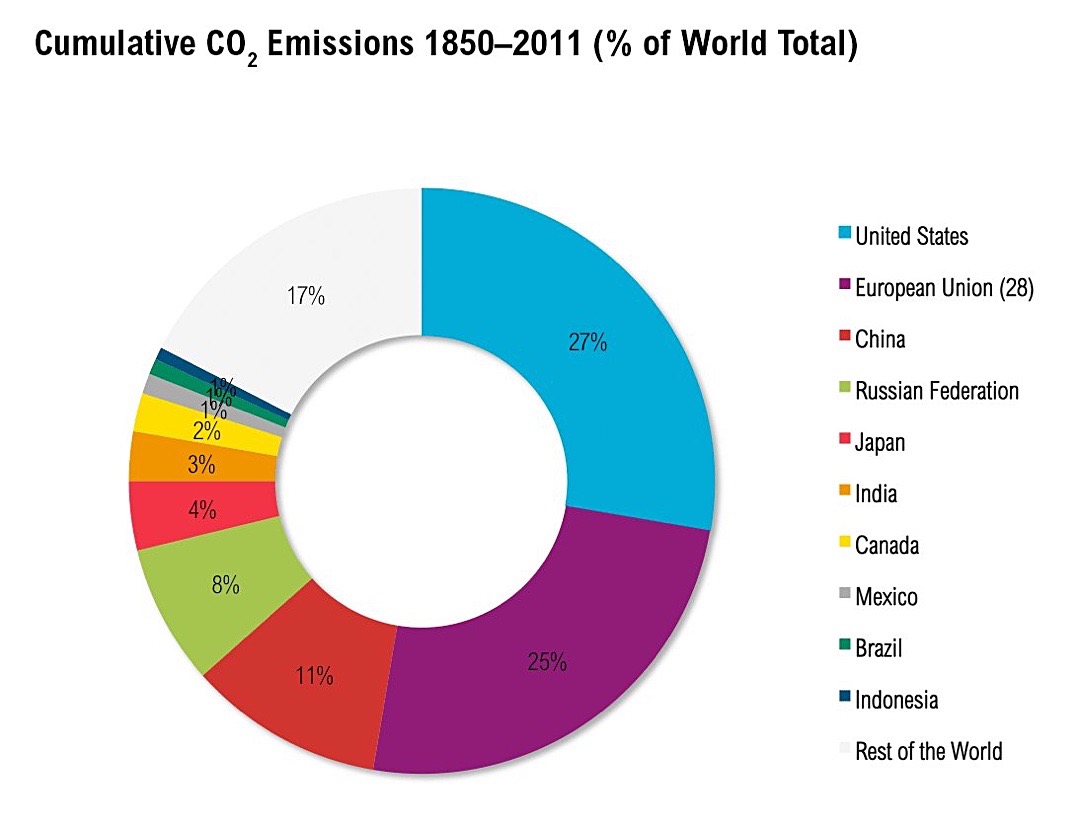
The USA has by far the biggest historical carbon emissions and one of the highest emissions per person in the world. This means they are one of the countries most responsible for causing this climate crisis. Quite frankly, it’s amoral to walk away from your responsibilities. If you make a mess, you should at least help clean it up.

Even if the USA wasn’t a heavy polluter, there would be a strong argument that they should be a key player in sorting out the mess anyway, just because they have the power to do so.

They are the richest country in the world and are routinely regarded as the most powerful, due to immense wealth and military might and ‘cultural power’ – a more fuzzy concept that includes everything from having the most UN diplomats to Hollywood movies dominating the global media market.

http://www.islandbreath.org/2017Year/06/170622piebig.jpg
Image above: Pie chart of percentage of cumulative CO2 emissions between 1850 and 2011 by country. From World Resource Institute (http://www.wri.org/blog/2014/11/6-graphs-explain-world%E2%80%99s-top-10-emitters). Click to enlarge.

http://www.islandbreath.org/2017Year/06/170622barbig.jpg
Image above: Bar chart of per person carbons emissions in metric tons of CO2 emissions in 2014 per person by country. From original article. This chart was adjusted from the 2011 data from the World Resource Institute (http://www.wri.org/blog/2014/11/6-graphs-explain-world%E2%80%99s-top-10-emitters). It separates countries in the European Union. Note, the United States past Canada in CO2 emissions per person. The world average is about what Britain's emissions are (less than a third of USA's. Click to enlarge. 

So what is the "We Are Still In" coalition?

The We Are Still In coalition is a loose voluntary group of city mayors, state governors, CEOs, investors and university principals who have signed a pledge, on behalf of their communities and organisations, and an open letter to the UN, stating that they are still committed to the Paris Agreement.

They have promised to use their respective powers to lead climate action in their communities and businesses, aiming to meet or exceed the USA’s commitments under the Paris Agreement. (Which by the way is a 26-28% cut in emissions compared to the 2005 level by 2025, and even under Obama they were likely to miss that target).

So who’s actually signed up? The pledge has 1219 signatories so far, and growing. This includes:
  • 9 states: California, Connecticut, Hawaii, New York, North Carolina, Oregon, Rhode Island, Virginia and Washington
  • 125 cities. Including Washington DC, New York City, Los Angeles, Chicago, Dallas, Pittsburgh…
  • 902 businesses and investors. Including Amazon, Apple, Google, Gap, Mars, Nike…
  • 183 universities and colleges.
You can check out the full list of signatories and their open letter here.

The cities and states represent 120 million Americans and a GDP of $6.2 trillion. The businesses together have combined revenue of $1.4 trillion.

This means 38% of the American population and at least 35% of their GDP is covered by this new alliance. If just the 9 states were a country, that country would be the fifth richest and sixth highest polluter in the world. So it’s a pretty big deal.

The philanthropist, business investor and former Mayor of New York Michael Bloomberg has been instrumental in coordinating this alliance, and he has even pledged to donate $15million from Bloomberg Philanthropies to the UN, to replace funding from Washington they’ll now miss out on thanks to Trump.

Although he’s certainly been a leader, it has also been a collaborative effort between 21 nonprofit groups, including C40 Cities, CDP (who I am starting a new job with next month!), WWF and others, who really pushed this forward.

The coalition wants to participate in the Paris Agreement, but there is currently no formal way for them to do so on America’s behalf, as it is an agreement between sovereign nations. However the Accord does call for ‘non-state actors’ to be involved. How this would work in practice is still being worked out.

The two big reasons why this is so incredible

Okay. Now into the real tofu and potatoes of this post. "Science" and "Symbolism"

The science

As this Alliance covers 38% of the American people and at least 35% of their GDP, they have significant power to influence the carbon emissions of the country. Due to the USA’s federal structure, states and cities have fairly extensive powers. The large companies have huge power through their supply chains.

However, even under Obama, the USA was not on track to meet its climate targets. With Trump’s hostile regressive stance and deregulation of pollution, it’s going to be even tougher to meet them.
But that doesn’t mean they can’t.

I’m fairly optimistic about their chances, as it looks like the hostility of the federal government is actually acting as an effective motivator to people who would have just sat back and done little otherwise. There really is a huge groundswell of support for the Paris Agreement emerging from the bottom up, and it’s not clear how far that momentum will go.

It’s difficult to estimate what percentage of the USA’s carbon emissions are represented in this coalition, because many of the members are overlapping – so you can’t just add up all their emissions. But the nine states alone represent 17% of USA emissions – and that’s without all the major cities and businesses outside of those states.

The symbolism

Direct cuts in carbon emissions are not even necessarily the most influential thing about the We Are Still In coalition. The symbolism is incredibly powerful. Here are cities, states and businesses directly defying Trump by saying: ‘You made the wrong decision. You do not speak for us. We are still in the Paris Agreement’.

The fact that Washington and New York were two key signatories will be a particular slap in the face for Trump. The small city of Pittsburgh is also notable because in his speech he declared ‘I was elected to represent Pittsburgh, not Paris’.

The mayor of Pittsburgh resented his city being used as an excuse like this, especially considering they already had a climate action plan to go 100% renewable powered. He publicly disagreed with the decision to leave the Paris Agreement, and joined the We Are Still In coalition instead.

The President also argued that climate action is bad for business and he would prioritise business. And what response did he get?

Tesla CEO Elon Musk and Disney CEO Bob Iger promptly quit his presidential advice council in protest. The ‘climate vs business’ position has become more discredited than ever, as over 900 businesses have joined the coalition.

Many of the most outspoken members are American-based tech giants, like Google, Apple and Amazon. They argue that in the short term, there are great business opportunities to be had from clean energy and greener products – and in the long term all business depends on a stable climate.

When Trump said he was going to exit the Paris Agreement, a real worry was that other countries would lose motivation and think ‘if the richest most powerful country, that has some of the highest emissions, is going to walk away, then there’s no point me doing anything.

Screw it, I’m out’. For some, that was an even bigger problem than the USA’s actual emissions. Because it posed the threat of unravelling the delicate international consensus that had been pieced together –finally, painfully- on this global issue.

Luckily, other national leaders were keen to reconfirm their support and to condemn Trump’s decision. (Even Kim Jong-un, who called the move “the height of egosim”, with zero self-awareness).
What this coalition does, is it assures the international community that America is still at the table. Even if the central government pulls out, America will still be informally committed to the Paris Agreement, through this broad and growing coalition.

Conclusion – Thank you America!

It’s imperative for the whole world’s future that America does not walk away from tackling climate change. Despite Trump’s damaging and regressive decision, it now looks like this will not be the case. Where the government steps down, leaders from local government, business and civil society will step up.

This has given me hope for the future. Thank you to everyone involved – thank you to the signatories, the organisers, and to all the everyday Americans who support it.
.

Grand Theft Aina: Part II

SUBHEAD: Another heist-scam spree to give corporations control of public Hawaiian lands.

By Shannon Rudolph on 1 May 2017 in Island Breath -
(http://islandbreath.blogspot.com/2017/05/grand-theft-aina-part-ii.html)

http://www.islandbreath.org/2017Year/05/170502gta2big.jpg
Image above: Poster for opposition to another scam from developers to get their hands on Hawaiian public land. From author. Click to enlarge.

[IB Publisher's note 5/3/17: This proposal was defeated.] 
[IB Publisher's note 5/1/17: In 2012 when then Governor Neil Abercrombie brought the PLDC proposal to Kauai he was booed so badly he had to leave the stage and exit the venue. The move was a career ender.]


We already told legislators we do not want another Public Land Development Corporation (PLDC) type bill to be passed at the legislature - there are other, better ways to deal with these issues and do not want to have to mount another repeal of a bad bill that gives away Hawaiian/Public property.

The existing laws were put in place for very good reasons & ought to stay the way they are to protect our interests from shady deals with little public input and oversight.

In the last week of the legislature - This IS Grand Theft `Aina - Part 2... and it's going to take ALL of us to stop it in it's tracks on TUESDAY!

Please SHARE with your friends & ohana!

Please copy all Legislator email addresses at the bottom of this post and shoot them a quick email to tell them to knock it off - the public is aware of what they're trying to do - and do not approve!

UNITE HERE Local 5 (Hawaii's Hospitality & Healthcare workers union) noted:
“The legislation puts significant decisions about state land use into the hands of unaccountable, unelected committees to an extent that goes far beyond what existing state and county boards and commissions have. Through the requirements in the bill about who may serve on such committees, they will tend to be biased toward the unchecked, profit-driven short-term interests of developers, real estate salespeople and bankers.

"Hawaii is a small state, and people in these circles work together frequently – because of this, committee members are almost certain to have direct or indirect conflicts of interest. 

This legislation gives these unaccountable, unelected, conflicted committees the power to lease out state land for as long as they choose at whatever rates they choose, which runs directly counter to good procurement practice.

“The legislation proposes just one hearing before an unaccountable, unelected body at which the public can voice its concerns about a redevelopment project. There is no binding language that would give that public input any influence at all over a committee’s plans. 

There is no language mandating where, when, or at what point in the redevelopment process such a hearing would take place. There is no language ensuring the public would even have access to information necessary to give informed testimony about a redevelopment plan.

“We are in the midst of a real estate development bubble. There is no reason this legislation should artificially prop up developers or add to the incentives they already have. 

On the contrary, creating artificial incentives to build in places not supported by market demand is very risky for the state long-term. It is likely to create even more blight than whatever may already exist in a given area. This bill is written in such a way that this risk will be borne entirely by Hawaii’s citizens, not by developers.

Developers will not have an ongoing, longterm responsibility to the success of the projects they may build with the help of this bill. It is additionally perplexing that this bill does not even mention housing, much less contemplate or allow for housing to be a part of any redevelopment plans. Considering that the lack of affordable housing is one of the biggest crises Hawaii residents face, the absence of any discussion about housing in this bill is a glaring problem.”
Common Cause Hawaii opposed the bill:
“As this bill seems reminiscent of the Public Lands Development Corporation (PLDC), we are reminded that one of the many issues raised was the lack of transparency and access. 

Thus, because planning committees are given broad powers including the ability to renew or renegotiate leases, and the ability to make and execute contracts, it should be clearly specified that all planning committees and their meetings are subject to our Sunshine Laws to ensure that the public has every opportunity to participate and voice their opinions on plans and activities.

We believe that the public should be involved from the outset, not after a plan has already been drafted, as these plans and how they’re implemented will affect their neighborhoods and daily lives.”
The League of Women Voters of Hawaii said:
“We support public planning for redevelopment of public lands and transparent, competitive procedures for award of long-term commercial leases on public lands. We oppose HB 1469, HD1, SD1 because this bill contains provisions which would encourage existing commercial lessees of public lands to ‘play politics` to gain special unfair treatment.”
The conference draft morphed the bill into a version that some believe is a sweetheart deal for existing tenants on any state land, including the University of Hawaii and the Thirty Meter Telescope (TMT) on Mauna Kea.

Under existing law, leases of state lands can’t exceed 65 years. Then they need to go back out for auction. The policy is that any lease longer for 65 years is essentially a sale of land. So to be fair, you put it up for auction to allow new parties to bid. The final version of the bill eliminates the 65-year limit on any new or existing lease on any state lands. Basically, it’s turning tenants into potential owners of state land.

It also eliminates the Land Board’s rights to access certain information from lessees (making it optional) who sell, assign or sublease state land."​
Link: http://www.ililani.media/2017/05/hawaii-legislature-contemplates-return.html

BILL HERE:
​http://www.capitol.hawaii.gov/measure_indiv.aspx?billtype=HB&billnumber=1469&year=2017​

​EMAIL NOW! ​
​"No on HB 1469!!!​ HD1 SD2 CD1​"

LIST OF REPRESENTATIVES IN LEGESLATURE (cut and paste into email)
senbaker@Capitol.hawaii.gov, senchang@capitol.hawaii.gov, sendelacruz@capitol.hawaii.gov, senenglish@capitol.hawaii.gov, senespero@capitol.hawaii.gov, sengabbard@capitol.hawaii.gov, sengaluteria@capitol.hawaii.gov, sengreen@capitol.hawaii.gov, senharimoto@capitol.hawaii.gov, senihara@capitol.hawaii.gov, seninouye@capitol.hawaii.gov, senkahele@capitol.hawaii.gov, senkeithagaran@capitol.hawaii.gov, senkidani@capitol.hawaii.gov, senkim@Capitol.hawaii.gov, senkouchi@Capitol.hawaii.gov, sennishihara@capitol.hawaii.gov, senrhoads@capitol.hawaii.gov, senriviere@capitol.hawaii.gov, senruderman@capitol.hawaii.gov, senshimabukuro@capitol.hawaii.gov, sentaniguchi@capitol.hawaii.gov, senthielen@capitol.hawaii.gov, sentokuda@capitol.hawaii.gov, senwakai@capitol.hawaii.gov, repaquino@Capitol.hawaii.gov, repbelatti@Capitol.hawaii.gov, repbrower@Capitol.hawaii.gov, repcachola@Capitol.hawaii.gov, repchoy@Capitol.hawaii.gov, repcreagan@Capitol.hawaii.gov, repcullen@Capitol.hawaii.gov, repdecoite@Capitol.hawaii.gov, repevans@Capitol.hawaii.gov, repfukumoto@Capitol.hawaii.gov, repgates@Capitol.hawaii.gov, rephashem@Capitol.hawaii.gov, repholt@Capitol.hawaii.gov, repichiyama@Capitol.hawaii.gov, reping@Capitol.hawaii.gov, repito@Capitol.hawaii.gov,repjohanson@Capitol.hawaii.gov, repkeohokalole@Capitol.hawaii.gov, repkobayashi@Capitol.hawaii.gov, replee@Capitol.hawaii.gov, replopresti@Capitol.hawaii.gov, replowen@Capitol.hawaii.gov, repluke@Capitol.hawaii.gov, repmatsumoto@Capitol.hawaii.gov, repmcdermott@Capitol.hawaii.gov, repmckelvey@Capitol.hawaii.gov, repmizuno@Capitol.hawaii.gov, repmorikawa@Capitol.hawaii.gov, repnakamura@Capitol.hawaii.gov, repnakashima@Capitol.hawaii.gov, repnishimoto@Capitol.hawaii.gov, repohno@Capitol.hawaii.gov, reponishi@Capitol.hawaii.gov, repmoshiro@Capitol.hawaii.gov, repquinlan@Capitol.hawaii.gov, repsaiki@Capitol.hawaii.gov, repsanbuenaventura@Capitol.hawaii.gov, repsay@Capitol.hawaii.gov, repsouki@Capitol.hawaii.gov, reptakumi@Capitol.hawaii.gov, reptodd@Capitol.hawaii.gov, reptokioka@Capitol.hawaii.gov, reptupola@Capitol.hawaii.gov, repward@Capitol.hawaii.gov, repwoodson@Capitol.hawaii.gov, repyamane@Capitol.hawaii.gov, repyamashita@Capitol.hawaii.gov


.