Showing posts with label Debt Serfs. Show all posts

Three Deprivation Narratives

SUBHEAD: I’d like to think that it possible for everyone to have safe and comfortable shelter.

By Chris Smaje on 7 October 2018 for Small Farm Future -
(https://smallfarmfuture.org.uk/2018/10/three-deprivation-narratives/)


Image above: Poster from 1974 showing peasant life in rural China titled "Reporting to Chairman Mao". From (https://chineseposters.net/posters/e13-451.php).

I’ve been reading Lynn T. White’s book Rural Roots of Reform Before China’s Conservative Change (Routledge, 2018). I couldn’t honestly recommend it as a light bedtime read, but it’s absolutely fascinating nonetheless.

Here I just want to reflect on the case of a rural migrant mentioned by White thus:
“A twenty-five-year-old legal migrant from Henan to Suzhou explained in 1994 why he was so much more productive on the delta: “We used to spend three months doing farm work, one month celebrating the Spring Festival, and eight months in idle time every year.”
Now he was a restaurant waiter, working fourteen hours each day, seven days a week – but receiving 400 yuan (about US$50 a month, which was four times his previous Henan wage).
When asked whether he thought he was working too hard, he replied with great eloquence….“No, it is better than sitting idly by watching people in cities getting rich. The conditions here are not bad at all.
Color TV, electric heating, free meals – these are great. What I like most here is that I can take a shower every day. I was not able to take a bath during the entire winter at home. It would be too cold to do so in the river.” (p.354)
FIRST  DEPRIVATION
This example poses some potentially awkward questions for those like me who advocate for a small farm future – for more Henan and less Suzhou, so to speak. Could I look this man in the eye and tell him that he should have stayed on the farm? My answer to that, emphatically, is no.

But I think the implications of what he said are worth pondering. The first reason he gave for leaving the farm draws from a relative deprivation narrative – why molder away in rural poverty while city people make so much more money?
 
The last reason he gave draws from an absolute deprivation narrative – back home, he couldn’t even take a shower during the winter!

This individual story fits easily into the dominant narrative of our times – people naturally seek prosperity, and when the opportunity arises will therefore move from countryside to city, and also from poorer countries to richer ones in search of it.

Good luck to them – so long as the national and international economies are structured the way they are, I have zero sympathy for the anti-immigration rhetoric of right-wing populism, and little sympathy for left-populist peasant romanticism either.

But if you aggregate this one man’s journey across the global billions, urban and rural, who share his impoverished starting point, I can’t see this strategy of wealth-through-urbanization-and-economic-growth working.

For one thing, while the global economy is certainly capable of lifting millions of people out of poverty in some places – China foremost among them – I don’t think it’s structurally or physically capable of doing it adequately everywhere.

If, like me, you number among the top few hundred million in global wealth then that may not concern you much. Possibly it doesn’t concern a man like the Henan waiter either.

And much as I’d like to think that such persistent inequalities would prompt the poor into political action to achieve a fairer distribution of the world’s resources, the fact is this only happens in historically unusual circumstances, as occurred in early 20th century China.

If economist Minqi Li, whose book China and the 21st Century Crisis (Pluto, 2016) I’m currently ploughing my way through (it’s another bedtime no-no, I’m afraid), is to be believed, these circumstances are also likely to occur in the mid-21st century, and will probably result in the end of the global capitalist order.

SECOND DEPRIVATION
Let me throw in another China book while I’m at it – David Bandurski’s Dragons in Diamond Village: Tales of Resistance in Urbanizing China (Melville House, 2016) – a much better candidate for bedtime reading, which shows vividly why somebody like this waiter may get richer in the city but will always be watching other people get richer still.

Having corresponded recently with David (more on that anon), he pronounces himself pessimistic about the opportunities for resistance in Xi’s China. Time will tell.

Quite apart from the limited economic capacity of the global political economy to lift adequate numbers of people out of poverty, the other side of it is the limited environmental and energetic capacities to do so.

If you aggregate the single migrant journey from Henan to Suzhou I’ve described here among all those similarly lacking in the food, shelter, comfort and entertainment that many of us take for granted, the consequences will quite simply be environmentally catastrophic and untenable long-term unless you buy into ecomodernist fantasies that it’s all manageable through nuclear power, GM crops and the like.

THIRD DEPRIVATION
So here we come to a third deprivation narrative – contemporary people pursuing eminently justifiable and personally rational goals deprive others, most especially future generations, of the opportunity to do likewise.

The only way I see out of this morass is to detoxify the first and third of these deprivation narratives while focusing relentlessly on the second.

I’d like to think that it should be possible for everyone in the world to have safe and comfortable shelter (including access to tolerably warm bathing water) and an adequate diet (I’m not so sure about the color TV…or the free meals: isn’t there a capitalist story doing the rounds that the latter are a myth?)

But to achieve that sustainably so that future generations don’t go without I think we’re going to have to let go of the relative deprivation story, the “people in cities getting rich”, by sharing the wealth around much more fairly.

Well, it’s a plan – and it’s been tried before, notably in China by one Mao Zedong. The aforementioned Minqi Li seems to be among the cohort that’s reevaluating Maoism positively, for example analyzing Mao’s Cultural Revolution as an attempt to “save the revolution” through “the dictatorship of the proletariat” (p.18).

Personally, I struggle to justify the enormous destructiveness, misery and cruelty of it in those terms, when it seemed to be at least as much about saving the power of Mao Zedong through the dictatorship of Mao Zedong.

I find Lynn White’s analysis more interesting – in his view, the disasters of Mao’s Great Leap Forward followed soon after by the power vacuum created by the Cultural Revolution fostered considerable local economic autonomy in China from the 1960s, and it was this bottom-up economic dynamism rather than the top-down reforms of the post-Mao government that laid the foundation for the country’s transformation into today’s huge industrial-capitalist power.

I do find Li’s prognosis for how that transformation is likely to end in tears quite convincing, however.

So no, I’m not too keen on Maoist solutions to economic inequality. My preference is for agrarian populist solutions to it – which essentially means getting more people into farming and paying them better for it.

Low economic returns to agriculture have often been a historical fact, but they’re not intrinsically an economic one. Still, the questions remain – is such a populist solution likely to occur, and how could it happen?

My answers to that are ‘no’ and ‘with great difficulty’, but it’s the only solution that strikes me as likely to be successful long-term, so the long march back to Henan-with-hot-showers is the one I want to devote my thinking to.

White and Li’s books have helped me to see that a little more clearly, though still through a glass darkly. I’ll try to elucidate it more in future posts.

.

Lamentation

SUBHEAD: The sudden end of a whole regional economy that was a tragic blunder from the get-go?

By James Kunstler on 14 September 2018 for Kunstler.com -
(http://kunstler.com/clusterfuck-nation/lamentation/)


Image above: Bedroom sheetrock drywalls in the home of Rashida Ferdinand in the New Orleans's Lower Ninth Ward blooming with health threatening mold following heavy rain and flooding in the wake of hurricane Katrina in 2005. From (https://www.thisoldhouse.com/ideas/keep-mold-taking-hold).

An awful lot of sheetrock is going to be permanently ruined over the next few days down along the coast of Dixieland. Following the spectacle of hurricane reportage on TV reveals very little while the event is in progress.

The cheapo building materials of the stereotypical strip malls flap around in the gale and the valiant cable news storm-chasers lean into the horizontal deluge in the empty parking lots, but their reportage doesn’t tell much of the real story, which only emerges when the roaring blob of weather moves on and the sun finally comes out.

More than a decade of punishing storms along the US coastline must be wrecking the insurance industry as much as the stuff on the landscape.

They’ve been pummeled from another direction for ten years by the supernaturally low interest rates that make it so hard to refurbish their coffers after whole regions like the Houston metro area and the entire island of Puerto Rico get blasted and they have to pay out billions in claims.

This time around, all those vinyl and chip-board McHouses along the Atlantic beaches will not be replaced. But farther inland, far from the roaring surf, along all the overflowing estuaries that drain the coastal plain, the damage will be widespread and epic.

It may create a whole new social class of de-housed, displaced Sunbelters who will never again have a decent place of their own to live in. Since many are retirees, the event may even lead to a stealth die-off of people who are just too far along to start over.

The lamentation for the northern part of “flyover” America is an old story now. Nobody is surprised anymore by the desolation of de-industrialized places like Youngstown, Ohio, or Gary, Indiana, where American wealth was once minted the hard way by men toiling around blast furnaces.

But the southeast states enjoyed a strange interlude of artificial dynamism since the 1950s, which is about three generations, and there is little cultural memory for what the region was like before: an agricultural backwater with few cities of consequence and widespread Third Worldish poverty, barefoot children with hookworm, and scrawny field laborers in ragged straw hats leaning on their hoes in the stifling heat.

The demographic shifts of recent decades turned a lot of it into an endless theme park of All-You-Can-Eat buffets, drive-in beer emporia, hamburger palaces, gated retirement subdivisions, evangelical churches built like giant muffler shops, vast wastelands of free parking, and all the other trappings of the greatest misallocation of resources in the history of the world.

Like many of history’s prankish proceedings, it seemed like a good idea at the time.

As survivors slosh around in the plastic debris in the weeks ahead, and the news media spins out its heartwarming vignettes of rescue and heroism, will there be any awareness of what has actually happened: the very sudden end of a whole regional economy that was a tragic blunder from the get-go?

It is probably hard to imagine Dixieland struggling into whatever its next economy might be. In some places, it’s not even possible to return to a prior economy based on agriculture. A lot of the landscape was farmed so ruinously for two hundred years that the soil has turned into a kind of natural cement, called hardpan or caliche.

The climate prospects for the region are not favorable either, not to mention the certain cessation of universal air-conditioning and “happy motoring” that made the unwise mega-developments of recent decades possible.

The one salutary effect of Hurricane Florence may be that news of the after-effects will supersede the incoherent manufactured political blather welling up around the coming midterm elections — especially if the financial damage is powerful enough to disturb the debt-fueled occult economic “boom” attributed to the magic powers of our deal-wielding POTUS.

.

Winners will lose - Losers will win

SUBHEAD: The consolation, perhaps, is that there will be plenty for all those who survive the collapse.

By James Kunstler on 20 August 2018 for Kunstler.com -
(http://kunstler.com/clusterfuck-nation/the-winners-will-lose-and-the-losers-will-win/)


Image above: Detail of poster for the 1949 movie "The Life of Riley" based on the popular radio show and later hit 1950's TV show. From (https://www.imdb.com/title/tt0041590/).

Who doesn’t want to think that they are a good human being? That they are a person of good intentions, clear conscience, fair-minded, generous, loving, and merciful? On the other hand, who wants to be a loser?

The current political predicament in the USA has America’s winners turned losers and the consequent pain of that flip-flop has propelled the new designated losers into a fury of moral indignation.

The deplorable Trump insurgents were supposed to be put in their place on November 8, 2016 — stuffed back into their reeking WalMarts — but instead, their champion with his gold-plated hair-do presides over the nation in the house where Lincoln, The Roosevelts, and Hillary lived. “Winning…!” as the new president likes to tweet.

What a revoltin’ development, as Chester A. Riley used to say on “The Life of Riley” TV show back in 1955, when America was great (at least that’s the theory). Riley was an original deplorable before the concept even emerged from the murk of early pop culture.

He worked in an aircraft factory somewhere in southern California, which only a few decades prior was the mecca of an earlier generations of losers: the Oakies and other Dust Bowl refugees who went west to pick fruit or get into the movies.

Chester A. Riley supported a family on that job as a wing-riveter. All the male characters in the series had been through the Second World War, but were so far removed from the horror that the audience never heard about it.

That was the point: to forget all that gore and get down with the new crazes for backyard barbeque, seeing the USA in your Chevrolet, enjoying that healthful pack of Lucky Strikes in the valley of the Jolly Green Giant… double your pleasure, double your fun… and away go troubles down the drain….

As Tom Wolfe pointed out eons ago, the most overlooked feature of post-war American life was the way that the old US peasantry found themselves living higher on the hog than Louis the XVI and his court at Versailles.

Hot and cold running water, all the deliciously engineered Betty Crocker cake you could eat, painless dentistry, and Yankees away games on Channel 11, with Pabst Blue Ribbon by the case! By 1960 or so, along came color TV and air-conditioning, and in places like Atlanta, St. Louis, and Little Rock, you barely had to go outside anymore, thank God! No more heat stroke, hookworm, or chiggers.

It was a helluva lot better than earlier peasant classes had it, for sure, but let’s face it: it was kind of a low-grade nirvana. And a couple of generations beyond “The Life of Riley” the whole thing has fallen apart.

There are few hands-on jobs that allow a man to support a family. And what would we even mean by that? Stick the women back in kitchen and the laundry room?

What a waste of human capital (even for socialists who oppose capital). The odd thing is that there is increasingly little for this class of people to do besides stand near the door of the WalMart, and if the vaunted tech entrepreneurs of this land have their way with robotics, you can be sure there would be less than nothing for them to do… except crawl off and die quietly, without leaving an odoriferous mess.

What political commentator has failed to notice that the supposed savior of this peasant class is himself a sort of shabby version of Louis XVI, with his gilded toilet seats, brand-name pomp, and complex hair?

A happy peasantry needs a good king, and that is the role Mr. Trump seems to have cast himself in. I assume that he wants very earnestly to be considered a good person, though all his efforts to demonstrate that have been startlingly clumsy and mostly ineffective.

The one thing he has truly accomplished is driving his opponents in the overclass out of their gourds with loathing and resentment. (The term, overclass was minted, I believe by the excellent essayist Michael Lind.)

It’s a wonderfully inclusive term in that it describes basically everyone who is not in the underclass — that now-dreadful realm of tattooed diabetics moiling in the war memorial auditoriums and minor league ball parks for their hero and leader to descend like Deus ex Machina in the presidential helicopter to remind them how much they’re winning.

Meanwhile, the class of former winners-turned-losers — the Silicon Valley executives, the Hollywood movers and shakers, the Brooklyn Hipsters, the Ivy League faculties, the Deep State guideline writers, the K-Street consultants, the yoga ladies of Fairfield County, Connecticut, the acolytes of Oprah Winfrey and Elizabeth Warren — resort to righteous litigation in their crusade to restore the proper order of rule in this land. When they come to power, the shining city will be at hand….

I kind of doubt it. The truth is, all current winners and losers are living in the shadow of a financial system that doesn’t really work anymore, because it doesn’t represent the reality of wealth that is no longer there.

The consolation, perhaps, is that there will be plenty for all those who survive the collapse of that system to do when the time comes.

But it will be in a disposition of things and of power that we can’t possibly recognize from where we stand these days.

.

USA is now a 3rd World nation

SUBHEAD: 3rd World nations are stable and work just fine for the elites who dominate them.

By Charles Hugh Smith on 9 July 2018 for Of Two Minds -
(https://www.oftwominds.com/blogjuly18/USA-3rd-world7-18.html)


Image above: Mark Saulys standing by his tent below busy Chicago's Lake Shore Drive on a winter evening in 2017. From (http://www.chicagohomeless.org/columbia-chronicle-homeless-lose-refuge-tent-city/).

Dividing the Earth's nations into 1st, 2nd and 3rd world has fallen out of favor; apparently it offended sensibilities. It has been replaced by the politically correct developed and developing nations, a terminology which suggests all developing nations are on the pathway to developed-nation status.

What's been lost in jettisoning the 1st, 2nd and 3rd world categories is the distinction between developing (2nd world) and dysfunctional states (3rd world), states we now label "failed states."

But 3rd World implied something quite different from "failed state": failed state refers to a failed government of a nation-state, i.e. a government which no longer fulfills the minimum duties of a functional state: basic security, rule of law, etc.

3rd World referred to a nation-state which was dysfunctional and parasitic for the vast majority of its residents but that worked extremely well for entrenched elites who controlled most of the wealth and political power. Unlike failed states, which by definition are unstable, 3rd World nations are stable, for the reason that they work just fine for the elites who dominate the wealth, power and machinery of governance.

Here are the core characteristics of dysfunctional but stable states that benefit the entrenched few at the expense of the many, i.e. 3rd World nations:

1. Ownership of stocks and other assets is highly concentrated in entrenched elites. The average household is disconnected from the stock market and other measures of wealth; only a thin sliver of households own enough financial/speculative wealth to make an actual difference in their lives.

2. The infrastructure of the nation used by the many is poorly maintained and costly to operate as entrenched elites plunder the funding to pad their payrolls, pensions and sweetheart/insider contracts.

3. The financial/political elites have exclusive access to parallel systems of transport, healthcare, education, etc. The elites avoid trains, subways, lenders, coach-class air transport, standard healthcare and the rest of the decaying, dysfunctional systems they own that extract wealth from the debt-serfs.

They fly on private aircraft, have their own healthcare and legal services, use their privileges to get their offspring into elite universities and institutions and have access to elite banking and lending services that are unavailable to their technocrat lackeys and enforcers.

4. The elites fund lavish monuments to their own glory disguised as "civic or national pride." These monuments take the form of stadiums, palatial art museums, immense government buildings, etc. Meanwhile the rest of the day-to-day infrastructure decays in various states of dysfunction.

5. There are two classes that only interact in strictly controlled ways: the wealthy, who live in gated, guarded communities and who rule all the institutions, public and private, and the debt-serfs, who are divided into well-paid factotums, technocrat lackeys and enforcers who serve the interests of the entrenched elites and rest of the populace who own virtually nothing and have zero power.

The elites make a PR show of being a commoner only to burnish the absurd illusion that debt-serf votes actually matter. (They don't.)

6. Cartels and quasi-monopolies are parasitically extracting the wealth of the nation for their elite owners and managers. Google: quasi-monopoly. Facebook: quasi-monopoly. Healthcare: cartel. Banking: cartel. National defense: cartel. National Security: cartel. Corporate mainstream media: cartel. Higher education: cartel. Student loans: cartel. I think you get the point: every key institution or function is controlled by cartels or quasi-monopolies that serve the interests of the few via parasitic exploitation of the powerless.

7. The elites use the extreme violence and repressive powers of the government to suppress, marginalize and/or destroy any dissent. There are two systems of "law": one for the elites ($10 million penalties for ripping off the public for $10 billion, no personal liability for outright fraud) and one for the unprotected-unprivileged: "tenners" (10-year prison sentences) for minor drug infractions, renditions or assassinations (all "legal," of course) and institutional forces of violence (bust down your door on the rumor you've got drugs, confiscate your car because we caught you with cash, so you must be a drug dealer, and so on, in sickening profusion).

8. Dysfunctional institutions with unlimited power to extract money via junk fees, licensing fees, parking tickets, penalties, late fees, etc., all without recourse. Mess with the extractive, parasitic bureaucracy and you'll regret it: there's no recourse other than another layer of well-paid self-serving functionaries that would make Kafka weep.

9. The well-paid factotums, bureaucrats, technocrat lackeys and enforcers who fatten their own skims and pensions at the expense of the public and slavishly serve the interests of the entrenched elites embrace the delusion that they're "wealthy" and "the system is working great." These deluded servants of the elites will defend the dysfunctional system because it serves their interests to do so.

The more dysfunctional the institution, the greater their power, so they actively increase the dysfunction at every opportunity.

I know it hurts, but the reality is painfully obvious: The USA is definitively a 3rd World nation.

.

That collapse you ordered...?

SUBHEAD: And when it happens here, it will spread through the financial systems of the world.

By James Kunstler on 30 April 2018 for Kunstler.com -
(http://kunstler.com/clusterfuck-nation/9192/)


Image above: Scene from the movie "The Road" based on the novel by Cormac McCarthy. From (http://www.enclavedecine.com/2010/02/la-carretera-road-2009-de-john-hillcoat.html).

I had a fellow on my latest podcast, released Sunday, who insists that the world population will crash 90-plus percent from the current 7.6 billion to 600 million by the end of this century.

Jack Alpert heads an outfit called the Stanford Knowledge Integration Lab (SKIL) which he started at Stanford University in 1978 and now runs as a private research foundation. Alpert is primarily an engineer.

At 600 million, the living standard in the USA would be on a level with the post-Roman peasantry of Fifth century Europe, but without the charm, since many of the planet’s linked systems — soils, oceans, climate, mineral resources — will be in much greater disarray than was the case 1,500 years ago.

Anyway, that state-of-life may be a way-station to something more dire. Alpert’s optimal case would be a world human population of 50 million, deployed in three “city-states,” in the Pacific Northwest, the Uruguay / Paraguay border region, and China, that could support something close to today’s living standards for a tiny population, along with science and advanced technology, run on hydropower.

The rest of world, he says, would just go back to nature, or what’s left of it. Alpert’s project aims to engineer a path to that optimal outcome.

I hadn’t encountered quite such an extreme view of the future before, except for some fictional exercises like Cormac McCarthy’s The Road. (Alpert, too, sees cannibalism as one likely byproduct of the journey ahead.)

Obviously, my own venture into the fictionalized future of the World Made by Hand books depicted a much kinder and gentler re-set to life at the circa-1800 level of living, at least in the USA.

Apparently, I’m a sentimental softie.

Both of us are at odds with the more generic techno-optimists who are waiting patiently for miracle rescue remedies like cold fusion while enjoying re-runs of The Big Bang Theory. (Alpert doesn’t completely rule out as-yet-undeveloped energy sources, though he acknowledges that they’re a low-percentage prospect.)

We do agree with basic premise that the energy supply is mainly what supports the way we live now, and that it shows every evidence of entering a deep and destabilizing decline that will halt the activities necessary to keep our networks of dynamic systems running.

A question of interest to many readers is how soon or how rapid the unraveling of these systems might be. When civilizations crumble, it tends to fast-track.

The Roman empire seems to be an exception, but in many ways it was far more resilient than ours, being a sort of advanced Flintstones economy, with even its giant-scale activities (e.g. building the Coliseum) being accomplished by human-powered work.

In any case, the outfit really fell apart steadily after the reign of emperor Marcus Aurelius (180 AD).

The Romans had their own version of a financialized economy: they simply devalued their coins by mixing in less and less silver at the mint, so they could pretend to pay for the same luxuries they had grown accustomed to as resources stretched thin.

Our financialized economy — like everything else we do — operates at levels of complexity so baffling that even its supposed managers at the central banks are flying blind through fogs of debt, deception, and moral hazard.

When that vessel of pretense slams into a mountain top, the effects are likely to be quick and lethal to the economies on the ground below.

In our time, the most recent crash of a major socioeconomic system was the fall of the Soviet Union in 1990-91. Of course, it happened against the backdrop of a global system that was still revving pretty well outside the USSR, and that softened the blow.

Ultimately, the Russians still had plenty of oil to sell, which allowed them to re-set well above the Fifth Century peasant level of existence. At least for now.
'
The Soviet Union collapsed because it was a thoroughly dishonest system that ran on pretense and coercion. Apparently, the US Intel Community completely missed the signs that political collapse was underway. They seem to be pretty clueless about the fate of the USA these days, too.

If you consider the preoccupations of two very recent Intel chiefs — John Brennan of CIA and James Clapper, DNI — who now inveigh full-time on CNN as avatars of the Deep State against the wicked Golden Golem of Greatness.

Personally, I expect our collapse to be as sudden and unexpected as the USSR’s, but probably bloodier because there’s simply more stuff just lying around to fight over.

Of course, I expect the collapse to express itself first in banking, finance, and markets — being so deeply faith-based and so subject to simple failures of faith.

But it will become political and social soon enough, maybe all-at once.

And when it happens in the USA, it will spread through the financial systems the whole world round.

.

Stop and Assess

SUBHEAD: Let’s pause to make an assessment of where we stand as Winter finally coils into Spring.

By James Kunstler on 23 April 2018 for Kunstler.com -
(http://kunstler.com/clusterfuck-nation/stop-and-assess/)


Image above: A man waits at dawn, after sleeping in his car, to see a free ‘mobile doctor’ in Olean, New York. Photo by Spencer Platt. From (https://www.theguardian.com/inequality/2017/jun/20/is-the-american-dream-really-dead).

America has become Alzheimer Nation. Nothing is remembered for more than a few minutes. The news media, which used to function as a sort of collective brain, is a memory hole that events are shoved down and extinguished in.

An attack in Syria, you ask? What was that about? Facebook stole your…what? Four lives snuffed out in a… a what? Something about waffles? Trump said… what?

Let’s pause today and make an assessment of where things stand in this country as Winter finally coils into Spring.

As you might expect, a nation overrun with lawyers has litigated itself into a cul-de-sac of charges, arrests, suits, countersuits, and allegations that will rack up billable hours until the Rockies tumble.

The best outcome may be that half the lawyers in this land will put the other half in jail, and then, finally, there will be space for the rest of us to re-connect with reality.

What does that reality consist of?

Troublingly, an economy that can’t go on as we would like it to: a machine that spews out ever more stuff for ever more people. We really have reached limits for an industrial economy based on cheap, potent energy supplies. The energy, oil especially, isn’t cheap anymore.

The fantasy that we can easily replace it with wind turbines, solar panels, and as-yet-unseen science projects is going to leave a lot of people not just disappointed but bereft, floundering, and probably dead, unless we make some pretty severe readjustments in daily life.

We’ve been papering this problem over by borrowing so much money from the future to cover costs today that eventually it will lose its meaning as money — that is, faith that it is worth anything. That’s what happens when money is just a representation of debt that can’t be paid back.

This habit of heedless borrowing has enabled the country to pretend that it is functioning effectively. Lately, this game of pretend has sent the financial corps into a rapture of jubilation.

The market speed bumps of February are behind us and the road ahead looks like the highway to Vegas at dawn on a summer’s day.

Tesla is the perfect metaphor for where the US economy is at: a company stuffed with debt plus government subsidies, unable to deliver the wished-for miracle product — affordable electric cars — whirling around the drain into bankruptcy.

Tesla has been feeding one of the chief fantasies of the day: that we can banish climate problems caused by excessive CO2, while giving a new lease on life to the (actually) futureless suburban living arrangement that we foolishly invested so much of our earlier capital building. In other words, pounding sand down a rat hole.

Because none of that is going to happen.

The true message of income inequality is that the nation as a whole is becoming incrementally impoverished and eventually even the massive “wealth” of the one-percenters will prove to be fictitious, as the things it is represented in — stocks, bonds, currencies, Manhattan apartments — hemorrhage their supposed value.

The very wealthy will be a lot less wealthy while everybody else is in a life-and-death struggle to remain fed, housed, and warm. And, of course, that only increases the chance that some violent social revolution will take away even that remaining residue of wealth, and destroy the people who held it.

What lies ahead is contraction. Of everything. Activity, population. The industrial economy is not going to be replaced by a super high tech utopia, because that wished-for utopia needs an industrial economy underneath to support it. This is true, by the way, for all the other “advanced” nations.

China has a few more years of dependable oil supply left and then they will discover that they can no longer manufacture solar panels or perhaps not even run the magnificent electronic surveillance system they are so artfully building. Their political system will prove to be at least as fragile as our own.

The time may even come when the young people, of the USA especially, have to put aside their boundary-smashing frolics of the day and adjust the precooked expectations they’ve been handed to the actual contraction at hand, and what it means for making a life under severely different conditions. It means, better learn how to do something really practical and not necessarily high tech.

Better figure out a part of the country that will be safe to live in. Better plan on hunkering down there when the people stuck in the less favorable places make a real mess of things.

.

Not So Happy Motoring

SUBHEAD: We’re so far from any real debate about the issues that the events will blindside the nation.

By James Kunstler on 30 March 2018 for Kunstler.com -
(http://kunstler.com/clusterfuck-nation/not-happy-motoring/)


Image above: Tesla said autopilot was activated during a fatal Model X crash last week in California. From (http://money.cnn.com/2018/03/31/technology/tesla-model-x-crash-autopilot/index.html).

It hasn’t been a great month for America’s electric car fantasy. Elon Musk’s Tesla company — the symbolic beating heart of the fantasy — is whirling around the drain with its share price plummeting 22 percent, its bonds downgraded by Moody’s to junk status, a failure to produce its “affordable” ($36,000 — Ha!) Model 3 at commercial scale, a massive recall of earlier S Model sedans for a steering defect, and the spectacular fiery crash in Silicon Valley last week of an X model that may have been operating in automatic mode (the authorities can’t determine that based on what’s left), and which killed the driver.

Oh, and an experimental self-driving Uber car (Volvo brand) ran over and killed a lady crossing the street with her bicycle in Tempe, Arizona, two weeks ago. Don’t blame Elon for that.

There’s a lot to like about electric cars, of course, if, say, you’re a Google executive floating through life in a techno-narcissism bubble, or a Hollywood actor with wooly grandiose notions of saving the planet while simultaneously signaling your wealth and your “green” virtue cred.

Teslas supposedly handle beautifully, ride very quietly, have great low-end power, and decent range of over 200 miles. The engine has something like twenty moving parts, is very long-lasting, and is easy to repair or change out if necessary.

Are they actually “green and clean?” Bwaahaaaaa….! Are you kidding? First, there’s the energy embedded in producing the car: mining and smelting the ores, manufacturing the plastics, running the assembly line, etc.

That embedded energy amounts to about 22% of the energy consumed by the car over a ten-year lifetime. Then there’s the cost of actually powering the car day-by-day. The electricity around the USA is produced mostly by burning coal, natural gas, or by nuclear fission, all of which produce harmful emissions or byproducts.

But the illusion that the power just comes out of a plug in the wall (for just pennies a day!) is a powerful one for the credulous public.

The cherry-on-top is the fantasy that before much longer all that electric power will come from “renewables,” solar and wind, and we can leave the whole fossil fuel mess behind us. We say that to ourselves as a sort of prayer, and it has exactly that value.

There are at least a couple of other holes in story, big-picture wise. One is that electric mass motoring — switching out the whole liquid fuel fleet for an all-electric fleet — won’t pencil out economically.

We probably started the project forty years too late to even be able to test it at scale, because economic events are now moving so quickly in the direction of global austerity that the putative middle-class customer base for electric cars will barely exist in the near future.

Americans especially nowadays are so financially stressed that they can’t qualify for car loans — and that is mainly how cars are bought in this land.

The industry has strained mightily to bend the rules so that these days it’s even possible to get a seven-year loan for a used car whose collateral value will dissipate long before the loan is paid back. Hard to see how they can take that much further.

The usual answer for that is that you won’t need to own a car because the nation will be served by self-driving electric Uber-style cars-on-demand, which will supposedly require far fewer cars in all.

That really doesn’t answer some big questions, such as: how might commuting work in our big metroplex cities? Even if you posit multiple occupancy vehicles, it still represents a whole lot of car trips.

Oh, you say, everybody will just work from home. Really? I don’t think so — though I wouldn’t rule out an end to corporate organization of work as we’ve known it, and if that happens, we will be a nation of farmers and artisans again, that is, a World Made By Hand.

Also consider, if the car companies only need to make and sell a fraction of the vehicles they sell now, the whole industry will collapse.

Another hole in the story is the universal assumption that the USA must remain a land of mandatory car dependency, hostage to the fiasco of our suburban infrastructure. I understand why we’re attached to it.

We spent most of the 20th century building all that shit, and squandered most our wealth on it. It’s comfortably familiar, even if it’s actually a miserable environment for everyday life.

But none of those monetary and psychological investments negate the fact that suburbia has outlived its limited and rather perverse usefulness.

We’re so far from having any intelligent public debate about these issues that the events now spooling out will completely blindside the nation.

.

Just wait a little while

SUBHEAD: You’ll have to earn everything worth having, including self-respect and your next meal.

By James Kunstler on 7 August 2017 for Kunstler.com -
(http://kunstler.com/clusterfuck-nation/just-wait-little/)


Image above: Aarly 20th century Russian painting of "A Peasant Leaving His Landlord on Yuri's Day" by Sergei V. Ivanov. From (https://www.kp.ru/radio/26511/3430500/).

The trouble, of course, is that even after the Deep State (a.k.a. “The Swamp”) succeeds in quicksanding President Trump, America will be left with itself — adrift among the cypress stumps, drained of purpose, spirit, hope, credibility, and, worst of all, a collective grasp on reality, lost in the fog of collapse.

Here’s what you need to know about what’s going on and where we’re headed.

The United States is comprehensively bankrupt. The government is broke and the citizenry is trapped under inescapable debt burdens. We are never again going to generate the kinds and volumes of “growth” associated with techno-industrial expansion.

That growth came out of energy flows, mainly fossil fuels, that paid for themselves and furnished a surplus for doing other useful things. It’s over.

Shale oil, for instance, doesn’t pay for itself and the companies engaged in it will eventually run out of accounting hocus-pocus for pretending that it does, and they will go out of business.

The self-evident absence of growth means the end of borrowing money at all levels. When you can’t pay back old loans, it’s unlikely that you will be able to arrange new loans.

The nation could pretend to be able to borrow more, since it can supposedly “create” money (loan it into existence, print it, add keystrokes to computer records), but eventually those tricks fail, too.

Either the “non-performing” loans (loans not being paid off) cause money to disappear, or the authorities “create” so much new money from thin air (money not associated with real things of value like land, food, manufactured goods) that the “money” loses its mojo as a medium of exchange (for real things), as a store of value (over time), and as a reliable index of pricing — which is to say all the functions of money.

In other words, there are two ways of going broke in this situation: money can become scarce as it disappears so that few people have any; or everybody can have plenty of money that has no value and no credibility.

I mention these monetary matters because the system of finance is the unifying link between all the systems we depend on for modern life, and none of them can run without it.

So that’s where the real trouble is apt to start. That’s why I write about markets and banks on this blog.

The authorities in this nation, including government, business, and academia, routinely lie about our national financial operations for a couple of reasons.

One is that they know the situation is hopeless but the consequences are so awful to contemplate that resorting to accounting fraud and pretense is preferable to facing reality.

Secondarily, they do it to protect their jobs and reputations — which they will lose anyway as collapse proceeds and their record of feckless dishonesty reveals itself naturally.

The underlying issue is the scale of human activity in our time. It has exceeded its limits and we have to tune back a lot of what we do. Anything organized at the giant scale is headed for failure, so it comes down to a choice between outright collapse or severe re-scaling, which you might think of as managed contraction.

That goes for government programs, military adventures, corporate enterprise, education, transportation, health care, agriculture, urban design, basically everything. There is an unfortunate human inclination to not reform, revise, or re-scale familiar activities.

We’ll use every kind of duct tape and baling wire we can find to keep the current systems operating, and we have, but we’re close to the point where that sort of cob-job maintenance won’t work anymore, especially where money is concerned.

Why this is so has been attributed to intrinsic human brain programming that supposedly evolved optimally for short-term planning. But obviously many people and institutions dedicate themselves to long-term thinking.

So there must be a big emotional over-ride represented by the fear of letting go of what used to work that tends to disable long-term thinking. It’s hard to accept that our set-up is about to stop working — especially something as marvelous as techno-industrial society.

But that’s exactly what’s happening. If you want a chance at keeping on keeping on, you’ll have to get with reality’s program. Start by choosing a place to live that has some prospect of remaining civilized. This probably doesn’t include our big cities.

But there are plenty of small cities and small towns out in America that are scaled for the resource realities of the future, waiting to be reinhabited and reactivated.

A lot of these lie along the country’s inland waterways — the Ohio, Mississippi, Missouri river system, the Great Lakes, the Hudson and St. Lawrence corridors — and they also exist in regions of the country were food can be grown.

You’ll have to shift your energies into a trade or vocation that makes you useful to other people. This probably precludes jobs like developing phone apps, day-trading, and teaching gender studies.

Think: carpentry, blacksmithing, basic medicine, mule-breeding, simplified small retail, and especially farming, along with the value-added activities entailed in farm production.

The entire digital economy is going to fade away like a drug-induced hallucination, so beware the current narcissistic blandishments of computer technology.

Keep in mind that being in this world actually entitles you to nothing. One way or another, you’ll have to earn everything worth having, including self-respect and your next meal.

Now, just wait a little while.

.

Wonderland of Magical Economics

SUBHEAD: The Earth's economy glorifies waste, exploitation, debt, expediency and magical thinking.

By Charles Hugh Smith on 17 July 2017 for Of Two Minds -
(http://www.oftwominds.com/blogjuly17/earth-economy7-17.html)


Image above: Painting of a Magritte-like figure swirling the sky with a wand and producing illuminated light bulbs. From (http://adelaidereview.com.au/opinion/magical-thinking-modern-world/).

Humanity appears to default to magical thinking when faced with untenable situations that demand systemic change.

How would extraterrestrial anthropologists characterize Earth's dominant socio-economic system? It's not difficult to imagine their dismaying report:

"Earth's economy glorifies waste. Its economists rejoice when a product is disposed as waste and replaced with a new product. This waste is perversely labeled 'growth.'

Aimless wandering that consumes fossil fuels is likewise rejoiced as 'growth.'

The stripping of the planet's oceans for a few favored species of edible fish is also considered 'growth' as the process of destroying the ocean ecosystem generates sales of the desired seafood.

Even more perversely, the resulting shortages are also causes of rejoicing by the planet's elites, as their ability to purchase the now-scarce resources boosts their social status and grandiose sense of self-worth.

This glorification of waste is the same dynamic that destroyed the civilization on Zork.

Earth's economy also glorifies exploitation, as this maximizes profits, which appears to be the planetary equivalent of a secular religion that everyone believes as a Natural Law.

Thus slavery and monopoly are highly valued as the most reliable sources of profits. If ethical concerns limit the actual ownership of humans, Earth's economy incentivizes feudal arrangements that share characteristics of servitude and bondage.

In the current era, the favored mechanisms are over-indebtedness (debt-serfdom) and taxation by the state, which extracts approximately 40% of all labor via threat of imprisonment.

Earth's elites exhibit a pathological preference for micro-managing the commoners via criminalizing much of everyday life and imposing extremely harsh punishments for any dissent or resistance to elite domination.

This is the same dynamic that doomed planetary civilizations in the Blug system.

Earth's economy is currently dependent on depleting fossil fuels and borrowing from the future to fund consumption in the present, i.e. debt.

Rather than face the reality that this is not sustainable and pursue other arrangements, Earth's elites have chosen expediency, responding to the inevitable crises caused by depletion and dependence on debt with expedient but ultimately destructive policies that paper over the crises but at the cost of generating greater crises in the next iteration.

Humanity appears to default to magical thinking when faced with untenable situations that demand systemic change. This is eerily parallel to the now-lost civilization of Frum.

It seems Earth's dominant species has selected the most destructive policies and mindsets to glorify and worship. Earth's current civilization is doomed, with near-zero prospects for the necessary transition to a more sustainable, less exploitive arrangement.

Earth's decline is a tragi-comedy, much like the one on Ononon that entertained our home planet audiences for a time."

In case you missed it, here's a snapshot of total debt as a percentage of median household income: from 79% to 584% between 1980 and 2016.


Image above: Chart of Total debt as a percentage of median household income. From original article.

If this strikes you as "healthy growth" because "debt doesn't matter"-- welcome to the Wonderland of Magical Thinking.
.

Things to Come

SUBHEAD: Budweiser-gulping, oxycontin addled masses in the boring wastelands of our ruined drive-in Utopia.

By James Kunslter on 12 June 2017 for Kunstler.com -
(http://kunstler.com/clusterfuck-nation/7771/)


Image above: Poster for the movie "Things to Come" based on H. G. Wells 1933 book presenting the century after the Great Depression. A description of the opening of the film "The year is 1940. News boys hold broadsheets declaring “WAR STORM BREWING” and “WORLD ON THE BRINK OF WAR.” John Cabal reads the rumors of war, and is disheartened. He is sure that if war comes, it will mean the end of civilization as it is known." From (https://themotionpictures.net/2016/05/19/things-to-come-1936/).

As our politicos creep deeper into a legalistic wilderness hunting for phantoms of Russian collusion, nobody pays attention to the most dangerous force in American life: the unraveling financialization of the economy.

Financialization is what happens when the people-in-charge “create” colossal sums of “money” out of nothing — by issuing loans, a.k.a. debt — and then cream off stupendous profits from the asset bubbles, interest rate arbitrages, and other opportunities for swindling that the artificial wealth presents.

It was a kind of magic trick that produced monuments of concentrated personal wealth for a few and left the rest of the population drowning in obligations from a stolen future. The future is now upon us.

Financialization expressed itself in other interesting ways, for instance the amazing renovation of New York City (Brooklyn especially). It didn’t happen just because Generation X was repulsed by the boring suburbs it grew up in and longed for a life of artisanal cocktails.

It happened because financialization concentrated immense wealth geographically in the very few places where its activities took place — not just New York but San Francisco, Washington, and Boston — and could support luxuries like craft food and brews.

Quite a bit of that wealth was extracted from asset-stripping the rest of America where financialization was absent, kind of a national distress sale of the fly-over places and the people in them.

That dynamic, of course, produced the phenomenon of President Donald Trump, the distilled essence of all the economic distress “out there” and the rage it entailed.

The people of Ohio, Indiana, and Wisconsin were left holding a big bag of nothing and they certainly noticed what had been done to them, though they had no idea what to do about it, except maybe try to escape the moment-by-moment pain of their ruined lives with powerful drugs.

And then, a champion presented himself, and promised to bring back the dimly remembered wonder years of post-war well-being — even though the world had changed utterly — and the poor suckers fell for it.

Not to mention the fact that his opponent — the avaricious Hillary, with her hundreds of millions in ill-gotten wealth — was a very avatar of the financialization that had turned their lives to shit. And then the woman called them “a basket of deplorables” for noticing what had happened to them.

And now the rather pathetic false promises of President Trump, the whole "Make America Great Again" thing, is unraveling at exactly the same time that the financialized economy is entering its moment of final catastrophic phase-change.

The monuments to wealth — especially the stock and bond portfolios and the presumed value of real estate investments — will surrender to a process you might call price-discovery-from-Hell, revealing their worth to be somewhere between little and nothing.

The accumulated monstrous debts of persons, corporations, and sovereign societies, will be suddenly, shockingly, absolutely, and self-evidently unpayable, and the securities represented by them will be sucked into the kind of vortices of time/space depicted in movies about mummies and astronauts.

And all of a sudden the avatars of that wealth will see their lives turn to shit just like moiling, Budweiser-gulping, oxycontin-addled deplorables in the flat, boring, parking lot wastelands of our ruined drive-in Utopia saw their lives rendered into a brown-and-yellow slurry draining clockwise down the toilet of history.

Nobody in power in this country is paying attention to how close we are to that epic moment — at least, they’re not talking about it. If the possibility of all that even occupies some remote corner of their brains, they surely don’t know how to prepare the citizenry for it, or what to do about it.

The truth is that societies respond emergently to major crises like the imminent unraveling of our financialized economy, often in disorderly and surprising ways.

I suppose we’ll just have to watch the nauseating spectacle play out, and in the meantime enjoy the Russian collusion melodrama for whatever it’s worth — probably more than a ticket to Wonder Woman or the new Tom Cruise Mummy movie.


Image above: Buffalo super Sabres fan Ken Johnson holds the ultimate tailgate party on the hood of his 1989 Ford Pinto. As you can see the car often catches fire. He drove in from Rochester for the game. He is cooking chicken wings on a shovel, does bacon on a saw and grills cheese sandwiches on a rake. From (http://www.gettyimages.com/detail/news-photo/buffalo-ny-super-sabres-fan-ken-johnson-holds-the-ultimate-news-photo/164999650#buffalo-nysuper-sabres-fan-ken-johnson-holds-the-ultimate-tailgate-picture-id164999650).

.

Trump won't cut taxes

SUBHEAD: It demonstrates the monumental magnitude of the Debt Trap that has enveloped the Imperial City.

By David Stockman on 1 April 2017 for Bonner & Partners -
(http://bonnerandpartners.com/reagan-adviser-why-trump-wont-cut-taxes/)

http://www.islandbreath.org/2017Year/04/170402trumpmarebig.jpg
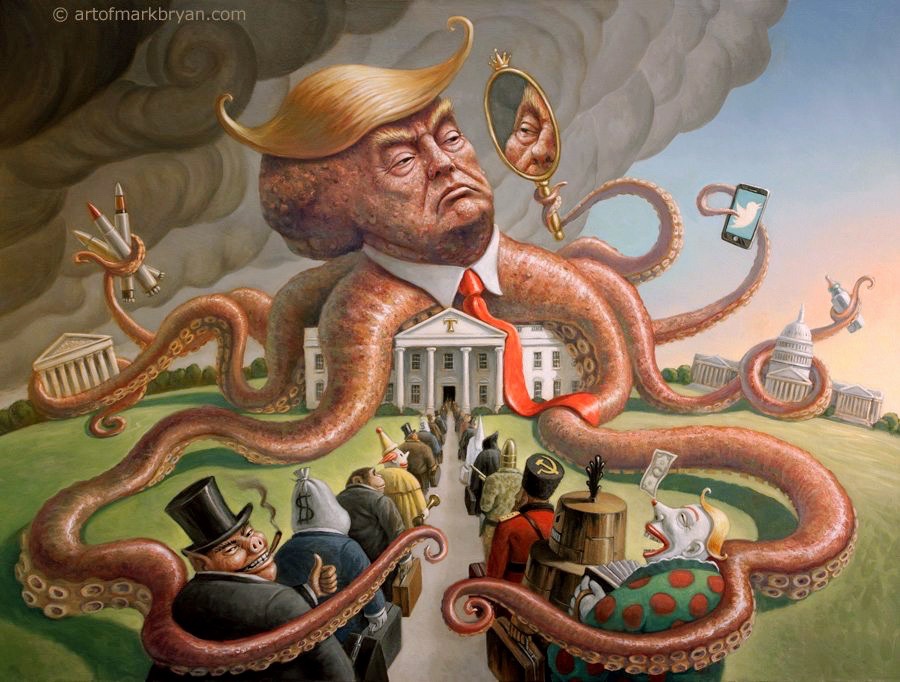
Image above: "The Nightmare" oil on canvas (30"x40") by Mark Bryan who says "The Kraken has been released from the depths, and the Trumpocalypse is at hand. Hang on tight, it’s gonna be a rough ride Back to when things were “great”." Click to enlarge. From (http://www.artofmarkbryan.com/the-nightmare/).

The mules of Wall Street were back at it again, buying the dips after the overnight whoosh downward in the futures market. Apparently, it will take an actual two-by-four between the eyes to break a habit that has been working for 96 months now since the March 2009 post-crisis bottom.

We think it is plain as day, however, that we are in a new ball game that the "stimulus-blinded” mules don’t see coming at all. To wit, they have been juiced for eight years running by the Keynesian apparatchiks at the Fed who needed permission from exactly no one to run the printing presses full tilt or to rescue the market with a new round of QE or an extension of ZIRP whenever the indices began to wobble.

But now, even the money printers have made it clear in no uncertain terms that they are done for this cycle, anyway, and that they will be belatedly but consistently raising interest rates for what ought to be a truly scary reason.

That is, the denizens of the Eccles Building have finally realized that they have not outlawed the business cycle after all and need to raise rates toward 2-3% so that they have headroom to "cut" the next time the economy slides into the ditch.

Instead, they are merely storing up monetary ammo for the next downturn.

But the Wall Street mules keep buying the dips anyway because they are under the preposterous delusion that one source of "stimulus" is just as good as the next.

And since the gamblers have now decreed that the "stimulus" baton be handed off to fiscal policy, it only remains for Congress and the White House to shape up and get the job done with all deliberate speed.
But they won’t.

Not in a million years.

The massive Trump tax cut and infrastructure stimulus is DOA because Uncle Sam is broke and the U.S. economy has slithered into moribund old age.

In that context, it’s not remotely the same as the 12  members of the FOMC sitting behind closed doors for two days jawing about the short-term economic weather; and then at the conclusion of their gabfest, ordering the New York Fed’s open market desk to flood the canyons of Wall Street with cash by buying another $80 billion of bonds with digital credits conjured from thin air.

Au contraire. Fiscal policy is inherently an exercise in herding cats and an especially impossible one when the cupboards are bare.

The essence of the matter at the present state of play is the legislative equivalent of "no ticky, no washy."

Without a 10-year budget resolution for FY [fiscal year] 2018 and associated reconciliation instructions, there is no possibility of passing a tax bill or even an infrastructure spending boondoggle.

But hammering out a budget resolution, passing it in each house, and reconciling the differences in conference would take months under the best of circumstances. But given the parlous state of Uncle Sam’s fiscal condition and the partisan acrimony that already suffuses Washington in the era of Trump, passage of a budget resolution by summer would be a miracle in itself.

Indeed, even the thought of surmounting this next daunting legislative obstacle course puts to rest this week’s particular Wall Street fantasy. Namely that after being burned by the Freedom Caucus on Obamacare Lite, the Trump White House will now "pivot" to the middle and form a coalition with the Democrats to make a deal on corporate tax cuts and infrastructure spending.

Yes, and if dogs could whistle, the world would be a chorus.

That is to say, there is no conceivable fiscal policy menu that could be agreed upon by Speaker Ryan, Nancy Pelosi, Chuck Schumer, and the Donald, and then be shoe-horned into a 10-year budget resolution.


In effect, the Fed is saying to Wall Street: "Price in" a recession because we are!

After all, our monetary central planners are not reluctantly allowing interest rates to lift off the zero bound because they have become converts to the cause of honest price discovery—-nor are they fixing to liberate money rates, debt yields, and the prices of stocks and other financial assets to clear on the free market.

Yet without a budget resolution and reconciliation instructions, there is not a fiscal stimulus "ticky" and no grand bipartisan compromise on building airports and slashing corporate tax rates.

So what lies directly ahead, therefore, is another bumbling attempt by the White House and Congressional Republicans to hammer out an FY 2018 budget resolution and what amounts to a 10-year fiscal plan. And it is there where the whole fantasy of the Trump Stimulus comes a cropper.

There are not remotely 218 GOP votes for what would be a $12 trillion-13 trillion add to the national debt with the Trump Stimulus program over the next decade—-even with all the "dynamic" scoring and revenue "reflows" that are imaginable.

To be sure, this is why the GOP Congressional leadership stoutly insists on a deficit-neutral tax cut. They are keenly aware of the debt monster they have been kicking down the road—-even if the headline-reading robo-traders of Wall Street are not.

What that means, in turn, of course, is that the rapidly fracturing Trump/Republican coalition must find the offsets on the spending side of the ledger.

In short, the whole enterprise amounts to budgetary madness and demonstrates the monumental magnitude of the Debt Trap that has enveloped the Imperial City.

And the “buy the dip” crowd will soon be getting that two-by-four between the eyes.

So now is not the time to buy.


.

Advantages of self employment

SUBHEAD: Working for yourself provides avenues of wealth-building that are not available to employees.

By Charles Hugh Smith on 25 OCtober 2016 for Of Two Minds -
(http://www.oftwominds.com/blogoct16/SE-overhead10-16.html)


Image above: Wilbur Wright working in the Wright brother's bicycle shop in Dayton Ohio in 1897 at age thirty. From (https://www.bowhunting.com/blog/2013/07/29/creating-a-home-bow-shop/).

There are still opportunities to not just earn a wage, but the overhead, profit and capital skimmed by global corporations.

So how can someone earning $15 an hour as an employee get ahead? The short answer is: they can't. One worker earning $15/hour will struggle to get ahead, which I define as building capital that generates an income stream.

A family with four adults working full-time at $15 an hour with benefits can get ahead; together, they're earning $60/hour plus another $40/hour in benefits. Assuming they live under one roof and live frugally, their combined earnings of $100/hour will enable investing in income-producing capital.

There is another path to getting ahead: self-employment. Working for yourself isn't for everyone, but it does provide two avenues of wealth-building that are not available to employees: overhead and capital accumulation.

Consider a typical Corporate employee, and what the company charges customers for their time. The corporation charges the customer $100 an hour for the employee and pays the employee $20 an hour.

The other $80 an hour goes to the corporation for labor overhead (Social Security, healthcare, pension /401K contribution, workers compensation insurance, etc.), general overhead (office, vehicles, accounting, Internet, phones, etc.) and profit.

Now consider the self-employed person who charges $70 an hour for the same work. The customer not only gets a 30% discount, they get someone who is motivated to do the job well enough to earn a referral or renewal of the contract.

The self-employed worker has $50/hour for overhead and hopefully some profit. The corporate employee earning $20/hour has to pay for his/her own vehicle, Internet service, etc. out of his/her wage.

The self-employed person pays the business-related expenses for vehicles, tools, Internet and phone service, accounting, home office, healthcare and other overhead expenses with pre-tax income--the $50 an hour he/she earns above and beyond the $20/hour wage.

The self-employed worker is also constantly investing in the capital of his/her enterprise. Capital comes in many forms: new tools, skills, contacts, collaborators/ subcontractors-- all the many variations of intellectual, social and human capital that create value.

In the corporate/employee setting, the corporation captures much or most of the employees' capital accumulation. The self-employed worker captures 100% of all capital accumulated.

Over a decade, this accumulated capital generates wealth that is unavailable to employees of corporations or the state. If we compare wealthy people with everyone else, what we notice is the wealthy own businesses and have very little debt, while everyone else owns very little productive capital while being burdened with plenty of debt.

Is it easy to be self-employed / start a new enterprise? No, it isn't. If anything, it's become more difficult in an era of corporate/ cartel dominance and regulatory capture.

But there are still opportunities to not just earn a wage, but the overhead, profit and capital skimmed by global corporations. Entrepreneurial success ultimately flows not from just from specific skills but from the eight essential skills that anyone can develop--skills I describe in Get a Job, Build a Real Career and Defy a Bewildering Economy.

Let's face it--lots of stuff no longer works very well. As costs rise, globalization supplies defective, pirated parts, and fewer people care due to burn-out, more and more of everyday life falls into the category of "no longer works very well."

Every one of those things that no longer works well offers an opportunity for a self-motivated person to fix someone else's problem-- and not just for a wage, but for the overhead, profit and accumulated capital that is currently skimmed by global corporations.

.

Elites lost consent of the governed

SUBHEAD: The Great Divide in America is between the ruling Elite and the governed they have strip-mined.

By Charles Hugh Smith on 20 October 2016 for Of Two Minds -
(http://www.oftwominds.com/blogoct16/consent-of-governed10-16.html)


Image above: Illustration of an uprising of peasants revolting against overlords. From (https://steamcommunity.com/sharedfiles/filedetails/?id=501698481).

Brimming with hubris and self-importance, the ruling Elite and mainstream media cannot believe they have lost the consent of the governed.

Every ruling Elite needs the consent of the governed: even autocracies, dictatorships and corporatocracies ultimately rule with the consent, however grudging, of the governed.

The American ruling Elite has lost the consent of the governed. This reality is being masked by the mainstream media, mouthpiece of the ruling class, which is ceaselessly promoting two false narratives:
  1. The "great divide" in American politics is between left and right, Democrat or Republican.

  2. The ruling Elite has delivered "prosperity" not just to the privileged few but to the unprivileged many they govern.
Both of these assertions are false. The Great Divide in America is between the ruling Elite and the governed that the Elite has strip-mined.

The ruling Elite is privileged and protected, the governed are unprivileged and unprotected. That's the divide that counts and the divide that is finally becoming visible to the marginalized, unprivileged class of debt-serfs.

The "prosperity" of the 21st century has flowed solely to the ruling Elite and its army of technocrat toadies, factotums, flunkies, apparatchiks and apologists.

The Elite's army of technocrats and its media apologists have engineered and promoted an endless spew of ginned-up phony statistics (the super-low unemployment rate, etc.) to create the illusion of "growth" and "prosperity" that benefit everyone rather than just the top 5%.

The media is 100% committed to promoting these two false narratives because the jig is up once the bottom 95% wake up to the reality that the ruling Elite has been stripmining them for decades.

As I have tirelessly explained, the U.S. economy is not just neoliberal (the code word for maximizing private gain by any means available, including theft, fraud, embezzlement, political fixing, price-fixing, and so on)--it is neofeudal, meaning that it is structurally an updated version of Medieval feudalism in which a top layer of financial-political nobility owns the engines of wealth and governs the marginalized debt-serfs who toil to pay student loans, auto loans, credit cards, mortgages and taxes--all of which benefit the financiers and political grifters.

The media is in a self-referential frenzy to convince us the decision of the century is between unrivaled political grifter Hillary Clinton and financier-cowboy Donald Trump. Both belong to the privileged ruling Elite: both have access to cheap credit, insider information (information asymmetry) and political influence.

The cold truth is the ruling Elite has shredded the social contract by skimming the income/wealth of the unprivileged.

The fake-"progressive" pandering apologists of the ruling Elite--Robert Reich, Paul Krugman and the rest of the Keynesian Cargo Cultists--turn a blind eye to the suppression of dissent and the looting the bottom 95% because they have cushy, protected positions as tenured faculty (or equivalent).

They cheerlead for more state-funded bread and circuses for the marginalized rather than demand an end to exploitive privileges of the sort they themselves enjoy.

Consider just three of the unsustainably costly broken systems that enrich the privileged Elite by strip-mining the unprivileged: healthcare (a.k.a. sickcare because sickness is profitable, prevention is unprofitable), higher education and Imperial over-reach (the National Security State and its partner the privately owned Military-Industrial Complex).

While the unprivileged and unprotected watch their healthcare premiums and co-pays soar year after year, the CEOs of various sickcare cartels skim off tens of millions of dollars annually in pay and stock options.

The system works great if you get a $20 million paycheck. If you get a 30% increase in monthly premiums for fewer actual healthcare services--the system is broken.
.

TPP secret Super Court

SUBHEAD: Financiers will use TPP court to bet on lawsuits against countries, while taxpayers foot the bill.

By David Dayan on 29 August 2016 for Huffington Post -
(http://www.huffingtonpost.com/entry/isds-lawsuit-financing-tpp_us_57c48e40e4b09cd22d91f660)


Image above: Still frame from anti TPP video below. From (https://www.youtube.com/watch?v=xXMJ-_93odY).

A secretive super-court system called ISDS is threatening to blow up President Barack Obama’s highest foreign policy priority.

Investor-state dispute settlement — an integral part of the Trans-Pacific Partnership trade deal — allows companies to sue entire countries for costing them money when laws or regulations change. Cases are decided by extrajudicial tribunals composed of three corporate lawyers.

Buzzfeed, in a multi-part investigation launched Sunday, called it “the court that rules the world.”

Although the ISDS process has existed for years, TPP would drastically expand it. The most common criticisms of the system are that it’s secret, that it’s dominated by unaccountable big-firm lawyers, and that global corporations use it to change sovereign laws and undermine regulations. That’s all true.
But here’s what most of the coverage and the critics are missing.

The ISDS system ― which is now written into over 3,000 international trade treaties, including NAFTA ― was designed to solve a specific problem.

When corporations invest abroad, they fear that their factories might be nationalized or their products expropriated by governments that also control the local courts. ISDS is meant to give companies confidence that if a country seizes their accounts or factories, they’ll have a fair, neutral place to appeal.

But instead of helping companies resolve legitimate disputes over seized assets, ISDS has increasingly become a way for rich investors to make money by speculating on lawsuits, winning huge awards and forcing taxpayers to foot the bill.

Here’s how it works: Wealthy financiers with idle cash have purchased companies that are well placed to bring an ISDS claim, seemingly for the sole purpose of using that claim to make a buck. Sometimes, they set up shell corporations to create the plaintiffs to bring ISDS cases.

And some hedge funds and private equity firms bankroll ISDS cases as third parties — just like billionaire Peter Thiel bankrolled Hulk Hogan in his lawsuit against Gawker Media.

It’s the same playbook that hedge funds were following when they bought up Argentine, Puerto Rican and other U.S. housing debt for pennies on the dollar. As The Huffington Post reported in May, the financiers were betting they could use lawsuits and lobbying to influence the political system in favor of the creditors like them and reap huge rewards.

Indeed, the damage of ISDS goes far beyond the money that investors manage to extract from public coffers and extends to the corruption of a political system by investors who buy off scholars, economists and politicians in pursuit of whatever policy outcome leads to a payoff.

And there’s nothing stopping plutocrats with agendas that go beyond profit-making from getting involved ― again the way Thiel did with Gawker. That alone changes the power dynamic: If you’re the government of Thailand, the billionaire you’re negotiating with has one extra threat at his disposal.

If these investors are able to cement ISDS as part of the Trans-Pacific Partnership, the opportunities for hedge funds to do what they’ve already done to Argentina will be endless ― possibly even in cities and states under financial pressure in the U.S., like Detroit and Illinois.

So-called third-party funding of “international arbitration against foreign sovereigns” has been expanding quickly, according to Selvyn Seidel, a pioneer in the litigation finance industry and now CEO of the advisory firm Fulbrook Capital Management.

“You can get an award for billions of dollars when that award would never come out in domestic law,” said Gus van Harten, a professor at Osgoode Hall Law School at York University in Toronto. “It’s just a jackpot for speculators.”

Here’s an example. In 2008, the Spanish government, under pressure from the eurozone to cut its budget during the financial crisis, began to reverse generous subsidies for solar energy. Spain reduced support for solar in stages. It changed the definition of its main solar incentive program in 2008, reduced the subsidies through two measures in 2010, placed a moratorium on subsidies for new solar plants in 2011, and added further restrictions in 2013.

Renewable energy activists could only shout into the air. But a group of investors hatched a plan.
Between November 2011 and December 2013, 22 different companies sued Spain in seven different cases over the subsidy changes – not in Spanish courts, but using ISDS.

RREEF, an investment fund subsidiary of Germany’s Deutsche Bank, and Antin, a private equity firm owned by French bank BNP Paribas, purchased their Spanish solar-thermal power plants in 2011, three years after the country began to roll back subsidies. But when they went to ISDS, they claimed they had expected subsidies to continue — not to continue declining.

“It feels like they acquired [the solar plants] in order to sue,” said Lora Verheecke, a campaigner for Corporate Europe Observatory, a Brussels-based research organization. Those two cases are still pending; a tribunal order allowed the RREEF case to advance in June.

The facts suggest that these investment funds made their purchases based not on the potential success or failure of the business they bought, not out of a concern for climate change and its consequences, but with the expectation that the Spanish government would continue its subsidy rollback, allowing the funds to sue in a special court unavailable to Spanish citizens. (To be fair, HuffPost can’t prove this to a certainty.)

ISDS represented the purpose of the investment ― or, to phrase another way, the use of ISDS was an asset-building strategy. Spain’s renewable energy subsidies have not been restored. Instead, a cash-strapped government is being forced to spend scarce resources defending a decision that was forced upon it.

Spain isn’t the only government defending these sorts of ISDS claims. PoÅ¡tová Banka of the Czech Republic bought sovereign debt from Greece in early 2010, well after rating agencies had downgraded the nation’s bonds. Two years later, after European leaders forced a restructuring of all Greek government bonds, PoÅ¡tová and its shareholder, Istrokapital of Cyprus, filed an ISDS claim, contending that the restructuring cost them millions.

Maybe Poštová bought the distressed bonds knowing that it could use arbitration as a fallback. Or maybe it bought the bonds with the intent to sue and gain a favorable return on its money through ISDS.

In several other cases, investors appeared to opportunistically purchase a company that had the ability to file an ISDS claim at exactly the right time.

In 2004, through one of its investment funds, the French bank Société Générale purchased a 50 percent stake in a public-private partnership to distribute electricity in the Dominican Republic. The purchase included intermediary companies from California, Delaware, Nevada and the Cayman Islands, and the corporate structure is nearly impossible to ascertain.

Because of the complex structure, the listed purchase price was only $2 U.S. (SocGen explained to arbitrators that it also arranged a “deferred purchase fee”). And the heart of the dispute ― the Dominican Republic’s alleged failure to pay negotiated compensation ― occurred years before SocGen made its purchase, according to the country, which argued SocGen was merely “buying a claim.”

Nonetheless, an ISDS tribunal ruled that “the principal objective of the transaction was the potential profitability of the investment.” It found that the Dominican Republic’s violations were ongoing and, through a settlement, awarded SocGen $26.5 million.

Since Greek and Roman times, the wealthy have placed bets on the outcomes of court cases. Under English common law, financing someone else’s lawsuit, known as champerty, was illegal. But the modern version of that, litigation finance ― which began in Australia in the 1960s ― has spread widely over the past two decades.

Investors seeking higher returns on their savings have looked to courtrooms instead of stocks or bonds, agreeing to bankroll cases and taking a portion of the cash awards if they win.

Third-party funding shields corporations from the upfront costs of litigation, making it easier to sue. Since companies generally don’t have to disclose that they’ve received third-party funding for an ISDS case, and since international arbitration usually proceeds in comparative secrecy, pursuing a claim through ISDS can shield companies from the public criticism that accompanies challenging a law in regular courts.

“You can actually ask for enormous amounts of money without anybody criticizing you,” said Verheecke of Corporate Europe Observatory.

With ISDS permitted under some 3,000 treaties, there are a huge number of opportunities to sue. And “unlike some other legal systems, the default remedy is a cash payment,” said Todd Tucker, a fellow at the Roosevelt Institute with a decade of experience researching trade and investment policy. The awards are also uncapped, meaning they can be enormous.

If a corporation sought damages on future profits in perpetuity and the arbitrators agreed, the sovereign would have no recourse. Dozens of cases have resulted in awards of over $100 million, according to a 2016 report from van Harten, the law professor.

Those possibilities have the ISDS claim-financing industry booming. Hedge funds, private equity firms and institutional investors are flocking to fund lawsuits as they would any other speculative asset, according to experts in the field. And the lack of transparency means that lawyers acting as arbitrators or advocates in one case could be unnamed investors in other cases, and nobody would ever know.

Defenders of ISDS argue that the outcome of any case is uncertain and that companies win only about one-quarter of the time. But that’s only the cases that have been publicly identified and it doesn’t include settlements, where the corporation can also extract a monetary award. If funding ISDS suits was really such a bad bet, the industry probably wouldn’t be expanding so quickly.

Fulbrook Capital Management’s primer on the litigation finance industry, updated this year, includes a section entitled “International, the name of the game.” It lists numerous big-city hubs for arbitration: London, New York, Paris, Toronto. About ISDS in particular, the primer reads, “Investment claims against Sovereigns are often subject to Treaty and, within the Treaty, subject to arbitration. This promotes investments. …

While investors are known to shy away from financing claims in ‘third world’ courts, particularly claims against the host court’s sovereign, they view international arbitration in a far more favorable light.”

Between 2009 and 2015, rulings in 16 ISDS cases have noted the existence of third-party funding, according to a report from Jean-Christophe Honlet, a partner at the global law firm Dentons. But the scale of third-party funding for ISDS cases is probably significantly larger than that number suggests.

The International Council for Commercial Arbitration suggests that at least 60 percent of ISDS cases “enquired about (but not necessarily sought or obtained) third-party funding before their cases were lodged.” Just this month, Canadian gold mining company Rusoro won a $1.2 billion claim against Venezuela that was “third-party funded,” according to Global Arbitration Review.

Burford Capital, Bentham IMF and Gerchen Keller are among the biggest litigation finance firms, working closely with these investors and specialized law firms to pursue commercial claims. Burford has publicly stated that it has tested ISDS cases.

While its chief marketing officer, Liz Bigham, would not reveal statistics on how many cases have been funded, she said via email, “Burford is a pioneer in the provision of arbitration finance and has been active in the field for well over a decade.”

She added that “commercial claimants involved in international disputes — as well as the law firms that serve them — see the tremendous benefits of shifting the significant cost and risk of pursuing claims off their own balance sheets.”

British law firm Freshfields is an adviser to Burford, and they have worked together on arbitration claims. Vannin Capital, another litigation funder, recently hired two Freshfields lawyers. The powerhouse law firm is one of the top three for ISDS cases, according to Corporate Europe Observatory.

The financing firms provide clients with a full litigation package at the outset, complete with what treaties to exploit and which law firms to hire. They even recommend arbitrators.

“Loads of law firms actually send alerts to clients,” said Verheecke. The alerts say “this country has just done this. It’s a good opportunity to sue.”

Often, the best country for international investors to sue is one that’s already in trouble. When a country uses emergency economic measures to protect its citizens, investors can argue that those measures conflict with an existing trade treaty. The subsequent flood of lawsuits can further hurt the country’s credit ratings and raise the cost of capital, while undermining its ability to attract future investment.

No country has been sued more in ISDS tribunals than Argentina. Of the 696 ISDS cases in the United Nations Conference on Trade and Development (UNCTAD) database, at least 59 were brought against that one country.

Since late 2001 and early 2002, when it defaulted on international debt and unpegged its currency from the U.S. dollar, Argentina has been forced to pay out $980 million in ISDS awards, in addition to the millions it spent to defend itself in arbitration.

Currently, some 60,000 bondholders are using ISDS to seek higher payouts on the value of Argentine debt. They claim they’re due $1 billion in lost profits because of the damaging effect of Argentine government policies.

Although bondholders are not traditional investors ― in the sense that they don’t actually build factories or sell services in a host country, they too have repeatedly used arbitration to get the highest returns on their debt purchases.

UNCTAD has warned that if those holding bonds that have lost value can access the ISDS back door to sue countries for monetary damages, then no country could ever escape its debt.


Video above: TPP establishes a global Corporate Supreme Court that is above the laws of Nations. From (https://www.youtube.com/watch?v=xXMJ-_93odY).


.