Showing posts with label Food Security. Show all posts

Another Half a Year passes

SUBHEAD: Same old Wake-up time. If you can't smell the smoke yet... take another deep sniff.

By Juan Wilson -
(INSERT_LINK_BETWEEN_PARENTHESES)


Image above: From ()

We trust you have buckled down and are anticipating that time when the gas stations and supermarkets are empty. Trust me... that time has just over an upcoming horizon. 

If you are not collecting rainwater, don't have a water well,  are not growing much of your own veggies and don't have a chicken coop (for eggs & meat) then you could get into some serious trouble when the farmers who use "supply ships" to stock Hawaii and can sell their all their crops without paying for the long Trans-Pacific shipping.

Despite how many "climate change observers" are in denial, it is obvious to me that the whole system of climate stability the expected results, will fall by the wayside.

If you have not lately  taken a look at climate warming, and the crucial environmental conditions necessary to allow the human population to quadruple in the last half century;  then as Mr. T (born Laurence Tureaud, May 21, 1952) said:

         "I pity the fool!" 

Here in Hawaii we have not yet seen catastrophically high temperatures or failures of rainfall in the crucial food growing areas that re experiencing environmental collapse... but it is a real possibility. Here on Kauai we have had an unusual low lying  ring cumulus clouds 360 degrees around our horizon with otherwise sunny skies.

It rained less than normal last winter. And  there is no reason to think it will be otherwise this coming winter. As the Pacific Ocean warms the clouds over Hawaii they will rise to higher altitude... meaning the rain clouds will be a little higher in altitude and miss supplying the water to all 5 of the of the only rivers in the state of Hawaii.

Much of Hawaii has been blessed for a long line with gentle climes. That is about to change, whether we like it or not... even if we are avid gardeners and living off the "grid" with our own water well powered by photovoltaic solar panels... the clouds will cease and the water table will drop.

When the shit hits the fan you will want to be in the greenest, wettest, sunniest place you can find inhabited by friendly like minded people. 

I hope you are there now. It takes a while to get it right, and there is not a lot of time left for Costco Walmart and Home Depot.

I am going to try and get back on a regular schedule of posting. The biggest hang-ups are difficulties getting the illustrations the way I want them it is much harder than it used to be... I know... picky... but that's important to me...


Radical Community Agriculture

SUBHEAD: Reconnecting people to growing of their own food may prove to be a radical means of healing.

By Jared Spears on 22 July 2022 in Resilience -
(https://www.resilience.org/stories/2022-07-22/the-radical-roots-of-community-supported-agriculture/)


Image above: Photo promoting education in organic farming.  (https://www.bestcolleges.com/blog/organic-farming-degrees-careers/).

Community-Supported Agriculture (CSA) is one of those rare ideas which combine transformative potential with an elegant simplicity. The CSA model of funding and sustaining locally-rooted agriculture has grown exponentially around the globe over the past four decades. Since the first formal CSA at Robyn Van En’s Indian Line Farm in South Egremont, Massachusetts in the early 1980s, CSAs have become a household fixture across the US and elsewhere; the most recent estimate by the USDA (2012) counted approximately 13,000 CSA farms in the US alone.

The success of community-supported farming has coincided with rising demand for organic food since the late 1970s. But the model’s popularization has meant that, sometimes, CSAs can be misrepresented as ‘just another way’ for consumers to purchase fresh, seasonal food. Important elements embedded into the CSA model, such as that of shared risk among members, make the arrangement more than merely transactional. In fact, the origins of the CSA movement in America have radical roots, drawn from the prominent environmental movement and a subculture dissatisfied with the prevailing economic system.

A 1985 paper newly digitized from the Schumacher Center archive, “Community Supported Food Systems”, clarifies the deeper motivations which brought CSAs to the US in their present form. It is a timely reminder of the transformative potential the broader concept of Community Supported Industry still holds today – especially in light of our urgent need to dramatically reduce carbon emissions and foster resilience in our supply chains.

Given renewed interest in the concepts of local food security and food sovereignty as principles of climate action and economic justice, it is worth revisiting the transformative potential of the CSA model as grasped by those who first put the idea into action.

Importing the CSA model from Switzerland

The community-supported farming movement popularized in the 1980s had multiple antecedents around the globe. With examples of localized farming initiatives from Chile, to Japan, to rural Black communities in the Southern US, this movement may be best thought of as a spontaneous, distributed reaction to the conditions of globalized food markets. At the same time, growing concern around the health impacts of chemical pesticides, as well as the environmental costs of fossil fuel-based fertilizers, added impetus to the organization of organic farming at a more human scale.

That said, the formalized CSA model which subsequently spread across the US and beyond was pioneered in the Southern Berkshires, in the state of Massachusetts. And as the “Community Supported Food Systems” paper shows, its character was highly informed by models developed earlier in Switzerland. The ethos and organizing principles of these Swiss examples were documented and brought to Massachusetts by one Jan Vander Tuin.

Vander Tuin, a champion of pedal-powered transport and car-sharing, would later go on to make his mark advocating for appropriate technology in transportation. But before all that, he was a disillusioned farm laborer looking for alternatives. As Vander Tuin recalled in a 1992 article in RAIN Magazine, he went to Switzerland in the early ‘80s from the US having “felt burned economically… with an eye open for alternatives to market agriculture.” As he described the attraction of Switzerland at that time:

The early 1980’s were inspiring years for Swiss activists. The youth were rebellious, and citizens at large asked questions of the nation that epitomizes capitalism. I saw many evolving solutions to problems that I, coming from the States, had written off as unsolvable.”

After some time working first-hand on an organic farm outside Zürich, Vander Tuin was directed to a successful producer-consumer food co-op in Geneva, which had been inspired by the cooperative movement in Chile during the Allende administration. Vander Tuin called the project the most radical food co-op group he had ever encountered: it “addressed almost every problem I’d encountered in modern farming.” This project’s philosophy went beyond ecologically sustainable practices and pesticide-free produce, addressing the steep economic challenges faced by organic farming in an era of big, corporate agri-business. 

The basic notion that consumers personally cooperate with producers to fund farming in advance, he wrote “makes for more efficient use of land… and much less stress for farmers…” In short, Vander Tuin recognized that this model made organic farming for local consumption not just economical, but also more elegant and communitarian – in a word, more beautiful.

What drove Vander Tuin, as expressed in the paper, is “the feeling that existing food infrastructures are hopelessly entangled in the societal/cultural systems, especially the ‘free’ market.” Rather than wait for planners and experts, Vander Tuin noted how, in the Swiss examples, “concerned consumers and frustrated food workers” decided to provide responsibly-grown organic food for themselves. Shared values such as organic growing and energy-conscious distribution were identified from the outset. Everything down to how shares were calculated – based on the amount of produce the average non-vegetarian consumes per year – underscores the ambition for local self-reliance in food production.

The document also highlights a strong desire for economic fairness at every step in CSA practices. The costs of start-up investment and land would “ideally…be divided up equally (or by sliding scale).” 

 In the Swiss example, wages for farm labor were to be estimated at “the average wage of worker in region – not banker unfortunately” Vander Tuin added with a dose of humor. “The emphasis in all economic thinking,” it concludes, “was not to work the maximum profit principle but on the need/cost coverage principle. This meant more trust and more participation.”

Finding like minds in the Southern Berkshires

Vander Tuin documented these practices, eager to bring them back to the US for implementation. He caught wind of a group in the Southern Berkshires who had set up a sort of buying club for locally-grown produce, including a handful of local growers meeting the demand. The Self-Help Association for a Regional Economy (S.H.A.R.E.) was a community micro-loan program which grew out of the activities of the E.F. Schumacher Society (precursor to the Schumacher Center) in South Egremont. 

Vander Tuin became aware of the group, according to Schumacher Center co-founder Susan Witt, after reading a news article about their novel SHAREcropper initiative. Community-members would pool to list requests for locally grown produce in the SHARE newsletter, enabling them to identify farmers to grow the food locally. Those growers, in turn, secured demand for their crops in advance.

In other words, SHAREcroppers was managing, in an ad-hoc way, what Vander Tuin envisaged as a systematic alternative to corporate, mono-crop agriculture.

When Vander Tuin presented his proposal to members of S.H.A.R.E., they promptly sent him down to the road to meet one of their growers: Robyn Van En, who ran Indian Line Farm. Robyn not only held equally radical ambitions, but possessed the roll-up-her-sleeves attitude needed to make them a reality. With a community around them dedicated to the cause and willing to help see through the implementation, they could set to work.

Having moved to the Southern Berkshires several years earlier from California, Van En was pursuing her own alternative vision for growing at Indian Line. She brought deep ethical convictions about humanity’s relationship with nature to inform the early CSA movement. She later articulated the ‘Ideals of Community Supported Agriculture’ for a CSA manual in such terms:

Agriculture… is the mother of all our culture and the foundation of our well-being. Modern farming…driven by purely economic considerations, has driven the culture out and replaced it with business: agriculture has become agribusiness… Our ideals for agriculture come to expression in the biodynamic method of farming which seeks to create a self-sustaining and improving ecological system in which…everything has its place in the cycle of the seasons… The community involvement in the rhythms of the seasons and the celebrations connected with them will also enable us to find our proper spiritual connection to nature again.”

With a new agricultural ethic clear from the start, Van En also recognized early on a need for a new economic approach as well. As she later described: “I knew there had to be a better way…something cooperative, that allowed people to combine their abilities, expertise, and resources for the mutual benefit of all concerned.” 

 When S.H.A.R.E. members introduced her to Vander Tuin in 1985, they “only had to talk for a few minutes,” according to Van En, to know that what he’d brought back from Switzerland articulated just the sort of community framework she’d been looking for. As she later summarized:

The prices we pay for food may be cheaper than ever, but the hidden costs… are being paid [in other ways]. Unlike agribusiness, which has the motto: ‘The end (profits) justifies the means (exploitation)’, CSA’s motto is: ‘The means (community) assures the end (quality food).’”

Planting the seeds of the CSA movement

The group’s first venture in 1985 involved shares for apples and cider from the orchard adjacent to the present-day Schumacher Center. After the growing season, shareholders were invited to the autumn harvest in a spirit of celebration. (Vander Tuin reportedly even designed and built a pedal-powered cider press for the occasion). Producers and consumers were brought together in relationship with the land and its produce, creating space for community while proving the viability of the CSA model.

The following season, Indian Line Farm became the first fully-fledged CSA in the US. Credit for the success of the model in the Southern Berkshires goes to the many members of the community who supported Indian Line in various ways. 

But it was only the beginning for Van En: an educator by training, she would go on to become a tireless advocate of the CSA model and biodynamic farming and a vocal critic of industrialized agribusiness. The propagation of the CSA model across North America in the following decades owes much to Robyn’s conviction and endurance.

A final aspect of the CSA concept, originally outlined by Vander Tuin, remained only a theory until Indian Line Farm came on the market in 1998, one year after Van En’s untimely passing. At that time the Community Land Trust in the Southern Berkshires and two area farmers formed a partnership with a local Nature Conservancy chapter to purchase the farm. Placing the land into the Community Land Trust in perpetuity was yet another innovation. 

Effectively decommodifying the land on which community food was grown while permitting the leaseholder to own the value of improvements, the move made good on an idea which, in Vander Tuin’s original proposal, appeared speculative: “community influenced land stewardship in the form of a ‘Community Land Trust’,” he wrote, seemed “applicable and desirable” compared to “normal ‘property’ arrangements.”

Today, the CSA model articulated by Van En and Vander Tuin remains a vital, community-based alternative to the host of health, environmental, and economic issues posed by industrial agribusiness. No wonder that the growth of CSAs has reportedly surged since 2020. Growing healthy, ecologically-sound food locally is, for a multitude of reasons, the most economical way for a community to provide for this most elemental of needs. 

Cutting out intermediaries and import dependency is a cornerstone of community food security and food sovereignty, as marginalized communities around the country and the world increasingly recognize. Combined with agro-ecological farming methods, relocalized agriculture holds great potential in our efforts to address climate change: reducing carbon emissions and helping to sequester carbon already in our atmosphere. And by layering on the innovative Community Land Trust model, affordable access to farmland can be secured for future generations of growers as well.

At the most human level, reconnecting people around the growing of their own food may prove to be among our most effective means of healing our widespread sense of disconnection from nature and community. It offers the promise for any community to rediscover how working in harmony with nature, rather than merely seeking to exploit it, can be as economical as it is beautiful.


.

Puerto Rican local food revolution

SUBHEAD: Puerto Rican farmers to envisage agriculture not reliant chemical companies and fossil fuels.

By Alex Sammon on 2 October 2018 for FoodTank -
(https://foodtank.com/news/2018/10/a-local-food-revolution-in-puerto-rico/)


Image above: A hillside at Plenitud Teaching Center in Puerto Rico, that grows ginger, turmeric, taro, string beans, and bananas. Plenitud uses practices such as terraces, swales, berms and other permaculture methods to manage stormwater and reduce erosion. From (https://www.nationalgeographic.com.au/people/puerto-ricos-farms-were-wiped-out-heres-how-theyre-bouncing-back.aspx).

A year has passed since Hurricane Maria first made landfall in Puerto Rico, destroying homes, roads, and vehicles in its path—and taking thousands of lives.

The island languished for months as an insufficient emergency response campaign attempted to restore basic services like water and power.

After a recent independent study, the official death toll was raised from the initial 64 to 2,975 through analysis done by The New York Times, citing malnutrition and other food-based ailments as possible culprits for surging mortality in the storm’s aftermath, estimated that number could be over 4,000.

How could this happen?

By taking out the island’s infrastructure like highways, trucks, gas stations, and more, the storm also wiped out its agricultural supply lines. Puerto Rico imports about 85% of all its food, producing just 15% of what’s consumed on the island. [IB Publisher's note: Hawaii imports a higher percentage than that.]

In the wake of the storm, people stood in lines for hours and walked barely-stocked aisles looking for canned, non-perishable foods.

Many relied on emergency responders and Federal Emergency Management Administration (FEMA) meals, made of packaged and processed foods that require little to no preparation, like the beef jerky and crackers you’d expect to find in a vending machine.

In harder-to-service rural areas on the island, the threat of starvation loomed large.

“They say that during Maria, Puerto Rico only had enough food for one week,” says Carmen Yulín Cruz, the mayor of San Juan, who became an international figurehead after calling out President Trump for his inadequate response to the crisis.

“I hate to say anything positive about Maria. But what the hurricane did was force us to look at the realities of life here and how our dependency on the outside weakens our ability to ensure our people are taken care of. Maria made it evident that we need agricultural sovereignty.”

The story of Puerto Rico’s food production is also the story of the island’s own colonial history.

Large-scale plantations replaced native farming during Puerto Rico’s days as a Spanish colony, resulting in the consolidation of agricultural land and landholding, as well as the number of crops being grown on it.

When the United States took over the island in the wake of the Spanish-American War in 1898, economic restructuring meant that the remaining agricultural activity focused only on cash crops like sugarcane and coffee.

Then, in the 1940s, Congress launched Operation Bootstrap, a campaign to overhaul the Puerto Rican economy that focused on manufacturing and tourism—moving even further away from agriculture.

Subsequent tax breaks and economic initiatives to encourage investment in these sectors solidified these moves.

Deliberately, over the course of years, an import-driven food system was put in place in Puerto Rico, and all other farming fell by the wayside.

“Puerto Rico’s economy has always been categorized by being an import economy: we produce things we do not consume but then we have to import things we do consume, especially in agriculture,” notes Gladys González-Martínez, a professor of agricultural economics at the University of Puerto Rico.

Still, Puerto Rican local farming had been experiencing the beginning stages of a renaissance even before the storm hit, spurred by the economic crisis of 2006.

According to statistics provided by the governor’s office, farm income grew 25% from 2012 to 2014, while the number of acres under cultivation rose by 50% between 2012 and 2016, generating at least 7,000 jobs.

That progress was short-lived: 80% of the island’s crops were destroyed in the storm. But, despite those losses, the seeds of a local agricultural had taken root. Some took the storm as inspiration.

At farms like Cosechas Tierra Viva in Las Piedras, run by Eduardo Burgos and Franco Marcano, where they grow kale, arugula, green beans, and eggplant for local farmers’ markets, the storm kicked them into high gear.

Just a month after Maria’s landfall, they converted the farm to run exclusively on solar energy and shifted their irrigation system’s source to rainwater.

“Maria was the push we needed to execute the ideas we had to expand our production,” Burgos told NBC News in July.

They’re not alone.

Agroecology—defined by the Food and Agriculture Organization of the United Nations as both a movement and practice of socially, economically, and environmentally sustainable development—is an approach to farming that promotes diversity through crop rotation, polycultures, or livestock integration, and uses natural systems and local knowledge like planting flowers to attract insects that keep pest levels under control.

Using agroecology has allowed Puerto Rican farmers to envisage an agriculture system not reliant on external inputs from chemical companies and fossil fuels. And the idea is rapidly taking hold in farms, schools, and community groups across the island.

Already, organizations like the Puerto Rico Resilience Fund are supporting the movement by establishing sites like the student-run farm at the University of Puerto Rico’s Río Piedras campus, while networks like the Organización Boricuá de Agricultura Ecológica de Puerto Rico are helping small farms like the Pachamama Bosque Jardín find their feet.

These projects are crucial for the island’s food security, but also for its protection from storms that are likely to grow in intensity and frequency due to climate change.

Surveys after hurricanes in the late 1990s in countries like Nicaragua and Cuba have shown that diversified, small-scale farms suffer less damage than bigger farms practicing conventional agriculture.

Already, the movement is making a noticeable difference. The Puerto Rican Department of Agriculture is aiming to have food imports down to 65% to 75% by the end of the year, which could represent as much as a 20% decrease on pre-Maria levels and a 30% drop from the island’s post-Maria peak.

Ricardo Fernandez, CEO of Puerto Rico Farm Credit, sees signs of the transformation. People are flocking to farmers’ markets; university students are signing up for agricultural classes.

“There’s a resurgence now, because we have to re-invent ourselves,” he says in a recent interview with NPR. For an island facing serious questions about its own colonial legacy and territorial status, local food may well be the first step towards a more independent Puerto Rico.

See also:
Ea O Ka Aina: The Off-Grid poster child 9/20/18
Ea O Ka Aina: 13 Years of Permaculture 9/5/17
Ea O Ka Aina: Permaculture in Hawaii 4/26/17
Ea O Ka Aina: Permaculture Cool Lab 4/5/17
Ea O Ka Aina: Forging Permaculture Hand Tools 2/15/17
Ea O Ka Aina: Forest Farms 8/16/16
Ea O Ka Aina: Permaculture, Climate & Survival 10/23/15
Ea O Ka Aina: The Permaculture Fail 8/21/14
Ea O Ka Aina: Permaculture Development 3/18/14
Ea O Ka Aina: The trouble with Permaculture 1/23/14
Ea O Ka Aina: Permaculture - Let's get real! 7/17/13
Ea O Ka Aina: Paradise Lot 6/7/13
Ea O Ka Aina: Programmable Permaculture
3/1/13
Ea O Ka Aina: Permaculture - Use of Space 5/24/12
Ea O Ka Aina: Permaculture - Design Diversity 5/24/12
Ea O Ka Aina: Permaculture - Problems to Solutions 5/24/12
Ea O Ka Aina: Permaculture - Relative Location 5/14/12
Ea O Ka Aina: Seattle Permaculture 2/29/12
Ea O Ka Aina: Permaculture Taking Off in Hawaii 3/29/11
Ea O Ka Aina: UN is Getting Into Permaculture
2/12/11
Ea O Ka Aina: Permaculture as a Venture 1/25/11
Ea O Ka Aina: Bill Mollison on Permaculture 11/12/10
Ea O Ka Aina: Permaculture - Multiple Functions 3/29/10
Ea O Ka Aina: Introduction to Permaculture
3/24/10
Ea O Ka Aina: Permaculture - Growing Zones
3/22/10
Ea O Ka Aina: Permaculture Realists & Optimists 5/2/09
Ea O Ka Aina: Permaculture Design Course 2/16/09
IslandBreath: Cultural Change at the Limits to Growth 5/7/2008
IslandBreath: The Garden of Eden 4/22/07
IslandBreath: Kauai 2007-2029 12/15/06
IslandBreath: How Cuba survived Peak Oil 7/23/06

.

RoundUp and honey bee decline

SUBHEAD: Millions of bees mysteriously disappeared, leaving farms with fewer pollinators for crops.

By Tyler Durden on 26 September 3018 for Zero Hedge -
(https://www.zerohedge.com/news/2018-09-25/weed-killer-linked-colony-collapse-disorder-honey-bees)

http://www.islandbreath.org/2018Year/09/180927roundupbig.jpg
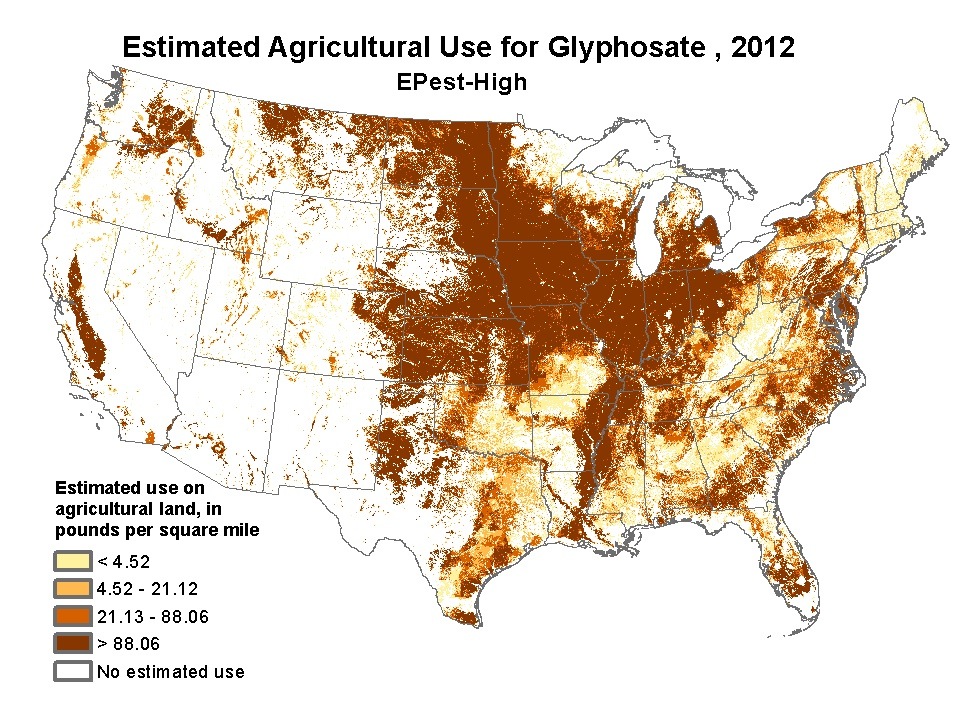
Image above: United State Geological Survey map of the continental states showing extent and intensity of the use of glyphsoates applied to cropland in 2012. Click to enlarge.  From (https://water.usgs.gov/nawqa/pnsp/usage/maps/show_map.php?year=2012&map=GLYPHOSATE&hilo=L).

Glyphosate, the world's most common weed killer, has caused significant concerns over its potential risk to human health, animals, and the environment for several decades. Earlier this month, a US court awarded a groundskeeper $289 million who claimed Bayer AG unit Monsanto's glyphosate-based weed-killers, including Roundup, gave him terminal cancer.

Now, a new report from PNAS alleges that glyphosate may be indirectly killing honey bees around the world, a threat that could potentially also leave a major mark on the global economy.
“We need better guidelines for glyphosate use, especially regarding bee exposure, because right now the guidelines assume bees are not harmed by the herbicide.
Our study shows that’s not true.” said Erick Motta, the graduate student who led the research, along with professor Nancy Moran.
UT News of The University of Texas at Austin says that glyphosate interferes with an important enzyme found in plants and microorganisms, but not in animals, it has long been assumed to be nontoxic to animals, including humans and bees.

However, the latest study reveals that by altering a bee’s gut microbiome — the ecosystem of bacteria living in the bee’s digestive tract, including those that protect it from harmful bacteria — glyphosate jeopardizes its ability to fight infection.

For this study, scientists exposed honeybees to glyphosate at normal levels found on farms. The researchers painted the bees' backs with colored dots so they could be tracked and later recaptured.

Three days later, they saw that the honeybees exposed to glyphosate suffered a significant loss of bacteria in their guts and were more susceptible to infection and death from harmful bacteria.
“Studies in humans, bees and other animals have shown that the gut microbiome is a stable community that resists infection by opportunistic invaders,” Moran said. “So if you disrupt the normal, stable community, you are more susceptible to this invasion of pathogens.”
In recent times, US beekeepers have reported a massive loss of bees or Colony Collapse Disorder (CCD). Millions of bees mysteriously disappeared, leaving farms with fewer pollinators for crops. Officials have been baffled, and the media has been quiet about the bee population collapse.

Explanations for the phenomenon have included exposure to pesticides or antibiotics, habitat loss, and bacterial infections. The latest study now adds herbicides to the list as a possible contributing factor.
“It’s not the only thing causing all these bee deaths, but it is definitely something people should worry about because glyphosate is used everywhere,” said Motta.
Among the nuts, almond growers have the largest need for bee pollination. Bee pollination is worth $15 billion to the US farming industry.

Any sharp change in global bee populations could affect the beef and dairy industries. Bees pollinate clover, hay, and other forage crops. As the bee population dwindles, it increases the cost of feedstock.

That forces inflation into beef and milk prices at the grocery store and ultimately hurts the American consumer. This could then lead to increased imports of produce from foreign countries where bee populations are healthy, further widening the trade deficit.

Couple this with the current trade war and this particular "black swan" - or rather "black bee" - problem, may be just the tipping point that finally forces the US economy to catch down to the rest of the world.


Image above: United State Geological Survey map of the continental states showing extent and intensity of the use of glyphsoates applied to cropland in 1992, twenty years earlier than map above. Note that  at that time the Central Valley in California was the densest and most intense use of glyphosates on food crops.  From (https://water.usgs.gov/nawqa/pnsp/usage/maps/show_map.php?year=1992&hilo=H&map=GLYPHOSATE).

See also:
Ea O Ka Aina: Bayer Beware! 9/11/18
Ea O Ka Aina: Side effect of Monsanto's Roundup 6/24/17
Ea O Ka Aina: Glyphosate harms gut enzyme 6/21/17
Ea O Ka Aina: RoundUp for Breakfast 4/20/16
Ea O Ka Aina: RoundUp carcenogenic in California 9/14/15
Ea O Ka Aina: Roundup Threatens Coral Reefs 12/30/14
Ea O Ka Aina: Word out on Roundup soaked wheat 11/24/14
Ea O Ka Aina: Gluten or Glyphosate Intolerance? 11/18/14
Ea O Ka Aina: Roundup and Lymphoma 6/10/14
Ea O Ka Aina: Roundup and human health 4/25/13
.

Comfy?

SUBHEAD: After a hard day's work homesteading, snuggle down for sunset and the dusky onset evening stars and conversation. 

By Juan Wilson on 26 July 2018 for Island Breath  -
(http://islandbreath.blogspot.com/2018/07/comfy.html)

http://www.islandbreath.org/2018Year/07/180726yardpano.jpg
Image above: Detail of backyard panorama. On building hotwater panel, solar PV panels, rain catchme4nt gutter to 1,000 water tank. In yard foreground: pepper trees, two cassava, ginger. Midground: papaya, 12 cacao trees. Backgound: Macadamia nut and litchi tree, to right is corner of enclosed raised-bed garden.  Photo by Juan Wilson. Click to see panorama view. ().

Homesteading in retirement is hard work. In some ways harder than having a nine-to-five job forty hours a week. With the full time job eating out or buying prepared food was normal.

It's not as demanding as commercial farming, but there are dozens of tasks that keep piling onto the "to-do" list as well as many regular routines needed to be done frequently... even on a half acre lot.

Checking the fruiting plants daily is a daily activity. Avocado, mango and macadamia nut trees are seasonal.

It getting into macadamia nut season right now. We have three producing trees now. That's enough macadamia nuts in a season to get us through the year.

We make macadamia nut butter, and eat roasted nuts for snacks. We need to check under each tree a few times a day. In July it begins as a trickle of a few dozen in a day. Later we will be picking up a few hundred nuts in a day.  Lots of bending over.

In their own seasons are mango, avocado and always papaya. Other fruiting trees are oranges, tangerines, grapefruit, limes, lemons... and that's just the citrus. There are also a few oddballs like cacao, starfruit, litchi, noni, surinam cherry and Hawaiian chili peppers.

Plus, we cannot forget the staples like taro, cassava and breadfruit, plantain, banana, coconut.

This does not count the daily tending, weeding, watering and harvesting of our 16' by 32' raised-bed garden.

Nor does this work does includes the husking, peeling, chopping, drying, canning, and other processes needed daily to keep the plant production converting into usable fresh or storable food.

Are you having fun yet? Well don't forget the composting of plant waste, amending the soil,  trimming of trees, etc.

Homesteading is more than a full-time job. It's a life. And about the most secure and rewarding one.

We are inching our way back to the Garden of Eden. Don't be left behind.


.

A trashcan of canned food

SUBHEAD: When the SHTF and the supermarkets sold out this will get you through the worst of it.

By Juan Wilson on 23 July 2018 for Island Breath -
(http://islandbreath.blogspot.com/2018/07/a-trashcan-of-canned-food.html)


Image above: Galvanized garbage can used to store canned food in outdoor conditions out of the rain. Photo by author.

Living in rural Hawaii we can year round grow fruits and vegetables for our table. We also can provide ourselves with all the eggs (and more) that we need with eight hens in a 4'x16' henhouse.

We are not vegetarians. Our fruit, vegetable and eggs are vital to us but we continue to rely on other sources for much of our protean.

Although we occasionally eat one of our hens when they stop laying, we are not yet raising fish, birds or mammals for dinner table. We rely on others for our fresh fish, poultry and meat.


In our garage is a steel galvanized garbage can. It is filled with canned food.


Image above: Inside the trashcan we keep canned food. Mostly items with hearty content, high in protein. Photo by author.

The meat in cans includes Spam (pork); corned beef hash, corned beef, canned roast beef; canned chicken, canned tuna, canned sardines, canned kippers (fish); soups including clam chowder, turkey rice, pea soup with ham. In addition we keep canned pinto, black, garbonzo and kidney beans; canned beef and chicken broth, and canned whole tomatoes for mixing with fresh vegetables.

With these canned items we also combine rice, rice pasta and also yard grown breadfruit, cassava or taro to create filling savory meals with plenty of protein - without having to throw a steak on the BBQ.

When our trashcan is filled there is enough food to stretch our "food independence" to a few months.

Image above: These foods are not just to get us through a disaster. We incorporate small amount of them into our regular cooking routines allowing us to get some experience getting the best out of them - before having to depending on them. Photo by author.

It should be added that this cache of food needs to maintained and refreshed over time. Even though many items are good for years we keep an eye on expiration dates and eat down (and replace) those items we feel need to be replaced.

We do not buy and store fresh water. We use filtration on water and have 1,500 gallons of water stored from a well and rain catchment system. We avoid packaged frozen "TV" dinners and freeze dried military style MREs.  They are too costly and unpleasant to eat.

We find it better to mix canned products with our own own fresh produce.


.

Maui Breadfruit Company

SUBHEAD: With community help this local business was able to get off the ground and help others do the same.

By John Cadman on 27 June 2018 in Resilience - (https://www.resilience.org/stories/2018-06-27/maui-breadfruit-company-receives-slow-money/)


Image above: A pile of breadfruit (left) and John's business partner Maile (right). Note the volume of large tough fallen leaves typical of  breadfruit trees. From original article.

We all have them; you know, those things we call defining moments in our lives. I’ve had several, but the one that stands out most for me occurred in the Fall of 2012. I was asked to give a cooking demo at the local chapter of the Farmers Union on Maui.

I said, “Sure, what would you like me to focus on?”

The Farmers Union said, “How about breadfruit?”

I thought, “OK, I know a little bit about that—heck, I had even eaten and cooked with breadfruit a few times.” Just so it sounded like I knew what I was talking about, however, I figured I better do a little research and experimentation.

I can’t really explain it, but for some reason the light just came on for me. I quickly realized what an amazing food breadfruit is.

You see, it is one of the original canoe plants that the ancient Polynesian voyagers brought to Hawaii. It has been grown throughout the Polynesia as a staple food crop for many centuries. The tree itself has many uses, but the fruit is what is so amazing.

When immature it is firm, very much like a potato. As it ripens it becomes soft, sweet, and deliciously aromatic. The trees are amazingly easy to grow, extremely high yielding, and are very tolerant to many types of growing conditions.

Sadly, it has become a neglected food here in Hawaii, but I was determined to change this. I am convinced that breadfruit has more potential to address food security than does any other crop in Hawaii, where we import about 90% of what we eat.

Developing our local small-chain food supply is truly essential in overcoming this staggering figure.

So, with my newfound passion for this forgotten fruit, I began experimenting and making all kinds of delicious things using breadfruit in both its starchy and sweet stages. Fast-forward about a year, and I had come up with a dessert that was nothing short of amazing—or so I was told.


Image above: A slice of John's Pono Pie. Note Maui upcountry is one of the few places in Hawaii that can grow commercial strawberries. From original article.

Naturally, the next step was to quit my secure and high-paying job and go into selling breadfruit pies. That was four years ago, and now Pono pies are sold on all four of the major Hawaiian Islands, at health food stores, and in some excellent restaurants.

In Hawaiian, “Pono” means correct, beneficial, and done in the right way. I have tried to adhere to this principle in my business. One way is to source my ingredients locally. My breadfruit, sweet potatoes, bananas, honey, macadamia nuts, coconut, and coffee are all grown in Hawaii.

One of the greatest unintended consequences of bootstrapping my business is that I can help other aspiring food entrepreneurs by renting out kitchen time at my factory. This is a win-win situation for everyone involved.

Currently, there are no truly affordable options available to anyone who wants to develop a value-added product here on Maui.

Presently, five fledgling companies use my kitchen space. Although I have watched at least that many companies start up only to shut down when the harsh realities of small-company food production became all too real, at least they didn’t have to make significant investments in building or leasing an entire kitchen to find this out.

For my company, the additional income really helped in the early growth stages when cash flow is so crucial.

You see, I started the company with very little money. I believe that growing a company with as little debt as possible is the best way; but sometimes it is just not possible to expand without some financial assistance.

That’s where Slow Money Hawaii came in. Previously, I had my labels printed locally in small batches at a cost of $0.31 per label. My printer told me that if I could order in bulk it could get the cost down to $0.06 per label, but that would require ordering at least 100,000 labels.

Slow Money Hawaii connected me with some very supportive and enthusiastic community members who believe in breadfruit as much as I do.

The very generous loan terms provided by Slow Money enable me to make the monthly payments and still increase my profit. I really hope that someday I will be able to return the favor and help other aspiring food entrepreneurs as a Slow Money lender.

See also:
Ea O Ka Aina: Changing the culture and ourselves 7/30/16
Ea O Ka Aina: In Soil We Trust 2/27/11
Ea O Ka Aina: Slow Money 12/16/10
Ea O Ka Aina: SuperBus vs StraddleBus 12/4/10
Ea O Ka Aina: COP16 as Cancun disappears 12/1/10
Ea O Ka Aina: Bringing Money Down to Earth 11/22/09
Ea O KA Aina: Breadfruit Recipe Experiments 11/15/09
Ea O Ka Aina: Investing in our community 5/25/09
.

Downshifter's way to RetroSuburbia

SUBHEAD: Review of book by David Holmgred on a resilient future for today's suburbanites.

By Bob Hopkins on 26 April 2018 for Resilience -
(http://www.resilience.org/stories/2018-04-26/my-review-of-david-holmgrens-retrosuburbia/)


Image above: Photo enactment of living in RetroSuburbia from the original article.

I am increasingly fascinated by two words I think are vital to our future, but which I see declining in the world around us, “what if?”

Navigating a way to a safe, nurturing and liveable future requires our coming together to create "what if?" spaces, places and events where we can come together with others to ask those questions.

The Transition movement, for me, has always been one of those spaces, the invitation for people to join up with others to look at their place through what if lenses.

David Holmgren’s new book is a fascinating, and intoxicating blast of "what if?" which ought to be put through every suburban letterbox in the world, although given its size I have doubts that it would fit.

I am a huge Holmgren fan. ‘Permaculture: principles and pathways beyond sustainability’ changed my life. The "what if?" at the heart of RetroSuburbia is “what if our suburbs were reimagined and repurposed to be sustainable, productive and vibrant?” Good question.

It takes his ‘permaculture flower’ at its basis, as the lens through which it looks at the possibilities of how the suburbs could be if catalysed with imagination and possibility.

Although written very much for the Australian context, there is much in its almost 600 pages to inspire suburban permaculturists anywhere.

There’s a treasury of Holmgren insight on topics from retrofitting your house, harvesting water and storing food, to setting up a food garden, managing with less than perfect urban soils, working with animals in the suburbs and maximising diversity.

You’ll find guidance on different models of living together, making decisions, creating a livelihood, reimagining your family finances, planning for disasters, ‘rearing self-reliant and resilient children’ and so much more.

While ‘Permaculture’ was a book that had so many brilliant ideas it struggled sometimes to imagine that you might need some time and space, or some nice photos even, to be able to digest them, ‘Retrosuburbia’ is a different beast.

Presented in full colour it is rich with photos, case studies from his own life and the lives of people he knows, every page drips with ideas, experience and advice with dirt beneath its nails.

A couple of years ago, David and I debated publicly his ‘Crash on Demand’ paper, where he declared that “an argument can be mounted for putting effort into precipitating that crash, the crash of the financial system”.

I disagreed, arguing that we needed to be very careful what we wish for. What I love about ‘Retrosuburbia’ is that the concerns that underpinned that paper are still present here, but beautifully couched in an utterly practical, utterly convincing vision for the suburbs.

It is the perfect riposte to anyone who says “permaculturists/Transitioners/greenies just want to take us back”.

 Although that’s always a lazy and rather pointless accusation, this book shows a way forward in which human culture, in all its aspects, can flourish. This is my vision for the future. It’s beautiful, it’s delicious, and it’s entirely possible.

You want ‘Take Back Control’? In these pages, you got it. This book will become the banner, the standard, around which people everywhere reimagine their future and then make it happen. And written on that banner? Two words. “What if?”.


Video above: Brief description of "RetroSuburbia" by David Holmgred. From (https://youtu.be/lm0eT1EMh4w).

IB Publisher's note: If you are interested in seeing a "Flip-Thru" of the pages of the book please visit the original review.

See also:
Ea O Ka Aina: Permaculture in Hawaii 4/26/17
Ea O Ka Aina: Decolonizing with Permaculture 2/22/16
Ea O Ka Aina: Why Permaculture? 4/18/15
Ea O Ka Aina: The trouble with Permaculture 1/23/14
Ea O Ka Aina: Permaculture - Let's get real! 7/17/13
Ea O Ka Aina: What Permaculture Isn't and Is 6/10/13
Ea O Ka Aina: Permaculture - Relative Location 5/24/12
Ea O Ka Aina: Permaculture - Use of Space 5/24/12
Ea O Ka Aina: Permaculture Taking Off in Hawaii 5/29/11
Island Breath: TGI Column - The Garden of Eden 4/19/07
Island Breath: Farming vs Gardening 8/31/06
Island Breath: Permaculture in Hawaii 6/25/06

Ea O Ka Aina: Permaculture 1 - Growing Zones 3/22/10
Ea O Ka Aina: Permaculture 2 - Multiple Functions 3/29/10
Ea O Ka Aina: Permaculture 3 - Relative Location 5/24/12
Ea O Ka Aina: Permaculture 4 - Problems into Solutions 5/24/12
Ea O Ka Aina: Permaculture 5 - Design Diversity 5/24/12
Ea O Ka Aina: Permaculture 6 - Use of Space 5/24/12

.

Obscuring Nature

SUBHEAD: How cleanliness and energy efficiency are damaging our relation to nature.

By Gunner Rundgren on 16 April 2018 for arden Earth -
(http://gardenearth.blogspot.co.uk/2018/04/how-cleanliness-and-efficiency-obscure.html)


Image above: A techno-optimist trying to grow "Green" food under artificial light in PVC irrigation tubes. From (http://www.thecoolist.com/geeky-gardening-how-to-grow-vegetables-with-green-technology/).

Alienation
Instead of retreating into urban eco-sanctuaries and buying industrial fare in hygienic and eco-friendly packaging, people need to grow, tend to animals, muck, dig, cook and bake. Only then can we expect people to become ecologically literate and realise that we are part of nature.

After the discovery of ”germs” and their role in disease, humans initiated a war on bacteria for two centuries. It is just the last decades that we start to realize that we are totally dependent on them.

There are so many of them inside our body and on our skin that one could almost claim that we are an agglomeration of germs. While we still know that there are the bad ones we should avoid we are also aware of that some dirt is beneficial. Somethings similar need to happen with efficiency.

The realization that there are fairly hard physical limits to our civilization, sometimes called Planetary Boundaries, has made efficient the buzzword of the day.

Efficency
Of course this is hardly nothing new, scarcity was the rule for most of human existence and efficient use of resources was part of the daily struggle. When fossil fuels were systematically put into our service followed a period of assumed limitless growth and limitless waste.

For a long period, efficiency was defined mainly in relation to the use of labour and the silver bullet of enterprise was to substitute nature resources with labour. Which meant more use of energy, more use of minerals, water, rocks and sand; more everything – but labour.

Now, there are growing insights that nature resources are not as abundant and limitless as we believed and that there are also limits in the receiving end. We can’t just pump our waste into the natural pools be it the oceans or the atmosphere.

It is therefore quite natural, and good, that we look for more efficient ways of using resources. But in my view the solutions are often misguided.

Technology
Farming is perhaps the best examples of this. Nowadays we are told that we should grow plants or fish indoor with artificial light to save water and land.

And the most used argument in favour of a vegan lifestyle is that there I less need for land to grow plants than to grow animals.

Lab meats are said to solve our craving for meat in a better way. Efficient use of land is also a major argument for the use of chemical fertilizers, pesticides and GMOs.

Most urban dwellers have no idea of how food is grown and how animals and plants interact in natural systems and they therefore easily buy into a narrative that goes like this:
“Humans are squeezing out other species, raze the rainforest to feed cattle or oil palm and cut down mangrove to grow shrimp.

Agriculture destroys the water and the atmosphere, pesticides kills, it even destroys its own foundation, the soil. Most agriculture land is used to feed cattle which also are most harmful for the climate.”
While there is some merit in all this (with the exception for the blame on grazing cattle) the solution which has gained traction is to withdraw humanity into sustainable cities where the food is grown within city walls. In this way we can leave the rest of nature to all the other creatures in God’s garden.

Overall, the alleged efficiency of most of these systems is an illusion because land and resources are mostly used to the same extent as earlier – but somewhere else. See example further down.

What worries me a lot more than the miscalculations, however, is the view of our relationship with nature that is reflected in this narrative.

The idea that we can save both ourselves and nature by retracting from nature, limit our interaction with nature to watching Animal Planet and going whale watching or gorilla spotting on eco-touristic trips.

For sure, those creatures need all those nature reserves that we have created and we need to expand those in parts of the world, in particular to coastal areas. But, as with germs I am afraid we draw this too far.

Many advocate artificial production systems in a similar way as sterility was promoted as an ideal for hygiene.

But distancing people more from germs mostly make them much less able to strike a balanced view on the merits of washing their hands or throwing away leftovers.

Dirt on Hands
In a similar way, I think that instead of withdrawing into urban eco-sanctuaries people need to immerse themselves in nature and dirt.

They need to grow, tend to animals, muck, dig, cook and bake rather than buying industrial fare in hygienic eco-friendly packaging.

Only then can we expect people to appreciate the real work, the resources needed, the interaction between humans, animals and plants.

Only then can we expect people to become ecologically literate and realise that we are part of nature.

Saving Resource Myths

The most flagrant myth is that vertical indoor farms powered by LED lights saves space. When you point out that they require a lot of energy, you are told that that energy can come from solar panels, fully renewable and benign.

We can leave the discussion about exactly how benign solar panels are when it comes to resources.

We can also leave the discussion how to store solar energy over the seasons in the Northern parts of the globe, and just focus on the area used.

Do indoor farms really save space?

Let’s envision a house with a vertical farm in the basement and let us put solar panels on top of the building. The roof is hit by sunlight with an intensity of some 1000 W per square meter.

Our solar panels are very efficient and convert 15% to electricity that will give us 150Watts per square meter. The basement is powered by efficient LED lights.

If we want to grow lettuce we will need about 250Watts per square meter for 12 hours per day. Assuming very small losses in transmission and for the light we can grow 0.6 square meters of lettuce for each square meter of roof area.

Each layer of plants in the vertical farm thus needs a much bigger area of solar panels to produce the electricity needed. And this is only growing lettuce. If we were to grow tomatoes, grain, potatoes or cabbage we would need much higher light intensity.

These calculations are in reality extremely optimistic. Of course, in the winter where I live there is almost no solar energy produced at all. To produce food in winter we would need solar panel areas perhaps 25 times as big as each layer in our indoor farm!

So for a farm with 10 layers we would need 250 times the area somewhere else, outside of the sustainable city’s walls.

These are back-of-the-envelope calculations, an art which seems long forgotten. You can read more here.

.

Making Friends with Microbes

SUBHEAD: Interview with Eva Bakkaeslitt on the importance of fermenting food in a low-tech future.

By Mark Watson on 12 January 2018 for Dark Mountain-
(http://dark-mountain.net/blog/dark-kitchen-making-friends-with-microbes/)


Image above: From original article.

This week Dark Mountain continues its Dark Kitchen exploration of food and eating in times of collapse. For our second course in the series Mark Watson interviews Norwegian artist Eva Bakkeslett about the ancient and modern language of fermentation.

‘It’s the next big thing,’ said Alexis, and handed me a jar of home-made kimchi.

‘Is it safe to eat?’ I asked, nervously peering into the pungent and compelling Korean ferment.

It was a very modern reaction: industrially processed, refrigerated, microbe-free and squeaky clean (dead) is good. Everything else is dangerous.

For thousands of years the arts of fermentation have transformed and preserved raw food in cultures across the world. Yet even though some of our strongest and most loved flavours – coffee, chocolate, cheese, salami, olives, as well as soy, miso and tempeh, wine and beer – are still alchemized via the life-death-life process of bacteria and yeasts, live, fizzing vegetables can be a challenge.

It was reading Sandor Katz’s encyclopaedic The Art of Fermentation that turned things around and got me hooked, with its hands-on approach to reviving the practice of fermenting just about everything.

The house started filling up with bubbling Kilner jars of fruit and flowers and vegetables –mead elixirs in the summer, kimchi in the winter – as my distrust gave way to bold, and delicious, experimentation.

Eva Bakkeslett is an artist, teacher and microbial cultural revivalist from Northern Norway. I came across her work with sourdough cultures and kefir in Lucy Neal’s Playing for Time: Making Art as if the World Mattered. Later we met and she gave me some Ivan Chai (an intense black tea of fermented rosebay willowherb leaves) made by wildcrafting colleagues in Russia.

I wanted to ask Eva about how she got into fermentation and microbes, and how they relate to current planetary, ecological and social conditions. 

MW: What’s going down in your ‘dark kitchen’ right now, Eva?

EB: Well, I’m tending to about six different ferments, so loads of little creatures are living on my kitchen bench: very old Scandinavian rømmekolle ferments, various kombuchas, Bulgarian yoghurts, kefir from the Caucasus, and an amazing sourdough from Russia. I’ve also started fermenting earth, using a Japanese composting method called bokashi, where you add microbes to your food waste. It speeds up the process and you get great compost for growing vegetables.

I started with bread. I always say the bread was talking to me. Fermenting bread has a very quiet language of its own. Put your ear against the rising dough and you hear these clicks and bubbles. I really wanted to learn about this extraordinary language. I wanted to befriend these guys. So it all started through language.

When I was growing up we fermented milk and bread, so when I started discovering the bacterial processes behind it I didn’t really have to overcome any distrust. I just remember being delighted at discovering this community of microbes I could make friends with.

I started making kombuchas and vegetable ferments, then explored the rather funky outer edges, like fermented shark in Iceland or kimchi with fish. That really tests the friendship – can I really be friends with somebody, you know, that funky?

MW: In Playing For Time you discuss rootlessness, and the relationship between place, belonging and fermentation. How can remembering the stories behind fermentation reconnect us?

EB: For some years now I’ve been exploring this yoghurt-like Norwegian milk ferment called rømmekolle. In my childhood everybody fermented it – in certain areas people wouldn’t have survived without it.

And the culture that develops between the place where the bacteria come from, and the material you ferment, in this case milk, and the humans that then share the culture, makes you very rooted to a particular place.

We now know from neuroscience research that there’s a huge connection between the bacterial flora in our guts and the way we think… so if everybody in a particular village is eating the same rømmekolle, you’re sharing that microbial community within your bodies; people would somehow be bonded through bacterial flora within a community, and to the place. And this was happening all over the world.

Also, people would closely guard their ferments and bring them wherever they went. A family from Finland emigrating to America, say, would dry their milk cultures on handkerchiefs, put them in their pockets and set off. When they settled, they’d put their handkerchiefs in milk and revive the bacterial culture.

Nowadays, with everyone constantly moving around and not connecting to places, we often feel fragmented. One way of rooting yourself is to befriend the local bacteria by growing vegetables and connecting with the soil. Ferment those vegetables and you’ll definitely communicate with the microorganisms in that particular place!

And the further you go into it the more you get excited about the taste, texture, colour – all the aesthetic elements of food and place. It’s a very rooting experience, as well as an antidote to industrialised food with its processed salts, fats and sugars: you start reconnecting and engaging with your food, the seasons – and time.

Fermentation has its own world and time-frame, and it can really help move you out of the hyped-up, driven pace of the modern world. You don’t even have to think about it. The relationship with the microbes just has that effect on you.

When people say they don’t have time for sourdough bread-making, I tell them it’s about working with time, replacing one way of thinking about time with another.

I see three elements to fermentation – time, conditions and ingredients – and the balance between those three. A vegetable ferment going for six months can be super-strong, a six-day one will be very mild. Time sits in the taste. It’s implied and embodied in the ferment and your experience of it.

Like growing vegetables, where you can’t rush your carrots, you can’t work against the fermentation process, you have to work with it. You heighten your awareness of what’s happening and your relationship with time changes. It roots you in the fabric of life.

MW: How can we learn from microorganisms?

EB: Bacteria communicate with each other with an incredible alertness, and they’re like magicians of adaptation. The hundreds of thousands of members in a culture communicate through this language called quorum sensing. And if something’s not working they’ll suddenly take a different course.

At an earlier time on the planet, bacteria eliminated all their food resources. They had to invent a way of processing the sun and transforming it into a new life substance through photosynthesis. I feel we can learn a lot from them, because we’re very set in our ways. It takes humans a long time to change.

MW: Right now we seem to need more time to get back on track with the planet, but don’t seem to have that much time. Can humans both bring time into the way we go about things and change swiftly enough? Also, so many of our collective stories seem outdated and resistant to change. Does fermentation have a story to counterbalance that?

EB: Well, we’re generally so removed from natural processes and going so fast, it seems almost impossible to slow down to a pace where we can have a natural relationship with time.

But I think through a close relationship to bacteria and to our earth, without us thinking that we have to change, it will happen naturally, through gentle action and collective absorption. If you create those relationships.

I’m fascinated by the sharing aspect of fermentation, when people give cultures to each other – especially through milk ferments and sourdough. There’s the sharing of the physical substance with the bacteria, which keeps it going, along with the sharing of cherished knowledge.

With that goes the sharing of stories, which accumulate within the bacterial cultures as people form their own relationship to them.

Somebody gives you some, and it already has a story; it enriches your life, and another layer of story is added to it. These stories create a different bond between people, the bacteria, and the Earth itself.

Fermentation is a beautiful way of transforming the way we live and communicate with each other. It’s an incredible thing that happens when your kefir is thriving, producing more and more grains, and you’re thriving from it, and so you go and meet your neighbor and tell them about kefir. Or like me you incorporate it into art events and share it publicly with people.

My favorite Christmas card this year was from a lady who came to an event I held in England in 2012. I gave her some of an old Romanian yoghurt culture that had travelled to a little Jewish café in New York. She’s been cultivating it ever since, and there it was in the photo, sitting amongst her Christmas decorations!

MW: What kind of art do you do with fermentation?

EB: A recent exhibition I gave in Bodø in Norway was with rømmekolle. It had disappeared, but I managed to find some eventually and I’m cultivating and sharing it now in all my events. I gathered archive photographs of people’s relationship to their milk animals.

Milk can have a bad reputation nowadays, but many people have traditionally had a close relationship not only with their cows, but also reindeer, buffalo, goats and sheep. The modern milk industry is another chapter entirely.


Image above: A photo of the historic social culture of consuming rømmekolle. From original article.

The rømmekolle culture was very sociable. On Sundays people would share a huge pot up in the mountains dressed in their finery. I interviewed old people about their relationship to this ferment for a radio program and video. So I’m bringing rømmekolle into the public sphere through these stories.

This exhibition included a bucket of worms with scrap food and a video camera and microphone attached. You could hear the worms talking – they have an amazing language, and when they’re happy they talk a lot. So I’m sharing the wonderful world of fermentation in a bucket, in the production of earth through worms.

I often do talks about bacterial connections, starting with when the Earth was formed, and about bacterial language – these always include some physical fermentation of milk or vegetables. I’ve also held a festival of different bread traditions. It takes different forms.

MW: It’s a lot about what’s worth keeping, isn’t it, particularly now when so many things are disappearing? A kind of cultural preservation.

EB: When you pay attention to these bacterial processes, you see we have to get to the roots in order to go forward. It’s like etymology. Often a word will go astray and start taking on a totally different meaning. But once you start looking at the roots of the word you realise there’s something fundamental in here that’s been lost. The bacterial world teaches me a lot about the way forward, because it has so much to do with the essence of life. So that’s the preservation part for me, more to do with not losing contact with the processes of life than preservation.

People often go ‘Eeeugh!’ when they see a bucket of compost, or smell one of my stronger ferments. Many people live in a very clean bubble where life processes can’t come in. I think it’s really important to stick our fingers in the earth, and for our kids to as well.

I bought a piss bucket recently and shocked my family: ‘You’re not going to make us piss in that are you?’ they cried. ‘Well, yeah,’ I said, ‘because piss is an amazing fertiliser, and nowadays we just think it’s something horrible and smelly. But it’s a life-giving property, right here in our system, and we just waste it.’ I want to bring back into the life-cycle all those vital things we just keep getting rid of.

I like this idea of the uncivilised. Many young people who come to my events are fed up with modern lifestyles. They’re get really excited about hands-on life processes like fermenting. When I get overwhelmed by the horrors of our fragmented world, I remember so many people have a real need for uncivilising, for seeing a different way. Things have been sterile for too long – we need to get grimy again.

MW: What about the future? Given our bodies are host to so many microbes, might we be our own microbial revolutions?

EB: Well, the current misuse of Earth and its resources is leading us to disaster. But many small groups of people are experimenting in living and doing things differently. They don’t believe in the predominant systems and want to uncivilise themselves. So from that disaster a lot of social fermentation is happening, bubbling in the corners, creating another type of atmosphere, temperature and timeframe for other things to blossom and thrive.

And I think learning about fermentation and bacterial communication, and exploring the way bacteria have adapted and survived, is a huge beginning.

The word culture comes from the Latin cultivare: to prepare the ground for something to grow. The word is used for everything now, including TV shows. But its original meaning implies a sense of mutual nurturing: we prepare the ground and the ground gives to us. And of course bacteria is alive, and makes up the earth, and us.


Image above: Squash and Red Cabbage kimchis in jars. From original article.
A Red Cabbage Kimchi ‘Slaw’ 

INGREDIENTS (Organic, local and home-grown vegetables if available) 
1 small red cabbage or ½ large one
1 large carrot
Japanese or daikon radish (mooli), equivalent size to carrot (optional)
Handful chives or small bunch spring onions
½ cup sea salt (not table salt)
5 cups filtered water (ratio = 1 part salt to 10 parts water) 
1 small or ½ large pear, peeled, seeded, chopped
2 garlic cloves, peeled,  roughly chopped
1 thumb ginger, peeled, cut into small chunks
1 or 2 fresh red chillies, deseeded if too hot
1 tablespoon raw organic cane sugar OR 1 tablespoon RAW honey
½ – 1 small cup stock: liquid from 5-6 shitake mushrooms soaked in warm water plus 1 level teaspoon kelp powder (optional)
1 dessert spoon Korean red pepper flakes/chilli flakes OR level teaspoon smoked paprika powder

Note: for some ferments I omit the red pepper/chilli flakes/paprika, and use one or two homegrown ‘Ring of Fire’ chillies in the sauce This gives just the right heat, definitely hot without going into overburn! 

METHOD
Chop/shred red cabbage. Remove hard center and keep intact for use as plug in the jar.

Place shredded cabbage in a bowl with water and sea salt. Stir and put plate on top of the bowl so all cabbage is submerged. Weight plate down with something heavy. Soak for 2 hours (at least), stirring and turning the cabbage thoroughly a few times.

Meanwhile soak five or six shitake mushrooms in warm water for 20 minutes.

Julienne carrot and daikon/mooli. (I often soak the carrots with the cabbage in the salt water.)

Rinse cabbage a few times and let drain in a colander.

In a liquidiser/food processor place pear, roughly chopped garlic, sugar/raw honey, chives/onion, ginger and mushroom and kelp stock (without the mushrooms). Blend to smooth sauce.

Place prepared vegetables in a bowl, pour the sauce on top and add red pepper flakes/smoked paprika. Gently and thoroughly mix in all the ingredients.

Place ‘kimchi slaw’ in a clean jar (mason jars are great) and push down firmly. Fold a few outer leaves of the cabbage and cover the slaw. At this point you can put the cabbage heart on top to hold the vegetables down further. The vegetables should be submerged under the liquid. Close the jar, or cover with a cloth.

IMPORTANT: Keep in a cool visible place. If you’ve put the top on, you must burp the jar frequently to prevent it exploding — seriously! You can start to eat this delicious ‘slaw’ after three days. Mine rarely last longer than a week before they are eaten up!
Images: Eva giving a workshop on the art and culture of viili, Finish live yoghurt, at Halikonlahti Green Arts in Salo, Finland  (photo: Tuula Nikulainen); pumpkins, kefir and kombucha in Eva’s kitchen (photo: Eva Bakkeslett); sharing rømmekolle in the snow, northern Norway, 1940s (archive photograph); fermenting pumpkin and red cabbage kimchi (photo: Mark Watson); Mark shaking it up at a raw food demo, Bungay Suffolk (photo: Josiah Meldrum)
—
Eva Bakkeslett is an artist, filmmaker, curator and cultural activist exploring the potential for social change through gut feelings and gentle actions. She creates spaces and participatory experiences that challenge our thinking and unravels new narratives that connect us to the earth as a living organism. Eva lives in North Norway and shows, lectures and performs her work worldwide. evabakkeslett.com
Mark Watson connects people, plants and places through walks, talks, teas, meads.

and other ferments. He has led medicine plant walks at Dark Mountain gatherings, and demonstrated how to make mead in five minutes at the launch of
Dark Mountain: Issue 8. As well as proofreading and downshifting, he is also part of the Dark Mountain production team and writes an occasional blog, Mark in Flowers. 

See also:
Ea O Ka Aina: Nutrition  (continuing)
Ea O Ka Aina: Advantages of decay in food system 2/23/17
Ea O Ka Aina: Jalapeño, Cilantro, Carrot Kraut 7/10/16
Ea O Ka Aina: Making sauerkraut at home 2/18/14
Ea O Ka Aina: "Sauerkimchi" Recip 3/14/14
Ea O Ka Aina: Fermaculture! 4/29/13
Ea O Ka Aina: Right Livlihood 10/19/12
Ea O Ka Aina: Fermenting Sauerkraut 6/23/12
Ea O Ka Aina: Green Papaya Sauerkraut 10/14/09


.

Wailua Nui Update

SUBHEAD: No sign of County or State authorities yet as Hawaiian "occupation" of Kauai Coco Palms site continues.

By Brittany Lyte on 2 February 2018 for Civil Beat -
(http://www.civilbeat.org/2018/02/no-sign-of-authorities-yet-as-occupation-of-kauai-resort-continues/)


Image above: Photo of the entry gate to the Wailua Nui Hawaiian encampment. Photo by Brittany Lyte. From original article.

[IslandBreath Publisher's note: The young Hawaiians doing indigenous farming near the mouth of the Wailua River are doing what we all should be doing - living on the land and growing food. The Coco Palms Resort site was always an abomination to Hawaiian sovereignty, culture and history. The site is part of a large, intricate and most sacred Hawaiian cultural system on Kauai that extends from the mouth of the Wailua River (largest in Hawaii) past the giant heiau near Opaekaa Falls. The site is totally inappropriate for commercial resort development in that it is located at a choke point for traffic and is threatened by rising seas, beach erosion and storm surge caused by global warming. The developers of the Coco Palms Resort are scam artists who will be in and out of the deal as fast as they can, and off to paramilitary protected estates in New Zealand if their Ponzi scheme is successful. We stand with the Hawaiian "occupiers".]

Authorities have not intervened in the ongoing occupation of Kauai’s famed Coco Palms resort, but the number of people who remain there in defiance of a court order had dwindled Thursday night.

Four days after a judge-ordered property eviction went into effect for two encampment leaders, about a dozen Native Hawaiians claiming ancestral ties to the land continued to live on the property while farming taro, keeping watch over ancient burials and hosting Hawaiian language classes.

The State Sheriff Division is the entity that is responsible for responding to a violation of a court order, and Hawaii Department of Public Safety spokesperson Toni Schwartz said Wednesday that the division has received an official request for assistance from the property owner’s representative.

“The Sheriffs will work with the property owner, (Kauai Police Department) and the occupants towards a resolution to this matter,” Schwartz said in an email. “For safety and security reasons, we are not at this time, free to discuss any strategies that may be utilized in any related enforcement action.”

On Thursday evening, an ashen sky periodically squeezed out rain showers as a protester harvested a coconut tree. Seated in a row of folding beach chairs lining the encampment entry gate, five occupiers kept watch for anything coming their way — be it food donations from supporters or a widely anticipated visit from police. More than humidity, the night air held a palpable anxiety.

“I’m not trying to be a hero,” said Ke’ala Lopez, 22, an anthropology student at Columbia University who has been sleeping at the camp since New Year’s Day. “If law enforcement does come, I would like to have a civil conversation with them. I would like to show them documentation of why we are allowed to be here and why we are not under their direction or authority.

On social media occupiers made requests for supporters to join them in keeping a physical presence on the property. Beyond donations of tents, extension cords and ice, they asked supporters to bring cellphones and cameras to help document any police “action.”

“Sheriffs waiting for there to be little presence to move in, we need as many people as possible to hold space at gates 24/7,” Lopez posted on her Facebook page.


Image above: Photo of e’ala Lopez, 22, stands beside thriving taro plants cultivated by Coco Palms site Hawaiian gardeners. Photo by Brittany Lyte. From original article.

“We’re still here because we’re trying to continue our mission of stewarding the land regardless of what has been happening legally,” Lopez said Thursday. “If the sheriffs come and try to forcibly remove me from being able to do that then that’s a reflection on them. I am a peaceful person.”

At issue is an impassioned battle over land rights at the site of the long-shuttered resort. A judge’s ruling last week confirmed the validity of the special warranty deed to the property which Coco Palms Hui had purchased from an insurance company.

Defendants Noa Mau-Espirito and Kamu “Charles” Hepa employed Hawaiian kingdom law when they fought for their standing as the lineal descendants of the property’s last owners prior to the overthrow of the kingdom.

Judge Michael K. Soong ordered the ejection of the co-defendants from the property effective 6 p.m. last Sunday. Occupiers said Mau-Espirito and Hepa were still at the encampment Thursday night.

The dispute has lasted almost a year, stalling a planned redevelopment of the hotel where Elvis Presley’s “Blue Hawaii” was filmed in 1961. Long before the resort popularized torch-lighting ceremonies as a mainstay of Hawaii hospitality, the property was the 19th century home of Kauai’s last queen, Deborah Kapule Kaumuali’i.

Chad Waters and Tyler Greene of the Honolulu-based redevelopment firm Coco Palms Hui say they are committed to reopening the site as the Coco Palms Resort by Hyatt with an estimated $135 million project that will pay tribute to the property’s storied heritage.

The resort has been closed since it was heavily damaged in 1992 by Hurricane Iniki.

“Our commitment to rebuild the Coco Palms resort has never wavered,” Waters told Civil Beat. “All development projects have their own set of unique challenges. We work very hard to resolve all issues in a fair manner. “We know that when the court is asked to step in that it is going to take much longer than hoped or desired,” he said. “At this point, the Court has heard both sides and they have ruled that exclusive possession belongs to Coco Palms Hui, LLC. The writ was issued and now in the hands of law enforcement.

See also:
Ea O Ka Aina: Okay given to destroy Paradise 6/10/17 
Ea O Ka Aina: Coco Palms Good to Go 3/11/15
Ea O Ka Aina: Annals of pure bullshit - Coco Palms 6/22/14  
Ea O Ka Aina: Coco Palms Travesty 8/10/13
Ea O Ka Aina: Wailua Beach "Elephant Path" 12/22/12
Ea O Ka Aina: Wailua Bike Path Consideration  12/12/12
Ea O Ka Aina: Prehistory Wailua Ahupuaa 1/20/11
Ea O Ka Aina: Kauai Future 2020 - Part 1 1/18/10
Ea O Ka Aina: Hawaiian Ceremony for Wailua 11/11/09
Ea O Ka Aina: Preserve Wailua Beach 9/13/09
Island Breath: Annals of False Advertizing - Kauai Lagoons 3/18/08
Island Breath: Coco Palms Developers Break Promises 1/14/07
Island Breath: Coco Palms & Traffic Problem 3/1/06
Island Breath: Coco Palms Review 1/8/06
Island Breath: Kauai Coconut Coast Overdeveloped 11/12/05
Island Breath: Coco Palms Development 12/28/04

.