Showing posts with label Safety. Show all posts

RoundUp and honey bee decline

SUBHEAD: Millions of bees mysteriously disappeared, leaving farms with fewer pollinators for crops.

By Tyler Durden on 26 September 3018 for Zero Hedge -
(https://www.zerohedge.com/news/2018-09-25/weed-killer-linked-colony-collapse-disorder-honey-bees)

http://www.islandbreath.org/2018Year/09/180927roundupbig.jpg
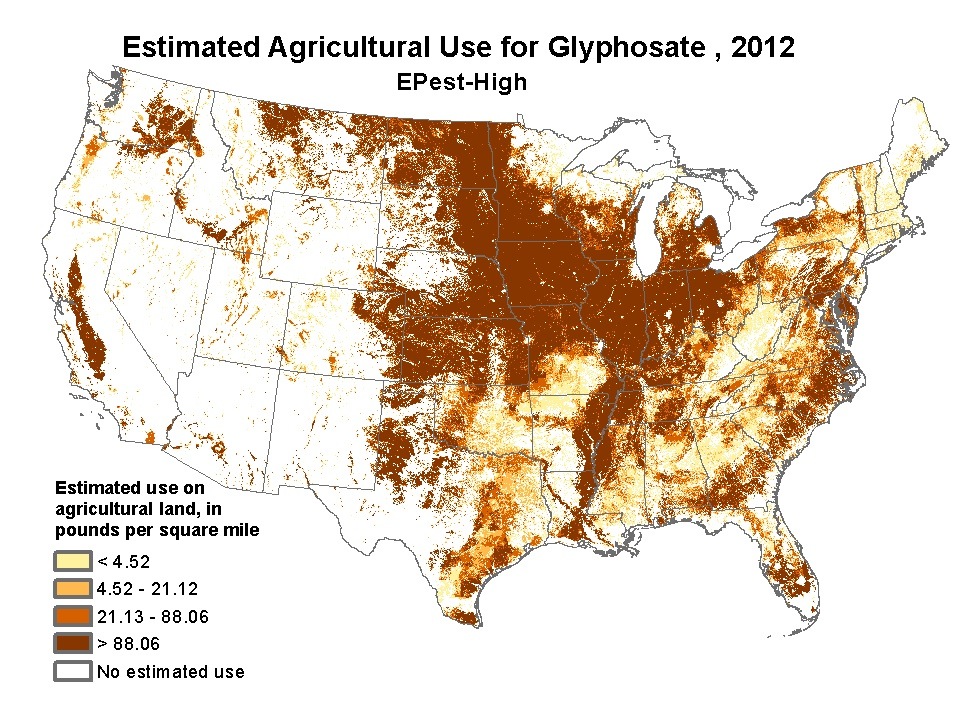
Image above: United State Geological Survey map of the continental states showing extent and intensity of the use of glyphsoates applied to cropland in 2012. Click to enlarge.  From (https://water.usgs.gov/nawqa/pnsp/usage/maps/show_map.php?year=2012&map=GLYPHOSATE&hilo=L).

Glyphosate, the world's most common weed killer, has caused significant concerns over its potential risk to human health, animals, and the environment for several decades. Earlier this month, a US court awarded a groundskeeper $289 million who claimed Bayer AG unit Monsanto's glyphosate-based weed-killers, including Roundup, gave him terminal cancer.

Now, a new report from PNAS alleges that glyphosate may be indirectly killing honey bees around the world, a threat that could potentially also leave a major mark on the global economy.
“We need better guidelines for glyphosate use, especially regarding bee exposure, because right now the guidelines assume bees are not harmed by the herbicide.
Our study shows that’s not true.” said Erick Motta, the graduate student who led the research, along with professor Nancy Moran.
UT News of The University of Texas at Austin says that glyphosate interferes with an important enzyme found in plants and microorganisms, but not in animals, it has long been assumed to be nontoxic to animals, including humans and bees.

However, the latest study reveals that by altering a bee’s gut microbiome — the ecosystem of bacteria living in the bee’s digestive tract, including those that protect it from harmful bacteria — glyphosate jeopardizes its ability to fight infection.

For this study, scientists exposed honeybees to glyphosate at normal levels found on farms. The researchers painted the bees' backs with colored dots so they could be tracked and later recaptured.

Three days later, they saw that the honeybees exposed to glyphosate suffered a significant loss of bacteria in their guts and were more susceptible to infection and death from harmful bacteria.
“Studies in humans, bees and other animals have shown that the gut microbiome is a stable community that resists infection by opportunistic invaders,” Moran said. “So if you disrupt the normal, stable community, you are more susceptible to this invasion of pathogens.”
In recent times, US beekeepers have reported a massive loss of bees or Colony Collapse Disorder (CCD). Millions of bees mysteriously disappeared, leaving farms with fewer pollinators for crops. Officials have been baffled, and the media has been quiet about the bee population collapse.

Explanations for the phenomenon have included exposure to pesticides or antibiotics, habitat loss, and bacterial infections. The latest study now adds herbicides to the list as a possible contributing factor.
“It’s not the only thing causing all these bee deaths, but it is definitely something people should worry about because glyphosate is used everywhere,” said Motta.
Among the nuts, almond growers have the largest need for bee pollination. Bee pollination is worth $15 billion to the US farming industry.

Any sharp change in global bee populations could affect the beef and dairy industries. Bees pollinate clover, hay, and other forage crops. As the bee population dwindles, it increases the cost of feedstock.

That forces inflation into beef and milk prices at the grocery store and ultimately hurts the American consumer. This could then lead to increased imports of produce from foreign countries where bee populations are healthy, further widening the trade deficit.

Couple this with the current trade war and this particular "black swan" - or rather "black bee" - problem, may be just the tipping point that finally forces the US economy to catch down to the rest of the world.


Image above: United State Geological Survey map of the continental states showing extent and intensity of the use of glyphsoates applied to cropland in 1992, twenty years earlier than map above. Note that  at that time the Central Valley in California was the densest and most intense use of glyphosates on food crops.  From (https://water.usgs.gov/nawqa/pnsp/usage/maps/show_map.php?year=1992&hilo=H&map=GLYPHOSATE).

See also:
Ea O Ka Aina: Bayer Beware! 9/11/18
Ea O Ka Aina: Side effect of Monsanto's Roundup 6/24/17
Ea O Ka Aina: Glyphosate harms gut enzyme 6/21/17
Ea O Ka Aina: RoundUp for Breakfast 4/20/16
Ea O Ka Aina: RoundUp carcenogenic in California 9/14/15
Ea O Ka Aina: Roundup Threatens Coral Reefs 12/30/14
Ea O Ka Aina: Word out on Roundup soaked wheat 11/24/14
Ea O Ka Aina: Gluten or Glyphosate Intolerance? 11/18/14
Ea O Ka Aina: Roundup and Lymphoma 6/10/14
Ea O Ka Aina: Roundup and human health 4/25/13
.

Bayer Beware!

SUBHEAD: Lawyers claim to have "Explosive" documents concerning Monsanto and RoundUp.

By Tyler Durden on 11 September 2018 for Zero Hedge -
(https://www.zerohedge.com/news/2018-09-07/bayer-beware-lawyers-claim-have-explosive-monsanto-documents)


Image above: Common Ragweed is becoming resistant to glyphsate applications in Nebraska. Ragweed plants from a glyphosate-resistant (left) and susceptible population (right) three weeks after application of 44 ounces per acre of Roundup PowerMax (that is one ounce per thousand square feet). From (https://cropwatch.unl.edu/glyphosate-resistant-common-ragweed-confirmed-nebraska).

Lawyers involved in a California lawsuit against Monsanto claim to have "explosive" documents concerning the Bayer-owned agrochemical giant's activities in Europe, according to Euronews.
"What we have is the tip of the iceberg. And in fact we have documents now in our possession, several hundreds documents, that have not been declassified and some of those are explosive," said US lawyer Robert Kennedy Jr, adding - "And many of them are pertinent to what Monsanto did here in Europe. And that's just the beginning."
Monsanto - bought by Germany's Bayer AG in June for $66 billion, was ordered in August to pay a historic $289 million to a former school groundskeeper, Dewayne Johnson, who said Monsanto's Roundup weedkiller gave him terminal cancer. Monsanto says it will appeal the verdict.

Environmental lawyers have been in Brussels in order to address a European Parliament special committee on the issue.
"They are fighting a fight for more democracy and for transparency and to get a better insight in how big corporation such as Monsanto act and try to manipulate the facts," said Belgium MEP Bart Staes.
Last November EU approved the use of glyphosate - a key chemical in Roundup, following five years of heated debate over whether it causes cancer. While it was approved for just five years until 2022 vs. the usual 15 years, there are now rumors that they will withdraw Roundup's license this year altogether.

Labeled a carcinogen by the EPA in 1985, the agency reversed its stance on glyphosate in 1991. The World Health Organization's cancer research agency, however, classified the compound as "probably carcinogenic to humans" in 2015. California, meanwhile, has the chemical listed in its Proposition 65 registry of chemicals known to cause cancer. 

See also:
Ea O Ka Aina: A MAtch Made in Hell 6/30/18

.

Breakfast with a dose of Roundup?

SUBHEAD: Weed killer is found in most of the oat cereals and granola bars tested, including some organic.

By Alexis Tempkin - Toxicologist on 15 August 2918 for EWG.org -
(https://www.ewg.org/childrenshealth/glyphosateincereal/#.W3con4WeGPX)


Image above: A child pouring Cheerios into a cereal bowl. From original article.

Popular oat cereals, oatmeal, granola and snack bars come with a hefty dose of the weed-killing poison in Roundup, according to independent laboratory tests commissioned by EWG.

Glyphosate, an herbicide linked to cancer by California state scientists and the World Health Organization, was found in all but two of 45 samples of products made with conventionally grown oats.

Almost three-fourths of those samples had glyphosate levels higher than what EWG scientists consider protective of children’s health with an adequate margin of safety. About one-third of 16 samples made with organically grown oats also had glyphosate, all at levels well below EWG’s health benchmark.

 Glyphosate does not belong in cereal. Act and urge the EPA to restrict pre-harvest applications of glyphosate and tell companies to identify and use sources of glyphosate-free oats.
 Report on samples tested indicates even organic oat products contained measurable amounts of glyphosate, but none were above the EWG's Health Benchmark of 160 parts per billion.
Samples Tested Conventional   Organic
Samples Tested 45   16
Glyphosate Detected 43   5
Detects above EWG’s Health Benchmark       31   0
Glyphosate is the active ingredient in Roundup, the Monsanto weed killer that is the most heavily used pesticide in the U.S. Last week, a California jury ordered Monsanto to pay $289 million in damages to a man dying of cancer, which he says was caused by his repeated exposure to large quantities of Roundup and other glyphosate-based weed killers while working as a school groundskeeper.

EWG tested more than a dozen brands of oat-based foods to give Americans information about dietary exposures that government regulators are keeping secret. In April, internal emails obtained by the nonprofit US Right to Know revealed that the Food and Drug Administration has been testing food for glyphosate for two years and has found “a fair amount,” but the FDA has not released its findings.

Each year, more than 250 million pounds of glyphosate are sprayed on American crops, primarily on “Roundup-ready” corn and soybeans genetically engineered to withstand the herbicide. But when it comes to the food we eat, the highest glyphosate levels are not found in products made with GMO corn.

Increasingly, glyphosate is also sprayed just before harvest on wheat, barley, oats and beans that are not genetically engineered. Glyphosate kills the crop, drying it out so that it can be harvested sooner than if the plant were allowed to die naturally.

Roundup was produced for decades by Monsanto, which this year merged with the German pharmaceutical company Bayer AG. In the case decided last week, the jury found that Monsanto knew for decades of the product’s hazards and not only failed to warn customers, but schemed to publicly discredit the evidence.

The California case that ended Friday was the first of reportedy thousands of lawsuits against Monsanto. These suits have been brought by farm workers and others who allege that they developed cancer from years of exposure to Roundup.

In 2015, the International Agency for Research on Cancer, part of the World Health Organization, reviewed extensive U.S., Canadian and Swedish epidemiological studies on glyphosate’s human health effects, as well as research on laboratory animals. The IARC classified the chemical as probably carcinogenic to humans, and has steadfastly defended that decision despite ongoing attacks by Monsanto.

In 2017, California listed glyphosate in its Proposition 65 registry of chemicals known to cause cancer. The state’s Office of Environmental Health Hazard Assessment, or OEHHA, has proposed a so-called No Significant Risk Level for glyphosate of 1.1 milligrams per day for an average adult of about 154 pounds. That level of exposure is more than 60 times lower than the safety level set by the Environmental Protection Agency.

California’s level represents an increased lifetime risk of cancer of one in 100,000 for an average adult. But for many cancer-causing drinking water contaminants, OEHHA’s lifetime risk factor is set at one in 1 million.

Additionally, because children and developing fetuses have increased susceptibility to carcinogens, the federal Food Quality Protection Act supports including an additional 10-fold margin of safety. With this additional children’s health safety factor, EWG calculated that a one-in-a-million cancer risk would be posed by ingestion of 0.01 milligrams of glyphosate per day.

To reach this maximum dose, one would only have to eat a single 60-gram serving1 of food with a glyphosate level of 160 parts per billion, or ppb. The majority of samples of conventional oat products from EWG’s study exceeded 160ppb, meaning that a single serving of those products would exceed EWG’s health benchmark.

As part of a glyphosate risk assessment, the EPA estimated potential highest dietary exposure levels for children and adults. The EPA has calculated that 1-to-2-year-old children are likely to have the highest exposure, at a level twice greater than California’s No Significant Risk Level and 230 times EWG’s health benchmark.

Studies suggest that glyphosate-sprayed crops such as wheat and oats are a major contributor to glyphosate in the daily diet. In EWG lab tests, 31 of 45 samples made with conventionally grown oats had 160 ppb or more of glyphosate.

The highest levels, greater than 1,000 ppb, were detected in two samples of Quaker Old Fashioned Oats. Three samples of Cheerios had glyphosate levels ranging from 470 ppb to 530 ppb. Twelve of the food samples had levels of glyphosate lower than EWG’s health benchmark, ranging from 10 ppb to 120 ppb. Only two samples had no detectable glyphosate.

Glyphosate was also detected at concentrations of 10 ppb to 30 ppb in five of 16 samples made with organic oats. The five samples came from two brands of organic rolled oats: Bob’s Red Mill and Nature’s Path.

A third brand of organic rolled oats and all other organic oat products tested did not contain detectable concentrations of glyphosate.

How does glyphosate get into organic foods? It could come from glyphosate drifting from nearby fields of conventionally grown crops, or by cross-contamination during processing at a facility that also handles non-organic crops. Nature's Path explains:
While organic farming certifications prohibit the use of glyphosate, organic products do not always end up completely free of glyphosate residue. While this news may come as disappointing, it is not entirely surprising. Glyphosate use has skyrocketed in the past decade, and it maintains the ability to adhere to water and soil particles long enough to travel through the air or in a stream to nearby organic farms.
The problem of glyphosate contamination of organic foods underscores the need to restrict pre-harvest uses of glyphosate and the need for more data on glyphosate levels in products, an area where U.S. federal agencies are falling short.

Two years ago, under pressure from the Government Accountability Office, the FDA began testing for glyphosate in a limited number of foods. At the 2016 North American Chemical Residue Workshop, an FDA scientist presented data showing that glyphosate has been detected in several oat-based food products.

After a Freedom of Information Act request by US Right to Know, earlier this year the FDA released documents that said the agency has found “a fair amount” of glyphosate in several processed foods. The results have not been released, but could be made public later this year or in early 2019.

In 2016, the non-profit Food Democracy Now tested for glyphosate in single samples of a variety of popular foods. “Alarming levels” of glyphosate were found in a number of cereals and other products, including more than 1,000 ppb in Cheerios. More recently, the Center for Environmental Health tested single samples of 11 cereal brands and found glyphosate levels ranging from about 300 ppb to more than 2,000 ppb.

EPA has denied that glyphosate may increase the risk of cancer, and documents introduced in the recent California trial showed how the agency and Monsanto worked together to promote the claim that the chemical is safe.

EWG has been urging the EPA to review all evidence linking glyphosate to increased cancer risk and other adverse health effects in human and animal studies. The EPA should limit the use of glyphosate on food crops, including pre-harvest application.

Oat-based foods are a healthy source of fiber and nutrients for children and adults, and oat consumption is linked to health benefits such as lowered cholesterol and decreased cardiovascular risk.

Parents should not have to wonder whether feeding their children these heathy foods will also expose them to a pesticide that increases the risk of cancer.

.

CRISPR and Genedrive danger

SOURCE: Jerry DiPietro (ofstone@aol.com)
SUBHEAD: Letting genedrives loose outside labs is too risky, says scientist who promoted idea.

By Paul Koberstein on 22 Devember 2017 for Earth Island Journal -
(http://www.earthisland.org/journal/index.php/elist/eListRead/letting_gene_drives_loose_outside_labs_is_too_risky_says_scientist_who_prom/)


Image above: Illusration of mosquito and genexrive. From (http://www.earthisland.org/journal/index.php/eij/article/editing_evolution/).

[IB Publisher's note: As more people are avoiding GMO produced food you can bet that "players" in the GMO/Pesticide development in Hawaii are salivating to get out of that business and into open field testing of gene drive technology. And if GMO companies' indifference to the health and welfare of the people living on these islands is an indicator we are all endangered. See accompanying article "Editing Evolution" by Paul Koberstein further explaining genedrive technology.]

A large cache of emails released this month show that the Bill and Melinda Gates Foundation is stepping up its efforts to promote the deployment of a controversial new genetic engineering tool known as “gene drive” to help eradicate malaria in Africa.

Malaria killed an estimated 438,000 worldwide in 2015. Sub-Saharan Africa continues to carry a disproportionately high share of the global malaria burden. 

However, some of the scientists who had initially proposed using the technology for public health and conservation purposes are having serious second thoughts about deploying it outside of labs.

In a effort to combat the disease, researchers funded by the Bill and Melinda Gates Foundation are planning a field trial of gene drive equipped Anopheles gambiae mosquitoes – the main malaria vector in Africa – in Burkina Faso.

Gene drives can help circumvent traditional rules of genetic inheritance and force a desired, specifically selected, genetic trait through a population.

Given the almost magical possibilities it offers to enhance beneficial traits or remove undesired characteristics in living things – think eradicating pests without using toxins, or saving an endangered species by making them immune to certain diseases – the technology has captured the imagination of many in the fields of conservation and public health.

The Bill and Melinda Gates Foundation, which considers gene drives “necessary” to end malaria, has invested some $70 million on Target Malaria, a research organization based at Imperial College in London that is working on preventing deaths from malaria, which numbered 438,000 worldwide in 2015.

Target Malaria is planning to release genetically modified Anopheles gambiae mosquitoes – the main malaria vector in Africa – in Burkina Faso.

These modified mosquitoes would be equipped with gene drives that would disrupt the reproductive systems of successive generations and eventually cause them to go extinct. The project would be the first field trial of gene drive technology.

The release of 1,200 emails by the Genetic Biocontrol of Invasive Rodents (GBiRD) program at North Carolina State University, provide fresh insights into the work of groups like the Gates Foundation and GBiRD that are promoting the use of gene drive biotechnology.

(GBiRD is a partnership of seven university, government and non-government organizations advancing gene drive research.)

The emails – which were released in response to freedom of information requests submitted by Edward Hammond, a biosafety activist from Austin, Texas –also show that the environmental advocacy group Island Conservation is developing plans to use gene drives as a mechanism for exterminating invasive species on the islands of Hawaii, New Zealand, and Australia.

Hammond made the emails public just two weeks after one of the key proponents of the gene drive technology, Kevin Esvelt, published a report saying the technology was too risky to be used in field trials to control invasive species.

Esvelt, a professor at MIT who first identified the potential for gene drives to alter wild populations of organisms in 2013, is now warning, once unleashed, gene drives will prove difficult if not impossible to control.

Esvelt said that projects that are planning to conduct gene drive experiments to control invasive species in the wild should first invent safer forms of the technology.

In theory, the release of these genetically altered mosquitoes or invasive pests like rats, would cause all the members of a targeted population of mosquitoes or rats to go sterile, eventually exterminating that and only that population.

But new research by Esvelt and his colleagues at MIT and Harvard University suggests that gene drive deployments are more than likely to go haywire, with potentially disastrous consequences for non-targeted animal populations and ecosystems. (*Check update/clarification on this below.)

In a paper published in the non-peer reviewed scientific journal BioRxiv, Esvelt and his colleagues wrote that, once unleashed, gene drives will prove difficult if not impossible to control.

The paper, “Current CRISPR gene drive systems are likely to be highly invasive in wild populations,” is currently in pre-publication review. CRISPR refers to Clustered Regularly Interspaced Short Palindromic Repeats, a new technology that allows scientists to alter genes by editing strands of DNA.

CRISPR’s invention in 2012 by scientists at the University of California-Berkeley and MIT led to the development of gene drives two years later in Esvelt’s research laboratory.

In the BioRxiv paper, the scientists said that mathematical models based on existing empirical data show that in their current form, gene drives cannot be deployed without harmful side effects. Their modeling showed that gene drives can be very aggressive and even a handful of gene drive modified organisms could carry the new gene, not only through much of the targeted population of a certain species, but also on to non-intended populations.

For example, under their models, a gene drive released in Hawai’i to kill a specific kind of mosquito on the island of Kauai would eventually start targeting a different kind of mosquito on the island.

“Releasing a small number of organisms often causes invasion of the local population, followed by invasion of additional populations connected by very low gene flow rates,” they wrote. “Highly effective drive systems are predicted to be even more invasive.”

On the same day his BioRxiv paper was released, Esvelt expressed regret for ever proposing gene drives be used in real word experiments.

In an interview with the New York Times, Esvelt called his championing the notion “an embarrassing mistake” given the predicted invasiveness of current CRISPER-based drive systems.

But he and his colleagues still thinks researchers should continue exploring ways in which gene drives could help save species that are in peril.

The new report confirms concerns that many within the scientific and environmental community have had about the unknown ecological and public health risks posed by a technology whose basic purpose is to spread genetic mutations.

Nevertheless, the GBiRD emails show that that the Gates Foundation is ploughing ahead with its research on gene drives as a mechanism for eradicating the mosquito that causes malaria (which, it should be noted again, is not an effort to control an invasive species, but rather an effort to eradicate a disease-carrying insect).

In 2016, it made a $1.6 million payment to Emerging Ag, a PR firm it retained for the purpose of influencing a United Nations expert group that has been addressing gene drive issues. The group, the Ad Hoc Technical Expert Group on Synthetic Biology (AHTEG), was convened by the UN’s Convention on Biological Diversity.

Hammond, who posted the emails to his website, is a former member of AHTEG.

In one of the emails, the Gates Foundation said it hired EmergingAg to “increase awareness, understanding, and acceptance of possible gene drive applications for public good purposes.”

One of EmergingAg’s initiatives has been to recruit scientists who will advocate for gene drives. For example, in an Aug. 1, 2017 email thread, Isabelle Coche, a vice president of EmergingAg, is trying to recruit Fred Gould, codirector of the Genetic Engineering and Society Center at North Carolina State, for advocacy work.

The email asks Gould to "support advocacy and engagement activities on gene drive.” Gould, however, demurs, saying, “it would be problematic for me to be involved,” adding that such advocacy would “compromise” his role on a gene drive ethics committee.

Coche’s role at EmergingAg, according to another email, is “to fight back against gene drive moratorium proponents before the next CBD meeting in 2018.”

This was in reference to calls from several anti-gene drive groups for an international moratorium on gene drive research in petitions last year before the United Nations Convention on Biological Diversity (CBD). The CBD rejected those petitions, which are likely to be repeated at next year’s CBD meeting.

On its website, Emerging Ag calls itself “a boutique international consulting firm providing communications and public affairs services.”

Its president and founder is Robynne Anderson, a former international communications director of CropLife, the global lobby group for the biotechnology, seed, and pesticide industries based in Brussels, Belgium.

On her personal website, Anderson praises gene drives without actually mentioning the biotechnology by name.

“The Target Malaria team is researching approaches that can reduce the numbers of mosquitoes that spread malaria,” she writes. 
“By reducing the population of the malaria mosquito, (a very specific beast called Anopheles), they are able to combat transmission of the disease. Their strategy relies on reducing the number of female malaria mosquitoes.”
She said this approach “is expected to be complementary to other mosquito control methods, easy and inexpensive to implement, because the mosquitoes themselves do the work of stopping malaria. The control method would be a long-term, sustainable, and cost-effective solution to prevent malaria.”

Austin Burt, professor of evolutionary genetics at Imperial College London and principle investigator for the Target Malaria consortium, said in an email that “a blanket assertion that ‘gene drive field trials pose unacceptable risks for ecosystems’ is not consistent with how I understand [Esvelt’s] position – risks must always be assessed on a case-by-case basis, as they will depend on the exact features of the construct and the species / population into which it is to be released.

Rather, I believe he is calling for inclusive, informed discussion of the risks, which I certainly agree with.”

Burt said Esvelt’s paper “just shows that a particular type of gene drive construct may be expected to spread from one population to another when there is naturally-occurring gene flow, which indeed is correct.”

As for the Target Malaria initiative, he said that although “we are one of the leading groups working on developing this sort of technology, we are still many years (>5) from having something that we might propose to release in the field, and indeed we are still working on the path to get to that point.” Safety, he said, “is paramount, for humans and the environment.

Malaria imposes an appalling burden across too much of sub-Saharan Africa, and we want to be in a position to offer something that people and governments will want to use to help reduce this burden.”

He emphasized that when Target Malaria develops a gene drive it “will go through extensive safety testing before we would consider releases.”

Island Conservation, meanwhile, sees gene drives as a tool that can rid islands of invasive pests without the use of chemical pesticides.

The group says that 180,000 islands around the world are infested with alien rodents, but only 400 rodent eradication programs to date have been successful, and each relied on rodenticides to remove the non-native populations.

Heath Packard, a spokesman for the group, told Earth Island Journal that the group “is investigating the feasibility and suitability of a potential gene drive mouse construct that could safely and effectively remove invasive species from islands. The question is not only could we, but should we and under what conditions.

Local communities and their governments will need to decide on a case by case basis.”

But he said that Island Conservation “would never contemplate even asking a community to consider a highly-contained field trial unless work in the genetic laboratories demonstrated that the mouse construct could not, itself pose unmitigated harm to well-established parts of our ecosystem.”

“This work must be done, cautiously, thoroughly, and stepwise,” he said. “That’s exactly what our partnership is doing.”

*UPDATE, December 22: To be clear, this risk is not of gene drives spreading to other species. The risk is that they could spread to other populations, or rather, sub-species of the same species — for example to any of the other 205 mosquito species in the Anopheles subgenus — and as a result impact local ecosystems where they might serve key roles, such as, as a food source for other critters. This report isn't implying that gene drives can jump the species barrier spread to other species.

.

Fukushima to poison Pacific more

SUBHEAD: Tepco plans to dump a million tons of radioactive nuclear water in ocean.

By Admin on 27 November 2017 for ENE News -
(http://enenews.com/ap-japan-poised-to-flood-pacific-with-1-million-tons-of-nuclear-water-contaminated-by-fukushima-newsweek-experts-want-japan-to-push-a-million-tons-of-radioactive-water-into-ocean-relea)


Image above: Some of the many prefab tanks erected by Tepco to temporarily store radioactive water contaminated when it was used to cool molten reactor cores at the destroyed Fukushima Daiichi Nuclear Power Plant in eastern Japan. From (https://blogs-images.forbes.com/jamesconca/files/2017/11/Fukushima-tanks.jpg).

Associated Press, Nov 26, 2017: Japan is poised to flood the Pacific with one million tons of nuclear water contaminated by the Fukushima power plant

The Japanese government is being urged by experts to gradually release radioactive water in to the Pacific Ocean…

 The water is stored on site in around 900 large and densely packed tanks and could spill should another major disaster strike. The government has been urged to release the water into the ocean…

Local fishermen are extremely hesitant to this solution…

Fumio Haga, a drag-net fisherman, said: ‘People would shun Fukushima fish again as soon as the water is released.’…

Newsweek, Nov 25, 2017:  
Experts Want Japan To Push A Million Tons Of Radioactive Water Into the Pacific Ocean… 

The government has been urged by experts to gradually release the water to the Pacific Ocean…

Associted Press, Nov 27, 2017:  
Fukushima meltdown: Japan urged to dump radioactive waste in Pacific Ocean by nuclear experts; Nation at a loss with how to dispose of tanks of toxic matter left over from 2011 disaster… 

Experts advising the government have urged a gradual release to the nearby Pacific Ocean… Local fishermen are baulking. The water, no matter how clean, has a dirty image for consumers, they say…

The fishermen fear any release would sound the death knell for their nascent and still fragile recovery…

The amount of radioactive water at Fukushima is still growing, by 150 tonnes a day. The reactors are damaged beyond repair, but cooling water must be constantly pumped in to keep them from overheating. That water picks up radioactivity before leaking out of the damaged containment chambers and collecting in the basements…

 “Our recovery effort up until now would immediately collapse to zero if the water is released,” Iwaki abalone farmer Yuichi Manome said…

Metro.co.uk, Nov 27, 2017: 
Japan could pump 1,000,000 tons of radioactive water into the sea from Fukushima — 

More than six years after a tsunami devastated Japan’s west coast and overwhelmed the Fukushima nuclear power plant it has been revealed radioactive water could be pumped into the sea…

Experts have advised the government to carry out a gradual release into the Pacific Ocean…

Fishermen are still trying to recover from the disaster but the release of water could kill the industry…

See also:
Ea O Ka Aina: Fukushima Coverup 11/14/17
Ea O Ka Aina: Fukushima Hot particle update 7/27/17
Ea O Ka Aina: E-Fukushima bosses on trial 6/25/17
Ea O Ka Aina: Tepco plan to dump tainted water 7/14/17
Ea O Ka Aina: Stop Fukushima as Olympic venue 5/10/17
Ea O Ka Aina: Continuing Fukushima danger 4/14/17
Ea O Ka Aina: Stop Fukushima as Olympic venue 4/8/17 
Ea O Ka Aina: Fukushima worse than ever 2/5/17
Ea O Ka Aina: Fukushima radiation on West Coast 1/13/17
Ea O Ka Aina: Fukushima cleanup cost to double 12/9/16
Ea O Ka Aina: Tokyo damaged by nuclear pellet rain 9/24/16
Ea O Ka Aina: Nuclear Power and Climate Failure 8/24/16
Ea O Ka Aina: High radioactivity in Tokyo 8/22/16
Ea O Ka Aina: Nuclear Blinders 8/18/16
Ea O Ka Aina: Fukushima and Chernobyl 5/29/16
Ea O Ka Aina: Fukushima radiation damages Japan 4/14/16
Ea O Ka Aina: Fukushima's Nuclear Nightmare 3/13/16
Ea O Ka Aina: Fifth Fukushima Anniversary 3/11/16
Green Road Jounral: Balls filled with Uranium, Plutonium 2/19/16
Ea O Ka Aina: Fukushima impacts are ongoing 11/8/15
Ea O Ka Aina: Petroleum and Nuclear Coverups 10/21/15
Ea O Ka Aina: Fukushima Radiation Contamination 10/13/15
Ea O Ka Aina: Radioactive floods damage Japan 9/22/15
Ea O Ka Aina: Fir trees damaged by Fukushima 8/30/15
Ea O Ka Aina: Japan restarts a nuclear plant 8/11/15
Ea O Ka Aina: Fukushima disaster will continue 7/21/15
Ea O Ka Aina: Too many fish in the sea? 6/22/15
Ea O Ka Aina: Fukushima prefecture uninhabitable 6/6/15
Ea O Ka Aina: In case you've forgotten Fukushima 5/27/15
Ea O Ka Aina: Radiation damages top predator bird 4/24/15
Ea O Ka Aina: Fukshima die-offs occurring 4/17/15
Ea O Ka Aina: Fukushima Impact Update 4/13/15
Ea O Ka Aina: Fukushima - the end of atomic power 3/13/15
Ea O Ka Aina: Where is the Fukushima Data? 2/21/15
Ea O Ka Aina: Fuku-Undo 2/4/15
Ea O Ka Aina: Fukushima MOX fuel crossed Pacific 2/4/15
Ea O Ka Aina: Fukushima worst human disaster 1/26/15
Ea O Ka Aina: Japan to kill Pacific Ocean 1/23/15
Ea O Ka Aina: Japan's Environmental Catastrophe 8/25/14
ENE News: Nuclear fuel found 15 miles from Tokyo 8/10/14
Ea O Ka Aina: Earthday TPP Fukushima RIMPAC 4/22/14
Ea O Ka Aina: Fukushima Daiichi hot particles 5/30/14
Ea O Ka Aina: Japanese radiation denial 5/12/14
Ea O Ka Aina: Entomb Fukushima Daiichi now 4/6/14
Ea O Ka Aina: Fukushima Disaster 3 Years Old 4/3/14
Ea O Ka Aina: Tsunami, Fukushima and Kauai 3/9/14
Ea O Ka Aina: Japanese contamination 2/16/14
Ea O Ka Aina: Bill for Fukushima monitoring 2/9/14
Ea O Ka Aina: Tepco under reporting of radiation 2/9/14
Ea O Ka Aina: Fukushima Fallout in Alaska 1/25/14
Ea O Ka Aina: Fukushima engineer against nukes 1/17/14
Ea O Ka Aina: California to monitor ocean radiation 1/14/14
Ea O Ka Aina: Demystifying Fukushima Reactor #3 1/1/14
Ea O Ka Aina: US & Japan know criticality brewing 12/29/13
Ea O Ka Aina: Fukushima Forever 12/17/13
Ea O Ka Aina: Brief radiation spike on Kauai 12/27/13
Ea O Ka Aina: USS Ronald Reagan & Fukushima 12/15/13
Ea O Ka Aina: Fukushima Pacific Impact 12/11/13
Ea O Ka Aina: Berkeley and Fukushima health risks 12/10/13
Ea O Ka Aina: Madness engulfs Japan 12/4/13
Ea O Ka Aina: Edo Japan and Fukushima Recovery 11/30/13
Ea O Ka Aina: Reaction to Fukushima is Fascism 11/30/13
Ea O Ka Aina: Radioisotopes in the Northern Pacific 11/22/13
Ea O Ka Aina: Fukushima cleanup in critical phase 11/18/13
Ea O Ka Aina: Fukushima fuel removal to start 11/14/13
Ea O Ka Aina: Fukushima, What me worry? 11/13/13
Ea O Ka Aina: Remove other Fukushina fuel 10/29/13
Ea O Ka Aina: End to Japanese Nuclear Power? 10/3/13
Ea O Ka Aina: Fukushima & Poisoned Fish 10/3/13
Ea O Ka Aina: Fuel Danger at Fukushima 9/27/13
Ea O Ka Aina: Reactor #4 Spent Fuel Pool 9/16/13
Ea O Ka Aina: Fukushima is Not Going Away 9/9/13
Ea O Ka Aina: X-Men like Ice Wall for Fukushima 9/3/13
Ea O Ka Aina: Fukushima House of Horrors 8/21/13
Ea O Ka Aina: Fukushima Apocalypse 8/21/13
Ea O Ka Aina: Fukushima Radioactive Dust 8/20/13
Ea O Ka Aina: Cocooning Fukushima Daiichi 8/16/13
Ea O Ka Aina: Fukushima radiation coverup 8/12/13
Ea O Ka Aina: Leakage at Fukushima an emergency 8/5/13
Ea O Ka Aina: Fukushima burns on and on 7/26/13
Ea O Ka Aina: What the Fukashima? 7/24/13
Ea O Ka Aina: Fukushima Spiking 7/15/13
Ea O Ka Aina: G20 Agenda Item #1 - Fix Fukushima 7/7/13
Ea O Ka Aina: Fukushima and hypothyroid in Hawaii 4/9/13
Ea O Ka Aina: Japan to release radioactive water 2/8/13
Ea O Ka Aina: Fukushima as Roshoman 1/14/13
Ea O Ka Aina: Fukushia Radiation Report 10/24/12
Ea O Ka Aina: Fukushima Fallout 9/14/12
Ea O Ka Aina: Fukushima Unit 4 Danger 7/22/12
Ea O Ka Aina: Fukushima denial & extinction ethics 5/14/12
Ea O Ka Aina: Fukushima worse than Chernobyl 4/24/12
Ea O Ka Aina: Fukushima dangers continue 4/22/12
Ea O Ka Aina: Fukushima children condemned 3/8/12
Ea O Ka Aina: Fukushima fights chain reaction 2/7/12
Ea O Ka Aina: Tepco faking Fukushima fix 12/24/11
Ea O Ka Aina: The Non Battle for Fukushima 11/10/11
Ea O Ka Aina: Fukushima Debris nears Midway 10/14/11
Ea O Ka Aina: Fukushima Radiation Danger 7/10/11
Ea O Ka Aina: Fukushima Abandoned 9/28/11
Ea O Ka Aina: Deadly Radiation at Fukushima 8/3/11
Ea O Ka Aina: Fukushima poisons Japanese food 7/25/11
Ea O Ka Aina: Black Rain in Japan 7/22/11
Ea O Ka Aina: UK PR downplays Fukushima 7/1/11
Ea O Ka Aina: Fukushima #2 & #3 meltdown 5/17/11
Ea O Ka Aina: Fukushima sustained chain reaction 5/3/11
Ea O Ka Aina: Ocean Radioactivity in Fukushima 4/16/11
Ea O Ka Aina: Japan raises nuclear disaster level 4/12/11
Ea O Ka Aina: Fukushima No Go Zone Expanding 4/11/11
Ea O Ka Aina: Fukushima to be Decommissioned 4/8/11
Ea O Ka Aina: Fukushima Poisons Fish 4/6/11
Ea O Ka Aina: Learning from Fukushima 4/4/11
Ea O Ka Aina: Fukushima Leak goes Unplugged 4/3/11
Ea O Ka Aina: Stick a fork in it - It's done! 4/2/11
Ea O Ka Aina: Fukushima reactors reach criticality 3/31/11
Ea O Ka Aina: Fukushima Non-Containment 3/30/11
Ea O Ka Aina: Fukushima Meltdown 3/29/11
Ea O Ka Aina: Fukushima Water Blessing & Curse 3/28/11 
.

Fukushima Coverup

SUBHEAD: Doctors keep cancers a secret.  Officials “actively ignoring” reports of illness and death.

By Admin on 14 November 2017 for ENE News -
(http://enenews.com/fukushima-cover-up-keep-cancers-a-secret-say-doctors-were-getting-leukaemia-and-cataracts-and-we-die-suddenly-students-having-sudden-heart-attacks-officials-actively-i)


Image above: Detail of graphic illustration of the "prompt criticality event" at Fukushima Reactor #3 on 3/13/11 when the containment structure was destroyed in a nuclear material chain reaction. From (http://www.beyondnuclear.org/home/2016/2/22/fukushima-the-great-japan-cover-up.html).

Adam Broinowski, visiting research fellow at The Australian National University, 2017 (h/t Fukushima 311 Watchdogs):
  • Faced with the post-3.11 reality of government (and corporate) policy that protects economic and security interests over public health and well-being, the majority of the 2 million inhabitants of Fukushima Prefecture are either unconscious of or have been encouraged to accept living with radioactive contamination…

  • As Fukushima city resident Shiina Chieko observed, the majority of people seem to have adopted denial as a way to excise the present danger from their consciousness. Her sister-in-law, for example, ignored her son’s ‘continuous nosebleeds’, while her mother had decided that the community must endure by pretending that things were no different from pre-3.11 conditions. [Source: Shiina Chieko, interview with the author]…

  • Some, such as Yokota Asami (40 years old), a small business owner and mother from Kōriyama (60 km from FDNPS), demonstrated initiative in voluntarily evacuating her family. She decided to return (wearing goggles and a mask, she joked) in September 2011 when her son’s regular and continuous nosebleeds (in 30-minute spells) subsided. The Yokotas found themselves the victims of bullying when they called attention to radiation dangers… Her son was the only one to put up his hand when he was asked along with 300 fellow junior high school students if he objected to eating locally produced school lunches. He also chose not to participate in outdoor exercise classes and to go on respite trips instead. When it came time to take the high school entrance exam, he was told by the school principal that those who took breaks could not pass. He took the exam and failed. When he asked to see his results he found that he had, in fact, enough points to pass (the cut-off was 156 while he received 198 out of 250 points). [Source: Yokota Asami, interview with the author]…

  • Asami reported that doctors undertook paediatric thyroid operations while denying any correlation (inga kankei) with radiation exposures. They also urged their patients to keep their thyroid cancer a secret… Yokota also indicated she knew of students having sudden heart attacks and developing leukaemia and other illnesses. [Source: Yokota Asami, interview with the author]

  • This seems to be supported by Mr Ōkoshi, a Fukushima city resident, whose two daughters experienced stillbirths after 3.11. While Ōkoshi found that doctors have regularly advised women in the area to abort after 3.11, presumably to avoid miscarriages and defects, they do not discuss direct causes. He also observed regular illnesses experienced by many of his friends, and some sudden deaths. After a friend (62 years old) started saying strange things, he was diagnosed with brain dysfunction. He died quickly. Another friend (53 years old) was advised by a doctor to monitor a polyp in her breast. When she sought second opinions, she discovered she had accumulated an internal dose of 22 mSv and had a rapidly developing liver cancer. She also died quickly. [Source: Mr Ōkoshi, interview with the author]

  • There are many more such stories that are being actively ignored by the authorities. As Shiina put it, ‘we’re getting leukaemia and cataracts and we die suddenly. The TEPCO registrar has been inundated with complaints’. [Source: Shiina Chieko, interview with the author]


Hawaii Hit Hard

SUBHEAD: Over a trillion becquerels of nuclear waste fell on Hawaii - over 200 times more radiation than expected.

By Admin on 13 November 2017 for ENE News -
(http://enenews.com/new-study-us-state-hit-with-up-to-200-times-more-fukushima-fallout-than-expected-over-a-trillion-becquerels-of-nuclear-waste-fell-on-hawaii-scientists-plume-may-have-taken-an-alternative-pat)

University of Hawai’i at Mānoa, Oct 31, 2017:
  • Fukushima-derived radiocesium fallout in Hawaiian soils… This study estimated the magnitude of cesium deposition in soil, collected in 2015-2016, resulting from atmospheric fallout… Detectable, Fukushima-derived 134Cs inventories ranged from 30 to 630 Bq m-2 and 137Cs inventories ranged from 20 to 2200 Bq m-2… This research confirmed and quantified the presence of Fukushima-derived fallout in the state of Hawai’i in amounts higher than predicted by models and observed in the United States mainland…

  • The Hawaiian Islands were expected to get minimal, below 10 Bq m-2 or lower, of Fukushima-derived fallout…

  • Fukushima-derived soil radiocesium concentrations, were greater than anticipated based on model-predicted Pacific atmospheric dispersion rates…

  • Maximum estimated values of 134Cs fallout on the islands of Hawaii and O’ahu constrained by precipitation and data from sites with less than 70% canopy cover were obtained by linear interpolation of all measured soil cesium concentrations, resulting in 134Cs fallout ranging from < 60 to 1000 Bq m-2 [According to this study, “The Fukushima-derived fallout… 134Cs to 137Cs ratio was 1:1” — therefore 137Cs fallout from Fukushima was also 60 to 1000 Bq m-2, making the total radiocesium 120 to 2000 Bq m-2. Compare this to the study’s previous statement that “The Hawaiian Islands were expected to get minimal, below 10 Bq m-2 or lower, of Fukushima-derived fallout”]…

  • Using the conservative values and integrating over the whole area with rainfall above 200 mm, we estimate that the island of Hawaii received 1.50 x 10^12 Bq [1.5 Trillion Bq] of 134Cs and 137Cs, each isotope contributing 50%, between March 19 and April 4, 2011…

  • Atmospheric dispersion models predicted the majority of the plume to travel a more northern route over the Aleutian Islands… however, suggesting that the Fukushima-derived aerosol plume may have taken an alternative southern path. Our radiocesium fallout inventories are comparatively higher than those estimated and measured in North America. Previous research that used whole-water wet deposition to predict ‘its fallout in North America estimated up to 180 Bq m -2 in Alaska, 46 Bq m -2 in California, and 29 Bq m -2 in Washington State…

  • This is the first study to our knowledge studying Fukushima-derived fallout in the Pacific Islands…
From last week: Fukushima radiation found in Hawaii fish — Almost half contain fallout from Japan nuclear disaster


Radiation in Hawaiian Fish

SUBHEAD:
Fukushima radiation found in Hawaii fish — Almost half contain fallout from Japan nuclear disaster

By Admin on 8 November 2017 for ENE News -
(http://enenews.com/fukushima-radiation-found-in-hawaii-fish-almost-half-contain-fallout-from-japan-nuclear-disaster)

University of Hawaii at Mānoa, 2017:
  • In the Wake of Fukushima: Radiocesium Inventories of Selected North Pacific Fish
     
  • Thirteen commonly consumed types of fish caught in the North Pacific and locally available in Hawaii were analyzed using gamma spectroscopy to measure Fukushima-derived and historic 134 Cs and 137 Cs isotopes.
  • All fish samples had detectable 137 Cs above 95% Confidence Intervals. Three out of the thirteen samples had 134 Cs, an isotope indicative of Fukushima releases, detected above 95% Confidence Intervals.
  • The highest 134 Cs and 137 Cs concentration in the examined species was in ahi tuna carrying 0.10±0.04 Bq/kg and 0.62±0.05 Bq/kg, respectively. Other samples with 134 Cs activities found above their 2-sigma uncertainty were albacore tuna and swordfish…
  • [W]hile the plume has not necessarily reached the Hawaiian Islands, it did travel within established fishing grounds across major migratory paths northeast of the islands…
  • Five samples showed the Fukushima tracer 134Cs, present above critical levels and at the 68% confidence interval (CI at 1-sigma uncertainty) but only three of those fish exhibited activities above the range of their 2 sigma uncertainty representing 95% CI…
  • Five samples showed evidence of Fukushima-derived 134Cs…
  • This study suggests that about 40% of fish tested here and are consumed on the islands of Hawai’i were recently exposed to the path of the Fukushima-derived radiocesium plume in the North Pacific Gyre…
See also:
Ea O Ka Aina: Fukushima Hot particle update 7/27/17
Ea O Ka Aina: E-Fukushima bosses on trial 6/25/17
Ea O Ka Aina: Tepco plan to dump tainted water 7/14/17
Ea O Ka Aina: Stop Fukushima as Olympic venue 5/10/17
Ea O Ka Aina: Continuing Fukushima danger 4/14/17
Ea O Ka Aina: Stop Fukushima as Olympic venue 4/8/17 
Ea O Ka Aina: Fukushima worse than ever 2/5/17
Ea O Ka Aina: Fukushima radiation on West Coast 1/13/17
Ea O Ka Aina: Fukushima cleanup cost to double 12/9/16
Ea O Ka Aina: Tokyo damaged by nuclear pellet rain 9/24/16
Ea O Ka Aina: Nuclear Power and Climate Failure 8/24/16
Ea O Ka Aina: High radioactivity in Tokyo 8/22/16
Ea O Ka Aina: Nuclear Blinders 8/18/16
Ea O Ka Aina: Fukushima and Chernobyl 5/29/16
Ea O Ka Aina: Fukushima radiation damages Japan 4/14/16
Ea O Ka Aina: Fukushima's Nuclear Nightmare 3/13/16
Ea O Ka Aina: Fifth Fukushima Anniversary 3/11/16
Green Road Jounral: Balls filled with Uranium, Plutonium 2/19/16
Ea O Ka Aina: Fukushima impacts are ongoing 11/8/15
Ea O Ka Aina: Petroleum and Nuclear Coverups 10/21/15
Ea O Ka Aina: Fukushima Radiation Contamination 10/13/15
Ea O Ka Aina: Radioactive floods damage Japan 9/22/15
Ea O Ka Aina: Fir trees damaged by Fukushima 8/30/15
Ea O Ka Aina: Japan restarts a nuclear plant 8/11/15
Ea O Ka Aina: Fukushima disaster will continue 7/21/15
Ea O Ka Aina: Too many fish in the sea? 6/22/15
Ea O Ka Aina: Fukushima prefecture uninhabitable 6/6/15
Ea O Ka Aina: In case you've forgotten Fukushima 5/27/15
Ea O Ka Aina: Radiation damages top predator bird 4/24/15
Ea O Ka Aina: Fukshima die-offs occurring 4/17/15
Ea O Ka Aina: Fukushima Impact Update 4/13/15
Ea O Ka Aina: Fukushima - the end of atomic power 3/13/15
Ea O Ka Aina: Where is the Fukushima Data? 2/21/15
Ea O Ka Aina: Fuku-Undo 2/4/15
Ea O Ka Aina: Fukushima MOX fuel crossed Pacific 2/4/15
Ea O Ka Aina: Fukushima worst human disaster 1/26/15
Ea O Ka Aina: Japan to kill Pacific Ocean 1/23/15
Ea O Ka Aina: Japan's Environmental Catastrophe 8/25/14
ENE News: Nuclear fuel found 15 miles from Tokyo 8/10/14
Ea O Ka Aina: Earthday TPP Fukushima RIMPAC 4/22/14
Ea O Ka Aina: Fukushima Daiichi hot particles 5/30/14
Ea O Ka Aina: Japanese radiation denial 5/12/14
Ea O Ka Aina: Entomb Fukushima Daiichi now 4/6/14
Ea O Ka Aina: Fukushima Disaster 3 Years Old 4/3/14
Ea O Ka Aina: Tsunami, Fukushima and Kauai 3/9/14
Ea O Ka Aina: Japanese contamination 2/16/14
Ea O Ka Aina: Bill for Fukushima monitoring 2/9/14
Ea O Ka Aina: Tepco under reporting of radiation 2/9/14
Ea O Ka Aina: Fukushima Fallout in Alaska 1/25/14
Ea O Ka Aina: Fukushima engineer against nukes 1/17/14
Ea O Ka Aina: California to monitor ocean radiation 1/14/14
Ea O Ka Aina: Demystifying Fukushima Reactor #3 1/1/14
Ea O Ka Aina: US & Japan know criticality brewing 12/29/13
Ea O Ka Aina: Fukushima Forever 12/17/13
Ea O Ka Aina: Brief radiation spike on Kauai 12/27/13
Ea O Ka Aina: USS Ronald Reagan & Fukushima 12/15/13
Ea O Ka Aina: Fukushima Pacific Impact 12/11/13
Ea O Ka Aina: Berkeley and Fukushima health risks 12/10/13
Ea O Ka Aina: Madness engulfs Japan 12/4/13
Ea O Ka Aina: Edo Japan and Fukushima Recovery 11/30/13
Ea O Ka Aina: Reaction to Fukushima is Fascism 11/30/13
Ea O Ka Aina: Radioisotopes in the Northern Pacific 11/22/13
Ea O Ka Aina: Fukushima cleanup in critical phase 11/18/13
Ea O Ka Aina: Fukushima fuel removal to start 11/14/13
Ea O Ka Aina: Fukushima, What me worry? 11/13/13
Ea O Ka Aina: Remove other Fukushina fuel 10/29/13
Ea O Ka Aina: End to Japanese Nuclear Power? 10/3/13
Ea O Ka Aina: Fukushima & Poisoned Fish 10/3/13
Ea O Ka Aina: Fuel Danger at Fukushima 9/27/13
Ea O Ka Aina: Reactor #4 Spent Fuel Pool 9/16/13
Ea O Ka Aina: Fukushima is Not Going Away 9/9/13
Ea O Ka Aina: X-Men like Ice Wall for Fukushima 9/3/13
Ea O Ka Aina: Fukushima House of Horrors 8/21/13
Ea O Ka Aina: Fukushima Apocalypse 8/21/13
Ea O Ka Aina: Fukushima Radioactive Dust 8/20/13
Ea O Ka Aina: Cocooning Fukushima Daiichi 8/16/13
Ea O Ka Aina: Fukushima radiation coverup 8/12/13
Ea O Ka Aina: Leakage at Fukushima an emergency 8/5/13
Ea O Ka Aina: Fukushima burns on and on 7/26/13
Ea O Ka Aina: What the Fukashima? 7/24/13
Ea O Ka Aina: Fukushima Spiking 7/15/13
Ea O Ka Aina: G20 Agenda Item #1 - Fix Fukushima 7/7/13
Ea O Ka Aina: Fukushima and hypothyroid in Hawaii 4/9/13
Ea O Ka Aina: Japan to release radioactive water 2/8/13
Ea O Ka Aina: Fukushima as Roshoman 1/14/13
Ea O Ka Aina: Fukushia Radiation Report 10/24/12
Ea O Ka Aina: Fukushima Fallout 9/14/12
Ea O Ka Aina: Fukushima Unit 4 Danger 7/22/12
Ea O Ka Aina: Fukushima denial & extinction ethics 5/14/12
Ea O Ka Aina: Fukushima worse than Chernobyl 4/24/12
Ea O Ka Aina: Fukushima dangers continue 4/22/12
Ea O Ka Aina: Fukushima children condemned 3/8/12
Ea O Ka Aina: Fukushima fights chain reaction 2/7/12
Ea O Ka Aina: Tepco faking Fukushima fix 12/24/11
Ea O Ka Aina: The Non Battle for Fukushima 11/10/11
Ea O Ka Aina: Fukushima Debris nears Midway 10/14/11
Ea O Ka Aina: Fukushima Radiation Danger 7/10/11
Ea O Ka Aina: Fukushima Abandoned 9/28/11
Ea O Ka Aina: Deadly Radiation at Fukushima 8/3/11
Ea O Ka Aina: Fukushima poisons Japanese food 7/25/11
Ea O Ka Aina: Black Rain in Japan 7/22/11
Ea O Ka Aina: UK PR downplays Fukushima 7/1/11
Ea O Ka Aina: Fukushima #2 & #3 meltdown 5/17/11
Ea O Ka Aina: Fukushima sustained chain reaction 5/3/11
Ea O Ka Aina: Ocean Radioactivity in Fukushima 4/16/11
Ea O Ka Aina: Japan raises nuclear disaster level 4/12/11
Ea O Ka Aina: Fukushima No Go Zone Expanding 4/11/11
Ea O Ka Aina: Fukushima to be Decommissioned 4/8/11
Ea O Ka Aina: Fukushima Poisons Fish 4/6/11
Ea O Ka Aina: Learning from Fukushima 4/4/11
Ea O Ka Aina: Fukushima Leak goes Unplugged 4/3/11
Ea O Ka Aina: Stick a fork in it - It's done! 4/2/11
Ea O Ka Aina: Fukushima reactors reach criticality 3/31/11
Ea O Ka Aina: Fukushima Non-Containment 3/30/11
Ea O Ka Aina: Fukushima Meltdown 3/29/11
Ea O Ka Aina: Fukushima Water Blessing & Curse 3/28/11 
.

France votes against glyphosate

SUBHEAD: The French government has voted against the renewal of an EU Commission license for glyphosate use.

By Staff on 1 September 2017 for Farming UK -
(https://www.farminguk.com/News/France-votes-against-the-use-of-pesticide-glyphosate_47307.html)


Image above: Grape vine spraying near Mersault village, Burgundy, France. From (https://www.pourquoidocteur.fr/Articles/Question-d-actu/2888-Pesticides-les-effets-reels-sur-la-sante).

The French government has voted against the renewal of an EU Commission license for the pesticide glyphosate.The decision by the French government comes as evidence emerges of the risk of birth defects caused by exposure to pesticides.

Monsanto is the major supplier of products containing glyphosate, with ‘Roundup’ being the best-known product.

The product is widely used by farmers, gardeners and local authorities to control weeds. In 2015 the World Health Organisation’s (WHO) classified glyphosate as a probable carcinogen.

But in March, the EU's chemicals agency said glyphosate should not be classed as a carcinogen. And a survey has shown that a ban on glyphosate in the UK could force one in five wheat farms into 'serious financial difficulty'.

More than half of British farmers say they are concerned that a ban could cost them more than £10,000 every year.Speaking at Cereals 2017, NFU Vice President Guy Smith said:
“This year looks like being a watershed year for classical chemistry for arable farms with these three decisions on the horizon from Europe.

“A poor decision on endocrine disruptor definition could see an end to the availability of around 26 active ingredients; the European Commission is proposing a ban on the use of neonicotinoids on all outdoor crops; and a decision on the reauthorisation of glyphosate is due by the end of the year.

“The NFU will continue to make the case for evidence-based decisions to be made in all three of these areas, and we will continue to work with our members to help them make the case to politicians and other decision makers about the importance of these products and to demonstrate the damage that bad decisions will have on farming and our food supply.”
.

"Green" Houston isn't for everybody

SUBHEAD: The Texas capital plan for sustainability does not include some minority neighborhoods.

By Raj Mankad on 15 August 2017 for Grist -
(https://grist.org/article/the-newer-greener-houston-isnt-for-everybody/)


Image above: In some cases, little more than a fence separates Manchester homes from neighboring fossil fuel industry. Photo by Paul Hester. From original article.

Juan Parras gives one hell of a tour of Houston’s east side. He’s charming and funny. Wearing a beret, he strikes an old-world look, like he might lead you to a cafe on a plaza. He doesn’t charge a fee for his services. After all, you’re on a “toxic tour,” and Parras is on a mission.

Parras grew up in 1950s West Texas. He remembers segregated schools, the restaurants that wouldn’t serve him, the unpaved roads, and the people who lived closest to the local refinery. Those experiences led him to a career as a social justice advocate.

The resident of Houston’s heavily industrial east side has worked in a city housing department, for a union, for a law clinic, and on a campaign that stopped a PVC factory from being built in Louisiana’s “Cancer Alley.”

For the last decade, he has served as executive director of Texas Environmental Justice Advocacy Services (better known as t.e.j.a.s.). Part of his work is leading tours past the heaping piles of scrap metal along Houston’s Buffalo Bayou and by Cesar Chavez High School, which opened in 2000 within a quarter-mile of three large petrochemical plants.

Parras can go all day, up and down the Houston Ship Channel to Denver Harbor and neighborhoods like Galena Park, Baytown, and Pasadena. Surely you’ve read about the Keystone XL pipeline and other controversial proposed projects that would carry oil from the Canadian tar sands to Gulf Coast refineries? Parras can show you where many of them would end.

The toxic tour sometimes concludes in the neighborhood of Manchester, a six-square-mile grid of streets where the petrochemical industry towers directly over small homes. Where, according to EPA databases, Valero Refining can produce up to 160,000 barrels a day of gasoline and other fuels.

 Where the Ship Channel Bridge, one of the busiest stretches of Interstate 610, carries tens of thousands of vehicles per day (along with their emissions) directly over homes. And where about 4,000 people live — more than 95 percent of whom are people of color, and 90 percent low income.

The cancer risk for residents of Manchester and the neighboring community of Harrisburg is 22 percent higher than for the overall Houston urban area, according to a recent report from the Union of Concerned Scientists and t.e.j.a.s. 

While the city works to overcome its image as a dirty oil town, these neighborhoods remain solidly dominated by the petrochemical industry. And despite the work of Parras and his team, the environmental and health issues that Manchester’s residents face are not gaining enough political traction to garner real change.

“Environmental justice issues become all too easy to grasp when you take people into neighborhoods,” Parras said when the Sierra Club awarded him its 2015 Robert Bullard Environmental Justice Award. So Parras gives the toxic tour over and over again, hoping that, eventually, people will listen.

In 2016, Houston was lauded for its “green transformation.” The D.C.-based nonprofit Cultural Landscape Foundation brought visitors from around the country to study new investments in the city’s parks, as well as an 150-mile network of trails alongs its bayous.

Long the whipping boy of the urban-planning world, the fourth-largest U.S. city will soon have half a dozen signature parks designed by internationally known firms.

Yet Houston’s attempts to appear greener have thrown longstanding inequities into sharper contrast. Two-bedroom apartments in a downtown highrise overlooking Discovery Green park rent for more than $4,000. Seven miles east, chemical storage tanks dot the landscape around Hartman Park in Manchester, where nearly 40 percent of residents live in poverty.

Beyond financial disparities, the region’s signature industry inflicts a staggeringly disproportionate burden on east-side residents.

According to the Union of Concerned Scientists’ report, the airborne concentration of 1,3-butadiene, which causes cancer and a host of neurological issues, is more than 150 times greater in Manchester and Harrisburg than in West Oaks and Eldridge, relatively affluent neighborhoods on Houston’s west side.

Adrian Shelley, director of Texas’s outpost of the watchdog group Public Citizen, describes Manchester and the neighborhoods that abut it as sacrificial lambs, where the situation is “unjust, offensive, cruel, racist, ridiculous, tragic, and costing lives.”

Juan Flores has lived in Galena Park, right across Buffalo Bayou from Manchester, since the age of four. One of his earliest memories, as a kindergartner, was “seeing all this white stuff on the cars” and thinking it was snow — a rare occurrence in Houston. He played in it until his mom yelled out, “Hijo, no! We don’t know what it is!”

When he would play with friends over in Manchester, he remembers smells that “were so unbearable you had to go inside.”

“Most of the people who live in the area, like my dad, work in the industry,” Flores says. “We are aware of the dangers. We can smell the chemicals.”

He recalls “his first explosion,” which happened in the nearby Pasadena neighborhood in 1989, when Flores was in sixth grade. He remembers seeing “a big mushroom cloud.”

The so-called Phillips disaster — which was actually multiple explosions at the Houston Chemical Complex owned by the energy company Phillips 66 — broke the windows of his school. Twenty-three Phillips 66 employees were killed and 314 people were injured.

Flores was a member of the Galena Park city council from 2014 to 2016. He helped get an ordinance passed that limits the time trucks can idle on city streets, a substantial source of air pollution along the Ship Channel. The neighboring Jacinto City community adopted the policy, too.

According to Flores, truck drivers were at first upset with the new regulation. But he helped them understand the impact of running engines on the neighboring communities. “I told them, ‘Guys, it is your own kids,’” he says.

Local advocates say the only remedy for really helping the people trapped in Manchester and its toxic surrounding areas would involve a public buyout of their homes for the full cost of rebuilding their houses. (Market prices for Manchester-area homes are depressed by their hazardous neighbors). But even if residents were suddenly able to move to more pristine surroundings, Shelly says, doing so would disperse an entire community.


Image above: In some cases, little more than a fence separates Manchester homes from neighboring fossil fuel industry. Photo by Paul Hester. From original article.

Meanwhile, it’s tough to argue that Houston — despite its new park-building boom — isn’t prioritizing industry over the health of its vulnerable communities.

In May, Houston agreed to sell Valero several Manchester streets near its refinery for $1.4 million. The energy company will expand its footprint, adding auxiliary buildings and more parking for the facility.

In recent years, according to Parras, Valero has bought out some residents in a piecemeal approach. (Valero did not respond to requests to comment for this story.)

But he still didn’t see the deal coming.
“I found out about the sale of the streets through the newspaper,” says Parras, who was taken aback after reading a Houston Chronicle article. “We are ignored.”

Policy that would help Houston control its pollution problem is tough to enact in a town dominated by the petrochemical industry. In 2005, a Chronicle investigation on industry-reported emissions spurred then-Houston Mayor Bill White to approach companies about voluntarily reducing air pollution — 1,3-butadiene, in particular.

In Manchester, Valero took the step of placing a sophisticated air monitor at its facility’s fenceline. Citywide, the impact of White’s entreaties on emissions appears to have been inconsequential, and the effort likely cost him in his subsequent campaign for governor.

City-led initiatives are consistently challenged in courts by the Business Coalition for Clean Air, an industry-lobbying group that represents ExxonMobil and others. Last year, it convinced the Texas Supreme Court to strike down Houston’s Clean Air Ordinance, which was adopted during White’s administration.

The court ruled that the city does not have authority to enforce clean air regulations. During the last legislative session and the current special session, state politicians have put forward a range of bills using that and other pro-industry precedents to undermine the city’s ability to police environmental issues.

Lawmakers have attacked tree-preservation ordinances, fracking bans, and policies to reduce single-use plastic bags.

A 2016 report by the Sierra Club, Public Citizen, and Texans for Public Justice found that the three state oil and gas regulators raised $11 million in recent years, 60 percent of which came from the industries they’re charged with monitoring.

A 2017 report by the Environmental Integrity Project found that Texas penalizes only 3 percent of the illegal pollution releases reported by companies.

“In a different political environment, self-reported violations or reports of air-emission events would result in fines of $25,000 per day,” Shelley says. “But it is not done, even though the authority is there under the law.”

T.e.j.a.s. argues that the state should require chemical facilities to use safer substances, update their technologies, continuously monitor and report emissions, and avoid the construction of new facilities near homes and schools.

But Bakeyah Nelson, the executive director of Air Alliance Houston, says that putting such changes into effect “is tied to civic engagement and voting.” A real shift will happen, she explains, only when “elected officials reflect what the population looks like and vote in a way that is consistent with what people want, which is protection from environmental toxins.”

Last year, former Harris County Sheriff Adrian Garcia, a Mexican-American running on a platform that included environmental justice issues, challenged incumbent Gene Green, who has represented Texas’ 29th district, which includes Manchester, since 1993. Despite the district having a population that is 76 percent Hispanic origin, local and national Latino leaders backed Green, praising his consistent stand on immigration issues.

Green retained his seat with a message that voters were more concerned about the jobs that industry brings than curtailing its unchecked growth.

According to the Air Alliance’s Nelson, that economy-versus-environment framing is a false dichotomy. She says that greater regulation at a national level has coincided with continued economic growth and helped spur technological innovation.

Countering industry’s hold on the region would involve raising awareness among locals that they don’t have to choose between their health and their livelihoods, Nelson says. But the very fact that people choose to live in places like Manchester, which has been heavily industrialized since the 1970s, points to fundamental problems with access to safe, healthy, affordable housing, she adds.

“People need living wages so they don’t have to purchase homes that put their health at risk,” Nelson explains. “It is about environmental, health, and economic justice. All of those things are tied together.”

In some cases, little more than a fence separates Manchester homes from neighboring industry.
 Paul Hester Houston-based and other Texas nonprofits — like Air Alliance Houston and Environment Texas — have recently banded together to try to bring the air quality around so-called fenceline communities (meaning they border the fences surrounding industrial facilities) into the public consciousness.

“Through storytelling and good science, we are informing people that we need better air for a healthier and prosperous Houston,” says Matthew Tresaugue, who manages the newly formed Houston Air Quality Media Initiative.

The strategy includes amplifying the voices of residents, like Bianca Ibarra, a recent graduate of Galena Park High School, whose video PSA won a competition held by the media initiative and sponsored by the Environmental Defense Fund.

The collaborative effort is funded by the Houston Endowment, a charitable organization that gives out $80 million in grants yearly to local nonprofits. (Though the Endowment has fewer direct ties to oil and gas wealth than other local foundations, it’s previous president, Larry Faulkner, sat on the board of ExxonMobil while at the organization.)

Tresaugue stresses the need to move people to take action and put pressure on policymakers by connecting people in areas far from the Ship Channel to the challenges faced by residents of communities like Manchester, Harrisburg, Galena Park, Baytown, and Pasadena.


Image above: Photo of Juan Parras who has led Texas Environmental Justice Advocacy Services for the past decade. From original article.

That’s something Juan Parras has been doing for years now. And while the new initiative gets its feet under it, he’ll continue his tours, giving them to anyone from students to fellow activists to public officials. That way, people can see and smell and reckon with what Manchester’s residents live with every day.

“This is considered the capital of the industry for gas and oil,” Parras says. “We learn that on a daily basis.”

.