Showing posts with label Finance. Show all posts

BlackRock reveals its Eco-Strategy

SUBHEAD: Investment company plans to fight Climate Change with its new strategy.

By Eoin Higgins on 14 January 2020 for Common Dreams  -
(https://www.commondreams.org/news/2020/01/14/massive-victory-blackrock-ceo-promises-center-climate-change-investment-strategy)


Image above: From ().

In a letter to investors Tuesday, Larry Fink, CEO of money management firm BlackRock, announced the company would prioritize the climate crisis in deciding on investments and strategies going forward—a major victory for the environmental movement.

The new direction for BlackRock, the largest investment firm in the world which manages assets of around $6.96 trillion, is the result of a hard-fought effort by a group of dedicated activists, tweeted 350 Action co-founder Bill McKibben.

"This is a massive victory for a small band of fighters," said McKibben.

"It gives us enormous confidence as we take on the giant banks," he added. "When we start to fight we start to win."
As Common Dreams reported last week, a new campaign called "Stop the Money Pipeline" is aimed at stopping financial support for the fossil fuel industry and has BlackRock as one of its primary targets.

Fink says in his letter to investors that he believes "we are on the edge of a fundamental reshaping of finance."

"The evidence on climate risk is compelling investors to reassess core assumptions about modern finance," Fink wrote.

According to the New York Times:
The firm, he wrote, would also introduce new funds that shun fossil fuel-oriented stocks, move more aggressively to vote against management teams that are not making progress on sustainability, and press companies to disclose plans "for operating under a scenario where the Paris Agreement’s goal of limiting global warming to less than two degrees is fully realized."
Diana Best, senior strategist for the Sunrise Project, said in a statement that Fink's letter was a welcome first step.

"BlackRock beginning its shift of capital out of fossil fuels, including today's divestment of coal in its actively managed funds, is a fantastic start and instantly raises the bar for competitors such as Vanguard and State Street Global Advisors," said Best. "We will be looking for additional leadership from the company in, as Larry Fink put it, 'fundamentally reshaping finance to deal with climate change,' including additional shifts of capital out of fossil fuels."

Sunrise Project is a key player in the BlackRock's Big Problem campaign.

Climate advocates celebrated the letter as a victory for years of activism and protest, but warned that the firm would have to be held accountable for its behavior going forward.

"BlackRock's coal divestment decision is yet another significant blow to the already dying market, yet major banks like Barclays continue to prop up coal-heavy companies," said ShareAction campaign manager Jeanne Martin. "If BlackRock is serious about its commitment to phase out thermal coal, it should use its voting rights to get major coal financiers to do the same."

In a statement, the Sierra Club's campaign representative Ben Cushing said BlackRock's decision was a watershed moment while warning the letter needs to be backed up by immediate and concrete action to divest from dirty investments.

"As the biggest financial institution in the world, BlackRock's announcement today is a major step in the right direction and a testament to the power of public pressure calling for climate action," said Cushing. "But BlackRock will continue to be the world's largest investor in coal, oil, and gas."

"It is time to turn off the money pipeline to dirty fossil fuels for good," Cushing added..

Maui Breadfruit Company

SUBHEAD: With community help this local business was able to get off the ground and help others do the same.

By John Cadman on 27 June 2018 in Resilience - (https://www.resilience.org/stories/2018-06-27/maui-breadfruit-company-receives-slow-money/)


Image above: A pile of breadfruit (left) and John's business partner Maile (right). Note the volume of large tough fallen leaves typical of  breadfruit trees. From original article.

We all have them; you know, those things we call defining moments in our lives. I’ve had several, but the one that stands out most for me occurred in the Fall of 2012. I was asked to give a cooking demo at the local chapter of the Farmers Union on Maui.

I said, “Sure, what would you like me to focus on?”

The Farmers Union said, “How about breadfruit?”

I thought, “OK, I know a little bit about that—heck, I had even eaten and cooked with breadfruit a few times.” Just so it sounded like I knew what I was talking about, however, I figured I better do a little research and experimentation.

I can’t really explain it, but for some reason the light just came on for me. I quickly realized what an amazing food breadfruit is.

You see, it is one of the original canoe plants that the ancient Polynesian voyagers brought to Hawaii. It has been grown throughout the Polynesia as a staple food crop for many centuries. The tree itself has many uses, but the fruit is what is so amazing.

When immature it is firm, very much like a potato. As it ripens it becomes soft, sweet, and deliciously aromatic. The trees are amazingly easy to grow, extremely high yielding, and are very tolerant to many types of growing conditions.

Sadly, it has become a neglected food here in Hawaii, but I was determined to change this. I am convinced that breadfruit has more potential to address food security than does any other crop in Hawaii, where we import about 90% of what we eat.

Developing our local small-chain food supply is truly essential in overcoming this staggering figure.

So, with my newfound passion for this forgotten fruit, I began experimenting and making all kinds of delicious things using breadfruit in both its starchy and sweet stages. Fast-forward about a year, and I had come up with a dessert that was nothing short of amazing—or so I was told.


Image above: A slice of John's Pono Pie. Note Maui upcountry is one of the few places in Hawaii that can grow commercial strawberries. From original article.

Naturally, the next step was to quit my secure and high-paying job and go into selling breadfruit pies. That was four years ago, and now Pono pies are sold on all four of the major Hawaiian Islands, at health food stores, and in some excellent restaurants.

In Hawaiian, “Pono” means correct, beneficial, and done in the right way. I have tried to adhere to this principle in my business. One way is to source my ingredients locally. My breadfruit, sweet potatoes, bananas, honey, macadamia nuts, coconut, and coffee are all grown in Hawaii.

One of the greatest unintended consequences of bootstrapping my business is that I can help other aspiring food entrepreneurs by renting out kitchen time at my factory. This is a win-win situation for everyone involved.

Currently, there are no truly affordable options available to anyone who wants to develop a value-added product here on Maui.

Presently, five fledgling companies use my kitchen space. Although I have watched at least that many companies start up only to shut down when the harsh realities of small-company food production became all too real, at least they didn’t have to make significant investments in building or leasing an entire kitchen to find this out.

For my company, the additional income really helped in the early growth stages when cash flow is so crucial.

You see, I started the company with very little money. I believe that growing a company with as little debt as possible is the best way; but sometimes it is just not possible to expand without some financial assistance.

That’s where Slow Money Hawaii came in. Previously, I had my labels printed locally in small batches at a cost of $0.31 per label. My printer told me that if I could order in bulk it could get the cost down to $0.06 per label, but that would require ordering at least 100,000 labels.

Slow Money Hawaii connected me with some very supportive and enthusiastic community members who believe in breadfruit as much as I do.

The very generous loan terms provided by Slow Money enable me to make the monthly payments and still increase my profit. I really hope that someday I will be able to return the favor and help other aspiring food entrepreneurs as a Slow Money lender.

See also:
Ea O Ka Aina: Changing the culture and ourselves 7/30/16
Ea O Ka Aina: In Soil We Trust 2/27/11
Ea O Ka Aina: Slow Money 12/16/10
Ea O Ka Aina: SuperBus vs StraddleBus 12/4/10
Ea O Ka Aina: COP16 as Cancun disappears 12/1/10
Ea O Ka Aina: Bringing Money Down to Earth 11/22/09
Ea O KA Aina: Breadfruit Recipe Experiments 11/15/09
Ea O Ka Aina: Investing in our community 5/25/09
.

America Can’t Afford to Rebuild

SUBHEAD: The grand credit/debt experiment is on its last legs, even with ultra low rates.

By Raul Ilargi Meijer on 9 September 2017 for the Automatic Earth -
(https://www.theautomaticearth.com/2017/09/america-cant-afford-to-rebuild/)


Image above: Mobile homes damaged in Naples, Florida, by hurricane Irma on 9/12/17. From (http://hamodia.com/2017/09/11/floridians-return-storm-shattered-homes-irma-hits-georgia/).

A number of people have argued over the past few days that Hurricane Harvey will NOT boost the US housing market. As if any such argument would or should be required. Hurricane Irma will not provide any such boost either.

News about the ‘resurrection’ of New Orleans post-Katrina has pretty much dried up, but we know scores of people there never returned, in most cases because they couldn’t afford to.

And Katrina took place 12 years ago, well before the financial crisis. How do you think this will play out today? Houston is a rich city, but that doesn’t mean it’s full of rich people only. Most homeowners in the city and its surroundings have no flood insurance; they can’t afford it. But they still lost everything. So how will they rebuild?

Sure, the US has a National Flood Insurance Program, but who’s covered by it? Besides, the Program was already $24 billion in debt by 2014 largely due to hurricanes Katrina and Sandy.

With total costs of Harvey estimated at $200 billion or more, and Irma threating to cause far more damage than that, where’s the money going to come from?

It took an actual fight just to push the first few billion dollars in emergency aid for Houston through Congress, with four Texan representatives voting against of all people. Who then will vote for half a trillion or so in aid? And even if they do, where would it come from?

Trump’s plans for an infrastructure fund were never going to be an easy sell in Washington, and every single penny he might have gotten for it would now have to go towards repairing existing roads and bridges, not updating them -necessary as that may be-, let alone new construction.

Towns, cities, states, they’re all maxed out as things are, with hugely underfunded pension obligations and crumbling infrastructure of their own. They’re going to come calling on the feds, but Washington is hitting its debt ceiling.

All the numbers are stacked against any serious efforts at rebuilding whatever Harvey and Irma have blown to pieces or drowned.

As for individual Americans, two-thirds of them don’t have enough money to pay for a $500 emergency, let alone to rebuild a home. Most will have a very hard time lending from banks as well, because
  1. They’re already neck-deep in debt, and
  2. Because the banks will get whacked too by Harvey and Irma. For one thing, people won’t pay the mortgage on a home they can’t afford to repair. Companies will go under. You get the picture.
There are thousands of graphs that tell the story of how American debt, government, financial and non-financial, household, has gutted the country. Let’s stick with some recent ones provided by Lance Roberts. Here’s how Americans have maintained the illusion of their standard of living. Lance’s comment:
This is why during the 80’s and 90’s, as the ease of credit permeated its way through the system, the standard of living seemingly rose in America even while economic growth rate slowed along with incomes. Therefore, as the gap between the “desired” living standard and disposable income expanded it led to a decrease in the personal savings rates and increase in leverage. It is a simple function of math. But the following chart shows why this has likely come to the inevitable conclusion, and why tax cuts and reforms are unlikely to spur higher rates of economic growth.
There’s no meat left on that bone. There isn’t even a bone left. There’s only a debt-ridden mirage of a bone. If you’re looking to define the country in bumper-sticker terms, that’s it.

A debt-ridden mirage. Which can only wait until it’s relieved of its suffering. Irma may well do that.

A second graph shows the relentless and pitiless consequences of building your society, your lives, your nation, on debt.
It may not look all that dramatic, but look again. Those are long-term trendlines, and they can’t just simply be reversed. And as debt grows, the economy deteriorates. It’s a double trendline, it’s as self-reinforcing as the way a hurricane forms.

Back to Harvey and Irma. Even with so many people uninsured, the insurance industry will still take a major hit on what actually is insured. The re-insurance field, Munich RE, Swiss RE et al, is also in deep trouble. Expect premiums to go through the ceiling. As your roof blows off.

We can go on listing all the reasons why, but fact is America is in no position to rebuild. Which is a direct consequence of the fact that the entire nation has been built on credit for decades now.

Which in turn makes it extremely vulnerable and fragile.

Please do understand that mechanism. Every single inch of the country is in debt. America has been able to build on debt, but it can’t rebuild on it too, precisely because of that.

There is no resilience and no redundancy left, there is no way to shift sufficient funds from one place to the other (the funds don’t exist). And the grand credit experiment is on its last legs, even with ultra low rates.

Washington either can’t or won’t -depending on what affiliation representatives have- add another trillion+ dollars to its tally, state capitals are already reeling from their debt levels, and individuals, since they have much less access to creative accounting than politicians, can just forget about it all.

Not that all of this is necessarily bad: why would people be encouraged to build or buy homes in flood- and hurricane prone areas in the first place? Why is that government policy? Why is it accepted?

Yes, developers and banks love it, because it makes them a quick buck, and then some, and the Fed loves it because it keeps adding to the money supply, but it has turned America into a de facto debt colony.

If you want to know what will happen to Houston and whatever part of Florida gets hit worst, think New Orleans/Katrina, but squared or cubed -thanks to the 2007/8 banking crisis.


.

Surfing the stock market bubble

SUBHEAD: If you want to make lots of money more than you want to grow your own food.

By Harry Dent on 4 May 2017 for Market Oracle -
(http://www.marketoracle.co.uk/Article58942.html)


Image above: German surfer Sebastian Steudtner drops down the face of a gargantuan wave at Praia do Norte, in Nazare, Portugal, on Nov. 1, 2015. The beach at the tiny fishing village has become a famous big wave surf spot ever since Hawaiian surfer Garrett McNamara set a world record there in 2011. Photo by Rafael Marchante. From (http://www.cbc.ca/news/world/photos/monster-waves-attract-daring-surfers-to-portugal-1.3301909).

I took up surfing in my early 30s.

It didn’t last long. But I learned a tremendous amount from the experience (least of which is that I suck at surfing).

Well, it’s time to think like a surfer... Your sole focus is to catch the wave.

The best surfers can see the waves building, just like we can in the markets, but they only care about where the biggest, best waves will crash. That’s where you get the ride.

And if you catch the biggest wave in the right place, you get the ride of a lifetime.

Look at this fourth and largest wave building in the stock market. It’s the wave of a lifetime for investors, and it’s rolling onto our shores right about now…

Remember, all the action comes when the wave crashes, not as it’s building.

As the swell grows around you, you can go with the flow and harness the energy of the wave with little effort. That’s when you become one with the universe, sitting there on your board, surrounded by dark water, rolling up and down as the power builds beneath you. That’s why surfers get addicted.

Then, at the perfect moment, all the wave’s pent up energy releases in a roaring spray of water and power.

That’s where we want YOU to be when the greatest market wave of your lifetime comes crashing to shore!

That’s when the greatest profits come.

That’s when the greatest innovations spring up.

The smartest people (I include surfers in this group) and the greatest innovators understand this. They don’t look at a good economy as the best opportunity for success. Seeds of radical innovation only grow in the most challenging conditions.

That’s why the best traders are most often short sellers rather than long buyers… just ask Paul Tudor Jones or George Soros.

That’s why people who are prepared for the crash make out like bandits in the aftermath.

While writing my latest best seller, The Sale of a Lifetime, I created a bubble model for stocks. It follows the Masters and Johnson male orgasm study of the late 1950s.

Bubbles build exponentially and then burst twice as fast, deflating back to their point of origin (or close).

Exactly like the ocean waves that surfers spend their lives hunting for. And precisely what smart investors spend their lives waiting for!

Central Banks have extended this wave beyond all expectations, but it’s now showing signs of peaking. It looks like it’s getting ready for that big crashing later this year.

You can either paddle out past where this massive 40-foot wave (at least you’ll be safe)…

Or you can ride it all the way down and create extreme wealth.

This is one of those defining moments.

The choice is entirely yours.

But know that our best investment services are designed to not only to profit from the upside (as the swell builds), but to also rake it in during the downside, when it comes crashing down like Holy Hell!


.

Our Intellectual Bankruptcy

SUBHEAD: When the system itself is the source of our problems, changing nothing guarantees collapse.

By Charle Hugh Smith on 19 April 2017 for of Two Minds  -
(http://www.oftwominds.com/blogapr17/idea-bankruptcy4-17.html)


Image above: Painting of an alchemist attempting to turn lead into gold. From (https://ecstatic-darkness.com/2016/12/13/solar-transformation/).

Clinging to magical-thinking fixes that change nothing on the fundamental level hastens collapse. For esxample the religious belief in "Keynesian Economics", "Universal Basic Income" and "Medicare/Medicade for All".

Here we stand on the precipice, and all we have in our kit is a collection of delusional magical thinking that we label "solutions." We are not just morally and financially bankrupt, we're intellectually bankrupt as well.
Here are three examples of magical thinking that pass for intellectually sound ideas:

1. Mainstream neo-classical/ Keynesian economics
As economist Manfred Max-Neef notes in this interview, neo-classical/ Keynesian economics is no longer a discipline or a science--it is a religion.

It demands a peculiar faith in nonsense: for example, the environment--Nature-- is merely a subset of the economy. When we've stripped the seas of wild fish (and totally destroyed the ecology of the oceans), no problem--we'll substitute farmed fish, which are in economic terms, entirely equal to wild fish.

In other words, the natural world cannot be valued in our current mock-science religion of economics.

Other absurdities abound. Stripping the seas of wild fish adds to GDP, so it's all good, right? Dismantling newly constructed buildings and building a replacement structure also adds to GDP, so it's an excellent source of "growth."

As Max-Neef points out, conventional economists have absolutely no understanding of poverty. If you need a sobering account of just how this abject willful ignorance works in the real world, I recommend reading The White Man's Burden: Why the West's Efforts to Aid the Rest Have Done So Much Ill and So Little Good.

Gail Tverberg (among others) has shown how the existing economic model no longer makes sense of the actual economy we inhabit: The Economy Is Like a Circus.

As for rising wealth/income inequality--there is a cure for that, but it's not in mainstream econ textbooks: The Only Thing, Historically, That's Curbed Inequality: Catastrophe Plagues, revolutions, massive wars, collapsed states—these are what reliably reduce economic disparities.(via Arshad A.)
2. Universal Basic Income
As noted in yesterday's essay, wages are no longer an adequate means of distributing the dwindling surplus of advanced economies. Wages as a share of GDP have been declining for decades, and only click up temporarily during massive speculative bubbles. Once these bubbles pop, which they inevitably do due to their instability and unsustainability, wage earners' share of GDP plummets to a new low.

The mainstream is enthusing about the "solution": Universal Basic Income (UBI). The solution to low pay and scarcity of middle-class paid work is to give everyone a basic income for doing nothing.

Delusional academics anticipate a flowering of creative talent akin to a new Renaissance as people are freed from work by robots and automation. But if we look at people already receiving the equivalent of "free money" UBI--disability-- studies find recipients are simply watching more TV and YouTube videos and pursuing opioids, not writing poetry and composing concertos.

They are not volunteering in their community or engaging their communities in any positive fashion. What actually happens with UBI is recipients become isolated and miserable because UBI strips their lives of meaning, purpose and the need to contribute to a community.

The real purpose of UBI is to chain every household to the state, and drain all social relations between the isolated "consumer" and the state.

As tragic as the delusion of UBI is to individuals, it is unworkable financially because profits will fall as automation becomes commoditized, and the surplus available to distribute to every household will diminish.

I explain this at some length in my books Why Our Status Quo Failed and Is Beyond Reform and A Radically Beneficial World: Automation, Technology & Creating Jobs for All.

Much of what is passed off as "corporate profits" is accounting fraud and the monetization of what was once free. For example, all that customer labor: now that we pump our own gasoline, check and pack our own purchases, do our own banking--who's skimming the output of our labor? Yup, the corporations.

Commoditization of software and tools + the Internet = loss of monopoly. This is a problem, for the core function of the state-cartel version of capitalism we inhabit is the state enforces a cartel-monopoly structure to guarantee steady surpluses it can tax for its own expansion.

As automation is commoditized, profits plummet as competition can no longer be controlled by cartels or even the state--just as Marx laid out.

Combine declining productivity and declining surplus (profits) (both for deeply structural reasons) and there cannot be enough money to fund UBI. Weirdly, proponents of UBI never even perform a back of the envelope calculation of cost and the source of all this free money (tax revenues and/or borrowing from future generations). Perhaps they intuit that such an exercise would reveal the bankruptcy of their magical thinking.

As we shall see below, the system can't even support the entitlements it has already promised to hundreds of millions of people, never mind an additional universal entitlement.

(Note to UBI enthusiasts: there are limits on what robots and automation can and will do: they will only perform work that is highly profitable. Since most human work is not profitable (or even paid), the idea that robots and automation will free everyone from work is delusional fantasy. I explain all this in greater detail in A Radically Beneficial World.)  
3. Medicare for all
I understand the desire for a single-payer healthcare system, and have published various proposals over the years for such a system.

The latest magical-thinking "solution" attracting widespread support (again, without any basis in actual numbers) is Medicare for all. The idea is: take a system (Medicare-Medicaid) that's already bankrupting the government and the nation and expand it from 70 million people to 320 million people.

Uh, right.

Shall we consult reality before embracing delusional "solutions"? Here's a chart of the rise of administrative costs in healthcare, public and private. Proponents of Medicare for All claim admin costs are lower in Medicare, but this conveniently overlooks the estimates that 40% of Medicare costs are paper-shuffling, needless or harmful tests, procedures, etc. and outright fraud.


Image above: Chart showing the growth in the number of physicians versus medical administrators. From the article.

We know a few things as fact
One is that the populations qualifying for Medicare and Medicaid (the elderly and low-income households) are expanding at a high and very predictable rate.

The other thing we know is that the Medicare-Medicaid costs are rising at a rate far above the growth rate of the economy that supports these programs (GDP), far above the growth rate of tax revenues and far above the growth rate of wages, which matters because payroll taxes fund Medicare.

It doesn't take much to extend these lines and conclude Medicare-Medicaid alone will bankrupt the federal government and the nation. The problem is these programs are bloated by fraud, defensive medicine, predatory pricing for medications, and every other costly ill of our healthcare system.

Like every other centrally funded/regulated sector, Medicare-Medicaid is optimized for maximizing private-sector profits and increasing regulatory costs. This is one manifestation of the diminishing returns on the entire centralized-control model.

We'd all like "solutions" that don't change anything, but when the system itself is the source of our problems, changing nothing guarantees collapse.

As noted in the article linked above, various inequalities and asymmetries get resolved by collapse. Clinging to magical-thinking fixes that change nothing on the fundamental level hastens collapse. In that sense, magical-thinking fixes are "solutions," but not the sort their proponents imagined.


.

Buy on the Dip?

SUBHEAD: What might happen to the USA if the SNAP card refills and Social Security checks stopped coming.

By James Kunstler on 17 April 2107 for Kunstler.com -
(http://kunstler.com/clusterfuck-nation/buy-the-dip/)


Image above: Illustration ofa  gold backed Chinese twenty "dollar" bill that could replace the US dollar in international trade. From (http://www.thedailyeconomist.com/2017/03/russia-may-soon-take-new-swift-type.html).

The military frolics of spring have distracted the nation’s attention from the economic and financial dynamics that pose the ultimate mortal threat to business as usual.

Note the distinction between economic and financial.

The first represents real activity in this Land of the Deal: people doing and making.

The second, finance, used to be a minor branch — only about five percent — of all the doing in the days of America’s putative bigliest greatitude.

The task of finance then was limited and straightforward: to manage the allocation of capital for more doing and making. The profit in that enabled bankers to drive Cadillacs instead of Chevrolets, but not much more.

These days, finance is closer to 40 percent of all the doing in America, and it is not about making anything, but getting more than its share of “money” — whatever that is now — and what “money” mostly is is whatever the people engaged in finance say it is, for instance, Fannie Mae bonds representing millions of sketchy loans for houses of vinyl and strand-board built in places with no future… or stock issued by the Tesla corporation… or the sovereign IOUs of the US Treasury.

The list of things that pretend to be “money” these days would be long and shocking and the sheer churn of these instruments among the banks and markets “produces” the fabled “revenue streams” beloved of The Wall Street Journal.

What happens when the world discovers that these instruments (securities and their derivatives) represent falsely? Why, bigly trouble.

And this is the season we’re moving into as the dogwoods blaze: the season of the re-discovery of actual value.

For those of you gloating over last week’s demonstrations of US Big Stick-ism, be warned that our military shenanigans have given China and Russia every reason to discipline this country by undermining the international standing of the dollar.

They’ve been preparing for this very deliberately for years: constructing an alternative to the US-sponsored SWIFT international payment system, stockpiling thousands of tons of gold, building trade partnerships to circumvent US dominated syndicates.

Before the month of April is out, they’ll “pull the trigger” on new voting arrangements in the International Monetary Fund that will reduce the financial power of the US and the Eurozone, especially in the oil trade.

Around the same moment, America will wake up to the awful reality of the debt ceiling. This petard has been ticking the whole time that the political bureaucracy of Washington has wasted its mojo on the quixotic crusade to blame Russia for the 2016 election outcome.

Congress will return from the Easter recess to discover that they have a few mere days to debate and resolve the debt ceiling problem — that is, to raise it so the country can borrow more “money” — or else they’ll be faced with a shut-down of government operations, including their own generous emoluments.

It’s a good thing (for them) that they have plenty of walking-around money from the mysterious perqs of government service, but the rest of America doesn’t have $500 to pay for a new set of tires or the extraction of an abscessed molar.

Some readers may have long wondered what might happen in this country if the SNAP card refills and social security checks stopped coming. Perhaps we’re about to find out. Congress might find itself in a painfully tight spot.

The Democrats would like nothing better than to let this drag on for a while in order to humiliate, and perhaps finish off, their arch-nemesis, the Golden Golem of Greatness.

Many Republicans have a religious-strength ideological aversion to increasing the already appalling US debt load. The prospects are not bright for a quick-and-easy resolution to this quandary.

The IMF voting re-set and the debt ceiling quagmire have the power to disrupt many of the arrangements that allow the banks and markets to continue pretending that their stuff has value.

When that consensus trance snaps, President Trump may find himself in the unhappy position of having to declare a bank holiday.

Unlike the usual holidays in America, there will no Easter Bunny, no Jack-o-lanterns, no Santa Claus.
Just empty supermarket shelves and pissed-off people marshaling in the WalMart parking lots with flaming brands and espontoons.

.

The Beginning is Near

SUBHEAD: Don’t operate out of a place of fear, operate from hope. Pipeline deadlines threaten project.

By Winona LaDuke on 29 November 2016 for Indian Country News -
(http://www.indiancountrynews.com/index.php/columnists/winona-laduke/14339-the-beginning-is-near-the-deep-north-evictions-and-pipeline-deadlines)


Image above: Winona LaDuke with unidentified child. From original article.

Standing Rock is an unpredicted history lesson for all of us. More than any moment I recall since Wounded Knee, the Vietnam War, or the time of Martin Luther King, this moment stands as a crossroads in the battle for social justice.

It is also an economic issue, in a time of economic system transformation, and profoundly a question of the future of this land. The world is watching.

As the US Army Corps of Engineers issues a December 5 eviction notice for thousands of people gathered on the banks of the Missouri River, we face our truth. Those people at the Oceti Sakowin and Red Warrior Camps, along with the 550 people who have been arrested so far, are really the only thing standing between a river and a corporation that wants to pollute it.

That we know, because absent any legal protections, and with a regulatory system hijacked by oil interests and a federal government in crisis, the people and the river remain the only clear and sentient beings.

In short, this is a moment of extreme corporate rights and extreme racism confronted by courage, prayers, and resolve. This moment has been coming. The violence and the economics of a failing industry will indeed unravel, and this is the beginning.

The Deep North
North Dakota did not become Alabama – or the Deep North, as it is now called – overnight. Native people in North Dakota have been treated poorly for more than a hundred years, whether by the damming of the Missouri and the flooding of millions of acres of tribal land, or by poverty and incarceration, North Dakota is a place of systemic and entrenched racism.

Two of the poorest counties in the country are on Standing Rock, Native people comprise almost a fourth of the people in prison, Native suicide rates are ten times that of North Dakotans, infrastructure (like the fifty year old hospital with four doctors for 8000 people, and a now blocked Highway l806, without a shoulder) is at an all time low, and people freeze to death and overdose in the shadow of the Bakken Oil fields.

That’s the first layer of abuse, aside from the day to day racism, emboldened by Morton County and the incoming Trump government. It is visible for the world to see now.

For many who come, North Dakota is something unknown. Americans fly over the state, talk about how the movie Fargo was funny, and wonder sheepishly about how it’s working out in the Bakken. Very few visit, and there is almost no civil society to advocate for the environment or the people.

Let me put it this way, until this year, the Sierra Club had one staff person in North Dakota, and the American Civil Liberties Union had one staff member covering both North and South Dakota. It is as if North Dakota is just too uncomfortable for a progressive movement to visit or work in. Instead, we have watched.

After all, the sex trafficking, violence, and corruption has overwhelmed most of the state’s capacity to address it, and a recent study by the National Academy of Sciences found widespread groundwater contamination in the fracking fields.

 For North Dakotans it has become just how it is…

That is to say: accommodating corporations is the North Dakota way. This last year, North Dakota health officials excused more oil spills without penalty, and increased the allowable levels of radiation in municipal and county dumps to accommodate the fracking industry. The corporations direct state policy.

It’s been easy to put it out of mind because after all, it seems so far away when we view the world from our television or smartphone. In the midst of this, we find ourselves facing a larger set of forces. As of November 18, the Morton County Sheriff’s Department inventoried their troops at 1,287 deputies, including police from 25 North Dakota counties, 20 North Dakota cities, and 9 states (Indiana, Louisiana, Minnesota, Montana, Nebraska, Ohio, South Dakota, Wisconsin and Wyoming).

Over 550 people have been arrested, many of them strip searched and cavity searched for misdemeanor charges, and a number of them held overnight in dog kennels. Now the state has fired on unarmed people who want to protect the water from contamination. After all, that’s what this is about.

To serve the convenience of a deadline for Energy Transfer Partners’s corporate profits, the police have fired teargas canisters, water hoses, concussion grenades, rubber bullets, tasers, and bean bag rounds at unarmed people trying to protect their water supply. Most of them are Native, and the North Dakota media has continued to portray the water protectors as outlaws.

When 21 year old New York resident Sophia Wilansky’s arm was blown off by a concussion grenade, Morton County Sheriff Kirchenmeir suggested that the water protectors caused it.

A statement of her father, attorney Wayne Wilansky, differs: “At around 4:30am after the police hit the bridge with water cannons and rubber bullets and pepper spray, they lobbed a number of concussion grenades which are not supposed to be thrown at people directly, at protesters or protectors as they want to be called.

A grenade exploded right as it hit Sophia in the left forearm taking most of the undersurface of her left arm with it.

Both her radial and ulnar artery were completely destroyed. Her radius was shattered and a large piece of it is missing. Her medial nerve is missing a large section as well. All of the muscle and soft tissue between her elbow and wrist were blown away.

The police did not do this by accident - it was an intentional act of throwing it directly at her. Additionally police were shooting people in the face and groin, intending to do the most possible damage…”

January 1 Energy Transfer Deadline
On January 1, the Dakota Access Pipeline may turn into a pumpkin. This is to say, that the Dakota Access Pipeline was proposed in 2014, when the Bakken was at a peak. The Bakken is presently producing 900,000 barrels a day of oil, and steadily declining. All of that oil is already being refined locally, or shipped out by train or pipeline.

The state of North Dakota has announced that they project to have the same 900,000 barrels of oil a day coming out of the Bakken in 2019, two years from now, and even that may be optimistic.

In other words, there’s already plenty of infrastructure to move all the oil from North Dakota; this pipeline is not needed. We call it the Dakota Excess Pipeline.

The Institute for Energy Economics and Financial Analysis with Sightline Institute just released a new report on the shaky finances of the Dakota Access Pipeline.

The report, “The High-Risk Financing Behind the Dakota Access Pipeline: A Stranded Asset in the Making in the Bakken Region of North Dakota,” delves into “the project’s financial weaknesses, and the fact the pipeline may represent a substantial overbuilding of the Bakken’s oil-transport infrastructure.”

The report notes that the pipeline’s principal backer, Energy Transfer Partners (ETP), has conceded in court proceedings that it is contractually obligated to complete the project by January 1. ETP will most likely miss this deadline, if for no other reason than lack of clearance.

The company recently informed investors that it would take from 90 to 120 days to complete the pipeline after it receives an easement from the Army Corps of Engineers to cross the Missouri River. The Corps has yet to give that permission and last week recommended further study on the question.

If the deadline is missed, companies that have committed long-term to ship oil through the pipeline at 2014 prices will have the right to rescind those commitments. “In the interest of protecting their investors and shareholders, these companies may well renegotiate terms, seeking concessions on contracted volumes, prices, or contract duration.

The impetus for striking new deals on Dakota Access Pipeline contracts is rooted in radical changes in the broader economic context in which the project was proposed in 2014 and in which the majority of the contracts were signed.

Global oil prices began to collapse just a few months after shippers committed to using DAPL, and consensus market forecasts see no recovery for at least a decade….”

In short, greed is expensive, and if Energy Transfer Partners does not meet that deadline, many prudent shippers may want to renegotiate or withdraw their contracts. In other words, the pipeline could become a pumpkin, in the terms of Cinderella, and there are a lot of people who would not be sorry about that.

So, let’s be honest, all of the aggression is to see if North Dakota can make sure that Energy Transfer Partners can make a deadline and not lose money and continue to bilk potential shippers.

Evicting Native People
On the day after Thanksgiving, the Army Corps of Engineers issued an eviction notice to the thousands of people camped on the banks of the river. Creating the legal fiction of a “free speech zone”, in no relationship to anything significant. District Commander John W. Henderson sent an email to the Standing Rock Sioux Tribe stating that on December 5, the Oceti Sakowin camp would need to evacuate Army Corps land.

The letter claims that evacuation “is necessary to protect the general public from the violent confrontations between protestors and law enforcement officials that have occurred in this area, and to prevent death, illness, or serious injury to inhabitants of encampments due to the harsh North Dakota winter conditions.

The necessary emergency, medical, and fire response services, law enforcement, or sustainable facilities to protect people from these conditions on this property cannot be provided.” At no point did the Army Corps point out that Highway 1806 was closed by Morton County and that all the sustained injuries were from Morton County.

Standing Rock Tribal Chairman Dave Archambault responded to the Army Corps: “Our Tribe is deeply disappointed in this decision by the United States, but our resolve to protect our water is stronger than ever. The best way to protect people during the winter, and reduce the risk of conflict between water protectors and militarized police, is to deny the easement for the Oahe crossing, and deny it now.

We ask that everyone who can appeal to President Obama and the Army Corps of Engineers to consider the future of our people and rescind all permits, and deny the easement to cross the Missouri River just north of our Reservation and straight through our treaty lands.

When the Dakota Access Pipeline chose this route, they did not consider our strong opposition.

Our concerns were clearly articulated directly to them in a tribal council meeting held on Sept. 30, 2014, where DAPL and the ND Public Service Commission came to us with this route. We have released the audio recording from that meeting.”

The fact is that the Dakota Access Pipeline is not complete because of the people camped on that land- whether in the Oceti Sakowin, Sacred Stone, or Red Warrior Camps. The arrests of 550 people have been at a high cost to people, but also at a high cost to Energy Transfer Partners, because they are unlikely to meet their deadline.

None of us know how this moment in history is going to work out. On December 4, thousands of military veterans are coming to support the people and the river – veterans of Iraq, Vietnam, and every war in between.

I am interested how the Army Corps will speak with the veterans.

The veterans join the thousands of elected officials, religious and cultural leaders who have come to stand with the river and the people. In the end, that’s what will remain, long after Energy Transfer is bankrupt and the state of North Dakota has come to reckoning. The river will remain.

I am reminded of a quote originating from Thunder Valley. “ How long are you going to let others determine the future for your children? Are we not warriors? When our ancestors went to battle they did not know what the consequences would be, all they knew is that, without action, things would not go well for their children .

Don’t operate out of a place of fear, operate from hope. With hope everything is possible. The time is now. That is this time.

• Winona LaDuke is a Native American environmentalist, economist, and writer, known for her work on tribal land claims and preservation, as well as sustainable development. She ran for US President in the 1996 and 2000 race for the Green Party.

See also:
Ea O Ka Aina: Feds to shutdown NoDAPL Camp 11/25/16
Ea O Ka Aina: NoDAPL people are going to die 11/23/16
Ea O Ka Aina: Hundreds of vets to join NoDAPL 11/22/16
Ea O Ka Aina: Obama must support Standing Rock 11/21/16
Ea O Ka Aina: Trump's pro oil stance vs NoDaPL 11/15/16
Ea O Ka Aina: Kauai NoDAPL Demonstration 11/12/16
Ea O Ka Aina: Obama to Betray Standing Rock 11/12/16
Ea O Ka Aina: Trump impact on Standing Rock 11/12/16
Ea O Ka Aina: Ann Wright on Standing Rock 11/8/16
Ea O Ka Aina: Turning Point at Standing Rock 11/6/16
Ea O Ka Aina: Jackson Browne vs DAPL owner 11/5/16
Democracy Now: Boycott of DAPL Owner's Music Festival
Ea O Ka Aina: World responds to NoDAPL protests 11/5/16
Ea O Ka Aina: NoDAPL victory that was missed 11/5/16
Ea O Ka Aina: DAPL hid discovery of Sioux artifacts 11/5/16
Ea O Ka Aina: Dakota Access Pipeline will leak 11/5/16
Ea O Ka Aina: Route of the Dakota Access Pipeline 11/4/16
Ea O Ka Aina: Sanders calls for stopping DAPL 11/4/16
Ea O Ka Aina: Obama hints at DAPL rerouting 11/3/16
Ea O Ka Aina: New military attack on NODAPL 11/3/16
Ea O Ka Aina: How to Support NoDAPL 11/3/16
Unicorn Riot: Tweets from NoDAPL 11/2/16
Ea O Ka Aina: Standing Rock & the Ballot Box 10/31/16
Ea O Ka Aina: NoDAPL reclaim new frontline 10/24/16
Ea O Ka Aina: How far will North Dakota go? 10/23/16
Ea O Ka Aina: Amy Goodman "riot" charge dropped 10/17/16
Ea O Ka Aina: Amy Goodwin to face "Riot Charge" 10/16/16
Ea O Ka Aina: Shutdown of all tar sand pipelines 10/11/16
Ea O Ka Aina: Why Standing Rock is test for Oabama 10/8/16
Ea O Ka Aina: Why we are Singing for Water 10/8/16
Ea O Ka Aina: Labor's Dakota Access Pipeline Crisis 10/3/16
Ea O Ka Aina: Standing Firm for Standing Rock 10/3/16
Ea O Ka Aina: Contact bankers behind DAPL 9/29/16
Ea O Ka Aina: NoDAPL demo at Enbridge Inc 9/29/16
Ea O Ka Aina: Militarized Police raid NoDAPL 9/28/16
Ea O Ka Aina: Stop funding of Dakota Access Pipeline 9/27/16
Ea O Ka Aina: UN experts to US, "Stop DAPL Now!" 9/27/16
Ea O Ka Aina: No DAPL solidarity grows 9/21/16
Ea O Ka Aina: This is how we should be living 9/16/16
Ea O Ka Aina: 'Natural Capital' replacing 'Nature' 9/14/16
Ea O Ka Aina: The Big Difference at Standing Rock 9/13/16
Ea O Ka Aina: Jill Stein joins Standing Rock Sioux 9/10/16
Ea O Ka Aina: Pipeline temporarily halted 9/6/16
Ea O Ka Aina: Native Americans attacked with dogs 9/5/16
Ea O Ka Aina: Mni Wiconi! Water is Life! 9/3/16
Ea O Ka Aina: Sioux can stop the Pipeline 8/28/16
Ea O Ka Aina: Officials cut water to Sioux 8/23/16   
 

.

Trump's 1995 tax records leaked

SUBHEAD: A "Deep Throat" emerges leaking Trump's $900+ million 1995 income loss.

By Tyler Durden on 2 October 2016 for Zero Hedge -
(http://www.zerohedge.com/news/2016-10-02/trump-deep-throat-emerges-unknown-source-leaks-donalds-95-tax-filing-nyt)

http://www.islandbreath.org/2016Year/10/161002trump1.jpg
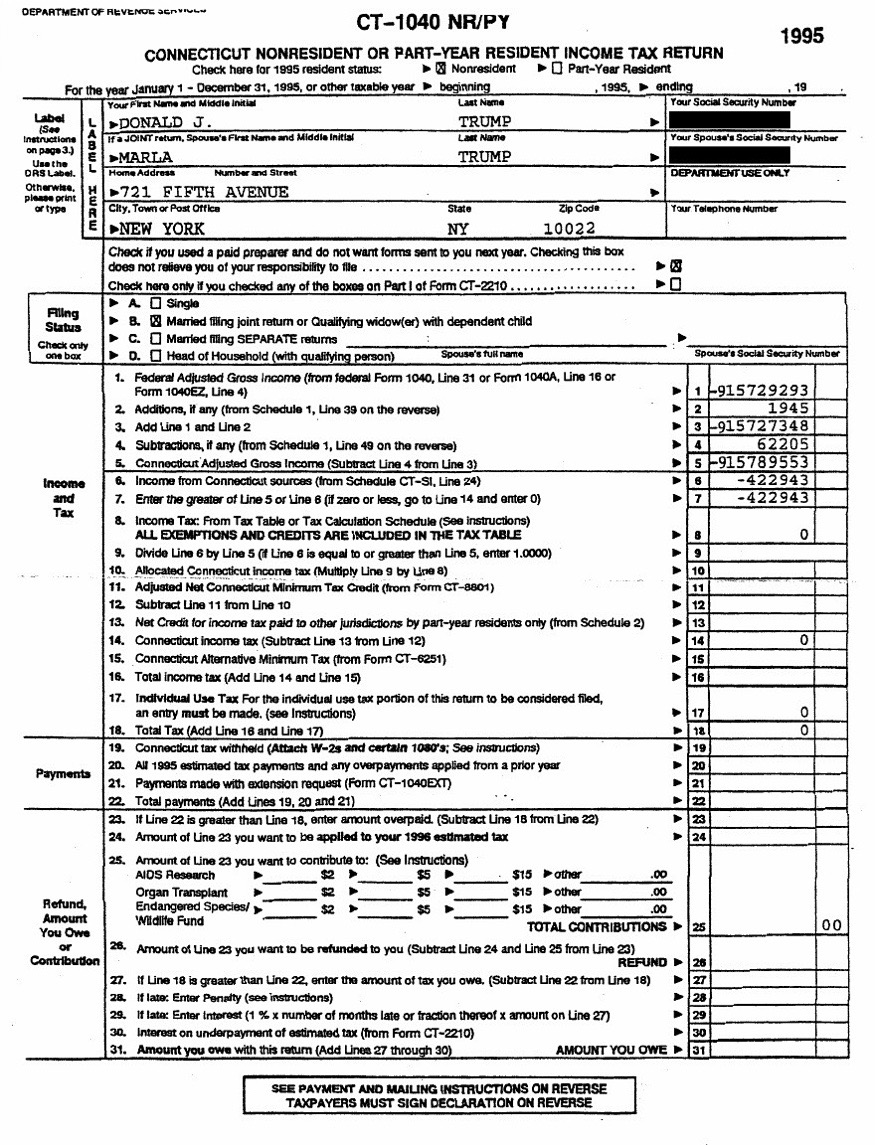
Image above: Page on of three pages of Donald Trump's 1995 New York State Income Tax Form IT-201 indicating an adjusted federal gross income of of -$915,729,293. Click to enlarge Page 1. Click to see  Page 2. Click to see Page 3. From original article.

For months democrats had complained that it was only damaging information associated with Hillary and the Democratic party that had been leaked during the election season, a string of hacks which was promptly assigned to Russia and Putin. That changed overnight.

In its leading Sunday story, the New York Times reports that "Trump Tax Records Obtained by The Times Reveal He Could Have Avoided Paying Taxes for Nearly Two Decades."

Specifically, it reports that according to a previously undisclosed 1995 tax filing, Trump reported a $916 million loss on his income tax returns that year which could have allowed him to legally avoid paying any federal income tax for up to 18 years.

As it explains, "the 1995 tax records, never before disclosed, reveal the extraordinary tax benefits that Mr. Trump, the Republican presidential nominee, derived from the financial wreckage he left behind in the early 1990s through mismanagement of three Atlantic City casinos, his ill-fated foray into the airline business and his ill-timed purchase of the Plaza Hotel in Manhattan."

To be sure, since Trump has never released his tax returns, it's still unclear if he paid federal income tax in subsequent years.  At Monday’s presidential debate when Hillary Clinton accused him of not paying federal income taxes, he replied, “That makes me smart.”

As the NYT further details, in the early 1990s, Trump's real estate projects and other businesses were quickly losing money, New Jersey casino regulator records and other documents have shown, which has been known for years as was the fact that Trump faced near-ruin in the mid-90s.  The Times said that Trump reported earning $7.4 million in interest income for the year but just over $6,000 in wages, salaries and tips.
“He has a vast benefit from his destruction” in the early 1990s, said one of the experts, Joel Rosenfeld, an assistant professor at New York University’s Schack Institute of Real Estate. Mr. Rosenfeld offered this description of what he would advise a client who came to him with a tax return like Mr. Trump’s: “Do you realize you can create $916 million in income without paying a nickel in taxes?”
Of course, the NYT discovery in itself is hardly as exciting as it makes it out to be: all the paper has found is that Trump established a substantial Net Operating Loss, or NOL, which courtesy of the US tax code, could be carried forward for years.
Reports by New Jersey’s casino regulators strongly suggested that Mr. Trump had claimed large net operating losses on his taxes in the early 1990s. Their reports, for example, revealed that Mr. Trump had carried forward net operating losses in both 1991 and 1993. What’s more, the reports said the losses he claimed were large enough to virtually cancel out any taxes he might owe on the millions of dollars of debt that was being forgiven by his creditors. (The I.R.S. considers forgiven debt to be taxable income.)
Indeed, as the NYT itself admits there was nothing illegal about using such a manoeuvre: the world's rich take advantage of NOL tax planning all the time, and in fact acquiring corporations for their NOL benefit has long been a strategy in corporate America designed to minimize Federal and State tax outflows.
The tax experts consulted by The Times said nothing in the 1995 documents suggested any wrongdoing by Mr. Trump, even if the extraordinary size of the loss he declared would have probably attracted extra scrutiny from I.R.S. examiners. “The I.R.S., when they see a negative $916 million, that has to pop out,” Mr. Rosenfeld said.
Considering that according to Trump he has been the subject of numerous tax audits by the IRS that appears to be indeed the case.

Furthermore, the NYT itself is perfectly happy to take advantage of the US tax to minimize the amount of money it pays to the government: in 2014 the company got a tax refund of $3.6 million despite having a $29.9 million pretax profit, an effective negative tax rate for 2014, which it explained was favorably affected by approximately $21.1 million for the reversal of reserves for uncertain tax positions due to the lapse of applicable statutes of limitations.

owever, the biggest news in the NYT report is not so much the glimpse into Trump's income statement over 20 years ago, but the fact that unexpectedly a Deep Throat appears to have emerged within Trump's organization, someone found directly inside the Trump Tower. This is how the NYT explains where it got the questionably obtained filings:
The documents consisted of three pages from what appeared to be Mr. Trump’s 1995 tax returns. The pages were mailed last month to Susanne Craig, a reporter at The Times who has written about Mr. Trump’s finances. The documents were the first page of a New York State resident income tax return, the first page of a New Jersey nonresident tax return and the first page of a Connecticut nonresident tax return.

Each page bore the names and Social Security numbers of Mr. Trump and Marla Maples, his wife at the time. Only the New Jersey form had what appeared to be their signatures.

The three documents arrived by mail at The Times with a postmark indicating they had been sent from New York City. The return address claimed the envelope had been sent from Trump Tower.
Missing, however, was Trump's comprehensive Federal tax return: "because the documents sent to The Times did not include any pages from Mr. Trump’s 1995 federal tax return, it is impossible to determine how much he may have donated to charity that year.

The state documents do show, though, that Mr. Trump declined the opportunity to contribute to the New Jersey Vietnam Veterans’ Memorial Fund, the New Jersey Wildlife Conservation Fund or the Children’s Trust Fund. He also declined to contribute $1 toward public financing of New Jersey’s elections for governor."

Understandably, the Trump campaign was troubled by the leak: as the NYT notes, a lawyer for Mr. Trump, Marc E. Kasowitz, emailed a letter to The Times arguing that publication of the records is illegal because Mr. Trump has not authorized the disclosure of any of his tax returns.

Mr. Kasowitz threatened “prompt initiation of appropriate legal action.” Incidentally, Kasowitz is also somewhat well known in the investing community for threatening to sue outspoken critics of problematic stock narratives, having threatened with lawsuits investors and journalists divulging negative information involving such Canadian firms as Fairfax, Valeant and Brookfield.

It remains to be seen if legal action against the NYT will indeed be taken. The Trump campaign promptly responded to what it alleges was "illegally obtained" information as follows:
"The only news here is that the more than 20-year-old alleged tax document was illegally obtained, a further demonstration that the New York Times, like establishment media in general, is an extension of the Clinton Campaign, the Democratic Party and their global special interests. What is happening now with the FBI and DOJ on Hillary Clinton's emails and illegal server, including her many lies and her lies to Congress are worse than what took place in the administration of Richard Nixon - and far more illegal.

"Mr. Trump is a highly-skilled businessman who has a fiduciary responsibility to his business, his family and his employees to pay no more tax than legally required. That being said, Mr. Trump has paid hundreds of millions of dollars in property taxes, sales and excise taxes, real estate taxes, city taxes, state taxes, employee taxes and federal taxes, along with very substantial charitable contributions. Mr. Trump knows the tax code far better than anyone who has ever run for President and he is the only one that knows how to fix it.

"The incredible skills Mr. Trump has shown in building his business are the skills we need to rebuild this country. Hillary Clinton is a corrupt public official who violated federal law, Donald Trump is an extraordinarily successful private businessman who followed the law and created tens of thousands of jobs for Americans."

However, while the story of Trump's use of NOLs may be overblown, the big news of the day is that a deeply-embedded, and well-connected mole appears to have emerged within Trump's organization, someone close enough to have access to Trump's tax filings, albeit at least for now, going back more than 20 years in time.

As such suddenly the odds that the "October Surprise" will be a leak not so much of additional Hillary hacked data, but of adverse infromation impacting the Trump campaign has surged. That said, we doubt if the media will blame the Kremlin for this particular leak, as it has done all along whenever Hillary's own dirty laundry was released into the open.
The three leaked state tax filing pages are shown below:


Trump may have avoided 18 years taxes

SUBHEAD: Trump may have 18 years of no federal taxes from 1995. Question is was it a "real" net operating loss.

By John Hempton on 2 October 2016 for Bronte Capital -
(http://brontecapital.blogspot.com/2016/10/some-comments-on-new-york-times-story.html)

Decades ago - before I was a fund manager - I was the resident expert on tax avoidance working for the Australian Treasury. That was where I started to hone the accounting skills sometimes shown on this blog.

I very rarely do anything in tax - but now I think it is time.

The New York Times has published a story (including extracts) about Donald Trump's tax returns over two decades ago. The money-quote is this:
Donald J. Trump declared a $916 million loss on his 1995 income tax returns, a tax deduction so substantial it could have allowed him to legally avoid paying any federal income taxes for up to 18 years...
According to the New York Times the losses came
... through mismanagement of three Atlantic City casinos, his ill-fated foray into the airline business and his ill-timed purchase of the Plaza Hotel in Manhattan.
There is an issue here.

Donald Trump did not repay all the debt associated with those investments.

Either
  • the loss is a real loss and the Donald was really was out of pocket by $916 million, in which case he has legitimate Net Operating Losses (NOLs)
  • or the loss was passed on to someone else by The Donald defaulting on debt - in which case Donald Trump should be assessed for income from debt forgiveness.
After all if the debt is forgiven it is not Donald Trump's loss. The loss is borne by the person who lent Donald money and did not get it back.

That - clearly stated by example - is why most income tax systems assess debt forgiveness as income.

Okay - I do not know whether Donald Trump had the wherewithal in 1995 to bear $916 million of losses personally. But I doubt it. (If he did his financial career is different from what is popularly accepted.)

So the alternative is the debt was forgiven in some way. But then the story the New York Times is running is wrong - because the $916 million of losses would not have survived the debt forgiveness and hence would have wiped out his NOLs and thus he would not be allowed to shelter his income for the next 18 years.

Unless that is there is an avoidance scheme the New York Times has not worked out. Those schemes go by the name of "debt parking".

Debt parking
Here is how debt parking works. Suppose the debtor (in this case The Donald) is going to get his debt cancelled for (say) 1c in the dollar. When he gets the debt wiped out the debtor (ie The Donald) will have to report assessable income equal to the debt wiped out (in this case 99 percent of $916 million).

The alternative though is for the debtor to set up a dummy party. The dummy party might be his wife or children or some company or trust set up by them or more likely some completely opaque offshore trust.

And that dummy party goes and buys the debt for say 1.1 cents in the dollar. Then they just sit there.

They don't force the debtor (ie The Donald) to repay. They don't make a profit or loss on the debt. And because the debtor never has his debt forgiven he never gets the assessment on debt forgiveness and he gets to keep his NOLs even though the losses did not come out of his pocket.

Every tax system worth its salt has some rules on "effective debt forgiveness" to prevent debt parking. And - from my experience which is now over twenty years old - none of them work entirely.

Now if Donald really has all those tax losses its pretty clear that the debt must be parked somewhere.

There is a vehicle out there (say an offshore trust or other undisclosed related party effectively controlled by Donald Trump) - which owns over $900 million in debt and is not bothering to collect it.

I do not have the time or energy to find that vehicle. But it is there. Now that this blog has gone public journalists are going to look for it.

There is a Pulitzer prize for whoever finds it. Just give me a nod at the acceptance ceremony.


.

Contact the bankers behind DAPL

SUBHEAD: How to contact the CEOs and others of bankers funding the Dakota Access Pipeline.

By Emily Fuller on 29 September 2016 for Yes Magazine -
(http://www.yesmagazine.org/people-power/how-to-contact-the-17-banks-funding-the-dakota-access-pipeline-20160929)


Image above: Goldman Sachs is deep into the shale fossil fuel business that is wrecking the world's climate. From (http://www.bidnessetc.com/47761-goldman-sachs-group-bullish-on-marathon-petroleum-corp-delek-energy-valero/).

Here are CEO names, emails, and phone numbers—because banks have choices when it comes to what projects they give loans to.

The Dakota Access pipeline is funded directly by 17 banks, many of which—Citibank, Wells Fargo—are ones you’ve probably heard of or do business with.

Researchers with the nonprofit Food & Water Watch found that 38 banking institutions are involved in funding the proposed Bakken pipeline, which would stretch from Canada to the Gulf of Mexico.

A section of this project is the Dakota Access pipeline, where the Standing Rock Sioux and thousands of allies have physically put themselves in the path of the pipeline to protect their reservation and a stretch of the Missouri River.

Bill McKibben, founder of 350.org, recently wrote an article for YES! suggesting that banks are more susceptible to public pressure than the oil and gas giants, which depend on bank loans and lines of credit to build their pipelines. “It’s probably sustained public pressure that will do the most good,” he wrote.

Wondering what to say to a bank executive?

Food & Water Watch researcher Hugh MacMillan: “Ask these banks to clarify whether funds they are providing are being used, in any amount, to pay for the heavily militarized response to the Standing Rock Sioux, including the attack dogs, sound-cannon trucks, heavily armed officers, and even a crop duster spraying undetermined chemicals over the camp.

“People should also ask these institutions why they are sinking so much money into maximizing the amounts of oil and gas that can be brought to the surface and burned at a time when climate science is clear we have to maximize what we keep in the ground instead,” said MacMillan.

The organization’s deputy communications director, Seth Gladstone, suggests saying: “As a customer of your financial institution, I reject the notion of my money helping to support your investment in the Dakota Access pipeline, an inherently dangerous and unjust oil pipeline that threatens air and water quality in many states, and violates sacred lands of the Standing Rock Sioux tribe. I urge you to give up your financial stake in the Dakota Access pipeline immediately.”

The following are names of CEOs and other bank executives involved in these decisions—along with their phone numbers and email addresses. The first 17 banks (*) are directly funding the Dakota Access pipeline.


Wells Fargo*
CEO John Stumpf
John.G.Stumpf@wellsfargo.com
BoardCommunications@wellsfargo.com
Phone: 866-249- 3302

Corporate Office:
Wells Fargo
420 Montgomery Street
San Francisco, CA 94104


BNP Paribas*
CEO Jean-Laurent Bonnafe
jean-laurent.bonnafe@bnpparibas.com

Corporate Office:
3 rue d’Antin
75002 Paris, France
Phone: 00-33-157-082-200

U.S. Office:
787 Seventh Avenue - The Equitable Tower
New York, NY 10019
Phone: 212-841-3000


SunTrust*
CEO William H. Rodgers Jr.

Corporate Office:
303 Peachtree Street NE
Atlanta, GA 30308
Phone: 800-786-8787

Chief Communications Officer:
Sue Mallino
jean-laurent.bonnafe@bnpparibas.com
Phone: 404-813-0463


The Bank of Tokyo-Mitsubishi UFJ*
Chairman Nobuyuki Hirano
CEO and President Takashi Oyamada

Corporate Office:
2-7-1, Marunouchi, Chiyoda-ku
Tokyo, Japan
Phone: 81-3-3240-8111

U.S. Office:
1251 Avenue of the Americas
New York, NY 10020-1104
Phone: 212-782-4000


Mizuho Bank*
President and CEO Nobuhide Hayashi

Corporate Office:
Otemachi Tower
1-5-5, Otemachi, Chiyoda-ku
Tokyo 100-8176, Japan
Phone: 81-3-3214-1111

U.S. Office:
1251 Avenue of the Americas
New York, NY 10020
Phone: 212-282-3000


Citibank (CitiGroup)*
CEO Michael Corbat
michael.corbat@citi.com
Phone: 212-793-1201

Corporate Office:
388 Greenwich Street
New York, NY 10013
Phone: 800-285-3000 and 212-793-0710


TD Securities*
Chairman, CEO, and President Bob Dorrance

Corporate Office:
P.O. Box 1, TD Bank Tower
66 Wellington Street W
Toronto, Ontario
M5K 1A2

Investment Banking:
Phone: 416-307-8500

Equity Research:
Phone: 416-307-9360

Trading Floor Enquiries:
Phone: 416-944-6978

U.S. Office:
31 West 52nd Street
New York, NY 10019-6101
Phone: 212-827-7000


Credit Agricole*
CEO Jean-Paul Chifflet

Corporate Office:
12, Place des Etats-Unis
Montrouge, France 92545
Phone: 33-1-43-23-52-02

U.S. Office:
1301 Avenue of the Americas,
New York, NY 10019
infoamericas@ca-cib.com


Intesa SanPaolo*
CEO Carlo Messina

Corporate Office:
Piazza San Carlo, 156
10121 Torino, Italy
Phone: 39-011-555-1

Corporate Social Responsibility Unit:
Phone: 39-02-8796-3435
CSR@intesasanpaolo.com
sostenibilita.ambientale@intesasanpaolo.com


ING Bank*
CEO and Executive Board Chairman Ralph A.J.G Hamers

Wholesale Banking, Operations & IT, Sustainability, Corporate Governance:
Carolien van der Giessen
carolien.van.der.giessen@ing.com
Phone: 31-20-576-63-86

Head of Media Relations:
Raymond Vermuelen
raymond.vermeulen@ing.com
Phone: 31-20-576-63-69

Corporate Office:
Amsterdamse Poort
Bijlmerplein 888
1102 MG Amsterdam
The Netherlands
31-20-5639111

Mailing Address:
ING Bank N.V.
P.O. Box 1800
1000 BV Amsterdam
The Netherlands

U.S. Office:
ING Financial Holdings LLC
1325 Avenue of the Americas
New York, NY 10019
Phone: 646-424-6000


Natixis*
CEO Pierre Servant

Corporate Office:
Natixis Global Asset Management, S.A.
21 quai d’Austerlitz
75634 Paris Cedex 13, France
Phone: 33-1-78-40-90-00

U.S. Office:
Natixis Global Asset Management, L.P.
399 Boylston Street
Boston, MA
Phone: 617-449-2100


BayernLB*
CEO Johannes-Jorg Riegler

Head of Communications:
Matthias Priwitzer
Matthias.Priwitzer@bayernlb.de
Phone: 49-89-2171-21255

Corporate Office:
Brienner Straße 18
80333 Munich
49-89-2171-27176

U.S. Office:
560 Lexington Avenue
New York City, NY 10022
212-310-9800


BBVA Securities*
CEO Carlos Torres Villa
Executive Chairman Francisco Gonzalez Rodriguez

Corporate Office:
Calle Azul, 4
28050 Madrid, Spain
Phone: 34-902-22-44-66


DNB First Bank*
CEO and President William J. Hieb
Phone: 610-269-1040

Main Branch:
4 Brandywine Avenue
Downingtown, PA 19335
Phone: 484-691-3621


ICBC London*
CEO and Managing Director Jin Chen
Corporate Office:
20 Gresham Street
London EC2V 7JE, United Kingdom
Phone: 44-203-145-5000

U.S. Office:
520 Madison Avenue 28th Floor
New York, NY 10022
Phone: 212-407-5000


SMBC Nikko Securities*
President and CEO Yoshihiko Shimizu

Corporate Office:
3-1, Marunouchi 3-chome, Chiyoda-ku
Tokyo 100-8325, Japan
Phone: 81-3-5644-3111


Societe General*
CEO Frederic Oudea
https://www.linkedin.com/in/fredericoudea

Chairman of the Board Lorenzo Bini Smaghi
lorenzo.binismaghi@snam.it

Corporate Office:
29 boulevard Haussmann 75009
Paris, France
Phone: 33-1-42-14-20-00
2.0@societegenerale.com

U.S. Office:
245 Park Avenue
New York City, NY 10167
Phone: 212-278-6000


The following banks are involved in funding for the entire Bakken pipeline:
Royal Bank of Scotland
CEO Ross McEwan
ross.mcewan@rbs.co.uk

Director of Media Relations:
Chris Turner
Phone: 44-20-7672-4515

Corporate Office:
Gogarburn
175 Glasgow Road
Edinburgh, United Kingdom
Phone: 44-131-626-3263

U.S. Office:
600 Washington Boulevard
Stamford, CT 06901
Phone: 203-897-2700


ABN Amro Capital
Chairman of the Board Gerrit Zalm

Corporate Office:
ABN AMRO Bank N.V.
Gustav Mahlerlaan 10
1082 PP Amsterdam
The Netherlands
Phone: 31-10-241-17-23

U.S. Office:
100 Park Avenue, 17th floor
New York, NY 10017
Phone: 917-284-6800


Bank of Nova Scotia (Scotiabank)
CEO and President Brian J. Porter

Corporate Office:
Scotia Plaza
44 King Street W
Toronto, Ontario
Canada M5H 1H1
Phone: 416-866-6161
email@scotiabank.com

U.S. Office:
250 Vesey Street,
23rd and 24th floors
New York, NY 10281
Phone: 212-225-5000

Howard Weil “Scotia Energy Investment Boutique”
Energy Centre
1100 Poydras Street Suite 3500
New Orleans, LA 70163
Phone: 504-582-2500 and 800-322-3005
howardweil@howardweil.com


Citizens Bank
Chairman and CEO Bruce Van Saun

Head of Media Relations:
Peter Lucht
Peter.Lucht@citizensbank.com
Phone: 781-655-2289

Consumer Lending, Business Banking, Wealth Management, Corporate:
Lauren DiGeronimo
Lauren.Digeronimo@citizensbank.com
Phone: 781-471-1454

Corporate Office:
1 Citizens Plaza
Providence, RI 02903
Phone: 401-456-7000


Comerica Bank
Chairman and CEO Ralph W. Babb Jr.

Investor Relations:
Phone: 214-462-6831

Corporate Contacts:
Wendy Bridges
wwbridges@comerica.com
Phone: 214-462-4443

Wayne Mielke
wjmielke@comerica.com
Phone: 214-462-4463

Corporate Office:
Comerica Bank Tower
1717 Main Street
Dallas, TX 75201
Phone: 800-521-1190


U.S. Bank
Chairman and CEO Richard K. Davis
richard.davis@usbank.com

Senior Vice President of Corporate CommunicationsDana Ripley
dana.ripley@usbank.com
Phone: 612-303-3167

Brand, Corporate Social Responsibility, Sponsorships:
Susan Beatty
susan.beatty@usbank.com
Phone: 612-303-9229

Corporate Office:
U.S. Bancorp Center
800 Nicollet Mall
Minneapolis, MN 55402
Phone: 800-685-5065 and 651-466-3000


PNC Bank
Chairman, President, and CEO William S. Demchak

Media Relations:
Fred Solomon
corporate.communications@pnc.com
Phone: 412-762-4550

Investor Relations:
Bryan K. Gill
investor.relations@pnc.com
Phone: 412-768-4143

Corporate Office:
300 Fifth Avenue
The Tower at PNC Plaza
Pittsburgh, PA 15222
Phone: 412-762-2000


Barclays
Chairman John McFarlane
john.mcfarlane@barclays.com

CEO Jes Staley

Corporate Office:
Barclays Bank PLC
1 Churchill Place
London E14 5HP, United Kingdom
Phone: 44-20-7116-1000

U.S. Office:
Barclays
745 7th Avenue
New York, NY 10019
Phone: 212-526-7000

Press Office:
Phone: 212-526-7000
CorporateCommunicationsAmericas@barclays.com


JPMorgan Chase
Chairman and CEO Jamie Dimon
jamie.dimon@jpmchase.com
Phone: 212-270-1111

Corporate Contacts:
Andrew Gray
andrew.s.gray@jpmchase.com

Jennifer Lavoie
jennifer.h.lavoie@jpmchase.com

Brian Marchiony
brian.j.marchiony@jpmorgan.com

Corporate Office:
270 Park Avenue
New York, NY 10017-2014


Bank of America
President, CEO, and Chairman Brian Moynihan
brian.t.moynihan@bankofamerica.com

Executive Relations, Office of the CEO:
Matthew Task
Phone: 813-805-4873

Corporate Office:
100 N Tryon Street
Charlotte, NC 28255


Deutsche Bank
CEO John Cryan

Corporate Contact:
Renee Calabro
renee.calabro@db.com
Phone: 212-250-5525

Corporate Office:
Deutsche Bank AG
Taunusanlage 12
60325 Frankfurt Am Main (for letters and postcards: 60262)
Germany
Phone: 49-69-910-00

U.S. Office:
Deutsche Bank AG
60 Wall Street
New York, NY 10005
212-250-7171


Compass Bank
Chairman and CEO Manolo Sanchez

Director of External Communications:
Christina Anderson
christina.anderson@bbva.com

Communications:
Al Ortiz
al.ortiz@bbva.com
Phone: 281-433-5640

Corporate Office:
15 S 20th Street
Birmingham, AL 35233
Phone: 205-297-1986


Credit Suisse
CEO Tidjane Thiam

Board Chairman Urs Rohner

Suisse Banking Ombudsman:
Bahnhofplatz 9
P.O. Box 1818
CH 8021 Zurich, Switzerland
Phone: 41-43-266-14-14

Corporate Office:
Uetlibergstrasse 231
P.O. Box 700
CH 8070 Zurich, Switzerland
Phone: 41-44-333-11-11

U.S. Office:
650 California Street
San Francisco, CA 94108
Phone: 415-249-2100


DNB Capital/ASA
CEO Rune Bjerke
https://www.linkedin.com/in/rune-bjerke-04714639

Chairwoman of the Board Anne Carine Tanum
Pbone: 47-915-04800

Executive Vice President Communications
Even Westerveld
Phone: 47-400-16-744

Corporate Address:
Dronning Eufemias Gate 30
0191 Oslo, Norway


Sumitomo Mitsui Bank
President and CEO Takeshi Kunibe

Corporate Office:
1-1-2, Marunouchi, Chiyoda-ku
Tokyo, Japan
Phone: 81-3-3282-8111

U.S. Office:
277 Park Avenue
New York, NY 10172
Phone: 212-224-4000


Royal Bank of Canada
CEO David I. McKay

CEO and Board Communications:
Paul French
paul.french@rbc.com
Phone: 416-974-3718

Corporate Media Relations:
Catherine Hudon
catherine.hudon@rbc.com
Phone: 416-974-5506

Corporate Address:
200 Bay Street P.O. Box 1
Royal Bank Plaza
Toronto, Canada
Phone: 416-974-5151 and 416-842-2000


UBS
CEO Sergio Ermotti
https://www.linkedin.com/in/sergiopermotti

Head Group External Communications:
Mark Hengel
mark.hengel@ubs.com
Phone: 41-44-234-32-21
Chief Communication Officer-Americas:
Marsha Askins
marsha.askins@ubs.com
Phone: 212-713-6151 office and 917-226-4743 cell

Corporate Office:
Bahnhofstrasse 45, CH-8098
8001 Zurich, Switzerland
Phone: 41-44-234-11-11

U.S. Office:
1285 Avenue of the Americas
New York, NY 10019
Phone: 212-713-2000


Goldman Sachs
Chairman and CEO Lloyd C. Blankfein
lloyd.blankfein@gs.com
Phone: 917-743-0939 and 212-902-0593

Media Contacts Americas:
Phone: 212-902-5400

Corporate Address:
Goldman, Sachs & Co.
200 West Street
New York, NY 10282
Phone: 212-902-1000


Morgan Stanley
CEO James P. Gorman
jgorman@morganstanley.com
Phone: 212-761-4000

Corporate Office:
Morgan Stanley
1585 Broadway
New York, NY 10036
Phone: 212-761-4000


Community Trust Bank
Chairman, President, and CEO Jean R. Hale
Senior Vice President, Investments:
Christopher Meng
mengro@ctbi.com
Phone: 859-389-5300
Corporate Office:
346 N Mayo Trail
Pikeville, KY 41501
Phone: 606-432-1414


HSBC Bank
Chairman Douglas Flint Group Chief Executive Stuart Gulliver
managingdirectoruk@hsbc.com

Corporate Office:
8 Canada Square
London E14 5HQ, United Kingdom
Phone: 44-20-7991-8888

U.S. Office:
HSBC Headquarters
425 5th Avenue
New York, NY 10018
Phone: 212-525-5600

Head of Media Relations, HSBC USA:
Rob Sherman
Phone: 212-525-6901

The information compiled here is from the latest information reported by the banks. If there are corrections or additions that we should consider, please let us know.

See also:
Ea O Ka Aina: NoDAPL demo at Enbridge Inc 9/29/16
Ea O Ka Aina: Militarized Police raid NoDAPL 9/28/16
Ea O Ka Aina: Stop funding of Dakota Access Pipeline 9/27/16
Ea O Ka Aina: UN experts to US, "Stop DAPL Now!" 9/27/16
Ea O Ka Aina: No DAPL solidarity grows 9/21/16
Ea O Ka Aina: This is how we should be living 9/16/16
Ea O Ka Aina: 'Natural Capital' replacing 'Nature' 9/14/16
Ea O Ka Aina: The Big Difference at Standing Rock 9/13/16
Ea O Ka Aina: Jill Stein joins Standing Rock Sioux 9/10/16
Ea O Ka Aina: Pipeline temporarily halted 9/6/16
Ea O Ka Aina: Native Americans attacked with dogs 9/5/16
Ea O Ka Aina: Mni Wiconi! Water is Life! 9/3/16
Ea O Ka Aina: Sioux can stop the Pipeline 8/28/16
Ea O Ka Aina: Officials cut water to Sioux 8/23/16 

.