New sail power in Mediterranean

SUBHEAD: In Europe cargo sail ships are making inroads replacing bunker fuel burning dinosaurs.

By Jan Lundborg on 15 June 2017 for Sail Transport Network -
(http://www.sailtransportnetwork.org/node/963)
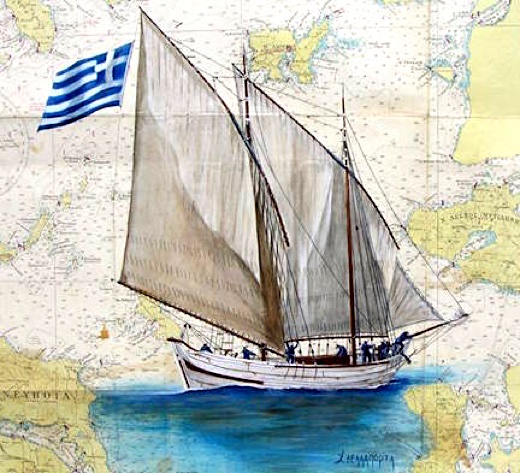

Image above: Painting of sailship Perama over map of Mediterranean  by Chryssa Dellapporta. From original artical.

In a fast changing world, it is no longer possible to automatically assume that what one is used to will endure. People want stability and predictability, but, as they say, good luck with that.

We are witnessing out-of-control evolution of a rapid, uncertain sort. Fortunately, there are pro-active initiatives that have seized the imagination of thinking people who think of the Earth as a community to share.

They look ahead in terms of decades and even centuries instead of mere days or quarterly periods.

As an environmental activist looking for answers to pollution and disastrous land use, after 1988 when I left the service of the oil industry and government, I eventually came upon the revival of sail transport as a most promising potential sector.

That was in 1999. Fast forward to 2017, and much progress has been made by the sail transport movement, especially since 2008.

The outstanding success that has endured since then has been that of the Fairtransport organization in the Netherlands. Their first ship was the Tres Hombres, a 32-meter brigantine, built by volunteers. It has now completed ten transatlantic voyages carrying cargo from the Caribbean back to northern Europe, without an engine.

Among several other sail transport projects, Timbercoast’s Avontuur cargo schooner, at 44 meters long with a cargo capacity of 70 tons, is the other standout. Since last year it is operating from Germany to the Caribbean and back.

This year is now seeing — as I write these lines — another step forward: like Fairtransport and Timbercoast, it marks a noteworthy and practical embrace of sail power for moving cargo via clean, renewable energy known as the wind.

In the eastern Mediterranean, Aegean Cargo Sailing is a demonstration project now underway (June 2017) to highlight high quality island products for a broadened market that caters to the ecologically sensitive. This niche market for food and beverage items, like in northern Europe, is growing and worth pursuing.

Furthermore, with an eye to the future, when climate change and the energy mix will be sure to challenge today’s unconscious shopping within the corporate consumer economy, solutions must also promise local economic health and meaningful work for the new generation.
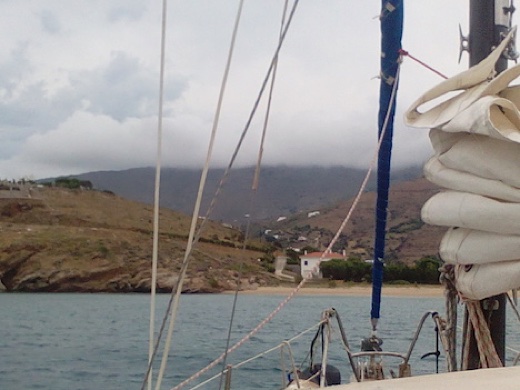

Image above: Sailship Sailship Pelago off town of Karystos on island of Euboea beginning of Aegean Cargo Sailing voyage. From original article.

Aegean Cargo Sailing visits six islands as well as the Greek mainland province of Attica, spreading the word and the tastes of a sustainable future. (See the voyage blog).

The current vessel the for project, the sloop Pelago, only carries one tonne [one metric ton, or 2,204.6 pounds] of cargo. But it serves as sufficient “proof of concept” for motivating people from various walks of life who have become, or may become, involved as supporters or self-starters of similar efforts.

Defenders of the status quo, however, resigned to the immense trade volumes (and pollution) of the 90,000 oil-burning cargo ships operating today, are correct that sail transport trade amounts to just a drop in the bucket.

Yes, for now. However, an historic trend starts with one small step. Think of many sailboats eventually commencing cargo transport, whether small sloops originally designed for recreation of living aboard, or larger vessels approaching clipper ships of 150 years ago that sailed faster than today’s modern cargo vessels. The drop in the bucket is no longer a drop in the bucket.

The island stops on the current route starting from the port of Lavrio, are Kea, Andros, Tinos, Mykonos, Ikaria, and Samos. The end of this voyage is a marina near Athens, enabling us to get the products to a cooperating health food store to display sail transport’s potential for bringing goods to customers without oil and its inherent pollution.

Organic and fair trade are wonderful developments, but what good are they if the transport is filthy and unsustainable?

On land, pedal power and animal power, combined with proximity, are the way to go, and we are intensifying of efforts in this regard. But the need for long-distance transport has been a fixture of human society, and this need will only grow as local ecosystems are discovered to inadequately provide for huge populations.

By now most of us have learned that unending oil dependence and its attendant harms is no answer, if long-term survival is to be planned rationally and honestly.


Image above: Valia Stefanoudaki, products coordinator Aegean Cargo Sailing with customer. From original article.

Valia Stefanoudaki, coordinator of Aegean Cargo Sailing products, is shown here with owner of the many traditional local-product shops on the Aegean island of Andros This shop is called “Biologos” ("organic"), and was one of the first collaborative shops visited in the debut voyage.

Valia wears the SAIL MED t-shirt of the Aegean Cargo Sailing crew. She and her mates report that shops and suppliers are reacting enthusiastically over clean, attractive sail transport for their goods, perceiving enhanced value generated.

Since oil-burning cargo ships kill around 60,000 people a year with sooty emissions, and the total annual global CO2 emissions from 90,000 motorized ships constitute what would be the sixth largest-ranking nation in the world, it is high time to adopt means of low-cost, clean, renewable energy that are here and now.

Considerations include food security, local development, the idea of a Blue Economy, and healthy seas (each of which is examined below). Addressing the issues raised can help counter the global, haphazard practices and systems threatening life as we know it.

Unfortunately, faith in government and industry has meant unending, unchecked emissions that the United Nations and its International Maritime Organization have done next to nothing about in the 20 years since the Kyoto Protocol. The slow pace along with greenwashing aids only entrenched industry.

But can we all just keep shopping, and assume that Mother Nature will keep providing, keep forgiving, and allow us to just wait until modern society is good and ready to make more intelligent innovations that secure a livable future?

A recent news item: "Cargo Shipping Market to Witness an Annual Growth Rate of 3.45% from 2017 to 2023".

This projection is possible only if there are no major events in the world oil market to significantly curtail supplies. Additionally, as oil products are hugely subsidized — with "externalities" of pollution, etc., paid for by the rest of society, such as those buying food — this state of affairs would need to remain unchanged. Never mind the impossibility of endless growth on a finite planet.

Food security
Local food production for food security and for avoiding long-distance oil consumption for transport is a crucial foundation for our common future. How can this be achieved under the corporate economy that rewards large economies-of-scale trade and distribution via dwindling fossil fuels?

Sail transport has potential as a vast, low-tech, albeit lower-volume means of bioregional and trans-ocean sharing of surpluses. A given ecosystem diminished by harmful development and loss of arable land can rarely provide all the food or kinds of food that a population needs for survival.

Indeed, the secure exchange of surpluses via sailing between coastal and island communities enhances the quality of nutrition for populations who have become distanced from local self-sufficiency.

One Greek island is known, for example, for potato production, while another is known for split peas — both enjoyed by most of the whole nation. It makes sense for any surpluses to be exchanged — in a sustainable fashion that won’t be affected by the next geopolitical oil supply shock.

For those of a mind to consider coffee and chocolate part of food security, they are welcome to this charming mindset as long as there is sailing from the tropics to the high-populated temperate regions that cannot grow those addictive, sensual crops.

Local development
Local development for a sustainable economy closely depends of food security. However, employment and the vital use and revival of skills for a community’s general resiliency are related requirements, and are addressed by sail transport and the cargo sailing sector’s future.

Also, a resilient economic system, sometimes called the Blue Economy, must be local-based instead of a U.N.- or E.U.-driven system out of reach of the average citizen.

Jobs today are primarily in the service of the corporate consumer economy. While this serves many workers, and especially benefits the few who profit greatly on the fossil-fuel based system of energy, transport, and agriculture, the fact remains that unemployment and a poor outlook shared by millions of citizens of developed economies are preventing uncounted working-class people from thriving or getting by with dignity.

Fortunately, the history and legacy of traditional sailing networks and shipbuilding have not disappeared from memory. Examples through successful, small-scale project have been reviving the sailing of cargo, primarily in northern Europe.

SAIL MED is tapping into young persons’ desires to work at meaningful positions that are not limited to serving drinks to tourists or vending souvlakis to increasingly cash-poor consumers.

While the older generation’s strengths and knowledge for community-based trades and services are still present — but being inexorably lost day by day — young people in search of work and convivial, meaningful activity can anticipate finding or creating jobs or small businesses.

Additionally, growing numbers of people find air travel to be unjustifiable due to inefficient, wasteful, toxic fuel consumption. Some of these folk wonder about sailing as the long-term answer for travel across oceans. But, for now, it is the moving of cargo and building local self-reliance that emerge as the priority.

The prospect for greater local development depends on nurturing today’s established home-production, for example of wines, olive oil, olives, and produce — typified by much of Greece.

These highly prized but common items are primarily traded or gifted on a person-to-person basis. This can be enhanced and expanded in order to encourage greater local food sources’ availability through interdependency and cooperation, rather than everyone's waiting for a job-opening involving impersonal, distant employment and the unlikely return of debt-related economic growth.

Additional benefits of local development include more feasible protection of the environment than from top-down policies and regulations that only serve out-of-touch, distant corporations and government technocrats who seldom have any role in enhancing sustainable, non-fossil fuel, local development.

The Blue Economy
Thus far, the Blue Economy is mostly limited to an NGO-oriented and government-agency initiative, promoted via conferences and technical papers.

Many of the “Blue” principles of cleaner seas and appropriate industry are within reach, but limiting and overriding the vision are entrenched business interests; they stand for the status quo of unsustainable development, emitting regulated but massive pollution, and unending industrial growth on a finite planet.

Clean, renewable energy has yet to include sail power for a Blue Economy, so today’s small sail transport movement needs to pursue on all levels the kind of growth that helps people and the environment. Solar panels have a place, but few people look at the issues of questionable net-energy-yield and the limitation of generating only electric power. Two approaches are complementary:
  • establishing local or regional, small scale cargo and passenger trade utilizing sail power;
  • following through with the “Ecoliner” approach for higher-volume cargos, to utilize modern ports currently given over to massive ships and high-tech dock complexes for recently constructed, modern harbors. Such facilities are no longer part of historically established cities or real communities.
The chief reasons for modifying the present fossil-fuel dominated economy, as to transport, are long-term oil supply and climate-protection considerations:
  • Conventional crude oil reserves have been on a depletion trajectory worldwide since 2005. Supplies of oil for ships, planes and trucks, agriculture, etc., have had to rely on increased subsidies. As higher-cost, lower net-energy-yield oil is counted on to stretch supply indefinitely, via fracking and deep water, frozen-environment extraction, the domination of oil and its refined fuels for transport makes less and less sense. To address this requires sound planning, innovative policies, and better technology, to be understood and pursued by the citizenry instead of technocrats and corporate-bottom-line careerists. A sudden oil supply crisis can threaten today’s commerce and consumers’ tenuous security. The 90,000 “oil boats” moving cargo will someday be lamented as non-renewable-energy dinosaurs.
  • CO2 emissions from shipping have been growing out-of-control, and are set to continue doing so. Up to 250% greater emissions have been forecast to occur by 2050. This state of affairs is due to the lack of regulations and pro-industry allegiance by the International Maritime Organization, which has not followed UNFCCC guidelines for protecting the climate. As extreme weather continues to worsen and exact exponential costs, and climate-change related migration accelerates, people will look to clean-energy transport that sail power offers.

Healthy Seas
In addition to species impacted directly by oil spills, the related crises of the plastic plague, poison runoff, and improper disposal of toxics call us to take action.

Some 20% of sea pollution comes from the deliberate dumping of oil and other wastes from ships, from accidental spills and offshore oil drilling.

But of all the sources of marine pollution, the discharge of oily engine wastes and bilge from day-to-day shipping operations may be the worst, because it is steady and occurs everywhere.

Instead of trying to solve the ongoing oil pollution crisis long-term, by reducing oil demand (see WorldOilReduction.org), the Obama administration mainly promised to fine the perpetrators and achieve a “clean energy economy” (some day).

Petroleum refineries keep producing toxic, non-biodegradable plastics, as part of the facilities’ requirement of high utilization of refining capacity. The oil and natural gas industries rely mainly on gasoline and diesel for profits, but to maximize those products, the manufacture and distribution of other products such as plastics, pesticides, dyes, asphalt, and more, must be maintained at all costs.

One result is that plastic particles are increasingly supplanting plankton in terms of volume. This was discovered almost 20 years ago by Capt. Charles Moore, author of Plastic Ocean. He is an active supporter and promoter of Sail Transport Network (SAIL MED’s parent organization).

Since conventional cargo shipping is guilty of more oil spillage on a daily basis, from emptying bilges, than all the high-profile wrecks of tankers and other ships, the poor performance needs a remedy such as sail power and a reduction in much consuming of unessential products. Unreported “accidents” not only harm sea life, but are destroying tourism potential. This recurring disaster is what the public is usually aware of.

However; the use of engines and propellers must be questioned, from both an animal-rights perspective and looking ahead to inevitable changes in technology in a post-peak oil world threatened by accelerated global warming.

Engine noise is extremely damaging to sea creatures, such as whales that depend on quiet seas for their communications that stretch for thousands of kilometers under water. This crisis is akin to land birds’ inability to find mates when motor vehicle noise and other disturbances are prevalent.

Propellers chop up sea creatures, particularly when oil-burning cargo ships travel at high rates of speed (e.g., 18 knots per hour). Slower species such as manatees are often bloodied and killed by propellers.

Additionally, collisions with ships — likely not the case with sailing ships that go slower — kill whales and many other species on a regular basis. The carnage is not quantified, nor banned in any way. This is akin to roadkill by motor vehicles. Species extinction cannot be allowed to continue to rage in our oceans and other bodies of water, and must be made as well-known as land-based species extinction.

The sail transport movement, while not exclusively engine-free and propeller-free, promises much healthier seas. Expansion of our sector as well as general education will help our fellow creatures and the species that they coexist with and rely on for food.

Conclusion:
The crew and management of Aegean Cargo Sailing, part of SAIL MED and the Sail Transport Network, welcome questions, participation, support, and publicity.

One project at a time, building into an ever stronger, growing movement, means sail transport will prevail not just as an interesting, romantic initiative; it is here to stay. A change in thinking is underway, that of placing sail power among the pantheon of (truly) renewable, (truly) clean forms of energy.

See also:
Ea O Ka Aina: New Sail Power in Mediterranean 6/15/17
Ea O Ka Aina: Larry Ellison - Oracle 6/21/12
Ea O Ka Aina: Our Brave Experiment 6/13/12
Ea O Ka Aina: Hokulea sister ship Hikianalia 10/10/12
Ea O Ka Aina: Moving local goods by boat 3/7/12 
Ea O Ka Aina: Polyneisans again tour the Pacific 8/15/11
Ea O Ka Aina: Clear Sky over Polynesian canoes 7/12/11
Ea O Ka Aina: The Sail Transport Network 6/4/11
Island Breath: The future of ocean sailing 8/15/08
Island Breath: Sail Technology Reemerges 12/25/07
Island Breath: Rethinking the sail 12/25/07
Island Breath: THe Polynesian Package 8/24/07
Island Breath: The Future of Ocean Sailing 8/15/06 
The Amazon Problem

SUBHEAD: There is only one force that can stop Amazon from running all American retail commerce.

By Matt Stoller on 17 June 2017 for Huffington Post -
(http://www.huffingtonpost.com/entry/americas-amazon-problem_us_59443b5be4b06bb7d2731cba)


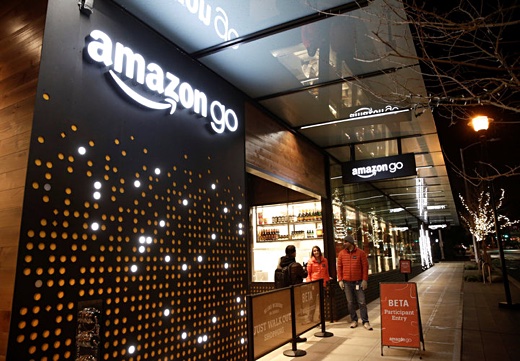
Image above: Exterior of AmazonGO store at the BETA participant entrance. From original article.

To understand the depth and breadth of Jeff Bezos’ ambitions for the company he built, type www.relentless.com into your browser. The domain Bezos registered in 1994 will redirect to Amazon, the company aptly, and ambitiously, nicknamed The Everything Store.n>

He tells his shareholders that the company will act like an aggressive startup — that at Amazon, it is always Day One.

Like Google and Facebook, Amazon uses technology and data to sidestep traditional restrictions on monopoly power.

Our lives are increasingly organized by the platforms these companies run, platforms which now mediate the way we communicate and engage in commerce with each other.

We are living in a world organized by tech monopolists, a change in power relationships that no one voted for but has been imposed upon us nonetheless.

Now, Bezos is attempting to add more power to his empire with the surprise announcement that the company will pay $13.7 billion for Whole Foods Market
. Amazon will now have a store footprint in neighborhoods across America.

Our communities and the way we engage in commerce will change. Imagine walking into a Whole Foods store and seeing different prices depending on whether you are a member of Amazon Prime — or seeing different prices depending on any other way that you interact with Amazon.

This isn’t implausible. It is what the company does when it opens up stores. For instance, Amazon is creating a chain of physical book stores to take the place of the book stores the company destroyed.

In these stores, there are no price tags at all: You scan the items with your phone and have a price delivered to you, personalized by Amazon.

Why wouldn’t Amazon extend this to Whole Foods? “Our goal with Amazon Prime, make no mistake,” says Amazon CEO Jeff Bezos, “is to make sure that if you are not a Prime member, you are being irresponsible.”


Image above: People shop in the newly opened Amazon Books on May 25 in New York City. Amazon Books, like the Amazon Go store, does not accept cash and instead lets Prime members use the Amazon app on their smartphone to pay for purchases. Non-members can use a credit or debit card. From original article.

This statement and the amount of power in Bezos’ hands should frighten all Americans. Bezos meant that Amazon will soon be so good for consumers that it would just be folly not to be a member.

But what he unwittingly implied is that as a citizen, you will have no choice but to interact with his institution to buy and sell key goods that everyone needs — on his terms.


Jeff Bezos, in other words, has a vision. To be everywhere, to be the platform for everything for every consumer. So when Bezos calls you irresponsible for not tithing to Amazon, America has a big political problem.

Amazon’s takeover of Whole Foods means that it can target and eliminate regional competitors one by one as it did with its online competitors. When Diapers.com emerged as a competitor to Amazon, Amazon simply sold diapers below cost until the company capitulated and sold itself to Bezos.

Why wouldn’t it? Even though predatory pricing is illegal, the government hasn’t enforced those laws for decades.

Whole Foods tends to source from local farms as part of a commitment to localism; these farms will now be negotiating with a much bigger entity that is committed to a ruthless model of efficiency.

There are so many ways that Amazon can use its power that it’s simply impossible to figure out what it will do. Amazon probably doesn’t even know yet; it will discover and test them, relentlessly.

Maybe you will get first in line, or last in line, for the most popular toy during the Christmas period, or maybe the restaurant you own will get access to the freshest yet limited batch strawberries you need based on whether you are giving better deals to Prime members.

Or here’s a more creative possibility. Amazon is excluding Amazon Prime video from Apple TV so that Prime members will buy its streaming device instead of Apple’s.

As the smartphone market commodifies and transforms, Bezos could simply use his combined physical and online footprint to keep you from even seeing prices at his stores unless you are using Amazon-approved electronic devices.

If Amazon were just one of many stores that would be one thing. But Amazon is quickly becoming the dominant way to buy and sell.

And this, make no mistake, is what is happening. Upon the announcement of the acquisition, Target’s stock price dropped by 10 percent and Walmart’s by 5 percent. Amazon’s rose by more than the price it is paying for Whole Foods.

Wall Street sees the writing on the wall. There is only one force that can stop Amazon from organizing and regulating basically all American retail commerce — our democratic institutions and our political system. We the people.

Bezos knows Amazon is a political enterprise at this point. The day before he announced his company’s attempt to buy this supermarket chain, he released a request on Twitter to have people offer ideas for where he can direct charity money. That is the kind of public relations undertaken by political leaders.

And Amazon put out an ad for a Ph.D. economist-cum-lobbyist “to educate regulators and policy makers about the fundamentally procompetitive focus of Amazon’s businesses.”

And he has put political fixers, like Ivanka Trump’s lawyer and ex-Clinton administration officer Jamie Gorelick, on his board of directors. He also bought The Washington Post.

The public should speak out in opposition to this merger. More than that, the government should take this opportunity to reject the entire pro-finance pro-concentration philosophy that has taken hold in this country since the Reagan era. 


It is no accident that Whole Foods founder John Mackey was forced to surrender his life’s work because financiers looking for a quick buck bought up a large bloc of shares in his company and pressured him to sell the company to Amazon.

The day before the announcement of the sale, he called these hedge funds “Ringwraiths,” after the evil characters in “Lord of the Rings.” Bezos might be the most powerful empire-builder in the land, but he had help.

This merger should frighten all of us. But it should also embolden anyone who believes that America should not be in thrall to monopolists like Bezos. For them, today, as Jeff Bezos might put it, is Day One.

See also:
Ea O Ka Aina: World Logistic Center Warehouse 6/6/17
Ea O Ka Aina: The coming tech backlash 1/5/17
Ea O Ka Aina: AT&T and Amazon Cloud outages 3/11/17
Ea O Ka Aina: Robots taking over Amazon 1/4/17
Ea O Ka Aina: Discovery  1/5/16
.
.

Interview with James Kunstler

SUBHEAD: Rob Hopkins interviews Kunstler on living in a moment of unprecedented incoherence.

Interview by Rob Hopkins on 16 June 2017 for Resilience -
(http://www.resilience.org/stories/2017-06-16/james-howard-kunstler-living-moment-unprecedented-incoherence/)


Image above: James Kunstler in his home near the Hudson Valley of New York. From original article.

James Howard Kunstler lives in upstate New York and is the author of about 20 books, 14 novels and the rest are non-fiction.  These include The Geography of Nowhere, about the suburbanisation of America, The Long Emergency, about the energy predicament and financial predicaments of our time, and the prospects for collapse, and Too Much Magic, an update of The Long Emergency about wishful thinking and technology.  He also recently completed a four book series of novels set in the post-collapse American future under the rubric ‘World Made by Hand’. He also runs a great blog, which includes my personal favourite, ‘Eyesore of the Month’.

I wonder how you would evaluate the state of the collective imagination in the US in 2017?

That’s a very interesting question.  I would say generally it is disorderly in a manner that we have not seen before in my lifetime.  That the various places that used to be the touchstones of ideology and belief, the ideas that are circulating there are pretty much insane.

If you’re on the left, what we have in the USA is a new kind of Maoism.  Mostly seen on campus, and it’s an anti-free speech despotic movement that used to be about identity politics – that’s how it started – and the ideology of victimisation, but it has really turned into something else now completely different.

What it’s really about now is just the pleasure of coercing other people.  I think the analogue to that is exactly what happened in the cultural revolution in China in the mid 1960s, which started out supposedly as an attempt to correct the thought of people who were not conforming, but ended up really just being a matter of young people enjoying pushing other people around.  And that’s what’s happened in the USA on the left.

On the right you have Trumpism which is just a celebration of incompetence and buffoonery, all based on the idea that we’re going to make America like it used to be in 1962, and that’s not going to happen.  What’s most amazing about the whole situation is that the places where people ought to do their thinking, places like the universities, and the thinking classes in general, are absolutely AWOL, as they say in the military.

Absent without leave.  They are not on the scene.  They are not raising their voices.  They are not making sense.  We are living in a moment of unprecedented incoherence.

We always used to look to the future with optimism and hope and think the future is where we want to get to, but now people seem to want to go to the past.  It seems to be the thing somehow that the 1950s was this golden age and we have to get back to the 1950s again.  What’s changed?  Why has our view reversed and we’re looking behind us rather than forwards?

We’re suffering from the disappointment about the promises of progress and technology, and it’s not much more complicated than that.  We have reason to feel that way.  In fact I don’t believe in the techno utopia that a lot of people are trying to sell.

I do believe that the direction of where civilisation is going in the not distant future is going to be a time out from what we have thought of as progress.  And in fact that’s really what’s happening.

There’s probably a very confused reaction to the dynamic tendencies in the on-going self-creation of history.  Human societies being the emergent phenomena that they are.  In other words, history is something that is a self-informing and self-creating phenomena, or dynamic.  Where it’s taking us is for example the downscaling of a lot of the activities that we’re used to, like the way we do industry or techno industrial things, and the size and scale of the way we operate our stuff.

Namely nation states and gigantic corporations and the gigantic organisation of just about anything, whether it’s a college, university or anything.  So the trend in all of that is to disaggregate, become smaller, for the world to become a larger place again, for our activities to become finer, smaller, less complex.  The reaction to that emotionally and intellectually by people at all sides of the political spectrum has been to be fairly confused about it.  That’s my analysis of it.

If what we’re seeing is a retreat of the imagination, or people being less imaginative than they used to be, what do you think are some of the causes of that?

I wouldn’t say that they’re being less imaginative.  I would actually challenge you that that is not an accurate representation of what’s going on.  In fact it’s very imaginative.  The trouble is that a lot of the imaginative result of it is delusional thinking.  That’s why I wrote the book Too Much Magic, because we had entered an era of wishful thinking in the United Sates, and probably in the West generally after the financial dislocations of 2008.

We adopted the idea that certainly a set of technologies was going to rescue us from the problems of techno industrial civilisation and the internal contradictions of it, and the place that it was leading us.  We basically don’t want to let go of this stuff that we’ve got, and the way that we’re running it, and the universe doesn’t really want us to do that anymore.   Doesn’t want us to run our stuff the way we’re running it, and it’s a very perplexing predicament for the human race.

So for you Donald Trump is somebody who is a very imaginative person?

No, I wouldn’t say that it’s a question of imagination.  I consider Donald Trump to be a clown and a buffoon.  And a product of an election process, and a society that cannot form a coherent idea of what’s happening to it, and as a result cannot make coherent plans for what to do about it.

So we elect a guy who has a lot of really empty promises and unrealistic plans for getting through the bottlenecks that we face.  I don’t think it’s about imagination.  Human imagination is always present.  It really depends on its capacity for meeting the exigencies of our time with ideas that comport with reality.

You’ve written about the built environments that we have now, and suburbia.  What happens to a culture when the world around it, that it interacts with on a daily basis, becomes boring?  You said in your TED talk about when there are enough places that nobody cares about anymore, then just nobody cares. 

The problem is not that they’re boring.  They’re not boring.  They’re not boring at all.  In fact they’re punishing.  They take all of the attention that you’re able to muster and punish you, and make you very self-conscious of your discomfort in these places.

It’s not a matter of boredom.  These places punish your neurology.  They punish really the way that you are designed to function as a human being in space.  And I don’t mean outer space.  I mean in the world around you.

If you give a talk about suburbia and say, “What’s the matter with this?”  American audiences will always say, “Oh the trouble is it’s all the same”, and that’s not true of course because there are a lot of things in the world that are all the same.  The hill towns of Tuscany are all the same.  At least from 500 ft away.  The boulevards of Paris all look the same to the casual observer.  The problem with the American milieu is not that it’s all the same.  The trouble is that it’s all the same lousy quality.  It’s all the same bad design and bad idea.

I like to think of it this way, what people identify as the immersive ugliness of their surroundings.  When you’re sitting in a car for example, on an eight-laner in the USA, one of those commercial boulevards where the street is lined with muffler shops and Taco stands and big box stores and parking lots and other furnishings and accessories of suburbia, people regard that as ugliness.  But there’s more to it, because this immersive ugliness actually represents entropy.

It’s entropy made visible, and entropy in the physical universe is really the force behind things running down or dying or moving towards death and stasis.  That’s really the quality that’s being reflected in the environments that we create in America.  And it’s no surprise that it’s punishing to the human psyche.

You’ve been writing and speaking about this for some time.  Do you see any change in direction? 

No, there’s no change in direction.  We’re doing what we’re doing here in the USA because we’ve developed an enormous matrix of behaviors and rackets that we don’t want to give up.  We’ve learned how to do this stuff, we’ve learned how to build suburbia, we’ve learned how to live in it.  We’re not going to give it up until reality compels us to because we can’t use it anymore, and then we won’t.

There was a guy who was an economic advisor to President Nixon back in the 1960s, and he made the observation that things go on until they can’t.  And that’s really how it’s going to roll in America.  There’s this wish, among all the other wishful things, for us to point to trends that are “hopeful”.

I must add or hasten to add that I am hardly without hope.  I think there will be some very salubrious results of the reset that we face, the civilizational reset that we’re entering.  It will put us in a place that will probably be better than where we are now.  But it doesn’t involve, for me, a lot of techno narcissistic triumphant rescue remedies.  I think the things that we’re going to be returning to are going to be pretty fundamental.  Things like leading a purposeful life.

Things like knowing the people who you transact with, and being part of a real community, and making music with your friends and neighbours, and taking part in the ceremonies of human existence in a meaningful way.  Those are the things that are going to matter.  Not whether we can run our cars on batteries.

You were very high profile in the debates around Peak Oil, which people don’t seem to talk about so much now.  I wondered what your views are now on that 10 years on, whether they’ve changed, or whether you still hold by everything that was in The Long Emergency, or whether events have overtaken that analysis in any way?

I would say that the analysis has changed because there were elements of the story that people like myself perhaps didn’t see coming, misinterpreted, but on the whole I think the story is still intact.  We do face a predicament with our oil supply.  What we got wrong was how the pricing mechanisms would affect the story.

What it turns out to be about is not running out of oil, it’s about not being able to afford to get the oil out of the ground.  What we missed was the whole story of the energy return on investment and how important that was.  The fact is that you can’t run an industrial society on less than a 3:1 oil energy return on investment.

We’re now at about 17:1 in the world wide aggregate, including everything, including tar sands, shale, deep water, Saudi Arabia, Iraq, everything.  But the newer, unconventional oil has a terrible return on investment, which is running about 5:1 for shale oil.  Once you’re at that ratio, you either have to drop certain activities in your daily life, or something else is going to happen.  And the something else that happened is that we destroyed the middle class.

So instead of saying, “Oh well, at an energy return on investment of 17:1 you can’t really have commuting and suburbia, and theme park vacations and the trucking industry, and some of those have to go”, well, we didn’t actually do that, and that’s not how it worked out.  How it worked out was we just destroyed the middle class, so that all of that aggregate demand coming from the middle class is dwindling because increasingly they have no money and no income.

That of course has led to massive political problems in the West.  So it has played out differently, to answer your question.  It has played out a little differently than we imagined, and that’s probably because history is not always strictly linear, and certainly not extrapolative.

How far do we have to go down Trump’s vision of how things want to be before it becomes blatantly obvious that it doesn’t work and we try something else?

Oh I don’t think we’ll have to go more than a year or so, maybe less.  Actually I predicted in my blogs that he wouldn’t make it as President for more than a year.  That he would be removed from office one way or another.

Clearly the guy’s a buffoon, doesn’t know what he’s doing.  But the nation also doesn’t know where it’s going.  He is in fact perfectly representing the incoherence of our politics.  How we get out of that?  I don’t know.  As I said a moment ago, it’s really only a question of how disorderly our journey is going to be.  In the US is it going to be a real political breakdown?  We’ve seen them before in the USA.  It can happen.

It’s not going to happen the same that it did in 1860, but it can be pretty bad.  In my ‘World Made by Hand’ books, I was actually trying to present a fairly realistic picture of where I thought we might be going, and where we would end up.  My idea is if we’re fortunate, we’ll land in a reset economy and civilisation that is not unlike the early to mid 19th century, if we’re lucky.  If we’re not so lucky and we make some really terrible blunders we could either go full medieval, or worse.

By the way, I’ve written in my blog that I believe that Japan is going to be the first advanced nation that goes medieval voluntarily.  And for the reason that they actually had a really lovely pre-industrial civilisation, the Edo period.  It preceded the 1850s when Japan was “opened up” by Commodore Perry of the USA.  That was a lovely civilisation.

Things don’t last for ever of course and history doesn’t repeat itself, but I think that the Japanese are very nostalgic for what they left behind and what they lost, and I think will be very glad to get back to it.  I don’t think that modernity is working out for them.  So they may be the canary in the coal mine, if Asia doesn’t go up in a vapour because of conflict with North Korea or something like that.

Heaven help us.  Jim, thank you, thank you very much.

.

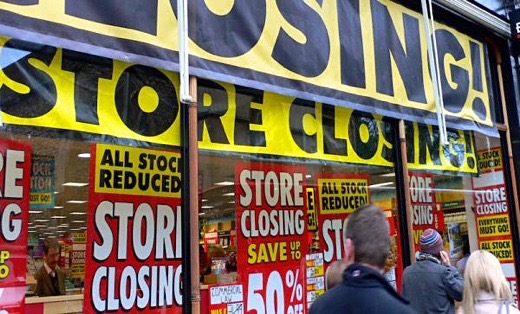
Worst retail year in US history

SUBHEAD: Not even during the worst parts of the last recession did things ever get as bad for U.S. retail industry.

By Michael Snyder on 14 June 2017 for the Economic Collapse Blog
(http://theeconomiccollapseblog.com/archives/2017-is-going-to-be-the-worst-retail-apocalypse-in-u-s-history-more-than-300-retailers-have-already-filed-for-bankruptcy)


Image above: Main Street America continues to suffer from retail failures. From (http://www.zerohedge.com/news/2017-06-14/2017-will-be-worst-retail-apocalypse-us-history-over-300-retailers-have-already-file).

Not even during the worst parts of the last recession did things ever get this bad for the U.S. retail industry.  As you will see in this article, more than 300 retailers have already filed for bankruptcy in 2017, and it is being projected that a staggering 8,640 stores will close in America by the end of this calendar year.

That would shatter the old record by more than 20 percent.  Sadly, our ongoing retail apocalypse appears to only be in the early chapters.  One report recently estimated that up to 25 percent of all shopping malls in the country could shut down by 2022 due to the current woes of the retail industry.

And if the new financial crisis that is already hitting Europe starts spreading over here, the numbers that I just shared with you could ultimately turn out to be a whole lot worse.

I knew that a lot of retailers were filing for bankruptcy, but I had no idea that the grand total for this year was already in the hundreds.  According to CNN, the number of retail bankruptcies is now up 31 percent compared to the same time period last year…
Bankruptcies continue to pile up in the retail industry. More than 300 retailers have filed for bankruptcy so far this year, according to data from BankruptcyData.com. That’s up 31% from the same time last year.

Most of those filings were for small companies — the proverbial Mom & Pop store with a single location. But there are also plenty of household names on the list.
Yes, the growth of online retailers such as Amazon is fueling some of this, but the Internet has been around for several decades now.

So why are retail store closings and retail bankruptcies surging so dramatically all of a sudden?
Just a few days ago, another major victim of the retail apocalypse made headlines all over the nation when it filed for bankruptcy.  At one time Gymboree was absolutely thriving, but now it is in a desperate fight to survive…
Children’s clothing chain Gymboree has filed for bankruptcy protection, aiming to slash its debts and close hundreds of stores amid crushing pressure on retailers.
Gymboree said it plans to remain in business but will close 375 to 450 of its 1,281 stores in filing for a Chapter 11 bankruptcy reorganization. Gymboree employs more than 11,000 people, including 10,500 hourly workers.
And in recent weeks other major retailers that were once very prosperous have also been forced to close stores and lay off staff…
This hemorrhaging of retail jobs comes on the heels of last week’s mass layoffs at Hudson Bay Company, where employees from Saks Fifth Avenue and Lord & Taylor were among the 2,000 people laid off.

The news of HBC layoffs came on the same day that Ascena, the parent company of brands like Ann Taylor, Lane Bryant, and Dress Barn, told investors it will be closing up to 650 stores (although it did not specify which brands will be affected just yet). Only two weeks ago, affordable luxury brand Michael Kors announced it too would close 125 stores to combat brand overexposure and plummeting sales.
In a lot of ways this reminds me of 2007.  The stock market was still performing very well, but the real economy was starting to come apart at the seams.

And without a doubt, the real economy is really hurting right now.  According to Business Insider, Moody’s is warning that 22 more major retailers may be forced to declare bankruptcy in the very near future…
Twenty-two retailers in Moody’s portfolio are in serious financial trouble that could lead to bankruptcy, according to a Moody’s note published on Wednesday. That’s 16% of the 148 companies in the financial firm’s retail group — eclipsing the level of seriously distressed retail companies that Moody’s reported during the Great Recession.
You can find the full list right here.  If this many major retailers are “distressed” now, what are things going to look like once the financial markets start crashing?

As thousands of stores close down all across the United States, this is going to put an incredible amount of stress on shopping mall owners.  In order to meet their financial obligations, those mall owners need tenants, but now the number of potential tenants is shrinking rapidly.

I have talked about dead malls before, but apparently what we have seen so far is nothing compared to what is coming.  The following comes from CNN…
Store closings and even dead malls are nothing new, but things might be about to get a whole lot worse.

Between 20% and 25% of American malls will close within five years, according to a new report out this week from Credit Suisse. That kind of plunge would be unprecedented in the nation’s history.
I can’t even imagine what this country is going to look like if a quarter of our shopping malls shut down within the next five years.  Already, there are some parts of the U.S. that look like a third world nation.

And what is this going to do to employment?  Today, the retail industry employs millions upon millions of Americans, and those jobs could start disappearing very rapidly…
The retail sales associate is one of the most popular jobs in the country, with roughly 4.5 million Americans filling the occupation. In May, the US Bureau of Labor Statistics released data that found that 7.5 million retail jobs might be replaced by technology. The World Economic Forum predicts 30 to 50 percent of retail jobs will be gone once struggling companies like Gymboree fully hop on the digital train. MarketWatch found that over the last year, the department store space bled 29,900 jobs, while general merchandising stores cut 15,700 positions. At this rate, one Florida columnist put it soberingly, “Half of all US retail jobs could vanish. Just as ATMs replaced many bank tellers, automated check-out stations are supplanting retail clerks.”
At this moment, the number of working age Americans that do not have a job is hovering near a record high.  So being able to at least get a job in the retail industry has been a real lifeline for many Americans, and now that lifeline may be in grave danger.

For those running our big corporations, losing these kinds of jobs is not a big deal.  In fact, many corporate executives would be quite happy to replace all of their U.S. employees with technology or with foreign workers.

But if the middle class is going to survive, we need an economy that produces good paying jobs.  Unfortunately, even poor paying retail jobs are starting to disappear now, and the future of the middle class is looking bleaker than it ever has before.

.

DAPL battle not over

SUBHEAD: A federal judge ruled an environmental review of the project was inadequate, and ordered it redone.

By Nick Visser on 15 June 2017 for Huffington Post -
(http://www.huffingtonpost.com/entry/judge-dakota-access-pipeline_us_594233bbe4b003d5948d22e7)


Image above: A demonstrator holds a ‘Water Is Life’ sign in front of the White House during a protest against the Dakota Access Pipeline in Washington, D.C. From original article.

A federal judge on Wednesday said an environmental review of the controversial Dakota Access Pipeline was inadequate, handing a last-minute victory to Native American tribes and environmentalists who have long opposed the project.

In a 91-page decision, U.S. District Court Judge James Boasberg said the Army Corps of Engineers, which gave its final approval to the oil project in February, “did not adequately consider the impacts of an oil spill on fishing rights, hunting rights, or environmental justice, or the degree to which the pipeline’s effect are likely to be highly controversial.”

Boasberg ordered the agency to conduct new reviews of those sections of its environmental analysis, but did not halt the use of the pipeline, which began flowing oil on June 1.

The Standing Rock Sioux tribe, which filed the lawsuit, called Wednesday’s decision a “significant victory.”

“The previous administration painstakingly considered the impacts of this pipeline, and President Trump hastily dismissed these careful environmental considerations in favor of political and personal interests,” tribe chairman Dave Archambault said in a statement. “We applaud the courts for protecting our laws and regulations from undue political influence, and will ask the Court to shut down pipeline operations immediately.”

The $3.8 billion, 1,170-mile pipeline has been at the center of an environmental battle for more than a year after thousands of activist, many with Standing Rock, descended on a small region of North Dakota to protest. The monthslong standoff drew international media attention and led the Army Corps of Engineers to pull the plug on the project.

However, just weeks into his presidency, Donald Trump signed an executive order reopening both the Dakota Access and Keystone XL pipelines. Now in operation, at its peak, the Dakota Access pipeline could ship up to 570,000 barrels of oil a day.

The courts have previously rejected legal arguments to shut down the pipeline. Boasberg in February allowed the project to go ahead after siding with its owner, Energy Transfer Partners, over a lawsuit that alleged the pipeline threatened cultural and historic sites.

The judge said he would consider whether the pipeline should shut down while a new environmental review is being conducted at a later time, The Guardian reports.

“This decision marks an important turning point. Until now, the rights of the Standing Rock Sioux Tribe have been disregarded by the builders of the Dakota Access Pipeline and the Trump administration ― prompting a well-deserved global outcry,” Jan Hasselman, an attorney for the group Earthjustice, which represented the Standing Rock Sioux, said in a statement:

“The federal courts have stepped in where our political systems have failed to protect the rights of Native communities.”

See also:
Ea O Ka Aina: Defense contractors fought NoDAPL 5/27/17
Ea O Ka Aina: Tribes divest DAPL Bankers 2/13/17
Ea O Ka Aina: Veterans defending NoDAPL 2/11/17
Ea O Ka Aina: Army Corps okays DAPL Easement  2/8/17
Ea O Ka Aina: Trump orders go on DAPL EIS 2/3/17
Ea O Ka Aina: Water Protectors pipeline resistance 2/1/17 
Ea O Ka Aina: Force a full EIS on DAPL 1/27/17
Ea O Ka Aina: Missile launcher at Standing Rock 1/19/17
Ea O Ka Aina: Lockdown at Trans-Pecos Pipeline 1/10/17
Ea O Ka Aina: Standing Rock has changed us 12/9/16
Ea O Ka Aina: As Standing Rock celebrates... 12/5/16
Ea O Ka Aina: Army Corps denies easement 12/4/16
Ea O Ka Aina: My Whole Heart is With You 12/2/16
Ea O Ka Aina: The Loving Containment of Courage 12/1/16
Ea O Ka Aina: The Beginning is Near 12/1/16
Ea O Ka Aina: Feds to shutdown NoDAPL Camp 11/25/16
Ea O Ka Aina: NoDAPL people are going to die 11/23/16
Ea O Ka Aina: Hundreds of vets to join NoDAPL 11/22/16
Ea O Ka Aina: Obama must support Standing Rock 11/21/16
Ea O Ka Aina: Trump's pro oil stance vs NoDaPL 11/15/16
Ea O Ka Aina: Kauai NoDAPL Demonstration 11/12/16
Ea O Ka Aina: Obama to Betray Standing Rock 11/12/16
Ea O Ka Aina: Trump impact on Standing Rock 11/12/16
Ea O Ka Aina: Ann Wright on Standing Rock 11/8/16
Ea O Ka Aina: Turning Point at Standing Rock 11/6/16
Ea O Ka Aina: Jackson Browne vs DAPL owner 11/5/16
Democracy Now: Boycott of DAPL Owner's Music Festival
Ea O Ka Aina: World responds to NoDAPL protests 11/5/16
Ea O Ka Aina: NoDAPL victory that was missed 11/5/16
Ea O Ka Aina: DAPL hid discovery of Sioux artifacts 11/5/16
Ea O Ka Aina: Dakota Access Pipeline will leak 11/5/16
Ea O Ka Aina: Route of the Dakota Access Pipeline 11/4/16
Ea O Ka Aina: Sanders calls for stopping DAPL 11/4/16
Ea O Ka Aina: Obama hints at DAPL rerouting 11/3/16
Ea O Ka Aina: New military attack on NODAPL 11/3/16
Ea O Ka Aina: How to Support NoDAPL 11/3/16
Unicorn Riot: Tweets from NoDAPL 11/2/16
Ea O Ka Aina: Standing Rock & the Ballot Box 10/31/16
Ea O Ka Aina: NoDAPL reclaim new frontline 10/24/16
Ea O Ka Aina: How far will North Dakota go? 10/23/16
Ea O Ka Aina: Amy Goodman "riot" charge dropped 10/17/16
Ea O Ka Aina: Amy Goodwin to face "Riot Charge" 10/16/16
Ea O Ka Aina: Shutdown of all tar sand pipelines 10/11/16
Ea O Ka Aina: Why Standing Rock is test for Oabama 10/8/16
Ea O Ka Aina: Why we are Singing for Water 10/8/16
Ea O Ka Aina: Labor's Dakota Access Pipeline Crisis 10/3/16
Ea O Ka Aina: Standing Firm for Standing Rock 10/3/16
Ea O Ka Aina: Contact bankers behind DAPL 9/29/16
Ea O Ka Aina: NoDAPL demo at Enbridge Inc 9/29/16
Ea O Ka Aina: Militarized Police raid NoDAPL 9/28/16
Ea O Ka Aina: Stop funding of Dakota Access Pipeline 9/27/16
Ea O Ka Aina: UN experts to US, "Stop DAPL Now!" 9/27/16
Ea O Ka Aina: No DAPL solidarity grows 9/21/16
Ea O Ka Aina: This is how we should be living 9/16/16
Ea O Ka Aina: 'Natural Capital' replacing 'Nature' 9/14/16
Ea O Ka Aina: The Big Difference at Standing Rock 9/13/16
Ea O Ka Aina: Jill Stein joins Standing Rock Sioux 9/10/16
Ea O Ka Aina: Pipeline temporarily halted 9/6/16
Ea O Ka Aina: Native Americans attacked with dogs 9/5/16
Ea O Ka Aina: Mni Wiconi! Water is Life! 9/3/16
Ea O Ka Aina: Sioux can stop the Pipeline 8/28/16
Ea O Ka Aina: Officials cut water to Sioux 8/23/16


.

Lima Ola mess to begin in 2018

SUBHEAD: This is a County program and is meant to be the spearpoint for heavy development of the Southside.

By Alden Alayvilla on 15 June 2017 for the Garden Island -
(http://thegardenisland.com/news/local/lima-ola-phase-to-begin/article_7128d697-3797-5045-86a4-81e97aae6d93.html)


Image above: Architects rendering of the Workforce World plan in Eleele named Lima Ola. Note about 40% of the site is multifamily apartments, many of them multi-story. From original From (http://islandbreath.blogspot.com/2014/07/tax-donkey-purgatory.html).

[IB Publisher's note: The Land Use Commission has not approved the change of the Lima Ola site from Agriculture Use to Urban Use. But the fix is likely in. However, the bad news about the suburban future of Kauai keeps piling up. The County government of Kauai is dragging us into a dead-end up cul-de-sacs and empty strip malls with no resiliency or self reliance. Duck and cover - a speculator's shit storm of failure is on the way.]

An affordable housing project that may provide the community with 550 residential units will be on the table at a Land Use Commission meeting later this month.

The county of Kauai is petitioning for a land use district boundary amendment, which if approved by the LUC, will change the 75-acre parcel from a State Land Use Agricultural Land District to a State Land Use Urban district.


Since the proposed project would include development of more than 15 acres of land within the Agricultural District, as defined by the LUC, a petition is necessary, according to the project’s environmental assessment.

Members of the LUC visited the parcel Tuesday and were briefed on Lima Ola Workforce Housing Project’s start date, intersection improvements, a proposed regional park, wastewater plan and concerns regarding overflow of a reservoir near the site.

“Considering everything goes well, we would like to commence infrastructure in 2018 and we anticipate an 18- to 20-month build out,” said Kanani Fu, County of Kauai housing director. “For the actual homes, conservatively, we’re looking at 2019 for phase one.”

However, after the first homes are built, it will take another five to seven years for the the completion of phase one, according to county officials. Phase one would add 149 units of 38 single-family and 111 multi-family units.

Funding secured for phase one totaled $20.3 million in sponsor equity, according to the Lima Ola 201H exemption application. In 2010, the county purchased the site for $2.5 million.
In 2016, the project received $16 million from the Legislature.

The development would include single-family, multi-family units, as well as units for seniors.
Because the project is to provide residents with affordable housing, households earning from 80 percent to below 140 percent area median income may be able to purchase homes.


Image above: County Housing Director Kanani Fu, left, talks about the the Lima Ola Work Force Housing Development project to State Land Use Commission members during a site visit to Eleele on Tuesday, 13 June 2017. From original article.

The majority of units — 385 — are for households in the 80 percent median income category.
In the 80-percent AMI, a household of four would have to have an income of $68,250, according to the County of Kauai 2017 annual income limits.

That may change over time, Fu said.

“Based upon the types of funds that we used to do the vertical construction, that dictates the affordables we gotta serve. If we use low-income housing tax credit, we are required to serve 60 percent AMI,” she said. “Who we build homes for cannot be decided now. It comes at the time when we go after financing for the vertical construction.”

Ken Taylor, a Kapahi resident who attended the site visit, said the Lihue area would have been a better place to build affordable housing.

“Look at this area out here. There’s very few jobs. Why would you put affordable housing out here where there’s no jobs?” he said. “This is just a prime example of urban sprawling. It’s really sad. Before you know it, the coffee field will all be gone and we’ll be growing houses.”

The county said it has put 300 homes in Lihue and 100 in Poipu in the past decade and has not created a housing project on the Westside.

As far as employment on that side of the island, the Pacific Missile Range Facility, Kauai Coffee landscaping companies and KIUC employ over 1,400 workers.

The last housing project on the Westside sponsored by the county was the Eleele Nani Subdivision consisting of 96 units and built in 1993.

Sacrificing ag land to make room for homes is another county mistake, Taylor added.
The majority of the parcel is on land utilized by Kauai Coffee. The parcel is less than 3 percent of Kauai Coffee’s available farm land. County officials say, however, the varietal of coffee on the development site will be grown at an alternative location.

“There’s plenty of room for affordable housing without taking out ag land,” Taylor said.
Taylor added the development will cause traffic issues.

Fu said the development will actually improve conditions, such as a signalized intersection and pedestrian crosswalk at the intersection of Mahea Road, Kaumualii Highway and Laulea Street.
A bus stop will be added by the intersection.

The project would be built in four phases may take over 20-plus years to complete, Fu said.
Lima Ola will utilize the Eleele wastewater treatment facility.

“At full build out, if no other development were to come online, the treatment is at 80 percent capacity,” Fu said. “The county, in response to this development, are required to expand its treatment center when population requires it.”

Overflow of the Kapa Reservoir, adjacent to Hanapepe, was a concern brought to LUC members.
With a 16 million gallon capacity, the Kauai Coffee-owned reservoir averages about 8 million gallons a day.

Though it doesn’t have a spillway, the reservoir does overflow once it reaches capacity, officials said.
Water would go under the roadway and back down the valley.

A Land Use Commission hearing regarding the project in tentatively scheduled for June 28 and 29.

COMMENTS:
manongindashadow071 posted at 3:49pm June 15, 2017
"A waste water plant next o the reservoir.....Eleele residents beware ! If this housing plan goes through, we soon will be smelling the odor from the waste water plant. We will catch the down wind breezes. Can you imagine having a barbeque outside your lawn and inhaling the stink odor. Worse yet, "the smell flowing throughout your house while having dinner or sleeping at night."
LostInParadise posted at 3:06pm June 15, 2017
"Affordable housing" = middle to upper middle class. making six figures! at 140k a year you should be able to pay off a median priced(740k) house in a decade anyways."
Spatial posted at 10:25am June 15, 2017
“Who we build homes for cannot be decided now.". Well sister, either that's your job to figure, or we are entirely dependent on handouts from the federal government to finance this project. If affordable housing truly is a priority for Kauai, we would be financing this through our local budget. Not increasing salaries, and giving council members yet another pay raise. For now, this project is only a "maybe affordable", because that's all you can promise."
See also:
Ea O Ka Aina: Commission accepts General Plan 6/14/17
Ea O Ka Aina: Testimony against General Plan 6/14/17
Ea O Ka Aina: Okay given to destroy Paradise 6/12/17
Ea O Ka Aina: Kauai Nui Kuapapa 5/14/1
Ea O Ka Aina: Find and Limit Ourselves 2/17/17
Ea O Ka Aina: Kauai General Plan open house 12/8/16
Ea O Ka Aina: Reject the Kauai General Plan Update 11/30/16
Ea O Ka Aina: Kauai County "Keep it Rural" 11/17/16
Kauai County General Plan 2000-2020 undated
Ea O Ka Aina: Kauai General Plan Update 9/3/16
Ea O Ka Aina: Kauai Plan Disappoints 12/9/15
Ea O Ka Aina: Tax Donkey Purgatory - Lima Ola 7/18/14
Ea O Ka Aina: Lihue Loss of Vision 9/5/14
Ea O Ka Aina: Kilauea Development on Agland 4/9/11
Ea O Ka Aina: If a tyrant developed Kauai 3/24/11
Ea O Ka Aina: Potash King's Palace 6/24/10
Ea O Ka Aina: Kauai Farm Worker Housing 7/14/09
Ea O Ka Aina: Let Moloaa farmers farm 4/2/09
Ea O Ka Aina: Kauai General Plan 4/2/09
Ea O Ka Aina: Peak Oil Planning 1/29/09
Island Breath: Kauai Sustainable Land Use Plan 11/1/07
Island Breath: LEGS Sustainability Conference 10/13/07
.

Commission accepts General Plan

SUBHEAD: Despite its unpopularity the Kauai County Planning Commission votes for the General Plan Update.

By Jenna Carpenter on 14 June 2017 for The Garden Island News -
(http://thegardenisland.com/news/local/planning-commission-approves-general-plan-update/article_202f3168-684e-5dab-b9e9-b4f3f3607a66.html)


Image above: Architect Ron Agor and representatives of the team promoting Kapaa's Hokua Place standing outside the Planning Commission Meeting during a break. The Hokua Place project was reinserted into the Kauai General Plan Update.  Photo by Juan Wilson.

[IB Publisher's note: Over the last 20 years the popular 2000 General Plan (Keep it rural!) was largely ignored by the Kauai Planning Department. Now, another travesty is born. This Kauai General Plan Update does not have the support of the general public. It should be an embarrassment even to the hacks in the Planning Department. Our planning officials should be ashamed of simply bowing to the American solution to social, infrastructure and urban problems - just build more suburban sprawl. Their plan is a sellout to our future in order to line the pockets of speculators, developers, contractors and banksters. It will also grease the palms of some career public employees and politicos. The cost will be environmental degradation, overpopulation and reduction of the resilience, self-reliance and sustainability of Kauai. The upside the public can choose to ignore this General Plan just as our current planners ignored the last.]  

On Tuesday, commissioners voted 4 to 2 to approve the seventh version of the General Plan Update, which restores Hokua Place, a proposed affordable housing development along Kapaa Bypass Road.

The Planning Commission’s work on the General Plan update is complete.

On Tuesday, commissioners voted 4 to 2 to approve the seventh version of the General Plan Update, which restores Hokua Place, a proposed affordable housing development along Kapaa Bypass Road.

In its previous version, the development had been deleted.

Kanoe Ahuna and Donna Apisa voted against the General Plan. About 20 people attended the meeting.

“I’m not comfortable making a decision. All I’ve known in the last six months are the same testimonies I don’t think we’ve addressed,” Ahuna said. “I don’t understand how we’ve heard the same testimonies and haven’t responded to that. How are we taking the community’s interest?”

Ahuna made a motion to defer the General Plan Update and have a workshop.

“So we can re-visit the critical areas,” she said.

Her motion was denied 5 to 1.

“I don’t see the point of a workshop. We are a decision-making body, and if there’s something that specifically needs to be addressed, we can bring it up and talk about it,” said Commissioner Sean Mahoney. “We’ve gone through all kinds of testimony and gone through all kinds of meetings. I think everyone’s been listened to.”

The General Plan, which contains everything from protecting Kauai’s beauty and the watersheds to addressing Kapaa traffic and designing healthy and complete neighborhoods, was last updated in 2000.

A 357-page updated discussion draft was released November 4th, after 18 months of public outreach.

But the $1.2 million project started in 2013, when the Planning Department began researching how to move forward with the update.

The Planning Commission has been tackling the update since the beginning of the year. It will now go the County Council for approval. If passed, it will go to Mayor Bernard Caravalho Jr.

During public testimony, Anne Walton, who lives in Kapaa, said the General Plan Update is built on an unstable foundation, including outdated data, inconsistencies and no rationale to support the reasons to keep Hokua Place in the General Plan.

“Let’s get back to where this General Plan started,” she said.

Carl Imparato, who lives in Hanalei, is concerned about how the General Plan addresses growth.

“We are drowning in an ever-expanding sea of tourists, and that excessive tourism growth is overwhelming our roads, parking capacity, parks and beaches, neighborhoods and lives,” he said.

He said nothing substantive was changed in the newest update.

“The current draft almost guarantees that county government will be the primary obstacle to genuine progress, rather than an ally in addressing the difficult issues that lie ahead,” he said.

Additionally, in the newest version, a paragraph that addresses a high tourist count was deleted, Imparato said.

He said the General Plan needs to go back to the drawing board, and when it does, he has two requests: The county needs to work with Kauai communities, and the General Plan needs to acknowledge and address Kauai’s tourism growth.

“Kauai’s health is poor. It’s like a patient in very serious condition. It needs surgery and rehabilitation, and all the General Plan is offering is a facelift.”

Commissioners made some amendments to the General Plan Update.

They added a definition to “provisional” as it relates to Provisional Agricultural, adopted agreements lined out in the Paris agreement and deleted a sentence that reflects a possibility of the Department of Land and Natural Resources beginning to charge people to go to state parks.The Planning Commission’s work on the General Plan update is complete.

See also:
Ea O Ka Aina: Testimony against General Plan 6/14/17
Ea O Ka Aina: Okay given to destroy Paradise 6/12/17
Ea O Ka Aina: Kauai Nui Kuapapa 5/14/1
Ea O Ka Aina: Find and Limit Ourselves 2/17/17
Ea O Ka Aina: Kauai General Plan open house 12/8/16
Ea O Ka Aina: Reject the Kauai General Plan update 11/30/16
Ea O Ka Aina: Kauai County "Keep Kauai Rural!" 11/11/16
Ea O Ka Aina: General Plan Update  9/4/16
Ea O Ka Aina: Will developers write Kapaa's future? 5/7/16
Ea O Ka Aina: Planet Kaauai 2/26/16
Ea O Ka Aina: Kauai Plan disappoints 12/9/15
Ea O Ka Aina: Potash King's Palace 6/24/10
Island Breath: Kauai Districts as Townships 3/27/08
Island Breath: Sustainability & Growth 4/19/05
Island Breath: Kauai Parks Master Plan - Puolo Point 10/7/04
Island Breath: Kauai Zoning 5/15/04
.