Two RUP pesticides to worry about

SOURCE: Ken Taylor (littlewheel808@gmail.com)
SUBHEAD: Atrazine and Chlorpyrifos are dangerous restricted use pesticides heavily used on Kauai.

By Dr. Lee Evslin on 3 Monday 2016 for the Garden Island -
(http://thegardenisland.com/news/opinion/guest/of-kauai-s-pesticides-are-having-a-bad-year/article_f419ec77-6e03-5c44-92c9-b23264b28a97.html)


Image above: Waimea, Kauai in foreground adjacent to hundreds of pesticide soaked acres experimental GMO crops. Waimea Middle School's yard faces the fields. Children have gotten sick there. From (https://www.theguardian.com/us-news/2015/aug/23/hawaii-birth-defects-pesticides-gmo).

Atrazine and Chlorpyrifos are two of the most heavily sprayed restricted use (RUPs) pesticides on Kauai. In the past year they have come under increasing fire from specialists in pediatric neurology, the EPA, U.S. Fish and Wildlife Service (USFWS), and the National Marine Fisheries Service (NMFS).
  1. On Oct. 30 2015, the EPA recommended the prohibition of Chlorpyrifos for agricultural use in the U.S. They stated that it was risky for workers and it was found to contaminate surface waters. Chlorpyrifos is the chemical that led to the symptoms experienced by the Syngenta workers. This recommendation for prohibition is still under review.
  2. In April 2016, the European Union did prohibit Chlorpyrifos for agricultural use in all 29 countries. They did this with very little advance notice, stating that they acted rapidly due to health concerns.
     
  3. In April 2016, the EPA released a statement drawn up with consultation with the Fish and Wildlife and Marine Fisheries Services. They stated that after reviewing 1400 studies they concluded that Chlorpyrifos was “likely to adversely affect” 97 percent of endangered species both on the land and in the water.

  4. In July 2016, Project TENDR released a position paper. Leading experts in neurologic development and in related fields created this document. They stated that there is an alarming national increase in neurobehavioral disorders in children and increasing evidence that environmental toxins were playing a role. Pesticides were first in their list of these toxins and Chlorpyrifos is a prominent chemical in the studies they reviewed.

  5. In April 2016, the EPA released a position paper on Atrazine. They stated that after reviewing hundreds of studies they concluded that at currently allowable levels of spraying, Atrazine was likely to exceed safe levels of exposure for land and sea animals. The EPA stated their “levels of concern for chronic risk are exceeded by as much as 22, 198 and 62 times for birds, mammals and fish, respectively.” Of note also is that Atrazine has been prohibited in Europe for decades.
We all sign an agricultural form when we fly into Hawaii. It seems that one could be sanctioned for bringing an orange into the state and not declaring it. Gov. Linda Lingle used to announce on every flight that we have one of the most fragile ecosystems in the world.

The EPA is being very clear about their increasing concern about both of these chemicals. I can only speak for myself but my concern about the possible effect of these chemicals on human health and on the environment has increased also.

Dr. Lee Evslin is a retired physician. He has lived and practiced on Kauai since 1979. He also served as the CEO of Kauai Medical Clinic and Wilcox Hospital.


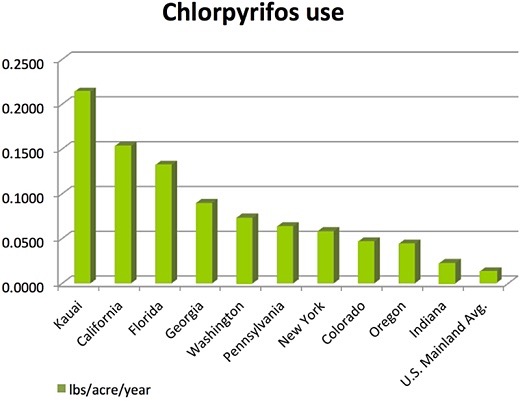
Image above: Graph showing the highest concentration per acre of Chlorpyrios on agricultural fields are on the small island of Kauai. More than ten times the US mailand average. From (http://grist.org/business-technology/gmo-companies-are-dousing-hawaiian-island-with-toxic-pesticides/).

[IB Publisher's Note: In addition a study published by the National Institute of Health in 2014 titled "Effects of atrazine and chlorpyrifos on DNA methylation in the liver, kidney and gill of the common carp" demonstrated that long-term exposure to Atrazine and Chlorpyrifos or Atrazine/Chlorpyrifos mixtures could disrupt genomic DNA."]
.

Farmers’ markets play a vital role

SUBHEAD: Both the DIY economy and farmers markets to continue flourishing as will need for sustainability.

By Daniel Matthews on 29 September 2016 for Sustainable Food Trust -
(http://sustainablefoodtrust.org/articles/farmers-markets-america/)


Image above: Fresh organic vegetables offered at local farmers' market. From original article.

Drive across America today, and there’s one thing you’re guaranteed to see more of: farmers’ markets. The USDA reports the number of registered farmers’ markets increased by 2.3% from 2015 to 2016—and that’s just the ones listed in the National Farmers Market Directory.

This increase wasn’t necessarily expected. In 2015, Treehugger author Margaret Badore speculated as to whether US farmers’ markets had hit their peak. From 2013 to 2014, the growth rate was only 1.5 percent. But after that, the number of markets continued to grow, instead of stagnating. What is driving this growth? The answer can be found in the broader state of economic affairs in the US.

Sustainability and the DIY Community
There’s increasing demand for organic foods and ethical business practices, reflecting a growing engagement with sustainability. According to Sustainable Table, more consumers are considering the “environmental, health and social consequences of industrial food production”; as a result, organic acreage is increasing at an annual rate of 15%.

In terms of demand, the USDA’s Organic Market Overview shows the market for organic food is continuing to show double-digit growth. In 2015, sales reached $37 billion, up 12 percent from 2014. And farms that conduct direct-to-consumer (DTC) sales at farmers markets, Community Supported Agricultural programs, and other outlets are more likely to stay in business than those that don’t.

Small local farms maintain their profitability, in part, through DTC sales of organic foods in a growing market. These farms spend less on land and equipment than large farms, and are able to get a good Return On Investment (ROI) through organic food sales. Simply put, organics fetch a high price because of high demand.

Most vendors at the market are part of a Do-It-Yourself (DIY) community that adds jobs to the economy. In 2015, Bloomberg reported a surprising statistic: the DIY economy had added 370,000 jobs, marking an increase of 1 million more self-employed workers in the first four months of the year. According to the Pew Research Center, three out of ten US jobs are held by the self-employed and their employees. In the agriculture sector, around 81 percent of the workforce consists of self-employed farmers and the workers they employ. The USDA’s report on the Farm Labor Survey reveals that, on average, the number of people employed by farms increased between 2007 and 2012. This was in contrast to “nonfarm employment”, which, according to the USDA, went down in this period because of the 2007-2009 recession.

Farmers exemplify a traditional form of self-employment as business owners, but another part of the picture is the self-employed worker in the ‘gig economy’. More and more Americans—particularly Millennials—are choosing to do contract work, taking on ‘gigs’ for a temporary period of time. This new gig economy has a technological twist, with workers using apps and websites that connect them to on-demand work. Think Uber, the ride-sharing service that uses a mobile app to connect drivers and riders.

The best estimate of the gig economy’s growth, reported by the Bureau of Labor Statistics, is that “nonemployers” under the “Other” category created one million jobs between 2003 and 2013. That’s more than any other sector. The self-employed in this case are short-term contract workers. They’re freelancers, independent consultants, people who work odd jobs. The Census Bureau defines the gig worker as a “self-employed individual operating a very small, unincorporated business with no paid employees.”

Just as farmers’ markets and CSAs don’t rely on distribution through centralised supermarkets, gig workers, by definition, don’t rely on a single location and employer for their source of income. The increase in self-employment and contract work are both moves away from centralisation, and growth in self-employment and ‘gig’ work is one of the primary economic catalysts feeding the increase in farmers markets.

Behind all this is the great enabler of our interconnected moment—new technologies.

Technology at the Farmers’ Market
When you go to a farmers’ market, one thing you may notice is that nearly every merchant accepts credit cards. That’s a far cry from an old-school market where people barter, trade or pay in cash.

This is, of course, smart business in the modern world. According to Square’s guide on how to accept credit card payments, people spend 12 to 18% more when they use a credit card instead of cash. At the farmers market I frequent in my hometown, all the merchants have a mobile payment device attached to their phones.

It’s no surprise that the growth of both the DIY community and farmers’ markets, parallels the growth of mobile payment and the smartphone market. With big players like Apple and Paypal in the mix, the mobile payment industry is expected to hit $189 billion by 2019, a growth of 154% from 2014. Many purchases from small merchants wouldn’t be possible without the huge mobile payment industry. There may be an irony, or worse, a paradox here in the dependency on technologies developed by huge corporate entities like Apple.

Smartphones have had an inarguable environmental impact that a sustainable farmer may not want to be associated with. But they have become an integral part of our business practices, especially so in micro and small businesses in developing countries. They increase the economic viability of small sole traders and the self-employed, enabling the vendor to cast a wider net for commerce
.
The benefits of mobile payments in farmers’ markets are enough to overlook any irony in their use.

The Benefits of Farmers’ Markets
Farmers’ markets provide an important array of benefits to local communities, as the Farmers Market Coalition’s infographic details.

Farmers’ markets return money to local economies, while a high percentage of profits from corporate ‘chain’ stores go elsewhere. Walmart, for one, has been implicated by Oxfam in the tax haven scandal that came to light following the Panama Papers leak. That means Walmart is not paying taxes on the profits it makes from grocery purchases. Some vendors make all their income from farmers’ markets. 

As the Coalition points out, “Locally owned retailers, such as farmers’ markets, return more than three times as much of their sales to the local economy. They hire nearly five times more people than non-local vendors. Workers hired by local farmers that use sustainable farming practices (such as crop rotation and cover crops) receive an education in good agro-ecological farming practice. Down the line, that means more farm start-ups and more entrepreneurial investment.

Impoverished families can use food stamps at the market, meaning the $18.8 million of SNAP cash from 2014 went right back into local taxpayer pockets. Fresh sustainable produce means better health and lower obesity rates for poorer families. Helping people to feed themselves better will place less of a burden on the health care system, lowering medical bills for poor families that can barely afford health insurance.

Additionally, there’s no doubt as to the sustainability benefits of farmers’ markets. According to the Farmers Market Coalition, which cites unpublished raw data from a survey of direct market farmers, the local and regional produce you’ll find at farmers’ markets travels about twenty-seven times less distance than “conventionally-sourced” produce. Further, 81% of these farmers use farming practices that reduce waste and promote soil health, such as on-site composting. And three out of four farmers follow practices “consistent with organic standards”.

These sustainability practices in turn benefit the consumer. According to Scientific American, soil depletion and “intensive agricultural methods” lessen the nutrient content in produce. According to authors Roddy Scheer and Doug Moss, “Those who want to get the most nutritious fruits and vegetables should buy regularly from local organic farmers.”

Bringing it home
As calls for sustainability keep escalating, expect both the DIY economy and farmers markets to continue flourishing. Can we expect complete decentralisation and the demise of supermarkets? It’s a long shot. But we can expect farmers markets and small farms to keep bringing organic foods closer to our homes, giving us more opportunities to support them.

.

Hawaiian bees endangered species

SOURCE: Faith Harding (tophatandscarf@yahoo.com)
SUBHEAD: The decline of these bees could lead to the extinction of the native plants that rely upon them.

By Lauren McCauley on 1 October 2016 for Common Dreams -
(http://www.commondreams.org/news/2016/10/01/bees-peril-first-species-added-endangered-species-list)


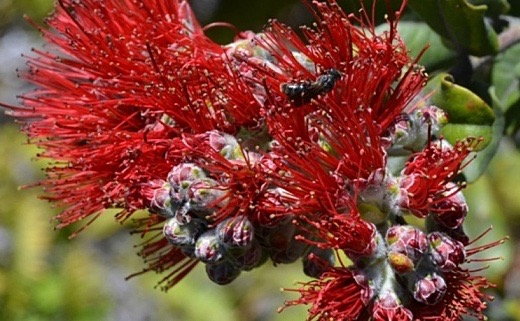
Image above: Hawaii's native yellow-faced bees are small and dark. This one is nestled inside the flower of ohi’a lehua, a native Hawiian shrub. Photo by Matthew Shepherd for the Xerces Society.From original article.

Listing comes amid a national crisis of declining bee populations, which is attributed to an array of causes, including habitat loss, and the widespread use of neonicotinoid pesticides.

Marking a troubling development in the crisis of pollinator decline, the first species of bees were added to the Endangered Species List.

The U.S. Fish and Wildlife Service (USFWS) announced the determined status on Friday for seven types of yellow-faced bees found in the Hawaiian islands.

It comes after a multi-year effort by the invertebrate conservation organization The Xerces Society to gain federal recognition and protection for the threatened bees.

Xerces communication director Matthew Shepard hailed the development as "excellent news for these bees," but added that "there is much work that needs to be done to ensure that Hawaii's bees thrive."

"Unfortunately," he lamented, "the USFWS has not designated any 'critical habitat,' areas of land of particular importance for the endangered bees."

The endangered genus, Hylaeus, commonly called yellow-faced, are the only genus native to Hawaii. Their failure comes amid a national crisis of declining bee populations, including colony collapse disorder, which is attributed to an array of causes, including habitat loss, infection, and the widespread use of neonicotinoid pesticides.

As Shepard wrote earlier, "Hawai'i's yellow-faced bees face many threats, from the loss of habitat due to land conversion, development, and recreation...to the negative impacts of nonnative species, such as wild pigs, bigheaded ants, and invasive plants. Climate change also poses a threat to small populations of these bees."

He further noted that the bees are "critical pollinators of many endangered native Hawaiian plants and the decline of these bees could lead to the extinction of the plants that rely upon them."

The announcement came a week after the USFWS proposed for protection the first bee in the continental U.S., the rusted patched bumble bee, typically found in the upper midwest and northeast.

See also:
Ea O Ka Aina: Morgan Freeman supports bees 9/30/16


.

Labor's Dakota Access Pipeline crisis

SUBHEAD: SEIU is latest union to declare its support of the Standing Rock Sioux Tribe against DAPL.

By Yassenia Funes on 3 October 2016 for Grist Magazine -
(http://grist.org/business-technology/big-labor-has-an-identity-crisis-and-its-name-is-dakota-access/)


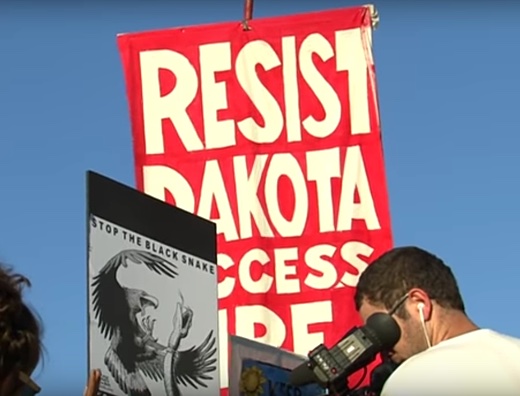
Image above: Demonstration against Dakota Access Pipeline supported by the National Nurses United union. Still from video below that slams AFL-CIO for supporting it.

Support for the Standing Rock Sioux Tribe’s battle against the Dakota Access Pipeline continues to grow with the Service Employees International Union hopping (SEIU) onboard October 1. The progressive union is joining at least four others in opposing the Dakota Access Pipeline.

“The two million members of SEIU stand beside the Standing River Sioux Tribe in their fight to protect their sacred lands and burial grounds from being dug up if the construction of the Dakota Access Pipeline is allowed to continue as planned,” the union wrote in an online statement.

The organization of 2 million members pointed out that the historical environmental justice factors at work make this battle especially important. They write:
Historical disregard for low income communities and communities of color, including those where many SEIU members live and work, has subjected them to toxic air pollution and contaminated waterways for decades. In these communities, asthma and other respiratory ailments caused by toxic air and poisonous toxins such as lead in the water supply, affect our children’s health and ability to thrive. As the nation’s largest healthcare union, we stand with the growing movement of environmental organizations, businesses, students, parents and others demanding cleaner air and water and to address the growing threat of climate change for the health and safety of our families and communities.
SEIU has led #FightFor15 and immigrant-rights movements. It joins the AFL-CIO, the country’s largest union federation, and four of its member unions: Communications Workers of America, the Amalgamated Transit Union, National Nurses United and the American Postal Workers Union.

Many other unions have chosen to support the pipeline instead, as Grist reported last month (September 28), highlighting the lingering tension between environmentalists and Big Labor.


Video above: Report on National Nurses United union support of Standing Rock Sioux. From (https://youtu.be/gJTh_yPNFh0)


AFL-CIO embraces the Death Star for jobs

SUBHEAD: US big labor organizations have an identity crisis, and its name is Dakota Access.

By Aura Bogado on 28 September 2016 for Grist Magazine -
(http://grist.org/business-technology/big-labor-has-an-identity-crisis-and-its-name-is-dakota-access/)


Image above: Hillary Clinton supporter and AFL-CIO head Richard Trumka at the Democratic national Convention is a strong supporter of the Dakota Access Pipe Line for the union jobs it will provide. From (http://www.startribune.com/democratic-national-convention-day-1/388186402/#1).

A growing rift has split the country’s biggest union federation, the AFL-CIO. Many labor activists and union members are outraged that Richard Trumka, the federation’s president, threw the AFL-CIO’s support behind the Dakota Access pipeline project earlier this month.

The AFL-CIO’s statement backing the pipeline was announced a week after the Obama administration put construction on hold. Trumka acknowledged “places of significance to Native Americans” but argued that the more than “4,500 high-quality, family supporting jobs” attached to the pipeline trumped environmental and other considerations.

That move rankled many in the AFL-CIO’s more progressive wing, highlighting strains within the federation of 56 unions representing 12 million workers.

Recent tensions within the AFL-CIO have deepened a long-running divide between a more conservative, largely white, jobs-first faction and progressive union members who are friendly to environmental concerns and count more people of color among their ranks.

Grist interviewed five staffers at the AFL-CIO and its affiliated unions on the condition of anonymity because they weren’t authorized to speak to the press. Trumka’s public support for the pipeline caught these senior-level and mid-level staffers by surprise, they told Grist — especially because he had recently taken progressive positions on Black Lives Matter, immigration, and criminal justice.

A call to Trumka’s office was not returned. The federation’s policy director, Damon Silvers, who is said to have helped write the statement, also did not respond to an interview request.

Union opponents of the pipeline project and their advocates quickly responded on social media with satire. One post on Twitter likened Trumka’s position to helping the wrong side in Star Wars.

Other frustrated union members and staffers placed calls to Climate Workers, an organization of union workers focused on climate justice, to vent. Brooke Anderson, an organizer at the group, says she fielded dozens of calls from members upset about the AFL-CIO’s position.

For those members, Anderson says, working in a federation means more than collecting a wage — it means being part of a broad movement for justice. Anderson says she thought that Trumka’s statement undermined efforts by groups like hers to protect the environment and jobs.

Trumka’s statement came out the day after one branch of the federation, the Building and Construction Trades, sent a private letter to Trumka complaining about AFL-CIO unions that opposed the pipeline.

In the weeks before Trumka’s public statement, four of the federation’s major unions – the Communications Workers of America (CWA), the Amalgamated Transit Union (ATU), National Nurses United (NNU), and the American Postal Workers Union (APWU) – came out in support of the Standing Rock Sioux Nation’s battle against the pipeline project. All four are part of the so-called Bernie Unions, given their support of former Democratic Presidential candidate Sanders.

The AFL-CIO endorsed Hillary Clinton in June, shortly before Sanders had conceded his candidacy, marking another fissure in the federation.

In a five-page letter to Trumka provided to Grist by union sources, Sean McGarvey, president of the Building Trades, argued that these four unions were partly to blame for Obama’s suspension of the pipeline. He wrote that union workers employed to build the pipeline have had “their lives placed on hold, their employment prospects upended and have been subjected to intimidation, vandalism, confrontation, and violence both on their job sites and in the surrounding community.”

The letter offers an anecdote to support these allegations. One unnamed worker was reportedly scared for his or her life by protestors “coming towards us.” The workers jumped in their cars and fled, according to the account, but there’s no mention of anyone getting hurt or even touched. (The Standing Rock Sioux Nation has called for protests to remain peaceful as the movement to stop the pipeline has grown.)

McGarvey blames unions opposed to the pipeline for hastening “a very real split within the labor movement at a time that, should their ceaseless rhetoric be taken seriously, even they suggest we can least afford it.”

Progressives within the labor movement describe the Building Trades as being whiter and more conservative than their counterparts. McGarvey’s letter contains what some of them consider dog-whistles. It mentions “outside agitators,” “environmental extremists,” and takes a jab at “theories of the 21st century labor movement.”

McGarvey declined an interview request from Grist, writing in an email that “[The letter] was an internal communication and we don’t comment on those!”

AFL-CIO union members who oppose the pipeline are now making their frustration public. A handful of labor activists picketed the AFL-CIO’s office in Washington, D.C., last week. And the Labor Coalition for Community Action, an alliance of groups representing women, people of color, and LGBT union workers within the AFL-CIO, released a statement in solidarity with those opposed to the pipeline.

“As organizations dedicated to elevating the struggles of our respective constituencies, we stand together to support our Native American kinfolk – one of the most marginalized and disenfranchised groups in our nation’s history – in their fight to protect their communities from further displacement and exploitation,” it says.

Although the statement makes no direct mention of the AFL-CIO’s position on the pipeline, nor of McGarvey’s letter, it calls on “the labor movement to strategize on how to better engage and include Native people and other marginalized populations into the labor movement as a whole.”

Anderson from Climate Workers, who is a rank-and-file member of the CWA, says the dispute over the pipeline represents a historic moment for the AFL-CIO. Rather than issue a statement and ignore the fallout, she says Trumka needs to participate in a crucial conversation with a wide variety of people about how the federation will balance race, labor, and the environment.

“Some of the questions [in that conversation include]: Whose land? Whose water? Whose lungs are going to suffer first? It’s communities of color and lower paid workers of color – and they’re also our brothers and sisters.”

See also:
Ea O Ka Aina: Standing Firm for Standing Rock 10/3/16
Ea O Ka Aina: Contact bankers behind DAPL 9/29/16
Ea O Ka Aina: NoDAPL demo at Enbridge Inc 9/29/16
Ea O Ka Aina: Militarized Police raid NoDAPL 9/28/16
Ea O Ka Aina: Stop funding of Dakota Access Pipeline 9/27/16
Ea O Ka Aina: UN experts to US, "Stop DAPL Now!" 9/27/16
Ea O Ka Aina: No DAPL solidarity grows 9/21/16
Ea O Ka Aina: This is how we should be living 9/16/16
Ea O Ka Aina: 'Natural Capital' replacing 'Nature' 9/14/16
Ea O Ka Aina: The Big Difference at Standing Rock 9/13/16
Ea O Ka Aina: Jill Stein joins Standing Rock Sioux 9/10/16
Ea O Ka Aina: Pipeline temporarily halted 9/6/16
Ea O Ka Aina: Native Americans attacked with dogs 9/5/16
Ea O Ka Aina: Mni Wiconi! Water is Life! 9/3/16
Ea O Ka Aina: Sioux can stop the Pipeline 8/28/16
Ea O Ka Aina: Officials cut water to Sioux 8/23/16  


.

Standing Firm at Standing Rock

SUBHEAD: For indigenous people, the fight to halt the Dakota Access Pipeline is about reviving a way of life.

By Sarah Jaffe on 28 September 2016 for Common Dreams -
(http://www.commondreams.org/views/2016/09/28/standing-firm-standing-rock-why-struggle-bigger-one-pipeline)
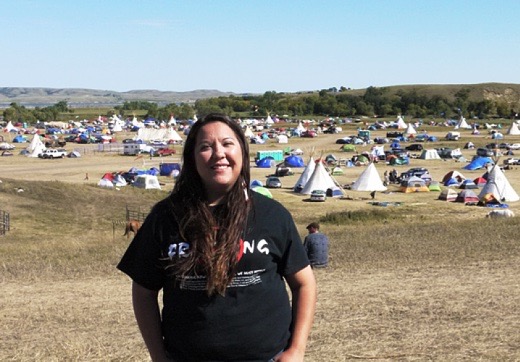

Image above: Kandi Mossett on a hill overlooking the Oceti Sakowin Camp. Photo by Sarah Jaffe. From original article.

The first sign that not everything is normal as you drive down Highway 1806 toward the Standing Rock reservation in North Dakota is a checkpoint manned by camouflage-clad National Guard troops. The inspection on Sept. 13 was perfunctory; they simply asked if we knew “what was going on down the road” and then waved us through, even though the car we rode in had “#NoDAPL” chalked on its rear windshield.

“What is going on down the road” is a massive camp-in led by the Standing Rock nation, aimed at blocking the construction of the Dakota Access Pipeline (the DAPL in question), which would carry oil from the Bakken shale in North Dakota across several states and under the Missouri River.

What began with a small beachhead last April on the banks of the Cannonball River on land belonging to LaDonna Brave Bull Allard has expanded to both banks of the river and up the road, to multiple camps that have housed as many as 7,000 people from all over the world.

Because of them, first the Obama administration and then a federal court stepped in to temporarily halt construction of the pipeline near the campsite. Still, the people of Standing Rock and their thousands of supporters aren’t declaring victory and folding their tents just yet.

The legal struggles for a permanent shutdown of the pipeline construction continue: the people of Standing Rock have filed a lawsuit to halt construction, as has one of the South Dakota Native American nations and landowners in Iowa as well. As the lawsuits proceed, other members of the camp have been involved in nonviolent direct actions, locking their arms around construction machinery to prevent digging.

Dozens have been arrested as part of those actions, including 22 people on Sept. 12, the day I arrived at the camp. That was days after the Obama administration’s call for a temporary halt to construction on the pipeline, and a stark reminder that the struggle was not over.
 
In addition to the legal battles and the direct actions, though, the people of the Oceti Sakowin and Sacred Stone camps were preparing for another challenge: a North Dakota winter. Already at night, the temperature drops to 40 degrees Fahrenheit; deliveries of blankets and warm clothing were constant, as was the chopping of wood for fires and discussion of what kinds of structures would allow the camps to stay in place through the bitter cold months ahead.

We’re already winterizing in all aspects of the camp, young people working with the elders to find, whether it’s longhouses, whether it’s yurts, whether it’s any kind of structures that would keep us warm for the winter,” said Lay Ha, who traveled to North Dakota from the Wind River Reservation in Wyoming in late August and became part of the camp’s youth council.

They’re staying partly out of suspicion: A temporary halt is, of course, just temporary. “As far as I can see, it’s just another way to lull us to sleep, make us go to sleep so we leave and then they’ll start again,” said Ista Hmi, an elder from Wanblee, South Dakota on the Pine Ridge Reservation and a member of the Seven Council Fires.

“The Missouri [River] here, it was poisoned already from the pesticides and all that but we were still able to clean it,” he said. “But those are just topical compared to this oil. The oil, if it gets in here, it will start destroying the ecosystem underneath; it’ll be dead water.”

“We’re protecting the water, we’re not protesters,” explained Lay Ha. To him, as to many others in the camp, that the action is led by Native people, that it is built around their belief in nonviolence and in the spirit of prayer, is vital. It is, to them, much more than a protest.

Ha is Arapaho and Lakota on his father’s side and Eastern Shoshone on his mother’s; he is part of what has become the largest coming together of Native people in, many said, more than 100 years. The flags that flap overhead represent something more than a fight for clean water — they are a powerful statement of solidarity, a declaration of common interest.

The first camp you pass once through the checkpoint is a small one on the side of the road overlooking the construction site. Further along, signs, flags and banners hang from the barbed-wire fence along the road. A massive banner declares “No DAPL!” Spray-painted on a concrete barrier are the words “Children Don’t Drink Oil.”

Then emerges the breathtaking sight of what is now called the Oceti Sakowin camp: Flags from well over 200 Native nations and international supporters line the driveway into the camp, flapping in the high plains wind. People ride through the camp on horseback.

At the entrance, when you drive in, you are greeted by security and a man with burning sage to smudge your car. Just beyond, at the main fire, a microphone is set up for speakers and performers: When we arrived, Joan Baez sat by the fire, singing “Blowin’ in the Wind.”

Kandi Mossett of the Indigenous Environmental Network was wearing a “No Fracking” T-shirt when I met her at the media tent, doing an interview alongside a delegation from Ecuador of indigenous people who have also fought the oil companies there.

She is from northwestern North Dakota, the Fort Berthold reservation, and the oil that would travel through the Dakota Access Pipeline is extracted from her community. She came to Standing Rock for the formation of the original camp, known as the Sacred Stone camp, on LaDonna Allard’s land.

At first, she remembered, the camp had anywhere from five to 30 people. Then, when Energy Transfer Partners, the company behind the pipeline, put out notification that it was going to begin construction, the camp swelled to 200, then 700. It spilled over the river, into what was at first simply called the overflow camp.

But as that camp grew, the campers began to feel it deserved its own name. Oceti Sakowin is the name for the Seven Council Fires, the political structure of what is known as the Great Sioux Nation. “We had for the first time in 200 years or more, the Seven Council Fires of the Great Sioux Nation coming together in one place to meet again,” Mossett said.

Faith Spotted Eagle is also part of the Seven Council Fires, from the Ihanktonwan or Yankton band. She too was there on what she remembered as a wintry, blowing day in April when the Sacred Stone camp first opened.

An elder and grandmother, she had also been part of the successful fight against the Keystone XL Pipeline, and pointed out that the networks activated by that fight were coming together again in North Dakota. In 2013, she said, a dream of her grandmother sent her to look at the 1863 treaty between her people and the Pawnee.

On the 150th anniversary of that treaty, Jan. 25, 2013, those nations, along with the Oglala and Ponca, signed the International Treaty to Protect the Sacred from Tar Sands Projects.

“In that treaty, we declared that forevermore we would be allies to stop this extractive move to destroy Mother Earth from the Boreal forest down to the Gulf,” she said. Since that time, other nations have joined, and the treaty was renewed with prayers and a donation to the Sacred Stone camp.

“A lot of those networks, it took years for them to come together. Standing Rock will do the same thing for the next one. It is a progressive healing and learning,” Spotted Eagle continued. In the unlikely alliances that came together, from the Keystone XL fight to Standing Rock, with farmers and landowners joining their actions, she noted, “That was where the power was.”

To Dave Archambault II, the tribal chairman of the Standing Rock Sioux, the struggle — and the response from indigenous people — is global. He greeted reporters Sept. 14 alongside the delegation from Ecuador.

“We all have similar struggles, where this dependency this world has on fossil fuels is affecting and damaging Mother Earth,” he said. “It is the indigenous peoples who are standing up with that spirit, that awakening of that spirit and saying, ‘It is time to protect what is precious to us.'”

Nina Gualinga, one of the Ecuadorian visitors, noted, “The world needs indigenous people. The statistics say that we are 4 percent of the world’s population, but we are protecting more than 80 percent of the world’s biodiversity.”

In an age where courts have deemed corporate entities “persons” with legal rights, Spotted Eagle sees a certain symmetry in the encampment’s philosophy: “The corporations have become individuals, the privatization has given them rights of individuals to just go out and wreak havoc,” she said. “Well, the river has a right and that right is being infringed upon.”

So do the people who live around it, she argues. “We are above all challenging the lack of consultation, of course, and the free prior and informed consent. Then, just our cultural freedom. We would never put a native pipeline underneath Arlington Cemetery,” Spotted Eagle added. But, she noted wryly, “It’s always a risk when you go into the courts. These courts are the courts of the conqueror.”

Winter will be hard, Spotted Eagle concedes. She said she hopes “the outside world will help” with donations. But, she added: “The ones that will stay are really going to have to bear down and address their cooperation even deeper, because if you go wandering off by yourself, you can perish, literally, up here.”

That outside support from individuals and environmental groups, she said, should respect the leadership of the Native people.” The message to the big greens is, stand by us, don’t co-opt us. And sometimes, they have to stand behind us, because 4,000, 7,000 Indians is a lot of Indians.”

Some of the campers were planning trips back and forth, while others were committed to staying. The nature of the camp has been to swell and shrink; on the weekends, Kandi Mossett said, it grows exponentially.

The estimate of 7,000 at one time does not count all the people who have passed through briefly, bringing messages of solidarity from places like Charlotte, North Carolina and Flint, Michigan. “I have people calling me, emailing me every day: ‘I am going to be able to come out in two weeks, are you still going to be there?'” Mossett said. “I say, ‘Of course.'”

For those who can’t make it to the camp, Mossett noted, there are other ways that supporters have held actions in solidarity with the camps. “We are targeting the financers of this project: the banks,” she said.

There are petitions, Facebook pages for the Sacred Stone and Red Warrior camps, and a call for Barack Obama to visit the camp. “We will welcome you, we will greet you, we will feed you, we will put up a tepee for you,” Mossett said.

The long-term strategy, she said, is similar to that of the Keystone XL project. “They told us ‘You are crazy. It is a done deal.’ They told us that about the Keystone XL and they are telling us that now about Dakota Access, that it is a done deal.

We respectfully disagree.” If the permit is granted, she said, they will continue to hold the space, to risk arrest, to halt construction. “Companies and shareholders, they only have so much patience and they are losing money,” she noted. “That is the bottom line: money. The more we can delay them, the more we can stall them, the more we know we are winning.”

The sentiments of Mossett and Spotted Eagle underscore what is perhaps most significant about the camps along the Cannonball River: What is happening here is something more than just a fight to stop a pipeline.

The word I heard over and over again from the people I interviewed was “decolonize.”

In the speak-outs and prayer circles, speaker after speaker, from the Pacific Northwest and from the Amazon, from New York to Arizona recalled the historic violence committed against Native American people not far from where the camp stood. Many recalled the Battle of the Greasy Grass, what is taught to schoolchildren as the Battle of Little Bighorn, which LaDonna Allard wrote was the last time the Oceti Sakowin came together.

But for her and others, the massacres at Wounded Knee and Whitestone were closer to mind. It was the anniversary of the Whitestone massacre, where 250 women and children were killed by the US military, when private security guards turned dogs on the protesters at Standing Rock.

It was Faith Spotted Eagle’s people, the Ihanktonwan, along with the Hunkpapa, that were killed there, and the use of police and security against peaceful protesters brought up those memories.

The echoes of historic struggles were everywhere, and to Spotted Eagle, they were reminders that the fight for the water is just a part of the fight for an entire way of life that was nearly crushed. She was raised speaking Dakota, and counted herself lucky to have her language and the worldview that came with it.

The grass-roots organizing that brought together the camp, she said, was helping the Standing Rock people and other tribal governments to look past the structures imposed on them by the process of colonization.

“If we don’t stop and every single day examine how I have become like the colonizer, I asked my daughter, ‘What is going to happen someday if we lose our songs, if we lose our language and we no longer think like Natives?’ She said, ‘Then the colonization process is complete.'”

In the camp, they experimented with bringing back the long-ago structure of the Oceti Sakowin. “The second part of that struggle is to wade through the colonialism that has happened between then and now and to figure out, ‘What can we bring back with some modifications that will work for the people?'” she said. “There have been a lot of attempts to revive the Oceti Sakowin, but it hasn’t happened because we didn’t have a common focus.”

The common struggle has in turn opened up a space for different people to come together and share their songs and dances, their prophecies and histories. The lack of good cell phone service, Lay Ha noted, forces people to be more present. “It just brings you back to the old days where you hear the language, you hear our culture, you get to see youth riding on horseback and it’s really a change, it’s really decolonizing ourselves.”

“We are at the right point in time,” Spotted Eagle agreed. “We are free at this space in time.”

Walking around the camp, you pass singing circles and the kitchen — Tuesday night the menu was moose, brought all the way from Maine by a visitor to the camp. A nurse from the medic tent made rounds, making sure that people knew that at night, the Standing Rock ambulance parked on the grounds would leave but the medics would be on duty.

Young children played volleyball and posed for photographs, finished from their day at school — a fully recognized school that teaches both the core curriculum so children at the camp won’t fall behind their schools at home, and also teaches songs and dances, languages and history, about the treaties and the fight for the water.

At night, campfires burned and tepees glowed, lit from within, as the open mic for speak-outs gave way to singing and dancing.

“We have had a few growing pains, but that is to be expected when you go from 30 people to 1,000 people in two or three days,” Mossett said. “There are a lot of logistics behind the scenes, things that people don’t see. Where are people going to go to the bathroom? Bringing in porta potties.

Waste disposal. It was a really beautiful thing to see the community step up on our own and say, ‘Did you forget we are sovereign nations? We are going to do this and make it happen.'”

The coming together of the nations was something Mossett wanted for as long as she could remember, and that more than anything helped her envision a victory, not just against the Dakota Access Pipeline, not just against the whole extractive industry but for something much bigger.

“This pipeline would have already been built if we hadn’t come out here, taken back the power for ourselves and said, ‘Hey, nobody is going to help us or protect us except for us,'” Mossett said. “I think it was the nonviolent direct actions. In fact, I know that it was the nonviolent direct actions that got us to this point.”

• Sarah Jaffe is a reporting fellow at The Nation Institute and the co-host of Dissent magazine's Belabored podcast. Her book, Necessary Trouble: America's New Radicals, is due out from Nation Books in August 2016. Follow her on Twitter: @sarahljaffe.

See also:
Ea O Ka Aina: Contact bankers behind DAPL 9/29/16
Ea O Ka Aina: NoDAPL demo at Enbridge Inc 9/29/16
Ea O Ka Aina: Militarized Police raid NoDAPL 9/28/16
Ea O Ka Aina: Stop funding of Dakota Access Pipeline 9/27/16
Ea O Ka Aina: UN experts to US, "Stop DAPL Now!" 9/27/16
Ea O Ka Aina: No DAPL solidarity grows 9/21/16
Ea O Ka Aina: This is how we should be living 9/16/16
Ea O Ka Aina: 'Natural Capital' replacing 'Nature' 9/14/16
Ea O Ka Aina: The Big Difference at Standing Rock 9/13/16
Ea O Ka Aina: Jill Stein joins Standing Rock Sioux 9/10/16
Ea O Ka Aina: Pipeline temporarily halted 9/6/16
Ea O Ka Aina: Native Americans attacked with dogs 9/5/16
Ea O Ka Aina: Mni Wiconi! Water is Life! 9/3/16
Ea O Ka Aina: Sioux can stop the Pipeline 8/28/16
Ea O Ka Aina: Officials cut water to Sioux 8/23/16 


.

Trump's 1995 tax records leaked

SUBHEAD: A "Deep Throat" emerges leaking Trump's $900+ million 1995 income loss.

By Tyler Durden on 2 October 2016 for Zero Hedge -
(http://www.zerohedge.com/news/2016-10-02/trump-deep-throat-emerges-unknown-source-leaks-donalds-95-tax-filing-nyt)

http://www.islandbreath.org/2016Year/10/161002trump1.jpg
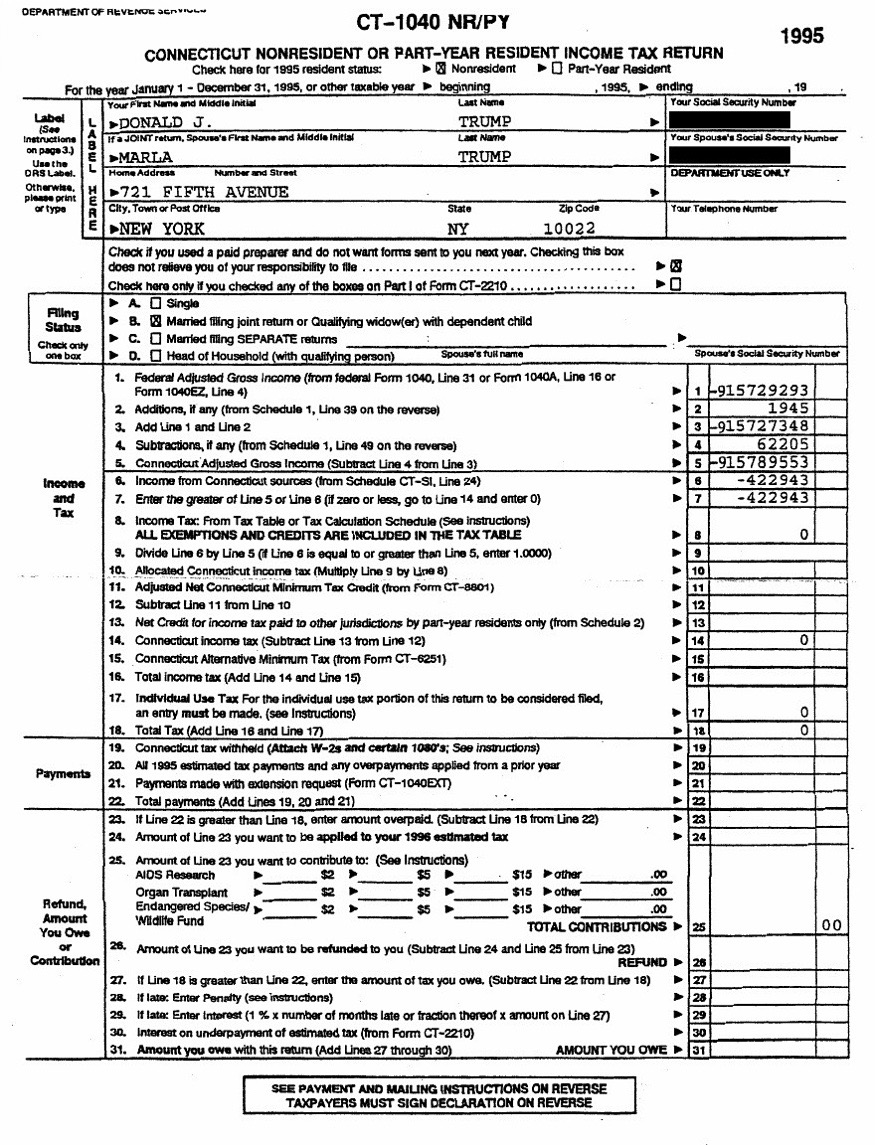
Image above: Page on of three pages of Donald Trump's 1995 New York State Income Tax Form IT-201 indicating an adjusted federal gross income of of -$915,729,293. Click to enlarge Page 1. Click to see  Page 2. Click to see Page 3. From original article.

For months democrats had complained that it was only damaging information associated with Hillary and the Democratic party that had been leaked during the election season, a string of hacks which was promptly assigned to Russia and Putin. That changed overnight.

In its leading Sunday story, the New York Times reports that "Trump Tax Records Obtained by The Times Reveal He Could Have Avoided Paying Taxes for Nearly Two Decades."

Specifically, it reports that according to a previously undisclosed 1995 tax filing, Trump reported a $916 million loss on his income tax returns that year which could have allowed him to legally avoid paying any federal income tax for up to 18 years.

As it explains, "the 1995 tax records, never before disclosed, reveal the extraordinary tax benefits that Mr. Trump, the Republican presidential nominee, derived from the financial wreckage he left behind in the early 1990s through mismanagement of three Atlantic City casinos, his ill-fated foray into the airline business and his ill-timed purchase of the Plaza Hotel in Manhattan."

To be sure, since Trump has never released his tax returns, it's still unclear if he paid federal income tax in subsequent years.  At Monday’s presidential debate when Hillary Clinton accused him of not paying federal income taxes, he replied, “That makes me smart.”

As the NYT further details, in the early 1990s, Trump's real estate projects and other businesses were quickly losing money, New Jersey casino regulator records and other documents have shown, which has been known for years as was the fact that Trump faced near-ruin in the mid-90s.  The Times said that Trump reported earning $7.4 million in interest income for the year but just over $6,000 in wages, salaries and tips.
“He has a vast benefit from his destruction” in the early 1990s, said one of the experts, Joel Rosenfeld, an assistant professor at New York University’s Schack Institute of Real Estate. Mr. Rosenfeld offered this description of what he would advise a client who came to him with a tax return like Mr. Trump’s: “Do you realize you can create $916 million in income without paying a nickel in taxes?”
Of course, the NYT discovery in itself is hardly as exciting as it makes it out to be: all the paper has found is that Trump established a substantial Net Operating Loss, or NOL, which courtesy of the US tax code, could be carried forward for years.
Reports by New Jersey’s casino regulators strongly suggested that Mr. Trump had claimed large net operating losses on his taxes in the early 1990s. Their reports, for example, revealed that Mr. Trump had carried forward net operating losses in both 1991 and 1993. What’s more, the reports said the losses he claimed were large enough to virtually cancel out any taxes he might owe on the millions of dollars of debt that was being forgiven by his creditors. (The I.R.S. considers forgiven debt to be taxable income.)
Indeed, as the NYT itself admits there was nothing illegal about using such a manoeuvre: the world's rich take advantage of NOL tax planning all the time, and in fact acquiring corporations for their NOL benefit has long been a strategy in corporate America designed to minimize Federal and State tax outflows.
The tax experts consulted by The Times said nothing in the 1995 documents suggested any wrongdoing by Mr. Trump, even if the extraordinary size of the loss he declared would have probably attracted extra scrutiny from I.R.S. examiners. “The I.R.S., when they see a negative $916 million, that has to pop out,” Mr. Rosenfeld said.
Considering that according to Trump he has been the subject of numerous tax audits by the IRS that appears to be indeed the case.

Furthermore, the NYT itself is perfectly happy to take advantage of the US tax to minimize the amount of money it pays to the government: in 2014 the company got a tax refund of $3.6 million despite having a $29.9 million pretax profit, an effective negative tax rate for 2014, which it explained was favorably affected by approximately $21.1 million for the reversal of reserves for uncertain tax positions due to the lapse of applicable statutes of limitations.

owever, the biggest news in the NYT report is not so much the glimpse into Trump's income statement over 20 years ago, but the fact that unexpectedly a Deep Throat appears to have emerged within Trump's organization, someone found directly inside the Trump Tower. This is how the NYT explains where it got the questionably obtained filings:
The documents consisted of three pages from what appeared to be Mr. Trump’s 1995 tax returns. The pages were mailed last month to Susanne Craig, a reporter at The Times who has written about Mr. Trump’s finances. The documents were the first page of a New York State resident income tax return, the first page of a New Jersey nonresident tax return and the first page of a Connecticut nonresident tax return.

Each page bore the names and Social Security numbers of Mr. Trump and Marla Maples, his wife at the time. Only the New Jersey form had what appeared to be their signatures.

The three documents arrived by mail at The Times with a postmark indicating they had been sent from New York City. The return address claimed the envelope had been sent from Trump Tower.
Missing, however, was Trump's comprehensive Federal tax return: "because the documents sent to The Times did not include any pages from Mr. Trump’s 1995 federal tax return, it is impossible to determine how much he may have donated to charity that year.

The state documents do show, though, that Mr. Trump declined the opportunity to contribute to the New Jersey Vietnam Veterans’ Memorial Fund, the New Jersey Wildlife Conservation Fund or the Children’s Trust Fund. He also declined to contribute $1 toward public financing of New Jersey’s elections for governor."

Understandably, the Trump campaign was troubled by the leak: as the NYT notes, a lawyer for Mr. Trump, Marc E. Kasowitz, emailed a letter to The Times arguing that publication of the records is illegal because Mr. Trump has not authorized the disclosure of any of his tax returns.

Mr. Kasowitz threatened “prompt initiation of appropriate legal action.” Incidentally, Kasowitz is also somewhat well known in the investing community for threatening to sue outspoken critics of problematic stock narratives, having threatened with lawsuits investors and journalists divulging negative information involving such Canadian firms as Fairfax, Valeant and Brookfield.

It remains to be seen if legal action against the NYT will indeed be taken. The Trump campaign promptly responded to what it alleges was "illegally obtained" information as follows:
"The only news here is that the more than 20-year-old alleged tax document was illegally obtained, a further demonstration that the New York Times, like establishment media in general, is an extension of the Clinton Campaign, the Democratic Party and their global special interests. What is happening now with the FBI and DOJ on Hillary Clinton's emails and illegal server, including her many lies and her lies to Congress are worse than what took place in the administration of Richard Nixon - and far more illegal.

"Mr. Trump is a highly-skilled businessman who has a fiduciary responsibility to his business, his family and his employees to pay no more tax than legally required. That being said, Mr. Trump has paid hundreds of millions of dollars in property taxes, sales and excise taxes, real estate taxes, city taxes, state taxes, employee taxes and federal taxes, along with very substantial charitable contributions. Mr. Trump knows the tax code far better than anyone who has ever run for President and he is the only one that knows how to fix it.

"The incredible skills Mr. Trump has shown in building his business are the skills we need to rebuild this country. Hillary Clinton is a corrupt public official who violated federal law, Donald Trump is an extraordinarily successful private businessman who followed the law and created tens of thousands of jobs for Americans."

However, while the story of Trump's use of NOLs may be overblown, the big news of the day is that a deeply-embedded, and well-connected mole appears to have emerged within Trump's organization, someone close enough to have access to Trump's tax filings, albeit at least for now, going back more than 20 years in time.

As such suddenly the odds that the "October Surprise" will be a leak not so much of additional Hillary hacked data, but of adverse infromation impacting the Trump campaign has surged. That said, we doubt if the media will blame the Kremlin for this particular leak, as it has done all along whenever Hillary's own dirty laundry was released into the open.
The three leaked state tax filing pages are shown below:


Trump may have avoided 18 years taxes

SUBHEAD: Trump may have 18 years of no federal taxes from 1995. Question is was it a "real" net operating loss.

By John Hempton on 2 October 2016 for Bronte Capital -
(http://brontecapital.blogspot.com/2016/10/some-comments-on-new-york-times-story.html)

Decades ago - before I was a fund manager - I was the resident expert on tax avoidance working for the Australian Treasury. That was where I started to hone the accounting skills sometimes shown on this blog.

I very rarely do anything in tax - but now I think it is time.

The New York Times has published a story (including extracts) about Donald Trump's tax returns over two decades ago. The money-quote is this:
Donald J. Trump declared a $916 million loss on his 1995 income tax returns, a tax deduction so substantial it could have allowed him to legally avoid paying any federal income taxes for up to 18 years...
According to the New York Times the losses came
... through mismanagement of three Atlantic City casinos, his ill-fated foray into the airline business and his ill-timed purchase of the Plaza Hotel in Manhattan.
There is an issue here.

Donald Trump did not repay all the debt associated with those investments.

Either
  • the loss is a real loss and the Donald was really was out of pocket by $916 million, in which case he has legitimate Net Operating Losses (NOLs)
  • or the loss was passed on to someone else by The Donald defaulting on debt - in which case Donald Trump should be assessed for income from debt forgiveness.
After all if the debt is forgiven it is not Donald Trump's loss. The loss is borne by the person who lent Donald money and did not get it back.

That - clearly stated by example - is why most income tax systems assess debt forgiveness as income.

Okay - I do not know whether Donald Trump had the wherewithal in 1995 to bear $916 million of losses personally. But I doubt it. (If he did his financial career is different from what is popularly accepted.)

So the alternative is the debt was forgiven in some way. But then the story the New York Times is running is wrong - because the $916 million of losses would not have survived the debt forgiveness and hence would have wiped out his NOLs and thus he would not be allowed to shelter his income for the next 18 years.

Unless that is there is an avoidance scheme the New York Times has not worked out. Those schemes go by the name of "debt parking".

Debt parking
Here is how debt parking works. Suppose the debtor (in this case The Donald) is going to get his debt cancelled for (say) 1c in the dollar. When he gets the debt wiped out the debtor (ie The Donald) will have to report assessable income equal to the debt wiped out (in this case 99 percent of $916 million).

The alternative though is for the debtor to set up a dummy party. The dummy party might be his wife or children or some company or trust set up by them or more likely some completely opaque offshore trust.

And that dummy party goes and buys the debt for say 1.1 cents in the dollar. Then they just sit there.

They don't force the debtor (ie The Donald) to repay. They don't make a profit or loss on the debt. And because the debtor never has his debt forgiven he never gets the assessment on debt forgiveness and he gets to keep his NOLs even though the losses did not come out of his pocket.

Every tax system worth its salt has some rules on "effective debt forgiveness" to prevent debt parking. And - from my experience which is now over twenty years old - none of them work entirely.

Now if Donald really has all those tax losses its pretty clear that the debt must be parked somewhere.

There is a vehicle out there (say an offshore trust or other undisclosed related party effectively controlled by Donald Trump) - which owns over $900 million in debt and is not bothering to collect it.

I do not have the time or energy to find that vehicle. But it is there. Now that this blog has gone public journalists are going to look for it.

There is a Pulitzer prize for whoever finds it. Just give me a nod at the acceptance ceremony.


.

Contact the bankers behind DAPL

SUBHEAD: How to contact the CEOs and others of bankers funding the Dakota Access Pipeline.

By Emily Fuller on 29 September 2016 for Yes Magazine -
(http://www.yesmagazine.org/people-power/how-to-contact-the-17-banks-funding-the-dakota-access-pipeline-20160929)


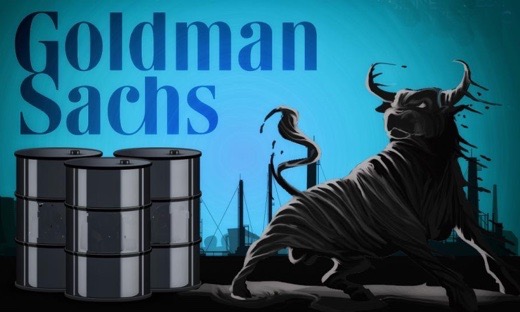
Image above: Goldman Sachs is deep into the shale fossil fuel business that is wrecking the world's climate. From (http://www.bidnessetc.com/47761-goldman-sachs-group-bullish-on-marathon-petroleum-corp-delek-energy-valero/).

Here are CEO names, emails, and phone numbers—because banks have choices when it comes to what projects they give loans to.

The Dakota Access pipeline is funded directly by 17 banks, many of which—Citibank, Wells Fargo—are ones you’ve probably heard of or do business with.

Researchers with the nonprofit Food & Water Watch found that 38 banking institutions are involved in funding the proposed Bakken pipeline, which would stretch from Canada to the Gulf of Mexico.

A section of this project is the Dakota Access pipeline, where the Standing Rock Sioux and thousands of allies have physically put themselves in the path of the pipeline to protect their reservation and a stretch of the Missouri River.

Bill McKibben, founder of 350.org, recently wrote an article for YES! suggesting that banks are more susceptible to public pressure than the oil and gas giants, which depend on bank loans and lines of credit to build their pipelines. “It’s probably sustained public pressure that will do the most good,” he wrote.

Wondering what to say to a bank executive?

Food & Water Watch researcher Hugh MacMillan: “Ask these banks to clarify whether funds they are providing are being used, in any amount, to pay for the heavily militarized response to the Standing Rock Sioux, including the attack dogs, sound-cannon trucks, heavily armed officers, and even a crop duster spraying undetermined chemicals over the camp.

“People should also ask these institutions why they are sinking so much money into maximizing the amounts of oil and gas that can be brought to the surface and burned at a time when climate science is clear we have to maximize what we keep in the ground instead,” said MacMillan.

The organization’s deputy communications director, Seth Gladstone, suggests saying: “As a customer of your financial institution, I reject the notion of my money helping to support your investment in the Dakota Access pipeline, an inherently dangerous and unjust oil pipeline that threatens air and water quality in many states, and violates sacred lands of the Standing Rock Sioux tribe. I urge you to give up your financial stake in the Dakota Access pipeline immediately.”

The following are names of CEOs and other bank executives involved in these decisions—along with their phone numbers and email addresses. The first 17 banks (*) are directly funding the Dakota Access pipeline.


Wells Fargo*
CEO John Stumpf
John.G.Stumpf@wellsfargo.com
BoardCommunications@wellsfargo.com
Phone: 866-249- 3302

Corporate Office:
Wells Fargo
420 Montgomery Street
San Francisco, CA 94104


BNP Paribas*
CEO Jean-Laurent Bonnafe
jean-laurent.bonnafe@bnpparibas.com

Corporate Office:
3 rue d’Antin
75002 Paris, France
Phone: 00-33-157-082-200

U.S. Office:
787 Seventh Avenue - The Equitable Tower
New York, NY 10019
Phone: 212-841-3000


SunTrust*
CEO William H. Rodgers Jr.

Corporate Office:
303 Peachtree Street NE
Atlanta, GA 30308
Phone: 800-786-8787

Chief Communications Officer:
Sue Mallino
jean-laurent.bonnafe@bnpparibas.com
Phone: 404-813-0463


The Bank of Tokyo-Mitsubishi UFJ*
Chairman Nobuyuki Hirano
CEO and President Takashi Oyamada

Corporate Office:
2-7-1, Marunouchi, Chiyoda-ku
Tokyo, Japan
Phone: 81-3-3240-8111

U.S. Office:
1251 Avenue of the Americas
New York, NY 10020-1104
Phone: 212-782-4000


Mizuho Bank*
President and CEO Nobuhide Hayashi

Corporate Office:
Otemachi Tower
1-5-5, Otemachi, Chiyoda-ku
Tokyo 100-8176, Japan
Phone: 81-3-3214-1111

U.S. Office:
1251 Avenue of the Americas
New York, NY 10020
Phone: 212-282-3000


Citibank (CitiGroup)*
CEO Michael Corbat
michael.corbat@citi.com
Phone: 212-793-1201

Corporate Office:
388 Greenwich Street
New York, NY 10013
Phone: 800-285-3000 and 212-793-0710


TD Securities*
Chairman, CEO, and President Bob Dorrance

Corporate Office:
P.O. Box 1, TD Bank Tower
66 Wellington Street W
Toronto, Ontario
M5K 1A2

Investment Banking:
Phone: 416-307-8500

Equity Research:
Phone: 416-307-9360

Trading Floor Enquiries:
Phone: 416-944-6978

U.S. Office:
31 West 52nd Street
New York, NY 10019-6101
Phone: 212-827-7000


Credit Agricole*
CEO Jean-Paul Chifflet

Corporate Office:
12, Place des Etats-Unis
Montrouge, France 92545
Phone: 33-1-43-23-52-02

U.S. Office:
1301 Avenue of the Americas,
New York, NY 10019
infoamericas@ca-cib.com


Intesa SanPaolo*
CEO Carlo Messina

Corporate Office:
Piazza San Carlo, 156
10121 Torino, Italy
Phone: 39-011-555-1

Corporate Social Responsibility Unit:
Phone: 39-02-8796-3435
CSR@intesasanpaolo.com
sostenibilita.ambientale@intesasanpaolo.com


ING Bank*
CEO and Executive Board Chairman Ralph A.J.G Hamers

Wholesale Banking, Operations & IT, Sustainability, Corporate Governance:
Carolien van der Giessen
carolien.van.der.giessen@ing.com
Phone: 31-20-576-63-86

Head of Media Relations:
Raymond Vermuelen
raymond.vermeulen@ing.com
Phone: 31-20-576-63-69

Corporate Office:
Amsterdamse Poort
Bijlmerplein 888
1102 MG Amsterdam
The Netherlands
31-20-5639111

Mailing Address:
ING Bank N.V.
P.O. Box 1800
1000 BV Amsterdam
The Netherlands

U.S. Office:
ING Financial Holdings LLC
1325 Avenue of the Americas
New York, NY 10019
Phone: 646-424-6000


Natixis*
CEO Pierre Servant

Corporate Office:
Natixis Global Asset Management, S.A.
21 quai d’Austerlitz
75634 Paris Cedex 13, France
Phone: 33-1-78-40-90-00

U.S. Office:
Natixis Global Asset Management, L.P.
399 Boylston Street
Boston, MA
Phone: 617-449-2100


BayernLB*
CEO Johannes-Jorg Riegler

Head of Communications:
Matthias Priwitzer
Matthias.Priwitzer@bayernlb.de
Phone: 49-89-2171-21255

Corporate Office:
Brienner Straße 18
80333 Munich
49-89-2171-27176

U.S. Office:
560 Lexington Avenue
New York City, NY 10022
212-310-9800


BBVA Securities*
CEO Carlos Torres Villa
Executive Chairman Francisco Gonzalez Rodriguez

Corporate Office:
Calle Azul, 4
28050 Madrid, Spain
Phone: 34-902-22-44-66


DNB First Bank*
CEO and President William J. Hieb
Phone: 610-269-1040

Main Branch:
4 Brandywine Avenue
Downingtown, PA 19335
Phone: 484-691-3621


ICBC London*
CEO and Managing Director Jin Chen
Corporate Office:
20 Gresham Street
London EC2V 7JE, United Kingdom
Phone: 44-203-145-5000

U.S. Office:
520 Madison Avenue 28th Floor
New York, NY 10022
Phone: 212-407-5000


SMBC Nikko Securities*
President and CEO Yoshihiko Shimizu

Corporate Office:
3-1, Marunouchi 3-chome, Chiyoda-ku
Tokyo 100-8325, Japan
Phone: 81-3-5644-3111


Societe General*
CEO Frederic Oudea
https://www.linkedin.com/in/fredericoudea

Chairman of the Board Lorenzo Bini Smaghi
lorenzo.binismaghi@snam.it

Corporate Office:
29 boulevard Haussmann 75009
Paris, France
Phone: 33-1-42-14-20-00
2.0@societegenerale.com

U.S. Office:
245 Park Avenue
New York City, NY 10167
Phone: 212-278-6000


The following banks are involved in funding for the entire Bakken pipeline:
Royal Bank of Scotland
CEO Ross McEwan
ross.mcewan@rbs.co.uk

Director of Media Relations:
Chris Turner
Phone: 44-20-7672-4515

Corporate Office:
Gogarburn
175 Glasgow Road
Edinburgh, United Kingdom
Phone: 44-131-626-3263

U.S. Office:
600 Washington Boulevard
Stamford, CT 06901
Phone: 203-897-2700


ABN Amro Capital
Chairman of the Board Gerrit Zalm

Corporate Office:
ABN AMRO Bank N.V.
Gustav Mahlerlaan 10
1082 PP Amsterdam
The Netherlands
Phone: 31-10-241-17-23

U.S. Office:
100 Park Avenue, 17th floor
New York, NY 10017
Phone: 917-284-6800


Bank of Nova Scotia (Scotiabank)
CEO and President Brian J. Porter

Corporate Office:
Scotia Plaza
44 King Street W
Toronto, Ontario
Canada M5H 1H1
Phone: 416-866-6161
email@scotiabank.com

U.S. Office:
250 Vesey Street,
23rd and 24th floors
New York, NY 10281
Phone: 212-225-5000

Howard Weil “Scotia Energy Investment Boutique”
Energy Centre
1100 Poydras Street Suite 3500
New Orleans, LA 70163
Phone: 504-582-2500 and 800-322-3005
howardweil@howardweil.com


Citizens Bank
Chairman and CEO Bruce Van Saun

Head of Media Relations:
Peter Lucht
Peter.Lucht@citizensbank.com
Phone: 781-655-2289

Consumer Lending, Business Banking, Wealth Management, Corporate:
Lauren DiGeronimo
Lauren.Digeronimo@citizensbank.com
Phone: 781-471-1454

Corporate Office:
1 Citizens Plaza
Providence, RI 02903
Phone: 401-456-7000


Comerica Bank
Chairman and CEO Ralph W. Babb Jr.

Investor Relations:
Phone: 214-462-6831

Corporate Contacts:
Wendy Bridges
wwbridges@comerica.com
Phone: 214-462-4443

Wayne Mielke
wjmielke@comerica.com
Phone: 214-462-4463

Corporate Office:
Comerica Bank Tower
1717 Main Street
Dallas, TX 75201
Phone: 800-521-1190


U.S. Bank
Chairman and CEO Richard K. Davis
richard.davis@usbank.com

Senior Vice President of Corporate CommunicationsDana Ripley
dana.ripley@usbank.com
Phone: 612-303-3167

Brand, Corporate Social Responsibility, Sponsorships:
Susan Beatty
susan.beatty@usbank.com
Phone: 612-303-9229

Corporate Office:
U.S. Bancorp Center
800 Nicollet Mall
Minneapolis, MN 55402
Phone: 800-685-5065 and 651-466-3000


PNC Bank
Chairman, President, and CEO William S. Demchak

Media Relations:
Fred Solomon
corporate.communications@pnc.com
Phone: 412-762-4550

Investor Relations:
Bryan K. Gill
investor.relations@pnc.com
Phone: 412-768-4143

Corporate Office:
300 Fifth Avenue
The Tower at PNC Plaza
Pittsburgh, PA 15222
Phone: 412-762-2000


Barclays
Chairman John McFarlane
john.mcfarlane@barclays.com

CEO Jes Staley

Corporate Office:
Barclays Bank PLC
1 Churchill Place
London E14 5HP, United Kingdom
Phone: 44-20-7116-1000

U.S. Office:
Barclays
745 7th Avenue
New York, NY 10019
Phone: 212-526-7000

Press Office:
Phone: 212-526-7000
CorporateCommunicationsAmericas@barclays.com


JPMorgan Chase
Chairman and CEO Jamie Dimon
jamie.dimon@jpmchase.com
Phone: 212-270-1111

Corporate Contacts:
Andrew Gray
andrew.s.gray@jpmchase.com

Jennifer Lavoie
jennifer.h.lavoie@jpmchase.com

Brian Marchiony
brian.j.marchiony@jpmorgan.com

Corporate Office:
270 Park Avenue
New York, NY 10017-2014


Bank of America
President, CEO, and Chairman Brian Moynihan
brian.t.moynihan@bankofamerica.com

Executive Relations, Office of the CEO:
Matthew Task
Phone: 813-805-4873

Corporate Office:
100 N Tryon Street
Charlotte, NC 28255


Deutsche Bank
CEO John Cryan

Corporate Contact:
Renee Calabro
renee.calabro@db.com
Phone: 212-250-5525

Corporate Office:
Deutsche Bank AG
Taunusanlage 12
60325 Frankfurt Am Main (for letters and postcards: 60262)
Germany
Phone: 49-69-910-00

U.S. Office:
Deutsche Bank AG
60 Wall Street
New York, NY 10005
212-250-7171


Compass Bank
Chairman and CEO Manolo Sanchez

Director of External Communications:
Christina Anderson
christina.anderson@bbva.com

Communications:
Al Ortiz
al.ortiz@bbva.com
Phone: 281-433-5640

Corporate Office:
15 S 20th Street
Birmingham, AL 35233
Phone: 205-297-1986


Credit Suisse
CEO Tidjane Thiam

Board Chairman Urs Rohner

Suisse Banking Ombudsman:
Bahnhofplatz 9
P.O. Box 1818
CH 8021 Zurich, Switzerland
Phone: 41-43-266-14-14

Corporate Office:
Uetlibergstrasse 231
P.O. Box 700
CH 8070 Zurich, Switzerland
Phone: 41-44-333-11-11

U.S. Office:
650 California Street
San Francisco, CA 94108
Phone: 415-249-2100


DNB Capital/ASA
CEO Rune Bjerke
https://www.linkedin.com/in/rune-bjerke-04714639

Chairwoman of the Board Anne Carine Tanum
Pbone: 47-915-04800

Executive Vice President Communications
Even Westerveld
Phone: 47-400-16-744

Corporate Address:
Dronning Eufemias Gate 30
0191 Oslo, Norway


Sumitomo Mitsui Bank
President and CEO Takeshi Kunibe

Corporate Office:
1-1-2, Marunouchi, Chiyoda-ku
Tokyo, Japan
Phone: 81-3-3282-8111

U.S. Office:
277 Park Avenue
New York, NY 10172
Phone: 212-224-4000


Royal Bank of Canada
CEO David I. McKay

CEO and Board Communications:
Paul French
paul.french@rbc.com
Phone: 416-974-3718

Corporate Media Relations:
Catherine Hudon
catherine.hudon@rbc.com
Phone: 416-974-5506

Corporate Address:
200 Bay Street P.O. Box 1
Royal Bank Plaza
Toronto, Canada
Phone: 416-974-5151 and 416-842-2000


UBS
CEO Sergio Ermotti
https://www.linkedin.com/in/sergiopermotti

Head Group External Communications:
Mark Hengel
mark.hengel@ubs.com
Phone: 41-44-234-32-21
Chief Communication Officer-Americas:
Marsha Askins
marsha.askins@ubs.com
Phone: 212-713-6151 office and 917-226-4743 cell

Corporate Office:
Bahnhofstrasse 45, CH-8098
8001 Zurich, Switzerland
Phone: 41-44-234-11-11

U.S. Office:
1285 Avenue of the Americas
New York, NY 10019
Phone: 212-713-2000


Goldman Sachs
Chairman and CEO Lloyd C. Blankfein
lloyd.blankfein@gs.com
Phone: 917-743-0939 and 212-902-0593

Media Contacts Americas:
Phone: 212-902-5400

Corporate Address:
Goldman, Sachs & Co.
200 West Street
New York, NY 10282
Phone: 212-902-1000


Morgan Stanley
CEO James P. Gorman
jgorman@morganstanley.com
Phone: 212-761-4000

Corporate Office:
Morgan Stanley
1585 Broadway
New York, NY 10036
Phone: 212-761-4000


Community Trust Bank
Chairman, President, and CEO Jean R. Hale
Senior Vice President, Investments:
Christopher Meng
mengro@ctbi.com
Phone: 859-389-5300
Corporate Office:
346 N Mayo Trail
Pikeville, KY 41501
Phone: 606-432-1414


HSBC Bank
Chairman Douglas Flint Group Chief Executive Stuart Gulliver
managingdirectoruk@hsbc.com

Corporate Office:
8 Canada Square
London E14 5HQ, United Kingdom
Phone: 44-20-7991-8888

U.S. Office:
HSBC Headquarters
425 5th Avenue
New York, NY 10018
Phone: 212-525-5600

Head of Media Relations, HSBC USA:
Rob Sherman
Phone: 212-525-6901

The information compiled here is from the latest information reported by the banks. If there are corrections or additions that we should consider, please let us know.

See also:
Ea O Ka Aina: NoDAPL demo at Enbridge Inc 9/29/16
Ea O Ka Aina: Militarized Police raid NoDAPL 9/28/16
Ea O Ka Aina: Stop funding of Dakota Access Pipeline 9/27/16
Ea O Ka Aina: UN experts to US, "Stop DAPL Now!" 9/27/16
Ea O Ka Aina: No DAPL solidarity grows 9/21/16
Ea O Ka Aina: This is how we should be living 9/16/16
Ea O Ka Aina: 'Natural Capital' replacing 'Nature' 9/14/16
Ea O Ka Aina: The Big Difference at Standing Rock 9/13/16
Ea O Ka Aina: Jill Stein joins Standing Rock Sioux 9/10/16
Ea O Ka Aina: Pipeline temporarily halted 9/6/16
Ea O Ka Aina: Native Americans attacked with dogs 9/5/16
Ea O Ka Aina: Mni Wiconi! Water is Life! 9/3/16
Ea O Ka Aina: Sioux can stop the Pipeline 8/28/16
Ea O Ka Aina: Officials cut water to Sioux 8/23/16 

.