Eco Warriors Arise!

SUBHEAD: We are either threatening the planet, or finding ways to a sustainable and a just future.

By Vandana Shiva on 23 May 2012 for The Asian Age -  
(http://www.asianage.com/columnists/eco-warriors-arise-128)

 
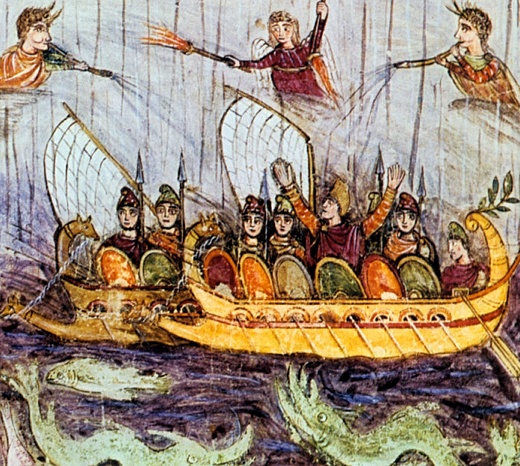
Image above: Jumbo container ships are the means of spreading corporate globalization. From (http://www.ibtimes.com/articles/269773/20111219/globalization-vote-today-american-people-ok.htm).  

In June 2012, world leaders along with thousands of participants from governments, NGOs and environmental groups as well as the private sector will come together in Rio de Janeiro in Brazil for Rio+20, 20 years after the Earth Summit was organized by the UN in 1992, to address urgent ecological challenges such as extinction of species, erosion of biodiversity and climate change. The Earth Summit gave us two significant international environmental laws — the United Nations Convention on Biological Diversity (UNCBD) and the United Nations Framework Convention on Climate Change (UNFCCC). It also gave us the Rio principles, including the precautionary principle, and the “polluter pays” principle.

The world has changed radically since 1992 and, sadly, not for the better. Ecological sustainability has been systematically sacrificed for a particular model of economy, which itself is in crisis.
The year 1995 saw a tectonic shift in values guiding our decisions together with a shift with regard to those who make those decisions. It was the year the World Trade Organization (WTO) was established. Whereas the Rio principles — shaped by ecological movements, ecological science and by sovereign governments — were informed by values of ecological sustainability, social justice and economic equity across and within the countries, the WTO introduced the paradigm of global corporate rule, changing the values and structures of governance and decision-making through free trade agreements between nations.

Conservation of the earth’s resources and equitable sharing were over the years replaced by greed and the grabbing and privatization of resources across the globe. Sustainable economies and societies were replaced by non-sustainable production systems and a relentless drive to spread the virus of consumerism. Decision-making moved into the hands of global corporations, both directly and indirectly. It is, therefore, not surprising that when we meet at Rio+ 20, the ecological crisis is deeper than what it was at the time of the Earth Summit.

While the corporations wrote the rules of WTO and global free trade, they also subverted the environmental rules that were supposed to regulate their commercial activities to ensure sustainability. They have mutated environmental laws that were supposed to regulate commerce into laws for commercialising and commodifying the earth’s resources and ecological functions. They have subverted the Climate Treaty (derived from UNFCCC) and the Biodiversity Convention (UNCBD).

Instead of polluters paying and being regulated at the national and international level to stop pollution, the biggest atmospheric polluters who have contributed most to climate change are laying the rules on how to deal with climate change. The biotechnology industry that has caused genetic pollution by releasing genetically engineered organisms into the environment is laying down the rules on how to manage biodiversity and govern biosafety. The attempt to introduce Brai, the Biotechnology Regulatory Authority of India, is an example of this.

The original objective of the Climate Treaty was to put in place legally binding emission reduction targets for the historical polluters, who in the pre-globalization era were concentrated in the rich industrial North. The treaty was destroyed in 2009 at the Climate Summit in Copenhagen by an attempt to replace it with a non-binding Copenhagen Accord. The Kyoto Protocol of 1997 had introduced emissions trading, which, in effect, meant that the polluter got paid, not punished. The big industrial polluters were first paid by allowing them to get private rights to our atmospheric commons. Then the polluters got paid by making profits through carbon trading. Profits increased and emissions also increased. Climate chaos is worse today than it was in 1992. And the polluters look for new avenues to make money and grab resources. Now they want to commodify the ecological functions and services that nature provides. This will be the big climate debate in Rio+20.

The objective of Climate Treaty was the conservation of biodiversity and its sustainable and equitable use. That objective has been subverted and is being increasingly replaced by objectives of trade in genetic resources, profits and privatization. The Nagoya Protocol on Access to Genetic Resources and Benefit Sharing, adopted in 2010, restricts access only to global players, ignoring the access of local communities. It treats as utilization only utilization for research and commerce, ignoring the survival needs of local communities. It is, in fact, legalized biopiracy as it enables transfer of genetic wealth from local communities to global corporations. It undermines the biodiversity economies and cultures that have conserved biodiversity and are necessary for conserving it for the future.

In both the Climate Treaty and the Biodiversity Convention, trade and commerce is replacing conservation and eroding the commons. Rights of corporations are edging out the rights of people.
And this change in values, from conserving and sharing to exploiting and privatising, is justified in the name of economic progress and economic growth. Yet, the economic paradigm for which the earth and the society are being pillaged and destroyed is itself in deep crisis. Look at the number of farmers committing suicides and hunger and malnutrition in India.

A paradigm shift is desperately needed. And it will not come from those who have created the crisis and who are looking for new ways to extend the life of the greed economy by commodifying and privatizing all life on earth. They will come to Rio+20 to paint the “greed economy” green, and call it the “green economy”. And they will have powerful governments on their side.

Movements for ecological sustainability, social justice and deep democracy will come to Rio+20 with another paradigm — one centered on the rights of mother earth, the rights of future generations, of women, indigenous communities and farmers. It is this epic contest between a destructive and dying outmoded paradigm and a life-enhancing emergent paradigm that will be the most significant aspect of Rio+20. The outcome of this contest will determine the future of humanity.

None of us are immune from the crisis or the response to it. None of us are bystanders. We are all immersed in the processes that are either threatening the planet and our own future, or finding creative ways to shape a sustainable and a just future. Every day is an earth summit in our lives. And each of us is negotiating our collective fate on earth.

• Vandana Shiva is a philosopher, environmental activist, and eco feminist.Shiva, currently based in Delhi, has authored more than 20 books and over 500 papers in leading scientific and technical journals.She was trained as a physicist and received her Ph.D. in physics from the University of Western Ontario, Canada. She was awarded the Right Livelihood Award in 1993. She is the founder of Navdanya http://www.navdanya.org. 


.

Night Thoughts in Hagsgate

SUBHEAD: There’s the choice: share the feast and share the fall, or wake up and walk away. Which will you do? By John Michael Greer on 23 May 2012 for the Archdruid Report - (http://thearchdruidreport.blogspot.com/2012/05/night-thoughts-in-hagsgate.html) Image above: The Last Unicorn before the end of Hagsgate. From (http://www.blackmagicmarkers.com/images/photoshoppery/The%20Last%20Unicorn.jpg).
There are times, at least for me, when the fate in store for industrial society can be seen with more than the usual clarity. I’m thinking just now of the time I looked out a train window and saw an abandoned factory, not yet twenty years old, with foot-high saplings rising incongruously from the gutter around the roof; or of another time, in a weekend flea market here in Cumberland, when I found a kid’s book on space travel I’d loved as a child, flipped through the pages, and found myself face to face with the gap between the shining future we were supposed to have by now and the mess that was actually waiting for us when we got here.
I’m pondering another of those moments now, but the trigger this time isn’t a trackside glimpse or a memento in a repurposed warehouse. It’s the current flood of news stories, opinion pieces, and public statements by pundits of various kinds, all focused on one theme—the supposed irrelevance of peak oil.
Those of my readers who have managed to miss that torrent so far may find it helpful to spare a glance at this typical example of the species, which was forwarded to me by one of this blog’s readers (tip of the archdruidical hat to Hereward). The author, Timothy Worstall, is a senior fellow at the Adam Smith Institute in London, and a specialist in rare earth elements; he starts off by complaining that he doesn’t understand peak oil, goes on to demonstrate that fact in impressive detail, and finishes up with the sort of whopper that normally earns an F on a freshman paper in Geology 101. No, Mr. Worstall, kerogen shales such as the Green River formation are not at all the same thing as oil-bearing shales such as the Bakken formation, and nobody yet has a viable way to extract oil from kerogen shales; I trust you provide better information to clients who ask your advice about rare earth elements.
I wish I could say that this is an extreme example, but it’s not. Worstall has at least grasped the fact that peak oil has to do the rate at which oil can be produced, which is more than most critics of the concept manage, and his confusion between kerogen shales and oil-bearing shales—though it could have been cleared up by five minutes of research—is common among people who are poorly informed about petroleum geology. Look at other efforts to dismiss peak oil and you’ll find worse. The question I’d like to raise is why this outpouring of misinformation and denial happens to be in full flood right now.
It’s a very odd time for peak oil to be dismissed, all things considered. Back in the late 1990s, when the first peak oil researchers began to exchange data and forecasts, several leading figures in the newborn movement made very straightforward predictions about what was going to happen. They predicted that global production of crude oil would peak in the near future, and decline thereafter; they predicted that this would cause the price of oil and petroleum products to skyrocket, imposing severe costs on the global economy and triggering economic contraction; some, though this was controversial, predicted that attempts to replace petroleum with alternative energy sources would fail because of net energy and other noneconomic factors.
These assertions were rejected with quite some heat by the few people outside the scene who bothered to notice. Critics of peak oil insisted, first, that increasing demand for petroleum would make additional capital available for the hunt for new oil fields, which would of course be found, and thus allow petroleum production to grow indefinitely; second, that if the price of oil did rise sharply, that would simply make other energy sources viable, releasing a flood of energy onto the market that would drive prices back down; and third, that human ingenuity, the free market, or some other allegedly omnipotent force would certainly be able to find limitless new energy resources and prove all the pessimists wrong.
A decade and a half later, it’s instructive to see how those predictions turned out. The short form is that the peak oil researchers were correct while their critics were shoveling smoke. The production of crude oil peaked in 2005; the price of oil spiked to levels that pundits insisted it could never reach, and has moved raggedly upward since the initial spike and crash to today’s value well above $100 a barrel; the global economy proceeded to lurch into serious trouble, and remains in a state of perpetual crisis that nobody in charge seems to be able to understand or fix; and a series of boomlets in hydrogen, ethanol, algal biodiesel and other much-hyped alternative energy sources rose and crashed as it turned out that no matter what oil cost, they cost more.
The current bubble in shale gas is to some extent an exception to that last rule, but it’s hardly the bonanza that the media likes to claim. Partly, shale gas production is simply a side effect of the fact that natural gas liquids, which occur in some shale gas deposits, can be sold as a petroleum substitute at very good prices; partly, shale gas has morphed in recent years into what Wall Street aficionados call a pump-and-dump operation—a bit of dubious marketing in which operators boost the price of a stock, then sell it at the inflated price to suckers, who are sure the price will go up further and are therefore left holding the bag when it goes down instead. (I trust none of my readers have put their life savings into shale gas companies.)
Still, there’s another factor to the shale gas bubble, and also to the boom in oil-bearing shale that has filled so many glowing headlines in recent years, and will fill so many gloomy headlines a few years further on. Both are being ballyhooed as game-changing breakthroughs, even though they’re nothing of the kind—hydrofracturing ("fracking") has been a common practice for forty years, and the Bakken shale was discovered long ago. The fracking boom is simply one of the many ways in which the world is scraping low-grade fuels out of the bottom of the barrel, just as peak oil researchers have predicted it would. Their breakthrough status is entirely a product of hype. Behind that hype, I’ve come to think, and the comparable hype that surrounded the hydrogen economy, corn ethanol, and all the other failed pseudosolutions to our predicament, lies a very specific motive: the desire to find some reason, however fatuous, to insist that it’s all right to keep on wallowing in the benefits of today’s wildly unsustainable energy and resource consumption, instead of getting ready for the far less lavish world that’s going to follow in short order.
That motive shapes a dizzyingly large share of the collective conversation of our time. Consider the book review I critiqued in last week’s post. One of the bits of rhetoric the reviewer used to dismiss my suggestion that social change has to be founded in personal change was the claim that "you can’t end rape [just] by not raping anyone." Perhaps so, but as one of my readers pointed out (tip of the archdruidical hat here to Ozark Chinquapin), someone who claimed to oppose rape would normally be expected to demonstrate that commitment by, at the very least, not raping anyone; an antirape movement that claimed that rapes committed by its members didn’t matter, because it was working to end rape everywhere, would rightly be dismissed as an exercise in extreme hypocrisy. Yet you’ll hear the identical logic from people in a good deal of the environmental movement, who insist that they can’t be bothered to lighten the burden their lifestyles place on the planet because they’re going to save the Earth all at once.
Work out the practical implications of that argument, in other words, and it amounts to a justification for clinging to the comforts and privileges of the modern industrial lifestyle even at the expense of one’s supposed ideals. That’s also the implication of the denunciations of peak oil I discussed at the beginning of this post, of course, and there are plenty of other ways of cloaking that same desire. Whether you expect solar power, thorium reactors, algal biodiesel or some other exciting new energy source to save the day; whether you anticipate the imminent arrival of the Rapture, the Singularity, the Space Brothers, a world-ending cataclysm, or a great leap of consciousness to some higher plane; or whether you simply tell yourself, as so many Americans do these days, "I’m sure they’ll think of something"—if you look at that belief honestly, dear reader, doesn’t it work out to an excuse that lets you claim that it really is okay for you to keep enjoying whatever you see as your share of the goodies churned out by the industrial machine?
It’s here, in turn, that I glance down and see the void opening up beneath the foundations of that same machine—and it’s also here that I find myself remembering a harrowing detail from one of the favorite books of my teen years, Peter Beagle’s brilliant fantasy The Last Unicorn.
I’m not even going to try to sketch out the plot of the book as a whole. The point that’s relevant here centers on a place, the town of Hagsgate, and its people, who are very rich. They live in the kingdom ruled by King Haggard, the villain of the story; they profit mightily from his rule, and are exquisitely careful not to notice anything that bears too closely on the terrifying evil that lies at the heart of his realm. They are also, as it happens, under a witch’s curse.
It occurs to me that some of my readers may not be familiar with the structure and function of curses. (What do they teach children these days?) The sort of thing you get in bad modern remakes of fairy tales, where someone inoffensive gets burdened with a dire fate that would not otherwise befall them, is strictly amateur stuff. Professionals know that the curses that matter are the kind that unfold by their own inexorable logic from the actions and attitudes of the accursed. The witch or wizard who finds it necessary or appropriate to pronounce a curse doesn’t have to make anything happen; he or she simply says aloud the unmentionable realities of the situation, states the necessary consequences, and leaves. The efforts of the accursed to avoid falling victim to the curse, without actually changing the things that make the curse inevitable, then proceed to drive the curse to its fulfillment.
The witch who cursed Hagsgate was a thoroughly competent professional. Here’s what she said:
You whom Haggard holds in thrall,
Share his feast and share his fall.
You shall see your fortune flower
Till the torrent takes the tower.
Yet none but one of Hagsgate town
May bring the castle swirling down.
You’ll notice that, like any good curse, this one includes an escape hatch: skip Haggard’s feast and you skip the fall, too. Beagle’s story doesn’t mention anyone who used the escape hatch, but there will have been somebody. There always is; whether we’re talking about Númenor, the City of Destruction, the warren of the shining wire, or some other place where a curse is at work, someone’s going to walk away. That sounds very heroic in retrospect, but that’s not the way it works in practice. In practice, those who walk away are as often as not weeping hysterically, torn between the fear of giving up everything they know and the knowledge that leaving is the only choice left for them, and trying without much success not to listen to the taunts or feel the stones flung by those who stay behind.
If, as Ursula LeGuin says in one of her best stories, they seem to know where they are going, it’s because "anywhere but here" is an easy course to chart at first. Mind you, some never even make it out the city gates; some come stumbling back to town a few days or weeks or years later; some are never seen again, and pebbles will grow into moss-covered boulders before anybody finds out exactly what happened to them; still, there’s always one, or a few, or nine tall ships sailing from Andunië with stormwinds howling in the rigging, who leave and do something less foredoomed with their lives.
It’s the ones who stay behind, though, who are more relevant to the point I want to make. It’s very easy to stay behind. Early on, when walking away is an easy thing, the threat of the curse is so far off that it’s seductive to think you can stay in Hagsgate for just a little while longer and still escape. Later on, you’ve come to enjoy the practical benefits that being a citizen of Hagsgate has to offer; you’ve got personal and financial ties to the place, and so you come up with ornate theories packed with dubious logic and cherrypicked data to convince yourself that the curse isn’t real or that it will only affect other people. As the curse begins to work, in turn, you start making excuses, insisting that you did everything you could reasonably be expected to do, and it’s all somebody else’s fault anyway. Finally, when the full reality of your fate stares you in the face and your last chance of escape is almost gone, comes the terrible temptation to treat the price you’re about to pay as a measure of the value of what you’ve gotten by staying in Hagsgate, and you cling to it ever more frantically as it drags you down.
Now of course a witch didn’t actually put a curse on industrial society—at least, if one did, I haven’t heard about it—but fairy tales keep their hold on our collective imagination because they contain a wealth of valid wisdom, wrapped up in a compact and memorable form. To say that there’s a curse on industrial society is simply to use an archaic metaphor for a point I’ve been discussing in these essays since The Archdruid Report began six years ago, which is that the consequences of industrial society’s mismanagement of its relations with the planet will not go away just because we don’t want to deal with them. That metaphor has a range of relevant features, and one of them is that any effective response to the curse—or, if you will, the predicament of our time—has to begin by taking stock of the ways that each of us, as individuals, contributes by our own attitudes and actions to the mess we’re in, and then making appropriate changes.
After six years, I shouldn’t even have to say that daydreaming about running off to some conveniently unaffordable eco-homestead in the country doesn’t count. Unless you’re in a position to do that, and the vast majority of us aren’t, that’s simply another evasion. What’s required instead is the less romantic but far more productive task of adapting in place: figuring out how, living where you live now, you can place much less of a burden on the biosphere, and help other people do the same thing. It probably has to be said that perfection isn’t a reasonable expectation here—there’s a long learning curve, and our culture and built environment place significant obstacles in the way—but a great deal can be done nonetheless That can easily lead into activism of various kinds, for those who feel called to do that specific kind of work; it can also lead in plenty of other constructive directions.
Still, that’s not a popular message just now, and I’m guessing that it’s going to become a great deal more unpopular as industrial civilization stumbles deeper into crisis. It doesn’t require a witch’s curse to make people cling frantically to exactly those things that are destroying them and their future, just the psychology of previous investment and a few other standard self-defeating habits of the human mind. Still, there’s the choice: share the feast and share the fall, or wake up and walk away. Which will you do?
.

Capitalism & Socialsim are Industrial

SUBHEAD: They're both wrong. Money doesn't grow on trees and Trees don't grow on Money.  

By Gene Logsdon on 23 May 2012 for the Contrary Farmer -
(http://thecontraryfarmer.wordpress.com/2012/05/23/money-doesnt-grow-on-trees-and-trees-dont-grow-on-money)

Image above: Mature men who believe money grows on trees. From (http://www.freerepublic.com/focus/f-news/2873674/posts)
 
I was so gratified to see Wendell Berry’s remarks in a recent interview (“Wendell Berry: Landsman” with Jim Leach in Humanities magazine, May/June 2012) where he makes a point about economics that is overlooked in these days when divisiveness rules the political roost. The general view is that the economic battle is between capitalism and socialism, but as Wendell observes, “both are industrial systems and they have made the same mistakes in some ways.” Both have ignored “the propriety of scale and the standard of ecological health.”

Yes, yes, yes. But I would like to go farther (probably too far) than Wendell did. Both capitalism and socialism are similar industrial systems basically because both accept and practice the industrial idea that the fundamental tool to “growing an economy” is the ability to borrow money at compound interest rates. I certainly would be foolish to deny the effectiveness, maybe the necessity, of being able to borrow money. We borrowed to buy our first house and car. 

But seeing how borrowed money nearly ruined people I knew when I was growing up, I was determined never to borrow again if I could avoid it and I never did. Repaying a loan over a long period of time often means buying the house or car twice and if one carries credit card debt all the time, to paying for stuff more than three times.

Somehow this kind of insanity has become sanctified in our society as if it were holy scripture. The phrase “free enterprise” is uttered by its high priests with all the fervor of a biblical evangelist uttering “the Lord Jesus Christ.” I remember the first time I confronted this kind of reverence and realized with a shock, that “free enterprise,” guided by what its followers called an “invisible hand,” was almost a synonym for God.

For centuries societies learned from experience that borrowing money on interest invariably results not in “free enterprise” but in the economic enslavement of indebtedness and usury. Humans privately, and as representatives of corporations and governments, eventually borrow more money than they can pay back. They just can’t help it. And they lack the will to install the rigid controls necessary to keep money interest from, literally, captivating them.

Farmers who ignore the wisdom of the ages are most at risk in the world of manufactured money. (The most well-known example perhaps is from Shakespeare: “Neither a borrower or a lender be/ for loan oft loses both itself and friend/ and borrowing dulls the edge of husbandry.”) Farm crops grow at their own sweet pace and know nothing about manipulated money growth— as I must have written a thousand times by now. 

The trading shenanigans going on presently in the banks are spilling over into the Chicago Board of Trade. Are you watching the grain markets? Corn and soybean prices have been bouncing up and down like a drunken kangaroo on steroids. Expert marketers admit that they are mystified. But I hear very few of them suggest that the basic reason for this instability might be coming from the notion that we can make money grow faster than real things grow.

Banks do the same when they buy up mortgages or other bundles of paper and attempt to sell them in secondary markets for a kind of gain that can vanish overnight because it is based not on real material resources but on human desire. It is a form of usury to me, a method of trying to make something that exists only in the mind— money value— grow without any respect at all for “the propriety of scale or the standard of ecological health.” This kind of speculation always comes to grief. Ask J.P.Morgan Chase. Money doesn’t grow in trees and trees don’t grow on money
.

All hail the Greek exit

SUBHEAD: What should be clear is we are sailing in uncharted territory here, and the seas are getting angry. By Ashvin Pandurangi on 23 May 2012 for the Automatic Earth - (http://theautomaticearth.com/Finance/all-hail-the-greek-exit.html) Image above: The first time we meet Aeneas, he is at sea in the midst of a great storm in the Mediterranean Sea sent by the Greek goddess Hera. From (http://www.usu.edu/markdamen/1320Hist&Civ/chapters/03EPIC.htm).

The dialogue between academics, officials, analysts and pundits in Europe has very obviously turned towards ways of spinning a Greek exit as a "good thing" for the system, or, at least, not such a "bad thing". Last week, we saw analysts at Bank of America and HSBC telling us that a Greek exit would actually cause a large market rally for a bunch of dubious reasons (i.e. the CBs will print to infinity and cause everything to soar, while also making a stark example out of Greece). That's a common argument, and there is at least some historical precedent in support. Like I said before, though, we can no longer use recent history alone as a reliable guide to the near future.

Deterrence is Dead

When the Greek people finally exit the EZ, and if/when they are made to SUFFER at the Cross for their "sins", the Spaniards, Italians, Portuguese and Irish (and eventually, the French, British, Germans, Americans) will look on and realize that the Cross is not such a bad fate when compared to the tons of flesh that will be demanded by the globalist elites in perpetuity.

In the short-term, it is quite possible that the bankster propaganda-and-punishment cycle succeeds in quelling further internal dissent within the Eurozone, but any such success will amount to nothing more than castles made of sand on the shores of a ravaging sea. As the tides of popular resistance continue to turn and grow with force, these castles will eventually crumble.

But now we have entered the stage of the crisis in which people are rushing to claim that the deeply-rooted structural issues facing countries in the EMU can be fundamentally resolved, despite or because of a Greek exit! These claims come from both sides of the divide, too. First, we have an article on BBC by Ann Pettifor, who falls into the "liberal progressive" camp - one that bears a certain fondness for Keynes. To be fair, people like Pettifor have been making the case for a Greek default/exit for quite some time now.

Nevertheless, I'm sure she is fully aware of the fact that, if there was ever a time to make the case for an exit, it is now.

Greece: The upside of default

It now seems inevitable that Greece will default on its debts, with all sorts of disastrous scenarios being discussed, particularly if it has to leave the euro.

But I know from my experience of working with Jubilee 2000 to "drop the debt" of poor countries in Africa and Latin America that there is life and economic recovery after sovereign debt crises.

Countries that defaulted in the 1990s suffered recessions that lasted briefly. Then came the rebound, as Arvind Subramanian of the Petersen Institute shows. Argentina grew by 8% after its default, Russia by more than 7%, and Indonesia by 5% after its crisis.

Of course Greece would initially suffer a severe shock and economic contraction. Its elites would intensify the export of their wealth to, for example, the City of London, causing inflation.

Greece would have to issue an alternative, parallel currency - at a large discount to the euro - to finance domestic economic activity.

But Greek exporters would benefit from a mega-devaluation of this new currency, and increased competitiveness vis-a-vis European partners, especially Germany.

There are other upsides for Greece too. To understand why, we need to recognise that the eurozone monetary framework is like a "golden corset". By defaulting on its debts, Greece can escape the "corset" that resembles the "barbaric relic" that Keynes deemed the Gold Standard of the 1930s.

I think you get the picture - it is pretty clear where Pettifor's analysis is headed from there (if not, follow the link). There is a good deal of truth to what she says, but it is also contains an obvious spin of optimism about what Greece can accomplish on its own. Next, we have an article in Bloomberg explaining the position of the Bundesbank (Germany's CB), which falls into the conservative, "fiscally disciplined" camp that has a fondness for Austrian economics. That is obviously the diametric opposite of what Pettifor believes, but they are both attempting to spin the Greek exit as a "manageable" affair.

Bundesbank Suggests Greek Exit From Euro Would Be Manageable

Germany's Bundesbank said the consequences of Greece reneging on the terms of its bailout program would be manageable for the euro area.

"The current situation in Greece is extremely worrying," the Frankfurt-based central bank said in its monthly report today. "Greece is threatening not to implement the reform and consolidation measures it agreed to in return for sizeable rescue programs."

Speculation about a Greek exit from the euro region has increased before new elections next month that could give power to parties opposed to austerity measures.

Greece is "jeopardizing the continuation of aid payments," the Bundesbank said. "Greece would have to bear the consequences of such a decision. The challenges for the euro area and Germany would be significant but manageable with the help of cautious crisis management."

The ECB, in an effort to protect its balance sheet, last week excluded some Greek banks from regular refinancing operations, moving them to an emergency-liquidity program run by the Greek central bank until they are sufficiently recapitalized.

"In supplying extensive liquidity to Greece, the Eurosystem believed in the implementation of the programs, and has thus taken on considerable risks," the Bundesbank said. "In light of the current situation, it shouldn't increase these significantly any more."

Please understand that I would be the last person to suggest that Greece defaulting on its external debts and implementing its own national currency will mark the "end of the world", because it most certainly won't, and those are really their best options now (they would have been much better options a few years ago - or better yet, before Greece entered the euro). However, a Greek exit is not going to be anything close to a walk in the park, and will be a lot more painful than the analysts above would have you believe. It will be very painful for both the Greek people, and the Eurozone in general.

What Pettifor and the Bundesbank fail to mention is that investors are like herd animals, and these animals have no time for Keynesian or Austrian ideology. The possibility of a Greek exit is weighing heavily on the markets as I write this today, as well as for the past few weeks, but have we really seen the full extent of panic that can result when it actually happens? That sort of panic is not something the Eurozone authorities can manage, no matter how badly they want us to believe that they can. Similarly, it will not be a path to favorable inflation, exporting glory and sustainable economic growth for Greece, as Pettifor argues.

So the liberal idelogues want to spin the crisis and prove to us why they were always so right, and the conservative policymakers want to spin the crisis and explain to us why it doesn't really hurt to be so wrong. They all want to pretend that the world is governed by a much simpler equation than it really is. What should be abundantly clear by now is that we are sailing in uncharted territory here, and the seas are getting angry. Everyone has an agenda or an ideology to push, and fanciful ideas about what the world will look like a few years from now, but no one really has a clue what will happen tomorrow or the day after.

See also: Ea O Ka Aina: Apocalypse Fairly Soon 5/19/12 .

Gay Penguin Parenting

SUBHEAD: A gay penguin pair adopt an egg to raise as their own. And this is not so unusual. By Stephen Messenger on 22 May 2012 for TreeHugger - (http://www.treehugger.com/natural-sciences/same-sex-penguin-couple-allowed-adopt-egg.html) Image above: A pair of penguins kissing at Cotswold Wildlife Park. From (http://en.wikipedia.org/wiki/File:Penguincotswoldwildlifepark.jpg). By all accounts, Inca and Rayas are just like any other Humboldt penguin couple -- loyal, affectionate, and family oriented -- but until recently, the same-sex pair's literal love nest seemed bound to be empty.

Last winter, the two male birds housed at the Madrid Zoo's Faunia Park made headlines in Spain by entering into a rare, but not unheard of, 'gay' penguin relationship. So, when the breeding season approached and an amorous spirit spread among their peers, Inca and Rayas worked together to prepare for the arrival of an offspring, apparently unaware of the nuts and bolts of reproduction.

But as the other preening penguin couples around them began to lay eggs and share in the duties of incubation, keepers say Inca and Rayas seemed a bit sullen and confused by their empty nest:

"They love each other as if they were male and female, courting each other the same," one zoo staffer told a Spanish news outlet. "But what they want is what they lack: to raise a chick."

Faced with this rather heartbreaking scene, last month zookeepers hatched a plan to help Inca and Rayas have a hatchling of their own. As it turns out, one of the zoo's breeding females had laid two eggs this season, one of which would have likely been abandoned -- so the keepers decided to offer it to the hapless penguin pair.

Keepers say that at first Inca and Rayas looked a bit nervous to suddenly be with child, but it didn't take long for them to welcome their new arrival with open wings, doting upon the adopted egg like any good expecting parents would.

"Inca (who's assumed the more motherly role) has yet to leave the nest. This is his first egg and he doesn't want to drop it," says their keeper. "He doesn't move even while we offer the best fish in the world."

Zoo staff expect the egg, so happily adopted by Inca and Rayas, to hatch within a week -- bringing with it renewed hopes of survival for their threatened species, and a reminder that the fruits of love most often grow sweetest when given a chance to grow.


Gay Penguins are not Gay Kyle Munkittrick on 6 June 2012 for Pop Bioethics - (http://www.popbioethics.com/2009/06/gay-penguins-are-not-gay/) [IB editor's note: This article used the same Wikipedia graphic to illustrate "gay" penguins three years earlier.]

At least not the way the internet has made it out to be. The Humbolt penguins at the German zoo, Bremerhaven, that have been “male-male” mating bonding and have been raising donor chicks are being portrayed as “gay” birds. The whole obsession with penguins is something I relate to – I used to doodle “Super Penguin” comics in my elementary school notebook – and this news is particularly funny after the breathless endorcement of March of the Penguins was given by conservative groups as a defence of marriage.

Describing the penguins as “gay” isn’t very accurate because, a) in general most penguins are “monogomous” meaning they’ll pair off with a single partner per mating season, but will often have a new partner the next year and b) if Foucault taught us nothing else, that sexuality is constructed so much so that homosexuality was, in a sense, invented at the turn of the century, it seems ridiculous to describe a species with season-to-season pair bonding with the word “gay.” Gay has too many implications socially and has been misappropriated in scientific work far too often.

What the gay penguin story has shown, however, is that same-sex bonding and mating behavior exists among this breed of penguin. More important, same-sex pairs can successfully raise a healthy chick when provided an egg. Of course, the correlation to humans is an easy one to draw, but I don’t think it is useful for the political debate of same-sex adoption. Gay adoption is ethical and should be allowed because the current arguments against it don’t hold water, not because a couple of penguins in a zoo hinted that it might not be as “unnatural” as antagonists claim.

.

Growth is over. Now What?

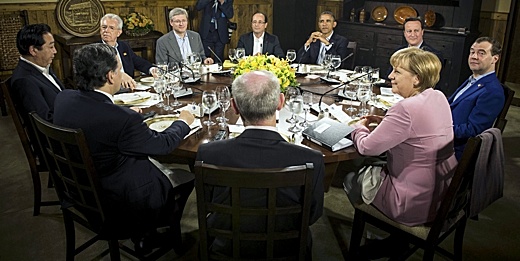
SUBHEAD: More stimulus means more growth and more debt. More debt means more austerity and less growth. By Dmitry Orlov on 22 May 2012 for Club Orlov - (http://cluborlov.blogspot.com/2012/05/in-name-of-austerity-stimulus-and.html) Image above: A sit-down for the world leaders of the G8. This a photo-op of a tieless meeting at a round table - symbols not substance. From (http://seeker401.wordpress.com/2012/05/20/g8-summit-the-parade-charade). Here's some food for thought. If you've been listening to the muffled and incoherent noises coming from the G8 and the surrounding political chattersphere, it's starting to sound like a prayer meeting: “In the name of Austerity, Stimulus and Growth, Amen!” And if you look at the individual leaders, what is there for them to do except pray?
Starting from the bottom, there is The Man Who Wasn't There: the newly reinaugurated Russian president Vladimir Putin. He didn't even show up, but sent his obedient deputy Medvedev instead, who made positive noises about how wonderful the meeting was. Putin is a lonely man: he's been seen in public with his wife a total of twice over the last two years; his two daughters are living incognito somewhere in Europe, there are mobs of people outside chanting “Russia Without Putin!” over and over again, and even the VIPs present at the inauguration seemed to be half-concealing a message behind their idolatrous smiles: “Wish you weren't here, Vova!”
The situation in the US isn't that much better: even his (once) ardent supporters see Obama as slightly worse than ineffectual, while many others are happy to vilify him for things he had nothing to do with. One thing is certain: the office changed him far more than he has managed to change the office. Even if he gets reelected, it will be four more years of ineffectual waffling, futile attempts to stay the course laid in by his manifestly incompetent predecessor, and frontal assaults on our remaining civil liberties. And if his opponent gets elected, it will much the same, except without the thin plastic veneer of pretending to give a damn.
Germany's Angela Merkel doesn't have much of a reason to be cheerful either. Her political support is eroding with each election. The task of pleasing the Germans while holding Eurozone together is an impossible one: the Germans are fed up with carrying the weaker European countries on their shoulders, but if they don't, then all fall down. The European dynamic is different because there the states that make up the EU negotiate with each other directly rather through the opaque proxy of Washington. If New York and California had a choice as to whether to give Louisiana, Missouri and Arkansas an endless series of financial piggyback rides, they would tell them to go ask Jesus for a loan, and then these three states would be worse off than Greece. But eventually something has to give, both here and in Europe.
Image above: Protesters of G8 Summit outside the White House in Wahington DC wear G8 leader masks. From (http://seeker401.wordpress.com/2012/05/20/g8-summit-the-parade-charade).
The new face, the freshly elected socialist François Hollande, hasn't had a chance to do much yet, but, uncharacteristically for an elected official, he seems to want to fulfill his campaign promises: he said that he will withdraw French troops from Afghanistan by the end of 2012, as promised. But his hand is weak: financially, France is not far ahead the Eurozone laggards; politically, Marine Le Pen's National Front is breathing down his neck.
And so, all they can do is pray: “In the Name of Austerity, Stimulus and Growth, Amen!” Growth is the holy grail, and austerity and stimulus will help us find it. But how?
Austerity is meant to bring deficit spending under control, curb the uncontrolled expansion of public debt, and avoid national default. But it has the unwelcome effect of triggering a severe recession, shrinking the tax base, and causing budget deficits to increase, not decrease.
Stimulus is meant to provide a way to kick-start economic growth, but the money for stimulus spending has to be borrowed, and this results in the expansion of public debt. And even an economist will tell you that a higher debt-to-GDP ratio results in lower growth.
This brings us to growth. The world is resource-constrained: the supply of most of the essential industrial commodities cannot be increased without triggering a price spike, which, in turn, will trigger another, even deeper, recession. Even with all the deep-water drilling (and spilling), fracking, tar sands and so on, there just isn't much growth potential for the US or the Eurozone, with their already high levels of per capita resource consumption.
Contrary to the ardent prayers of the world's leaders, the three-legged stool of austerity, stimulus and growth is a rickety piece of furniture: no matter which combination of legs they try put their weight on, they will end up sitting on the floor, and we will end up sitting on the floor with them. Now, sitting on the floor does not have to be uncomfortable. Perhaps, instead of praying, they should try some yoga: I am thinking of the lotus position. Repeating the same thing over and over again doesn't seem to be working; let's try meditating instead. Growth is over; now what?
.

Jaczko resigns from NRC

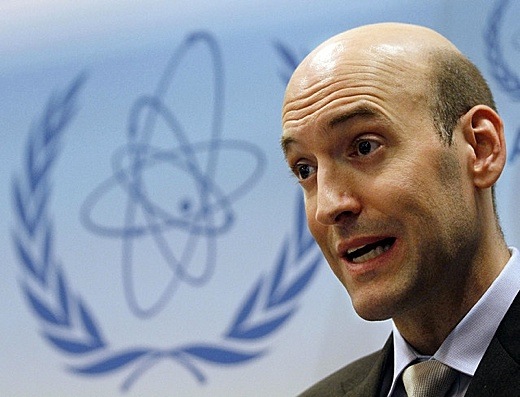
SUBHEAD: Chairman was to interested in safety for those leading the nuclear industry. By Brian Wingfield on 21 May 2012 for Bloomberg News - (http://www.bloomberg.com/news/2012-05-21/gregory-jaczko-resigns-as-chairman-of-nuclear-commission.html) Image above: Gregery Jaczko while chairman of Nyclear Regulatory Commission. From original article.

[IB Editor's note: The nuclear industry stooges on the commission were set on making Jazcko ineffective and ultimately gone (see links below). The succeeded. You can now expect a rush to building more nuclear reactors in America, despite Fukushima.]

U.S. Nuclear Regulatory Commission Chairman Gregory Jaczko said he is resigning, as lawmakers, colleagues and an independent watchdog criticize what they said is a bullying style and mistreatment of female employees.

“This is the appropriate time to continue my efforts to ensure public safety in a different forum,” Jaczko said today in a statement. “My responsibility and commitment to safety will continue to be my paramount priority after I leave the commission and until my successor is confirmed.” In an interview, he said disputes with NRC colleagues weren’t a reason for his decision.

Jaczko, 41, whose term expires in June 2013, has been faulted for his management by other commissioners and in a report by the agency inspector general last year. President Barack Obama intends to nominate a successor soon, Clark Stevens, a White House spokesman, said today in an e-mail.

The new chairman will have to take the lead on a range of nuclear-energy issues including a potential atomic-waste repository at Nevada’s Yucca Mountain, regulations to be adopted in response to Japan’s disaster last year and license extensions for an aging fleet of reactors. The five-member commission this year awarded Southern Co. (SO) and Scana Corp. (SCG) the first U.S. permits to build new reactors in more than 30 years, a decision that Jaczko opposed.

Commissioners’ Disagreements

The decision to resign more than a year before his term ends wasn’t influenced by recent disputes with other commissioners, who said in a letter they had “grave concerns” about his intimidation and bullying of staff.

“Some of those instances of the past six months or so really had nothing to do with my decision,” Jaczko said today in a phone interview. The chairman has denied allegations he verbally abused female employees, as claimed by one commissioner.

Jaczko said he wanted to make his “intentions clear” and give Obama and the Senate enough time to confirm his replacement, he said. NRC commissioners were notified by e-mail earlier today, he said in the interview.

The U.S. nuclear-power industry has differed with Jaczko on how best to achieve safety goals, said Marvin Fertel, chief executive officer of the Nuclear Energy Institute, a Washington- based industry group that includes members such as Progress Energy Inc. (PGN), PG&E Corp. (PCG) and Xcel Energy Inc. (XEL)

Open Lines

“To his credit, we’ve always had open lines of communications and a willingness to respectfully discuss the issues,” especially since the triple-meltdown at Japan’s Fukushima Dai-Ichi plant in March 2011, Fertel said in a statement. The industry wants the White House to name a replacement quickly, he said.

The chairman, who returned last week from a vacation, disclosed his decision to his staff at 10:22 a.m. Washington time, Eliot Brenner, an agency spokesman, said.

Jaczko wants to give Obama “maximum time” to find a successor, Brenner said in an interview at the agency’s headquarters in Rockville, Maryland. Jaczko notified the president in a letter to White House Chief of Staff Jacob Lew, according to Brenner.

Jaczko’s tense relationship with his colleagues was disclosed in an Oct. 13 letter from the four commissioners to the White House complaining that the NRC chairman bullied career staff and attempted to intimidate an independent panel of technical advisers. The letter to then-White House Chief of Staff William Daley was released Dec. 9 by Republicans on the House Oversight and Government Reform Committee. Jaczko denied the allegations.

Ugly Chapter

“The resignation of Chairman Jaczko will close an ugly chapter and allow the Nuclear Regulatory Commission to focus on its mission -- ensuring the safe operations of the nation’s nuclear plants,” Representative Darrell Issa, a California Republican and chairman of the oversight committee investigating the accusations, said in a statement.

Senator James Inhofe, an Oklahoma Republican, said Jaczko made the right decision to step down after “inappropriate behavior” that he said undermined the mission of the agency.

“Throughout his time at the NRC, it was abundantly clear that Chairman Jaczko used his office to undermine the NRC to the point that all four of his fellow commissioners wrote to the President to ask for assistance as a last resort,” Inhofe said in a statement.

Yucca Mountain

Jaczko on April 20 denied allegations that he mistreats female colleagues and said the agency’s inspector general is preparing another report. The watchdog on June 6 in a report said Jaczko improperly ended consideration of a proposed nuclear-waste disposal facility at Yucca Mountain. Jaczko denied any wrongdoing.

Senator Bernie Sanders, a Vermont independent, said Obama must nominate a new NRC chairman who will stand up to industry pressure as he said Jaczko did.

“Chairman Jaczko was subjected to repeated personal attacks made by some of his colleagues and pro-industry advocates in Congress,” Sanders said in a statement.

The Union of Concerned Scientists, an advocate for better oversight of nuclear-power plants, said the resignation robs the agency of a regulator committed to public health and safety.

“Jaczko often took a more cautious approach on plant safety and security than his colleagues,” Edwin Lyman, senior scientist at the Cambridge, Massachusetts, group, said in a statement. “He generally supported larger safety margins in the face of uncertainty.”

Verbal Assault

The NRC chairman, a former aide to Senate Majority Leader Harry Reid, a Nevada Democrat, aimed a “raging verbal assault” at three female agency staff members in separate encounters, NRC Commissioner William Magwood told the House Oversight and Government Reform Committee in December, a charge that the NRC chairman then denied.

“He dedicated his tenure to improving the safety of nuclear energy, and his leadership during the Fukushima nuclear crisis protected millions of Americans,” Reid said in an e- mailed statement.

Jaczko was nominated to the commission by President George W. Bush in 2005. In 2009, President Barack Obama named him chairman of the agency, which regulates safety at 104 commercial nuclear reactors.

Prior to his tenure on the commission, Jaczko worked for Reid in the Senate, for Representative Edward Markey, a Massachusetts Democrat and was an adjunct professor teaching science and policy at Georgetown University. He has a doctorate in physics.

“Greg has led a Sisyphean fight against some of the nuclear industry’s most entrenched opponents of strong, lasting safety regulations, often serving as the lone vote in support of much-needed safety upgrades recommended by the Commission’s safety staff,” Markey said in a statement.

See also: Ea O Ka Aina: Unacceptable radiation in Japan 3/26/12 Ea O Ka Aina: Feds approve first nuke since 1978 2/8/12 Ea O Ka Aina: NRC Chair Jaczko & the Commission 12/29/11 Ea O Ka Aina: Fire & Flood threaten nuke plants 6/28/11 Ea O Ka Aina: Ft. Calhoun Reactor Endangered 6/26/11 .

Endless Money for War

SOURCE: Jon Letman (@jonletman) SUBHEAD: Unlike the majority of House Democrats, Hirono and Hanabusa voted in favor of NDAA. By Jon Letman on 18 May 2012 for Civic Beat - (http://www.civilbeat.com/posts/2012/05/21/15894-the-grand-illusion-endless-money-for-weapons-and-war/) Image above: Hirono and Hanabusa making their victory speeches 11/2/2010. Photo by Brian Tseng. From (http://www.flickr.com/photos/civilbeat/5142918902/). Congresswomen Mazie Hirono and Colleen Hanabusa joined 222 of their Republican colleagues in voting for H.R.4310: National Defense Authorization Act (NDAA) for Fiscal Year 2013 which authorizes $643 billion for, among other things, the war and occupation of Afghanistan, tank upgrades, submarines, long-range bombers, Air Force drones, and an East Coast missile defense system to be built by 2015 to "counter threats from Iran and North Korea."

Unlike the majority of House Democrats, both Rep. Hirono and Rep. Hanabusa voted in favor of this despite the fact that NDAA surpasses spending limits imposed by the 2011 Budget Control Act by $8 billion and is $3.7 billion over what President Obama requested. Is this Congress’s idea of fiscal responsibility?

For the rest of this article go to Civil Beat here. .

Smart Grid Greed

SOURCE: Ken Taylor (taylork021@hawaii.rr.com) SUBHEAD: The shocking way electric utilities are making us pay for the Smart Grid.  

By Richard Smith on 20 May 2012 for Daily Finance - 
(http://www.dailyfinance.com/2012/05/15/electric-utilities-smart-grid-greed)

 
Image above: The world hive under the smart grid.. From (http://newsfox.pressetext.com/show_attach.mc?pte=081231002). 
 
Are you ready for the smart electricity revolution? On July 20, 2006, California's Public Utilities Commission approved a proposal by Pacific Gas & Electric (PCG) to begin phasing out conventional electricity meters (those big gray boxes on the side of your house, with the dials that spin around) and replace them with "smart" meters.

 Relaying data on electricity usage wirelessly and in real time, the devices should in theory help utilities such as PG&E charge consumers more when they use electricity at times of greatest demand. This would, for example, encourage users to dial back the A/C on hot summer days.

Conversely, consumers would get a break on their bills for smart electricity usage. You could pay lower rates for doing your dishes and drying your laundry overnight, and for charging your plug-in electric car at nonpeak hours as well. It's all part of a $29 billion, nationwide plan to make electricity usage smarter, by helping to build the "smart grid."

And it's failing because of greed. Specifically, the greed of electric utility companies such as PG&E. It's axiomatic that corporations don't do anything unless they see a profit in it -- or at least a savings.  

Heads, Utility Companies Win
 PG&E and utilities such as Central Maine Power and Central Vermont Public Service (CV) tout smart meters as a way to save their customers money. But what these companies are really interested in is saving themselves money.

As "public utilities," these companies are charged with making sure electricity users can flip a switch and turn on a light bulb any hour the day, or night. Of course, night's not so much of a problem. The real issue for these companies is daytime, and specifically, hot summer daytimes, when everyone's cranking up the air conditioners.

The utilities have to build coal, gas, and nuclear power plants or purchase energy on the market, in numbers sufficient to ensure there's enough power for everyone during such peak periods. At night, these plants often are underutilized as power demands dwindle.

Every hour a power plant sits idle is money wasted in their view. Hence, there's a real incentive for the utilities to finds ways to use their plants more efficiently, and save money by building fewer of them. Smart meters, and the incentives they offer consumers to spread out electricity usage across the 24 hours, offer utilities a great way to do this.

Because the devices are wireless, they also save utilities labor costs, by eliminating the need to send out neighborhood meter-readers to jot down the readings and prepare the bills. Given all this, you'd think utilities would do all they could to sweeten the deal for consumers, and encourage adoption of smart meters, right? Actually, no.  

Tails, Customers Lose As it turns out, what the utilities are doing instead is trying to have their cake and eat it, too. As reported by Bloomberg, utilities in several states are asking regulators for permission to pass along the cost of buying the new equipment to consumers. They also want to charge for its installation. Adding insult to injury, even consumers who balk at this tactic may not be able to avoid higher fees.
In Vermont and elsewhere, utilities plan to tack on a monthly fee to the bills of electric customers who opt out of the smart meter technology -- to cover the cost of manually reading their old meters. (A cost that, one presumes, is already covered quite well in the rates utilities charge for electricity.)

In California, some utilities want to charge $75 upfront, plus an additional $10 a month, to keep an old-style meter. Meanwhile, consumers who have agreed to install the devices already complain that the promised savings aren't materializing. Try as they might to switch electricity consumption to odd hours of the day, their bills are actually going up.

Some consumers argue the meters are in fact overcharging them for the electricity they use. All this makes one wonder: Are utilities really as smart as their meters? By rationalizing energy usage, and lowering the cost of building power plants, these devices have the potential to save money for utilities and consumers alike. It's in the utilities' interests to share the wealth -- not hog all the savings for themselves.
.

Life & Death of Gaia

SUBHEAD: So, we must learn to live with the flow of the Earth's cycles. For that, we must know a little chemistry.  

By Ugo Bardi on 21 May 2012 for Casandra's Legacy - 
  (http://cassandralegacy.blogspot.it/2012/05/great-chemical-reaction-life-and-death.html)

 
Image above: Photo of a valley on Earth where Gaia is robust. From original article.

Good evening everyone and it is very nice to be here today. You know, every time I give a talk I try to say something different - otherwise it would be boring for me and, perhaps, for you, too. So, this time I thought I could do something closer to what's my job. After all, I teach chemistry. So, shouldn't I teach you a little bit of chemistry? Then, I thought that I could start by presenting to you a chemical reaction. Here it is:
Well, after you give speeches for a while, you become somewhat telepathic. So, I know what you are thinking. Yes: I can read your minds and I know that this slide is making you happy; isn't it? By the way, the exit door is down there. Maybe you can scream something like "I forgot to turn off the gas stove!" as you run away. Well, nobody is running away and that's nice. I said that I know what you are thinking and it is true - without exaggerating, of course! You are thinking that chemical reactions are boring. And I agree with you: chemical reactions are very boring. I can tell you that: I studied chemistry, I teach chemistry, I've been working in chemistry for all my life. I should know!

So, why do chemists like the things that they hate - so to say? Are they masochist or what? Well, no. Maybe I am asking you to believe something a little too extreme, but let me tell you something: chemistry is not boring! Chemistry is fascinating, it is interesting, it is even fun. And chemical reactions are not what chemistry is about. Chemical reactions are just a shorthand that hides the really interesting things. If you look at the symbols, well, it is boring. If you look at what the symbols describe, if you look inside, well it is not the same. It may be an interesting story, as I was saying it may be fun, it may be fascinating.

You know, when I was a freshman in chemistry, I had to attend chemistry labs. There were many nice girls in my class and they were all wearing lab coats in the lab - not exactly sexy as garments. But that was just the outside: what was fascinating was the inside! So, I hope today that I could show you that the specific reaction that I am showing to you today is hiding something hugely interesting. It is called "silicate weathering" and is the basis of life on Earth.

The way I have written it, it is very simplified - it is much more complex than that. But we can take it in this form in order to understand it. If that reaction were not running all the time on our planet, I wouldn't be here, you wouldn't be here and not even those nice looking girls that I met during my time as a student would ever have existed. Nothing alive on this planet would exist. The entity we call "Gaia" would not exist. Let me explain. What do we mean exactly with "Gaia"? I think the best I can do is to show you an image.
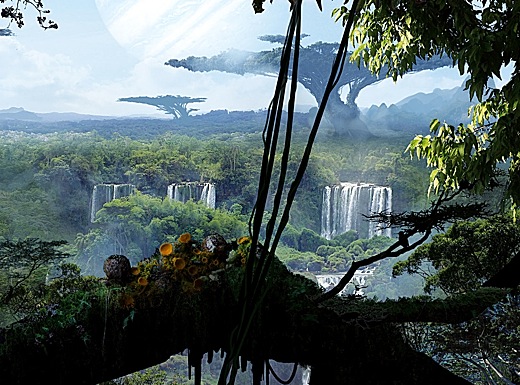

 
Image above: Detail of rendering of the planet Pandora. From (http://cassandralegacy.blogspot.it/2012/05/great-chemical-reaction-life-and-death.html).

I am sure you recognize what this is; it is "Pandora" from the film "Avatar." Now, we can say that Pandora is a sort of an Earth on steroids. It is lush, it is full of life, full of creatures: dragons, monsters, waterfalls, trees, mountains, clouds; all that. Of course, Pandora is a fantasy world; but we are discovering plenty of new words in the Galaxy; many are about the same size of the Earth and at the right distance from their suns; so they could well host organic life similar to ours - like Pandora does in the Avatar movie.

We can't say for sure if such words exist, but one thing we can say is that - if they exist - the reaction I was showing to you before must be running on there. A world without that silicate weathering reaction running is like Mars or Venus. No silicate weathering reaction, no life. Let me explain: in order for life to exist, there have to be some materials that make it exist. There has to be oxygen to breathe, for instance. But, even more important than oxygen is a special molecule that we call carbon dioxide and that we write as CO2, pronounced see-oh-two.

 You know that carbon dioxide is what plants use to carry on photosynthesis, which is what keeps alive everything on this planet. If Pandora is so lush and beautiful, it has to have CO2 in the atmosphere, just as our Earth does. Plants make CO2 react with hydrogen extracted from water and out of this reaction they create all organic matter which is then be used to make living beings. In a sense, CO2 is Gaia's food, it is also Gaia's blood, Gaia's lymph and more. But, then, if CO2 is Gaia's food, there is a problem. CO2 is a reactive molecule and here is where the reaction I wrote kicks in:
You see that this reaction contains carbon dioxide; CO2, on the left side. And you see that this CO2 react with something written as "CaSiO3" which I can read as "calcium silicate". Now, the reaction (keep in mind that it is very simplified) says that carbon dioxide reacts with the silicates of the crust to create carbonates (CaCO3) and silica (SiO2). So, a gas, carbon dioxide, reacts with rocks to create more rocks. And, if it has to create these rocks, the carbon which once formed CO2 becomes carbonate, which is solid. Let me show you:

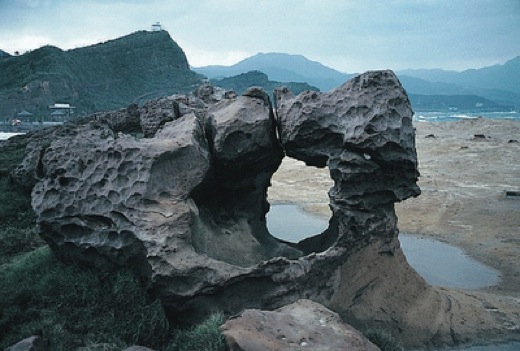
Image above: Photo of weathered rock in a place where Gaia is not robust. From original article.

This is a weathered rock somewhere. See? CO2 reacts with the rock and corrodes it. In doing so, CO2 disappears. Clearly, it is a very slow process. You don't see rocks being washed away by rain, unless you are willing to wait for a very, very long time. How long? Well, we are talking of geological times; millions of years, but that's not what we are worried about. The question is; if CO2 is consumed by the reaction, how long would it take for the atmosphere to lose all of it? (and note that plants would start dying much before CO2 were to disappear completely).

 On this point, there is an answer that you can find in Robert Berner's 2001 book which has a rather impressive title "The carbon cycle of the phanerozoic". Berner says that all the CO2 in the Earth's atmosphere would be consumed by the weathering reaction in about ten thousand years. In part, it would be replaced by CO2 degassing from the oceans, but even that source would be exhausted in about 300,000 years. These numbers are, of course, just orders of magnitude but for what we are concerned here, the uncertainty doesn't matter much.

Life on Earth has been going on for more than three billion years and there must have been CO2 in the atmosphere all this time. No CO2, no life. There is no escape to that. So, you see that we arrived to a paradox. The weathering reaction should have consumed all the CO2 in the atmosphere long ago but there is still plenty of it; enough, at least, to keep photosynthesis going and with it all life on Earth. But paradoxes are almost always pathways to understanding deeper truths and this one is no exception. Let's go back (once more!) to the weathering reaction:
You probably remember from what you studied in high school that chemical reactions never go fully in one direction. They can go both ways and often they are in an equilibrium condition in which reactants and products remain in constant concentrations. And you may remember that there are conditions that can shift the equilibrium from one direction to another. About the weathering reaction, we said that it goes from left to right, as you can see from the picture of the weathered rock seen before. But, if we could make the reaction go from right to left, then the carbonates decompose and become a source of CO2. If that were possible, we'd have a way to bring CO2 back in the atmosphere.
How could that happen? Well, another thing that you surely learned in high school is that the equilibrium of a chemical reaction depends on temperature. There are good reasons based on thermodynamics that say that a solid compound decomposes at high temperatures. That's what happens to carbonates, provided that you can reach temperatures of the order of several hundred degrees Celsius - possibly over a thousand. Now, where can you find these temperatures on Earth?
Very easy: look at your feet.

Think of making a hole of a few tens of kilometers and there you are. You find an area of the Earth called the "mantle" which is semi-molten rock composed mainly of silicates, but also carbonates. Here is the structure of the inside of our planet as we know it today.
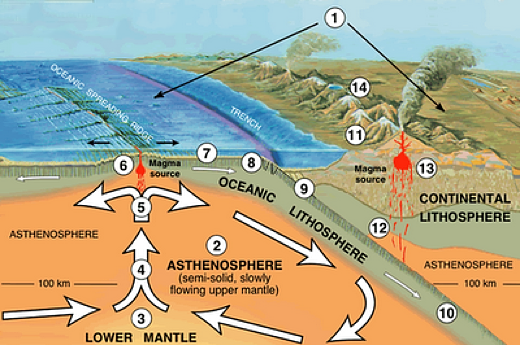
You have to go deep down, but eventually you reach temperatures which decompose the carbonates. Now, if carbonates were to reach those depth, they would be decomposed into CO2 that would then degassed out by volcanoes, geysers, hot springs, all that. That's exactly what happens in the great CO2 cycle that goes under the name of "plate tectonics". Here is it:

Image above: Illustration explaining plate tectonics. From original article.

 Let me explain a little this image. It shows how the ocean floor moves and is gradually pushed inside the depths of the Earth in a process called "subduction". Everything that stands on the ocean floor is destined, eventually, to disappear into the mantle. But this is also a cycle, you can see in the figure how material from the mantle is pushed up to the surface to form new ocean floor at those regions which are called "mid-ocean ridges". A very slow process, it takes tens of millions of years for a piece of rock that surfaces at the mid ocean ridge to go back to the mantle. But it does occur. Now, this is also the CO2 cycle.

You see, we said that the reaction of carbon dioxides with silicates produces carbonates. These carbonates end up on the ocean floor, often in the form of the shells of dead marine organisms. And the final result is that this carbonate is pushed into the mantle - where it is hot enough to decompose it into oxide and CO2. Then, the CO2 returns to the atmosphere in the form of volcanic eruptions. The beautiful thing of all this is that the cycle is that it is the "control knob" of the Earth's surface temperature. Really, the CO2 cycle is a thermostat that keeps the Earth not too warm and not too cold; just right. It has been doing that for billions of years.

As a thermostat, it must be said that it has not always functioned so well: we have had ice ages and those hot periods called sometimes "planetary hothouses". But, on the whole, the Earth's temperature has always remained within the limits that make life possible. Otherwise, we won't be here. So, how does the thermostat work? First of all, you know that CO2 is a "greenhouse gas". It traps the heat emitted by the Earth's surface acting a little like a blanket that keeps the planet warm. So, the more CO2 there is, the more we expect the Earth to be warm. As a consequence, the temperature can be regulated by controlling the concentration of CO2 in the atmosphere. But how can that be done? Well, there is the trick: the speed of chemical reactions depends on temperature. It is true also for the silicate weathering reaction:
High temperatures make the reaction go faster. So, if the Earth's becomes warmer, then there is more CO2 consumed and that reduces the temperature because the concentration of CO2 goes down - and remember that it is a greenhouse gas! The opposite takes place if the Earth becomes cooler - the reaction slows down, the CO2 concentration increases because of all those volcanoes and, in the end, the temperature returns to the previous values. See?

Simple and effective. Of course, as I said, the control is far from perfect. It involves times of the order of millions of years, so it takes a huge time lapse for the planet to recover from a perturbation. For instance, a huge volcanic eruption took place some 250 million years ago in Siberia. It emitted so much CO2 that the resulting increase in temperatures almost killed all life on Earth. The silicate weathering reaction, eventually, absorbed all that CO2 and brought temperatures back to more acceptable values for the biosphere. But it took millions of years. So, if we look at the temperature record, we see that it oscillates and that shouldn't surprise us too much. Here are the data we have for the past 550 million years or so, the period we call "Phanerozoic":


As I said, the regulation is not perfect, but the fact that temperatures oscillate around a constant value tells us that there is a regulation ongoing. You see, the point is that the planet badly needs that regulation, because the sun's irradiation is far from being constant. It increases of about 10% every billion years because of reasons that have to do with the evolution of stars. So, in a period of half a billion years, as the Phanerozoic, we'd expect the planetary temperature to go up as the result of the sun becoming more and more bright. Instead, we don't see it.

What we see, instead, is a gradual reduction of the concentration of CO2. Yes, it is irregular, but there is no doubt that the concentration of CO2 has gone down, on the average, during the past half billion years. And if we make a little calculation that takes into account the increase in solar luminosity (you can find it in Berner's book) we can see that the numbers do click together. The variation of CO2 concentration is what has kept the Earth not too warm and not too cold, just right, during the geological past.

Now, I guess you are asking yourselves what's going to happen in the future. As you surely noted, the CO2 concentration has been going down and continues to do so (apart from human intervention in terms of burning fossil fuels, but that's not part of the regulation system). Eventually, we'll arrive to a point where the system can't reduce the concentration any more. Yes, and before we arrive to that point, there won't be enough CO2 for plant photosynthesis. And without photosynthesis, there can't be any life on Earth - everything must die. That's indeed the ultimate destiny of the Earth's biosphere. Of Gaia, if you like.

If Gaia is a living being then, as all living beings, it must die. It will be a slow process - very slow by human standards. But it is going to happen. In the simulation below, by Franck and others, you can see the slow winding down of the biosphere which should become extinct a billion and a half years from now. You see also that vertebrates should disappear much earlier, perhaps in less than a billion years And here is the ultimate destiny of the Earth.

To be sterilized by the sun as it becomes more and more bright. The oceans will evaporate and - eventually - the surface will melt under the tremendous heat. That is, clearly, a far away future. Maybe, by then, our descendants, if there will be any, will have found another place to live, around another star or somewhere in the galaxy.

But our main concerns are not about such a remote future. Our main concern is that even the near future may give to our close descendants, a lot of problems with the Earth's temperature. The problem is that we have been tinkering with the thermostat without understanding exactly what we were doing. And we have been emitting into the atmosphere a large amount of gases which had been removed from the atmosphere as part of the regulating mechanism. Gases which had been stored underground in the form of what we call "fossil fuels": coal, oil, and natural gas. The perturbation made to the system is very large and extremely rapid if compared with anything that has occurred in the past history of Earth.


You probably have seen this picture and it is very, very worrisome. The fact is that such high CO2 concentrations have never occurred on Earth during the past few millions of years. When we had such concentrations, tens or hundreds of millions of years ago, the sun was less hot than it is now and, nevertheless, the Earth was a much warmer place than it is today.

We might be able to adapt to a much warmer planet, but the process wouldn't be painless. Just think that the melting of the continental icecaps would submerge all of our coastal cities. We can't hope that the silicate thermostat will save us from CO2 caused warming. This reaction
is damn slow by our standards. It will, eventually, remove from the atmosphere the CO2 we have emitted, but it will take tens of thousands of years, at the very least. Look at these simulations by Dave Archer and you see what the problem is:


See? part of the CO2 we have emitted in the atmosphere will still be there in 40,000 years from now. Actually, it will stay there much longer. So, you see how important it is the reaction that I showed to you. The silicate weathering reaction is what keeps "Gaia" alive - better said, it is Gaia.

And don't make the mistake of thinking that Gaia is a goddess and that, somehow, she cares about us. No, it is more correct to say that Gaia doesn't give a damn about us - which is what you'd expect from a chemical reaction, after all. It is us who have been tampering with this chemical reaction and it will be us who will have to face the consequences. In the end, we can't hope to force the planet to do what we want it to do.

So, we must learn to live with the flow of the Earth's cycles. For that, we must know a little chemistry.

 My idea today was to show to you a bit of this chemistry. But more than chemistry, we must learn our limits, otherwise we won't survive for long. This is our Earth, not a fantasy planet, let's try to keep it the way we found it.

 .

Dancing Shoes

SUBHEAD: When the central banks finish destroying he meaning of money altogether you'll be paying $25,000 for a Little Debbie snack cake.  

By James Kunstler on 20 May 2012 forKunstler.com - 
  (http://kunstler.com/blog/2012/05/dancing-shoes.html)


Image above: Opening dance scene in a bank from "Pennies From Heaven" set during 1930's Depression. From (http://www.nicksflickpicks.com/2005/11/picked-flick-73-pennies-from-heaven.html).


So many shoes are dropping out there that reality is starting to look and sound like the tap-line in a Busby Berkeley production number. The meme-scape, too, is humming with viral transmissions of dire doings. Is JP Morgan unwinding like a 1911 knitted woolen Yale varsity sweater? Did it booby-trap the credit default swap universe in the process, and is that getting ready to blow? The whole world is hanging by its fingernails, refusing to be dragged into the future.

That future is all about contraction. We could navigate our way into it but we don't want to. We want to stay right where we are with all our stuff and no need to make new arrangements and we are trying every last trick to do that. Can you not sense a terrible tidal surge of implacable forces under the headlines' placid surface? I do offer Mark Zuckerberg best wishes on his nuptials, but I think he set himself up for one of fate's great pranks as FB stock goes to 99 cents while he's still on his honeymoon (playing Frogger in a super deluxe hotel suite).

Does anybody really believe that the European money problem has any other ending except massive repudiation of obligations and epic political realignment? Or that the USA isn't caught in the undertow. The only real question now is how the civilized world might remain civilized while it rebuilds its money system. Money, after all, is a representative of reality and the representations by nations and person and institutions have been so false for so long that, for practical purposes, there is no consensual reality anymore.

By the way, it was a nice gag at the time, but Karl Rove was wrong. We are not creating our own reality.

Reality's theme going forward is changing from liquidity to liquidation. The European LTRO (quantitative easing) was a nice fairy tail, and the mild buzz lasted a few months, but its flimsy spell is broken. An awful lot of parties may be liquidating gold and silver, too, this week but under the circumstances I've got to think there will be plenty of counterparties looking to buy, since uncertainty is crushing all other media of exchange.

The process begins to look like a mass metamorphic conversion of winners to losers and vice-versa. In a giant unwinding of paper assets the result may be that precious metals go sideways while all other assets tank - and then once everything's in the tank, PMs tank, too, because nobody is left standing with that kind of cash.

Of course, in the event just a little bitty bit of gold will still buy a lot of stuff. The other possibility is that the rumored global coordinated central bank QE (quantitative easing) doomsday machine goes off destroying the meaning of cash money altogether. Surely that sort or stunt will not cast the same spell as the LTRO, a more measured act of desperation, but will call into question the very meaning of dollars, euros, yen, and pounds sterling. That's when you'll be paying $25,000 for a Little Debbie snack cake.

Let me be first of the non-right-wing in the blogster corps to venture the somewhat un-PC idea that Barack Obama turned out to be the first black schmuck elected President of the US. He didn't do the one thing that would have mattered most: put an end to government sponsored control fraud. Control fraud at that level is so pernicious because it destroys the legitimacy of institutions. It can only make a nation cynical, by which I don't mean given to malicious humor, which is different, but just always thinking the worst of your fellow man and the very idea that the human race ever produced anything fine and durable.

And on top of that malfeasance, to try to suspend due process of law in Section 1021 of the NDAA bill (military budget) - smacked down by federal judge Katherine Forrest last week - was an amazing transgression that the mainstream press greeted four months ago with barely a shrug. Can't we just start a movement to go down to Charlotte, NC, this summer and levitate the convention center into outer space? It nearly worked with the Pentagon forty odd years ago.

What do you suppose Obama and the other feckless schmucks of the G-8 were telling each other this weekend at Camp David between weenie roasts and ping-pong round robins? It must have been the emptiest dumb show of mere protocol; an exchange of tie-tacks in the national colors, the playing of many anthems and flying of flags, issuance of bland assurances and platitudes. Nobody believes any of them anymore, even poor Mr. Hollandaise, who has been on the job a few days. Angela Merkel must be good and goddam sick of even showing up at the office.

Well, perhaps its best that the world will go where it has to go without leadership. After all, human history is emergent and improvisation suits us. Forceful leaders often only leave a big mess behind. But imagine a world where nobody gets paid. That might be our world by the end of the week.
.