SUBHEAD: A smoke & mirrors summit in Paris will not save us from anthropogenic climate disruption.
By Robert James Parsons on 10 January 2015 for Truthout -
(http://www.truth-out.org/opinion/item/28443-smoke-and-mirrors-will-not-save-us-from-acd)
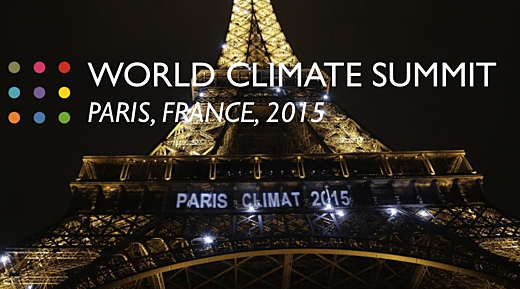
Image above: Eiffel Tower lit with sign for World Climate Summit 2015, December 9-10, Paris, FranceFrom ().
With 2015 billed as the make-it-or-break-it year for climate control, in anticipation of next December's Paris conference, and in the midst of much vehement - if not downright virulent - controversy, it is worth proposing some perspective beyond what most of the media deign to serve up to us.
In an article that appeared in mid-November in the French online journal A l'encontre, Daniel Tanuro analyzed the "unprecedented" and "historic" agreement between the United States and China resulting from Barack Obama's encounter with Xi Jinping just before the November G20 conference in Brisbane.
The insufficiency - to put it mildly - of this agreement, in comparison with the warnings issued by the Intergovernmental Panel on Climate Change (IPCC) in its most recent report, is unbridgeable, he points out.
Citing the reduction of 26% promised by Obama for 2025, which ought to lower United States emissions to 5.368 gigatonnes (Gt), he notes: "According to the Kyoto Protocol (which the United States signed but never ratified), Uncle Sam should have reduced his emissions by 8% by 2012, relative to 1990.
That means that the emissions should have dropped from 6.233 Gt (1990 figure) to 5.734 Gt – instead of which, they increased 0.2% per year, on average, to reach 6.526 Gt. In other words, Obama has committed the United States to reaching by 2025 a target that is almost no better than than the one that the United States was supposed to have reached two years ago."
For China, it is similar: "Xi Jinping stipulated that China would begin to reduce its absolute emissions at the latest in 2030 and that 'zero-carbon' sources would then cover 20% of its energy needs.
To take the full measure of this promise, one must bear in mind that these 'zero-carbon' energy sources, already in 2013, represented in China 9% of the primary consumption of energy and that the twelfth five-year plan has set a target of 15% for 2020.
Given the current amounts being invested, an increase of a further 5% in over ten years is anything but a 'performance': US$ 65 billion have already been invested in 'non-fossil' energy."
According to the Kyoto Protocol, the ratifying countries committed themselves to reducing their green house gas emissions between 8% and 20% relative to 1990. As these emissions have continued to increase, the reductions since then have been completely canceled out.
In 2007, the World Meteorological Organization (WMO) and the International Council for Science undertook the third International Polar Year (IPY) study, with the intention of exploring the role played by the polar regions in the world's climate configurations. It was to be one of the biggest scientific studies ever undertaken, if not the biggest outright.
More than 1,500 scientists took part during two years, thus completely covering the north and south polar cycles.
In March 2009, to present the IPY's preliminary conclusions, the WMO organized a conference at its headquarters in Geneva involving some 60 of the IPY scientists, several of whom participated through video teleconference from the four corners of the earth.
The Geneva media representatives - multitudinous, to say the least - had been invited (through several announcements), and a major section of the auditorium was reserved for them.
In the end, this journalist - with an intern in tow - was the only one to turn up.
In view of the Copenhagen conference (considered "crucial") scheduled for the following December, a succession of prep conferences had been held (with more planned) without ever coming anywhere near a tentative text to be presented in Copenhagen to replace the Kyoto Protocol.
The target consistently sought in the new document, repeatedly proposed and scuttled, was a 40 percent greenhouse gas reduction by 2020 - a target that the scientists at the Geneva gathering insisted was the only one capable of averting a cataclysmic warming of the planet.
However . . .
That evening, during the reception (with the superb Geneva wines ubiquitously and abundantly in attendance) following the closing of the conference, as is often the case in such situations, people relaxed, chatted amiably and even openly - some would say indiscreetly. The same scientists who that afternoon had sworn that a 40 percent reduction was the only way to save the world, acknowledged that the figure was bogus.
It is worth noting that there is a golden rule within governmental organizations, and it is that no official document may ever contain anything that displeases a member state.
Thus, the conclusions made public there, just like those of the IPCC reports and any other report on a controversial subject, represented the least common denominator. In other words, it was the least that could be stated without losing credibility.
An example of how this works, regarding the first installment of the four-part series of the most recent fifth assessment report, was discussed by Justin Gillis, in his New York Times article "Climate Alarm, Too Muted for Some." He mentioned two areas where the IPCC went "a little bit conservative on a couple of issues related to both sea level and temperature."
The estimates ranged from three to five feet for the rise in the oceans by 2100. The IPCC chose to use the lower estimate, he pointed out, even though the higher, although not endorsed by the majority of scientists, would be the more realistic one in view of the way that all estimates so far have been far below the reality (in keeping with the whole process of minimizing the message).
He continued. The majority of scientists say that the continued burning of fossil fuels, with a doubling of the amount of carbon in the atmosphere from the estimated preindustrial level (280 p.p.m.) will result in a temperature rise of 3.6° F. to 5°F., with the higher temperature likely. The minority are saying that the temperature rise could be well below 3°F. Here the IPCC chose to use the minority figure.
Thus, the warnings issued by the IPCC in the November fourth installment that has garnered so much attention must be seen as merely the minimal - least disturbing - assessment. The answers given this journalist that evening at the WMO - all most emphatically NOT for attribution - painted a far different, and, according to the scientists, a far more realistic picture of what is happening.
Asked what, then, a realistic prescription for survival would be, they were categorical: greenhouse gases must be reduced by 80 percent - by 2015.
That was almost six years ago. Everything seems to be on schedule for the worst, including the denial from most of those on the top on down to most of the grassroots. While climatologists making candid public assessments have been decried as "doom-and-gloom" people, they more and more appear to be the lucid voices of reality in a fantasy world.
Among them, Guy McPherson could be said to have one of the most reasonable approaches:
.
By Robert James Parsons on 10 January 2015 for Truthout -
(http://www.truth-out.org/opinion/item/28443-smoke-and-mirrors-will-not-save-us-from-acd)
Image above: Eiffel Tower lit with sign for World Climate Summit 2015, December 9-10, Paris, FranceFrom ().
With 2015 billed as the make-it-or-break-it year for climate control, in anticipation of next December's Paris conference, and in the midst of much vehement - if not downright virulent - controversy, it is worth proposing some perspective beyond what most of the media deign to serve up to us.
In an article that appeared in mid-November in the French online journal A l'encontre, Daniel Tanuro analyzed the "unprecedented" and "historic" agreement between the United States and China resulting from Barack Obama's encounter with Xi Jinping just before the November G20 conference in Brisbane.
The insufficiency - to put it mildly - of this agreement, in comparison with the warnings issued by the Intergovernmental Panel on Climate Change (IPCC) in its most recent report, is unbridgeable, he points out.
Citing the reduction of 26% promised by Obama for 2025, which ought to lower United States emissions to 5.368 gigatonnes (Gt), he notes: "According to the Kyoto Protocol (which the United States signed but never ratified), Uncle Sam should have reduced his emissions by 8% by 2012, relative to 1990.
That means that the emissions should have dropped from 6.233 Gt (1990 figure) to 5.734 Gt – instead of which, they increased 0.2% per year, on average, to reach 6.526 Gt. In other words, Obama has committed the United States to reaching by 2025 a target that is almost no better than than the one that the United States was supposed to have reached two years ago."
For China, it is similar: "Xi Jinping stipulated that China would begin to reduce its absolute emissions at the latest in 2030 and that 'zero-carbon' sources would then cover 20% of its energy needs.
To take the full measure of this promise, one must bear in mind that these 'zero-carbon' energy sources, already in 2013, represented in China 9% of the primary consumption of energy and that the twelfth five-year plan has set a target of 15% for 2020.
Given the current amounts being invested, an increase of a further 5% in over ten years is anything but a 'performance': US$ 65 billion have already been invested in 'non-fossil' energy."
According to the Kyoto Protocol, the ratifying countries committed themselves to reducing their green house gas emissions between 8% and 20% relative to 1990. As these emissions have continued to increase, the reductions since then have been completely canceled out.
In 2007, the World Meteorological Organization (WMO) and the International Council for Science undertook the third International Polar Year (IPY) study, with the intention of exploring the role played by the polar regions in the world's climate configurations. It was to be one of the biggest scientific studies ever undertaken, if not the biggest outright.
More than 1,500 scientists took part during two years, thus completely covering the north and south polar cycles.
In March 2009, to present the IPY's preliminary conclusions, the WMO organized a conference at its headquarters in Geneva involving some 60 of the IPY scientists, several of whom participated through video teleconference from the four corners of the earth.
The Geneva media representatives - multitudinous, to say the least - had been invited (through several announcements), and a major section of the auditorium was reserved for them.
In the end, this journalist - with an intern in tow - was the only one to turn up.
In view of the Copenhagen conference (considered "crucial") scheduled for the following December, a succession of prep conferences had been held (with more planned) without ever coming anywhere near a tentative text to be presented in Copenhagen to replace the Kyoto Protocol.
The target consistently sought in the new document, repeatedly proposed and scuttled, was a 40 percent greenhouse gas reduction by 2020 - a target that the scientists at the Geneva gathering insisted was the only one capable of averting a cataclysmic warming of the planet.
However . . .
That evening, during the reception (with the superb Geneva wines ubiquitously and abundantly in attendance) following the closing of the conference, as is often the case in such situations, people relaxed, chatted amiably and even openly - some would say indiscreetly. The same scientists who that afternoon had sworn that a 40 percent reduction was the only way to save the world, acknowledged that the figure was bogus.
It is worth noting that there is a golden rule within governmental organizations, and it is that no official document may ever contain anything that displeases a member state.
Thus, the conclusions made public there, just like those of the IPCC reports and any other report on a controversial subject, represented the least common denominator. In other words, it was the least that could be stated without losing credibility.
An example of how this works, regarding the first installment of the four-part series of the most recent fifth assessment report, was discussed by Justin Gillis, in his New York Times article "Climate Alarm, Too Muted for Some." He mentioned two areas where the IPCC went "a little bit conservative on a couple of issues related to both sea level and temperature."
The estimates ranged from three to five feet for the rise in the oceans by 2100. The IPCC chose to use the lower estimate, he pointed out, even though the higher, although not endorsed by the majority of scientists, would be the more realistic one in view of the way that all estimates so far have been far below the reality (in keeping with the whole process of minimizing the message).
He continued. The majority of scientists say that the continued burning of fossil fuels, with a doubling of the amount of carbon in the atmosphere from the estimated preindustrial level (280 p.p.m.) will result in a temperature rise of 3.6° F. to 5°F., with the higher temperature likely. The minority are saying that the temperature rise could be well below 3°F. Here the IPCC chose to use the minority figure.
Thus, the warnings issued by the IPCC in the November fourth installment that has garnered so much attention must be seen as merely the minimal - least disturbing - assessment. The answers given this journalist that evening at the WMO - all most emphatically NOT for attribution - painted a far different, and, according to the scientists, a far more realistic picture of what is happening.
Asked what, then, a realistic prescription for survival would be, they were categorical: greenhouse gases must be reduced by 80 percent - by 2015.
That was almost six years ago. Everything seems to be on schedule for the worst, including the denial from most of those on the top on down to most of the grassroots. While climatologists making candid public assessments have been decried as "doom-and-gloom" people, they more and more appear to be the lucid voices of reality in a fantasy world.
Among them, Guy McPherson could be said to have one of the most reasonable approaches:
Make the most, imperatively, of what we have and can do now, with an emphasis on excellence in every endeavor, all while accepting that everything is telling us that we are on our way to extinction (soon rather than later), and prepare to take leave of the good earth without losing our humanity - graciously, with dignity.
.