Showing posts with label Trees. Show all posts

The Forest Economy

SUBHEAD: The natural environment as a metaphor for how we organize our own human economies.

By Rob Hopkins on 20 June 2016 for Transition Network -
(https://www.transitionnetwork.org/blogs/rob-hopkins/2016-06/forest-economy-woodland-new-economy-metaphor)


Image above: Trees with leaves and moss moderate the movement of water over the landscape. From original article. See more photos in original article.

I spent Sunday afternoon having a beautiful walk in the woods with my son at Venton Brook, near Holne on Dartmoor, one of the most beautiful places on earth. 

As we walked down through this ancient woodland, with its stream, its waterfalls, its trees, moss and lichen, the sun breaking through the canopy, I found myself thinking of this woodland not as an ecosystem, but as a metaphor for the kind of economy we are seeking to create in Transition.

As Bill Mollison wrote in 'Permaculture: a Designers' Manual', "trees are, for the earth, the ultimate translators and moderators of incoming energy".  You can think of a forest as the most incredibly sophisticated water management system.  Indeed, as you walk through a forest, all but 5-10% of what you're looking at is water.

When it rains over a wood like Venton Brook, the canopy intercepts it first.  The leaves break the heavier droplets into a finer mist.  Some of the water is held by the surface of the leaves, which are themselves small reservoirs of water, sometimes referred to as a "lake in the sky".

This interrupting of the power of the rain reduces the damage that heavy rain would otherwise do to bare soil.

The water that continues groundwards is no longer just water.  It has picked up all manner of dust and other nutrients which it transfers to the soil.  From the top of the trees to the bottom of their roots, woodlands have evolved many sophisticated ways of capturing water.

These include: Mosses on trees that act as sponges, able to hold a lot of water all the way up the trees, and crevasses on the trees, fissures in the bark and other plants growing on trees who also capture water:


Image above: Rockface covered in moss, lichen and ferns hold water. From original article.

Mosses and lichens on the rocks, such as those on the rockface near a waterfall which were holding a huge amount of water.  This rockface held so much more water than bare rock would.

Dead wood, rather than being removed to keep the wood 'tidy', acts as an incubator for new life and, increasingly as it decomposes, as a sponge.  Great thick mats of moss and decomposing wood are scattered across the ground, acting as a nursery to all manner of plants:

The leaf litter and deep rich soil that has formed beneath is also a key store of water.  Soils with high organic matter are able to capture and hold high levels of water (1 cm of water for every 3cm of depth).

That top 60cm of soil contains 85% of the roots and 94% of the soil water.  That fine mat of tree roots is then able to take what is now the perfect 'tree tea' and feed it back into the tree and back up to the leaves, as well as to slow its percolation into the soil.  As Mollison puts it, "the forests represent great lakes of actively managed and actively recycled water".

And then of course there are the mycorrhizal fungi, those vast networks which store water while acting as the forest's brain, distributing resources and managing its response to disturbance.

Forests such as this have evolved as incredibly sophisticated, self-organising systems for holding and storing water and nutrients.  It's why they are such a vital strategy in preventing the kind of flooding seen in the UK and elsewhere in recent years.  Rather than surges of water, they act as a vast sponge, moderating the throughflow of water.

Even the brook itself seemed to have decided to get as much out of the water passing through it as possible: wide shallow sections full of water weeds, and piles of branches washed down in storms which collect at bottlenecks and which then, over time, become home to a range of plants.
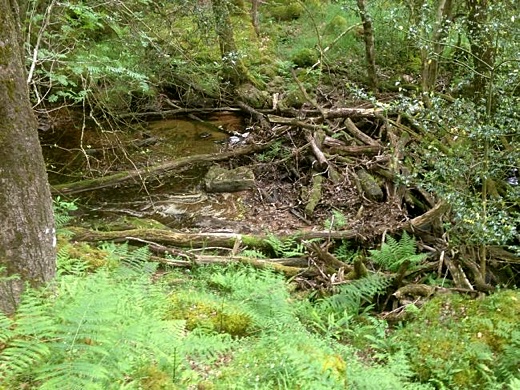

Image above: Stream with decaying branch and ferns. From original article.

As we walked through the woods, I was thinking about what a perfect metaphor this place was for the kind of economy we strive to create in Transition initiatives.  An economy based on maximising the Multiplier Effect.  In this kind of economy, we become more skilful at capturing money that would otherwise just pass through our economy.

Then, once it is there, we strive get it to circulate as many times as possible, to pass from hand to hand to hand, incubating a great diversity of enterprises and businesses.

The alternative, the globalised neo-liberal economy, is the mirror opposite of our forest economy.

Rather than trying to maximise the number of places money can pass through or be stored, distributing it as much as possible, it aims to centralise, to concentrate that water into a handful of places.

The equivalent that I could think of would be to put plastic guttering around all our trees, dig channels to concentrate the water, so that as soon as a raindrop landed it was being channelled towards one of several large reservoirs. Not quite the same experience at all.

Nowhere in that wood could I see any one single species sucking up all that water to the detriment of others.  Everything in the ecosystem acted as a good neighbour, stronger due to the diversity of what's around it.  Nothing was wasted.  It's a resilient system.  In the event of a drought, a lack of input of water, it would survive so much longer than a monocultural field of crops or our more 'tidy' gardens.

If we can protect local economies from the predations of large extractive corporations, keep the metaphorical plastic guttering at bay, they will naturally move towards the kind of self-organising, diverse resilient systems that our woodland was modelling.  It's a system designed to maximise the wellbeing of its community, through an approach based not on austerity but on being regenerative.

It's an economy that isn't about locking resources up, but allowing them to flow at different speeds, to allow some throughput, but to strive to ensure the maximum amount of circulation as possible.  It's the thinking that underpins local currencies, although it can happen without them.

Mollison once also famously described tidiness as "maintained disorder".  Extracting money from local economies requires highly efficient systems that have none of the disorder of natural systems.

Think of the difference between supermarket aisles and a marketplace with its diversity of eclectic stalls.  Or the clone produce of the supermarket veg section, bereft of wonky carrots and nobbly potatoes as opposed to what appears in your CSA vegetable box.

As you walk through the woodland, what initially appears to be a messy riot of untidy chaos is in fact a highly sophisticated, vibrant, thriving ecosystem.  It works.  As do resilient local economies.  And they're beautiful.  As Mollison once said, "if we lose the Universities we lose nothing: if we lose the forests we lose everything".  Amen to that.

.

Capitalism & Socialsim are Industrial

SUBHEAD: They're both wrong. Money doesn't grow on trees and Trees don't grow on Money.  

By Gene Logsdon on 23 May 2012 for the Contrary Farmer -
(http://thecontraryfarmer.wordpress.com/2012/05/23/money-doesnt-grow-on-trees-and-trees-dont-grow-on-money)

Image above: Mature men who believe money grows on trees. From (http://www.freerepublic.com/focus/f-news/2873674/posts)
 
I was so gratified to see Wendell Berry’s remarks in a recent interview (“Wendell Berry: Landsman” with Jim Leach in Humanities magazine, May/June 2012) where he makes a point about economics that is overlooked in these days when divisiveness rules the political roost. The general view is that the economic battle is between capitalism and socialism, but as Wendell observes, “both are industrial systems and they have made the same mistakes in some ways.” Both have ignored “the propriety of scale and the standard of ecological health.”

Yes, yes, yes. But I would like to go farther (probably too far) than Wendell did. Both capitalism and socialism are similar industrial systems basically because both accept and practice the industrial idea that the fundamental tool to “growing an economy” is the ability to borrow money at compound interest rates. I certainly would be foolish to deny the effectiveness, maybe the necessity, of being able to borrow money. We borrowed to buy our first house and car. 

But seeing how borrowed money nearly ruined people I knew when I was growing up, I was determined never to borrow again if I could avoid it and I never did. Repaying a loan over a long period of time often means buying the house or car twice and if one carries credit card debt all the time, to paying for stuff more than three times.

Somehow this kind of insanity has become sanctified in our society as if it were holy scripture. The phrase “free enterprise” is uttered by its high priests with all the fervor of a biblical evangelist uttering “the Lord Jesus Christ.” I remember the first time I confronted this kind of reverence and realized with a shock, that “free enterprise,” guided by what its followers called an “invisible hand,” was almost a synonym for God.

For centuries societies learned from experience that borrowing money on interest invariably results not in “free enterprise” but in the economic enslavement of indebtedness and usury. Humans privately, and as representatives of corporations and governments, eventually borrow more money than they can pay back. They just can’t help it. And they lack the will to install the rigid controls necessary to keep money interest from, literally, captivating them.

Farmers who ignore the wisdom of the ages are most at risk in the world of manufactured money. (The most well-known example perhaps is from Shakespeare: “Neither a borrower or a lender be/ for loan oft loses both itself and friend/ and borrowing dulls the edge of husbandry.”) Farm crops grow at their own sweet pace and know nothing about manipulated money growth— as I must have written a thousand times by now. 

The trading shenanigans going on presently in the banks are spilling over into the Chicago Board of Trade. Are you watching the grain markets? Corn and soybean prices have been bouncing up and down like a drunken kangaroo on steroids. Expert marketers admit that they are mystified. But I hear very few of them suggest that the basic reason for this instability might be coming from the notion that we can make money grow faster than real things grow.

Banks do the same when they buy up mortgages or other bundles of paper and attempt to sell them in secondary markets for a kind of gain that can vanish overnight because it is based not on real material resources but on human desire. It is a form of usury to me, a method of trying to make something that exists only in the mind— money value— grow without any respect at all for “the propriety of scale or the standard of ecological health.” This kind of speculation always comes to grief. Ask J.P.Morgan Chase. Money doesn’t grow in trees and trees don’t grow on money
.

Breadfruit - Trees that Feed

SUBHEAD: In Jamaica this food tree reduces dependence on imported grains and reliance on agrochemicals. By Ramon Gonzalez on 25 April 2012 for TreeHugger - (http://www.treehugger.com/green-food/breadfruit-trees-are-trees-feed-and-create-jobs-jamaica.html) Image above: A two year old breadfruit tree we, of Island Breath, planted in Hanapepe Valley, Kauai, Hawaii, as a root sucker from a tree up country in Lawai. It is now over ten feet tall and will probably bear fruit in two years.

Today Mary McLaughlin works and lives in Winnetka, Illinois, but she grew up in Spanish Town the capital of St. Catherine in the county of Middlesex, Jamaica. As a child, her family’s carbohydrate needs were served by a single breadfruit tree growing in their yard.

One day while pondering the issue of food security she had a revelation. If she could plant massive amounts of breadfruit trees in her home country not only would it benefit the environment, but the trees would create micro-economies, combat hunger and lessen the need for expensive imported grains.

The breadfruit, Artocarpus altilis, is a species of flowering tree in the mulberry family. “It tastes like bread,” she explained with a wry smile when I asked her a couple of years ago what breadfruit tasted like. This exotic fruit-which to me look like the dragon eggs on HBO’s "Game of Thrones"-is very versatile. It's commonly referred to as “loaves of bread on trees.”

According to Mary, when roasted the fruit tastes just like a bagel. At lunch time Mary says the fruit can be mashed into a mashed potatoes alternative. It can be dried into chips, which store for a long time, and the chips processed into flour. The breadfruit flour, which is gluten free, can be used to make pancakes, flat bread, and tortillas.

In 2008 Mary and her husband, Mike, formed the Trees That Feed Foundation. In just a few years the 501(c) (3) nonprofit organization has planted thousands of breadfruit trees in Jamaica slowly inching their way to their goal of planting over a million fruit-bearing trees across tropical countries.

One downside of breadfruit is that it has a short harvest season and in nature is slow to propagate. To overcome this the trees the foundation plants are propagated via tissue culture allowing them produce and deploy many trees at once.

Different cultivars-of which there are over 100-that fruit at different times of the year are selected to create a year-round production cycle. Varying the cultivars planted also prevents the possibility of creating a monoculture that can be wiped out by diseases or pests.

The foundation plants breadfruit trees in orphanages, schoolyards, orchards and backyards all across Jamaica. The breadfruit trees are creating food systems and food security where they are needed most.

Recently, the foundation partnered with Compatible Technology International, a nonprofit organization that builds and deploys devices that address the post-harvest side of the food chain, to provide mills to process breadfruit chips into flour.

Together with the flour mills these trees are fostering a breadfruit cottage industry. "When day laborers become breadfruit producers they own their lives," Mary told me recently of the financial impact planting thousands of breadfruit trees is having. "We're creating entrepreneurs, and helping people at the bottom of the economic ladder."

After Haiti was rocked by an earthquake in 2010 the Trees That Feed Foundation saw a need and an opportunity to expand their work. Over the past two years they’ve planted over two thousand trees in Haiti. The trees are a mixture of mangos, avocados, breadfruit, and pomegranates.

A pilot program with Three Angles has created a fruit tree nursery and a program where families are taught how to care for breadfruit trees, harvest, prepare, dry, and mill flour. After completing the program families are provided a micro-loan that will not only allow them to grow their own breadfruit to feed themselves, but also teach them to how market and sell their harvest.

Fruit trees planted by the Trees That Feed Foundation are creating food systems which are controlled by communities, reducing their dependence on imported grains and annual crops which rely heavily on agrochemicals. If you would like to help the foundation continue their work in Jamaica and Haiti and expand into other tropical countries you can make a tax-deductible donation.

Image above: Same breadfruit tree as above, that we planted on state agland, in March of 2010. The sapling has weathered extended winter flooding on lowland that was once a rice field. Photos by Juan Wilson.

See also: Ea O Ka Aina: Plant a Breadfruit Tree 3/31/10 Ea O Ka Aina: Breadfruit Recipe Experiments 11/15/09 Ea O Ka Aina: Get out your `ulu! 7/14/09 Island Breath: Ulu - The Breadfruit Tree 12/31/06 .

UN is Getting Into Permaculture

SUBHEAD: Putting more trees on farms is fundamental to the future agricultural development.

 By Paul Stapleton on 9 February 2011 in EureakAlert! - 
  (http://www.eurekalert.org/pub_releases/2011-02/wac-pto020911.php)

 
Image above: A tropical agroforestry tree nursery. From (http://www.forestnursery.com/).
 
Trees growing on farms will be essential to future development. As the number of trees in forests is declining every year, the number of trees on farms is increasing. Marking the launch of the International Year of Forest by the United Nations Forum on Forests (UNFF9) in New York on 29 January, Dennis Garrity, the Director General of the World Agroforestry Centre, highlighted the importance of mixing trees with agriculture, the practice known as agroforestry.

"Over a billion hectares of agricultural land, almost half of the world's farmland, have more than 10 percent of their area occupied by trees," said Garrity, "and 160 million hectares have more than 50 percent tree cover."

Growing trees on farms can provide farmers with food, income, fodder and medicines, as well as enriching the soil and conserving water. As natural vegetation and forests are cleared for agriculture and other types of development, the benefits that trees provide are best sustained by integrating them into agriculturally productive landscapes.

Speaking at the High Level Dialogue of UNFF9 on 3 February 2011, Garrity said, "Agroforestry is a crucial bridge between forestry and agriculture. Essentially, agroforestry is about the role of working trees in agricultural landscapes, particularly on, but not limited to, small-scale farms."

Over the next two decades, the world's population is expected to grow on average by more than 100 million people a year. More than 95 percent of that increase will occur in the developing countries, where pressure on land and water is already intense. A key challenge facing the international community is, therefore, to ensure food security for present and future generations, while protecting the natural resource base on which we all depend. Trees on farms will be an important element in meeting those challenges. In some regions, such as Southeast Asia and in Central America, tree cover on agricultural lands now exceeds 30%.

"The transformation of agriculture into agroforestry is well under way across the globe," said Garrity. "And there are drivers, including climate change, that ensure that this transformation will accelerate in the coming years, since agricultural systems incorporating trees increase overall productivity and incomes in the face of more frequent droughts, and agroforestry systems provide much greater carbon offset opportunities than any other climate mitigation practice in agriculture."

In many countries, it is now quite clear that the future of forestry is on farms. In countries such as India, Kenya, and many others, the majority of the nation's wood is derived from farm-grown timber.
Practiced by farmers for millennia, agroforestry focuses on the wide range of working trees grown on farms and in rural landscapes. Among these are fertilizer trees for land regeneration, soil health and food security; fruit trees for nutrition; fodder trees that improve smallholder livestock production; timber and fuelwood trees for shelter and energy; medicinal trees to combat disease; and trees that produce gums, resins or latex products.


Reinventing agriculture
Evergreen Agriculture is a form of agroforestry that integrates trees with annual crops. "We see Evergreen Agriculture as nothing less than the radical, but entirely practical, pathway to a reinvention of agriculture," said Garrity. "It is a vision of a future in which much of our food crops will be grown under a full canopy of trees."

Combining fertilizer trees with conservation farming techniques is doubling and tripling cereal crop yields in many parts of the African continent. The nitrogen-fixing tree Faidherbia or Acacia albida, is increasing unfertilized maize yields in Malawi, Zambia, Tanzania, Ethiopia, and in numerous other countries. They are now being grown on millions of hectares of crop land throughout Niger, at densities of up to 200 trees per hectare, and show a tripling of yield in the crops growing beneath them. Producing food crops like maize, sorghum, and millets under these agroforests dramatically increases their drought resilience in dry years, because of positive soil moisture regimes, and a better microclimate.

This development is not happening only in Africa. The South Asia Network of Evergreen Agriculture has been launched to advance an evergreen revolution throughout the subcontinent.


Feeding the hungry
Planting trees that provide natural fertilizers on farms with poor soils helps farmers restore fertility and increase yields. Gliricidia bushes fix nitrogen in their roots and act as natural green fertilizer factories, tripling yields of maize on farms in Malawi. The prunings are fed to the animals. The bushes also reduce the risk of crop failure during droughts and prevent waterlogging when it rains too much. The nitrogen-fixing tree Faidherbia increased unfertilized maize yield four times in Zambia. The trees are being grown on over 5 million hectares of crop land in Niger.


Relieving poverty
Domesticating wild fruit trees in the Cameroon has allowed smallholder farmers to increase their earnings five times. Thousands of farmers in Tanzania are planting Allanblackia trees and earning much-needed income by selling the oil-containing seeds to companies to make margarine.

Trees grown on homestead farms, in woodlots and on communal lands are an important source of wood and other products. In humid-zone West African countries, Burundi, Rwanda and Uganda in particular, trees grown in home gardens meet most household needs for fuelwood and timber. In many cash-crop systems, trees are grown for shade and eventually provide wood – an example is Grevillea robusta in tea plantations in Kenya. In the Sudan, Acacia senegal, the source of gum arabic, is largely grown in agroforestry systems.


Accumulating carbon
Investments in agroforestry over the next 50 years could remove 50 billion tonnes of additional carbon dioxide from the atmosphere. Most of the deforestation in Africa, and in parts of Asia, is caused by agricultural expansion, largely by smallholder farmers. Agroforestry activities curb emissions of greenhouse gases by slowing the conversion of forest to farm land and holding carbon in the trees on the farms. Developing smallholder agroforestry on land that is not classified as forest could capture 30-40 percent of the emissions related to land-use change. Encouraging farmers to plant trees has the potential to increase farmers' income, sequester more carbon and benefit biodiversity.

"The International Year of Forests is a momentous opportunity to more fully recognize the tremendous importance of agroforestry and evergreen agriculture in building a better world," noted Garrity. "Agroforestry is one of mankind's best hopes to create a climate smart agriculture, increase food security, alleviate rural poverty, and achieve truly sustainable development. And, thereby, better ensure that our world's forests can indeed be conserved far into the future."

See also: http://agroforestry.net/index.html


.

The tree that changed the world

SUBHEAD: Two planets diverged in a solar system, and the successful one took a path more wooded. Image above: A dense forest of fern-leafed trees from Devonian epoch absorbed CO2. From (http://www.bertsgeschiedenissite.nl/geschiedenis%20aarde/devoon_planten.htm) By John Perlin on 29 March 2010 in Miller- McCune - (http://www.miller-mccune.com/science-environment/the-tree-that-changed-the-world-11656) The author of "A Forest Journey: The Story of Wood and Civilization", begins a series of articles on the world’s first energy crisis: peak wood.

Astronomers for the longest time have regarded Venus as the planet most resembling Earth. Having almost the exact size as Earth and being almost as close to the sun has led many to call it Earth’s twin.

The clouds always covering the Venusian landscape are another compelling example of Venus’ affinity to Earth. Pioneering astronomer Svante Arrhenius hypothesized great rains pouring from these clouds nurtured lush rain forests below. But when various space probes penetrated the Venusian atmosphere, this belief burst. Astronomers found an inferno rather than a tropical paradise.

Here they discovered the ultimate greenhouse effect: Although the carbon dioxide-laden atmosphere allowed sunlight to pass through, when the solar rays hit the surface of Venus and changed into heat waves, they could not escape the carbon dioxide cover. So the heat had nowhere to go and accumulated at the surface, where temperatures exceed 800 degrees Fahrenheit.

Earth has as much carbon dioxide as Venus. But instead of the gas blanketing the sky as happened on Venus, much of the carbon dioxide on Earth has been locked up inside and on the surface. This has made all the difference in the story of the two planets — one, a heaven bountiful with life, the other a hellish place where nothing animate as we understand it can survive.

Credit much of this carbon dioxide transfer from the atmosphere to the land to the rapid global spread 400 million years ago of the first (or among the first) true trees, Archaeopteris.

Its dense canopy photosynthetically absorbed carbon dioxide. As its fernlike leaves shed, they would have given back the carbon dioxide to the air — had the tree’s deep and powerful root system not broken down rock through which it dug into soil, where chemical reactions eventually locked the carbon dioxide into sediment. Mud buried much of the remaining dead leaves, branches, twigs, trunks and roots.

With the passing of millions of years under great pressure deep in the bowels of the earth, the plant material ended up as rich beds of fossils and coal. Once again, natural forces denied returning to the atmosphere what the trees had devoured.

Archaeopteris prepared the soil for smaller plants to flourish and assist in removing carbon dioxide from the air. Its root system turned rock into rich, soft earth. Their leaves shielded the newly formed soil from erosive rain and wind, and fertilized it as they fell and decomposed. Debris from the growing number of plants filled waterways, promoting plankton, which also feeds on atmospheric carbon dioxide.

Buried by sediments these consumers of carbon dioxide could not release this greenhouse gas to the air. The plunging carbon dioxide levels in the atmosphere caused temperatures on land to drop. The change made it possible for large creatures to amble about the land without overheating. They no longer had to remain immersed in water — which heats more slowly than land surfaces, and which also better conducts heat away from animals than does air — to maintain healthy body temperatures.

At the same time, declining amounts of atmospheric carbon dioxide enlarged the ozone layer above the Earth. Such protection shields land animals from lethal doses of ultraviolet radiation. Previously, creatures of any significant size had to remain underwater for protection from the unfiltered sun’s harmful rays. Of equal importance, the injection of more oxygen into the air by Archaeopteris and smaller plants provided enough of the life-giving gas to make it possible for animals to breathe.

Scientists find charcoal for the first time during the reign of Archaeopteris, suggesting that with the trees’ appearance came sufficient amounts of oxygen to support combustion.

As logs and large branches started to clutter the bottom of shallow waterways, fishlike creatures with limbs could better propel themselves through the plant debris than those with fins. The increasing organic debris finding its way into waterways would rob them of their oxygen as it decomposed. Creatures that could breathe as well as walk could escape sure death by making their ascent to land where a relatively mild climate, sufficient oxygen, protection from ultraviolet radiation, and plenty of food provided by plants made survival possible.

So began the chain of events that has permitted vertebrates to flourish on land so that 400 million years later I can write this, and you can read it.

While Archaeopteris is now extinct, nature kept buried the remains of ancient organic debris of algae, plankton, plants and trees. Their entombment helped keep the carbon dioxide they captured through photosynthesis out of the atmosphere.

But people started to dig up and burn the early trees, ancient plants and plankton first as coal and then as oil and natural gas. The seemingly unlimited availability of long-buried organic material, aptly named fossil fuels, ushered in a new technological era qualitatively separating those living since the middle of the 19th century from the rest of history. This new age of unprecedented growth, the Industrial Revolution, also accelerated the rate of deforestation as growing markets and population require more and more clearing for agriculture, livestock and biofuels, and the consumption of trees for fuel and for timber.

True, deforestation has occurred throughout world history. Plato, for example, saw deforestation turn a fertile piece of Attica into rock. He compared this butchered slice of earth to a carcass stripped of all its meat with only the bones remaining.

“What now remains compared with what then existed is like the skeleton of a sick man, all fat and soft earth having wasted away, and only the bare framework of the land being left,” he wrote in Critias. “… There are some mountains which have nothing but food for bees, but they had trees not very long ago …”

Since the beginning of the Industrial Revolution, Plato’s compelling description of a particular place in Greece has become universal.

The growing loss of trees has allowed ever increasing amounts of carbon dioxide to return the to atmosphere. So have the engines of commerce and industry by burning fossil fuels. Scientific investigations have proven that since the beginning of the industrial revolution carbon dioxide levels have increased as well as the temperature of the Earth.

Unless drastic changes occur socially and technologically, increasing amounts of carbon dioxide will enter the atmosphere as the burning of fossil fuels continues to accelerate along with deforestation. Deforestation alone accounts for the release of more greenhouse gases than do all the vehicles throughout the world!

Bad forestry practices help hasten the pace of carbon released into the atmosphere. Following a clear-cut, for example, the formerly forested soil releases tremendous amounts of carbon dioxide into the atmosphere.

In North America, for example, 60 percent of all carbon resides within the earth of the forest floor. Replanting does capture carbon dioxide as new organic matter grows. The losses of carbon dioxide to the atmosphere continue to exceed the removal of carbon in the replanted clear-cut for 15 to 25 years depending on the type of tree, climate and soil. Then the trees and the soil underneath start to store more carbon dioxide than released.

Conversely, forests can become a weapon in our arsenal to break global warming if foresters practice enlightened stewardship. Sustainable forestry will need to become the standard on all forest lands globally. Replanting formerly forested land helps if trees are not selectively harvested until the seedlings reach an age where they have taken in more carbon dioxide than has been exhaled. Trees cut down in cycles of 50, 75 and 100 years store only 38 percent, 44 percent and 51 percent, respectively, of the carbon that an old-growth stand retains.

Indeed, trees can play a vital role in reducing atmospheric carbon dioxide. A recent study shows that saving the Amazon can be a cheaper and faster way to mitigate the consequences of global warming than replacing coal-fired power plants with renewable energy.