FERC you!

SUBHEAD: The rising tide of indignation over the attempted FERC KIUC deal may result in outrage like that over the Superferry.  

By Andy Parx on 9 June 2011 for Parx News Daily -  
(http://parxnewsdaily.blogspot.com/2011/06/ferc-you.html)

 
Image above: Scene from the ducudrama "Enron" that was produced as a Broadway stage play. From (http://topics.lingospot.com/XIXTBADGHE/enron/).

Anyone surprised at the FERC KIUC debacle wave your electricity bill in the air. Okay- you can go back to sleep now. Because unless you were under the proverbial rock for the past decade you must have been fast asleep to be shocked at anything "this co-op" does. Since day one when barnacle-on-the-butt-of-Kaua`i Gregg Gardiner convinced a group of good old boys and girls and Democratic Party bosses to pay way too much for the liability that was Citizen’s Electric, and stick the resultant debt on the backs of the island working people- the hew and cry of warnings has been a loud if ineffective undercurrent of stomach churning rage from rate payers.

"We're all for a co-op. just not THIS co-op". was the slogan of the original "nitpickers" whose moniker was proudly taken from former Mayor Marianne Kusaka's attempt to denigrate the effort that saved members $50 million and should have brought the price down by another hundred million.

 But the makeup of the board was a who's who of the then, two factions of the Democratic Party, the old guard represented by aging, "442nd" party boss Turk Tokita vs the new guard of then-former Mayor and then-out-of-politics progressive JoAnn Yukimura. And when the bylaws and rules were forced down the throats of members in an all-or-nothing vote- removing the promised precepts of the Sunshine law and giving all power to the board- the course was set for today's dictatorial decision-making by a handful of the power elite.

 With today's news from Pacific Business News (via the local newspaper) that William Tam, deputy director for water at DLNR said that "the state does not want Hawai‘i's (sic) in-stream flow standards to be decided by a federal agency in Washington D.C. that does not have any experience with or understand Hawai‘i’s streams" and the announcement of an effort from anti-FREC forces leader Adam Asquith to get signatures to a full page ad fully explaining all that's insanely stupid about going through the feds, the tide seems to be turning- that despite the "that's my story and I'm stickin' to it" stance of the stumble-bums on the KIUC board. And that includes the original three opponents- Carol Bain, Ben Sullivan and Jan TenBruggencate who were elected to be the voice of reason but who now, reportedly, have switched sides.

What the board seems to have forgotten are the lessons of another recent debacle- the ill-conceived and supremely bungled Superferry and the resultant battle. The reason why, shockingly, the people of Kaua`i seemed to oppose the big bad boat was not the boat itself but for the way it usurped the processes that, although usually ineffective, are at least supposedly there to protect us from deregulatory invasion from Washington D.C. and Honolulu.

Just as the feds and state conspired to remove the environmental assessment and impact statement process for the Superferry, once again a bunch of power mongers have decided to allow a federal process to negate the unique water rights and management laws that have been carefully developed over decades in Hawai`i. Then when challenged the powerful wielded their power to lie and deceive in such a blatant way that nobody failed to get the "sit down and shut up" message that General Linda Lingle and her unified command threw in the faces of those who usually, unless riled up by a lack of respect, act like sheeple.

And now though few understand the ins and outs of water usage, citizens feel the same kind of "like it or lump it" missive coming from elected officials who fail to get the message that their arrogance, not the project, is the becoming the issue. Though it's too early to tell, the rising tide of indignation over the attempted FERC KIUC sleight-of-hand indicates that the same kind of outrage that swept the island over the Superferry fiasco might just be at hand. Because, as "this co-op" circles the wagons, the natives are getting restless.

.
What Climate Change? - Flood

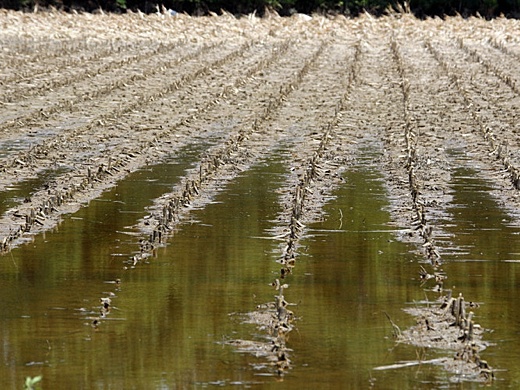
SUBHEAD: After a season of wild weather there are higher food prices on the horizon. By Marilyn Geewax on 12 June 2011 for NPR - (http://www.npr.org/2011/06/12/137129634/after-wild-weather-higher-food-prices-on-horizon) Image above: Destroyed corn glistens under floodwater in Yazoo City, Miss., on June 1.From original article.

Throughout April and May, U.S. farmers faced floods, tornados, downpours and droughts — all of which made planting difficult. Now in June, intense heat has been sweeping over much of the country.

The harsh weather likely will reduce the fall's harvest, according to a new report from the U.S. Department of Agriculture. That, in turn, could further drive up grocery prices for consumers.

"Farmers had everything thrown at them" by Mother Nature this spring, USDA economist Gerald Bange said. "Excessive rains led to planting delays, and then some of what was already planted actually got flooded."

The violent storms and persistent rains were especially challenging for Midwestern farmers who needed to get their corn crops planted by mid-May to maximize the harvest, Bange said.

The USDA has reduced its June estimate of planted corn acres by 1.5 million acres, down from its March "planting intentions" survey to 90.7 million acres. That means U.S. farmers are on track to produce 13.2 billion bushels this year, down 305 million bushels from the May estimate.

Bange said the harvest should be a record, but still will be too small to meet the record demand. "We are seeing very, very strong demand for corn for bio-energy, livestock feed input and export," he said.

Prices have been shooting up along with the surging demand. The cash price of a bushel is now at $7.75, up from $3.20 at this time last year. Some analysts expect the price to keep climbing to $9.

All of that could have a big — and bad — impact on consumers. Economists are predicting meat prices will rise 7 percent this year. And that would hurt consumers, who already have seen the average price per pound of beef rise 8 percent over the past year, according to data compiled by the National Cattlemen's Beef Association.

The problem of rising prices is not confined to corn-fed beef. In fact, most food prices are trending up. This past week, the American Farm Bureau Federation released its spring Market Basket survey of 16 common food items purchased at supermarkets. It found that on average, prices were 8 percent higher than one year ago.

A number of food companies, including Kraft, Kellogg, Sara Lee and Smucker, have raised prices to keep up with the surge in the cost of ingredients like corn, oats, coffee and so on. Many restaurants, including McDonald's, also have raised prices.

But Bange noted that food price hikes reflect much more than just the Midwestern flooding and the Southwestern drought. The trend toward higher prices has been in place for months — and is a global phenomenon.

A United Nations report issued last week showed that global food prices have been unusually high this year. The U.N.'s global price index for meat hit a record high in May. The U.N. blamed bad weather, high oil prices, the earthquake and tsunami in Japan, and export policies that restrict the flow of food.

But the single biggest factor is soaring demand for food as the world gets more crowded. Inventories of food stocks of all sorts are quite low all over the world, according to Ben Grossman-Cohen, a spokesman for Oxfam America, an international relief and development organization.

The tight inventories keep prices high, making it hard for poor people to eat. "About a billion people go hungry every day because they can't afford to grow or buy enough food," he said.

On June 22-23, the agriculture ministers of the so-called G-20 — a group of the world's biggest countries — will meet in Paris to discuss food issues. They are planning to launch an initiative called the "Agriculture Market Information System." This system would push countries to more honestly report on agriculture. For example, China has always been secretive about its stocks of food. So if China signs on, it would start to release more data about its food inventories and consumption.

The agriculture ministers say transparency is important. If countries had a clearer idea of what crops were being planted and how they were coming along, then officials could respond more quickly in a coordinated way whenever they see food shortages developing. More crop information also would cut down on price speculation. .

We're Baaack! - online that is.

SUBHEAD: As the Beatles said on the White album "Baack in the US - Back in the US - Back in the USSR".  

By Juan Wilson on 11 June 2011 for Island Breath -  
(http://islandbreath.blogspot.com/2011/06/were-baaack-online-that-is.html)


Image above: View from a terminal pod at Dulles International Airport in DC. Photo by Juan Wilson.  

Wilted Lettuce On the morning of our flight from Kauai to the mainland I tweated:
"We're flying Kauai HI to San Francisco CA to Washington DC, to Buffalo NY. For most a gradient from good to bad. But we love Chautauqua." (http://twitter.com/#!/IslandBreath)
Chautauqua is the westernmost county in New York state and just a little bit bigger than Kauai. It has about twice as many people on gently rolling green hills with lots of woodland. I have been going there all my life my wife Linda Pascatore grew up there and has her family there. In June the air is usually as crisp as a granny smith apple. Our flight arrived in San Francisco shortly after dark and it the sun was not back up until long after crossing the Mississippi. I noticed when there was enough light that you couldn't see the ground.

There was a brownish haze everywhere I looked. It didn't go away as the sun rose and the plane began it's descent into DC. The air had the look of the bad old days of the late 60's before the Environmental Protection Agency, the Clean Water & Clean Air Acts. It made you glad to move from the air-conditioned plane, through and air-conditioned jetway and on into the refrigerated terminal.

I have to say, Dulles International Airport has got to be one of the ugliest airports in the world. In the 1960s it was transformed by architect Eero Saarinen into a concept piece. Saarinen was just of building the gull-wing TWA terminal at Idlewild Aiport (now JFK) in NYC. He built a flying wing of a building with a space age control tower. The terminal used rolling waiting areas to take out to the planes. They were sort of jetways not permanently to either the plane or terminal. A bad one - but at least a new idea.

Anyway since the 60's the terminal has been growing like an aggressive cancer. It has that Soviet ugliness. I really did not taste the air until after leaving DC. We flew north towards Buffalo - hazy all the way. Buffalo has a new sporty terminal that sings by comparison to Dulles. I didn't taste the air until getting out of the Buffalo baggage claim area. It was gritty and sour. It was not really hot and muggy. Chautauqua had its usual cool green June going - but it wasn't crisp - more like wilted lettuce forgotten in the back of the crisper. It's enough to get me looking more seriously into chemtrails and HAARP conspiracies.  

Windstream - Forgotten know-how
 The reason its taken three days to get back on line is a dance between high-tech convenience and cluelessness. Windstream is a phone company that three years ago took over Allegany Telephone Company (Altel). Windstream comes out of Georgia and seems to want to project the fast modern flow of information rather than a history as a crusty old telephone company.

 I called them weeks in advance to set things up so the phone and DLS internet access would be running when I hit the ground. I had used them in 2008 on my last trip and even still had the Siemen's 4200 moden ready to go. Well windstream told me I'd have to get a newer model modem for $50 (after the a $50 rebate). Reluctantly I went for it. Only one little problem. Just before I arrived in New York they sent the modem to my Hawaiian address on a slow boat to China.

This meant that by the time I get back to Hawaii it will be working its way back to the sender in Georgia. I tried hooking up the old modem anyway. It would jump trough all the hurdles through the setup procedure until the last step and then fail. The tech people told me the old 4200 should be compatible. After a day and a half I drove the 15 miles and got the shiny new $100 4300 model.

Needless to day - that did the exact same thing the 4200 did. After another day they had gone up two levels of tech experts and were actually sending out a specialist to my home in the boondocks to test the site. About an hour before the the specialist was to arrive someone in Georgia found the right knob or switch and I was back on the internets.

Whoooeee! If this is how America looks, smells and acts - I want to get back to Hawaii sooner than later.

 See also:
Ea O Ka Aina: A Heads Up 6/6/11 .

No Virginia there is no Santa

SUBHEAD: North Carolina lawmaker's 3rd grade daughter writes him letter to protest education cuts. By AP Staff on 6 June 2011 in Huffington Post - (http://www.huffingtonpost.com/2011/06/06/north-carolina-mike-stone-education-budget_n_872250.html) Image above: A pixilated press photo of Rep. Mike Stone. From (http://www.ncpolicywatch.com/2011/02/14/jones-street-quote-of-the-week/). A North Carolina lawmaker doesn't think it was right for his daughter and her third-grade class to write to him and other elected officials protesting possible cuts in state education spending.

Republican state Rep. Mike Stone says his daughter asked in her note to "please raise the budget, dad" and help keep two teacher assistants employed.

Republican lawmakers and Democratic Gov. Beverly Perdue are at odds over the budget that is on her desk to either sign or veto.Some in education say the proposed spending plan could eliminate 9,300 positions in the public schools. Republicans have said those numbers are exaggerated.

Lee County Schools Superintendent Jeff Moss told WRAL-TV he didn't see the writing exercise as a problem.

Moss said students in other schools wrote to lawmakers and Perdue.

.

Served Papers on Facebook

SUBHEAD: Many people have no real place as a legal address. Now Facebook is becoming their real legal home. By Heather Smith on 7 June 1022 for Bloomberg News - (http://www.bloomberg.com/news/2011-06-06/facebook-becomes-tool-to-serve-legal-papers-on-those-who-exist-only-online.html) Image above: A Facebook hompage layout for Moin Abjad. From (http://ajgago.wordpress.com/2009/03/12/facebook-in-09-pt-2/). Two years after an Australian lawyer caused a stir by sending a foreclosure notice via Facebook, the practice of online legal service is spreading as a means for courts to keep their dockets moving. Courts in New Zealand, Canada and the U.K. have adopted the Australian example to avoid having cases stall when people can’t be located and served in person. Lawyers said the U.S. may not be far behind in using the world’s most popular social- networking service. “There are people who exist only online,” said Joseph DeMarco, co-chair of the American Bar Association’s criminal justice cyber crime committee, and a lawyer at New York-based DeVore & DeMarco LLP. Being able to serve documents by social- media networks would be a useful tool, he said. While Facebook Inc. is under regulatory and legal scrutiny in countries including the U.S., South Korea and Germany for failing to protect its 694 million users’ data, privacy advocates said that serving court notices by mail or in person often already provokes privacy complaints. Therefore using Facebook doesn’t raise any new issues. “There are going to be privacy concerns, but in some respects they’re almost inescapable,” said Mark Rotenberg, president of the Electronic Privacy Information Center in Washington. Someone “is going to be subject to legal service, even though they may not be happy about it. But if they are properly notified the law’s primary concern is addressed,” whether the notice arrived via Facebook or not. Reliable, Secure The Palo Alto, California-based company may find legal papers served via its system a welcome recognition of the security of its internal messaging function. Following the 2008 foreclosure case, spokesman Barry Schnitt said the company was pleased to see the Australian court validate Facebook as a reliable, secure and private communication medium, the Associated Press reported. Andrew Noyes, a Facebook spokesman, declined to comment on its recent use as an alternative means of delivering court documents. “It seems only logical now that tools like Facebook or Twitter be used” to contact people who can’t be traced using traditional means, said Daniel Hamilton, director of Big Brother Watch in London, noting such efforts don’t violate personal privacy. “Now is it desirable? No.” The judge in the Canberra case required lawyers to serve a foreclosure notice on the couple at their home address and a secondary address, as well as via Facebook, said Archie Tsirimokos, a managing partner at Meyer Vandenberg Lawyers who represented creditor MKM Capital. Calls, Faxes Since then, courts have grown more lenient in approving the use of Facebook. In March, Hilary Thorpe, a lawyer in East Sussex, England, persuaded a British court to allow her to serve a woman solely through her Facebook account, after showing that calls, faxes and visits had failed to track her down. The people in both the U.K. and Australian cases were successfully notified in the eyes of the court, the lawyers said. Tsirimokos said that “within a day” of sending the notice, the recipient’s privacy settings in the Australian case were tightened, showing the debtors got the notice. MKM won a court order and then seized and sold the house. Thorpe, who sent the notice via Facebook’s private message system, said “it was a matter of minutes for the debtor to respond to the e-mail,” allowing the case to move ahead. U.S. lawyers say it would be helpful if their courts allowed the practice, and privacy experts don’t see it as a concern because U.S. court documents are already public. Unethical Friending The challenge would be to collect enough proof to convince a court the accountholder is the right person and the page is checked often enough to ensure it’s a fair path of notification, DeMarco said. This would need to be done without violating ethics codes that would prevent lawyers from “friending” the target under false pretenses to get past security settings. Not everyone with a Facebook page visits the site regularly, as seen with statistics comparing the number of users, tracked by the website Socialbakers.com, with the number of visits, tracked by ComScore Inc. Of the 150 million U.S. users, there were just over 145 million unique visitors there. In the U.K., Facebook’s third-largest market with 29.5 million users, there were 27.8 million visits, according to ComScore. “Nothing on its face in New York state or federal law precludes it,” DeMarco said. There are countries, like France and Germany, where electronic delivery isn’t allowed in any form. French law requires delivery in person. “It wouldn’t be admissible procedurally to send a message by Facebook,” said Matthieu Bonduelle, head of France’s Magistrates’ Union. English court rules permit electronic document service, said Danvers Baillieu, a technology-law specialist in London. “As far as the law is concerned, it’s just a method of delivery,” he said. “The precise form of technology is neither here nor there.” .

Monsanto knew of birth defects

SUBHEAD: Monsanto and federal regulators have known since 1980 that Round-Up produces birth defects and said nothing.  

By Lucia Graves on 7 June 2011 for Huffington Post -
(http://www.huffingtonpost.com/2011/06/07/roundup-birth-defects-herbicide-regulators_n_872862.html)

Image above: Men spraying herbicides without much protection. From (http://ecokvetch.blogspot.com/2011/02/surprise-approval-of-gmo-alfalfa.html).

Industry regulators have known for years that Roundup, the world's best-selling herbicide produced by U.S. company Monsanto, causes birth defects, according to a new report released Tuesday.

The report, "Roundup and birth defects: Is the public being kept in the dark?" found regulators knew as long ago as 1980 that glyphosate, the chemical on which Roundup is based, can cause birth defects in laboratory animals.

But despite such warnings, and although the European Commission has known that glyphosate causes malformations since at least 2002, the information was not made public.

Instead regulators misled the public about glyphosate's safety, according to the report, and as recently as last year, the German Federal Office for Consumer Protection and Food Safety, the German government body dealing with the glyphosate review, told the European Commission that there was no evidence glyphosate causes birth defects.

The report comes months after researchers found that genetically-modified crops used in conjunction Roundup contain a pathogen that may cause animal miscarriages. After observing the newly discovered organism back in February, Don Huber, a emeritus professor at Purdue University, wrote an open letter to Secretary of Agriculture Tom Vilsack requesting a moratorium on deregulating crops genetically altered to be immune to Roundup, which are commonly called Roundup Ready crops.

In the letter, Huber also commented on the herbicide itself, saying: "It is well-documented that glyphosate promotes soil pathogens and is already implicated with the increase of more than 40 plant diseases; it dismantles plant defenses by chelating vital nutrients; and it reduces the bioavailability of nutrients in feed, which in turn can cause animal disorders."

Although glyphosate was originally due to be reviewed in 2012, the Commission decided late last year not to bring the review forward, instead delaying it until 2015. The chemical will not be reviewed under more stringent, up-to-date standards until 2030.

"Our examination of the evidence leads us to the conclusion that the current approval of glyphosate and Roundup is deeply flawed and unreliable," wrote the report authors in their conclusion. "What is more, we have learned from experts familiar with pesticide assessments and approvals that the case of glyphosate is not unusual.

"They say that the approvals of numerous pesticides rest on data and risk assessments that are just as scientifically flawed, if not more so," the authors added. "This is all the more reason why the Commission must urgently review glyphosate and other pesticides according to the most rigorous and up-to-date standards.".

Nausea of American Exceptionalism

SUBHEAD: Has everybody in upstate New York only just been released from prison?  

By James Kunstler on 6 June 2011 for Kunstler.com - 
(http://kunstler.com/blog/2011/06/the-creeping-nausea-of-american-exceptionalism.html)

 
Image above: A photo portrait of a Crusty Punk. (http://crustypunks.blogspot.com/2010/08/were-all-poor-white-trash-squatters.html).

History, that coy dominatrix, loves to trick the credulous human race. In a moment when something we call "democracy" seems to be spreading through the dodgy precincts of the world like a contagion of virtue, the trend is actually going the other way in countries that have practiced it for a while.

That is certainly the case in Europe, especially Greece right now, where the mobs in Syntagma Square denounce their waffling parliament for agreeing to a bailout deal that will make Greece a step-child of Germany. The German voters are none too pleased with this, either, since their country is now on the hook to pay Greece's bills.

Ireland, Portugal, and Belgium are standing by for adoption next in Europe's Home for Wayward Children. Spain and Italy may need to become wards of the Euro-state, too, but they are more like adults with drinking problems who are liable to wreck the whole household if invited in.

Anyway, the Greeks rallying in Athens' central square lately are sick of politicians and parliaments, and there is a no small danger that they will soon rise up and dispense with theirs in the dumpster behind the Parthenon. A man in a uniform has a certain appeal in a situation like this. He is comfortable issuing orders in unfavorable situations, in fact, rather thrives on it.

The Germans know all about this. Their "savior" back in the 20th century was a fellow in an ersatz military getup who virtually ran for office by denouncing "parliamentarism" and by the time his party occupied a fair portion of the seats in theirs, he burned the darn thing to the ground.

The Irish gaze longingly at little Iceland, out there in the North Atlantic now free of debt obligations from the simple act of raising the middle finger in the direction of the London banks. Ireland is sore tempted to do likewise, and the act would have an appealing historical symmetry to it. They may toss out their parliament to get to it.

Staying sober is another matter. In Portugal, they are too busy having lunch, which is a very serious affair, they will assure you, and undertaken in spirit of absolute Iberian fatalism (that beefsteak died for you!).

Oh, for the days of Salazar when lunch was decreed eighteen hours a day! Belgium, of course, will always be hopeless - Europe's doormat. And what can you say about a people who slather mayonnaise on their French fries - apart from their amazing failure to discover the miracle of ketchup, despite being overrun by American GIs sixty-odd years ago - and speaking a language that nobody has ever written rock and roll song in.

Europe is held together with baling twine, masking tape, and spit. It's been a fun half-century catering to harmless clownish tourists from Houston, with their "big boss" belt buckles and decoupaged wives. But lately the Chinese visitors look more like bargain-hunters at the preview of an estate auction, sizing up the merchandise, and even the waiters in the cafes know the score. The Grand Palace of Euroland is closing for business.

Anybody who thinks that Germany is going to run some kind of halfway house for crackhead countries "in recovery" will be disappointed. The compressive contraction that grips the OECD like economic Lou Gehrig disease will be with us as far ahead as anyone can see.

For sure, there are features of European life that dispose many of its countries to face the long emergency on much better terms than the train wreck across the Atlantic. They know how to get by on much less oil - though the coming energy crisis will still be hard on them. They have excellent public transit already in place (yes, it depends on the energy situation). Their agriculture is scaled much more intelligently. Their cities, too, with some exceptions.

But they have a long history of brawling amongst themselves and the recent half-century of peace and prosperity is already taking on the shimmer of a fading mirage. Europe is burning down financially from the outside in while the monster that was known as the global economy lies gasping on the rocky shore of Fukushima. The Euro and the weak political union that went with it, is toast. You can include the outsider England in all that, since their practical circumstances are no better than Spain's or Italy's - perhaps a little worse, even... poor tattered Old Blighty!

By the way, I hope you don't think the homefolks here in the USA are all that deliriously happy with representative government either. These days, despite all Sarah Palin's bluster about "freedom" and "our heritage," elected officials are held in about equal esteem to herpes viruses. Congress and the senate are paralyzed by triviality and the President is too busy golfing to disturb the status quo - which is the status quo of a house on fire. We won't have to wait much longer to find out how unexceptional America actually is.

It's a darn shame, and I mean that literally, because this is exactly what the American public is so ashamed of, and why appeals to the repressed sense of shame based on hyper-patriotic bluster, are so successful. It allows folks to feel great about themselves while they sink into the ooze. It's okay, we're special. I stopped at a convenience store at the edge of the Adirondack Mountains on Saturday afternoon and a more frightening gaggle of disfigured mutts I have never seen before.

Has everybody in upstate New York only just been released from prison? The tattoo craze is especially telling. It's one thing to get some tattoos with the idea that you are artfully expressing something. It's another thing to deploy them around your body parts as though you were slapping decals on a 1989 beater car. These mutts had tattoos on their necks, their boobs, the sides of their heads, their knuckles, their ankles. The idea, apparently, is to make yourself appear as frightening as possible - and I can tell you it is a very successful initiative. Can lady Gaga please write us a new national anthem: America the horror movie.
.

New Fukushima data discomforting

SUBHEAD: Fukushima release of radioactive material was double original estimate by Tokyo Electric Company.  

By Ami Sedghi on 7 June 2011 for the Gaurdian - 
(http://www.guardian.co.uk/news/datablog/2011/mar/18/japan-nuclear-power-plant-updates)


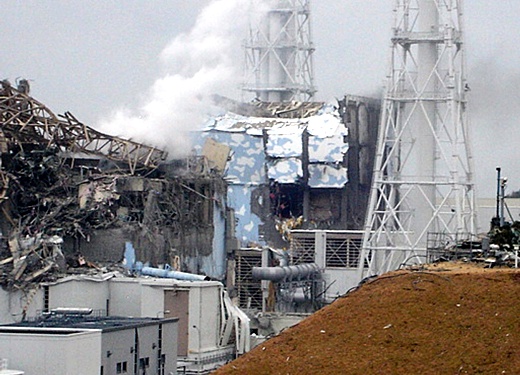
Image above: Fukushima Daiichi Reactors #3 and #4 after meltdown. From (http://sidewalksocial.wordpress.com/2011/03/26/nuclear-energy-vs-natural-gas/).
 
Japan is racing to gain control of the crisis at the Fukushima nuclear power plant. Where does the most detailed data come from?

Fukushima Daiichi nuclear power plant has had a nuclear disaster after the events of March 11 in Japan.Photograph: Air Photo Service/AFP/Getty Images

The 9.0 magnitude earthquake and following tsunami on March 11 has seen a rush by officials to gain control of power plants in the north-east of the country and have been under pressure to resolve the situation.

Today it has been revealed that studies show the nuclear leak could be double the estimated amount when the disaster first occurred. Justin McCurry writes:
"The amount of radiation released by the Fukushima Daiichi nuclear power plant in the days after the 11 March tsunami could have been more than double that originally estimated by its operator, Japan's nuclear safety agency has said.
The revelation has raised fears that the situation at the plant, where fuel in three reactors suffered meltdown, was more serious than government officials have acknowledged."
Last month The World Bank estimated the cost of the nuclear crisis at $235bn (£144bn) - making it one of the world's most expensive disasters.

The operators of the plant, Tokyo Electric Power (Tepco), announced record losses of 1.25 trillion yen (£9.5bn) as they struggle with the nuclear crisis still present. Tepco also announced last month that there is data that would indicate that during the immediate aftermath of the earthquake and tsunami, the fuel rods in three of the reactors had melted.

Although it may be some time after the radiation levels at the Fukushima Daiichi nuclear power plant rose: the severity level changed from five to seven - the same level as Chernobyl in 1986, the Fukushima plant is still being focused on as more information and images appear.

Fukushima nuclear power plant has been closely scrutinised as reports flow in on the progress of the situation - Japan's nuclear board previously raised the nuclear alert level from four to five in the weeks following the disaster and the JAIF warned of products such as dairy and spinach being restricted for shipping. Explosions and reports of nuclear fuel rods melting at the power plant have meant progress on the situation has been closely followed as has the environmental effects with concerns for marine life and spreading radiation through seawater. There were also concerns over radioactive dirt found in a school playground in Fukushima.

Industry body the Japan Atomic Industrial Forum are currently publishing daily updates of the status of power plants in Fukushima which give great detail into the condition of each reactor. Ranked from a level of low to severe, the update records the conditions of core and fuel integrity, water level and containment amongst other key information. These are some of the most in-depth and recent records and show how the crisis is being handled.

The table below shows the status of the reactors in the Fukushima Daiichi (the largest of the Fukushima power plants) and is colour coded to show the severity. Green for low, yellow represents high and red shows those of severe significance as judged by the JAIF. We have used JAIF's update 154 as of 12:00 local time as this is the most up to the minute data we can get. The format of these reports has changed as of 6th June 2011 and are now focused on countermeasures and only reactors one to four, therefore some of the details collated before are now unavailable. For full details you can download the report from JAIF.

A table of major incidents and accidents at the plants can be found in our spreadsheet as can the data for Daini, Onagawa and Tokai Daini Nuclear power stations. What can you do with this data?

For spreadsheet on Fukushima damage: (https://spreadsheets.google.com/ccc?key=0AonYZs4MzlZbdHY4aUJhUlY3Mnd0NVFJRXVidFYtR2c&hl=en#gid=92)


.

Big Island Agventures

SUBHEAD: Agro-tourism in Hawaii is tapping into the self-reliant locovore movement but it is still tourism.  

By Roberta Kruger on 4 June 2011 for TreeHugger - 
(http://www.treehugger.com/files/2011/06/agritourism-big-on-big-island-with-farm-to-table-agventures.php)

 
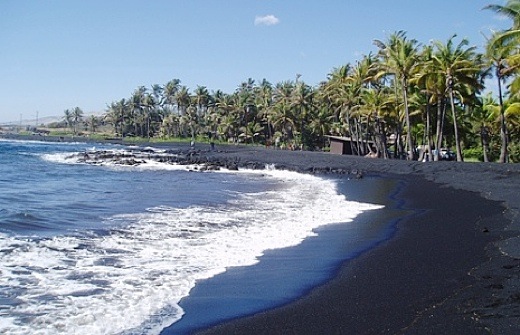
Image above: Not the oil-soaked Gulf Coast - it's Hawaiian lava black sands. Photo by Steve Cadman via Flickr. 
 
Salamanders zip by, wild flowers grow along the mountainside and a misty marine layer floats up from the Pacific. Sounds like it could be Hawai'i but it was Will Rogers State Park near Topanga Canyon where I took a hike recently and learned the latest about the Big Island.

While climbing to Inspiration Point, I remembered scrambling across moonscapes of volcanic lava rock previously and caught up on the current molten smoldering glow of Kilauea Volcano, plus news of its plentiful farmers markets and locally sourced eateries. Some recipes may wet your appetite:


While climbing the trail, I looked across the Pacific longingly at the islands and met Ann Shepphird who blogs for her Gardens-to-Tables website and has written extensively on Hawaiian agritourism and restaurants aboard the locavore movement. It's a natural way to eat in Hawai'i, as she says, they live in an "agricultural paradise!"

With the goal of sourcing 60 percent of its produce from certified local farms, thanks to the Hawaii Farm Bill 1471, Hawaiian chefs tap into farms, a goat dairy, fish companies, and their own gardens. Ann shares some chef's enticing recipes, like Apple Banana Kabucha Pumpkin Soup from the Fairmont Orchid, the Mauna Lani Bay Hotel & Bungalows' Grilled Vegetable Gazpacho with Hamakua heirloom tomatoes and watermelon, and Hamakua Mushroom Risotto from the Sheraton Keauhou Bay Resort. Try them with your own local ingredients.

Not-to-be-missed, the historic daily Hilo Farmer's Market is filled with papaya, mango and macadamia nuts, and coffee from the nearby Puna Coast. More than 200 local farmers and crafters sell their produce and wares. In season now is soursop with its pineapply, strawberryish and coconutty taste. There's also tropical fruits such as jackfruit, longan and rambutan, vegetables like taro and warabi (fiddlehead ferns), and exotic flowers from anthuriums to protea. Wash down a coconut pastry with an awa juice and pick up locally fished opihi or uhu.

Hawaiin ecotourism has played an important role in keeping the islands sustainable and Big Island Farm Bureau's Hawai'i AgVentures offers informative agri-tours of sustainable and family farms, tastings and harvests. There are 65 farm stop's on the Big Island (a/k/a Hawai'i), including the organic Honopua Farm and Waimea Lavender -- plus Natural Energy Laboratory of Hawai'i Authority's research of deep-ocean energy generation, whales and micro-algae farming.

The classic complaint about Hawaii is that the food is expensive. I realize it's a long way to the mainland for supplies, but still I've wondered why. Is it the little orchids decorating every plate instead of a sprig of parsley that ups the cost?

In a fertile and diverse environment with 11 of the world's 13 climates, ideal for farming, agriculture accounts for $1.9 billion of the local economy and the Big Island has 820,000 acres of the state's 1.3 million acres for agriculture, according to the University of Hawai'i, per Gardens to Tables. Much is exported but there's plenty of local fresh food to be had on the Big Island.

The east side of the Big Island doesn't offer long stretches of white sand beaches, but there's plenty of exotic black sand, lava tubes, waterfalls, and an endless to-do list from snorkeling to mountain climbs, landscapes from rainforests to jungles, World Heritage sites--Hawai'i Volcanoes National Park and the Marine National Monument.

And now my favorite island can be reached directly with United/Continental Airlines nonstops between Hilo and California, starting June 9 from LA/June 11 from San Francisco. Since direct flights are generally more energy-efficient, I'll skip hopping from Honolulu and Maui.

Also, you can stay at the solar powered guesthouse on the organic Kona Rainforest Coffee Farm where geese handle weed control and rain is harvested for the 41-acres where beans are picked, dried and roasted or the Ka'awa Loa Plantation and Guest Retreat on a 5.6-acre sustainable plantation.
 
When not eating, visit the lush Hāmākua Coast, pastoral Waipi'o Valley, hike up Maunakea, bike Kīlauea volcano -- if it doesn't erupt and temporarily cool off the planet while spewing.


.

The Sail Transport Network

SUBHEAD: For in today's post-peak oil world, millions of people may soon need sail power, along with pedal power transport.  

By Jan Lundgren on 4 June 2011 for Culture Change - 
 (http://www.culturechange.org/cms/content/view/734/1)

 
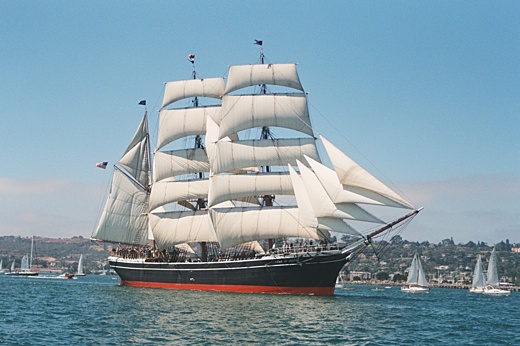
 Image above: The Star of India, built in 1863 is the oldest ocean going sailing vessel in the world. From (http://www.schoonerman.com/sailing_ships_s.htm).

 sail transport revival is afoot and afloat around the world. As the cheap, easy crude oil has mostly been extracted from the Earth and spewed into the sky and water, the desirability and economics of sail power get stronger.

Sail Transport Network (STN) is an open project for almost anyone to participate in. Most of the inhabited world is coastal or on rivers. STN was put forward originally by Culture Change in 1999. We sail-transport activists envision linking coastal communities, islands, and river communities together sustainably -- without the extreme petroleum dependency we have known.

Post-petroleum travel and shipment of goods are about communication and exchange that we might have a hard time doing without. Long distances may be bridged only by sail in the fairly near future. However necessary this might be, sail power will allow any local surpluses to be traded. This helps specialized areas gain diverse sources of needed products, skills, heirloom seeds, etc.

A few years ago sail transport was thought to be off on the distant horizon and impractical in the "real world." This is changing rapidly.

Without the continuity of affordable oil supplies -- a toxic and planet-warming commodity whose use has greatly afflicted the world's ecosystems and peoples -- arrangements to go oil-free need to be made immediately. For in today's post-peak oil world, millions of people may soon need sail power, along with pedal power transport, for local self-reliance.

Our STN website does not yet tell of the rapidly developing planning for sail transport that excites my colleagues, fellow sailors and me. This report is our latest thinking for you to consider. It is the result of our investigations into opportunities for truly sustainable, renewable wind power and human power for certain products as well as for benefits such as sharing information and enabling education.

A look at SailTransportNetwork.com presently features the Dutch concern Fair Transport, a sail transport group whose schooner recently took a cargo of rum from the Caribbean to Holland. Please check the website's other projects, news, positive press on STN, and join our listserve for active communication online.

In this report I lay out the ideas and initiatives brewing on Sail Transport Network. They may earn your optimism, as they offer humanity a realistic way to reduce carbon emissions immediately. Let us take a big step toward emancipating ourselves from horrific oil dependence. A study in the UK found that 16 cargo vessels spew the equivalent of the world's entire "fleet" of cars' air pollution. We cannot just throw up our hands and wait until "they" think of something. The time is now to act and reclaim our future.

Lest one imagine that sail power is premature or just idealistic, let economic reality speak: cargo container ships have slowed down to an average of 15 knots, the speed of the clipper sailing ships of 150 years ago. This historic development saves on increased oil costs.

"
Global greenhouse-gas emissions are at an all time high. How smart is society's vaunted economic growth and job generation, when global corporate trade based on strategic, dwindling supplies of oil threatens life as we know it? How will people cope when the "energy slave" known as crude oil and refined petroleum are suddenly unavailable? The energy power of a single barrel of oil equals all the power a bicyclist can generate in several year's time.

Before you despair too much, know that there are things we can still do about the climate trend and petrocollapse. And, fear not ye denizens of northern nations, for coffee, cacao and cigars may be extended for your pleasurable habits and benign addictions, thanks to sail voyages from the tropics.
The reason for revealing the following projects' announcements -- some projects are merely on the drawing board -- is that we wish to spread the word now instead of waiting and sitting on a good thing that should be shared.

The more the merrier! Join with sailfolk hoisting halyards and fonding tillers, and with "foodies" who pedal local produce. We of many diverse skills and interests are getting together for a measure of food security, passenger service, and transporting goods. Our efforts may not serve more than an extremely modest portion of the present economy. But the bioregional economies of tomorrow will rely on sail power for a crucial amount of trade and travel.

The questions of profit margins, economic efficiency, break-even points, and subsidies all come up when we brainstorm to assess what is doable now for sail transport. The main uncertainty is the up-and-down price of oil. Subsidies for oil have been massive, so what about subsidies now for sail transport? Will sail transport have to wait to be on a large scale only when oil-based freight cost is much, much higher in price? No. We can shape the future now.
A few examples of new local initiatives:
• Sail-ferry service between Monterey and Santa Cruz, California can enjoy a niche advantage today. Note that it can take less time to sail across the Monterey Bay than to take the public bus system. Such a sail transport service can easily extend north to include the San Francisco Bay. Already, wine is sailed from Petaluma to the SF Peninsula.
• Speaking of other fun liquids, a brewery downstream of Portland, Oregon will be receiving malted grain by sailboat and enabling beer-keg distribution by sail and pedal power.
Across oceans:
• China has great potential to dive into sail transport as a fast growing sector. As the nation is the top solar panel maker in the world, and plastic bag waste has been consciously and hugely cut back, we should think of China as forward-thinking. China is fortunately still heavily bicycle friendly, which will aid sail transport by connecting people and products pedaled to and from the docks. Peak oil and climate protection are major concerns in China. A top financial and political newspaper, the Shanghai Oriental Morning Post, ran an extensive interview of me on May 6, and in it I spoke of our mutual concerns and dreams that may help lay groundwork for a sail revival in the western Pacific and beyond.
• The entire Pacific Rim, with its currents called gyres, and the helpful trade winds, is a once and future sail transport environment of major importance. An international sail transport conference needs to be held in the near future, perhaps in Hawaii as a central location. Representatives from various countries can convene to share their knowledge and advance the cause. Attendees who arrive via sailboat or outrigger canoe will get a double lei (no double entendre intended). At the conference STN projects under discussion can be manifested in various forms: new shipping companies, expanded eco-tourism, passenger service, green jobs generation, energy saving and pollution abatement, and communication such as cultural exchange.
Many boats are already available for sail transport, in part because they are low-cost compared to new cars. Meanwhile, some new, large boats must be designed and built too, and this is already underway. A potential STN supporter can make a donation of his or her boat's time for STN's use, resulting in a tax deduction. Likewise, a charitable gift of a boat for the Sail Transport Network or related nonprofit entity can help this movement on its way. Existing as well as new boats need to be outfitted with gear and crew. (Please see our wish list at the first link at bottom.)

Biodiesel/veggie-oil engines and electric motors as auxiliary for sailboats are available. Renewable energy charging through solar and wind systems help, as does regenerative propeller charging at sea. Gathering information on the best models, their installation and cost needs to be done for the network to share. The role of the sculling oar may become surprisingly significant.

As with the marine research vessel Alguita, the catamaran sailboat made famous by Captain Charles Moore (who displays the STN burgee), sailboats can do important research such as on the presence and source of plastic plaguing the sea and its creatures. Another contribution to the common good is for sailboats to be available for emergency rescue if oil for the Coast Guard boats is unavailable. Indeed, saiboats might have to rescue Coast Guard "sailors" at sea.

The possibilities for Sail Transport Network are so awesome that I am more excited about the potential than anything I can imagine, short of kicking back in a perfect ecovillage by a beautiful cove.

Interns and volunteers are being sought to help implement STN plans, and integrate them with academic advancement, job possibilities, fund raising, and logging hours at sea. Please contact us ( info@culturechange.org ), and sign up for the listserve [never mind the technical lingo "private information" that is simply our STN description].

Making a donation toward STN development will help Culture Change and STN spread the word about the growing movement: sail transport networking. Thank you for your participation in any way.

See also:
Island Breath: Future of Ocean Sailing - Dmitry Orlov 1/15/08
Island Breath: Rethinking the Sail 12/25/07 .

A Heads Up

SUBHEAD: We'll be heading for a trip to the mainland and will be unable to post to the website from Tuesday until Thursday.  

By Juan Wilson on 6 June 2011 for Island Breath - 
(http://islandbreath.blogspot.com/2011/06/heads-up.html)


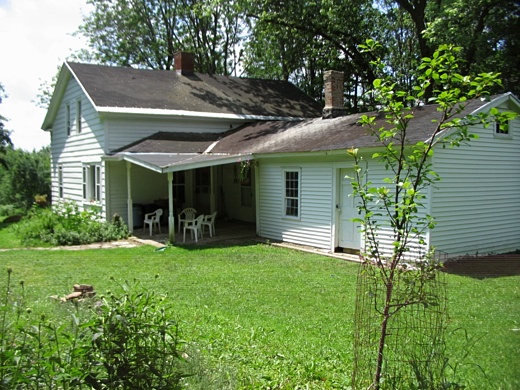
Image above: A view of the back of The Farm in Panama, New York. Photo by Juan Wilson in 2008.


Linda Pascatore and I head for the mainland on Wednesday. We'll be leaving our chickens, vegetable, fruit trees and cat to a caretaker staying in our home. Given the fragility of the world economy as well as the price of oil we expect that this may be the last time we'll be able to get back to remote western New York state.

We have lots of things to take care of if that's true. When we first moved to Hawaii we thought we might spend half the year on Kauai and half in Chautauqua County, NY. Our plan was July-January in NY and February-June in HI. Well that never happened. We knew that couldn't really fly until Linda retired from the DOE here.

In the early 2000's We did spend our summers back in the woods of the Amish country that is the western tip of the Empire State. We simply called the place The Farm, as my grandmother, my mother and now my kids do. We even had a dog and a couple of cats that our renters took care of while we were here. - Ah - the renters.

That was one reason we pull off the snowbird life. We needed someone staying in our place back on the mainland when we were on Kauai, but we didn't want them there while we were. It was hard to find renters that didn't mind being displaced for eight weeks a year. Few did more than one tour of duty. That problem was mirrored on Kauai.

We needed people to stay in our Hanapepe house and take care of things. Often time that meant people staying for free and us paying to keep both places up and running. That gets increasingly difficult form a distance, and will only get worse. We intend to consolidate our efforts of resilience and sustainability here on Kauai.

It's going to require jettisoning a lot of our old lives and reducing four generations of our past into a 1/4 of a 20' shipping container. I'm not looking forward to the triage. Anyway, once past the overseas trip we have to get a car registered and running, pick up a DLS modem, install it and get our laptop up on a wireless network.

Once that's in place we'll be back online with new material for Island Breath. For continued coverage of the birthing of a self relient Hookahi Kauai we need you, who will be on island, with your observations. Please let us know what's going on - KIUC, FERC, DLNR, PMRF, GMO's - whatever.

Email juanwilson@mac.com or
lindapascatore@me.com.

We'll be there. .

Sweet Justice

SUBHEAD:Homeowners wrongly foreclosed on foreclose on Bank Of America. By Staff on 5 June 2011 for Huffington Post - (http://www.huffingtonpost.com/2011/06/05/homeowners-foreclose-on-bank-of-america_n_871540.html) Image above: Demonstrators against Bank of America. From (http://understory.ran.org/2008/07/11/%E2%80%9Cbillionaires-for-coal%E2%80%9D-defend-bank-of-america-investments-in-mountain-top-removal/).

Sweet justice.

That's how foreclosure defense attorney Todd Allen described the feeling of going to a Bank of America branch in Naples, Fla. to seize their assets.

Faced with a pair of sheriff's deputies locking down his building, the branch manager capitulated and handed over a check for $2,534. The sum was to cover Allen's fees from a case where he represented clients that the bank had tried to foreclose on -- despite the fact that they paid for their home in cash.

According to the News-Press in Fort Myers, Bank of America opened their case against Warren and Maureen Nyergers in February of 2010 and voluntarily dropped it two months later, but never coughed up for the couple's legal fees as ordered by a judge.

North Carolina's WFMY has the details on how justice was served:

Sheriff's deputies, movers, and the Nyergers' attorney went to the bank and foreclosed on it. The attorney gave instructions to to remove desks, computers, copiers, filing cabinets and any cash in the teller's drawers.

After about an hour of being locked out of the bank, the bank manager handed the attorney a check for the legal fees.

Video above: Video coverage of foreclosure by WINK-TV (http://www.youtube.com/watch?v=3ctLEGrOmf4) .

Where to from Here?

SUBHEAD: Raul Ilargi Meijer and Nicole Foss (Stoneleigh) announce changes for Automatic Earth.

 By Ilargi & Stoneleigh on 5 June 2011 for the Automatic Earth - (http://theautomaticearth.blogspot.com/2011/06/june-5-2011-where-from-here.html)
 
Image above: The logo of automatic Earth - North Pole Sun Moon. From (http://s243.photobucket.com/albums/ff223/dbzgirl2234/?action=view&current=north-pole-sun-moon.jpg).

Ilargi:
Unemployment numbers on the one hand, and home sales and prices on the other, are the by far most important trend indicators for the US economy. Without falling unemployment, in combination with rising home sales and prices, there can be no recovery.

And a jobless recovery is no more real than a homeless one. Trillions upon trillions in wealth, capital, earning potential, that belongs to our children and grandchildren, has served only to temporarily soften the deterioration in economic indicators.

This has provided us with an entirely illusory picture, greatly helped along by politicians and media pundits, which serves to make people believe what they want so much to believe: that things have been, and are, getting better.

We can all understand that if you ignore the millions of Americans who drop out of what the government defines as the "looking for work" category, and that if millions of -often foreclosed- homes that sit empty are not put on the market, the indicators will look less detrimental. We understand this.

Still, we all do follow the "polished" numbers, because they are the ones that make the headlines. And if even the polished data start looking bad, there's never a shortage of pundits to tell us it's all just a temporary blip on the road to recovery. All we really need to do, goes their -often unspoken- message, is to look at the stock markets, which are doing just fine.

Or the price of gold, copper, or food commodities. But the largest investors in these items are the very financial institutions that have received your children's money to invest, play, and gamble with. They don't have to fess up their losses, say our invented-on-the-fly accounting "standards", but instead the house supplies them with more and new money, in order to keep the game going. The house doesn’t want the game to stop, because the house is the game.

The house isn't about to shut its doors, and its elected puppets aren't about to join the ranks of the unemployed, as long as access to the capital and earning potential of future generations is available. That is where the financial crisis has long since become a political one. Right there.

In the bankers, industrials and politicians' access to the -fast rising, re: the deficit- interest your children will have to pay on their labor.

The Greeks, Spanish and Egyptians seem to understand this dynamic much better than do Americans, but then the PR industry in these countries is a lot less sophisticated than that in the US. Still, this should be no excuse. It is glaringly obvious, so much so that nobody, when put to the question, will attempt to deny it: there can be no economic recovery with falling home prices and rising unemployment.

There can be a period of confusion, especially when gargantuan amounts of public money are transferred to the private sector; indeed, we have witnessed such a period in the past two years. Confusion sown by tax incentives for homebuyers, for instance, but most of all by manipulation of the data.

By mortgage modification initiatives that are as dead in the water when they start as they turn out to be down the line.

By job creation programs that strip down hourly wages and benefits until what's left is not even enough to feed and house an individual, let alone a family.

By pushing millions of would be workers off the back of the employment truck, and hoping they’ll never be heard from again; even if they are, at least for now they don't show up in the stats anymore.

And don't let's forget: there's always an election somewhere coming up that trumps the interests of those who will vote in it, and those who elect not to. So where to from here? The BLS unemployment report on Friday was once again dismal.

There was supposed to be a lot of growth in the job market that had long since been forecast by the usual suspects, but hasn't materialized. Temporary blip, says White House economist Austan Goolsbee. Just a bump in the road. Looks like the road is nothing but a bump.

Even if the official U3 number went up "only" to 9.1%, and U6 even fell a notch, unemployment duration went up again, and that's a big one. It’ll take many years for the labor market to get anywhere near "normal" numbers, and even then, and even IF it does, it will look nothing like what we have become used to over the past decades. The situation where we had good wages, and strong benefits, will never return, or at least not for decades. For that situation to occur, you need an economy with a solid manufacturing base, with near full employment, and with home prices that are available and affordable for Joe and Jane Main Street with their average salaries.

But homes have only been affordable for Joe and Jane off late because the Federal Reserve and the government pushed down interest rates and made huge amounts of credit available (re: Fannie and Freddie). Ironically, though, these policies pushed up home prices to levels where they were no longer affordable.

And just as ironically, this means that Joe and Jane and all of their families and friends now owe trillions of dollars more to the banks than before Greenspan and Rubin and Summers et al. injected US society with financial steroids.

All these every day Americans may not all realize it yet, but then, home prices are only down 33% so far. Just wait for the real plunge. It’ll come. Soon enough. Pending home sales came in down 11.6%, 27% for the year. Just follow the money. As it vanishes. Where from here?

Looking at all the week's awful stats, it should be clear that a return to business as usual, in case this wasn't clear yet, is out of the question. You need to find a way to make sure your elected leaders', and their financial leaders', fingers, no longer have access to your kids' cookie jars and piggy banks. That is pivotal.

It's also the hardest part; you'll have to snatch it from their cold dead fingers, since it's the biggest prize out there to be had. An infinite claim on the future, which pays out today: the rewards of multiple generations worth of labor used to pay off the gambling debts of the past and present.

There is nothing more perverse than that. We will have to mark down all assets, including our homes, to their present market value. A value that, moreover, will go down enormously simply because we do the marking down. If we don't do it now, it will happen later anyway, but it will then occur beyond our control. Better to keep our hands on the pulse, no matter how painful the experience may be.

And it's from that point that we will have to try and rebuild. It's not going to be fun, not by a long shot, but it'll be our own "not fun", not something contrived for us by psychopaths and perverse narcissists who care not whether we live or die.

Ilargi: Because of all the thoughts, trials and tribulations described above, as well as through the past 3.5 years of The Automatic Earth in its present form, Stoneleigh and I have decided that it's time to change things around here.

Observing the shenanigans of the financial and political world inevitably turns to rubber necking and accident tourism, and we feel it's time to talk more about what comes after the present, what we can supply people with that can help them when what we are witnessing today snaps out of this suspended animation and starts its way down into the gorge for real.

We will continue to comment on the economy, but we will also add sections to our new site on for instance preparation, in all its diverse forms, from growing and preserving food to building homes and energy facilities to keeping your remaining wealth where it counts. In short, all that will serve to make people less dependent on the crumbling infrastructures they presently rely upon. We invite anyone who thinks they can contribute to contact us.

We’ll fill you in on the details as we go along. It may take a while longer to get all the pieces to fit into place, but they will be there. In order to make that happen, we do something today that we haven't done for a long time: launch a fund drive. People have been very generous with their donations in the past, and it's thanks to them that we have been able to do what we have done, and to contemplate doing just that, but more and better.

In order to achieve this, we need a stable funding base; it is the only way we can make future -financial- commitments involved in everything a larger and more elaborate site requires. We have been thinking about setting up a members sections at TAE for this purpose, and we may have to go that road at some point.

However, if enough people sign up for recurring donations, which for members -if we would be forced to go that route- would be maybe $10 per month, we may not need to do this, which would be a relief: it's not really what we're about. We've set the goal for this Summer Fund Drive at $50,000.

We know that may seem like a lot of money to some, but believe me, it's really not; not for what we have in mind. There are several ways to support the Automatic Earth:

One-time donations and recurring donations via Paypal, donations through other means, visits to our advertisers (that’s why they're there!), and clicking on the Amazon box with Stoneleigh’s book favorites in the left hand bar: if, for any Amazon purchase you make, not just those books, you go through their box at TAE, we get a percentage of what you purchase without any extra cost to you. That should be easy... As I said, we will explain -much- more soon. First, here's Stoneleigh's own personal message for you:

Stoneleigh:
This summer The Automatic Earth marks three and a half years of big picture commentary on finance, energy, the environment, resources, carrying capacity, geopolitics, the psychology of herding behaviour, networked systems, crisis preparedness and anything else we have considered to be relevant to helping people to navigate the tumultuous times we are poised to descend into.

While there are many sources of information on single aspects of our predicament, there are few that attempt to truly tackle complexity and render it comprehensible. That is our chosen role and we see it as being of the utmost importance.

The consequences of ponzi finance on the global scale, the peaking of the energy supply that has been our lifeblood as a civilization, environmental degradation and ecological overshoot are set to manifest in our times, and we need to understand what is unfolding in order to minimize the impact on ourselves, our loved ones and our societies. The Automatic Earth focuses first on finance for reasons of timeframe.

As the resumption of financial crisis looms, and bubbles can burst very rapidly once a critical momentum to the downside is reached, people must address the issues of debt vulnerability, control over the essentials of their own existence and capital preservation in order to retain their freedom of action to deal with the other challenges to follow.

However, we must not lose sight of the larger context. Humanity faces an intractable and thoroughly multi-faceted predicament, with no means to continue a busines-as-usual scenario. As the top down structures we have built, which are structurally dependent on cheap energy and cheap credit, begin to fail, we must construct new means of supporting ourselves from the bottom up - at a human rather than an industrial scale.

These community initiatives will need to be funded, and that requires capital to be rescued and preserved for the purpose, rather than allowing it to disappear into a giant black hole of credit destruction or end up entirely in the the hands of the very few.

The Automatic Earth attempts to provide the information ordinary people need to accomplish this critical task. We also exist to warn people as to the dangers of the darker side of human nature that typically manifests when there is not enough to go around, especially when that circumstance can manifest rapidly. When fear and anger are in the ascendancy, societies can turn in directions that benefit no one but a handful of manipulative predators.

One of our goals is to minimize the tendency for people to become embroiled in movements that feed such interests, and maintain a focus on the constructive activities that will be absolutely essential if we are to mitigate the pain of a major economic depression. Fear and anger are extremely 'catching', hence we regard what we do as providing a 'psychological inoculation' against them.

We feel we have a very important role to play in providing the intellectual and emotional tools that people will need in the unstable times that are coming, and we have chosen to undertake that through the vehicle of The Automatic Earth. In order to maintain and expand an endeavour that requires two people to make a full time commitment to the project, and others to play supporting vital roles, we need to develop and maintain a stable funding base.

For this reason we will soon be making a number of changes to our site and the way it is run. We have secured the programming services needed to develop an expanded and more flexible site, outside of the constraints imposed by blogspot, that will be able to offer greater value to our readers.

We will need to maintain programming services and deal with other costs of a more ambitious endeavour. Today we are instituting a summer fundraising drive in order to take

The Automatic Earth to the next level. We ask you to support our efforts on your behalf, so that we can continue to bring you the biggest possible big picture, and help you to navigate the challenges to come.

 .

FERC on Lanai, Maui & Kauai

SOURCE: Ken Taylor (taylork021@hawaii.rr.com)
SUBHEAD: Spate of FERC hydro project permit applications by U.S. mainlanders are causing a stir.

By Sophie Cocke on 3 June 2011 for pacific Business News -
(http://www.bizjournals.com/pacific/blog/2011/06/spate-of-hydro-projects-causing-a-stir.html#ixzz1OMoDjnMf)


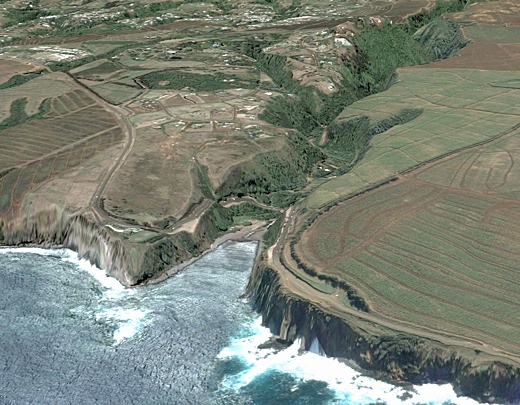
Image above: View looking south-west of Maliko Gulch on Maui. Site of a FERC permit application. From GoogleEarth.


There hasn’t been much talk about hydropower as the state works to transition away from oil to locally produced, renewable sources of energy. But a recent spate of proposed hydro projects have, for better or worse, been causing quite a stir. And in large part it’s because Mainland companies have been filing applications for preliminary permits for hydro projects with the Federal Energy Regulatory Commission. Federal oversight of Hawaii’s waterways was fought vigorously by the state two decades ago, with mixed results.

But in the end, three proposed projects on Kauai didn’t move forward. The pushback was centered in large part over concern that federal regulators didn’t have the specialized knowledge of local waterways and ecosystems to make decisions such as how much water can be diverted from a stream or river to turn a turbine without having harmful environmental impacts. On Kauai, where executives of the Kauai Island Utility Cooperative are hoping to make small hydro projects a cornerstone of the island’s transition to renewables, this issue has presented a stumbling block.

A company called Free Flow Energy, based in Boston, filed six permits with the federal agency to develop hydro projects on Kauai, which the utility has now assumed control of, and is working in conjunction with the company to develop. David Bissell, CEO of the KIUC, has made strong arguments for why these projects are a good source of energy for the island, providing residents with low-cost, stable rates for years to come. And he has expressed a commitment to ensuring that they are carried out in ways that don’t harm the fragile waterways. But the strategy of going through FERC to develop the projects has not proven a smooth one, with some members of the community, and now state agencies, sounding alarm bells.

But the more startling hydro projects have been ones proposed for Maui and Lanai. Not only are they huge in scale, the Mainland developers who filed the applications through FERC don’t seem to have much knowledge of the local landscape — topographical or political. Idaho resident Matthew Shapiro filed an application for a 57-acre pumped storage hydro project on Lanai that would ideally work in tandem with the Big Wind project. The technology of the proposed project is in and of itself intriguing. With the benefit of a 1,700-foot drop, seawater would be pumped upward and then released back down to drive a turbine to generate electricity.

There’s only one other project like it in the world — a 30 megawatt plant in Okinawa, according to Shapiro. The project on Lanai would be 10-times the size, turn the wind energy into a reliable source of electricity and the cost to ratepayers would be marginal, according to his plan. But it hasn’t gotten much traction. Not from Castle & Cooke, which has publicly said that they have no relationship with his company, and not from Hawaiian Electric Co., whose officials Shapiro said weren’t returning his calls. He described the lack of response as “puzzling.”

Part of the problem could be that Shapiro, as he told PBN, had never been to Lanai, or Hawaii, and never consulted with local officials before filing the application, which is still pending. While he described the project to PBN as “quite small,” for local residents it doesn’t seem so modest. Lanai resident Robin Kaye told PBN that the project would encompass “a very, very large area in a very accessible part of the island — right in the middle of a hunting ground.” “It’s a huge project, and it came out of the blue,” said Kaye. “We were as stunned as everyone else.”

 On Maui, two proposed projects by the same developer — one which would dam up the Maliko Gulch on the North Shore and a second on the west side near Lahaina, aren’t going over so well, either. As on Lanai, residents and local officials found out about the projects when legal notices were filed in newspapers. Doug McLeod, Maui’s energy commissioner, told PBN that the project on Maliko Gulch was “the single worst idea we have seen in a long time” and that “we’d like to see it die an early death.”

Rob Parsons, executive assistant to Maui‘s mayor, Alan Arakawa, said the project on the west side, which proposes to use wastewater, could potentially be a very good idea. But he said “it’s just perplexing that these things would go forward without any communication with anyone locally. A few phone calls could have helped smooth things out,” he added.

 .