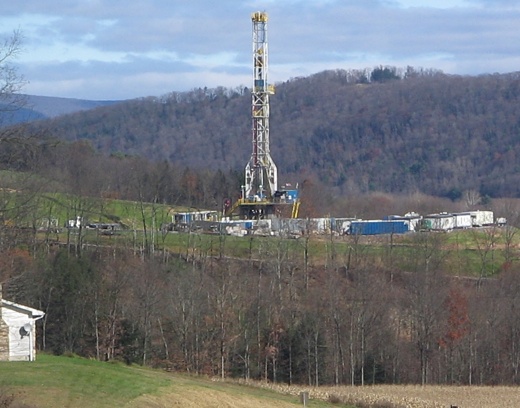
 Image above: Tower for drilling horizontally into the Marcellus Shale Formation for natural gas, from Rt 118 in Lycoming County, Pennsylvania. From (http://en.wikipedia.org/wiki/File:Marcellus_Shale_Gas_Drilling_Tower_1_crop.jpg).
The official shale gas story goes something like this: recent technological breakthroughs by US energy companies have made it possible to tap an abundant but previously inaccessible source of clean, environmentally friendly natural gas. This has enabled the US to become the world leader in natural gas production, overtaking Russia, and getting ready to end of Russia's gas monopoly in Europe. Moreover, this new shale gas is found in many parts of the world, and will, in due course, enable the majority of the world's countries to achieve independence from traditional gas producers. Consequently, the ability of those countries with the largest natural gas reserves—Russia and Iran—to control the market for natural gas will be reduced, along with their overall geopolitical influence.
Image above: Tower for drilling horizontally into the Marcellus Shale Formation for natural gas, from Rt 118 in Lycoming County, Pennsylvania. From (http://en.wikipedia.org/wiki/File:Marcellus_Shale_Gas_Drilling_Tower_1_crop.jpg).
The official shale gas story goes something like this: recent technological breakthroughs by US energy companies have made it possible to tap an abundant but previously inaccessible source of clean, environmentally friendly natural gas. This has enabled the US to become the world leader in natural gas production, overtaking Russia, and getting ready to end of Russia's gas monopoly in Europe. Moreover, this new shale gas is found in many parts of the world, and will, in due course, enable the majority of the world's countries to achieve independence from traditional gas producers. Consequently, the ability of those countries with the largest natural gas reserves—Russia and Iran—to control the market for natural gas will be reduced, along with their overall geopolitical influence.
If this were the case, then we should expect the Kremlin, along with Gazprom, to be quaking in their boots. But are they? Here is what Gazprom's chairman, Alexei Miller, recently told Süddeutsche Zeitung: “Shale gas is a well-organized global PR-campaign. There are many of them: global cooling, biofuels.” He pointed out that the technology for producing gas from shale is many decades old, and suggested the US turned to it out of desperation. He dismissed it as an energy alternative for Europe. Is this just the other's sides propaganda, or could Miller be simply stating the obvious? Let's explore. I will base my exploration on Russian sources, which is why all the numbers are in metric units. If you want to convert to Imperial, 1 m3 = 35 cubic feet, 1 km2 = .38 square miles, 1 tonne = 1.1 short tons).
The best-developed shale gas basin is Barnett in Texas, responsible for 70% of all shale gas produced to date. By “developed” I mean drilled and drilled and drilled, and then drilled some more: just in 2006 there were about as many wells drilled into Barnett shale as are currently producing in all of Russia. This is because the average Barnett well yields only around 6.35 million m3 of gas, over its entire lifetime, which corresponds to the average monthly yield of a typical Russian well that continues to produce over a 15-20 year period, meaning that the yield of a typical shale gas well is at least 200 times smaller. This hectic activity cannot stop once a well has been drilled: in order to continue yielding even these meager quantities, the wells have to be regularly subjected to hydraulic fracturing, or "fracked": to produce each thousand m3 of gas, 100 kg of sand and 2 tonnes of water, combined with a proprietary chemical cocktail, have to be pumped into the well at high pressure. Half the water comes back up and has to be processed to remove the chemicals. Yearly fracking requirements for the Barnett basin run around 7.1 million tonnes of sand and 47.2 million tonnes of water, but the real numbers are probably lower, as many wells spend much of the time standing idle.
In spite of the frantic drilling/fracking activity, this is all small potatoes by Russian standards. Russia's proven reserves of natural gas amount to 43.3 trillion m3, which is about a third of the world's total. At current consumption rates, that's enough to last 72 years. Russian gas production is constrained by demand, not by supply; it is currently down simply because Eurozone is in the midst of an economic crisis. Meanwhile, US production has surged ahead, for no adequately explored reason, crashing the price and making much of it unprofitable.
Let's compare: Gazprom's price at the wellhead runs from US$3 to $50 per thousand m3, depending on the region. Compare that to shale gas in the US, which runs from $80 to $320 per thousand m3. At this price, the US cannot afford to sell shale gas on the European market. Moreover, the overall volume of shale gas being produced in the US, even given the feverish drilling rate of the past couple of years, if cleaned up, liquified, and shipped to Europe in LNG tankers, would not be enough to book up just the LNG terminal in Gdańsk, Poland, which is currently standing idle. It seems that Gazprom has little to worry about.
The US, on the other hand, does have plenty to worry about. There has been much talk already about groundwater pollution and other forms of environmental destruction that accompanies the production of shale gas, so I will not address these here. Instead, I will focus on two aspects that are just as important but have received scarcely any attention.
First, what is shale gas? Ask this question, and you will be told: “Shut up, it's methane.” But is it really? The composition of shale gas is something of a state secret in the US, but information about the gas produced from the nine Polish shale gas test projects did leak out, and it's not pretty: Polish shale gas turned out to be so high in nitrogen that it does not even burn. Technology exists to clean up gas that is, say, 6% nitrogen, but Polish shale gas is closer to 50% nitrogen, and, given high production costs, low yields, rapid depletion and low wellhead pressure, cleaning it up to bring it up to spec (which is 1% nitrogen) would most likely result in a net waste of energy.
Even if shale gas is low enough in nitrogen to burn, the problems do not end there. It may also contain hydrogen sulfide, which is toxic and corrosive and has to be removed before the gas can be stored or injected into a pipeline. It probably contains toluene and other organic solvents—ingredients in the fracking cocktails—which are carcinogenic. Lastly, it may be radioactive. All clays are mildly radioactive, and shale is a sort of heat-treated clay. While Barnett shale is not particularly radioactive, Marcellus shale, which has recently been the focus of frantic drilling activity, is. Thanks to Marcellus shale gas, radioactive radon gas is being delivered directly to your kitchen, via the burners of your stove, or to a power plant smokestack upwind from where you live. This is expected to result in increased lung cancer rates in the coming years.
Second, why is shale gas being produced at all? Natural gas prices have fallen through the roof, and are currently around $2 per thousand cubic feet. This works out to around $70 per thousand m3. If shale gas costs from $80 to $320 per thousand m3 to produce, it is unclear how one might make any money with it.
But perhaps making money with it is not the point. What if shale gas is just a PR campaign (with horrific environmental side effects)? Going back to what Alexei Miller said, what if the entire point of the exercise was to increase the capitalization of shale gas exploration and production companies? The number one company in shale gas is Chesapeake Energy, the owner of the Barnett basin and a major player in the Marcellus basin. This company almost went bankrupt in 2009, but then managed to claw its way back to profitability in 2010 and 2011 by drilling, and drilling, and drilling, and then drilling some more. Sixty percent of their revenue is from drilling operations. And now there is a scandal involving Chesapeake Energy's (former?) chairman, Aubrey K. McClendon, who apparently awarded himself a stake in each well his company drilled, used them as collateral for billions in loans, and used the loans to bet that natural gas prices will go up (they haven't). In the meantime, natural gas drilling rig count has dropped to a ten-year low. Given that shale gas wells deplete very quickly, it looks like the shale gas boom is over.
But now that it's over, what was it, exactly? It appears to have been something like the dot-com bubble: companies with no conceivable way of turning a profit using hype to attract investment and drive up their valuations. Since 2008, various kinds of hype-based market manipulations have become the staple of economic life in the US, and so this is nothing new or different.
One interesting question is, What sort of bubble will the US attempt to blow next, if any? There is the Facebook IPO coming up. Facebook is a ridiculous time-waster and, as such, seems a bit overpriced. Are we going to attempt blowing up another dot-com bubble? Another round of subprime mortgages does not seem to be in the works. What's a bubble boy to do? If there are no more bubbles to blow, then it's back to just plain printing money.
So this whole shale gas thing didn't work out as planned, did it? But could it have? Had it turned out to be much better in every way, could it have swung geopolitical influence away from Russia and Iran and back toward the US? Alas, no.
You see, there is no such thing as a global natural gas market. Yes, there are some LNG tankers sailing about, but that is very much a point-to-point trade. There is a closed North American market, a European market, and another market in the Asia-Pacific region. These markets do not interact. The North American market and the European market could have potentially shared just one producer: Qatar. Qatar once wanted to export LNG to the US, but then decided to export it to Europe instead, generating less of a loss, because European gas prices are substantially higher. And the reason Qatar is dumping natural gas in Europe is because it has gas to dump: its northern gas field is a very “wet” field, with a substantial percentage of natural gas condensate. Qatar's OPEC quota is 36-37 million tonnes of oil per year, but natural gas condensate is not considered to be oil and is not covered by OPEC quotas. Exploiting the condensate loophole allows Qatar to export 65.7 million tonnes: 77% over quota. The LNG is just concomitant production, and Qatar can afford to export LNG to Europe at a loss. This is a juicy bit of trivia, but really something of a footnote: an exception that proves the general case: there is no global natural gas market.
There is still, however, a global American disinformation and PR hype market, although this too is changing. The view from Russia is that it is pretty clear what this was all along: American propaganda and financial shenanigns. Nothing to see here, people, keep moving.
.