Showing posts with label Travel. Show all posts

Hawaii judge halts Trump travel ban

SUBHEAD: Judge says executive order was issued with a purpose to disfavor a particular religion.

By Rui Kanyena on 16 March 2017 for Civil Beat-
(http://www.civilbeat.org/2017/03/hawaii-judge-to-rule-on-challenge-to-travel-ban-before-it-takes-effect/?mc_cid=e810ff9805&mc_eid=28610da3ab)
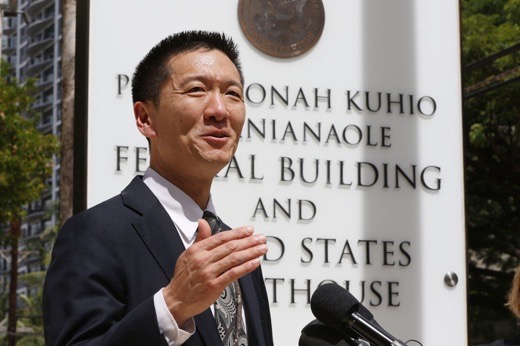

Image above:  U.S. District Court Judge Derrick Watson in front of the US Federal Court in Honolulu, Hawaii speaks to media about his ruling on Trump travel ban. From original article.

In a case of legal deja vu, President Donald Trump’s new executive order on immigration suffered a major setback Wednesday, when a federal judge in Honolulu issued a temporary restraining order to keep the travel ban from taking effect nationwide.

n a 43-page opinion, U.S. District Court Judge Derrick Watson ruled that Hawaii met the “burden of establishing a strong likelihood of success on the merits” of its claims against the travel ban — which suspends refugee resettlements and temporarily halts the issuance of new visas to citizens of six Muslim-majority countries.

“A reasonable, objective observer — enlightened by the specific historical context, contemporaneous public statements and specific sequence of events leading to its issuance — would conclude that the executive order was issued with a purpose to disfavor a particular religion, in spite of its stated, religiously neutral purpose,” Watson wrote.

Watson’s ruling was a resounding victory for Hawaii, which mounted the first legal challenge against the new order on grounds that it unconstitutionally targets Muslims and discriminates based on national origin.

Hawaii Attorney General Doug Chin, who first sued the Trump administration in February to challenge the original travel ban, hailed the ruling.

“This is what the checks-and-balances system is all about,” Chin said. “The president might make certain decisions, but the way our government works, we also need to be able to take our own stance to check and balance out that whole process.”

Watson’s ruling was also the second major setback for Trump, who has long argued that the travel ban is necessary for national security.

Trump’s original travel ban, issued January 27th, triggered a flurry of legal challenges across the country and ended in a defeat at the 9th U.S. Circuit Court of Appeals, whose three-judge panel unanimously upheld an injunction issued in Seattle.

Speaking at a rally in Nashville, Tennessee, Trump called Watson’s ruling “an unprecedented judicial overreach” and noted that it came from a judge within the “much-overturned 9th Circuit Court.”

To the cheers of supporters in a campaign-style setting, Trump vowed that “we’re going to fight this terrible ruling” and eventually prevail at the U.S. Supreme Court.

“The danger’s clear; the law is clear,” Trump said, adding, “The best way to stop radical Islamic terrorists … is to stop them from entering the country in the first place.”


Image above: Hawaii Attorney General Doug Chin (center) discusses the decision by U.S. District Court Judge Derrick Watson to block the travel ban with Gov. David Ige and other local lawmakers. From original article.

Religious Discrimination

In his ruling, Watson directed much of his attention at assessing whether the new order, like the original travel ban, is a “Muslim ban” dressed up in legal garb — in violation of the First Amendment’s establishment clause.

At a hearing Wednesday, acting U.S. Solicitor General Jeffrey Wall argued that Trump was simply exercising his broad authority to address national security concerns.

Wall also told Watson that the travel ban had been revised to address the concerns raised by 9th Circuit Court, noting that it applies only to visa applicants who have yet to travel to the U.S., removes a provision that singled out Syrian refugees for an indefinite ban and no longer gives preferential treatment to the refugee claims of religious minorities.

But Watson was having none of it.

Watson ruled that, despite the revisions, the new order still amounts to religious discrimination — a step toward the “total and complete shutdown of Muslims entering the United States” that Trump promised on the campaign trail.

Watson chided the Trump administration, in particular, for suggesting that, since the travel ban doesn’t apply to all Muslim-majority countries, it has no “religious animus.”

“The illogic of the government’s contention is palpable,” Watson wrote. “The notion that one can demonstrate animus toward any group of people only by targeting all of them at once is fundamentally flawed. The court declines to relegate its establishment clause analysis to a purely mathematical exercise.”

Last-Minute Challenges

Watson’s ruling came on a day in which two other judges held hearings to decide whether to issue an injunction against the travel ban.

Six hours before Watson’s hearing, U.S. District Judge Theodore Chuang in Greenbelt, Maryland, heard oral arguments on a lawsuit brought by refugee aid groups but declined to issue a ruling from the bench.

Chuang indicated that his ruling, when it does come, might not be nationwide in scope.

In Seattle, U.S. District Judge James Robart, who blocked the original travel ban, held a hearing to consider the claims of four Washington residents who are concerned that the new order will bar their relatives from entering the U.S. But he has yet to issue a ruling.

Meanwhile, Washington Attorney General Bob Ferguson cheered Hawaii’s success.

“A win for Hawaii is a win for all of us,” Ferguson said. “Trump is piling up defeat after defeat after defeat. And we’ll all be here working to make sure his streak continues.”

Oregon Attorney General Ellen Rosenblum, who was in Honolulu to attend the meeting of the Conference of Western Attorneys General, said Watson’s ruling reflected Hawaii’s aloha spirit.

“We’re so happy to stand together today with your state with this very, very significant victory for inclusivety and for saying loud and clear against discrimination,” said Rosenblum, who, along with attorneys general from 13 states and the District of Columbia, filed an amicus brief in Hawaii’s lawsuit.

Hakim Ouansafi, president the Muslim Association of Hawaii, said Watson’s ruling will protect “all the families affected by this Muslim ban.”

“They say precious things come in small packages and, in this case, great things for America and the world came from this small state of ours,” Ouansafi said. “Very proud of the great work (Attorney General) Doug Chin and his team did and hope that President Trump can concentrate on truly protecting this country as opposed to concentrating on fulfilling an unconstitutional and un-American campaign pledge.”


.

Becoming Bluegill

SUBHEAD: Staying put allows us to become invested in protecting and being a part of the land.

By Brian Miller on 22 May 2016 for Winged Elm Farm -
(http://www.wingedelmfarm.com/blog/about-the-south-roane-agrarian/)


Image above: A mature bluegill fish. From (http://blog.nature.org/science/2015/10/14/big-battles-big-gonads-crazy-bluegill-spawn-fish-fishing/).

The bluegill were popping the surface of the pond, loudly glopping up insects knocked off the tall grass at water’s edge by the rain. Becky, our English shepherd, was nudging a box turtle crossing in front of the log where I sat. I called her off, and she settled into the wet grass to wait me out.

After a long week away from the farm, I was exercising my favorite spiritual practice, staying put. I had just come off spending time in one of my least favorite cities, Seattle.

Apart from a dramatic setting, good beer, and good food, it is much like most cities in this country: too many people, too much concrete, too many drivers — too much of everything — and too little civility.

But, lest you think I’m picking on Seattle, let me confess that I just don’t like cities. Give me the chance of spending time in New York or London and I’d turn it down for the same time in a small rural city or town.

I appreciate and understand appropriate scale. I spent a night on this trip in McMinnville, Oregon, visiting with my niece. A small city of 20,000, McMinnville is relatively compact and accessible, surrounded by rich agricultural land.

The vineyards, nurseries, and orchards that surround it keep the land prices high enough to fend off the encroaching growth of Portland … for now.

My niece and her fiancé are both employed in the wine business. They are definitely my kind of folks. They are hands on about all aspects of their lives, from the crawfish aquaponics to the raised garden beds, from the handmade staircase banister made from recycled oak staves to the sweat equity invested in renovating their modest home.

They get the importance of community, family, food, and work. And after a few peripatetic years, they are now staying put.

Staying put fosters both conservation and conversation with place. It spares resources and allows us to become invested in protecting and being a part of the land, the community, and the people.

Moving about, on the other hand, translates into waste and disconnection. It’s a form of consumer capitalism that encourages a callous disregard for our planet’s resources and cohabitants. It removes the connections of kith and kin from our experience. It’s turns us all into emigrants and immigrants of the world, both spiritual and physical nomads from heart and hearth.

As someone who travels frequently for a job, I know the occasional enjoyments of travel.

But I’m also all too aware of the impacts and demands I place on the earth in doing so. Like footprints on a fragile landscape, each trip we take, whether across the country or to the corner store, leaves an indelible mark.

Remaining in place certainly doesn’t solve all problems. But, as I got up from the log, I resolved to be more like the bluegill, the soil, and the fruit trees on our farm, staying put as if I didn’t have a choice.


.

Thanksgiving with Trump & ISIS

SUBHEAD: All our traditions are in anaphylactic shock. We chew together in the eye of the storm.

By Reverend Billy Talen on 26 November 2015 for RevBilly -
(http://www.revbilly.com/thanksgiving_with_trump_and_isis)


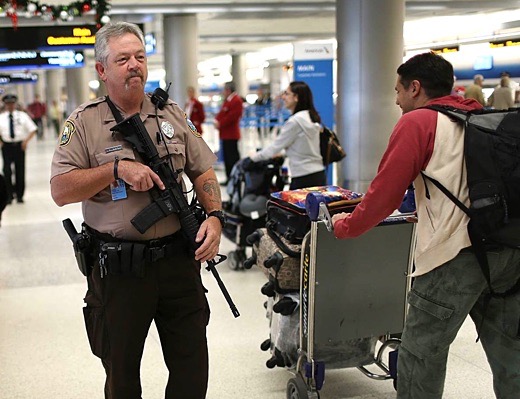
Image above: In America, from coast to coast, Thanksgiving travelers face heavy security this weekend. From (http://www.nbcnews.com/news/us-news/thanksgiving-travelers-face-intense-security-amid-terror-threat-n469056).

Norman Rockwell is dead at the easel, his paintbrush still hanging in the air. All our traditions are in anaphylactic shock. We chew together in the eye of the storm.

This turkey-day we gather around the steaming food to defend ourselves against what is outside. We are seated facing inward, admiring the steaming aroma of the overkill. We pretend for an hour that we don't notice what is behind us, the climate rattling the windows and the families knocking on our door.

We express our gratitude for what? That we have just a little more time; time for this meal. The ritual meal gives us a feeling of false momentum; that we are logically coming from 10,000 meals going back through time. This also suggests that there will be many more such celebrations to follow. This is a lie and we know it.

We all live in a gated community now. We all live within a militarized zone, in the center of which is an extreme form of retail culture which storms our minds with smiling graphics, actors, anti-depressants, fossil-sourced packaging and carbon shipping. This bizarre deathtrap is called our mainstream economy.

Here in 2015, after Beirut and Paris; after extinction sweeping through the natural world; after cops shooting unarmed black men sixteen times and cities hiding the evidence; after the language of candidates out-Hitlering the worst of the past - we take another bite. We use the words of mild-mannered love. We think of our family as a little culture with borders. Well, should we be grateful that we can still harbor this fantasy?

We hear the wind blowing against the side of our dining room. We call it a super storm, hoping to make it as manageable as the super bowl or a super mall. We are watching the geo-political super-storm of ISIS, Putin and Goldman Sachs, but we are belching the gas from the top of our packed stomachs and the problems of the world are on a screen on the wall.

We are not witnesses to the world, we are consumers of it. It comes as information on a screen. It is our most violent border. We have ourselves to thank for corporate media.

Our mature response is to remain in a state of non-protest and keep shopping. Cornel West is right when he says, “Everything is commodified. All things are for sale.” This is a state-sanctioned religion. Extreme shopping is the psychic heart of modern racism.

The shopping drug makes us the kind of idiots that accept violence. The Ferguson young people last year were right to march into Walmart and shout "Hands Up! Don't Shop!"

This year is a hard Thanksgiving. Our thanks must leap from our immediate love all the way over Trump and ISIS and toxin-coated seeds of 200 mile-an-hour wind. Our thanks flies out to Chelsea Manning, the truth-teller alone in her cell. Our thanks go to the families who miss their murdered loved ones, the survivors of state violence from bullets, drone bombs or Monsanto.

Our thanks go to the piano player at the Paris theater; to the all-night campers in the Minnesota cold at Precinct #4, and to the police who are beginning to have, in the midst of their thanks, doubts about their leaders.

The sun is rising in our windows on Thanksgiving Day in the USA. It's getting warmer for the homeless here in New York. My thanks go out to them, and the 60 million homeless who walk hundreds of miles toward militarized horizons. We must escape to all of you, cross the borders from the shopping side, and give thanks to you for our freedom.


.

Chicken Odyssey

SUBHEAD: It seems chickens didn't cross the Pacific to reach South America.

By Scott Neuman on 18 March 2014 for NPR News -
(http://www.npr.org/blogs/thetwo-way/2014/03/18/291182073/study-the-chicken-didnt-cross-the-pacific-to-south-america)


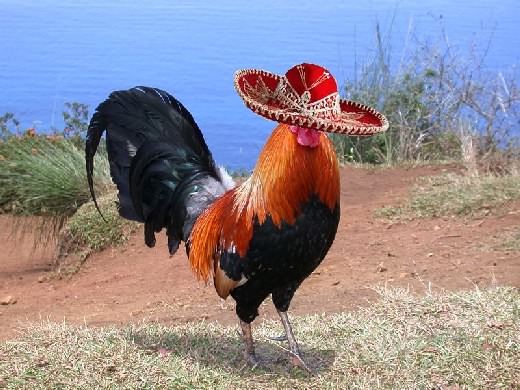
Image above: Kauai chicken (moi) with mariachi hat. Mashup by Juan Wilson.

An analysis of DNA from chicken bones collected in the South Pacific that the ubiquitous bird first arrived in South America aboard an ancient Polynesian seafarer's ocean-going outrigger.

Instead, researchers who sequenced mitochondrial DNA from modern and ancient chicken specimens collected from Polynesia and the islands of Southeast Asian found those populations are genetically distinct from chickens found in South America.

"[The] lack of the Polynesian sequences [of DNA] in modern South American chickens ... would argue against any trading contact as far as chickens go," says Alan Cooper, director of the Australian Centre for Ancient DNA, who is a co-author in the study published this week in

(For a treatise on the origins of the domesticated chicken, and how the bird came to play such a key role in the human diet, )

The finding may shed light on one of the most vexing questions in modern anthropology: Did South Pacific seafarers, who evidence shows settled island chains separated by vast stretches of ocean, reach the coast of South America before the time of Christopher Columbus?

The evidence is contradictory.

In , researchers looked at chicken bones found at an archeological site in Chile that were radiocarbon dated to pre-Columbian times (between 1321 and 1407). DNA analysis of those specimens found what scientists thought was a genetic mutation unique to Polynesian chickens — which would point to a Pacific origin for the birds — only to discover later that the mutation is common in all chickens.

Alice Storey, an archeologist who led the 2007 study, is skeptical of the latest results. She says the new study focuses too much on modern DNA.

"Using modern DNA to understand what people were doing in the past is like sampling a group of commuters at a London Tube station at rush hour," Storey is . "The DNA you get is unlikely to provide much useful information on the pre-Roman population of London."

Nat Geo writes:
"As humans moved around the world, they brought chickens along with them. So modern chicken populations aren't necessarily representative of past populations, Storey said. "We know from his journals [that] Cook moved chickens all over the Pacific, as did other Europeans, so DNA from chickens living on Pacific islands today has little to tell us about what people were doing in Polynesia, the Pacific, and in Southeast Asia before A.D. 1600."
The South American sweet potato, common in modern times in the Pacific islands, has long been viewed as a key piece of evidence supporting the hypothesis that Polynesians made contact with the Americas in pre-Columbian times.

(Incidentally, Thor Heyerdahl, who built and to bolster his now discredited hypothesis that it was South Americans who settled the South Pacific, and not the other way around, used the sweet potato evidence to support his claim, too).

But the absence in South America of Pacific rats, known to have accompanied Polynesians on their island-hopping voyages of colonization, is a strike against the theory.

So, where did the Pacific islands chicken come from?

"We can show that the trail heads back into the Philippines," Cooper tells Nat Geo. "We're currently working on tracing it farther northward from there. However, we're following a proxy, rather than the actual humans themselves."

As for the South American bird, that's still a mystery.
.

It Pays to Stay Home

SUBHEAD: Staying home has to be one of the most unpopular ideas in America, where travel is king.  

By Gene Logsdon on 25 Aoril 2012 for The Contrary Farmer -  
(http://thecontraryfarmer.wordpress.com/2012/04/25/it-pays-to-stay-home/)

 
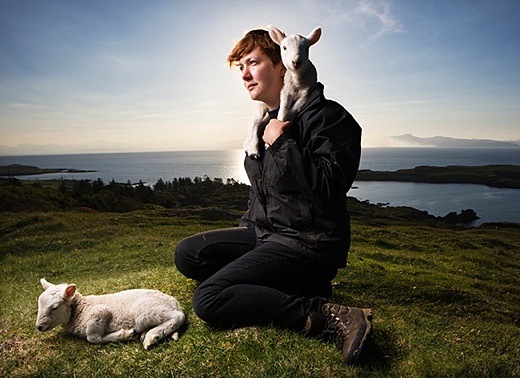
Image above: Photo of Sara Boden with lambs in "Back to the Land". From (http://www.guardian.co.uk/lifeandstyle/gallery/2011/aug/12/farming-on-eigg#/?picture=377809720).
 
One of the unsung advantages of being in love with a garden or a farm is that the lover doesn’t mind staying home and by doing so, saving gobs of money. In fact most of us land lovers much prefer to stay home. A back forty even as small as an acre can be an exciting, fascinating adventure into the farthest reaches of the earth.

The great entomologist, Jean Henri Fabre, spent much of his life making amazing discoveries about bugs on the few brushy acres behind his house and writing about them. With 30 acres, I never want for a changing world to travel through, a journey not far in miles but almost infinite in terms of material wonders and splendors deep down into the earth and high up into the ever-changing beauty of the sky.

Staying home has to be one of the most unpopular ideas in America where the whole culture embraces faraway travel as essential to happiness. Many of us don’t really have homes that can provide as much enjoyment as travel promises. Rather than spending our money to acquire such a property, we are taught to buy such enjoyment with far away travel.

Perhaps what we need is proper publicity. To advertise traveling at home, a documentary could open with unbelievable close-ups of ants herding and milking aphids on an apple tree, a raccoon destroying a bluebird house, a hawk dive-bombing a mouse, a flint arrowhead sticking out of a creek-side cliff. Then a roll of drums and a voice sonorously introduces the docudrama: “Today we are going where no explorer has gone before— YOUR BACK FORTY.”

Also, in earlier times, a home could not electronically provide all the connections with the outer world that now make travel almost obsolete. You can visit just about everything now in your living room. It may be true that nothing beats seeing a tourist attraction in person, but today you can get really close-up and intimate sights and insights into such attractions on the Internet without being strip-searched.

Just this Sunday, my dear friend, Wendell Berry, was speaking in the National Cathedral in Washington D.C. and will be receiving at the John F. Kennedy Center today (Monday), as I write this, the National Endowment For The Humanities Award, the highest honor given by the government in this field. I was able to watch and listen to him from our living room, closer and more vividly on our computer screen than if I had been there in the audience.

Another advantage of being a farmer, if not a gardener, is that you can often use your work as an excuse not to attend meetings and social affairs you do not want to attend anyway. We used to have big, loud family gatherings at my grandparents’ house on holidays.

Along about four o’clock in the afternoon, I would assume my standard, long-suffering countenance and with a sigh say that I had to go home and milk the cows. Everyone understood. The cows had to be milked. Poor Gene. Poor Gene would then shuffle, downcast, out the door but with a big inward smile. At least I knew the cows were not going to get in an argument over politics.

Another time, not so many years ago, I politely declined an invitation to give a speech faraway. I hate to give speeches and am not very good at it anyway. The fellow who was inviting me protested. “You aren’t going to give me that guff about how airplanes are environmentally destructive, are you?” he said. “That plane is going to fly here whether you are on it or not.”

“I can’t come because we will be lambing at that time,” I said, which happened to be the truth.

“Oh!” he said, much more contritely. “I understand.”

Even pulling lambs has its advantages.


.

Flying home to Kauai

SUBHEAD: We'll be in in transit from tomorrow dawn EST until afternoon Kauai time July 20th.  

By Juan Wilson on 19 July 2011 for Island Breath - 
(http://islandbreath.blogspot.com/2011/07/flying-home-to-kauai.html)

 
Image above: Front of pole barn we built in 2000 in Chautauqua County NY just before moving to Hawaii. Photos by Juan Wilson.

We'll likely post no articles tomorrow. My wife, Linda, and I will be heading back to Kauai after six weeks on the mainland. We've spent most of the time in Panama NY where we lived before we moved to Kauai. It's a place of mostly green forests and fields. It seems to go on forever compared to anywhere in Hawaii. You could walk the Appalachian from here for a 1000 miles.

  
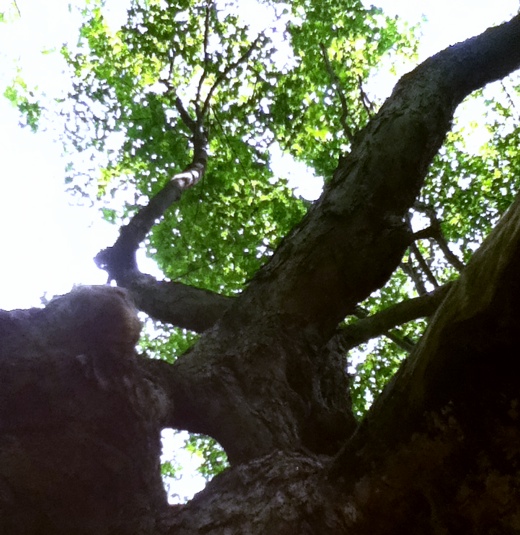
Image above: The Old Witch Tree is probably the oldest tree on our land. Probably a few hundred years old. On Halloween we put a lit pumpkin in it's yawning hole.

We are finally letting go of my grandparents old 100 acre farm. We are letting go of the ancient farmhouse and much of its contents. Another generation of our people won't be living here but we hope someone who cares to live here will ... I think we are finally OK with that. We will keep an 8 acre triangle of woods for a campsite in case we ever return.

Here is a good place to live. Right now it's not set up to be very sustainable. Too much driving, too much reliance on the electric grid, too much fossil fuel needed for heating. But that is actually not so hard to fix. All it takes is living like the Amish who have been here ever since that was the way everybody lived.


Image above: Inside our pole barn we set up a temporary home that was quite comfortable and included a pool table, wireless internet and pretty good jerry rigged kitchen.

We're coming home to Kauai on the cusp of more than one world economic crisis. The Greek default and American debt ceiling both are poised to do significant damage to the financial markets no matter how they are resolved. We'll be glad to get back before the SHTF.

We have several projects to complete before we will be ready to be more self reliant. Should be a busy autumn. We be back online in a couple of days to chronicle what we can. Aloha!
.

L.A. Carpocalypse

SUBHEAD: This will be the weekend the busy 405 freeway in Los Angeles will stand still still. By Reza Gostar & Shawna Burreson on 9 July 2011 in Brentwood Patch - (http://brentwood.patch.com/articles/carpocalypse-the-weekend-the-405-freeway-will-stand-still) Image above: Illustration of traffic jam. From (http://66.147.244.241/~coastto5/?p=696).

It has been called “Carmageddon,” "the nightmare on the 405" and "the mother of all traffic jams." Considering the psyche of drivers in Los Angeles, these sensationalized nicknames for the massive shutdown of the 405 freeway on July 15-18 might not be too far off the mark. We are Angelenos, after all, and if there is one thing we have the right to do, it’s to get behind the wheel of our eco-friendly-sporty-SUV-Lexus-BMW-Toyota-hybrids and drive. Preferably while sipping on a latte, talking on our “hands-free” device and listening to Randy Newman’s “I Love L.A.” For many of us, getting behind the wheel is a form of meditation. It’s time to blow off some steam, think about work or wonder what that personalized license plate on the car ahead is supposed to mean. The freeway, whether good or bad, has become a venue of release for pent-up rage, stress and frustration. However, I fear that our psyches might not be able to withstand a traffic jam of this magnitude.

Imagine the fictitious river of gooey supernatural liquid flowing below New York City, which was fed by people's rage and hatred in the movie Ghostbusters II. The 405 is very similar. Now picture a dam blocking that flow of rage and frustration, which is essentially what will happen when the 53-hour construction project commences.

In spite of the freedom the 405 provides, it’s also a cesspool of negative emotions so heavy it sucks the light from the casual passer-by, transforming even schoolteachers into homicidal maniacs. If you have never watched the movie Falling Down, I suggest you rent a copy, stock up on supplies and stay home that July weekend. Perhaps California should declare a holiday or a state of emergency not only to commemorate the weekend that the most congested freeway in the world was completely shut off from the city’s traffic flow, but also as a way to offer busy and beleaguered commuters a few days off of work and a few days of freedom from the stress of struggling against Hummers, SUVs and semitrucks to make it on time. But if the powers that be neglect to take advantage of this momentous opportunity for a holiday, at least it’s a good excuse for making it into work late, or not at all.

Officials are expecting traffic conditions on local streets and freeways within L.A. County and beyond to be severe, with multi-hour delays.

Here is some information from officials about alternates routes, closure times and advice about how to get from point A to point B without losing your mind.

The specific freeway closure boundaries are:

• Northbound I-405: 10-mile closure between I-10 and U.S. 101 • Southbound I-405: 4-mile closure between U.S. 101 and Getty Center Drive ramps

Alternate Routes:

Officials are advising motorists who must travel through L.A. to use alternate freeways within the region, including the 5, 15, 23, 55, 57, 101, 118, 126, 210, 605 and 710, to bypass the impacted area.

In addition, officials are urging the use of public transportation such as the Metro Rail service within L.A. County and Metrolink servicing the five county Southern California region.

Additional alternate route information will be made available on the project website at www.metro.net/405.

Closure times:

On Friday, July 15, ramps will begin to be shut down as early as 7 p.m., and closure of freeway lanes will begin at 10 p.m. to ensure full freeway closure by midnight. The closure will continue until 5 a.m. Monday morning, July 18. Ramps and connectors will be reopened by 6 a.m.

Conditions:

Sepulveda Boulevard is intended as an alternate route for local resident access only. Sepulveda will not have the capacity to accommodate both local and diverted freeway traffic. Those using Sepulveda should expect extreme congestion and lengthy delays. Motorists should instead use alternate regional freeway routes to completely bypass the Sepulveda Pass, officials said in a statement.

.

Polynesians again reach Hawaii

SUBHEAD: Navigators from Polynesia land seven canoes with crew from 14 islands at Kualoa, Oahu.  

By Gorden Y. K. Pang on 26 June 2011 for the Star Advertiser - (http://www.staradvertiser.com/news/20110626_Navigators_from_Polynesia_land_their_canoes_at_Kualoa.html)


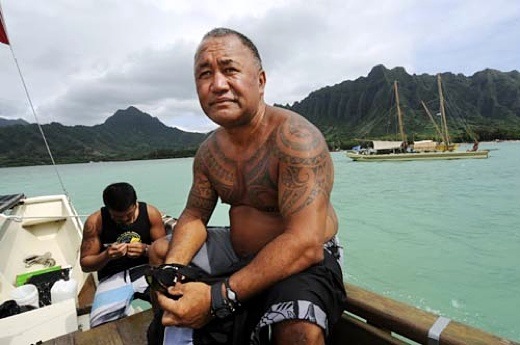
Image above: Pererika Makiha aboard the Te Matau a Maui was among the crew members waiting to be shuttled off their voyaging canoe to Kualoa Regional Park. From original article.
 
The sun broke briefly through the overcast sky over Kualoa Regional Park Saturday morning as the crew members from seven canoes that had journeyed across the Pacific made their way to shore.

The voyagers, who numbered well more than 100 people, came from 14 island nations in the South Pacific, including Tahiti, Samoa, Fiji, the Cook Islands, Aotearoa (New Zealand), Tonga and New Guinea.

It was a chicken-skin moment for many of the 1,000-plus people who gathered to greet them and understood the symbolism of the arrival. Hokule‘a, the first double-hulled voyaging canoe to make its way across the Pacific through traditional celestial navigation in 600 years, set off for its mission to Tahiti from Kualoa in 1975.

Thirty-five years later, navigators from the nations touched by Hokule‘a had come here, also relying on the stars to find land.

Frank Kawe, who captained the Aotearoa vessel Te Matau A Maui, said, "It's important to complete this aspect of the journey — to bring the newer people who've begun voyaging and sailing from our part of the Pacific up to meet the family that's been here and has been doing this work for 35 years," Kawe said. "These are some of the lifelong friends we've made over the years that have hosted us, that have fed us, that have trained us."

Kailua resident John Myrdal, who paddles recreationally in Lanikai, sat on the beach alone and watched in awe at the seven canoes, constructed in Aotearoa specifically for this journey, sat moored side by side in the bay with the flags of different nations flapping in the wind.

"Any time people from different backgrounds and cultures can get together — it's a good thing to reconcile the differences we may have had in the past in this world. You can't help but be impressed by the camaraderie and people acting as one human race."

Nani Kauka of Kailua canceled all the other activities she had planned for the day so she could attend the "once-in-a-lifetime" event.

Polynesians are "getting back to realizing that we are probably one of the greatest voyaging cultures in the world," Kauka said. "What Hokule‘a did was instill in the rest of the Polynesians a desire to reclaim their cultures."

The mission of the voyage, dubbed "Te Mana o te Moana" or "The Spirit of the Sea," is to promote global awareness of increasing threats to the environment and the world's oceans, the Pacific in particular. It is sponsored by Okeanos — Foundation for the Sea, a nonprofit founded by German native Dieter Paulmann.

The voyage began in Aotearoa in April and arrived in Hilo a week ago. While on Oahu during the next 10 days, representatives from the project will take part in Kava Bowl Ocean Summit 2011 at the Imin International Conference Center. After a stop on Kauai, the contingent will head to California.

Billy Richards, one of Hokule‘a's original crew members, said the voyage has not only brought the peoples of the different island nations closer, but also has helped provide what essentially are classrooms for a new generation of Pacific navigators.

The voyage's message of environmental awareness was also repeated throughout Saturday's celebration.

"The Earth's in trouble," said Hokule‘a master navigator Nainoa Thompson, chief executive of the Polynesian Voyaging Society. "And the one piece that needs to be saved first — because otherwise nothing else will make it — is the oceans. And I would argue that the largest, the most magnificent and the most powerful ocean of them all is the Pacific. And if we lose the Pacific, ecologically, it's over.".

A Heads Up

SUBHEAD: We'll be heading for a trip to the mainland and will be unable to post to the website from Tuesday until Thursday.  

By Juan Wilson on 6 June 2011 for Island Breath - 
(http://islandbreath.blogspot.com/2011/06/heads-up.html)


Image above: A view of the back of The Farm in Panama, New York. Photo by Juan Wilson in 2008.


Linda Pascatore and I head for the mainland on Wednesday. We'll be leaving our chickens, vegetable, fruit trees and cat to a caretaker staying in our home. Given the fragility of the world economy as well as the price of oil we expect that this may be the last time we'll be able to get back to remote western New York state.

We have lots of things to take care of if that's true. When we first moved to Hawaii we thought we might spend half the year on Kauai and half in Chautauqua County, NY. Our plan was July-January in NY and February-June in HI. Well that never happened. We knew that couldn't really fly until Linda retired from the DOE here.

In the early 2000's We did spend our summers back in the woods of the Amish country that is the western tip of the Empire State. We simply called the place The Farm, as my grandmother, my mother and now my kids do. We even had a dog and a couple of cats that our renters took care of while we were here. - Ah - the renters.

That was one reason we pull off the snowbird life. We needed someone staying in our place back on the mainland when we were on Kauai, but we didn't want them there while we were. It was hard to find renters that didn't mind being displaced for eight weeks a year. Few did more than one tour of duty. That problem was mirrored on Kauai.

We needed people to stay in our Hanapepe house and take care of things. Often time that meant people staying for free and us paying to keep both places up and running. That gets increasingly difficult form a distance, and will only get worse. We intend to consolidate our efforts of resilience and sustainability here on Kauai.

It's going to require jettisoning a lot of our old lives and reducing four generations of our past into a 1/4 of a 20' shipping container. I'm not looking forward to the triage. Anyway, once past the overseas trip we have to get a car registered and running, pick up a DLS modem, install it and get our laptop up on a wireless network.

Once that's in place we'll be back online with new material for Island Breath. For continued coverage of the birthing of a self relient Hookahi Kauai we need you, who will be on island, with your observations. Please let us know what's going on - KIUC, FERC, DLNR, PMRF, GMO's - whatever.

Email juanwilson@mac.com or
lindapascatore@me.com.

We'll be there. .

Vietnam is our future

SUBHEAD: Where it’s not being used as space for concrete buildings, the whole country is being cleared and terraced to grow vegetables. By John Rember on 28 May 2011 for Nature Bats Last - (http://guymcpherson.com/2011/05/vietnam-is-our-future/) Image above: Rickshaws in the streets of Dalat, Vietnam, servicing tourists. From (http://www.vietnam-travel-and-food.com/traveldalat.html#dalatshopping). 1. In the fall of 2010, it’s still possible to buy two round-trip plane tickets from the west coast of the United States to Vietnam for two thousand dollars. Once there, it’s cheaper than staying home. A clean hotel room with a shower and toilet costs two people fifteen to twenty-five dollars and includes breakfast. Lunch can be locally-grown fruit, and it’s hard to eat a dollar’s worth. A lavish dinner for two costs ten dollars. Beer is cheap and good. Wine is expensive and not good.

Of course, a lot of times a beer sounds good with lunch. Beer doesn’t go with mangos or papaya or pineapples or bananas. It goes with curry, or a seafood hot-pot, or braised pork ribs, or prawns in tamarind sauce. Sometimes you get hungry near a tall hotel, with a rooftop restaurant where menu prices are in dollars, the tables have bouquets, and even the chairs wear tablecloths.

So you can spend money as if you were a rich American tourist. Even with Vietnamese inflation running at twelve percent in 2010, being a rich American in Vietnam isn’t nearly as expensive as being a rich American in Venice or London. But if you are a Vietnamese farmer, in the fall of 2010 you’re paying more for basic necessities such as food and fuel than you were in 2009, and a lot more than you were in 2008, because inflation in 2009 was twenty-four percent.

The reason for this inflation has been an invasion of foreign capital, some brought in by tourists, but most brought in by people building infrastructure for more tourists. Earlier rounds of inflation have come with the sweatshops and electronics factories built when the Vietnamese government opened its human resources to international capitalism.

The government doesn’t call it capitalism. They call it enhanced communism, and sure enough, the government takes a generous cut from the new factory builders and the new factory workers and anyone else who wants to invest in Vietnamese land or resources.

But tourism is regarded as the real cash cow. Neighboring Thailand has made an art form of tourism, building whole cities of hotels on islands that once held only rubber and coconut plantations. The Vietnamese are following their example. They too want eight-hundred-dollar hotel rooms and sex tourists and people who will order Armani suits from people not named Armani. They ignore signs that Thailand’s tourist industry has been overbuilt, with half-empty hotels lining its beaches even before the crash of 2008.

People hoping to get in on the ground floor of the Next Best Place are waving their money, and the government admits anyone with the price of admission. Vietnam is like Thailand, only its beaches aren’t as crowded with tourists. That’s a good thing, at least in the eyes of tourists, who can be a self-loathing species.

But not all tourists are looking for the perfect deserted beach, the most primitive trek, or the best curry dish in the world. Not all of them are looking for low-priced art or antiques. Not all of them are looking to lie drunk on a sun-drenched beach chair for two weeks. Some of them are looking for their youth, and in Vietnam, some of them can pinpoint the spot where they saw it last.

2. I didn’t take the first chance I had to go to Vietnam. That was in May of 1968, when I graduated from high school. Some of my classmates had joined the Marines that spring, and they went from commencement to boot camp. As a college student, I didn’t have to worry about going to war until my junior year, when a draft lottery was instituted.

The night of the lottery, my college roommate and I purchased a six-pack of Rolling Rock, a bag of Doritos, and two cans of bean dip. A party.

Our lives were tied to the numbers that were picked for us, but we didn’t understand that. We each opened a beer, scooped up gobs of bean dip with our Doritos, and turned on the radio. The lottery started. The second date called was my roommate’s birthday. His draft number was two. The party was over.

My roommate enlisted rather than be drafted into the infantry, and ended up going to language school and learning Japanese. He spent his war on Okinawa, eavesdropping on Japanese military communications. Once out of the Army, he became an auto mechanic in Philadelphia, probably the only auto mechanic in Philadelphia capable of reading Toyota shop manuals in their original language.

My own number was 117. Selective Service drafted to 113 that year.

Vietnam didn’t teach me Japanese, but it shaped me. It gave me a deep distrust of the powerful and demented old men of my government. It derailed my plans to go to law school and become wealthy and live in a gated subdivision and learn to play golf and eventually become one of those old men.

I couldn’t articulate those thoughts at eighteen, but I did sense that Vietnam pulled my life out of its ordained path and made it more alienated and thoughtful than it should have been. Though invisible, it was always there, always exerting a genetic influence. It was like discovering that you were adopted, and that your real parents were Vietnamese. Who knew?

3. Julie and I fly into Saigon from Boise on November 17, 2010. It’s a twenty-three hour trip. We are jet-lagged and confused.

We get ripped off right away by a taxi scam. It costs us thirty-five dollars to be delivered to the wrong hotel. It should have cost us ten to be delivered to the right one. It’s our first encounter with Vietnamese economic policy. It will remain in our minds during all subsequent transactions in Vietnam.

The good news is that over the next two months we will save far more than the twenty-five dollars we lose to the taxi-scammer. Paranoids make hard bargainers, and we refuse to be good-willed American tourists, free with our dollars and excited about mailing souvenirs home. Instead we look for the next person who might trick us and take our money. I take the lead in this matter, refusing offers for treks and tours and motorcycle taxi rides to the best hotel in town. “We’re not rich American tourists,” I say. “We’re poor American tourists.”

There is no way to translate “poor American tourist” into Vietnamese. American tourists get to Vietnam on jet planes, from a country that lets its citizens leave and then return. They have carbon footprints that Paul Bunyan can’t match. They have cards that pull wads of money from ATM machines.

When a poll was taken of young people in Southeast Asia, asking them what they most desired in life, the majority wanted an ATM card.

So we walk instead of ride around Saigon. We do not take a tour. For reasons of claustrophobia, we do not visit the Cu Chi tunnels, used to shelter a Viet Cong battalion during the war. We consult the guidebook and walk around our crowded neighborhood. We visit the Museum of Fine Arts and the war rooms under the presidential palace of the defunct Republic of South Vietnam. We find some good restaurants and once, an air-conditioned coffee shop where even the prices are modeled on Starbucks.

Saigon is a city of seven or eight or nine million. Motorcycles are the preferred form of transport. Most intersections lack traffic lights. Five or six streams of traffic, fifty motorcycles wide, will move through each other without as many collisions as you’d expect. The decibel level is in the hearing-damage range.

Our hotel is comfortable and in a neighborhood of restaurants and shops, but the size of Saigon, its traffic, its noise, the beggars displaying Agent-Orange-mutated children, and the warnings in our guidebook of motorcycle thieves make us want to go south, through the Mekong Delta to the island of Phu Quoc.

4. Life on Phu Quoc: up at dawn, watch the sunrise off the balcony. Walk down to the restaurant, have a coffee, have another coffee. Walk a mile along the beach or until you pass one hundred thousand lost flip-flops, whichever comes first. Walk back. Have lunch. Start a new book on the Kindle. Feed the tan. Swim in the crashing surf. Have a beer. Have dinner. Finish the new book on the Kindle.

Watch the evening thunderstorm march across the water on legs of lightning. When the rain hits, head for the suite for the night. Go to sleep to thunder. Dream of war.

Rinse. Repeat.

We stay at a small boutique hotel on a secluded southern beach of the island. Our suite is all teak and marble and beveled glass. It would be luxurious except there is no electricity after 10 p.m. No television anytime. No hot water, even though our bathroom has a jacuzzi tub inset into its marble surfaces. Not much water pressure. It would take all day to fill the tub. But the shower dribbles enough cool water to wash off the salt after a day at the beach.

Julie and I don’t normally stay at boutique hotels, but our hotel wasn’t planned to be boutique. It was supposed to be much larger, with a dozen or so bungalows built out behind the hotel. Our suite, I decide, is the owner’s intended residence.

The common areas, the kitchen, the restaurant and gift shop are all built for the crowds that will come with Phase II.

Phase II is not going to make it. Work has yet to start on the bungalows, or on a good water system, or on the power lines to run twenty air-con units. Meanwhile, Phase I is deteriorating, despite the efforts of a small army of landscapers, beach attendants, waitresses and bartenders. From the balcony, I can see peeling paint and the balding thatch of aging beach umbrellas. The hotel’s two jet skis sit rusting and unused in a litter-filled storage bay behind an artisan-crafted rock wall from the restaurant.

But the crippled luxury of our hotel suits both our sensibilities and our budget. The food is beyond good, and an expert massage on the beach costs three dollars. Long walks along the coastline don’t cost anything except time and sweat, and reveal more beaches and more shoals of plastic, and now and then a single standing wall of a collapsed house, a remnant of the time before the war.

5. At the end of World War II, the population of Vietnam was less than 25 million. Now it’s ninety million. Population density is 628 people per square mile, twice that of China. Seventy percent of present-day Vietnamese were not born when the Vietnam War ended in 1975.

It’s a country of young and hopeful people, and there’s no thought that they will ever run out of resources to exploit or markets to sell to. But we see lots of inflation-impoverished old people, lots of unemployed young ones, lots of people selling lottery tickets, lots of new plastic crap in the markets on its way to becoming the old plastic crap that marks the high-tide lines. Every year the new market economy grows seven percent, and that growth is seen as proof that things will get better and better until everyone has an ATM card.

The communists need to change their name of their party to something more American. They’re a new hereditary elite, feeding off an ability to pass laws in their favor and siphon tax dollars for their own companies and appoint their relatives to high positions in companies or governments.

At street level, you pass rows of shops, all selling the same goods. Hotel districts are expanding in beach towns — you can spot them by the construction cranes. The buildings going up are monsters with hundreds of rooms. Under the skeletal shadows of the hotels, restaurants park children on the sidewalk, and it’s not uncommon to have tiny smiling girls thrust menus under your nose five or six times in a single block.

Fans of capitalism tout its capacity for creative destruction, but more than once in Vietnam I had the thought that what was being destroyed was a nation’s young people. They compete with each other on a life-and-death basis, and it made me glad that there was an ocean between Vietnam’s young people and ours.

6. A temporary incursion into Cambodia:

Kampot is a small, lazy town on a Cambodian estuary that leads to the Gulf of Thailand. The food is good. Our hotel is clean and new. A population of English-speaking expatriates is happy to recount sad life stories and local survival tips for the price of a beer. The Honey Bar, whose outside sign has a dissipated Pooh Bear hoisting a beer mug, is for sale for five thousand dollars, and that includes the girls who work there. We leave Kampot thinking we should have stayed maybe a year longer. I’ve been a bartender. I could do it again.

We escape Phnom Penh as quickly as we can, distressed that our hotel has been built on the site of one of the Khmer Rouge’s slaughterhouses, and by the taxi drivers’ incessant cries: “Killing Fields? You want to go to Killing Fields?”

We tour Angkor Wat and a small percentage of the temples that surround it. A thousand years ago, these jungle-covered ruins were the biggest city in the world, ten miles on a side, containing a million people. It shows the scale of our own time that two to three times that many were killed in the Khmer Rouge genocide alone.

When we were in Kampot, we met a down-at-his-heels Australian running a small-time tour business with his Cambodian in-laws. He had explained for us the pathologically laid-back attitude of Cambodians: “Most of them had their whole families killed by the Khmer Rouge. They live with no sense of the future.”

7. Hanoi is not laid-back. It is the capital of a huge and diverse but officially unified nation, although in our short time in the capital we see evidence of deep divisions between rich and poor, young and old, north and south, mountain and lowland, ethnic Chinese and ethnic Vietnamese.

Communism still has a religious heft in Hanoi, even as global capitalism pays the bills. A few of the self-sacrificing heroes of 1975 are still in power, and younger middle-aged bureaucrats still pay lip service to the people’s struggle against American imperialism. A still younger generation of communists is composed of a familiar international breed: intelligent but unimaginative young people who do all the right things in high school and college to worm their way into the existing power structure. Once there, they display a commendable respect for enforcing rules, following procedures, and advancing their careers. But like the generation before them, they have little ideological backbone when it comes to keeping their fingers out of the cookie jar, and Vietnam’s corruption index matches that of Ethiopia, Mongolia, and Tanzania.

A local magazine survey of Hanoi residents reveals that what Hanoians want most in life is not an ATM card. They want a car. This, in spite of the fact that if everybody in Hanoi who wants a car gets one, there will be no room – none — on the already gridlocked streets.

One good thing the government has done is to build housing for the homeless, and down the coast from Hanoi, there are countless five- to ten-story concrete buildings going up around every town. Much of Vietnam is made up of limestone mountains, and those mountains are being ground into powder, and the powder is mixed with water and gravel and poured into forms. There are a limited number of forms: one for family housing, one for multi-family housing, one or two for tourist hotels, and so on. Different colored ceramic facades distinguish one building from another.

In the future there will be no mountains left in the country. In their place will be a vast grey hive, a labyrinth a thousand miles long, with caste-specific cells for genetically-engineered farmers, shopkeepers, soldiers, party members, and tourists.

8. The week we arrive in Nha Trang, it’s been listed by an international tourist organization as one of the ten worst beach towns in the world. We don’t know that when we check into the Ha Van hotel, where friendly people usher us to a nice twenty-dollar room that comes with the best breakfast we’ll have in Vietnam. We don’t know that when we discover the Louisiana Brew House, across the shore highway from our hotel, where you can sit by the pool all day, drinking beer and Kindling your way through a Russian novel, and eat a superb lunch at poolside or in the attached restaurant. We don’t know that when we walk through the town’s bizarre beachfront sculpture garden in seventy-degree sunshine, or when we visit its restored Cham Dynasty towers. We especially don’t know that when we find an inexpensive Indian restaurant on a narrow back street right across from an ATM.

What could Nha Trang done to have gotten itself on a ten-worst list? It’s the most touristed place we visit in Vietnam, but we’ve become hardened to the beggars and street-hawkers and sidewalk touts, and they have long ago learned to read the subtle signals of that hardening, and they mostly leave us alone. Nha Trang has a half-dozen half-completed high-rise hotels, and some of the completed hotels in town are empty, even though the weather is good. If you dine upstairs at the Indian restaurant, you look across the street to a clothing factory, where the teen-aged workers get ready for bed, right next to their sewing machines. They look out at you with eyes a hundred years old. They see you looking back at them, and you both realize how unbridgeable the gap is between you, how improbable for each the gaze of the other. The blinds come down with a snap. You go back to your beer and lamb vindaloo.

Perhaps the worst thing that Nha Trang has done is to sprawl into a miles-long high-rise carnival on a beautiful white half-moon beach. It doesn’t help that the beach lies between two fog-topped mountain headlands and faces a soft blue bay full of dark green islands.

There is a headless chicken tendency in the tourist industry, one that keeps on keeping on even when it’s clear the tourist infrastructure threatens to kill the thing that attracted tourists in the first place. Nha Trang isn’t quite there yet. It won’t get there, either.

We still want to go back in ten years, not just for another week around the pool at the Louisiana Brew House, but to see what becomes of a place built on the ability of people from all over the world to buy cheap airline tickets in a time when airline tickets won’t be cheap.

9. In the mountain town of Dalat, home to Vietnam’s wine industry, a university, a replica of the Eiffel Tower, an astonishing botanical garden, and the summer palace of Vietnam’s last emperor, we strike up a conversation with our waiter in the restaurant across the street from our hotel.

He speaks good English, and acts happy to see us. He’s twenty-one years old and goes to Dalat University. He grew up on his parents’ coffee farm. His name is Kong, he says, like King Kong. He flexes his muscles and laughs.

He asks us where we’re from and we say America and we ask where he’s from and he says he’s from his mother. It’s a joke we’ve heard before in Vietnam but when we ask where his mother’s from, he says his parents have always lived in the mountains north of Dalat.

Does he see his parents? Not often. They work the farm. When Kong isn’t working as a waiter, he needs to study.

Kong wants to meet us for coffee in the morning. He has some questions he wants to ask us, and we reluctantly agree. I tell Julie that if he tries to sell us something or get us to go on a trek, I’m out the door. But Kong wants information, not money.

“How can I get rich?” he asks, even before the coffee comes.

I’m not the person to ask, I tell him. I revert to an old cultural narrative and tell him to work hard, save his money, and do everything he can to stay out of debt, but that advice doesn’t even work in America any longer. Finally I say, “Kong, some money is good, but you can have too much. Make sure you own things. Don’t let things own you.”

He doesn’t like this advice. “Interesting,” he says.

I ask him about his family’s farm and he says it’s on a steep hillside. Each coffee plant has to be watered by hand in dry season, he says. He has one brother and three sisters. His brother will run the farm. His sisters will be married to other farmers. He is the oldest son, and for that reason he was chosen to go to university.

He asks how old I am. When I tell him sixty, he says that his parents are younger than me but they look much older. He says that he would like to own a car someday, when he’s a hotel manager in Saigon.

“You will never be rich if you buy a car,” I say. He doesn’t like this advice either.

Julie compliments him on his command of English and apologizes for our not knowing Vietnamese.

“You learn Vietnamese?” he asks. “Why?” Then he says, “I have to learn English. English is my future.”

10. There is little awareness in Vietnam that the world might run short of oil, or that the economy won’t grow by seven percent every year forever. There is no understanding that recent floods in the central part of the country might be related to changes in the world climate, or that the rice fields of the Mekong Delta could be under sea water by the year 2100. There is no fear that tourists might stop coming due to collapsed economies, or that tourism might become morally unaffordable in a world of scarcity. Population growth is seen as a problem by a few government officials, but when Vietnam’s official two-child policy was recently relaxed, it took only a year for the population growth rate to almost double.

Where it’s not being used as space for concrete buildings, the whole country is being cleared and terraced to grow vegetables. Vietnam will still have food if industrialism and globalism and world currencies get tossed on the ash-heap of history. But it’s not hard to imagine the great tourist hotels becoming high-rise versions of the overgrown temples of Angkor Wat. As for the ambitious young people who have put their faith in our cherished western narrative of hard work and accumulated wealth, I think there will be a time that they will be angry and disappointed for themselves and their families. At least they won’t starve, I think, but then I remember that when the Japanese confiscated the Vietnamese rice crop in 1945, two million of them did.

Near the end of our time in Vietnam, Julie and I hike to a high peak outside the city of Dalat. On our way back down we stop at a roadside café, and a wizened old woman sells us two cans of Coke and sits down at our table. She looks at our wedding rings and smiles.

“How many children?” she asks.

“None,” says Julie. “Zero.”

I try to say that we’re content to be uncle and aunt, but that doesn’t translate well.

“I have eleven children,” she says. “My children have ten children.”

She asks me my age, and I tell her.

“I’m fifty-eight,” she says.

I pay her for the Cokes and get up to leave.

“No children,” she says, “No grandchildren.” She shakes her head in pity, and makes a face so sad that it looks like she’s crying. I’m making the same face, but she’s not looking at me.

.

Oil / Economy like Flour / Bakery

SUBHEAD: How is an Oil Shortage Like a Missing Cup of Flour? The economy cannot afford high-priced oil. By Gail Tverberg on 2 February 2011 in Our Finite World - (http://ourfiniteworld.com/2011/02/02/how-is-an-oil-shortage-like-a-missing-cup-of-flou/#more-945) Image above: Ingredients for gooey butter cake. From (http://thepioneerwoman.com/tasty-kitchen-blog/2011/01/step-by-step-gooey-butter-cake).

If I bake a batch of cookies and the recipe calls for two cups of flour, but I have only one, it is pretty clear that I can’t bake a full batch of cookies. All I can make is half a batch. I will end up with half of the sugar, and half of the eggs, and half of the shortening that I originally planned to use left over.

Liebig’s Law of the Minimum applies in situations like this. In agriculture, it says that growth is controlled not by total resources available, but by the one in scarcest supply. If a baker does not have enough of one necessary ingredient, he will have to make a smaller batch. I wonder if it isn’t a little like this with oil and the economy.

Oil seems to me to be a necessary “ingredient” in our economy. If for some reason oil is not available (perhaps because the buyer cannot afford it), then to some extent other “ingredients” in the economy, like human labor and new houses and stores in shopping malls, are less-needed as well. That is why as oil consumption decreases, there are so many lay-offs, and the effect multiplies and affects all areas of the economy, even housing prices and demand for business property.

If worldwide oil price is on the high side (like it is now), customers are faced with a choice–should they buy the full amount of high-priced oil, or should they cut back in some way. For example, a state transportation department might find that asphalt (an oil product) is high priced. They might decide to buy less and fix fewer roads. If they do this, they won’t need as many workers to spread the asphalt, so they may lay off some workers. With less demand, refineries that make the asphalt won’t need to process as much oil, so some of the older refineries can be closed, and their workers laid off.

The laid off workers will have less money to spend, so they will cut back–go out to restaurants less, take fewer trips, and wait longer between haircuts. And of course, there will be little need to build new refineries, or to buy new trucks for spreading asphalt, so these changes will impact workers in the construction business and in the manufacturing of trucks. A laid off worker may miss mortgage payments, and this will trickle through the economy in other ways. Housing prices may drop from lack of demand because some workers have lost their jobs, and because foreclosed houses are on the market at low prices.

In some cases, there may be the possibility of substitution–in this example, switching to concrete or gravel roads instead. But even in this case, there might be layoffs–less need for refineries, for example. Also, spreading gravel might take fewer workers. Concrete roads might last longer, and therefore affect employment in years to come.

Let’s take another example. If oil prices rise, airlines will need to raise their prices to cover the cost of fuel. Because of higher prices, businesses can be expected to cut back on travel, and less-wealthy vacation travelers may stay home. The reduction in travel can be expected to lead to layoffs in the airline industry. There will be less demand for new airplanes (unless an inventor can truly figure out a way to make a more fuel-efficient airplane!), and less demand for workers who build the airplanes. Fewer travelers will pass through the airport, so airport restaurants and shops are likely to lay off workers.

As a third example, if oil prices rise, grocery stores will raise the price of the food they sell because oil is used in food production and transport, and stores will need to pass the higher costs through to the customer. While customers are likely to “trade down” to the less-expensive items offered, in total, they are still likely to spend more on groceries than in the past. To compensate, customers can be expected to cut back on their discretionary expenditures elsewhere. A few may even miss mortgage payments.

How can this problem of layoffs, debt defaults, and falling housing prices be avoided when oil prices rise? I am not sure that it can be.

If a government has a huge amount of money for oil subsidies, perhaps it can subsidize oil prices, so the effect isn’t felt throughout the economy. Usually, it is only the oil exporters who can afford such subsidies.

Or a government can make a rule that companies can’t lay off workers, no matter how much demand drops. Unfortunately, such a rule is likely to result in many bankrupt companies. If they continue making goods few can afford, they will end up with a lot of excess inventory as well.

Or governments can try to cap oil prices. But now we are running short of oil that can be extracted from the ground at low cost, so capping prices has the perverse effect of reducing supply. Governments can also raise taxes on oil companies, but to some extent this also has the effect of reducing supply. The fields that had marginal profitability before the tax hike are likely to be closed.

If the government wants to keep employment up, somehow it needs to find less expensive alternatives to oil, so as to stop this vicious cycle of higher oil prices sending the economy into a tail-spin. Higher priced substitutes are not helpful–they just make the situation worse! This is why most of the alternatives now under consideration are dead ends, unless the costs can be brought way down, say to $50 or $60 barrel. Even electric cars need to be inexpensive, to really help the economy.

Too many people don’t really understand where the economy is running into trouble, and are proposing solutions that can’t fix the problem. Our real problem is that the economy cannot afford high-priced oil; it is not that there is too little (high-priced) oil in the ground.

We have always assumed that we can have cheap and available ingredients for our societal “recipe” for how our current economy functions. Now this assumption is coming into question.

Amelia Earhart's Fate?

SUBHEAD: DNA testing on recent bone discovery may confirm suspected fate on Nikumaroro Island, about 1,800 miles south of Hawaii.

 By Sean Murphy on 18 December 2010 for Huffington Post - 
  (http://www.huffingtonpost.com/2010/12/18/amelia-earhart-bones-island_n_798607.html)

 
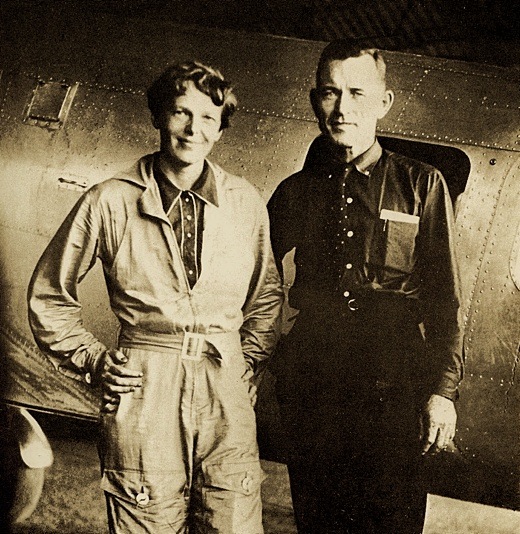
Image above: Amelia and Noonan on their stopover in Brazil on round the world attempt. From (http://library.pittstate.edu/AxeBLOG/amelia%20earhart%20brazil.jpg).

The three bone fragments turned up on a deserted South Pacific island that lay along the course Amelia Earhart was following when she vanished. Nearby were several tantalizing artifacts: some old makeup, some glass bottles and shells that had been cut open.

Now scientists at the University of Oklahoma hope to extract DNA from the tiny bone chips in tests that could prove Earhart died as a castaway after failing in her 1937 quest to become the first woman to fly around the world.

"There's no guarantee," said Ric Gillespie, director of the International Group for Historic Aircraft Recovery, a group of aviation enthusiasts in Delaware that found the pieces of bone this year while on an expedition to Nikumaroro Island, about 1,800 miles south of Hawaii.

"You only have to say you have a bone that may be human and may be linked to Earhart and people get excited. But it is true that, if they can get DNA, and if they can match it to Amelia Earhart's DNA, that's pretty good."

It could be months before scientists know for sure – and it could turn out the bones are from a turtle. The fragments were found near a hollowed-out turtle shell that might have been used to collect rain water, but there were no other turtle parts nearby.

Earhart's disappearance on July 2, 1937, remains one of the 20th century's most enduring mysteries. Did she run out of fuel and crash at sea? Did her Lockheed Electra develop engine trouble? Did she spot the island from the sky and attempt to land on a nearby reef?

"What were her last moments like? What was she doing? What happened?" asked Robin Jensen, an associate professor of communications at Purdue University in West Lafayette, Ind., who has studied Earhart's writings and speeches.

Since 1989, Gillespie's group has made 10 trips to the island, trying each time to find clues that might help determine the fate of Earhart and her navigator, Fred Noonan.

Last spring, volunteers working at what seemed to be an abandoned campsite found one piece of bone that appeared to be from a neck and another unknown fragment dissimilar to bird or fish bones. A third fragment might be from a finger. The largest of the pieces is just over an inch long.

The area was near a site where native work crews found skeletal remains in 1940. Bird and fish carcasses suggested Westerners had prepared meals there.

"This site tells the story of how someone or some people attempted to live as castaways," Gillespie said Friday in an interview with The Associated Press. "These fish weren't eaten like Pacific Islanders" eat fish.

Millions of dollars have been spent in failed attempts to learn what happened to Earhart, a Kansas native declared dead by a California court in early 1939.

The official version says Earhart and Noonan ran out of fuel and crashed at sea while flying from Lae, New Guinea, to Howland Island, which had a landing strip and fuel.

Gillespie's book "Finding Amelia: The True Story of the Earhart Disappearance," and "Amelia Earhart's Shoes," written by four volunteers from the aircraft group, suggest the pair landed on the reef and survived, perhaps for months, on scant food and rainwater.

Gillespie, a pilot, said the aviator would have needed only about 700 feet of unobstructed space to land because her plane would have been traveling only about 55 mph at touchdown.

"It looks like she could have landed successfully on the reef surrounding the island. It's very flat and smooth," Gillespie said. "At low tide, it looks like this place is surrounded by a parking lot."

However, Gillespie said, the plane, even if it landed safely, would have been slowly dragged into the sea by the tides. The waters off the reef are 1,000 to 2,000 feet deep. His group needs $3 million to $5 million for a deep-sea dive.

The island is on the course Earhart planned to follow from Lae, New Guinea, to Howland Island, which had a landing strip and fuel. Over the last seven decades, searches of the remote atoll have been inconclusive.

After the latest find, anthropologists who had previously worked with Gillespie's group suggested that he send the bones to the University of Oklahoma's Molecular Anthropology Laboratory, which has experience extracting genetic material from old bones. Gillespie's group also has a genetic sample from an Earhart female relative for comparison with the bones.

The lab is looking for mitochondrial DNA, which is passed along only through females, so there is no need to have a Noonan sample.
Cecil Lewis, an assistant professor of anthropology at the lab, said the university received a little more than a gram of bone fragments about two weeks ago. If researchers are able to extract DNA and link it to Earhart, a sample would be sent to another lab for verification.

"Extraordinary claims require extraordinary evidence. That's why we're trying to downplay a lot of the media attention right now," Lewis said. "For all we know, this is just a turtle bone, and a lot of people are going to be very disheartened."

Under the best circumstances, the analysis would take two weeks. If scientists have trouble with the sample, that time frame could stretch into months, Lewis said.

"Ancient DNA is incredibly unpredictable," he said.

Other material recovered this year also suggested the presence of Westerners at the isolated island site:
  • Someone carried shells ashore before cutting them open and slicing out the meat. Islanders cut the meat out at sea.
  • Bottles found nearby were melted on the bottom, suggesting they had been put into a fire, possibly to boil water. (A Coast Guard unit on the island during World War II would have had no need to boil water.)
  • Bits of makeup were found. The group is checking to see which products Earhart endorsed and whether an inventory lists specific types of makeup carried on her final trip.
  • A glass bottle with remnants of lanolin and oil, possibly hand lotion.
In 2007, the group found a piece of a pocket knife but didn't know whether it was left by the Coast Guard or castaways. This year, it found the shattered remains of the knife, suggesting someone had smashed it to extract the blades. Gillespie speculated a castaway used a blade to make a spear to stab shallow-water fish like those found at the campsite.

Following Earhart's disappearance, distress signals picked up by distant ships pointed back to the area of Nikumaroro Island, but while pilots passing over saw signs of recent habitation, the island was crossed off the list as having been searched, Gillespie said.

In 1940, a British overseer on the island recovered a partial human skeleton, a woman's shoe and an empty sextant box at what appeared to be a former campsite, littered with turtle, clamshell and bird remains.

Thinking of Earhart, the overseer sent the items to Fiji, where a British doctor decided they belonged to a stocky European or mixed-blood male, ruling out any Earhart connection.

The bones later vanished, but in 1998, Gillespie's group located the doctor's notes in London. Two other forensic specialists reviewed the doctor's bone measurements and agreed they were more "consistent with" a female of northern European descent, about Earhart's age and height.

On their own visits to the island, volunteers recovered an aluminum panel that could be from an Electra, another piece of a woman's shoe and a "cat's paw" heel dating from the 1930s; another shoe heel, possibly a man's, and an oddly cut piece of clear Plexiglas.

The sextant box might have been Noonan's. The woman's shoe and heel resemble a blucher-style oxford seen in a pre-takeoff photo of Earhart. The plastic shard is the exact thickness and curvature of an Electra's side window.

The body of evidence is intriguing, but Gillespie insists the team is "constantly agonizing over whether we are being dragged down a path that isn't right."


.

TSA Radiation Exposure

SUBHEAD: TSA field agents have reason to worry about their safety. Not from the public but from radiation exposure. By Alison Young on 6 December 2010 for USA Today - (http://www.usatoday.com/travel/flights/2010-12-06-tsa-xray-inside_N.htm)
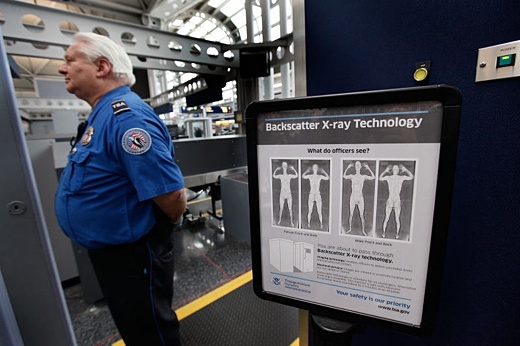
Image above: A rather unhealthy TSA agent stands next to backscatter x-ray machine/ From (http://www.freerepublic.com/focus/news/2631515/posts).
When investigators with the Centers for Disease Control and Prevention's workplace safety team visited a dozen airports in 2003 and 2004, what they found was disturbing — at least to federal airport workers. Although most radiation levels around baggage X-ray machines were low, six of 281 machines used to screen checked luggage violated federal radiation standards, some emitting two or three times the allowed limit, the CDC found. Perhaps most troubling, the CDC had found what the Transportation Security Administration hadn't noticed. The TSA and its contractors had failed to identify the machines that were emitting excessive radiation — a failure that continues to leave TSA workers and some lawmakers uneasy, especially as the agency continues to deploy hundreds of controversial radiation-emitting machines to help screen passengers. Video above: "Please Remove Your Shoes" Movie Trailer, From (http://www.youtube.com/watch?v=bTJ9v1s1Oak). Although the CDC report, finished in 2008, concluded that the radiation levels didn't pose a "direct hazard" to TSA workers, it recommended that the TSA take steps to protect against excessive exposures. Health guidelines call for people to limit their exposure to radiation as much as reasonably possible. In late November, USA TODAY requested current inspection reports for the 4,080 X-ray machines used to examine checked and carry-on bags, and for the 221 new full-body X-ray scanners. The TSA insists that all have passed radiation inspections conducted by contractors but has thus far been unwilling to release the reports. Members of Congress are now calling on the TSA to release radiation inspection records, and one lawmaker — Rep.Ed Markey, D-Mass. — has asked for an investigation into the effectiveness of the TSA's oversight of its X-ray machines. The TSA's lack of transparency troubles agency workers, according to the union that represents them. "We don't think the agency is sharing enough information," said Milly Rodriguez, occupational health and safety specialist at the American Federation of Government Employees. "Radiation just invokes a lot of fear." Jill Segraves, director of TSA's occupational safety office, said the problems identified by CDC were a result of the agency's rapid creation in the wake of the Sept. 11, 2001, attacks. "We didn't even have policies and procedures in place yet," she said, noting TSA's safety office wasn't created until 2003. "Now we have a much better educated workforce. They understand what to look for with these systems," Segraves said. A different contractor now maintains the TSA's airport equipment, she said, and every machine receives a radiation test at least annually, at installation and after maintenance issues. TSA, Army inspect machines Airport X-ray machines are exempt from the state radiation control inspections they would receive if installed at a local courthouse or in a non-federal office building.The U.S. Food and Drug Administration doesn't routinely inspect airport X-ray machines either because they are not medical devices, said FDA spokesman Dick Thompson. That leaves the TSA responsible for inspecting its own devices. Since 2008, the TSA has contracted with the U.S. Army Public Health Command to do additional radiation spot checks at 10-12 of the nation's 450 commercial passenger airports each year. The added layer of scrutiny is supposed to act as a backstop to the regular inspections and monitoring done by maintenance contractors. So far the Army radiation inspectors have checked 437 baggage X-ray machines at 34 airports selected by TSA; all had radiation emissions "well below" federal requirements, said Fran Szrom, a health physicist with the Army program. Every year Americans are exposed to about 300 millirem of radiation from naturally occurring sources, from rocks and soil to cosmic rays, according to the Health Physics Society. The amounts of radiation emitted by properly working airport X-ray equipment is small, though some experts disagree how small Federal regulations require X-ray machines that screen bags to emit less than 0.5 millirem an hour. Currently, there are 221 backscatter X-ray machines to screen passengers at 39 airports. According to the TSA, each scan delivers a radiation dose of less than 0.01 millirem. For the new backscatter X-ray full-body scanners, Army inspectors have taken radiation readings in and around 15 of the scanners at three airports: Cincinnati, Boston and Los Angeles. All of them met safety standards and delivered less than 0.005 millirem per screening, Szrom said. Not all of the TSA's new full-body scanners use X-rays to see through passengers' clothing. Of 412 full-body scanners deployed so far, 191 at 30 airports use a different technology called millimeter wave, that uses electromagnetic waves instead of ionizing radiation. Concerns remain Despite assurances, some TSA workers don't trust that the agency has fixed the kinds of maintenance and monitoring issues identified by the CDC, said union official Rodriguez. Because TSA workers at airports in Boston and San Juan were troubled by what they saw as possible cancer clusters among colleagues, the TSA this year requested health hazard evaluations of their work areas to address radiation concerns, CDC records show. The CDC found nothing unusual about the number of cancer cases and determined they were likely unrelated to airport X-ray machines, the reports say. And a TSA employee at an unidentified airport asked CDC in June to examine concerns about radiation exposures from standing near the new full-body X-ray scanners for hours a day. The CDC said it didn't have authority to do a hazard assessment unless three or more current employees at one location made a joint request, according to a September letter from the CDC to the unnamed worker. The CDC provided the letter to USA TODAY. Since April 2009, the Army team also has been studying the radiation doses received by TSA workers at six airports, Philadelphia, Baltimore, West Palm Beach, Memphis, Los Angeles, Portland, Ore. The report is not yet final, but Szrom said all the data shows radiation exposure is low — "well below" limits that would require workers to routinely wear radiation monitoring badges. The backscatter machines have drawn criticism among some scientists and health experts who are concerned about subjecting thousands of travelers to even tiny doses of radiation. Peter Rez, a physics professor at Arizona State University, also worries about the possibility of higher doses or even radiation burns if a machine malfunctions and the scanning beam stops on one part of the body. Rez, who has reviewed a patent application for the backscatter system, notes that the scanner has a fail-safe system that is supposed to shut down the X-ray beam if there's a problem. "But we all learned this summer that fail-safe systems do fail," Rez said, referring to the mechanical failures that resulted in the massive Gulf oil spill. Rapiscan Systems, the company that makes the full-body backscatter X-ray scanners used by TSA, did not respond to interview requests. The new full-body scanners have raised more concerns than the baggage X-ray machines, despite TSA and FDA assurances that they're safe. David Brenner, director of Columbia University's center for radiological research, questions whether it's good public policy to give millions of people the backscatter scans — even if the health risk is remote. "The radiation dose is very, very low indeed," Brenner said. "From most individuals' point of view, I don't think one should have much concern about walking through these scanners." But as millions of scans are performed on large populations of people, Brenner said "you can be reasonably convinced a certain number of people will end up with a cancer from the radiation exposure, despite the fact the risk to the individual is very low." Skin cancer, is the primary risk, he said. Brenner said a few people getting cancer might be acceptable in return for air security if there weren't an alternative technology — the millimeter wave machines — that had no known health risk. "Why use a technology where the best estimate is there will be come cancers somewhere down the line?" he asked. TSA spokesman Kimball said the TSA competitively bids for new technology and will deploy those that meet its threat detection and safety standards. Both millimeter wave and backscatter X-rays meet those standards, he said.
SUBHEAD:
Radiation scientists agree TSA naked body scanners could cause breast cancer and sperm mutations.
By Mike Adams on 3 December 2010 for in Natural News - (http://www.naturalnews.com/030607_naked_body_scanners_radiation.html)
Video above: Denver Airport Underwear Interviews WACCTV. From (http://www.youtube.com/watch?v=qCagUmAS5QE).
The news about the potential health dangers of the TSA's naked body scanners just keeps getting worse. An increasing number of doctors and scientists are going public with their warnings about the health implications of subjecting yourself to naked body scanners. These include Dr Russell Blaylock (see below) as well as several professors from the University of California who are experts in X-ray imaging. At the same time, some internet bloggers are insisting that the TSA's naked body scanners pose no health risks because air travelers are subjected to higher levels of radiation by simply enduring high-altitude flights where cosmic radiation isn't filtered out by the full thickness of the Earth's atmosphere. This comparison, however, is inaccurate: The TSA's body scannersfocus radiation on the skin and organs near the skin whereas cosmic radiation during high-altitude flights is distributed across the entire mass of your body. Comparing the total radiation exposure across your entire body to machine-emitted radiation exposure that focuses its ionizing radiation primarily on your skin is like comparing apples and oranges. You'll see this explained further, below, in the words of these scientists. As Dr Russell Blaylock (www.BlaylockReport.com) recently reported: The growing outrage over the Transportation Security Administration's new policy of backscatter scanning of airline passengers and enhanced pat-downs brings to mind these wise words from President Ronald Reagan: The nine most terrifying words in the English language are: I'm from the government and I'm here to help you. So, what is all the concern really about - will these radiation scanners increase your risk of cancer or other diseases? A group of scientists and professors from the University of California at San Francisco voiced their concern to Obama's science and technology adviser John Holdren in a well-stated letter back in April. The letter Dr Blaylock is referring to is from the Faculty of the University of California, San Francisco and is signed by Doctors John Sedat Ph.D., David Agard, Ph.D., Marc Shuman, M.D., Robert Stroud, Ph.D. You can download or view the full letter from NaturalNews here (PDF): http://www.NaturalNews.com/files/TS... Even though it was written in April of this year, this letter has received increased publicity lately due to the TSA's sudden expansion of naked body scanners in airports as well as the agency's arrogant insistence that such machines will soon be used at bus stations, railway stations and other entrance points for mass transportation. In this NaturalNews article, I highlight the most important warnings from this letter and explain, in plain language, what these scientists are trying to say.
The letter that the TSA doesn't want you to read - Once again, this letter was written by Drs John Sedat Ph.D., David Agard, Ph.D., Marc Shuman, M.D., Robert Stroud, Ph.D., all from the University of California. Here is their background as described in the letter: Dr. Sedat is a Professor Emeritus in Biochemistry and Biophysics at the University of California, San Francisco, with expertise in imaging. He is also a member of the National Academy of Sciences. The other cosigners include Dr Marc Shuman, and internationally well known and respected cancer expert and UCSF professor, as well as Drs David Agard and Robert Stroud, who are UCSF Professors, X-ray crystallographers, imaging experts and NAS members. Here are the highlights of the letter along with my comments and explanations: "We are writing to call your attention to serious concerns about the potential health risks of the recently adopted whole body backscatter X-ray airport security scanners. This is an urgent situation as these X-ray scanners are rapidly being implemented as a primary screening step for all air travel passengers." Translation: The naked body scanners may be dangerous to your health. "Our overriding concern is the extent to which the safety of this scanning device has been adequately demonstrated. This can only be determined by a meeting of an impartial panel of experts that would include medical physicists and radiation biologists at which all of the available relevant data is reviewed." Translation: The safety of these naked body scanners has never been demonstrated, and especially not by an independent panel of qualified scientists.
"The physics of these X-rays is very telling: the X-rays are Compton-Scattering off outer molecule bonding electrons and thus inelastic (likely breaking bonds)."
Translation: The ionizing radiation emitted by these devices can alter your DNA.
"Unlike other scanners, these new devices operate at relatively low beam energies (28keV). The majority of their energy is delivered to the skin and the underlying tissue. Thus, while the dose would be safe if it were distributed throughout the volume of the entire body, the dose to the skin may be dangerously high."
Translation: The danger of these devices is significantly higher than what might be assumed from the TOTAL radiation emissions. This is why those who claim "you get more radiation just from flying" are flat-out wrong in their conclusions.
"This comparison is very misleading: both the air travel cosmic ray exposure and chest X-rays have much higher X-ray energies and the health consequences are appropriately understood in terms of the whole body volume dose. In contrast, these new airport scanners are largely depositing their energy into the skin and immediately adjacent tissue, and since this is such a small fraction of body weight / volume, possibly by one to two orders of magnitude, the real dose to the skin is now high."
Translation: This is a further explanation of why the ionizing radiation from the naked body scanners may pose a much higher risk of cancer (two orders of magnitude higher!) than what might be assumed from the total radiation emissions.
"In addition, it appears that real independent safety data do not exist. A search, ultimately finding top FDA radiation physics staff, suggests that the relevant radiation quantity, the Flux [photons per unit area and time (because this is a scanning device)] has not been characterized. Instead an indirect test (Air Kerma) was made that emphasized the whole body exposure value, and thus it appears that the danger is low when compared to cosmic rays during airplane travel and a chest X-ray dose. In summary, if the key data (flux-integrated photons per unit values) were available, it would be straightforward to accurately model the dose being deposited in the skin and adjacent tissues using available computer codes, which would resolve the potential concerns over radiation damage."
Translation: The FDA screwed up the safety testing (gee, really?) by assuming the emitted radiation was distributed across the entire body rather than focused on the skin. It brings up the question: When and how were these devices ever approved by the FDAanyway? Naked body scanners are clearly "medical devices" as they emit X-rays that penetrate body tissue. Did the FDA ever conduct long-term clinical trials demonstrating the safety of these devices? (Of course not.) Did they ever test the safety of naked body scanners on pregnant women? What about senior citizens? How about people who have already undergone radiation treatments for conditions like thyroid cancer? Ten big concerns voiced by the scientists Here are ten additional concerns raised by these scientists in their letter: (the bolded titles are my subheads, the subsequent explanation test is quoted straight out the scientists' letter)
#1) Cancer in senior citizens - The large population of older travelers, greater than 65 years of age, is particularly at risk from the mutagenic effects of the X-rays based on the known biology of melanocyte aging. #2) Breast cancer - A fraction of the female population is especially sensitive to mutagenesis-provoking radiation leading to breast cancer. Notably, because these women, who have defects in DNA repair mechanisms, are particularly prone to cancer, X-ray mammograms are not performed on them. The dose to breast tissue beneath the skin represents a similar risk. #3) White blood cells being irradiated - Blood (white blood cells) perfusing the skin is also at risk. #4) HIV and cancer patients - The population of immunocompromised individuals -- HIV and cancer patients (see above) is likely to be at risk for cancer induction by the high skin dose. #5) Radiation risk to children - The risk of radiation emission to children and adolescents does not appear to have been fully evaluated. #6) Pregnant women - The policy towards pregnant women needs to be defined once the theoretical risks to the fetus are determined. #7 Sperm mutations - Because of the proximity of the testicles to skin, this tissue is at risk forsperm mutagenesis. #8 Radiation effects on cornea and thymus - Have the effects of the radiation on the cornea and thymus been determined? #9 Problems with the machine - There are a number of 'red flags' related to the hardware itself. Because this device can scan a human in a few seconds, the X-ray beam is very intense. Any glitch in power at any point in the hardware (or more importantly in software) that stops the device could cause an intense radiation dose to a single spot on the skin. Translation: This machine does not emit a "flood light" of radiation like you might get from a dental X-ray machine. Rather, this machine emits a thin, narrow beam of radiation that is quickly "scanned" across your body, back and forth, in much the same way that an inkjet printer prints a page (but a lot faster). Because the angle of the X-ray beam is controlled by the scanner software, a glitch in the software could turn the naked body scanner into a high-energy weapon if the beam gets "stuck" in one location for more than a fraction of a second. #10 Higher radiation for the groin? - Given the recent incident (on December 25th, 2009), how do we know whether the manufacturer or TSA, seeking higher resolution, will scan the groin area more slowly leading to a much higher total dose?
None of these ten concerns are being answered by the TSA and its head John Pistole. The attitude from the TSA on these scanners, in fact, is downright belligerent, treating Americans as terrorists and threatening to arrest and detain individuals who refuse to be scanned and groped. The TSA, it seems, believes it can do no wrong. Such is the inevitable outcome of granting too much power to any government department, as it will always seek to expand its power to the point of tyranny over the People. Dangerous errors are possible In this letter, these scientists go on to explain why they continue to hold such concerns: (my emphasis added) We would like to put our current concerns into perspective. As longstanding UCSF scientists and physicians, we have witnessed critical errors in decisions that have seriously affected the health of thousands of people in the United States. These unfortunate errors were made because of the failure to recognize potential adverse outcomes of decisions made at the federal level. Crises create a sense of urgency that frequently leads to hasty decisions where unintended consequences are not recognized. Examples include the failure of the CDC to recognize the risk of blood transfusions in the early stages of the AIDS epidemic, approval of drugs and devices by the FDA without sufficient review, and improper standards set by the EPA, to name a few. Similarly, there has not been sufficient review of the intermediate and long-term effects of radiation exposure associated with airport scanners. There is good reason to believe that these scanners will increase the risk of cancer to children and other vulnerable populations. We are unanimous in believing that the potential health consequences need to be rigorously studied before these scanners are adopted. Modifications that reduce radiation exposure need to be explored as soon as possible. In summary we urge you to empower an impartial panel of experts to reevaluate the potential health issues we have raised before there are irrevocable long-term consequences to the health of our country. These negative effects may on balance far outweigh the potential benefit of increased detection of terrorists. Translation: These scientists believe that the TSA's naked body scanners pose a risk of promoting cancer across the population and that a real, scientific evaluation by trained, independent scientists must be conducted before these scanners are put to further use. Again, you can read this letter for yourself here: http://www.NaturalNews.com/files/TS... Big Government says: What cancer? The TSA, of course, refuses to hold any serious discussion about the science behind its use of naked body scanners... primarily because there is no legitimate science backing the use of its naked body scanners. This whole scam was orchestrated by Chertoff and his Washington buddies to scare the population into accepting X-ray scans at airports so that a few rich white guys could cash in on the sale of these machines to the federal government. The whole thing is a massive con job that, as usual, benefits the bank accounts of a few well-connected power pushers while compromising both the freedoms and the health of the American people. No legitimate safety testing has ever been conducted on these naked body scanners, and yet the FDA and TSA just allow them to be rolled out on the ASSUMPTION that they must somehow be perfectly safe. (The same is true with seasonal flu vaccines, by the way, which are never tested in randomized, placebo-controlled clinical trials.) Isn't this how aspartame got legalized, come to think of it? Except in that case it was Rumsfeld, not Chertoff, calling the shots. You can't have nutrition, but we'll feed you X-rays! Think about what's happening here for a minute: The FDA is an agency that has gone out and threatened, raided and persecuted manufacturers of walnuts, cherries and green tea products who made scientifically validated health claims about the benefits of those products. And yet, when it comes to rolling out naked body scanners that pose a cancer risk to the population, the FDA requires no legitimate scientific testing whatsoever and simply rubber stamps the whole project, thereby subjecting virtually the entire population to radiation-emitting devices with an unknown level of health risk. But then again, what do they care if a few thousand people get cancer anyway? More cancer just means more profits for the cancer industry which, not coincidentally, just happens to treat its patients with yet more radiation as some sort of "therapy" for cancer. (I know, this just gets more bizarre the further you go). Big Pharma must love the fact that millions of Americans are now being subjected to yet another form of ionizing radiation, as that means more cancer patients to buy chemotherapy in the years ahead, too. Pile 'em in, Chief! We've got more cattle to brand! The craziest part of all But the really crazy part about this whole story is not that the scientists are concerned about the health risks of these naked body scanners. It's not that the TSA is, itself, a terrorist organization now generating more fear and terror than the international terrorists could ever hope to accomplish. It's not even the fact that the FDA allows these radiation machines to be widely used across the country despite the fact that they've never been honestly and scientifically tested for use on humans. No, the real shocker in all this is the startling fact that people are lining up like cattle to go along with this. Your average American citizen, it seems, just can't wait to bow down to authority and subject their private body parts to a federal search in complete violation of their Constitutional rights. In fact, come to think of it, Judge Napolitano recently appeared on the Alex Jones Show to talk about the freedom issues with the naked body scanners and obscene gropes. You can watch those videos at: http://www.prisonplanet.com/the-ale... It's a very educational interview. Naked body scanners pose a cancer risk But getting back to the health issue in particular, it is clear to anyone who understands the laws of physics that the TSA's naked body scanners create an increased risk of cancer to the population. That's why I had the sense to refuse to go through one of these when directed to do so at a California airport. I opted out and went through the "easy" pat down (the easy version, before they upgraded to their "enhanced" pat downs). () As of right now, I refuse to fly until the TSA backs off its naked body scanner madness. Not only do I refuse to subject my biology to ionizing radiation that carries an unknown cancer risk, but I also strongly object to the U.S. government violating my Constitutional rights by viewing the shape of my naked body on their electronic viewing screens. "The price of freedom is eternal vigilance." - Thomas Jefferson. And Winston Churchill famously said:
"If you will not fight for the right when you can easily win without bloodshed; if you will not fight when your victory will be sure and not too costly; you may come to the moment when you will have to fight with all the odds against you and only a small chance of survival. There may even be a worse case: you may have to fight when there is no hope of victory, because it is better to perish than to live as slaves."
.