Showing posts with label Whistleblowing. Show all posts

Clinton Foundation admits crimes

SUBHEAD: Confidential memo of audit of Clinton Foundation shows illegal activities.

By Tyler Durden on 6 November 2016 for Zero Hedge -
(http://www.zerohedge.com/news/2016-11-05/leaked-clinton-foundation-smoking-gun-memo-reveals-it-was-not-compliance-law)


Image above: Bill, Hillary and Chelsea make a presentation for the Clinton Global Initiative University, an initiative of the Clinton Foundation. From (http://www.investors.com/politics/editorials/clinton-foundation-scandal/).

[IB Publisher's note: And that's why we voted for Jill Stein for President.]
There are conflicting reports whether the FBI may or may not indict the Clinton Foundation, which as the WSJ reported last week is being investigated by various FBI teams, even as other parts of the Bureau - and the DOJ - seek to squash the probe.

The latest dump of Podesta emails has revealed a critical, confidential memo from prominent New York lawyer Kumiki Gibson to Clinton Foundation Chairman Bruce Lindsey (and former Bill Clinton attorney) which was performed as part of an inside audit of the foundation, and confirms that the charitable organization (which it found "operates more like a political operation") was engaged in practices that broke the law.

As Gibson (who according to her resume "counseled the William J. Clinton Foundation, an international not-for-profit organization, on structural, legal, and compliance issues” from May 2008 until January 2014) wrote the purpose of the confidential November 10, 2008 memo, was to:
"set forth the findings of my review of the Legal and Human Resources Departments of the William J. Clinton Foundation (“Foundation”) and those pertaining to other areas of the Foundation revealed during this review, and my recommendations to the Foundation based on this review."
The summary reveals serious reservations about the viability of the foundation - which "operates more like a political operation" than a "professional, strategic, and sustainable corporation committed to advancing its overall mission" - if and when Bill Clinton were to depart and "the Foundation has to rise and/or fall on its own name and work only."
While the Foundation has grown impressively over the past several years, it has a number of fundamental organizational challenges and deficiencies that undermine its effectiveness, expose it to significant risk, and, ultimately, threaten its long-term survival.  The Foundation (as opposed to its initiatives, which I have not reviewed) operates more like a political operation focused on immediate situations, tasks, and events, as opposed to a professional, strategic, and sustainable corporation committed to advancing its overall mission.  While that may not be a problem while the President is personally involved in the Foundation -- and can garner support based on that involvement -- it will be a problem when he is no longer involved, and the Foundation has to rise and/or fall on its own name and work only.
The chief risks identified in Gibson's outside review, stem from both its Legal and Human Resource Departments, as well as Bill Clinton's unwillingness to "allow the Board and CEO to make the changes necessary for it to become sustainable, even great."
If the leadership (that is, the Board and the CEO) intends and wants the organization to survive beyond the President’s personal involvement, then it must take measures to move the organization onto a path of sustainability, starting with revamping both the Legal and Human Resources (“HR”) Departments; reviewing its corporate structure and governance documents; and, perhaps most importantly, having a frank discussion with the President about the current state of the organization, the future of the organization, and his appetite and willingness to allow the Board and CEO to make the changes necessary for it to become sustainable, even great.
As the summary concludes, "the time for making these changes, if they are desired, could not be better:  The presidential campaign, which distracted some key employees and caused uncertainty among others about the future of the organization, is now over; virtually all of the employees interviewed are anxious for more structure, professionalism, and mission-focus; and funders are expecting the same."

Next follows a detailed and highly critical analysis of the Foundation's (1) shared values, (2) strategy, (3) structure, (4) systems, (5) staff, (6) style, and (7) skills, which the review finds "the Foundation to significant legal and reputational risks, results in inconsistencies and inefficiencies, and undermines its work and viability" and leads to the following conclusion about the CF's operational shortcomings:
The assessment of the organization through the 7-S Framework makes clear that the organization is not operating as effectively or efficiently as it should or could.  Indeed, it has major deficiencies in each of the fundamental areas.  Each of these deficiencies, standing alone, threatens the effectiveness of the Foundation in the short and long term.  When combined, as currently the case, they threaten its very existence (absent the President’s involvement).  
The outside legal review of the Clinton Foundation is that, at least operationally, the only thing that was keeping the enterprise going was the presence of Bill Clinton, whose anchor role to match donors with "uses of funds" and subsequent distribution of favors , aka "pay for play" made the former president indispensable in an organization that would otherwise not survive:
Because it is unclear whether the President wants the Foundation to exist beyond his personal involvement, the Foundation’s leadership (that is, the Board and CEO) should address this question head-on with the President.  That will require a frank discussion with the President about his desire, willingness, and appetite to move the Foundation to the next level of development.  If the President concludes that he does, in fact, want the Foundation to survive and thrive beyond his involvement, then he should authorize and empower the CEO and Board to make the changes necessary for this survival.
However, while all of that is troubling, and suggests that the CF was - from day one - just a corporate extension of Bill Clinton's persona, it was in no way illegal. Where the alarm bells go off, however, is taking a look at page 9 of the memo, where Gibson does a review of the Foundation's "Legal and HR Departments", something troubling emerges, which perhaps the FBI may want to take a particularly close look at. The following:
No matter what the leadership decides about the larger, over-arching question, it must act immediately to bring the Foundation into compliance with the law and standards that govern not-for-profits, and must create strong legal and HR offices so to prevent any lapses in the future. 
The memo also notes that "the Foundation has very few procedures, processes, and systems in place, and even fewer that are consistent across the organization.  For example, it is missing several policies/procedures that are required by law (e.g., record retention policy).  Moreover, although it has an employee manual, that manual is not comprehensive and is not distributed or followed consistently across the organization."
What makes this (systems) deficiency particularly problematic is that (1) the organization is legally liable for the acts of its offices and initiatives and those who run them; (2) managers in key positions have no to little experience in not-for-profit management and thus do not even possess the right instincts when faced with a problem for which there is no policy or procedure; and (3) there is no established mechanism for catching problems and mistakes.  
Gibson's take: "In short, the systems deficiency subjects the Foundation to significant legal and reputational risks, results in inconsistencies and inefficiencies, and undermines its work and viability. "

Simply stated, as of the day the memo was written, the Foundation was not in compliance with the law and with standards that govern "not-for-profits."

Among the policies and procedures that Gibson found missing or inadequate at the Foundation were the following, some of which - such as the procedures the CF was utilizing in Harlem -  may be in violation of the law. Here is a brief sample of the findings:
  • The Foundation lacks important policies and procedures and a real process to ensure compliance, resulting in increased risks, confusion, conflicting (and perhaps arbitrary) decisions, and inefficiencies.  
  • The Foundation does not have a record retention policy, and the procedures currently utilized in Harlem may violate the law.
  • It is unclear whether lower level employees actually meet the definition of exempt under the Fair Labor Standards Act.
  • Processes and employment decisions are made on an ad hoc basis. 
  • Staff complained about the lack of comprehensive and/or written policies and procedures.
  • Staff complained about the lack of a real complaint and/or whistleblower policy.
And many more.

Furthermore, and more troubling, the review pointed to a high-ranking but unnamed foundation executive who was “being paid by [President Clinton], the government and the foundation” who “allowed the foundation to host what may have been (or may have been viewed as) a political event, apparently without official pre-approval from the foundation’s legal department and without regard, before the fact, to the impact of that decision on the foundation’s tax exempt status.”

While the conclusion avoids repeating the explicit accusation of operating outside of the law - we assume Gibson did not want to scare the Clinton Foundation too much, and thus avoid repeat work - it is a stark condemnation of the underlying practices and principles of operation:
The challenges and deficiencies plaguing the Foundation cannot be over-stated:  They are real and undermine the organization’s effectiveness, immediately and more long term.  To address the issues that present immediate threats, the Foundation should revamp its Legal and HR operations, should review its governance structure and documents; and should have an open and honest discussion with the President about the future of the Foundation. 
It is illegal for tax-exempt non-profit foundations like the Clinton Foundation to be linked with partisan political events as described in the review report.

The Lindsey memo was distributed just two days before the Clinton Foundation signed an agreement with Obama’s transition office Dec. 12, 2008, as part of the president-elect’s decision to appoint Hillary Clinton as the nation’s chief diplomat. Obama wanted assurance that no conflicts of interest would arise between Clinton’s work as Secretary of State and the foundation, which had operations in numerous foreign countries.

It is unclear if any of these recommendations were implemented, or if the CF is now in "compliance with the law and standards that govern not-for-profits."

It is clear, however, that at least at one point it was not. It remains to be seen if such illegal activity will be grounds for the DOJ to permit the FBI to do its job and indict a foundation that, as lawyer determined, was operating in a fraudulent fashion.

.
Drone Whistleblower's Claim

SUBHEAD: Former drone operation pilots say they were "horrified by cruelty of assassination program.

By Murtaza Hussain on 19 November 2015 for the Intercept -
(https://theintercept.com/2015/11/19/former-drone-operators-say-they-were-horrified-by-cruelty-of-assassination-program/)


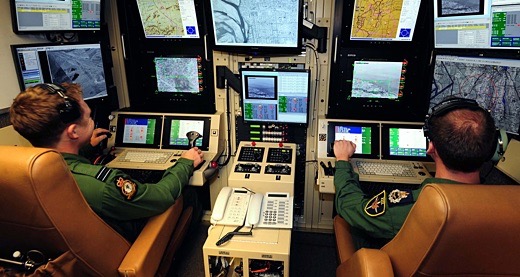
Image above: Drone pilots during operations.  From original article.

U.S. drone operators are inflicting heavy civilian casualties and have developed an institutional culture callous to the death of children and other innocents, four former operators said at a press briefing today in New York.
 
The killings, part of the Obama administration’s targeted assassination program, are aiding terrorist recruitment and thus undermining the program’s goal of eliminating such fighters, the veterans added. 

Drone operators refer to children as “fun-size terrorists” and liken killing them to “cutting the grass before it grows too long,” said one of the operators, Michael Haas, a former senior airman in the Air Force. Haas also described widespread drug and alcohol abuse, further stating that some operators had flown missions while impaired.

In addition to Haas, the operators are former Air Force Staff Sgt. Brandon Bryant along with former senior airmen Cian Westmoreland and Stephen Lewis. The men have conducted kill missions in many of the major theaters of the post-9/11 war on terror, including Iraq, Afghanistan and Pakistan.
“We have seen the abuse firsthand,” said Bryant, “and we are horrified.”

An Air Force spokesperson did not address the specific allegations but wrote in an email that “the demands placed on the [drone] force are tremendous. A great deal of effort is being taken to bring about relief, stabilize the force, and sustain a vital warfighter capability. … Airmen are expected to adhere to established standards of behavior. Behavior found to be inconsistent with Air Force core values is appropriately looked into and if warranted, disciplinary action is taken.”

Beyond the press conference, the group also denounced the program yesterday in an interview with The Guardian and in an open letter addressed to President Obama.

Read the full letter the drone whistleblowers sent to Obama below or here, or (http://www.islandbreath.org/2015Year/11/151125droneletter.pdf)


President Barack Obama
The White House Washington, D.C.
Secretary Ashton B. Carter
Department of Defense

Director John O. Brennan
Central Intelligence Agency

Dear President Obama, Secretary Carter and Director Brennan:

We are former Air Force service members. We joined the Air Force to protect American lives and to protect our Constitution.

We came to the realization that the innocent civilians we were killing only fueled the feelings of hatred that ignited terrorism and groups like ISIS, while also serving as a fundamental recruitment tool similar to Guantanamo Bay. This administration and its predecessors have built a drone program that is one of the most devastating driving forces for terrorism and destabilization around the world.

When the guilt of our roles in facilitating this systematic loss of innocent life became too much, all of us succumbed to PTSD. We were cut loose by the same government we gave so much to ­­ sent out in the world without adequate medical care, reliable public health services, or necessary benefits. Some of us are now homeless. Others of us barely make it.

We witnessed gross waste, mismanagement, abuses of power, and our country’s leaders lying publicly about the effectiveness of the drone program. We cannot sit silently by and witness tragedies like the attacks in Paris, knowing the devastating effects the drone program has overseas and at home. Such silence would violate the very oaths we took to support and defend the Constitution.

We request that you consider our perspective, though perhaps that request is in vain given the unprecedented prosecution of truth­tellers who came before us like Chelsea Manning, Julian Assange, and Edward Snowden. For the sake of this country, we hope it is otherwise.

Sincerely,

Brandon Bryant
Staff Sergeant
MQ­1B Predator Sensor Operator
SERE Instructor Trainee
USAF Joint Special Operations Command 3rd Special Operations Squadron Disabled Iraq and Afghanistan Veteran Founder of Project RED HAND
Cian Westmoreland
Senior Airman
RF Transmissions Systems
USAF CENTCOM
73rd Expeditionary Air Control Squadron
Disabled Afghanistan Veteran
Project RED HAND's Sustainable Technology Director

Stephen Lewis
Senior Airman
MQ­1B Predator Sensor Operator
USAF Joint Special Operations Command 3rd Special Operations Squadron
Iraq and Afghanistan Veteran
Michael Haas
Senior Airman
MQ­1B Predator Sensor Operator Instructor USAF Air Combat Command
15th Reconnaissance Squadron
Iraq and Afghanistan Veteran


At the press conference, Bryant said the killing of civilians by drone is exacerbating the problem of terrorism. “We kill four and create 10 [militants],” Bryant said. “If you kill someone’s father, uncle or brother who had nothing to do with anything, their families are going to want revenge.”

The Obama administration has gone to great lengths to keep details of the drone program secret, but in their statements today the former operators opened up about the culture that has developed among those responsible for carrying it out.

Haas said operators become acculturated to denying the humanity of the people on their targeting screens. “There was a much more detached outlook about who these people were we were monitoring,” he said. “Shooting was something to be lauded and something we should strive for.”

The deaths of children and other non-combatants in strikes was rationalized by many drone operators, Haas said. As a flight instructor, Haas claimed to have been non-judicially reprimanded by his superiors for failing a student who had expressed “bloodlust,” an overwhelming eagerness to kill.

Haas also described widespread alcohol and drug abuse among drone pilots. Drone operators, he said, would frequently get intoxicated using bath salts and synthetic marijuana to avoid possible drug testing and in an effort to “bend that reality and try to picture yourself not being there.”

Haas said that he knew at least a half-dozen people in his unit who were using bath salts and that drug use had “impaired” them during missions.

The Obama administration’s assassination program has come under increasing scrutiny in recent months. This October, The Intercept published a cache of classified documents leaked by a government whistleblower that showed how the program killed people based on unreliable intelligence, that the vast majority of people killed in a multi-year Afghanistan campaign were not the intended targets, and that the military by default labeled non-targets killed in the campaign as enemies rather than civilians.

The operators said that they felt increasing urgency to speak out in the wake of the deadly terrorist attacks in Paris last week; they believe drone assassinations have fed the rise of the extremist group the Islamic State, which has claimed responsibility for the attacks.

Westmoreland said of drones: “In the short term they’re good at killing people, but in the long term they’re not effective. There are 15-year-olds growing up who have not lived a day without drones overhead, but you also have expats who are watching what’s going on in their home countries and seeing regularly the violations that are happening there, and that is something that could radicalize them.”

In their open letter to Obama, the former drone pilots made a similar point, writing that during their service they “came to the realization that the innocent civilians we were killing only fueled the feelings of hatred that ignited terrorism and groups like ISIS,” going on to describe the program as “one of the most devastating driving forces for terrorism and destabilization around the world.”

 At the press conference today, the pilots echoed these sentiments. “It seems like our actions of late have only made the problems worse. …

The drones are good at killing people, just not the right ones,” Bryant said. “Have we forgotten our humanity in the pursuit of vengeance and security?”

.

Army finds against Manning

SUBHEAD: This sets a 'concerning precedent,' as US Army finds Manning guilty of bogus charges.

By Laurali McCauley on 18 August 2015 for Common Dreams -
(http://www.commondreams.org/news/2015/08/18/setting-concerning-precedent-us-army-finds-manning-guilty-bogus-charges)


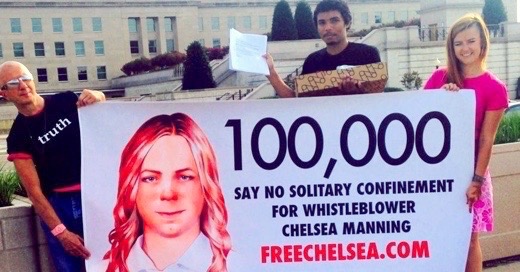
Image above: Ahead of the hearing, supporters delivered 100,000 signatures to the Army to drop the bogus charges. Photo by Mike Avender. From original article.

A U.S. Army disciplinary board on Tuesday found Pfc. Chelsea Manning "guilty" of four charges, including one for possessing LGBTQ reading material like the Caitlyn Jenner issue of Vanity Fair and another for having a tube of expired toothpaste in her cell.

As punishment for the alleged transgressions, the whistleblower received 21 days of recreational restrictions, excluding her from time in the gym, library, and outdoors; she faced a maximum possible sentence of indefinite solitary confinement.

However, Manning as well as her attorneys fear that the conviction, now part of her permanent record, will be used against her in future parole or clemency hearings and could potentially delay her transition to minimum security custody status by years.

Ahead of the hearing, supporters delivered 100,000 signatures to the Army liaison office, calling on the military to drop the charges.

"When I spoke to Chelsea earlier today she wanted to convey the message to supporters that she is so thankful for the thousands of people from around the world who let the government know that we are watching and scrutinizing what happens to her behind prison walls," said Chase Strangio, Manning's attorney at the ACLU. "It was no doubt this support that kept her out of solitary confinement."

"But the fact that Chelsea had to face today’s four-hour Disciplinary Board without counsel, and will now be punished for daring to share her voice, sets a concerning precedent for the remaining decades of her incarceration," Strangio continued.

"No one should have to face the lingering threat of solitary confinement for reading and writing about the conditions we encounter in the world," the attorney added. "Chelsea’s voice is critical to our public discourse about government accountability and trans justice and we can only preserve it if we stay vigilant in our advocacy on her behalf."

Earlier:

Pfc. Chelsea Manning has undergone harassment and what many deem torture, and on Tuesday the U.S. Army whistleblower is faced with a potential sentence of indefinite solitary confinement for offenses her advocates say are "extreme and ridiculous."

Ahead of the 2:30 PM EST disciplinary hearing, supporters collected 100,000 signatures which they delivered Tuesday morning to the Army Liaison office on Capitol Hill. The petition is calling on the disciplinary board to open the hearing to the public and drop the charges, arguing that the egregious punishment would be an affront to justice.

"Putting any human being in indefinite solitary confinement is inexcusable, and for offenses as trivial as these (an expired tube of toothpaste, and possession [of] magazines?) it is a discredit to America's military and its system of justice," the petition states.

However, as of this writing, the hearing remained closed with no attorney present, forcing Manning to represent herself. Supporters told Common Dreams that they expect to hear the result of the hearing by the end of the day. However, they note that if Manning does not call from the prison, it likely means that the sentence was severe.

Over the weekend, news broke that military prison authorities were denying Manning access to the facility's legal library.

As Common Dreams previously reported, prison authorities are accusing Manning of such violations as "medicine misuse," prohibited property, and disorderly conduct for such "innocuous" offenses as possessing books and magazines related to politics and LBGTQ issues. Supporters say these "trumped up" charges are being levied to silence the whistleblower, who was jailed for leaking cables that exposed U.S. military misconduct, including the killing of innocent civilians.

"The U.S. government has a terrifying track record of using imprisonment and torture to silence free speech and dissenting voices," said Evan Greer, campaign director of digital rights group Fight for the Future, which initiated the petition. "They’ve tortured Chelsea Manning before and now they’re threatening to do it again, without any semblance of due process."

Greer continues, "Perhaps the military thought that now that Chelsea is behind bars she’s been forgotten, but the tens of thousands who signed this petition are proving them wrong. Chelsea Manning is a hero and the whole world is watching the U.S. government’s deplorable treatment of whistleblowers, transgender people, and prison inmates in general."

Since Manning was sentenced to 35 years in prison in August 2013, she began writing a column for the Guardian and has garnered international support, emerging as figure of free speech and transgender rights.

Chase Strangio, Manning's attorney at the American Civil Liberties Union, says that thousands of signatures collected in her defense and the outpouring of support "can break down the isolation of her incarceration and sends the message to the government that the public is watching and standing by her as she fights for her freedom and her voice."

See also:
Ea O Ka Aina: Injustice for Chelsea Manning 8/12/15


.

Injustice for Chelsea Manning

SUBHEAD: She may face indefinite solitary confinement for having Jenner Vanity Fair issue in cell.

By Ed Pilkington on 12 August 2015 for the Guardian -
(http://www.theguardian.com/us-news/2015/aug/12/chelsea-manning-solitary-confinement-toothpaste-army)


Image above: How Chelsea Manning sees herself. By Alicia Neal, in cooperation with Chelsea herself, commissioned by the Chelsea Manning Support Network, 23 April 2014. From (https://commons.wikimedia.org/wiki/File:C_Manning_Finish-1.jpg).

Expired tube of toothpaste and Malala Yousafzai memoir also among cell items that led to US soldier being allegedly charged with four violations of custody rules. Chelsea Manning’s lawyer says charges against her are ‘utterly ridiculous’ since US army soldier was allowed to have books and toothpaste in her cell.

Chelsea Manning, the soldier and Guardian columnist, has been denied access to a prison legal library days before a crucial hearing at which she will represent herself against charges including possession of unapproved reading material, according to a message posted to her official Twitter account at the weekend.

The hearing is part of a legal process that could result in indefinite solitary confinement for Manning, for reported violations that also include storing a tube of expired toothpaste in her military prison cell.

The army has scheduled a hearing on the violations for Tuesday at Fort Leavenworth, Kansas, where Manning is being held. She was given a 35-year sentence for having been the source of the vast leak of US state secrets to WikiLeaks.

“Prison staff are now denying me access to the law library @ scheduled times – w/only 2 days until my board,” read the tweet, which was posted by supporters in contact with the prisoner.

A call to the US disciplinary barracks at Fort Leavenworth was not immediately returned.

Earlier this week, Chase Strangio, a staff attorney with the American Civil Liberties Union who is handling Manning’s legal dispute with the US military over her health treatment in prison as a transgender woman, told the Guardian it seemed Manning was being unfairly targeted.

“Chelsea has a growing voice in the public discussion,” Stangio said, “and it would not surprise me were these charges connected to who she is.”

A petition calling on the military the drop charges against Manning for the reported prison infractions has gained 64,000 signatures, said Evan Greer, campaign director of the activist nonprofit Fight for the Future, one of four groups circulating the petition.

The groups plan to deliver the signatures to John McHugh, the secretary of the army, in Washington on Tuesday morning, in advance of Manning’s hearing.

“This is a hearing where she’s facing a disciplinary board that has the power to essentially remand her to indefinite solitary confinement,” Greer told the Guardian. “She has to face this board without her attorneys present.

And now she’s being denied access to the resources to prepare a proper defense.

“Those things being denied paint a really grim picture of what it looks like the military’s trying to do to her, and should arouse suspicion from the public and from journalists.”

Manning has told supporters that property confiscated from her cell included the memoir I Am Malala by Nobel peace prize laureate Malala Yousafzai, the Caitlyn Jenner issue of Vanity Fair, a novel featuring trans women called A Safe Girl to Love and the LGBT publication Out Magazine.

.

Newspapers seek Snowden clemency

SUBHEAD: New York Times and Guardian editorial boards recommend clemency for Edward Smowden.

By Staff on 2 January 2014 for Huffington Post -
(http://www.huffingtonpost.com/2014/01/02/edward-snowden-clemency_n_4529563.html#slide=3074349)


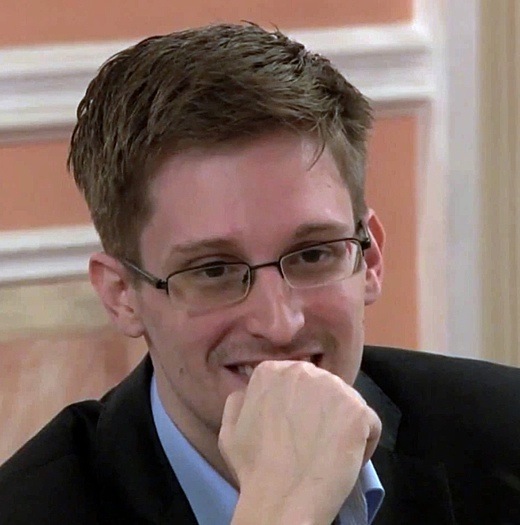
Image above: Edward Snowden smiles during a presentation ceremony for the Sam Adams Award in Moscow. From slideshow in original article.

The editorial boards of The New York Times and The Guardian published editorials on Wednesday, urging the Obama administration to treat Edward Snowden as a whistleblower and offer him some form of clemency.

Seven months ago, the former National Security Administration contractor stole as many as 1.7 million highly classified documents about the U.S. government's surveillance program and released the information to the press. The files revealed how the NSA forced American technology companies to reveal customer information, often without individual warrants, and how data from global phone and Internet networks was secretly intercepted.

While the release of these documents forced Snowden to flee the U.S. and move to Russia, it also alerted the American public -- and many U.S. allies -- of the government's intrusive, unethical and possibly unlawful spying efforts.

Beyond sparking public debate, Snowden's actions have prompted the American Civil Liberties Union to sue the NSA. The suit aims to force the U.S. government to disclose details of its electronic surveillance program and describe what protections it provides to Americans whose communications are swept up during the search for terrorist suspects, Reuters reported.

Eight major technology companies -- including Google, Facebook and Twitter -- have also joined forces to call for tighter controls on government surveillance.

To date, two federal judges have accused the NSA of violating the Constitution, and a panel appointed by President Barack Obama has blasted the agency's spying efforts and called for an overhaul of the program.

On Wednesday night, the editorial board of The New York Times published an editorial that not only described Snowden as a whistleblower but also called on the government to give him clemency.
Considering the enormous value of the information he has revealed, and the abuses he has exposed, Mr. Snowden deserves better than a life of permanent exile, fear and flight. He may have committed a crime to do so, but he has done his country a great service. It is time for the United States to offer Mr. Snowden a plea bargain or some form of clemency that would allow him to return home, face at least substantially reduced punishment in light of his role as a whistle-blower, and have the hope of a life advocating for greater privacy and far stronger oversight of the runaway intelligence community.
The Times noted that none of Snowden's revelations have done profound damage to the intelligence operations of the U.S., nor have his disclosures hurt national security. However, his efforts have exposed the federal government's lack of respect for privacy and constitutional protections.
When someone reveals that government officials have routinely and deliberately broken the law, that person should not face life in prison at the hands of the same government.
The Guardian, which has been at the forefront of the Snowden story from the very beginning, is also calling for clemency.
Snowden gave classified information to journalists, even though he knew the likely consequences. That was an act of courage.
In November, the White House rejected a clemency plea from Snowden, and told him to return to the U.S. to face trial.

.

The paper of elitist record


SUBHEAD: New York Times is guilty of 'Aiding the Enemy' with its biased reporting on whistleblowers.

By Mickey Z. on 2 August 2013 for World News Trust -
(http://worldnewstrust.com/new-york-times-guilty-of-aiding-the-enemy-mickey-z)


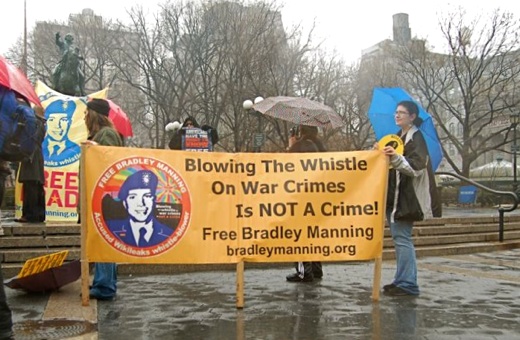
Image above: Photo of Free Bradley manning demonstration by Mickey Z. From original article.
“There is an odor to any press headquarters that is unmistakable: the unavoidable smell of flesh burning quietly and slowly in the service of a machine.”
- Norman Mailer
If you’ve ever wondered why someone like Bradley Manning gets far less media coverage than, say, a “royal” birth or a mayoral candidate’s penis, well… you can always count on the “newspaper of record” to reveal the method behind the madness.

A July 30, 2013 New York Times article by John M. Broder and Ginger Thompson was deftly entitled, “Loner Sought a Refuge, and Ended Up in War.” The stage was set in a single word -- the first word, in fact -- as we all know what America thinks about “loners.” Those are the ones who turn out to like Oswald or Dahmer or Klebold and Harris.

Any lingering hope for a nuanced discussion on privacy or war crimes was dashed by the opening paragraph:

Feeling outcast and alone in Iraq, Bradley Manning, then a 22-year-old Army private, turned to the Internet for solace in early 2010, wanting to share with the world what he saw as the unconscionable horrors of war, an act that resulted in what military prosecutors called one of the greatest betrayals in the nation’s history.

Not only a loner but an “outcast,” Manning merely exposed “what he saw as the unconscionable horrors of war.” Well played by the Times as loyal readers -- long conditioned by daily propaganda -- are given the comfortable choice of accepting that some weirdo geek with a grudge against god’s country misinterpreted U.S. military behavior. For good measure, Broder and Thompson only tell us how military prosecutors perceive his actions.

For the handful of mainstream folks who might actually continue reading the article beyond this point, the Times offers passing mention of Manning being “confined to a tiny cell 23 hours a day at the Marine base at Quantico, Virginia,” before quickly returning to their more familiar role of stenographer to power.

Those same military prosecutors, we’re told,
“accused Private Manning of being a self-promoting ‘anarchist’ who was nothing like the tortured man of principle portrayed by his lawyers, supporters around the world celebrated him as a martyr for free speech.”
Let’s stop for a second to note that the NY Times not only dragged out the all-purpose smear of “anarchist” but has yet to find it “fit to print” to include any details of the specific “unconscionable horrors of war” Manning exposed. This omission allows Broder and Thompson to claim his supporters are solely focusing on the issue of “free speech.” 
As for the Times’ mocking phrase “tortured man of principle,” it wouldn’t take the reporters (sic) much effort to find Manning’s own thoughts and words on the topic. But, of course, the article’s authors don’t want to complicate matters with such context. Instead, they educate their readers with news that the “heated language on both sides” tends to “overshadow the human story at the center of the case.”

With all due respect to both Manning’s courage and the criminal treatment he’s endured, the story at “the center of the case” is not his personality, upbringing, or political leanings. The story cleverly but predictably obscured by the Times is all about the Home of the Brave™ sanctioning war crimes as policy and throwing the full weight of its legal (sic) might at anyone crazy enough to expose such global criminality.

As Amnesty International recently concluded: “It's hard not to draw the conclusion that Manning's trial was about sending a message: the U.S. government will come after you, no holds barred, if you're thinking of revealing evidence of its unlawful behavior.”

Rather than discuss any of that, of course, journalists (sic) Broder and Thompson treat us to details like Manning being “the child of a severed home” and “a teenager bullied for his conflicted sexuality” who “never fit in.” Even in the Army, he was a “misfit” and just in case you’re not sure why, the Times gleefully clarifies: “In early 2010, he covertly downloaded gun-camera videos, battle logs and tens of thousands of State Department cables onto flash drives while lip-syncing the words to Lady Gaga songs.”


Who ya gonna trust, big strong white men with lots of stripes on their uniforms or a Gaga-loving misfit outcast?

The slander and innuendo goes on -- and on -- but it isn’t until paragraph 12 (when maybe 90 percent of readers have already moved on?) that Broder and Thompson deign to mention Manning as: 
“disturbed by footage shot by an Apache helicopter of an attack on a street in Baghdad in July 2007 that killed two Reuters journalists and several other men.”
Before any of you get the bright idea to ponder a U.S. military helicopter given the name “Apache” or to question our (sic) heroic (sic) men and women in uniform, Broder and Thompson lay it out simply but firmly: 
“While larger questions about government secrecy and the role of the news media in the Internet age swirl around the case, the roots of Private Manning’s behavior may spring as much from his troubled youth as from his political views.”
The remainder of the article provides tidbits about Manning playing video games, being teased by classmates and rejected by his father, living in his car for a while, and 
“his geeky fascination with computers, his liberal political opinions and his sexual orientation.”
To fully illustrate the sheer weirdness of this America-hating gay anarchist loner, Broder and Thompson make sure they tell us that Private Manning wore a dog tag that said “Humanist” and kept a toy fairy wand on his desk.

Which brings me back to the title of this article…

The U.S. government charged Bradley Manning with aiding the enemy but, let’s state the obvious: the enemy is the U.S. government… and the multi-national corporations that fund it. The crime isn’t whistle-blowing, the crime is relentless, lawless global war in pursuit and protection of profit. The New York Times and all corporate media outlets, therefore, should be charged with aiding the enemy.

It is the role, the mission, of the corporate-run media to aid the enemy.

Whether you label them liberal or conservative, most major media outlets are large corporations owned by or aligned with even larger corporations, and they share a common strategy: selling a product (an affluent audience) to a given market (advertisers).

Therefore, we shouldn’t find it too shocking that the image of the world being presented by a corporate-owned press very much reflects the biased interests of the elite players involved in this sordid little love triangle.

If you created a blueprint for an apparatus that utterly erased critical thought, you could make none more efficient than the American corporate media -- and please don't fall into the trap of only demonizing Fox News.

A major component of the free press illusion is the notion that some media outlets are more liberal while others are more right-wing -- belief in this myth further limits the already limited parameters of accepted debate.

Reality Check: The media are as liberal or conservative as the corporations that own them.

So, of course the mainstream media distorts and/or ignores the Manning story. That's their job and it's a waste of our time and energy to expect otherwise. The major media corporations been given the keys to the public (sic) airwaves and we don't yet have the means to change that. We do, however, have the means to circumvent this model.

Tracy Chapman once promised that revolution “sounds like a whisper.” Well, we may not be able to yell louder than the professional propagandists of the corporate media but we damn sure can whisper more effectively.
The media can't be "fixed" any more than all the other dying institutions (banking, health care, education, etc.) can be. So, I say: Let the corporate press rot while we utilize our resources and ingenuity to create an entirely new model.

If we build it, they will join us…

It will require both outrage and outreach for us to outlive the corporate pirates (and the politicians they fund) who have hijacked our future. To help make this happen, we need more of the 99% to get aware and active. Thus, we must keep whispering the truth and continue working to model new alternatives.

Let’s not allow Bradley Manning’s efforts and sacrifice to be in vain!

#shifthappens


Video above: From(http://youtu.be/5rXPrfnU3G0).


• Mickey Z. is the author of 11 books, most recently the novel Darker Shade of Green. Until the laws are changed or the power runs out, he can be found on an obscure website called Facebook. Anyone wishing to support his activist efforts can do so by making a donation here.
 

Manning and WikiLeaks not deadly

SUBHEAD: Bradley Manning sentencing testimony indicates WikiLeaks not responsible for any deaths.

By Matt Sledge on 3 August 2013 for Huffington Post -
(http://www.huffingtonpost.com/2013/08/03/bradley-manning-sentence_n_3696501.html)


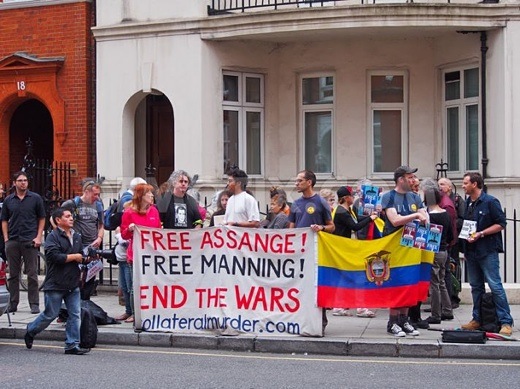
Image above: Supporters of Julian Assange, Bradley Manning, Wikileaks and ex-NSA whistleblower Edward Snowden gather with banners and flags outside the Ecuadorean embassy where Julian Assange is scheduled to make a balcony speech. From (http://www.demotix.com/news/2188354/julian-assange-supports-whistleblower-ed-snowden-speech-transcript#media-2188384).

 For three years Bradley Manning and Julian Assange were accused of murder. Members of Congress and the administration said their WikiLeaks document dump endangered U.S. interests -- and lives.

"Mr. Assange can say whatever he likes about the greater good he thinks he and his source are doing, but the truth is they might already have on their hands the blood of some young soldier or that of an Afghan family," Adm. Mike Mullen, then the chairman of the Joint Chiefs of Staff, said in July 2010.

Before a press corps hollowed out to a skeleton crew after Manning's verdict, that insinuation is falling apart. Top government officials testifying in open court for Manning's sentencing in recent days have cited no credible evidence his leaks led directly to any deaths. They have instead spoken to diplomatic sources placed at risk and strayed foreign relations. In the words of one official, some allies got "chesty."

The State Department's current, official take on the cables' release may come Monday, as Undersecretary of State Patrick Kennedy testifies in court for a full day on damage caused by the cables. Or Kennedy may once again be forced into closed session to talk about any specifics in yet another example of the secrecy that has shrouded the trial, even in its sentencing phase.

During the first phase of the trial, the judge overseeing Manning's case prevented the defendant from presenting any evidence against claims that his releases caused any harm. So those revelations, endlessly fought over in the press since WikiLeaks' releases, have all taken place during the sentencing phase of Manning's court martial. They may shave years off his maximum 132.5-year punishment.

For Assange supporters, meanwhile, the trial testimony comes as long-awaited vindication for the much-vilified WikiLeaks founder.

"I did not expect anyone was killed otherwise I am sure it would have come out already. What we saw early on regarding Manning, Julian Assange and Wikileaks were efforts to poison the atmosphere against them by claiming they had blood on their hands," said Michael Ratner, Assange's U.S. lawyer. "Our government lies."

The disclosures have come out as glimpses of sunlight in the secrecy shadowing the trial. Though Manning's leaks are freely available online, the government still treats most of them as classified.

It's an absurd situation that has led to Manning's prosecutors referring to clearly legitimate State Department cables as "purported" State Department cables. Perhaps more consequentially, it means a significant portion of the testimony about the harm caused by the cables' release is taking place in closed, classified session.

Nevertheless, the most explosive claim about Manning's leaks -- that battlefield reports from Iraq and Afghanistan got U.S. sources killed -- seems to have been settled. The prosecution's first witness was Brig. Gen. Robert Carr, who led the Department of Defense's review of the WikiLeaks releases.

Carr's order to lead the Information Review Task Force came straight from then-Secretary of Defense Robert Gates. Carr and a team of 300 worked for over a year.

"We had to understand this data ... give them some reassurance that they didn't have to sit on the top in the middle of a hill in Afghanistan and go through 77,000 documents to find their vulnerabilities," Carr said. "That was our job."

Not a single death could be linked to names in the WikiLeaks files, Carr testified.

After more than a year of searching, the task force found a single instance where the Taliban claimed to have killed an Afghan source because of WikiLeaks. But then they discovered the cables did not actually contain the source's name.

"The name was not there," Carr said.

The Taliban's claim was so dodgy that the judge overseeing the case, Col. Denise Lind, said she would disregard it.

But Carr did state that, "There are some people out there that quit talking to us as a result of their releases." He also provocatively suggested that the release of Guantanamo detainee assessment briefs in April 2011 slowed down transfers from the prison to foreign countries.

"There might have been a delta between what the foreign government was saying and what they had told their people," said Carr, "and that could, in fact, cause conflict between two nations and stop our efforts to move forward on the Guantanamo."

Two lawyers who represent clients at Guantanamo, however, reject Carr's claims out of hand. They note that the assessment briefs' release came right in the middle of the longest period without a transfer in the history of the prison.

"I would think it would be difficult for this administration to claim with a straight face that they were making any efforts to close the prison in 2011 or '12," said Shane Kadidal, a lawyer at the Center for Constitutional Rights. "It's faintly ludicrous to blame their failures on WikiLeaks."

Clive Stafford Smith, director of the UK legal charity Reprieve, said, "It is idiotic."

Carr was followed on the witness stand Wednesday by John Kirchhofer, who as deputy director of the Defense Department's WikiLeaks task force was responsible for its day-to-day operations.

Kirchhofer singled out one episode in open court: a briefing he gave to NATO allies in Belgium the week the Iraq War Logs were released in October 2010.

There were some "pretty aggressive people getting chesty," Kirchhofer said. "In a closed forum I can tell you what countries if that matters."

More tangibly, Michael Kozak, who led the State Department's WikiLeaks Persons at Risk working group, testified about the efforts the department had to take to protect U.S. sources named in the diplomatic cables. If the group thought someone might be in danger of "violence or incarceration or something similarly grave," he said, it sprung into action -- notifying them that their name was in the cables, and asking if they needed American assistance.

The most important type of assistance offered, Kozak said, was a ticket out of harm's way or help with immigration status in a new country. Kozak spoke bluntly. But he was not asked, nor did he offer, any testimony about sources who were named in the cables and later killed.

Kozak said the greatest damage of the leaks, from his perspective, was their "chilling effect" on human rights activists no longer willing to talk to the U.S.

When Kozak was asked how many people the working group had identified as being in danger, he was quickly cut off by a defense objection. He added that he would rather provide an answer in closed, classified session -- which the court then entered.

The exchange was one more example of how the court's strict adherence to government secrecy has obscured the presentation of evidence of actual harm caused by the leaks. But Steve Aftergood, an expert on government secrecy at the Federation of American Scientists, said closing court may sometimes be necessary.

"It’s possible that publicly highlighting a specific incident of damage -- perhaps some kind of diplomatic dispute arising from the cables -- would reopen the dispute and aggravate it further," Aftergood said.

"But if something like that is true, it would be true only with regard to specific incidents," he added. "It should still be possible for the prosecution to publicly characterize the damage it says was done, and to describe the nature and the magnitude of the harm."

Outside of the courtroom, there are clues about damage from the cables' release.

P.J. Crowley, the former State Department spokesman who helped respond to the WikiLeaks dump that became known as "Cablegate," told HuffPost before the trial started that fears the disclosures would throw sand in the gears of U.S. diplomacy had not been realized. This was in part, Crowley said, because of extensive outreach and mitigation efforts of the sort Kozak described in court Friday.

But on the individual level, Crowley said, "The reality is that people have been put in danger -- people have been incarcerated. There are people who have been cited in these cables who have been killed."

"Now, I'm very cautious," he added. "Was somebody killed because they were listed in a WikiLeaks cable? I can't say that."

If the sentencing testimony from State Undersecretary Kennedy remains hidden Monday in a secure courtroom at Fort Meade, the closest we may come to the facts is an anonymous congressional aide's January 2011 analysis to Reuters. The aide's summation of internal government reviews of the WikiLeaks releases at both the State and Defense departments came just months after Kennedy first briefed Congress on harm from WikiLeaks.

It's an appraisal that has been widely known for years, yet it has not stopped critics from repeating the charge that Assange and Manning have blood on their hands.

As the anonymous aide related to Reuters in 2011: "We were told (the impact of WikiLeaks revelations) was embarrassing but not damaging."

Manning verdict & Snowden's future

SUBHEAD:  Edward Snowden's father, Lonnie, said: "I have absolutely no faith in the attorney general of the United States."

By Eyder Peralta on 30 January 2013 for NPR News -
(http://www.npr.org/blogs/thetwo-way/2013/07/30/207042272/what-the-manning-verdict-says-about-edward-snowdens-future)


Image above: Photo courtesy of Bradley Manning Support Network. From (http://www.bu.edu/today/2012/the-making-of-a-cyber-libertarian/).

In the wake of of aiding the enemy, the natural question is, what does this say about Edward Snowden's future?

is, of course, the Army private responsible for the biggest leak of classified information in U.S. history. is responsible for revealing some of the most secretive and sensitive intelligence programs inside the National Security Agency.

The U.S. government charged Manning with aiding the enemy. , that was an unprecedented charge that had the potential of casting a long shadow over future leak cases.

Mary-Rose Papandrea, a professor of law at Boston College, is in the middle of writing an academic paper that explores the difference between leakers and traitors.

Papandrea said an aiding-the-enemy charge essentially amounts to treason; the fact that Col. Denise Lind, the military judge presiding over the Manning case, found him not guilty of the charge bodes well for Snowden and whoever may come next.

"It is good news for people who have the intent to inform the public that they will be protected," Papandrea said. "What I think the court did — without having seen any explicit rationale here — is to make a distinction between true aiding the enemy — intent to aid the enemy, knowledge that information will be read by the enemy and an intent to have that information read by the enemy — versus individuals who disclose information without authorization but with the intent to disclose them to the public at large."

During the trial, the U.S. government argued that when Manning released information to WikiLeaks — instead of traditional news outlets — it was because he wanted the data to be available in an indiscriminate manner. As an intelligence analyst, the government argued, he should have known that the information was going to end up in the hands of al-Qaida.

Many civil libertarians worried about the kind of precedent the case would set for investigative journalism in the United States. In essence, they said, this meant anyone could be charged with aiding the enemy for handing information to a website or news outlet because al-Qaida was free to visit that website.

What's more, aiding the enemy is one of only three crimes in the Uniform Code of Military Justice that theoretically applies to everyone.

Eugene Fidell, a lecturer at Yale Law School and an expert on military law, said the Manning verdict will likely revive talk about whether you can aide the enemy by releasing information to a news organization. One thing that seems clear, he says, is that Snowden will not be tried on that most-serious charge.

"On paper, the statute applies to any person. But in fact the Supreme Court would not tolerate a court martial of a civilian for aiding the enemy," Fidell said. "I don't think Mr. Snowden has to worry about being court martialed."

Papandrea agrees, but she says that while Manning beat the most serious charge against him, he could still face decades in prison for his other crimes, including espionage and theft.

"It's not like Bradley Manning is getting off scot-free. All it means is that he was not found guilty of what essentially amounts to treason," Papandrea says. "So as far as the message for Snowden, he still would face potential Espionage Act charges and other lesser charges."

In fact, the U.S. government has already charged the former NSA contractor with .

Papandrea argues, however, there are stark differences between Manning and Snowden.

"I don't think the espionage charges [against Manning] were that controversial," she said. "I think some people thought that Bradley Manning may have been engaged in whistle-blowing.

But I think the Snowden disclosures raise much bigger questions about the role of leakers in our society. You have Congress right now considering and coming close to passing legislation that would stop the program that Snowden revealed.

Clearly, his disclosures have had a big impact on the public debate. They are meaningful; they are important."

Manning, on the other hand, disclosed some 700,000 classified documents that "did not have significant impact on public discourse."

That was the argument, Snowden's father Lonnie and his attorney, Bruce Fein, made on CNN this afternoon. Snowden, Fein said, should be treated as a whistle-blower not a spy.

"He has sparked a conversation that Mr. Obama said was urgent," said Fein.

In Manning's case, judge Lind found the 25-year-old was not a traitor, but in six different instances, she rejected the defense's argument that Manning was a whistle-blower intent on sparking a debate about war and diplomacy.

If Lind sticks to maximum sentences, Manning could be in prison for decades.

Lonnie Snowden, who had called for his son to come back to the United States and face justice, had a different message for his son today: Stay safe, in Russia, he told him on CNN.

He added: "I have absolutely no faith in the attorney general of the United States."


Holden indicates US Government attitude

SUBHEAD: A.G. Holden says U.S. will not seek death penalty or torture Snowden if he returns. What a pathetic thing for him to have to say.

Mariano Castillo on 27 July 2013 for CNN News -
(http://www.cnn.com/2013/07/26/us/nsa-snowden/index.html)


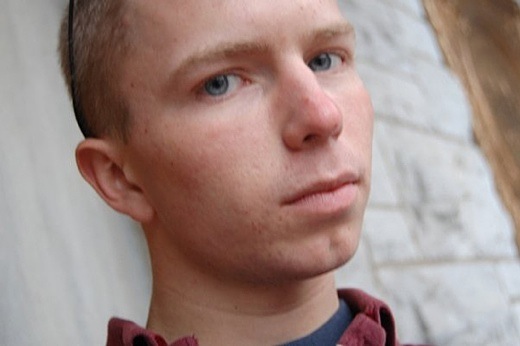
Image above: Eric Snowden as a teen in an online post. Photo courtesy elitedaily.com — “The Voice of Generation Y”From (http://dhogle.wordpress.com/tag/edward-snowden/).
The U.S. Justice Department will not seek the death penalty for U.S. intelligence leaker Edward Snowden, Attorney General Eric Holder wrote to Russian authorities in a letter dated July 23.

In the letter, Holder says Snowden's arguments for temporary asylum in Russia are without merit.

Snowden is seeking asylum because he claims he will be tortured and face the death penalty if returned to the United States.

But the death penalty is not an option given the current charges against Snowden, and even if additional charges are filed, the United States would still not seek capital punishment, Holder wrote.

Once back in the United States, Snowden would not be tortured and would face a civilian trial with a lawyer appointed to him, the attorney general wrote.

"We believe that these assurances eliminate these asserted grounds for Mr. Snowden's claim that he should be treated as a refugee or granted asylum," Holder wrote.

He also said it is untrue that Snowden cannot travel because his U.S. passport was revoked. Snowden is still a U.S. citizen and is eligible for a limited-validity passport that would authorize a direct return to the United States.

"The United States is willing to immediately issue such a passport to Mr. Snowden," Holder wrote.

Father asks Obama to rein in Holder
In a letter released Friday, Snowden's father called on President Barack Obama to order Holder to dismiss the criminal complaint filed against his son.

Lon Snowden defended his son's actions, comparing them to acts of civil disobedience.

"We are also appalled at your administration's scorn for due process, the rule of law, fairness and the presumption of innocence as regards Edward," the letter said.

Earlier in the day, Lon Snowden said on NBC's "Today" that Snowden did the right thing by leaking U.S. intelligence and helping Americans see the truth.

"I think my son, when he takes his final breath, whether it's today or 100 years from now, (will) be comfortable with what he did," he said. "He did what he knew was right. He shared the truth with the American people. What we choose to do with it is up to us as a people."

Lon Snowden expressed his disappointment with the recent House vote that continued funding for the spy program that Edward Snowden exposed.

There is a need for a strong intelligence community, Lon Snowden said, but many who voted for continued funding for the program are really looking out for the special interests that will benefit.

"It's all about the money," he said.

The father said he has not been in direct contact with his son, but there has been indirect contact through intermediaries.

The intermediaries do not include WikiLeaks, Lon Snowden said, but he added that he is thankful to that group for aiding his son.

"I'm thankful for anybody at this point that is providing him with assistance to keep him safe and secure," he said.

U.S., Russian officials continue talks

Meanwhile, the Kremlin said that the Russian security agency FSB is talking to American officials.

"The situation around Snowden is not being discussed at the top level. There's a discussion between heads of FSB and FBI," the Kremlin press office said.

A spokesman for Vladimir Putin said the Russian president "expressed a firm intention to not allow" further damage to U.S. interests, including a pledge by Snowden not to release any more intelligence. "And I have no doubt this is how it will be, no matter how the situation develops," the spokesman said, according to the Russian news agency RIA Novosti.

The many mysteries of Snowden's transit zone

Snowden isn't yet allowed to step outside the Moscow airport where he's been confined for weeks. He is waiting for permission to stay elsewhere in Russia while his request for temporary asylum is considered.

He has been searching for a place to settle after the United States charged him with espionage.

The former National Security Agency contractor, who admitted last month to revealing sweeping U.S. electronic surveillance programs to the news media, left Hong Kong for Moscow on June 23.

Snowden may remain stuck in the transit area for weeks and maybe months, the head of Russia's migration service, Vladimir Volokh, told the Russian news agency Interfax. The maximum length of time Snowden can spend at the airport is six months, he said.
.

Bradley Manning won't face life

SUBHEAD: Bradley Manning found not guilty of aiding the enemy as court-martial judge reads verdict.

By Staff on 30 July 2013 for the Washington Post -
(http://www.washingtonpost.com/world/national-security/judge-to-announce-verdict-in-bradley-manning-case-today/2013/07/29/e894a75c-f897-11e2-afc1-c850c6ee5af8_story_1.html)


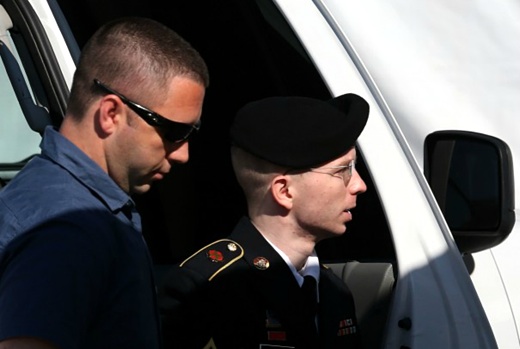
Image above: Army Pfc. Bradley Manning, right, is escorted by military police as he arrives to hear the verdict in his military trial at Fort Meade in Maryland 7/30/13. From original article.

7:10 a.m. HST: Bradley Manning found not guilty of aiding the enemy as court-martial judge reads verdict. This story will update soon.

If found guilty of all charges, including aiding the enemy, private Bradley Manning would have face a sentence of life in prison without the possibility of parole.
The private is accused of providing 700,000 classified documents to transparency organization WikiLeaks.
 
Manning arrived at court to hear the verdict in his military espionage and aiding the enemy trial at Fort Meade Tuesday. Manning was found not guilty of aiding the enemy.

The planned announcement of the verdict follows an eight-week trial at Fort Meade in Maryland, where military prosecutors argued that Manning, 25, betrayed his oath and his country, and assisted al-Qaeda because the terrorist group was able to access secret material once WikiLeaks posted it.

Hours before the verdict, about two dozen Manning supporters demonstrated outside Fort Meade wearing “truth” T-shirts and waving signs proclaiming their admiration for the former intelligence analyst, the Associated Press reported.

“He wasn’t trying to aid the enemy,” said Barbara Bridges, 43, of Baltimore. “He was trying to give people the information they need so they can hold their government accountable.”

As dozens of journalists were admitted to the installation amid tight security, dogs trained to sniff out explosives searched their vehicles before they were escorted to a media room where the court proceedings were to be broadcast live on a screen.

The government’s pursuit of the charge of aiding the enemy under a theory that had not been used since the Civil War troubled civil libertarians and press-freedom advocates. They said the publication of secret defense information online could expose any leaker to life in prison and will chill press scrutiny of the military.

The government relied on a case from the Civil War to bring the charge: In that trial, a Union Army private, Henry Vanderwater, was found guilty of aiding the enemy when he leaked a Union roster to an Alexandria newspaper. Vanderwater received a sentence of three months hard labor and was dishonorably discharged.

Manning has pleaded guilty to a number of lesser charges, including unauthorized possession of information relating to the national defense.

The sentencing phase of the trial at Fort Meade outside Baltimore will begin Wednesday. With a conviction, the prosecution is expected to press the judge, Col. Denise Lind, to impose the maximum sentence. The government would present in a closed session of the court the classified damage assessments conducted by government agencies after the disclosures by WikiLeaks.

Defense attorney David Coombs would also be able to offer mitigating evidence about Manning’s motives and his state of mind when he turned the material over to the group.

Manning would be likely to serve any sentence at the U.S. Disciplinary Barracks at Fort Leavenworth, Kan.

Manning, of Crescent, Oklahoma, enlisted in the Army in October 2007, hoping to fund his college education through the G.I. Bill. He trained as an all-source intelligence analyst at Fort Huachuca, Arizona, and was stationed at Fort Drum, New York.

The military said Manning’s service was troubled from the start. He took more time than usual to pass basic training and struggled to connect with fellow soldiers. In October 2009, Manning’s unit was deployed to Iraq, where as part of his assignment he was able to access classified networks containing military and diplomatic documents.

In closing arguments last week, Maj. Ashden Fein, a military prosecutor, said Manning had disregarded the “sensitivity” of the material he leaked and “decided to release it to a bunch of anti-government activists and anarchists to achieve maximum exposure, the maximum exposure, and advance his personal quest for notoriety.”


Coombs has argued that Manning grew increasingly disturbed by the violence in Iraq and that his objective in copying secret documents while at a forward operating base there and leaking them to WikiLeaks was to “spark a worldwide discussion.” During the past two years of proceedings, Coombs has portrayed Manning as both naive and “well-intentioned.”

On Feb. 3, 2010, Manning turned over a trove of documents that became known as the War Logs to WikiLeaks. He attached a note: “This is possibly one of the more significant documents of our time, removing the fog of war, and revealing the true nature of the 21st century asymmetric warfare. Have a good day.”

After that transmission, Manning developed a more robust relationship with WikiLeaks, passing on more than 700,000 documents and other material to the Web site, including video of an Apache helicopter engaging what the pilots believed were armed fighters in Baghdad. WikiLeaks called it “Collateral Murder.” Eleven people were killed in the incident, including an unarmed Reuters news agency photographer and his driver.

Manning developed an online relationship with a person believed to be Julian Assange, one of the founders of WikiLeaks.

“We conversed on a near daily basis, and I felt we were developing a friendship,” said Manning in a statement in March. “The conversations covered many topics and I enjoyed the ability to talk about pretty much anything, and not just the publications that the WLO (WikiLeaks) was working on.”

Manning was arrested in Iraq in May 2010 and transferred to the brig at Marine Corps Base Quantico in July 2010. He was kept alone in a windowless six-by-eight-foot cell 23 hours a day and forced while on suicide watch to sleep in a “suicide smock.”

In March 2011, after eight months of confinement, Manning quipped sarcastically that he could kill himself with the elastic of his underwear if he wanted to.

Lind ruled in January that any sentence the Army private receives should be reduced by 112 days because of his mistreatment in confinement.

.

Prometheus Among the Cannibals

SUBHEAD: Letter to Edward Snowden from Rebecca Solnit.

By Rebecca Solnit on 18 July 2013 for Tom Dispatch -
(http://www.tomdispatch.com/post/175726/)


Image above: Detail of painting by Heinrich Friedrich of Prometheus Stealing the Fire of the Gods, 1817. From (http://www.flickr.com/photos/iesluisvelez2006-2007/8893194517/).

Dear Edward Snowden,

Billions of us, from prime ministers to hackers, are watching a live espionage movie in which you are the protagonist and perhaps the sacrifice. Your way forward is clear to no one, least of all, I’m sure, you.

I fear for you; I think of you with a heavy heart. I imagine hiding you like Anne Frank. I imagine Hollywood movie magic in which a young lookalike would swap places with you and let you flee to safety -- if there is any safety in this world of extreme rendition and extrajudicial execution by the government that you and I were born under and that you, until recently, served. I fear you may pay, if not with your death, with your life -- with a life that can have no conventional outcome anytime soon, if ever. “Truth is coming, and it cannot be stopped,” you told us, and they are trying to stop you instead.

I am moved by your choice of our future over yours, the world over yourself. You know what few do nowadays: that the self is not the same as self-interest. You are someone who is smart enough, idealistic enough, bold enough to know that living with yourself in a system of utter corruption would destroy that self as an ideal, as something worth being. Doing what you’ve done, on the other hand, would give you a self you could live with, even if it gave you nowhere to live or no life. Which is to say, you have become a hero.

Pity the country that requires a hero, Bertolt Brecht once remarked, but pity the heroes too. They are the other homeless, the people who don’t fit in. They are the ones who see the hardest work and do it, and pay the price we charge those who do what we can’t or won’t. If the old stories were about heroes who saved us from others, modern heroes -- Nelson Mandela, Cesar Chavez, Rachel Carson, Ella Baker, Martin Luther King, Aung San Suu Kyi -- endeavored to save us from ourselves, from our own governments and systems of power.

The rest of us so often sacrifice that self and those ideals to fit in, to be part of a cannibal system, a system that eats souls and defiles truths and serves only power. Or we negotiate quietly to maintain an uneasy distance from it and then go about our own business. Though in my world quite a few of us strike our small blows against empire, you, young man, you were situated where you could run a dagger through the dragon’s eye, and that dragon is writhing in agony now; in that agony it has lost its magic: an arrangement whereby it remains invisible while making the rest of us ever more naked to its glaring eye.

Private Eyes and Public Rights
Privacy is a kind of power as well as a right, one that public librarians fought to protect against the Bush administration and the PATRIOT Act and that online companies violate in every way that’s profitable and expedient. Our lack of privacy, their monstrous privacy -- even their invasion of our privacy must, by law, remain classified -- is what you made visible. The agony of a monster with nowhere to stand -- you are accused of spying on the spies, of invading the privacy of their invasion of privacy -- is a truly curious thing. And it is changing the world. Europe and South America are in an uproar, and attempts to contain you and your damage are putting out fire with gasoline.

You yourself said it so well on July 12th:

“A little over one month ago, I had family, a home in paradise, and I lived in great comfort. I also had the capability without any warrant to search for, seize, and read your communications. Anyone's communications at any time. That is the power to change people's fates. It is also a serious violation of the law. The 4th and 5th Amendments to the Constitution of my country, Article 12 of the Universal Declaration of Human Rights, and numerous statutes and treaties forbid such systems of massive, pervasive surveillance. While the U.S. Constitution marks these programs as illegal, my government argues that secret court rulings, which the world is not permitted to see, somehow legitimize an illegal affair. These rulings simply corrupt the most basic notion of justice -- that it must be seen to be done.”

They say you, like Bradley Manning, gave secrets to their enemies. It’s clear who those enemies are: you, me, us. It was clear on September 12, 2001, that the Bush administration feared the American people more than al-Qaeda. Not much has changed on that front since, and this almost infinitely broad information harvest criminalizes all of us. This metadata -- the patterns and connections of communications rather than their content -- is particularly useful, as my friend Chris Carlsson pointed out, at mapping the clusters of communications behind popular movements, uprisings, political organizing: in other words, those moments when civil society rises to shape history, to make a better future in the open world of the streets and squares.

The goal of gathering all this metadata, Chris speculates, "is to be able to identify where the ‘hubs’ are, who the people are who sit at key points in networks, helping pass news and messages along, but especially, who the people are who spread ideas and information from one network of people to the next, who help connect small networks into larger ones, and thus facilitate the unpredictable and rapid spread of dissent when it appears.”

Metadata can map the circulatory system of civil society, toward what ends you can certainly imagine. When governments fear their people you can be sure they are not serving their people. This has always been the minefield of patriotism: loyalty to our government often means hostility to our country and vice-versa. Edward Snowden, loyalist to country, you have made this clear as day.

Those who demonize you show, as David Bromwich pointed out in a fine essay in the London Review of Books, their submission to the power you exposed. Who stood where, he writes,

“was an infallible marker of the anti-authoritarian instinct against the authoritarian. What was distressing and impossible to predict was the evidence of the way the last few years have worn deep channels of authoritarian acceptance in the mind of the liberal establishment. Every public figure who is psychologically identified with the ways of power in America has condemned Snowden as a traitor, or deplored his actions as merely those of a criminal, someone about whom the judgment ‘he must be prosecuted’ obviates any further judgment and any need for thought.”

You said, "I know the media likes to personalize political debates, and I know the government will demonize me." Who you are is fascinating, but what you’ve exposed is what matters. It is upending the world. It is damaging Washington’s relations with many Latin American and some European countries, with Russia and China as well as with its own people -- those, at least, who bother to read or listen to the news and care about what they find there. “Edward Snowden Single-Handedly Forces Tech Companies To Come Forward With Government Data Request Stats,” said a headline in Forbes. Your act is rearranging our world. How much no one yet knows.

What You Love
What’s striking about your words on video, Edward Snowden, the ones I hear as your young, pale, thoughtful face speaks with clarity and incisiveness in response to Glenn Greenwald’s questions, is that you’re not talking much about what you hate, though it’s clear that you hate the secret network you were part of. You hate it because it poisons what you love. You told us, "I understand that I will be made to suffer for my actions... [but] I will be satisfied if the federation of secret law, unequal pardon, and irresistible executive powers that rule the world that I love are revealed even for an instant." You love our world, our country -- not its government, clearly, but its old ideals and living idealists, its possibilities, its dreamers, and its dreams (not the stale, stuffed American dream of individual affluence, but the other dreams of a better world for all of us, a world of principle).

You told us where we now live and that you refuse to live there anymore:

"I don't want to live in a world where everything that I say, everything I do, everyone I talk to, every expression of creativity or love or friendship is recorded. And that's not something I'm willing to support, it's not something I'm willing to build, and it's not something I'm willing to live under. America is a fundamentally good country. We have good people with good values who want to do the right thing. But the structures of power that exist are working to their own ends to extend their capability at the expense of the freedom of all publics."

Which is to say you acted from love, from all the things the new surveillance state imperils: privacy, democracy, accountability, decency, honor. The rest of us, what would we do for love?

What is terrifying to the politicians at the top is that you may be our truest patriot at the moment. Which makes all of them, with their marble buildings and illustrious titles, their security details and all the pomp, the flags, the saluting soldiers, so many traitors. The government is the enemy of the people; the state is the enemy of the country. I love that country, too. I fear that state and this new information age as they spread and twine like a poison vine around everything and everyone. You held up a mirror and fools hate the mirror for it; they shoot the messenger, but the message has been delivered.

“This country is worth dying for,” you said in explanation of your great risks. You were trained as a soldier, but a soldier’s courage with a thinker’s independence of mind is a dangerous thing; a hero is a dangerous thing. That’s why the U.S. military has made the Guardian, the British newspaper that has done the key reporting on your leaks, off limits to our soldiers overseas. Whoever made that cynical censorship decision understands that those soldiers may be defending a set of interests at odds with this country and its Constitution, and they need to be kept in the dark about that. The dark from which you emerged.

When the United States forced the airplane of Evo Morales, Bolivia’s democratically elected head of state, to land in Austria, after compliant France, Spain, Portugal, and Italy denied him the right to travel through their airspace, all South America took it as an insult and a violation of Bolivia’s sovereignty and international law. The allied president of Argentina, Cristina Fernandez de Kirchner, tracked the incident in a series of tweets that demonstrated an openness, a principledness, and a strong friendship between Morales, Ecuadoran president Rafael Correa, and her. It was a little window onto a really foreign continent: one in which countries are sometimes headed by genuinely popular leaders who are genuinely transparent and governed by rule of law. It’s a reminder that things in our own blighted, corrupted, corporate-dominated country could be different.

Building a Bridge to the Nineteenth Century
How did we get here? In 1996, President Bill Clinton and Vice President Al Gore pushed the dreadful slogan “building a bridge to the twenty-first century.” It was a celebration of Silicon Valley-style technological innovation and corporate globalization, among other things. At the time, I put “building a bridge to the nineteenth century” on my letterhead. It turned out that we were doing both at once: erecting a massive electronic infrastructure that outpaces our ability to democratically manage it and shifting our economy backward to recreate the chasms of class divide that marked the nineteenth century. The two goals intertwined like serpents making love.

The new technologies made a surveillance state that much more powerful and far-reaching; the new technologies replaced many jobs with few; the new technologies created new billionaires without principles; the new technologies made us all into commodities to be sold to advertisers; the new technologies turned our every move into something that could be tracked; the new technologies kept us distracted and busy. Meanwhile, almost everyone got poorer.

What the neoliberals amassing mountains of wealth for the already super-wealthy forgot, what the tax-cutters and child-starvers never learned in school, is that desperate people do not necessary simply lie down and obey. Often enough, they rebel. There is no one as dangerous as he or she who has nothing to lose. The twentieth century’s welfare states, their pumped-up, plumped-up middle classes, their relative egalitarianism and graduated tax plans pacified the once-insurrectionary classes by meeting, at least in part, their needs and demands. The comfortable don’t revolt much. Out of sheer greed, however, the wealthiest and most powerful decided to make so many of the rest of us at least increasingly uncomfortable and often far worse.

Edward Snowden, you rebelled because you were outraged; so many others are rebelling because their lives are impossible now. These days when we revolt, the new technologies become our friends as well as our enemies. If you imagine those technologies as the fire Prometheus stole from the gods, then it works both ways, for us and for them, to create and to destroy.

Those new technologies are key to the latest rounds of global organizing, from the World Trade Organization actions of 1999, put together by email and epochal in their impact, to the Arab Spring, which used email, cell phones, Facebook, Twitter, and other means, to Occupy Wall Street. The technologies are double-edged: populist networks for creating global resistance are vulnerable to surveillance; classified reams of data are breachable by information saved to thumb drives or burned onto CDs by whistleblowers and hackers. They can spy in private; we can organize in public, and maybe the two actions are true opposites.

Meanwhile there is massive upheaval in Egypt and in Brazil, and in recent years there have been popular rebellions in many parts of the Arab world, Turkey, Iceland, Greece, Spain, Britain, Chile, and the U.S. itself with Occupy. The globe is on fire with popular outrage, with fury over economic injustice and, among other things, climate change spurred by the profits a few are piling up to the detriment of the rest of us, generations to come, other species, and the planet itself. It seems that, surveillance or not, people are not about to go quietly into the nineteenth century or accept the devil’s bargains of the twenty-first either.

Prometheus and Being Burned
I think of a man even younger than you, Edward Snowden, who unlike you acted without knowing what he did: 26-year-old Mohammed Bouazizi, whose December 2010 self-immolation to protest his humiliation and hopelessness triggered what became the still-blooming, still-burning Arab Spring. Sometimes one person changes the world. This should make most of us hopeful and some of them fearful, because what I am also saying is that we now live in a world of us and them, a binary world. It’s not the old world of capitalism versus communism, but of the big versus the little, of oligarchy versus democracy, of hierarchies versus swarms, of corporations versus public interest and civil society.

It seems nearly worldwide now, which is why revolts all over the planet have so much in common these days, why Occupy activists last month held up signs in New York’s Liberty Plaza in solidarity with the uprising in Taksim Square in Turkey; why Arab Spring activists phoned in pizza orders to the uprising in Wisconsin in early 2011; why Occupy spread around the world, and Greek insurrectionaries learned from the successes of Argentina in the face of austerity and economic collapse. We know our fate is common and that we live it out together and change it together, only together.

There were rumblings that you had defected, or would defect, to China or Russia, but you had already defected when we became aware of your existence: you had defected from them to us, using the power you had gained deep within the bowels of their infernal machines to empower us. What will we do with what you’ve taught us? That’s up to us, but for anyone who thinks what you did was not threatening to those in power, just look at how furious, how upset, how naked our emperors now are.

And you, Prometheus, you stole their fire, and you know it. You said, "Being called a traitor by Dick Cheney is the highest honor you can give an American, and the more panicked talk we hear from people like him, [Senator Dianne] Feinstein, and [Congressman Peter] King, the better off we all are. If they had taught a class on how to be the kind of citizen Dick Cheney worries about, I would have finished high school."

Someday you may be regarded as a Mandela of sorts for the information age, or perhaps a John Brown, someone who refused to fit in, to bow down, to make a system work that shouldn’t work, that should explode. And perhaps we’re watching it explode.

The match is sacrificed to start the fire. So maybe, Edward Snowden, you’re a sacrifice. In the process, you’ve lit a bonfire out of their secrecy and spying, a call to action.

I fear for you, but your gift gives us hope and your courage, an example. Our loyalty should be to our ideals, because they are a threat to the secret system you’ve exposed, because we have to choose between the two. Right now you embody that threat, just as you embody those ideals. For which I am grateful, for which everyone who is not embedded in that system should be grateful.

Love,

Rebecca

• Rebecca Solnit, like Edward Snowden, has a GED, not a high-school diploma. She lives in Silicon Valley’s shadow, in a city where billionaires race $10 million yachts and austerity is closing the community college.  Her newest book is The Faraway Nearby.
.