SUBHEAD: Obama's final Clean Power Plan drops support for existing nuclear plants.
By Jeff McMahhon on 3 August 2015 for Forbes -
(http://www.forbes.com/sites/jeffmcmahon/2015/08/03/final-clean-power-plan-drops-support-for-existing-nuclear-plants/)
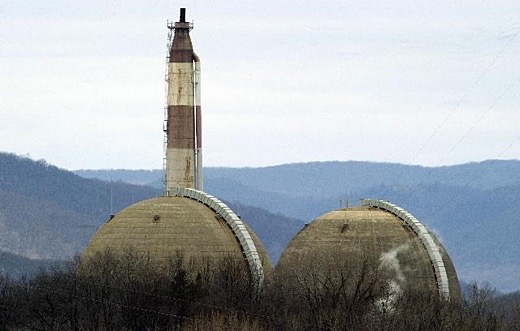
Image above: The aging Indian Point Nuclear Power Plant on the banks of the Hudson River upstream from NYC. Photo by Don Emmert for AFP/Getty Images. From original article.
The final version of President Obama’s Clean Power Plan does not include aid to existing nuclear power plants at risk of closing because they can’t compete with cheaper natural gas and renewables—a list that includes some of the nation’s most controversial reactors, including Indian Point and Three Mile Island.
In the draft version, EPA had proposed allowing states to count 6 percent of existing nuclear generation toward their clean energy goals, a provision designed to rescue the 6 percent of nuclear capacity considered at risk.
“On further consideration, we believe it is inappropriate to base the BSER (Best System of Emission Reduction) on elements that will not reduce CO2 emissions from affected electric generating units below current levels,” EPA states in the final rule.
“Existing nuclear generation helps make existing CO2 emissions lower than they would otherwise be, but will not further lower CO2 emissions below current levels. Accordingly… the EPA is not finalizing preservation of generation from existing nuclear capacity as a component of the BSER.”
Accordingly, states will not be able to meet their clean energy goals by extending the licenses of existing nuclear plants.
The revised rule does have some good news for nuclear utilities:
Older nuclear plants can only help states meet their goals though uprates that would have to be approved by the Nuclear Regulatory Commission during license extensions.By Jeff McMahhon on 3 August 2015 for Forbes -
(http://www.forbes.com/sites/jeffmcmahon/2015/08/03/final-clean-power-plan-drops-support-for-existing-nuclear-plants/)
Image above: The aging Indian Point Nuclear Power Plant on the banks of the Hudson River upstream from NYC. Photo by Don Emmert for AFP/Getty Images. From original article.
The final version of President Obama’s Clean Power Plan does not include aid to existing nuclear power plants at risk of closing because they can’t compete with cheaper natural gas and renewables—a list that includes some of the nation’s most controversial reactors, including Indian Point and Three Mile Island.
In the draft version, EPA had proposed allowing states to count 6 percent of existing nuclear generation toward their clean energy goals, a provision designed to rescue the 6 percent of nuclear capacity considered at risk.
“On further consideration, we believe it is inappropriate to base the BSER (Best System of Emission Reduction) on elements that will not reduce CO2 emissions from affected electric generating units below current levels,” EPA states in the final rule.
“Existing nuclear generation helps make existing CO2 emissions lower than they would otherwise be, but will not further lower CO2 emissions below current levels. Accordingly… the EPA is not finalizing preservation of generation from existing nuclear capacity as a component of the BSER.”
Accordingly, states will not be able to meet their clean energy goals by extending the licenses of existing nuclear plants.
The revised rule does have some good news for nuclear utilities:
- EPA will allow Southern states to count 5.5GW of electricity from new reactors under construction in South Carolina, Georgia and Tennessee toward their goals. The draft rule had counted that power as existing, rather than new generation. EPA encourages states to include “the continued commitment of the owner/operators to completion of the new units” in their plans. The owner operators are SCANA Corp in South Carolina, Southern Company in Georgia, and the Tennessee Valley Authority.
- And EPA will allow states to count uprates at nuclear plants . Uprates allow reactors to produce more thermal energy than their initial approval, sometimes through the use of richer uranium fuel, taking advantage of overcapacity built into the plants.
Quite a few at-risk reactors are operated by Exelon Corp, owner of the nation’s largest nuclear fleet, which has been lobbying for renewed government support. When I contacted him this afternoon, Exelon spokesman Paul Elsberg said the company had not had sufficient time to review the final version of the Clean Power Plan to comment:
“It’s obviously something Exelon is examining closely Exelon has long supported efforts to reduce carbon and other dangerous air emissions from the power sector while maintaining reliable and affordable energy for our customers. We are evaluating EPA’s final rule and look forward to continuing to engage with EPA, states and all stakeholders on the most cost effective means to achieve targeted greenhouse gas reductions.”Entergy, owner of the Indian Point Energy Center near New York City and two other reactors considered at risk said this:
“The U.S. EPA’s final Clean Power Plan is complex, and it will take time for Entergy to conduct its full analysis,” Entergy said in a prepared statement sent by spokeswoman Kay Jones. The statement says Entergy continues to be concerned about he legality of EPA’s approach, and it’s analysis will include ”the impact on the nation’s existing nuclear fleet, which in 2014 comprised nearly 61 percent of U.S. emissions-free generation.”In 2013, Morningstar identified six nuclear plants that could be next to shut down because of economic conditions:
- Indian Point, NY, owned by Entergy
- Ginna, NY, Exelon
- Fitzpatrick, NY, Entergy
- Three Mile Island, PA, Exelon
- Davis Beese, OH, FirstEnergy
- Pilgrim, MA, Entergy
The nuclear industry had campaigned for stronger support for nuclear power in the Clean Power Plan.
American Nuclear Society President Brady Raap argued that the draft rule ”almost completely discounts the clean energy contributions of current nuclear energy facilities, while penalizing states that have new plants under construction.”
ANS took it as a good sign when EPA Administrator Gina McCarthy said EPA would reconsider the rule’s treatment of nuclear.