Showing posts with label Exxon. Show all posts

Exxon must reveal CO2 research

SUBHEAD: A Massachusetts judge has refused to block the climate fraud investigation of Exxon.

By By David Hasemyer on 12 January 2017 for Inside Climate News -
(https://insideclimatenews.org/news/12012017/mass-judge-ruling-climate-investigation-exxon-tillerson)


Image above: An ice sculpture fashioned by protesters slowly melts outside the Exxon Mobil shareholders meeting in Dallas. From (https://thinkprogress.org/50-years-ago-big-oil-bragged-about-being-able-to-melt-glaciers-while-they-knew-about-climate-change-728efe887daa#.6d54cpe8f).

Exxon had fought state Attorney General Maura Healey's demand for documents about potential climate fraud, but a Massachusetts judge backs Healey's right to the probe.  


A Massachusetts Superior Court judge has refused to block the climate fraud investigation of ExxonMobil opened last year by state Attorney General Maura Healey.

The ruling Wednesday means Exxon must comply with Healey's civil investigative demand for company records. Healey requested the documents as part of an investigation to determine if Exxon misled consumers about the risks climate change posed to its business.

Exxon had argued Healey lacked the jurisdiction to pursue the investigation and maintained Texas was the proper venue for any legal action because the company is headquartered in Dallas.

But Judge Heidi Brieger disagreed.

"This matter involves the Massachusetts consumer protection statute and Massachusetts case law arising under it about which the Massachusetts Superior Court is certainly more familiar than would be a federal court in Texas," according to Brieger's ruling.

The parallel legal battle Exxon is waging in a federal court in Texas to derail Healey's investigation remains under way.

The Massachusetts court ruling affirms the authority of the attorney general to investigate fraud, said Chloe Gotsis, a spokeswoman for Healey.

"Exxon must now end its obstructive tactics and come clean about whether it misled Massachusetts consumers and investors about what it knew about climate change, its causes and effects," Gotsis said.

A spokesman for Exxon did not respond to a request for comment.

Healey opened the investigation in April under the state's consumer protection laws seeking documents back to 1976 related to Exxon's understanding of climate change and the effects it could have on its business.

The civil investigative demand—similar to a subpoena—included a request for documents detailing the company's decades of climate research, how it was preparing for sea-level rise and materials prepared for potential investors.

The demand also sought statements by Exxon officials, including by the company's then-chief executive, Rex Tillerson, who was questioned Wednesday about climate change during his Senate confirmation hearing to become secretary of state.

The company argued that Healey's investigation amounted to an "arbitrary and capricious" abuse of power and was politically motivated.

But the judge said that under state law Healey was empowered to open the investigation based on her belief that a person or company was engaged in unfair or deceptive business practices in the state and that she should have "broad access" to Exxon records to determine if there were any violations of law.

Brieger also rejected Exxon's contention that the company was targeted by Healey because of its views on global warming.

"The court finds that the Attorney General has assayed sufficient grounds her concerns about Exxon's possible misrepresentations to Massachusetts consumers—upon which to issue the CID," said the 14-page ruling.

"In light of these concerns, the court concludes that Exxon has not met its burden showing that the Attorney General is acting arbitrarily or capriciously toward it."

See also:
Ea O Ka Aina: Exxon - The Road not Taken 12/25/16

.

Exxon - The Road Not Taken

SUBHEAD: Their own research confirmed fossil fuels' role in global warming decades ago.

By N. Banerjee, L. Song , D. Hayesmyer on 16 September 2015 for Inside Climate News-
(https://insideclimatenews.org/news/15092015/Exxons-own-research-confirmed-fossil-fuels-role-in-global-warming)
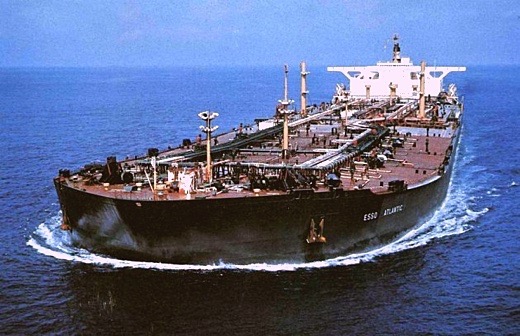

Image above: Photo of the "Esso Atlantic" oil tanker aboard which Esso gathered CO2 climate data. Built in 1977 it was one of the ten biggest boats ever constructed. It was scrapped for its steel in 2001. From (http://informasiduniasekitar.blogspot.co.id/2014/11/10-largest-ships-ever-built-in-world.html).

Top executives were warned of possible catastrophe from greenhouse effect, then led efforts to block solutions.

At a meeting in Exxon Corporation's headquarters, a senior company scientist named James F. Black addressed an audience of powerful oilmen. Speaking without a text as he flipped through detailed slides, Black delivered a sobering message: carbon dioxide from the world's use of fossil fuels would warm the planet and could eventually endanger humanity.

"In the first place, there is general scientific agreement that the most likely manner in which mankind is influencing the global climate is through carbon dioxide release from the burning of fossil fuels," Black told Exxon's Management Committee, according to a written version he recorded later.
It was July 1977 when Exxon's leaders received this blunt assessment, well before most of the world had heard of the looming climate crisis.

A year later, Black, a top technical expert in Exxon's Research & Engineering division, took an updated version of his presentation to a broader audience.

He warned Exxon scientists and managers that independent researchers estimated a doubling of the carbon dioxide (CO2) concentration in the atmosphere would increase average global temperatures by 2 to 3 degrees Celsius (4 to 5 degrees Fahrenheit), and as much as 10 degrees Celsius (18 degrees Fahrenheit) at the poles.  Rainfall might get heavier in some regions, and other places might turn to desert.

"Some countries would benefit but others would have their agricultural output reduced or destroyed," Black said, in the written summary of his 1978 talk.

His presentations reflected uncertainty running through scientific circles about the details of climate change, such as the role the oceans played in absorbing emissions. Still, Black estimated quick action was needed. "Present thinking," he wrote in the 1978 summary, "holds that man has a time window of five to ten years before the need for hard decisions regarding changes in energy strategies might become critical."

Exxon responded swiftly. Within months the company launched its own extraordinary research into carbon dioxide from fossil fuels and its impact on the earth. Exxon's ambitious program included both empirical CO2 sampling and rigorous climate modeling. It assembled a brain trust that would spend more than a decade deepening the company's understanding of an environmental problem that posed an existential threat to the oil business.

Then, toward the end of the 1980s, Exxon curtailed its carbon dioxide research. In the decades that followed, Exxon worked instead at the forefront of climate denial. It put its muscle behind efforts to manufacture doubt about the reality of global warming its own scientists had once confirmed. It lobbied to block federal and international action to control greenhouse gas emissions. It helped to erect a vast edifice of misinformation that stands to this day.

This untold chapter in Exxon's history, when one of the world's largest energy companies worked to understand the damage caused by fossil fuels, stems from an eight-month investigation by InsideClimate News.

ICN's reporters interviewed former Exxon employees, scientists, and federal officials, and consulted hundreds of pages of internal Exxon documents, many of them written between 1977 and 1986, during the heyday of Exxon's innovative climate research program. ICN combed through thousands of documents from archives including those held at the University of Texas-Austin, the Massachusetts Institute of Technology and the American Association for the Advancement of Science.

The documents record budget requests, research priorities, and debates over findings, and reveal the arc of Exxon's internal attitudes and work on climate and how much attention the results received.

Of particular significance was a project launched in August 1979, when the company outfitted a supertanker with custom-made instruments. The project's mission was to sample carbon dioxide in the air and ocean along a route from the Gulf of Mexico to the Persian Gulf.

In 1980, Exxon assembled a team of climate modelers who investigated fundamental questions about the climate's sensitivity to the buildup  of carbon dioxide in the air. Working with university scientists and the U.S. Department of Energy, Exxon strove to be on the cutting edge of inquiry into what was then called the greenhouse effect.

Exxon's early determination to understand rising carbon dioxide levels grew out of a corporate culture of farsightedness, former employees said. They described a company that continuously examined risks to its bottom line, including environmental factors. In the 1970s, Exxon modeled its research division after Bell Labs, staffing it with highly accomplished scientists and engineers.

In written responses to questions about the history of its research, ExxonMobil spokesman Richard D. Keil said that "from the time that climate change first emerged as a topic for scientific study and analysis in the late 1970s, ExxonMobil has committed itself to scientific, fact-based analysis of this important issue."

"At all times," he said, "the opinions and conclusions of our scientists and researchers on this topic have been solidly within the mainstream of the consensus scientific opinion of the day and our work has been guided by an overarching principle to follow where the science leads. The risk of climate change is real and warrants action."

At the outset of its climate investigations almost four decades ago, many Exxon executives, middle managers and scientists armed themselves with a sense of urgency and mission.

One manager at Exxon Research, Harold N. Weinberg, shared his "grandiose thoughts" about Exxon's potential role in climate research in a March 1978 internal company memorandum that read: "This may be the kind of opportunity that we are looking for to have Exxon technology, management and leadership resources put into the context of a project aimed at benefitting mankind."

His sentiment was echoed by Henry Shaw, the scientist leading the company's nascent carbon dioxide research effort.

"Exxon must develop a credible scientific team that can critically evaluate the information generated on the subject and be able to carry bad news, if any, to the corporation," Shaw wrote to his boss Edward E. David, the president of Exxon Research and Engineering in 1978. "This team must be recognized for its excellence in the scientific community, the government, and internally by Exxon management."

Irreversible and Catastrophic
Exxon budgeted more than $1 million over three years for the tanker project to measure how quickly the oceans were taking in CO2. It was a small fraction of Exxon Research's annual $300 million budget, but the question the scientists tackled was one of the biggest uncertainties in climate science: how quickly could the deep oceans absorb atmospheric CO2? If Exxon could pinpoint the answer, it would know how long it had before CO2 accumulation in the atmosphere could force a transition away from fossil fuels.

Exxon also hired scientists and mathematicians to develop better climate models and publish research results in peer-reviewed journals. By 1982, the company's own scientists, collaborating with outside researchers, created rigorous climate models – computer programs that simulate the workings of the climate to assess the impact of emissions on global temperatures. They confirmed an emerging scientific consensus that warming could be even worse than Black had warned five years earlier.


Between 1979 and 1982, Exxon researchers sampled carbon dioxide levels aboard the company's Esso Atlantic tanker (shown here).
Exxon's research laid the groundwork for a 1982 corporate primer on carbon dioxide and climate change prepared by its environmental affairs office. Marked "not to be distributed externally," it contained information that "has been given wide circulation to Exxon management." In it, the company recognized, despite the many lingering unknowns, that heading off global warming "would require major reductions in fossil fuel combustion."

Unless that happened, "there are some potentially catastrophic events that must be considered," the primer said, citing independent experts. "Once the effects are measurable, they might not be reversible."

The Certainty of Uncertainty
Like others in the scientific community, Exxon researchers acknowledged the uncertainties surrounding many aspects of climate science, especially in the area of forecasting models. But they saw those uncertainties as questions they wanted to address, not an excuse to dismiss what was increasingly understood.

"Models are controversial," Roger Cohen, head of theoretical sciences at Exxon Corporate Research Laboratories, and his colleague, Richard Werthamer, senior technology advisor at Exxon Corporation, wrote in a May 1980 status report on Exxon's climate modeling program. "Therefore, there are research opportunities for us."

When Exxon's researchers confirmed information the company might find troubling, they did not sweep it under the rug.

"Over the past several years a clear scientific consensus has emerged," Cohen wrote in September 1982, reporting on Exxon's own analysis of climate models. It was that a doubling of the carbon dioxide blanket in the atmosphere would produce average global warming of 3 degrees Celsius, plus or minus 1.5 degrees C (equal to 5 degrees Fahrenheit plus or minus 1.7 degrees F).

"There is unanimous agreement in the scientific community that a temperature increase of this magnitude would bring about significant changes in the earth's climate," he wrote, "including rainfall distribution and alterations in the biosphere."

He warned that publication of the company's conclusions might attract media attention because of the "connection between Exxon's major business and the role of fossil fuel combustion in contributing to the increase of atmospheric CO2."

Nevertheless, he recommended publication.

Our "ethical responsibility is to permit the publication of our research in the scientific literature," Cohen wrote. "Indeed, to do otherwise would be a breach of Exxon's public position and ethical credo on honesty and integrity."

Exxon followed his advice. Between 1983 and 1984, its researchers published their results in at least three peer-reviewed papers in Journal of the Atmospheric Sciences and an American Geophysical Union monograph.

David, the head of Exxon Research, told a global warming conference financed by Exxon in October 1982 that "few people doubt that the world has entered an energy transition away from dependence upon fossil fuels and toward some mix of renewable resources that will not pose problems of COaccumulation." The only question, he said, was how fast this would happen.

But the challenge did not daunt him. "I'm generally upbeat about the chances of coming through this most adventurous of all human experiments with the ecosystem," David said.

Exxon considered itself unique among corporations for its carbon dioxide and climate research.  The company boasted in a January 1981 report, "Scoping Study on CO2," that no other company appeared to be conducting similar in-house research into carbon dioxide, and it swiftly gained a reputation among outsiders for genuine expertise.

"We are very pleased with Exxon's research intentions related to the CO2 question. This represents very responsible action, which we hope will serve as a model for research contributions from the corporate sector," said David Slade, manager of the federal government's carbon dioxide research program at the Energy Department, in a May 1979 letter to Shaw. "This is truly a national and international service."

Business Imperatives
In the early 1980s Exxon researchers often repeated that unbiased science would give it legitimacy in helping shape climate-related laws that would affect its profitability.

Still, corporate executives remained cautious about what they told Exxon's shareholders about global warming and the role petroleum played in causing it, a review of federal filings shows. The company did not elaborate on the carbon problem in annual reports filed with securities regulators during the height of its CO2 research.

Nor did it mention in those filings that concern over CO2 was beginning to influence business decisions it was facing.

Throughout the 1980s, the company was worried about developing an enormous gas field off the coast of Indonesia because of the vast amount of CO2 the unusual reservoir would release.
Exxon was also concerned about reports that synthetic oil made from coal, tar sands and oil shales could significantly boost CO2 emissions.

 The company was banking on synfuels to meet growing demand for energy in the future, in a world it believed was running out of conventional oil.

In the mid-1980s, after an unexpected oil glut caused prices to collapse, Exxon cut its staff deeply to save money, including many working on climate. But the climate change problem remained, and it was becoming a more prominent part of the political landscape.

"Global Warming Has Begun, Expert Tells Senate," declared the headline of a June 1988 New York Times article describing the Congressional testimony of NASA's James Hansen, a leading climate expert. Hansen's statements compelled Sen. Tim Wirth (D-Colo.) to declare during the hearing that "Congress must begin to consider how we are going to slow or halt that warming trend."

With alarm bells suddenly ringing, Exxon started financing efforts to amplify doubt about the state of climate science.
Exxon helped to found and lead the Global Climate Coalition, an alliance of some of the world's largest companies seeking to halt government efforts to curb fossil fuel emissions. Exxon used the American Petroleum Institute, right-wing think tanks, campaign contributions and its own lobbying to push a narrative that climate science was too uncertain to necessitate cuts in fossil fuel emissions.
As the international community moved in 1997 to take a first step in curbing emissions with the Kyoto Protocol, Exxon's chairman and CEO Lee Raymond argued to stop it.

"Let's agree there's a lot we really don't know about how climate will change in the 21st century and beyond," Raymond said in his speech before the World Petroleum Congress in Beijing in October 1997.

"We need to understand the issue better, and fortunately, we have time," he said. "It is highly unlikely that the temperature in the middle of the next century will be significantly affected whether policies are enacted now or 20 years from now."

Over the years, several Exxon scientists who had confirmed the climate consensus during its early research, including Cohen and David, took Raymond's side, publishing views that ran contrary to the scientific mainstream.

Paying the Price
Exxon's about-face on climate change earned the scorn of the scientific establishment it had once courted.

In 2006, the Royal Society, the United Kingdom's science academy, sent a harsh letter to Exxon accusing it of being "inaccurate and misleading" on the question of climate uncertainty. Bob Ward, the Academy's senior manager for policy communication, demanded that Exxon stop giving money to dozens of organizations he said were actively distorting the science.

In 2008, under mounting pressure from activist shareholders, the company announced it would end support for some prominent groups such as those Ward had identified.

Still, the millions of dollars Exxon had spent since the 1990s on climate change deniers had long surpassed what it had once invested in its path-breaking climate science aboard the Esso Atlantic.

"They spent so much money and they were the only company that did this kind of research as far as I know," Edward Garvey, who was a key researcher on Exxon's oil tanker project, said in a recent interview with InsideClimate News and Frontline. "That was an opportunity not just to get a place at the table, but to lead, in many respects, some of the discussion. And the fact that they chose not to do that into the future is a sad point."

Michael Mann, director of the Earth System Science Center at Pennsylvania State University, who has been a frequent target of climate deniers, said that inaction, just like actions, have consequences. When he recently spoke to InsideClimate News, he was unaware of this chapter in Exxon's history.

 "All it would've taken is for one prominent fossil fuel CEO to know this was about more than just shareholder profits, and a question about our legacy," he said. "But now because of the cost of inaction—what I call the 'procrastination penalty'—we face a far more uphill battle."

Click here for Part II, an accounting of Exxon's early climate research; Part III, a review of Exxon's climate modeling efforts; Part IV, a dive into Exxon's Natuna gas field project; Part V, a look at Exxon's push for synfuels; Part VI, an accounting of Exxon's emphasis on climate science uncertainty.

.

If Exxon had told the truth

SUBHEAD: Imagine if thirty years ago Exxon had shared its scientific research on Climate Change.

By Bill McKibbon on 29 October 2015 for EcoWatch -
(http://ecowatch.com/2015/10/29/bill-mckibben-exxon-climate-change/)


Image above: A fork in the road for Exxon in 1981. From (http://www.resilience.org/stories/2015-10-30/imagine-if-exxon-had-told-the-truth-on-climate-change).

Like all proper scandals, the #Exxonknew revelations have begun to spin off new dramas and lines of inquiry. Presidential candidates have begun to call for Department of Justice investigations, and company spokesmen have begun to dig themselves deeper into the inevitable holes as they try to excuse the inexcusable.

(Worst idea: attack Pulitzer prize-winning reporters as “anti-oil and gas activists”)

As the latest expose installment from those hopeless radicals at the Los Angeles Times clearly shows, Exxon made a conscious decision to adopt what a company public affairs officer called “the Exxon position.” It was simple: “Emphasize the uncertainty.” Even though they knew there was none.

Someone else will have to decide if that deceit was technically illegal. Perhaps the rich and powerful have been drafting the laws for so long that Exxon will skate; I confess my confidence that the richest company in American history can be brought to justice is slight.

But quite aside from those questions about the future, let’s take a moment and just think about the past. About what might have happened differently if, in August of 1988, the “Exxon position” had been “tell the truth.”

That was a few months after Nasa scientist James Hansen had told Congress the planet was heating and humans were the cause; it was amid the hottest American summer recorded to that point, with the Mississippi running so low that barges were stranded and the heat so bad that corn was withering in the fields.

Imagine, amid all that, Exxon scientists had simply said: “Everything we know says Hansen is right; the planet’s in serious trouble.”

No one would, at that point, have blamed Exxon for causing the trouble—instead it would have been hailed for its forthrightness.

It could have begun the task of finding alternatives to hydrocarbons, and the world could have done the same thing. This would not have been an easy job: the world was utterly dependent on coal, gas and oil.

But it would have become our planet’s single-minded job. With Exxon—largest company on Earth, heir to the original oil baron, with tentacles reaching around the world—vouching for the science, there is no way we would have wasted 25 years in fruitless argument.

There’s no way, for instance, that Tim DeChristopher would have had to spend two years in jail, because it would have been obvious by the mid-2000s that the oil and gas leases he was blocking were absurd.

Crystal Lameman and Melina Laboucan-Massimo and Clayton Thomas-Muller would not have had to spend their whole lives fighting tar sands mining in Alberta because no one would seriously have proposed digging up the dirtiest oil on the North American continent.

Students would not have—as we speak—to be occupying administration buildings from Tasmania to Cambridge, because the fossil fuel companies would long since have become energy companies, and divesting from them would not be necessary.

More urgently, rapid development of renewables might well have kept half of Delhi’s children—2.5 million children—from developing irreversible lung damage.

The rapid spread of decentralised renewable technology might have kept oil and gas barons like the Koch Brothers from becoming, taken together, the richest man on Earth, and purchasing America’s democracy.

The Earth’s oceans would be measurably less acidic—and we are, after all, an ocean planet.

Some climate change was unavoidable even by 1988—that’s about the moment when we were passing what now seems the critical 350 parts per million threshold for atmospheric CO2. And with the best will in the world it would have taken time to slow that trajectory; there’s never been an overnight fix.

So we can’t say which of the various droughts and floods and famines might have been avoided.

But because we wasted those critical decades, we’re now committed to far more warming than we needed to be—as one scientist after another has shown recently, our momentum has carried to us the point where stopping warming at even the disastrous 2C level may at this point be barely manageable if it’s manageable at all.

Of all the lies that Exxon leaders told about climate change, none may quite top the 1997 insistence that “it is highly unlikely that the temperature in the middle of the next century will be significantly affected whether policies are enacted now or 20 years from now.”

Exxon scientists knew that was wrong, and so did pretty much everyone else. If you could poll all the experts about to descend on Paris for UN climate talks and ask them what technology would be most useful in the fight against climate change, I’m pretty sure they’d say: a time machine that could take us back 20 years and give us those wasted decades.

And if you think it’s just scientists and environmentalists thinking this way, it’s actually almost anyone with a conscience.

 Here’s how the editorial board of the Dallas Morning News—Exxon’s hometown paper, the morning read of the oil patch— put it in an editorial last week:

“With profits to protect, Exxon provided climate-change doubters a bully pulpit they didn’t deserve and gave lawmakers the political cover to delay global action until long after the environmental damage had reached severe levels. That’s the inconvenient truth as we see it.”
Those years weren’t inconvenient for Exxon, of course. Year after year throughout the last two decades they’ve made more money than any company in the history of money.

But poor people around the world are already paying for those profits, and every generation that follows us now will pay as well, because the “Exxon position” has helped take us over one tipping point after another.

Their sins of emission, like so many other firms and individuals, are bad. But their sins of omission are truly inexcusable.

.

Petroleum and Nuclear Coverups

SUBHEAD: We cannot rely on our governments to tell us the truth about the dangers we face from continuing our current existence.

By Juan Wilson on 21 October 2015 for Island Breath -
(http://islandbreath.blogspot.com/2015/10/petroleum-and-nuclear-coverups.html)


Image above: A shot at night of Chicago from the John Hancock Building looking south. Photo by Jamie of Bytown. From (http://www.wired.com/2014/12/cities-climate-change-danger-warns-capitan-planet/).

Two articles came to my attention this morning. The subject of these pieces are cover-ups of ongoing disasters that may cause TEOTWAWKI, or the End Of The World As We Know it. Both are related to the ways in which we get the energy to meet the modern world's day to day needs.

PETROLEUM COVERUP
The first cover-up goes back to the 1970's and has continued for 40 years. It is that Exxon Corporation has been doing Climate Change science related to CO2 emissions all that time and has known that the rate of burning petroleum products would threaten our very existence. In the intervening years Exxon chose to become Climate Change denier and amass more profits than any other company during that period.

Below is a quote from of today's Democracy Now! video below:
For decades, Exxon has publicly questioned the science of global warming, contradicting internal findings by the company’s own scientists.

Recent exposés by InsideClimate News and the Los Angeles Times reveal that Exxon concealed for decades its own conclusions that fossil fuels cause global warming, alter the climate and melt the Arctic.

Exxon’s climate deception is now sparking calls for a federal probe similar to that which yielded a racketeering conviction of Big Tobacco for hiding the dangers of smoking.

We are joined by Rep. Ted Lieu (D-California), who is calling for a Justice Department investigation of Exxon, as well as 350.org co-founder Bill McKibben, who was just arrested for a one-man protest shutting down his local Exxon gas station. "It’s difficult to think of a company that could have set back humanity for decades, and perhaps permanently," Rep. Lieu says. "But that’s what happened here."

Video above: Interview on subject of Exxon cover-up with 350.org founder Bill MCKibbon and US Congressman Ted Lieu. From (http://www.democracynow.org/2015/10/21/prison_for_exxon_execs_calls_grow).

NUCLEAR COVERUP
The second cover-up has been on going for five years, ever since the multiple nuclear reactor meltdowns in Fukushima.  It has been the policy of the Japanese and American governments to pretend the disaster is behind us and no major threat. They, and the corporations that depend on the economy supported by nuclear power (including mass media), have denied, under reported and hidden the evidence of the ongoing and increasing threat to life on Earth posed by nuclear energy and Fukushima in particular. 

Below is are excerpts from ENEnews.com made by former US Congresswoman Cynthia McKinney on cover-up of dangers posed by Fukushima meltdowns. "The elephant in the room is Fukushima radiation"
In the aftermath of Japan’s Fukushima nuclear power meltdown… the international community has totally failed in keeping the public properly informed and protected from the fallout. Scientists and environmental officials continue to express concern, even now, at the unusual events and wonder about the causes. At the same time, the media present the facts, but fail to make any connection whatsoever to the ongoing state of affairs stemming from the tragic 2011 events at Fukushima...

Gerry McChesney of the Farallon National Wildlife Refuge says that the die-off has him all the more “baffled” because of the strip of cold water in his area full of food for these birds. In my mind’s eye, I can see McChesney scratching his head as I read that he considers poisoning, starvation, and El Nino as possible causes for the die-off. The article ends with the following comment by McChesney, “We might have to see some other problem in the ocean before we understand what’s causing the die-off.”

The media provide coverage of marine anomalies mentioning global warming, even El Nino and toxic algae, while the elephant in the room is Fukushima radiation. It is this silence that is deafening!… I do want to know why in the face of what appear to be Pacific Ocean die-offs, El Nino is mentioned and not the Fukushima-related elevated levels of radiation.

As long as there is a palpable lack of transparency in the mainstream media’s ordinary coverage of extraordinary environmental events, that includes what one senses as a reticence to discuss the obvious, I predict that there will be a proliferation of citizen journalists and citizen scientists seizing upon each piece of new data trying to make sense out of a government-approved narrative that just doesn’t make sense…


Video above: The Fukushima cover-up begins.  President Obama statement a few days after the disastrous meltdowns indicating that now harm should be expected in the Pacific islands, Hawaii, Alaska, or the continental United States. From (https://youtu.be/095dqQn_3H8).

One thing we at IslandBreath have concluded is that now we cannot rely on our governments to tell us the truth about the dangers we face from on going poisoning of the planet by Fukushima radiation or the on going use of fossil fuels to continue our current existence.

We must awake from the deep sleep of comfy coach potatoes, turn off the mass media and shutdown power generators and refineries that are killing the planet.


.

Exxon Pipeline Break Update

SUBHEAD: An update about the Exxon Pegasus Pipeline tar sands oil spill in Mayflower Arkansas.

By Ben Jervey on 4 April 2013 for Desmogblog.com -
(http://desmogblog.com/2013/04/01/everything-you-need-know-about-exxon-pegasus-tar-sands-spill)


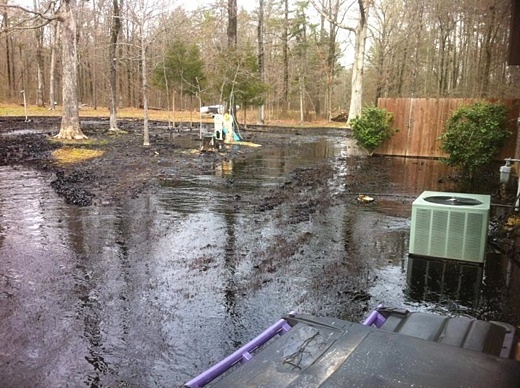
Image above: Backyard full of diluted bitumen accompanied by poisonous off-gassing.  From original article.

In Greek legend, everytime the winged horse Pegasus struck his hoof to the Earth, an "inspiring spring burst forth." Unfortunately for residents in Mayflower, Arkansas, when the Pegasus pipeline ruptured, the only thing bursting forth was a nasty tar sands oil spill.

On Friday afternoon, the Pegasus pipeline operated by Exxon Mobil ruptured, flooding an Arkansas neighborhood with thousands of barrels of Wabasca Heavy crude from the Athabasca tar sands in Alberta. Here’s what you need to know about the spill, with links to some reporting on this awful event, which at very least ruined the holiday weekends of many Mayflower, Arkansas residents, many of whom didn’t even know the pipeline was running through their neighborhood.

What is Pegasus?
The 20-inch pipeline carries diluted bitumen -- originating from the Alberta tar sands -- for 858 miles from Patoka, Illinois to refineries in Nederland, Texas. It was built in the 1940s and can carry up to 95,000 barrels a day.

Pegasus was built to funnel crude from the Gulf Coast up to the Midwest, but the flow was reversed in 2006 to help relieve the tar sands crude bottleneck in Cushing, Oklahoma. (The same reason given by proponents for the construction of Keystone XL.)

It is worth noting that a similar line reversal has been proposed by Enbridge to potentially ship tar sands crude for Atlantic export from a port in Maine.

In 2009, Exxon Mobil successfully petitioned regulators to allow them to expand capacity on the pipeline from 65,000 barrels per day to 95,000 barrels per day, a nearly 50 percent increase.

Update 4/2: On DeSmog Canada, Carol explains the bizarre technicality that allowed Exxon Mobil to avoid paying into a federal oil spill cleanup fund for its use of Pegasus.

How bad is the spill?
In 45 minutes, the spill spread through the suburban neighborhood, filling the streets and covering lawns with dilbit.

Because of the dangerous vapors emitted from the dilbit, residents of at least 22 homes were forced to evacuate.

The spill was first estimated by the EPA at 84,000 gallons, but already over 189,000 gallons of oil and water (combined) have been collected.

Greenpeace photographer Karen Seagrave has the best photos from the spill that we've yet seen.


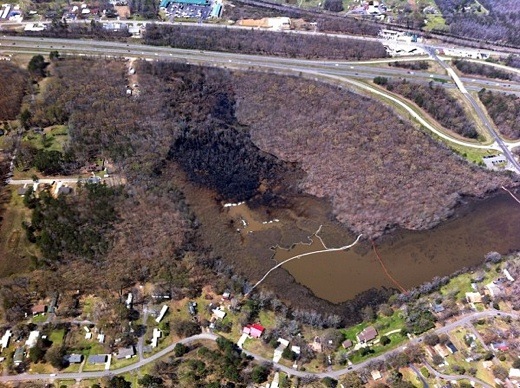
Image above: Aerial view of spill reaching waterway leading to Lake Conway. The worst was averted. Photo provided by Karen Seagrave. From (http://www.huffingtonpost.com/philip-radford/the-arkansas-oil-spill-ph_b_2998988.html).


Is it under control?
Update 4/1: The spill's impact on local wildlife is already being documented, as at least two ducks have been found dead, and at least a dozen more are oily. Carol has heartwrenching photos of volunteers cleaning ducks in her post.

Cleanup crews scrambled to prevent the diluted bitumen (or dilbit) from reaching Lake Conway, an important local source of drinking water and a popular recreation spot. A local judge, who was responsible for declaring a state of emergency and is coordinating response efforts, told Lisa Song of InsideClimate News that they were successful in doing so.
Dodson said emergency crews led a "monumentally successful" effort to prevent the Exxon spill from entering nearby Lake Conway, a popular recreational area. First responders set up earthen dams to contain the flow of oil, he said, and crews are working to shore up the protections as rains continue to fall and complicate the cleanup operations.
Update 4/2:
There are some troubling accounts from the ground of the cleanup efforts, however. Lisa Song from InsideClimate News is there on the scene and writes of how public officials are nowhere to be seen, and Exxon Mobil is clearly running the show, and limiting access to journalists and the public.

Along the same vein, on Mother Jones, Kate Sheppard has written about her frustrating interactions with Exxon's staff and is properly chastising the company for its vague responses to earnest and important questions about the spill.

Update 4/3:
Here on DeSmogBlog, Steve points out that the FAA has issued a "No Fly Zone" at ExxonMobil's request, which will essentially keep out news copters and other sources of aerial photography.

Update: 4/3:

Meanwhile, I took a closer look at Exxon's history of paying for spill cleanup and damages, and asked whether we can really trust ExxonMobil to make it right for the victims of this spill.

Sign of things to come?
Just last week, we wrote about how the oil spill from a derailed train in Minnesota was being used by Keystone XL boosters as an argument for the pipeline. We sarcastically ended that post with a “sure, pipelines never spill,” linking to a catalog of multiple spills along existing stretches of the Keystone pipeline system.

Pegasus provides yet another example -- on top of those Keystone spills and the so-called DilBit Disaster of Enbridge’s Line 6B -- of how pipelines carrying tar sands crude are more susceptible to leaks and ruptures and spills. Here’s an earlier post on the many problems with tar sands pipelines.

Who is on this story?

We'll update this story with any new developments, but here are some of the best pieces of reporting on the Pegasus spill thus far:
See also:
Ea O Ka Aina: Exxon Arkansas Pipeline Spill 3/31/13
Ea O Ka Aina: Thousands in DC protest KXL 2/17/13
Ea O Ka Aina: Obama could stop XL Pipeline 2/10/13
Ea O Ka Aina: XL Pipeline down your throat 8/16/12
Ea O Ka Aina: Koch Bros, Hillary & Keystone XL 8/30/11
.