Showing posts with label Fragility. Show all posts

Re-opening won't fix our economy

SUBHEAD: Our national economy is too fragile, brittle, bankrupt, corrupt and hopelessly perverse.

By Charles Hugh Smith on 26 May 2020 for Of Two Minds -
(http://charleshughsmith.blogspot.com/2020/05/re-opening-economy-wont-fix-whats-broken.html)
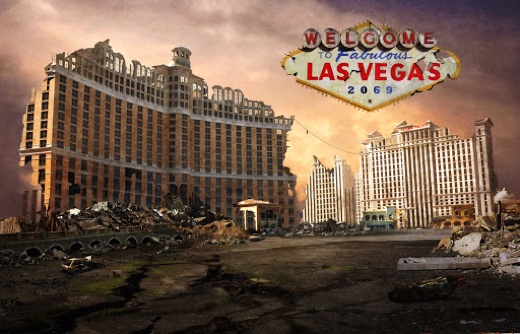

Image above: Illustration of the ruins of Las Vegas with the Bellagio Casino in the left foreground and Caesar's Palace to the right for the story "Underneath Us" by Alex TIllson. From (http://alextillson.com/writing/underneath-us/).

The stock market is in a frenzy of euphoria at the re-opening of the economy. Too bad the re-opening won't fix what's broken. As I've been noting recently, the real problem is the systemic fragility of the U.S. economy, which has lurched from one new extreme to the next to maintain a thin, brittle veneer of normalcy.

Fragile economies cannot survive any impact with reality that disrupts the distortions that are keeping the illusion of "growth" from shattering. 

For the past two decades, every collision with reality cracked the illusion, and the "fix" was to duct-tape the pieces together with new extremes of money-creation, debt, risk and speculative excess.

While the stock market has soared, the real world falls apart. If your region needs a new bridge built, count on about 20 years to get all the "stakeholders" to agree and get the thing actually built. 

Count on the cost quintupling from $500 million to $2.5 billion. Count on corners being cut as costs skyrocket, so those cheap steel bolts from China that are already rusting before the bridge is even finished? Oops. Replacing them will add millions to the already bloated budget.

Want to add a passenger stop on an existing railroad line? Count on 20 years to get it done.

The complexity thicket of every regulatory agency with the power to say "no" basically guarantees the project will never get approved, because every one of these bureaucracies justifies its existence by saying "no." Sorry, you need another study, another environmental review, and so on.

Need a new landfill? I hope you started the process 15 years ago, so you'll get approval in only five more years. Every agency with the power to say "no" will stretch out the approval, so they have guaranteed "work" for another decade or two.

Did your subway fares double? Was the excuse repairing a crumbling system? Did the work get done on budget and on time? You must be joking, right? All the fare increase did was cover the costs of skyrocketing salaries, pensions and administrative costs. Repairs to the tracks and cars-- that's extra. 

Let's float a $1 billion bond so nobody have to tighten their belts, and have riders pay for it indirectly, through higher taxes to pay the exorbitant costs of 20 years of interest on the bond.

Have you been thrown off your bicycle by the giant potholes in the city's "bike lanes"? The city reluctantly admits that these streets that haven't been maintained for decades--yes, decades. 

The city once paid for street maintenance out of its general budget, but alas, that's been eaten up by skyrocketing salaries, pensions and administrative costs, so now we need to float $100 million bond to fund filling potholes.

If all goes according to plan (ha-ha), we should be able to re-pave the streets that have been crumbling for 20 years in... the next 20 years.

These real-world examples are just four of thousands of manifestations of a broken system. Rather than make tough choices that drain power and wealth from vested interests, we simply borrow more money, in ever increasing amounts, to keep the entrenched interests and elites happy.

There are two "solutions" in the status quo: dump the debt on taxpayers or on powerless debt-serfs--for example, college students. (See chart below of the $1.6 trillion that's stripmining student debt-serfs.)

Who benefits from selling all the municipal bonds, bundled student loans, etc. to investors starving for a yield above 0.1%? Wall Street, of course.

The problem is that while debt has soared, productivity and earned income have stagnated. The statistical narrative has been ruthlessly gamed to hide the erosion of living standards, but even with the bogus "low inflation" of official statistics, wages for the bottom 95% have stagnated for decades.

Measures of productivity have also been gamed to mask the ugly reality that the vast majority of the U.S. economy is stagnating under the weight of interest payments on debt, mal-investments in speculative gambles, higher junk fees and taxes, crushing regulatory compliance, high costs imposed by monopolies and cartels and a well-cloaked decline in the quality of just about everything the bottom 95% uses or owns.

What little productivity gains have been made have been skimmed by the top 5%. Coupled with the Federal Reserve's single-minded goosing of the one signaling device it controls, the stock market, the top 0.1% in America own more wealth than the bottom 80%.

If productivity stagnates and winners take all, the wages of the bottom 95% cannot rise. Real wealth is only created by increases in the productivity of labor and capital; everything else is phantom wealth.

The only way stagnant incomes can support more debt is if interest rates decline. Presto, the Fed dropped interest rates to near-zero a decade ago. 

Of course you and I can't actually borrow millions for 0.1%; that privilege is reserved for financiers and other financial parasites and predators.

Debt-serfs were able to refinance their crushing mortgages to save a few bucks, and so they can afford to 1) take on more debt and 2) pay higher taxes to fund the ballooning public debt.

Every one of these extremes has increased the systemic fragility of the American economy. This fragility is reflected in the impoverishment of the bottom 95%, the thin line between solvency and bankruptcy, the decay of public trust in institutions run for the benefit of entrenched interests, and the quickening erosion of America's social contract.

Re-opening a fragile, brittle, bankrupt, hopelessly perverse and corrupt "normal" won't fix what's broken.
.
Systemic Uncertainty - Meet Fragility

SUBHEAD: Our systemic failure will only be revealed when multiple storms arise and the system is pushed to the limit.

By Charles Hugh Smith on 30 August 2017 for Of Two Minds -
(http://www.oftwominds.com/blogaug17/uncertainty-fragility8-17.html)


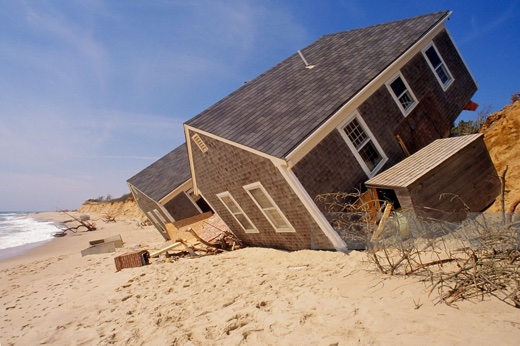
Image above: Coastal erosion causes this vacation home to collapse on a beach in Nantucket, Massachusetts. Photo by Steven Rose. From (http://www.gettyimages.com/detail/photo/collapsed-beach-house-high-res-stock-photography/80638463).

That's the problem with fragility: everything looks fine on the surface until a crisis applies pressure. Then the whole rickety contraption collapses in a heap..

Life is inherently uncertain, but systems that were once considered certainties have increasingly become uncertain. Social Security is one example; recent polls reflect widespread doubts among Millennials and Gen-Xers that there will be any Social Security benefits left for them by the time they reach retirement age.

This doubt is fact-based; as the number of retirees swells, as Medicare costs soar ever higher and the number of full-time jobs paying into Social Security/ Medicare stagnates, these pay-as-you-go programs break down; Social Security is already paying out billions more than it collects from employers and employees.

Uncertainty is one thing, fragility is another. The socio-economic systems we rely on are also becoming increasingly fragile and prone to failure, for an entirely different set of reasons than those driving uncertainty.

Changing fundamentals drive uncertainty. The nation's demographics and stagnant wages for the bottom 95% are extremely unfavorable for pay-as-you-go programs like Social Security and Medicare; their future is uncertain because the inputs and outputs are changing.

Fragility is a function of systems being thinned by cronyism, self-serving insiders, fraud, lack of transparency, lack of competition, monopolies, profiteering and a decline of quality.

Systems that become too costly due to the above dynamics are hollowed out as everyone seeks some way to reduce the costs.

Redundancies are stripped out, staff is slashed to the bone, senior managers with the most experience are pushed out to lower payroll costs, quality control is whacked, and inferior inputs are presented as equal to the higher quality inputs that they replace.

When these weakened systems are under pressure or face a crisis, they crumble. Shoddy materials fail, inexperienced managers make hasty, ill-informed decisions, the barebones staff is overwhelmed, equipment that wasn't properly maintained to save money breaks down, and so on.

We're assured by financial authorities and the media that our banking system is now monstrously resilient and robust, and it is impervious to financial crisis.

You're kidding, right?

So when all the subprime auto loans go bust, and all the overleveraged commercial real estate loans go bust, and all the developing-world debt in U.S. dollars goes into default, and all the consumer debt issued to marginal borrowers goes bust, the hundreds of billions in losses are all going to be absorbed, no problem.

This is fragility writ large. You can bet the entire financial sector is making the same faulty, fragility-creating assumptions as a means of maximizing profits: only one auto loan in a hundred will go into default, near-zero commercial real estate loans will blow up, every dollar-denominated loan in the developing world will be paid in full, blah blah blah.

In other words, if we assume FantasyLand perfection of marginal borrowers--that once a global recession guts their opportunities to refinance and the income needed to service their loans, they will still magically make all payments in full and on time--the financial system is resilient.

Beneath the reassurances, the system is increasingly fragile because all the resilience has been stripped out of it to maximize profits in the current quarter. And as for the financial authorities--who believes the financial sector is serving the interests of the bottom 99.5%? Based on what evidence?

Who believes the mainstream media is reporting the deteriorating fundamentals and the increasing fragility of our society's core systems?

All we need is a few overlapping crises to reveal the structural fragility and lack of trust/certainty in our core systems.

Profiteering, cronyism, self-serving insiders, a decline in quality, gaming the system, fraud, opacity, propaganda, and the erosion of competence all seem like good clean fun when the weather is calm and the sun in shining.

But the true nature of our systemic failure will only be revealed when multiple storms arise and the system is pushed to the limit.

.

Fragile

SUBHEAD: To recover from ecological crisis, we must transform our who we are in relation to the Earth.

By Peter Reason on 31 May 2017 for Dark Mountain -
(http://dark-mountain.net/blog/fragile/)


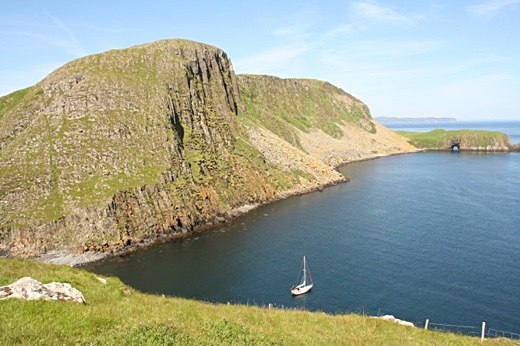
Image above: A small sailboat anchored in the lee of a small island east of Ireland. From original article.

[Dark Mountain Editor's note: ‘To recover from ecological crisis, we humans must transform our sense of who we are in relation to the Earth.’ In 2011 Peter Reason sailed his little yacht Coral from the south coast of England to the west coast of Ireland, a journey recorded in his book Spindrift: A Wilderness Journey at Sea. This week we bring you an excerpt from his latest book In Search of Grace: An Ecological Pilgrimage, which follows the further voyages of Coral to the far north of Scotland.]
 
I steered my little yacht Coral through the confused water of the tidal stream that poured out between Garbh Eilean and Eilean Mhuire. The calm pool opened in front of me, littered with specks of white as if some giant had cast handfuls of torn up paper across the surface.

Soon Coral was surrounded by puffins, with their startling white breasts, the distinctive markings around their eyes and brightly coloured beaks. The air was full of puffins too, so full they seemed more like a cloud of mosquitoes than a flock of birds.

I was in the final stages of my travels, which over two summers had taken me and Coral from the south coast of England, round the west coast of Ireland and through the Western Isles to the far north of Scotland, mainly single handed.

As I turned southward, I made for the small archipelago of the Shiant Islands, an isolated group, separated from Lewis by the Sound of Shiant, notorious for its strong tides, overfalls and underwater hazards.


I saw my travels as an ecological pilgrimage. There is a longstanding tradition in most human societies of making a journey, more or less arduous, away from the comforts of home in search of new insights and deeper understandings.

This practice may be as old as the human species: Mesolithic peoples in Europe certainly made long journeys to the sacred sites marked by stone circles; the Aboriginal people of Australia take extended walks along ‘songlines’, re-enacting the journeys of ‘creator-beings’ during the Dream Time.

The idea and practice of pilgrimage developed in a religious context. One thinks of the requirement of good Muslims to undertake the Hajj at least once in their lives; of the Christian pilgrimages of the Middle Ages and the continuing contemporary practices; of the vast numbers of Hindu devotees who travel to sacred sites on the River Ganges; and of Buddhists who walk the difficult path to circumnambulate Mount Kailash.

In its fullest sense, pilgrimage entails a long journey in search of qualities of moral or spiritual significance, a journey across both outer physical and inner spiritual landscapes. Pilgrims separate themselves from home and familiars, maybe joining a group of like-minded seekers and wearing special clothes or other marks to indicate their pilgrim status.

The pilgrimage journey offers a fluid and imaginative space between the everyday and the eternal, a liminal zone between body and soul, heaven and Earth, humanity and divinity. For it is not easy to move across the boundaries between these worlds when locked in the familiarity of the everyday.

Religious pilgrimages are taken to sacred sites in order to encounter a holy realm for worship and the affirmation of faith, in search of illumination and for healing.

As I conceive it, the ecological pilgrimage seeks a primal, heartfelt connection with the Earth itself and the community of life that has evolved on Earth.

It is also a celebration and an act of homage, honouring the Earth as the more-than-human world of which we are a part, existing for itself rather than for human use.

By taking the pilgrim away from the habits of civilization and by disrupting the patterns of everyday life, pilgrimage offers an opening to a different view of the Earth of which we are a part.


Before I left for Scotland, I read about the Shiant Islands and studied the sailing directions. I learned to pronounce the name properly, in one softened syllable: ‘Shant’.

The little archipelago is made up of three rugged islands: to the west Garbh Eilean and Eilean an Tighe are joined by a natural boulder isthmus; across an open pool to the northeast lies Eilean Mhuire.

Adam Nicolson, whose family have owned the islands for many years writes; 
‘The rest of the world thinks there is nothing much to them. Even on a map of the Hebrides the tip of your little finger would blot them out. But the Shiants… are not modest. They stand out high and undoubtable.’ 
Although keen to visit, I doubted whether it would be possible, for they are very exposed and offer little shelter. But it seemed I was lucky: the weather was quiet, with a smooth sea yet enough wind to sail.

Nevertheless, I approached them with caution, keeping an eye on the tidal streams and carefully noting landmarks.

Once I was safely in the pool and had got over the thrill of seeing so many puffins, I turned my attention to getting Coral settled.

The recommended anchorage is by the isthmus that connects Garbh Eilean and Eilean an Tighe.
This is protected from the prevailing westerly winds, but open to the light easterlies blowing that morning.

Since these volcanic islands rise abruptly from the seabed, the bottom shoals steeply and consists of boulders, so there is sediment of mud or sand into which the anchor can sink and get a good grip.

It took a little while before I was happy that the anchor was holding, with Coral tucked into the corner between the isthmus and the precipitous cliffs of Eilean an Tighe.

With Coral safely anchored, I could look around. I soon realised that there were nearly as many razorbills as puffins in the pool.

They are also auks, but rather bigger, distinguished by a black beak with a white line across it, joining a similar line across the face to the eye.

The razorbills seem on the whole less nervous than the puffins: I watched one swimming within a couple of yards of Coral, quite undisturbed as I moved about the deck.

When it decided to dive I was able to watch it turn tail up and, once underwater, open its wings to fly down beneath Coral’s keel, the bubbles of air around its feathers gleaming as they caught the sunlight.

Looking up again across the pool, I realized that there were tens of thousands of puffins and razorbills, for this is one of the major nesting places in the North Atlantic.

There were, of course, other birds: shags, black-backed gulls, kittiwakes, fulmars, guillemots, and the odd gannet.

For me the most impressive were the skuas, big, heavily built seabirds, brown, with two white stripes on their wing. Skuas are known as ‘kleptoparasites’ because of their habit of stealing food from other birds: I watched one attack a gull, hanging onto its wing as they tumbled together to the water to make it regurgitate its meal.

I am sure that given half a chance they would snatch a puffin chick, as would the big gulls. I imagined the links in the local food chain: marine plankton feeding sand-eels, sand-eels feeding baby birds and baby birds feeding skuas and gulls.

I spent the afternoon sitting in the cockpit watching the birds and enjoying the changing light. A few yachts visited, but none stayed for long; a couple of fishing boats chugged through the pool.

As the long northern evening drew in I began preparations for the night. The weather was calm enough for it to be safe to stay overnight at the islands, but I wanted to move to a more secure anchorage.

The dark cliffs and the stony isthmus looked too close, and if the anchor were to drag Coral would soon be ashore. Even if the light winds persisted through the night, it felt unseamanlike to sleep while she was anchored off a lee shore where there was poor holding.

So I hauled up the anchor and motored round the end of Eilean an Tighe to the western side of the isthmus. This anchorage is open to the swell of the Little Minch and disturbed by the tidal movement through the Sound of Shiant.

Despite this, with the light wind blowing Coral away from the islands, she felt safer. Two Danish yachts had already taken the best positions but I was able to find a spot where the anchor held closer inshore.

In the early evening the crews of the Danish yachts returned from their expeditions ashore, and soon there was a whiff of diesel and rattle of anchor chains as they left the anchorage and disappeared north round the end of Garbh Eilean.

With their departure I felt suddenly alone and vulnerable. I checked the forecast on my iPhone yet again, even though that meant waiting ages for the weak signal to load the page.

I looked again at the anchor chain – it was hanging almost vertical, I had plenty of scope out, so all was well there. I looked about me and consulted the chart to see how I would leave the anchorage in the dark if I needed to – there was sea room to the southwest.

There was no rational reason why I should not stay safely overnight, so I took myself in hand, sat down quietly, made myself breath properly and look out at the world around me rather than inwards to my anxieties. I might feel exposed, just a speck in a vast sky and expanse of sea, but I could relax and appreciate it.

The evening wore on, the light faded and I became enveloped in the quiet mystery of twilight. Coral pitched gently on the light swell. Little waves rolled continuously up to the stony shore and broke with a hollow crash on the boulders.

The mound of Garbh Eilean loomed above me, dark against the evening sky, the details of the basalt columns obscured. Nicolson’s little cottage on Eilean an Tighe stood out ghostly white, then, as the light faded away, merged with the hillside behind.

 Looking over Coral’s stern, past the line of rocks and islets that stretches toward the mainland, I searched the surface of the Sound for a glimpse of the flashing green light on the buoy that marks Damhag. All I could see was the grey sea and the distant hazy line of Lewis.

Through the evening the inexhaustible stream of puffins flew overhead; the skuas and black-backed gulls continued their patrols around the cliff tops. If I peered out to sea I could just make out the white flash of gannets on a late search for fish. I sat out late, enchanted by my surroundings while still feeling strangely vulnerable, reluctant to go to bed.


The word that keeps coming to my mind to describe this evening is ‘fragile’. It captures both the strength and the vulnerability of my situation, of the puffins and of the islands themselves. The Shiants are the nesting ground of one of the last flourishing populations for puffins: huge populations in Iceland and elsewhere have quite suddenly disappeared as climate change has brought warm waters that have disturbed the delicate ecological balance on which they depend.

The basalt columns that form the Shiant Islands appear strong and stable, but are weakly jointed; over time, wind and waves penetrate the joints, allowing large chunks to break away. And indeed of all of us, despite the veneer of civilization, are at root unprotected in a wild world and the wild universe.

Our attention has been drawn to the fragility of Planet Earth by the space program. Ever since the early Apollo missions, pictures of planet Earth from space have been widely available, starting with the most famous ‘Earth Rising’, taken as Apollo 8 emerged from behind the moon.


Image above: Earthrise on Christmas Eve 1968. This photo was taken in black and white from the Apollo Command Module orbiting the Moon. NASA has colorized it from available data. From (https://earthobservatory.nasa.gov/IOTD/view.php?id=82693).

This has been called ‘the most influential environmental photograph ever taken’. For, it is argued, now that humanity can see the Earth alone within the vast reaches of space, we will realise her beauty, fragility and significance and band together to protect and preserve her as our home.

Astronauts report that they spend much of their spare time on missions simply ‘Earthgazing’.

NASA engineer Nicole Stott tells us;
‘I think you start out with this idea of what its going to be like, and then when you do finally look at the Earth for the first time you’re overwhelmed by how much more beautiful it really is…’
Shuttle astronaut Jeff Hoffman goes further;
'Earth looks like a living, breathing organism, but it also at the same time looks extremely fragile’. 
And Ron Garon, who served on the International Space Station, remembers;
 ‘When we look down on the Earth from space we see this amazing, indescribably beautiful planet… It’s really striking and its sobering to see this paper thin layer and to realize that that little paper thin layer is all that protects every living thing on Earth from death’.
Edgar Mitchell, who was the Lunar Module pilot on Apollo 14 and the sixth person to walk on the moon, is one of many astronauts to reflect deeply on their experience. His view is that it is not just that you get see the beauty and fragility from space, but there is also a shift in consciousness which he describes a close to the ancient accounts of savikalpa samādhi.

There is as a direct experience of interconnection:
‘You see things as you see them with your eyes but you experience them emotionally and viscerally as ecstasy and a sense of total unity and oneness…
It’s rather clear to me as I studied this that is was not anything new, but was something that was very important to the way we humans were put together’.
I wonder if the experience of the astronauts was so very far from my own as I sat in the long northern twilight off the Shiant Islands: it was just this kind of direct interconnection that I was seeking on my ecological pilgrimage.

Of course, I am not among those who first saw Earth rising from behind the moon; I have not watched the shadow of night move across the face of the Earth; nor I have experienced the thin blue line of the biosphere clinging to the curve of the planet.

And yet, as Mitchell points out, the astronauts’ experience of oneness is nothing new. I think we may idealize their experience and in doing so see the capability of experiencing oneness as something special, something extraordinary, something for which we have to go outside the planet.

Maybe it is better to see it as a dimension of human consciousness that we modern humans have neglected and marginalised, rather than something only available from outer space.

Maybe a better way to celebrate the astronauts’ experience, the way that ‘Earth Rising’ might change human consciousnesses, the way it might kick-start a true environmental movement, is realise our own capacity for such experiences.

Zen masters teach us not to seek the extraordinary, not to look for special or ‘sacred’ places. To seek that seeking prevents us from seeing what is before our eyes – the specialness of the everyday, how everything rolls together in being and nonbeing, how we are every moment part of a living planet.

These are capabilities that we must bring back to ourselves, and not just to our pilgrimages into the wild, but into our homes, our gardens, our cities, the everyday world around us and our relationships with other humans.


As the darkness finally gathered off the Shiants and day finally rolled into night, my long watch was rewarded by the waxing crescent moon rising, a deep red, between the two dark humps of the islands. The overhead stream of puffins ceased, and I too was at last content to climb down the companionway and sleep.

[Dark Mountain Editor's note: In Search of Grace is the story of an ecological pilgrimage undertaken by the author from the south coast of England, round the west coast of Ireland to the far north of Scotland. It explores themes of pilgrimage, the overall pattern of separation from the everyday, venturing forth and returning home. It tells of meeting wildlife, visiting sacred places, confronting danger, expanding and deepening the experience of time, of silence, of fragility.
It will be published in October 2017 by Earth Books. You can read pre-publication reviews, more excerpts from the book and watch a video describing the journey here.]


.

Deflation Shock Wave

SUBHEAD: SocGen bear growls that deflation shock-wave from Asia will trigger global recession.

By Ambrose Evans-Pritchard on 6 February 2014 for the Telegraph -
(http://blogs.telegraph.co.uk/finance/ambroseevans-pritchard/100026574/socgen-bear-growls-deflation-shock-wave-from-asia-to-trigger-global-recession/)


Image above: Albert Edwards photographed in his officin 2011 by Tim Foster. From (http://timfosterphotographer.blogspot.com/2011/02/albert-edwards-societe-generale.html).

Albert Edwards from Societe Generale has returned from two weeks holiday in a completely foul mood.

"The ongoing emerging market debacle will be less contained than sub-prime ultimately proved to be. The simple fact is that US and global profits growth have reached tipping point and the unfolding EM crisis will push global profits and thereafter the global economy into deep recession."

What we are seeing is a "direct replay" of the East Asia crisis of 1997 but on a bigger scale. A strong dollar/weak yen world is an "incendiary mix" for emerging markets. It tightens liquidity while delivering a trade shock to weaker economies.

Analysts are slashing their forecasts at an "all-time record rate – this is wholly inconsistent with talk of economic acceleration".

"The dire profits situation will only get worse as EM implodes and waves of deflation flow from Asia to overwhelm the fragile situation in the US and Europe."

This week's slump in America's ISM manufacturing gauge is the "straw in the wind" of what is to come. "Even if the Fed resumes massive QE at some point as the world melts down, and markets desperately attempt their return to the dream trance, they will instead find themselves locked into a Freddy Krueger-like nightmare in which phase 3 of this secular bear market takes equity valuations down to levels not seen for a generation."

Albert and SG's Andrew Lapthorne say profits have already slumped to near zero growth if you use MSCI reported earning rather than the "made-up" pro-forma IBES data.

EM profits have been negative for two years already. The global equity rally has been driven by QE fumes.

I hate to think what would happen if Albert were right. The world cannot take such an outcome in its present enfeebled condition.

It would push China into a dangerous crisis, greatly raising the risk a diversionary military clash with Japan, which would in turn embroil the US in a Pacific War.

It would doom any chance of recovery in southern Europe, sending debt trajectories and jobless rates through the roof. The European Project would disintegrate in acrimony, with a chain of sovereign defaults pushing Germany into depression.

Britain would spin into another financial cataclysm, this time having to rescue banks with huge exposure to emerging markets and China (through Hong Kong). This would be hard to explain to long-suffering British taxpayers a second time. The retribution that bankers deftly avoided post-Lehman would be crushing.

Much of the world would revert to capital controls, locking down trillions of foreign wealth much as the Bolshevik revolution wiped out French investors. Western pensioners would face a greatly impoverished old age.

It would cause the further implosion of Argentina, risking a fresh Falklands War with Britain. It would endanger Brazil's democracy, and tempt military coups in several Latin American states.

It would lead to the economic collapse of Russia, with fearsome implications for Ukraine and ex-Soviet sphere.

I could go on,

But in the end I am not as gloomy as Albert — though I share his fears over the gravity of the EM crisis, and the implications of Fed tightening.

The financial world is ultimately smoke and mirrors. Debt is a mirage. Creditor claims can be "re-arranged" at the point of a bayonet if need be, and often are.

You can conjure all kinds of tricks, and wave all kinds of magic wands. A determined central bank – backed by a credible government and a cohesive society – can achieve miracles. Any deflationary shock can overpowered.

Political will can always triumph over these setbacks. To borrow from the Habsburgs, the situation may be desperate but it is not serious. So waltz on, and keep the champagne flowing.

.

Fragility & Collapse

SUBHEAD: Collapse happens slowly at first, then all at once. Exactly when is hard to predict.  

By Dmitry Orlov on 5 June 2012 for Club Orlov -  
(http://cluborlov.blogspot.com/2012/06/fragility-and-collapse-slowly-at-first.html)  

  
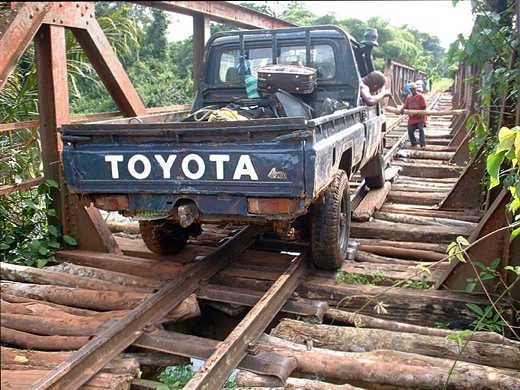
Image above: Passing over a fragile bridge in the interior of the Congo. From (http://www.flickr.com/photos/7185410@N06/407301027/lightbox/).


[IBPublisher's note: This is a long article (approximately 5,000 words. We have simply pulled three paragrphs to set the tone. For its entirety please visit the link above.]
I have been predicting collapse for over five years now.

My prediction is that the USA will collapse financially, economically and politically within the foreseeable future... and this hasn’t happened yet. And so, inevitably, I am asked the same question over and over again: “When?”

And, inevitably, I answer that I don’t make predictions as to timing. This leaves my questioners dissatisfied, and so I thought that I should try to explain why it is that I don’t make predictions as to timing. I will also try to explain how one might go about creating such predictions, understanding full well that the result is highly subjective...

... It is something of a general property of things that things build up slowly and collapse quickly. Examples of this sort abound (buildings, bridges, dams, military empires, economies, supernovae...) 

And so, please don’t ask me “When?”—do your own thinking! I’ve given you the tools you need to come to your own conclusions, based on which you may be able to start your collapse early and get it over with quickly.
  
.

America, the Fragile Empire

SUBHEAD: Here today, gone tomorrow -- could the United States fall that fast? That's what empires do.

By Niall Ferguson on 28 February 2010 in the Los Angeles Times
(http://www.latimes.com/news/opinion/commentary/la-oe-ferguson28-2010feb28,0,7706980.story) 

 
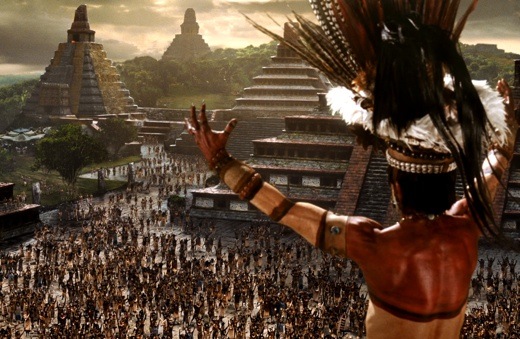
Image above: Still from movie "Apocalypto" portraying collapse of Incan Empire. From (http://video.movies.go.com/apocalypto)

For centuries, historians, political theorists, anthropologists and the public have tended to think about the political process in seasonal, cyclical terms. From Polybius to Paul Kennedy, from ancient Rome to imperial Britain, we discern a rhythm to history.

Great powers, like great men, are born, rise, reign and then gradually wane. No matter whether civilizations decline culturally, economically

For ecologically, their downfalls are protracted. In the same way, the challenges that face the United States are often represented as slow-burning. It is the steady march of demographics -- which is driving up the ratio of retirees to workers -- not bad policy that condemns the public finances of the United States to sink deeper into the red.

It is the inexorable growth of China's economy, not American stagnation, that will make the gross domestic product of the People's Republic larger than that of the United States by 2027.

 As for climate change, the day of reckoning could be as much as a century away. These threats seem very remote compared with the time frame for the deployment of U.S. soldiers to Afghanistan, in which the unit of account is months, not years, much less decades.

But what if history is not cyclical and slow-moving but arrhythmic -- at times almost stationary but also capable of accelerating suddenly, like a sports car? What if collapse does not arrive over a number of centuries but comes suddenly, like a thief in the night?

 Great powers are complex systems, made up of a very large number of interacting components that are asymmetrically organized, which means their construction more resembles a termite hill than an Egyptian pyramid.

They operate somewhere between order and disorder. Such systems can appear to operate quite stably for some time; they seem to be in equilibrium but are, in fact, constantly adapting. But there comes a moment when complex systems "go critical."

A very small trigger can set off a "phase transition" from a benign equilibrium to a crisis -- a single grain of sand causes a whole pile to collapse.

Not long after such crises happen, historians arrive on the scene. They are the scholars who specialize in the study of "fat tail" events -- the low-frequency, high-impact historical moments, the ones that are by definition outside the norm and that therefore inhabit the "tails" of probability distributions -- such as wars, revolutions, financial crashes and imperial collapses.

But historians often misunderstand complexity in decoding these events. They are trained to explain calamity in terms of long-term causes, often dating back decades. This is what Nassim Taleb rightly condemned in "The Black Swan" as "the narrative fallacy."

In reality, most of the fat-tail phenomena that historians study are not the climaxes of prolonged and deterministic story lines; instead, they represent perturbations, and sometimes the complete breakdowns, of complex systems.

To understand complexity, it is helpful to examine how natural scientists use the concept.

Think of the spontaneous organization of termites, which allows them to construct complex hills and nests, or the fractal geometry of water molecules as they form intricate snowflakes.

Human intelligence itself is a complex system, a product of the interaction of billions of neurons in the central nervous system. All these complex systems share certain characteristics.

A small input to such a system can produce huge, often unanticipated changes -- what scientists call "the amplifier effect." Causal relationships are often nonlinear, which means that traditional methods of generalizing through observation are of little use.

Thus, when things go wrong in a complex system, the scale of disruption is nearly impossible to anticipate. There is no such thing as a typical or average forest fire, for example.

To use the jargon of modern physics, a forest before a fire is in a state of "self-organized criticality": It is teetering on the verge of a breakdown, but the size of the breakdown is unknown.

Will there be a small fire or a huge one? It is nearly impossible to predict. The key point is that in such systems, a relatively minor shock can cause a disproportionate disruption. Any large-scale political unit is a complex system.

Most great empires have a nominal central authority -- either a hereditary emperor or an elected president -- but in practice the power of any individual ruler is a function of the network of economic, social and political relations over which he or she presides.

As such, empires exhibit many of the characteristics of other complex adaptive systems -- including the tendency to move from stability to instability quite suddenly. The most recent and familiar example of precipitous decline is the collapse of the Soviet Union. With the benefit of hindsight, historians have traced all kinds of rot within the Soviet system back to the Brezhnev era and beyond.

Perhaps, as the historian and political scientist Stephen Kotkin has argued, it was only the high oil prices of the 1970s that "averted Armageddon." But this did not seem to be the case at the time.

The Soviet nuclear arsenal was larger than the U.S. stockpile. And governments in what was then called the Third World, from Vietnam to Nicaragua, had been tilting in the Soviets' favor for most of the previous 20 years.

Yet, less than five years after Mikhail Gorbachev took power, the Soviet imperium in central and Eastern Europe had fallen apart, followed by the Soviet Union itself in 1991. If ever an empire fell off a cliff, rather than gently declining, it was the one founded by Lenin.

If empires are complex systems that sooner or later succumb to sudden and catastrophic malfunctions, what are the implications for the United States today? First, debating the stages of decline may be a waste of time -- it is a precipitous and unexpected fall that should most concern policymakers and citizens. Second, most imperial falls are associated with fiscal crises.

Alarm bells should therefore be ringing very loudly indeed as the United States contemplates a deficit for 2010 of more than $1.5 trillion -- about 11% of GDP, the biggest since World War II. These numbers are bad, but in the realm of political entities, the role of perception is just as crucial.

In imperial crises, it is not the material underpinnings of power that really matter but expectations about future power. The fiscal numbers cited above cannot erode U.S. strength on their own, but they can work to weaken a long-assumed faith in the United States' ability to weather any crisis.

One day, a seemingly random piece of bad news -- perhaps a negative report by a rating agency -- will make the headlines during an otherwise quiet news cycle. Suddenly, it will be not just a few policy wonks who worry about the sustainability of U.S. fiscal policy but the public at large, not to mention investors abroad. It is this shift that is crucial: A complex adaptive system is in big trouble when its component parts lose faith in its viability.

Over the last three years, the complex system of the global economy flipped from boom to bust -- all because a bunch of Americans started to default on their subprime mortgages, thereby blowing huge holes in the business models of thousands of highly leveraged financial institutions.

The next phase of the current crisis may begin when the public begins to reassess the credibility of the radical monetary and fiscal steps that were taken in response. Neither interest rates at zero nor fiscal stimulus can achieve a sustainable recovery if people in the United States and abroad collectively decide, overnight, that such measures will ultimately lead to much higher inflation rates or outright default.

Bond yields can shoot up if expectations change about future government solvency, intensifying an already bad fiscal crisis by driving up the cost of interest payments on new debt. Just ask Greece. Ask Russia too. Fighting a losing battle in the mountains of the Hindu Kush has long been a harbinger of imperial fall.

What happened 20 years ago is a reminder that empires do not in fact appear, rise, reign, decline and fall according to some recurrent and predictable life cycle. It is historians who retrospectively portray the process of imperial dissolution as slow-acting.

Rather, empires behave like all complex adaptive systems. They function in apparent equilibrium for some unknowable period. And then, quite abruptly, they collapse. Washington, you have been warned.

 .

Poison is Profitable

SUBHEAD: It’s also one of America's top products. Food is power and the powerful are poisoning us.

By Chris Hedges on 06 September 2009 in Truthdig -  
(http://www.truthdig.com/report/item/20090906_food_is_power_and_the_powerful_are_poisoning_us)

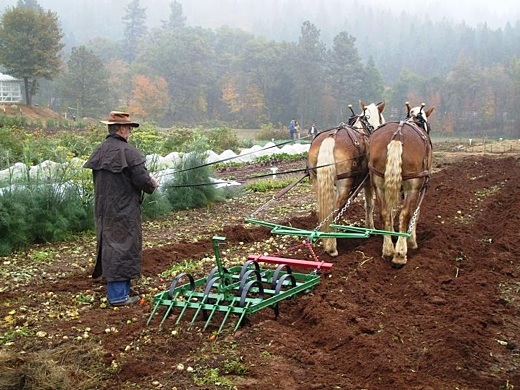
Image above: Small farm plowing with draft horses. From http://slowfoodsacramento.com/2008/10/14/sierra-nevada-small-farm-progress-days-activities-and-events

Our most potent political weapon is food. If we take back our agriculture, if we buy and raise produce locally, we can begin to break the grip of corporations that control a food system as fragile, unsafe and destined for collapse as our financial system.

If we continue to allow corporations to determine what we eat, as well as how food is harvested and distributed, then we will become captive to rising prices and shortages and increasingly dependent on cheap, mass-produced food filled with sugar and fat. Food, along with energy, will be the most pressing issue of our age.

And if we do not build alternative food networks soon, the social and political ramifications of shortages and hunger will be devastating. The effects of climate change, especially with widespread droughts in Australia, Africa, California and the Midwest, coupled with the rising cost of fossil fuels, have already blighted the environments of millions.

The poor can often no longer afford a balanced diet. Global food prices increased an average of 43 percent since 2007, according to the International Monetary Fund. These increases have been horrific for the approximately one-billion people—one-sixth of the world’s population—who subsist on less than $1 per day. And 162 million of these people survive on less than 50 cents per day.

The global poor spend as much as 60 percent of their income on food, according to the International Food Policy Research Institute.

There have been food riots in many parts of the world, including Austria, Hungary, Mexico, Namibia, Zimbabwe, Morocco, Yemen, Mauritania, Senegal and Uzbekistan. Russia and Pakistan have introduced food rationing. Pakistani troops guard imported wheat. India has banned the export of rice, except for high-end basmati.

And the shortages and price increases are being felt in the industrialized world as we continue to shed hundreds of thousands of jobs and food prices climb. There are 33.2 million Americans, or one in nine, who depend on food stamps.

And in 20 states as many as one in eight are on the food stamp program, according to the Food Research Center.

The average monthly benefit was $113.87 per person, leaving many, even with government assistance, without adequate food. The USDA says 36.2 million Americans, or 11 percent of households, struggle to get enough food, and one-third of them have to sometimes skip or cut back on meals.

 Congress allocated some $54 billion for food stamps this fiscal year, up from $39 billion last year. In the new fiscal year beginning Oct. 1, costs will be $60 billion, according to estimates.

Food shortages have been tinder for social upheaval throughout history. But this time around, because we have lost the skills to feed and clothe ourselves, it will be much harder for most of us to become self-sustaining.

The large agro-businesses have largely wiped out small farmers. They have poisoned our soil with pesticides and contaminated animals in filthy and overcrowded stockyards with high doses of antibiotics and steroids. They have pumped nutrients and phosphorus into water systems, causing algae bloom and fish die-off in our rivers and streams.

Crop yields, under the onslaught of changing weather patterns and chemical pollution, are declining in the Northeast, where a blight has nearly wiped out the tomato crop. The draconian Food Modernization Safety Act, another gift from our governing elite to corporations, means small farms will only continue to dwindle in number.

Sites such as La Via Campesina do a good job of tracking these disturbing global trends. “The entire economy built around food is unsafe and unethical,” activist Henry Harris of the Food Security Roundtable told me.

The group builds distribution systems between independent farmers and city residents. “Food is the greatest place for communities to start taking back power,” he said. “The national food system is collapsing by degrees. More than 50 percent of what we eat comes from the Central Valley of California.

What happens when gasoline becomes $5 a gallon or drought sweeps across the cropland? The monolithic system of food production is highly unstable. It has to be replaced very soon with small, diverse sources that provide greater food security.”

Cornell University recently did a study to determine whether New York state could feed itself. The research is described in two articles published in 2006 and 2008 by the journal Renewable Agriculture and Food Systems.

If all agricultural land were in use, and food distribution were optimized to minimize the total distance that food travels, New York state could, the researchers found, have 34 percent of its food needs met from within its boundaries.

This is not encouraging news to those who live in New York City. New York once relied on New Jersey, still known as the Garden State, instead of having food shipped from across the country.

But New Jersey farms have largely given way to soulless housing developments. Farming communities upstate, their downtowns boarded up and desolate, have been gutted by industrial farming. The ties most Americans had to rural communities during the Great Depression kept many alive.

A barter economy replaced the formal economy. Families could grow food or had relatives to feed them. But in a world where we do not know where our food comes from, or how to produce it, we have become vulnerable.

And many will be forced, as food prices continue to rise, to shift to a diet of cheap, fatty, mass-produced foods, already a staple of the nation’s poor. Junk food, a major factor in obesity, diabetes and heart disease, is often the only food those in the inner city can buy because supermarkets and nutritious food are geographically and financially beyond reach.

As the economy continues to deteriorate, the middle class will soon join them. “It is clear to anyone who looks carefully at any crowd that we are wasting our bodies exactly as we are wasting our land,” Wendell Berry observed in “The Unsettling of America.”
“Our bodies are fat, weak, joyless, sickly, ugly, the virtual prey of the manufacturers of medicine and cosmetics. Our bodies have become marginal; they are growing useless like our ‘marginal land’ because we have less and less use for them. After the games and idle flourishes of modern youth, we use them only as shipping cartons to transport our brains and our few employable muscles back and forth to work.”

Berry, who lives on a farm in Kentucky where his family has farmed for generations, argues that local farming is fundamental to sustaining communities. Industrial farming, he says, has estranged us from the land. It has rendered us powerless to provide for ourselves. It has left us complicit in the corporate destruction of the ecosystem. Its moral cost, Berry argues, has been as devastating as its physical cost.

“The people will eat what the corporations decide for them to eat,” writes Berry. “They will be detached and remote from the sources of their life, joined to them only by corporate tolerance. They will have become consumers purely—consumptive machines—which is to say, the slaves of producers.

What … model farms very powerfully suggest, then, is that the concept of total control may be impossible to confine within the boundaries of the specialist enterprise—that it is impossible to mechanize production without mechanizing consumption, impossible to make machines of soil, plants, and animals without making machines also of people.”

The nascent effort by communities to reclaim local food production is the first step toward reclaiming lives severed and fragmented by corporate culture. It is more than a return to local food production. It is a return to community.

It brings us back to the values that sustain community. It is a return to the recognition of the fragility, interconnectedness and sacredness of all living systems and our dependence on each other. It turns back to an ethic that can save us.

“[The commercial] revolution … , ” writes Berry, “did not stop with the subjugation of the Indians, but went on to impose substantially the same catastrophe upon the small farms and the farm communities, upon the shops of small local tradesmen of all sorts, upon the workshops of independent craftsmen, and upon the households of citizens.

It is a revolution that is still going on. The economy is still substantially that of the fur trade, still based on the same general kinds of commercial items: technology, weapons, ornaments, novelties, and drugs.

The one great difference is that by now the revolution has deprived the mass of consumers of any independent access to the staples of life: clothing, shelter, food, even water. Air remains the only necessity that the average user can still get for himself, and the revolution has imposed a heavy tax on that by way of pollution. Commercial conquest is far more thorough and final than military defeat.

“The inevitable result of such an economy,” Berry adds, “is that no farm or any other usable property can safely be regarded by anyone as a home, no home is ultimately worthy of our loyalty, nothing is ultimately worth doing, and no place or task or person is worth a lifetime’s devotion.

‘Waste,’ in such an economy, must eventually include several categories of humans—the unborn, the old, ‘disinvested’ farmers, the unemployed, the ‘unemployable.’ Indeed, once our homeland, our source, is regarded as a resource, we are all sliding downward toward the ash heap or the dump.”

.