Fukushima radiation damages Japan

SUBHEAD: The government from Tokyo to the  prefectures are saying illnesses are from stress, there’s no radiation.

By Admin on 14 April 2016 for ENE News -
(http://enenews.com/top-official-60-million-japanese-irradiated-fukushima-nuclear-expert-50000-square-miles-country-highly-contaminated-many-millions-be-evacuated-govt-decided-sacrifice-serious-crime-professor-70-lS)

http://www.islandbreath.org/2016Year/04/160414japanbig.jpghttp://www.islandbreath.org/2016Year/04/160414japanbig.jpg
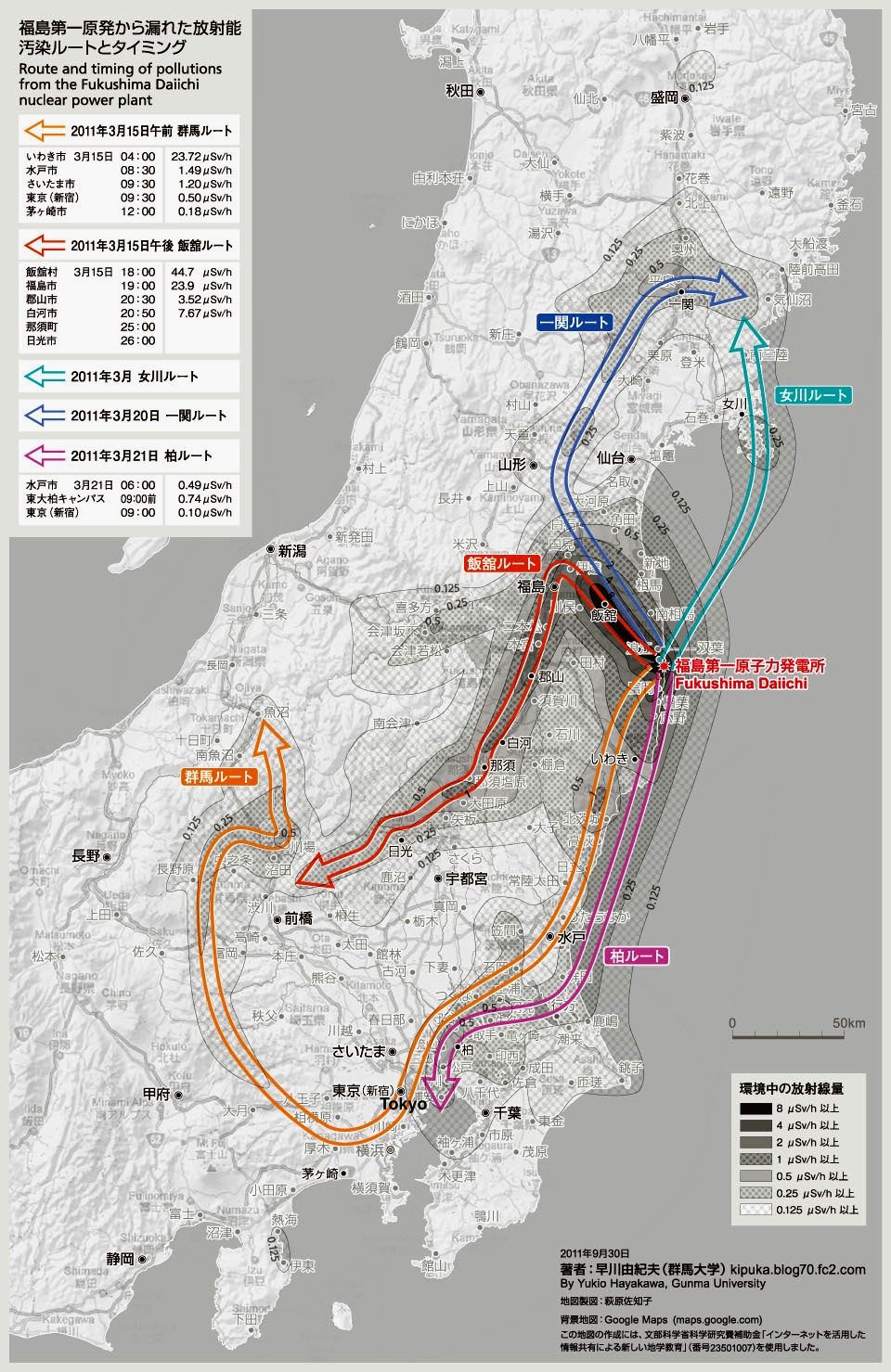
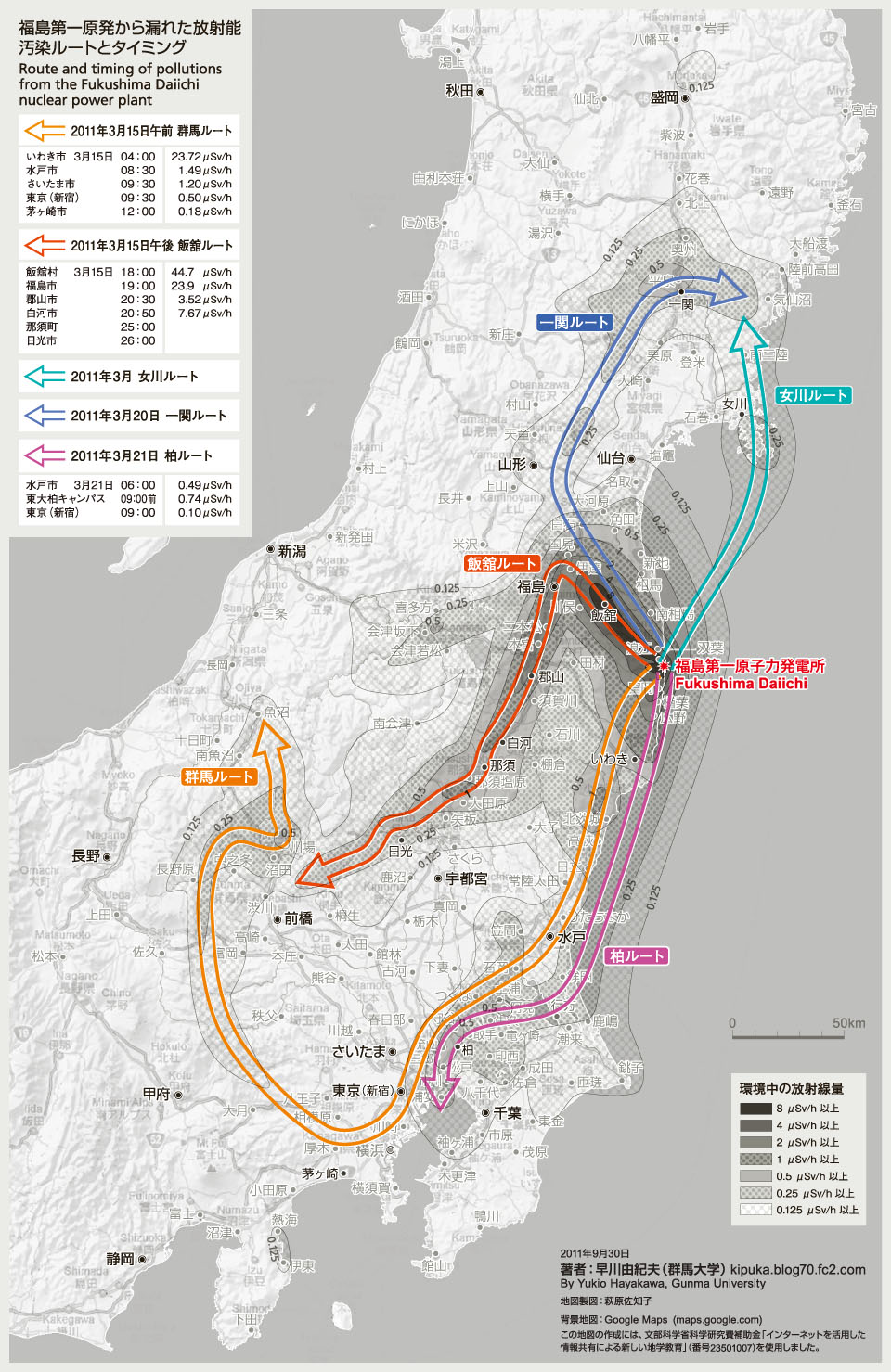
Image above: Detail of map of by Yukio Hayakawa, Gunma University of Fukushima Dai Ichi radiation contamination in the weeks after multiple nuclear plant meltdowns began in March of 2011 after devastating tsunami. Click to enlarge. From (http://www.hayakawayukio.jp/pub/2011/route930.jpg). Origina map indicate that on 3/15/11 (orange path) and 3/21/11 (magenta path) that Tokyo received the most fallout radiation.

Interview with nuclear engineer Hiroaki Koide 8 March 2016
(translation by Prof. Robert Stolz, transcription by Akiko Anson)

 [Radioactive] material has been dispersed, contaminating Tohoku, Kanto [Tokyo area], and western Japan…

[The law says] that absolutely nothing may be removed from a radioactive management area in which the levels exceed 40,000 Becquerels per square meter… [H]ow much area has been contaminated beyond 40,000 Bq/m2… that answer is 140,000 km^2 [54,054 square miles]…

Indeed, while centered on Fukushima, parts of Chiba and Tokyo have also been contaminated. The number of people living in what must be called a radiation-controlled area is in the millions, and could exceed ten million…

I believe the government has the responsibility to evacuate these entire communities… the government decided to leave them exposed to the real danger of radiation.

In my view, Fukushima should be declared inhabitable… but if that were to be done, it would likely bankrupt the country… They’ve decided to sacrifice people…

In my view, this is a serious crime committed by Japan’s ruling elite… [F]undamentally, people must not be forced to live in contaminated areas… First must come complete evacuation…

[W]hen it comes to radiation… “removal of contaminants” is impossible… This stuff contaminates everything.


Arne Gundersen on health impacts 5 April 2016


Video above: From (https://youtu.be/7YN7-wy-zMU).

[During my recent trip to Japan] I met in one of the resettlement areas… The unofficial mayor of this group – a real dynamo of a woman – she experienced hair loss, bloody nose, speckles on her skin and the doctors told her it was stress and not to worry about it. That’s not stress. It was radiation damage.

But again, that’s this inhumanity that I was experiencing… Every time I turned around, I saw people that definitely experienced radiation damage. We had one woman who ran from her house to evacuate carrying her dog. About a day after the accident, they realized that she needed to be evacuated.

And so she runs barefoot to her car, gets in her car, drives to the resettlement community. She’s highly radioactive. They make her – especially her feet – they make her take her socks off and take showers, wash her down before they let her in. And her feet were black for three years from radiation damage.

And that’s not being spoken about in any of the medical journals… [The government wants] to get these other nuclear plants up and running. And if the population is getting ill from radiation effects, it’s a lot harder.

So they have… banded together with the medical community. We had numerous doctors say that they were going to lose hospital privileges and things like that. And the people that are keeping track of deaths in Fukushima Prefecture aren’t publishing the data.

So the entire government infrastructure, from the people in Tokyo to the underlings in the Prefecture, are all singing the same song: that this is stress, there’s no radiation. And it sure isn’t what I found, I’ll tell you…

Were it not for the internet, they would have won. And I think the difference between the disaster at Fukushima and the disaster at Chernobyl and TMI is that now we have the internet. It still is an unlevel playing field. There’s still so much money on the other side of it that people are being brainwashed. Oh, that bloody nose you’ve had for the last 3 weeks is stress. So they are being brainwashed.


‘Fukushima and Its Aftermath’ 16 March 2016
Arirang (Government-funded Korean TV network)


Video above: From (https://youtu.be/RZdnu8rZtKU).


(at 6:45 in) Professor Kim Ik-Jung, Medical College at Dongguk University: “When you look at the contamination map, about 70% of Japan is contaminated by radiation. That means that 70% of Japan’s agricultural and marine products are contaminated.”… According to PNAS, one of the five major scientific journals, over 70% of the land in Japan is contaminated by radiation.


Naoto Kan, former Prime Minister of Japan 11 April 2016


Video above: Presentaion of Naoto Kan on contamination of Japan by Fukushima Daiichi disaster. From (https://youtu.be/Q4kwR6wpw2g).

(at 2:15 in) The molten material broke through the pressure vessel and accumulated low down in the containment. Now what would have happened if this molten material had escaped from the containment?… A radius of 250 kilometers — which includes the city of Tokyo — anyone living in this area, if you count them up it comes to 50 million or 40% of the Japanese population, and they would all have had to be evacuated.  [Note: Many nuclear experts believe the molten fuel did in fact escape from the containment]

As we know from Chernobyl, not just a couple of weeks, but 30 years or 40 years — it would have virtually meant the end of Japan. Half the population was subject to radiation [Japan Population: 127 million]. That’s something that could just be imagined, for instance the event of losing a major war.

See also:
Ea O Ka Aina: Fifth Fukushima Anniversary 3/11/16
Ea O Ka Aina: Fukushima impacts are ongoing 11/8/15
Ea O Ka Aina: Petroleum and Nuclear Coverups 10/21/15
Ea O Ka Aina: Fukushima Radiation Contamination 10/13/15
Ea O Ka Aina: Radioactive floods damage Japan 9/22/15
Ea O Ka Aina: Fir trees damaged by Fukushima 8/30/15
Ea O Ka Aina: Japan restarts a nuclear plant 8/11/15
Ea O Ka Aina: Fukushima disaster will continue 7/21/15
Ea O Ka Aina: Too many fish in the sea? 6/22/15
Ea O Ka Aina: Fukushima prefecture uninhabitable 6/6/15
Ea O Ka Aina: In case you've forgotten Fukushima 5/27/15
Ea O Ka Aina: Radiation damages top predator bird 4/24/15
Ea O Ka Aina: Fukshima die-offs occurring 4/17/15
Ea O Ka Aina: Fukushima Impact Update 4/13/15
Ea O Ka Aina: Fukushima - the end of atomic power 3/13/15
Ea O Ka Aina: Where is the Fukushima Data? 2/21/15
Ea O Ka Aina: Fuku-Undo 2/4/15
Ea O Ka Aina: Fukushima MOX fuel crossed Pacific 2/4/15
Ea O Ka Aina: Fukushima worst human disaster 1/26/15
Ea O Ka Aina: Japan to kill Pacific Ocean 1/23/15
Ea O Ka Aina: Japan's Environmental Catastrophe 8/25/14
Ea O Ka Aina: Earthday TPP Fukushima RIMPAC 4/22/14
Ea O Ka Aina: Fukushima Daiichi hot particles 5/30/14
Ea O Ka Aina: Japanese radiation denial 5/12/14
Ea O Ka Aina: Entomb Fukushima Daiichi now 4/6/14
Ea O Ka Aina: Fukushima Disaster 3 Years Old 4/3/14
Ea O Ka Aina: Tsunami, Fukushima and Kauai 3/9/14
Ea O Ka Aina: Japanese contamination 2/16/14
Ea O Ka Aina: Bill for Fukushima monitoring 2/9/14
Ea O Ka Aina: Tepco under reporting of radiation 2/9/14
Ea O Ka Aina: Fukushima Fallout in Alaska 1/25/14
Ea O Ka Aina: Fukushima engineer against nukes 1/17/14
Ea O Ka Aina: California to monitor ocean radiation 1/14/14
Ea O Ka Aina: Demystifying Fukushima Reactor #3 1/1/14
Ea O Ka Aina: US & Japan know criticality brewing 12/29/13
Ea O Ka Aina: Fukushima Forever 12/17/13
Ea O Ka Aina: Brief radiation spike on Kauai 12/27/13
Ea O Ka Aina: USS Ronald Reagan & Fukushima 12/15/13
Ea O Ka Aina: Fukushima Pacific Impact 12/11/13
Ea O Ka Aina: Berkeley and Fukushima health risks 12/10/13
Ea O Ka Aina: Madness engulfs Japan 12/4/13
Ea O Ka Aina: Edo Japan and Fukushima Recovery 11/30/13
Ea O Ka Aina: Reaction to Fukushima is Fascism 11/30/13
Ea O Ka Aina: Radioisotopes in the Northern Pacific 11/22/13
Ea O Ka Aina: Fukushima cleanup in critical phase 11/18/13
Ea O Ka Aina: Fukushima fuel removal to start 11/14/13
Ea O Ka Aina: Fukushima, What me worry? 11/13/13
Ea O Ka Aina: Remove other Fukushina fuel 10/29/13
Ea O Ka Aina: End to Japanese Nuclear Power? 10/3/13
Ea O Ka Aina: Fukushima & Poisoned Fish 10/3/13
Ea O Ka Aina: Fuel Danger at Fukushima 9/27/13
Ea O Ka Aina: Reactor #4 Spent Fuel Pool 9/16/13
Ea O Ka Aina: Fukushima is Not Going Away 9/9/13
Ea O Ka Aina: X-Men like Ice Wall for Fukushima 9/3/13
Ea O Ka Aina: Fukushima House of Horrors 8/21/13
Ea O Ka Aina: Fukushima Apocalypse 8/21/13
Ea O Ka Aina: Fukushima Radioactive Dust 8/20/13
Ea O Ka Aina: Cocooning Fukushima Daiichi 8/16/13
Ea O Ka Aina: Fukushima radiation coverup 8/12/13
Ea O Ka Aina: Leakage at Fukushima an emergency 8/5/13
Ea O Ka Aina: Fukushima burns on and on 7/26/13
Ea O Ka Aina: What the Fukashima? 7/24/13
Ea O Ka Aina: Fukushima Spiking 7/15/13
Ea O Ka Aina: G20 Agenda Item #1 - Fix Fukushima 7/7/13
Ea O Ka Aina: Fukushima and hypothyroid in Hawaii 4/9/13
Ea O Ka Aina: Japan to release radioactive water 2/8/13
Ea O Ka Aina: Fukushima as Roshoman 1/14/13
Ea O Ka Aina: Fukushia Radiation Report 10/24/12
Ea O Ka Aina: Fukushima Fallout 9/14/12
Ea O Ka Aina: Fukushima Unit 4 Danger 7/22/12
Ea O Ka Aina: Fukushima denial & extinction ethics 5/14/12
Ea O Ka Aina: Fukushima worse than Chernobyl 4/24/12
Ea O Ka Aina: Fukushima dangers continue 4/22/12
Ea O Ka Aina: Fukushima children condemned 3/8/12
Ea O Ka Aina: Fukushima fights chain reaction 2/7/12
Ea O Ka Aina: Tepco faking Fukushima fix 12/24/11
Ea O Ka Aina: The Non Battle for Fukushima 11/10/11
Ea O Ka Aina: Fukushima Debris nears Midway 10/14/11
Ea O Ka Aina: Fukushima Radiation Danger 7/10/11
Ea O Ka Aina: Fukushima Abandoned 9/28/11
Ea O Ka Aina: Deadly Radiation at Fukushima 8/3/11
Ea O Ka Aina: Fukushima poisons Japanese food 7/25/11
Ea O Ka Aina: Black Rain in Japan 7/22/11
Ea O Ka Aina: UK PR downplays Fukushima 7/1/11
Ea O Ka Aina: Fukushima #2 & #3 meltdown 5/17/11
Ea O Ka Aina: Fukushima sustained chain reaction 5/3/11
Ea O Ka Aina: Ocean Radioactivity in Fukushima 4/16/11
Ea O Ka Aina: Japan raises nuclear disaster level 4/12/11
Ea O Ka Aina: Fukushima No Go Zone Expanding 4/11/11
Ea O Ka Aina: Fukushima to be Decommissioned 4/8/11
Ea O Ka Aina: Fukushima Poisons Fish 4/6/11
Ea O Ka Aina: Learning from Fukushima 4/4/11
Ea O Ka Aina: Fukushima Leak goes Unplugged 4/3/11
Ea O Ka Aina: Stick a fork in it - It's done! 4/2/11
Ea O Ka Aina: Fukushima reactors reach criticality 3/31/11
Ea O Ka Aina: Fukushima Non-Containment 3/30/11
Ea O Ka Aina: Fukushima Meltdown 3/29/11
Ea O Ka Aina: Fukushima Water Blessing & Curse 3/28/11

.

What's going on with the Banks?

SUBHEAD: This week emergency bank meetings throughout the world including two with Obama and the Fed. 

By David Haggith on 12 April 2016 for The Great Recession Blog-
(http://wolfstreet.com/2016/04/12/what-in-the-worlds-going-on-with-banks-this-week-emergency-meetings-summits-crashing-eu-banks/)


Image above: a pensioner tries to enter a Greek National Bank branch to receive part of her pension in the island of Crete on July 9, 2015. From (http://www.cnbc.com/2015/07/11/greek-banks-to-run-out-of-money-by-monday-without-ecb-help.html).

[IB Publisher's note: This story is already a day old. It would seem there is some anticipated economic convulsion about to take place. Be prepared. This from SuperStation 95: "RUMORS swirling say "Martial Law discussions over a banking system failure" are the reasons President Obama and Vice President Biden are to meet with Fed. Chair Janet Yellen today after the Federal Reserve's Emergency Meeting this morning.  In the history of the United States, it has never before taken place that both the President AND Vice President meet "unexpectedly" with the Federal Reserve.  Speculation is already flowing all over Washington, DC that it may have something to do with "the survival of the government." Members of the House and Senate are said to have been "up all night" in discussions and meetings; with floods of phone calls back and forth."]

Just about every major banker and finance minister in the world is meeting in Washington, DC, this week, following two rushed, secretive meetings of the Federal Reserve and another instantaneous and rare meeting between the Fed Chair and the president of the United States.

These and other emergency bank meetings around the world cause one to wonder what is going down. Let’s start with a bullet list of the week’s big-bank events:
  • The Federal Reserve Board of Governors just held an “expedited special meeting” on Monday in closed-door session.
  • The White House made an immediate announcement that the president was going to meet with Fed Chair Janet Yellen right after Monday’s special meeting and that Vice President Biden would be joining them.
  • The Federal Reserve very shortly posted an announcement of another expedited closed-door meeting for Tuesday for the specific purpose of “bank supervision.”
  • A G-20 meeting of finance ministers and central-bank heads starts in Washington, DC, on Tuesday, too, and continues through Wednesday.
  • Then on Thursday the World Bank and the International Monetary Fund meet in Washington.
  • The Federal Reserve Bank of Atlanta just revised US GDP growth for the first quarter to the precipice of recession at 0.1%.
  • US banks are widely expected this week to report their worst quarter financially since the start of the Great Recession.
  • The European Union’s new “bail-in” procedures for failing banks were employed for the first time with Austrian bank Heta Asset Resolution AG.
  • Italy’s minister of finance called an emergency meeting of Italian bankers to engage “last resort” measures for dealing with 360-billion euros of bad loans in banks that have only 50 billion in capital.

President Obama’s meeting with Fed Chair Yellen

It is rare for presidents to meet with the chair of the Federal Reserve. The last time President Obama met with Janet Yellen was in November of 2014, a year and a half ago. It is even more rare for the vice president of the United States to join them. In fact, I’ve heard but haven’t verified that it has never happened in a suddenly called meeting with the Fed before.

For security reasons, the president and vice president don’t regularly attend the same events. There are, of course, many planning sessions or emergency meetings where they do get together, but not with the head of the Federal Reserve. Emergency meetings where the VP is included in the planning session would include situations related to dire national security in case the VP winds up having to take over.

(George Bush and Dick Cheney were exceptional to the point that everyone commented on how often the VP was included in meetings with the president, but I always figured that was because George Bush couldn’t think and speak without Cheney acting as the ventriloquist.)

In fact the meeting with the prez and vice prez is so rare that the White House is bending over backwards to assure the entire nation that the president is not meeting with Yellen to try to influence the Fed, which is required to act independently of politics (so they claim).

According to the White House, President Obama is meeting with the Fed chair and Biden to discuss the nation’s “longer-term economic outlook,” even though Yellen just told the entire nation that the economy was strong and had arrived nearly back at “full health.” The president says they will be “comparing notes.”

Do their notes about the nation’s outlook disagree? “Compare notes” sounds sufficiently vague to cover everything imaginable.
White House spokesman Josh Earnest said both Obama and Yellen are focused on ways to expand economic opportunities for the U.S. middle class. He called the meeting an opportunity for the two to “trade notes” while emphasizing that Yellen makes decisions about monetary policy independently. (SFGate)
Either such meetings are, indeed, extremely rare, or the White House doth protest to much because they spent more time this week emphasizing what the president was not going to do than what he was going to do in assuring us all that the president will not try to influence Yellen.
“The president has been pleased with the way that she has fulfilled what is a critically important job,” Earnest said. He added that Obama has “the utmost respect for the independent nature of her role.”
Earnest also said that, “even in a confidential setting” Obama would not “have a conversation that would undermine” the Fed’s ability to make “critical financial decisions independently.” I’m waiting to here the next words — “trust us!”

If such meetings with the Fed are so rare they require careful defensive explanation, why the sudden call of the meeting, oddly timed between two specially called, emergency meetings of the Fed — or, at least, “expedited” meetings of the Fed. It can’t just be that the president wants to plan what he will be saying at this week’s G-20 conference, if he’s to speak there. That kind of planning would happen in advance because one knows the conference is coming.

One striking peculiarity of the president’s meeting with the Fed is that it appeared to have been called immediately after the Fed announced Monday’s “expedited” meeting of the Board of Governors.

We are in an election cycle, and I already speculated in my last article that, with the anti-establishment, Fed-hating candidates Sanders and Trump doing so well in their bids for the presidency, we could be sure the Administration would be doing all it can with the Fed to put some accelerant on this economy and forestall the recession that I believe we have already begun.

A recession would prove Trump and Sanders right in their statements about a coming recession or about the failed recovery actions of the Fed and Wall Street. So, the Fed and the President have every reason to work together to make sure an announcement of recession never happens. That could be what “comparing notes” on the economy’s future means — how do we assure the economy doesn’t fall apart in the next few months before the election since we have that common interest?

(In that case, the president is right that he will not be influencing the Fed — not in the sense of telling it what to do. He will be brainstorming with the Fed what they can both do in their own self-interest. No need for presidential persuasion or coercion because the Fed’s head is in the noose with the presidents if this economy fails.)

That would explanation why the White House is saying, in advance of any accusations, that the president isn’t trying to influence the Fed. They want to get ahead of the story. (Of course, it could just be that they recognize such rare meetings will lead to the kind of speculation I’m now brattishly doing.)

Tuesday’s specially called meeting of the Board of Governors under “expedited procedures”

Here is the announcement the Fed posted at the end of last week for Monday’s meeting (italics mine): 

Advanced Notice of a Meeting under Expedited Procedures

It is anticipated that the closed meeting of the Board of Governors of the Federal Reserve System at 11:30 AM on Monday, April 11, 2016, will be held under expedited procedures, as set forth in section 26lb.7 of the Board’s Rules Regarding Public Observation of Meetings, at the Board’s offices at 20th Street and C Streets, N.W., Washington, D.C. The following items of official Board business are tentatively scheduled to be considered at that meeting.
Meeting Date: Monday, April 11, 2016
Matter(s) Considered
1. Review and determination by the Board of Governors of the advance and discount rates to be charged by the Federal Reserve Banks.
A final announcement of matters considered under expedited procedures will be available in the Board’s Freedom of Information and Public Affairs Offices and on the Board’s Web site following the closed meeting.

Dated: April 7, 2016
The promised update after the meeting merely added,
Effective April 11, 2016, the meeting was closed to public observation by Order of the Board of Governors 1 because the matters fall under exemption(s) 9(A)(i) of the Government in the Sunshine Act (5 U.S.C. Section 552b(c)), and it was determined that the public interest did not require opening the meeting.
I’ve worked with boards for enough years to know they can always find a reason something is not in the public interest … and to know how generically they word things whenever they have a closed-door session. One day later, the Fed put out an announcement of another special meeting to be held on Tuesday, after the suddenly scheduled meeting with the president:

Advanced Notice of a Meeting under Expedited Procedures

It is anticipated that the closed meeting of the Board of Governors of the Federal Reserve System at 2:00 PM on Tuesday, April 12, 2016, will be held under expedited procedures, as set forth in section 26lb.7 of the Board’s Rules Regarding Public Observation of Meetings, at the Board’s offices at 20th Street and C Streets, N.W., Washington, D.C. The following items of official Board business are tentatively scheduled to be considered at that meeting.
Meeting Date: Tuesday, April 12, 2016
Matter(s) Considered
1. Bank Supervisory Matter
A final announcement of matters considered under expedited procedures will be available in the Board’s Freedom of Information and Public Affairs Offices and on the Board’s Web site following the closed meeting.

Dated: April 8, 2016
O.K. Two expedited, closed meetings in a row accompanied by a meeting with the president and vice president in between, which the White House, itself, associated with these closed-door meetings, that is so rare it required special White House defense as to what would not be happening in the president’s meeting between these two sessions.

The first meeting was nominally to talk about setting interest rates, which the FOMC will be meeting to consider again later this month, having just postponed their scheduled increase in March. The second meeting is more interesting. If you have served on board or worked with boards that go into closed session, you know they always use the most generic terminology that is still truthful when announcing the meeting and when reporting in minutes what happened in the meeting.

The fact that it is a bank supervisory matter makes it sound like a particular concern, not a general discussion about supervisory policy. Something is the matter somewhere that requires an immediate meeting right after another immediate meeting … behind closed doors. That particular matter immediately requires central-bank supervision.

Boards hold closed meetings when they have to talk about specific institutions or individuals with details that they don’t want to go public. This all comes very close to sounding like some bank somewhere is in trouble, and the trouble is big enough to call a special meeting of the very august board of governors right after they just had a special meeting, and if you know these kinds of guys, they don’t like wasting their time in excessive meetings.

Naturally, I am as curious as you probably are about why so many last-minute meetings behind closed doors and with the president and vice president at a time when all major central bank heads in the world will be meeting with finance ministers in Washington, DC. So, I cast about for some possible related stories in order to what could be the matter, and I found several very hot issues going on this same week.

The recession that has already begun

Atlanta Fed revises US GDP down AGAIN! The president’s meeting with the Fed and the Fed’s two meetings with the Fed were all called right after the Atlanta Federal Reserve Bank revised the revisions of its previous revisements to say the US economy now looks like it will report in for the first quarter at 0.1% growth.
It seems I cannot write fast enough to keep up with the Federal Reserve’s downward revisions of anticipated US GDP growth for the first quarter of 2016. No sooner did I click “publish” on my last article where I noted they had just revised their estimates of GDP down to a 0.4% growth rate than I read an article stating they have revised it again down to 0.1%!

Isn’t this where I said this quarter was going? That last number is within a rounding error of going negative and is less then the margin of error for their data. It was only back in February that the Fed anticipated a cruising speed of 2% growth for GDP in the first quarter. They have revised that number down almost every week.

Of course, the fact that the Fed and the President called an unscheduled, closed-door meeting to include the VP does not mean there is any connection between the events, and I certainly am not concluding even for myself that there is something dire happening here … but stay with me. There is more to perk the ears.

That’s no minor announcement for a coincidence in timing. What if the numbers to be reported are even worse than has been anticipated, and the Fed is seeing bank trouble in some of those numbers, and the President has received advanced information about some of those numbers? What if they foresee turmoil as the numbers come out? All speculation on my part, of course.

What isn’t speculation on my part is that Wall Street is already predicting that this week’s quarterly bank reports are going to look like the start of the Great Recession, and some pretty big players are using some pretty severe language.
Analysts say it has been the worst start to the year since the financial crisis in 2007-2008 and expect poor first-quarter results when reporting begins this week…. Analysts forecast a 20 percent decline on average in earnings from the six biggest U.S. banks, according to Thomson Reuters I/B/E/S data. Some banks, including Goldman Sachs Group Inc (GS.N), are expected to report the worst results in over ten years. (Reuters
Whoa! That means a report for Goldman Sachs that is worse than any time just prior to or during the Great Recession! When you consider how bad the last decade has been, being worse than that is pretty bad. Moreover, the timing is considered unusually nasty:
This spells trouble for the financial sector more broadly, since banks typically generate at least a third of their annual revenue during the first three months of the year…. Bank executives have already warned investors to expect major declines…. Citigroup Inc (C.N) CFO John Gerspach said to expect trading revenue more broadly to drop 15 percent versus the first quarter of last year. JPMorgan Chase & Co’s (JPM.N) Daniel Pinto said to expect a 25 percent decline in investment banking. Several bank executives have warned about declining quality of energy sector loans.
“The first quarter is going to be ugly and we don’t think that necessarily gets recovered in the back half of the year,” said Jerry Braakman, chief investment officer of First American Trust, which owns shares of Citigroup, JPMorgan, Wells Fargo and Goldman. “There are a lot of challenges ahead.”
Yes, one of the biggest areas of bank troubles is emerging now from defaults in the energy sector that I have been saying will play a major role in birthing this banking crisis. (Translate that primarily oil and gas.)
BofA’s Michael Contopoulos warned last week, it may be the worst default cycle in history with “cumulative losses over the length of the entire cycle could be worse than we’ve ever seen before.”
Over the weekend, the FT got the memo with a report that … said that “the global bond default rate by companies is running at its highest since 2009 with the US accounting for the vast majority, according to rating agency Standard & Poor’s. A further four defaults this week, with three coming from the troubled oil and gas sector, pushed the overall tally to 40 with a little over a quarter of 2016 done.” (Zero Hedge)
According to the Wall Street Journal, these defaults are from “massive energy loans that most investors didn’t even know about until recently.” The recovery rate of these bad debts is falling extremely fast.
The growth of the high-yield bond market allowed drillers to take on far more debt than in past booms, leaving them more vulnerable to default. The emergence of shale technology allowed companies to expand reserves and the loans backed by those properties. Some of those loans may now be underwater. (Bloomberg
You can thank the Fed’s zero-interest-rate policy for that easy, crazy credit bubble!
Is anyone starting to feel a little financial crisis deja vĂ¹? Last time it was declining housing-sector loans. This time, as I’ve been saying for the last few months we would soon see, it’s declining energy-sector loans. Same song, different verse. Looks like all of that is now materializing.

In code words, Wells Fargo tells us that their trench-worthy report has not even begun to fully write down the bad debts or move into foreclosures that would cause write-downs: (That is, at least, what I read in public bankerspeak.)
John Shrewsberry, Wells Fargo’s chief financial officer, said on a January call with analysts. “We were working with each customer to help them work through this. It doesn’t do us any good to accelerate an issue, or to end up as the holder of a number of oil leases as a bank.
Since we start the big-bank reporting season on Wednesday, we should know right away if this is the next leg down in the Epocalypse, but you will probably have some coded language to look through.

Something as big as this would certainly merit a flash meeting with the president and vice president, multiple meetings of the board of governors, and a G-20 financial summit in Washington along with meetings with the IMF and World Bank.

Not saying that’s what it is. Just sniffing out the kinds of stories that could be related to all these meetings, some planned earlier, others suddenly and all held somewhat secretively.

Austrian bank failure echoes Great Depression

Five and a half years ago, I wrote an article here that mentioned how the Great Depression took its second and deepest plunge in 1931 because of the failure of a private Austrian bank named Credit Anstalt.
In May 1931, a Viennese bank named Credit-Anstalt failed. Founded by the famous Rothschild banking family in 1855, Credit-Anstalt was one of the most important financial institutions of the Austro-Hungarian Empire, and its failure came as a shock because it was considered impregnable…. The fall of Credit-Anstalt—and the dominoes it helped topple across Continental Europe and the confidence it shredded as far away as the U.S.—wasn’t just the failure of a bank: It was a failure of civilization. (Bloomberg
Now, as I’ve been writing about the start of what I believe will be the the second and worst dip of the Great Recession, another Austrian bank is crumbling.

Austria created Heta Asset Resolution AG when it nationalized all the bad loans of Hypo Alpe-Adria-Bank International five years ago to rescue that bank and its depositors by creating a “bad bank” to contain the problems. It went down something like this:

Hypo Alpe-Adria bank, when it was still owned by the small Austrian state of Carinthia, was a cesspool of corruption. It involved bankers, politicians, and powerbrokers in Austria and the Balkans. It was the perfect union of money and power. Investigators found 160 instances of suspected fraud….
Six of the bank’s former executives have been convicted of crimes.
“I’m not aware of a criminal case bigger than this one,” explained Christian Böhler, whose forensics team started investigating the bank in 2011. “It was a mix of greed, criminal energy, and utter chaos.” (Wolf Street)

Hypo’s troubles began, much as Credit Anstalt’s had before it, when it was required to adjust its books to reflect the true value of its collateral assets after the value of real estate in southeastern Europe collapsed. Everything fell apart upon the realization of how little it was actually worth.
Austria’s central bank governor Ewald Nowotny and his task force recommended that Hypo’s toxic assets of €17.8 billion should be put into a “bad bank.” But to stop the drag on public finances, the federal government should not guarantee Hypo’s bonds. At the time, Austrian taxpayers had already plowed €4.8 billion into Hypo to bail out these bondholders.
He then explained on TV to incredulous Austrians that this deal would nudge the budget deficit over the 3% limit set by the Maastricht Treaty and push the government’s debt from 74.4% of GDP to 80% of GDP. This one rotten, state-owned bank in Carinthia was causing this much damage to the country’s finances!
The government, at that point, set a one-year moratorium on all payments to the “bad bank’s” bondholders.

After burning through 5.5 billion euros of taxpayer money to no avail and discovering a
7.6billion-euro hole in its balance sheet still remained to be filled, Finance Minister Hans Joerg Schelling ended support in March 2015. Surprise, surprise, the bad bank created by the government to put a fence around all the bad debts of the original bad bank became nothing but a black hole of debt, swallowing all money poured into it with nothing to show for the effort.

That didn’t stop Schelling from claiming the nationalized bank was in good health in order to put a good face on things, as leaders are inclined to do when dealing with really bad stuff in order to protect the public from a scare.

Yesterday, under the first application of Europe’s new forced “bail in” procedures, Austria ordered a haircut to the banks bondholders. Sighs. This is apparently what happens if your money is invested in a bank with “good health.”

It does, indeed, sound a tad bit like Credit Anstalt. Now the moratorium is up, and it’s time to start dishing out the bad news to the bondholders under Europe’s new rules:

Austria officially became the first European country to use a new law under the framework imposed by Bank the European Recovery and Resolution Directive to share losses of a failed bank with senior creditors as it slashed the value of debt owed by Heta Asset Resolution AG.

The highlights from the announcement…
  • a 100% bail-in for all subordinated liabilities,
  • a 53.98% bail-in, resulting in a 46.02% quota, for all eligible preferential liabilities,
  • the cancellation of all interest payments from 01.03.2015, when HETA was placed into resolution pursuant to BaSAG,
  • as well as a harmonisation of the maturities of all eligible liabilities to 31.12.2023. ((SuperStation95)
This is actually some much-needed relief from how things used to work:
Throughout the Financial Crisis, and since, there has been one rule: bank bondholders will always be bailed out at the expense of everyone else. The sanctity of bank bonds reigned supreme, no matter what government and central banks had to do to keep it that way. Bank bonds weren’t allowed to be judged by the capital markets. They were simply untouchable. Underpaid and overtaxed workers would have to bail out bank bondholders when these recklessly managed banks collapsed.
That was the rule in the US when the Fed, and to a lesser extent the federal government, bailed out the banks. And that was the rule during the debt crisis in Europe. (Wolf Street cont.)
Europe’s new rules were intended to make sure that depositors did not take all the loss and that tax payers don’t absorb all the loss. Heta, because it was a government created “bad bank,” apparently does not have depositors, as it was the creditors and stock holders who were pooled into the “bad bank” who take the hit. The preferred creditors at the Austrian bank have been told they will have to take a 54% haircut, meaning the bonds they have purchased will recover forty-six cents on the euro.

 The big-money (preferred) creditors of the bank, however, don’t like the new rules. They complained and are still holding out for ninety-two cents on the euro. That doesn’t bode well for anything being left for the smaller creditors, whose money will, in the very least, be kept in a lockbox for seven years because payouts to the non-Majors don’t wind up until 2023.

Major bond-holders demanding a smaller hit include Pimco, Commerzbank and the already deeply troubled Deutsche Bank. (Anybody see how things can quickly move down the line like dominoes when you consider the size of some of the worried creditors who are complaining that the hit will be too hard for them?)

The “subordinated liabilities,” as I understand the complex breakdown (for which I have been unable to find any clear definitions), appears to include bondholders who took a second position to the “preferred liabilities” in getting their money back and third-party investors in the bank. It also appears to include the partners in the bank.

If so, then this is exactly how bank failures should happen. The investors are slated to lose 100% of their money first, allowing for the smaller loss by the bondholders.

It is the investors who elect the board that governs the bank and who fill the board positions and who make the decisions of who will be CEO; so, of course, they should lose all of their money before anyone else does. Creditors (bond holders) should be next, as they are often large institutions like PIMCO that have more than enough capacity to investigate risk before investing.

Depositors should always be last, as most of them have no capacity whatsoever to investigate the real risk of banks and nowhere near enough money to put into a bank to make it worth a serious and useful investigation of risk. They are acting in trust … and particularly in trust that government regulators are doing their job.

Too bad the United States doesn’t operate this way!

What kind of spinoff can the settlement of Heta have to other institutions? Well, last month, the Association of German Banks had to bail out a small bank called Duesseldorfer Hypothekenbank AG because its hit as a creditor of Heta would have killed it. Though Duesseldorfer is a small bank, it was apparently deemed too big to fail because, once again, government bailouts went to the rescue.

Given that such an agreement happened on Sunday afternoon, and that central banks and regulatory bodies usually talk with other national bodies that may be affected, I have to wonder if the thought of how Europe might react on Monday had anything to do with Monday’s sudden meetings of the Fed.

Italian banks on final crash-landing approach

As if all that were not bad enough for the start of a week in banking news, Italy’s minister of finance called an emergency meeting over the past weekend of Italian bankers to engage “last resort” measures for dealing with 360-billion euros of bad loans in banks that have only 50 billion in capital.
Finance minister Pier Carlo Padoan has called a meeting in Rome on Monday with executives from Italy’s largest financial institutions to agree final details of a “last resort” bailout plan.
Yet on the eve of that gathering, concerns remain as to whether the plan will be sufficient to ringfence the weakest of Italy’s large banks….
Italian bank shares have lost almost half their value so far this year amid investor worries over a €360bn pile of non-performing loans — equivalent to about a fifth of GDP. (Contra Corner)
Could that have had anything to do with the flurry of bank meetings in the US. I have no idea, but I do have to wonder, with so much smoke everywhere in the banking industry, is there a fire we need to know about? You can be sure, we’ll be the last to know, and any announcement of what’s really going down will hit like Bear Sterns or Lehman Brothers. One day, all the central bankers are talking like things are fine. The next day a major vertebrae is knocked out of the nation’s financial spine.
Or maybe presidents and central bankers are just making sure things generally hold together through the election cycle. Such a bad-news week for banks around the world certainly doesn’t sound like all is well as our smiling central bankers, president and VP, say it is. I don’t know any top secrets to reveal, but the smoke is killing me.

.

"Where to Invade Next" on Kauai

SUBHEAD: Three free showings on Kauai, April 22nd, 28th, and 30th, of Michael Moore's latest.

By Sandra Herndon on 12 April 2016 for Island Breath -  
(http://islandbreath.blogspot.com/2016/04/where-to-invade-next-on-kauai.html)


Image above: Michael Moore looking for a new place to plant Old Glory. Still from video below.

WHERE AND WHEN:
 Three free movie showings on Kauai:

Hanalei Community Center
(Hale Halawai near the Green Church)
Friday April 22nd at 7:00 pm.

Lihue Public Library
(4344 Hardy Street)
Thursday April 28th
, 7:00 pm

Koloa Neighborhood Center
(3461B Weliweli Road),
Saturday, April 30
, 6:30 pm

WHAT:
"Where to Invade Next", a film by Michael Moore and his most dangerous comedy.

SPONSORED BY:
Kauai Alliance for Peace and Social Justice, with generous support from Kauai friends of Michael to purchase screening rights.  Donations will be accepted. Call (808) 320-3878 for more information.
To learn what the USA can learn from other nations, Michael Moore playfully "invades" them to see what they have to offer.

 Just in time for election season, America's favorite political provocateur, Michael Moore, is back with his new film, WHERE TO INVADE NEXT. Honored by festivals and critics groups alike, WHERE TO INVADE NEXT is an expansive, hilarious, and subversive comedy in which the Academy Award®-winning director confronts the most pressing issues facing America today and finds solutions in the most unlikely places. The creator of FAHRENHEIT 9/11 and BOWLING FOR COLUMBINE has returned with an epic movie that’s unlike anything he has done before—an eye-opening call to arms to capture the American Dream and restore it in, of all places, America.

REVIEWS:
Provacative, hilariously Funny....Moore's latest film is his most bold and most sophisticated.  Instead of pointing out our flaws, he imagines our possibilities. And instead of wallowing in fear and panic, he offers practical ideas for productive change. Sophia A McClennen in Salon
"Funny, but also serious as a heart attack."
Chris Nashawaty, Entertainment Weekly
"Impassioned, Mr. Moore's most far-reaching film.
Stephen Holden, The New York Times
"Moore has made an act of guerrilla humanity."
Owen Gleiberman, BBC

Video above: Trailer for ""Where to Invade". From (https://youtu.be/tFgewMnZdQc).
.

Dream of the planet in recovery

SUBHEAD: We can live and die such that we make possible a time after where life on Earth flourishes.

By Derrick Jensen 6 April 2016 for Yes Magazine  -
(http://www.yesmagazine.org/issues/life-after-oil/when-i-dream-of-the-planet-in-recovery-20160406)


Image above: Buffalo on the plains. Photo from U.S. Department of the Interior. From original article.

For decades, poet-philosopher and radical environmentalist Derrick Jensen has warned us about the problems of civilization. Yet he’s a tireless activist with hope for the planet’s future.

In the time after, the buffalo come home. At first only a few, shaking snow off their shoulders as they pass from mountain to plain. Big bulls sweep away snowpack to the soft grass beneath; big cows attend to and protect their young. The young themselves delight, like the young everywhere, in the newness of everything they see, smell, taste, touch, and feel.

Wolves follow the buffalo, as do mallards, gadwalls, blue-winged teal, northern shovelers, northern pintails, redheads, canvasbacks, and tundra swans. Prairie dogs come home, bringing with them the rain, and bringing with them ferrets, foxes, hawks, eagles, snakes, and badgers. With all of these come meadowlarks and red-winged blackbirds. With all of these come the tall and short grasses. With these come the prairies.

In the time after, the salmon come home, swimming over broken dams to forests that have never forgotten the feeling of millions of fish turning their rivers black and roiling, filling the rivers so full that sunlight does not reach the bottom of even shallow streams.

In the time after, the forests remember a feeling they’ve never forgotten, of embracing these fish that are as much a part of these forests as are cedars and spruce and bobcats and bears.

In the time after, the beavers come home, bringing with them caddisflies and dragonflies, bringing with them ponds and pools and wetlands, bringing home frogs, newts, and fish. Beavers build and build, and restore and restore, working hard to unmake the damage that was done, and to remake forests and rivers and streams and marshes into what they once were, into what they need to be, into what they will be again.

In the time after, plants save the world.

In the time after, the oceans are filled with fish, with forests of kelp and communities of coral. In the time after, the air is full with the steamy breath of whales, and the shores are laden with the hard shells and patient, ageless eyes of sea turtles. Seals haul out on sea ice, and polar bears hunt them.

In the time after, buffalo bring back prairies by being buffalo, and prairies bring back buffalo by being prairies. Salmon bring back forests by being salmon, and forests bring back salmon by being forests.

Cell by cell, leaf by leaf, limb by limb, prairie and forest and marsh and ocean by prairie and forest and marsh and ocean; they bring the carbon home, burying it in the ground, holding it in their bodies. They do what they have done before and what they will do again.

The time after is a time of magic. Not the magic of parlor tricks, not the magic of smoke and mirrors, distractions that point one’s attention away from the real action. No, this magic is the real action. This magic is the embodied intelligence of the world and its members.

This magic is the rough skin of sharks without which they would not swim so fast, so powerfully. This magic is the long tongues of butterflies and the flowers that welcome them. This magic is the brilliance of fruits and berries that grow to be eaten by those that then distribute their seeds along with the nutrients necessary for new growth.

This magic is the work of fungi that join trees and mammals and bacteria to create a forest. This magic is the billions of beings in a handful of soil. This magic is the billions of beings that live inside you, that make it possible for you to live.

In the time before, the world was resilient, beautiful, and strong. It happened through the magic of blood flowing through capillaries, and the magic of tiny seeds turning into giant redwoods, and the magic of long relationships between rivers and mountains, and the magic of complex dances between all members of natural communities. It took life and death, and the gifts of the dead, forfeited to the living, to make the world strong.

In the time after, this is understood.

In the time after, there is sorrow for those who did not make it: passenger pigeons, great auks, dodos, striped rocksnails, Charles Island tortoises, Steller’s sea cows, Darling Downs hopping mice, Guam flying foxes, Saudi gazelle, sea mink, Caspian tigers, quaggas, laughing owls, St. Helena olives, Cape Verde giant skinks, silver trout, Galapagos amaranths.

But in those humans and nonhumans who survive, there is another feeling, emerging from below and beyond and around and through this sorrow. In the time after, those still alive begin to feel something almost none have felt before, something that everything felt long, long ago.

What those who come in the time after feel is a sense of realistic optimism, a sense that things will turn out all right, a sense that life, which so desperately wants to continue, will endure, will thrive.

We, living now, in the time before, have choices. We can remember what it is to be animals on this planet and remember and understand what it is to live and die such that our lives and deaths help make the world stronger.

We can live and die such that we make possible a time after where life flourishes, where buffalo can come home, and the same for salmon and prairie dogs and prairies and forests and carbon and rivers and mountains.


.

Clinton's NY lead drops 30%

SUBHEAD: New poll shows Clinton with 18-point lead over Sanders, compared to 48-point lead in mid-March.

By Andrea Germanos on 8 April 2016 for Common Dreams -
(http://www.commondreams.org/news/2016/04/08/sanders-takes-30-point-bite-out-clinton-lead-ny)


Image above: Bernie Sanders speaking at a campaign rally in the South Bronx on March 31, 2016. Photo by Michael Vadon. From original article.

A poll released Friday shows that Bernie Sanders has significantly narrowed the lead Hillary Clinton once claimed in New York.

The new Emerson College poll (pdf) shows Clinton leading Sanders among Democratic primary voters in the state by 18 points—56 percent to 38 percent. That marks a significant drop in support for the former secretary of state since the same poll was taken less than one month ago.

The mid-March Emerson poll showed Sanders trailing Clinton by 48 percent; she claimed 71 percent compared to his 23 percent.

The new results also show Sanders having gained 6 points with African Americans and 23 points with Hispanics since the previous poll. The one group Sanders claims a lead over is young voters, having 60 percent of support from those aged 18-34 compared to Clinton's 36 percent.
The new poll was conducted April 6 and 7 and has a margin of error of +/ - 5.4 percent.

Referring to the April 19 primary in New York, CNN political commentator and former green jobs adviser to President Barack Obama Van Jones told Democracy Now! on Wednesday, "this is the war to settle the score." Jones also cautioned against assuming Clinton would win in what he called her "third declared home state" after Arkansas and Illinois.

New reporting by the New York Times looks at what's at stake in the state as well. "The state has 291 delegates, including 247 pledged delegates up for grabs. (There are also 44 superdelegates.)

Even with his recent wins in Washington, Alaska, Idaho, Utah, Hawaii and Wisconsin, Mr. Sanders would need an estimated 56 percent of the remaining pledged delegates nationwide to overtake Mrs. Clinton, who maintains a lead of 219. A win for Mr. Sanders in New York would not only buoy his candidacy, but it would also be an embarrassment to the former senator from New York."

Days ahead of the state's primary, the two Democratic candidates will square off for a debate in Brooklyn.>

.

Youth bring climate lawsuit ahead

SUBHEAD: 'Unprecedented' legal case by youth and James Hansen against government damage of environment moves forward.

By Nadia Prupis on 9 April 2016 for Common Dreams -
(http://www.commondreams.org/news/2016/04/09/unprecedented-youth-climate-case-against-government-moves-forward)


Image above: The plaintiffs celebrate after Friday's court ruling. Photo by Our Children's Trust. From original article.

A federal judge in Oregon on Friday ruled that the lawsuit brought against the U.S. government by a group of youths last August can go to trial—a huge victory for the case climate activists are calling "the most important lawsuit on the planet right now."

The lawsuit, filed by 21 plaintiffs ages 8-19, and climate scientist Dr. James Hansen, states that the federal government is violating their right to life, liberty, and property, as well as their right to public trust resources, by enabling continued fossil fuel extraction and use.

U.S. Magistrate Judge Thomas Coffin in Eugene, who called the case "unprecedented," rejected motions by federal lawyers and representatives of fossil fuel groups to dismiss the lawsuit. He stated in his decision (pdf) that the plaintiffs "give this debate justiciability by asserting harms that befall or will befall them personally and to a greater extent than older segments of society."

There is a need for a court to assess the "constitutional parameters of the actions or inactions taken by the government," Coffin said.

Philip Gregory, who represents the plaintiffs, said in a statement that the decision is "one of the most significant in our nation's history."

"The court upheld our claims that the federal government intensified the danger to our plaintiffs' lives, liberty, and property.... The next step is for the court to order our government to cease jeopardizing the climate system for present and future generations," Gregory said. "The court gave America's youth a fair opportunity to be heard."

Lawyers for the fossil fuel groups said the lawsuit posed a "direct, substantial threat" to their businesses, an argument Coffin rejected. The defendants have 14 days to file objections to the ruling.

One plaintiff, Kelsey Juliana, said the decision "marks a tipping point on the scales of justice.... This will be the trial of the century that will determine if we have a right to a livable future, or if corporate power will continue to deny our rights for the sake of their own wealth."
The decision was lauded by environmental activists.

"This is as important a court case as the planet has yet seen," said Bill McKibben, co-founder of climate group 350.org. "To watch the next generation stand up for every generation that will follow is as moving as it is significant."

See also:
Island Breath: Hansen sea level rise update 3/22/16
.

Lebanon is being forced to collapse

SUBHEAD: Lebanon cannot stand on its feet, anymore. It is overwhelmed, frightened and broke.

By Andre Vltchek on 9 April 2016 for Counter Currents -
(http://www.countercurrents.org/vltchek090416.htm)


Image above: These Lebanese army soldiers are ready to defend Lebanon. From original article.

Lebanon stands on the front line, facing the ISIS in the east and north, a hostile Israel in the south and the deep blue sea to the west. 1.5 million (mostly Syrian) refugees are dispersed all over its tiny territory. Its economy is collapsing and infrastructure crumbling.

The ISIS is right at the border with Syria, literally next door, or even with one foot inside Lebanon, periodically invading, and setting up countless “dormant cells” in all Lebanese cities and all over its countryside.

Hezbollah is fighting the ISIS, but the West and Saudi Arabia apparently consider Hezbollah, not the ISIS, to be the major menace to their geopolitical interests. The Lebanese army is relatively well-trained but badly armed, and like the entire country, it is notoriously cash-strapped.

These days, on the streets of Beirut, one can often hear: “Just a little bit more; one more push, and the entire country will collapse, go up in smoke.”

Is this what the West and its regional allies really want?

Top foreign dignitaries, one after another,are now paying visits to Lebanon: the U.N. chief Ban Ki-moon, World Bank Group President Jim Yong Kim and the EU foreign policy chief, Federica Mogherini.

All the foreign visitors are predictably and abstractly expressing “deep concern” about the proximity of the ISIS, and about the fate of the 1.5 million Syrian refugees now living in the Lebanese territory. “The war in the neighboring Syria is having deep impact on tiny Lebanon”, they all admit.

Who triggered this war is never addressed.

And not much gets resolved. Only very few concrete promises are being made. And what is promised is not being delivered.

One of my sources that attended the closed-door meeting of Ban Ki-moon, Jim Yong Kim and the heads of the U.N. agencies in Beirut, commented: “almost nothing new, concrete or inspiring was discussed there.”

The so-called international community is showing very little desire to rescue Lebanon from its deep and ongoing crises. In fact, several countries and organizations are constantly at Lebanon’s throat, accusing it of ‘human rights violations’ and of having a weak and ineffective government. What seems to irritate them the most though, is that Hezbollah (an organization that is placed by many Western countries and their allies in the Arab world on the “terrorist list”)is at least to some extent allowed to participate in running the country.

But Hezbollah appears to be the only military force capable of effectively fighting against the ISIS - in the northeast of the country, on the border with Syria, and elsewhere. It is also the only organization providing a reliable social safety-net to those hundreds of thousands of poor Lebanese citizens. In this nation deeply divided along the sectarian lines, it extends its hand to the ‘others’, forging coalitions with both Muslim and Christian parties and movements.


Image above: The once lavish streets of of Beirut are getting ready for war. From original article.

Why so much fuss over Hezbollah?

It is because it is predominantly Shi’a, and Shi’a Muslims are being antagonized and targeted by almost all the West’s allies in the Arab world. Targeted and sometimes even directly liquidated.

Hezbollah is seen as the right hand of Iran, and Iran is Shi’a, it stands against Western imperialism determinedly, alongside Russia, China and much of Latin America – countries that are demonized and provoked by the Empire and its ‘client’ states.

Hezbollah is closely allied with both Iran and with the Bashar al-Assad’s government in Syria. It combats Israel whenever Israel invades Lebanon, and it wins most of the battles that it is forced to fight. It is openly hostile towards the expansionist policies of the West, Israel and Saudi Arabia; its leaders are extremely outspoken.

“So what?” many people in the region would ask, including those living in Lebanon.

Angie Tibbs is the owner and senior editor of Dissident Voice who has been closely watching events in the Middle East for the last number of years. She believes that a brief comparison between events of 2005 and today is essential for understanding the complexity of the situation:
“In a country where, since the end of civil wars in 1990, outward civility masks a still seething underbelly wherein old wounds, old wrongs, real and imagined, have not been forgotten or forgiven, the military and political success of Hezbollah has been the most stabilizing influence. Back in 2005, following the bomb explosion that killed former Premier Rafic al Hariri and 20 others, the US and Israel proclaimed loudly that "Syria did it" without producing a shred of evidence. The Syrian army, in Lebanon at the request of the Lebanese government, was ordered out by the US, and UN Resolution 1559 stated in part that all Lebanese militias must be disarmed. The plan was clear. With Syrian forces gone, and an unarmed Hezbollah, we had two moves which would leave Lebanon's southern border completely vulnerable, and then -- well, what would prevent Israel from barging in and taking over?”
Ms Tibbs is also convinced that the so-called international community is leaving Lebanon defenseless on purpose:
“A similar devious scenario is unfolding today. Hezbollah is busy fighting ISIS in Syria; the Lebanese army, though well trained, is poorly armed. Arms deals are being cancelled, the UN and IMF, and, in fact, the world community of nations are not providing any assistance, and little Lebanon is gasping under the weight of a million plus Syrian refugees. It's a perfect opportunity for ISIS, the proxy army of Israel and the west, to move in and Lebanon's sovereignty be damned.”
Indignant, several Lebanese
leaders are snapping back.The Foreign Minister Gebran Bassil even refused to meet with Ban Ki-moon during his two-day visit of Beirut and the Bekaa Valley.

One of Lebanon’s major newspapers, the Daily Star, reported on March 26th, 2016:
“Foreign Minister Gebran Bassil Saturday accused the international community of approaching the Syrian refugee crisis with a double standard; hours after U.N. chief Ban Ki-moon departed Beirut following a two-day visit.

“They create war, and then call on others to host refugees in line with human rights treaties,” he said in a televised news conference from his residence in Batroun.”

Image above: Northern city of Tripoli will soon be a war zone again. From original article.

Lebanon is collapsing. Even its once lavish capital Beirut is experiencing constant blackouts, water shortages and garbage-collection dramas. Economically, the country is in a sharp decline.
Dr. Salim Chahine, Professor of Finance, at the American University of Beirut, is usually at least moderately upbeat about his country. Developments of recent years, however, wear off his optimism.
“Although the Coincident Indicator issued by the Lebanese Central Bank, BDL, has recently suggested a slight enhancement in economic activity, several officials are sending clear warnings about further deterioration of the situation. The regional geopolitical tensions, the civil conflict in Syria, as well as their implications internally have impacted tourism, trade, and the real estate sectors. According to HSBC, deposits from Lebanon’s largest expatriate population – that usually provide the necessary liquidity for government’s borrowing – may grow at a slower rate in the near future given the worsening conditions in the Gulf. As the country enters in its sixth year of economic slump, HSBC remains skeptical about a short-term recovery. The public deficit is currently rising by around 20% per year, and the GDP growth rate is close to zero.”
Yayoi Segi, an educationalist and the Senior Program Specialist for UNESCO’s Arab Regional Office based in Beirut, works extensively in both Syria and Lebanon. The education sector is, according to her, struggling:
“The public education sector is very small in terms of its coverage in the country, reaching only about 35 percent of the school age population. The state allocation to education is less than 10 percent while the world average or benchmark is 18-20 percent. The situation is further compounded by the currently ongoing crisis in the region whereby Lebanon has had to accommodate a large influx of refugees. The public provision of education has expanded and continues to expand. However, it is impacting on quality and contributes to an increasing number of vulnerable Lebanese students dropping out of school, while it can only reach 50 percent of Syrian refugee children.”
Nadine Georges Gholam (not her real name), working for one of the UN agencies, says that lately she feels phlegmatic, even hopeless:
“What has been happening to Lebanon particularly these past five years is really depressing. I used to actively take part in protests to voice my anger and frustration. But now I don't know if they make any difference or change anything at all. There is no functioning government in sight. 300,000 tons of unprocessed trash accumulated in just 8 months. There is sectarian infighting. Regional conflicts... What else? Lebanon can't withstand such pressure, anymore. All is going down the drain, collapsing...”
But worse is yet to come. Recently, Saudi Arabia cancelled a US$4 billion aid package for Lebanon. It was supposed to finance the massive purchase of modern weapons from France, something urgently needed and totally overdue. That is, if both the West and the KSA are serious about fighting the ISIS.

The KSA “punished” Lebanon for having representatives of Hezbollah in the government, for refusing to support the West’s allies in the Arab League (who define Hezbollah as a terrorist group), and for still holding one of Saudi Arabia’s princes in custody, after he attempted to smuggle 2 tons of narcotics from Rafic Hariri International Airport, outside Beirut.

The story of the Saudi prince is truly grotesque but ‘explosive’. Lebanese authorities found some cocaine on board his private jet, most likely for the personal use of his family and friends. But most importantly there was an industrial quantity of Captagon,which is not some recreational drug, intended for the underground nightclubs of the Gulf in general, nor for the notorious private orgies in Saudi Arabia in particular.

It is, as I was told by several local experts, a “drug that makes one extremely brutal; a drug, which destroys all fear. It is a ‘combat narcotic’, which has been given mainly to the ISIS fighters.It could have been destined for Iraq and the ISIS cells there, but most likely the Saudi Prince was carrying it for the Saudi allies in Yemen. Or both… or most likely, for both.”

Lebanon obviously “crossed the line”. It refused to play by the script painstakingly prepared by the West and its partners. And now it is being slapped, brutally punished, some even say: “sacrificed”.

These are of course the most dangerous times for this tiny but proud nation. Syrian forces, with the great help of Russia, are liberating one Syrian city after another from the ISIS and other terrorist groups supported by Turkey, KSA, Qatar and other Western allies.

The ISIS may try to move into Iraq, to join its cohorts there, but the Iraqi government is trying to get its act together, and is now ready to fight. It is also talking to Moscow, while studying the great success Russia is having in Syria. For the ISIS or al Nusrah, a move to the weak and almost bankrupt Lebanon would be the most logical step.

And the West, Saudi Arabia and others, are clearly aware of it. In fact, the ISIS is already there; ithas infiltrated virtually all cities and towns of Lebanon, as well as its countryside. Whenever it feels like it, it carries out attacks against the Shi’a, military and other targets. Both the ISIS and al Nusrah do.

And the dream of the ISIS is blatant: a caliphate with access to the sea, one that would cover at least the northern part of Lebanon. If the West and its allies do nothing to prevent these plans, it is because they simply don’t want to.

There are several scenarios how the “fall of Lebanon” could occur. The simplest one is this: Israel could execute another invasion, or even a “mini-incursion” into Lebanon. It periodically does, anyway. And it keeps threatening, warning that it will again.

The Lebanese army is too weak to do anything to defend the country. Hezbollah would throw its forces from the battlefield with the ISIS (in the northeast) down to the south. There they would be tied down for at least several weeks. And that would allow the ISIS to move in, across the border, almost unopposed. Dormant cells - “5th columns” - would be immediately activated. The country could collapse within just a few days.

Now Lebanese leaders should be talking to Teheran and Moscow, immediately, while there is still at least some time left to avert absolute disaster. They should be openly asking for help. There are alwayswide-open channels with Iran.

But instead of hosting a delegation that would try to prevent imminent collapse of Lebanon, Russia had to dealwith a recent visit of Saad Hariri, former PM and the leader of “Future Movement”; a man who is openly anti-Hezbollah and, like his (assassinated) father Rafic Hariri, a staunch ally of the KSA, and on top of it, a Saudi Arabiancitizen! ‘Coincidentally’, Robert Fisk wrote, sarcastically, about Mr. Hariri, for

The Independent on 3 March 2016:
The Sunni Lebanese Future Movement’s leader and former Prime Minister, Saad Hariri, is a Saudi citizen – as was his assassinated ex-prime minister father Rafic – and is now quite taken aback by the willful actions of a nation to which he has always given as much allegiance as he has to Lebanon. The Future Movement, it seems, did not try hard enough to ameliorate Lebanon’s official criticism of Saudi Arabia in the Arab League and should have prevented Hezbollah from destabilizing Yemen and Bahrain – even though there is no physical proof that either Hezbollah or Iran have actually been involved in the Yemeni war or the Shi’a revolt against the Bahraini autarchy, where a Sunni king rules over a Shia majority.

Tiny Lebanon is finding itself in the middle of a whirlwind of a political and military storm that is consuming virtually the entire Middle East and the Gulf.

In the last decades, Lebanon has already suffered immensely. This time, if the West and its allied do not change their minds, it may soon cease to exist altogether. It is becoming obvious that in order to survive, it would have to forge much closer ties with the Syrian government, as well as with Iran, Russia and China.

Would it dare to do it? There is no united front inside Lebanon’s leadership. Pro-Western and pro-Saudi fractions would oppose an alliance with those countries that are defying Western interests.

But time is running out. Just recently, the Syrian city of Palmyra was liberated from the ISIS.

Paradoxically, the great Lebanese historic cities of Baalbek and Byblos may fall soon.

• Andre Vltchek is a philosopher, novelist, filmmaker and investigative journalist. He covered wars and conflicts in dozens of countries. His latest books are: “Exposing Lies Of The Empire” and “Fighting Against Western Imperialism”. Discussion with Noam Chomsky:On Western Terrorism. Point of No Return is his critically acclaimed political novel. Oceania - a book on Western imperialism in the South Pacific. His provocative book about Indonesia: “Indonesia – The Archipelago of Fear”. Andre is making films for teleSUR and Press TV. After living for many years in Latin America and Oceania, Vltchek presently resides and works in East Asia and the Middle East. He can be reached through his website or his Twitter.
.

Keystone Pipeline Mishap

SUBHEAD: TransCanada is seeking source of oil leak in Keystone pipeline. Not a question of if, but when.

By Julie Dermansky on 6 April 2016 for DeSmog Blog -
(http://www.desmogblog.com/2016/04/06/keystone-pipeline-spill-transcanada-scrambles-latest-mishap)


Image above: TransCanada emergency crew working to solve pipeline leak in North Dakota. From original article.

Landowners’ worst fears came true,” Jane Kleeb, the head of Bold Nebraska, told DeSmog after news broke about the latest Keystone pipeline oil spill. “When you have a pipe running through your farm or ranch-land all you think about is: it could break today.”

On Saturday afternoon that fear was realized by a Hutchinson County, South Dakota land owner.  Loern Schulz found oil in surface water near the Keystone pipeline’s right-of-way and reported the spill.

By Sunday, TransCanada had shut down the Keystone Pipeline, which originates in Alberta, Canada, and goes to Steele City, Nebraska. But the rest of its U.S. pipeline network is operational.

The Keystone connects to the Cushing Extension pipeline that ends in Cushing, Oklahoma, where it connects to the Keystone XL’s southern route, renamed the Keystone Gulf Coast Pipeline when the project was split into sections. The Gulf Coast line moves product from Cushing to Nederland, Texas, providing TransCanada a route to move Canadian tar sands bitumen to the Gulf of Mexico for refining and export.

Though President Obama rejected the northern Keystone XL route last year, which would have stretched from Alberta to Cushing, TransCanada has transported Canadian tar sands crude via its Keystone pipeline network since early 2014, when the Gulf Coast pipeline started operations.

TransCanada didn’t have a representative at the potential spill site until Sunday. But by Monday, when the media broke the news, TransCanada had blocked off the area, making documenting the contaminated area from the ground impossible.

[UPDATE APRIL 8: KCCI reports that TransCanada now believes the Keystone pipeline has leaked about 16,800 gallons in South Dakota, a dramatic increase from initial estimates.]
It was also impossible to photograph the site from the sky, according to Bold Nebraska. Kleeb told DeSmog that FAA forbade the pilot she hired to fly over the site because it closed the airspace until May 8. *Update April 6: The FAA has now lifted the airspace restriction.*

“To have the FAA close off airspace for a foreign corporation is a big problem,” Kleeb said. “We want to take our own pictures. With 100 clean-up workers on site, we have a right to be taking our own pictures and finding out our own information.”

If the public isn’t able to take their own pictures of the site, they shouldn’t expect to see any for years, if at all. Any photos that would be made available will come from TransCanada or the Pipeline and Hazardous Materials Safety Administration (PHMSA), the agency responsible for regulating interstate pipelines.

TransCanada turns over its findings about pipeline spills, which include photos, to the PHMSA, and the agency does not share such information with the public until its investigations are complete, which can take years. And even when the agency’s investigations are finished, it does not automatically release photos when requested.

It took DeSmog over two years to obtain photos from PHMSA of a site in Missouri, where TransCanada had indicated to PHMSA that there may have been a spill in 2012. After TransCanada dug up parts of the pipeline that
were almost completely corroded, both TransCanada and PHMSA claimed that no oil was released.  But the few photos DeSmog obtained do not conclusively prove whether a spill took place or not.

TransCanada has released a couple of photos taken near the site that they are working on yesterday, but the photos do not show any oil, which the company admitted was visible when its representatives arrived.

Yesterday, some South Dakotans who have fought against the Keystone XL pipeline went as close to the site as they could get. They took pictures from the perimeter that TransCanada set up around the spill. But the way the perimeter was set up makes it impossible to meaningfully document the company’s remediation work.

Evan Vokes, former TransCanada materials engineer-turned-whistleblower, told DeSmog, “If there is an oil spill the probable source of the spill is at the site of a bad weld. And bad welds are inevitable when welding is not done to code.”

TransCanada’s first estimate reported 187 gallons were found.

“It can take a lot of oil to leak before enough of it percolates up to the surface level for someone to notice,” Vokes said.

If there was indeed a spill, Vokes believes it is fair to assume muchmore oil spilled than the initial estimate states. Vokes points out that oil from any leak  that happens underground, would have moved wherever the subsurface water moved, making estimating the spill’s size difficult.

“TransCanada’s leak detection equipment can’t pick up a leak until 2% of the pressure in a pipeline drops,” Vokes said. “Which is what makes small leaks like this dangerous since they can go undetected for a long time.”

Though TransCanada confirmed its leak detection system didn’t pick up a spill, it would not confirm if the product  in the line was diluted bitumen or crude oil, but it is likely that if product spilled in South Dakota it is diluted bitumen, also known as dilbit.

“Dilbit is indeed crude oil,” Mark Cooper, TransCanada’s public affairs officer, wrote DeSmog in an email. But that statement isn’t accurate.
“Dilbit is not the same as crude oil,” Vokes told DeSmog. “It is processed crude that has more benzene in it than crude oil.”

Dilbit spills in Kalamazoo, Michigan, and Mayflower, Arkansas, proved more problematic to clean up than crude oil spills. It took Enbridge four years to complete remedial efforts ordered by federal regulators, and in Mayflower, some homeowners had no choice but to relocate. It was thought that some of the homes nearest to the spill would never be safe to live in again.

“A dilbit spill releases far more toxins into the ground and water than a crude oil spill,” Vokes said.

Canadian regulators noted 21 incidents in the Keystone pipeline’s first year in operation. And U.S regulators identified up to 62 probable deficiencies in TransCanada’s operations of the pipeline, as noted in a letter PHMSA sent to TransCanada last year. PHMSA has fined the company for breaking rules, but has never taken action to stop construction when inspectors caught the company breaking the rules.

“It is possible the Keystone pipeline has other small leaks that have not been identified yet at the site of other bad welds,” Vokes said. “It is impossible to know where they are until someone notices them, and by that time the damage could be catastrophic.”

.