Showing posts with label Europe. Show all posts

State of Failure

SUBHEAD: How is it in Bashar al-Assad’s interests to provoke a fresh international uproar against him and his regime?

By James Kunstler on 9 April 2018 for Kunstler.com  -
(http://kunstler.com/clusterfuck-nation/state-of-failure/)


Image above: War Criminal Votes. Bachar al-Assad and his wife Asma at a polling place during a recent vote in Damascus, Syria. From (http://www.newindianexpress.com/world/2018/mar/19/syrias-assad-congratulates-vladimir-putin-on-natural-victory-1789486.html).
BEIRUT, Lebanon — Days after President Trump said he wanted to pull the United States out of Syria, Syrian forces hit a suburb of Damascus with bombs that rescue workers said unleashed toxic gas.
Fool me once, shame on you; fool me twice, shame on me, the old saying goes. So, tread carefully through the minefields of propaganda laid for the credulous in such low organs as The New York Times.

There are excellent reasons to suppose that the American Deep State wishes strenuously to keep meddling all around the Middle East.

The record so far shows that the blunt instruments of US strategic policy produce a consistent result: failed states.

Syria was well on its way to that sorry condition — prompted by an inflow of Jihadi maniacs fleeing our previous nation un-building experiment in Iraq — when the Russians stepped in with an arrantly contrary idea: to support the Syrian government.

Of course, the Russians had ulterior motives: a naval base on the Mediterranean, expanded influence in the region, and a Gazprom concession to develop and manage large natural gas fields near the Syrian city of Homs, for export to Europe.

The latter would have competed with America’s client state, Qatar, a leading gas exporter to Europe.

But the US objected to supporting the government of Bashar al-Assad, as it had previously with Saddam Hussein and Muammar Gaddafi, as well as Russia’s presence there in the first place.

So, the US cultivated anti-government forces in the Syrian civil war, a hodgepodge of Islamic psychopaths variously known as ISIS (Islamic State of Iraq and the Levant), Daesh, al-Qaeda, al-Nusra, Ansar al-Din, Jaysh al-Sunna, Nour al-Din al-Zenki, and what-have-you.

As it happened, US policy in Syria after 2013 became an exercise in waffling. It was clear that our support for the forces of Jihad against Assad was turning major Syrian cities into rubble-fields, with masses of civilians caught in the middle and ground up like so much dog food.

President Barack Obama famously drew a line-in-the-sand on the use of chemical weapons. It was well-known that the Syrian army had stockpiles of chemical poisons.

But the US also knew that our Jihadi consorts had plenty of their own. Incidents of chemical atrocities were carried out by… somebody… it was never altogether clear or proven… and Mr. Obama’s line-in-the-sand disappeared under dust-storms of equivocation.

Finally, a joint mission of the United Nations Human Rights Commission (UNHRC) and the Organization for the Prohibition of Chemical Weapons (OPCW) was called in to supervise the destruction of the Syrian government’s chemical weapons, and certified it as accomplished in late 2014.

Yet, poison gas incidents continued — most notoriously in 2017 when President Donald Trump responded to one with a sortie of cruise missiles against a vacant Syrian government airfield.


Image above:  War Criminal Votes. Donald Trump, with his wife Melania, votes for himself at polling place during 2016 Presidential Election. From (https://qz.com/831181/election-2016-how-do-you-write-donald-trump-in-chinese/).

And now another incident in the Damascus suburb of Douma has provoked Mr. Trump to tweetstormed threats of retaliatory violence, just days after he proposed a swift withdrawal from that vexing corner of the world.

Surely by now the American public has developed some immunity to claims of nefarious doings in foreign lands (“weapons of mass destruction,” and all).

The operative sentence in that New York Times report is “…Syrian forces hit a suburb of Damascus with bombs that rescue workers said unleashed toxic gas.”

Yeah, well, how clear is it that the toxic gas was contained in the bombs, or rather that the bombs dropped by the Syrian military blew up a chemical weapon depot controlled by anti-government Jihadis?

Does that hodgepodge of maniacs show any respect for the UN, or the Geneva Convention, or any other agency of international law?

As in many previous such incidents, we don’t know who was responsible — though there is plenty of reason to believe that parties within the US establishment are against Mr. Trump’s idea of getting the hell out of that place, and might cook up a convenient reason to prevent it.

Lastly, how is it in Bashar al-Assad’s interests to provoke a fresh international uproar against him and his regime? I’d say it is not the least in his interest, since he is on the verge of putting an end to the awful conflict. He may not be a model of rectitude by Western standards, but he’s not a mental defective.

And he has very able Russian support advising him in what has been so far a long and difficult effort to prevent his state from failing — or being failed for him.

[IB Publisher's note: We have been at war in the Middle East since 2001 and at war in Syria since 2013. As Americans we are now in a state of perpetual war in that region that accelerates ecosystem collapse and permanent climate change and mass exodus. Next stop Iran!]

See also:
Ea O Ka Aina: Syriasly! 4/2/18
Ea O Ka Aina: US shoots down Syrian jet 6/19/17
Ea O Ka Aina: Australia suspends Syria overflights 6/ 20/17
Ea O Ka Aina: Syria poison gas story unravels 4/18/17
Ea O Ka Aina: Source of Sarin gas attack faked? 4/14/17
Ea O Ka Aina: US has used DU in Syria 2/19/17
Ea O Ka Aina: Ms Gabbard goes to Syria 1/29/17
Ea O Ka Aina: Trump amps up war in Syria 1/29/17
Ea O Ka Aina: US shoots down Syrian drone 1/20/17
Ea O Ka Aina: Need for New Syria Policy 12/19/16
Ea O Ka Aina: To prevent still worse in Syria 10/4/16
Ea O Ka Aina: WWIII has begun in Syria 9/23/16
Ea O Ka Aina: Skidding towards Syrian War 6/19/16
Ea O Ka Aina: Hillary and the Syrian Bloodbath 2/15/16
Ea O Ka Aina: Road to World War III 2/14/16
Ea O Ka Aina: Don't Bomb Syria 11/28/15
Ea O Ka Aina: Ten reasons not to overthrow Syria 11/23/15
Ea O Ka Aina: Tulsi Gabbard on Syria 11/1/15
Ea O Ka Aina: Michele won't go to Syria 9/10/13
Ea O Ka Aina: Pentagon's Syrian Blackout 6/6/13
Ea O Ka Aina: Syria a preview of 2030 6/2/13
.

The Catalan Integrative Co-op

SUBHEAD: A cooperative organization designed to transfer away from capitalism to sustainability.

By Ruby Irene Pratka on 16 November 2017 for Shareable -
(https://www.shareable.net/blog/new-report-shines-light-on-groundbreaking-catalan-cooperative)


Image above: Meeting of CIC participants. From (http://commonstransition.org/catalan-integral-cooperative/).

An intriguing blueprint for a post-capitalist world is gradually being built in a converted spa in Barcelona, Spain. Founded by the Catalan dissenter Enric Duran, who made headlines in 2008 after “borrowing” thousands of Euros from Spanish banks and donating it to social causes, the Catalan Integral Cooperative  (CIC) is a wide-ranging operation which encompasses diverse services: a financial co-op, a food pantry, a legal-aid desk, an open-source tool workshop, and a bed-and-breakfast for tourists in a medieval watchtower.

It has developed its own local exchange currency — the eco — and launched a cooperative credit mechanism for funding social projects.

A readable and eye-opening new report commissioned by the P2P Foundation and the Robin Hood Coop for Commons Transition summarizes the co-op’s numerous projects and wide-ranging ambitions.

The goal of the Catalan Integral Cooperative (“Integral” is a Spanish word best translated as “holistic”) is to build an anti-capitalist cooperative structure not just for the benefit of its own fee-paying members, but for the Commons as a whole.
“The main objective of the CIC is nothing less than to build an alternative economy in Catalonia capable of satisfying the needs of the local community more effectively than the existing system, thereby creating the conditions for the transition to a post-capitalist mode of organization of social and economic life. …

It is the conviction of the CIC that the goods required for satisfying the basic needs of society should be freely accessible social goods, rather than commodities,” the author George Dafermos writes.
Like many co-ops, the CIC resists hierarchical organization; about a dozen committees manage its day-to-day activities. The co-op itself has more than 2,000 members, whose levels of involvement vary from paid committee members to freelancers (auto-ocupados), to the many subscribers to the CIC’s local product exchange networks.

The product exchanges provide local farmers and other producers with a market and allow the cooperative to fund its operations with a small percentage from each sale.

The cooperative was formed seven years ago and since then has enjoyed rapid growth. Dafermos spent two months in 2016 studying the CIC, its projects and its aspirations.

“It’s an amazing and crazy thing, unlike anything I’ve ever seen before,” he says. “On paper, it doesn’t really exist, but at the same time, it creates legal entities which allow people, mostly young professionals, to do their own thing. It’s a highly ideological co-op meeting practical needs.”

In other words, the CIC thinks globally and acts locally.

The nerve center of the CIC is AureaSocial, a converted spa in downtown Barcelona which serves as a co-working and workshop space and houses a CIC-run library and food pantry in addition to headquarters.

Its daughter projects, including the bed-and-breakfast (called SOM Pujarnol), a tool lab (maCUS), and a self-managed cooperative community, are spread across Catalonia, attracting the interest of increasing numbers of potential members at a key time in history.

The report describes it as a “network of projects” that has a long-term aim of creating a fairer world.
“Young people are seeing less hope now than in the past…if you do get a job in the corporate structure, it’s not appealing,” Dafermos says. “People want to experiment, and that’s why we’re seeing the re-emergence of co-ops in general, and of this one in particular.”
To learn more about the CIC’s activities, read the report here.

See also:
Coopertiva Integral Catalana (english)
Ea O Ka Aina: To find alternatives to Capitalism 8/15/17
Ea O Ka Aina: Adios autos - Children have legs 8/14/17
Ea O Ka Aina: Build a local low-tech internet 9/12/16
Ea O Ka Aina: Chicago Worker Cooperative 10/16/15
Ea O Ka Aina: A Commons Based Economy 6/30/15
Ea O Ka Aina: Cooperatives, Collectives, Commons 4/7/15
Ea O Ka Aina: Economy under a new management 3/1/13

Coming Apart at the Brink

SUBHEAD: We have reached a point where there is no possibility of revival within the current system.

By Alastair Crooke on 18 June 2017 for the Automatic Earth -
(https://www.theautomaticearth.com/2017/06/coming-apart-the-imperial-city-at-the-brink/)


Image above: Oil painting by Thomas Cole "The Consummation of Empire" 1836. From original article.

[Automatic Earth's publisher Raul Ilagi Meier's introduction: The Conflicts Forum, directed by former British diplomat and MI6 ‘ranking figure’ Alastair Crooke, sent me another unpublished article by Alastair and asked if the Automatic Earth would publish it. But of course. Previous articles by Alastair published here are: ‘End of Growth’ Sparks Wide Discontent in October 2016, Obstacles to Trump’s ‘Growth’ Plans in November 2016 and What is this ‘Crisis’ of Modernity? in January 2017.]

David Stockman routinely refers to President Trump as the ‘Great Disrupter’. But this is not a bad quality, he insists. Rather, it is a necessary one: Stockman argues (my paraphrasing) that Trump represents the outside force, the externality, that tips a ‘world system’ over the brink: It has to tip over the brink, because systems become too ossified, too far out on their ‘branch’ to be able to reform themselves.

It does not really matter so much, whether the agency of this tipping process (President Trump in this instance), fully comprehends his pivotal role, or plays it out in an intelligent and subtle way, or in a heavy-handed, and unsubtle manner. Either serve the purpose. And that purpose is to disrupt.

Why should disruption be somehow a ‘quality’? It is because, during a period when ‘a system’ is coming apart, (history tells us), one can reach a point at which there is no possibility of revival within the old, but still prevailing, system.

An externality of some sort – maybe war, or some other calamity or a Trump – is necessary to tip the congealed system ‘over’: thus, the external intrusion can be the catalyst for (often traumatic) transformational change.

Stockman puts it starkly:
“The single most important thing to know about the present risk environment [he is pointing here to both the political risk as well as financial risk environment], is that it is extreme, and unprecedented. In essence, the ruling elites and their mainstream media megaphones have arrogantly decided that the 2016 [US Presidential] election was a correctible error”.
But complacency simply is endemic: “The utter fragility of the latest and greatest Fed bubble could not be better proxied than in this astounding fact. To wit, during the last 5,000 trading days (20 years), the VIX (a measure of market volatility) has closed below 10 on just 11 occasions. And 7 of those have been during the last month! … That’s complacency begging to be monkey-hammered”, Stockman says.

Former Presidential candidate, Pat Buchanan concurs: “President Trump may be chief of state, head of government and commander in chief, but his administration is shot through with disloyalists plotting to bring him down.

We are approaching something of a civil war where the capital city seeks the overthrow of the sovereign, and [to achieve] its own restoration. Thus far, it is a nonviolent struggle, though street clashes between pro- and anti-Trump forces are increasingly marked by fistfights and brawls. Police are having difficulty keeping people apart. A few have been arrested carrying concealed weapons.

That the objective of this city is to bring Trump down, via a deep state-media coup, is no secret. Few deny it.”

The extraordinary successful ‘manufacture’ and ‘parachuting-in’ of Macron into the French Presidential election by the French élite, precisely has given to the globalised Deep State (including their US counterparts), renewed confidence that Europe and America’s slide towards ‘populism’, is indeed a ‘correctable error’. European elites now can barely contain their revived schadenfreude at the Brexiters’ and at the Populists’ presumed discomfort (see here).


Image above: Oil painting by Thomas Cole "The Destruction of Empire" 1836. From original article.

But despite the palpable danger to the integrity of the political system itself, Stockman notes, “it is no inconsiderable understatement to suggest that the S&P 500 at 2440 is about as fragile as the ‘market’ has ever been.

Any untoward pinprick could send it into a tailspin … Doug Kass said it best in his recent commentary:
“Over history, as we have learned, a Minksy Moment develops when investor sentiment becomes complacent after long periods of prosperity and the data is ignored, and doesn’t seem to matter anymore, as I wrote in “It’s a ‘Bohemian Rhapsody’ Market: Nothing Really Matters … to investors.” 
In short, the market has become ‘zombie’ (in the sense of residing within a psychological defence mechanism – as, when to contemplate the alternative – simply is too threatening to the psyche) [emphasis added].

Daniel Henninger, in a Wall Street Journal op-ed, writes:
“Donald Trump’s election has caused psychological unhingement in much of the population. But the Trump phenomenon only accelerated forces that were plummeting in this direction before the 2016 election…

“Impossible to miss, though, is how jacked up emotional intensity has become in American politics. The campaign rallies of both Mr. Trump and Bernie Sanders often sat on the edge of violence. Reporters describe political town hall meetings as full of “angry” voters. Shouting down the opposition in these forums or on campus has been virtually internalized as standard behavior. Refusal to reason is the new normal. And then, the unreason is euphemized as free speech.

Explaining away these impulses as a routine turn of the populist political cycle is insufficient. Something more permanent is happening.”
It is not, of course just the markets which are threatened by unperceived risk. Trump shall not be forgiven for challenging the sacrosant meme of a world divided between (good) ‘liberal’ democracies (led by the US and its European allies) and (bad) illiberal autocracies (led today, by President Putin’s Russia): by snubbing NATO and withdrawing from the Paris Climate Agreement, Professor Michael Klare writes;
“We’ve been told, President Trump is dismantling the liberal world order created by Franklin D Roosevelt at the end of World War II”.
An offence, it seems, against something somehow sacral: recently, US comedienne Kathy Griffin posted a video of herself holding the bloody, severed head of Donald Trump. “But that wasn’t the end of it” Henninger notes.
 “We may assume that as Ms. Griffin was creating her video, the artists at New York’s Public Theater, were rehearsing their production of Julius Caesar, the one in which Central Park audiences watch ‘Caesar’ as a blond-haired Donald Trump, who is pulled down from a podium by men in suits, and assassinated with plunging knives … Whatever once fastened the doors of people’s minds to something secure and stable has become unhinged.”
Mike Vlahos (Professor at the US Naval War college and John Hopkins) tells us that, as a military historian and global strategist, he became curious to know just why it is that ‘world systems’ do ‘come apart’. His first, intuitive sense was that their collapse generally was brought about by some massive external force such as war, pestilence or famine, and by the concomitant mass migrations of peoples.

But when he and his students completed their research, he concluded that though these factors had often played an important part, they were not the prime cause of the system coming apart. Rather, he identified a number of key triggers:
  • The elites became stratified, and politics frozen
  • The peoples’ allegiance became taken for granted, at the same time that the elites chose to ignore threats to the peoples’ way of life
  • Social mobility declined, and change is fiercely resisted
  • Rather, élites work to maximize their wealth and status.
  • Elite authority becomes excessively militarized – and justified as ‘saving civilization’.
He concludes from this study;
“The situation that we inhabit today […] here in the imperial city in Washington DC, is that it is absolutely hollowed out … it is incapable of offering anything to its own people, the American people … I think we have reached a point where there is no possibility of revival within the current system that exists. The current system is set upon … is determined to eat itself out in a kind of civil war that is coming, and at the end of that, it will be done, will be finished”.

“The Methoni, one of the great nations of the late Bronze Age, had this same problem with the élites and the 1% that we have today, and they were overthrown. That’s 3300 years ago, and it keeps happening again and again.

And the very structure of the decadent relationships in late periods where élites refuse to accommodate, refuse to adapt, refuse to be sensitive to needs of the larger whole of society, means this has to happen. There has to be an overthrow … for things eventually to get better, to be renewed. In other words, you can’t renew from within”.


Image above: Oil painting by Thomas Cole "The Desolation of Empire" 1836. From original article.

Is this the situation today? The pre-conditions that Professor Vlahos relates, in terms of élite hubris, self-regard, and disdain for the real concerns of people are there (the polarization of US society at the US election provides the empirical evidence for this). And Stockman, in calling Trump the ‘Great Disrupter’ plainly implies that he might be precisely the ‘externality’ (coming from outside the élite) – that might tip things ‘over’. This surely is what Stockman means when he warns about ‘the present risk environment’ being extreme.

Of course, the usual retort is that Trump offers no coherent alternative conceptual vision for the future, but only seized successfully upon a number of key insights: the power of cultural nationalism, the pain felt by the casualties of globalism, the impact of a hollowed-out US economy, and the need to put America first.

This is true. These insights do not constitute a vision for the future, but why should one expect that, from the ‘Disrupter’? His ‘agency’ is that of catalyst, not that of final ‘constructor’. That comes later.

So, from whence does ultimate societal renewal come? The classic answer is that after ‘disruption’ nothing much is left standing amidst the (metaphoric) ruins of whatever stood as the reigning ‘modernity’.

Historically, renewal was effected through a communal ‘reaching back’- beyond the roots of whatever represented the contemporary crisis – to delve back, deep into the archetypal cultural history of a people. The rummaging in collective memory, allows a narrative to shape, about why the present ‘hurt’ befell its people, and to bring forward, transformed into contemporary meaning, some ‘solution’: a new meta-historical understanding.

Plainly, this (a type of spiritual renewal) is not President Trump’s ‘bag’. (Steve Bannon’s the more so, perhaps?)

What does all this mean in practical terms? First, it suggests that most of us still prefer not to address the stark reality that “the objective of this city (DC), is to bring Trump down, via a deep state-media coup” and the bitter political trench warfare, which this portends. We prefer to rest in complacency, (as zombies for now), until a crisis squarely hits us – in a personal way.

Secondly, thoughts of an easy return to the status quo ante (such as via Vice-President Pence standing-in), is problematic (Macron’s election in France notwithstanding). Since the élites (all of them), have, in their ‘war’ against ‘populists’ and deplorables, totally lost legitimacy and authority for a substantive part of their populations. And they will not – cannot – adapt. For, that is their nature.

This is the moment, Professor Vlahos notes, when a system – i.e. US operational governance – begins to ‘come apart’. Individuals, cabals within government, whole departments of state, look to their own self-awarded ‘authority’, rather than to that of the government as mandated by the electorate.

Thus we have this past week, the Senate voting 97-2 to impose further sanctions on Russia. Another wrench jammed into Trump’s foreign policy wheels – and explicitly conceived to paralyse and impede the President.

Thirdly, the intent is – like some Amazonian reptile venom – to ‘bite’ him with so much innuendo and assorted investigations and further allegations, that Trump, like the reptile’s victim, remains awake – but incapable of moving a muscle: A true zombie, in fact, as the reptile feeds on its living corpse.

Fourth, this zombified US President, will shortly face the requirement to negotiate with Congress an exit from a bubbling financial sphere soaring upwards, whilst a moribund real economy trails downwards – under pressure from the fast-approaching debt-ceiling deadline.

The Senate’s slap at the President’s face with the Russia sanctions vote suggests it is more likely that he will be tossed another spanner: this time aimed at the wheels of the ‘Trump reflation’ program.

What other insights might history offer? Two, perhaps: Professor Vlahos, during his discussion with John Batchelor, the latter points out that, even at the very moment that the hub of the Roman Empire already had fallen apart, the collapsing Empire was celebrated the most, when it was imitated at the furthest edges of Empire: by the peoples of Gaul and Germany, for example.

Are we not seeing the same today, in Europe, as Merkel and Macron vow to keep the liberal, globalist values of the American Empire alive — at the edges of the American Empire — in Europe?

And lastly, the constituency that historically led renewal? Professor Vlahos: “The Roman legions, the Czarist armies, the German Imperial armies and the Ottoman armies”.

The Pentagon élites should note well.


http://www.islandbreath.org/2017Year/06/170618empire4big.jpg
Image above: Oil painting by Thomas Cole 1836 series on "The Course of Empire - The Pastoral State". From (http://www.artfixdaily.com/artwire/release/1791-nature-and-the-american-vision-the-hudson-river-school) Click to enlarge..

[IB Publsiher's note: Above is another of American painter Thomas Cole's series. This one illustrates the arcadian or pastoral state. It's not clear if it follows or  precedes Empire. We, at Island Breath, are hoping and planning for the latter.]

.

New sail power in Mediterranean

SUBHEAD: In Europe cargo sail ships are making inroads replacing bunker fuel burning dinosaurs.

By Jan Lundborg on 15 June 2017 for Sail Transport Network -
(http://www.sailtransportnetwork.org/node/963)


Image above: Painting of sailship Perama over map of Mediterranean  by Chryssa Dellapporta. From original artical.

In a fast changing world, it is no longer possible to automatically assume that what one is used to will endure. People want stability and predictability, but, as they say, good luck with that.

We are witnessing out-of-control evolution of a rapid, uncertain sort. Fortunately, there are pro-active initiatives that have seized the imagination of thinking people who think of the Earth as a community to share.

They look ahead in terms of decades and even centuries instead of mere days or quarterly periods.

As an environmental activist looking for answers to pollution and disastrous land use, after 1988 when I left the service of the oil industry and government, I eventually came upon the revival of sail transport as a most promising potential sector.

That was in 1999. Fast forward to 2017, and much progress has been made by the sail transport movement, especially since 2008.

The outstanding success that has endured since then has been that of the Fairtransport organization in the Netherlands. Their first ship was the Tres Hombres, a 32-meter brigantine, built by volunteers. It has now completed ten transatlantic voyages carrying cargo from the Caribbean back to northern Europe, without an engine.

Among several other sail transport projects, Timbercoast’s Avontuur cargo schooner, at 44 meters long with a cargo capacity of 70 tons, is the other standout. Since last year it is operating from Germany to the Caribbean and back.

This year is now seeing — as I write these lines — another step forward: like Fairtransport and Timbercoast, it marks a noteworthy and practical embrace of sail power for moving cargo via clean, renewable energy known as the wind.

In the eastern Mediterranean, Aegean Cargo Sailing is a demonstration project now underway (June 2017) to highlight high quality island products for a broadened market that caters to the ecologically sensitive. This niche market for food and beverage items, like in northern Europe, is growing and worth pursuing.

Furthermore, with an eye to the future, when climate change and the energy mix will be sure to challenge today’s unconscious shopping within the corporate consumer economy, solutions must also promise local economic health and meaningful work for the new generation.


Image above: Sailship Sailship Pelago off town of Karystos on island of Euboea beginning of Aegean Cargo Sailing voyage. From original article.

Aegean Cargo Sailing visits six islands as well as the Greek mainland province of Attica, spreading the word and the tastes of a sustainable future. (See the voyage blog).

The current vessel the for project, the sloop Pelago, only carries one tonne [one metric ton, or 2,204.6 pounds] of cargo. But it serves as sufficient “proof of concept” for motivating people from various walks of life who have become, or may become, involved as supporters or self-starters of similar efforts.

Defenders of the status quo, however, resigned to the immense trade volumes (and pollution) of the 90,000 oil-burning cargo ships operating today, are correct that sail transport trade amounts to just a drop in the bucket.

Yes, for now. However, an historic trend starts with one small step. Think of many sailboats eventually commencing cargo transport, whether small sloops originally designed for recreation of living aboard, or larger vessels approaching clipper ships of 150 years ago that sailed faster than today’s modern cargo vessels. The drop in the bucket is no longer a drop in the bucket.

The island stops on the current route starting from the port of Lavrio, are Kea, Andros, Tinos, Mykonos, Ikaria, and Samos. The end of this voyage is a marina near Athens, enabling us to get the products to a cooperating health food store to display sail transport’s potential for bringing goods to customers without oil and its inherent pollution.

Organic and fair trade are wonderful developments, but what good are they if the transport is filthy and unsustainable?

On land, pedal power and animal power, combined with proximity, are the way to go, and we are intensifying of efforts in this regard. But the need for long-distance transport has been a fixture of human society, and this need will only grow as local ecosystems are discovered to inadequately provide for huge populations.

By now most of us have learned that unending oil dependence and its attendant harms is no answer, if long-term survival is to be planned rationally and honestly.


Image above: Valia Stefanoudaki, products coordinator Aegean Cargo Sailing with customer. From original article.

Valia Stefanoudaki, coordinator of Aegean Cargo Sailing products, is shown here with owner of the many traditional local-product shops on the Aegean island of Andros This shop is called “Biologos” ("organic"), and was one of the first collaborative shops visited in the debut voyage.

Valia wears the SAIL MED t-shirt of the Aegean Cargo Sailing crew. She and her mates report that shops and suppliers are reacting enthusiastically over clean, attractive sail transport for their goods, perceiving enhanced value generated.

Since oil-burning cargo ships kill around 60,000 people a year with sooty emissions, and the total annual global CO2 emissions from 90,000 motorized ships constitute what would be the sixth largest-ranking nation in the world, it is high time to adopt means of low-cost, clean, renewable energy that are here and now.

Considerations include food security, local development, the idea of a Blue Economy, and healthy seas (each of which is examined below). Addressing the issues raised can help counter the global, haphazard practices and systems threatening life as we know it.

Unfortunately, faith in government and industry has meant unending, unchecked emissions that the United Nations and its International Maritime Organization have done next to nothing about in the 20 years since the Kyoto Protocol. The slow pace along with greenwashing aids only entrenched industry.

But can we all just keep shopping, and assume that Mother Nature will keep providing, keep forgiving, and allow us to just wait until modern society is good and ready to make more intelligent innovations that secure a livable future?

A recent news item: "Cargo Shipping Market to Witness an Annual Growth Rate of 3.45% from 2017 to 2023".

This projection is possible only if there are no major events in the world oil market to significantly curtail supplies. Additionally, as oil products are hugely subsidized — with "externalities" of pollution, etc., paid for by the rest of society, such as those buying food — this state of affairs would need to remain unchanged. Never mind the impossibility of endless growth on a finite planet.

Food security
Local food production for food security and for avoiding long-distance oil consumption for transport is a crucial foundation for our common future. How can this be achieved under the corporate economy that rewards large economies-of-scale trade and distribution via dwindling fossil fuels?

Sail transport has potential as a vast, low-tech, albeit lower-volume means of bioregional and trans-ocean sharing of surpluses. A given ecosystem diminished by harmful development and loss of arable land can rarely provide all the food or kinds of food that a population needs for survival.

Indeed, the secure exchange of surpluses via sailing between coastal and island communities enhances the quality of nutrition for populations who have become distanced from local self-sufficiency.

One Greek island is known, for example, for potato production, while another is known for split peas — both enjoyed by most of the whole nation. It makes sense for any surpluses to be exchanged — in a sustainable fashion that won’t be affected by the next geopolitical oil supply shock.

For those of a mind to consider coffee and chocolate part of food security, they are welcome to this charming mindset as long as there is sailing from the tropics to the high-populated temperate regions that cannot grow those addictive, sensual crops.

Local development
Local development for a sustainable economy closely depends of food security. However, employment and the vital use and revival of skills for a community’s general resiliency are related requirements, and are addressed by sail transport and the cargo sailing sector’s future.

Also, a resilient economic system, sometimes called the Blue Economy, must be local-based instead of a U.N.- or E.U.-driven system out of reach of the average citizen.

Jobs today are primarily in the service of the corporate consumer economy. While this serves many workers, and especially benefits the few who profit greatly on the fossil-fuel based system of energy, transport, and agriculture, the fact remains that unemployment and a poor outlook shared by millions of citizens of developed economies are preventing uncounted working-class people from thriving or getting by with dignity.

Fortunately, the history and legacy of traditional sailing networks and shipbuilding have not disappeared from memory. Examples through successful, small-scale project have been reviving the sailing of cargo, primarily in northern Europe.

SAIL MED is tapping into young persons’ desires to work at meaningful positions that are not limited to serving drinks to tourists or vending souvlakis to increasingly cash-poor consumers.

While the older generation’s strengths and knowledge for community-based trades and services are still present — but being inexorably lost day by day — young people in search of work and convivial, meaningful activity can anticipate finding or creating jobs or small businesses.

Additionally, growing numbers of people find air travel to be unjustifiable due to inefficient, wasteful, toxic fuel consumption. Some of these folk wonder about sailing as the long-term answer for travel across oceans. But, for now, it is the moving of cargo and building local self-reliance that emerge as the priority.

The prospect for greater local development depends on nurturing today’s established home-production, for example of wines, olive oil, olives, and produce — typified by much of Greece.

These highly prized but common items are primarily traded or gifted on a person-to-person basis. This can be enhanced and expanded in order to encourage greater local food sources’ availability through interdependency and cooperation, rather than everyone's waiting for a job-opening involving impersonal, distant employment and the unlikely return of debt-related economic growth.

Additional benefits of local development include more feasible protection of the environment than from top-down policies and regulations that only serve out-of-touch, distant corporations and government technocrats who seldom have any role in enhancing sustainable, non-fossil fuel, local development.

The Blue Economy
Thus far, the Blue Economy is mostly limited to an NGO-oriented and government-agency initiative, promoted via conferences and technical papers.

Many of the “Blue” principles of cleaner seas and appropriate industry are within reach, but limiting and overriding the vision are entrenched business interests; they stand for the status quo of unsustainable development, emitting regulated but massive pollution, and unending industrial growth on a finite planet.

Clean, renewable energy has yet to include sail power for a Blue Economy, so today’s small sail transport movement needs to pursue on all levels the kind of growth that helps people and the environment. Solar panels have a place, but few people look at the issues of questionable net-energy-yield and the limitation of generating only electric power. Two approaches are complementary:
  • establishing local or regional, small scale cargo and passenger trade utilizing sail power;
  • following through with the “Ecoliner” approach for higher-volume cargos, to utilize modern ports currently given over to massive ships and high-tech dock complexes for recently constructed, modern harbors. Such facilities are no longer part of historically established cities or real communities.
The chief reasons for modifying the present fossil-fuel dominated economy, as to transport, are long-term oil supply and climate-protection considerations:
  • Conventional crude oil reserves have been on a depletion trajectory worldwide since 2005. Supplies of oil for ships, planes and trucks, agriculture, etc., have had to rely on increased subsidies. As higher-cost, lower net-energy-yield oil is counted on to stretch supply indefinitely, via fracking and deep water, frozen-environment extraction, the domination of oil and its refined fuels for transport makes less and less sense. To address this requires sound planning, innovative policies, and better technology, to be understood and pursued by the citizenry instead of technocrats and corporate-bottom-line careerists. A sudden oil supply crisis can threaten today’s commerce and consumers’ tenuous security. The 90,000 “oil boats” moving cargo will someday be lamented as non-renewable-energy dinosaurs.
  • CO2 emissions from shipping have been growing out-of-control, and are set to continue doing so. Up to 250% greater emissions have been forecast to occur by 2050. This state of affairs is due to the lack of regulations and pro-industry allegiance by the International Maritime Organization, which has not followed UNFCCC guidelines for protecting the climate. As extreme weather continues to worsen and exact exponential costs, and climate-change related migration accelerates, people will look to clean-energy transport that sail power offers.

Healthy Seas
In addition to species impacted directly by oil spills, the related crises of the plastic plague, poison runoff, and improper disposal of toxics call us to take action.

Some 20% of sea pollution comes from the deliberate dumping of oil and other wastes from ships, from accidental spills and offshore oil drilling.

But of all the sources of marine pollution, the discharge of oily engine wastes and bilge from day-to-day shipping operations may be the worst, because it is steady and occurs everywhere.

Instead of trying to solve the ongoing oil pollution crisis long-term, by reducing oil demand (see WorldOilReduction.org), the Obama administration mainly promised to fine the perpetrators and achieve a “clean energy economy” (some day).

Petroleum refineries keep producing toxic, non-biodegradable plastics, as part of the facilities’ requirement of high utilization of refining capacity. The oil and natural gas industries rely mainly on gasoline and diesel for profits, but to maximize those products, the manufacture and distribution of other products such as plastics, pesticides, dyes, asphalt, and more, must be maintained at all costs.

One result is that plastic particles are increasingly supplanting plankton in terms of volume. This was discovered almost 20 years ago by Capt. Charles Moore, author of Plastic Ocean. He is an active supporter and promoter of Sail Transport Network (SAIL MED’s parent organization).

Since conventional cargo shipping is guilty of more oil spillage on a daily basis, from emptying bilges, than all the high-profile wrecks of tankers and other ships, the poor performance needs a remedy such as sail power and a reduction in much consuming of unessential products. Unreported “accidents” not only harm sea life, but are destroying tourism potential. This recurring disaster is what the public is usually aware of.

However; the use of engines and propellers must be questioned, from both an animal-rights perspective and looking ahead to inevitable changes in technology in a post-peak oil world threatened by accelerated global warming.

Engine noise is extremely damaging to sea creatures, such as whales that depend on quiet seas for their communications that stretch for thousands of kilometers under water. This crisis is akin to land birds’ inability to find mates when motor vehicle noise and other disturbances are prevalent.

Propellers chop up sea creatures, particularly when oil-burning cargo ships travel at high rates of speed (e.g., 18 knots per hour). Slower species such as manatees are often bloodied and killed by propellers.

Additionally, collisions with ships — likely not the case with sailing ships that go slower — kill whales and many other species on a regular basis. The carnage is not quantified, nor banned in any way. This is akin to roadkill by motor vehicles. Species extinction cannot be allowed to continue to rage in our oceans and other bodies of water, and must be made as well-known as land-based species extinction.

The sail transport movement, while not exclusively engine-free and propeller-free, promises much healthier seas. Expansion of our sector as well as general education will help our fellow creatures and the species that they coexist with and rely on for food.

Conclusion:
The crew and management of Aegean Cargo Sailing, part of SAIL MED and the Sail Transport Network, welcome questions, participation, support, and publicity.

One project at a time, building into an ever stronger, growing movement, means sail transport will prevail not just as an interesting, romantic initiative; it is here to stay. A change in thinking is underway, that of placing sail power among the pantheon of (truly) renewable, (truly) clean forms of energy.

See also:
Ea O Ka Aina: New Sail Power in Mediterranean 6/15/17
Ea O Ka Aina: Larry Ellison - Oracle 6/21/12
Ea O Ka Aina: Our Brave Experiment 6/13/12
Ea O Ka Aina: Hokulea sister ship Hikianalia 10/10/12
Ea O Ka Aina: Moving local goods by boat 3/7/12 
Ea O Ka Aina: Polyneisans again tour the Pacific 8/15/11
Ea O Ka Aina: Clear Sky over Polynesian canoes 7/12/11
Ea O Ka Aina: The Sail Transport Network 6/4/11
Island Breath: The future of ocean sailing 8/15/08
Island Breath: Sail Technology Reemerges 12/25/07
Island Breath: Rethinking the sail 12/25/07
Island Breath: THe Polynesian Package 8/24/07
Island Breath: The Future of Ocean Sailing 8/15/06 

We cannot admit it's the Saudis

SUBHEAD: Trump ludicrously accuses Iran of being the source of most terrorism in the Middle East.

By Patrick Cockburn on 28 March 2017 for Strategic Culture -
(https://www.strategic-culture.org/news/2017/05/28/we-know-what-inspired-manchester-attack-we-just-wont-admit-it.html)


Image above: Armed police in aftermath of terrorist attack at the Manchester Arena after Ariana Grande concert. From (http://metro.co.uk/2017/05/23/fundraiser-started-for-homeless-man-who-held-dying-woman-in-manchester-attack-6655996/).

[IB Publisher's note: We also cannot believe that we created Al  Qaeda (and ISIS) by funding Osama Bin Ladin and the Mujahideen to thwart the Soviet Union in Afghanistan in the 1980's.]

In the wake of the massacre in Manchester, people rightly warn against blaming the entire Muslim community in Britain and the world. Certainly one of the aims of those who carry out such atrocities is to provoke the communal punishment of all Muslims, thereby alienating a portion of them who will then become open to recruitment by Isis and al-Qaeda clones.

This approach of not blaming Muslims in general but targeting “radicalisation” or simply “evil” may appear sensible and moderate, but in practice it makes the motivation of the killers in Manchester or the Bataclan theatre in Paris in 2015 appear vaguer and less identifiable than it really is.

Such generalities have the unfortunate effect of preventing people pointing an accusing finger at the variant of Islam which certainly is responsible for preparing the soil for the beliefs and actions likely to have inspired the suicide bomber Salman Abedi.

The ultimate inspiration for such people is Wahhabism, the puritanical, fanatical and regressive type of Islam dominant in Saudi Arabia, whose ideology is close to that of al-Qaeda and Isis. This is an exclusive creed, intolerant of all who disagree with it such as secular liberals, members of other Muslim communities such as the Shia or women resisting their chattel-like status.

What has been termed Salafi jihadism, the core beliefs of Isis and al-Qaeda, developed out of Wahhabism, and has carried out its prejudices to what it sees as a logical and violent conclusion.

Shia and Yazidis were not just heretics in the eyes of this movement, which was a sort of Islamic Khmer Rouge, but sub-humans who should be massacred or enslaved. Any woman who transgressed against repressive social mores should be savagely punished.

 Faith should be demonstrated by a public death of the believer, slaughtering the unbelievers, be they the 86 Shia children being evacuated by bus from their homes in Syria on 15 April or the butchery of young fans at a pop concert in Manchester on Monday night.

The real causes of “radicalisation” have long been known, but the government, the BBC and others seldom if ever refer to it because they do not want to offend the Saudis or be accused of anti-Islamic bias. It is much easier to say, piously but quite inaccurately, that Isis and al-Qaeda and their murderous foot soldiers “have nothing to do with Islam”. This has been the track record of US and UK governments since 9/11.

They will look in any direction except Saudi Arabia when seeking the causes of terrorism. President Trump has been justly denounced and derided in the US for last Sunday accusing Iran and, in effect, the Shia community of responsibility for the wave of terrorism that has engulfed the region when it ultimately emanates from one small but immensely influential Sunni sect.

One of the great cultural changes in the world over the last 50 years is the way in which Wahhabism, once an isolated splinter group, has become an increasingly dominant influence over mainstream Sunni Islam, thanks to Saudi financial support.

A further sign of the Salafi-jihadi impact is the choice of targets: the attacks on the Bataclan theatre in Paris in 2015, a gay night club in Florida in 2016 and the Manchester Arena this week have one thing in common. They were all frequented by young people enjoying entertainment and a lifestyle which made them an Isis or al-Qaeda target.

But these are also events where the mixing of men and women or the very presence of gay people is denounced by puritan Wahhabis and Salafi jihadis alike. They both live in a cultural environment in which the demonisation of such people and activities is the norm, though their response may differ.

The culpability of Western governments for terrorist attacks on their own citizens is glaring but is seldom even referred to. Leaders want to have a political and commercial alliance with Saudi Arabia and the Gulf oil states. They have never held them to account for supporting a repressive and sectarian ideology which is likely to have inspired Salman Abedi.

Details of his motivation may be lacking, but the target of his attack and the method of his death is classic al-Qaeda and Isis in its mode of operating.

The reason these two demonic organisations were able to survive and expand despite the billions – perhaps trillions – of dollars spent on “the war on terror” after 9/11 is that those responsible for stopping them deliberately missed the target and have gone on doing so.

After 9/11, President Bush portrayed Iraq not Saudi Arabia as the enemy; in a re-run of history President Trump is ludicrously accusing Iran of being the source of most terrorism in the Middle East.

This is the real 9/11 conspiracy, beloved of crackpots worldwide, but there is nothing secret about the deliberate blindness of British and American governments to the source of the beliefs that has inspired the massacres of which Manchester is only the latest – and certainly not the last – horrible example.

.

G7 nations shun Trump

SUBHEAD: G7 leaders plow ahead after Trump throws 'Tantrum' over Paris Climate Accord.

By Lauren McCauley on 27 May 2017 for Common Ground -
(https://www.commondreams.org/news/2017/05/27/other-g7-leaders-plow-ahead-after-trump-throws-tantrum-over-climate-accord)


Image above: After pushing his way to the front of the G7 leaders Trump has a "tug of War" handshake with newly elected French President Emmanuel Macron who was trying to avoid the orange clown. From (http://www.unionleader.com/article/20170526/NEWS06/170529490).

In addition to stymying action on fossil fuels, Trump also 'forced the Italian prime minister Paulo Gentiloni to shred plans for an ambitious statement stressing the plight of migrants.

Further isolating the United States as other world powers prepare to take on the crisis of climate change, President Donald Trump refused to commit to the landmark Paris Climate Agreement as the remaining G7 leaders reaffirmed their determination to implement the accord.

In what has been described as an "unusually frank statement," the G7 Taormina Leaders' Communiqué (pdf) released Saturday after the two-day meeting in Sicily, says that the U.S. is "in the process of reviewing its policies on climate change and on the Paris Agreement and thus is not in a position to join the consensus on these topics."

"Understanding this process," the document continues, "the heads of state and of government of Canada, France, Germany, Italy, Japan, and the United Kingdom and the presidents of the European Council and of the European Commission reaffirm their strong commitment to swiftly implement the Paris Agreement."

Meanwhile, Trump took to Twitter to announce that he would "make a final decision on the Paris Accord next week," but it was clear the U.S. president had been a substantial roadblock over the course of the summit.

"The entire discussion about climate was very difficult, if not to say very dissatisfying," German Chancellor Angela Merkel told reporters on Saturday. "There are no indications whether the United States will stay in the Paris Agreement or not."

On those deliberations, The Guardian reported:
During the two-day conclave in Taormina, other leaders repeatedly urged Trump to recognize that as world's second biggest carbon emitter, the U.S. had to show leadership on climate issues.

Leaders warned the U.S. president that he risks a stampede, as others in the 195-nation agreement use American withdrawal from the treaty to reduce their own commitments.

Trump retained the option of pulling out of the treaty altogether or, more likely, scaling back on the specific commitments made by the Obama administration. Obama pledged to cut domestic greenhouse gas emissions 26-28 % below 2005 levels by 2025.
While not surprised, environmental groups expressed dismay over Trump's recalcitrance.
The truncated six-page document (compared with last year's 32-page tome), which outlines the industrialized nations' top priorities, "offered only minimal language on climate change and energy," the Union of Concerned Scientists noted.

Alden Meyer, a leading expert on the United Nation's international climate negotiations process and director of strategy and policy with the organization, said that Trump's "continued waffling on whether to stay in or withdraw from the Paris Agreement made it impossible to reach consensus at the Taormina summit on the need for ambitious climate action."

But, Meyer continues, "he stands in stark isolation, as the leaders from Europe, Canada, and Japan have made it crystal clear they intend to fully implement their national commitments under the Paris Agreement and pursue efforts to decarbonize the global economy."

More concisely, Alex Doukas, senior campaigner at Oil Change International, said: "even though Donald Trump threw a tantrum, the grown-ups in the room ignored him."

However, Doukas did note that the group stopped short of reaffirming their commitment to phase out fossil fuel subsidies by 2025.

"G7 leaders caved in the face fossil fuel cronyism, and were silent on their prior commitment to end fossil fuel subsidies by 2025—despite this language being agreed at the meeting of G7 energy ministers in April," Doukas said.

"Subsidizing fossil fuel companies in the face of rapid climate change is like spraying jet fuel on a burning home. To put out the fire, we must first stop making the problem worse," Doukas continued.

"Ignoring the problem just because fossil fuel industry mascots like Trump demand it is like agreeing to take the warning labels off of cigarettes because they offend Joe Camel. Our leaders must act now to stop burning our tax dollars and stop trashing the climate."

In addition to stymying action on fossil fuels, Trump also reportedly "forced the Italian prime minister Paulo Gentiloni—the summit host—to shred plans for an ambitious statement stressing the plight of migrants was a global rather than regional responsibility," the Guardian reported.

One unnamed European diplomat told the Independent that "[t]here was very strong opposition by the Americans and British who wanted to refocus on security and water down the expansive language on freedom of movement."

Opening up borders was one of the primary demands of the protesters who rallied on the streets of the Italian resort community on Saturday. Thousands of peaceful activists marched and carried signs, that included phrases like "Freedom, not Frontex," referring to the European Union's draconian border control agency.

Instead, the groups settled on language committing to fighting "protectionism" through trade and terrorism, as well as vowing to impose additional sanctions against Russia if warranted.


.

Mystery radiation spikes in Europe

SUBHEAD: Someone out there knows why the radioactivity was spread over large areas of Europe.

By Admin on 20 Februry 2017 for ENE News -
(http://enenews.com/mystery-radiation-spikes-being-detected-in-many-countries-us-military-secretly-deploys-nuclear-sniffer-aircraft-radioactivity-levels-quadrupled-officials-iodine-131-is-proof-of-ra)


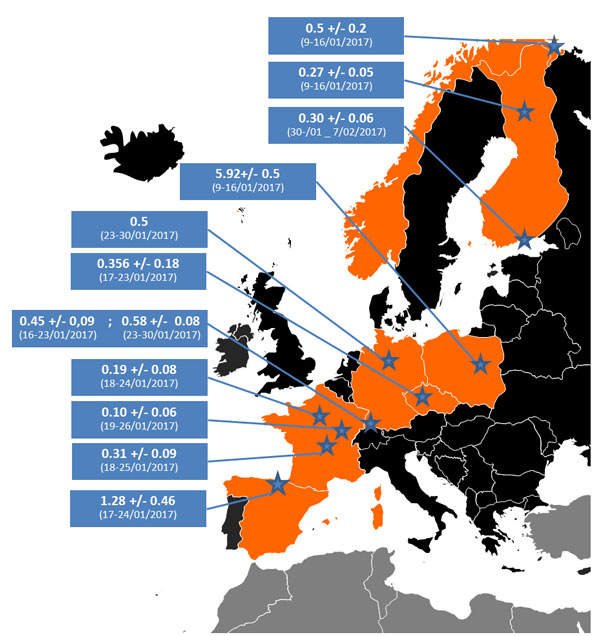
Image above: Map by IRSN of locations of where radioactive Iodine-131 has been detected and  revealed to public. From (http://www.irsn.fr/FR/Actualites_presse/Actualites/PublishingImages/IRSN_detection-iode-131_Janvier-2017.jpg).

The Aviationist on 19 February 2017 
U.S. Air Force deploys WC-135 nuclear sniffer aircraft to UK as spike of radioactive Iodine levels is detected in Europe…

Along with monitoring nuke testing, the WC-135 is used to track radioactive activity as happened after the Chernobyl nuclear plant disaster in the Soviet Union in 1986 and Fukushima incident back in 2011…

As of yet, there has been no official statement from the U.S. military about the reasons why such nuclear research aircraft was deployed there. However, many sources suggest the aircraft was tasked with investigating the spike in Iodine levels detected in northern Europe since the beginning of January… no one seems to know the reason behind the released Iodine-131…

Barents Observer on 19 February 2017

Radioactive Iodine-131 of unknown origin was in January detected over large areas in Europe. Since the isotope has a half-life of only eight days, the detection is a proof of a rather recent release.

Where the radioactivity is coming from is still a mystery… Iodine-131 in the air could come from an incident with a nuclear reactor…

Someone out there knows why the radioactivity was spread over large areas of Europe… Nuclear installations [where] radioactivity was first discovered, includes nuclear power plants in Finland, Sweden and Russia…

The source could as well come from even further away installations.

IRSN (French Nuclear Safety Institute) on 13 February 2017
Iodine-131 (131I), a radionuclide of anthropogenic origin, has recently been detected in tiny amounts in the ground-level atmosphere in Europe.

The preliminary report states it was first found during week 2 of January 2017 in northern Norway. Iodine-131 was also detected in Finland, Poland, Czech Republic, Germany, France and Spain, until the end of January. Iodine-131 is a radionuclide with a short half-life (T1/2 = 8.04 day).

The detection of this radionuclide is proof of a rather recent release… the origin of which is still unknown… Lead-210 [concentration detected by IRSN peaked at 1600 µBq/m3 in January, four times higher than the usual mean value]… It must be pointed out that only particulate iodine was reported.

When detectable, gaseous iodine is usually dominant and can be estimated to be 3 to 5 times higher than the fraction of particulate iodine. In France, particulate 131I reached 0.31 µBq/m3 and thus the total (gaseous + particulate fractions) can be estimated at about 1.5 µBq/m3.

.

How Great the Fall Can Be

SUBHEAD: In the fall of a civilization things you think of as important and necessary are going to go away.


By John MIchael Greer on 25 January 2017 for The Archdruid Report -
(http://thearchdruidreport.blogspot.com/2017/01/how-great-fall-can-be.html)


Image above: Cover art of Supertamp album "Crisis? What Crisis?" From ().

While I type these words, an old Supertramp CD is playing in the next room. Those of my readers who belong to the same slice of an American generation I do will likely remember the words Roger Hodgson is singing just now, the opening line from “Fool’s Overture”:

“History recalls how great the fall can be...”

It’s an apposite quote for a troubled time.

Over the last year or so, in and among the other issues I’ve tried to discuss in this blog, the US presidential campaign has gotten a certain amount of air time.

Some of the conversations that resulted generated a good deal more heat than light, but then that’s been true across the board since Donald Trump overturned the established certainties of American political life and launched himself and the nation on an improbable trajectory toward our current situation.

Though the diatribes I fielded from various sides were more than occasionally tiresome, I don’t regret making the election a theme for discussion here, as it offered a close-up view of issues I’ve been covering for years now.

A while back on this blog, for example, I spent more than a year sketching out the process by which civilizations fall and dark ages begin, with an eye toward the next five centuries of North American history—a conversation that turned into my book Dark Age America.

Among the historical constants I discussed in the posts and the book was the way that governing elites and their affluent supporters stop adapting their policies to changing political and economic conditions, and demand instead that political and economic conditions should conform to their preferred policies.

That’s all over today’s headlines, as the governing elites of the industrial world cower before the furious backlash sparked by their rigid commitment to the failed neoliberal nostrums of global trade and open borders.

Another theme I discussed in the same posts and book was the way that science and culture in a civilization in decline become so closely identified with the interests of the governing elite that the backlash against the failed policies of the elite inevitably becomes a backlash against science and culture as well. We’ve got plenty of that in the headlines as well.

According to recent news stories, for example, the Trump administration plans to scrap the National Endowment for the Arts, the National Endowment for the Humanities, and the Corporation for Public Broadcasting, and get rid of all the federal offices that study anthropogenic climate change.

Their termination with extreme prejudice isn’t simply a matter of pruning the federal bureaucracy, though that’s a factor.

All these organizations display various forms of the identification of science and culture with elite values just discussed, and their dismantling will be greeted by cheers from a great many people outside the circles of the affluent, who have had more than their fill of patronizing lectures from their self-proclaimed betters in recent years.

Will many worthwhile programs be lost, along with a great deal that’s less than worthwhile? Of course. That’s a normal feature of the twilight years of a civilization.

A couple of years before the sequence of posts on dark age America, for that matter, I did another series on the end of US global hegemony and the rough road down from empire. That sequence also turned into a book, Decline and Fall.

In the posts and the book, I pointed out that one of the constants of the history of democratic societies—actual democracies, warts and all, as distinct from the imaginary “real democracy” that exists solely in rhetoric—is a regular cycle of concentration and diffusion of power. The ancient Greek historian Polybius, who worked it out in detail, called it anacyclosis.

A lot can be said about anacyclosis, but the detail that’s relevant just now is the crisis phase, when power has become so gridlocked among competing power centers that it becomes impossible for the system to break out of even the most hopelessly counterproductive policies.

That ends, according to Polybius, when a charismatic demagogue gets into power, overturns the existing political order, and sets in motion a general free-for-all in which old alliances shatter and improbable new ones take shape.

Does that sound familiar? In a week when union leaders emerged beaming from a meeting with the new president, while Democrats are still stoutly defending the integrity of the CIA, it should.

For that matter, one of the central themes of the sequence of posts and the book was the necessity of stepping back from global commitments that the United States can no longer afford to maintain. That’s happening, too, though it’s being covered up just now by a great deal of Trumped-up bluster about a massive naval expansion.

If we do get a 350-ship navy in the next decade, I’d be willing to bet that a lot of those ships will turn out to be inexpensive corvettes, like the ones the Russians have been using so efficiently as cruise missile platforms on the Caspian Sea.

European politicians are squawking at top volume about the importance of NATO, which means in practice the continuation of a scheme that allows most European countries to push most of the costs of their own defense onto the United States, but the new administration doesn’t seem to be buying it.

Mind you, I’m far from enthusiastic about the remilitarization of Europe. Outside the brief interval of enforced peace following the Second World War, Europe has been a boiling cauldron of warfare since its modern cultures began to emerge out of the chaos of the post-Roman dark ages.

Most of the world’s most devastating wars have been European in origin, and of course it escapes no one’s attention in the rest of the world that it was from Europe that hordes of invaders and colonizers swept over the entire planet from the sixteenth through the nineteenth centuries, as often as not leaving total devastation in their wake.

In histories written a thousand years from now, Europeans will have the same sort of reputation that Huns and Mongols have today—and it’s only in the fond fantasies of those who think history has a direction that those days are definitely over.

It can’t be helped, though, for the fact of the matter is that the United States can no longer afford to foot the bill for the defense of other countries.

Behind a facade of hallucinatory paper wealth, our nation is effectively bankrupt. The only thing that enables us to pay our debts now is the status of the dollar as the world’s reserve currency—this allows the Treasury to issue debt at a breakneck pace and never have to worry about the cost—and that status is trickling away as one country after another signs bilateral deals to facilitate trading in other currencies.

Sooner or later, probably in the next two decades, the United States will be forced to default on its national debt, the way Russia did in 1998.

Before that happens, a great many currently overvalued corporations that support themselves by way of frantic borrowing will have done the same thing by way of the bankruptcy courts, and of course the vast majority of America’s immense consumer debt will have to be discharged the same way.

That means, among other things, that the extravagant lifestyles available to affluent Americans in recent decades will be going away forever in the not too distant future.

That’s another point I made in Decline and Fall and the series of posts that became raw material for it.

During the era of US global hegemony, the five per cent of our species who lived in the United States disposed of a third of the world’s raw materials and manufactured products and a quarter of its total energy production.

That disproportionate share came to us via unbalanced patterns of exchange hardwired into the global economy, and enforced at gunpoint by the military garrisons we keep in more than a hundred countries worldwide.

The ballooning US government, corporate, and consumer debt load of recent years was an attempt to keep those imbalances in place even as their basis in geopolitics trickled away. Now the dance is ending and the piper has to be paid.

There’s a certain bleak amusement to be had from the fact that one of the central themes of this blog not that many years back—“Collapse Now and Avoid the Rush”—has already passed its pull date. The rush, in case you haven’t noticed, is already under way.

The fraction of US adults of working age who are permanently outside the work force is at an all-time high; so is the fraction of young adults who are living with their parents because they can’t afford to start households of their own.

There’s good reason to think that the new administration’s trade and immigration policies may succeed in driving both those figures down, at least for a while, but of course there will be a price to be paid for that—and those industries and social classes that have profited most from the policies of the last thirty years, and threw their political and financial weight behind the Clinton campaign, will be first in line to pay it. Vae victis! (Woe to the vanquished!)

More generally, the broader landscape of ideas this blog has tried to explore since its early days remains what it is.

The Earth’s economically accessible reserves of fossil carbon dwindle day by day; with each year that passes, on average, the amount of coal, oil, and natural gas burnt exceeds the amount that’s discovered by a wider margin; the current temporary glut in the oil markets is waning so fast that analysts are predicting the next price spike as soon as 2018.

Talk of transitioning away from fossil fuels to renewable energy, on the one hand, or nuclear power on the other, remains talk—I encourage anyone who doubts this to look up the amount of fossil fuels burnt each year over the last two decades and see if they can find a noticeable decrease in global fossil fuel consumption to match the much-ballyhooed buildout of solar and wind power.

The industrial world remains shackled to fossil fuels for most of its energy and all of its transportation fuel, for the simple reason that no other energy source in this end of the known universe provides the abundant, concentrated, and fungible energy supply that’s needed to keep our current lifestyles going.

There was always an alternative—deliberately downshifting out of the embarrassing extravagance that counts for normal lifestyles in the industrial world these days, accepting more restricted ways of living in order to leave a better world for our descendants—but not enough people were willing to accept that alternative to make a difference while there was still a chance.

Meanwhile the other jaw of the vise that’s tightening around the future is becoming increasingly visible just now. In the Arctic, freak weather systems has sucked warm air up from lower latitudes and brought the normal process of winter ice formation to a standstill.

In the Antarctic, the Larsen C ice shelf, until a few years ago considered immovable by most glaciologists, is in the process of loosing an ice sheet the size of Delaware into the Antarctic Ocean. I look out my window and see warm rain falling; here in the north central Appalachians, in January, it’s been most of a month since the thermometer last dipped below freezing.

The new administration has committed itself to do nothing about anthropogenic climate change, but then, despite plenty of talk, the Obama administration didn’t do anything about it either.

There’s good reason for that, too.

The only way to stop anthropogenic climate change in its tracks is to stop putting greenhouse gases into the atmosphere, and doing that would require the world to ground its airlines, turn its highways over to bicycles and oxcarts, and shut down every other technology that won’t be economically viable if it has to depend on the diffuse intermittent energy available from renewable sources.

Does the political will to embrace such changes exist? Since I know of precisely three climate change scientists, out of thousands, who take their own data seriously enough to cut their carbon footprint by giving up air travel, it’s safe to say that the answer is “no.”

So, basically, we’re in for it.

The thing that fascinates me is that this is something I’ve been saying for the whole time this blog has been appearing.

The window of opportunity for making a smooth transition to a renewable future slammed shut in the early 1980s, when majorities across the industrial world turned their backs on the previous decade’s promising initiatives toward sustainability, and bought into the triumphalist rhetoric of the Reagan-Thatcher counterrevolution instead.

Since then, year after weary year, most of the green movement—with noble exceptions—has been long on talk and short on action.

Excuses for doing nothing and justifications for clinging to lifestyles the planet cannot support have proliferated like rabbits on Viagra, and most of the people who talked about sustainability at all took it for granted that the time to change course was still somewhere conveniently off in the future. That guaranteed that the chance to change course would slide steadily further back into the past.

There was another detail of the post-Seventies sustainability scene that deserves discussion, though, because it’s been displayed with an almost pornographic degree of nakedness in the weeks just past.

From the early days of the peak oil movement in the late 1990s on, a remarkably large number of the people who talked eagerly about the looming crisis of our age seemed to think that its consequences would leave them and the people and things they cared about more or less intact.

That wasn’t universal by any means; there were always some people who grappled with the hard realities that the end of the fossil fuel age was going to impose on their own lives; but all things considered, there weren’t that many, in comparison to all those who chattered amiably about how comfortable they’d be in their rural doomsteads, lifeboat communities, Transition Towns, et al.

Now, as discussed earlier in this post, we’ve gotten a very modest helping of decline and fall, and people who were enthusiastically discussing the end of the industrial age not that long ago are freaking out six ways from Sunday.

If a relatively tame event like the election of an unpopular president can send people into this kind of tailspin, what are they going to do the day their paychecks suddenly turn out to be worth only half as much in terms of goods and services as before—a kind of event that’s already become tolerably common elsewhere, and could quite easily happen in this country as the dollar loses its reserve currency status?

What kinds of meltdowns are we going to get when internet service or modern health care get priced out of reach, or become unavailable at any price?

How are they going to cope if the accelerating crisis of legitimacy in this country causes the federal government to implode, the way the government of the Soviet Union did, and suddenly they’re living under cobbled-together regional governments that don’t have the money to pay for basic services?

What sort of reaction are we going to see if the US blunders into a sustained domestic insurgency—suicide bombs going off in public places, firefights between insurgent forces and government troops, death squads from both sides rounding up potential opponents and leaving them in unmarked mass graves—or, heaven help us, all-out civil war?

This is what the decline and fall of a civilization looks like. It’s not about sitting in a cozy earth-sheltered home under a roof loaded with solar panels, living some close approximation of a modern industrial lifestyle, while the rest of the world slides meekly down the chute toward history’s compost bin, leaving you and yours untouched.

It’s about political chaos—meaning that you won’t get the leaders you want, and you may not be able to count on the rule of law or even the most basic civil liberties.

It’s about economic implosion—meaning that your salary will probably go away, your savings almost certainly won’t keep its value, and if you have gold bars hidden in your home, you’d better hope to Hannah that nobody ever finds out, or it’ll be a race between the local government and the local bandits to see which one gets to tie your family up and torture them to death, starting with the children, until somebody breaks and tells them where your stash is located.

It’s about environmental chaos—meaning that you and the people you care about may have many hungry days ahead as crazy weather messes with the harvests, and it’s by no means certain you won’t die early from some tropical microbe that’s been jarred loose from its native habitat to find a new and tasty home in you.

It’s about rapid demographic contraction—meaning that you get to have the experience a lot of people in the Rust Belt have already, of walking past one abandoned house after another and remembering the people who used to live there, until they didn’t any more.

More than anything else, it’s about loss.

Things that you value—things you think of as important, meaningful, even necessary—are going to go away forever in the years immediately ahead of us, and there will be nothing you can do about it.

It really is as simple as that.

People who live in an age of decline and fall can’t afford to cultivate a sense of entitlement.

Unfortunately, for reasons discussed at some length in one of last month’s posts, the notion that the universe is somehow obliged to give people what they think they deserve is very deeply engrained in American popular culture these days.

That’s a very unwise notion to believe right now, and as we slide further down the slope, it could very readily become fatal—and no, by the way, I don’t mean that last adjective in a metaphorical sense.

History recalls how great the fall can be, Roger Hodgson sang. In our case, it’s shaping up to be one for the record books—and those of my readers who have worked themselves up to the screaming point about the comparatively mild events we’ve seen so far may want to save some of their breath for the times ahead when it’s going to get much, much worse.
.

Freedom of speech threatened

SUBHEAD: Italy urges Europe to begin censoring free speech on the internet. US to attack "Fake News".

By Tyler Durden on 30 December 2016 for Zero Hedge-
(http://www.zerohedge.com/news/2016-12-30/italy-urges-europe-begin-censoring-free-speech-internet)


Image above: 'Invasion of the Fake News" mashup from "Invasion of the Body Snatchers". The war on "Fake News" is all about censoring real news. From (http://truepundit.com/the-war-on-fake-news-is-all-about-censoring-real-news/).

First it was the US, then Germany blamed much of what is wrong in society on "fake news", and not, say, a series of terrible decisions made by politicians.

Now it is Italy's turn to call for an end to "fake news", which in itself would not be troubling, however, the way Giovanni Pitruzzella, head of the Italian competition body, demands the European Union "cracks down" on what it would dub "fake news" is nothing short of a total crackdown on all free speech, and would give local governments free reign to silence any outlet that did not comply with the establishment propaganda.

In an interview with the FT, Pitruzzella said the regulation of false information on the internet was best done by the state rather than by social media companies such as Facebook, an approach taken previously by Germany, which has demanded that Facebook end "hate speech" and has threatened to find the social network as much as €500K per "fake" post.

Pitruzzella, head of the Italian competition body since 2011, said "EU countries should set up independent bodies — co-ordinated by Brussels and modeled on the system of antitrust agencies — which could quickly label fake news, remove it from circulation and impose fines if necessary."

In other words, a series of unelected bureaucrats, unaccountable to anyone, would sit down and between themselves decide what is and what isn't "fake news", and then, drumroll, "remove it from circulation."

On the other hand, coming one week after Obama give Europe the green light to engage in any form of censorship and halt of free speech that it desires, when the outgoing US president voted into law the  "Countering Disinformation And Propaganda Act", it should come as no surprise that a suddenly emboldened Europe is resorting to such chilling measures.

So with Europe on the verge of rolling out unbridled censorship, here is the strawman used to justify it.

“Post-truth in politics is one of the drivers of populism and it is one of the threats to our democracies,” Pitruzzella told the FT. “We have reached a fork in the road: we have to choose whether to leave the internet like it is, the wild west, or whether it needs rules that appreciate the way communication has changed. I think we need to set those rules and this is the role of the public sector.”

Translation: it will soon be up to Brussles to decide what content on the Internet is appropriate for broad European consumption, because unless a bureaucrat intervenes "fake news" will lead to even more populism and not, say, years of failed political reform, and central bank decisions.

In short, it's all the internet's fault that Europe's legacy political system is reeling from an unprecedented anti-establishment backlash, which has nothing to do with, well, anything else.

As the FT notes, Pitruzzella’s call comes amid growing concern over the impact of fake news on politics in western democracies, including in this year’s UK Brexit vote and the US election.

In Germany, which faces parliamentary elections in 2017, the government is planning a law that would impose fines of up to €500,000 on social media companies for distributing fake news.

Allies of Matteo Renzi, the former prime minister, have also complained that fake news contributed to his defeat in the December referendum on constitutional reform, which led to his resignation, even though he lost by a wide 20-percentage point margin. At least they haven't blamed Russian hackers... yet.

So even assuming limiting free speech is the answer, why not force potential offenders to companies to police themselves?

Well, according to Pitruzzella it would be inappropriate to leave this task to social media self-regulation. “Platforms like Facebook have created great benefits for people and customers: they are doing their part as an economic entity in adopting policies to modify their algorithms to reduce this phenomenon”, he said. “But it is not the job of a private entity to control information.

This is historically the job of public powers. They have to guarantee that information is correct. We cannot delegate this completely.”

We know of at least one Italian who would agree.

And just like the person shown above, Pitruzzella dismissed concerns that setting up state agencies to monitor fake news would introduce a form of censorship, saying people could “continue using a free and open internet”... as long as all the members of the "open" internet agreed with what the agencies determined to be true and undisputed. But he said there would be a benefit in that there would be a public “third party” — independent of the government — to “intervene quickly if public interests were harmed”.

At the moment, the only way that fake news can be tackled — at least in Italy — is through the judicial system, which is notoriously clunky. “Speed is a critical element,” Pitruzzella said, so what is the solution? Why a Ministry of Truth of course.

The anti-establishment Five Star Movement is often labelled as the main facilitator of fake news in Italy, through the blog of its founder, the comedian Beppe Grillo, and a network of other websites affiliated to the party.

But Pitruzzella declined to cite them as the main culprits. “I don’t know if this is true, I would not want to criticise anyone, not even the Five Star Movement. But I believe that if there aren’t any rules then many can take advantage of this.”

Of course, once free speech is censored, Pitruzzella will have no problem with no only criticizing anyone who disagrees with him, but promptly shutting down their freedom of speech on the net.


Obama, DOD and Free Speech

By Claire Bernish on 24 December 2016 for Free Thought Project -
(http://thefreethoughtproject.com/distraction-obama-propaganda-provision-law/)


Image above: Source of US government propaganda includes "Fake News" in Mainstream Media. The FaceBook response on December 15th 2016 was announcement it will begin censoring stories they feel constitute "Fake News". From (http://www.nowtheendbegins.com/zuckerberg-announces-facebook-will-now-begin-censoring-stories-feel-constitute-fake-news/).

Using the cover of the holidays and distracted attention, President Obama signed the National Defense Authorization Act into law Friday evening — just two days before many Americans celebrate Christmas — perhaps because it contains ominously Orwellian language meant to “counter propaganda and disinformation directed at the United States.”

Although the NDAA’s true purpose is to fund the military, notorious provisions — particularly of the variety which erase yet more freedoms — are often added to the overall legislation. In this case, the propaganda and disinformation provisions mentioned above had been attempted in a stand-alone bill which remains stalled in Congress — partly due to scathing criticism and unpopularity from wary politicians.

And that seems justifiable, given legitimate parallels drawn to 1950s McCarthyism and the Red Scare.
According to the text of the $619 billion bill, the Secretaries of State and Defense and other pertinent officials will be tasked with creating an innocuous-sounding “Global Engagement Center.”
“The purpose of the Center,”states the text, “shall be to lead, synchronize, and coordinate efforts of the Federal Government to recognize, understand, expose, and counter foreign state and non-state propaganda and disinformation efforts aimed at undermining United States national security interests.”
In actuality, however, countering propaganda amounts to silencing dissenting opinion — particularly in the press — of anything deemed shining a favorable light on one of the many countries the U.S. considers a foe.

Such as Russia — which has been the target of choice for blame concerning the election of Donald Trump.&

But it could also be a vehicle to initiate censorship of independent and alternative media for reporting on corruption — rife in the Democrat establishment and corporate press — as exposed by documents published by Wikileaks.

It also means creating and furthering propaganda of the American government — because, theoretically, you can’t combat foreign agitprop without filling the void with something convincing and favorable to governmental agendas.

As text of the new law explains, the center will “support the development and dissemination of fact-based narratives and analysis to counter propaganda and disinformation directed at the United States and United States allies and partner nations.”

Many of the Global Engagement Center’s duties concern targeting disinformation and propaganda being disseminated in other nations; however, it subtly suggests the effort would seek to prevent such content from reaching the United States — thus, domestic actions are, by no means, ruled out.

Indeed, as the law states:
“The Center is authorized to provide grants or contracts of financial support to civil society groups, media content providers, nongovernmental organizations, federally funded research and development centers, private companies, or academic institutions for the following purposes:
  • To collect and store examples in print, online, and social media, disinformation, misinformation, and propaganda directed at the United States and its allies and partners.
  • To analyze and report on tactics, techniques, and procedures of foreign information warfare with respect to disinformation, misinformation, and propaganda.
  • To support efforts by the Center to counter efforts by foreign entities to use disinformation, misinformation, and propaganda to influence the policies and social and political stability of the United States and United States allies and partner nations.
Seeming at least somewhat innoxious, had the law been passed in a vacuum, the current hysteria over putative Russian interference during the election cycle presents alarming potential implications for the future of free speech and unobstructed access to information.

A subsequently partially backtracked report by the Washington Post, “Russian propaganda effort helped spread ‘fake news’ during election, experts say,” originally published on November 24, boldly declared the Russians had been behind disinformation during the election cycle, and had facilitated the election of Donald Trump to suit a shady but noticeably unspecified political agenda. 

First to obtain an ostensibly damning list of news organizations affiliated with The Russians, the Post failed, negligently or intentionally, to investigate the nascent organization which provided said list, or to even contact a single outlet named — yet reported as if the information were so damning as to be indisputable truth. 

 In fact, the supposed experts cited by the once-illustrious outlet inhabited a single, newly created website, PropOrNot, whose owners sophomorically responded to outrage — giving the Post a black eye in the process — tweeting,
“Aww, wook at all the angwy Putinists, trying to change the subject – they’re so vewwy angwy!! It’s cute [gloating emoticon] We don’t censor; just highlight.”
The website encourages reporters and anyone with questions to reach out via Twitter or email, but says, “If you’re a Russian troll, though, don’t bother. We’ll just ban you.”

Although the Post, itself, did not publish or link to the unsourced and unverified index of organizations — incidentally, comprising 200 independent, alternative outlets, and those who’d dared endorse presidential candidates other than Hillary Clinton — the damage exponentially worsened as countless corporate presstitutes parroted the non-information at a rapid clip.

 After its half-hearted retraction of that misstep, the Post further embarrassed itself with a report titled, “Secret CIA assessment says Russia was trying to help Trump win White House” — but stunningly provided even less evidence — and again failed due diligence to back this assertion, other than the putative claims of unnamed officials.

Worse, its own article disputed the audaciousness of the headline — the Post admitted no report would be forthcoming from a consensus of all 17 U.S. Intelligence agencies, since “minor disagreements” among officials persist. 

When the public had a difficult time swallowing such allegations, the White House stepped in and, rather flippantly, proclaimed Russian President Vladimir Putin played a direct role in hacking the U.S. presidential election — again,despite any evidence the ‘election’ had been ‘hacked.’ 

 Couple this renewed Red Scare with what, in essence, marked the legalization of one of the most nefarious covert domestic government operations in U.S. history — Operation Mockingbird — and any iterations this program won’t severely cripple legitimate but dissenting American media ring hollow. 

 Notably, though the Obama administration cited pernicious pro-Russian propaganda and the proliferation of false reports for causing the election of Trump, no unassailable evidence has yet been proffered proving this theory true — nor has any indication “fake news” so much as changed a single vote.  

.