Showing posts with label DLNR. Show all posts

Storm damage on Kauai

SUBHEAD: Rain storms have done more damage this spring to our north shore than in more than a generation.

By Juan Wilson on 24 April 2018 for Island Breath -
(http://islandbreath.blogspot.com/2018/04/rain-damage-on-kauai.html)

http://www.islandbreath.org/2018Year/04/180424kauailarge.jpg
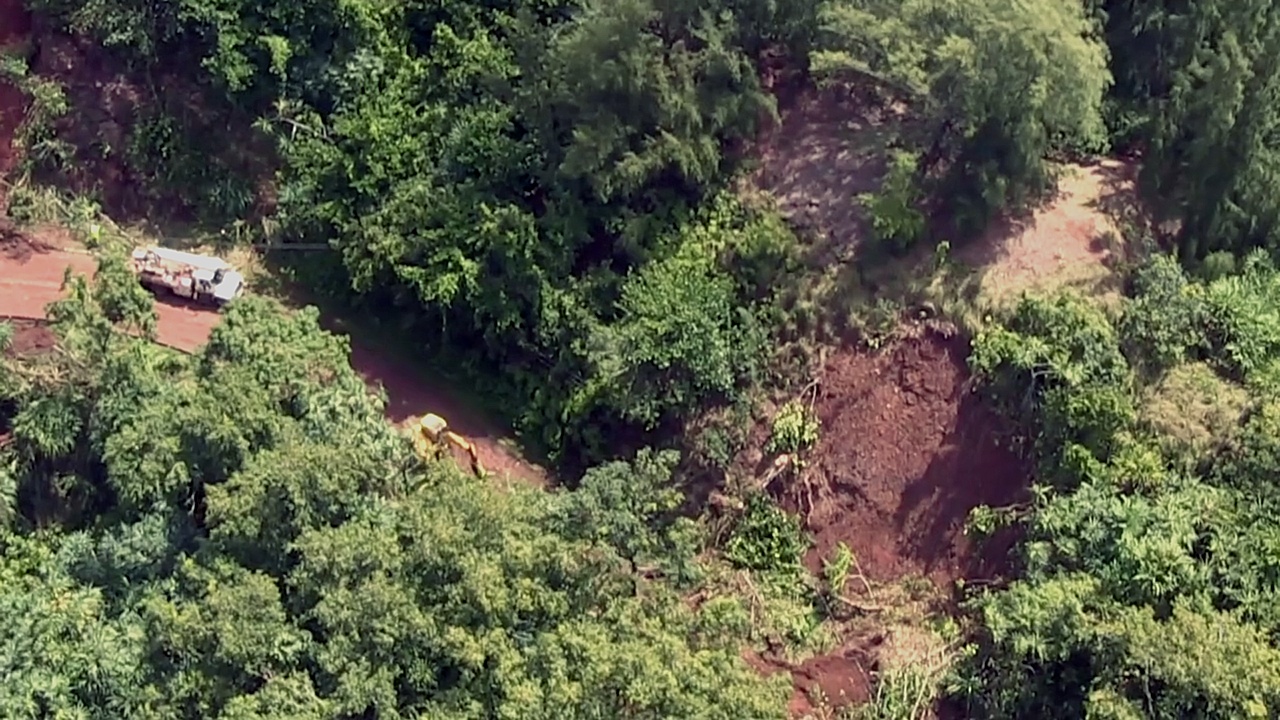
Image above: Only public road along the north shore of Kauai in Waikoko is obliterated by landslide west of Hanalei Bay.  Click to enlarge. Still image from video below.

Living in Kauai on the south side of Kauai we have missed he destruction of storms that destroyed much of the communities and infrastructure on our north shore. The impact has been tremendous for residence there; homes destroyed and roads wiped away.

As much suffering as this has caused and the long term difficulties that will linger, there is a thin silver lining in the darkened clouds.
 
The army of tourists in rented cars making the obligatory daily pilgrimage to Kee Beach crowding the roads, overflowing the parking lots and trampling the land has been temporarily halted.

When the roads are repaired and northshore tourism resumes we hope it is under new circumstances that would restrict tourist cars from anywhere west of Hanalei Bay. There was a feeble attempt to due this in the recent pass, but the will to disappoint tourists simply collapsed.

Here on the south shore we have noticed traffic through Hanapepe has increased significantly since last spring. Some of this is due to more rush hour traffic, presumably from the GMO companies and the PMRF (Pacific Missile Range Facility). We have a regular weekday 3pm eastbound rush hour never seen before.

Moreover, our local county beach, Salt Pond Beach Park, has been overrun by tourists since for over six months. This is certainly been in part because of the destruction of subtropical vacation destinations in the Caribbean.

In the last hurricane season there were 5 category-five storms that destroyed beaches, resorts, roads and much of amenities that attracted visitors. Puerto Rico is still suffering from island-wide blacked-outs. And here comes another hurricane season.

There seems to have been a bit of a campaign to make Salt Pond a heavier used visitor destination as well. Salt Pond is now rated online as a top beach for tourists. This take may take some pressure of totally overrun Poipu Beach Park and other crowded locations, but it is has unanticipated effects.

Salt Pond has historically been a "local" beach used as an outdoor living/rec room for many local families from the westside. Birthdays, weddings, graduation parties, spear-fishing surf-casting, BBQs and minding the kids and just kicking back with a beer after work has been the usage.

There is also and tradition of people temporarily living in tents (mixed with tourist camping) that helps transition (some people I've known) through a job loss, breakup or other temporary difficulty.

Anyway, I continue to hope jet plane enabled mass tourism to Hawaii ceases for two primary reasons. Is is destroying Kauai and it is destroying the atmosphere.

I have not flown to the mainland in several years and have no plans to start again.


Video above: Hawaii Department of Land & Natural Resources damage assessment of storm damage on several videos of the North Shore of Kauai. For more videos visit Vimeo site (https://vimeo.com/265509802).

.

Update on Wailua Diversion

SUBHEAD: Meeting Thursday 12/14 from 11:00am-1:00pm at the Kapaa Neighborhood Center.

By Bridget Hammerquist on 12 December 2017 in Island Breath -
(http://islandbreath.blogspot.com/2017/12/update-on-wailua-diversions.html)


Image above: Two hikers at the Blue Hole walk across the concrete diversion (at left) of the North Fork of the Wailua Rivere diversion lets only overflow water into the natural channel of the river (at right). From (https://yosemitenews.info/forum/read.php?1,64439,64449).

[IB Publisher's note: The day with article was first published KIUC announced they were changing policy on the North Fork diversion of the Wailua River. See content of email we received.]


KIUC Board's Action on to Wailua River Diversions
Līhu'e, Kaua'i, HI - 12/12/17 - The Kauaʻi Island Utility Cooperative Board today authorized KIUC President and Chief Executive Officer David Bissell to make changes to the ditch system to return water to the North Fork of the Wailuā River at the Blue Hole and Waikoko diversions.
This action will ensure that water is flowing immediately downstream of the diversions.
The board also authorized the commencement of engineering design for permanent diversion modifications to ensure continuous stream flow for aquatic habitat. Construction will take place upon approval from the appropriate regulatory agencies.
Additionally, approval was granted to install additional gauging stations to increase data collection and understanding of the hydrology of the system.
"The hydros have been producing energy on Kauaʻi for more than 100 years and represent an important piece of KIUC's renewable portfolio and will help us reach the State's mandate of 100 percent renewables by 2045," said KIUC Board Chair Allan Smith.
On December 8, the State Board of Land and Natural Resources met and approved the holdover of a revocable permit for water use at the Blue Hole Diversion, which contribute 1.5 megawatts of energy to the island's renewable portfolio.


Image above: Boulders are scattered across the diversion at the head of the North Fork of the Wailua River due to heavy winter rains. Note the diversion channel is all but blocked (at left) and the natural flow of the water is in the original river bed (at right). From (https://www.bizjournals.com/pacific/news/2017/12/11/kiuc-receives-approval-for-holdover-of-hydro.html).


IB Publisher's note: On Friday 7 December 2017 the Hawaii State Board of Land & Natural Resources (BLNR) met on Kauai to consider the  renewal of a revocable water-diversion permit for Kauai Island Utility Cooperative’s (KIUC) hydroelectric plants that utilize water from Mt. Waialeale.

The water diversions have been criticized as illegal.  The Kiai Wai O Waialeale coalition, along with community groups Friends of Mahaulepu, HAPA and the Sierra Club, said KIUC and Grove Farm are illegally using 30 million gallons or more of water per day for the hydroelectric plants, and on days when there’s no rain, the streams are dry.

The BLNR approved the KIUC request.

Their will be a debriefing of the BLNR meeting Thursday 12/14 from 11:00am-1:00pm at the Kapaa Neighborhood Center.

WHAT:
Debriefing on BLNR decision in favor of KIUC and Gloves Farms to continue diverting Wailua River forks.

WHEN:
Thursday December 14th from 11:00am to 1:00pm

WHERE:
Kapaa Neighborhood Center
4491 Kou Street Kapaa, HI 96746

Summary of BLNR Meeting
Friday was an exciting day and I have to say that we did shine a bright light on a big issue that has received little public coverage. For those who may not have seen the news coverage of the Board meeting, here are a couple links to TV and newspaper coverage.

http://www.thegardenisland.com/2017/12/09/hawaii-news/kiuc-wins-water-fight/

http://www.hawaiinewsnow.com/story/37029649/land-board-approves-permit-to-continue-diverting-waialeale-waters-for-hydropower

For those who want to listen to the meeting Friday, here is a link to download the audio recording of Friday's BLNR meeting:

https://files.acrobat.com/a/preview/15e8a4fc-0d4b-4223-8c90-a96c83b92c04

My big take away/summary is:
  1. The Board was arbitrary when it denied the request for a contested case hearing.
  2. The denial gives us the right to go directly to the State Environmental Court.
Based on the facts and illuminating power points presented, Kiai Wai O Waialeale may be well positioned now to file a State Court lawsuit against KIUC on the merits of BLNR's renewal of the Waikoko and Blue Hole/North Fork Wailua diversion permits while simultaneously suing Grove Farm for its 4 100% base flow stream diversions (Iliiliula, Iole, Waiaka and Waiahi) in violation of the following water use law.

The testimony offered by KIUC established that Grove Farm is also taking 100% of the base flow from four streams fed by Mt Waialeale which waters are mixed into the waters from Waikoko and Blue Hole, diversions on State land.

Grove Farm has no permits to divert those streams and should have permits because the water is no longer used to grow sugar and pursuant to Hawaii State Supreme Court decisions, when the purpose for the diversion ends, the diversions have to be taken down and stream flow restored as mandated by Hawaii's Constitution.

Most importantly, DLNR staff and KIUC admitted the water use at issue is consumptive, because the waters diverted are never returned to their stream of origin. If you read the statute below, it doesn't appear that BLNR has any authority to approve, permit or lease State waters when the use is consumptive.

§171-58 Minerals and water rights.
(a) Except as provided in this section the right to any mineral or surface or ground water shall not be included in any lease, agreement, or sale, this right being reserved to the State; provided that the board may make provisions in the lease, agreement, or sale, for the payment of just compensation to the surface owner for improvements taken as a condition precedent to the exercise by the State of any reserved rights to enter, sever, and remove minerals or to capture, divert, or impound water.(c)(3)

After a certain land or water use has been authorized by the board subsequent to public hearings and conservation district use application and environmental impact statement approvals, water used in nonpolluting ways, for non-consumptive purposes because it is returned to the same stream or other body of water from which it was drawn, and essentially not affecting the volume and quality of water or biota in the stream or other body of water, may also be leased by the board with the prior approval of the governor and the prior authorization of the legislature by concurrent resolution.

When you read the statute, Grove Farm's diversions are illegal. Grove Farm is directing water through KIUC's hydro plants and in return, KIUC releases that water back to Grove Farm and also adds the water from its State land diversions.

Not only did we have 3 solid votes against RP renewal, with each no vote the voting board member spoke directly to KIUC's CEO, David Bissel, and told KIUC to:
  1. Complete their environmental studies (171.58 call for an EIS... did not understand why attorney's like Chris Yuen were speaking in terms of an EA when the statutory requirement is clear that any authorized use of State water can be permitted only "subsequent to" the acceptance of an EIS),
  2. Restore uninterpreted stream flow as soon as possible and
  3.  Meet with DHHL staff asap to achieve water distribution for its beneficiaries. One of the yes votes, from Chris Yuen, also made it sound like he wouldn't support them if they were not substantially along in the process by this time next year.

The other aspect that I didn't understand was why Suzanne Case did not recuse herself once it was clear that water from four Grove Farm stream diversions (IliIliula, Iole, Waiaka and Waiahi) mixes with the KIUC diversions and all runs through KIUC's power plant before being delivered to Grove Farm's infrastructure: the upper Lihue ditch (which is piped), the lower Lihue ditch and the Wailua South Fork that is 100% diverted by Grove Farm into the Hanamauulu ditch. 

Those four diversions were not part of the RP but the water from them is being used by the permittee and in return the permittee supports distribution back to Grove Farm. If you read 171.58, I can't find anything that exempts Grove Farm from a permit for their use of waters of the State. It is not right that Grove Farm directs this water to their surface water treatment plant before selling it to the County.

They claim they're charging for the delivery of water which is certainly splitting hairs because their charge is a fixed annual fee for 3 mgd.BLNR's arbitrary and capricious denial of the request for a contested case hearing, is a huge gift because we may now advance an Environmental State Court claim, having had our administrative remedy curtailed and having been deprived of due process. So rather than having the cost of an administrative hearing, I think we get to go right to State Court.

Note: Bridget Hammerquist is President of Friends of Maha’ulepu
P.O. Box: 1654
Koloa, HI 96756
friendsofmahaulepu.org
(808)742-1037

See also:
Ea O Ka Aina: Waialeale Water Lease 7/18/17
Ea O Ka Aina: Kauai's Hydro Battle 7/31/11
Ea O Ka Aina: Notice of Objection 6/3/11
Ea O Ka Aina: Special KIUC/FERC Meeting 5/28/11
Island Breath: Kauai Water Diversion - as a way of life 4/9/04

.

Kauai hui sues DLNR over GMOs

SUBHEAD: To ensure that public lands are given the proper and environmental review before being leased out for commercial use. 

By Staff on 14 June 2017 for Hawaii Alliance for Progressive Action -
(http://www.hapahi.org/news/2017/6/14/kauai-groups-sue-state-to-enforce-environmental-review-law)


Image above: "No Tresspass" sign on gate to public land leased to private corporations for experimenting with pesticides combined with genetically modified organisms sited on "reclaimed" wetlands close to nearby the ocean reefs and westside Kauai populations centers. What could go wrong? From (http://www.huffingtonpost.com/maggie-sergio/gmo-pesticide-experiments_b_3513496.html).

A Kauai-based community group, Ke Kauhulu o Mana, have filed a lawsuit against the State Department of Land and Natural Resources (DLNR) and Syngenta.

The suit calls for enforcement of Hawaii Revised Statute (HRS) Chapter 343, which requires an environmental assessment (EA) or an Environmental Impact Statement (EIS) for any significant actions or development proposed on publicly-owned, coastal and conservation-zoned lands.

In this instance, the lands in question are located on Kauai’s west side in Mana adjacent to the coast, about three quarters of a mile from the homes and community of Kekaha, and close to the frequent surfing and recreation beach, Targets.

The hui, Ke Kauhulu O Mana, is represented by west side residents Loui Cabebe and Punohu Kekaualua III. The plaintiffs include the Surfrider Foundation, Kohola Leo and the Hawai'i Alliance for Progressive Action (H.A.P.A.).
“These lands are historically Hawaiian crown lands. According to the state Constitution, these lands are supposed to be held and protected as part of the public trust. The State of Hawai`i as the present caretaker of these lands needs to take that responsibility seriously. We are disappointed that to date, they have failed to do so. We feel compelled to take this legal action to ensure that the regulations designed to preserve and protect crown lands are respected, and that state agencies do their job and enforce those laws.”

- Loui Cabebe, long time west Kauai resident and representative of plaintiff group, Ke Kauhulu o Mana.
The plaintiffs are represented by public interest attorney, Lance Collins, who has a wide range of experience with a focus on good government, environmental protection and native Hawaiian law. Mr. Collins has brought a number of successful cases under HRS 343, most recently Kalepa v. Dept. of Transportation and Maalaea Community Assn v. Dept. of Housing & Human Concerns.

“This suit is being filed to ensure that sensitive, coastal, and publicly-owned lands zoned for conservation are given the proper and legally required environmental review prior to being leased out for private commercial use,” said Collins.

According to Collins, a thorough review evaluating direct, indirect and cumulative impacts which the law requires, has not been done.

The complaint further states that the proposed use of the lands may have significant negative impacts given the anticipated heavy application of Restricted Use Pesticides involved in the industrial farming of crops by Syngenta.

Syngenta has announced plans to sell its Hawai'i operations to the Wisconsin-based company, Hartung Brothers. However, media reports also indicate that Hartung Brothers will be contracted by Syngenta to perform the same activities currently conducted by Syngenta employees. Thus the environmental and health impacts will remain similar regardless of the named entity conducting day to day operations.

State must ensure that permittees abide by regulations and protect public lands

“These lands are historically Hawaiian crown lands. According to the state Constitution, these lands are supposed to be held and protected as part of the public trust,” says Loui Cabebe, a native Hawaian and long time West side resident and representative of the plaintiff group, Ke Kauhulu o Mana.

“The State of Hawaii as the present caretaker of these lands needs to take that responsibility seriously.

We are disappointed that to date, they have failed to do so. We feel compelled to take this legal action to ensure that the regulations designed to preserve and protect crown lands are respected, and that state agencies do their job and enforce those laws,” he added.

The complaint states that the DLNR must require and ensure the execution of a full Environmental Impact Statement (EIS) covering the lands currently being used by Syngenta.

Based on what is known of the company’s activities thus far, and because of the close proximity of the parcel in question to the ocean and its conservation designation, Syngenta’s use of the land will have significant impacts on the recreational use of the beach and near-shore waters, adjacent reef eco-systems, fishermen, surfers and endangered native species.

Area once considered for park expansion leased instead to Syngenta

In granting Syngenta its permit to utilize the lands the DLNR has stated the action is exempt from the requirements of HRS343 as no significant impacts are expected.  The complaint alleges this decision was made based on only a superficial review.  

That review is woefully inadequate in light of the area’s conservation zoning, its proximity to the coastline and the pesticide-intensive nature of the proposed use by Syngenta.

The complaint further points out that exemption to HRS343 was granted even though the Office of Hawaiian Affairs expressed concerns about possible burials in the area and even though Syngenta’s own federal permits indicate much of the work is done in areas that impact critical habitats of rare and endangered species.

The approximately 60 acre parcel comprises section 5(b) lands, which means they are held in public trust for the people of Hawai`i and are subject to native Hawaiian entitlements.  The area was previously identified by State agencies as ideal for future park expansion, but is now part of Syngenta’s approximately 3,000 acres of leased, publicly-owned crown lands on Kauai’s west side.

Pesticide-intensive industrial farming hazardous to health and the environment

The complaint argues that a full EIS is needed given the scale and nature of the planned industrial farming activities which are distinctly different from the operations of local farmers in several ways.

First and foremost, these large scale actions are occurring on state-owned conservation lands situated in a sensitive coastal environment.

Secondly they involve the heavy application of restricted use pesticides (RUP). Thirdly, night-time activity involving the use of bright lights is known to impact endangered species such as the ‘a’o (Newell’s Shearwater) and ua’u (Hawaiian Petrel). The Kauai Endangered Seabird Recovery Project has reported that between 1993 and 2013, populations of the ‘a’o declined by 94 percent while the ua’u declined by 78 percent.

The federal permits held by Syngenta to grow experimental crops state clearly that the activity is occurring in areas where critical habitats for endangered species exist.

The case will be heard in the environmental court on Kaua‘i, presided over by the Hon. Randal Valenciano.

.

Impact of Lehua rat poisoning

SUBHEAD: Will the aerial rat poison drop endanger Niihauans and the local fisheries?

By Kawai Warren on 7 June 2017 for Island Breath -
(http://islandbreath.blogspot.com/2017/06/impact-of-lehua-rat-poisoning.html)


Image above: North-west coast of Lehua Island in foreground with Niihau Island in background. Photo by Juan Wilson on 7/9/11.

I attended the community meeting for the Environmental Assessment Draft in Kekaha. Their was a handful of fisherman that expressed their concern about the side effects of the rat extermination poison and aerial application.

A day after the meeting, we got word that our comments at the meeting were to "do it quickly".

At the meeting I attended in Kekaha no one supported the aerial drop, because the impact it could have on the fisherman, Niihauians, fish, limu, coral, opihi, a' am a, and ocean ecosystems.

The US Fish and Wildlife Service and the Hawaii Department of Land and Natural Resources (DLNR)  are trying to get this done this summer. Unless the fisherman raise their voices and get the media involved. Check out the article below.

Our fisheries (near shore) on the Westside is all ready impacted by these chemicals Atrazine, bentazon, chlorpyrifos, fipronil, metolachlor, propiconazole, and simozine from Kinikini ditch and second ditch during seasonal flooding.


Image above: GoogleEarth 2011 aerial perspective showing proximity of Lehua and Niihau Islands. Same orientation direction as photo above. Only about 4,000 feet separate the two. Image by Juan Wilson.


The Lehua Aerial Poison Drop

SUBHEAD: A risk that the lethal anticoagulant rodenticides could impact the biologically diverse area.


Image above: Photo of monk seal swimming close to shoreline of Lehua Island in shallow water. Photo by Richard Jarke on 7/9/11.

By Maggie Sergio on 7 June 2017 for Huffington Post - 
(http://www.huffingtonpost.com/entry/5936e141e4b033940169ce56)

In Hawaii, the Department of Land and Natural Resources (DLNR), and U.S Fish and Wildlife Service (USFWS) are planning several rat poison drops via helicopter onto Lehua Island, located approximately 30 miles west of Kauai.

These drops are being fast-tracked for this summer, part of an eradication project for the 284 acre bird sanctuary.

The planned drop is three-quarter of a mile from an important Native Hawaiian community on Niihau. There is risk that the poison pellets (lethal anticoagulant rodenticides) could impact the biologically diverse and important Lehua Crater.

Sources indicate that DLNR and USFWS are pressuring the State Department of Agriculture to grant permission for the poison bait to be dropped right up to the shoreline, which will result in bait entering the marine environment, allowing the toxins to infiltrate and settle in waters frequented by commercial and Native Hawaiian subsistence fishermen.

The agencies will not disclose or estimate the duration or extent of any fishing bans for tour and recreational boats in surrounding waters. The extent of a ban might be of concern to the local fishing and tour boat communities, given that a 942-day fishing ban was recommended after another Island Conservation poison drop on Wake Island in the in 2012.

If given the green light, the poison drops will happen on Lehua this summer, delivering an estimated 8-10 tons of anticoagulant rodenticide. Birds, fish, monk seals, and other wildlife that consume the cereal-based poison bait either directly or indirectly (secondarily) will be affected, and there is risk of contaminating the food web.

Note: the estimated application rate has been calculated from the amount disclosed on a kg/per hectare basis. Pesticide labels were not included in the draft environmental assessments (EA), so it is unclear if the proposed amount to be dropped is within legal limits.

The Failed 2009 Poison Drop Lehua Controversy
This will be the second poisoning of Lehua in the name of “conservation,” after a failed attempt in 2009. The previous drop was highly controversial—dead fish washed up on the neighboring island of Niihau, and a juvenile whale beached itself.

The state of Hawaii claimed the fish die-off and dead whale were “coincidental” and not related in any way to the nearly four tons of rat poison that had been dropped on the island just days earlier.

After researching the failed event in 2009, which included findings in this presentation given at a national pesticides conference, questions remain about what really happened.

Why was there a two month delay in requesting the fish be tested for exposure to the poison?

Since the rodenticide used in 2009, diphacinone, metabolizes quickly, did the delay in testing capture meaningful results? Are the chain of custody documents available for review?

Could ultra-nutrification and de-oxygenating of the waters, due to the cereal component of the poison bait that entered the surrounding ocean, be a contributing reason for the algae bloom, which, officials claimed, was the cause of the fish kill?

Or, could the poison pellets that entered the marine environment have impacted the fish, not enough to kill them, but enough to cause immunosuppression, thereby making the fish more susceptible to the impacts of an algae bloom? These questions have never been addressed by the agencies.

Are Rats a Problem on Lehua? - Not According to the Data
The data provided in both draft EAs (both the state and feds created a draft environmental assessment) does not support that the rodents on Lehua are having a negative impact on the bird life on the island.

All evidence provided is anecdotal, and astonishingly, USFWS has no idea of the size of the rodent population. One could reasonably ask—since this critical piece of data is unknown—why is this project being fast tracked?

The agencies need to respond to these questions: Why is the collateral damage and potential risk to the food web, in addition to putting sustenance and commercial fishermen in jeopardy, worth the risk? How much consideration was truly given to the Native Hawaiian Ni’ihauans in this accelerated operation, aside from conversations set up and/or attended by the owner of Ni’ihau, the Robinson family?

The only evidence of rodent impact to birds included in the state issued EA shows that four eggs from the nest of a wedge tail shearwater showed indication of predation by rats.

As the wedge tailed shearwater is considered to be a species of least concern by the IUCN (with a worldwide population of over 5 million birds), this hardly constitutes a scientifically-based rationale for dropping 8-10 tons of pesticide, threatening the fragile ecosystem, rare reef system, and food chain.

The DLNR and USFWS have yet to respond to public demands for site-based scientific (vs. anecdotal) evidence on the Lehua rat population, bird decline and mortality causation on Lehua, if any, that justifies this large scale poison drop.

Downplaying Risks  - The Selling of Island Eradication Projects
Both EAs issued mispresent environmental risks, and make misleading statements about the lethal and sub-lethal impacts to wildlife poisoned, which are referred to as “non-target species.”

Though the proposed poisons have never been tested on coral reefs, and the impact is completely unknown, the EA makes the puzzling, badly worded statement on page 73 of the federal EA that “there are no data to indicate corals have been impacted by anticoagulant rodenticides from previous eradication projects.”

Since there are no studies which reflect that rodenticide testing on coral reefs has ever been carried out, and long term, ecosystem monitoring is lacking in eradication projects, the above statement made in the EA could be viewed as disingenuous.

I asked Dr. Mourad Gabriel, who has done extensive research on wildlife diseases, including the impacts of rodenticides on wildlife for his thoughts on the statement specific to coral reefs - his response can be found below.
“The lack of data collected on a topic should not imply that a deleterious impact does not occur.” - Mourad W. Gabriel MS, PhD - Executive Director of Integral Ecology Research Center.
Page 51 of the federal EA cites studies from 1977, 1998, and 1999 with respect to birds eating the poison bait and make the following, false claims:
9. To minimize consumption of bait pellets by shorebirds and terrestrial birds, the bait pellets are dyed a green or blue color, which birds appear to prefer less than yellow or red. 10. Bait pellets are formulated large enough that it would be difficult for a small, seed-eating bird to consume the whole pellet.
The video below, from the New Zealand documentary, “Poisoning Paradise – Eco-cide NZ,” is evidence that color and size of the pellets will not deter birds or other animals from eating them. Deaths of birds poisoned during these projects can occur either directly from eating the bait, or secondarily, by consuming poisoned rodents, insects and fish. Video courtesy of Clyde Graf.

Island Eradications - Previous Problems
Information received from a FOIA request filed in 2014 reveals serious ethical issues from previous eradication projects and shows the consequences of what can go wrong.

Rat Island
In October 2008, USFWS and Island Conservation aerially dropped 51 tons of brodifacoum over Rat Island, located in the Aleutian Islands, and then left for eight months. When they returned, over 400 dead birds were collected, including 46 bald eagles.

Note: the total number of poisoned wildlife counted was by no means the total number of animals poisoned, nor was any long term monitoring done to test for sub-lethal impacts.

In the investigation that followed, U.S. Fish & Wildlife Law Enforcement division reported ten illegal actions including exceeding legal application rates mandated by the pesticide label, failure to properly calibrate dispersion equipment and failure to keep accurate records of their pesticide applications.

You can read a copy of the full USFWS law enforcement report here, released as the result of a FOIA request.

After the investigation by USFWS law enforcement, the Ornithological Council issued this scathing report. You can find a copy of it here.

Wake Island
Located in the South Pacific, Wake Island is host to a military base and is under the jurisdiction of the U.S. Air Force. Wake Island was the recipient of an island eradication attempt in 2012, carried out by Island Conservation and USFWS.

While the almost 20 ton rat poison drop failed to kill all the rats, the more serious issues are the internal emails released in response to the 2014 FOIA request. The discussions between USFWS, the USAF and Island Conservation show that after the fish were tested for brodifacoum, a fishing ban was recommended for 942 days.
FYI – note the Wake Atoll brodifacoum results analysis. We have a couple of options. I guess it comes down to how long we want to restrict consumption of fish at Wake. The current recommendation is approximately 942 days. Also with no money [and] furloughs occurring July 8 – end of September, it is unlikely that a sampling project will occur this FY. I’ll keep you in the loop, but thought you’d might like this info for future projects.” - USAF
You can find the entire email exchange containing the details of the fishing ban recommendation here.

While USFWS and the state of Hawaii assert that no final decision has been made, sources indicate that this project is planned for this summer, and that lead state agencies are awaiting approval from the Hawaii Deptartment of Agriculture (Pesticides Division).

It is notable that some of the supporting state agencies for this poison drop are currently facing a federal investigation charging racial discrimination against Hawaii’s native communities in their lack of care in state pesticide regulation.

The Farallon Islands
This is not the first time that helicopter drops of rodenticides have been called into question. In 2013 a planned rodenticide drop of 1.5 tons of brodifacoum over the Farallon Islands National Marine Sanctuary was halted due to public opposition and heavy questioning into Island Conservation’s conflict of interest in authoring the draft environmental impact statement. 

The city of San Francisco closed their strongly worded letter urging USFWS to seek a partner for the risk assessment that did not have a financial interest in the project.

It remains to be seen whether Hawaii’s impacted communities and scientists will demand fuller disclosure and further study from its agencies and sole-source contractor Island Conservation. For it is Kaua’i’s fishing and tourism industries, and local Hawaiian residents that have the most to lose if anything should go wrong.

In 1962, with the publication of “Silent Spring,” Rachel Carson warned us of the influence the pesticide industry has on agriculture. Fifty-five years later, the dominion of the pesticide industry continues, and non-native species has become another market opportunity to exploit.

.

DLNR responsibility on RIMPAC

SUBHEAD: 60 Day Legal Notice to Enforce the U.S. Endangered Species Act on the U.S. Navy and RIMPAC.

By Terry Lilly on 5 July 2016 in Island Breath -
(http://islandbreath.blogspot.com/2016/07/dlnr-responsibility-on-rimpac.html)


Image above: DLNR police armed with semiautomatic weapons enforcing restrictions on Hawaiian protest of construction of Thirty Meter Telescope on a sacred part of the summit of Mauna Kea mountain on the Big Island in 2015.  From (http://www.civilbeat.org/2015/12/should-hawaiis-dlnr-cops-carry-semi-automatic-weapons/).

[IB Publisher's note: The following is a letter from Terry Lilly to Mrs. Suzanne Case Chairperson of the Hawaii Department of Land & Natural Resources to enforce the US Endangered Species Act  against the U.S. Navy for conducting RIMPAC 2016 and damaging the environment in and around Hawaii. Certainly, the DLNR fully enforce regulations along the beaches of Polehale and Kalalau to keep residents without the proper permits from camping (presumably to protect these pristine environments.]

Dear Mrs. Case,
As Chair Person of the Hawaii DLNR you are head of law enforcement and bound by law to enforce the US Endangered Species Act (ESA) here in Hawaii. When you took your oath of office you swore to uphold US and State Law.

The federal and state ESA claims " Any employee or agent of the department upon whom the board has conferred powers of police officers, including the power to serve and execute warrants and arrest offenders, or issue citations throughout the state, and any police officer of the counties of this state shall have the authority to enforce any of the provisions of this chapter or any rule adopted under this chapter".
Furthermore, it has been determined in court "That the Willful Omission of enforcing the ESA can be considered a Take under the law itself". Which means that you are obligated to enforce this law.

I know you are well aware of the wording in the ESA and are aware of the need for the Navy to do a Habitat Conservation Plan before operating in the habitat of Hawaiian endangered species.

The reason I know you know this law is because in December of 1998 you attended and graduated from the same class I did in California which was hosted by the US Fish and Wildlife Service and Craig Potter who wrote the ESA in 1973.

The class was called "Endangered Species Act and Habitat Conservation Planning". You are listed on the attendance sheet as "Suzanne Case : The Nature Conservancy: 201 Mission Street 4th FL San Francisco CA : 415-281-0466.

During that class we were both give many legal quotes out of the ESA itself and also many court case studies.

We were presented by the top environmental attorney firms in the USA and Craig Potter himself these quotes about the ESA.
1. ESA Section 7 requires that EVERY Federal agency consult with the Fish and Wildlife Service (FWS) to ensure that the agency actions are "not likely to jeopardize the continued existence or ANY endangered species or result in the destruction or adverse modification of designated critical habitat of such species.
I can prove that the war ships off our coastline during RIMPAC and the US Navy five year long electronic microwave war testing here in Hawaii is "likely" to jeopardize the critical habitat of the endangered green sea turtle, hawksbill turtle and monk seal. These ships put out billions off watts of electromagnetic energy they discharge into the sea and they are using high intensity sonar. Both of these events harm, harass and take our endangered species.
2. 16 U.S.C. 1536 (a)(3)(4), 50 C.F.R. 402.14 legal code claims that : If the agency determines that an endangered species MAY be present in the area affected by the action and proposed actions is LIKELY to effect the species the ESA REQUIRES consultation.
NOAA has already determined that all Hawaiian waters are critical habitat for the monk seal because these endangered species travel in between islands!

Plus the very rare hawksbill turtle travels between islands and the baby green sea turtles live out at sea for the first part of their life.

So it is obvious that the wide area of sea that the Navy is discharging electricity into, blasting with explosives, sinking ships with bombs and using massive amounts of sonar and underwater (DARPA) tested electronics to track and destroy submarines is "likely" to harm, harass and take our endangered species.
3. Section 7 V. Section 10 of the ESA is a process by which FEDERAL agencies obtain permission to "TAKE" endangered species. The Navy must file for and receive an Incidental Take Permit to START RIMPAC or their microwave war test.
Section 7 outlines the process that the Navy must take to get a permit to operate in the habitat of our endangered turtles, whales and monk seas. This process is called an HCP.

It is described by law as:
Habitat Conservation Plan as a plan describing the ANTICIPATED effect of proposed taking on the affected species and HOW that TAKE will be minimized and mitigated for : the plan is submitted with and Incidental Take Permit.

No HCP was done or submitted by the Navy to operate RIMPAC! RIMPAC is in direct violation of the most powerful environmental law ever adopted by a country on our planet.

Commander Bruce Hay from PMRF openly told all of us on the KKCR radio show and in a private meeting with the top PMRF officials "RIMPAC 2014 had no way to monitor the effects on the sea turtles and coral reefs". He further said "RIMPAC 2016 will be operated just like RIMPAC 2014 and the Navy has NOT done an environmental study ahead of time or a Habitat Conservation Plan".

The ESA has been held up in court against the US Navy in dozens of law suits filed by the NRDC and Earth Justice and once again it looks like we must got to court to force the Navy to follow our Endangered Species Act, Marine Mammal Protection Act and Clean Water Act.

As a citizen of the USA I have the LEGAL rite to make you enforce the ESA onto the Navy. I have the legal rite to sue the Navy, NOAA, and the DLNR for violating the ESA and, or lack of enforcement of the ESA.

This is called a Citizens Suit. It is described in the ESA section 11 as : To enjoin any person, INCLUDING the United States of America and other governmental instrumentality or agencies, who allege to be in violation of the ACT or its implementing regulations.

Craig Potter who wrote the ESA said " This is the peoples law" because the people own the wildlife, not the government.

Well I am "the people" and I wish to formally allege that the US Navy is currently in violation of the ESA for not doing the needed Habitat Conservation Plan before RIMPAC started. I allege that you are violating the ESA for lack of enforcing the ESA onto the military. I allege that very same actions on NOAA for their lack of enforcing the ESA onto the military.

I am alleging these violation on behalf of the endangered sea turtles, whales, monk seals and their coral reef habitat because I have direct proof via HD video with time, date and GPS of the US Navy and their guests during the 2014 RIMPAC harming, harassing and taking our endangered species.
.
Since Commander Bruce Hay said "that RIMPAC 2016 will operated like RIMPAC 2014" and we know the capabilities of the ships currently involved in RIMPAC today we easily have the "Likelihood" that these current operations are effecting the habitat of our endangered species.

Therefore by law the military needs to stop ALL activities in Hawaiian waters and do the needed Habitat Conservation Plan and acquire the needed Incidental Take Permit to resume their destructive activities!

Please look at this letter as a legal 60 day notice under the ESA to force you to enforce the ESA on the US Navy. This is the responsibility of the oath of office you hold.

I would be more than happy to meet with you and your legal council in person and go over all of the documented proof I have of the violations of the ESA the Navy has committed. I already had a high profile meeting with the Navy brass in Kauai of which they did NOT dis agree with any of these violations!

Aloha,
Terry Lilley: Marine Biologist
Hanalei HI
808-212-8600

See also:
Ea O Ka Aina: Oceans4Peace Pacific Pivot Panel 6/18/16
Ea O Ka Aina: Ocean 4 Peace Events 6/11/16
Ea O Ka Aina: Prepare for RIMPAC 2016 War in Hawaii 5/22/16
Ea O Ka Aina: Navy to "take" millions of mammals 5/17/16
Ea O Ka Aina: US court RIMPAC Impact decision 4/3/15
Ea O Ka Aina: RIMPAC 2014 Impact Postmortem 10/22/1
Ea O Ka Aina: RIMPAC 2014 in Full March 7/16/14
Ea O Ka Aina: 21st Century Energy Wars 7/10/14
Ea O Ka Aina: RIMPAC War on the Ocean 7/3/14
Ea O Ka Aina: Voila - World War Three 7/1/14
Ea O Ka Aina: The Pacific Pivot 6/28/14
Ea O Ka Aina: RIMPAC IMPACT 6/8/14
Ea O Ka Aina: RIMPAC Then and Now 5/16/14
Ea O Ka Aina: Earthday TPP Fukushima RIMPAC 4/22/14
Ea O Ka Aina: The Asian Pivot - An ugly dance 12/5/13
Ea O Ka Aina: Help save Mariana Islands 11/13/13
Ea O Ka Aina: End RimPac destruction of Pacific 11/1/13 
Ea O Ka Aina: Moana Nui Confereence 11/1/13
Ea O Ka Aina: Navy to conquer Marianas again  9/3/13
Ea O Ka Aina: Pagan Island beauty threatened 10/26/13
Ea O Ka Aina: Navy license to kill 10/27/12 
Ea O Ka Aina: Sleepwalking through destruction 7/16/12
Ea O Ka Aina: Okinawa breathes easier 4/27/12
Ea O Ka Aina: Navy Next-War-Itis 4/13/12
Ea O Ka Aina: America bullies Koreans 4/13/12
Ea O Ka Aina: Despoiling Jeju island coast begins 3/7/12
Ea O Ka Aina: Jeju Islanders protests Navy Base 2/29/12
Ea O Ka Aina: Hawaii - Start of American Empire 2/26/12
Ea O Ka Aina: Korean Island of Peace 2/26/12   
Ea O Ka Aina: Military schmoozes Guam & Hawaii 3/17/11
Ea O Ka Aina: In Search of Real Security - One 8/31/10
Ea O Ka Aina: Peace for the Blue Continent 8/10/10
Ea O Ka Aina: Shift in Pacific Power Balance 8/5/10
Ea O Ka Aina: RimPac to expand activities 6/29/10
Ea O Ka Aina: RIMPAC War Games here in July 6/20/10
Ea O Ka Aina: Pacific Resistance to U.S. Military 5/24/10
Ea O Ka Aina: De-colonizing the Pacific 5/21/10
Ea O Ka Aina: RIMPAC to Return in 2010 5/2/10
Ea O Ka Aina: Living at the Tip of the Spear 4/5/10
Ea O Ka Aina: Living at the Tip of the Spear 4/15/10
Ea O Ka Aina: Guam Land Grab 11/30/09
Ea O Ka Aina: Guam as a modern Bikini Atoll 12/25/09
Ea O Ka Aina: GUAM - Another Strategic Island 11/8/09
Ea O Ka Aina: Diego Garcia - Another stolen island 11/6/09
Ea O Ka Aina: DARPA & Super-Cavitation on Kauai 3/24/09
Island Breath: RIMPAC 2008 - Navy fired up in Hawaii 7/2/08
Island Breath: RIMPAC 2008 uses destructive sonar 4/22/08
Island Breath: Navy Plans for the Pacific 9/3/07
Island Breath: Judge restricts sonar off California 08/07/07
Island Breath: RIMPAC 2006 sonar compromise 7/9/06
Island Breath: RIMPAC 2006 - Impact on Ocean 5/23/06
Island Breath: RIMPAC 2004 - Whale strandings on Kauai 9/2/04
Island Breath: PMRF Land Grab 3/15/04 
.

Crackdown on Kalalau Hikers

SUBHEAD: The reason for crack down in Kalalau is that the first strike weapon base on Kauai doesn’t want strangers nearby.

By Ray Songtree on 6 February 2016 for Kauai Transparency Initiative -
(https://lipstick-and-war-crimes.org/kauai-cracks-kalalau-hikers-protect-security-state/)


Image above: Paul and Laura finding the Kalalau Trail closed. From (http://kalalautrail.com/kalalau-trail-closed/).

Some operators offered boat trips into Kalalau. They still will, but they won’t land on beach which was the illegal part, and people will need permits to be onshore. I have used their services. They haul out tons of trash.

The people who live there are trying to live a simple lifestyle and I support them. I am not into total control and needing a permit to go hiking. It is just a matter of time before there is permanent settlements and agriculture in Kalalau and the government is presently in the way. It should be allowed now.

Off grid living without zoning or intrusions should be normal.  But of course, that is anathema to this regime which allows nothing to be un-regulated and comes up with more and more and more safety excuses for more intrusion. We have to obey the insurance industry, after all.
The garbage everywhere is crazy. I’m looking forward to when most packaging is illegal, and most goods are sold in bulk, with people providing their own bags which are not disposable.  Wouldn’t that be cheaper than garbage pickup?

But before that common sense happens, tourism will crash and people will start living in Kalalau again.  This will happen in my lifetime. The bubble of tourism is going to decline as all the destabilization programs, such as cheap heroin, wrecks society. They need an excuse.

So geoengineering, heroine, Muslims… some perfect storm of stress to cause the system to fail to carefully control-demolish society, before it crashes randomly of its own top heavy imbalance, the way the medical industry will fail soon.

After the U.S. armed the Mexican Drug Cartels, they transferred opium production from Afghanistan to Mexico (banned by Taliban and back in production instantly after US came in).

Heroin is allowed in by Homeland Security. Think about that! Why not tons of plastic explosives? Homeland security could stop neither, so it is a farce
https://slowdecline.wordpress.com/2011/11/30/heroin-mexico-becomes-the-largest-exporter-to-united-states-drug-addicts/
http://www.thenewamerican.com/world-news/north-america/item/17396-u-s-government-and-top-mexican-drug-cartel-exposed-as-partners
If you think a wilderness experience should include being checked at gunpoint by police, like Penny and I were checked, is that a quality experience?

The reason for crack down in Kalalau is that the first strike weapon base on Kauai doesn’t want strangers nearby. It is a criminal offense to not have a permit. To go hiking a few miles from your home with your daughter is a crime.

I am now a criminal and experienced being in a court house for first time in my life this winter. Crime – I was hiking with my 9 year old daughter.

See also:
Ea O Ka Aina: Fuck the PMRF's Aegis plan! 1/22/16
.

The Commons is the Future

SUBHEAD: The falsity of the state/private dilemma can also be seen from the symbiotic-like relationship between the two.

By Yavor Tarinski on 20 January 2016 for Geo Coop -
(http://www.geo.coop/story/commons-future)


Image above: A kind of Commons. The Flemingdon Health Centre community garden. Photo by Laura Berman. From (http://greenfusestock.photoshelter.com/image/I0000ChNcdGVaK74).
People called commons those parts of the environment for which customary law exacted specific forms of community respect. People called commons that part of the environment which lay beyond their own thresholds and outside of their own possessions, to which, however, they had recognized claims of usage, not to produce commodities but to provide for the subsistence of their households.”~Ivan Illich 1

Introduction

In their book The Economic Order & Religion (1945), Frank H. Knight and Thomas H. Merriam argue that social life in a large group with thoroughgoing ownership in common is impossible 2. William F. Lloyd

and later Garret Hardin, in the same spirit, promoted the neo-Malthusian 3 term “Tragedy of the Commons” 4 arguing that individuals acting independently and rationally according to their self-interest behave contrary to the best interests of the whole group by depleting some common-pool resources.

Since then, the thesis that people are incapable of managing resources collectively, without control and supervision by institutions and authorities separated from the society, have successfully infiltrated the social imagination.

Even for large sections of the Left, managing resources in common is viewed as utopian, and therefore they prefer to relegate the possibility to the distant future. Instead of embracing the commons today, they linger between variations of private and state-based forms of property 5. This maintains the supposed dilemma of private/state management of common-pool resources, which leads to the marginalization of alternative approaches.

A great many voices trying to break with this private/state dichotomy have always been always present, and are currently growing in numbers. For autonomists Michael Hardt and Antonio Negri, this is a false dilemma. According to them:
The seemingly exclusive alternative between the private and the public corresponds to an equally pernicious political alternative between capitalism and socialism. It is often assumed that the only cure for the ills of a capitalist society is public regulation and Keynesian and/or socialist economic management; and, conversely, socialist maladies are presumed to be treatable only by private property and capitalist control. Socialism and capitalism, however, even though they have at times been mingled together and at others occasioned bitter conflicts, are both regimes of property that excluded the common. The political project of instituting the common...cuts diagonally across these false alternatives 6
The falsity of the state/private dilemma can also be seen from the symbiotic-like relationship between the two supposed “alternatives”. Author and activist David Bollier points at the historic partnership between the two 7. According to him, the markets have benefited from the state’s provisioning of infrastructure and oversight of investment and market activity, as well as the state’s providing of free and discounted access to public forests, minerals, airwaves, research dollars and other public resources.

On the other hand, the state depends upon markets as a vital source of tax revenue and jobs for people – and as a way to avoid dealing with inequalities of wealth and social opportunity, which are two politically explosive challenges.

At first sight, it seems like we are left without a real option, since the two “alternatives” we are being told that are possible “from above” are pretty much leading to the same degree of enclosure as we saw earlier in history, the beneficiaries of which were a few elites.

But during the last several years, the paradigm of “the commons” has emerged from the grassroots as a powerful and practical solution to the contemporary crisis, and a step beyond the dominant dilemma. This alternative is emerging as a third way, since it goes beyond the state and the “free” market and has been tested in practice by communities in the past and the present.

The logic of the commons

The logic of the commons goes beyond the ontology of the nation-state and the “free” market. In a sense it presupposes that we live in a common world that can be shared by all of society without some bureaucratic or market mechanisms to enclose it. Thus, with no enclosure exercised by external managers (competing with society and between each other), the resources stop being scarce since there is no more interest in their quick depletion.

Ivan Illich notes that when people spoke about commons, they designated an aspect of the environment that was limited, that was necessary for the community's survival, that was necessary for different groups in different ways, but which, in a strictly economic sense, was not perceived as scarce 8.
 The logic of the commons is ever-evolving and rejects the bureaucratization of rights and essences, though it includes forms of communal self-control and individual self-limitation. Because of this, it manages to synthesize the social with the individual.

The commons can be found all around the world in different forms: from indigenous communities resisting the cutting of rainforests and Indian farmers fighting GMO crops to open source software and movements for digital rights over the internet. The main characteristics that are found in each one of these examples are the direct-democratic procedures of their management, open design and manufacturing, accessibility, and constant evolution.

The commons have their roots deep in antiquity, but through constant renewal they are exploding nowadays, adding to indigenous communal agricultural practices new 'solidarity economic' forms as well as high-tech FabLabs, alternative currencies and much more. The absence of a strict ideological frame enhances this constant evolution.

The logic of the commons is deeply rooted in the experience of Ancient Athens. The Greek-French philosopher Cornelius Castoriadis describes this time as a period during which a free public space appeared 9. Castoriadis depicts it as a political domain which 'belongs to all' (τα κοινα – the commons in Greek). The ‘public’ ceased to be a ‘private’ affair – i.e. an affair of the king, the priests, the bureaucracy, the politicians, or/and the experts. Instead decisions on common affairs had to be made by the community.

The logic of the commons, according to the anthropologist Harry Walker 10, could also be found in the communities of Peruvian-Amazonia, for whom the most desirable goods were not viewed as rival goods - in contrast with modern economics, which assumes that if goods are enjoyed by one person, they can't be enjoyed by another. The Peruvian-Amazonian culture was focused on sharing and on the enjoyment of what can be shared rather than privately consumed.

Swiss villages are a classic example of sustainable commoning. Elinor Ostrom shed light on this with her field research in a particular area of Switzerland 11. In the Swiss village in question, local farmers tend private plots for crops but share a communal meadow for herd grazing.

Ostrom discovered that, in this case, an eventual tragedy of the commons (hypothetical overgrazing) is being prevented by villagers maintaining a common agreement that one is only allowed to graze as many cattle as they can take care of during the winter months. This practice dates back to 1517.

There are other practical and sustainable examples of effective communal management of commons that Ostrom discovered in the US, Guatemala, Kenya, Turkey, Nepal and elsewhere.Elinor Ostrom visited Nepal in 1988 to research the many farmer-governed irrigation systems 12.

The management of these systems was done through assemblies of local farmers held annually and also informally on a regular basis. Thus agreements for using the system, its monitoring and sanctions for transgression were all created on a grassroots level.

Ostrom noticed that farmer-governed irrigation systems were more likely to produce not in favor of markets, but for the needs of local communities: they grow more rice and distribute water more equitably. She concluded that although the systems in question vary in performance, few of them perform as poorly as the ones provided and managed by the state.

One of the brightest contemporary examples for reclaiming the commons is the Zapatista movement. In 1994, the Zapatistas revolted against the North American Free Trade Agreement (NAFTA) that was seeking the complete enclosure of common-pool resources and goods that were vital for the livelihood of indigenous communities. Through the Zapatista uprising, the locals reclaimed their land and resources, and have successfully managed them through a participatory system based on direct democracy for more than 20 years.

The digital commons, on the other hand, includes wikis, such as Wikipedia, and open licensing organizations such as the Creative Commons and many others. Social movement researcher Mayo Fuster Morell defines them as "information and knowledge resources that are collectively created and owned or shared between or among a community that tend to be non-exclusive, that is, be (generally freely) available to third parties. Thus, they are oriented to favor use and reuse, rather than to exchange as a commodity. Additionally, the community of people building them can intervene in the governing of their interaction processes and of their shared resources." 13

In other words, the logic of the commons is to strive towards inclusiveness and collective access to resources, knowledge and other sources of collective wealth, which necessarily requires the creation of socially active and devoted stewards of these commons.

This means a radical break with the currently dominant imagery of economism, which views all human beings simply as rational materialists, always striving at maximizing their utilitarian self-interest. Instead it implies the radical self-instituting of society to allow its citizens to directly manage their own commons.

The commons as model for the future

A main characteristic shared between different cases of commoning is grassroots interactivity. The broad accessibility of such resources, and their ownership being held in common by society, presupposes that their management is done by society itself.

Thus state involvement is incompatible with such a broad popular self-management, since statist forms imply the establishment of bureaucratic, managerial layers separated from society. That is, the commons go beyond (and are often even detrimental to) various projects for nationalization.

The same goes for the constant neoliberal efforts to enclose what is still not privatized. Against these, social movements across the globe rose up during the last couple of years with alternative proposals including - in one form or another - a wide project of direct democracy. Such a project inevitably includes every sphere of social life, and that goes for the commons as well.


A holistic alternative to the contemporary system, that incorporates the project of direct democracy and the commons, can be drawn from the writings of great libertarian-socialist theorists like Cornelius Castoriadis and Murray Bookchin. The proposals developed by the two thinkers offer an indispensable glimpse at how society can directly manage itself without and against external managerial mechanisms.

As we saw in the cases presented above, the commons require coordination between the commoners so eventual "tragedies" can be avoided. But for many, like Knight and Merriam, this could only possibly work in small-scale cases. This pessimism has led many leftists to instead support different forms of state bureaucracy in managing the commons in the name of society, as the lesser evil.

In his writings, Castoriadis repeatedly repudiated this hypothesis, claiming instead that large-scale collective decision-making is possible with a suitable set of tools and procedures. Rejecting the idea of one "correct" model, his ideas were heavily influenced by the experience of Ancient Athens. Drawing upon the Athenian polis, he claimed that direct citizen participation was possible in communities of up to 40,000 people 14.

On this level, communities can decide on matters that directly affect them in face-to-face meetings (general assemblies). For other matters that also affect other communities, revocable, short-term delegates could be elected by the local assemblies to join regional councils. Through such horizontal flow of collective power, common agreements and legal frameworks could be drawn to regulate and control the usage of commons.

Similar is the proposal made by Murray Bookchin. Also influenced by the ancient Athenian experience, he proposed the establishment of municipal face-to-face assemblies, connected together in democratic confederations, making the state apparatus obsolete.

According to Bookchin, in such a case the control of the economy is not in the hands of the state, but under the custody of "confederal councils", and thus, neither collectivized nor privatized, it is common 15.

Such a "nestedness" does not necessarily translate into hierarchy, as suggested by Elinor Ostrom and David Harvey 16, at least if certain requirements are being met. As is the case in many of the practical examples of direct democracy around the world, the role of the delegates is of vital importance, but is often neglected.

Thus their subordination to the assemblies (as the main source of power) has to be asserted through various mechanisms, such as short term mandates, rotation, choosing by lot, etc. All of these mechanisms have been tested in different times and contexts and have proven to be an effective antidote to oligarchization of the political system.

Through such networking and self-instituting, much can be done by the establishment and direct control of commons by many communities that depend on them. Another element that could supplement the propositions, described above, is the so-called "solidarity economy".

Spreading as mushrooms, different collective entities in different forms are rapidly spreading across Europe and other crisis-stricken areas (like South America) allowing communities to directly manage their own economic activities in their favour.

Such merging will allow society to collectively draw the set of rules on which to regulate the usage of commons, while solidarity economic entities, such as co-operatives and collectives, will deal with commons' direct management. These entities are being managed directly and democratically by the people working in them, who will be rewarded in a dignified manner for their services by the attended communities.

On the other hand, the public deliberative institutions should have mechanisms for supervision and control over the solidarity economic entities, responsible for the management of commons, in order to prevent them from enclosing them.
 
One example for such merging has occurred in the Bolivian city of Santa Cruz, where the water management is organized in the form of a consumer co-operative 17.

It has been functioning for more than 20 years, and continues to enjoy a reputation as one of the best-managed utilities in Latin America. It is being governed by a General Delegate Assembly, elected by the users. The assembly appoints senior management, over whom the users have veto rights, thus perpetuating stability. This model has drastically reduced corruption, making the water system work for the consumers.

Such a merger between the commons and the co-operative production of value, as Michel Bauwens and Vasilis Kostakis suggest 18, integrates externalities, promotes the practice of economic democracy, produces commons for the common good, and socializes knowledge.

The circulation of the commons would be combined with the process of co-operative accumulation on behalf of the commons and its contributors. In such a model, the logic of free contribution and universal use for everyone would co-exist with a direct-democratic networking and co-operative mode of physical production, based on reciprocity.

Conclusion

The need for recreating the commons is an urgent one. With global instability still on the horizon and deepening, the question of how we will share our common world is the thin line separating the dichotomous world of market barbarity and bureaucratic heteronomy, and a possible world based on collective and individual autonomy. As Hannah Arendt suggests 19:
The public realm, as the common world, gathers us together and yet prevents our falling over each other, so to speak. What makes mass society so difficult to bear is not the number of people involved, or at least not primarily, but the fact that the world between them has lost its power to gather them together, to relate and to separate them. The weirdness of this situation resembles a spiritualistic séance where a number of people gathered around a table might suddenly, through some magic trick, see the table vanish from their midst, so that two persons sitting opposite each other were no longer separated but also would be entirely un­related to each other by anything tangible.
The paradigm of the commons, as part of the wider project of direct democracy, could play the role of the trick of the vanishing table, separating us, but simultaneously creating strong human relationships, based on solidarity and participation.

And for this to happen, social movements and communities have to reclaim, through the establishment of new networks and the strengthening of already existing ones, the public space and the commons, thus constituting coherent countervailing power and creating real possibilities of instituting, in practice, new forms of social organization beyond states and markets.

Notes and References
  1. Ivan Illich. Silence is a Commons, first published in CoEvolution Quarterly, 1983
  2. Deirdre N. McCloskey. The Bourgeois Virtues, The University of Chicago Press, 2006. p. 465
  3. Malthusianism originates from Thomas Malthus, a nineteenth-century clergyman, for whom the poor would always tend to use up their resources and remain in misery because of their fertility. (Derek Wall. Economics After Capitalism, Pluto Press, 2015. p.125)
  4. The concept was based upon an essay written in 1833 by Lloyd, the Victorian economist, on the effects of unregulated grazing on common land and made widely-known by an article written by Hardin in 1968.
  5. As Theodoros Karyotis demonstrates in his article Chronicles of a Defeat Foretold, published in ROAR magazine, Issue #0 (2015), pp 32-63
  6. Michael Hardt & Antonio Negri. Commonwealth, The Bleknap Press of Harvard University press, 2011. p. ix
  7. David Bollier & Silke Helfrich. The Wealth of the Commons, The Commons Strategy Group, 2012. In Introduction: The Commons as a Transformative Vision
  8. Ivan Illich. Silence is a Commons, first published in CoEvolution Quarterly, 1983
  9. Cornelius Castoriadis in “The Greek Polis and the Creation of Democracy” (1983), The Castoriadis Reader (1997), Ed. David A. Curtis. p. 280
  10. http://bollier.org/blog/anthropologist-harry-walker-lessons-amazonian-commons
  11. http://www.onthecommons.org/magazine/elinor-ostroms-8-principles-managing-commmons
  12. Elinor Ostrom in Nobel Prize lecture Beyond Markets and States: Polycentric Governance of Complex Economic Systems (2009)
  13. http://whatis.techtarget.com/definition/digital-commons
  14. Cornelius Castoriadis in “Democracy and Relativism”, 2013. p.41
  15. Cengiz Gunes and Welat Zeydanlioglu in “The Kurdish Question in Turkey”, Routledge, 2014. p.191
  16. For example Ostrom in Beyond Markets and States: Polycentric Governance of Complex Economic Systems (2009) and Harvey in Rebel Cities (2012. p.69)
  17. http://siteresources.worldbank.org/INTWSS/Resources/WN5cooperatives.pdf
  18. http://peerproduction.net/issues/issue-7-policies-for-the-commons/peer-reviewed-papers/towards-a-new-reconfiguration-among-the-state-civil-society-and-the-market/
  19. Hannah Arendt. The Human Condition, The University of Chicago, second edition, 1998, p.53.

.