State Department promotes GMOs

SUBHEAD: US taxpayers are footing the bill for State Department heavy promotion of GMO crops overseas.

By Carey Gillam om 14 May 2013 for Huffington Post -
(http://www.huffingtonpost.com/2013/05/14/monsanto-gmo-crops-taxpayers-overseas_n_3272136.html)


Image above: State Department Secretary Hillary Clinton in profile. From (http://www.washingtonpost.com/blogs/she-the-people/wp/2012/12/17/rush-limbaughs-obsession-with-hillary-clinton/).

Monsanto interests mentioned in US State Department overseas cables.

U.S. taxpayers are footing the bill for overseas lobbying that promotes controversial biotech crops developed by Monsanto Corporation and other seed makers, a report issued on Tuesday said.

A review of 926 diplomatic cables of correspondence to and from the U.S. State Department and embassies in more than 100 countries found that State Department officials actively promoted the commercialization of specific biotech seeds, according to the report issued by Food & Water Watch, a nonprofit consumer protection group.

The officials tried to quash public criticism of particular companies and facilitated negotiations between foreign governments and seed companies such as Monsanto over issues like patents and intellectual property, the report said.

The cables show U.S. diplomats supporting Monsanto, the world's largest seed company, in foreign countries even after it paid $1.5 million in fines after being charged with bribing an Indonesian official and violating the Foreign Corrupt Practices Act in 2005.

One 2009 cable shows the embassy in Spain seeking "high-level U.S. government intervention" at the "urgent request" of Monsanto to combat biotech crop opponents there, according to the Food & Water Watch report.

The report covered cables from 2005-2009 that were released by Wikileaks in 2010 as part of a much larger release by Wikileaks of a range of diplomatic cables it obtained.

Monsanto spokesman Tom Helscher said Monsanto believes it is critical to maintain an open dialogue with government authorities and trade groups in other countries.

"We remain committed to sharing information so that individuals can better understand our business and our commitments to support farmers throughout the world as they work to meet the agriculture demands of our world's growing population," he said.

State Department officials had no immediate comment when contacted about the report.

Food & Water Watch said the cables it examined provide a detailed account of how far the State Department goes to support and promote the interests of the agricultural biotech industry, which has had a hard time gaining acceptance in many foreign markets.

"It really goes beyond promoting the U.S.'s biotech industry and agriculture," said Wenonah Hauter, executive director of Food & Water Watch. "It really gets down to twisting the arms of countries and working to undermine local democratic movements that may be opposed to biotech crops, and pressuring foreign governments to also reduce the oversight of biotech crops."

But U.S. officials, Monsanto and many other companies and industry experts routinely say that biotech crops are needed around the world to increase global food production as population expands. They maintain that the crops are safe and make farming easier and more environmentally sustainable.

The cables show that State Department officials directed embassies to "troubleshoot problematic legislation" that might hinder biotech crop development and to "encourage the development and commercialization of ag-biotech products".

The State Department also produced pamphlets in Slovenia promoting biotech crops, sent pro-biotech DVDs to high schools in Hong Kong and helped bring foreign officials and media from 17 countries to the United States to promote biotech agriculture, Food & Water Watch said.

Genetically altered crops are widely used in the United States. Crops spliced with DNA from other species are designed to resist pests and tolerate chemical applications, and since their introduction in the mid 1990s have come to dominate millions of acres of U.S. farmland.

The biotech crops are controversial with some groups and in many countries because some studies have shown harmful health impacts for humans and animals, and the crops have been associated with some environmental problems.

They also generally are more expensive than conventional crops, and the biotech seed developers patent the high-tech seeds so farmers using them have to buy new seed every season, a factor that makes them unappealing in some developing nations.

Many countries ban planting of biotech crops or have strict labeling requirements.

"It's appalling that the State Department is complicit in supporting their (the biotech seed industry's) goals despite public and government opposition in several countries," said Ronnie Cummins, executive director of nonprofit organization Organic Consumers Association.

"American taxpayer's money should not be spent advancing the goals of a few giant biotech companies."

.

Consumers - Please don't!

SUBHEAD: Dear American Consumers: Please don’t start eating healthfully. sincerely, the Food Industry.

By Patrick Mustain on 19 May 2013 for Scientific American -
(http://blogs.scientificamerican.com/guest-blog/2013/05/19/dear-american-consumers-please-dont-start-eating-healthfully-sincerely-the-food-industry/)


Image above: Looks like home, but this is a supermarket snack aisle in South Korea. From (http://iconicseoul.blogspot.com/2012/07/scary.html).

A disturbing trend has come to our attention. You, the people, are thinking more about health, and you’re starting to do something about it. This cannot continue.

Sure, there’s always been talk of health in America. We often encourage it. The thing is, we only want you to think about and talk about health in a certain way—equating health with how you look, instead of outcomes like quality of life and reduced disease risk. Your superficial understanding of health has a great influence over your purchasing decisions, and we’re ready for it, whether you choose to go low-calorie, low-fat, gluten-free or inevitably give up and accept the fact that you can’t resist our Little Debbie snacks, potato chips and ice cream novelties.

Whatever the current health trend, we respond by developing and marketing new products. We can also show you how great some of our current products are and always have been. For example, when things were not looking so good for fat, our friends at Welch’s were able to point out that their chewy fruit snacks were a fat free option. Low fat! Healthy! Then the tide turned against carbohydrates. Our friends in meat and dairy were happy to show that their steaks, meats and cheeses were low-carb choices. Low carbs! Healthy!

But we’re getting uneasy.

In 2009, Congress commissioned the Inter-agency Working Group (IWG) to develop standards for advertising foods to children. The IWG included the Federal Trade Commission (FTC), the Centers for Disease Control and Prevention (CDC), the Food and Drug Administration (FDA) and the United States Department of Agriculture (USDA).

Congress identified these organizations as having “expertise and experience in child nutrition, child health, psychology, education, marketing and other fields relevant to food and beverage marketing and child nutrition standards.”

We were dismayed when the IWG released its report in 2011. The guidelines said that foods advertised to children must provide “a meaningful contribution to a healthful diet.” For example, any food marketed to children must “contain at least 50% by weight one or more of the following: fruit; vegetable; whole grain; fat-free or low-fat milk or yogurt; fish; extra lean meat or poultry; eggs; nuts and seeds; or beans.”

This report was potentially devastating. These organizations, experts in nutrition, were officially outlining what constituted “a meaningful contribution to a healthful diet.” Thankfully, we have a ton of money and were able to use it to get the IWG to withdraw the guidelines.

In a public comment posted on the FTC website, our friends at General Mills pointed out that under the IWG guidelines, the most commonly consumed foods in the US would be considered unhealthy. Specifically, according to General Mills, “of the 100 most commonly consumed foods and beverages in America, 88 would fail the IWG’s proposed standards.” So you see? If you people start eating the way the nutrition experts at the CDC and USDA recommend that you eat, that would delegitimize almost 90 percent of the products we produce! Do you realize how much money that would cost us?

According to the General Mills letter, if everyone in the US started eating healthfully, it would cost us $503 billion per year! That might affect our ability to pay CEOs like General Mills’ Ken Powell annual compensations of more than $12 million.

But revamping the food environment will also cost you money. The General Mills letter stated “a shift by the average American to the IWG diet would conservatively increase the individual’s annual food spending by $1,632.” Sure, we’ve heard talk about costs to the individual that arise from being obese. One 2010 paper from the George Washington University School of Public Health and Health Services estimated that the annual costs to an individual for being obese can be upwards of $8,000. We like to think of this as a small price to pay for consumer freedom.

Of course, we don’t necessarily want you to be unhealthy. It’s just that it’s so much more profitable to provide foods that happen to be unhealthy. We’ve been able to industrialize the food system so that we can produce massive amounts of the cheapest ingredients available, in the cheapest, most efficient way possible.

On top of that, we understand human biology. Humans evolved in situations in which food was scarce. This led to an evolutionary adaptation that causes you to crave salty, sugary and fatty foods. Consuming foods with these characteristics actually lights up the same pleasure centers in the brain as cocaine. Who wouldn’t play upon that biological craving to increase profits? If one company didn’t, their competitors would, so we all kind of have to do it.

We are also able to provide you with perceived value. Because it doesn’t cost us that much more to make a soda, say, 42 ounces instead of 22, we can almost double the size of a beverage and only charge you 20 percent more. How could you resist a deal like that? You can’t. Trust us, we know.

So you see, dear consumer, everything is fine. We’ve got a good thing going here. There’s no need for you to start worrying about the industrial food system. If you do start thinking about your weight, check out our line of Healthy Choice frozen meals. If that doesn’t work, our friends over in the pharmaceutical industry, the health and fitness industry and the healthcare industry will be happy to help you to continue to fulfill your role as an American Consumer.

.

High Plains Go Dry

SUBHEAD: “I’ve raised 294 bushels of corn per acre there before, with water and the Lord’s help.” Now, he said, “it’s over.”

By Michael Wines on 19 May 2013 for the New York Times -
(http://www.nytimes.com/2013/05/20/us/high-plains-aquifer-dwindles-hurting-farmers.html)


Image above: Ashley Yost's grandfather struck an artery of water so prodigious that he could pump 1,600 gallons  to the surface every minute. That's over now. From original article.

Forty-nine years ago, Ashley Yost’s grandfather sank a well deep into a half-mile square of rich Kansas farmland. He struck an artery of water so prodigious that he could pump 1,600 gallons to the surface every minute.

Last year, Mr. Yost was coaxing just 300 gallons from the earth, and pumping up sand in order to do it. By harvest time, the grit had robbed him of $20,000 worth of pumps and any hope of returning to the bumper harvests of years past.

“That’s prime land,” he said not long ago, gesturing from his pickup at the stubby remains of last year’s crop. “I’ve raised 294 bushels of corn an acre there before, with water and the Lord’s help.” Now, he said, “it’s over.”

The land, known as Section 35, sits atop the High Plains Aquifer, a waterlogged jumble of sand, clay and gravel that begins beneath Wyoming and South Dakota and stretches clear to the Texas Panhandle. The aquifer’s northern reaches still hold enough water in many places to last hundreds of years. But as one heads south, it is increasingly tapped out, drained by ever more intensive farming and, lately, by drought.

Vast stretches of Texas and Kansas farmland lying over the High Plains Aquifer no longer support irrigation.


Vast stretches of Texas farmland lying over the aquifer no longer support irrigation. In west-central Kansas, up to a fifth of the irrigated farmland along a 100-mile swath of the aquifer has already gone dry. In many other places, there no longer is enough water to supply farmers’ peak needs during Kansas’ scorching summers.

And when the groundwater runs out, it is gone for good. Refilling the aquifer would require hundreds, if not thousands, of years of rains.

This is in many ways a slow-motion crisis — decades in the making, imminent for some, years or decades away for others, hitting one farm but leaving an adjacent one untouched. But across the rolling plains and tarmac-flat farmland near the Kansas-Colorado border, the effects of depletion are evident everywhere. Highway bridges span arid stream beds. Most of the creeks and rivers that once veined the land have dried up as 60 years of pumping have pulled groundwater levels down by scores and even hundreds of feet.

On some farms, big center-pivot irrigators — the spindly rigs that create the emerald circles of cropland familiar to anyone flying over the region — now are watering only a half-circle. On others, they sit idle altogether.

Two years of extreme drought, during which farmers relied almost completely on groundwater, have brought the seriousness of the problem home. In 2011 and 2012, the Kansas Geological Survey reports, the average water level in the state’s portion of the aquifer dropped 4.25 feet — nearly a third of the total decline since 1996.

And that is merely the average. “I know my staff went out and re-measured a couple of wells because they couldn’t believe it,” said Lane Letourneau, a manager at the State Agriculture Department’s water resources division. “There was a 30-foot decline.”

Kansas agriculture will survive the slow draining of the aquifer — even now, less than a fifth of the state’s farmland is irrigated in any given year — but the economic impact nevertheless will be outsized. In the last federal agriculture census of Kansas, in 2007, an average acre of irrigated land produced nearly twice as many bushels of corn, two-thirds more soybeans and three-fifths more wheat than did dry land.

Farmers will take a hit as well. Raising crops without irrigation is far cheaper, but yields are far lower. Drought is a constant threat: the last two dry-land harvests were all but wiped out by poor rains.

In the end, most farmers will adapt to farming without water, said Bill Golden, an agriculture economist at Kansas State University. “The revenue losses are there,” he said. “But they’re not as tremendously significant as one might think.”

Some already are. A few miles west of Mr. Yost’s farm, Nathan Kells cut back on irrigation when his wells began faltering in the last decade, and shifted his focus to raising dairy heifers — 9,000 on that farm, and thousands more elsewhere. At about 12 gallons a day for a single cow, Mr. Kells can sustain his herd with less water than it takes to grow a single circle of corn.

“The water’s going to flow to where it’s most valuable, whether it be industry or cities or feed yards,” he said. “We said, ‘What’s the higher use of the water?’ and decided that it was the heifer operation.”

The problem, others say, is that when irrigation ends, so do the jobs and added income that sustain rural communities.

“Looking at areas of Texas where the groundwater has really dropped, those towns are just a shell of what they once were,” said Jim Butler, a hydrogeologist and senior scientist at the Kansas Geological Survey.

The villain in this story is in fact the farmers’ savior: the center-pivot irrigator, a quarter- or half-mile of pipe that traces a watery circle around a point in the middle of a field. The center pivots helped start a revolution that raised farming from hardscrabble work to a profitable business.

Since the pivots’ debut some six decades ago, the amount of irrigated cropland in Kansas has grown to nearly three million acres, from a mere 250,000 in 1950. But the pivot irrigators’ thirst for water — hundreds and sometimes thousands of gallons a minute — has sent much of the aquifer on a relentless decline. And while the big pivots have become much more efficient, a University of California study earlier this year concluded that Kansas farmers were using some of their water savings to expand irrigation or grow thirstier crops, not to reduce consumption.

A shift to growing corn, a much thirstier crop than most, has only worsened matters. Driven by demand, speculation and a government mandate to produce biofuels, the price of corn has tripled since 2002, and Kansas farmers have responded by increasing the acreage of irrigated cornfields by nearly a fifth.

At an average 14 inches per acre in a growing season, a corn crop soaks up groundwater like a sponge — in 2010, the State Agriculture Department said, enough to fill a space a mile square and nearly 2,100 feet high.

Sorghum, or milo, gets by on a third less water, Kansas State University researchers say — and it, too, is in demand by biofuel makers. As Kansas’ wells peter out, more farmers are switching to growing milo on dry land or with a comparative sprinkle of irrigation water.

But as long as there is enough water, most farmers will favor corn. “The issue that often drives this is economics,” said David W. Hyndman, who heads Michigan State University’s geological sciences department. “And as long as you’ve got corn that’s $7, then a lot of choices get made on that.”

Of the 800 acres that Ashley Yost farmed last year in Haskell County, about 70 percent was planted in corn, including roughly 125 acres in Section 35. Haskell County’s feedlots — the county is home to 415,000 head of cattle — and ethanol plants in nearby Liberal and Garden City have driven up the price of corn handsomely, he said.

But this year he will grow milo in that section, and hope that by ratcheting down the speed of his pump, he will draw less sand, even if that means less water, too. The economics of irrigation, he said, almost dictate it.

“You’ve got $20,000 of underground pipe,” he said. “You’ve got a $10,000 gas line. You’ve got a $10,000 irrigation motor. You’ve got an $89,000 pivot. And you’re going to let it sit there and rot?

“If you can pump 150 gallons, that’s 150 gallons Mother Nature is not giving us. And if you can keep a milo crop alive, you’re going to do it.”

Mr. Yost’s neighbors have met the prospect of dwindling water in starkly different ways. A brother is farming on pivot half-circles. A brother-in-law moved most of his operations to Iowa. Another farmer is suing his neighbors, accusing them of poaching water from his slice of the aquifer.

A fourth grows corn with an underground irrigation system that does not match the yields of water-wasting center-pivot rigs, but is far thriftier in terms of water use and operating costs.

For his part, Mr. Yost continues to pump. But he also allowed that the day may come when sustaining what is left of the aquifer is preferable to pumping as much as possible.

Sitting in his Ford pickup next to Section 35, he unfolded a sheet of white paper that tracked the decline of his grandfather’s well: from 1,600 gallons a minute in 1964, to 1,200 in 1975, to 750 in 1976.

When the well slumped to 500 gallons in 1991, the Yosts capped it and drilled another nearby. Its output sank, too, from 1,352 gallons to 300 today.

This year, Mr. Yost spent more than $15,000 to drill four test wells in Section 35. The best of them produced 195 gallons a minute — a warning, he said, that looking further for an isolated pocket of water would be costly and probably futile.

“We’re on the last kick,” he said. “The bulk water is gone.”
.

The Case for Hope

SUBHEAD: Of course there is no way forward now. You walk the path into being, you make the way, and if you do it well, others can follow the route.

By Rebecca Solnit on 19 May 2013 for Tom Dispatch  -
(http://www.tomdispatch.com/post/175701/tomgram%3A_rebecca_solnit%2C_what_comes_after_hope)


Image above: Trekking through Malaysia in March 2012. From (http://samandkaty.wordpress.com/2012/03/15/food-glorious-food/).

Ten years ago, my part of the world was full of valiant opposition to the new wars being launched far away and at home -- and of despair. And like despairing people everywhere, whether in a personal depression or a political tailspin, these activists believed the future would look more or less like the present. If there was nothing else they were confident about, at least they were confident about that. Ten years ago, as a contrarian and a person who prefers not to see others suffer, I tried to undermine despair with the case for hope.

A decade later, the present is still contaminated by the crimes of that era, but so much has changed. Not necessarily for the better -- a decade ago, most spoke of climate change as a distant problem, and then it caught up with us in 10,000 ways. But not entirely for the worse either -- the vigorous climate movement we needed arose in that decade and is growing now. If there is one thing we can draw from where we are now and where we were then, it’s that the unimaginable is ordinary, and the way forward is almost never a straight path you can glance down, but a labyrinth of surprises, gifts, and afflictions you prepare for by accepting your blind spots as well as your intuitions.

The despairing of May 2003 were convinced of one true thing, that we had not stopped the invasion of Iraq, but they extrapolated from that a series of false assumptions about our failures and our powerlessness across time and space. They assumed -- like the neoconservatives themselves -- that those neocons would be atop the world for a long time to come. Instead, the neocon and neoliberal ideologies have been widely reviled and renounced around the world; the Republicans’ demographic hemorrhage has weakened them in this country; the failures of their wars are evident to everyone; and though they still grasp fearsome power, everything has indeed changed. Everything changes: there lies most of our hope and some of our fear.

I’ve seen extraordinary change in my lifetime, some of it in the last decade. I was born in a country that had been galvanized and unsettled by the civil rights movement, but still lacked a meaningful environmental movement, women’s movement, or queer rights movement (beyond a couple of small organizations founded in California in the 1950s).

Half a century ago, to be gay or lesbian was to live in hiding or be treated as mentally ill or criminal. That 12 states and several countries would legalize same-sex marriage was beyond imaginable then. It wasn’t even on the table in 2003. San Francisco’s spring run of same-sex weddings in 2004 flung open the doors through which so many have passed since.

If you take the long view, you’ll see how startlingly, how unexpectedly but regularly things change. Not by magic, but by the incremental effect of countless acts of courage, love, and commitment, the small drops that wear away stones and carve new landscapes, and sometimes by torrents of popular will that change the world suddenly. To say that is not to say that it will all come out fine in the end regardless. I’m just telling you that everything is in motion, and sometimes we are ourselves that movement.

Unstoppabilities
Hope and history are sisters: one looks forward and one looks back, and they make the world spacious enough to move through freely. Obliviousness to the past and to the mutability of all things imprisons you in a shrunken present. Hopelessness often comes out of that amnesia, out of forgetting that everything is in motion, everything changes. We have a great deal of history of defeat, suffering, cruelty, and loss, and everyone should know it. But that’s not all we have.

There’s the people’s history, the counterhistory that you didn’t necessarily get in school and don’t usually get on the news: the history of the battles we’ve won, of the rights we’ve gained, of the differences between then and now that those who live in forgetfulness lack. This is often the history of how individuals came together to produce that behemoth civil society, which stands astride nations and topples regimes -- and mostly does it without weapons or armies. It’s a history that undermines most of what you’ve been told about authority and violence and your own powerlessness.

Civil society is our power, our joy, and our possibility, and it has written a lot of the history in the last few years, as well as the last half century. If you doubt our power, see how it terrifies those at the top, and remember that they fight it best by convincing us it doesn’t exist. It does exist, though, like lava beneath the earth, and when it erupts, the surface of the earth is remade.

Things change. And people sometimes have the power to make that happen, if and when they come together and act (and occasionally act alone, as did writers Rachel Carson and Harriet Beecher Stowe -- or Mohammed Bouazizi, the young man whose suicide triggered the Arab Spring).

If you fix your eye on where we started out, you’ll see that we’ve come a long way by those means. If you look forward, you’ll see that we have a long way to go -- and that sometimes we go backward when we forget that we fought for the eight-hour workday or workplace safety or women’s rights or voting rights or affordable education, forget that we won them, that they’re precious, and that we can lose them again. There’s much to be proud of, there’s much to mourn, there’s much yet to do, and the job of doing it is ours, a heavy gift to carry. And it’s made to be carried, by people who are unstoppable, who are movements, who are change itself.

Too Soon to Tell
Ten years ago I began writing about hope and speaking about it. My online essay “Acts of Hope,” posted on May 19, 2003, was my first encounter with Tomdispatch.com, which would change my work and my life. It gave me room for another kind of voice and another kind of writing. It showed me how the Internet could give wings to words. What I wrote then and subsequently for the site spread around the world in remarkable ways, putting me in touch with people and movements, and deeper into conversations about the possible and the impossible (and into a cherished friendship with the site’s founder and editor, Tom Engelhardt).

For a few years, I spoke about hope around this country and in Europe. I repeatedly ran into comfortably situated people who were hostile to the idea of hope: they thought that hope somehow betrayed the desperate and downtrodden, as if the desperate wanted the solidarity of misery from the privileged, rather than action. Hopelessness for people in extreme situations means resignation to one’s own deprivation or destruction. Hope can be a survival strategy. For comfortably situated people, hopelessness means cynicism and letting oneself off the hook. If everything is doomed, then nothing is required (and vice versa).

Despair is often premature: it’s a form of impatience as well as certainty. My favorite comment about political change comes from Zhou En-Lai, the premier of the People’s Republic of China under Chairman Mao. Asked in the early 1970s about his opinion of the French Revolution, he reportedly answered, “Too soon to tell.”

Some say that he was talking about the revolutions of 1968, not 1789, but even then it provides a generous and expansive perspective. To hold onto uncertainty and possibility and a sense that even four years later, no less nearly two centuries after the fact, the verdict still isn’t in is more than most people I know are prepared to offer. A lot of them will hardly give an event a month to complete its effects, and many movements and endeavors are ruled failures well before they’re over.

Not long ago, I ran into a guy who’d been involved in the Occupy Wall Street movement, that great upwelling in southern Manhattan in the fall of 2011 that catalyzed a global conversation and a series of actions and occupations nationwide and globally. He offered a tailspin of a description of how Occupy was over and had failed.

But I wonder: How could he possibly know? It really is too soon to tell. First of all, maybe the kid who will lead the movement that will save the world was catalyzed by what she lived through or stumbled upon in Occupy Fresno or Occupy Memphis, and we won’t reap what she sows until 2023 or 2043. Maybe the seeds of something more were sown, as they were in Czechoslovakia during the Prague Spring of 1968 and Charter 77, for the great and unforeseen harvest that was the Velvet Revolution of 1989, the nonviolent overthrow of the Soviet totalitarian state in that country.

Second, Occupy began to say what needed to be said about greed and capitalism, exposing a brutality that had long been hushed up, revealing both the victims of debt and the rigged economy that created it. This country changed because those things were said out loud. I can’t say exactly how, but I know it mattered. So much that matters is immeasurable, unquantifiable, and beyond price. Laws around banking, foreclosure, and student loans are changing -- not enough, not everywhere, but some people will benefit, and they matter. Occupy didn’t cause those changes directly, but it did much to make the voice of the people audible and the sheer wrongness of our debt system visible -- and gave momentum to the ongoing endeavors to overturn Citizens United and abolish corporate personhood.

Third, I only know a little of what the thousands of local gatherings and networks we mean by “Occupy” are now doing, but I know that Occupy Sandy is still doing vital work in the destruction zone of that hurricane and was about the best grassroots disaster relief endeavor this nation has ever seen. I know that Strike Debt, a direct offshoot of Occupy Wall Street, has relieved millions of dollars in medical debt, not with the sense that we can fix all debt this way, but that we can demonstrate the malleability, the artifice, and the immorality of the student, medical, and housing debt that is destroying so many lives.

I know that the Occupy Homes foreclosure defenders have been doing amazing things, often one home at a time, from Atlanta to Minneapolis. (Last Friday, Occupy Our Homes organized a “showdown at the Department of Justice” in Washington, D.C.; that Saturday, Strike Debt Bay Area held their second Debtors' Assembly: undead from coast to coast.)

Fourth, I know people personally whose lives were changed, and who are doing work they never imagined they would be involved in, and I’m friends with remarkable people who, but for Occupy, I would not know existed. People connected across class, racial, and cultural lines in the flowering of that movement. Like Freedom Summer, whose consequences were to be felt so far beyond Mississippi in 1964, this will have reach beyond the moment in which I write and you read.

Finally, there was great joy at the time , the joy of liberation and of solidarity, and joy is worth something in itself. In a sense, it’s worth everything, even if it’s always fleeting, though not always as scarce as we imagine.

Climates of Hope and Fear
I had lunch with Middle East and nonviolence scholar Stephen Zunes the other day and asked him what he would say about the Arab Spring now. He had, he told me, been in Egypt several months ago watching television with an activist. Formerly, the news was always about what the leaders did, decided, ordained, inflicted.

But the news they were watching was surprisingly focused on civil society, on what ordinary people initiated or resisted, on how they responded, what they thought. He spoke of how so many in the Middle East had lost their fatalism and sense of powerlessness and awoken to their own collective power.

This civil society remains awake in Egypt and the other countries. What will it achieve? Maybe it’s too soon to tell. Syria is a turbulent version of hell now, but it could be leaving the dynasty of the Assads in the past; its future remains to be written. Perhaps its people will indeed write the next chapter in its story, and not only with explosives.

You can tell the arc of the past few years as, first, the Arab Spring, then extraordinary civil society actions in Chile, Quebec, Spain, and elsewhere, followed by Occupy. But don't stop there.

After Occupy came Idle No More, the Canada-based explosion of indigenous power and resistance (to a Canadian government that has gone over to the far right and to environmental destruction on a grand scale). It was founded by four women in November of 2012 and it’s spread across North America, sparking new environmental actions and new coalitions around environmental and climate issues, with flash-mob-style powwows in shopping malls and other places, with a thousand-mile walk (and snowshoe) by seven Cree youth this winter. (There were 400 people with them by the time they arrived at Canada’s Parliament in Ottawa.)

Idle No More activists have vowed to block the construction of any pipeline that tries to transport the particularly dirty crude oil from the Alberta tar sands, whether it heads north, east, or west from northern Alberta. Each of those directions takes it over native land. This is part of the reason why tar sands supporters are pushing so hard to build the Keystone XL pipeline from Alberta to the U.S. Gulf Coast.

Thankfully, the push back is also strong. Our fate may depend on it. As climate scientist James Hansen wrote a year ago, “Canada’s tar sands, deposits of sand saturated with bitumen, contain twice the amount of carbon dioxide emitted by global oil use in our entire history. If we were to fully exploit this new oil source, and continue to burn our conventional oil, gas, and coal supplies, concentrations of carbon dioxide in the atmosphere eventually would reach levels higher than in the Pliocene era, more than 2.5 million years ago, when sea level was at least 50 feet higher than it is now.”

The news just came in that we reached 400 parts per million of carbon dioxide in our atmosphere, the highest level in more than five million years. This is terrible news on a scale that eclipses everything else, because it encompasses everything else. We are wrecking our world, for everyone for all time, or at least the next several thousand years. But “we” is a tricky word here. Some of the people I most love and admire are doing extraordinary things to save the world, for you, for us, for generations unborn, for species yet to be named, for the oceans and sub-Saharan Africans and Arctic dwellers and everyone in-between, for the whole unbearably beautiful symphony of life on Earth that is imperiled.

Part of what sustains me in the face of this potential cataclysm is remembering that, in 2003, there hardly was a climate movement. It was small, polite, mostly believed the troubles were decades away, and was populated with people who thought that lifestyle changes could save the planet -- rather than that you have to get out there and fight the power. And they were the good ones. Too many of us didn’t think about it at all.

Only a few years later, things have changed. There’s a vibrant climate movement in North America. If you haven’t quite taken that in, it might be because it’s working on so many disparate fronts that are often treated separately: mountaintop coal removal, coal-fired power plants (closing 145 existing ones to date and preventing more than 150 planned ones from opening), fracking, oil exploration in the Arctic, the Tar Sands pipeline, and 350.org’s juggernaut of a campus campaign to promote disinvestment from oil, gas, and coal companies. Only started in November 2012, there are already divestment movements underway on more than 380 college and university campuses, and now cities are getting on board. It has significant victories; it will have more.

Some countries -- notably Germany, with Denmark not far behind -- have done remarkable things when it comes to promoting non-fossil-fuel renewable energy. Copenhagen, for example, in the cold gray north, is on track to become a carbon-neutral city by 2025 (and in the meantime reduced its carbon emissions 25% between 2005 and 2011). The United States has a host of promising smaller projects. To offer just two examples, Los Angeles has committed to being coal-free by 2025, while San Francisco will offer its citizens electricity from 100% renewable and carbon-neutral sources and its supervisors just voted to divest the city’s fossil-fuel stocks.

There are so many pieces of the potential solution to this puzzle, and some of them are for you to put together. Whether they will multiply or ever add up to enough we don’t yet know. We need more: more people, more transformations, more ways to conquer and dismantle the oil companies, more of a vision of what is at stake, more of the great force that is civil society. Will we get it? I don’t know. Neither do you. Anything could happen.

But here’s what I’m saying: you should wake up amazed every day of your life, because if I had told you in 1988 that, within three years, the Soviet satellite states would liberate themselves nonviolently and the Soviet Union would cease to exist, you would have thought I was crazy. If I had told you in 1990 that South America was on its way to liberating itself and becoming a continent of progressive and democratic experiments, you would have considered me delusional.

If, in November 2010, I had told you that, within months, the autocrat Hosni Mubarak, who had dominated Egypt since 1981, would be overthrown by 18 days of popular uprisings, or that the dictators of Tunisia and Libya would be ousted, all in the same year, you would have institutionalized me. If I told you on September 16, 2011, that a bunch of kids sitting in a park in lower Manhattan would rock the country, you’d say I was beyond delusional. You would have, if you believed as the despairing do, that the future is invariably going to look like the present, only more so. It won’t.

I still value hope, but I see it as only part of what’s required, a starting point. Think of it as the match but not the tinder or the blaze. To matter, to change the world, you also need devotion and will and you need to act. Hope is only where it begins, though I’ve also seen people toil on without regard to hope, to what they believe is possible. They live on principle and they gamble, and sometimes they even win, or sometimes the goal they were aiming for is reached long after their deaths. Still, it’s action that gets you there. When what was once hoped for is realized, it falls into the background, becomes the new normal; and we hope for or carp about something else.

The future is bigger than our imaginations. It’s unimaginable, and then it comes anyway. To meet it we need to keep going, to walk past what we can imagine. We need to be unstoppable. And here’s what it takes: you don’t stop walking to congratulate yourself; you don’t stop walking to wallow in despair; you don’t stop because your own life got too comfortable or too rough; you don’t stop because you won; you don’t stop because you lost. There’s more to win, more to lose, others who need you.

You don’t stop walking because there is no way forward. Of course there is no way. You walk the path into being, you make the way, and if you do it well, others can follow the route. You look backward to grasp the long history you’re moving forward from, the paths others have made, the road you came in on. You look forward to possibility. That’s what we mean by hope, and you look past it into the impossible and that doesn’t stop you either. But mostly you just walk, right foot, left foot, right foot, left foot. That’s what makes you unstoppable.

• Rebecca Solnit’s first essay for Tomdispatch.com turned into the book Hope in the Dark: Untold Histories, Wild Possibilities, since translated into eight languages. Portions of this essay began life as the keynote speech at the National Lawyers' Guild gala in honor of attorney and human rights activist Walter Riley, whose own life is a beautiful example of unstoppability. Solnit’s latest book, The Faraway Nearby, will be published in June. 

.

Resisting Near-Term-Extinction

SUBHEAD: Prattling about how resistance is futile and the need to passively accept NTE is exactly what the mass media up to.

By Jeffrey Strahl on 16 May 213 for Nature Bats Last -
(http://guymcpherson.com/2013/05/resistance-is-the-only-ethical-response-to-near-term-extinction/)


Image above: Violent protests in Madrid and growing talk of secession in Catalonia are piling pressure on Spain.
From (http://theextinctionprotocol.wordpress.com/2012/09/27/eurozone-crisis-spain-inching-closer-to-a-meltdown/).


I begin with a short biography to give readers some understanding of why I see things the way I do. I grew up in New York, where I received a degree in mechanical engineering from the City University of New York. I moved to the San Francisco Bay Area in early 1970 to take a job, and I still live there, with most of my time spent living in Berkeley. I was a very conservative and conformist person when I started working for Bechtel, the giant multinational construction firm, assigned to the division designing and supervising the construction of nuclear power plants. It took me just a few months to be totally disgusted by both the nature of corporate culture and nuclear power.

Simultaneously I faced a close call regarding induction into the armed forces, which were still engaged in Vietnam. These experiences, plus my increased engagement with the counterculture still prevalent in Berkeley led to a rapid personal transformation, and to my being laid off from my job as a recession deepened and Bechtel supervisors grew disenchanted with an employee whose looks and views changed right before their eyes.

I subsequently applied to law school at Berkeley and was admitted, with the notion of using my technical background and legal education to pursue environmental law. At the time I started school in autumn of 1972, I also started going to Grateful Dead shows, further exploring the alternative route, and in addition came upon anarchist politics.

By the middle of my second year, I came to realize that the environmental crisis which had been manifesting itself even to the mainstream for several years could not be dealt with by new laws and regulations, or new shopping habits, but required the elimination of capitalism. I also had become conscious of the still-continuing pacification program directed at the 1960s insurgency, be it by COINTELPRO and direct police repression, or by media efforts to convince the public that “the ’60s are over” and that conformity and a “New Age” of self-indulgence were now what’s in.

I dropped out of law school, but kept the job I had began on campus to support myself, tutoring students in math and statistics. I ended up sticking with that job for almost 37 years (until my retirement in 2009), becoming for all practical purposes the instructor for many students in the second-year calculus classes that form the mathematical foundation for engineering and physical sciences. In the meantime, my politics developed further, incorporating Marx’s analysis of capital, the surrealist/situationist analysis of modern mass culture, a critique of the mechanistic materialist paradigm that has dominated science for centuries, a critique informed by process philosophy (see here and here), and other ideas that have come up.

The world today faces three deadly crises. They can be analyzed separately but are interconnected and feed back and forth in major ways. I won’t go into too much detail, as a lot more can be found in the readings I will reference.

The first is the global economic crisis. I’m tackling it first because it has manifested itself the longest. It has little to do with greedy banksters and speculators, inadequate regulations and corrupt regulators, monopolies, or the restricted ability of “the masses” to consume. It is a crisis rooted in the very structure of global capitalism. It first appeared in a global form on the world stage in the early 1910s, and led to WWI. That war did not provide a long respite, and so the crisis reappeared globally by 1930, leading to WWII.

The massive destruction of much of the industrial world’s fixed capital in that war, and the need to reconstruct all that, formed the foundation of what appeared to be a postwar boom, aided by a reconfiguration of the world economy under US domination and with coordinating institutions such as the IMF and the World Bank, massive expansion of debt, unprecedented consumerism, vast military spending via the creation of the military-industrial complex, and the increased incorporation of the non-industrial world into the global empire, often facilitated by military force.

But by 1970, the fundamental crisis had begun to reemerge. It has been staved off by even more massive exponential debt expansion, by globalization which has facilitated the driving of wages and working conditions downward all over the world, and by hi-tech innovations. However, all these countermeasures have by now turned into factors which exacerbate the crisis. The collapse of 2007-8 has not been overcome. In fact, signs of worsening arise daily, such as indications Europe is entering a new Great Depression.

There is no reason whatsoever why the crisis now will not lead to another global war, and already we see the emergence of currency/trade wars, just as occurred before each of the Twentieth Century’s two global conflicts.

We even see renewed discussions of “winnable” nuclear wars. For more extensive readings, I recommend this series of articles, all by Jack Straw: “The American Left Doesn’t Get Capitalism,”
“Michael Hudson and Webster Tarpley Disseminate Disinformation,”
and “Occupy Should Target and Destroy the Ruling Money Fetish.”

I also recommend a very fundamental analysis of capitalism, Sander’s “A Crisis of Value.”

One short note: readers should not confuse Marx’s analysis of capitalism with the state capitalist monstrosities of the former USSR and allied states, with state ownership of capitalist enterprises, or even with workers’ ownership of such enterprises. His analysis isn’t another school of “economics,” like the Austrian or Keynesian schools. Nor is it based upon competition and other conditions specific to Nineteenth Century industrial capitalism. It uses a single global capital as its starting point. Hopefully the suggested readings will do away with such confusion.

The Ecological Crisis needs little introduction to readers of Nature Bats Last. While climate collapse is the most obvious facet, there are others, such as the destruction of habitats and ensuing, accelerating collapses of ecosystems and species extinctions, the acidification of the oceans, and the spreading of chemical poisons and pollutants of all sorts, including GMOs and nano-materials. I would like to refer readers to a couple of older articles, “The Sick Planet” by Guy Debord from 1970, and “In the Wake of the Exxon Valdez: World Capitalism and Global Ecocide” by Will Guest from 1989. These articles demonstrate how the problem has been festering and worsening while some people warned us.

Last, but far from least, the world faces an increasing shortage of resources which are vital for both human survival and, even more, the very functioning of the global advanced industrial system, in particular the energy supplied by fossil fuels. Peak Oil comes to mind readily, but we also face Peak Soil, Peak Water, and many other vital peaks. Regardless of industry/media propaganda, the shale shell games will make little if any difference.

We have just started seeing the effects of what will be growing shortages. Readers who are still not sure should read sites such as Resilience and Culture Change. I recommend a couple of articles on the inability of “renewables” to power a growth-requiring capitalist global economy (or for that matter any system requiring the maintenance of modern industry), “Searching for a Miracle” by Richard Heinberg, and Ted Trainer’s “Can the World Run on Renewables, Nuclear Energy and Geo-Sequestration? The Negative Case,” which has a link to his full paper. Short pieces on this topic can be found at The Energy Skeptic site.

These three crises feed back and forth. Global warming increases pressures upon dwindling clean water sources, and requires more expenses on the part of states which are already facing severe budget constraints. The economic crisis makes investment in renewables increasingly problematic. Peak Oil means the costs of producing oil are such that gas prices have to climb to where they start choking off other spending. And so on. In addition, there are sub-crises being spun by the major ones which take on lives of their own, such as the accelerating disintegration of the fiber which holds society together due to the near-universal use of cell phones and other wireless devices, which drive people into self-absorption bubbles, detached from the physical reality around them.

Clearly, there is no way out which preserves capitalism. Indeed, there is no way to preserve industrial society and the population levels it has enabled, levels which are far beyond the capacity of the planet to support. We would not be in this situation were it not for the emergence of and global conquest by capitalism and its growth imperative, but more needs to be shed than just the capitalist mode of production.

Near-term extinction appears to be almost inevitable. To me, the main question right now is whether the extinction will come first from a new global war, or from runaway climate destabilization. The US government is consciously preparing for the future by reinforcing its military/police state apparatus. Part of these preparations have included the execution of false-flag terrorist attacks. This is the only way to understand 9/11 in context. See here and here.


Image above: Slaughtered elephants - wildlife rangers fight to save them from poaching extinction. From (http://www.islandbreath.org/2013Year/05/130519extinction.jpg). 

Yet this conclusion does not mean that people should stop resisting the pressures to conform and to go along with futile steps intended to maintain what is totally unmaintainable, and increasingly so even in the short term.

There are those who offer “New Age” psycho-babble to the effect that resistance is futile and that we should focus on ourselves and on coming to terms with death and go gently into the good night. In my book however, a failure to resist amounts to complicity with the accelerating destruction. It is as much an aspect of counterinsurgency as are the various repression efforts of the control apparatus. This is true even if the odds of failure are just about certain, indeed even more so.

When you see a rape and do nothing, you are guilty too. When you see genocide and do nothing, because you claim you feel powerless, you are a participant. This is what global society determined regarding how Germans behaved during WWII. A few brave ones, e.g., the White Rose Society, resisted the Nazi regime, odds be damned. The others turned their heads and pretended to not know. People within the concentration camps also counseled that “resistance is futile.” Most of those who listened to them died sooner than they otherwise would have.

It would not occur to a mouse in the mouth of a cat to stop resisting. There is after all a thing called the survival instinct. Just as they have to be taught to be killing soldiers in an organized armed force, a behavior which is far more akin to sheep being herded than to an animal fighting for its food or survival. People have to be taught to not resist. Resistance is what living things and living systems do in the face of attempts to do them in.

Our resistance is not just about us as individuals, or even us as a species, but us as members of the global ecosystem, an entity which like the Tao is everything and nothing, a sum of its parts which is more than a sum. We owe it to all the other members to do what we can on behalf of the whole. See Peter Kropotkin’s Mutual Aid and Lynn Margulis’s The Symbiotic Planet for useful antidotes to the mainstream’s junk notions that the dominant motif of life is selfish competition.

Some folks counsel for us to give in, to reject making a stand, and to counter “bad vibes” with “joy.” Such notions given the present situation show to me people who are in a privileged position in global society, coasting on top of terrain anchored upon slave mines in Africa and South America, sweatshops in Bangladesh and China (and even in North America) as well as on massive ecocide. People in those situations do not engage in discussions whether resistance is appropriate. They have to resist just to survive day to day.

Please spare us talk of how “we are all equally at fault,” “it’s just human nature,” and “we need to all come together and recognize our common humanity,” or false hopes that the ruling elites will somehow do the right thing.

There is no one “we.” There is the vast majority of ordinary humans on one hand, and a tiny segment of ruling elites who are psychopaths and sociopaths, determined to keep their system going and their social power intact no matter what, who have made and continue to make the essential decisions which have led to the current situation of near-term extinction. The current holocaust, currently in its early stages, will affect all of humanity and the bulk of the ecosystem, putting the Nazi version to shame. Passivity is complicity. Silence is consent.

Prattling about how resistance is futile and how we’re better to retreat into passive contemplation and getting those around us to passively accept it all is exactly what the mass media do day in and day out. Let’s not pretend that it’s anything but another form of pacification.

Our predicament is like that of someone who is tied up in a boat which is rapidly approaching a large waterfall. If this person could get untied and jump off, they are highly likely to be swept up by the current and go over anyway.

But how many people would simply not even try? I intend to go on with my resistance, be it in public acts of defiance, conveying information through writing and talking, or helping out with my neighborhood collective native plant garden, pacification efforts be damned.

.

See Harvest of Empire

SUBHEAD: Free showing of documentary film "Harvest of Empire" at Kapaa Library on 5/24/13, 6pm.

By Michael Goodwin on 18 May 2013 in Island Breath -
(http://islandbreath.blogspot.com/2013/05/see-harvet-of-empire.html)


Image above: From (http://menudoreport.com/TMR-Latinopoliticalave41413.html).

WHAT:
Free showing of documentary film "Harvest of Empire" exclusive to Kaua`i. Not available at Amazon or Netflix.

WHEN:   
Friday, May 24th, at 6:00pm

WHERE:
Kapa`a Library,
Kuhio Highway
  
Adapted from the book by Democracy Now co-host Juan Gonzalez, Harvest of Empire chronicles the long history of US military and economic intervention in Latin America, and the resulting unprecedented wave of migration that transformed America's cultural and economic landscape.

From the late 19th century wars for territorial expansion that gave the US control of Puerto Rico, Cuba and most of Mexico (and Hawai`i) to the covert operations that imposed oppressive military regimes in Honduras, Ecuador, El Salvador and Guatemala, Harvest of Empire unveils a moving human story that is largely unknown in today's America.

Opening the event: Latin Music performed by Peruvian-born now Kaua`i resident Danitza Galvan, with John Dumas and Blu Dux.


Video above: Official trailer for "Harvest of Empire". From (http://harvestofempiremovie.com/).


.

Worldwide March Against Monsanto

SOURCE: Michael & Patti (wisevalentine@gmail.com)
SUBHEAD: Kauai will be part of the Worldwide March Against Monsanto on Saturday, May 25, 2013!

By Patti Valentine on 16 May 2013 in Island Breath -
(http://islandbreath.blogspot.com/2013/05/worldwide-march-against-monsanto.html)


Image above: Monsanto controlling Obama illustration on Facebook. From (https://www.facebook.com/MarchAgainstMonstanto).

The Worldwide March Against Monsanto Saturday, May 25, 2013

Kauai will be part of the WORLDWIDE March Against Monsanto happening Saturday, May 25, 2013!

We rally to protect our food supply, support lo cal farmers, be aware of the harmful effects of gmo foods, promote organic solutions, and expose the cronyism between big business and the government.

Join GMO Free Kauai for sign-making from 9:30-10:30am in the Dance Studio at Children of the Land Polynesian Center in Safeway & Long’s shopping center in Kapaa.

Sign waving will follow on Kuhio Highway in front of the shopping center from 10:30am-2pm.


WHAT:
 The Worldwide March Against Monsanto on Kauai

WHERE:
Dance Studio at Children of the Land Polynesian Center
Kauai Village Shopping Center
Next to Papaya's Natural Foods in Safeway & Long’s shopping center.
4-831 Kuhio Hwy #332, Kapaa

WHEN:
 Saturday, May 25th, 2013
No-GMO sign-making 9:30-10:30am
Sign waving on Kuhio Highway 10:30am-2pm

This is text from Maui March against GMOs at 11am at War Memorial Stadium in Wailuku. Maui, Hawaii on 25 May, 2013:

WHY MARCH WITH US?

GENETICALLY MODIFIED ORGANISMS. OR GMO'S ARE PLANTS OR ANNALS CREATED THROUGH THE GENE SPLICING TE04NIQUES OF TECHNOLOGY (ALSO CALLED GENETIC ENGINEERNG, OR GE) THIS EXPERIMENTAL TECHNOLOGY MERGES DNA FROM DIFFERENT SPECIES CREATING UNSTABLE COMBINATION$ OF PLANT ANIMAL BACTERIAL AND VIRAL GENES THAT CANNOT OCCUR IN NATURE OR IN TRADITIONAL CROSSBREEDING (HTTP://NONGMOPROJECT.ORG)

70 % OF THI PROCESSED FOODS SOLD IN GROCERY STORES CONTAIN GMOS WHICH ARE MADE AND MODIFIED BY THE WO"S LARGEST "ROUND UP" PESTICIDE MANUFACTURER: MONSANTO.

LAB RATS THAT INGESTED THIS GMO CORN DEVELOP HORRIFYING TUMOURS AND WIDE SPREAD ORGAN DAMAGE & PREMATURE DEATH THE SANE CORN 6 IN NMORGANIC BREAKFAST CEREAL, T02TILLA CHIPS ETC.

MORE THAN 60 COUNTRIES HAVE RESTRICTIONS OR BANS ON THE

PRODUCTION AND SALES OF GMO'S (CANADA AND USA ARE NOT PART OF

THESE COUNTRIES) WHILE MONSAN70 WILL TELL YOU THIS IS SAFE 70 EAT,

EXPERIMENTS DONE ON ANNALS IN LABORATORIES WILL SHOW OTHERWISE

WHAT CAN YOU DO?

AVOID GMO'S AND VOTE WITH YOUR DOLLARS TO AVOID PROCESSED FOODS AND EAT ORGANIC! BUY LOCALLY GROWN FOOD OR BETTER YET GROW YOUR OWN EDUCATE YOURSELF, YOU OR YOUR CHILDREN ARE NOT SCIENCE EXPERIMENTS


MARCH AGAINST MONSANTO

.

Obama's Third World USA

SUBHEAD: The Obama Administration's economic vision for America is coming into focus and it's not pretty -- the United States as a third-world nation.

By Curtis Ellis on 14 May 2013 for Huffington Post -
(http://www.huffingtonpost.com/curtis-ellis/obamas-economic-vision_b_3276203.html)


Image above: The Damm family in their car photographed by Amanda Rosende. From (http://amandarosende.blogg.se/2011/october/mary-ellen-mark.html).

Third world economies export raw materials, such as oil, timber and ore, while advanced economies process raw materials into value-added manufactured goods.

The U.S. has a newfound abundance of natural gas from the fracking boom. While the debate over fracking continues, the question remains: Should we use the gas for value-added manufacturing here in the U.S. (both as an inexpensive energy source and as a feedstock for chemicals and pharmaceuticals), or do we export it in raw form as liquefied natural gas?

The development strategy the president seems to favor resembles that of an extractive third world economy. The Financial Times reports:

"The Obama administration has signalled support for more plants to export liquefied natural gas, as the US embraces its surging energy production as a key new element of its national security policy.

Barack Obama said at the weekend the US was likely to be a net gas exporter by 2020, the strongest sign yet that the president is swinging his support behind higher energy sales overseas."

European and Asian customers currently pay three to four times the going rate for natural gas in the U.S. Under the White House plan, we would frack as much gas as we possibly can and send it to Japan to fuel their manufacturing industries. The gas would return to our shores in the form of value-added manufactured goods.

American manufacturers, including Dow and Alcoa, disagree. They advocate limiting gas exports, instead using the gas as a source of cheap energy to give U.S. industry a competitive edge over Asian competitors. They argue rightly that manufacturing creates more jobs outside its sector than any other industry.

But the oil & gas industry supports maximum exports, and it has an ally in the debt merchants of Wall Street. (Gas liquefaction plants typically have a 4-to-1 debt-to-equity ratio.)

It's no surprise an administration as tied to Wall Street as this one is taking the side of the financial sector.

But it's even worse: If the administration has its way, neither Congress nor any government official, elected or appointed, would have any say in the matter.

The Obama Administration (along with corporatist allies in the GOP) is pursuing the TransPacific Partnership (TPP), a so-called free trade agreement with eleven nations including Japan. TPP has been described as NAFTA on steroids, and the president says he wants to conclude it this year.

If TPP is approved we would be all but required to export natural gas to Japan.

Under the banner of global free trade, Congress would forfeit its power to craft a national energy policy that serves the best interests of all our citizens, rather than the narrow interests of international bankers and the Seven Sisters.

I would argue that a maximum export policy relegates the U.S. to the status of a captive colonial market for manufactured goods from Asia.

Reasonable people can disagree. But one thing is certain: The decision whether to export and how much to export should be made in America, by Americans, not by unaccountable transnational authorities beyond the reach of our elected representatives.

The first order of business is stopping the TransPacific Partnership so we will continue to have control over our nation's energy resources and the power to determine what we do with them.

.

Monsanto lobbying Congress

SOURCE: Ken Taylor (taylork021@hawaii.rr.com)
SUBHEAD: Monsanto in trouble and using government to stomp on states' rights concerning GMOs.

By Ronnie Cummins on 18 May 2013 for nation of Change -
(http://www.nationofchange.org/genetically-modified-democracy-monsanto-and-congress-move-stomp-states-rights-1368886586)


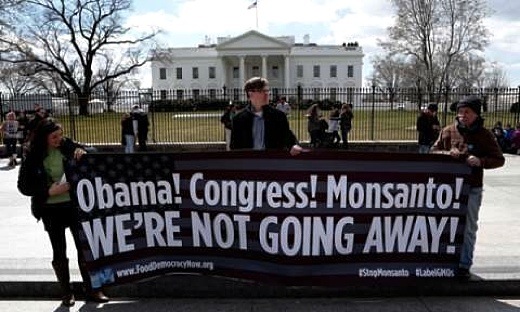
Image above: Demonstration at White House against Obama, Congress, and Monsanto. From original article.

Reliable sources in Washington D.C. have informed the Organic Consumers Association (OCA) that Monsanto has begun secretly lobbying its Congressional allies to attach one or more “Monsanto Riders” or amendments to the 2013 Farm Bill that would preempt or prohibit states from requiring labels on genetically engineered (GE) foods.

In response to this blatant violation of states’ rights to legislate, and consumers’ right to know, the OCA and a nationwide alliance have launched a petition to put every member of Congress on notice: If you support any Farm Bill amendment that would nullify states’ rights to label genetically modified organisms (GMOs), we’ll vote – or throw – you out of office.

On Wednesday, May 15, an amendment to the House version of the Farm Bill, inserted under the guise of protecting interstate commerce, passed out of the House Agricultural Committee. If the King Amendment makes it into the final Farm Bill, it would take away states’ rights to pass laws governing the production or manufacture of any agricultural product, including food and animals raised for food, that is involved in interstate commerce.

The amendment was proposed by Rep. Steve King (R-Iowa), largely in response to a California law stating that by 2015, California will allow only eggs to be sold from hens housed in cages specified by California. But policy analysts emphasize that the amendment, broadly and ambiguously written, could be used to prohibit or preempt any state GMO labeling or food safety law.

Will the King Amendment survive the Senate? No one can be sure, say analysts. However few doubt that Monsanto will give up. We can expect that more amendments and riders will be introduced into the Farm Bill--even if the King Amendment fails—over the next month in an attempt to stop the wave of state GMO labeling laws and initiatives moving forward in states like Washington, Vermont, Maine, Connecticut and others.

Monsanto and the Grocery Manufacturers Association (GMA) have admitted privately that they’ve “lost the battle” to stop GE food labeling at the state level, now that states are aggressively moving forward on labeling laws. On May 14, Maine’s House Ag Committee passed a GMO labeling law. On May 10, the Vermont House passed a labeling bill, 99-42, despite massive lobbying by Monsanto and threats to sue the state. And though Monsanto won a razor-thin victory (51 percent to 49 percent) in a costly, hard fought California GMO labeling ballot initiative last November, biotech and Big Food now realize that Washington State voters will likely pass I-522, an upcoming ballot initiative to label GE foods, on November 5.

If Monsanto can’t stop states from passing laws, then the next step is a national preemptive measure. And all signs point to just such a power grab. Earlier this year, Monsanto slipped its extremely unpopular “Monsanto Protection Act,” an act that gives biotech immunity from federal prosecution for planting illegally approved GE crops, into the 2013 Federal Appropriations Bill. During the June 2012 Farm Bill debate, 73 U.S. Senators voted against the right of states to pass mandatory GE food labeling laws. Emboldened by these votes, and now the House Ag Committee’s vote on the King Amendment, Monsanto has every reason to believe Congress would support a potential nullification of states’ rights to label.

The million-strong OCA and its allies in the organic and natural health movement are warning incumbent Senators and House members, Democrats and Republicans alike, that thousands of health and environmental-minded constituents in their Congressional districts or states will work to recall them or drive them out of office if they fail to heed the will of the people and to respect the time-honored traditions of shared state sovereignty over food labels, food safety laws, and consumers’ right to know.

Trouble in Monsanto Nation

Over the past 20 years Monsanto and the biotech industry, aided and abetted by indentured politicians and corporate agribusiness, have begun seizing control over the global food and farming system, including the legislative, patent, trade, judicial and regulatory bodies that are supposed to safeguard the public interest.

In the U.S., despite mounting evidence of the damage GE crops inflict on human health and the environment, approximately 170 million acres of GE crops, including corn, soybeans, cotton, canola, sugar beets, alfalfa, papaya, and squash, are currently under cultivation. These crops, untested and unlabeled, comprise 41 percent of all cultivated cropland, or 17 percent of all cropland and pastureland combined. According to the GMA, at least 70 percent of non-organic grocery store processed foods contain GMOs. And GE grains and mill byproducts now supply the overwhelming majority of animal feed on the factory farms that supply 90 percent to 95 percent of the meat, eggs and dairy products that Americans consume.

Yet despite their marketplace dominance, record profits and enormous political clout in Washington D.C., Monsanto and the biotech industry are in deep trouble. Evidence is mounting that Monsanto’s top-selling herbicide, Roundup, is a deadly poison, destroying important human gut bacteria and likely contributing to the rapid increase of food allergies and serious human diseases including cancer, autism, neurological disorders , Attention Deficit Hyperactive Disorder (ADHD), dementia, Alzheimer’s, schizophrenia and bipolar disorder. Those most susceptible to poisoning by Monsanto’s Roundup are children and the elderly.

Scientists aren’t the only ones raising new questions about Roundup. Farmers are complaining that they’re being forced to spray more and more chemicals on crops increasingly under siege from a growing army of herbicide-resistant weeds. The situation is so bad that the U.S. Environmental Protection Agency (EPA) just raised the limits of Roundup residue allowed on grains and vegetables to even more dangerous levels. But just in case the EPA someday stops raising the limits, Monsanto, Dow and the biotech industry are working on a new “solution” to the onslaught of herbicide-resistant Superweeds: They’ve applied for approval of a new and highly controversial generation of super toxic herbicide-resistant GE crops, including “Agent Orange” (2,4-D and dicamba-resistant) corn, soybeans and cotton.

As a recent widely-circulated article points out,   
“The use of 2,4-D is not new; it’s actually one of the most widely used herbicides in the world. What is new is that farmers will now ‘carpet bomb’ staple food crops like soy and corn with this chemical at a previously unprecedented scale—just the way glyphosate has been indiscriminately applied as a result of Roundup Ready crops. In fact, if 2,4-D resistant crops receive approval and eventually come to replace Monsanto's failing Roundup-resistant crops as Dow intends, it is likely that billions of pounds will be needed, on top of the already insane levels of Roundup being used (1.6 billion lbs were used in 2007 in the US alone).”
In addition to these Agent Orange crops, an expanded menu of genetically engineered organisms are awaiting approval. Next on the menu?  GE apples, trees, and salmon.

State Labeling Laws: The ‘skull and crossbones’ that terrify Monsanto
Monsanto’s greatest fear isn’t a federal government charged with protecting the health and safety of its citizens. Congress and the White House seem only too happy to oblige the biotech industry’s unquenchable thirst for growth, power and dominance. No, it’s the massive, unstoppable (so far) grassroots movement of Millions Against Monsanto that strikes fear in the heart of the Biotech Bully. U.S. citizens are waking up. They’re demanding labels on genetically engineered foods, similar to those already required in the European Union. They’re calling for serious independent safety-testing of GE crops and animals, both those already approved (especially Monsanto’s Roundup-resistant crops) and those awaiting approval.

The anti-GMO movement has finally figured out, after 20 years of fruitlessly lobbying Congress, the FDA and the White House, that the federal government is not going to require labels on GE foods. Instead the movement has shifted the battleground on GMO labeling from Monsanto and Big Food’s turf in Washington D.C. to the more favorable terrain of state ballot initiatives and state legislative action—publicizing the fact that a state GMO labeling law will have the same marketplace impact as a national labeling law.

State laws spell doom for Monsanto. Companies like Kellogg’s, General Mills, Coca-Cola, Pepsi/Frito-Lay, Dean Foods, Unilever, Con-Agra, Safeway, Wal-Mart and Smuckers are not going to label in just one or two states. Monsanto knows that U.S. food companies will go GMO-free in the entire U.S., rather than admit to consumers that their products contain GMOs.

As Monsanto itself has pointed out, labels on genetically engineered foods are like putting a “skull and crossbones” on food packages. This is why Monsanto and their allies poured $46 million into defeating a California ballot initiative last year that would have required labels on GMO foods. This is why Monsanto has lobbied strenuously in 30 states this year to prevent, or at least delay, state mandatory labeling laws from being passed. This is why Monsanto has threatened to file federal lawsuits against Vermont, Connecticut, Maine and Washington if they dare grant citizens the right to know whether or not their food has been genetically engineered or not.

And this is why Monsanto’s minions are trying to insert amendments or riders into the Farm Bill that will make it nearly impossible, even illegal, for states to pass GMO labeling laws. And there’s nothing to stop them when Congress is filled with pro-biotech cheerleaders who could care less that 90 percent of U.S. consumers want mandatory labels and proper safety testing of genetically engineered crops and foods.

Countering Monsanto’s Final Offensive: Throw the Bums Out!
Only a massive grassroots resistance will deter the U.S. Senate and House from stomping on our rights. Only an unprecedented campaign of public education, petition-gathering and grassroots pressure will be able to convince the ever-more corrupt and indentured politicians in Washington D.C. to back off.

Eighteen state constitutions have century-old provisions for state registered voters to collect petitions and recall state and local officials, forcing them to either resign or stand for reelection. But what very few Americans, and even members of Congress, realize is that 11 states have constitutional provisions to recall U.S. Senators and House of Representative members, as well as state elected officials.

It’s time we exercise the full power of direct democracy, not just state and municipal ballot initiatives. We must continue to support efforts like the current state ballot initiative to label GMOs in Washington state, and county ballot initiatives to ban GMOs, factory farms and other corporate crimes, in the 24 states and hundreds of counties and municipalities where these are allowed. But we also need to use the power we have to recall and throw out of office our out-of-control Congressional Senators and Representatives as well.

If our elected officials in Congress continue to represent Monsanto and big corporations, rather than their constituents, then let’s throw the bums out! If the Washington political Establishment, both Democrats and Republicans, continue to trample on our inalienable constitutional rights and contemptuously disregard the 225-year principle of a shared balance of power between the federal government, the states and local government, then we have no choice but to recall them or throw them out of office.

Please join the nation’s organic consumers and natural health advocates in this strategic battle, the Food Fight of Our Lives. Please join this campaign to save, not only our right to choose what’s in our food, but our basic right to democratic representation and self-determination as well. Sign the petition. Tell your Congressmen and women, especially the 73 incumbents who voted last year to eliminate states rights’ to legislate on GMO labels, and those in the House this week who voted to support the King Amendment that “enough is enough,” “ basta ya.” Power to the People!

• Ronnie Cummins is founder and director of the Organic Consumers Association. Cummins is author of numerous articles and books, including "Genetically Engineered Food: A Self-Defense Guide for Consumers" (Second Revised Edition Marlowe & Company 2004).
.

Kauai Heroes

SUBHEAD: As David Bowie sang “We can be heroes, just for one day.” Maybe in a month or so our County Council can be, too.

By Joan Conrow on 16 May 2013 for Kauai Eclectic  -
(http://kauaieclectic.blogspot.com/2013/05/musings-heroes.html)


Image above: As a result of the intense illegal landscaping, erosion is consuming the public access to the beach. From (http://kauaieclectic.blogspot.com/2013/04/musings-abuse-chronicles-14-a.html).

Given the reactions, you would've thought the Kauai County Council had proposed The Inquisition rather than an investigation into just how, exactly, the vacation rental issue got so damn messed up.

I mean, nobody was gonna be burned at the stake or anything. Just a few subpoenas, some interviews, a little fact-finding, perhaps a wrist-slap, or in the best county tradition, an assignment to another job where your incompetence isn't quite so noticeable.

Absolutely no investigation is needed, but if one must be done, let the Administration do it, pleaded HGEA union rep Gerald Ako, who admitted he had not even read the resolution he was testifying against.

Aw, come on, give the Administration another chance, begged managing director Gary Heu. We'll get it right this time. After all, the mayor has formed an “oversight committee at an executive level...to get our arms around this issue.”

When was it formed? Oh, about two weeks ago.

“We should really pull back and take a much broader look at the issue,” Heu advised.

You mean as in whether we want Mayor Bernard Carvalho to represent us for another four years, seeing as how all this ineptitude and inaction happened under his watch? Or just who, exactly, does benefit from blanket approvals of non-qualifying TVRs? Or how much this boondoggle has — and will — cost the taxpayers?

What the county really requires is a re-engineering study, “a big picture, long-term kind of thing,” Heu said. But the Administration knows nobody wants to wait around six months to a year for that. So instead, “a short term plan is being developed, such as taking some of these [years old] violations into enforcement.”

Be still, my heart.

The planning department has actually formed a four-person task force “to take a look at a few of these violations and a find a way to move them forward,” Heu said.

Can we expect in three months to see at least one case brought to a hearings officer, civil or criminal charges, fines? wondered Councilwoman JoAnn Yukimura, ever the optimist.

“We would like to move as soon as possible,” Heu hedged, following the county maxim of never let yourself be pinned down.

By the afternoon, that “few” had somehow mushroomed into 30 cases that Planning is investigating or enforcing against, or maybe looked at the files or something. It wasn't totally clear, but the number sounded big. Or at least, bigger than “a few,” and hopefully big enough to head off a Council investigation at the pass.

More obfuscation was provided by County Attorney Al Castillo, who was flanked in this most serious matter by deputy county attorneys Maunakea Trask and Ian Jung. The three of them offered a lot of mumbo jumbo about adjudication, due process for TVR owners, county rights, 20 contested cases, Council overstepping its bounds, duplicate investigations. It all boiled down to the same message: butt out and let the Administration handle it.

“I would've liked to be able to review the resolution first for its legality,” Castillo sniffed. No one sent it to his office with that specific request, though surely he knew about it, since it was publicly noticed a week ago, and he could have shown some initiative in checking it out.

But then, initiative is apparently not a county value, or we wouldn't have a planning department that waits until it receives a formal complaint before investigating, even when it has been made publicly aware of zoning violations.

“Can we get an attorney who can help us?” asked Councilman Mel Rapozo in frustration.

One thing the Council and Administration did agree upon, aside from wanting to “get to the same place” — a destination that was not precisely defined, and appears to have several routes, depending on who is steering and how much they wish to keep hidden— was the county's tremendous liability exposure. Then there's its unspoken counterpart: how much that exposure might increase if the county's dirty laundry is hung out on the line.

Caren Diamond, a longtime beach advocate and member of Protect Our Neighbor Ohana, discussed the dangers of allowing visitors to keep sleeping in ground floor units within the flood zone.

“Every morning that visitors wake up in these units exposes the county to liability, especially that morning when a tsunami comes,” she said.

After her testimony, Councilman Ross Kagawa praised her contribution to the investigation and evidence laid out in the 16-and-counting “Abuse Chronicles” series on this blog: “You and Joan and Barbara Robeson [Caren's fellow PONO member] are heroes.”

“You are only heroes if the Council takes action to rectify,” said Councilman Gary Hooser, who with Rapozo introduced the resolution to investigate.

About seven hours later, the Council voted to defer the issue for a month.

Oh.

Well, as David Bowie would sing: “We can be heroes, just for one day.”

And maybe in a month or so the Council can be, too.
.

The Pleasures of Extinction

SUBHEAD: Fantasies of imminent human extinction are comforting iin the face of this ugly predicament.

By John Michael Greer on 15 May 2013 for the Archdruid Report -
(http://thearchdruidreport.blogspot.com/2013/05/the-pleasures-of-extinction.html)


Image above: Toronto with CN Tower after everybody is gone. From (http://redstarcafe.wordpress.com/2008/09/27/life-after-humans/).

One of the wry pleasures that’s repeatedly come my way since the beginning of this blog seven years ago is that of watching a good many of my predictions come true in short order. Now it’s true that I’ve also made a certain number of failed predictions over that time. Back in 2007 and 2008, for instance, I insisted that the US government wouldn’t be dumb enough to try to cover its ballooning budget deficits by spinning the printing presses; some idiocies, I thought, were too extreme even for the inmates of the current American political class.

As th Fed proceeds merrily through yet another round of quantitative easing, that assumption has proved to be rather too naive.

Even so, my batting average so far has been pretty respectable. In the early days of this blog, for example, Daniel Yergin was insisting at the top of his lungs that the price of oil would settle down shortly to a long-term plateau of $38 a barrel, while fans of a dozen different alternative technologies were claiming just as stridently that if the price of oil ever got to the unthinkable level of $60 a barrel, the technology they favored would be profitable enough to sweep all before it.

There were very few of us back then who predicted that oil would go quite a bit past $60 a barrel and stay there, and even fewer who pointed out that abundant cheap fossil fuel energy made alternatives look much more viable than they were. These days, with oil wobbling around $100 a barrel and most of the alternatives still wholly dependent on government subsidies, that turned out to be tolerably prescient.

Over the last few weeks, another of my predictions has turned out spot on the money. A little less than six months ago, as New Age bookstores around the world were quietly emptying entire bookshelves dedicated to December 21, 2012 and putting 50%-off stickers on the contents, I noted in a blog post here that it wouldn’t be long before people who were looking for an excuse to put off doing anything about the crisis of industrial society would have a replacement for 2012.

Well, it’s here. The latest apocalyptic fad is near-term human extinction, or NTE for short: the claim that humanity, along with most other life on Earth, will inevitably be extinct by 2030 at the latest.

It’s probably necessary to say up front that humanity will certainly go extinct eventually—no species lasts forever—and there’s always the chance that it could happen in short order; a stray asteroid with enough mass, or a few rearranged codons in some virus nobody’s heard about yet, could do the job quite readily.

Still, there’s a great difference between claiming that human extinction is possible and insisting that it’s certainly going to happen in the next seventeen years, especially when the arguments used to defend that claim amount to nothing more than an insistence that worst-case scenarios are the only possible outcome.

There’s a tolerably long history to such claims. When I was growing up in the 1970s, there were people on the far end of the environmental movement who insisted that humanity would certainly be extinct before the year 2000, and the same prediction has been repeated with different dates and justifications ever since.

Those of my readers who remember the Solar Temple mass suicides of 1994 and 1995 may recall that the collective suicide note left behind by the members of that ill-fated order made exactly that claim: Earth would be uninhabitable by the year 2000, Solar Temple founder Luc Jouret insisted, and so the initiates of the Solar Temple were getting out while the getting was good.

In the early days of the peak oil movement, similarly, the same insistence on imminent extinction popped up tolerably often. I was convinced at the time, and remain convinced today, that this was largely a product of an odd and very American habit I’ve termed "apocalypse machismo."

One consequence of America’s pervasive anti-intellectualism, with its frankly weird equation of manhood with chest-thumping brainlessness, is that many male American intellectuals end up burdened by doubts about their own masculinity, and some of them respond by trying to talk as tough as possible; intellectual women in this male-dominated culture find they often have to copy that same habit, sometimes to even greater extremes, in order to get taken seriously at all.

This has been a major factor all through America’s recent history; the neoconservative movement, packed as it was with academic intellectuals whose obsession with proving their own virility on a global stage drove them into one foreign policy fiasco after another, makes as good a poster child as any.

In the same way, we had a lot of apocalypse machismo in the early peak oil movement. In the first few years of this blog, for that matter, I could count on fielding (and deleting) a comment every month or two from somebody who wanted to talk about the new scenario for imminent human extinction he’d just worked up.

The Deepwater Horizon blowout and the Fukushima Daiichi nuclear meltdown fielded a bumper crop of the same thing; those of my readers who doubt this are invited to go digging back through the archives of any unmoderated peak oil forum, where they’ll find, in the days and weeks immediately following each of these disasters, colorful if implausible scenarios predicting the imminent demise of all life on earth presented as sober fact.

No doubt there’s at least some of that at work in the sudden surge of interest in near-term human extinction, but I question whether it’s the main driving force this time around. There are at least two other factors that are likely to be involved, and one of them unfolds directly from the points made in the last few posts in the current sequence.

The shape of time sketched out by Augustine of Hippo in the pages of The City of God, and adopted thereafter by most of the western world until the rise of the later mythology of perpetual progress, allows a range of variations.

Even within the mainstream of western Christianity, the options extend over a much broader landscape than most of my readers may realize, and the versions of the Augustinian mythos found outside the Christian mainstream are even more diverse. In his useful 1998 book Millennium Rage, sociologist Philip Lamy argued that most beliefs about the future in today’s America are "fractured apocalypses," in which the events foretold in the Book of Revelation are pulled out of context and rearranged in response to contemporary social trends.

His insight can be applied a good deal more generally: the whole Augustinian story has been subjected to similar treatment. Eden, the Fall, the vale of tears, the righteous remnant, the redeeming revelation, the rising struggle between good and evil, the final catastrophe and the return to paradise thereafter—you’ll find these, or most of these, in a great many current belief systems, but the order and relative importance of each element may vary, and it’s far from uncommon for one or two of the classic themes of the story to be stretched nearly out of recognition, or deleted entirely.

One detail that often comes in for serious reworking in modern social movements is the final step, the one in which the elect are welcomed back into paradise while everyone else is herded into the lake of fire to be punished for all eternity. The habit of morphological thinking discussed earlier in this sequence of posts is of crucial importance here: take a close look at the development over time of social movements that embrace the Augustinian narrative, and the historical shifts in that last part of the story have a fascinating message to communicate.

The wave of Christian fundamentalism that’s currently breaking and flowing back out to sea makes a good case in point. Back in the days of the Jesus People and the Good News Bible, when that wave first began building, its rhetoric was triumphant: the whole nation was turning to Christ, the rest of the world would surely follow, and the imminent Second Coming would see everyone but a few stubborn sinners rushing forward joyfully to embrace God’s infinite love.

Fast forward a couple of decades, and the proportion between the saved and the damned shifted significantly closer to the sort of thing you’d hear in an old-fashioned hellfire-and-brimstone sermon, but the saved were still utterly convinced of their own salvation: those were the days when "In Case Of Rapture, This Car Will Be Unoccupied" bumper stickers sprouted on the rear ends of cars all over America.

You won’t see too many of those bumper stickers these days. Just as the optimistic faith that a new generation could win the world for Christ gave way gradually to the far more pessimistic vision of a world mired in wickedness from which the elect would shortly be teleported to safety—beamed up by St. Scotty, as the joke had it, to the bridge of the USS Enterchrist—so the serene confidence on the part of believers that they would be numbered among the elect has been replaced, in these latter days of the movement, by an increasingly pervasive sense of sin and unworthiness.

Too many dates for the Rapture have come and gone, too many once-respected preachers have been caught with their pants around their ankles in one sense or another, and the well-founded suspicion that the Republican party is using the evangelical churches every bit as cynically and shamelessly as the Democratic party is using the environmental movement has got to weigh on a lot of once-hopeful minds.

Christian theology places hard limits on just how far the exclusion from future blessedness can extend, as there has to be "a great multitude, which no man could number" (Revelations 7:9) of the saved gathered around the throne of God when the boom comes down. Outside Christianity, the same process routinely goes much further.

A good example is the New Age movement, which emerged out of a variety of older fringe spiritualities right around the same time that the current round of Christian fundamentalism got going in America. The early days of the New Age movement were pervaded by the same optimistic sense that a new and more enlightened epoch was about to dawn, and everyone—even, or especially, those who made fun of the movement’s pretensions—would soon fall in line.

As the movement matured and the New Age stubbornly refused to arrive, in turn, the same mood shift that affected fundamentalism had a comparable impact; New Age teachers began to talk more about the ascension of enlightened individuals into higher planes of being, the activities of evil powers who were maintaining the illusion of a world of limits, and the imminence of a world-cleansing cataclysm that would finally get around to ushering in the New Age.

By the time the hoopla began building over 2012, finally, the prophecies trotted out in advance of that much-ballyhooed nonevent ranged all over the map; there were still optimists of the old school, who insisted that a great shift in consciousness would make everyone get around to agreeing with them; there were many more who expected mass death to leave the world purified for the usual minority of the elect; and there were no small number who were retailing scenarios in which the entire human race would be exterminated.

This is a familiar rhythm in the history of American popular spirituality. At regular intervals, some movement that’s existed out on the fringes for decades suddenly gets a mass following, turns into a pop culture phenomenon, and has thirty to forty years of popularity before it returns to the fringes. Some traditions repeat the process; Christian fundamentalism has had two periods of pop stardom—once between the Roaring Nineties and the Great Depression, and then again from the late 1970s to the present—and a strong case could be made that the New Age movement is a rehash of the vogue for occultism that was so huge a part of American pop culture between 1890 and 1929.

Other movements fill the void when the ones just named head for the fringes; from the 1930s to the 1970s, liberal Christian churches were a dominant force in American religion, and there’s some reason to think that the pendulum is headed the same way again as fundamentalism sunsets out a second time.

If human beings were rational actors, as economists like to imagine, they wouldn’t respond to the disconfirmation of their beliefs by postulating world-wrecking catastrophes. Here as elsewhere, though, the fond fantasies of economists stand up poorly as models for predicting events in the real world. If you haven’t had the experience of devoting decades of your life to a failed belief system, dear reader, try to put yourself into such a person’s shoes.

It would take a degree of equanimity rare even among saints to look back on such an experience without harvesting a bumper crop of resentment, grief and guilt—and if fantasies of apocalyptic destruction play any role at all in your belief system, one way to deal with those difficult emotions in their first and rawest forms is to pour them into a belief in some cataclysm big enough to punish the world and everyone in it for their failure to live up to your hopes.

The environmental movement is not a religion, but its course in America in recent decades followed the pattern I’ve just outlined. Like fundamentalism and the New Age movement, it came in from the fringe in the 1970s with the same sense of imminent triumph that guided the other movements I’ve named. Its transformation from a charismatic movement of outsiders to a set of bureaucratic institutions closely intertwined with the existing order of society followed the same trajectory as fundamentalist churches, and its sense of triumphant expectancy faded out at roughly the same pace, replaced by the same struggle against evil that brought fundamentalist Christians into their devil’s pact with the GOP and inspired New Age believers to embrace conspiracy theories and the paranoid fantasies of David Icke.

At this point, roughly in parallel with fundamentalism and the New Age, the environmental movement is having to come face to face with the total failure of its hopes. Back in the heady days of its early successes, the vision that guided it saw environmental protection as the next step forward in the same trajectory of social progress that included the civil rights movement and second wave feminism; it was in this spirit, for example, that environmental lawyers proposed that trees be given legal standing.

The hope all along was that industrial civilization could achieve a permanent peace with the world of nature and continue up the infinite road of progress without leaving a scorched and looted planet in its wake.

That hope is dead. If there was ever a chance to achieve it, it went whistling down the wind decades ago, and at this point the jaws of resource depletion and environmental degradation are tightening around the collective throat of the world’s industrial societies, in exactly the fashion predicted in detail forty years ago in the pages of The Limits to Growth.

Even if the green technologies promoted by an increasingly frantic minority of environmentalists could support something like today’s rates of energy use, which they can’t, we can no longer afford the sort of massive buildout of those technologies that would be necessary to supplant even a significant part of our current fossil fuel consumption.

If what’s left of the environmental movement managed to overcome its own internal dysfunctions and the formidable opposition of its foes, and became a mass movement again, the most it could accomplish at this point would be the protection of some of the most vulnerable ecosystems as industrial society stumbles down the first bitter steps of the long descent into the deindustrial future.

That’s still a goal worth achieving, but it’s not the goal to which the environmental mainstream committed itself when it embraced a role among the socially acceptable institutions of American public life, with the perks and salaries that this status involves.

This explains, I suggest, the way that certain mainstream environmentalists have turned to proselytizing for nuclear power and other frankly ecocidal technologies, under the curious delusion that "possibly a little better than the worst" somehow amounts to "good." The desperation in such rhetoric is palpable, and signals the end of the road—an end that, in this case as in the others I’ve cited, involves a good many fantasies of total destruction.

Still, there’s another factor here, and it unfolds from one of the least creditable aspects of the way that the environmental movement has evolved over time. It has become increasingly clear that the perks, the salaries, and the comfortable middle class lifestyles embraced so enthusiastically by so many people in the movement are themselves part of the problem.

I was intrigued to read earlier this month a thoughtful essay by leading British climate scientist Kevin Anderson arguing, in terms that will sound very familiar to regular readers of The Archdruid Report, that the failure of climate change activism to make any headway in changing people’s behavior may have more than a little to do with the fact that the people who are urging such changes aren’t making them themselves.

I have no reason to think that Anderson reads my blog or, for that matter, knows me from Hu Gadarn’s off ox, but then you don’t need to wear an archdruid’s funny hat to notice that people these days are acutely sensitive to signs of hypocrisy, or to grasp that even the most vital changes aren’t going to happen if even the people who are most aware of their importance aren’t willing to start making them in their own lives. For reasons a post last year discussed at some length, those who have built their lives on the fantasy that it’s possible to have their planet and eat it too are not going to find such reflections welcome, or even bearable.

Fantasies of imminent human extinction are one comforting if futile response to this ugly predicament. If you want a justification for living as though there’s no tomorrow, insisting that in fact, there’s no tomorrow is certainly one option. If I’m right, the pleasures of believing in near-term human extinction are likely to appeal to a very large and well-heeled audience in the years immediately ahead, and those of my readers interested in cashing in on the next 2012-style bonanza should probably take note.

See also:
Ea O Ka Aina: Preparing for Near Term Extinction 5/7/13
Ea O Ka Aina: Pondering Near Term Extinction 4/28/13

.