Clothesline at the end of the world

SUBHEAD: The apocalypse of climate change is not going to come with a bang but with a whimper.

By Charlotte McGuin Freeman on 6 May 2017 for Dark Mountain -
(http://dark-mountain.net/blog/dark-mountain-issue-11-clothesline-at-the-end-of-the-world/)


Image above: Steel framed washing line with clothes blowing dry in sun and wind. From (http://lawoffashion.info/old-fashioned-washing-line-pole/).

On the first warmish March day, I’ll be outside hanging my wash on the line even if my boots are crunching on snow. If the sun is shining, if there’s even a hint of warmth on the breeze I’ll be bringing my wash outside, freeing it from the clotheslines in the basement.

I am a tiny bit fanatical about my clotheslines. The outdoor line is attached to my side yard fence and, like all people who engage in a repetitive physical task, I have a specific method for hanging the clothes. Pants, dresses, bathrobes – long items get hung on the back line against the fence.

Then shirts, which must be hung upside down, connected at the corners to save on clothespins. (If you hang them right side up by the shoulders, you get weird bumps dried into your shirts that make you look like you’re continually shrugging.)

Smalls get hung on the end furthest from the street, between the dresses and the shirts. No need to embarrass the neighbours. Then last are the socks – matched together, hung in pairs. A load of wash takes me maybe ten minutes to hang. I work at home so it makes for a nice break in the day, and I love my washline. I love the way things look hanging there in the breeze.

But I don’t hang clothes just because I like the way they look. I am a true believer in the power of the clothesline. For one thing, the clothes dryer is second in American homes only to the refrigerator for electricity consumption, and while I know that eliminating my use of the dryer individually isn’t going to slow the onslaught of climate change, it’s something concrete I can do. Also, as a freelancer,

I’m broke, so anything to bring down the electric bill.

But I hang laundry for a less concrete reason, because hanging the laundry is about taking care, it’s about a version of domesticity that is not oppression, but which models the sort of caretaking we’re all going to have to learn to value in order to make a hotter, drier, more crowded world habitable.

I live in a small town in Montana, a town that until about 20 years ago was solidly working class. It was the headquarters for the Northern Pacific Railway, and it’s a town of small railroaders’ houses with tiny yards, nearly every one of which has a sturdy clothesline out back.

Because we’re one of the windiest towns in America and these are serious clotheslines – usually built from six–inch plumbing pipe, sunk into three or four feet of concrete.

And yet, I’m one of the few people I know who actually dries my clothes on the line. As the cost of appliances dropped and dryers became ubiquitous, clotheslines came to be seen as ‘trashy’, a symbol of poverty and sloth.

Even as the new people moving to town buy hybrid vehicles and put solar panels on their roofs, even as greenhouses and chicken coops spring up in backyards, those sturdy old plumbing-pipe clotheslines, painted silver, are always empty.

I moved here from California in 2002 for a number of reasons, but chief among them I was anxious about climate change. It made me nervous, California. It had been good to me career-wise, twice.

First when I moved there to do my master’s degree at UC Davis; then when I left Salt Lake City after my PhD and went back out to live with my brother and find a job.

Desperate to pay off my student loans, I got work in a tech company, editing user and administration guides. I liked it. I liked the people I worked with and the intellectual challenge of figuring out how to present information to people in the most useful format possible. But California was giving me the willies.

It was so crowded, and the Bay Area is such an enclosed space, bounded by the Pacific on the one side and the coast hills and Sacramento-San Joaquin River Delta on the other.

Three years into my tech job, I’d seen field after field on my evening commute disappear under the onslaught of ugly housing developments, just as I’d watched the last few migrant workers hoeing a zucchini field that was doomed to become another Cisco campus.

I wish I’d had a camera that day. I was stopped in traffic, and across from me were several guys with computer cases standing at a bus stop, while behind them four or five Mexican guys hoed zucchini rows, and behind them another three–storey Cisco building, identical to all the others, was going up.

I could feel the big change coming – whatever we want to call it, climate change, global warming, the Anthropocene, the great acceleration – I don’t know what it is, but having been raised by unreliable parents you develop antennae for impending doom.

You can tell by the energy level, the degree of frantic vibration, that something bad is about to happen. And that’s how I felt in California. I couldn’t put a finger on it exactly, but I knew something wasn’t right and I wanted to get out of the way.

I knew about Livingston from having run writers’ workshops while I was in graduate school. The nature and western writers were a friendly lot, most knew one another, and talk across the patio tables at Squaw Valley often turned to places where a person could live cheap. Livingston was one of them.

Like a lot of beautiful places left empty when an industry implodes, Livingston has attracted writers and painters and fading movie stars for decades now, along with a vibrant population of hunting and fishing guides, building contractors and former cult members. It’s a creative bunch and, with the exception of the rich summer people who build trophy homes in the valleys that radiate out from town, it’s a place where no–one has ever had much money.

Most of us live in one- and two-storey houses on small lots in town. Old railroaders’ houses like the one I bought. Mine was built in 1903, and hadn’t had anything much done to it since they put the indoor plumbing in sometime in the forties.

It’s a small house on a town lot that I bought for a number of reasons, chief among them the five-foot clawfoot tub, and the well-used vegetable plot that took up half the back yard.

I was lucky enough to get to hang around Gary Snyder when I was at UC Davis, and Snyder’s advice to us wasn’t about poetry, well, not directly. Gary told us that if we wanted a creative life, we should find someplace cheap to live, where a person could afford to buy and pay off a house.

Cheap housing attracts artists, he said, so chances are you’d wind up with interesting neighbors, and if you had a place to live you wouldn’t have to go teach in places you didn’t want to be. You’d have your freedom.

And that’s what I was aiming for when I moved here. I’d been living with my brother for four years, a roommate arrangement that had worked out so well we thought we’d better break up before we wound up like one those pairs of spinster siblings you used to see sometimes out in the country near our grandmother’s farm. The ones in the white farmhouse they’d been raised in, still sleeping in their childhood bedrooms.

In the four years we’d lived together we’d both found better jobs and had repaired some of the anxiety we had about domestic life. We’d been raised in a world of unstable alcoholics, the kind who pick a fight whenever they’re feeling existentially itchy.

By teaming up, we’d figured we could practise domestic life on one another, see if we could figure out how to live in a house with another person you love without screaming fights or tears of recrimination. That we’d done it and had righted our little ships, both financially and emotionally, was a major accomplishment. But it was time to move on.

Time to take those skills and go find real partners. And so when my manager agreed to let me telecommute, I went looking for a house I could afford, and since I wasn’t tied to the Bay Area anymore, a house I could afford back in the Rocky Mountains I loved.

Pretty quickly, things fell into place and I found myself in possession of a mortgage and the keys to a small bungalow in Montana. I packed the cat and computer and boxes of books into my Honda, and arrived three days ahead of the moving van.

That I’d been able to not only buy a house, but could afford a moving van felt miraculous to me. We’d moved every 18 months or so growing up, renting U-Hauls or borrowing horse trailers.

Despite having managed to get a mortgage, purchase a house and arrange for a moving van, I still felt that first night, setting up the inflatable mattress in my empty house, that I’d broken in, that any moment someone was going to burst through the door and shout at me to leave.

The first year went pretty well. Patrick, my brother, wound up moving here after me, having been laid off from his job just as I was leaving California.

I got a dog, and built raised beds in the existing vegetable patch, and made friends. Patrick found a cheap apartment on the other side of town, took up with his first girlfriend in ages, and set about building himself a niche running events and helping with wedding planners, work he’d done since his teens.

We were settling in. At his birthday party in early September he made a sentimental speech to our new friends, thanking them for taking us into their lives, saying he’d never had such a happy year.

On 28 September that first year I lived here, on a beautiful, blue-sky, golden sunshine autumn day, I was in the hammock strung between my apple trees when the Assistant Coroner of Park County Montana walked through my front gate.

I got up to see what the dogs were barking about only to meet this big man, taking off his feed cap as he saw me, who put one enormous hand on my shoulder and said;
 ‘Ma’am. There’s no good way to say this. There was a car accident last night. Your brother is dead.’
Time stopped.

The world as I knew it ended that day, and while a new life has taken root, it is not at all the same. It is a replacement world.

Patrick dying was the one thing I had feared above all others. It was like being simultaneously orphaned and widowed.

Our divorced parents are unreliable at best, our youngest brother had died as a toddler, and we had survived it all together. We were less than two years apart, and in every photo I have of us, from earliest childhood until the end, one of us has an arm around the other.

I’d gone from the oldest of three, to being the big sister, to being an only child.

In losing Patrick, I lost the one person on this earth who loved me absolutely, whose faith in me was unshakeable. Without Patrick, it took me a very long time to piece together some kind of identity, and even now, 13 years later, it feels false, because he hasn’t been here to see it.

It was terrible, and I survived it in large part due to the tender ministrations of the town of Livingston. ‘If you’re going to have a disaster,’ I tell people when the story comes up, ‘you want to have it here. Everyone came, and they stayed.’

My house filled up that first night as word got out. They got me through a funeral, and saw that I was never left out. I had people to go to Happy Hour and dinner with on Fridays, and they took me in for holidays, and some, like my friend Jennifer, occasionally walked in my front door that first year or so and said ‘No really, how are you?’

My best friend had twins (after a terrifying pregnancy), so for a couple of years there was always a screaming baby to tend, and her two big girls needed an auntie as much as I needed kids to take care of. I was taken in by a tribe of people, people who became my new family, people who I love with all my heart. And yet.

When I say the world stopped, I mean that I have a very strange relationship to time now. There was my life until 2003, a life that hummed along and things changed and I moved from place to place and attended schools and published a novel and got a job and eventually moved to Montana. My story kept unfolding.

And then Patrick died, and it feels in some weird way like my story ended. However, I’m still here.

To compare my personal loss to the avalanche of loss that is heading our way as a planet would be unbelievably callow, and yet there are things you learn when you lose the person you thought you could not live without that seem germane.

For one thing, the surprise at still being alive. You have to figure out how to live in this diminished world. You have to figure out how to go on after the fourth, or seventh, or 15th time you pick up the phone to call the person who is no longer here.

Those first months after Patrick died, I remember thinking, ‘Forty years? Fifty years? I have to live like this for how long?’

The literature of climate change is mostly of the apocalyptic variety. There will be a disaster and then it will ALL END. But if there’s anything I have learned in these intervening years, it’s that it doesn’t end. You’re still here. The sun comes up.

The apple trees bloom in the spring, and the garden needs planting, and the children you love will keep growing and even, eventually, you might be lucky enough to meet someone who loves you and who doesn’t mind when you spend the first three or four years telling him stories about your dead brother, and who you love back even though you find it inconceivable that you’re spending your life with someone who didn’t know Patrick, and who Patrick will never know.

Apocalyptic stories are sexy in their drama. The end of the world as we know it will be big and dramatic and everything will change, and we will be living in some mythical landscape where we’ll be freed from all the boring conventional aspects of our daily lives. My instinct, however, is that this is not how things are going to unfold.

More likely it’ll entail the slow chipping away of things we’re accustomed to, changes like our fruit trees dying. We had a frost three years ago, a freak freeze in October that killed every cherry tree in town. We didn’t find out until spring, when they didn’t come back. Here in Montana we get much of our fruit in the summer from Utah.

Orchardists will drive up and set up roadside stands where they sell raspberries and plums and currants and peaches. Beautiful peaches. They were late this year, and my first thought was, ‘Is this it? Is this the year they don’t come? Is this the year we’ll look back on and say, “Remember when there were peaches?”’

One reason I’m such a fanatic about the clothesline is that, like clearing the table after dinner and doing the dishes in the sink with soap and hot water, hanging your wash on the line keeps you in actual physical contact with the world.

You have to touch each piece and in doing so you can see which tee shirts are wearing thin, which socks have holes in the heels, which trousers are getting worn in the knees. It is this physical contact, this clearing up of messes that I think is at the root of the peculiar hostility toward clotheslines that has taken root in those neighborhoods where clotheslines have been forbidden and even outlawed.

For two or three generations now we’ve been told by the culture that success is measured by the distance we can put between ourselves and the physical acts of both making and cleaning up.

I know perfectly competent grown people who cannot cook themselves dinner, who rely on restaurants or make a sandwich, who have no idea how to do something as simple as roast a chicken. People rely on clothes dryers and dishwashers.

We hire cleaners for our houses. We hire gardeners to mow our lawns.

We sometimes have to hire people to raise our babies so we can continue to work at jobs we might love, or just need in order to bring in the money we require to keep the machinery of consumption humming along.

We rent storage units where we put the stuff we worked all those hours to buy but that no longer fits in our houses.

That my household chores are largely physical in nature – hanging out wash, cooking dinner and then cleaning the dishes, mucking out a chicken coop, tidying the garden to get ready for winter – marks me as old-fashioned and an outlier.

I don’t live in a city, or even a particularly large town. I cook all my own meals, in part because our town is so small that there aren’t cheap takeout places. I work at home so I don’t have a commute anymore. I’m already a throwback, to the extent that when I visit folks ‘out there’ I do find the noise and pace and sheer amount of disposable trash of modern life a little disorienting.

What I learned when my brother died and left me here alone is this: it is in taking care that we can save ourselves and others. Nina’s twins, with all their mess and screaming those first few years (and they were screamers, those two), that’s what saved me. Having something useful to do. Something immediate.

The baby cannot sleep without being held, and there are two of them. So days we spent, on Nina’s big white sofa, watching Barefoot Contessa reruns and trying to get those girls to sleep.

What I learned is that the garden can save you, because it doesn’t give a shit if you’re having a freaked out, weeping kind of a day. It’s spring and things need planting, or it’s the end of the season and snow is coming and if you don’t get the tomatoes in and taken care of the whole summer will have been a waste. And so you do it.

You find a rhythm in the physical world that carries you through, because the bottom line is that you are not dead. You are still living on this earth, and there are days of stupendous beauty, even in the midst of unbearable sorrow.

And so, because I love the world, even in its diminished state, I hang the laundry outside. I hang laundry and refuse to use my clothes dryer. I bought a tiny, efficient little car. I grow food in my backyard and put it up in jars for the winter and I’ve pretty much stopped flying on airplanes. I know that these actions, taken as an individual, are not going to slow down the changes we see happening. The freak frost that killed the cherry trees.

The fish parasite that bloomed in the Yellowstone River this summer, when the river was at its lowest-ever recorded flow, when the water was hotter than it had ever been and so a parasite bloomed and thousands upon thousands of fish died. So clear was the danger that the state banned our sacred sport, fly fishing, for a month. Which was unprecedented.

For the 14 years I’ve lived here I’ve watched that rusty brown creep across the mountains as the pine beetle kills off the trees and, more years than not, there are no chanterelles or boletes in the fall, not even up high in the mountains, because the late summer rains didn’t come.

But I hang my wash on the line, and grow vegetables in the backyard, and love the girls I’m helping to raise even when they turn into terrible teenagers who are acting out in the most ridiculous ways possible. Because I’m still here.

Apocalyptic stories about of the end of the world are sexy, in part because they allow us, in much the same way as fantasies of past lives do, to cast ourselves as important players in grand historical dramas. They strip us of boring domestic chores. They set us free from our stuff and give us a blank slate with which to start over.

However, I think our job is going to be more complicated than that. My hunch is that we’re not going to get a big, sexy, end-of-the-world do-over. What we’ll be faced with is more ordinary. A series of diminishments. The loss of one thing we thought we could not live without, and then another, and then another yet.

Every so often, when someone mentions that something happened years ago, in say, 2011, I’ll find myself startled at how far in the temporal past 2003 has slipped.

For me, it’s still right here. The day the world stopped. The day that Mike Fitzpatrick, that big kind man who is himself dead now, walked into my side yard bearing the worst of all possible news.

It’s right there with me as I hang wash in that same side yard, dresses and pants and shirts waving in our stiff winds, as the cottage roses and cosmos and hollyhocks wave back. We might all be living in the end times, living in the aftermath, but we are still living.—

Source's Note: You’ll find more articles where this came from in our latest book. Dark Mountain: Issue 11 is available through our online shop

.

See "The Strangled Sea"

SUBHEAD: The courageous Okinawan struggle against U.S. military destruction of their beautiful island.

By Katherine Muzik PHD on 9 May 2017 in Island Breath -
(http://islandbreath.blogspot.com/2017/05/see-stranged-sea.html)

http://www.islandbreath.org/2017Year/05/170509poster.pdf
Image above: Poster for "The Strangled Sea" event. Click for enlarged PDF file to post around the island.

WHAT:
See film "The Strangled Sea" (in Japanese with English Subtitles)
Presented by Professor Kosuzu Abe, an activist and Social Scientist, Ryukyu University
For the Okinawans it is a matter of "Peace, Beauty and Agony".

WHEN:
Saturday, 20 May 2017 at 7:00 - 9:30pm

WHERE:
Kealia Farm Market
2345 Kealia Road, Kealia, Kauai, HI 96746
Venue phone number: +1 808-635-4100

COST:
Free (but donations appreciated).

ENDORSED: 
by the Kauai Alliance for Peace ans Social Justice

MORE INFO:
For more information call +1 (808) 346-6167

Besides the film their will be a presentation of “Threatened to Death“ honoring the wonders of Okinawa’s Oura Sea and Yambaru Forest by Katherine Muzik, Ph.D., Marine Biologist

There will also ne Q & A to discuss America's increased militarization of Okinawa, Puerto Rico, Korea and Kauai...

.

Olduvai on the Dnepr

SUBHEAD: An introduction to the process of the collapse of Industrialism and US world hegemony.

By Dmitry Orlov on 9 May 2017 for Club Orlov -
(http://cluborlov.blogspot.com/2017/05/odulvai-on-dnepr.html)


Image above: Not at Olduvai in Africa and nor the river Dnepr in Europe, but an illustration of a Manahattan skyline against the East River during the 1965 Northeast Blackout. Many at the time thought it was the beginning of WWIII. From original article.

[IB Publisher's note: Dmitry Orlov's website "Club Orlov" is now financially supported through the Patreon system. To read full articles you must support the website through Patreon's . I prefer James Kuntler's website (http://kunstler.com/) that is also using Patreon, but still allows reading articles without prepaying for them. I recommend supporting both authors.]

I have been in the collapse prediction business for over a decade now, with relatively good results overall.

One aspect of predicting collapses that remains troublesome is their timing. The reason why it is troublesome is well understood: collapse is a sort of phase transition, and phase transitions are notoriously difficult to time with any precision. It is also nearly impossible to establish what has triggered any one of them.

When will a raindrop of supercooled water suddenly turn into a snowflake? Only the snowflake knows. What triggered the collapse of the USSR? If you too have an opinion on the matter, please stuff it. Thank you.

Another aspect of my method that could be improved is its lack of quantitative rigor. I have been able to make a great number of fairly accurate qualitative predictions, all of them based on reasoning by analogy.

For example, after observing the collapse of the USSR and its immediate aftermath, then imagining, using thought experiments, how it would map onto the collapse of the USA, I was able to formulate something I called Superpower Collapse Soup.

Its key ingredients are: a severe shortfall in the production of crude oil, a large, systemic trade deficit, an oversized, bloated military budget, an outsized military incapable of victory, crippling levels of runaway debt and an entrenched, systemically corrupt political elite incapable of reform.

During the decade since I came up with it, the events I have predicted have been unfolding with some precision. The USA has been steadily losing its economic and military dominance; it can no longer get its way in the world diplomatically; the last straw will be the loss of its financial stranglehold over the global economy.

It is fun and instructive to watch superpowers jostling for position and eventually collapsing, but that is just a backdrop to a far more important phenomenon that is starting to unfold with increasing speed: the waning of the industrial age.

Here is another analogy: the idea that ten years from now most of the currently industrialized world will be clearly, obviously far along on the path toward deindustrialization seems just as outlandish now as the idea that the USA would rapidly lose its position as the world’s one remaining superpower seemed a decade ago when I first broached the subject.

But there is also an important difference: industrial activity is far more easily quantifiable than such matters as political and military dominance.

In particular, Richard Duncan’s Oldu vai theory provides a good guide to the upcoming events. Its longer name is “the transient-pulse theory of industrial civilization.”

Its main idea is that the industrial age will span roughly a hundred-year period, from 1930 to 2030, with a peak somewhere near the middle. His prediction is that by 2030 industrial activity will decrease to 1930 levels.

To read the the full 4325 go to original article and click on Patreon page link for payment options. https://www.patreon.com/bePatron?patAmt=0.01&u=5259868)

.

When the trucks stop running

SUBHEAD: Review of book by Alice J. Friedemann about impacts of loss of trucking on society.

By Allan S. Christensen on 8 May 2017 for Resilience -
(http://fromfilmerstofarmers.com/blog/2017/april/book-review-when-trucks-stop-running-energy-and-the-future-of-transportation/)


Image above: You don't see many Amish men and their horses hauling those wind 100' generator blades around on dirt roads.From original article.

I left off last week's post – "Money Doesn't Grow on Trees, Industrial-Scale Renewable Energy Does" – by mentioning the existence of a rather excellent resource.

By that I didn't mean an energy resource, but rather a book – a book that nonetheless gives a rather fine breakdown of our various energy resources and their applicability to a world in the midst of peak oil and declining EROEI levels (Energy Returned On Energy Invested). That book would be When Trucks Stop Running: Energy and the Future of Transportation by systems analyst Alice J. Friedemann.

But before I get to the book, it's worth reiterating from said previous post the notion that just as the coal lobbies, nuclear lobbies, and all the other "dirty" fuel lobbies are wont to exaggerate and obfuscate the specifics of their energy resources, so too are lobbyists for the large-scale application of "renewable" energy sources more than willing to exaggerate, obfuscate, and even fudge the facts when it comes to conveying the benefits and advantages of their energy resources.

And as I also pointed out, the latter is just as often the work of PR agencies and other marketeers, the goal effectively being anything but conveying a clear understanding of our current energy situation. Friedemann perfectly explains why this is (italics mine):
In business, ...analysis is essential to prevent bankruptcy. Yet when scientists find oil, coal, and natural gas production likely to peak within decades, rather than centuries, or that ethanol, solar photovoltaic, tar sands, oil shale, and other alternative energy resources have a low or even negative energy return on the energy invested, they are ignored and called pessimists, no matter how solid their findings. For every one of their peer-reviewed papers, there are thousands of positive press releases with breakthroughs that never pan out, and economists promising perpetual growth and energy independence. Optimism is more important than facts. And, it's essential for attracting investors.
So don't let a title like When Trucks Stop Running give you the impression that Friedemann's book is simply one about the energetic options for the trucking industry, since what it actually does is use trucks as an interesting starting point for how to understand the viability of the various energy options available to our declining industrial way of life.

While it was coal-powered trains and railroads that, as described, allowed for extensive inland settlements distant from shipping ports, it was cheap oil supplies after WWII that allowed for the even more distant and scattered suburbs – "truck towns" – thanks to the proliferation of diesel-powered trucks (ten million trucks in the U.S. alone), the millions upon millions of miles of road (4.1 million miles in the U.S. alone), and the just-in-time transport enabled by it all.

With our industrial civilization now largely built around the continued operation of these trucks, Friedemann then explains that if our current way of life is to be maintained – and since supplies of various fossil fuels are finite and have begun, or are to soon begin, peaking – this suggests a turn towards renewables to power those trucks.

But as is pointed out, renewables themselves are just as dependent on trucks as the rest of our modern, industrial civilization is: trucks are needed to transport massive wind turbine blades and the rest of their thousands of components (more than 8,000 in all), they're necessary to transport the cement needed for windmill sites, they're necessary to build and maintain the very roads they themselves travel on, and so forth.


Image above: I stand corrected. Even Tonkas use diesel – turbo-diesel! Photo by Dana Martin. From original article.

You don't see many Amish men and their horses hauling those things around on dirt roads. The underlying question then becomes: How can the trucking system be adapted to run on alternative fuels in order to remain viable in a world of depleting fossil fuels of which said trucks rely on?

Because if the trucking system can't be adapted, then there wouldn't be much reason for building out the large-scale windmill, solar photovoltaic, and all the other fandangle electricity generating ideas being hyped.

For starters, diesel-engine trucks can last decades, this implying a decades-long replacement time due to the billions of dollars already sunk in said trucks of which isn't going to be thrown away.

Simultaneously, a chicken-and-egg problem exists of an aversion to buying alternative-fuel trucks due to the non-existence of fuelling stations, buttressed by an aversion to the building of alternative-fuel stations since the alternative-fuel trucks don't exist either.

What is ideally called for then is a "drop in fuel" – a fuel that utilizes the existing infrastructure and so works with the engines and pipeline systems we've currently got.

But as Friedemann explains, ethanol and biodiesel can't travel in oil pipelines for a variety of reasons, one of these being the resultant corrosion of said pipelines.

Instead, ethanol will continue to travel by trains and trucks powered by twice-as-energy-dense... diesel.

Furthermore, hydrogen isn't a drop in fuel for the simple reason that it can't be used in existing engines, never mind that it would ruin existing oil and/or natural gas pipelines anyway. And although natural gas already has pipelines to be transported through, it can't be used in existing engines either.

In short, a drop in fuel doesn't exist.

That being the case, Friedemann proceeds to break down the three most notable alternatives to diesel-powered, internal-combustion-engine trucks: battery-powered trucks, hydrogen-powered trucks, and trucks running on a catenary system (an overhead wire system as used by trolleys/trams/streetcars).

Battery-powered trucks:
While it might be possible to get a battery-powered remote-control Tonka truck with a cute little Tesla sticker on it, the battery-powered trucks that matter are the massive ones that can haul 30 tons of cargo or pour cement, generally weighing more than 40 times your average car.

Problem is, the amount of batteries needed to allow a truck like this to travel an appreciable distance results in a significant dent in available cargo space, which is then made even worse by the decreased amount of payload a truck can carry due to the sheer weight of the batteries themselves.

This doesn't make for economical transport, and nor does it help that the advancement of batteries is bumping up against physical and thermodynamic limits (as Friedemann has explained on her blog, Energy Skeptic).

But supposing you've got the money to burn (and/or have made some key donations to people in the right government departments and/or positions) and wack it all together anyway, the inherent limitations to the energy density of batteries not only dictates the need for more frequent stops, but for prolonged stops of several hours in order to recharge the batteries.

As if that weren't bad enough, battery-powered trucks have many performance issues, such as mediocre acceleration and problems driving up steep hills, shoddy performance in subzero temperatures, declining range as batteries degrade, and simply cost much more than a conventional diesel truck.

As a result, the battery-powered trucks currently in use are heavily subsidized by governments and exist in the form of smaller-sized hybrids used for garbage pickup since this allows them to utilize all the stopping and starting to recharge their batteries. In other words, they aren't even the type of truck that hauls large loads and travels for long distances without stopping.

Hydrogen-powered trucks:
As should go without saying, hydrogen isn't a fossil fuel we mine from the ground but rather an intermediary of sorts that other energies (such as from wind, solar, etc.) can be transferred over to for storage or other means of usage.

In other words, hydrogen isn't an energy source but more like a battery, and since it takes an enormous amount of energy to split hydrogen from water (water which must be very pure), 96% of H2 is derived from natural gas.

In effect, hydrogen has an abysmal efficiency rate due to the multiple stages where energy is lost – liquification, hydrogen re-forming, fuel cell efficiency, etc.

On top of all this, hydrogen-powered trucks are so horrible at acceleration that they actually require a secondary propulsion system – batteries – which results in a single truck costing more than a million dollars each – in comparison to the $100,000 or so for a diesel truck.

Catenary system:
Problems quickly appear here due to the frequency of trucks traveling on the system – once every few seconds versus trolley/tram/streetcar systems in which passenger vehicles generally come once every ten minutes or so. This puts a significant strain on the system due to the enormously large loads of electricity that must pass through the overhead wires.

Moreover, the tens of thousands of trucks that would travel on a single system each weigh twice as much as one of the few hundred trolleys/trams/streetcars on an urban transit system and so require much more energy to move.

Then there's the massive overhead costs to install such a system over tens of thousands of kilometers (at several million dollars per kilometre) and the abhorrent amounts of electricity that tens of thousands of trucks would necessitate, compounded by the fact that catenary enabled trucks also require an added battery or fuel cell system for those times when trucks need to drive off the catenary system towards a delivery/pick-up point (or simply overtake another vehicle), or for those times that the power goes out and one doesn't want the highways to turn into McParking lots.

And that's all supposing that there's even enough energy in the first place to charge those batteries, or to be a feedstock for the hydrogen fuel cells, or to power the overhead catenary system.

Because while being a slim and easy-to-read 131-page book, When Trucks Stop Running also gives a barrel-by-barrel, kilowatt-by-kilowatt account of why none of our fossil fuel energy sources – not oil, not coal-to-liquids, not natural gas, not even any of their combination – are capable of maintaining the trucking system and thus our current industrial way of life.

Likewise, the book also conveys why no amount or combination of renewable energies are enough to maintain a trucking system which is needed to maintain a... renewable energy system. And sorry, Friedemann also explains why energy storage systems are a crapshoot as well.

In effect, you aren't going to find much in When Trucks Stop Running to help sell your favourite brand of snake oil in order to prop up your Madison Avenue lifestyle. Otherwise, it's an excellent read.


Image above: Without fossil fuels, how will the trucking industry be able to move around all the components necessary to maintain the trucking industry? Photo by Jeshua Nace. From original article.

That all being so, Friedemann suggests in summation that rather than waste the fossil fuels we've got left on attempting to build out systems that won't have much of a shelf life, we'd be much better off using that fossil energy to convert away from industrial agriculture, to build passive solar houses and buildings, maintain and upgrade domestic waterway transportation infrastructure as well as other low-energy systems.

Regardless, no PR agency, or energy lobbyist, or charlatan is going to be content with letting Friedemann get away with the last word here. For as was mentioned in the passage of hers I quoted earlier:
[W]hen scientists find [uncomfortable facts], they are ignored and called pessimists, no matter how solid their findings. For every one of their peer-reviewed papers, there are thousands of positive press releases with breakthroughs that never pan out...
And you know what that means, right?
Elon Musk just announced the unveiling of the Tesla Semi truck!! And it's "Seriously next level"!!

Okay, okay, I don't mean to say that the latest MuskMobile will "never pan out", just that Concordes generally necessitate too much energy to make them viable without significant subsidies of one sort or another.

And that isn't to say that there's anything inherently wrong with subsidies either, just that while Friedemann also points out that "it is energy, not money, that fuels society", it is also energy, not money, that fuels subsidies (money is after all a proxy for energy, as I've previously written).

In other words, using energy to subsidize energy probably isn't much of a viable long-term plan, but it can certainly score you the starring role as the latest messiah in this age of optimism being valued over facts.


Image above: Sorry there Elon, but it looks like even the big boys realize their Tonkas have no choice but to use diesel – mighty diesel! Photo by Wallace Shackleton. From original article.

.

The Okinawan Diet

SUBHEAD: People in southernmost Japan have the longest average lifespans on Earth.

By Shereen Lahman MS on 23 March 2017 for Very Well -
(https://www.verywell.com/the-okinawan-diet-2507127)


Image above: Seaweed and sesame seeds top an example of Okinawan Diet. From original article.

[IB Publisher's note: Okinawa is at a latitude just a few degrees above Kauai. Much that is grown there can be grown here. While we agree with possible health advantages of the Okinawan Diet we have some reservations. We are primarily we are concerned that food grown in Japan that may have been contaminated with radiation from the Fukushima Daiichi nuclear catastrophe be avoided. Certainly seaweed grown in the possible path of radioactive discharge into the ocean from the Fukushima reactor cores on the eastern shore of Japan should not be consumed. The Fukushima Prefecture was dedicated to farming and fishing and those activities have continued. Some of the food produced there has been shipped to other locations and used as source locations. Be wary of the source.]

Okinawa is a region in the southernmost part of Japan where inhabitants have traditionally had the longest lifespans on earth. While there are probably many reasons for those long lifespans, there's a good chance their typically healthy diet play some part.

The Okinawan diet is made up mostly of vegetables and legumes, especially soy. It's low in calories and fat, and high in complex carbohydrates.

Most of those carbohydrates come from vegetables, with only a small amount of grains or seeds, and no sugar or refined sweets. There is only a little bit of red meat and a minimal amount of dairy. Fish is consumed in moderation, and alcohol consumption is limited to an occasional drink.

Typical foods in this diet include sweet potatoes, soy, bitter melon, shiitake mushrooms, burdock, jasmine tea, seaweed, and a fascinating array of herbs and spices. Here are a few that you should be able to buy in most grocery stores or Asian markets:

Sweet Potatoes
In the past, less affluent Okinawans ate sweet potatoes. Lots and lots of sweet potatoes. Rice, especially white rice, was more expensive and therefore a bit of a status symbol: it was something consumed only by the wealthier folks. The neat thing about sweet potatoes is they are nutrient-dense and rich in vitamins A and C, calcium and potassium.

They're also high in fiber and contain vitamin E.

Soy
The traditional Okinawan diet includes soy in the form of miso paste and tofu. Soy is an excellent source of plant protein, and it provides the bulk of the protein in the Okinawa diet. Soy also contains phytochemicals called flavonoids and phytoestrogens, which may have health promoting qualities.

Bitter Melon
Bitter melon is a gourd that's also known as goya, goo-fa or ku gua. It's used in salads, stir-fried meals and can be made into juice or tea. It's high in fiber and vitamin C, plus it has some beneficial phytochemicals. It may be difficult to find bitter melon in your local grocery store, but Asian food markets probably carry it.

Shiitake Mushrooms
These large mushrooms are found in many types of Asian cooking. They're nutritious, and they might have some health benefits that could impact your immune system and help regulate cholesterol. You can find these mushrooms in the produce section of most grocery stores, or they may be found in the canned vegetable aisle.

Seaweed
Kombu, hijiki, and mozuku are seaweeds commonly used in Okinawa. They're often served with noodles, in salads, in stir-fries, and with vegetables. Seaweed is high in iodine, folate, calcium, iron, magnesium and astaxanthin. It's not easy to find these types of seaweed in a typical grocery store, but you may be able to find nori, which is sold in thin sheets, and sometimes used when preparing sushi.

Herbs and Spices
Some of the seasonings used in this diet have a potential for health benefits and add flavor without adding any calories.

They include turmeric, mugwort, Okinawan peppers, and fennel seeds.

Why the Diet May Work
The Okinawan diet is low in calories and high in fiber, so it can help you lose or maintain weight, which is essential for avoiding chronic diseases like cardiovascular disease, diabetes and some forms of cancer.

You could say the Okinawan diet is an anti-inflammatory diet, which can help to reduce the risk of those chronic diseases for a number of reasons:

Low fat (especially saturated fat), but still high in omega-3 fatty acids. At least some forms of saturated fats can increase inflammation and omega-3's tend to reduce inflammation.

Low in refined carbohydrates (like sugar), so it doesn't have a big impact on your blood sugar levels. That's good because blood sugar spikes could contribute to a pro-inflammatory state in your body that increases the risk of chronic disease and inflammation.

High in vitamins C, E and A, and phytochemicals. These nutrients work as antioxidants to protect your cells from free radical damage (things like smoke, pollution, rancid fats and oils and so on). These nutrients might help to reduce inflammation.

The main negative I can see with this diet is that it tends to be high in sodium. If you're on a salt-restricted diet, please speak to your doctor before adding in some of the sodium-rich foods like miso, salted fish or soy sauce (even reduced sodium soy sauce is high in sodium). It's possible that the abundance of fruits and vegetables high in potassium and calcium counteracts the sodium, but I wouldn't risk it.

This diet is very low in red meat, eggs, and poultry. That's okay because you can still get enough protein from soy and fish. But it also has very few grains, even whole grains, and it's very low in dairy products. You can get enough nutrition without those food groups, but it's difficult to follow a diet that's so restrictive.

You don't have to follow the Okinawan diet religiously to see some benefit: Some of these components could be incorporated into your diet:
  • Eat more vegetables, preferably the ones that are deep green or brightly colored. The star of the Okinawa diet is the sweet potato. They're easy to find at any grocery store (although they may be mislabeled as yams).
  • Choose soy and soy foods. Try adding tofu to a stir-fry or switch from dairy milk to soy milk.
  • Swap out your red meat for a serving of fish. Or better yet, up your intake of legumes.
  • Add mushrooms to your meals. Try different varieties like shiitake, oyster, and King trumpet mushrooms. They're delicious and can be used in place of meat as the focus of a meal.
Source:
Willcox DC, Willcox BJ, Todoriki H, Suzuki M. "The Okinawan diet: health implications of a low-calorie, nutrient-dense, antioxidant-rich dietary pattern low in glycemic load." J Am Coll Nutr. 2009 Aug;28 Suppl:500S-516S.
.

Surfing the stock market bubble

SUBHEAD: If you want to make lots of money more than you want to grow your own food.

By Harry Dent on 4 May 2017 for Market Oracle -
(http://www.marketoracle.co.uk/Article58942.html)


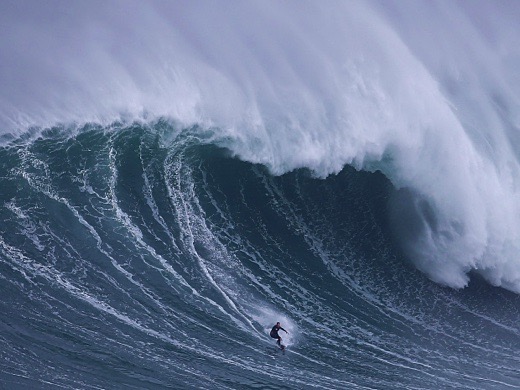
Image above: German surfer Sebastian Steudtner drops down the face of a gargantuan wave at Praia do Norte, in Nazare, Portugal, on Nov. 1, 2015. The beach at the tiny fishing village has become a famous big wave surf spot ever since Hawaiian surfer Garrett McNamara set a world record there in 2011. Photo by Rafael Marchante. From (http://www.cbc.ca/news/world/photos/monster-waves-attract-daring-surfers-to-portugal-1.3301909).

I took up surfing in my early 30s.

It didn’t last long. But I learned a tremendous amount from the experience (least of which is that I suck at surfing).

Well, it’s time to think like a surfer... Your sole focus is to catch the wave.

The best surfers can see the waves building, just like we can in the markets, but they only care about where the biggest, best waves will crash. That’s where you get the ride.

And if you catch the biggest wave in the right place, you get the ride of a lifetime.

Look at this fourth and largest wave building in the stock market. It’s the wave of a lifetime for investors, and it’s rolling onto our shores right about now…

Remember, all the action comes when the wave crashes, not as it’s building.

As the swell grows around you, you can go with the flow and harness the energy of the wave with little effort. That’s when you become one with the universe, sitting there on your board, surrounded by dark water, rolling up and down as the power builds beneath you. That’s why surfers get addicted.

Then, at the perfect moment, all the wave’s pent up energy releases in a roaring spray of water and power.

That’s where we want YOU to be when the greatest market wave of your lifetime comes crashing to shore!

That’s when the greatest profits come.

That’s when the greatest innovations spring up.

The smartest people (I include surfers in this group) and the greatest innovators understand this. They don’t look at a good economy as the best opportunity for success. Seeds of radical innovation only grow in the most challenging conditions.

That’s why the best traders are most often short sellers rather than long buyers… just ask Paul Tudor Jones or George Soros.

That’s why people who are prepared for the crash make out like bandits in the aftermath.

While writing my latest best seller, The Sale of a Lifetime, I created a bubble model for stocks. It follows the Masters and Johnson male orgasm study of the late 1950s.

Bubbles build exponentially and then burst twice as fast, deflating back to their point of origin (or close).

Exactly like the ocean waves that surfers spend their lives hunting for. And precisely what smart investors spend their lives waiting for!

Central Banks have extended this wave beyond all expectations, but it’s now showing signs of peaking. It looks like it’s getting ready for that big crashing later this year.

You can either paddle out past where this massive 40-foot wave (at least you’ll be safe)…

Or you can ride it all the way down and create extreme wealth.

This is one of those defining moments.

The choice is entirely yours.

But know that our best investment services are designed to not only to profit from the upside (as the swell builds), but to also rake it in during the downside, when it comes crashing down like Holy Hell!


.

Lanai sustainable energy plan upset

SUBHEAD: Punahou grad no longer heading billionaire Larry Ellison’s Lanai sustainable energy efforts.

By Duane Shimogawa on 27 March 2017 for Bizjournals -
(http://www.bizjournals.com/pacific/news/2017/03/27/punahou-grad-no-longer-heading-billionaire-larry.html)


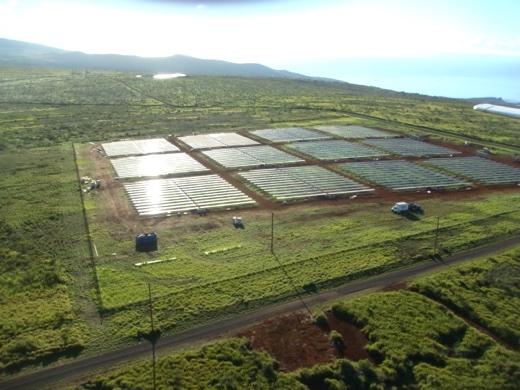
Image above: Sunpower Lanai Laola Solar PV Farm. From (http://hawaiirenewableenergy.org/).

Billionaire Oracle Corporation founder Larry Ellison is not using the expertise of an energy veteran and Punahou School alumnus to lead his sustainability efforts on the Hawaiian island of Lanai that he purchased for $300 million in 2012, the company heading operations on the island on behalf of Ellison confirmed to Pacific Business News.

In 2013, Ellison, who has talked about turning the Pineapple Island into a “model of sustainability,” tapped Byron Washom, director of strategic energy initiatives at University of California-San Diego, to lead his Lanai sustainability efforts.

In that role as chief architect, Washom was working with Pulama Lanai, the company owned by Ellison, to oversee the development of an electricity microgrid that would’ve been powered by renewable energy sources and a desalination plant that would’ve augmented the island’s supply of fresh water. Neither projects have been able to get off the ground.

A spokeswoman for Pulama Lanai told PBN that Washom is not actively engaged with the company.

Washom, who was raised on Midway Atoll and Oahu, is responsible for energy management policy at UC San Diego. His stint with Pulama Lanai was supposed to last at least nine months.

Hawaiian Electric Co. through its subsidiary Maui Electric Co., which covers the islands of Maui, Molokai and Lanai, recently revealed that the Pineapple Island could get to 59 percent renewable energy by 2020, using a mix of renewable energy projects, including solar.

The island already has a 1.2-megawatt solar farm, which supplies about 10 percent of the island’s electricity. There are more than 3,000 residents on the island.

A major plan to develop a large wind farm on the island and connect it to an undersea cable that would pump power to energy-starved Oahu is now off the table.

Ellison, through a spokeswoman for Oracle, told PBN that it will be declining the opportunity to talk about the billionaire’s latest plans for the island.

See also:
Ea O Ka Aina: Paradise Real Estate 12/11/12
Ea O Ka Aina: The Pivot Point 9/21/12
Ea O Ka Aina: Pro Big Wind signs come down 7/23/12
Ea O Ka Aina: Larry Ellison - Oracle 6/21/12


.

Hawaii missile defense a bad idea

SOURCE: Katy Muzik PHD (kmuzik@gmail.com)
SUBHEAD: A missile defense system in Hawaii would be a costly mistake that won't make us any safer.

By Ian Lind on 3 May 2017 for Civil Beat -
(http://www.civilbeat.org/2017/05/ian-lind-why-installing-a-missile-defense-system-is-a-bad-idea/)


Image above: The first intercept flight test of a land-based Aegis Ballistic Missile Defense (BMD) weapon system and Standard Missile-3 Block IB Threat Upgrade guided missile, launched from the the Pacific Missile Range Facility in Kauai in 2015. From original article.

Pushing ahead with a missile defense system in Hawaii wouldn’t make us any safer, and could signal to North Korea and others that we aren’t interested in diffusing tensions.

With so much going on in Washington and the world these days, it’s no wonder that the remarks of the Hawaii-based Commander in Chief Pacific drew only modest local attention.

Admiral Harry Harris Jr., who has been at the helm of the world’s largest military command for just two years, told the House Armed Services Committee last week that we should be installing a missile defense system here in Hawaii to defend against a potential North Korean nuclear attack.

Harris has repeatedly expressed concern about the threat from North Korea “because you have an unpredictable leader who is in complete command of his country and his military.”

No doubt North Korea’s nuclear program is worrisome. But there are many reasons that building an anti-missile system is not the answer. What’s wrong with a missile defense? The answer, it turns out, is quite a lot.

First, there are the practical aspects. Despite decades of research and development, missile defense is still a hit-or-miss technology. It can’t be relied on for protection, despite incremental improvements over the years, especially in the case of long range missiles, which pose a very different threat than short range non-nuclear missiles, where existing defense systems have proven their value.

Second, remember the old adage—If the only tool you have is a hammer, everything starts to look like a nail. That’s increasingly our problem today.

At the same time the Trump administration is seeking dramatic increases in U.S. military spending, and loosening restraints on military commanders, it has decimated the State Department’s top ranks by demanding resignations and then leaving most posts unfilled.

To make matters worse, the administration has put sensitive diplomatic tasks, which should be the province of the diplomatic corps, into the hands of family insiders with no experience in such matters.

At a moment when skillful diplomacy is desperately needed, we’re in danger of finding ourselves being forced to rely on military responses to threatening international events because our diplomatic resources have been so severely compromised.

Third, although we like to view anti-missile technology as purely defensive in nature, that’s not how it appears to our adversaries.

Here’s the problem. The nuclear arms race between the U.S. and the former Soviet Union showed that there really isn’t a role for nuclear weapons in actual combat. Instead, their value is primarily as a deterrent against a nuclear attack by another nuclear power.

The doctrine of “mutually assured destruction,” or MAD, is the idea that neither side could contemplate a nuclear strike on the other because a devastating counter-attack would lead to certain annihilation. Both sides would be wiped out in a nuclear war.  And as long as we knew that, and they knew that, the world stayed away from the brink of nuclear war.

But a robust anti-missile defense system would be destabilizing because it would undermine a key part of the MAD doctrine. If one side could render a nuclear counter-attack ineffective via an anti-missile system, the country that deployed it would no longer have to fear that devastating second strike.

So erecting such defenses can be seen, somewhat counterintuitively, as making nuclear war more likely.

And although the immediate threat today is from North Korea, what we do to counter it has immediately implications for other adversaries, including China and Russia. And their responses could, in the long run, prove more dangerous than the somewhat tenuous current threat of a Korean attack on Hawaii.

Yes, it’s very complicated, as President Trump has been finding out. Each policy has myriads of unintended consequences, and reliance on a missile defense system is no exception.

And, fourth, let’s be honest. If North Korea is targeting Hawaii, it probably isn’t because they’re threatened by our visitor industry. It’s because Hawaii has become home to both the command headquarters and military bases that are targeting North Korea. These military facilities make us targets.

So while island residents mostly relate to military facilities in terms of their economic impact on the state, the jobs they provide, we have to be mindful that they also draw us into the middle of any future military conflicts.

So what should the U.S. do?

I think the first step has to be to stop thinking primarily of military solutions. None of those are pretty.

Meanwhile, China has pointed to the need to reduce tensions on the Korean peninsula by beginning to demilitarize. They have suggested a quid pro quo in which North Korea might drop their nuclear program in exchange for a suspension of joint U.S.-South Korean military maneuvers, which they see as provocative and threatening.

Similar steps to defuse military tensions were backed last week by Women Cross DMZ, a coalition of women from 40 countries, including North and South Korea, who called for “an even-handed freeze on both North Korea’s nuclear program and the US/South Korea military exercises.”


Image above: Admiral harry S. Harris Commander, U.S. Pacific Fleet, said a missile defense system should be installed in Hawaii. back in 2011 he said Lybia campaign was sustainable. We all know how well that "victory" turned out... a failed state and ISIS. From (http://www.timesfreepress.com/news/news/story/2011/jun/15/admiral-harris-says-libya-campaign-sustainable/51936/).

But reflecting our over-reliance on military responses—the hammer-and-nail problem— Admiral Harris is doing just the opposite. During his congressional appearance last week, Harris said joint military exercises with Japan and South Korea, as well as deployments of American warships, along with B-1 and B-52 bombers, will “ameliorate Kim Jong Un’s worse impulses.”

It’s not hard to see that what Harris looks at as responses to North Korea are easily seen as threats in their own right, seeming to confirm Kim Jong Un’s worst fears.

In that context, pushing ahead with a missile defense system in Hawaii would be a costly mistake. It wouldn’t make us any safer, and it could make the world a more dangerous place by signaling that we aren’t interested in diffusing tensions between North and South Korea, and their neighbors, or by demilitarizing the region.

So let’s just say to Admiral Harris, “thanks, but no thanks.”

It’s a tradeoff that not everyone is happy with. The military’s extensive physical presence involves a loss of local control over and ability to protect public land and other natural resources.

• Ian Lind is an award-winning investigative reporter and columnist who has been blogging daily for 15 years. He has also worked as a newsletter publisher, public interest advocate and lobbyist for Common Cause in Hawaii, peace educator, and legislative staffer. Lind is a lifelong resident of the islands. Read his blog at (http://www.ilind.net/).

See also:
Ea O Ka Aina: Kauai military buildup at PMRF 2/22/17
Ea O Ka Aina: Fuck the PMRF's Aegis plan! 1/23/16
Ea O Ka Aina: PMRF Aegis missile test 5/11/12
Ea O Ka Aina: Land based Aegis on Kauai 9/2/11
.

ChemChina takeover of Syngenta

SUBHEAD: For $43billion the Chinese chemical corporation gains control of Swiss Syngenta.

By Michael Shields on 5 May 2017 for Rueters -
(http://uk.reuters.com/article/us-syngenta-ag-m-a-chemchina-idUKKBN1810CU)


Image above: Syngenta corporate logo wall sign. From original article.

ChemChina [CNCC.UL] has won more than enough support from Syngenta shareholders to clinch its $43 billion takeover of the Swiss pesticides and seeds group, the two companies said on Friday.

The deal, announced in February 2016, was prompted by China's desire to use Syngenta's portfolio of top-tier chemicals and patent-protected seeds to improve domestic agricultural output. It is China's biggest foreign takeover to date.

It is one of several deals that are remaking the international market for agricultural chemicals, seeds and fertilisers.

The other deals in the sector are a $130 billion proposed merger of Dow Chemical and DuPont, and Bayer's plan to merge with Monsanto.

The trend toward market consolidation has triggered fears among farmers that the pipeline for new herbicides and pesticides might slow. Regulators have required some divestments as a condition for approving the Syngenta deal.

Based on preliminary numbers, around 80.7 percent of Syngenta shares have been tendered, above the minimum threshold of 67 percent support, the partners said in a joint statement.

The agreed offer is for $465 per share. Syngenta shares closed on Thursday at 459 Swiss francs ($464.5), and rose 0.4 percent in early trade on Friday to 461.20 francs.

The transaction is set to close on May 18 after the start of an additional acceptance period for shareholders and payment of a special 5-franc dividend to holders of Swiss-listed shares on May 16. Holders of U.S.-listed depositor receipts will get the special dividend in July.

Syngenta shares will be delisted from the Swiss bourse and its depository receipts from the New York Stock Exchange.

Chief Executive Erik Fyrwald played down the transition from publicly listed group to becoming part of a Chinese state enterprise, stressing that Syngenta would remain a Swiss-based global company while under Chinese ownership.

"It is very important to understand that this is a financial transaction," he told broadcaster CNBC in an interview.

He saw two major changes: giving Syngenta a long-term shareholder to accompany it during the 12 years it typically takes to discover and launch new products, and helping to overhaul Chinese agriculture, which he called very much behind the global standard.

He said he expected the acceptance rate to easily surpass 90 percent, with a squeeze-out of remaining shareholders to follow if needed in June.

Funding for the acquisition was clear and irrevocable, while refinancing the company after the transaction closed was still being discussed.

"I am very confident we are going to have a strong balance sheet as agreed," he said, with an investment-grade rating that would let it pursue market share growth, investments, capital spending and acquisitions.

Syngenta sells its products in more than 90 countries under such brand names as Acuron, Axial, Beacon and Callisto. It sells seeds such as cereals, corn, rice, soybeans and vegetables.

.

Evolution in the Fast Lane

SUBHEAD: Some species are evolving far more quickly than Darwin ever imagined. Is it fast enough?

By Jane Braxton on 22 January 2015 for Discover Magazine-
(http://discovermagazine.com/2015/march/19-life-in-the-fast-lane)


Image above: Reznick’s study of Trinidad guppies revealed that the fish can evolve rapidly. Photo by Paul Bentzen. From original article.

[IB Publisher's note: This article is a bit dated. Unfortunately, we don't have 20 generations to adapt to climate change caused by global warming. I doubt if we have 2 generations. Adapt now and avoid the crush at the bottleneck up ahead.]

As a graduate student in the late 1970s, David Reznick set out on a modest quest to test a key part of the theory of evolution. Reznick wanted to examine Charles Darwin’s concept of the struggle for existence — specifically, how predator-prey interactions shape the evolution of new species.

Enthusiastic and ambitious, he intended to do it in the wild. “I wanted to watch evolution happen,” says Reznick, now an evolutionary biologist at the University of California, Riverside.

So in 1978, he flew to Trinidad in search of guppies. Armed with a topographic map traced onto a piece of notebook paper, he headed into the Caribbean island’s rugged Northern Range.

Working under a canopy of tropical trees amid squawking birds, multicolored butterflies and boas, he collected 1,600 guppies, a colorful fish species so prolific that the females can produce dozens of babies every three to four weeks. Reznick was curious to see if predators could affect genetic adaptation in guppies over a short time.

It was not considered a promising experiment. A century earlier, Darwin had assumed that evolution takes tens to hundreds of thousands of generations to produce new species — a plodding path so slow it is essentially invisible.

That theory still held sway when Reznick began grad school in 1974. Scientists had studied evolution in controlled laboratory experiments, but watching it happen in a natural setting in a human lifetime was considered improbable at best, more likely impossible.

“I was hanging my career on the idea that you could change the environment and see things evolve significantly in time to get tenure,” Reznick says. “People thought my thesis was cute, but doubted I would live long enough to see the results.”

Undaunted, in 1981 Reznick returned to Trinidad’s swift streams to test his theory. He transplanted guppies from a site where they had to fend off cichlids, an aggressive, wide-mouthed fish, to a new site with no predators and no other guppies. Reznick also introduced cichlids to guppy sites without predators.

He found that within four years — a mere six to eight generations — male guppies had significantly changed their reproductive patterns. Those transplanted from a high-predation site to a stream without predators were larger, matured later and reproduced more slowly. Where Reznick had introduced predators, the guppies adapted by maturing at an earlier age. Survival became a race to produce more babies.

“The risk of death alters the ways organisms allocate resources for survival,” Reznick says.

The results of his federally funded study prompted what he calls one of his proudest moments in science: a National Enquirer story with the headline, “Uncle Sam wastes $97,000 to learn how old guppies are when they die.”

Actually, Reznick chuckles, “I learned a great deal more than that.”

His work with the guppies changed his thinking about how quickly species can evolve. And it helped launch a paradigm shift in scientists’ thinking about evolution.

In the decades since Reznick’s first trip to Trinidad, other studies have demonstrated a fast drive toward adaptation that scientists have come to call “rapid evolution.” Researchers who once assumed evolution required millennia are documenting species adapting in mere decades, or even shorter time frames.

Mosquitoes that colonized the London Underground in 1863 are now so different they can no longer mate with their above-ground relatives.

Chinook salmon from Alaska to California needed just a human generation to become smaller and shorter-lived after an increase in commercial fishing in the 1920s. Adaptation is happening right under our noses, in our lifetimes.


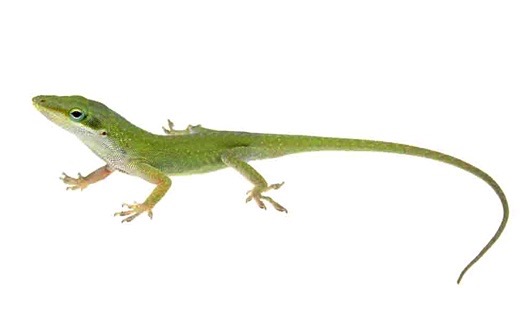
Image above: Green anole gecko lizards have adapedt to the invasion of brown anoles in only 20 generations. Photo by Seth Patterson. From original article.

Most recently, evolutionary biologist Yoel Stuart found that green anole lizards on islands in Florida’s Indian River Lagoon needed just 20 generations to adapt to an invasion of brown anoles.

Driven to higher perches by the invaders, the green anoles became better at clinging to branches by developing larger toepads with more scales — in just 15 years. It’s more evidence of “evolutionary change on observable time scales,” says Stuart, now at the University of Texas at Austin.

Many of the extraordinary adaptations happening around us may be because of us. As human activity disrupts climate patterns and modifies habitats, rapid evolution appears to be an increasingly common strategy for survival.

The effect of warming temperatures on tawny owls is one of the first documented examples of adaptation to climate change in a wild population. Finnish ornithologist Patrik Karell and others found in a 2011 study that the coloration of the owls morphed in response to warming winters in Finland.

Tawny owls come in two colors, pale gray and reddish brown. Until recently, natural selection favored the pale shade, which gave owls a better chance at survival in a snowy landscape. As winters became milder, Karell noticed a steady increase in the proportion of reddish-brown owls.

“Even subtle alterations shape how organisms evolve,” Reznick says.

Species are evolving at speeds that Darwin could not have imagined. But not all species can adapt quickly enough to evade harm. When a non-native species arrives in an ecosystem, the native species often are ill-equipped to defend against the foreign invader.

Ash trees in North America, for example, lacked “evolutionary accommodations” to protect against the emerald ash borer when it arrived from Asia, Reznick says. As a result, tens of millions of ash trees across the continent are threatened by the green beetle, which is thought to have hitchhiked to the U.S. in wood crating or pallets.

Today’s evolutionary biologists have the analytic power to track species adaptation like never before. Advances in molecular biology allow them to identify the very genes that help individuals move away from their ancestors as they adapt to new conditions.

For example, a team of scientists at Harvard Medical School and Princeton identified BMP4 as the key gene that sculpts the beaks of the Galapagos finches that gave Darwin his first inklings of the theory of evolution.

“We are no longer forced to infer evolution from its historical footprints in the fossil record or from dusty collections of moths,” Reznick says.

Reznick and his team continue to transplant guppies in the tropical streams of Trinidad.

Along with other new tools of evolutionary biology, such as DNA analysis, they are using a technique Reznick developed to mark individual guppies so they can more easily recapture them later. This marking method allows his team to reconstruct the pedigree of individual guppies and measure their reproductive success.

The research is answering questions about how predator-prey interactions shape evolving species, but it has also generated new questions: If environmental forces can change guppies, could the guppies themselves also change their ecosystems? Intrigued, Reznick has turned his attention to how ecological and evolutionary processes interact.

Now he’s not only monitoring guppies; he’s also watching their predators to see how the interaction changes the ecosystem. His team wants to know how guppies adapt to predators as well as how predators evolve in response to guppies — the ecological cause-and-effect relationships.

“What hardly anyone’s thinking about is that the animals and plants left behind may have evolved and are different from what they were before predators were eliminated,” Reznick says. This raises fundamental questions about ecological restoration, invasive species, natural selection and what else changes when the fittest actually survive.

Documenting the rapid evolution of species in natural settings turns Darwin’s “mystery of mysteries” into a real-time scientific adventure.

And while Reznick has succeeded in watching evolution happen, he’s beginning to think his earlier calculations underestimated how quickly species actually adapt in nature. “What’s exciting,” says Reznick, “is that it is now feasible to incorporate evolution into our thinking about how the world is changing.”
.

Humans can change rapidly

SUBHEAD: Study indicates we are better at making quick changes than is generally thought. Let's hope so.

By Alex Kirby on 3 May 2017 for Truth Dig -
(http://www.truthdig.com/report/item/humans_are_better_at_rapid_change_than_we_think_20170503)


Image above: Mostly female workers employed as wipers by the Chicago and Northwestern Railroad take a break for lunch in in Clinton, Iowa, in 1943. Photo by Jack Delano in a book on New Deal photography. From (http://bintphotobooks.blogspot.com/2016/09/views-reviews-introducing-america-to.html).

Human beings often forget that we have an invaluable ability, says a study by two British social scientists: we can change the world around us, and our treatment of it, more quickly and more significantly than we realise.

Beset by wars and rumours of still worse wars, by economic, political and social implosions, by natural disasters and a climate warming faster than we can moderate our impact on it, it is easy to think that changing to a greener and fairer society is beyond us. But rapid, radical transitions are more possible than we suppose, the study says.

Perhaps this sounds like so much wishful thinking. But the authors say their conclusions are firmly based on facts: what we can learn about our capacity for rapid change, they say, comes through examples drawn both from history and from the present day.

The study is published by the New Weather Institute and the STEPS Centre (based at the University of Sussex in the UK) and was funded by the UK’s Economic and Social Research Council.

It details 14 stories of the sort of change it believes we need now. The choice is necessarily highly selective – “just a glimpse of where we might look”, as the authors put it.

One story describes the New Deal in 1930s America, which, the study says, “invested an amount similar to that thought needed for low carbon transition today to public relief and federal works programs.

“The New Deal saw a general drop in income inequality, an improvement in gender equality, a major program of new public housing and significant environmental works.”


Image above: Kurdish YPG fighters, whose experiment with direct democracy is cited in a British study on change includes women fighters. From original article.

A present-day example comes from Kurdish Rojava, at the heart of the Syrian conflict, where the authors say experiments with direct democracy on feminist and ecological principles “show that citizens can work together even in the face of violence and economic collapse”.

They describe the rapid changes that have occurred in renewable energy capacity in countries from Costa Rica to Denmark, and in food systems in Cuba.

They even suggest that the eruption of the Eyjafjallajökull volcano in Iceland in 2010, which halted northern European air travel overnight, prompted businesses and individuals to adapt almost instantly to the loss of a transport link previously thought indispensable.

But while the authors argue that we need drastic change and need it now, they acknowledge that achieving it involves overcoming massive obstacles.

“Much of human society is locked into a high-consumption culture, energy-intensive infrastructure, unequal power relations, and an economic system dominated by finance that fails the poorest and takes infinite growth for granted,” they write.

Other barriers lie more in mindsets and attitudes. “Opponents of radical change argue that it is impossible because of powerful interests, high costs, the lack of a detailed blueprint, or the unwillingness of governments or citizens to act. Others pin their hopes on technology to solve environmental problems.”

The study suggests that these barriers can be overcome, and have been in the past – through grassroots movements, or leadership from governments, or a combination of the two.

It insists that both the costs and the benefits of change must be equally shared. “To be accepted, rapid change must be seen to be fair. This is especially true if and where there is any perceived sacrifice to be made for the greater good.”

One co-author, Andrew Simms of the New Weather Institute, told the Climate News Network there was a secret human history of society achieving extraordinary things during times of upheaval. “It contradicts fears or political excuses that no progress can be made on vital social and environmental challenges because of Brexit, economic uncertainties, conflicts or security threats.

“We need those lessons now as we’re challenged to reverse socially divisive inequality and pull back from the edge of catastrophic, irreversible climate change,” he says.

“There are countless half-buried or forgotten examples that tell us that bold action in times of uncertainty is not only possible but could solve many other problems too.

“The power of past experience is how it shows that far from being powerless we have enormous capacity to adapt and change.”

.

Grand Theft Aina: Part II

SUBHEAD: Another heist-scam spree to give corporations control of public Hawaiian lands.

By Shannon Rudolph on 1 May 2017 in Island Breath -
(http://islandbreath.blogspot.com/2017/05/grand-theft-aina-part-ii.html)

http://www.islandbreath.org/2017Year/05/170502gta2big.jpg
Image above: Poster for opposition to another scam from developers to get their hands on Hawaiian public land. From author. Click to enlarge.

[IB Publisher's note 5/3/17: This proposal was defeated.] 
[IB Publisher's note 5/1/17: In 2012 when then Governor Neil Abercrombie brought the PLDC proposal to Kauai he was booed so badly he had to leave the stage and exit the venue. The move was a career ender.]


We already told legislators we do not want another Public Land Development Corporation (PLDC) type bill to be passed at the legislature - there are other, better ways to deal with these issues and do not want to have to mount another repeal of a bad bill that gives away Hawaiian/Public property.

The existing laws were put in place for very good reasons & ought to stay the way they are to protect our interests from shady deals with little public input and oversight.

In the last week of the legislature - This IS Grand Theft `Aina - Part 2... and it's going to take ALL of us to stop it in it's tracks on TUESDAY!

Please SHARE with your friends & ohana!

Please copy all Legislator email addresses at the bottom of this post and shoot them a quick email to tell them to knock it off - the public is aware of what they're trying to do - and do not approve!

UNITE HERE Local 5 (Hawaii's Hospitality & Healthcare workers union) noted:
“The legislation puts significant decisions about state land use into the hands of unaccountable, unelected committees to an extent that goes far beyond what existing state and county boards and commissions have. Through the requirements in the bill about who may serve on such committees, they will tend to be biased toward the unchecked, profit-driven short-term interests of developers, real estate salespeople and bankers.

"Hawaii is a small state, and people in these circles work together frequently – because of this, committee members are almost certain to have direct or indirect conflicts of interest. 

This legislation gives these unaccountable, unelected, conflicted committees the power to lease out state land for as long as they choose at whatever rates they choose, which runs directly counter to good procurement practice.

“The legislation proposes just one hearing before an unaccountable, unelected body at which the public can voice its concerns about a redevelopment project. There is no binding language that would give that public input any influence at all over a committee’s plans. 

There is no language mandating where, when, or at what point in the redevelopment process such a hearing would take place. There is no language ensuring the public would even have access to information necessary to give informed testimony about a redevelopment plan.

“We are in the midst of a real estate development bubble. There is no reason this legislation should artificially prop up developers or add to the incentives they already have. 

On the contrary, creating artificial incentives to build in places not supported by market demand is very risky for the state long-term. It is likely to create even more blight than whatever may already exist in a given area. This bill is written in such a way that this risk will be borne entirely by Hawaii’s citizens, not by developers.

Developers will not have an ongoing, longterm responsibility to the success of the projects they may build with the help of this bill. It is additionally perplexing that this bill does not even mention housing, much less contemplate or allow for housing to be a part of any redevelopment plans. Considering that the lack of affordable housing is one of the biggest crises Hawaii residents face, the absence of any discussion about housing in this bill is a glaring problem.”
Common Cause Hawaii opposed the bill:
“As this bill seems reminiscent of the Public Lands Development Corporation (PLDC), we are reminded that one of the many issues raised was the lack of transparency and access. 

Thus, because planning committees are given broad powers including the ability to renew or renegotiate leases, and the ability to make and execute contracts, it should be clearly specified that all planning committees and their meetings are subject to our Sunshine Laws to ensure that the public has every opportunity to participate and voice their opinions on plans and activities.

We believe that the public should be involved from the outset, not after a plan has already been drafted, as these plans and how they’re implemented will affect their neighborhoods and daily lives.”
The League of Women Voters of Hawaii said:
“We support public planning for redevelopment of public lands and transparent, competitive procedures for award of long-term commercial leases on public lands. We oppose HB 1469, HD1, SD1 because this bill contains provisions which would encourage existing commercial lessees of public lands to ‘play politics` to gain special unfair treatment.”
The conference draft morphed the bill into a version that some believe is a sweetheart deal for existing tenants on any state land, including the University of Hawaii and the Thirty Meter Telescope (TMT) on Mauna Kea.

Under existing law, leases of state lands can’t exceed 65 years. Then they need to go back out for auction. The policy is that any lease longer for 65 years is essentially a sale of land. So to be fair, you put it up for auction to allow new parties to bid. The final version of the bill eliminates the 65-year limit on any new or existing lease on any state lands. Basically, it’s turning tenants into potential owners of state land.

It also eliminates the Land Board’s rights to access certain information from lessees (making it optional) who sell, assign or sublease state land."​
Link: http://www.ililani.media/2017/05/hawaii-legislature-contemplates-return.html

BILL HERE:
​http://www.capitol.hawaii.gov/measure_indiv.aspx?billtype=HB&billnumber=1469&year=2017​

​EMAIL NOW! ​
​"No on HB 1469!!!​ HD1 SD2 CD1​"

LIST OF REPRESENTATIVES IN LEGESLATURE (cut and paste into email)
senbaker@Capitol.hawaii.gov, senchang@capitol.hawaii.gov, sendelacruz@capitol.hawaii.gov, senenglish@capitol.hawaii.gov, senespero@capitol.hawaii.gov, sengabbard@capitol.hawaii.gov, sengaluteria@capitol.hawaii.gov, sengreen@capitol.hawaii.gov, senharimoto@capitol.hawaii.gov, senihara@capitol.hawaii.gov, seninouye@capitol.hawaii.gov, senkahele@capitol.hawaii.gov, senkeithagaran@capitol.hawaii.gov, senkidani@capitol.hawaii.gov, senkim@Capitol.hawaii.gov, senkouchi@Capitol.hawaii.gov, sennishihara@capitol.hawaii.gov, senrhoads@capitol.hawaii.gov, senriviere@capitol.hawaii.gov, senruderman@capitol.hawaii.gov, senshimabukuro@capitol.hawaii.gov, sentaniguchi@capitol.hawaii.gov, senthielen@capitol.hawaii.gov, sentokuda@capitol.hawaii.gov, senwakai@capitol.hawaii.gov, repaquino@Capitol.hawaii.gov, repbelatti@Capitol.hawaii.gov, repbrower@Capitol.hawaii.gov, repcachola@Capitol.hawaii.gov, repchoy@Capitol.hawaii.gov, repcreagan@Capitol.hawaii.gov, repcullen@Capitol.hawaii.gov, repdecoite@Capitol.hawaii.gov, repevans@Capitol.hawaii.gov, repfukumoto@Capitol.hawaii.gov, repgates@Capitol.hawaii.gov, rephashem@Capitol.hawaii.gov, repholt@Capitol.hawaii.gov, repichiyama@Capitol.hawaii.gov, reping@Capitol.hawaii.gov, repito@Capitol.hawaii.gov,repjohanson@Capitol.hawaii.gov, repkeohokalole@Capitol.hawaii.gov, repkobayashi@Capitol.hawaii.gov, replee@Capitol.hawaii.gov, replopresti@Capitol.hawaii.gov, replowen@Capitol.hawaii.gov, repluke@Capitol.hawaii.gov, repmatsumoto@Capitol.hawaii.gov, repmcdermott@Capitol.hawaii.gov, repmckelvey@Capitol.hawaii.gov, repmizuno@Capitol.hawaii.gov, repmorikawa@Capitol.hawaii.gov, repnakamura@Capitol.hawaii.gov, repnakashima@Capitol.hawaii.gov, repnishimoto@Capitol.hawaii.gov, repohno@Capitol.hawaii.gov, reponishi@Capitol.hawaii.gov, repmoshiro@Capitol.hawaii.gov, repquinlan@Capitol.hawaii.gov, repsaiki@Capitol.hawaii.gov, repsanbuenaventura@Capitol.hawaii.gov, repsay@Capitol.hawaii.gov, repsouki@Capitol.hawaii.gov, reptakumi@Capitol.hawaii.gov, reptodd@Capitol.hawaii.gov, reptokioka@Capitol.hawaii.gov, reptupola@Capitol.hawaii.gov, repward@Capitol.hawaii.gov, repwoodson@Capitol.hawaii.gov, repyamane@Capitol.hawaii.gov, repyamashita@Capitol.hawaii.gov


.

100% Renewable Hawaii

SUBHEAD: 100% Renewable Hawaii" is inevitable - Your share will likely be what you have installed yourself.

By Juan Wilson on 1 May 2017 for Island Breath -
(http://islandbreath.blogspot.com/2017/05/100-renewable-hawaii.html)


Image above: Tour of system and battery array needed to power remote house in Alaska. From video below.

The good news is that we will achieve 100% renewable energy here in Hawaii fairly soon.

That news even reaches further abroad. The whole planet Earth will attain that goal sometime in the future as well.

The bad news is that here in Hawaii that will happen only as a result it not being economically feasible to get oil, gas or other sources of energy that can deliver 24 hours a day/ 7 days a week/ 365 days a year support for the power grids to our islands.

Then, as a result, we will have only what renewable energy we have installed before that date. Now there may be  plenty of PV panels on the roofs of homes, businesses and institutions in Hawaii, but only a fraction of that is supported with enough battery storage to get a site through the night, much less a few weeks of rainy weather.

Certainly, solar panel costs are a fraction of what they once were, and they could last thirty years.

But for electrical power self reliance, the battery storage capability is as important, and more ultimately more expensive than the PV panels. That's because most batteries won't last six or seven years. The best we have experienced has been ten years for 3 out of 4 of a set of AGM (glass-mat) sealed batteries.

For of the five of the seven PV systems we run our house on, we use  arrays of four 110 amp-hour deep cycle marine batteries. The oldest still operational were installed in late 2010.

The two battery arrays we use to;
1) operate the outlets and switches in the house through the old circuit board and
2) to run our refrigerator and freezer appliances; each use 8 AGM 6volt 410 amp-hour batteries. Those batteries are five years old and cost more than the solar panels that charge them.

And don't count on running your home system with a gas powered electric generator every night to get around the storage issue. That generator fuel won't be available in the quantity needed to run everybody's house through each night. You can count on the generator for not much longer than a short hurricane emergency with the fuel you have on hand.

Henry Curtis wrote in November 2016:
What if solar were the only energy source? Photo-voltaic panels could absorb light and convert it into electricity between 8 am and 5 pm.

During the intense middle part of the day, from 10 am to 2 pm, the supply would exceed the demand. The excess supply could be stored in an energy storage system, and be available for use from 5 pm to 8 am.

The home or business would use only solar power and hence the average solar penetration would be 100 percent. If in the middle of the day the solar electricity being generated were three times the demand, then the solar capacity would be 300 percent.

Hawaii PUC Commissioner Michael E. Champley asserted at the VERGE Hawaii 2016 conference addressed the issue.
“In reality, we`re probably going to need 300 plus percent renewable capacity, if we`re going to get to 100 percent renewable energy.” 
At the present rate of Hawaiian adoption of alternative energy it is unlikely that many will be prepared for a time when the grid on their island goes down and doesn't get up. Even those who are prepared might not have thought out the "arc of story" regarding industrial collapse.

There will come a time when the rare elements and raw materials used to make solar PV panels, charge controllers, inverters - and perhaps most critically storage batteries - will either be unaffordable or unavailable.

I speak of batteries as "being critical" because the panels have particularly long lives (assuming hurricane debris doesn't take them out) and the inverters and controllers, if used properly seem fairly rugged. It's the batteries that get ruined fast if you decide to keep the freezer going through just a few weeks of cloudy weather off-grid with just a single battery charge.

I often say running a solar powered house is like sailing a boat. On a boat the sailor has to be constantly aware of the wind direction and strength. At any moment the wind could change direction and strength and wreck his vessel.

So when I say "100% Renewable Hawaii" it is because it is inevitable - one way or another. And what power you have available will be because you installed an off-grid system.

But that off-grid system storage capability will degrade over time and you will not be able to fully replace it... and over time you will learn to live with less electricity -  and eventually just a little - and if you live long enough you might live here in Hawaii like the early Polynesians did - with no electricity.

But that's okay. You'll have been weaned.


Video above: "Off Grid Electricity in Remote Alaska". From (https://youtu.be/pij7SjOx4xA).

See also:
Ea O Ka Aina: Alaska turning to microgrids 3/6/17
.

Sound of One Wing Flapping

SUBHEAD: Just when you thought it was safe you find that a calm surface is exactly what Black Swans like to land on.

By James Kunstler on 1 May 2017 for Kunstler.com -
(http://kunstler.com/clusterfuck-nation/sound-one-wing-flapping/)


Image above: One from a series of photos of a black swan landing on calm waters. From (http://wampy1.blogspot.com/2011/04/black-swan-landing.html).

And suddenly the storms of early Trumptopia subside, or seem to. The surface of things turns eerily placid as the sweets of May sweep away the toils of an elongated mud season. Somebody stuffed Kim Jong Un back in his bunker with a carton of Kools and the Vin Diesel video library.

France appears resigned to Hollandaise Lite in the refreshing form of boy wonder Macron. It’s been weeks since The New York Times complained about the Russians stealing Hillary’s turn as leader of the free world.

We’re given to understand that Congress managed overnight to cook up a spending bill that will avert a Government shut-down until September. Rest easy America… oh, and buy every dip.

A calm surface is exactly what Black Swans like to land on, though by definition we will not know they’re out there until our reveries are broken by the sound of wings flapping.

Some kind of dirty bird showed up on Canada’s thawing pond last week when that country’s biggest home loan lender suffered a 60 percent pukage of shareholder equity and had to be bailed out — not by the Canadian government directly, but by the Ontario Province’s Health Care Workers Pension Fund, a neat bit of hocus pocus that amounts to a one-year emergency loan at ten percent interest.

If that’s a way for insolvent public employee pension plans to find enough “yield” to meet their obligations, then maybe that could be the magic bullet for the USA’s foundering pension funds.

The next time Citibank, Goldman Sachs, JP Morgan, and friends get a case of the Vapors, let them be bailed out by the Detroit School Bus Drivers’ Pension Fund at ten percent interest. That ought to work. And let Calpers take care of Wells Fargo.

The situation across Western Civilization is as follows: virtually every major financial institution has become a check-kiting operation or a Ponzi scheme, and we’ve reached the point where they can only pretend to be rescued.

Bailout or not, the Toronto-based Home Capital Group is still stuck with shit-loads of non-performing sub-prime mortgage loans — its specialty — and Canada’s spectacular real estate bubble has hardly begun to pop. The collateral is starting to turn, like dead meat in the May sunshine, and the odium will waft across the border.

It doesn’t take much to blow things up, as the world discovered in several other historically recent episodes.

The 1998 banking contagion started with the collapse of Thailand’s currency, called the baht. I doubt you could count on one hand the number of people in Wall Street or the Federal Reserve (with its 300-plus PhD economists) who gave a flying fuck about the Thai baht.

Before you knew it, South Korea and Indonesia started whirling around the drain. And then Russia felt the suck.

And then the Nobel Prize winning economists at a Connecticut hedge fund called Long Term Capital Management found out the hard way that their “secret sauce” investment formula which “could not fail in the life of this universe or several like it,” fatally poisoned its balance sheet on a repast of Russian sovereign bonds after only about eighteen months.

And it took all the poobahs of American banking to paper over the firm’s death about five minutes before the global banking system would shut down via the greatest daisy chain of cross-collateralized financial booby-traps ever assembled.

And ten years later, there was the fiasco of 2008, starring Lehman Brothers and a demonic host of grifters trafficking in worthless bonded debt around the sub-prime mortgage racket tied into a toxic web of “derivative financial products” — i.e. bad bets between insolvent counter-parties masquerading as “insurance” against unsound investment. Trillions of bailout monies conjured out of thin air fixed that, oh yes it did!

So enjoy the festivities around the Maypole today, and the suddenly calm waters of global affairs, and keep your ears pricked for the sound of wings flapping.

See also:
Ea O Ka Aina: Land as insurance - The Black Swan 3/7/17

.