Showing posts with label Prepper. Show all posts

A trashcan of canned food

SUBHEAD: When the SHTF and the supermarkets sold out this will get you through the worst of it.

By Juan Wilson on 23 July 2018 for Island Breath -
(http://islandbreath.blogspot.com/2018/07/a-trashcan-of-canned-food.html)


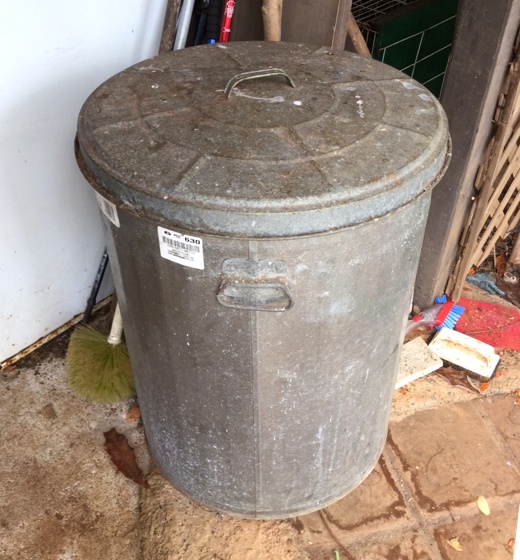
Image above: Galvanized garbage can used to store canned food in outdoor conditions out of the rain. Photo by author.

Living in rural Hawaii we can year round grow fruits and vegetables for our table. We also can provide ourselves with all the eggs (and more) that we need with eight hens in a 4'x16' henhouse.

We are not vegetarians. Our fruit, vegetable and eggs are vital to us but we continue to rely on other sources for much of our protean.

Although we occasionally eat one of our hens when they stop laying, we are not yet raising fish, birds or mammals for dinner table. We rely on others for our fresh fish, poultry and meat.


In our garage is a steel galvanized garbage can. It is filled with canned food.


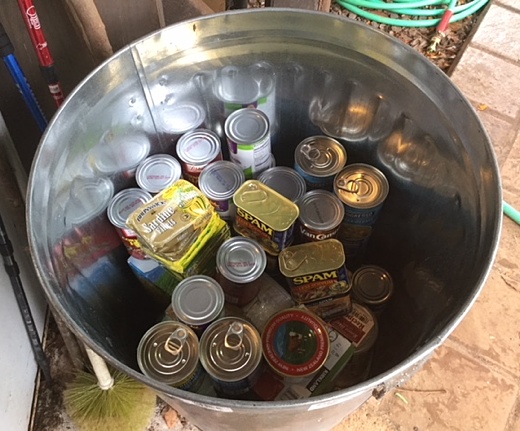
Image above: Inside the trashcan we keep canned food. Mostly items with hearty content, high in protein. Photo by author.

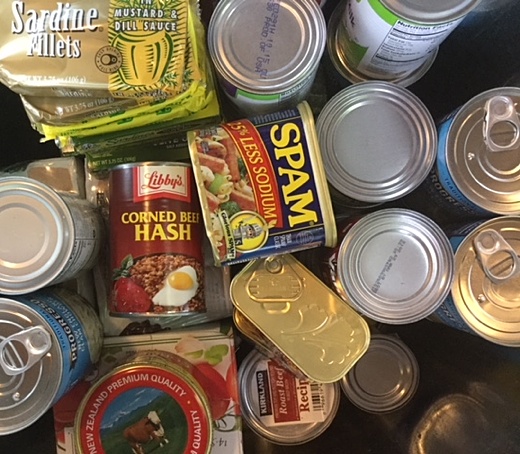
The meat in cans includes Spam (pork); corned beef hash, corned beef, canned roast beef; canned chicken, canned tuna, canned sardines, canned kippers (fish); soups including clam chowder, turkey rice, pea soup with ham. In addition we keep canned pinto, black, garbonzo and kidney beans; canned beef and chicken broth, and canned whole tomatoes for mixing with fresh vegetables.

With these canned items we also combine rice, rice pasta and also yard grown breadfruit, cassava or taro to create filling savory meals with plenty of protein - without having to throw a steak on the BBQ.

When our trashcan is filled there is enough food to stretch our "food independence" to a few months.

Image above: These foods are not just to get us through a disaster. We incorporate small amount of them into our regular cooking routines allowing us to get some experience getting the best out of them - before having to depending on them. Photo by author.

It should be added that this cache of food needs to maintained and refreshed over time. Even though many items are good for years we keep an eye on expiration dates and eat down (and replace) those items we feel need to be replaced.

We do not buy and store fresh water. We use filtration on water and have 1,500 gallons of water stored from a well and rain catchment system. We avoid packaged frozen "TV" dinners and freeze dried military style MREs.  They are too costly and unpleasant to eat.

We find it better to mix canned products with our own own fresh produce.


.

Get in the lifeboat now!

SUBHEAD: There is not much time left to find a way off this sinking ship. Find a seat soon.

By Juan Wilson on 19 June 2018 for Island Breath -
(http://islandbreath.blogspot.com/2018/06/get-in-lifeboat-now.html)


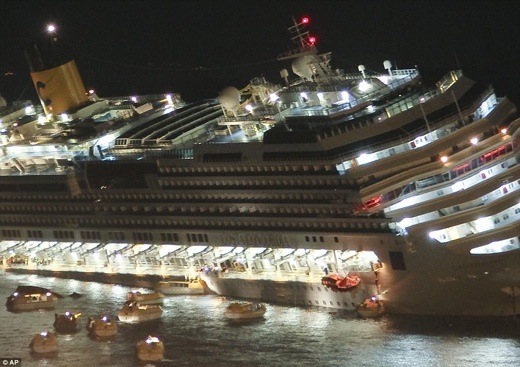
Image above: Abandoning the Costa Concordia that capsized and sank in 2012 off Isola del Giglio, Tuscany, Italy. From (https://paullaherty.com/2015/01/05/lessons-from-the-costa-concordia/).

I know it's comfy in the First Class State Room on A Deck but that won't be for long. As Americans we've grown accustomed to having "the best". However, now in the first part of the 21st century we are beginning to realize that we all are not "on board". An increasing number are in steerage... already below the waterline.

People around the world in places that have been trashed by over population, war,  bad agriculture, eco-collapse and fanaticism have been rushing to the exits - primarily to Western Europe, America, Australia, New Zealand and other parts of the world held together by some combination of modern technology, advanced military, historic plunder, natural resources  and/or isolation.

Those "safe havens" likely won't be able to handle the additional load. This is particularly true if those escaping intend to live in the style that "western civilization" has become accustomed:
Automobiles for everybody, highways to everywhere; universal electric grid, internet, and cell service; air conditioning, refrigeration, supermarkets, frozen food;  jet travel and fresh fruit on the table from another hemisphere, next day Amazon delivery service - total security... etc.
Those services cannot be provided for the eight billion people that inhabit the planet now. At this point of degradation of the ecosystem it is probably not possible for even a tenth of that number. That's about what the population of the world was when America became nation independent in 1776.

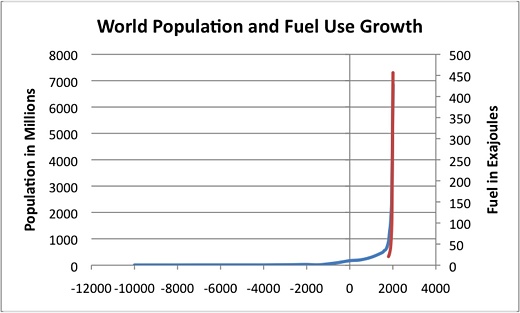
Basically, this human population explosion is a function of the consumption of fossil fuels. See the chart below:


Image above: World population from US Census Bureau inj blue, overlaid with fossil fuel use (red) by Vaclav Smil from Energy Transitions: History, Requirements, Prospects. From "Human Population Overshoot: What Went Wrong?"2/15/12 (https://ourfiniteworld.com/2012/02/15/human-population-overshoot-what-went-wrong/).

What is the solution?
Back away from your dependence on fossil fuel (and all that it supports) as soon as you can. Make your life livable (and hopefully enjoyable) off the grid as soon as you can. Get in a lifeboat now! By that I mean have at your immediate disposal a place where you can survive, and even thrive, without dependence on "The Mother Ship" (The System, The Grid, Civilization, the United States of America. etc.).

There is no time for any delay. My wife and I have been working towards this goal for over a decade and we are not quite there. If the container ships and tankers were to stop coming to Hawaii we would face drastic changes, but likely our homestead could support human habitation.

Are you in such a place now? If the lights go out can you be in such a place securely within a couple of days? I say that because that is about as long as most people have the resources at hand to survive.

For starters, you will need your own sources for water, food, energy and shelter.

See also:
Ea O Ka Aina: Settling into a Collapse Rant 11/15/17
Ea O Ka Aina: Oases on a future Eaarth 6/28/15
Ea O Ka Aina: Tales of a Dark Kauai 5/23/14
Ea O Ka Aina: The New Game 11/10/13
Ea O Ka Aina: Food, Water, Energy & Shelter 1/31/13
Ea O Ka Aina: The Titanic or Noah's Ark 3/4/12
Ea O Ka Aina: The Hero's Way 1/13/12
Ea O Ka Aina: Time to Stop Pretending 4/27/11
Ea O Ka Aina: All Aboard 12/9/09
Ea O Ka Aina: Here the Deal!  7/5/09
.

Extending the Glide

SUBHEAD: Extending the glide just gives you more time to find a safe place for the crash landing.

Jem Bendell interview by Douglas Hine on 21 March 2018 in Dark Mountain -
(http://dark-mountain.net/blog/extending-the-glide-an-interview-with-jem-bendell/)

,
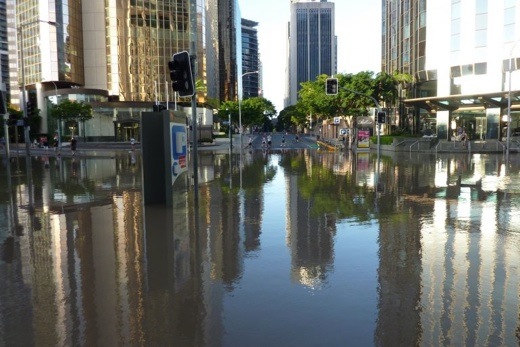
Image above: Photo of flooded intersection of Eagle and Charlotte Streets in Brisbane, Australia in 2011 by Andrew Kesper.zFrom original article.

I first met Professor Jem Bendell at a festival in the middle of a Swedish forest. This was back around the beginning of the 2010s, and he wasn’t a professor in those days, and to be honest we didn’t find that much in common.

The festival was called Future Perfect. The organizers had brought together sustainability thinkers, ecologically-minded designers, organic food entrepreneurs and a whole smorgasbord of buzzwords.

At several points, I was provoked into forceful interventions, which led to the invention of the role of ‘difficultator’ – a kind of anti-facilitator or heckler-in-residence – in which capacity they invited me back the following year.

My impression of Jem from that event was of a big NGO, sustainable development, Corporate Social Responsibility guy. He was living in Geneva, working as a consultant to the UN. He’d done things: the Marine Stewardship Council was one of his projects, and he’d been in at the beginning of the UN Global Compact.

He was all about getting big business to drive sustainability. He struck me as driven, ambitious, serious, but I didn’t get much sense of someone wrestling with the existential implications of the mess in which we find ourselves. And fair play, he was too busy for that.

So it came as a surprise when we crossed paths again last year and he told me that Dark Mountain had been much on his mind.

 I’d been aware of the ripples made by a keynote that he had given at a climate change conference in Australia, setting out an agenda for what he calls Deep Adaptation, based around the three ‘R’s of Resilience, Relinquishment and Restoration.

It’s been picked up in places like the Planet B festival in Peterborough last summer and a forthcoming season of events at the NewBridge Project in Newcastle – while Charlotte Du Cann wrote about it in the call for submissions for the next Dark Mountain book.

When I caught up with Jem over Skype a few weeks ago, I mentioned that I’d been struck by how far he had traveled since our first meeting, so I was curious to know what had set him on that journey.

JB: I gave my inaugural professorial talk in March 2014 at a big literary festival in Cumbria. I’d already become aware of some of the latest science on climate change, so I decided to frame sustainability as an adventure – to say that we have to let go of our incremental, non-ambitious, conformist approaches.

I gave a speech about that, because it was a frame that could be palatable to my colleagues, my employer, my academia and my audience. But I was coming down with the flu during the speech. And for the week after, I was in bed ill.

There’s something emotional about a conclusion – that’s what you do in an inaugural lecture, you try and synthesise twenty years of your work, and by summarizing, you’re also concluding it. So I spent that week in bed, with a fever, not doing much apart from reading scientific papers and watching traumatizing videos from the Arctic. And I actually went into despair.

It took years before I became more deliberate and public about this, and in a way it’s taken me until now to realize that I’ve been going through a professional catharsis which goes back to March 2014.

DH: I read a piece that you wrote for openDemocracy later that year, arguing that the mainstream debate around climate change had become detached from the facts that were now coming in from the science.

You highlight four different conversations going on around the edges which you say have more to do with the reality of where we find ourselves, one of which is a conversation you identify with the radical end of Transition Towns, the work of people like Charles Eisenstein, as well as with Dark Mountain.

JB: The reason I wrote that article was that after the experience I’d had that year, I couldn’t help but have conversations with friends about this topic, and I found that I just left people sort of staring into space with their jaws wide open.

So I wanted to give them something that would help them think things through, and then they could end up with whichever of those agendas that I mapped out in the piece – and working on any of those agendas would be better than the mainstream denial of how things are.

DH: That brings me to the speech where you presented what you call the Deep Adaptation agenda. Can you say a bit about how you arrived at that framing?

JB: Looking back over the last few years, I didn’t really know what to do about this realisation that we can’t fix climate change, that so much of the impact for our civilisation is already locked in. I didn’t know how to work on that.

And I realized that one of the reasons was the lack of a framework to get your head around all this.

So I thought it might be useful to come up with a map for people who are climate experts, policymakers, researchers about what this might mean. A map that would sound approachable, but would actually be the thin end of a wedge, in terms of where it would take them.

This coincided with an invitation to a place in Australia where I used to work, Griffith University. It was the tenth anniversary of their centre and they invited me to give the keynote.

They are at the center of the climate change adaptation network of Australia, so they had hundreds of climate change policymakers coming from across the country, and researchers and academics. And I couldn’t justify flying down there and just giving a speech about, you know, the latest great ideas about investment in solar, and so on.

I was a bit scared, because I knew the guy who was organizing the conference and I knew he’d want me to be dynamic. Everyone who’s organizing a conference wants to be upbeat – and suddenly the keynote person is going to give a speech about the end of the world, or that’s how it might come across, anyway.

It was a bit of a coming out. Standing in front of these climate experts who work with this all day and saying: well, this is my reality, this is what I’m struggling with, and this is a map that I have that I think we could use to work on it.

I called it Deep Adaptation. I introduced the three ‘R’s: Resilience, Relinquishment and Restoration.

DH: So this is where you’re trying to say, OK, what kind of stuff is worth working on, if you start from climate change as an unfolding tragedy, rather than as a problem that can be fixed and made to go away. Can you just elaborate on what falls within each of those three spheres?

JB: Sure, well the first one – Resilience – I chose because it’s so mainstream already in the adaptation field. Even in the business schools and the sustainability field, the term resilience had become popular.

Because businesses have been experiencing, through their supply chains in particular, disturbances and disruptions through weather events correlated with climate change.

But I talked about resilience in a deeper sense than just, ‘How do we diversify our suppliers so that if one gets knocked out by a hurricane, we’ve still got something else?’

So for example, I was talking in a hall which was next to the Brisbane River, which had had flood water lapping at its doors just a year previously – and I pointed out that the place had been refurbished with the electric sockets still near the ground.

We need to think again, to switch our mind-sets. These once-in-a-century events will be happening every five years, so resilience needs to wake up to that.

That brings you into Relinquishment which is about not just, how do we preserve what we want to preserve, but what do we need to let go of?

Because if we don’t let go of it, we’ll make matters worse. And I felt that the discourse of sustainability would have seen that previously as peculiar and defeatist – and I wanted to say that, we’re going to have to let a whole lot of things go, ways of life, cultural patterns.

You know, in that room we were all wearing suits with ironed shirts and ties, with blasting air con. There are patterns of behavior which we have to let go of – and I thought, give it a fancy name and you re-code it as something interesting, rather than defeatist.

Then the third one, Restoration – again, it exists already, with people talking about the restorative dimension of environmentalism, restoring ecosystems. Not just stopping the damage, but improving things.

But for me, I wasn’t saying that in terms of how we can fix everything, but that you rewild because it is going to happen anyway and you build that into your thinking.

But it’s also about restoration in terms of how did people have joy, fun and love, and wonder, celebration and meaning, prior to this hydrocarbon civilization?

So Resilience is ‘how do we keep what we really want to keep?’, Relinquishment is ‘what do we need to let go of?’ and Restoration is ‘what can we bring back to help us through this?’

 DH: So you said you were nervous in the run-up to that speech. What kind of reaction did you get?

JB: I was surprised and delighted at the warm round of applause and the things people were saying to me afterwards. I remember one lady came up to me and said she used to be a pilot in the Outback of Australia and in her training, they used to do quite a spooky exercise which was called ‘extend the glide’.

And it’s about, if the aircraft has a problem with the engines and they cut out, how do you then extend the glide to just give yourself more time to find yourself a safer place for the crash landing, but also on the off-chance that the engines might kick in again.

And she said, that’s what you’re inviting us to start working on: how do we extend the glide?

There were other people coming up to me and what I understood was that they had already been talking about these things in their own ways, making sense of it, but not really in their day-jobs, despite being paid to be environmental professionals.

DH: How has this changed the work you’re doing – that experience of despair and catharsis that you described, going back to 2014, and then creating a framework for those who want to work with this professionally – where has that taken you in the years since?

JB: Well, in 2017 it took me into politics, writing speeches for Jeremy Corbyn and John McDonnell, because it seems to me that we need a cultural shift towards compassion and a spiritual awakening, an awakening from the delusion of materialism. We don’t see much of that in politics, but Corbyn was saying something similar in a secular way.

Meanwhile, I decided to approach education in a very different way, as a sort of emancipation from your received assumptions and received wisdom, as a preparation for people to be able to approach these very disturbing and troubling times.

But also to see it as an amazing – it’s kind of crazy to say, isn’t it – an amazing opportunity for reflection into the true meaning of being alive. Because climate change is holding up a severe mirror to our consciousness: it means we have to really ask why we are here. Because somehow, we delay that question, and now we can’t.

So on the one hand, I see that I’ve been doing quite a lot of stuff that I’m OK with that flows from that point in 2014, but I also realise that part of this has been getting busy in order to distract myself, because I didn’t have a good way of living with this knowledge.

My sense of self-worth as a good guy, working hard, becoming an expert, becoming a professor – along the way, I made sacrifices in order to achieve that, and then suddenly I had a loss of a sense of self-worth, my role, my identity in life.

 So I think quite a bit of what I’ve been doing over the past years has been reconstituting a sense of self.

So thank you for inviting me to talk about this, because it made me reflect in the last few days, and I realise that maybe it’s useful to share this.

Because this cathartic process that I went through, some of it conscious and some of it actually only making sense to me looking back, is perhaps something that other people will go through and need to go through. And maybe it’s something we can go through together and help each other.

I guess I’ve gone through a grieving process and now I realize that it was pretty damn obvious that I will die, everyone I know will die, any community or culture I could ever contribute to will die out, this human species will die out, and the Earth and everything on it will die – well, that’s just obvious, we all knew that, anyway.

DH: Yes, all of those things were true before the great hydrocarbon episode in humanity’s history. Arriving at that is an important part of the journey of making sense of what it means to be alive right now.

JB: I feel free of some forms of delusion, some forms of social pressure, and I am approaching things with fascination and playfulness.

And what I didn’t have over the past few years were fellow travelers and community, and now I’m realizing that I do need a community around this very realization that we’ve been talking about.

And what will emerge from that, I don’t know, but there will be love within it, there will be creativity within it, there will be a sense of wonder at being alive at this incredibly strange moment in human history.

• Jem Bendell is Professor of Sustainability Leadership at the University of Cumbria. He is now taking applications for full- and part-time PhD students to work on aspects of deep adaptation, to be located in Cumbria or remotely, with a start on 1 October, 2018.

.

Going through a real collapse

SUBHEAD: When the "Shit Hits the Fan" can you be prepared for a period without civilization?

By Daisy Luther on 17 January 2018 for the Organic Prepper -
(https://www.theorganicprepper.com/selco-who-survives-who-dies-shtf/)


Image above: A Serbian paramilitary kicks the dead body of a woman in Bosnia in 1992. Photo by Ron Haviv. From (http://www.balkaninsight.com/en/article/capturing-the-image-of-ethnic-cleansing-in-bosnia-01-19-2017).

[IB Publisher's note: This article by Daisy Luther is from an interview with "Selco", a survivor of a brutal military occupation during the Balkan War in the early 1990s. For months civilians died of thirst, starvation and sniper fire in European towns. Selco is not a native English speaker and we have corrected some language.]

Did you ever wonder about the differences in how people behave in a crisis? Why some people survive and some people die? Are there characteristics that we can nurture now in good times that could help see us through bad times?

I have talked with Selco previously about who lives and who doesn’t in a long-term emergency, and a great determiner is a flexible mindset. In this interview, we go deeper into who can withstand the stress of a SHTF (Shit Hits the Fan) event and who crumbles. Today he shares his insights from the Balkan War.

Luther: What were the worst mental stresses during the situation in Bosnia that are probably common in many long-term scenarios?

Selco: Obviously, it was a situation when violence was very widely used and in a random way, often without any logic. So people lived n very poor conditions under constant physical threat.

Of most importance were mental stresses. This part of survival is in my opinion very important and commonly overlooked in the prepper community.

It is a huge topic, but we can touch on some of this in the article. I researched it a lot. A few factors were important, and will be important in any future collapse event:

#1) Loss of control

If you are living a normal average life with your family, you have a job, the kids go to school and can eat their favorite foods, and when someone is sick you go to the physician.

There are police to help if there are problems, there is law and order, everybody knows their place more or less.

You feel that you are in control of your life and lives of your family.

And then one day all that is gone. You find yourself in the world where very often things of life and death are a matter of pure coincidence or chance. For example, is there going to rain that day for enough water?

People had a very hard time of dealing with it. You can be prepared very well to some extent, but also you need to be prepared that for a number of things that you are simply not in control anymore.

#2) Hopelessness
Hopelessness is the big word when it comes to survival, and from my experience, it is hard to beat it.

A survival event that lasts for few days, even a week or two, is like a camping trip, something like people go together, share food, help, there are nights spent next to lamps, violence is possible but not widespread because people see that event is going to last only for week or two.

Some people will take a chance and do violence or steal, but the majority are going to keep it together to the end of SHTF.

Events that last for month or two are harder, more violence and a harder time, but still, people see that everything is going to go back to normal.

When you are thrown into an event that looks like (or you think ) it is going to be a permanent or very prolonged condition, rules change.

From one side you have people that are not going to be so nice and helpful to each other simply because they see this is going last and they will be forced to fight for resources; and from the other side you are going to have hopelessness.

Most humans need to see cause in order to operate in the proper way, or in other words, in hard conditions people need to see ‘light“ no matter how far it is, otherwise, you might just mentally “surrender“ because it is hopeless to push on.

#3) Re-setting of the values
In normal life, you might be a lawyer or clerk, or teacher, or famous writer and then one day the world collapses (let say because of an EMP- Electro-Magnetic Pulse- weapon).

In a few weeks you find out that you are living in the world where you are valuable if you can quickly and efficiently chop wood, or pickle vegetables, repair weapons, devise a setup to charge a car battery, or simply shoot a rifle effectively.

I am not saying a teacher or writer is useless in SHTF, but values are “re-set“. If you do not have any immediate useful skills you’ll be forced to learn one. You may be forced to understand that the values (knowledge and skills) that you had prior collapse simply may not be valuable anymore.

People had problems with this new “value system“.

#4) Responsibility
People have responsibilities in normal times taking care of their families. Those responsibilities are still there when there is a serious collapse but because the "System" is out, all help is out too.

For example, you are responsible for your old mother who has high blood pressure problem but there is no doctor anymore and there is no medicine. There is no help for your kid who has special needs, for example.

You realize that everything is up to you.

Some people simply could not take that. People could not watch their sick child because they could not help them.

Some people would simply “surrender" or leave everything.

#5) Bending the rules
Most interesting is actually how people would (or would not) bend the rules that they had prior to the collapse.

A majority of us live by some mental and moral rules. They tell us what is right and what is wrong.

It is wrong to steal, it is wrong to harm people. It is right to take care of sick and elderly.

When the SHTF you’ll be in a position to “bend“ these rules, simply because you’ll be faced with lot of tough decisions and choices.

For example is it right to steal from others if that means my child will not be hungry or die from an infection?

Is it OK to harm other people because of that? How are you going mentally live with that?

I am not advocating anything here, and I cannot give you suggestions but be sure that you’ll have to bend the rules, and that you will be be faced with tough decisions.

It is up to you how much you are going to bend or break them.

All of the factors mentioned above are examples, and usually, you meet all of them more or less, and in combinations.

Luther: What kind of person tended to do better when everything went belly up?
Selco: First, we need to formulate a definition of “person who tended to do better when everything went belly up.”

I know people who were powerful in that time: maybe because they had manpower, or a role in the black market. For example, they’d sell baby formula to people (sometimes mixed with plaster), or they simply robbed people.

When war stopped they ended up very powerful and they are still (years after) very powerful.

But they are not my definition of normal people.

We are talking now about ordinary folks, and I use the term “small circle“ when describing how to live in those times.

You need to mentally adapt to the fact that you will have to overcome some serious problems, but what is more important you need to adapt to the fact that some of the problems cannot be solved, some people will not survive, and you still will have to move on.

That small circle is your family or your group, and while the world outside is falling apart that does not mean your family needs to fall apart. You will just have to adapt to the new world.

Many people survived hard times, some of them by doing bad things. Other survived but fell apart when they found themselves back in normal times.

One thing about who did mentally good in those times is that people who had support from other people (family, friends) in that time did good.

It is very hard to be alone during events like that, especially if it is prolonged, of course, because obvious reasons, for example security reasons (guarding home), or simply resources gathering.

But when it comes to the mental aspect you need to have support from trusted people (just like they are going need that support from you) otherwise resetting your values is much harder.

Hopelessness will kick down. Simply bending the rules too much may change you in a way that, in the end, turns yours into something that is more animal than human.

Luther: Do you remember any stories you can tell about specific people who thrived?
 Selco: Ordinary folks usually did not thrive. We all dragged ourselves through that way-too-long period feeling lucky if we were alive, with all parts of our body intact, and with families alive.

Everything else was day by day.

I remember this guy, I’ll call him Ed here, he was the man with information.

You need to know that there was a complete information blackout, and even if you could somewhere find a radio most of the stuff that you heard on it was pure propaganda junk.

When you find yourself cut off from real information, all that you are going have is a whole bunch of rumors and misinformation, and only then you realize how much people are used to having information.

I cannot even remember what kind of ridiculous information I have heard in those times, and I believed much of it because I needed to believe in something.

I have heard (and believed) probably 100 times that peace is coming in 3 days, or a new big UN convoy with food for everybody coming to the city tomorrow, big enemy movements there.

People need to know. It is human nature.

And during very hard times people are simply ready to believe in a lot of things that look like clear nonsense in normal times.

Note: Have a means to communicate with other people, CB, radio, satellite phone, ham radio. To hear correct information, it is valuable for many reasons - including mental health.

Ed was the guy who spread rumors, information, and news; and people would give him food for that information.

I believe we all deep in ourselves knew that it is probably just rumor, but “Ed said yesterday“ was some kind of information, something to talk about, something to hope for.

Ed survived alone whole event (pretty rare) thanks to the fact that “he had information.”

Luther: What kind of person suffered the most?


Selco: Survival is about being able to adapt to new things, and those new things are bad mostly.

There are many factors here that are influencing how you gonna mentally cope with collapse. A few of those are:
  • how prepared you are (how much food, water, medicines in stock)
  • how many usable skills you have? (natural remedies knowledge, gardening, technical skills, fighting skills…)
  • how dependent you are on the system? (you are living in city apartment building or in a small rural community)
  • what kind of group (or family) you have around you, what kind of skills those people have, how close and trusted are those people?
    These are just a few examples. Even if you have all of the above you still need to have mental strength.

    Or in other words, you may be perfectly prepared survivalist when SHTF just to find that you are simply falling apart mentally.

    In my case (I am talking about people who were not preppers at all) people who suffered most were people who failed to recognize the new rules.

    We had (in that time, in my family), a college professor, a man that was pretty important in normal times. Students were kinda trembling when they used to see him.

    When SHTF he mentally fell apart and become useless because he felt that suddenly he become nobody, completely unimportant.

    Every scum with a rifle was more important than him.

    It is not about that we could not find a use for him, it is about fact that he was “plugged-in" so heavily in the system and when that system was gone he felt there was no sense to anything.

    He did not want to try to be useful in any other ways.

    One definition would be that people who are “plugged-in" or depended too much on the system had worst time when system disappeared (SHTF).

    Luther: What are some things that can help a person who is having a difficult time during a crisis?
     Selco: I mentioned that you need to have support from other people, but also you need to have peace of mind.

    It is easier said then it is done, but yes, faith and religion, or kind of spiritual-mental order helps a lot.

    I cannot say that religious people had less hard times, but I am sure that religious people went more peacefully through that hard time because it helps you to make sense of everything.

    Personally, I had a kind of “philosophy“ during that time. It went something like “I’ll do whatever I can, and the rest is not in my hands anyway.“

    Over the times it grew into “It will be whatever it has to be.“ It worked for me at that time.

    It sounds simple, but this philosophy helped me through some of the hardest periods because I understood that I can do only do so much. There were so many things that were way out of my control, and way random. If I worried too much about it I might lose my mind.

    It worked for me then, but remember that I was not prepared. Preppers today are more prepared, and by combining that prepping with peace of mind, it makes even more sense.

    Remember that you need to find sense in life when SHTF. You need to have reasons to push on and on.

    God, faith, kids, love… you need to have some reason and to stick to it.

    It can be things like teaching others about herbs, or food growing.

    If you do not have good reasons you either end up dead because you stop caring, or simply you turn to an animal just following the most primitive instincts.

    Luther: What are the things that made people feel better and helped recapture some normalcy?
     Selco: I have to say that drugs and heavy alcohol drinking were in use very much, but not as a mean to recapture normalcy, it was more to get lost – to forget reality.

    You need to have a “vent“ - it is different for different people. As I said, for a lot of people it was alcohol or drugs, for me it did not do the complete job and often it was dangerous to get “lost“ in times like that.

    It was very usual to see people smoking marijuana, people who never even heard of it prior the SHTF.

    For me, two things were like “charging my mental batteries“ – music and reading.

    Music was rare, and it was actually if you stumble on someone who plays guitar, reading was more available, and for me, it was like I was still there but I had escaped to a better place while reading or listening music.

    In some bad situations I did find myself singing songs, maybe I looked retarded in that moment because of that, but actually it helped.

    When you are dirty, hungry, insecure, frightened and worried for your family, and when all that goes for months, you need something that going to make you feel fine for some time, not to forget all troubles (like with heavy drinking or drugs maybe) but more like to push all worries aside for a bit.

    Note: do not mix alcohol abuse with fact that it is a great idea to store alcohol for SHTF. Have alcohol for a trade, or drink, but do not try to solve heavy times with alcohol abuse, it does not work.

    Small snacks, like candies, are precious things as a mental help.

    Check today what kind of small things comfort you when you are down or having problems, and count on that when the SHTF. Those small things will probably comfort you ten times more then.

    Luther: Are there specific personality traits that we can focus on now which would help us through a situation like this? 


    Selco A sense of humor! In that time, for me, a friend with a good sense of humor was worth some rifles or and a pile of MREs.

    A good sense of humor is an important survival skill and often overlooked. I am not joking.

    And storytelling.

    We had in our family old man who was guerilla fighter during WW2, and he combined both of these qualities.

    In hard times, when we were more or less desperate he would tell us stories of his fighting in WW2 – how they fled from the Nazis, how they starved, how they froze in the woods.

    And over the time it helped. 

    For example, one of us would comment “Oh, there is only one can of food today for 5 of us" and then he would say “Oh, you wimps, it is piece of cake, during the WW2 in the German encirclement I ate my shoe for a week.“

    And for whatever hard time in our SHTF, he would have a story of “Oh, you wimps, during the WW2 I…“
    Over time it became partly a joke, but also partly a serious thing.

    Even between each other, when we saw it is a hard situation, we would joke “Shit, this is bad, we are in serious trouble now, call grandpa with one of his “oh, you wimps, during the WW2“ stories.

    That old guy knew exactly what kind of mental relief we needed – joking and storytelling how someone else had hard times and how he managed to survive.

    He had a sense of humor, a gift for storytelling, and he had spirit.

    Thanks to him I grew the habit of using humor in hard situations.
    .

    About that Bugout Hideaway...

    SUBHEAD: The remote cabin in the woods has the problem that "remote" and "secret" are not the same thing.

    By Charles Hugh Smith on 8 April 2017 for Of Two Minds -
    (http://www.oftwominds.com/blogapr17/bug-out4-17.html)


    Image above: Your bugout retreat in the woods may be occupied when you finally get there. From (http://www.survivalistdaily.com/finding-the-ultimate-bug-out-property-or-survival-retreat/#sthash.sH0muLTx.dpbs).

    A flurry of recent headlines has highlighted the financial elites’ interest in secure retreats (a.k.a. bug-out locations) should the "trucks stop rolling". That those with the most money and access to expertise are preparing safe havens has moved the conversation about bug-out plans from the alt-media to the mainstream, however briefly.

    The basic idea is to develop some measure of security in an increasingly insecure world, and pursue some measure of independence in an increasingly fragile system of global supply chains.

    The intuitive solution to many, from the super-wealthy on down, is some version of a hideaway in the woods: a remote locale known only to the owner, where the owner can burrow safely away until the storm passes.

    It turns out security and independence are tricky qualities, and surprising reversals are not just possible but likely: what appears to be secure at first glance might be highly insecure, and independence turns out to be highly relative.

    Remote Cabin : A Perfect Target for Theft

    The first problem with the remote cabin in the woods (RCITW) bug-out plan is that “remote” and “secret” are two different things. As I explained in my 2008 essay The Art of Survival, Taoism and the Warring States, the local residents have a much different view of what’s remote and secret than outsiders.

    Simply put, if humans are settled anywhere nearby, nothing is remote or secret. I have come across guys on foot in extremely remote logging roads miles from any paved road, much less a settlement. I’ve been startled by hunters on family-owned wooded acreage far from neighbors or towns.

    Throw in drones, Internet access to terrain photography that was once the domain of spy satellites, and humans’ healthy curiosity, and “remote” and “secret” just got even scarcer.

    A local news story some years ago illustrated the point: some luckless outsider’s entire bug-out cabin was stolen: not the contents, the entire cabin.  The “owner” returned to a bare concrete slab.
    “Remote and secret” means “easy to steal”: nobody around, plenty of time to take the whole darn thing.

    I put quotation marks around “owner” because “owner,” “possessor” and “occupant” are different things.

    Consider the broken window problem.  A kid tosses a rock through the window of an unoccupied house, and people notice the window doesn’t get fixed. So somebody has the bright idea of breaking in and looking around.

    Next, some unsavory characters discover the back door is open, and they start using the place as a crash pad and drug haven.  Now the property is occupied—by squatters.

    “Squatter’s rights” have a long history, and the rights of possession could once be transformed into outright ownership back in the day. Evicting squatters can require quite a bit of legal work and money, and of course squatters being evicted tend not to be overly respectful of the house or its contents.

    Lest you reckon this possibility is out of the question: a surprising number of abandoned homes in middle-class neighborhoods slide into becoming squatters’ druggie havens.

    It turns out security is less a function of “remote and secret” and more a function of eyes on the street community and full-time occupancy.

    About That “Rugged Individualism”…

    There’s a whole other set of problems with the remote cabin in the woods (RCITW) bug-out plan: the owner of the RCITW is typically as dependent on the fragile supply chain as any urban dweller.

    The proud “rugged individual” on the remote homestead may have his own well, a solar panel and a garden, but if we observe him closely we find he drives his hugely inefficient vehicle into town weekly to fuel up at the gas station, fill his propane tank, pick up his medications, cash his government/ institutional check (Social Security, SSI, pension, etc.), buy 98% of his food calories, get spare parts for his water pump, and so on.

    This “rugged individual” is as dependent on the trucks rolling as any city dweller. He is dead in the water without abundant cheap fossil fuels, functioning supply chains for industrial-manufactured parts, constant delivery of cheap food calories, and money from the state or some financial institution.

    If the homestead is remote, he’s actually more dependent than the city dweller, because he absolutely needs abundant, affordable, consistently available fuel for his private vehicle to get the essentials of life. The town dweller is just as dependent on the global supply chain, but at least he can walk to the store.

    Does a remote rural location add to one’s independence from the global supply chain?

    Not necessarily.

    It can actually increase dependency and fragility by increasing consumption of fossil fuels (both to drive into town and also to transport goods to distant rural stores) and by positioning oneself at the most costly and least profitable end of already long supply chains.

    The idea that Nature is bountiful is largely illusory. Most woods and untilled fields are food deserts to humans. A normal person can walk all day and find nothing remotely edible—and even foragers would be hard-pressed to locate 2,000 calories a day, day after day, week and after week, month after month.

    As for growing one’s own food: it’s remarkably difficult to raise tons of calorie-dense food on a small plot of land.  The ground water might be deep, or taste bad; the soil might be depleted or rocky, and the weather might not cooperate at all times. One storm at the wrong moment can decimate a crop that’s been carefully tended for months.

    It turns out “independence” is relative, and may well decrease the farther one gets from agriculture, energy sources and communities.

    Dependence and independence are not just measured by reliance on global supply chains of food, energy and manufactured goods. Consider the “rugged individual” who keeps himself to himself, holed up in his hideaway. How likely are you to ask him for help? How likely are you to offer him some share of your bounty?

    Or would you rather ask the friendly fellow who is out in his garden, who drops by to share some fresh produce or baked goods, a person you see at church or in town chatting with friends?

    The productive relationship is the one with a productive person. Not only is the remote “rugged individual” unlikely to offer anyone help, he may have little in the way of resources to offer.

    “Independence” of the completely self-sufficient sort is relative: most homesteaders still depend on the global supply chain for fossil fuels, manufactured parts, bulk food calories, and so on.

    Independence may be more properly defined as inter-dependence: the greater the reliance on local interdependent productive networks of makers/growers/doers, the greater the independence.
    It isn’t just where the goods and services come from, and from how far away; the level of consumption is the critical factor.

    The lower the consumption of fossil fuels, manufactured goods and bulk food calories shipped from far away, the greater the relative independence. The household that only consumes a gallon of fuel a week (i.e. 35 miles driven in a compact car) is considerably less dependent than the household that consumes 30 gallons of fuel a week.

    About Those Wealthy Islands Of Security…

    The financial elites who reckon they can buy everything they want, including security and independence, might be in for some surprises.

    Those private security details might be fine for dodging kidnappers, but how about dealing with dozens of hungry squatters?

    How long will the jet fuel last if you’re flying in literally everything?

    An island built on the promise of unlimited supply of distant goodies is actually an island of fragile dependence, an artificial construct built on shifting sand.

    Also take into account that if things are so bad to merit escaping to a private retreat location, conditions may also be stressed there, too. Locals there may well view a rich outsider suddenly showing up as an interloper, one who's hoarding valuable local resources (food, water, tools, money, etc).

    If times get even tougher, what's to prevent folks from deciding to target the only person in the area whom no one has any relationship with? Very little.

    Doing 'Retreat' Right

    But all the above warnings notwithstanding, it is possible to develop a retreat that's far more sustainable (and likely more enjoyable) than the costly islands of financial elites.
    This essay was first published on peakprosperity.com, where I am a contributing writer, under the title "Having a 'Retreat' Property Comes With Real Challenges". 

    In Part 2: Doing 'Retreat' Right, we lay out the core strategies of developing a retreat that takes into consideration the realities of security, fragility and dependence.

    Community and regional resources are key to the selection process of a workable retreat location. Learning what to look for in each is essential to making the right decision for your needs.

    Click here to read the report (free executive summary, enrollment required for full access)

    .

    Long Term Egg Storage

    SUBHEAD: There are a number of techniques for keeping eggs edible for months without refrigeration.

    By Brian Kaller on 25 October 2016 for Restoring Mayberry -
    (http://restoringmayberry.blogspot.com/2016/10/storing-eggs-for-winter.html)


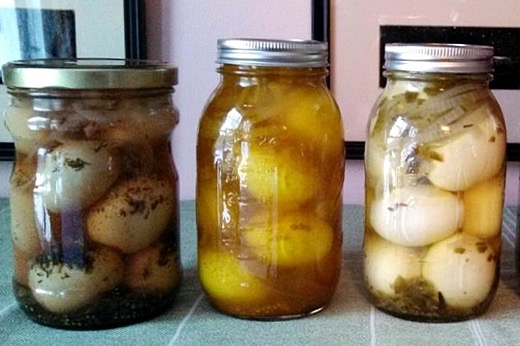
    Image above: A variety of jarred pickled eggs. They can be kept for long periods. From (https://www.reference.com/food/basic-recipe-pickled-eggs-bb99f4e9c9bcce2a).

    No matter what else you have in your kitchen, you probably have eggs. Whether you boil or fry them for breakfast, brush them over meat, whisk them into egg-drop soup, bake them into pastries, eggs provide one of the simplest and yet most versatile of foods, prized the world over as a rich source of easy protein.

    If you raise your own chickens, moreover, you have a ready source of eggs, as well as fertilizer and comedy relief. Hens convert your leftovers into your next breakfast, keep your garden free of pests and mow your lawn for free.

    Other animals can do some of these things, but not many of us have the time, space or will to manage a suburban herd of sheep or swine, or to slaughter them in the garage. Hens, however, require little space or maintenance, and turn any home into a homestead.

    They lay eggs seasonally, however, speeding up in summer and slowing in winter. You could give them more indoor light or Vitamin D supplements, but they cost money and interfere with the chickens’ natural cycle – and saving money and being all-natural are two of the most popular reasons for keeping backyard chickens in the first place.

    Another way would be to collect the extra eggs in summer and preserve them through the winter. Eggs can be preserved in several ways; one, well-known to pub patrons here, is to pickle them.

    A typical recipe involves hard-boiling eggs and removing the shells, and then creating a pickling solution of cider vinegar, small amounts of salt, sugar, herbs and spices. Bring the mixture to the boil, then simmer for five minutes and pour over the eggs – they should keep for at least a few months.

    You can also soak the eggs in a solution of sodium silicate, known as isinglass or water-glass. One popular recipe from a century ago recommended dissolving sodium silicate in boiling water, to about the consistency of a syrup (or about 1 part silicate to 3 parts water).

    The eggs -- as fresh as possible, and thoroughly clean -- should be immersed in the solution in such manner that every part of each egg is covered with the liquid, then removed and let dry. If the solution is kept near the boiling temperature, the preservative effect was said to be much more certain and to last longer.

    Perhaps the best and longest-lasting way, however, is to preserve eggs in limewater. No recipe could be simpler; take fresh raw eggs in the shell, set them gently in a jar, and pour in a simple lukewarm mix of tap water and lime powder. I’ve done this with our eggs, and they lasted for up to a year and remained edible.

    “Lime” here means neither the citrus fruit nor the tree, but refers to calcium hydroxide, a white powder derived from limestone. For at least 7,000 years humans burned limestone in kilns to create the dangerous and caustic “quicklime” (Calcium oxide), and hydrated that to create lime powder (calcium hydroxide).

    Sumerians and Romans used it as a cement, while farmers mixed it with water to create whitewash, tanners used it to remove hair from hides, gardeners to repel slugs and snails, printers to bleach paper.

    Perhaps most importantly, farmers here in Ireland spread lime over their boggy fields to “sweeten” the acid soil and increase crop production as much as four-fold. For hundreds of years until the mid-20th century, lime supported a vast and vital network of village industry in this part of the world-- County Cork alone was said to contain an amazing 23,000 kilns, or one every 80 acres.

    In his 1915 monograph “Lime-water for the preservation of eggs,” Frank Shutt describes a series of egg preservation experiments at an experimental farm in Ottawa, which found lime-water to be “superior to all other methods” – how, he didn’t say.

    When I first tried to preserve eggs in lime-water, I simply mixed equal parts lime and water – which did no harm, but most of the lime simply settled to the bottom.

    It turned out a fraction as much lime would have sufficed – Shutt says that water saturates with lime at 700 parts water to one part lime, but adds that “owing to impurities in commercial lime, it is well to use more than is called for.” In any case, if you use more lime than is necessary to saturate in water, the rest simply condenses out.

    Since exposure to air causes more lime to condense over time, some articles recommend keeping the container sealed, either in a Kilner jar or by pouring a layer of oil over the top. I kept mine in an ordinary mayonnaise jar, and they kept fine for a year.

    Eggs kept this way do come out with their whites darkened slightly, and with a faint “musty” smell like old clothes. It does not, however, have the unpleasant smell of a rotten egg – believe me, you won’t mistake one for the other.

    The difference can perhaps be compared to that of rehydrated milk vs. fresh milk – not inedible, just slightly different than expected. As Shutt puts it, nothing “can entirely arrest that ‘stale’ flavour common in all but strictly fresh laid eggs.”

    I’m not aware of an upper limit on how long eggs could be kept this way – I kept mine a year, with no ill effects beyond the stale smell – but I would not recommend going longer than several months to be on the safe side. Several months, however, still allows the homesteader to continue harvesting eggs through the winter.

    Shutt recommends keeping the water at a cool temperature – 40-45 degrees Fahrenheit, or five degrees Centigrade, to help the preservation.

    That’s the temperature of a refrigerator, but a cellar or underground storage container would probably be fine. I kept mine at room temperature during an Irish year, where the temperature ranges from freezing (32F, 0C) in winter to lukewarm (75F, 25C) in summer, with no ill effects.

    Some old texts say to boil the lime-water, dissolving as much of the lime as you can and letting it cool before immersing the eggs; that might be slightly preferable simply to maximise the amount of lime dissolved or to sterilise the water, but I tried it both ways and noticed no difference in quality.

    Some old recipes recommend adding salt to the eggs, but I tried it with and without salt and found that it didn’t make a difference, and neither did Shutt a century ago. Still other 19th-century recipes mixed the lime with salt-peter and even borax, but I would not try those until I had confirmed their safety.

    Experiments like this might seem pointless when we have refrigerators, freezers and a convenience store down the road.

    Many of us, though, like being able to do things ourselves, with simple ingredients, for a lot less money than processed food at the store would cost. Money and electricity, moreover, are less certain than they used to be; I know many friends who have lost jobs, or whose power now goes out regularly.

    Here in Europe we know people whose governments have collapsed or gone bankrupt, or been torn by civil war. These scenarios are not as apocalyptic as most people imagine -- crises are rare, and even in a crisis life goes on – but they happen occasionally, in an emergency our local village would benefit from someone who knows how to do things the old-fashioned way.

    See also a website page with several recipes for pickling eggs
    (https://www.pinterest.com/Dragonfly9586/pickled-egg-recipes/)

    .

    Shrinking the Technosphere - Part 6

    SUBHEAD: If you follow these tips your chances of living a long and happy life are much better.

    By Dmitry Orlov on 17 November  2015 for Club Orlov -
    (http://cluborlov.blogspot.com/2015/11/shrinking-technosphere-part-vi.html)


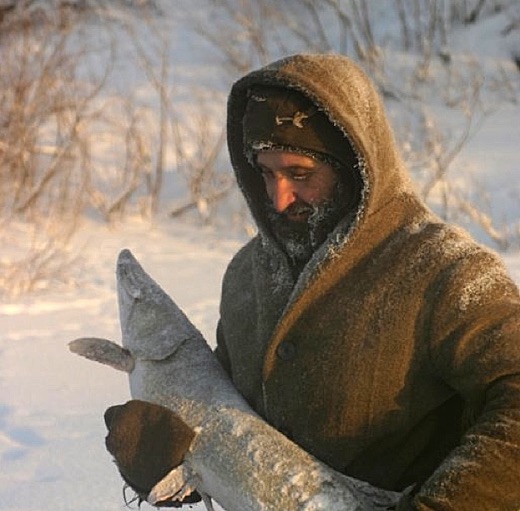
    Image above: Still from movie about survival living in Siberia. See trailer below. eFrom (http://www.imdb.com/media/rm2620304640/tt1683876).

    Suppose your situation is such that you need to effect a swift change of venue. The circumstances that prompt this relocation can be quite varied, but the common and foreseeable ones are:
    1. There is no fresh water where you are. The reservoirs are dry and dusty, the artesian wells are either no longer producing or are producing water laced with arsenic and heavy metals, and the few desalination plants bottle their water and sell it at prices you cannot afford. What was once fields and pasture is reverting to sand dunes. Forests have dried out, burned down, and are now a lunar landscape criscrossed by deep ravines eroded by sporadic torrential downpours—too sporadic and too torrential to be of benefit.
    2. The place where you live is under a few feet of ocean water mixed with raw sewage—not all the time, but often enough that staying there has become a very bad idea. An onshore wind combined with a high tide and a bit of rain are enough to make contaminated, brackish water spew out of every storm drain.

      With each passing year and more and more basements are flooded, more and more foundations undermined, more and more buildings condemned. Places further inland flood more rarely but are already too crowded, and will be subject to the same conditions after a slight delay.
    3. Your country has been overrun by “refugees” who have looted the shops, occupied many of the public buildings and are busy beating up the men and raping the women (like they are doing in Sweden, which is now the second-rapiest country in the world, Lesotho in South Africa is the rapiest). There are large sections of your city where even the military, never mind the police, fear to venture. But the rest of the city is not the least bit safe.

      Beardless men and women without proper headdress are attacked without warning. Property crimes and home invasions by “refugees” are not persecuted for fear of giving them an excuse to start a riot.
    4. Your country has gone full-retard fascist. Your best option is to work a soul-destroying corporate job while slowly sinking deeper and deeper into debt, hoping against hope that you will make it all the way to retirement, even as you watch your colleagues being replaced by machines, illegal immigrants and underpaid foreign contractors.

      Your second-best choice is to subsist on meager social benefits, most of which go to pay for drugs, which you need in order to hold on to what remains of your sanity while the pressure of perverse government incentives destroys your family and your children turn feral.

      Whichever option you choose, you are electronically monitored 24/7 and are absorbed into the prison system for the tiniest transgression, where your best chance to survive is by working as a slave.
    5. You are doing fine economically, but you find your environment, both physical and human, increasingly unsatisfactory. Everything you see around you is cheaply slapped together out of industrially produced components, dressed up with a gaudy plastic veneer to make it “look nice.” It all looks computer-generated because, in fact, it is.

      All the people around you walk around ignoring the real world, which they might as well, since their physical environment is just an older, no longer fashionable version of what they see on the screens of the mobile computing devices to which they are hopelessly addicted.

      They are obese, emotionally stunted, physically helpless and, as far as you are concerned, might as well not be there. In fact, you'd enjoy seeing them replaced with cages of parakeets, potted plants or nice round rocks in a Zen garden. Their parents and grandparents once got things done by pushing buttons on machines, but now it is the machines that push their buttons and program them to say and feel various things on command.

      You can't help obsessing over the fact that this is not real life—that real life is somewhere else, and that you must go and find it before you run out of time.
    6. Any combination of the above, including all of the above.

    Let us further assume that the logistics and the political situation around your relocation have been sorted out: your papers are in order and you have a berth on a ship that will take you to a river port near your destination. From there, a river boat will take you upstream to a spot near your assigned 100 hectares (250 acres) of land, where you, perhaps with a group of like-minded others, will be left with enough supplies to make a fresh start. You slip away in the night with just a change of clothing and a pocketful of mementos, quiet as a cat, never to be heard from again.

    Your land is being granted to you by the government in the form of a perpetual, heritable lease, with no commercial rights over it whatsoever, for you and your children to use sustainably in perpetuity, for as long as you physically reside on the land.

    The terms are not particularly onerous: you are taxed only on home-produced goods that you sell, and one of your sons may be conscripted in case of a national emergency, provided he is not your only or your eldest son, and not a younger son either if he is the family's main provider.

    But there is a problem: your land is quite far north. Nine months out of the year, the temperature there is near or below freezing, and during the coldest 4-5 months it can get as cold as -40ºC. In the dead of winter there are only three hours of sunlight. But during the other three months the temperatures soar to +35ºC and there is 21 hours of sunlight.

    Another problem is that the land is not easily accessible. There are no roads; nor are there plans to build any. During the summer it is accessible on foot and over water; during the winter it is accessible by ski and sled, over snow-covered land and frozen water. During spring, when trails turn to mud and broken ice rushes down streams and rivers, it is not accessible at all.

    Nor is it accessible during autumn, when snow falls on ground that isn't frozen yet and forms a heavy, wet slush, and when the ice on waterways is already too think to navigate but not yet thick and solid enough to travel over. But there is also good news: each year, the climate is getting warmer, with the frosts arriving later, the thaws setting in earlier, the growing season getting longer, and more and more deciduous trees taking root in sunny, sheltered spots.

    A river boat will drop you off a the water's edge within less than a day's hike of your land. It will be in early summer, after the rivers are clear of ice and the riverbanks are no longer flooded. You will have just enough time to prepare for next winter, so that you can survive it.

    What you can take with you is what you and members of your party can carry on their shoulders, ferrying supplies from the river's edge to your plot of land. This basic kit includes:
    1. An axe, and spare axe heads
    2. A knife, and several knife blades without handles
    3. Shovel heads
    4. Saw blades
    5. A file for keeping all of these sharp
    6. A shotgun and a dozen shells
    7. Heavy boots, a parka and other cold weather gear
    8. Several changes of clothing per person
    9. Emergency medical kit
    10. A few pots, cups, spoons, forks
    11. A samovar
    12. Several sacks of grain (rye)
    13. Several sacks of potatoes
    14. Assorted seed packets
    15. Canvas tents
    16. A small assortment of tools (such as sewing kit) and supplies (such as tea)
    You will also be bringing with you a few animals:
    1. Dogs (one of them male) to serve as your security system and to help you hunt and pull sleds
    2. Cats (one of them male) to keep the rodent population under control
    3. Chickens (one of them male) to provide eggs, meat and to keep the bugs under control

    This, plus your body, is all of your initial “hardware” which you will use to bootstrap the entire operation; everything else is “software”—and it has to be downloaded directly to your brain before you begin, with a full back-up in somebody else's brain in case something goes wrong with yours.

    This is your Naturelike Technology Suite (NTS), and if you use it correctly, your chances of surviving, living a long and happy life, and leaving behind happy, healthy, self-reliant children are much better than in any and all of the typical scenarios outlined above.


    Video above: Trailer from "Happy People: A Yar in the Taiga" by Werner Herzog. From (https://youtu.be/V1pOjj49d9Y).We recommend you see movie at either Hulu or Amazon.

    The land is neither farmland nor pasture but boreal forest, thick with coniferous trees, mostly pines and firs. There is plenty of animals you will be sharing it with, especially in the summer when the migratory birds make their appearance and lots of other animals come out of hibernation. But your first concern is with bears, who have come out of hibernation some time ago, but are still hungry and very ornery. The local wolves may also take a keen interest in your camp.

    You will need to impress it upon all of them that this is now your territory as well as theirs, by keeping fires lit at night, never going anywhere without a shotgun, or at least a forked stick, screaming at them and physically threatening them whenever you see them and other such measures.

    Shooting one alpha male of both the wolf tribe and the bear tribe, using up a few shotgun shells from your precious collection, then tanning the skins and sewing them into hats sends an unmistakable message: there is a new apex predator in these woods; act accordingly.

    As for the rest, you should try to make peace with them or let your animals handle them. If you leave them alone and sometimes (but only sometimes, on specific occasions) offer them food, they will become semi-tame over time, and will be much easier to catch by setting traps. Of these, back-breaking deadfalls are the most humane.

    But your first and primary task is to fell trees—as quickly as possible, propping up the logs in sunny places so that they have a chance to dry out. The time to harvest timber is before thaws set in and the sap starts running, because after that the logs become much heavier and more difficult to work with and move, will not burn as well, and will rot much faster if you build with them.

    But you have arrived too late to do that, and have to make do with wet, heavy logs. (By the way, this is the exact opposite of what you would do in the tropics. There, you would harvest wood when it is full of sap, to protect it against insects and rot.) Regardless of the time of year, the best time to fell trees is on a full moon.

    Your second task is to get food, to avoid depleting your supplies, which are for planting, not for eating. A spring thaw is an excellent time to get moose and reindeer, which can't run away because of the heavy, wet snow.

    Until the ice breaks, ice fishing also remains a possibility, and you can preserve your supply over the warm months by hot-smoking and drying the meat and the fish. But, again, you arrived too late, and your best chance to catch enough food is by setting traps and building weirs.

    Your third task begins once the ground is thawed out enough and dry enough to dig. You need to move out of tents and into a slightly more permanent dwelling before winter. Constructing a log cabin during the first season is out of the question, because there is simply too much else to do, and because you arrived too late to get logs that are free of sap.

    But you can certainly harvest enough logs to build a dugout bunker that will last a few seasons. This is done by choosing a patch of land with good drainage and digging a trench. At the back of it is a hearth, along the sides are bunk beds. The roof is created using a layer of logs, the cracks between them packed with moss, and insulated by covering it with a thick a layer of dirt and sod.

    The hearth should have a flue, and a chimney high enough to stick out above the snow, or your fire will keep getting extinguished by melt-water. Two doors with a vestibule between them are an excellent idea. The vestibule will be used to store your supplies of frozen meat. The doors must open in rather than out, or you will be trapped inside by snowdrifts.

    Your bunker should be surrounded by a wicker fence, constructed by driving stakes into the ground at intervals and filling the spaces between them with tightly packed twigs or saplings.

    Make the fence round rather than square, for a 25% increase in the amount of area encompassed for the same length of fence. A round fence also makes it easier for your animals to catch interlopers because there are no corners where they can hide and burrow. Curved fences are also better at resisting wind and snow drifts.

    Your fourth task will be to grow food.

    The land you've cleared by chopping down trees is covered with a thin layer of poor forest soil, acidic because of all the pine and fir needles, and is not immediately useful for planting. But if you dig various things into it, you will be able to use it to grow all of your staples: potatoes, rye, cabbages and turnips.

    Ashes from the hearth, thoroughly rotted tree trunks and mud dredged out of nearby streams all make useful soil amendments. Potatoes can be planted as chunks containing eyes, or buds, with one or two eyes per chunk, and the rest of the potato can be eaten. Rye can be grown in quite poor soils and is amazingly stubborn and keeps going until it goes to seed.

    Because of the nearly 24-hour sunlight and warm temperatures everything will grow very fast. Your animals will be kept busy, and well fed, by all the moles, voles and mice that will be trying to eat your produce.

    By the time you are done growing and harvesting the food, days will start getting shorter and by sunrise frost will appear on trees and the walls of your tent. It will be time to move inside your bunker and start heating.

    Before the migratory fowl fly away, be sure to get some geese, or, failing that, ducks, and save their fat for the winter. Goose fat is smeared on any exposed skin when you venture outside in the dead of winter, to avoid frostbite.

    Once the temperatures stay reliably below freezing, but before the winter blizzards set in, try to stockpile as many animal carcasses as you can, to gradually hack away at and defrost as the winter wears on. This is the time of year when animals are at their fattest and most complacent, and those that are the oldest and the least likely to survive the winter are ripe for the picking; if you don't get them the wolves will.

    The fat is particularly important: in a cold climate, it is almost impossible to get enough calories to stay warm while working outside in any other way, and how much winter work you will get done will be directly determined by how much animal fat you can get your hands on.

    At the beginning of winter, most of your work outside will involve cutting, splitting and stacking firewood out of the logs you harvested in the springtime, since you do not want to be out swinging an axe when it's -40ºC outside and blowing a blizzard. But once your supply of firewood is laid in, there are other tasks to attend to.

    First, you need to get serious about trapping for fur. The parka you brought with you will wear out and will need to be replaced with a fur parka you will need to sew yourself. The animals you trap will be frozen solid by the time you get to them, and can stay that way until springtime.

    You can gut them and skin them when they thaw out, saving the brain and the liver for tanning the pelt. The pelts will also serve as valuable trade goods—about the only ones you will be able to come up with during the first few seasons—and you will need trade goods in order to barter for the supplies you will need.

    Second, if you are close enough to a river or a lake to make it there and back during daylight, you might also attempt some ice fishing, although without skis and a sled (unless you found time to make them already) your range will be quite limited.

    Other than that, most of what you will do during the winter is cook, feed yourself, feed the animals, drink tea, tend the all-important fire and sleep a lot. The tea is important because working outside in cold temperatures is extremely dehydrating: the cold air sucks the moisture right out of you.

    This is why a samovar (which is stoked using pine cones or wood chips) is included in your initial survival kit. Trying to boil enough water in a pot over a hearth is far too slow and rather inefficient.

    But a bucket hung over the hearth is quite useful for melting snow, to get water for drinking and washing without going anywhere.

    Before spring thaw arrives, you will need to get busy harvesting logs—for next winter's firewood as well as for building the log cabin.

    Once that's done, you will have won, surviving the most difficult first season without starving or dying of exposure, and ready to build your homestead.

    Once that's done, you will be well on your way to making a perfectly reasonable life for yourself and your family, using the rest of your NTS, which we will describe next.

    See part Five of series here (http://cluborlov.blogspot.com/2015/11/shrinking-technosphere-part-v.html).

    .

    Living off-grid becoming illegal

    SUBHEAD: The off-grid lifestyle in Costilla County enjoyed by an estimated 800 people is now being threatened.

    By Jay Syrmopoulos on 4 November 2015 for Activists Post -
    (http://www.activistpost.com/2015/10/camping-on-your-own-land-is-now-illegal.html)


    Image above: A trailer with awning, picnic table and wood pile sits behind a PV solar panel in an off grid living arrangement. From original article.

    [IB Publisher's note: It's clear that local governments and their partners - utility companies, land speculators, developers, constructions outfits, and county employees have an aversion to off-grid living arrangements. Why - because their very own livelihoods based on of services, red tape paperwork, pension padding, cronyism, and blood-sucking taxation are not only unneeded, but unwelcome.]

    Across the U.S., local zoning officials are making it increasingly difficult for people to go off the grid, in some instances threatening people with jail time for collecting rainwater or not hooking into local utilities.

    As zoning laws have increasingly targeted the off-grid lifestyle, many have moved to the Southwestern U.S. as an escape from overzealous zoning officials.

    In Costilla County, Colorado, there has been a major influx of off-grid residents to the San Luis Valley. The combination of lax zoning regulations, cheap property, and an already thriving community of self-reliant off-grid homesteaders has led to many new residents.

    The off-grid lifestyle, enjoyed by an estimated 800 people, is now being threatened as county officials have recently made moves to essentially regulate and license the lifestyle into oblivion.

    Tensions boiled over during a county commissioners’ meeting in San Louis, Colorado, devolving into a shouting match between homesteaders and police. One of the major points of contention is the county’s attempt to ban camping on your own property, in an effort to force the off-grid homesteaders back onto the grid.

    “We are residents who have come to live off the grid. It’s all our land.” … “These are harsh economic times. We have nowhere to go,” twenty-year resident Paul Skinner said.

    “We’ve been regulated out of life,” homesteader Robin Rutan told Colorado Public Radio. “I came here because I couldn’t live by the codes [in other regions].”

    The county, which requires residents to have a camping permit to live in an RV, “small house” or other camp style home, has started to simply refuse the renewal of these permits.

    This is obviously a major problem for homesteaders, who often live in such accommodations while building their permanent residents.

    “They started enforcing the changes before they were actually made,” resident Chloe Everhart said.

    Everhart said she performed due diligence prior to buying her land, with one of the most important aspects of the plan being a 90-day camping permit. Without a 90-day permit, camping on residential plots is only allowed for 14 days per every three months.

    But just as Everhart was arriving, the board of commissioners instructed the planning and zoning commission to no longer issue camping permits.

    In spite of her best efforts, Everhart is now an outlaw.

    County land use administrator Matt Valdez disputes the claims that the county is trying to regulate people’s lifestyles out of existence. He says that his office has discretion to deny camping permits under existing code and claims that too many new residents were habitually renewing permits meant to be temporary.

    “We’re not trying to drive people off their property,” Valdez said.

    Valdez said he simply wants to make sure already established rules are followed for aesthetic and safety reasons.

    The vilification of people who choose to live an alternative lifestyle is extremely commonplace in modern America.

    While there may be legitimate issues that need to be addressed, people have a right to use land that they own in the manner they see fit. To use the technicalities of the law to essentially evict people from land they own reeks of tyrannical overreach and oppression of personal liberty.

    Jay Syrmopoulos is an investigative journalist, free thinker, researcher, and ardent opponent of authoritarianism. He is currently a graduate student at University of Denver pursuing a masters in Global Affairs. Jay’s work has been published on Ben Swann’s Truth in Media, Truth-Out, AlterNet, InfoWars, MintPressNews and many other sites. You can follow him on Twitter @sirmetropolis, on Facebook at Sir Metropolis and now on tsu

    See also:
    Ea O Ka Aina: Make HEI pay us for going off grid 9/23/15
    Ea O Ka Aina: Off Grid living is illegal 1/26/15
    Ea O Ka Aina: Off-grid handcrafted life 12/5/13
    Ea O Ka Aina: Off-Grid Night Lighting 8/14/09
    .

    Flowing toward Abundance

    SUBHEAD: Build up appropriate stocks where needed, but be aware that it’s flows that generate those stocks.

    By Toby Hemenway on 21 October 2015 for TobyHemenway.com -
    (http://tobyhemenway.com/1234-flowing-toward-abundance/)


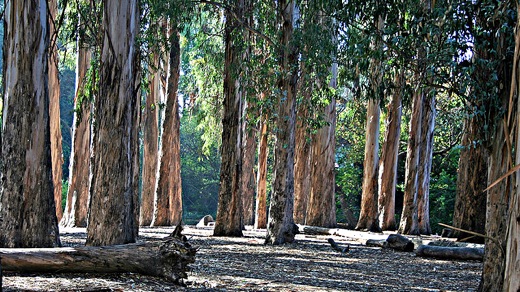
    Image above: Grove of eucalyptus trees on the Berkley campus of the University of California. From (http://ww2.kqed.org/quest/2011/10/17/eucalyptus-fuel-for-fire/).

    Over the last year or so, a neighbor has stocked up eight or ten piles of firewood in his yard, probably fifteen or twenty cords. What’s he going to do with it all? The house has a wood stove, but the family mostly uses the furnace, and burns wood only occasionally to get that cozy, fire-heated feel. It’s going to take them a decade or more to go through all that wood. Some of it is split and stacked, while much of it is strewn over a substantial chunk of their yard.

    The wood comes from another neighbor’s multi-acre eucalyptus grove. Some of the trees are huge—three or more feet in diameter, a hundred feet tall. The landowner, Lyn, can pull out seven or eight properly chosen big trees each year and still replace all that biomass in the next year’s growth. It strikes me as a sustainable yield.

    Several neighbors rely on her for their winter wood; the lot pumps out a good fifteen cords a year, and in our mild climate, you can heat a 2000-square-foot house using only wood by burning about a cord and a half.

    The point of my little tale is this: My neighbor with the giant woodpile is thinking that the most secure source of wood is the store of it in his yard. But—to put it in systems language—that’s focusing on stocks over flows.

    We tend to do that in this culture. However, the real wood storage is the woodlot in Lyn’s yard: the standing, growing trees, getting bigger each year, healthy and enlarging rather than rotting and getting punky on the ground.

    Sure, it’s a good idea to keep two years of firewood on hard, which would be about three or four cords. But twenty cords? That’s a ten or fifteen year supply here. It’s a mammoth task to split and stack it all (only a fifth or so has been split in the last year, and who can blame them?); it should be covered or it will start to rot, and that’s a huge area to cover; and even with the best of care, by year five it will be breaking down and thus won’t heat as well.

    Meanwhile, Lyn’s woodlot is cranking out fifteen cords of beautiful firewood every year. But we don’t tend to see flows as sources of abundance as easily as we see it in stocks—in piles of inert, stored, easily measured stuff.

    One reason for this is our culture’s focus on things rather than on processes, relationships, and dynamics. Another is that it’s easy to trust that by squirreling away a fat store of something in a safe place, we will be able to use it.

    But trusting that, say, some seeds freshly planted will truly feed you in a few months time, or that those trees will produce just as much wood next year as this—that takes a leap of faith. Especially in our culture, inculcated with scarcity and fear, we have more faith what we can see in front of us right now than in some gradual process that could, in our doubt-ridden imaginations, go awry at any moment.

    Those of you who have seen my pieces on humanity’s transition from foraging to agriculture know that I believe that hunter-gatherers were secure in the knowledge that the wild world would always provide sustenance of some kind—that nature could be trusted—while agricultural people have lost that, and are taught that only our own hard work and piling up a storable surplus can guarantee survival.

    Fortunately, with the emergence in the last few decades of whole-systems studies and related fields such as permaculture and holistic management, we’re seeing that flows are the real key to abundance. It’s flow, dynamic and well-channeled, that keeps any system running.

    Yes, stocks and storages are an important part of any system, but any dynamic system, whether a garden, an ecosystem, a business, or a community, is kept healthy—is kept in existence at all—by the flows cycling within it, into it, and out of it. Lyn’s living woodlot—its increasing kilocalories of stored sunlight on the hoof—is the real source of abundance, not my neighbor’s slowly deteriorating pile.

    I’ve seen what happens when people make the transition from a fear-based need to hoard to an abundance model of flow.

    Through the lens I so often look through, of horticulture versus agriculture (a culture of gardeners tending the wild’s diversity rather than farmers sweating in domesticated monocultures), early humanity’s two million years of trusting nature is a more powerful legacy than a mere ten-thousand years of control-freaks breaking nature to the plow, and I’m hoping we are returning to that.

    An encouraging example of this is the evolution of the prepper movement, a subset of the survivalists who have made full readiness for socio-economic collapse a major part of their lives.

    The term “prepper” arose in the 1990s and the steady drumbeat of accumulating acute and chronic crises of 9/11; climate change; energy descent; Hurricanes Katrina, Sandy, and other natural disasters; the financial collapse of 2008, and the feeble official responses to most of these, have driven prepper numbers to new highs.

    But many preppers are moving away from the “build a bunker and fill it with freeze-dried food and ammo” mentality. I’ve had some rollicking conversations about this with the lively Jack Spirko, moderator of The Survival Podcast, probably the most popular prepper website. Jack began his journey in classic survivalist mode—bunker, ammo, and all. Then he was introduced to permaculture, and a series of lightbulbs turned on.

    The constant flow from an exuberant garden, he realized, was better long-term insurance than barrels in a basement, and less likely to attract or be understood by those potential “apocalypse zombie” raiders.

    A community of like-minded men and women working together on food- and resource-yielding projects could produce much more than one man’s garden, and a large, cohesive group of tool-using (and, yes, given Jack’s world, some of them gun-toting) people would be a far less tempting target than a lone guy in a bunker full of food. And lots more fun.

    The preppers are moving from a mindset of stocks to one of flows.

    We need both stocks and flows. But our culture has focused largely on stocks, and when we do focus on flows we often go too far the other way, creating non-resilient systems that have been stripped of their buffers in the interest of economics, such as just-in-time production and so-called “lean businesses.” Stocks do have their role, especially as buffers, but it’s the flows that keep a system running.

    So, sure, build up appropriate stocks where needed. But be aware that it’s flows that generate those stocks, and where flows are healthy, your piles of squirreled-away stuff can be a lot smaller. Nourish those flows. That way, we can move away from fear-based hoarding to a flow-based abundance model—the one that nature uses.

    .

    Homeless Urban Survival

    SUBHEAD: This is how to survive in a settled urban area if you lose everything, including your home.

    By Nomad on 15 October 2015 in SHTF Plan -
    (http://www.shtfplan.com/headline-news/this-is-how-to-survive-if-you-lose-everything-including-your-home_10152015)

    Image above: Used U.S. Marine combat tent for sale on line is sold out today. From (http://www.sportsmansguide.com/product/index/used-us-marines-combat-tent?a=220668).

    Practical Tips And Advice Derived From Personal Experience

    These days, “survivalism” has come to mean preparing for great events like nuclear holocaust or total government collapse. But disaster may come on a much more personal level. Individuals can suffer catastrophe as surely as nations can. When they do, it can be even more distressing because individuals feel alone in their suffering.

    I am talking about personal financial ruin and homelessness. Thousands of people across North America, indeed the world, have already experienced it following bankruptcies and foreclosures.

    Whole families have been evicted from their homes, some quite forcibly. We see dozens of tent cities appearing across America, and more people ordering storage containers to live in.

    What we don’t see are the “hidden homeless” – those forced to survive by couch-surfing or moving back in with family. If 47 + million Americans now live below the poverty line, that means 47 + million who are either homeless or in imminent danger of becoming so. And the number is still growing.

    When I lost my own job a while ago, I was not overly concerned. I had enough savings to live on for over a year. Then the economy self-destructed. It became exceedingly difficult to score a job interview, let alone an actual job.

    As the months of unemployment dragged on, my savings dwindled until I was forced for the very first time to consider homelessness as a real possibility.

    What would I do if worse came to worst? How would I live? Not being a “rugged” or “street-smart” person at all, I knew from the outset that I could not follow the prevailing wisdom of living as the homeless do and trying to blend in with them.

    Sleeping in bus shelters, eating from dumpsters, and staying in homeless shelters was not for me. I feel that joining the homeless population, as many recommend, severely limits your options, especially if you hold out any hope of ever rejoining society.

    My only survival experience comes from camping and backpacking. I’ve survived for days or weeks with just the supplies on my back. So I tried to adapt that same knowledge to an urban environment, envisioning a new kind of “home-free” lifestyle.

    I prefer to call it “distributed living” or being an “urban nomad” because it lets you have most of life’s necessities, just not all in one place. It’s based on the backpacking model of carrying everything you need with you and being self-sufficient. It does require some resources and preparation.

    A plan like this must be undertaken before you actually become homeless, when you still have some money and credit to draw on.

    Fortunately, homelessness is more easily anticipated than some other disasters. You often can see it coming months in advance. But even those who do may prefer to live in denial. You may think it cannot happen to you.

    But it has already happened to thousands who thought it could never happen to them either. Nobody plans to end up in a homeless encampment. But lately, this is where more and more of the former middle-class are landing. Even many famous celebrities have had periods of homelessness.

    If you’re one of the lucky few who have nothing to worry about financially, remember that poverty is not the only cause of homelessness. Things like chemical spills, radiation leaks, brush fires, mudslides, arson, water main breaking, and civil unrest could all force you from your home as surely as mounting debt can.

    Natural disasters can strike anyone at any time. Hurricane Katrina rendered an entire city’s population homeless within hours. So have tornadoes in America’s heartland and nuclear meltdown in Japan. In such situations, people with vehicles and bug out bags ready will be survivors. Everyone else will be refugees.

    With that in mind, the following suggestions should be helpful to many, whether facing imminent homelessness or not. They can also be used in partial disaster scenarios where much of society still functions, with only some residents being displaced.

    SHELTER
    Obviously this is the main problem faced by the homeless. Those who stay in the city are restricted by laws against putting up any kind of temporary shelter. This is why the homeless are so often seen huddling in doorways, alcoves, tunnels, etc.

    Many cities have outlawed sleeping outdoors, which gives police the power to harass anyone they see lying down with their eyes closed. In fact, as long as you can be seen by anyone at night, your safety is at risk.

    Homeless shelters may be no better. Filled with drugs and mental illness, they can be more dangerous than the streets, and many transients know enough to avoid them. Similar problems exist in tent cities. Diseases and parasites can easily spread when many people, all with poor hygiene, live close together.

    Wooded areas appear safer and can be found throughout cities in the form of ravines, forests, valleys and parks. Some homeless build shelters there using tarps, plywood, cardboard boxes, or whatever else they can find.

    This may work for a while. But authorities keep tabs on these encampments and sooner or later come to take them down. Also, any shelter can be a target for thieves and squatters when you’re not there. Its mere presence during the day tells everyone that homeless person is living there.

    I get around these problems by using a relatively inexpensive “pop-up" camouflage dome tent found online. A pop-up tent can be set up and taken down extremely fast, with very little effort. The idea is to find a secluded area in the woods or a local park, put up the tent at sunset, and then take it down again at or before sunrise the next morning.

    There is no campsite for anyone to find because it does not exist during the day. This is also known as stealth camping and many long-distance cyclists use it to avoid staying in motels. They camp on public or private land and take off before anyone knows they were there.

    Your safety will come from being totally hidden. For anyone to see you sleeping at night, they would have to enter the forest after dark, leave the path at the right spot, and see through your camouflage. Even in broad daylight, a camo tent amid foliage is hard to spot. I have spent several nights in city parks using this method and haven’t yet been detected.

    A tent is one of the best possible temporary shelters you can use and gives a sense of security, even if it is mostly psychological. It does need a relatively flat, clear area of ground to be set up, so scout locations before you need them and clear them of debris before nightfall.

    An even smaller shelter that fits practically anywhere is the bivy sack – essentially a zippered bag just large enough for your body, made of waterproof, breathable material. Some fold down to the size of a water bottle. A bivy will keep you dry and sheltered but won’t have room for anything else, like changing clothes. Some come with a framework that holds the fabric away from your face for some breathing room.

    Satellite images on Google Maps are great for finding dense woods in your area. You want areas that are more “wild” and overgrown, not those which are obviously mowed and well maintained by the parks department(though if you are very diligent about always taking your tent down at sunrise, you should have no problems either way).

    Find spots which are totally hidden from both the trail and the street. At the same time, they should not be too far from places you want to go during the day. Eventually you will have memorized a few ideal spots around the city and can rotate between them so that you never camp in the same place too long.

    I use a heavy camouflage tarp as a groundsheet, protecting the tent floor from sharp debris. This can double as a cover for your gear, keeping it dry and hidden in the forest while you go about your daily business.

    Do not try to weather a serious storm in a tent. At such times, train stations, bus stations and airports are better choices. They are open24 hours a day and are designed for people to wait in, with ample seating, bathrooms, snack bars, and sometimes wi-fi.

    In bad weather, some people will be sleeping in their seats or on the floor due to transit delays, and you can blend in with them. Keep a travel book from the library across your chest or some old boarding passes sticking out of your pocket.

    If you are in an airport with multiple terminals, change terminals every so often. Lingering in one place too long may attract the attention of security(though I have heard of one woman living for months at the airport before anyone caught on). Hospital waiting rooms may be almost as good.

    CLOTHING
    As an urban nomad, pick your outfit very carefully. It must not only protect you from the elements and carry what you need it to carry but also fit into an urban setting without looking odd. In my opinion, black should be the color of all your items, including bags.

    Black looks right at home in the city, can go longer between washings without looking dirty, makes your bags and pockets look smaller despite being packed with stuff, and will render you practically invisible at night. My all-black outfit consists of:
    • waterproof hiking shoes
    • paratrooper or cargo pants (lots of pockets)
    • alternate pair of waterproof pants
    • turtleneck
    • hoodie sweater
    • expedition vest filled with pockets
    • waterproof coat with hood
    • baseball cap with built-in LEDs (like the Panther Vision power cap, for hands-free lighting)
    Add to this a week’s worth of clean socks and underwear, as well as duplicate pants and hoodie so you’ll still have something to wear when doing laundry. In cold weather, I add wool socks, thermal insoles, wool turtleneck, wool long underwear, waterproof mitts, and a balaclava.

    BAGS
    Huge packs made for backpacking may look odd in the city. I use a large size army surplus ALICE pack to carry bulky items such as sleeping bag and sleeping pad, with tent strapped to the outside.

    Choose a backpack that places the weight on your hips, not your shoulders, as the ALICE does. Urban commuter bags and messenger bags also work well for the city. You should be able to carry everything yourself when you need to.

    At other times, leave some of it stored or hidden and carry only what you need for that day. As backpackers know, the level of fitness required to carry everything you need on your back is not inconsiderable. So get in shape.

    A compression sack may help fit everything in. Used by the army, this is a sack meant to be carried inside your pack.

    Fill it with compressible items (usually sleeping bag and clothes), then squeeze everything down, usually by sitting on it. At the same time, tighten all the straps around the sack. It will retain its smaller size until opened again.

    HYGIENE
    Besides clothing, this is the other area that gives homeless people away. Though cities are filled with public bathrooms, it is hard to find one private enough to do anything more than use the toilet and wash your hands.

    So I recommend carrying a collapsible pail (found at camping stores) and a magnetic mirror (from a school supply store or dollar store).

    Collapsible pails fold down flat to take up very little space in your pack. Fill one with warm water from the sink and bring it into one of the stalls. Set the pail atop the toilet tank or hang it from something if possible.

    Stick your magnetic mirror to the stall wall and use the pail as your sink. Now you can shave, brush teeth, and scrub your armpits in relative privacy.

    Avoid bathrooms frequented by the homeless which tend to be the filthiest and most dangerous (eg. those in subways, public squares, certain restaurants, etc.). Clean, even elegant restrooms can be found in upscale shopping centers, colleges, theaters, airports, office buildings… places the homeless generally avoid. In hot weather, it may be possible to bathe in the same lakes and rivers where people go swimming.

    When only a hot shower will do, visit a gym, YMCA, or university athletic center for the day, all of which have well appointed locker rooms. Fitness centers on college campuses may just be the cheapest, cleanest and safest, and are usually open to the public.

    A year’s membership will likely cost less than one month of rent, and may include perks like free wi-fi, towel service and a locker. It also provides a place to work out, rest, and socialize. Keeping suit clothes in your locker will allow you to go for job interviews. Beaches and campgrounds are other places to look for showers.

    The travel section of dollar stores is a good place to pick up lightweight hygiene products like mini shampoo, mouthwash and toothpaste. Don’t forget plastic containers for your soap and toothbrush, and pill boxes to carry aspirin, vitamins, and any medication you need.

    I keep all toiletries in a mesh bag which lets them air out after use. Replace your regular towel with a small, super absorbent one from a backpacking store.

    A battery-powered travel razor will let you shave just about anywhere, any time. Get one that runs on AA batteries as opposed to a plug-in rechargeable. Look for any way to save space, for instance using a bottle of camping soap also as dishwashing liquid and shampoo.

    Facial cleansing cloths, wet naps, and hand sanitizer can keep you clean without water. If given any at a restaurant, save them until needed. Use those wet naps on your armpits and groin if necessary, where bacteria flourish.

    Use a high SPF sunscreen to avoid the telltale sunburn that many homeless people have. And if the look suits you, shave your head and forget about all the maintenance that comes with having hair.

    Always practice good hygiene and grooming, not just for your own health but to keep blending in with civilized society. If you look and smell like a bum, you will find many doors closed to you.

    FOOD
    The homeless survivalist does not have the option of storing food long-term or buying in bulk. You can only stockpile what you can carry – which amounts to maybe a week’s worth of sustenance at most. Peanut butter is an excellent choice, being easy to carry and eat, high in calories and protein, and needing no refrigeration. Trail mix is another.

    There’s a lot of energy in nuts and seeds, and most of these mixes now come in resealable bags. Think like a backpacker, keeping heavy items like canned goods to a minimum and removing any unnecessary packaging from foods to make them lighter.

    Dried (dehydrated) foods are the lightest. Foods that are simple, won’t spoil quickly, and require little to no cooking are well suited for the urban nomad: think beef jerky, granola bars, raisins and other dried fruits, corn chips, banana chips, buns, bagels, raisin bread, peanuts, instant soups, etc. Again, dollar stores are good places to procure these items cheaply.

    Because your diet is sure to drop in quality, take a multivitamin daily as well.

    Carry your food in a reusable cloth shopping bag and you will simply look as though you’ve just been grocery shopping. Also keep a length of rope in this bag for hanging it from a tree when in the forest. Never keep food in your tent or your pockets at night, especially in city parks teeming with raccoons.

    You should still have some means of cooking food. Needless to say, a big open fire in the woods would give away your presence. My personal choice was a Jet boil propane stove, with an Emberlit stove as backup.

    The Jet boil may be the fastest, most efficient means of boiling water outside, making it good for preparing instant foods and purifying water. The Emberlit stove is a wood stove. It folds flat, taking up almost no space in a pack, and its fuel is essentially free. It lets you cook with a very small fire well suited to stealth camping.

    Look into the ultra-light, compact kitchen utensils that backpackers use. Such products are designed to fit inside each other and take up minimum space. I fit my two stoves, fuel canisters, two bowls, pot, mug, cutlery, can opener, and even a Steripen water purifier into a bag less than 9” wide by 11” tall.

    Cities usually have places to fish. Take advantage of this free food source by carrying a compact fishing rod. The smallest rods fold down almost to the size of a pen.

    For tackle, all you really need are a couple of floats, some hooks, sinkers, and a lure or two, all of which will fit in the palm of your hand.

    Add a package of scented Power bait, or some similar product, to always have bait on hand. Look for live bait beneath fallen and rotting logs, or use pieces of food like bread or corn.

    I’ve heard you can cook and eat practically anything that walks on land or flies. But be very careful with plants and eat only those you can positively identify as safe. (The color illustrations of plants in the pocket version of The SAS Survival Guide can help with this.)

    WATER
    This should be the least of your worries. Drinking water is readily found throughout cities. You should carry at least one 1L water bottle andget in the habit of topping it up every time you come to a tap or drinking fountain.

    Once you get used to water, you need never pay money for drinks again.

    In the woods, large rivers are the preferred water source and you’ll want to camp near one if possible. A fast moving stream will be cleaner than a pool of standing water.

    Of course any water drawn from such a source must first be purified, just like in the wilderness. That means boiled, filtered, or treated with tablets or UV light.

    Water purification tablets (easily found at camping stores) are the easiest way to treat water without additional apparatus. River water should never be your first choice for drinking, but is good to have nearby when you run out of water collected from the city.

    Remember that almost all purification methods will remove the biological pathogens but not the chemical pollutants.

    If rain is forecast, leave your collapsible pail outside to collect it. This water will not have to be purified.

    INTERNET
    Internet access is essential even when homeless. It is how you will look for jobs, send resumes, learn survival tips, and keep in contact with the wider world.

    You may even use it to earn money directly, using something like Amazon Mechanical Turk, or to offer your goods and services on EBay or Craigslist (the “gigs” section of Craigslist contains short-term odd jobs that pay cash).

    Under normal circumstances, this would hardly be enough to live on. But without rent or utilities to pay, the economics of a nomadic lifestyle are somewhat different.

    Fortunately there are more and more places to use the Internet for free, especially if you can provide your own laptop, iPad or netbook. Find out all the freewi-fi zones in your vicinity. There will be some in places you never knew or expected.

    Large district libraries and reference libraries can be ideal. There you can find computers, cubicles, outlets to plug into, and some portable chairs to sit in all day. (Note: When using public wi-fi, always use a Virtual Private Network or VPN, like the free service Hotspot Shield, when entering passwords.)

    The online environment looks the same whether you are homeless or not, and so can be a source of comfort and consistency as your living conditions change. When immersed in online activities, it almost doesn’t matter where you are.

    Even a homeless person can spend the day playing online games, watching shows, listening to music, writing a blog, and reading the news, much like a normal person would. If you have the need and the money, consider a rugged computer like the Panasonic Toughbook.

    Able to withstand drops and freezing temperatures, with a waterproof keyboard that glows in the dark, this laptop line is practically built for homelessness.

    RADIO
    You should have a radio, like any survivalist. The lightest might be something like an armband radio for joggers, with readout showing the time and an alarm. Use it to check weather reports daily, and choose your attire and shelter areas accordingly.

    TELEPHONE
    Cellphones make having your own phone number as an urban nomad very easy. Remember to charge it and your other wireless devices whenever you come across an available outlet.

    MAIL
    If you need to receive mail, one choice is renting a PO Box. There are also services that can provide you with a real street address if you want people to think you have one. You will get an address like “99 Paladin Street #1” where the number actually refers to your box. This is useful when you have to give your home address to obtain services.

    This is the essence of “distributed living” – your shelter in one area, your shower in another, your mailbox in yet another. All are components of your “home”, you just need to travel a bit to get to each one.

    TRANSPORTATION
    Your own two feet may serve as your primary mode of transport. For this reason, don’t skimp on your footwear and make sure it fits perfectly.

    If you can still afford gas, auto repairs, parking and insurance, then by all means keep your vehicle as both transportation and shelter.

    If not, consider a bicycle as a substitute. Having a bike makes everything seem much closer than if you were walking, and will expand your range considerably.

    I already cycle everywhere and now prefer it to the often poor and overcrowded public transit system.

    Add a Bob Yak trailer, or almost any child bicycle trailer, and you can bring all your survival supplies with you. Some child trailers turn into strollers when detached from the bike. You can then push your belongings along the sidewalk in something a little more stylish than a shopping cart.

    WINTER
    Not everyone will have concerns about winter, depending on where they live. For me, the problem of surviving a Canadian winter without a heated shelter must be treated with deadly seriousness. Many homeless people die on the streets of cold countries every year.

    Throughout Europe, we have just seen how extreme cold can strike even in unlikely places and kill hundreds without warning. Without going into all the details of winter survival, here are some tips:

    You must test out your cold weather gear before trusting your life to it. For example, camp out in the backyard during a deep freeze. Winterized sleeping bags have temperature ratings but their effectiveness varies depending on the user’s own body heat, metabolism, and clothing. Sit in the park for several hours in your full winter outfit to see if it’s enough.

    The amount of insulation needed for sitting still in the cold is greater than what people typically wear for dashing from one heated structure to another. Dress in layers and always cover your head, even when sleeping. Wool is arguably the best material as it insulates so well, even when wet.

    A sleeping pad is just as essential as a sleeping bag. This item is easy to overlook, but without it you will get cold no matter how great your sleeping bag is. The ground has a way of conducting the heat right out of a warm body. (For the same reason, never sit directly on the ground without a thermal cushion like hunters use or some such insulating barrier.)

    The warmest sleeping pads are also the bulkiest and cannot be carried inconspicuously. I chose to focus on the smaller self-inflating pads and get the one with the highest ‘R-value (insulation rating) I could find. Without a sleeping pad, you will have to sleep on cardboard or newspapers just like the homeless do, or use pine boughs when in the wilderness.

    From what I’ve seen, gadgets like electric sleeping bags and propane space heaters are not practical or effective. And building a fire is usually out of the question. So you will be relying on your own body heat for warmth. Don’t lose it by leaving your shelter at night. If you have to relieve yourself, use a bottle instead. Study the survival tactics of winter campers and arctic explorers.

    Anything that does not take well to freezing – laptops, cell phones, water bottles – should share the sleeping bag with you, down near your feet. Some winter sleeping bags have extra room at the bottom for this purpose.

    If you fill your water bottle with hot water before retiring, it will help warm you. Use extra layers of shelter if you have them. For example, using a bivy sack inside a tent may seem redundant but it will increase your bag’s effectiveness against the cold. So will using a tent inside a larger structure.

    FURTHERREADING
    The U.S. Army Survival Handbook adequately covers the wilderness side of homeless survival. It takes into account the soldier’s need for stealth and concealment when stuck in enemy territory.

    Where other survival books tell how to remain visible and attract the attention of search parties, this one shows how to conceal your presence, move stealthily over terrain, and to build fires and shelters so that they cannot be spotted by the enemy. (For our purposes, “enemy” can refer to anyone – police, park rangers, security guards, neighborhood watch, etc. – who tend to make life extra difficult for the homeless.)

    This no-nonsense guide also has surprising and innovative ways to treat your own injuries and illnesses in the field using common materials.

    CONCLUSION
    Thanks to odd jobs, credit cards and help from relatives, I remain housed for now. But the threat of homelessness still looms large. My debts are such that I do not know exactly where I will be living three months from now. But even if homelessness never strikes, I won’t regret the time and money spent preparing for it.

    The increased confidence and peace of mind have been worth it. I know that, whether housed or not, life will go on.

    Even the idea of spending winter without a permanent shelter is no longer unthinkable, and that is an amazing thing. Preparing for homelessness has incidentally prepared me for other scenarios, like the furnace breaking down or a sudden evacuation. And I can go camping or backpacking at a moment’s notice.

    Homelessness has to be one of the gloomiest things to think about, let alone prepare for. But realize that not thinking or preparing will make the reality of it worse. If you do find yourself out on the street, having a plan of where to go, what to do, and what to take with you can make all the difference.

    If it helps, don’t think of yourself as homeless but as a nomad practicing an alternative lifestyle.

    Without such an attitude or plan, you will start to resemble the typical bums who wander without direction or purpose. Who have nowhere to go, nothing to do, and nothing to hope for. Homelessness does not have to look like that.

    Develop the skills of the urban nomad and practice distributed living. Keep your basic needs met and your mind clear, and you can always live a dignified existence whatever your situation may be.

    .