All nations accept CO2 targets

SUBHEAD: Failing UN Warsaw COP19 talks end in a last minute save. Something useful was actually accomplished.

By Paul Brown on 23 November 2013 for Climate News Network -
(http://www.climatenewsnetwork.net/2013/11/warsaw-day-12a-all-nations-accept-co2-targets/)


Image above: One clear winner in Warsaw was the struggle to slow the destruction of forests.
Photo Hugo.org via Wikimedia Commons. From original article.


[Paul Brown, one of the editors of the Climate News Network, has reported from the UN climate talks in Warsaw since the start. In his final despatch on the unscheduled last day, he reports how compromises have kept the talks on track – but only just.]

For the first time, all countries of the world have agreed to make contributions in cutting greenhouse gas emissions to prevent the planet’s temperature rising above the 2°C danger limit previously agreed by politicians.

Thirty hours after the climate conference in Warsaw should have ended, a series of compromises rescued the talks from collapse, although the deal fell far short of developing countries’ original expectations.

The last stumbling block preventing agreement was overcome with an addition to the climate convention (UNFCCC), enabling the use of an existing mechanism to provide money from rich nations for loss and damage suffered by developing countries because of extreme climate events and long-term problems like rising sea levels. This would potentially allow the Philippines to apply for funds to help with the effects of this month’s super-typhoon.

One concrete achievement was to finalise an agreement to conserve the world’s forests and to make it operational.

The Warsaw meeting was billed as a preparatory step to the 194 participating countries signing a legally binding agreement in Paris in 2015 to limit greenhouse gas emissions, and also as a vehicle for providing poorer countries with finance – both to adapt to climate change and also to deal with irreparable damage like loss of islands through sea level rise.
Dangerous overheating

Previously only the rich industrial nations have agreed to make commitments to cut greenhouse gases, but emissions from developing countries have been rising so fast that without contributions from them there is no hope of preventing the atmosphere dangerously overheating.

Reluctance by India and other larger developing countries to make commitments to limit emissions was overcome by calling targets “contributions” and so avoiding making them appear legally binding.

An important part of the agreement is for all countries to come up with their national “contributions” by the spring of 2015. This will allow scientists to evaluate all the targets offered by countries to see if this will keep world temperatures below a 2°C rise.

Nick of time

If they are not sufficient, then the less ambitious countries will be encouraged to improve their contributions in time for the Paris conference in December that year.

Jennifer Morgan, from the World Resources Institute, said: “Just in the nick of time, the negotiators in Warsaw delivered enough to keep the process moving.

“Country representatives now need to return home to make significant progress on their work plans and national offers that can become the backbone of a new climate agreement. Progress will also depend on mobilizing more financial support for vulnerable countries.”

A statement by the Third World Network, an organisation helping developing nations, said the agreement meant that all countries needed to discuss their contributions towards the ultimate objective of the convention, which was “truly to avoid dangerous climate change.”

Meena Raman from the Network said the negotiations next year would have to grapple with the emission budget required and how to share it fairly. This would need to take into account the historic contributions to climate change of developed countries.

China, now the world’s largest contributor to greenhouse gases, acknowledged here that developing countries’ emissions now exceeded those of the developed countries and needed to be limited.
 

Forest prospects brighten
Agreements on finance were fudged. At the conference $110 million was promised, mostly by EU countries, to help developing countries adapt to climate change.

Attempts to get a much larger sum of $70 billion from the developed world by 2016 were blocked by the United States. Instead, a pledge to provide $100 billion a year from 2020, which had been promised at previous climate talks, remained on the table, although as yet which countries are going to provide this money remains unstated.

One outstanding success of the conference was the agreement designed to reward countries that prevent the destruction of their forests.

Tree loss is estimated to increase man-made emissions of carbon dioxide to the atmosphere by 12% a year. It has long been the concern of developed countries to find a way of preventing tropical forests being cut down, but it has taken 20 years to create an international agreement on how to do it.

The agreement called REDD (Reducing Emissions from Deforestation and Degradation) provides compensation for countries that lose revenue from not exploiting their forests. Countries that have satellite monitoring and can show they protect the rights of forest peoples and biological diversity can now claim from climate funds for carbon emissions avoided. Some less developed countries still do not have adequate verification schemes in place, but key states like Brazil, where the Amazon losses are carefully monitored, should benefit from REDD immediately, provided they can reduce forest loss.

Lyrics to The Other Side
by Tiny Tim in 1968

One eye is brown,
The other is brown.
I am a fish,
I swim around.
You say I'm lost,
I disagree.
The map has changed,
And with it, me.

Flying through the seaweed,
What strange things I see below.
Cars are waiting,
Windshields wiping,
Nowhere left to go! Oh!

The ice caps are melting, oh ho ho ho!
All the world is drowning, oh ho ho ho ho.
The ice caps are melting,
The tide is rushing in.
All the world is drowning,
To wash away the sin.

The seagull flies,
In search of land.
The children hide,
Beneath the sand.
As golden toys,
Come floating down,
I play the fish,
I swim around.

Flying through the seaweed,
what strange things I see below.
Cars are waiting,
Windshields wiping,
Nowhere left to go! Oh!

The ice caps are melting, oh ho ho ho!
All the world is drowning, oh ho ho ho ho.
The ice caps are melting,
The tide is rushing in.
All the world is drowning,
To wash away the sin.

See also:
Ea O Ka Aina: COP19 has failed 11/19/13

.

Test move of #4 spent fuel soon

SUBHEAD: As early as today an attempt by Tepco to move spent fuel from Reactor #4 cooling pond.

By Staff on 23 November 2013 for Kyodo News -
(http://english.kyodonews.jp/news/2013/11/258085.html)


Image above: Still from video supplied by Tepco of some new fuel  from Reactor #4 spent fuel pool on 11/21/13. To see this and other videos follow this link (http://www.tepco.co.jp/en/news/library/movie-01e.html?bcpid=59368209002&bclid=347242463002&bctid=665354868002).

[IB Editor's note: Below are expressions of worry about a spent fuel criticality that could occur as a result of moving spent nuclear fuel in Fukushima Daiichi Reactor #4. If there is such a danger there is little time or many practical actions that can be taken this late before those efforts start. We hope you have made some preparations already for a possible nuclear plume emanating across the Pacific from the stricken plant. A particular worry is hyperthyroidism for babies in utero, infants and young children. One mitigating and preventative supplement is Potassium Iodide (KI) to block uptake of radioactive Iodine 131 (half-life 8 days) by thyroid tissue. See (http://www.bt.cdc.gov/radiation/ki.asp). Do some research on other supplements for radioisotopes Strontium 90 (half-life 29 years) and Cesium 137 (half-life 30 years). Having access to a radiation monitor helps as well. Check (http://www.bt.cdc.gov/radiation/ki.asp) if you don't have access to the hardware.]

Work to remove spent fuel from a storage pool inside a damaged reactor building at the Fukushima Daiichi nuclear complex will begin on Tuesday the 26th November 2013, at the earliest, a source close to the operator of the Fukushima plant said Saturday.

Fuel removal work started last Monday the 18th, with workers first extracting 22 unused fuel assemblies that are relatively easier to handle than spent fuel.

The second batch of work involves removing 22 spent fuel rod assemblies as part of a yearlong mission to eventually remove over 1,000 assemblies from the spent fuel pool of the No. 4 unit of Tokyo Electric Power Co.'s Fukushima plant to deal with one of the major hazards in the cleanup activities.


Spent Fuel Criticality Possible

SUBHEAD: Interview with Chis Harris, former senior reactor operator and engineer. He worries about spent fuel criticality.

 By Dr. Bill Deagle MD on 21 November 2013 for Nutrimedical Report -(http://podcast.gcnlive.com/podcast/nutri_med/1120133.mp3)


Chris Harris (at 30:15 in):

I spoke with some colleagues this week and they're] concerned about a criticality event. […] Of course I asked them about the boraflex, which is the boronated rubber — again a nervous laugh. They said that’s all gone, you’ve got to consider that gone also. That’s pretty much the consensus of everyone there, including one of the fellows that actually goes to Fukushima. So I got some inside information on that too.

Chris Harris  (at 45:30 in):
The corrosion that’s occurring because of the seawater, everyone is rather nervous about the corrosion that’s happening and how much material is being lost, mainly from the zircoloy tubing that houses the fuel pellets themselves. They don’t know the actual wastage, and of course the structural integrity — so when you go ahead and start pulling the fuel, is there going to be a loss of the pellets? […] You could get a criticality event.

By Chris Harris on 21 November 2013 for WBEZ Worldview -
(https://soundcloud.com/wbez-worldview/fuel-rod-removal-starts-at)

Chris Harris (at 34:45 in):
You can have an occurance of a complete criticality in the spent fuel pool. If you imagine the whole spent fuel pool boiling away at one time, a dazzling display of light, […] involvement where the fuel itself gets damaged, liberating hydrogen, getting contained inside the new building that they have, and that exploding. I almost believe that would be close to, or indistinguishable from, a nuclear explosion from a practical standpoint.


Hyperthyroidism up 28%
SUBHEAD: 28% increase in thyroid problems in babies born after Fukushima in Alaska, Hawaii, and West Coast.

(http://www.washingtonsblog.com/2013/04/study-almost-one-third-of-babies-born-after-fukushima-in-alaska-california-hawaii-oregon-and-washington-have-thyroid-problems.html)

Is Fukushima Causing Health Problems In the United States?

Infants are much more vulnerable to radiation than adults. And see (http://www.washingtonsblog.com/2011/04/french-nuclear-group-warns-that-children-and-pregnant-mothers-should-protect-themselves-from-radiation.html).

However, radiation safety standards are set based on the assumption that everyone in the world is a healthy man in his 20s.

Now, a medical doctor (Janette D. Sherman, M. D.) and epidemiologist (Joseph Mangano) have released a study showing a 28% increase in thyroid problems in babies born in Hawaii and America’s West Coast after the Fukushima nuclear accident.

Janette Sherman, M.D. worked for the Atomic Energy Commission (forerunner of the Nuclear Regulatory Commission) at the University of California in Berkeley, and for the U.S. Navy Radiation Defense Laboratory in San Francisco. She served on the EPA’s advisory board for 6 years, and has been an advisor to the National Cancer Institute on breast cancer. Dr. Sherman specializes in internal medicine and toxicology with an emphasis on chemicals and nuclear radiation.

Joseph J. Mangano is a public health administrator and researcher who has studied the connection between low-dose radiation exposure and subsequent risk of diseases such as cancer and damage to newborns. He has published numerous articles and letters in medical and other journals in addition to books, including Low Level Radiation and Immune System Disorders: An Atomic Era Legacy.

Their new study – published in the Open Journal of Pediatrics – is entitled “Elevated airborne beta levels in Pacific/West Coast US States and trends in hypothyroidism among newborns after the Fukushima nuclear meltdown.”
Common Dreams notes:
[The study found that] children born in Alaska, California, Hawaii, Oregon and Washington between one week and 16 weeks after the meltdown began are 28 percent more likely to suffer from congenital hypothyroidism (CH) than were kids born in those states during the same period one year earlier.

CH results from a build up of radioactive iodine in our thyroids and can result in stunted growth, lowered intelligence, deafness, and neurological abnormalities—though can be treated if detected early.

According to researchers from the Radiation and Public Health Project who performed the study, “Fukushima fallout appeared to affect all areas of the US, and was especially large in some, mostly in the western part of the nation.” They add that CH can provide an early measure to “assess any potential changes in US fetal and infant health status after Fukushima because official data was available relatively promptly.”

Health researcher Joe Mangano similarly cautioned, “Reports of rising numbers of West Coast infants with under-active thyroid glands after Fukushima suggest that Americans may have been harmed by Fukushima fallout. Studies, especially of the youngest, must proceed immediately.”

Earlier this year, the Fukushima Prefecture Health Management Survey found that more than 40 percent of the Japanese children studied showed evidence of thyroid abnormalities, which Wasserman says signifies a “horrifying plague.”
Sherman and Mangano published an essay in June 2011 claiming that  the 35% spike in infant mortality in Northwest cities since the Fukushima meltdown might have been caused by radiation.
And they published a study in December 2011 in the peer-reviewed journal International Journal of Health Services, alleging that 14,000 people had already died in the United States due to Fukushima.   A Scientific American blog post and Med Page Today slammed the study as being voodoo science. However, Scientific American does admit:
Certainly radiation from Fukushima is dangerous, and could very well lead to negative health effects—even across the Pacific.
See also:
Ea O Ka Aina: Tepco pixilates parts of fuel casket 11/19/13
Ea O Ka Aina: The New Game 11/10/13
Ea O Ka Aina: Tepco delays #4 Fuel Removal 11/4/13
Ea O Ka Aina: Remove other Fukushima fuel 10/29/13
Ea O Ka AIna: Fuel Danger at Fukushima 9/27/13

.

Maui mayor signs pact with Monsanto

SOURCE: Brad Parsons (mauibrad@hotmail.com)
SUBHEAD: Maui Mayor Arikawa signs Memorandum of Understanding with Monsanto requiring pesticide use disclosure.

By Staffon 20 November 2013 for Maui News -
(http://mauinow.com/2013/11/20/maui-mayor-signs-mou-with-monsanto-requiring-disclosure/)


Image above: Monsanto’s Alex Mangayayam (right) explains the company’s drip irrigation system to Nature Conservancy Molokai staff members Russell Kallstrom (left) and Wailana Moses (center). File photo courtesy, Monsanto Molokai.From original article.

Maui Mayor Alan Arakawa announced that he has signed a Memorandum of Understanding with Monsanto, “obtaining assurances from the company that they will engage in safe practices involving restricted-use pesticides.”

The MOU was reached earlier this month, and comes after bills were passed on Kauaʻi and in Hawaiʻi County, involving restrictions on the use of pesticides, the mayor’s announcement said.

According to officials with the mayor’s office, the county decided to approach Monsanto, while watching the developments in other counties, seeking “disclosure of the company’s restricted-use pesticides and all information about related practices.”

According to Mayor Arakawa, Monsanto, which operates farms on Maui and Molokaʻi, “readily complied,” and signed an agreement being referred to as the “Maui County AG Oversight Agreement.”

Monsanto Community & Government Affairs Manager Carol Reimann commented on the new agreement saying, “Monsanto has a company-wide pledge to dialogue and respect, and we strive every day to be a good neighbor and manage our business responsibly.”

“We are pleased to have engaged in the mayor’s ‘Ag Oversight Agreement,’ as it is a reflection of our sincere desire for positive dialogue and improved understanding of our farming practices. We appreciate the mayor’s strong leadership and commitment to the community,” said Reimann.

The mayor’s office released details of the agreement, which state that Monsanto must do the following:
Mayor Arakawa said, “the AGOA will help provide some much-needed information to the public without putting financial burdens on taxpayers or opening the county up to costly lawsuits.”

“Responsible use of pesticides is a concern for us all, especially for those of us who grew up on these islands when sugar cane and pineapples were our main exports,” said Mayor Arakawa in a press release statement issued this afternoon.

“There must be safeguards and a sharing of information, and I believe the AG Oversight Agreement is a proactive step we needed to take in providing both for our community.”

Similar MOU agreements are also being developed by the County of Maui with Hawaiian Commercial & Sugar Company, according to the mayor’s announcement.
.

Front lines of Hawaii GMO War

SOURCE: Brad Parsons (mauibrad@hotmail.com)
SUBHEAD: Facilities operated by the agrichemical firms Syngenta and DuPont run right up to the public beach.

[IB Publisher's note: Mike Ludwig got some things wrong, but he came and spoke to people and tried to understood the gravity of the situation for Kauai and the health risks the population faces.]

By Mike Ludwig on 21 November 2013 for TruthOut.org -
(http://truth-out.org/news/item/20170-on-the-front-lines-of-hawaiis-gmo-war)


Image above: Biotech agriculture facility and irrigation ditch near the beach on the Hawaiian island of Kauai. Photo by Mike Ludwig from original article.

Malia Chun lives just blocks away from the beach on the western shores of the Hawaiian island of Kauai. On a sunny November morning, local activist Josh Mori drives Chun and I down the beach in his truck. Children are surfing and swimming in the waves as fisherman wait for a tug on their lines. Hawaiian beaches are known for their sparking blue waters, but Chun worries that the water lapping on the beach in her small town of Kekaha is polluted.

The nearby residential neighborhood is a "homestead" area that is reserved for people of native Hawaiian heritage and boasts one of the highest numbers of native speakers of any neighborhood in the state. Chun calls the homestead "a gem." She runs a cultural enrichment program for native Hawaiian students at a local community college, and she moved with her two daughters, ages 7 and 11, to the homestead community six years ago. As we ride past the men and their fishing poles, Chun explains that some locals are subsistence fishermen and their families rely on what they catch. Chun says there are rumors among fisherman that the offshore reef, a crucial habitat for fish, is dying.

Mori stops the truck near two chain link fences separating the beach from sandy lots full of equipment and storage containers. Facilities operated by the international agrichemical firms Syngenta and DuPont-Pioneer run right up to the beach, where the stretch of sand occupied by the swimmers and fisherman is split by an irrigation ditch that stretches back toward the agricultural fields near Chun's neighborhood. The biotech giants BASF and Dow also operate in the area, and Monsanto has facilities elsewhere in the state. On Kauai, the four companies take advantage of The Garden Island's three growing seasons to develop and produce varieties of seeds that are bred or genetically engineered to resist pests and pesticides and increase yields.

Stands of genetically engineered corn are not what you would expect to see on a tropical island that once hosted sugar cane plantations and has kept its population happy for generations with coconuts, breadfruit, taro and papaya. But high demand on the mainland has made biotech corn and other seeds one of Hawaii's top agricultural commodities. Hawaii is the world's leading producer of corn seed, which accounts for 96 percent of the state's $247 million biotech agriculture industry, according to the Hawaii Crop Improvement Association, which represents biotech companies. Virtually every genetically engineered seed variety has spent some time in development on a Hawaiian island.


Image above: Biotech agriculture facility and irrigation ditch near the beach on the Hawaiian island of Kauai. Photo by Mike Ludwig from original article.

The transgenic seed varieties, also known as genetically modified organisms, or GMOs, are at the heart of a global controversy over the future of agriculture. Hawaii has become a flashpoint for the debate and a center of anti-GMO activism. In September, thousands of people marched in Lihue, the county seat of Kauai, to protest GMO agriculture and support a local initiative to regulate pesticide use.

On November 19, the Hawaii County Council passed a controversial bill banning new GMO operations on Hawaii's big island. All new GMO crop varieties except papaya, which was genetically engineered to resist a virus in the 1990s, would be illegal under the ban if the island's mayor gives it his approval.

But in communities on the west side of Kauai, the most immediate controversy is not over genetic engineering, but the considerable amount of chemicals sprayed on the GMO development plots. The GMO seeds produced on Kauai are not considered food items, so the agrichemical companies are allowed to use more pesticides than traditional farmers. Together, the four biotech and agrichemical companies use an estimated 18 tons of "restricted use" pesticides on their plots each year, and local doctors and activists worry about the chemicals drifting in the air and water.

Some of the 22 restricted-use pesticides in use on Kauai, such as atrazine, are linked to serious health problems and are banned in European countries, and federal law requires that they be applied by or under supervision of workers with special training. Sometimes the pesticides are combined, or "stacked," with general-use pesticides in cocktails that have never been tested officially for safety.

A seed test plot is visible from Chun's home in the homestead neighborhood. The only thing separating the plot from her neighbors' backyard is some bare land and a drainage ditch. "There is no testing," says Mori, looking out toward the biotech seed plot. "We are the lab rats."

As Chun began to learn about the GMO development in her neighborhood's backyard, she decided to organize potlucks to bring local mothers together to share knowledge about GMO farming, pesticides and alternatives like organic farming and produce. Few, if any, other mothers showed up. On other parts of the island, anti-GMO bumper stickers and lawn signs are common sights, but not in Chun's neighborhood.

The agrichemical companies are major employers in the working-class communities on the west side of Kauai, where there are few signs of the tourist industry that supports other areas of the island. Chun says there is still a "plantation mentality" left from the days before the island's wealthy landowners signed their sugar cane fields over to the biotech companies. Many folks in the area work for the biotech companies or are close with people who do, so Chun says it's difficult to speak up about pesticide concerns.

"It's offensive to our own intellect ... that they can silence us," Mori adds. Mori has founded two nonprofits focused on indigenous culture and has a degree in native American studies from the University of Montana, and he sees the chemical-laden GMO farming on Kauai as another chapter in an American legacy of big business exploiting indigenous workers and their sacred lands.

A few miles down the road, the town of Waimea has become known locally as "ground zero" for suspected pesticide exposure and a debate that has threatened to create deep divisions on an island where aloha means much more than hello and goodbye. Lands used by the biotech companies run right up against neighborhoods, schools and the Waimea River.

On two occasions, in 2006 and 2008, teachers at a local middle school said noxious odors caused chaos on campus as children became sick and some had to be taken home or to the hospital. Many of the teachers at the school blamed pesticides sprayed by Syngenta, but the company claimed the strange odors and symptoms were caused by an outbreak of stinkweed, a plant that grows in the area.

In 2013, investigators released a report showing that five pesticides, along with about half the chemicals associated with stinkweed, were detected in air samples inside and outside of Waimea Canyon Middle School from 2010 to 2012. The five pesticides - which included chlorpyrifos, metolachlor and bifenthrin - were well below acceptable federal safety levels, but community advocates argued that any level of pesticides floating near schoolchildren is unacceptable and possibly illegal. State records show that the four biotech companies had purchased chlorpyrifos, commonly known as Lorsban, in recent years.

The west side of Kauai is dryer than the lush areas that attract tourists, and the soil is dusty and red. The bridges and buildings along the highway to Waimea look like they are rusting away, but they are actually coated with red dust. Years of sugar cane plantation farming, and now experimental GMO seed development, has removed much of the groundcover, allowing the prevailing winds to pick up and dump red dust onto the neighborhoods of Waimea.

In their public testimony, residents say they regularly clean the dust from the sides of their houses and even from their bed sheets. They fear that the dust is laden with the restricted-use pesticides that are applied heavily on the GMO seed development plots, as well as toxic leftovers from the plantation days, when heavier chemicals were still in use.

In 2000, Waimea residents petitioned DuPont-Pioneer to control the dust and give the community some relief, but the problem persisted. In 2011, more than 150 Waimea residents filed a lawsuit alleging that the company failed to keep pesticides from migrating from the GMO fields and had unlawfully allowed pesticide-laden fugitive dust to blow on their homes on a daily basis for the past decade, raising health concerns and diminishing property values.

Chun says she has "so many" friends on the west side with children who were born with birth defects, and local doctors and nurses have reported what they say is a spike in rare birth defects in the area. The doctors and nurses fear that a cluster of birth defects is emerging in the community, but they admit in public testimony that more research is needed. Biotech supporters have dismissed the claims as merely anecdotal. "Because there is no disclosure, everything we say is not based on fact," Chun says.

Last year, the American Academy of Pediatrics released a statement on children and pesticide exposure, citing scientific evidence linking early life exposure to pesticides to preterm birth, neurological defects, low birth weight, asthma and cancer. Representatives for the biotech companies have said repeatedly that pesticide applicators follow federal and manufacturer guidelines to prevent exposure to the public and use the chemicals only when necessary. But activists and parents such as Chun want more information.

Activists and local doctors want research to be done on pesticide exposure and potential health impacts on west-side residents, and parents such as Chun want to be able to protect their children. But little is known about how much of each pesticide is used and where and when the chemicals are applied, making it difficult to identify any potential links between the chemicals and health problems.

The Hawaii Department of Agriculture told Truthout that it requires the companies to keep logs of restricted-use pesticide applications for two years, but those are not handed over to the state unless an inspector makes a request. The biotech companies compete with each other in the global GMO seed and agrichemical markets, so they prefer to keep the details of their operations under wraps.

That's why Chun and Mori have rallied around the Kauai County Council's Bill 2491. The bill requires the major biotech companies to disclose the details of their pesticide applications publicly, create buffer zones around school and health clinics and comply with an environmental impact analysis of pesticide use in the area.

Earlier versions of the bill included a moratorium on pesticide use and restrictions on GMO farming, but those provisions were dropped after lengthy public debate. Groups of doctors, nurses and first responders signed petitions supporting the bill, saying the disclosure will make it easier to advise patients and respond to any potential accidents.

In the past months, the drama around Bill 2491 created thick tension on an otherwise tight-nit island of 67,000 residents. The biotech companies fought the bill tooth and nail, rallying their workers in protest and framing the bill as an attack on Kauai farmers and their jobs. Both sides rallied at county council meetings where activists and industry supporters waited their turn to testify in marathon public comment periods. Opponents of the bill wore blue shirts, and supporters wore red, creating a distinct image of an island divided.

"They see [Bill 2491] as a threat to the things they already have," Mori says of the bill's opponents. "They don't have much, but they do have these jobs."

The County Council passed the bill by a 6-1 vote in October even as the biotech firms threatened the county with expensive lawsuits. Kauai County Mayor Bernard P. Carvalho, Jr. said he agreed with the spirit of the bill but said it was legally flawed and vetoed it.

The County Council was scheduled to vote on an override of the mayor's veto the day after I met with Chun and Mori. Chun didn't know it yet, but with a hefty dose of political theater and maneuvering by the bill's supporters on the council, the mayor's veto would be defeated despite a dissenting vote that threatened the supermajority needed to override.

But nothing was certain on that Wednesday morning as Chun showed me the new organic garden in her backyard, one of several installed at neighborhood homes by a loose group of community activists. She describes their efforts to raise awareness and support for their campaign to hold the biotech companies accountable, like a recent cultural event that celebrated the Waimea River. As more people get together to share their concerns, she says, they discover they are not alone and feel more comfortable speaking out.

"I'm stoked; I feel the energy," Chun tells me. She's juggling duties as a single mother, an educator and a community activist up against some of the most powerful companies in the world, but her resolve is not shaken. More members of her community recently have volunteered to testify at the council meeting, and Chun says they come from "whole streets where kids have birth defects."

The movement, she says, is born of the desire to make the west side a better place for their kids. "Whatever happens tomorrow," Chun says, "it's not going to dampen our spirit moving forward and our effort to educate the community."

.

Hooser votes "NO" on spying

SUBHEAD: Kauai County Council votes 5-1 for Federal aid to battle "Domestic Terrorism' - like cutting down GMO plants.

By Andy Parx on 20 November 2013 for Parx News Network -
(http://parxnewsdaily.blogspot.com/2013/11/hooser-votes-no-to-spying-software.html)


Image above: One of several GMO papaya trees cut down on the Big Island in 2011. From (http://www.huffingtonpost.com/2011/08/20/genetically-modified-papayas-attacked_n_932152.html).

Councilmember Gary Hooser was the only one to vote against allowing the KPD to accept computer software designed to allow the sharing of intelligence regarding "domestic terrorism,".

The measure passed the Kaua`i County Council this morning (Wednesday 11/20) by a 5-1 vote.

According to a memorandum from KPD chief Darryl Perry the action allows local police to "accept and utilize CrimeNtel, a Windows based software, through the Kaua’i Police Department’s (KPD) collaboration with the Hawai`i State Civil Defense Division of the Department of Defense, for law enforcement purposes and to bring KPD in compliance with the 28 Code of Federal Regulations (CFR) Part 23."

During discussion, members of KPD said hypothetically that one uses of the software could be to track and surveil a suspect in the alleged multiple incidents of vandalism of genetically modified (GM) papaya trees on Hawai`i Island over the past few years.

The Hawai`i Island County Council voted yesterday to ban genetically modified organisms (GMO) but exempted papayas.

According to an attached explanatory sheet also sent to the council by Perry, the federal regulation "governs interjurisdictional and multijurisdictional criminal intelligence systems that are operated by or on behalf of state and local law enforcement agencies and that are funded with certain federal funds."

Hooser indicated he was troubled about the trend toward the sacrificing of people's rights and freedoms in exchange for supposed increased security.

According to Perry's memo "due to its assignment to the Criminal Intelligence Unit, KPD is precluded from publically (sic) releasing any detailed information about the new software."

GM papaya trees have been cut down on Hawai`i Island and representatives from KPD said, under questioning by Councilmember JoAnn Yukimura, that if the Hawai`i Island Police Department (HiPD) told them there was a suspect who was living on Kaua`i they would be able to use the software to surveil the suspect and share the information with HiPD regarding the acts of what they termed "domestic terrorism."

.

The Barbarism of Reflection

SUBHEAD: The way towards a Green future is to abandon industrial progress for a new faith and religion.

By John Michael Greer on 21 November 2013 for the Archdruid Report -
(http://thearchdruidreport.blogspot.com/2013/11/toward-green-future-part-three.html)


Image above: Painting of "Christian Martyrs Last Prayer" by Jean Leon Gerome, 1863. From (http://commons.wikimedia.org/wiki/File:Jean-L%C3%A9on_G%C3%A9r%C3%B4me_-_The_Christian_Martyrs%27_Last_Prayer_-_Walters_37113.jpg).

One of the least helpful habits of modern thinking is the common but really rather weird insistence that if something doesn’t belong all the way to one side of a distinction, it must go all the way to the other side.

Think about the way that the popular imagination flattens out the futures open to industrial society into a forced choice between progress and catastrophe, or the way that American political rhetoric can’t get past the notion that the United States must be either the best nation on earth or the worst: in both these cases and many more like them, a broad and fluid continuum of actual possibilities has been replaced by an imaginary opposition between two equally imaginary extremes.

The discussion of the different kinds of thinking in last week’s Archdruid Report post brushed up against another subject that attracts this sort of obsessive binary thinking, because it touched on the limitations of the human mind.

Modern industrial culture has a hard time dealing with limits of any kind, but the limitations that most reliably give it hiccups are the ones hardwired into the ramshackle combination of neurology and mentality we use to think with.

How often, dear reader, have you heard someone claim that there are no limits to the power of human thought—or, alternatively, that human thought can be dismissed as blind stumbling through some set of biologically preprogrammed routines?

A more balanced and less binary approach allows human intelligence to be seen as a remarkable but fragile capacity, recently acquired in the evolutionary history of our species, and still full of bugs that the remorseless beta testing of natural selection hasn’t yet had time to find and fix.

The three kinds of thinking I discussed in last week’s post—figuration, abstraction, and reflection—are at different stages in that Darwinian process, and a good many of the challenges of being human unfold from the complex interactions of older and more reliable kinds of thinking with newer and less reliable ones.

Figuration is the oldest kind of thinking, as well as the most basic. Students of animal behavior have shown conclusively that animals assemble the fragmentary data received by their senses into a coherent world in much the same way that human beings do, and assemble their figurations into sequences that allow them to make predictions and plan their actions.

Abstraction seems to have come into the picture with spoken language; the process by which a set of similar figurations (this poodle, that beagle, the spaniel over there) get assigned to a common category with a verbal label, “dog,” is a core example of abstract thinking as well as the foundation for all further abstraction.

It’s interesting to note, though, that figuration doesn’t seem to produce its most distinctive human product, narrative, until the basic verbal tools of abstraction show up to help it out.

In the same way, abstraction doesn’t seem to get to work crafting theories about the cosmos until reflection comes into play. That seems to happen historically about the same time that writing becomes common, though it’s an open question whether one of these causes the other or whether both emerge from deeper sources. While human beings in all societies and ages are capable of reflection, the habit of sustained reflection on the figurations and abstractions handed down from the past seems to be limited to complex societies in which literacy isn’t restricted to a small religious or political elite.

An earlier post in this sequence talked about what happens next, though I used a different terminology there—specifically, the terms introduced by Oswald Spengler in his exploration of the cycles of human history.

The same historical phenomena, though, lend themselves at least as well to understanding in terms of the modes of thinking I’ve discussed here, and I want to go back over the cycle here, with a close eye on the way that figuration, abstraction, and reflection shape the historical process.

Complex literate societies aren’t born complex and literate, even if history has given them the raw materials to reach that status in time. They normally take shape in the smoking ruins of some dead civilization, and their first centuries are devoted to the hard work of clearning away the intellectual and material wreckage left behind.

Over time, barbarian warlords and warbands settle down and become the seeds of a nascent feudalism, religious institutions take shape, myths and epics are told and retold: all these are tasks of the figurative stage of thinking, in which telling stories that organize the world of human experience into meaningful shapes is the most important task, and no one worries too much about whether the stories are consistent with each other or make any kind of logical sense.

It’s after the hard work of the figurative stage has been accomplished, and the cosmos has been given an order that fits comfortably within the religious sensibility and cultural habits of the age, that people have the leisure to take a second look at the political institutions, the religious practices, and the stories that explain their world to them, and start to wonder whether they actually make sense.

That isn’t a fast process, and it usually takes some centuries either to create a set of logical tools or to adapt one from some older civilization so that the work can be done. The inevitable result is that the figurations of traditional culture are weighed in the new balances of rational abstraction and found wanting.

Thus the thinkers of the newborn age of reason examine the Bible, the poems of Homer, or whatever other collection of mythic narratives has been handed down to them from the figurative stage, and discover that it doesn’t make a good textbook of geology, morality, or whatever other subject comes first in the rationalist agenda of the time.

Now of course nobody in the figurative period thought that their sacred text was anything of the kind, but the collective shift from figuration to abstraction involves a shift in the meaning of basic concepts such as truth. To a figurative thinker, a narrative is true because it works—it makes the world make intuitive sense and fosters human values in hard times; to an abstractive thinker, a theory is true because it’s consistent with some set of rules that have been developed to sort out true claims from false ones.

That’s not necessarily as obvious an improvement as it seems at first glance. To begin with, of course, it’s by no means certain that knowing the truth about the universe is a good thing in terms of any other human value; for all we know, H.P. Lovecraft may have been quite correct to suggest that if we actually understood the nature of the cosmos in which we live, we would all imitate the hapless Arthur Jermyn, douse ourselves with oil, and reach for the matches.

Still, there’s another difficulty with rationalism: it leads people to believe that abstract concepts are more real than the figurations and raw sensations on which they’re based, and that belief doesn’t happen to be true.

Abstract concepts are simply mental models that more or less sum up certain characteristics of certain figurations in the universe of our experience. They aren’t the objective realities they seek to explain.

The laws of nature so eagerly pursued by scientists, for example, are generalizations that explain how certain quantifiable measurements are likely to change when something happens in a certain context, and that’s all they are. It seems to be an inevitable habit of rationalists, though, to lose track of this crucial point, and convince themselves that their abstractions are more real than the raw sensory data on which they’re based—that the abstractions are the truth, in fact, behind the world of appearances we experience around us.

It’s wholly reasonable to suppose that there is a reality behind the world of appearances, to be sure, but the problem comes in with the assumption that a favored set of abstract concepts is that reality, rather than merely a second- or third-hand reflection of it in the less than flawless mirror of the human mind.

The laws of nature make a good example of this mistake in practice. To begin with, of course, the entire concept of “laws of nature” is a medieval Christian religious metaphor with the serial numbers filed off, ultimately derived from the notion of God as a feudal monarch promulgating laws for all his subjects to follow.

We don’t actually know that nature has laws in any meaningful sense of the word—she could simply have habits or tendencies—but the concept of natural law is hardwired into the structure of contemporary science and forms a core presupposition that few ever think to question.

Treated purely as a heuristic, a mental tool that fosters exploration, the concept of natural law has proven to be very valuable. The difficulty creeps in when natural laws are treated, not as useful summaries of regularities in the world of experience, but as the realities of which the world of experience is a confused and imprecise reflection.

It’s this latter sort of thinking that drives the insistence, very common in some branches of science, that a repeatedly observed and documented phenomenon can’t possibly have taken place, because the existing body of theory provides no known mechanism capable of causing it.

The ongoing squabbles over acupuncture are one example out of many: Western medical scientists don’t yet have an explanation for how it functions, and for this reason many physicians dismiss the reams of experimental evidence and centuries of clinical experience supporting acupuncture and insist that it can’t possibly work.

That’s the kind of difficulty that lands rationalists in the trap discussed in last week’s post, and turns ages of reason into ages of unreason: eras in which all collective action is based on some set of universally accepted, mutually supporting, logically arranged beliefs about the cosmos that somehow fail to make room for the most crucial issues of the time.

It’s among history’s richer ironies that the beliefs central to ages of unreason so consistently end up clustering around a civil religion—that is, a figurative narrative that’s no more subject to logical analysis than the theist religions it replaced, and which is treated as self-evidently rational and true precisely because it can’t stand up to any sort of rational test, but which provides a foundation for collective thought and action that can’t be supplied in any other way—and that it’s usually the core beliefs of the civil religion that turn out to be the Achilles’ heel of the entire system.

All of the abstract conceptions of classical Roman culture thus came to cluster around the civil religion of the Empire, a narrative that defined the cosmos in terms of a benevolent despot’s transformation of primal chaos into a well-ordered community of hierarchically ranked powers.

Jove’s role in the cosmos, the Emperor’s role in the community, the father’s role in the family, reason’s role in the individual—all these mirrored one another, and provided the core narrative around which all the cultural achievements of classical society assembled themselves.

The difficulty, of course, was that in crucial ways, the cosmos refused to behave according to the model, and the failure of the model cast everything else into confusion. In the same way, the abstract conceptions of contemporary industrial culture have become dependent on the civil religion of progress, and are at least as vulnerable to the spreading failure of that secular faith to deal with a world in which progress is rapidly becoming a thing of the past.

It’s here that reflection, the third mode of thinking discussed in last week’s post, takes over the historical process.

Reflection, thinking about thinking, is the most recent of the modes and the least thoroughly debugged. During most phases of the historical cycle, it plays only a modest part, because its vagaries are held in check either by traditional religious figurations or by rational abstractions.

Many religious traditions, in fact, teach their followers to practice reflection using formal meditation exercises; most rationalist traditions do the same thing in a somewhat less formalized way; both are wise to do so, since reflection limited by some set of firmly accepted beliefs is an extraordinarily powerful way of educating and maturing the mind and personality.

The trouble with reflection is that thinking about thinking, without the limits just named, quickly shows up the sharp limitations on the human mind mentioned earlier in this essay. It takes only a modest amount of sustained reflection to demonstrate that it’s not actually possible to be sure of anything, and that way lies nihilism, the conviction that nothing means anything at all.

Abstractions subjected to sustained reflection promptly dissolve into an assortment of unrelated figurations; figurations subjected to the same process dissolve just as promptly into an assortment of unrelated sense data, given what unity they apparently possess by nothing more solid than the habits of the human nervous system and the individual mind.

Jean-Paul Sartre’s fiction expressed the resulting dilemma memorably: given that it’s impossible to be certain of anything, how can you find a reason to do anything at all?

It’s not a minor point, nor one restricted to twentieth-century French intellectuals. Shatter the shared figurations and abstractions that provide a complex literate society with its basis for collective thought and action, and you’re left with a society in fragments, where biological drives and idiosyncratic personal agendas are the only motives left, and communication between divergent subcultures becomes impossible because there aren’t enough common meanings left to make that an option.

The plunge into nihilism becomes almost impossible to avoid once abstraction runs into trouble on a collective scale, furthermore, because reflection is the automatic response to the failure of a society’s abstract representations of the cosmos. As it becomes painfully clear that the beliefs of the civil religion central to a society’s age of reason no longer correspond to the world of everyday experience, the obvious next step is to reflect on what went wrong and why, and away you go.

It’s probably necessary here to return to the first point raised in this week’s essay, and remind my readers that the fact that human thinking has certain predictable bugs in the programming, and tends to go haywire in certain standard ways, does not make human thinking useless or evil.

We aren’t gods, disembodied bubbles of pure intellect, or anything else other than what we are: organic, biological, animal beings with a remarkable but not unlimited capacity for representing the universe around us in symbolic form and doing interesting things with the resulting symbols.

Being what we are, we tend to run up against certain repetitive problems when we try to use our thinking to do things for which evolution did little to prepare it. It’s only the bizarre collective egotism of contemporary industrial culture that convinces so many people that we ought to be exempt from limits to our intelligence—a notion just as mistaken and unproductive as the claim that we’re exempt from limits in any other way.

Fortunately, there are also reliable patches for some of the more familiar bugs. It so happens, for example, that there’s one consistently effective way to short-circuit the plunge into nihilism and the psychological and social chaos that results from it.

There may be more than one, but so far as I know, there’s only one that has a track record behind it, and it’s the same one that provides the core around which societies come together in the first place: the raw figurative narratives of religion.

What Spengler called the Second Religiosity—the renewal of religion in the aftermath of an age of reason—thus emerges in every civilization’s late history as the answer to nihilism; what drives it is the failure of rationalism either to deal with the multiplying crises of a society in decline or to provide some alternative to the infinite regress of reflection run amok.

Religion can accomplish this because it has an answer to the nihilist’s claim that it’s impossible to prove the truth of any statement whatsoever. That answer is faith: the recognition, discussed in a previous post in this sequence, that some choices have to be made on the basis of values rather than facts, because the facts can’t be known for certain but a choice must be made anyway—and choosing not to choose is still a choice.

Nihilism becomes self-canceling, after all, once reflection goes far enough to show that a belief in nihilism is just as arbitrary and unprovable as any other belief; that being the case, the figurations of a religious tradition are no more absurd than anything else, and provide a more reliable and proven basis for commitment and action than any other option.

The Second Religiosity may or may not involve a return to the beliefs central to the older age of faith.

In recent millennia, far more often than not, it hasn’t been. As the Roman world came apart and the civil religion and abstract philosophies of the Roman world failed to provide any effective resistance to the corrosive skepticism and nihilism of the age, it wasn’t the old cults of the Roman gods who became the nucleus of a new religious vision, but new faiths imported from the Middle East, of which Christianity and Islam turned out to be the most enduring.

Similarly, the implosion of Han dynasty China led not to a renewal of the traditional Chinese religion, but to the explosive spread of Buddhism and of the newly invented religious Taoism of Zhang Daoling and his successors. On the other side of the balance is the role played by Shinto, the oldest surviving stratum of Japanese religion, as a source of cultural stability all through Japan’s chaotic medieval era.

It’s still an open question whether the religious forms that will be central to the Second Religiosity of industrial civilization’s twilight years will be drawn from the existing religious mainstream of today’s Western societies, or whether they’re more likely to come either from the bumper crop of religious imports currently in circulation or from a even larger range of new religious movements contending for places in today’s spiritual marketplace.

History strongly suggests, though, that whatever tradition or traditions break free from the pack to become the common currency of thought in the postrationalist West will have two significant factors in common with the core religious movements of equivalent stages in previous historical cycles.

The first is the capacity to make the transition from the religious sensibility of the previous age of faith to the emerging religious sensibility of the time.

The second is a willingness to abandon the institutional support of the existing order of society and stand apart from the economic benefits as well as the values of a dying civilization. Next week’s post will offer some personal reflections on how that might play out.

.

Radioisotopes in the Northern Pacific

SUBHEAD: Researchers measure most radioactive cesium emitted from Fukushima held in northern Pacific by Kuroshio Current.

By David Paccioli on 1 May 2013 for Oceanus Magazine -
(http://www.whoi.edu/cms/files/Radioisotopes_in_the_Ocean_167804.pdf)


Image above: The Ka’imikai-o-Kanaloa, a scientific research vessel stationed in Honolulu and operated by the University of Hawaii used to sample Northwest Pacific Ocean contamination by radioisotopes emitted from the Fukushima Daiichi Nuclear Power Station after 11 March 2011. From (http://commons.wikimedia.org/wiki/File:Ka%E2%80%98imikai-o-Kanaloa_at_pier_-_Nur08523.jpg).

The release of radioisotopes from the Fukushima Dai-ichi nuclear power plant in March 2011amounts to the largest-ever accidental release of radiation to the ocean. It came mostly in the form of iodine-131, cesium-134 and cesium-137, the primary radioisotopes released from the reactors, reported Ken Buesseler, a marine chemist at Woods Hole Oceanographic Institution.

All of these substances can cause long-term health problems, said Buesseler, but iodine-131 has a half-life of just eight days and so would be effectively gone from the environment in a matter of weeks. It was cesium-134 and cesium-137, with their half-lives of two and 30 years, respectively, which would remain in the ocean for years and decades to come.

In fact, most of the cesium present in today’s oceans, Buesseler noted, is armemnant of atmospheric nuclear weapons testing conducted by the United States, France, and Great Britain during the 1950s and ’60s. Lesser amounts are attributable to the Chernobyl nuclear accident in 1986 and to local sources, such as the dumping of low-level waste from England’s Sellafield nuclear facility into the Irish Sea.

Prior to Fukushima, however, the levels of cesium-137 off the coast of Japan, as cataloged by Michio Aoyama at the Meteorological Research Institute in Japan and others, were among the world’s lowest, at around 2 becquerels per cubic meter (1 becquerel, or Bq, equals one radioactive decay event per second).

Against this background, the concentrations measured in early April of 2011 were all the more alarming. At Woods the source waters closest to the Fukushima Dai-ichi plant operated by the Tokyo Electric Power Company (TEPCO), concentrations of up to 60 million becquerels per cubic meter were reported, high enough to cause reproductive and health effects in marine animals.

Most of the cesium from Fukushima came from the millions of gallons of water poured onto the reactors during efforts to cool them, which subsequently flowed into the ocean as runoff or via groundwater. One major leak from flooded buildings at the plant also added cesium to the ocean. Once the leak was plugged in early April, cesium levels close to shore fell off dramatically, Buesseler said. They did not, however, fall out of sight.

“Dilution due to ocean mixing should be enough to cause a decrease in concentration down to background levels with in a short period of time,” Buesseler told his audience at the Fukushima and the Ocean conference in November 2012. “Yet all the data we have show that measurements around the site remain elevated to this day at up to 1,000 becquerels
per cubic meter.”

He hastened to put that number into context. “A thousand becquerels is not a big number for cesium. Just for comparison, that’s lower than the U.S. Environmental Protection Agency’s limit for drinking water. At that level, Buesseler stressed, the cesium in Japanese coastal waters is safe for marine life and for human exposure.

“It’s not direct exposure we have to worry about, but possible incorporation into the food chain,” he said. That, and the ongoing high levels of radioactive cesium. “The fact that they have leveled off and remained higher than they were before the accident tells us there is a small but continuous source from the reactor site.”

The Routes and rates of Radiation
 Away from the coast in the open ocean, the radioactivity that showed up first came from fallout from the atmosphere carried out to sea by winds. The winds limited radioactive exposure on land, as more than 80 percent of the fallout fell on the sea. Only a few weeks after the accident, a research cruise undertaken by Makio Honda and colleagues at the Japan Agency for Marine-Earth Science and Technology, or JAMS-TEC, detected low levels of both cesium-137 and cesium-134 some 1,900 kilometers (1,180 miles) from Fukushima, from radioactive gases carried out to sea by winds. The importance of the shorter-lived cesium-134 isotope, Buesseler said, was that it offered definitive proof that the contamination had originated from Fukushima.

Cesium-134 is not naturally present in the ocean, and it has a half-life of only two years. Any amount of it introduced by weapons testing or other pre-Fukushima sources would have long since disappeared.


Image above: Marine chemist Ken Buesseler (foreground) checks a CTD sampler prior to deploying the instrument to collect data and water samples from the ocean off the coast of Fukushima, Japan. Photo by Ken Kostel, WHOI. From original article.

In June 2011, Buesseler led a quickly organized expedition aboard the research vessel Ka’imikai-o-Kanaloa that took a comprehensive look at the fate of Fukushima radiation both in the open ocean and in marine life. Beginning 600 kilometers offshore and coming within 30 kilometers of the crippled nuclear plant, the research team sailed a sawtooth pattern, gathering water samples from as deep as 1,000 meters, and collecting samples of phytoplankton, zooplankton, and small fish.  They also released two dozen drifters to track currents. These instruments move with ocean currents over months and report their positions via satellite.

Like their Japanese colleagues, Buesseler’s team measured elevated levels of both cesium-137 and the telltale cesium-134 in the water they collected. These levels varied widely across the sampling area, however, which indicated the complexity of the currents at play—dominated by the mostly eastward flow of the mighty Kuroshio Current, the Pacific Ocean’s equivalent of the Gulf Stream in the Atlantic.


Image above: Map of Northern Pacific Ocean currents flow clockwise around Hawaiian archipelago. From (http://alohaanalytics.blogspot.com/2011/09/fukushima-radiation-plume-to-spread.html). Map source: http://www.algalita.org/index.php

“The first thing we noticed was that when we got to the Kuroshio, we lost the cesium-134 signal,” Buesseler said. “That confirmed that the Fukushima radioactive fallout from the atmosphere did not reach these more southern latitudes.” The scientists believe the Kuroshio acted as a barrier, blocking radioisotope-contaminated waters from flowing through it and to the south.

As expected, he said, the highest levels of radioactivity were measured closer to the shore. Surprisingly, these high levels were found not at Fukushima but much farther south, off the coast of neighboring Ibaraki Prefecture. The drifter data showed that this seeming anomaly was the result of a large circular flow, or eddy, that had trapped contamination close to shore south of the plant.

Over time, the researchers’ drifters helped to establish the routes and rate of radiation transported out into the wider ocean and revealed the complexity of currents in the region.

A year after the drifters were released, WHOI oceanographer Steve Jayne showed that their circuitous tracks extended half way across the Pacific, remaining mostly north of the Kuroshio Current.

Combined with surface-water samples taken by commercial “ships of opportunity” in a program organized by Aoyama, these data show cesium mixing down into the ocean and flowing east at a rate of about 7 kilometers per day. At that rate, Buesseler said at the November 2012 conference, it would take another year for small but measurable amounts of cesium to show up off the U.S. West Coast.

Modeling the ocean
Lacking dipsticks in the ocean to measure the ongoing dispersal of radioisotopes, or regular research cruises, scientists must rely on mathematical ocean models to predict where radioactivity from Fukushima is flowing. These incorporate the best-known physics of ocean current dynamics, but modeling the unique currents off Japan’s Pacific coast can be a frustrating task, JAMSTEC’s Yukio Masumoto said at the Tokyo conference.

In particular, the waters off Fukushima are squeezed between the Kuroshio, which flows northeastward near Chiba Prefecture and then turns eastward, and the colder and fresher
Oyashio Current, which flows south from the Arctic Ocean.

The collision of these two major currents in the western North Pacific creates a region of dynamically mixing waters that makes for prolific fishing grounds, Masumoto said, and also produces 100- to 1,000-kilometer-wide eddies and complicated small-scale effects, all of which must be incorporated into any large-scale simulation. “In addition to these open-ocean phenomena,” he said, “we must also account for coastal phenomena, and for the interactions between the two.”

To take up this challenge, JAMSTEC has developed a nested system of models. Some cover wider territory, sacrificing detailed resolution; others provide more details by focusing in on smaller areas. The base model, called the Japan Coastal Ocean Prediction Experiment, or JCOPE, is a global-scale ocean simulator.

Contained within it is JCOPE2, a regional model covering just the Northwest Pacific and incorporating observed data on temperature and salinity in order to produce realistic ocean
currents. Tucked within the regional model, and offering still finer resolution, is JCOPET, a coastal model that can simulatetidal effects.

Masumoto stressed that the accuracy of each of these dispersion models—and several others currently being run at his and other institutions in Japan and elsewhere—depends largely on actual measurements put into the models before they are set in motion.

“The observed data are quite limited in time and space, and we cannot say which model is the best,” Masumoto said—especially given the ongoing uncertainty about the amount of radioisotopes that entered the ocean.


Image above: Chart of unprecedented releases of radioisotopes into the ocean. The amount of cesium-137 radioisotopes from the Fukushima disaster in surface ocean waters was 10,000 to 100,000 times greater than amounts that entered the ocean from the Chernobyl accident or atmospheric nuclear weapons tests. From original article. 

Buesseler reviewed the range of current estimates of the total cesium releases. Their totals vary widely, he noted, but are “beginning to converge” on a total cesium-137 release of between 15 and 30 petabequerels (10PBq = 10e15 Bq = 1,000 trillion Bq) . In comparative terms, he said, this is slightly more than the amount put into the sea by Chernobyl—although the total environmental release from that accident, at 85 PBq, was much higher.

Of the fraction delivered as atmospheric fallout, most estimates lie between 10 and 15 PBq. The numbers for direct discharge, 3 to more than 15 PBq, are much less certain, Buesseler noted.

Nor do these total numbers account for the release of other isotopes from lingering plant discharges, including strontium-90, which, although present in quantities much lower than cesium, is of concern: It accumulates in the bones of fish that could be eaten.

To understand the ultimate fate of Fukushima cesium in the oceans, scientists will have to uncover not just the paths and speed of ocean currents that transport cesium across the Pacific, but also how cesium mixes into deeper layers of the ocean and how much accumulates in particles of organic detritus, or “marine snow,” that sinks down and settles on the seafloor.

Smaller but ongoing radioactive inputs from rivers and groundwater in the vicinity are being reported by Japanese scientists, and will also have to be considered. Although some of these puzzle pieces are beginning to fit together, Buesseler said, significant gaps in knowledge remain.


Cesium 137 to reach Hawaii in early 2014

SOURCE: Brad Parsons (mauibrad@hotmail.com)
SUBHEAD:Surface and interior pathways of the Fukushima Cesium-137 radioactive plume in the Pacific Ocean.

By Vincent Rossi on 1 October 2013 for ScienceDirect - 
(http://www.sciencedirect.com/science/article/pii/S096706371300112X)


Image above: Distribution of Cesium 137 1.5 years (a), 3.5 years (b), and 4 years (c) after 3/11/11.

Following the March 2011 Fukushima disaster, large amounts of water contaminated with radionuclides, including Cesium-137, were released into the Pacific Ocean. With a half-life of 30.1 years, Cs-137 has the potential to travel large distances within the ocean. Using an ensemble of regional eddy-resolving simulations, this study investigates the long-term ventilation pathways of the leaked Cs-137 in the North Pacific Ocean.

The simulations suggest that the contaminated plume would have been rapidly diluted below 10,000 Bq/m3 by the energetic Kuroshio Current and Kurushio Extension by July 2011. Based on our source function of 22 Bq/m3, which sits at the upper range of the published estimates, waters with Cs-137 concentrations >10 Bq/m3 are projected to reach the northwestern American coast and the Hawaiian archipelago by early 2014.

Driven by quasi-zonal oceanic jets, shelf waters north of 45°N experience Cs-137 levels of 10–30 Bq/m3 between 2014 and 2020, while the Californian coast is projected to see lower concentrations (10–20 Bq/m3) slightly later (2016–2025).

This late but prolonged exposure is related to subsurface pathways of mode waters, where Cs-137 is subducted toward the subtropics before being upwelled from deeper sources along the southern Californian coast.

The model suggests that Fukushima-derived Cs-137 will penetrate the interior ocean and spread to other oceanic basins over the next two decades and beyond. The sensitivity of our results to uncertainties in the source function and to inter-annual to multi-decadal variability is discussed.
.

Reefer madness New York years

SUBHEAD: Time with Timothy Leary, Mexico, Magic Mushrooms, and Reefer Madness.

By Ethan Persoff and Scott Marshall on 21 November 2013 for Boing Boing -
(http://boingboing.net/2013/11/21/john-wilcock-participating-in.html)

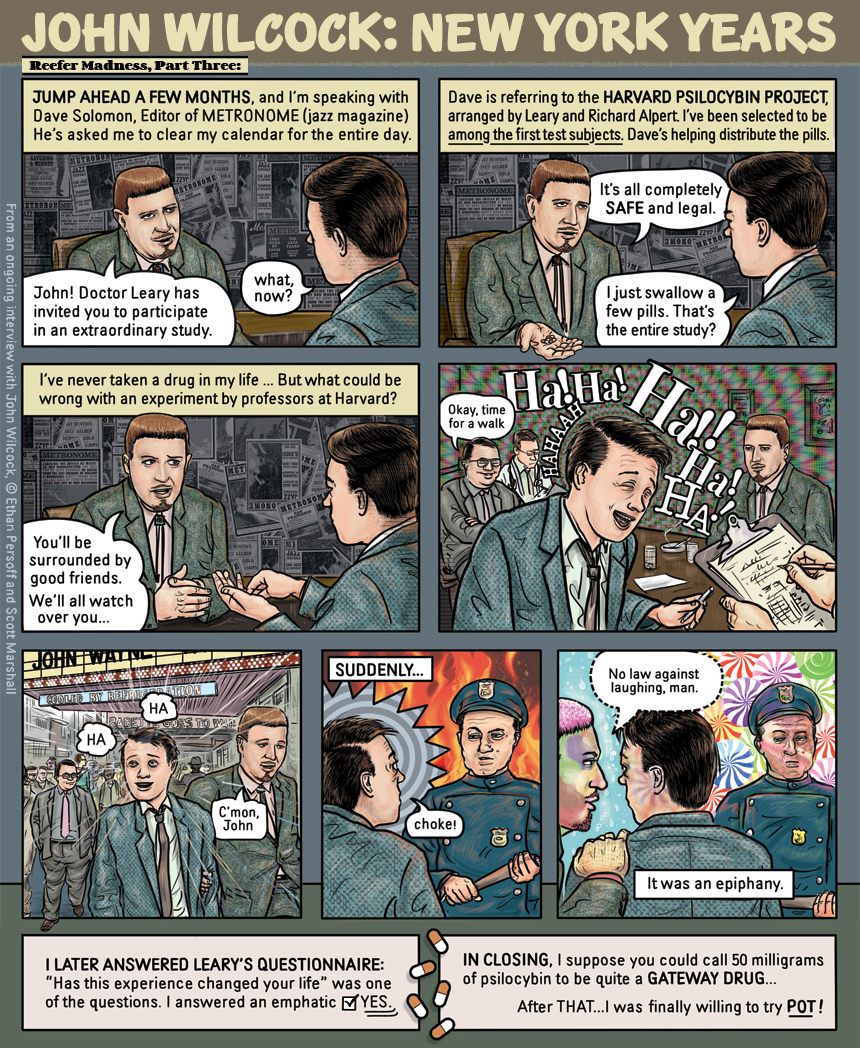
[IB Publisher's note: This is a three part comic graphic illustrated story published by Boing Boing that looks back on the early 1960s and a New York writer's first introduction to psychedelic drugs.

THE STORY: Part 1


While on an assignment John Wilcock meets an enthusiastic Timothy Leary, wearing red socks, in Cuernavaca, Mexico.

http://www.islandbreath.org/2013Year/11/131121wilcock1big.jpg
Image above: Detail from Reefer madness Part 1.  Click for full page. From (http://boingboing.net/2013/11/07/john-wilcock-timothy-leary-m.html).

THE STORY: Part 2

Witnessing a dinner with  a spacey Timothy Leary and his fascination with avocados (green butter) and bananas (joyous miracle).

http://www.islandbreath.org/2013Year/11/131121wilcock2big.jpg
Image above: Detail from Reefer madness Part 2.  Click for full page. From (http://boingboing.net/2013/11/14/john-wilcock-witnessing-tim-l.html).

THE STORY: Part 3

John Wilcock concludes with an invitation to participate in the  Harvard Psilocybin Project - the road to ruin that ultimately leads John to pot.

http://www.islandbreath.org/2013Year/11/131121wilcock3big.jpg
Image above: Detail from Reefer madness Part 3.  Click for full page. From (http://boingboing.net/2013/11/21/john-wilcock-participating-in.html).


Adventure with a Pink Pill
By John Wilcock on 6 September 1962 for The Village Voice -
(http://boingboing.net/2013/11/21/john-wilcock-participating-in.html)

[Boing Boing Editior's note: As an added treat to this final comic tale, here's John's original column on participating in the Harvard Psilocybin Project, from 1962.]

A questionnaire arrived last month from Tim Leary, a professor at Harvard who has been doing research on the effects of Mexico's "magic mushrooms" (teonanacati) on human consciousness. The mushrooms, foundation of some Indian religions, have been synthesized commercially into psilocybin, a small pink pill, and Tim Leary's Harvard group has been testing them on people and noting the effects.

I tried psilocybin about a year ago and reported on the enjoyable and highly euphoric effects. What Dr. Leary wanted to know now was whether there had been any permanent effects or changes in my life as a result. I was able to tell him (as, apparently, 62 percent of his subjects have told him) that my life had changed for the better.

It's always difficult to evaluate what effect a single action has had upon the course of one's life, and to what extent the normal maturing process is responsible, but it's true to say that in the past year I have become happier, more tolerant, less compulsive, and much more of a PARTICIPANT in virtually every phase of activity. I enjoy everything more these days, often with the sort of hearty abandon that wouldn't have been possible at one time in my life.

The simplest things -- reading the newspapers, listening to jazz on the radio, stopping for a hamburger, taking a bubble bath, kissing a girl -- fill me with tremendous anticipation and pleasure. I have become in love with the whole world, while at the same time retaining a healthy contempt for cruelty, greed, inhumanity, and the terrible things that people and countries do to each other.

It would be very unscientific, and potentially dangerous, to believe that these effects came solely from psilocybin, of course, but I do have a suspicion that that one afternoon's experience, coming at a particular time of my life, helped along what would possibly have been a natural course of events.

And I take my cue from a statement by Leary's group (the Center for Research in Personality):
"We have come to believe that psilocybin has the potential to facilitate for an individual the experience of major insights and problem solutions of an intellectual-emotional nature... It is also our conviction that these insights, enlightenment, or solutions provide a firm educational foundation for change in the social or intellectual behavior of the individual."

...In a meeting with representatives of the Food and Drug Administration, which has been kept informed of his research, Dr. Leary's group reported:
"We are convinced that these substances can contribute to human welfare in many ways -- in psychiatry and other forms of social rehabilitation, in creative industry, in education, in defense enterprises, in artistic and cultural pursuits."

And a compilation of reports from 98 of the 157 people who tried psilocybin reveals that 70 percent found the experience pleasant; 87 percent learned something new about themselves and the world; 62 percent report it changed their lives for the better; and 90 percent want to try it again. Leary's initial experiments are now concluded, and he has none of the drug available.


FOOTNOTE BY DR. LEARY:

The most important single factor that determines whether a person undergoes a heavenly or hellish experience is his expectancy. If, for example, he takes one of these drugs in a hospital setting, where his contract is to behave as a subject in a scientific experiment and where his every move is carefully watched and noted by attending doctors and psychiatrists, he will almost certainly manifest psychiatric symptoms.

On the other hand, if the drug is taken together with a group of close, loving friends in a warm, familiar environment and the expectancy is to have a joyful, intellectual experience, then the chances for this to happen are very good.

However, if the scene is rebellious or secretive -- fear of being caught by the police, guilt of pleasure, sense of doing something shady and illicit -- the chances are that all these things will become magnified out of all proportion.

COMIC CREDITS:
John Wilcock: Author and experimental psychedelic guinea pig will continue with additional chapters of this story in a few months. John still writes a terrific column of news and opinion, posted every week at www.johnwilcock.net.

Ethan Persoff (Twitter) is an archivist, sound artist and cartoonist. His other new comics project is RADIO WIRE.

Scott Marshall (Facebook) is an illustrator, sound artist, and art director, based in New York City. Previous projects include audio work for Woody Allen (Small Time Crooks), and the score for a full-length dance piece by choreographer Lar Lubovitch (Men's Stories).


See also:
Island Breath: Tales from The Tube 11/29/08
(Psychedelic surf comic by Rick Griffin in 1971 Surfer Magazine)


.

Navy Network Information Center

SUBHEAD: RIMPAC - MIRC - PMRF Whether you are a military cyberbot, an intelligence agency or Navy defense contractor you've been punked.

[Author's update 11/21/13: I guess they are listening. Not only did the Navy Network Information Center (in Lexington Park, Maryland) get punked by this story so did Lockheed Martins (Denver Colorado). Thanks for dropping by and hearing a bit of criticism.]

By Juan Wilson on 20 November 2013 for Island Breath -
(http://islandbreath.blogspot.com/2013/11/navy-network-information-center.html)


Image above: Concept illustration from Legendary Pictures of battle between a US Navy Aircraft Carrier group and Godzilla. From (http://www.thetimewarriors.co.uk/blog/?p=15150).

I frequently check on who is reading our website through a service provided free from StatCounter.com. They list the ISP of visitors and tell when and which posts on our site that they visit. Yesterday we had several visits from the Navy Network Information Center.

This morning when I saw the NNIC was back on our site I typed "navy network information center" into Google (just to see what would pop-up this time) the top result (past a paid ad by the US Navy) was an article CrashWorthy: Navy Network Information Center. 

The author (AliMaui) appears to be the wife of a USN submariner who is stationed on the USS San Juan (SSN-751) is a Los Angeles Class nuclear submarine that carries 12 Tomahawk missiles with an assignment with Submarine Group TWO, North Atlantic, Groton, CT. AliMaui writes:
I have learned that NNIC shows up ANY time someone is accessing my blog (or anyone's site) from a Navy Controlled computer. Whether that be some admiral in Washington DC, a petty officer on the Enterprise, or a land locked recruiter at his computer in Kansas City, it will all show up the same. So conspiracy theorists, put your theories to rest. No one is stalking you...

... I am sure I have been flagged because I occasionally talk about our crazy navy life. Or perhaps the crazy women of the San Juan have started to ruffle more feathers than those of the BB housing office. Perhaps they are worried I am going to divulge national secrets amongst my my musings. No secrets to be had here. I think that is the one thing that I find most annoying...I can ask my husband a question that seams pretty innocent, but the lack of comment and the nasty look that follows indicates that information is not for my ears.
Well, AliMaui, you are not the only one of interest to someone through the NNIC, We also are visited by US Navy controlled computers. Every once in a while we post an article that tweaks the interest of the US military and its supporters. We first noticed this back in 2007 during our coverage of the Hawaii Superferry... particularly in articles that connected it to the Navy through John Lehman; CEO of the Superferry corporationa and Navy Secretary under President Reagan.

Other subjects have interested the NNIC as well. For example coverage RIMPAC Navel operations every two years; the expansion of Navy operations in Guam; the new nuclear aircraft carrier port on Jeju Island in South Korea; US Navy opeations on Diego Garcia in the Indian Ocean; and the creation of a Marianas Islands Range Complex (targeting Pagan Island and others).

This last item has created a fury of NNIC visits in recent days. See a partial list for yesterday (image below) monitoring such visits to the article "Help Save Mariana Islands (http://islandbreath.blogspot.com/2013/11/help-save-mariana-islands.html).

http://www.islandbreath.org/2013Year/11/131120nnicbig.jpg
Image above: Screenshot from StatCounter visitor monitor showing Navy Network Information Interest in post about the Mariana Islands. Click to enlarge.

The three Navy computers most active were in Honolulu, Pearl Harbor and San Diego. We have received so many hits from these specific ISP addresses that we have labeled them "Navy Spies". Note the earliest (bottom of list) visit from the Navy was through an encrypted search from the San Diego computer. The last search (top of the list) was not from the Navy, but from a private corporation named ManTech, headquartered in Fairfax, Virginia. There were multiple visits from the Mantech ISP subsequently.

Recent @ManTech twitter feed:
ranked 5th on Friendly Employer list:
Wins $24 Million Option to Support Naval Air System Command - Congrats! bit.ly/1jglf7q

ManTech was founded in 1968 to provide advanced technological services to the United States government. We began with a single contract with the U.S. Navy to develop war-gaming models for the submarine community. Over the years, our government’s technology needs have increased dramatically in scope and sophistication, and we have grown to meet that challenge.

For more than 40 years, we kept a careful eye on where emerging technologies were taking the government, and we developed the resources to master those technologies—by staying close to our customers and anticipating their needs, hiring talented professionals to propel us into the future, and acquiring companies with proven capabilities.

Today, we are a $3 billion public company that provides the innovation, adaptability, and critical thinking our government needs for success in defense, intelligence, law enforcement, science, administration, and other fields—throughout the nation and in many countries throughout the world. We are now applying the lessons learned in the unforgiving arena of national security to help the private sector protect networks and critical information.
In other words; ManTech is a private information and technology corporation operated by the US Military - like Raytheon, Lockheed Martin, General Dynamics, ITT, Sandia Labs et al.

I continue to hold that the US Navy is the most destructive single organization threatening life on planet Earth. The world would be better off without nuclear weapons; nuclear power and the US Navy.

There is plenty of evidence that the US Navy has woken up to Peak Oil and Climate Change. In fact they have been early adopters. They are quickly moving to be energy independent throughout their operations and here on Kauai. They also see the need for local food production here on Kauai.

Unfortunately the US Navy mission (http://www.navy.mil/navydata/organization/org-top.asp) is still:
The mission of the Navy is to maintain, train and equip combat-ready Naval forces capable of winning wars, deterring aggression and maintaining freedom of the seas.

Too bad they do not see the that their mission should be the protection of the health of oceans and shorelines of the islands and continents that border them. Certainly the list of dangers that cannot be "shot down or sunk" is far more threatening to America than the enemies the Navy is preparing for. They include:
  • Radiation contamination of the Pacific Ocean by the catastrophe at Fukushima Daiichi Nuclear Power Plant.
  • Global Warming intensification of hurricanes and typhoons to heavily populated coastlines.
  • Acidification of the oceans and subsequent reef die-off from CO2 pollution by fossile fuel emmsissions.
  • Mammoth gyres of plastic litter that is mistaken for food by ocean fauna and also mimics organic material that interferes with Nature's chemistry.
  • "Strip Mining" of fish by dragging operations that have removed more than 90% of mega-fauna from the oceans.
  • Deep water drilling for petroleum that has destroyed the habitat of the Gulf of Mexico and now threatens the melting Acrtic Circle.
I suggest that the Navy take another look at its plans for RIMPAC 2014 scheduled for next summer and sill include several Pacific Rim nations in war game simulations with real depleted uranium wmunitions and brain shattering sonar affecting large ocean mammals.

Perhaps the RIMPAC members could think about turning from the Dark Side and joining Team Life.  If they can't they should simply save us some money and grief by cancelling the games.

Are you listening NNIC?


.