Showing posts with label Tropics. Show all posts

Permaculture Cool Lab

SUBHEAD: Is it possible that technology as simple as an Easy Bake Oven can reverse climate change?

By Albert Bates on 2 April 2017 for The Great Change -
(http://peaksurfer.blogspot.co.uk/2017/04/the-cool-lab.html)


Image above: Illustration of "biorefinery" concept that can be applied to utilization of bamboo forestry. From original article.

[IB Publisher's note: The "Cool Lab" technology that Albert Bates describes in this article includes ideas from holistic thinking, permaculture, and technologies like biochar that could transform agriculture and our use of technology, and be the solution to Global Warming, Climate Change and our own extinction. Get on board!]

In Permaculture the first stage of any design is protracted observation. What does a biological system have in over-abundance? What is scarce? How will it restore balance? What are the obstacles?

Let us say that an impoverished village in Haiti risks being carried away by mudslides that follow brush fires where the forest has been cut down to supply wood for shelter and cooking.

What things are scarce? In no particular order:
  • food
  • water 
  • cooking fuel 
  • secure shelter
  • energy
  • productive employment
  • biodiversity soil 
  • birth control 
  • health care
What things are over-abundant?
  • mud
  • deforestation
  • rain
  • hurricanes
  • earthquakes
  • unemployed people
  • superstition
  • resentment
  • mosquitoes
  • climate change
Lets see which of these things we can match up and cancel out. What we are about to describe is a carbon cascade.

The hillside needs to be planted with vegetation. It is especially important that the hilltops be forested.


Image above:Principles and techniques Refenerative Agriculture to improve whole agroecosystems. From original article.

A keyline analysis will show us where water wants to go when it rains, and how best it can be held high in the landscape and directed both to subsurface flows and to dam storage for uses in the dry season. Alley cropping along the contours follows hand-cut swales (or machine cut where financial capital  substitutes for social capital).

The berms are planted with successional understory (in this tropical example, pineapple, cassava, ginger, allspice, coffee and medicinal herbs), mid-level canopy banana, papaya, moringa, cacao, mulberry, tree legumes of mimosa, cassia, and pea subfamilies, chaya, climbing vines such as vanilla, dioscorea, cucumber, chocho and pasaflora, and eventual overstory of coconut, jackfruit, breadfruit, breadnut, ramon, samwood, mahogany, cedar, bamboo, peach palm, etc.

Between the alleys are seeded perennials such as callalu, okra, sorghum, and supergrasses like kernza (Thinopyrum intermedium), sunn hemp (Crotalaria juncea), pennisitum and pearl millet hybrids (Tembo), brassica napus, amaranth, etc., as well as familiar food crops such as maize, rice, yam and beans, where soils and water supply are well suited.

As much as possible, the planting process can be accompanied by biofertilizers having a high percentage of finely pulverized biochar, activated indigenous microorganisms, some immediate food for those microbes (such as composted food wastes and manures), and minerals keyed to redress local soil deficiencies.

If these biofertilizers are not immediately available for the first plantings, they can always be added later, as a byproduct of the early harvests.
 
Water in storage on the hillsides is edge-planted with Acoris, a plant that inoculates the water with a mosquito-larvae destroying resin. As the Acoris matures, pools and dams progress from being mosquito generating to mosquito decimating.

In the lowlands, water that overflows from catchments above is directed into chinampas, constructed wetlands composed of alternating islands and channels and rotating between aerobic (horizontal and vertical flow reedbeds) and anaerobic (settling lagoons) seeded with aquatic and semi-aquatic plants (taro, Chinese water spinach, lotus, azola, wild rice) and freshwater fish (aquaculture).

Acoris for mosquito control can also be planted here, but the fish do most of that work already, so the plant is only needed in mudflats and places fish cannot go.

The appearance of this microbiome also augurs the reappearance of frogs, peepers, lizards, dragonflies, water birds, bats, turtles, and forest mammals who venture to the water’s edge to drink.

Within the first season, the hillside mud problem is erased, deforestation is reversed, and food scarcity begins to be alleviated from the fast-yielding varieties of annuals, perennials and fish.

Productive employment can expand this system as much as available land permits, even on relatively steep hillsides. Resentment diminishes, and with it, superstition.

Within the village a regenerative, biological energy system arrives to replace the fossil fuel (diesel electric) grid-based source that previously had supplied electricity only intermittently, occasionally dimming lights and frying phone chargers and boom boxes.

This system consists of a biomass furnace, running on the woody wastes from coppice (the moringa, jackfruit and cassava plantation), coconut, rice or other shell crops, pelletized supergrasses and other biomass after food harvest or extraction of leaf protein, vitamins and useful fiber.

The loading dock at the biorefinery receives raw materials second-harvested from the farms.

Leaves of tropical legumes (Leucaena Zeucocephala, Vigna unguiculata, Clitoria ternatea, Desmodium distortum, Psophocarpus tetragonolobus, Macroptilium lathyroides, Phaseolus calcaratus, Brassica napus, and Manihot esculenta, for instance) are taken by conveyor and chopped into 2-cm pieces, soaked in 2-percent sodium metabisulfite, disintegrated in a hammer mill and pressed in a single-screw press.

The expressed juice is heated with steam (produced by the furnace) and protein coagulum collected, centrifuged, and pressed, then spread in a thin layer on glass plates and dried in an air-filtered, dehumidified room. It is then collected as a powder and containerized to be used or sold as a feed supplement.

At its most basic level, high-protein, high-quality leaf protein fractionation is simple. Production is geared to consumption by farm animals to remove some of the food safety, preservation and storage concerns.

Later improvements can produce dried leaf extracts for human consumption but higher capital costs are incurred and clean-room protocols by workers become essential.

Following leaf-protein extraction, the dried mash from the press is used as a feedstock for the furnace, where it joins other dried agricultural wastes: coppice wood, prunings, bamboo thinnings, pallets, cardboard boxes, coconut coir, nut and rice husks, etc.

All of this is pyrolyzed, the heat captured to run both the leaf protein process and produce electricity, and co-products (fractionated volatile gases, wood vinegar) drawn off before the final product — high quality biochar — remains.

The biochar is quenched (preferably with urine because that adds a 30% fertility gain), pulverized, and charged (blended with microbe-rich aerobic compost) to make a potent “cool” biofertilizer.

Alternatively, it is kept at food-grade and sold as a dry product for use as a food supplement, animal feed probiotic, water filtration medium or deodorizer. At less-than-food-grade it can be used as a litter amendment to reduce smells in animal enclosures, improve the fermentation of silage, or go into a variety of natural building materials — paints, dyes, plasters, wallboard and bricks.

And it can always become biofertilizer, even after undergoing one or more of these other uses.

Styrofoam “clamshell” food containers, which are ubiquitous from take-out restaurants and shops in the cities and often wind up just floating away on ocean currents, never to be destroyed, are collected and brought to the biorefinery.

There they go into an acetone bath and the dissolved liquid blended with low-grade biochar and poured into molds to dry. The resulting hard resin is mold-proof, waterproof, non-degradable, lightweight and durable.

Depending on the dies and molds, it can become a whole range of products — roofing tile, caulk, surfboards, fishing boats, life-vests, doors, bicycles, and ice chests.


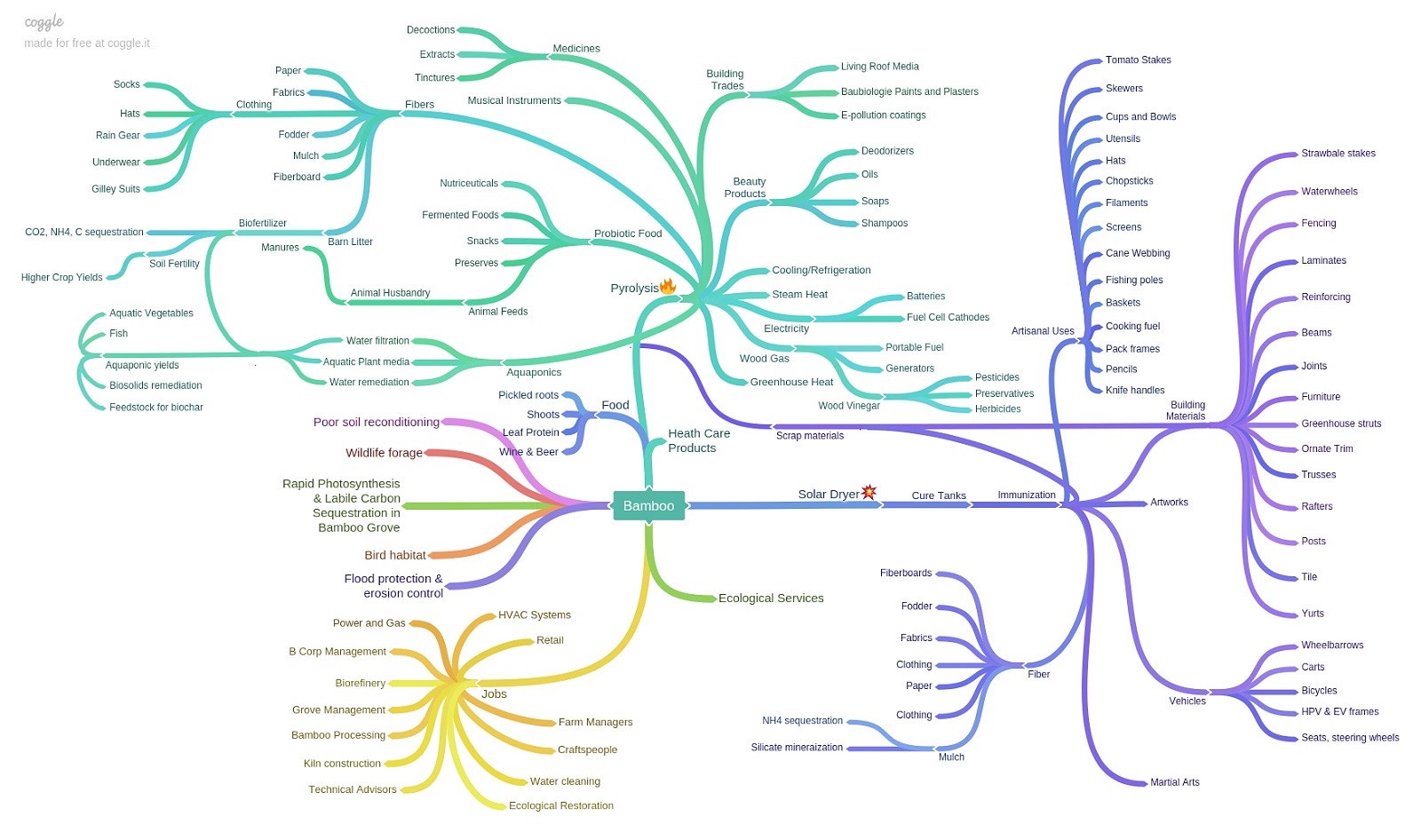
http://www.islandbreath.org/2017Year/04/170405bamboobig.jpg
Image above: Detail of the network of uses of bamboo in a regenerative agroecosystem. Click for the whole enlarged image. From original article.

If there is a surge in demand for a particular product — refrigerator deodorizers or animal feed supplements, for instance — or there is a surplus of some particular feedstock — bamboo knocked down by a storm — the biorefinery can shift its production pattern to take advantage immediately.

This  system sequesters more carbon than it emits, so we call it “cool.” By adding biochar, mineral rich compost, and microorganisms to the poor soils, we can jump-start soil productivity and boost farm productivity.

The gains in those alley-cropped contours will be anywhere from 40-percent to 400-percent vegetative growth, depending on the type of plants and the quality of the soils (poor soils will produce higher performance gains than good soils).

The same can be said for fish and livestock fed the leaf-protein and biochar nutriceuticals.

Let us pause here just a moment. Step back and take a look at the big picture. What is really being increased here is not so much village-scale well-being as photosynthesis. How are the greenhouse gases that are causing climate catastrophe — principally CO2, CH4 and N2O — to be removed from the atmosphere?

Mainly, although not exclusively, they will be removed by photosynthesis. The more of Earth’s surface that can be brought to bear on that task, the sooner the vital balance that harbors life on this tiny blue rock in space can be restored and the crisis ended.

Poultry can free-range the alleys to benefit of both plants and animals. Grazers can be moved through rotational cells that take advantage of water impoundments and high quality supergrasses. Fed nutrient-dense supplements with biochar, fish, poultry and grazing animals all grow faster and healthier without antibiotics or hormones, and deposit long-lived biochar back into the earth for long term carbon storage and soil fertility.

Growing nutrient-dense, no-till, organic food and perennial fibers on these marginal lands, using bioenergy and biofertilizers, creates a new, circular bioeconomy.  There is no such thing as waste. Nothing need leave the system, but what does is not raw material or pollution — representing the depleting wealth of the land — but high value byproducts — providing return on social capital invested. Waste becomes an orphaned verb.

Transportation presents an energetic challenge in the post-petroleum world. Nearly all modern forms of transportation evolved in an era of cheap net energy and diminish in economic viability when costed on renewable sources and life cycles.

Gone will be diesel-powered semi-tractor-trailers and locomotives. There could be new generations of electrified tow-paths for barges and gondolas, mag-lev rail and other innovations, but these costly innovations will be fragile in an era marked by overpopulation, resource constraints, climate chaos and economic contraction and likely will not provide a stable foundation for commerce in most places. Returning will be sail and animal powered transport.

If taken to maximum scale (rotationally planting an area the size of India each year and installing Cool Labs in every village), at a capital cost of $10000 to $15000 per hectare, the price would tally up to approximately 2% of the price of the fairy dust BECCS (Biomass Energy with Carbon Capture and Storage) conversion favored by geoengineers stuck in the fossil industrial paradigm.

Moreover, while BECCS represents continuing cost and is fraught with risk from plantation biomass crops — possibly genetically engineered and carrying along the can of worms that opens up — hazardously supplanting forested, multi-diverse, self-regenerating ecosystems.

The Cool Lab alternative represents antifragile synergies of local conservation communities, continuous and adaptive profits, and continuous gains in ecological health, stability and wealth.

Can the conversion be done in time? In contrast to the 45-year gradual expansion of soybean cropping from the early 1960s to reach 200 Mha today, this system offers five times the protein per area farmed while providing a far greater, and more immediate, returns on investment.

When one considers the rapid growth of renewable energy in the past decade, consider this: an energy producing Cool Lab costs one-seventh the capital as hydro, wind or solar and runs entirely on “wastes” that would otherwise be destined to add greenhouse gases to the atmosphere but are now intercepted and neutralized.

Cool Labs use the existing financial and technological landscape of the world today and simply change the way products are produced in order to heal the earth, balance carbon, and make more real wealth for more people more quickly.

Does this hold a hazard in the form of perpetuating wealth inequality, militarism and hegemony by the “taker” class? Yes it does. However, in the post-petroleum era, relocalization of economies is inevitable, and with relocalization comes local control over shared destinies.

Cool Labs represent circular economies that are inherently leveling.

Each lab adapts to needs and available resources and can flex to provide more or less of a particular kind of benefit and tailor fuels to available feedstocks and labor options. The number of cascades possible is limited only by the imagination and each year we conceive of more. We are at the dawn of a new kind of lean, clean, nature-centered economy.

This system can turn almost any human settlement into an ecovillage, although the criteria for what defines ecovillage must necessary include a few more elements than merely having a Cool Lab or permacultural support systems.

Ecovillages are based on a cohesive worldview, an abiding respect for the ecological integrity of your home biome, a circular local economy and a culture of peace and mutual respect. Depending on your starting point for each of these elements, bringing all of them into harmony can take time and effort.

The energy and food production system using mixed-aged, mixed-species forest, wetland and marine ecosystems we’ve outlined, taken to scale on the world’s available marginal land (not productive farmland or developed areas) could restore the fertility of those soils and waters while sequestering carbon from the atmosphere at the average rate of 17 PgC/yr after getting established.

To get back to the Holocene we need to return atmospheric carbon to pre-industrial range, around 260 ppm. The system just described, at full scale, could do that within about 50 years, taking into account the oceans’ CO2 outgassing feedback.

Village scale Cool Labs could achieve the cumulative storage of 667 gigatons of legacy carbon required to bring atmospheric carbon back to pre-industrial levels in the lifetimes of the majority of people now living. Were nations to collectively phase out fossil fuels as quickly as called for in the Paris Agreement, restabilization of the climate would be achieved sooner.

Recovering one percentage point of soil organic matter means that around 27 long tons of organic matter per hectare would enter the soil and remain there. Because around two thirds of organic matter added to agricultural soils will be decomposed by soil organisms and plants and given back to the atmosphere, in order to add permanently 27 tons, a total of 81 tons of organic matter per hectare would be needed. This cannot be done quickly or it just washes or evaporates away. A slow process is required.

An example of how this could play out in Haiti or anywhere else can be seen in the Loess Plateau of Northern China where fertile soils were overworked until they had to be abandoned. At the time of abandonment organic carbon concentrations had dropped to under 3 percent.

Thirty years later Loess soils had regained concentrations of 6 percent by natural processes. If natural restoration were accelerated by amending soil carbon in both metabolizable forms (such as crop litter and manures) and recalcitrant forms (such as biochar), the potential to increase soil carbon in a few decades could be raised to 10 percent or greater. This could happen virtually anywhere.

A farm that switches to organic, animal powered no-tillage methods can sequester 1 to 4 tons of organic matter per acre per year. By employing perennial polycultures, rotated pastures of grazing animals, trees and wild plant strips, that amount can be doubled or tripled.

Harvard professor Thomas Goreau writes:
Current rates of carbon farming at typical current levels would take thousands of years to draw down the dangerous excess CO2, but state of the art methods of soil carbon sequestration could draw it down in as little as decades if the percentage of long lived carbon is raised to as little as about 10%.
If the recuperation of soil carbon became a central goal of agricultural policies worldwide, it would be possible and reasonable to set as an initial goal the sequestration of one half ton per acre-year (1.5 t/ha-y or 500 grams per m2/y), comparable to the 4 pour 1000 program (4 grams per kg of soil) proposed by the French delegation at COP-21.

Carbon stored in the world’s soils and living biomass provides additional benefits beyond sequestration. As soil conditions improve, erosion and pests decline and the land comes back into balance.

Farming this way globally could sequester about 8 percent of the current total annual human-made emissions of 10 petagrams of carbon (PgC).

However, the fertility gains (equivalent to more than all of current global fertilizer production) would mean that chemical fertilizers could be (and should be) eliminated where carbon farming is practiced.

By reducing emissions of nitrous oxide from fertilizer (equivalent to approximately 8 percent annual human-made greenhouse gases) and the transportation and energy impacts of fertilizer production, we shave another 1 percent off global emissions.

But let’s keep going. If organic waste is returned to agricultural soils in the form of compost, then methane and CO2 emissions from its current destinations to landfills and wastewater (equivalent to 3.6 percent of man-made emissions) could be significantly reduced. Even a modest start, such as by elevating the soil carbon content of existing farmed soils by 0.4 percent, would have the potential to offset global greenhouse gas emissions by approximately 20 percent per year.

If biochar is added to the compost, we can quickly get to 100 percent, and then 120 percent. That is when it starts to matter.

After 10 years, we can increase progressively the reincorporation of organic matter into soils. By mid-21st century, we could increase the total world reservoir of carbon in the soil by two percentage points, and possibly more. In this way it is conceivable to restore our soil carbon reservoir to 10 percent, as Goreau argues. Because the system works best in poor soils, and because it eventually creates its own hydrological cycles, it can even re-green and reforest sandy deserts.

Are we doomed to Near Term Human Extinction?

Not yet. While there are still wild cards waiting to be played, what we have outlined shows a complete escape from our present trajectory. Is it possible that technology no more complicated than an Easy Bake Oven — and that pays for itself — can reverse climate change?


Image above: Photo of Chinese model of a Cool Lab rotary oven. From original article.

The rotary oven pictured above gasifies waste rice husks at the rate of 2.5 tons per hour. Thirty-five percent of that weight is transformed into biochar.

Half of the rest, as pyrogas, is extracted for useful synthetic compounds that replace petrochemicals.

The other half of that gas is used to co-generate 1.6 megawatts of electricity from this half-million-dollar biorefinery. It could also be refined into a liquid substitute for gasoline.

The Chinese government has invested heavily to develop this technology, and the wares they are producing are now the most efficient and lowest cost in the world. They will pour another $40 million into advanced biochar research this year.

Chinese Cool Lab reactors have been sold to 20 countries, including Haiti. In Senegal there is a prototype that has been continuously operating for 8 years.

In Egypt, the biochar made by their Chinese reactor is producing organic cabbages from the sandy shore of the Suez Canal. We witnessed a similar effect in the infertile clay soil beside the Asian Biochar Centre in Nanjing.

This we know: we can achieve faster and more well-rounded human development within the carrying capacity of the Earth. Will we? Who decides?

.

Dominica in Transition

SUBHEAD:Report from the island State of Dominica in the Caribbean.  Could "Transition" assist the island?

By Naresh Giangrande on 6 January 2017 for Resilience -
(http://www.resilience.org/stories/2017-01-06/dominica-in-transition/)


Image above: Secret Beach at Portsmouth on Dominica. Photo byEric Tuvel. From (https://erictuvel.wordpress.com/2012/01/12/island-life/).

[IB Publisher's note: This Caribbean island nation halfway between Puerto Rico and Trinidad is not that dissimilar to Kauai. It is, however, closer to its full independence and its indigenous population more in charge. Dominica does not have an armed forces - and likes it that way. Lessons might be learned through their experience.]

The island state of Dominica (absolutely NOT the Dominican Republic!) is unique, constantly confounding my expectations. It is a tropical Caribbean island, but not a typical Caribbean island.

It is hot and wet, mountainous, with small rocky beaches, few tourists, and a fiercely independent spirit in a part of the world dominated by their powerful neighbor to the North.

I was invited by WEF, the Waitukubuli Ecological Foundation, to visit and help them explore Transition as a possible way for this island.

The last refuge of the indigenous inhabitants of the Caribbean, the Kalinago people, Wai’ Tukubuli in their language, is at another moment of choice in it’s history. At a time when the socialism has come and gone, and the current neoliberal, globalized trade system is rapidly falling away, what place for small island states such as Dominica?

When there is a wish amongst most people to move forward and not backwards to a poverty and simple existence that is within living memory. Never completely colonized, to understand the people and this island you need to look back, which might also provide insights into ways forward.

The interior of the island is mountainous, very steep and rugged, and covered with dense rainforest. This enabled a state within a state to sit side by side with first the French then English colonizers. Read this account of the fighting Maroons of Dominica to understand how comprehensive the resistance to colonization was.

Tribes of Maroons and Kalinagos lived for centuries, free men and women apart from, and in occasional violent, bloody conflict with, the colonial slave regimes on the coastal plains.


Image above: Kalinago dancers don traditional wear for displays at the Baruna Aute in the Kalinago Territory. From (http://embracedominica.com/dominicas-people/).

The interior of the island was unsuitable for agriculture, or at least the plantation agriculture of the colonists, and able to resist the superior firepower of the European garrisons. Modern day Dominicans have the blood of these fiercely independent people running in their veins.

Dominica has much going from it from a resilience point of view, and is very different from most Caribbean islands. The sand, sea, and hot dry climate formula which facilitates mass tourism on most islands in the Caribbean does not work in Dominica.

The climate is wetter, the beaches rocky. The shoreline is common land. There have been attempts by hotels chains to build large hotels, but with the proviso that their section of beach become private. Dominicans have so far resisted the temptation to privatize this commons.

Few large estates remain. One of the heirs to the Rockefeller fortune donated his estate to help form the Morne Trois Pitons National Park in the center of the island. Land ownership remains widespread and egalitarian. I have been told most Dominicans have land and many grow their food. Most Transitioners would be very jealous of the 3 or 4 hectares with ample water and sun that ordinary folks have here.


Image above: For Dominicans the perfect definition of ‘peace’ is the absence of an armed force, and they seem to be doing just fine without the intervention of one. From (http://traveltriangle.com/blog/places-without-armed-forces/).

The land is not suitable for large scale agribiz, and hence not bought up by the large tropical fruit and commodity multinationals. There has been a succession of mono cropped, cash crops; citrus, ‘bay’, sugar cane, coffee, and bananas mostly grown by small land owners. All have come and gone. Many of the brightest young educated Dominicans leave the island to work in the USA and UK.

As the curtain goes down on the globalized world we have known for so many decades where does that leave Dominica? The set of cultural assumptions which I call the ‘myth of progress’ operates here as everywhere else.

But as in the ‘developed world’ that set of assumptions about our future; more, better, richer, more high tech are disappearing before our eyes as the ecological limits of growth on a finite planet begin to bite. Transition presents another way altogether of a marriage of the old and the new, making life more local, small scale, and convivial.

Would Transition work here? What would it take? There is a very small middle class. Could or would the ordinary Dominican warm to Transition? There is healthy scepticism of anything European, hardly surprising given the history.

There are a network of credit unions which could supply community funding. Can the small scale land ownership model be extended to renewable energy or community owned light industry? Could Local Entrepreneur Forums work here?

These are some of the questions I have been raising and the Dominicans I have meet are grappling with. There are no easy answers. The Transition model would be useful to the extent that it is very good at engaging people in conversations that matter, visioning, working well in groups, and developing a good networking strategy.

Would Transition look very different, to most places in the world, in Dominica? Probably yes. We have a workshop this Monday to explore these questions further. As always, I only ask the questions.Dominicans must answer.

.

Genetically Modified Mosquitos

SUBHEAD: Zika-linked brain damage in Brazilian infants may be only the 'Tip Of The Iceberg'.

By Lourdes Garcia-Navarro on  29 January 2016 for NPR -
(http://www.npr.org/sections/goatsandsoda/2016/01/29/464811052/doctors-see-profound-abnormalities-in-zika-linked-microcephaly-cases)


Image above: Gleyse Kelly da Silva holds her daughter, Maria Giovanna, who was born with microcephaly. Photo by Felipe Dana. From original article.

Dr. João Ricardo de Almeida is part of a team in Brazil that's investigating the cases of microcephaly — brain damage in infants born to mothers who contracted Zika virus during their pregnancy. He's examined dozens of brain scans, and he says that the scans are "very scary to look at."

"You see very profound abnormalities," says the neuro-radiologist. "Usually it's striking."
And they're notably different than scans of other babies born with the birth defect.

That's one of the disturbing findings in a large-scale study of the babies born with microcephaly. A team of doctors — from a neuro-pediatrician to an ophthalmologist — have taken a good look at dozens of affected infants. They're conducting the study at Roberto Santos General Hospital in the city of Salvador in Bahia.

One goal is to establish whether the Zika virus is in fact the cause of the thousands of cases of microcephaly in babies born since the fall.
 
"Of course the evidence is mounting but we need to prove," says Dr. Antonio Raimundo de Almeida, director of the hospital, which is in the city of Salvador in the state of Bahia. (He is a cousin of the other Dr. de Almeida.)

This week, 16 mothers and their microcephalic babies came to the hospital for a battery of tests.
"We do a full history, we do a blood test, everything," hospital director de Almeida says.
In the waiting room, the mothers cradle their infants, who all have the small cranium that is typical of microcephaly.

Microcephaly itself is not a disease. It's a condition caused by the failure of a fetus's brain to develop in the mother's womb.

There can be a number of causes, including toxoplasmosis, cytomegalovirus, syphilis, rubella and genetic abnormalities. So first, the researchers need to rule out these causes out.

In their research, the doctors have made some startling discoveries: There are some unique markers in the infants who have suspected cases of Zika-related microcephaly.

In one of the rooms, Dr. Adriana Mattos examines 3-month-old Barbara Antonia. Her mother, Ana Claudia Teixera, caught Zika when she was four months pregnant.

Dr. Mattos flips the child so she's lying on her chest. The doctor points out that in these Zika-related cases, the muscles in the upper body and neck are unusually stiff. And that's very different from cases of microcephaly caused by other infections.

Dr. João Ricardo de Almeida says the infants born to mothers who were infected in the first trimester seem to suffer the most brain damage. And that kind of damage also appears to be different than what you would see with microcephaly caused by other types of infections.

"Regarding Zika there seems to be some particular abnormalities that we do not see in [microcephaly cases caused by] toxoplasmosis or cytomegalovirus or rubella."

A normal brain has ridges like coral. The brains of these babies look "like a smooth rock," he says.
He says the degree of brain damage he is seeing will probably mean that rehabilitation will be very difficult.

"They are not going to be functional," he says of the babies he has examined. "They'll need care for the rest of their lives."

Dr. Albert Ko from Yale University has been collaborating with the study in Bahia. He says that while the cases of microcephaly are getting all the attention, the Zika virus could be having a wider range of effects on the development of a fetus.

"We are seeing cases in the hospital of children who have normal size heads but are having neurological lesions and eye lesions," he says. "And we are extremely concerned ... this might suggest that [the microcephaly cases] are just the tip of the iceberg."

In other words, even children who appear normal may suffer from a range of developmental delays. So the deeper the investigation goes into this outbreak, the more worrying it becomes.


GM Mosquitoes > Zika Virus > Microcephaly


SUBHEAD: Zika virus epicenter, related to microcephaly breakout, in same area where these GM mosquitos were released in 2015.

By Claire Bernish on  28 January 2016 for The AntiMedia - (http://theantimedia.org/zika-outbreak-epicenter-in-same-area-where-gm-mosquitoes-were-released-in-2015/)


Image above: Epicenter in Juazeiro, Brazil, where zika virus broke out after introduction of GM mosquitoes and where microcephaly cases have mushroomed.

The World Health Organization announced it will convene an Emergency Committee under International Health Regulations on Monday, February 1, concerning the Zika virus ‘explosive’ spread throughout the Americas. The virus reportedly has the potential to reach pandemic proportions — possibly around the globe. But understandingwhy this outbreak happened is vital to curbing it. As the WHO statement said:
“A causal relationship between Zika virus infection and birth malformations and neurological syndromes … is strongly suspected. [These links] have rapidly changed the risk profile of Zika, from a mild threat to one of alarming proportions.

“WHO is deeply concerned about this rapidly evolving situation for 4 main reasons: the possible association of infection with birth malformations and neurological syndromes; the potential for further international spread given the wide geographical distribution of the mosquito vector; the lack of population immunity in newly affected areas; and the absence of vaccines, specific treatments, and rapid diagnostic tests […]

“The level of concern is high, as is the level of uncertainty.”
Zika seemingly exploded out of nowhere. Though it was first discovered in 1947, cases only sporadically occurred throughout Africa and southern Asia. In 2007, the first case was reported in the Pacific. In 2013, a smattering of small outbreaks and individual cases were officially documented in Africa and the western Pacific. They also began showing up in the Americas. In May 2015, Brazil reported its first case of Zika virus — and the situation changed dramatically.

Brazil is now considered the epicenter of the Zika outbreak, which coincides with at least 4,000 reports of babies born with microcephaly just since October.

When examining a rapidly expanding potential pandemic, it’s necessary to leave no stone unturned so possible solutions, as well as future prevention, will be as effective as possible. In that vein, there was another significant development in 2015.

Oxitec first unveiled its large-scale, genetically-modified mosquito farm in Brazil in July 2012, with the goal of reducing “the incidence of dengue fever,” as The Disease Daily reported. Dengue fever is spread by the same Aedes mosquitoes which spread the Zika virus — and though they “cannot fly more than 400 meters,” WHO stated, “it may inadvertently be transported by humans from one place to another.”

By July 2015, shortly after the GM mosquitoes were first released into the wild in Juazeiro, Brazil, Oxitec proudly announced they had“successfully controlled the Aedes aegypti mosquito that spreads dengue fever, chikungunya and zika virus, by reducing the target population by more than 90%.”

Though that might sound like an astounding success — and, arguably, it was — there is an alarming possibility to consider.

Nature, as one Redditor keenly pointed out, finds a way — and the effort to control dengue, zika, and other viruses, appears to have backfired dramatically.

The particular strain of Oxitec GM mosquitoes, OX513A, are genetically altered so the vast majority of their offspring will die before they mature — though Dr. Ricarda Steinbrecher published concerns in a report in September 2010 that a known survival rate of 3-4 percent warranted further study before the release of the GM insects. Her concerns, which were echoed by several other scientists both at the time and since, appear to have been ignored — though they should not have been.

Those genetically-modified mosquitoes work to control wild, potentially disease-carrying populations in a very specific manner. Only the male modified Aedes mosquitoes are supposed to be released into the wild — as they will mate with their unaltered female counterparts.

Once offspring are produced, the modified, scientific facet is supposed to ‘kick in’ and kill that larvae before it reaches breeding age — if tetracycline is not present during its development. But there is a problem.

According to an unclassified document from the Trade and Agriculture Directorate Committee for Agriculture dated February 2015, Brazil is the third largest in “global antimicrobial consumption in food animal production” — meaning, Brazil is third in the world for its use of tetracycline in its food animals.
As a study by the American Society of Agronomy, et. al., explained, “It is estimated that approximately 75% of antibiotics are not absorbed by animals and are excreted in waste.” One of the antibiotics (or antimicrobials) specifically named in that report for its environmental persistence is tetracycline.

In fact, as a confidential internal Oxitec document divulged in 2012, that survival rate could be as high as 15% — even with low levels of tetracycline present. “Even small amounts of tetracycline can repress” the engineered lethality. Indeed, that 15% survival rate was described by Oxitec:
“After a lot of testing and comparing experimental design, it was found that [researchers] had used a cat food to feed the [OX513A] larvae and this cat food contained chicken. It is known that tetracycline is routinely used to prevent infections in chickens, especially in the cheap, mass produced, chicken used for animal food. The chicken is heat-treated before being used, but this does not remove all the tetracycline. This meant that a small amount of tetracycline was being added from the food to the larvae and repressing the [designed] lethal system.”

Even absent this tetracycline, as Steinbrecher explained, a “sub-population” of genetically-modified Aedes mosquitoes could theoretically develop and thrive, in theory, “capable of surviving and flourishing despite any further” releases of ‘pure’ GM mosquitoes which still have that gene intact. She added, “the effectiveness of the system also depends on the [genetically-designed] late onset of the lethality. If the time of onset is altered due to environmental conditions … then a 3-4% [survival rate] represents a much bigger problem…”

As the WHO stated in its press release, “conditions associated with this year’s El Nino weather pattern are expected to increase mosquito populations greatly in many areas.”
Incidentally, President Obama called for a massive research effort to develop a vaccine for the Zika virus, as one does not currently exist. Brazil has now called in 200,000 soldiers to somehow help combat the virus’ spread. Aedes mosquitoes have reportedly been spotted in the U.K. But perhaps the most ironic — or not — proposition was proffered on January 19, by the MIT Technology Review:
“An outbreak in the Western Hemisphere could give countries including the United States new reasons to try wiping out mosquitoes with genetic engineering.

“Yesterday, the Brazilian city of Piracicaba said it would expand the use of genetically modified mosquitoes …

“The GM mosquitoes were created by Oxitec, a British company recently purchased by Intrexon, a synthetic biology company based in Maryland. The company said it has released bugs in parts of Brazil and the Cayman Islands to battle dengue fever.”

.

Keeping lilikoi, cassava & macadamia

SUBHEAD: We have found a satisfactory way of freezing for long term the food of these productive plants.

By Juan Wilson on 1 September 2015 for Island Breath -
(http://islandbreath.blogspot.com/2015/09/keeping-lilikoi-cassava-macadamia.html)


Image above: Lilikoi fruit cleaned and ready for cutting, with frozen and fresh juice at right. Photo by Juan Wilson.

One of the things food growers frequently face is too much of a good thing. In the American northeast that can be rhubarb, zucchini or pumpkin. Here in Hawaii it can be avacado, lichi or guava. - an over-abundance -  so much so you cannot even give the harvest away.

Over the years we have not found a solution for year-round avacado, lichi or guava, but we have developed a process for keeping lilikoi, cassava and macadamia in long term storage for year round use. It does require some processing and freezer storage.

Lilikoi Juice
The easiest of the three to prepare are lilikoi (or passionfruit). We have a few vines around the property that we have let grow up on a few non-food producing trees - a monkeypod and plumeria. The lilikoi on the plumeria is right off our side porch and we can watch the ripening fruit and occasionally hear a falling fruit hit the ground or the metal porch roof.

Everyday in season we walk along the ground in front of the porch and pick up six or eight yellow ripe passionfruit. As we gather them we strip off the dried petals left on the stem. We place the fruit on a platter in the shade of the porch where our chickens don't go. Chicken learn to like lilikoi juice too, and we let them get a few on the ground.

 After three or four days, when we have a couple of dozen lilikoi, we take them to the kitchen sink and rinse them off.

We use a serrated knife to cross cut them in half. We use a large spoon to scoop out the "guts" and place them is a strainer over a pot to separate the seeds from the juice. Some stirring helps. A couple of dozen lilikoi will yield about a cup of juice. We have bought several small freezer friendly seal-able containers and use them for storing the passionfruit. This gives passionfruit an almost unlimited shelf-life - as long as the freezer is working anyway.

We always keep a thawed cup of this juice in the refrigerator. We often use it to flavor cold drinks. We have a CO2 tank to carbonate water. We make carbonated drinks with fruits and vegetables. With carbonated lemon, lime drinks a few spoonfuls of lilikoi juice makes a very exotic flavor.

My wife, Linda, has also perfected a lilikoi icing for her gluten-free cake recipe.
“It's funny how the colors of the real world only seem really real when you watch them on a screen.” ― Anthony Burgess, A Clockwork Orange

I stumbled on the material for a cocktail with what was in the fridge one day - I named it "A Clockwork Orange" - largely due to its neon bright orange color. The recipe is 1) fill a Tom Collins glass with ice. 2) Fill the glass one quarter with vodka, one quarter with carrot juice, one quarter with club soda (or carbonated water) and top it off with lilikoi juice. Stir gently and sip.


Image above: A small cassava root reday for chunking. Most roots we harvest are 6" in diameter or more. Photo by Juan Wilson.

Mashed Cassava

Long term storage of something as awkward and bulky as cassava root is a problem. We have found a process for cassava (or yucca) that works for us. We have about a dozen cassava trees growing around the yard and nearby fields.

Our first efforts with cassava was to make chips. (see http://islandbreath.blogspot.com/2012/09/cassava-chips-life-cycle.html). Early efforts were to fry them with some oil. Later we baked them with a lot less oil and a more uniform result. These chips are usually consumed quickly in a single session with guacamole or baba ganoush.  Even sealed in a bag the chips do not save well.

Another more useful way for us to use cassava is as a substitute for potato. Both as boiled or mashed as a side dish with meat, vegetables and salad.

We harvest the swollen upper roots from a cassava tree, leaving the smaller deeper roots alone. We prune the tree down by a third or so and save some thick short leafy branch section for planting in new locations.

We soak most of the clingy dirt off the roots in a five-gallon bucket and after scrub them gently with steel wool before skinning them. We trim tips and the branch stub completely off leaving only the white flesh of the root. We then use a large knife to cross-cut the root into large circular chunks.

We then pie cut the chunks into large potato-sized wedges. It is often necessary to pare off some woody central root sections. We put these potato-sized chunks into boiling water. After some time test the consistency with sharp paring knife. It yields through-and-through drain and cool. Place boiled cassava in one quart bags for freezing. We recommend dating the bags.

When thawed for use our favorite recipe is make mashed cassava much like your favorite way of making mashed potatoes. We heat the cassava in water, strain, mash and add plenty of garlic and butter.  The results are delicious and a bit stickier that potato.


Image above: "Dried" macadamia nuts ready for roasting in oven. Photo by Juan Wilson.

Roasted Macadamia Nuts 
We have one mature 30 year-old macadamia nut trees. In peak season (August and September) if drops a couple of dozen nuts a day that we can recover. Many we never find and many are eaten by rats at night. There have been days where we collected over one-hundred nuts. (see http://islandbreath.blogspot.com/2009/09/peak-macadamia-nut.html)

The first season we collected a burlap bag full. We hung the bag on a peg near our kitchen window. After a few weeks we noticed a macadamia nut on the floor. And as time went on we kept finding a few here and there. After a week we realized that there was a hole in the screen to the window. Rats had chewed through a part of the screen hidden by the bag and then chewed through the burlap to get the nuts. The bag was leaking our treasure. We tightened security.

We now peal and roast all our macadamia nuts in batches as they fall. We bag them in on pint freezing bags. Now we have have our own roasted macadamia nuts year-round. Here's our process.

We collect the nuts when the have fallen off the tree and are still in their green outer husk. We place them on a 30" diameter flat bamboo basket spread out so they are not piled on one another. The basket is placed on a table in the sun on our deck during the day and brought back to the covered porch at night to keep them dry.

It should be noted that we now have a cat who is an aggressive rat hunter who sleeps on and patrols our porch. The storage on the porch described above would not work otherwise. 

We keep the new green nuts on one side of the basket and the older brown (to black) nuts on the other side. The new nut husks turn brown and many begin to split. As they split more they turn to black.

Every few days we take about a hundred of the darkest husked nuts from old side and  put them in a bowl for husking. This is the toughest part of the job. The husks harden as they dry. We leave the husks on for three reasons. 1) we think the nuts age better with the husks on. 2) they are difficult to take off even green. 3) you can tell how old the nut is by the husk color.

I use a 10" Vise-Grip brand tool to remove the husk. I adjust it to about two-thirds of a nut diameter and grab the opposite and aligned with the split on the husk. This can often push the nut out of the husk in one motion. Often it take two swipes to free the nut.

Once they are husked I put them on a large platter in the shade. Then in the partially empty basket we roll nuts to the "dark-side" making room for green newbies.

The platter sits and gathers more nuts for about ten days. After that we start a new platter and start roasting the nuts in the old platter. We take about hundred 'aged" nuts at a time and put them in a colander for a quick rinse and inspection. any nuts with a perforation or weird color is tossed.

We but the remaining nuts is an oven pan at 240º for about three hours. There is a wide range of roasting that is possible. The color of the nuts can vary from a light tan to a creamy coffee color to brown, depending on your taste and use. Mostly we like medium well.

About one a week we thaw a bag of nuts and put the sealed bag in a bowl with some wrapped dark chocolates. Having to crack nuts and peel chocolate is a small price to pay for the ensuing bliss.

We highly recommend the mac nut cracker from TJs Nutcrackers from:
Gold Crown Macadamia Association
9582 Del Dios Highway Escondido CA 92029
call tollfree: (800) 344-6887
visit:  www.macnuts.org

.

Leaf Cutters

SUBHEAD: The problem is the solution. Damaged soils is a problem. Natures solution is to send leaf cutter ants.

By Christopher Nesbitt on 22 February 2015 for the Great Transition -
(http://peaksurfer.blogspot.co.uk/2015/02/leaf-cutters.html)


Image above: Leaf cutter ants marching to nest carrying sections of leaves. From (http://www.optibacprobiotics.co.uk/blog/2013/09/leaf-cutter-ants-carry-friendly-bacteria).

We are up river in Belize at the Maya Mountain Research Farm these next two weeks, teaching our tenth annual Permaculture Design Course here. This year we have 16 local Mayan farmers, healers, businessmen and women, trainers in development work, and students from the US, UK, Russia and Greece. Our own essay this week, about a different topic, is being guest-published at Club Orlov on Monday, so we thought we would publish here a short piece by our host, Christopher Nesbitt.

This is a small nest of a leaf cutter ant queen, establishing a colony. We tend to see them in tired land, rebuilding soils, assaulting the biological obscenity of monoculture, especially citrus, and aerating soils, hauling carbon down to the subsoil, allowing oxygen and water to infiltrate soils.

They will do some damage to native species, like cacao, but mostly concentrate on introduced species. Chemicals are not a constant necessity. I have been farming in a tropical setting since 1988, and I have NEVER used any biocides.

I am farming about 15 acres of a 70 acre piece of land. Most of the land I am working right now is old cattle pasture or abandoned citrus. You would not be able to tell looking at it. I live in a pretty lush forest of trees, with hundreds of species. Most of what I am doing is creating a stacked polyculture with a large diversity of species, ranging from banana, papaya and pineapple, to timber, to fuel wood, to tree legumes, to food, to medicinals and market crops that fit into the matrix of the farm, things like cacao, coffee and vanilla.

We do have some gardens, and we are expanding on the periphery of the land to create coconut dominated polycultures and feed banks for pigs, but the majority of the farm resembles the primary rainforest in structure, with less diversity, and with all the species being selected by us. We get both termites and leaf cutter ants. While they can both be a nuisance, if we step back a bit, we can see some of the services and products they provide.

Think of the presence of leaf cutter ants as being an indicator of an ecosystem out of balance, of being a cure for damaged soils. The lack of leaf cutter ants may mean a healthy ecosystem, or massive use of chemicals, including aldrin. I think of leaf cutter ants as being nature's way of rehabilitating damaged soils.

You really only see leaf cutters in the wake of a biological catastrophe, hurricanes, fire damaged land, or places like played-out milpa, after the window of 3-6 years of annuals productivity has dwindled out, and the return on energy invested is not worth the effort, and the land in question is being fallowed, or in the wake of the life of a citrus grove, abandoned banana plantations or damaged cattle pasture.

Most biological "catastrophes" are man made, with monocultures being the biggest biological catastrophe, sustained through work and inputs. These systems are only sustainable in simplistic economic models of capital invested in input and labor versus kilograms per hectar x dollar per kilogram.

Often, in terms of calorie based accounting, they are net losses of energy. Without cheap petroleum to subsidize their profitless existence, they would not exist.

I have lots of leaf cutter ants here in Belize, and while they can be a nuisance, they seldom damage a tree beyond the capacity of recovery. The biggest problem is that, if one is looking to produce marketable quantities of a single species, you have painted a sign on your ass that tells nature "bite me." Nature obliges.

While working industriously to undo the biological abomination of a monoculture the ants are the rescue squad, aerating the soil, allowing water to percolate in, and hauling carbon, all things that help damaged soil to recover.

Monocultures lead to leaf cutter ants. Leaf cutters have adapted to citrus in particular, with a preference for Washington navels and Valencia oranges. They are less excited by grapefruit or limes. What we call Jamaica lime here in Belize is practically immune to leaf cutter ants (and tolerates poor soil).

One way to avoid leaf cutters is to have a diversified farm in the first place, but any young polyculture in the lowland humid tropics is going to be prone to leaf cutter ants. When the land is more mature, it will be less susceptible, but not immune.

We see a lot of leaf cutter nests. I periodically dig up the mounds, looking for their fungus gardens, the subterranean chambers where they use the leaves for a substrate for their fermentations. When the young flightless queens are in the embryonic stage, they are like milk shakes for chickens. Even whacking on the surface of the nest will excite the colony.

Ants, being social insects, react to any perceived threat to the queen by swarming. Any disturbance on ground level will result in massive retaliation by the soldier ants, which are like micro pit bulls.

My chickens have visually imprinted on soldier ants and queen ants as being food. Soldier ants come out, looking to attack the source of the disturbance, and chickens happily eat them, racing about to snatch them up, converting a problem into eggs, meat and manure. I invest a bit of energy in harassing the colony, and the result is a smorgasborg of insect protein for my chickens. I have eliminated a few nests with this technique.

You can also make barriers of lemon grass, or vetiver, which leaf cutter ants do not like, lay cannavalia ensoformis leafs in their trails, which has antifungal properties and eventually, accidentally, will be taken into their nest, working better than a Stuxnet virus. If I put the soil from one nest across the trail of another nest they will not cross the trail (for a while). All of these are more about management than destruction.

The important thing is to see the inherent limitations of sustainably managing your farm. Certain crops are leaf cutter ants' favorite foods. If you want to grow citrus, you need to walk your land regularly, looking for new nests. How much land can a farmer adequately monitor? When you find a new nest, you must dig it up and find the queen, and kill her. I find a certain spiteful glee of throwing the helpless queen out into a flock of chickens, and watching them fight over her.

If the colony is young enough that it has no capacity to requeen itself, you have killed the colony. If not, you will need to dig it several times to kill the colony. Sometimes, its just going to be there. In Costa Rica and Panama, I hear they use pig manure to discourage the leaf cutter ants, pouring in a foul slurry into their home.

The key is to have a diversified system whereby you can use that energy in a useful way. Without poultry, we would have little use for either leaf cutter ants or for termites. With them, they both become assets.

Industrial mentality: the solution is the problem. Have leaf cutter ants. Apply biocide. Poison soil, water, self. Support nasty earth destroying chemical company.

Permaculture mentality: The problem is the solution. Damaged soils is a problem. Natures solution is to send leaf cutter ants. Leaf cutter ants are a problem. My solution is to use them to solve another problem, what to feed our chickens. 

.

Tropical forests & Climate change

SUBHEAD: NASA finds tropical forests absorbing more carbon dioxide than previously thought .

By Nadia Prupis on 4 January 2015 for Common Dreams -
(http://www.commondreams.org/news/2015/01/04/nasa-tropical-forests-key-fighting-greenhouse-gases)


Image above: Photo of tropical forest. From original article. Photo by Leonard S. Jacobs.

Tropical forests have emerged as a crucial factor in the fight against climate change, according to a new NASA-led study published Friday which finds that they are absorbing carbon dioxide at a far higher rate than previously thought.

As atmospheric levels of greenhouse gases have continued to rise, tropical forests, like those found in Malaysia, have been absorbing roughly 1.4 billion metric tons of carbon dioxide out of a total global absorption of 2.5 billion, NASA found.

Those rates are not only higher than previously estimated, they are also higher than those of the vast boreal forests found in northern regions like Canada and Siberia—which are diminishing.

"This is good news, because uptake in boreal forests is already slowing, while tropical forests may continue to take up carbon for many years," said Dr. David Schimel, NASA Jet Propulsion Laboratory senior research scientist and lead author of a paper on the study.

Forests use human-made emissions to grow faster, which in turn reduces the amount of carbon dioxide in the atmosphere—an effect known as carbon fertilization. They also remove up to 30 percent of airborne human emissions through photosynthesis. If those processes slowed down, the rate of global warming would increase.

Why was it important to determine which kind of forest are more adept at that process?
Because the answer "has big implications for our understanding of whether global terrestrial ecosystems might continue to offset our carbon dioxide emissions or might begin to exacerbate climate change," said Britton Stephens, co-author of the study and a scientist at the National Center for Atmospheric Research.

Schimel added, "All else being equal, the effect is stronger at higher temperatures, meaning it will be higher in the tropics than in the boreal forests."

The problem lies in other harmful impacts of climate change that also affect forests. Warming temperatures decrease water availability and increase larger and more frequent wildfires—which, in turn, release large amounts of carbon into the atmosphere.

Still, NASA's discovery is largely auspicious. "What we've had up till this paper was a theory of carbon dioxide fertilization based on phenomena at the microscopic scale and observations at the global scale that appeared to contradict those phenomena," Schimel said. "Here, at least, is a hypothesis that provides a consistent explanation that includes both how we know photosynthesis works and what's happening at the planetary scale."

The study is groundbreaking in its methodology, as it is the first to use a variety of models, technology, and data to create an "apples-to-apples" comparison carbon dioxide estimates between forests, NASA explained.

By using computer models of ecosystem processes, inverse models of atmospheric concentrations, satellite images, and other data and analysis, the researchers were able to determine the accuracy of their results "based on how well they reproduced independent, ground-based measurements."

.

Borneo's Danum Valley

SUBHEAD: Scientists fight to protect an untouched tropical Garden of Edan in Borneo from logging and palm oil cultivation.

By William Laurance on 20 December 2013 for Yale 360 -
(http://e360.yale.edu/feature/in_imperiled_forests_of_borneo_a_rich_tropical_eden_endures/2723/)


Image above: From original article. More photos there.

In Borneo's Danum Valley — one of the last, untouched forest reserves in a region ravaged by logging and oil palm cultivation — a team of international and Malaysian scientists is fighting to preserve an area of stunning biodiversity.

After three decades of studying the world’s great rainforests, including the Amazon and Congo Basin, I thought I’d seen the best nature has to offer. But that was before I visited a small pocket of forest in northern Borneo known as the Danum Valley. There, I found a dedicated band of international and Malaysian scientists fighting to save a true biological Eden.

In just three days at Danum, I saw a stunning assortment of creatures. Dense rainforests are notoriously difficult places to spot wildlife, but not at Danum — animals are practically dripping from the trees. Bornean gibbons howl from treetops, while giant squirrels and macaques leap spectacularly among branches. Pygmy elephants abound, along with sambar deer and bearded pigs. Orangutans are spotted regularly, while my nighttime hikes revealed palm civets, leopard cats, and giant flying foxes. Even while taking breakfast on the deck of the research lodge, I was enthralled by a kaleidoscope of butterflies and birds, including magnificent rhinoceros hornbills. And soon after that I had a jolting encounter on a forest track with a spitting cobra, which reared up with hood extended just six feet in front of me.

By any measure, Danum ranks among the world’s most biologically rich and imperiled real estate. My host at Danum, Glen Reynolds, who oversees the British Royal Society’s research in the area, explained how the forests of Borneo have suffered hugely in recent decades from rampant logging, slash-and-burn farming, and cutting for oil palm and rubber plantations. The island’s rich lowland forests have nearly vanished, with rates of forest loss still among the highest on Earth. For this reason, Borneo is a global epicenter for endangered wildlife, with conservation prognoses for many species becoming ever more perilous.

But Danum has survived, thanks in part to the prestige of the Royal Society and its three decades of collaborative research in Sabah, the Malaysian state in which the conservation area is located. The Royal Society has forged close ties with several influential partners, including the Sabah Forestry Department, the nearby Universiti Malaysia Sabah, and the Sabah Foundation, which administers Danum Valley and its surrounding forests. It also has trained scores of Malaysian scientists and policy makers, including a number who now hold key research or government positions in Sabah and elsewhere in the region.

Danum is not big by nature-reserve standards — it spans just 438 square kilometers (169 square miles) — but it has impressive attributes and occupies a pivotal position in a rainforest region under siege. In Borneo, half a square kilometer of forest can sustain well over a thousand tree species — more than occur in the entire Northern Hemisphere. In addition, while the forests surrounding Danum have suffered considerably, the reserve itself has never been hunted or logged. That means that wildlife abounds in rainforests dominated by ancient, towering trees, some reaching up to 80 meters (262 feet) in height.

The combination of off-the-charts species diversity and high animal abundance seen at Danum is exceedingly rare. In the central Amazon, for instance, species diversity is very high but you can walk all day and see just a handful of animals — the forest’s nutrient-starved soils sharply limit animal numbers. And elsewhere in Borneo, many nature reserves have suffered terribly from hunting. At Lambir Hills National Park in Sarawak, for example, half of the primate species, six of seven hornbill species, and nearly all of the endangered mammal species have been hunted out. With the disappearance of its key seed dispersers, the fruits of many trees now just rot en masse on the forest floor.

The scientists who flock to the Danum area, many working through the Royal Society’s Southeast Asia Rainforest Research Program, have made important discoveries. Among these is that epiphytic plants perched high in the rainforest canopy are hotbeds of biodiversity, sustaining a veritable zoo of creatures living inside them. A former postdoctoral researcher in my lab, David Edwards, has shown that even repeatedly logged native forests in the Danum area can sustain considerable biodiversity — less than is found in old-growth forest but far more than occurs in oil palm or rubber plantations.

From the air, one can see a tsunami of threats advancing toward Danum. To reach the park, I flew from the small city of Kota Kinabalu across northern Borneo. This was like touring a battle front — to the south I saw mostly forest, to the north devastation, especially from rapidly expanding oil palm plantations. Danum is smack in the middle of this ecological war zone.

In recent decades the forests around Danum have been heavily logged, often repeatedly. Their stocks of timber depleted, many of these forests are now being bulldozed for oil palm or for growing plantations of acacia, which is chipped and then shipped overseas to make paper pulp. For Reynolds, this is a travesty. "I realize the government needs income from its forests," he says, "but unrestricted development of plantations at the expense of forests is an ecological disaster. It’s infinitely preferable to have logged native forests, which sustain many vulnerable species, including the orangutan."

Reynolds has found a sympathetic counterpart in Malaysia in Sam Mannan, the director of the Sabah Forestry Department. Though under intense pressure from his political masters and oil palm interests to clear more forests, Mannan has managed in the last two years to reclassify more than 3,000 square kilometers of logged forest near Danum as fully protected forest reserves, ensuring their long-term survival. Crucially, these new reserves were designed to create buffers around Danum and two other small protected areas in the vicinity, and to begin linking them together so that none becomes fully isolated by encroaching development.

Mannan’s efforts are vital, because small size and isolation are the enemies of nature. A single herd of elephants, for instance, may need to range over hundreds of square kilometers, whereas fruit-eating animals such as bearded pigs, sun bears, and many birds famously migrate across vast areas of Bornean forest in search of fruit. For such species, forest isolation could be a death sentence. Indeed, my own research shows that in forests across the tropics, biodiversity fares far worse if the habitats surrounding protected areas are cleared or heavily disrupted.

In addition to an avalanche of land-use pressures, the specter of future climate change is lending a special urgency to those battling for the greater Danum ecosystem. Current climate models suggest that in coming decades, global warming will amplify El Niño droughts in the western Pacific region. In the past, such droughts, combined with widespread logging and slash-and-burn farming, have led to catastrophic forest fires in Borneo. Droughts in Borneo also trigger mass fruiting events that are followed by long periods of fruit scarcity, during which wildlife must either move to new areas or die.

Crucially, the disparate blocks of forest that Mannan and Reynolds are trying to cobble together would form a continuous belt from sea level to over 1,700 meters in elevation. If they succeed — and they estimate at least 1,000 square kilometers of additional forest is needed — it would provide a link between more drought-prone forests in the coastal lowlands and wetter forests at higher elevations. Such a gradient would allow animals to move and species to migrate — a critical buffer against the effects of future climate change and droughts. "Ecologically, this is probably the most important stretch of forest in Borneo," says Reynolds. "It’s the last link between the lowlands and uplands that hasn’t been completely hunted out."

Mannan stresses that support from the Royal Society and other high-profile partners is crucial for him. But the situation is changing. The Royal Society has been downsizing its financial investment in Borneo research and will soon hand off its programs there to a consortium of academic, conservation, and training organizations — a key development that should help ensure the survival of the society’s legacy in Borneo.

Clearly, it is a pivotal time for Danum Valley and its surrounding forests. As the roar of encroaching bulldozers draws nearer, one has to applaud those fighting so resolutely to save a piece of Eden.

.

The pit of my stomach

SUBHEAD: Avocados, papayas, mangoes and yucca should have gone extinct millions of years ago.

By Natashia Hakimi on 9 December 2013 for TruthDig.org -
(http://www.truthdig.com/eartotheground/item/avocados_shouldve_gone_extinct_millions_of_years_ago_20131209)


Image above: Painting of a family of ambelodon, a gomphothere proboscidean in midground, by Sam Matternes, 1964. From (http://rhamphotheca.tumblr.com/post/11197204477/the-gomphotheres-and-the-avocado-most-plants-bear).

The Gomphotheres and the Avocado
Most plants bear fruit so that animals can eat them and then disperse their seeds. Avocados, and a few other fruits, are too large (or rather have seeds too large) to be eaten and be dispersed by any animals that are extant (currently in existence). These large seeded fruits, that are found throughout the Americas, evolved along with the large mammals of the Pleistocene epoch (the “Pleistocene Megafauna”), like Gomphotheres, other proboscideans, and Giant Ground Sloths. These animals went extinct around 10,000 years ago, and the Avocados lost their chief dispersers. Many plants went extinct along with the megafauna, but some, like avocados, found new dispersers (like humans and slightly smaller mammals). The geographic range of many of the fruits that survived decreased greatly, but they managed to hold on. (From source of image above.)

Many don’t know that if it weren’t for homo sapiens’ avocado fetish, their favorite fruit would have been wiped off the face of the planet by now. It’s common knowledge that fruits spread their seed through animals’ digestive tracts, and avocados are no exception. In order for their seeds to be planted far enough from their “parent” tree, fruits depend on animals to eat them, and then leave their seeds elsewhere. 

However, avocados’ huge, lethal pits present a modern day problem for most animals since most can’t reach, chew or digest the massive brown seeds at the core of the creamy fruit. So how is it the delicious green fruits are still found in dishes all over the world?

According to writer Maria Popova on her blog Brain Pickings:
...apparently, avocados coevolved with ground sloths and were originally eaten by gomophotheres — elephant-like creatures that lived during the Miocene and Pliocene, between 12 million and 1.6 million years ago, who happily reaped the fruit with their hefty trunks, crunched them with their massive teeth, and passed the seeds comfortably through their oversized digestive tract.

The problem, of course, is that gomophotheres no longer roam the Earth — and yet avocados still exist.
 Popular science writer and evolutionary biology champion Connie Barlow writes:
Avocado’s strategy for propagation made a great deal of sense throughout the long life of its lineage — until the present moment. Even after thirteen thousand years, avocado is clueless that the great mammals are gone.

For the avocado, gomophotheres and ground sloths are still real possibilities. Pulp thieves like us reap the benefits. Homo Sapiens will continue to mold the traits of the few species of genus Persea it prefers.

Ultimately, however, wild breeds will devolve less grandiose fruits, or else follow their animal partners into extinction.

And avocados aren’t the only vegetation that have been around past their due date.

Apparently, mangoes, papayas and yucca are also evolutionary anachronisms that have survived natural selection thanks to humans’ hankering for them.

.

Peak Coconuts

SUBHEAD: While demand rises coconut crisis looms as postwar palm trees age and are not replaced.

By Supunnabul Suwannakij on 3 November 2013 for Bloomberg News -
(http://www.bloomberg.com/news/2013-11-03/coconut-crisis-looms-as-postwar-palm-trees-age-southeast-asia.html)


Image above: Proposed Longs Drugs paving over the remnants of the eastsides once extensive coconut orchards next to failing Coconut Glove mall. From (http://thegardenisland.com/business/local/longs-drugs-plans-waipouli-store/article_eaaeb146-d267-11e2-b2be-0019bb2963f4.html?mode=jqm_gal).

Asia’s coconut palms, which mark the landscape from the Philippines to India, face a crisis as aging groves become less productive, with harvests that are a source of food and income for millions being outstripped by demand.

The trees, many of which were planted about 50 to 60 years ago, no longer yield enough to meet rising demand, according to the Rome-based Food & Agriculture Organization. There’s an urgent need for replanting, said Hiroyuki Konuma, regional representative for Asia and the Pacific at the UN agency, which is coordinating a response to the challenge. While world consumption of coconut products is growing more than 10 percent a year, production is increasing by only 2 percent, it said.

At stake is the productivity of a core part of the rural economy in the Asia-Pacific, which accounts for about 85 percent of the global supply of the commodity that goes into food, fuel, soaps and cosmetics. In the Philippines, among the three biggest growers, one in five people depends on the crop to some extent, according to the Asian and Pacific Coconut Community. The Jakarta-based group, which represents growers, predicts that harvests could be increased to benefit millions of smallholders.

“We have a lot of aging trees,” Yvonne Agustin, executive director of the United Coconut Association of the Philippines, said in an interview, adding some local palms are already 100 years old. “The government recognizes that and has embarked on a planting and replanting program,” Agustin said by phone.

Slender Trees
The slender trees that are a staple image for tourists’ postcards are productive for between 50 years and a century, with the highest yields in the first three decades, according to the FAO. The harvest in the Asia-Pacific is now about 40 nuts per tree a year, compared with a potential yield of 75 to 150, it estimates, saying replanting is advisable after 60 years.

India, Asia’s third-largest economy, is the top producer, harvesting 17 billion nuts last year, followed by Indonesia, which gathered 15.4 billion, and the Philippines, with 15.2 billion, according to the Asian and Pacific Coconut Community. The global coconut area was about 12.3 million hectares (30.3 million acres), yielding 64.3 billion nuts, it said.

While the expansion of services and manufacturing spurs economic growth in Asia, farming remains important. In India, agriculture accounted for 17 percent of gross domestic product last year, according to the Washington-based World Bank. In Indonesia, agriculture was 15 percent of GDP in 2011, while in the Philippines it was 13 percent. The FAO estimates the coconut industry accounts for as much as 5 percent of Philippine GDP.


Image above: Photo of existing aging coconut trees to be taken down and replaced with parking lot . From (http://thegardenisland.com/business/local/longs-drugs-plans-waipouli-store/article_eaaeb146-d267-11e2-b2be-0019bb2963f4.html?mode=jqm_gal).

Philippine Yield
In the Philippines, an estimated 340 million trees cover 26 percent of farmland, yielding 43 nuts per tree a year, data from the Philippine Coconut Authority show. Shipments of coconut products in the first eight months of the year rose 10 percent to $1 billion, data from the statistics agency show. The industry is the country’s largest agricultural exporter, said Euclides Forbes, the authority’s administrator.

Kerala is the top producer in India, followed by Tamil Nadu, Karnataka and Andhra Pradesh, according to the Coconut Development Board, under the Ministry of Agriculture. While a trial program in Kerala to replace aged palms has boosted productivity, yields are still dropping in the three other states, sometimes by as much as third, Sugata Ghose, the board’s chief coconut development officer, said in an interview.

“We have removed disease-ridden and old palms for replanting,” said Ghose, who’s based in Kochi, Kerala. “Last year, we had a big problem with the price, as farmers were not getting a good price. This year farmers are happy because production is less plus demand has gone up.”

Bangkok Consultation
Not all farmers face difficulties. Aging trees aren’t an issue in Vietnam’s Ben Tre, according to Tran Van Hung, deputy director of the agriculture department in the province that’s the biggest grower. Yields are stable at about 100 nuts per tree a year in most areas, up from about 60 a few years ago after prices rose and farmers used more fertilizer, Hung said.

The FAO, a United Nations agency, hosted a consultation in Bangkok last week to address the yield issue, drawing representatives from states including the three top growers as well as Fiji and the Solomon Islands. While yields are low and most trees are old, scientists are working to raise output, said Siriwat Kajornprasart, Thailand’s deputy minister of agriculture and cooperatives.

“Coconut is a traditional crop in India, with more than 2,000 years of history,” K. Muralidharan, director of the Coconut Development Board, said on the sidelines of the gathering in Bangkok. Every part of the palm can be used, and the industry contributes more than 83 billion rupees ($1.3 billion) a year to India’s GDP (INQGGDPY), he said.

Often Overlooked
New trees can start producing in as few as two or three years, according to Romulo Arancon, executive director of the Asian and Pacific Coconut Community. With replanting and improved farm practices, output can be raised by 50 percent to 100 percent within a few years, said Arancon, who estimated that a mature palm can produce as many as 400 nuts a year.

More than half of Indonesia’s 4 million hectares of palms are aging, or over 50 years old, said Irawadi Jamaran, chairman of the Indonesian Coconut Board, which groups producers, processors and sellers. The main problem for the industry is a lack of government attention, with greater concern for bigger plantations, especially oil palm, Irawadi said. The country is the largest producer of palm oil, which is grown on estates.

“Coconut is often overlooked by many people because we’re always looking at rice and oil palm, and people don’t think coconut is an important one: this is not true,” the FAO’s Konuma said in an interview. “It contributes to economy, culture and livelihood.”


.

Climate Crisis Weather

SUBHEAD: Climate change from global warming will bring drought in temperate areas and flooding in the tropics.

By Staff on 5 May 2013 for CounterCurrents -
(http://www.countercurrents.org/cc050513A.htm)


Image above: Studio set from movie "Smell of Success", 2009. From (http://miltonadamou.com/2009/10/11/smell-of-success/).

Climate crisis may increase the risk of extreme rainfall in the tropics and drought in temperate zones. Citing a new study led by NASA Neela Banerjee reported [1] from Washington:

"These results in many ways are the worst of all possible worlds," said Peter Gleick, a climatologist and water expert who is president of the Pacific Institute, an Oakland research organization. "Wet areas will get wetter and dry areas will get drier."

The regions that could get the heaviest rainfall are along the equator, mainly over the Pacific Ocean and the Asian tropics. Increased aridity and drought could have a greater effect on human life, however, because those conditions are more likely to occur where most of the world's population lives.

In the Northern Hemisphere, drought-prone areas include the southwestern US, Mexico, North Africa, the Middle East, Pakistan and northwestern China. In the Southern Hemisphere, drought could become more likely in South Africa, northwestern Australia, coastal Central America and northeastern Brazil.

"Large changes in moderate rainfall, as well as prolonged no-rain events, can have the most impact on society because they occur in regions where most people live," said William Lau, the study's lead author and a scientist at NASA's Goddard Space Flight Center in Greenbelt, Md. "The regions of heavier rainfall, except for the Asian monsoon, may have the smallest societal impact because they usually occur over the ocean," he added.

The study is based on the results of 14 models that show agreement on the possible rainfall trends, Gleick said.

Climate change does not cause forest fires but does contribute to their likelihood, Gleick said, adding: "It's not about causality but influence."

For every 1 degree Fahrenheit increase in global average temperature because of GHG emissions, heavy rainfall will increase globally by 3.9%, the study predicted.

Climate change could lead to heavier rainfall because warmer air holds more moisture.

On the flip side, for every degree Fahrenheit of warming, the length of time a region goes without rain could increase globally by 2.6%.

Scientists have said that the world needs to keep global average temperatures from exceeding 2 degrees Celsius, or about 3.6 degrees Fahrenheit, above pre-industrial global temperatures to avert catastrophic changes to nearly all aspects of life. In the last 150 years or so, the Earth's average temperature has already risen about 1 degree Celsius, or 1.3 degrees Fahrenheit.

To prevent the 2 degree Celsius rise and its effects, including extremes in rainfall, the world has to keep emissions of heat-trapping carbon dioxide below a ratio of 400 parts per million.

According to the Scripps Institution of Oceanography at UC San Diego, there have been isolated measurements of 400 parts per million in the Arctic, and scientists expect readings in Hawaii to exceed 400 parts per million this month.

Another report [2] added:

The study, to be published in the journal Geophysical Research Letters, demonstrates for the first time how rising carbon dioxide concentrations could affect the entire range of rainfall types on Earth.

“In response to carbon dioxide-induced warming, the global water cycle undergoes a gigantic competition for moisture resulting in a global pattern of increased heavy rain, decreased moderate rain, and prolonged droughts in certain regions,” said William Lau.

Light rain will also increase by one percent, across the globe. Because moderate rainfall is projected to decrease by 1.4 percent, total global rainfall is not expected to change much.

Scientists define heavy rainfall as months that receive an average of more than about 0.35 of an inch per day, and light rainfall as months that receive an average of less than 0.01 of an inch per day. The definition of moderate rainfall is months that receive an average of between about 0.04 to 0.09 of an inch per day.

According to the study, some regions outside the tropics may have no rainfall at all.

The researchers calculated statistics on the rainfall responses for a 27-year control period, starting at the beginning of the simulation. They also calculated statistics for 27-year periods around the time of doubling and tripling concentrations.

Predictions for how much rainfall will occur at any one location as the climate warms are not very reliable, the team found.

“But if we look at the entire spectrum of rainfall types we see all the models agree in a very fundamental way — projecting more heavy rain, less moderate rain events, and prolonged droughts,” Lau said.

Source:
[1] Los Angeles Times, May 4, 2013,
Climate change may bring drought to temperate areas, study says,
http://www.latimes.com/news/nationworld/nation/la-na-nasa-climate-20130504,0,2772152.story

[2] Red Orbit, May 4, 2013, “Rain And Drought Will Increase Due To Warming: NASA”,
http://www.redorbit.com/news/science/1112838172/nasa-projects-global-warming-will-drive-global-rainfall-changes-050413/
.

How we might be saved

SUBHEAD: Can a single species of tree significantly reduce hunger, unemployment and deforestation? By Jon Letman on 6 June 2012 for IPS News - (http://www.ipsnews.net/news.asp?idnews=108051) Image above: Dr. Diane Ragone, director of the Breadfruit Institute of the National Tropical Botanical Gardens on Kauai, holds a flat of tiny Ma'afala breadfruit trees before shipping overseas. Photo by Jon Letman in original article. Researchers and scientists behind a surge in breadfruit activity are optimistic about its effects in the tropics. Over the last decade, a handful of nonprofits and NGOs have accelerated efforts to test, grow and distribute breadfruit trees with the idea that this versatile, nutritious, fast-growing member of the mulberry family has enormous untapped potential to improve food security and local ecosystems. Breadfruit proponents from Hawaii to British Columbia, the U.S. Midwest, Central America and Europe have stepped up efforts to expand the tree's presence in the Caribbean. Breadfruit, a staple in the Pacific Islands for thousands of years, has been popular in the Caribbean for over 200 years. What's different about the trees being introduced today is that they are a Samoan variety called Ma'afala (mah-ah-fala), previously unknown in this part of the world. Ma'afala was selected as optimal for mass propagation and distribution because it has the highest protein and mineral nutrition (iron, potassium, zinc) of 94 varieties studied, and is widely considered one of the tastiest of varieties. All the Ma'afala grown and distributed in the Caribbean today originates from the collection at the Breadfruit Institute, part of the Hawaii-based National Tropical Botanical Garden. Breadfruit Institute director Dr. Diane Ragone, who manages the world's largest and most diverse breadfruit collection on Maui and Kauai islands, partners with Dr. Susan Murch, a chemistry professor at the University of British Columbia (UBC), Okanagan. Ragone began collecting breadfruit varieties for conservation and research in the mid-1980s and has worked with Murch to develop micro- propagation protocols for elite varieties that are then mass- propagated by U.S.-Germany-based Global Breadfruit. The tiny Ma'afala trees are then purchased by organisations which introduce the plants where they are most needed ― in places like Jamaica, Honduras and Haiti. More jobs, cleaner water and better food One organisation encouraging the growth and consumption of Ma'afala is the Agro-forestry Regional Nursery (ARN) Foundation of Haiti. ARN works on the premise that local food security, employment and healthy watersheds and forests are interrelated. With the capacity to grow one million trees per year, the foundation aims to improve the condition of Haiti's watersheds, nine out of 10 of which ARN co-founder James Kishlar says are polluted by humans and animals and the effects of deforestation. Including breadfruit as part of a suite of food-producing trees like mango, avocado, citrus and banana has environmental benefits while providing much-needed food and jobs. By adding Ma'afala to Haiti's crop base, ARN aims to increase agricultural diversity and extend fruit-bearing periods since different varieties produce throughout the year. "Diversity is what we're trying to get back to, not monoculture," says Kishlar. Another nonprofit distributing Ma'afala is the Chicago-based Trees That Feed Foundation (TTFF) which is distributing breadfruit trees to school, hospitals, orphanages and for use in public spaces in Jamaica. TTFF works closely with the Jamaican Ministry of Agriculture, which receives the tiny trees upon arrival in the country and transports them to a nursery where they are grown out before being distributing to independent farmers who can receive up to 25 trees at no cost. In Haiti, TTFF has formed an alliance with a Port-au-Prince orphanage which is growing trees in a nursery until they are large enough to be given to partners. Since 2009, Trees That Feed has shipped over 12,000 Ma'afala trees, almost 3,000 to Haiti in this year alone. As more trees bear fruit, founder and chairperson Mary McLaughlin expects commercial farmers who can afford them to purchase trees and help increase interest and demand. But breadfruit, which is easy to grow and remarkably prolific - a single tree can easily yield 200 kg or more of food a year - has a short shelf life. Mature fruit must be consumed quickly and during fruit season there can be a glut. Gluten-free without the glut One way to address this is by drying and milling breadfruit for flour which is gluten-free and can be preserved for later use in secondary, value-added food products. The flour, which has a shelf-life measured in years, can be used for breads, cakes, porridges, and other baked goods, says Dr. Camille George, an associate professor at the University of St. Thomas' (UST) School of Engineering. George is also a board member with Compatible Technology International (CTI), a Minnesota-based nonprofit that designs and distributes simple technologies that can be used to fight hunger in remote and rural communities. Currently UST and CTI are distributing their own breadfruit processing equipment for producing flour in Haiti and elsewhere. George says, "I'm trying to come up with new, innovative ideas of how to engineer for the majority of the world that really has been neglected by mainstream engineering." Trees That Feed has begun purchasing grinders and shredders designed by CTI and will help establish "factories in a box" that can be set up almost anywhere. "We feel very strongly at Trees That Feed that we have to lead the way in every aspect," McLaughlin says. "We are generating excitement, making people want to plant breadfruit trees, helping feed people, create jobs and benefit the environment." By advancing interest in and use of breadfruit flour, McLaughlin says, there's more need for harvesting breadfruit and growing more trees. She sees a bright future for breadfruit in the Caribbean. So does UBC's Murch who thinks breadfruit is already beyond a tipping point. With the in-vitro Ma'afala breadfruit on the market and being circulated around the world (in 2011 one thousand Ma'afala saplings were hand-delivered to Ghana), the number of trees, the desirability of growing those trees, and a broader awareness of breadfruit as an under-utilised crop, not just in the Caribbean, but around the tropical world, is accelerating greatly. A second Samoan breadfruit variety - Ulu fiti - has already gone through virus screening and field testing protocols with memorandums of understanding established between interested parties. Next comes distribution and educating the public about the environmental, social, dietary and culinary benefits of growing, eating and selling breadfruit in its various forms. Greater interest and understanding of the trees, the Breadfruit Institute's Ragone believes, means more breadfruit will be planted in the ground and filling the kitchens and markets throughout the tropical world and that, she says, can only be good. See also: Ea O Ka Aina: Breadfruit - The Tree that Feeds 4/25/12 Ea O Ka Aina: One Harvest from Chaos 2/15/11 Ea O Ka Aina: Plant a Breadfruit Tree 3/31/10 Ea O Ka Aina: Breadfruit Recipe Experiments 11/15/09 Island Breath: Ulu - The Breadfruit Tree 12/21/06 .