Showing posts with label Biofuel. Show all posts

Making Biomass Sustainable

SUBHEAD: Coppiced woodlands, pollarded trees, and hedgerows provided sustainable energy. 

By Kris De Decker on 15 September 2020 for Low-Tech Magazine
(https://www.lowtechmagazine.com/2020/09/how-to-make-biomass-energy-sustainable-again.html)


Image above:Pollarded trees in Germany are a technology worth keeping. Photo by Rene Schroder in original article.

IB Editor's note: The article has many more images of coppiced and pollarded wood farms in Europe that have operated for centuries.

From the Neolithic to the beginning of the twentieth century, coppiced woodlands, pollarded trees, and hedgerows provided people with a sustainable supply of energy, materials, and food.

How is Cutting Down Trees Sustainable?

Advocating for the use of biomass as a renewable source of energy – replacing fossil fuels – has become controversial among environmentalists. The comments on the previous article, which discussed thermoelectric stoves, illustrate this:

  • “As the recent film Planet of the Humans points out, biomass a.k.a. dead trees is not a renewable resource by any means, even though the EU classifies it as such.”
  • “How is cutting down trees sustainable?”
  • “Article fails to mention that a wood stove produces more CO2 than a coal power plant for every ton of wood/coal that is burned.”
  • “This is pure insanity. Burning trees to reduce our carbon footprint is oxymoronic.”
  • “The carbon footprint alone is just horrifying.”
  • “The biggest problem with burning anything is once it's burned, it's gone forever.”
  • “The only silly question I can add to to the silliness of this piece, is where is all the wood coming from?”

In contrast to what the comments suggest, the article does not advocate the expansion of biomass as an energy source. Instead, it argues that already burning biomass fires – used by roughly 40% of today’s global population – could also produce electricity as a by-product, if they are outfitted with thermoelectric modules. 

Nevertheless, several commenters maintained their criticism after they read the article more carefully. One of them wrote: “We should aim to eliminate the burning of biomass globally, not make it more attractive.”

Apparently, high-tech thinking has permeated the minds of (urban) environmentalists to such an extent that they view biomass as an inherently troublesome energy source – similar to fossil fuels. To be clear, critics are right to call out unsustainable practices in biomass production. 

However, these are the consequences of a relatively recent, “industrial” approach to forestry. When we look at historical forest management practices, it becomes clear that biomass is potentially one of the most sustainable energy sources on this planet.

Coppicing: Harvesting Wood Without Killing Trees

Nowadays, most wood is harvested by killing trees. Before the Industrial Revolution, a lot of wood was harvested from living trees, which were coppiced. The principle of coppicing is based on the natural ability of many broad-leaved species to regrow from damaged stems or roots – damage caused by fire, wind, snow, animals, pathogens, or (on slopes) falling rocks. 

Coppice management involves the cutting down of trees close to ground level, after which the base – called the “stool” – develops several new shoots, resulting in a multi-stemmed tree.

When we think of a forest or a tree plantation, we imagine it as a landscape stacked with tall trees. However, until the beginning of the twentieth century, at least half of the forests in Europe were coppiced, giving them a more bush-like appearance. [1

 The coppicing of trees can be dated back to the stone age, when people built pile dwellings and trackways crossing prehistoric fenlands using thousands of branches of equal size – a feat that can only be accomplished by coppicing. [2]

Ever since then, the technique formed the standard approach to wood production – not just in Europe but almost all over the world. Coppicing expanded greatly during the eighteenth and nineteenth centuries, when population growth and the rise of industrial activity (glass, iron, tile and lime manufacturing) put increasing pressure on wood reserves.

Short Rotation Cycles

Because the young shoots of a coppiced tree can exploit an already well-developed root system, a coppiced tree produces wood faster than a tall tree. Or, to be more precise: although its photosynthetic efficiency is the same, a tall tree provides more biomass below ground (in the roots) while a coppiced tree produces more biomass above ground (in the shoots) – which is clearly more practical for harvesting. [3

Partly because of this, coppicing was based on short rotation cycles, often of around two to four years, although both yearly rotations and rotations up to 12 years or longer also occurred.

Because of the short rotation cycles, a coppice forest was a very quick, regular and reliable supplier of firewood. Often, it was cut up into a number of equal compartments that corresponded to the number of years in the planned rotation. 

For example, if the shoots were harvested every three years, the forest was divided into three parts, and one of these was coppiced each year. Short rotation cycles also meant that it took only a few years before the carbon released by the burning of the wood was compensated by the carbon that was absorbed by new growth, making a coppice forest truly carbon neutral. In very short rotation cycles, new growth could even be ready for harvest by the time the old growth wood had dried enough to be burned.

In some tree species, the stump sprouting ability decreases with age. After several rotations, these trees were either harvested in their entirety and replaced by new trees, or converted into a coppice with a longer rotation. Other tree species resprout well from stumps of all ages, and can provide shoots for centuries, especially on rich soils with a good water supply. Surviving coppice stools can be more than 1,000 years old.

Biodiversity

A coppice can be called a “coppice forest” or a “coppice plantation”, but in reality it was neither a forest nor a plantation – perhaps something in between. Although managed by humans, coppice forests were not environmentally destructive, on the contrary. Harvesting wood from living trees instead of killing them is beneficial for the life forms that depend on them. 

Coppice forests can have a richer biodiversity than unmanaged forests, because they always contain areas with different stages of light and growth. None of this is true in industrial wood plantations, which support little or no plant and animal life, and which have longer rotation cycles (of at least twenty years).

Our forebears also cut down tall, standing trees with large-diameter stems – just not for firewood. Large trees were only “killed” when large timber was required, for example for the construction of ships, buildings, bridges, and windmills. [4

Coppice forests could contain tall trees (a “coppice-with-standards”), which were left to grow for decades while the surrounding trees were regularly pruned. However, even these standing trees could be partly coppiced, for example by harvesting their side branches while they were alive (shredding).

Multipurpose Trees

The archetypical wood plantation promoted by the industrial world involves regularly spaced rows of trees in even-aged, monocultural stands, providing a single output – timber for construction, pulpwood for paper production, or fuelwood for power plants. 

In contrast, trees in pre-industrial coppice forests had multiple purposes. They provided firewood, but also construction materials and animal fodder.

The targeted wood dimensions, determined by the use of the shoots, set the rotation period of the coppice. Because not every type of wood was suited for every type of use, coppiced forests often consisted of a variety of tree species at different ages. 

Several age classes of stems could even be rotated on the same coppice stool (“selection coppice”), and the rotations could evolve over time according to the needs and priorities of the economic activities.

Coppiced wood was used to build almost anything that was needed in a community. [5] For example, young willow shoots, which are very flexible, were braided into baskets and crates, while sweet chestnut prunings, which do not expand or shrink after drying, were used to make all kinds of barrels. Ash and goat willow, which yield straight and sturdy wood, provided the material for making the handles of brooms, axes, shovels, rakes and other tools.

Young hazel shoots were split along the entire length, braided between the wooden beams of buildings, and then sealed with loam and cow manure – the so-called wattle-and-daub construction. Hazel shoots also kept thatched roofs together. 

Alder and willow, which have almost limitless life expectancy under water, were used as foundation piles and river bank reinforcements. The construction wood that was taken out of a coppice forest did not diminish its energy supply: because the artefacts were often used locally, at the end of their lives they could still be burned as firewood.

Coppice forests also supplied food. On the one hand, they provided people with fruits, berries, truffles, nuts, mushrooms, herbs, honey, and game. On the other hand, they were an important source of winter fodder for farm animals. Before the Industrial Revolution, many sheep and goats were fed with so-called “leaf fodder” or “leaf hay” – leaves with or without twigs. [6]

Elm and ash were among the most nutritious species, but sheep also got birch, hazel, linden, bird cherry and even oak, while goats were also fed with alder. In mountainous regions, horses, cattle, pigs and silk worms could be given leaf hay too. Leaf fodder was grown in rotations of three to six years, when the branches provided the highest ratio of leaves to wood. When the leaves were eaten by the animals, the wood could still be burned.

Pollards & Hedgerows

Coppice stools are vulnerable to grazing animals, especially when the shoots are young. Therefore, coppice forests were usually protected against animals by building a ditch, fence or hedge around them. In contrast, pollarding allowed animals and trees to be mixed on the same land. Pollarded trees were pruned like coppices, but to a height of at least two metres to keep the young shoots out of reach of grazing animals.

Wooded meadows and wood pastures – mosaics of pasture and forest – combined the grazing of animals with the production of fodder, firewood and/or construction wood from pollarded trees. “Pannage” or “mast feeding” was the method of sending pigs into pollarded oak forests during autumn, where they could feed on fallen acorns. 

The system formed the mainstay of pork production in Europe for centuries. [7] The “meadow orchard” or “grazed orchard” combined fruit cultivation and grazing -- pollarded fruit trees offered shade to the animals, while the animals could not reach the fruit but fertilised the trees.

While agriculture and forestry are now strictly separated activities, in earlier times the farm was the forest and vice versa. It would make a lot of sense to bring them back together, because agriculture and livestock production – not wood production – are the main drivers of deforestation. 

If trees provide animal fodder, meat and dairy production should not lead to deforestation. If crops can be grown in fields with trees, agriculture should not lead to deforestation. Forest farms would also improve animal welfare, soil fertility and erosion control.

Line Plantings

Extensive plantations could consist of coppiced or pollarded trees, and were often managed as a commons. However, coppicing and pollarding were not techniques seen only in large-scale forest management. Small woodlands in between fields or next to a rural house and managed by an individual household would be coppiced or pollarded. 

A lot of wood was also grown as line plantings around farmyards, fields and meadows, near buildings, and along paths, roads and waterways. Here, lopped trees and shrubs could also appear in the form of hedgerows, thickly planted hedges. [8]

Although line plantings are usually associated with the use of hedgerows in England, they were common in large parts of Europe. In 1804, English historian Abbé Mann expressed his surprise when he wrote about his trip to Flanders (today part of Belgium):

 “All fields are enclosed with hedges, and thick set with trees, insomuch that the whole face of the country, seen from a little height, seems one continued wood”. 

Typical for the region was the large number of pollarded trees. [8]

Like coppice forests, line plantings were diverse and provided people with firewood, construction materials and leaf fodder. However, unlike coppice forests, they had extra functions because of their specific location. [9] One of these was plot separation: keeping farm animals in, and keeping wild animals or cattle grazing on common lands out. Various techniques existed to make hedgerows impenetrable, even for small animals such as rabbits. 

Around meadows, hedgerows or rows of very closely planted pollarded trees (“pollarded tree hedges”) could stop large animals such as cows. If willow wicker was braided between them, such a line planting could also keep small animals out. [8]

Trees and line plantings also offered protection against the weather. Line plantings protected fields, orchards and vegetable gardens against the wind, which could erode the soil and damage the crops. In warmer climates, trees could shield crops from the sun and fertilize the soil. Pollarded lime trees, which have very dense foliage, were often planted right next to wattle-and-daub buildings in order to protect them from wind, rain and sun. [10]

Dunghills were protected by one or more trees, preventing the valuable resource from evaporating due to sun or wind. In the yard of a watermill, the wooden water wheel was shielded by a tree to prevent the wood from shrinking or expanding in times of drought or inactivity. [8]

Location Matters

Along paths, roads and waterways, line plantings had many of the same location-specific functions as on farms. Cattle and pigs were hoarded over dedicated droveways lined with hedgerows, coppices and/or pollards. 

When the railroads appeared, line plantings prevented collisions with animals. They protected road travellers from the weather, and marked the route so that people and animals would not get off the road in a snowy landscape. They prevented soil erosion at riverbanks and hollow roads.

All functions of line plantings could be managed by dead wood fences, which can be moved more easily than hedgerows, take up less space, don’t compete for light and food with crops, and can be ready in a short time. [11

However, in times and places were wood was scarce a living hedge was often preferred (and sometimes obliged) because it was a continuous wood producer, while a dead wood fence was a continuous wood consumer. A dead wood fence may save space and time on the spot, but it implies that the wood for its construction and maintenance is grown and harvested elsewhere in the surroundings.

Local use of wood resources was maximised. For example, the tree that was planted next to the waterwheel, was not just any tree. It was red dogwood or elm, the wood that was best suited for constructing the interior gearwork of the mill. When a new part was needed for repairs, the wood could be harvested right next to the mill. 

Likewise, line plantings along dirt roads were used for the maintenance of those roads. The shoots were tied together in bundles and used as a foundation or to fill up holes. Because the trees were coppiced or pollarded and not cut down, no function was ever at the expense of another.

Nowadays, when people advocate for the planting of trees, targets are set in terms of forested area or the number of trees, and little attention is given to their location – which could even be on the other side of the world. However, as these examples show, planting trees closeby and in the right location can significantly optimise their potential.

Shaped by Limits

Coppicing has largely disappeared in industrial societies, although pollarded trees can still be found along streets and in parks. Their prunings, which once sustained entire communities, are now considered waste products. If it worked so well, why was coppicing abandoned as a source of energy, materials and food? The answer is short: fossil fuels. 

 Our forebears relied on coppice because they had no access to fossil fuels, and we don’t rely on coppice because we have.

Most obviously, fossil fuels have replaced wood as a source of energy and materials. Coal, gas and oil took the place of firewood for cooking, space heating, water heating and industrial processes based on thermal energy. Metal, concrete and brick – materials that had been around for many centuries – only became widespread alternatives to wood after they could be made with fossil fuels, which also brought us plastics. 

Artificial fertilizers – products of fossil fuels – boosted the supply and the global trade of animal fodder, making leaf fodder obsolete. The mechanisation of agriculture – driven by fossil fuels – led to farming on much larger plots along with the elimination of trees and line plantings on farms.

Less obvious, but at least as important, is that fossil fuels have transformed forestry itself. Nowadays, the harvesting, processing and transporting of wood is heavily supported by the use of fossil fuels, while in earlier times they were entirely based on human and animal power – which themselves get their fuel from biomass. It was the limitations of these power sources that created and shaped coppice management all over the world.

Wood was harvested and processed by hand, using simple tools such as knives, machetes, billhooks, axes and (later) saws. Because the labour requirements of harvesting trees by hand increase with stem diameter, it was cheaper and more convenient to harvest many small branches instead of cutting down a few large trees. 

Furthermore, there was no need to split coppiced wood after it was harvested. Shoots were cut to a length of around one metre, and tied together in “faggots”, which were an easy size to handle manually.

To transport firewood, our forebears relied on animal drawn carts over often very bad roads. This meant that, unless it could be transported over water, firewood had to be harvested within a radius of at most 15-30 km from the place where it was used. [12

 Beyond those distances, the animal power required for transporting the firewood was larger than its energy content, and it would have made more sense to grow firewood on the pasture that fed the draft animal. [13] T

here were some exceptions to this rule. Some industrial activities, like iron and potash production, could be moved to more distant forests – transporting iron or potash was more economical than transporting the firewood required for their production. However, in general, coppice forests (and of course also line plantings) were located in the immediate vicinity of the settlement where the wood was used.

In short, coppicing appeared in a context of limits. Because of its faster growth and versatile use of space, it maximised the local wood supply of a given area. Because of its use of small branches, it made manual harvesting and transporting as economical and convenient as possible.

Can Coppicing be Mechanised?

From the twentieth century onwards, harvesting was done by motor saw, and since the 1980s, wood is increasingly harvested by powerful vehicles that can fell entire trees and cut them on the spot in a matter of minutes. 

Fossil fuels have also brought better transportation infrastructures, which have unlocked wood reserves that were inaccessible in earlier times. Consequently, firewood can now be grown on one side of the planet and consumed at the other.

The use of fossil fuels adds carbon emissions to what used to be a completely carbon neutral activity, but much more important is that it has pushed wood production to a larger – unsustainable – scale. [14

Fossil fueled transportation has destroyed the connection between supply and demand that governed local forestry. If the wood supply is limited, a community has no other choice than to make sure that the wood harvest rate and the wood renewal rate are in balance. Otherwise, it risks running out of fuelwood, craft wood and animal fodder, and it would be abandoned.

Likewise, fully mechanised harvesting has pushed forestry to a scale that is incompatible with sustainable forest management. Our forebears did not cut down large trees for firewood, because it was not economical. 

Today, the forest industry does exactly that because mechanisation makes it the most profitable thing to do. Compared to industrial forestry, where one worker can harvest up to 60 m3 of wood per hour, coppicing is extremely labour-intensive. 

Consequently, it cannot compete in an economic system that fosters the replacement of human labour with machines powered by fossil fuels.

Some scientists and engineers have tried to solve this by demonstrating coppice harvesting machines. 

[15] However, mechanisation is a slippery slope. The machines are only practical and economical on somewhat larger tracts of woodland (>1 ha) which contain coppiced trees of the same species and the same age, with only one purpose (often fuelwood for power generation).

 As we have seen, this excludes many older forms of coppice management, such as the use of multipurpose trees and line plantings. Add fossil fueled transportation to the mix, and the result is a type of industrial coppice management that brings few improvements.

Sustainable forest management is essentially local and manual. This doesn’t mean that we need to copy the past to make biomass energy sustainable again.

 For example, the radius of the wood supply could be increased by low energy transport options, such as cargo bikes and aerial ropeways, which are much more efficient than horse or ox drawn carts over bad roads, and which could be operated without fossil fuels. 

Hand tools have also improved in terms of efficiency and ergonomics. We could even use motor saws that run on biofuels – a much more realistic application than their use in car engines. [16]

The Past Lives On

This article has compared industrial biomass production with historical forms of forest management in Europe, but in fact there was no need to look to the past for inspiration. The 40% of the global population consisting of people in poor societies that still burn wood for cooking and water and/or space heating, are no clients of industrial forestry. Instead, they obtain firewood in much of the same ways that we did in earlier times, although the tree species and the environmental conditions can be very different. [17]

A 2017 study calculated that the wood consumption by people in “developing” societies – good for 55% of the global wood harvest and 9-15% of total global energy consumption – only causes 2-8% of anthropogenic climate impacts. [18

 Why so little? Because around two-thirds of the wood that is harvested in developing societies is harvested sustainably, write the scientists. People collect mainly dead wood, they grow a lot of wood outside the forest, they coppice and pollard trees, and they prefer the use of multipurpose trees, which are too valuable to cut down. 

The motives are the same as those of our ancestors: people have no access to fossil fuels and are thus tied to a local wood supply, which needs to be harvested and transported manually.

These numbers confirm that it is not biomass energy that’s unsustainable. If the whole of humanity would live as the 40% that still burns biomass regularly, climate change would not be an issue. What is really unsustainable is a high energy lifestyle. 

We can obviously not sustain a high-tech industrial society on coppice forests and line plantings alone. But the same is true for any other energy source, including uranium and fossil fuels. 

Can airlines be saved?

SUBHEAD: The Seneca Cliff - Alternatives energy sources for commercial aircraft will not replace fossil fuels. 

By Ugo Bardi on  30 October 2017 for Cassandra's Legacy -
(http://cassandralegacy.blogspot.co.uk/2017/10/biofuels-can-they-save-airlines-from.html)


Image above: It's easier to paint a plane green than to run it on biofuel.  Rainy day for a new Boeing 747 that rests on tarmac ready for testing before certification and an airline paint job. From (https://www.flickr.com/photos/1337n00b/847065645/in/photostream/).

"Can the airlines be run on biofuels?" As it often happens, this simple question doesn't have a simple answer. First of all, it is a question that makes sense only in terms of a "sustainable" plane, that is one that doesn't run on fossil fuels. That's a major technological problem.

Whereas cars can be made to run on battery-powered electric motors, the power/weight ratio of the combination is simply unacceptable for a passenger plane that could provide a performance comparable to that of current jet planes.

Hydrogen planes have been proposed, but they are a nightmare for several reasons and it is unlikely that they could become practical in the short and medium term future.

That would leave only biofuels as a "sustainable" fuel that could power the current fleet of jet planes. Indeed, a small number of tests have been carried out showing that it is possible to fly planes using biofuels. But can it be done on the large scale needed to get rid of fossil fuels?

The first problem is whether biofuels are truly carbon-free. Most likely, the current fuels made from crops are not; in the sense that they involve extensive use of fossil fuels for their manufacturing. In many cases, however, even the current generation ("1st generation") of biofuels can provide a significant saving in the use of fossil fuels for the same amount of energy produced.

This is the case, in particular, for ethanol produced from sugarcane in Brazil. But there is a more fundamental question is: what would be the consequences of ramping up biofuel production to the levels needed to power the current airline fleet?

In a recent paper on Nature, Rulli et al. discuss the effect of the large scale cultivation of 1st generation biofuels on various parameters of the world's economy, including the global food supply.

They don't specifically examine the needs of airlines, but we can use their results for analyzing this sector.

First of all, the total amount of jet fuel consumed in the world is reported to be 6,000,000 barrels per day. It corresponds to about 7% of the total world combustible liquids production, but note that jet fuel is a refinery product, so the actual fraction is larger. But let's stick with 7% for lack of better data.

We may consider this value as approximately the fraction of transportation energy used by airlines since crude oil represents 93% of the total.

Rulli et al. estimate that if we were to arrive at a 10% reliance on biofuels for the world's transport, that would leave food for no more than 6.7 billion people and, since the current world population is about 7.6 billion people, almost one billion people would starve.

Now, since the airlines consume about 7% of the world's transport energy, feeding the airlines with biofuels would move us dangerously close to the threshold that would lead to killing a large number of people for the purpose of keeping planes flying. Maybe that won't happen if we are careful, but it is not impossible.

Of course, these data are for first-generation biofuels. There is much enthusiasm for 2nd and 3rd of second and third generation biofuels from cellulosic plant tissues or algae which, theoretically don't impact on the food supply.

Sure, but today the production of these fuels is non-existent or at best negligible. How long will it take to ramp up their production to the levels we are discussing here? And are we sure that they will work as promised?

The problem, here, is not just a technological one. We are dealing with a complex system, the world's economy coupled with the planetary ecosystem. In these systems, you can't change just one thing and leave all the rest unchanged.

Once we start to produce biofuels on a very large scale, it becomes extremely difficult to stop at a certain threshold. If we have a product and a market for it, both tend to expand and it is nearly impossible to stop the expansion of something that generates a profit.

That would bring big problems, to say the least. Rulli et al. estimate that arriving to supply 1st generation biofuels in an amount corresponding to 20% of the transport energy would leave no more than 4.4 billion people alive in the world.

That is, it would kill some 3 billion people.

Or, if dealing with 2nd or 3rd generation biofuels, it would lead to whatever disaster generated by the appropriation for humankind an even larger fraction of the planetary photosynthetic activity than it is done today. The ecosystem has limits, after all.

Unfortunately, it is unlikely that ethical considerations would affect decisions in this field. The system is made in such a way that if producing fuels for the rich is more profitable than producing food for the poor, which is normally the case, the system will produce fuels, even though that implies killing billions of people.

So, we can only hope that biofuels will turn out to be too expensive even for the rich; but that may not be the case.

With so much research and development ongoing, production costs might be lowered enough to turn biofuel into an effective weapon of mass destruction (and I wouldn't be surprised to discover that this is one of the reasons why biofuels are promoted so aggressively in some quarters).

Or, more simply, we may hope that the Seneca Collapse of the world's economy will take care of the "airline problem" once and for all. As I said many times, the Seneca Cliff is not a problem, it is an opportunity.

In this case, it could lead us to develop better transportation technologies; more efficient and more benign for the ecosystem - although probably slower. But that's not a problem, either. It is an opportunity to travel only when you need to, and to enjoy the trip, too!

Some further data on the extent of land needed for the cultivation of biofuels for airlines:

First of all, the total amount of jet fuel consumed in the world is reported to be 6,000,000 barrels per day . It corresponds to about 7% of the total world combustible liquids production. Now, we need to compare the values measured in barrels with the needs of the airlines, measured in liters. A barrel contains 159 liters, so 159*6=1000 makes about 1 billion liters/day, or 3.6x10^11 liters/year.

Let's now consider the most efficient biofuel production: ethanol from Brazil's sugarcane. It can produce 6000 liters/ha per year (http://biotechnologyforbiofuels.biomedcentral.com/articles/10.1186/1754-6834-1-6)

Note that ethanol is not as energy dense as jet fuel. It has only about 70% of the energy density of gasoline http://www.afdc.energy.gov/fuels/fuel_comparison_chart.pdf. Which means that the airlines would consume 3.6*10^11/0.7 = ca. 500 billion liters of ethanol per year.

So, assuming that the whole production of Brazilian ethanol is dedicated to airplanes, we would need more than 80*10^6 hectares (eighty million hectares). The total arable land in Brazil is reported to be: 75 Million ha. (http://www.tradingeconomics.com/brazil/arable-land-hectares-wb-data.html).
It means that the whole agriculture of Brazil should be dedicated only to produce fuel for the airlines.

That is, of course, absurd, but it is also true that the world's total arable land is = 1,407 x10^6 ha (https://en.wikipedia.org/wiki/Arable_land), about 20 times the area available in Brazil.

So, the airlines would need only about 5% of the total which is, by the way, just slightly larger than the global arable area used for biofuel production today (about 4%) (http://www.nature.com/articles/srep22521).

But note also that not all the arable land has the same good productivity as the land used for sugarcane production in Brazil, so the real fraction needed would have to be considerably larger than 5%, probably still less than 10%. How many people would starve if we were to arrive to that, it is impossible to say.

Permaculture Cool Lab

SUBHEAD: Is it possible that technology as simple as an Easy Bake Oven can reverse climate change?

By Albert Bates on 2 April 2017 for The Great Change -
(http://peaksurfer.blogspot.co.uk/2017/04/the-cool-lab.html)


Image above: Illustration of "biorefinery" concept that can be applied to utilization of bamboo forestry. From original article.

[IB Publisher's note: The "Cool Lab" technology that Albert Bates describes in this article includes ideas from holistic thinking, permaculture, and technologies like biochar that could transform agriculture and our use of technology, and be the solution to Global Warming, Climate Change and our own extinction. Get on board!]

In Permaculture the first stage of any design is protracted observation. What does a biological system have in over-abundance? What is scarce? How will it restore balance? What are the obstacles?

Let us say that an impoverished village in Haiti risks being carried away by mudslides that follow brush fires where the forest has been cut down to supply wood for shelter and cooking.

What things are scarce? In no particular order:
  • food
  • water 
  • cooking fuel 
  • secure shelter
  • energy
  • productive employment
  • biodiversity soil 
  • birth control 
  • health care
What things are over-abundant?
  • mud
  • deforestation
  • rain
  • hurricanes
  • earthquakes
  • unemployed people
  • superstition
  • resentment
  • mosquitoes
  • climate change
Lets see which of these things we can match up and cancel out. What we are about to describe is a carbon cascade.

The hillside needs to be planted with vegetation. It is especially important that the hilltops be forested.


Image above:Principles and techniques Refenerative Agriculture to improve whole agroecosystems. From original article.

A keyline analysis will show us where water wants to go when it rains, and how best it can be held high in the landscape and directed both to subsurface flows and to dam storage for uses in the dry season. Alley cropping along the contours follows hand-cut swales (or machine cut where financial capital  substitutes for social capital).

The berms are planted with successional understory (in this tropical example, pineapple, cassava, ginger, allspice, coffee and medicinal herbs), mid-level canopy banana, papaya, moringa, cacao, mulberry, tree legumes of mimosa, cassia, and pea subfamilies, chaya, climbing vines such as vanilla, dioscorea, cucumber, chocho and pasaflora, and eventual overstory of coconut, jackfruit, breadfruit, breadnut, ramon, samwood, mahogany, cedar, bamboo, peach palm, etc.

Between the alleys are seeded perennials such as callalu, okra, sorghum, and supergrasses like kernza (Thinopyrum intermedium), sunn hemp (Crotalaria juncea), pennisitum and pearl millet hybrids (Tembo), brassica napus, amaranth, etc., as well as familiar food crops such as maize, rice, yam and beans, where soils and water supply are well suited.

As much as possible, the planting process can be accompanied by biofertilizers having a high percentage of finely pulverized biochar, activated indigenous microorganisms, some immediate food for those microbes (such as composted food wastes and manures), and minerals keyed to redress local soil deficiencies.

If these biofertilizers are not immediately available for the first plantings, they can always be added later, as a byproduct of the early harvests.
 
Water in storage on the hillsides is edge-planted with Acoris, a plant that inoculates the water with a mosquito-larvae destroying resin. As the Acoris matures, pools and dams progress from being mosquito generating to mosquito decimating.

In the lowlands, water that overflows from catchments above is directed into chinampas, constructed wetlands composed of alternating islands and channels and rotating between aerobic (horizontal and vertical flow reedbeds) and anaerobic (settling lagoons) seeded with aquatic and semi-aquatic plants (taro, Chinese water spinach, lotus, azola, wild rice) and freshwater fish (aquaculture).

Acoris for mosquito control can also be planted here, but the fish do most of that work already, so the plant is only needed in mudflats and places fish cannot go.

The appearance of this microbiome also augurs the reappearance of frogs, peepers, lizards, dragonflies, water birds, bats, turtles, and forest mammals who venture to the water’s edge to drink.

Within the first season, the hillside mud problem is erased, deforestation is reversed, and food scarcity begins to be alleviated from the fast-yielding varieties of annuals, perennials and fish.

Productive employment can expand this system as much as available land permits, even on relatively steep hillsides. Resentment diminishes, and with it, superstition.

Within the village a regenerative, biological energy system arrives to replace the fossil fuel (diesel electric) grid-based source that previously had supplied electricity only intermittently, occasionally dimming lights and frying phone chargers and boom boxes.

This system consists of a biomass furnace, running on the woody wastes from coppice (the moringa, jackfruit and cassava plantation), coconut, rice or other shell crops, pelletized supergrasses and other biomass after food harvest or extraction of leaf protein, vitamins and useful fiber.

The loading dock at the biorefinery receives raw materials second-harvested from the farms.

Leaves of tropical legumes (Leucaena Zeucocephala, Vigna unguiculata, Clitoria ternatea, Desmodium distortum, Psophocarpus tetragonolobus, Macroptilium lathyroides, Phaseolus calcaratus, Brassica napus, and Manihot esculenta, for instance) are taken by conveyor and chopped into 2-cm pieces, soaked in 2-percent sodium metabisulfite, disintegrated in a hammer mill and pressed in a single-screw press.

The expressed juice is heated with steam (produced by the furnace) and protein coagulum collected, centrifuged, and pressed, then spread in a thin layer on glass plates and dried in an air-filtered, dehumidified room. It is then collected as a powder and containerized to be used or sold as a feed supplement.

At its most basic level, high-protein, high-quality leaf protein fractionation is simple. Production is geared to consumption by farm animals to remove some of the food safety, preservation and storage concerns.

Later improvements can produce dried leaf extracts for human consumption but higher capital costs are incurred and clean-room protocols by workers become essential.

Following leaf-protein extraction, the dried mash from the press is used as a feedstock for the furnace, where it joins other dried agricultural wastes: coppice wood, prunings, bamboo thinnings, pallets, cardboard boxes, coconut coir, nut and rice husks, etc.

All of this is pyrolyzed, the heat captured to run both the leaf protein process and produce electricity, and co-products (fractionated volatile gases, wood vinegar) drawn off before the final product — high quality biochar — remains.

The biochar is quenched (preferably with urine because that adds a 30% fertility gain), pulverized, and charged (blended with microbe-rich aerobic compost) to make a potent “cool” biofertilizer.

Alternatively, it is kept at food-grade and sold as a dry product for use as a food supplement, animal feed probiotic, water filtration medium or deodorizer. At less-than-food-grade it can be used as a litter amendment to reduce smells in animal enclosures, improve the fermentation of silage, or go into a variety of natural building materials — paints, dyes, plasters, wallboard and bricks.

And it can always become biofertilizer, even after undergoing one or more of these other uses.

Styrofoam “clamshell” food containers, which are ubiquitous from take-out restaurants and shops in the cities and often wind up just floating away on ocean currents, never to be destroyed, are collected and brought to the biorefinery.

There they go into an acetone bath and the dissolved liquid blended with low-grade biochar and poured into molds to dry. The resulting hard resin is mold-proof, waterproof, non-degradable, lightweight and durable.

Depending on the dies and molds, it can become a whole range of products — roofing tile, caulk, surfboards, fishing boats, life-vests, doors, bicycles, and ice chests.


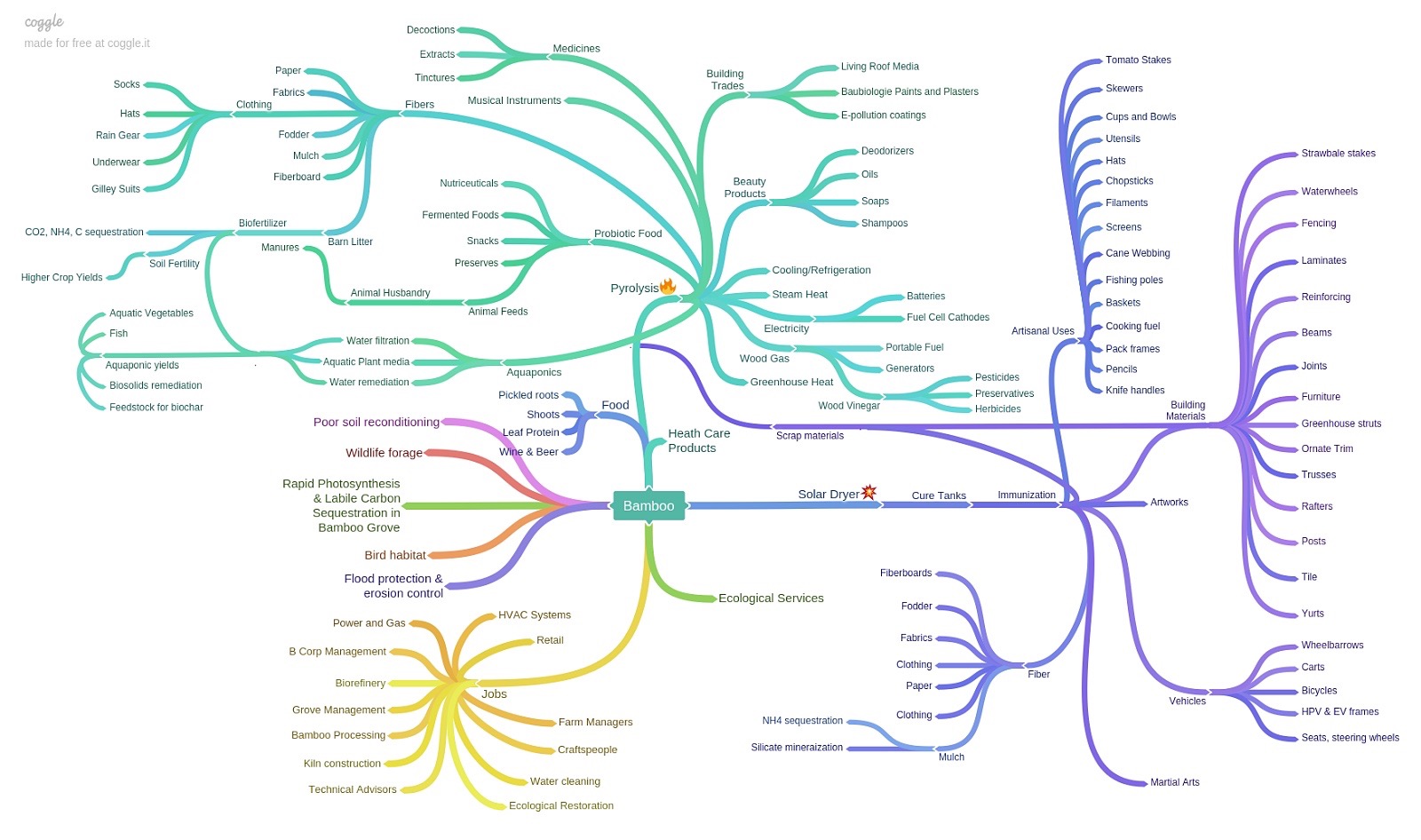
http://www.islandbreath.org/2017Year/04/170405bamboobig.jpg
Image above: Detail of the network of uses of bamboo in a regenerative agroecosystem. Click for the whole enlarged image. From original article.

If there is a surge in demand for a particular product — refrigerator deodorizers or animal feed supplements, for instance — or there is a surplus of some particular feedstock — bamboo knocked down by a storm — the biorefinery can shift its production pattern to take advantage immediately.

This  system sequesters more carbon than it emits, so we call it “cool.” By adding biochar, mineral rich compost, and microorganisms to the poor soils, we can jump-start soil productivity and boost farm productivity.

The gains in those alley-cropped contours will be anywhere from 40-percent to 400-percent vegetative growth, depending on the type of plants and the quality of the soils (poor soils will produce higher performance gains than good soils).

The same can be said for fish and livestock fed the leaf-protein and biochar nutriceuticals.

Let us pause here just a moment. Step back and take a look at the big picture. What is really being increased here is not so much village-scale well-being as photosynthesis. How are the greenhouse gases that are causing climate catastrophe — principally CO2, CH4 and N2O — to be removed from the atmosphere?

Mainly, although not exclusively, they will be removed by photosynthesis. The more of Earth’s surface that can be brought to bear on that task, the sooner the vital balance that harbors life on this tiny blue rock in space can be restored and the crisis ended.

Poultry can free-range the alleys to benefit of both plants and animals. Grazers can be moved through rotational cells that take advantage of water impoundments and high quality supergrasses. Fed nutrient-dense supplements with biochar, fish, poultry and grazing animals all grow faster and healthier without antibiotics or hormones, and deposit long-lived biochar back into the earth for long term carbon storage and soil fertility.

Growing nutrient-dense, no-till, organic food and perennial fibers on these marginal lands, using bioenergy and biofertilizers, creates a new, circular bioeconomy.  There is no such thing as waste. Nothing need leave the system, but what does is not raw material or pollution — representing the depleting wealth of the land — but high value byproducts — providing return on social capital invested. Waste becomes an orphaned verb.

Transportation presents an energetic challenge in the post-petroleum world. Nearly all modern forms of transportation evolved in an era of cheap net energy and diminish in economic viability when costed on renewable sources and life cycles.

Gone will be diesel-powered semi-tractor-trailers and locomotives. There could be new generations of electrified tow-paths for barges and gondolas, mag-lev rail and other innovations, but these costly innovations will be fragile in an era marked by overpopulation, resource constraints, climate chaos and economic contraction and likely will not provide a stable foundation for commerce in most places. Returning will be sail and animal powered transport.

If taken to maximum scale (rotationally planting an area the size of India each year and installing Cool Labs in every village), at a capital cost of $10000 to $15000 per hectare, the price would tally up to approximately 2% of the price of the fairy dust BECCS (Biomass Energy with Carbon Capture and Storage) conversion favored by geoengineers stuck in the fossil industrial paradigm.

Moreover, while BECCS represents continuing cost and is fraught with risk from plantation biomass crops — possibly genetically engineered and carrying along the can of worms that opens up — hazardously supplanting forested, multi-diverse, self-regenerating ecosystems.

The Cool Lab alternative represents antifragile synergies of local conservation communities, continuous and adaptive profits, and continuous gains in ecological health, stability and wealth.

Can the conversion be done in time? In contrast to the 45-year gradual expansion of soybean cropping from the early 1960s to reach 200 Mha today, this system offers five times the protein per area farmed while providing a far greater, and more immediate, returns on investment.

When one considers the rapid growth of renewable energy in the past decade, consider this: an energy producing Cool Lab costs one-seventh the capital as hydro, wind or solar and runs entirely on “wastes” that would otherwise be destined to add greenhouse gases to the atmosphere but are now intercepted and neutralized.

Cool Labs use the existing financial and technological landscape of the world today and simply change the way products are produced in order to heal the earth, balance carbon, and make more real wealth for more people more quickly.

Does this hold a hazard in the form of perpetuating wealth inequality, militarism and hegemony by the “taker” class? Yes it does. However, in the post-petroleum era, relocalization of economies is inevitable, and with relocalization comes local control over shared destinies.

Cool Labs represent circular economies that are inherently leveling.

Each lab adapts to needs and available resources and can flex to provide more or less of a particular kind of benefit and tailor fuels to available feedstocks and labor options. The number of cascades possible is limited only by the imagination and each year we conceive of more. We are at the dawn of a new kind of lean, clean, nature-centered economy.

This system can turn almost any human settlement into an ecovillage, although the criteria for what defines ecovillage must necessary include a few more elements than merely having a Cool Lab or permacultural support systems.

Ecovillages are based on a cohesive worldview, an abiding respect for the ecological integrity of your home biome, a circular local economy and a culture of peace and mutual respect. Depending on your starting point for each of these elements, bringing all of them into harmony can take time and effort.

The energy and food production system using mixed-aged, mixed-species forest, wetland and marine ecosystems we’ve outlined, taken to scale on the world’s available marginal land (not productive farmland or developed areas) could restore the fertility of those soils and waters while sequestering carbon from the atmosphere at the average rate of 17 PgC/yr after getting established.

To get back to the Holocene we need to return atmospheric carbon to pre-industrial range, around 260 ppm. The system just described, at full scale, could do that within about 50 years, taking into account the oceans’ CO2 outgassing feedback.

Village scale Cool Labs could achieve the cumulative storage of 667 gigatons of legacy carbon required to bring atmospheric carbon back to pre-industrial levels in the lifetimes of the majority of people now living. Were nations to collectively phase out fossil fuels as quickly as called for in the Paris Agreement, restabilization of the climate would be achieved sooner.

Recovering one percentage point of soil organic matter means that around 27 long tons of organic matter per hectare would enter the soil and remain there. Because around two thirds of organic matter added to agricultural soils will be decomposed by soil organisms and plants and given back to the atmosphere, in order to add permanently 27 tons, a total of 81 tons of organic matter per hectare would be needed. This cannot be done quickly or it just washes or evaporates away. A slow process is required.

An example of how this could play out in Haiti or anywhere else can be seen in the Loess Plateau of Northern China where fertile soils were overworked until they had to be abandoned. At the time of abandonment organic carbon concentrations had dropped to under 3 percent.

Thirty years later Loess soils had regained concentrations of 6 percent by natural processes. If natural restoration were accelerated by amending soil carbon in both metabolizable forms (such as crop litter and manures) and recalcitrant forms (such as biochar), the potential to increase soil carbon in a few decades could be raised to 10 percent or greater. This could happen virtually anywhere.

A farm that switches to organic, animal powered no-tillage methods can sequester 1 to 4 tons of organic matter per acre per year. By employing perennial polycultures, rotated pastures of grazing animals, trees and wild plant strips, that amount can be doubled or tripled.

Harvard professor Thomas Goreau writes:
Current rates of carbon farming at typical current levels would take thousands of years to draw down the dangerous excess CO2, but state of the art methods of soil carbon sequestration could draw it down in as little as decades if the percentage of long lived carbon is raised to as little as about 10%.
If the recuperation of soil carbon became a central goal of agricultural policies worldwide, it would be possible and reasonable to set as an initial goal the sequestration of one half ton per acre-year (1.5 t/ha-y or 500 grams per m2/y), comparable to the 4 pour 1000 program (4 grams per kg of soil) proposed by the French delegation at COP-21.

Carbon stored in the world’s soils and living biomass provides additional benefits beyond sequestration. As soil conditions improve, erosion and pests decline and the land comes back into balance.

Farming this way globally could sequester about 8 percent of the current total annual human-made emissions of 10 petagrams of carbon (PgC).

However, the fertility gains (equivalent to more than all of current global fertilizer production) would mean that chemical fertilizers could be (and should be) eliminated where carbon farming is practiced.

By reducing emissions of nitrous oxide from fertilizer (equivalent to approximately 8 percent annual human-made greenhouse gases) and the transportation and energy impacts of fertilizer production, we shave another 1 percent off global emissions.

But let’s keep going. If organic waste is returned to agricultural soils in the form of compost, then methane and CO2 emissions from its current destinations to landfills and wastewater (equivalent to 3.6 percent of man-made emissions) could be significantly reduced. Even a modest start, such as by elevating the soil carbon content of existing farmed soils by 0.4 percent, would have the potential to offset global greenhouse gas emissions by approximately 20 percent per year.

If biochar is added to the compost, we can quickly get to 100 percent, and then 120 percent. That is when it starts to matter.

After 10 years, we can increase progressively the reincorporation of organic matter into soils. By mid-21st century, we could increase the total world reservoir of carbon in the soil by two percentage points, and possibly more. In this way it is conceivable to restore our soil carbon reservoir to 10 percent, as Goreau argues. Because the system works best in poor soils, and because it eventually creates its own hydrological cycles, it can even re-green and reforest sandy deserts.

Are we doomed to Near Term Human Extinction?

Not yet. While there are still wild cards waiting to be played, what we have outlined shows a complete escape from our present trajectory. Is it possible that technology no more complicated than an Easy Bake Oven — and that pays for itself — can reverse climate change?


Image above: Photo of Chinese model of a Cool Lab rotary oven. From original article.

The rotary oven pictured above gasifies waste rice husks at the rate of 2.5 tons per hour. Thirty-five percent of that weight is transformed into biochar.

Half of the rest, as pyrogas, is extracted for useful synthetic compounds that replace petrochemicals.

The other half of that gas is used to co-generate 1.6 megawatts of electricity from this half-million-dollar biorefinery. It could also be refined into a liquid substitute for gasoline.

The Chinese government has invested heavily to develop this technology, and the wares they are producing are now the most efficient and lowest cost in the world. They will pour another $40 million into advanced biochar research this year.

Chinese Cool Lab reactors have been sold to 20 countries, including Haiti. In Senegal there is a prototype that has been continuously operating for 8 years.

In Egypt, the biochar made by their Chinese reactor is producing organic cabbages from the sandy shore of the Suez Canal. We witnessed a similar effect in the infertile clay soil beside the Asian Biochar Centre in Nanjing.

This we know: we can achieve faster and more well-rounded human development within the carrying capacity of the Earth. Will we? Who decides?

.

Dirty Energy vs. Clean Power

SUBHEAD: The energy of the past battles the energy of the future around Seneca Lake, NY and Kauai, HI.

By By Ellen Cantarow on 9 July 2015 for TomDispatch -
(http://www.tomdispatch.com/blog/176021/tomgram%3A_ellen_cantarow%2C_paradise_lost_--_or_found/)


Image above: Autumn trees around Senecca Lake, New York. From (http://ciphotography.photoshelter.com/image/I0000IRSmCJO73wA).

Let’s amend the famous line from Joni Mitchell’s “Yellow Taxi” to fit this moment in the Finger Lakes region of New York State. There, Big Energy seems determined to turn paradise, if not into a parking lot, then into a massive storage area for fracked natural gas. But there’s one way in which that song doesn’t quite match reality.

Mitchell famously wrote, “Don't it always seem to go that you don't know what you've got till it's gone.” As part of a growing global struggle between Big Energy and a movement focused on creating a fossil-fuel-free future, however, the residents of the Finger Lakes seem to know just what they’ve got and they’re determined not to let it go.

As a result, a local struggle against a corporation determined to bring in those fracked fuels catches a changing mood not just in the United States but across the world when it comes to protecting the planet, one place at a time, if necessary.

It’s difficult to imagine a more picturesque landscape, a more tranquil locale, a more bucolic garden spot than the Finger Lakes region. Each year, it draws tens of thousands of tourists to gaze at the waterfalls in Watkins Glen, to kayak and canoe in its deep waters, to dine in its farm-to-table restaurants and enjoy the homespun hospitality of its bed and breakfasts.

Lush vineyards rustle on tree-studded hillsides. Wine Enthusiast magazine gave it top honors last year, calling it “one of the most vibrant and promising wine regions of the world.” There are fruit and vegetable farms and sugar maples, too. In 2013, the state’s maple syrup production ranked second only to Vermont’s.

The eleven Finger Lakes are among the wonders of the natural world. At 38 miles in length, Seneca Lake is the second longest of them, its 4.2 trillion gallons of water provide drinking water for 100,000 people. Its shallows are home to warm-water fish like smallmouth bass and yellow perch. Its deep waters play host to lake trout and Atlantic salmon and have created a unique microclimate in the surrounding region, neither too cold in winter nor too warm in summer, allowing agriculture to flourish.

Perhaps inspired by the ecological marvel that is their home, many of the Finger Lakes vineyards and vegetable farms rely on sustainable production methods. At the same time, wineries, hundreds of businesses, and individual families have begun converting from the use of fossil fuels to alternative energies.

Tompkins County, adjacent to Seneca Lake, has even developed a solar energy program that has inspired similar efforts in counties across the state. A regional wind farm is scheduled to start operating in 2016. Clean and green seems to be the ethos of the region, but all that could change fast -- and soon.


The Battle of Seneca Lake
There’s a battle brewing between the burgeoning clean-energy future embraced by this region and the dirty energy sources on which this planet has been running since the Industrial Revolution.  Over the last six years, Crestwood Midstream Partners, a Texas-based corporation, has been pushing to build a gas storage and transportation hub for the entire northeastern United States at Seneca Lake.

The company’s statements boast about setting up shop “atop the Marcellus Shale play,” a hydraulic fracturing, or fracking, hotspot.  It plans to connect pipelines that will transmit two kinds of fracked gas -- methane and liquefied petroleum gas (LPG) -- probably from areas of the Marcellus Shale in Pennsylvania, Ohio, and West Virginia.  These will be stockpiled in long-abandoned salt caverns, the remnants of a nineteenth-century salt-mining industry that capitalized on the remains of a 300-million-year-old ocean that once was here.

Against the project, a motley coalition of farmers and vintners, doctors and lawyers, clean energy companies and reluctant do-it-yourself activists are focused on protecting this ecological marvel. Their goal: to guide the region toward a fossil-fuel-free future despite the deep pockets and corporate savvy of an out-of-state energy firm.
 
Crestwood is already storing 1.5 billion cubic feet of methane at the lake and has just won approval from the Federal Energy Regulatory Commission (FERC) to add another half-billion cubic feet. In addition, Crestwood is intent on storing millions of barrels of two highly volatile liquefied petroleum gases, propane and butane, in the caverns. While FERC has jurisdiction over the methane part of the plan, New York State’s Department of Conservation governs the LPG part and its decision is pending.

Although scientists warned about likely serious incidents of gas seepage or structural collapse in the salt caverns, FERC approved the methane storage part of the plan in May.

Crestwood’s plan would mean the full-scale industrialization of the lake’s shores near Watkins Glen, including a 14-acre open pit for holding brine (water supersaturated with salt) removed from the caverns upon the injection of the gas; a 60-foot flare stack (a gas combustion device); a six-track rail site capable of loading and unloading 24 rail cars every 12 hours, each bearing 30,000 gallons of LPG; and a truck depot where four to five semi-trailers would be unloaded every hour.

As many as 32 rail cars at a time would cross a 75-year-old trestle that spans one of the country’s natural wonders, the Watkins Glen gorge, its shale sides forming steep columns down which waterfalls cascade.
The plan is riddled with accidents waiting to happen. Brine seepage, for example, could at some point make the lake water non-potable.  (From 1964 to 1984, when propane was stored in two of the caverns, the lake’s salinity shot up.)

That’s only the first of many potential problems including tanker truck and train accidents, explosions, the emission of toxic and carcinogenic organic compounds from compressor stations and other parts of the industrial complex, air pollution, and impacts on local bird species and animal life due to deforestation and pollution.

Salt caverns 1,000 feet or more underground have been used for gas storage since the middle of the last century and have a checkered history. A January 2015 analysis of Crestwood’s plan, based on documents by both independent scientists and an industry geologist, found 20 serious or extremely serious incidents in American salt cavern storage facilities between 1972 and 2012.

Ten of these involved large fires and explosions; six, loss of life or serious injury; eight, the evacuation of from 30 to 2,000 residents; and 13, extremely serious or catastrophic property loss.

According to the report, if Crestwood’s proposal is approved, worst-case scenarios could include loss of life, loss of the lake as a drinking-water source, and temporary or even permanent evacuation of the local population.

 “Most other regulated [industries] with a persistent serious to extremely serious facility incident rate of this magnitude would be shut down or else voluntarily discontinued, except in wartime,” writes the report’s editor, Rob Mackenzie, a medical doctor and fellow of the American College of Healthcare Executives.

The Seneca Lake caverns where Crestwood plans to store LPG are also alarmingly unstable. One was plugged and abandoned a decade ago after an engineer concluded that its roof had collapsed during a minor earthquake in the 1960s.  What fell from the top of the cavern was no pebble. The chunk of rock weighed 400,000 tons and was four times the size of the U.S.S. Nimitz aircraft carrier. Another cavern lies beneath a rock formation that is subject to intermittent collapse and weakened by faults.

Nonetheless, Crestwood is proceeding with plans to store 600,000 barrels of liquid propane in the first cavern and 1.5 million barrels in the second. Geologist H.C. Clark, who authored a 2013 report on salt-cavern fragility, has charged both FERC and Arlington Storage, a Crestwood subsidiary, with making “an incredible error” in pushing the project forward.

Fighting the Good Fight
Hundreds of local businesses, organizations, and individuals opposed to the project have formed a coalition to block Crestwood’s plan, while 23 municipalities and five of the six townships surrounding Seneca Lake have also come out against the project. In April 2013, 12 demonstrators staged a “stand-in” outside a fenced Crestwood site and were arrested for trespassing. “My small, peaceful act of trespass was intended to prevent a larger, violent one: the trespass of hazardous chemicals into air and water and the intrusion of fracking infrastructure into our beloved Finger Lakes,” said biologist and writer Sandra Steingraber, a local resistance leader.

“All of us are 65 percent water by weight,” she told demonstrators and reporters. “Seneca Lake is the source of drinking water for 100,000 people. So 100,000 people are walking around [made up of] Seneca Lake.

That’s their blood plasma, that’s their cerebral spinal fluid, that’s their exhaled breath on a cold winter day.”  With this in mind, Steingraber co-founded We Are Seneca Lake, a loose affiliation of people who have been facilitating citizen blockades at the site. All protestors sign and then, at the protest site, recite a pledge of resistance that concludes:


"I make this pledge to ensure the protection of Seneca Lake, which nourishes the vitality and enjoyment of the communities surrounding it; to prevent the destruction and poisoning of water, air, and food systems on which safety, health, and economic prosperity of our communities -- and those of future generations -- all depend. My abiding concern for the health and safety of my community compels me to take this action."

The protests have had themes: an elf and Santa blockade during the 2014 Christmas season; a farm and food blockade in January 2015, which brought “foodies,” farmers, chefs, bakers, vintners, restaurant owners, and cookbook authors to Crestwood’s gates; a people of faith blockade; and another in honor of Pete Seeger.

In May, I attended a renewable energy blockade featuring employees from Renovus, a small, Ithaca-based renewable energy company. That firm's president and employees drew attention to the dozens of jobs they had available, a dramatic contrast to the paltry eight to 10 that Crestwood says the storage project would create.

To date, according to Sujata Gibson, an attorney working pro bono for We Are Seneca Lake, there have been more than 270 arrests. Many protestors have been sentenced to 15-day terms for trespass, a violation-level offense that is not serious enough to constitute a crime in New York.

Will Ouweleen, founding secretary of the Finger Lakes Wine Business Coalition, was the first of several vintners to be arrested. “It wasn’t like I jumped up to be arrested,” he says. “It was a last resort after our concerns went unheard by our elected officials.”

Sixty people have had their charges dismissed in the “interests of justice,” a provision of New York criminal procedure law. Gibson calls those dismissals “a huge victory... They were dismissed by four different judges in four different courts, kind of a universal recognition of what justice really required in this circumstance.” Another 84 dismissal motions have been made and decisions on them are pending.

At the We Are Seneca Lake website, hundreds of statements by demonstrators, ages 19 to 90, including farmers, doctors, ministers, town councilors, a pastry chef, and a midwife, highlight their opposition to fossil fuels and support for a future world of renewable energy.

"Muskrat Studio is my haven for creativity,” writes 68-year-old Barbara Peace of Ithaca, owner of the Muskrat, where poetry, fine art, photography, and sculpture are sold “for a reasonable price.”

Forty-four-year-old Sara Ferguson writes, "My son Lucian just turned six. He is the future. Fossil fuels are not the future. I’m a cancer survivor, and I don’t want to get sick again. I have a boy to raise."

A Dirty Past or a Clean Future?
“One of the exciting effects of the protests,” Sujata Gibson told me, “is that they have energized our community to start looking for ways to become sustainable without the use of fossil fuels.” In 2013, for instance, nearby Madison County became the first municipality in New York State to initiate a solar energy program, Solarize Madison, with 35 home solar installations.

The following year, inspired by Madison, Solarize Tompkins Southeast was launched in three Tomkins County towns -- Caroline, Danby, and Dryden -- to educate residents about solar energy and help many of them switch off fossil fuels and onto solar for electricity.

All three towns had earlier imposed bans on fracking within their jurisdictions. (Such town bans finally persuaded New York Governor Andrew Cuomo to declare a statewide ban on fracking in December 2014.) “What was really exciting,” says Don Barber, Caroline’s town supervisor, “was [that] people who were on the opposite sides of the fence regarding gas drilling [fracking] were on the same side of the fence when it came to this program.”

In 2014, Solarize Tompkins Southeast completed its work and a new organization, Solar Tompkins, was incorporated to conduct a countywide solar campaign. “If you put the two programs together,” says Jonathan Comstock, a researcher in horticulture at Cornell University and chair of the Solar Tompkins board, “we more than tripled how much residential solar there was in the county before.”

 Much of the Solar Tompkins work has been to educate citizens countywide. Solar energy is a new concept for most people, Comstock points out. “The education, the community participation, [have given] people more confidence that this is something for everybody, not just some kind of elite few... Now we’re hoping that everybody who knows somebody who just went solar should [spur] a self-perpetuating educational process.”

By January, the installation of solar panels had begun for 400 Tompkins households, with competition among installers keeping prices relatively low. Solar Tompkins has launched another program, HeatSmart Tompkins, for installing ground- and air-driven heat pumps.

About three-quarters of the region’s energy use goes to heating, mostly supplied by fossil fuels. Heat pumps, which can be powered by fossil fuels or renewable sources, are what Comstock calls “super-efficient.”

“Running on modest amounts of electricity,” he says, “they make it possible and practical to heat with renewably generated energy. They are a major step on the path to zero-carbon homes.”

Another regional renewable project soon to get off the ground is Black Oak Wind Farm. Local investors own the farm and no corporation is involved, says Comstock, himself a Black Oak shareholder.

On the state level, New York’s Public Service Commission has launched a program, Reforming the Energy Vision (REV), which promotes more efficient use of energy including wind and solar power. “There are a lot of high-tech ways of improving the function of the grid that can accommodate a larger amount of these intermittent forces effectively,” says Comstock, “and hopefully that’s what the REV will do.”

A 2013 study by Marc Jacobson of Stanford University demonstrated that renewable energies could supply 100% of New York State’s needs by 2030. While this conversion might involve high initial costs, eliminating fossil fuels would more than make up for them over time.

Commenting on renewable energy development in the state so far, especially in the Finger Lakes region, Jacobson wrote in an email: “I believe that every step to install wind, water, and solar... energy in New York is a step in the right direction in that it will replace conventional fuels, which currently cause over 3,000 premature air pollution mortalities per year and hundreds of thousands more illnesses per year in the state.”

He added that renewable conversion “will create over 80,000 more jobs in the state than it will cost,” and that it will “stabilize energy prices because the fuel costs of wind, water, and solar are zero.”

Despite these developments and the growth of opposition to it, Crestwood’s expanded methane storage plan continues to move forward, while the company awaits a decision on liquefied petroleum gases. Meanwhile, other corporations continue building fracking infrastructure (including pipelines and compressor stations) in the state.

The fate of renewable energy in New York depends in great part on a 2015 New York State Energy Plan, a draft of which, to the disappointment of critics, included increased reliance on natural gas, which means gas fracked from shale formations, and funds for bolstering the infrastructure needed for increased gas consumption.

As economist Janette Barth wrote, “It is foolish for New York State to encourage a build-out of a natural gas infrastructure that will last for 30 to 50 years when climate change is upon us, and increased production and use of shale gas are likely to detrimentally impact our environment, our health, and our economy here in New York State.

There is a much better fossil-fuel-free alternative and [the plan] should focus on transitioning to this better fossil fuel-free energy system immediately.”

Many Finger Lakes residents are doing just that: focusing on clean energy technology while an out-of-state energy giant works to turn the tranquil shores of Seneca Lake into a hub for fracked gas storage.  It’s a battle whose outcome may offer a signal as to just where the region, the state, and perhaps the country are headed. “We’re in the middle of this climate crisis.

Wind and solar are finally ramping up,” says Seneca Lake activist Sandra Steingraber. “In a few years, if we say ‘energy,’ the idea that it would come from fossil fuels might seem as crazy as if we said ‘telecommunications’ and people thought of the electric typewriter.”

• Ellen Cantarow reported on Israel and the West Bank from 1979 to 2009 for the Village Voice, Mother Jones, Inquiry, and Grand Street, among other publications. For the past five years she has been writing about the environmental ravages of the oil and gas industries. Thanks to DC Bureau reporter Peter Mantius for his assistance.


Koloa Biomass plant stalled

SUBHEAD: For better efficiency the turban needs adjustment, delaying going online


By Britany Lyte on 19 July 2015 for the Garden Island - (http://thegardenisland.com/news/local/biomass-plant-stalled-while-turbine-tweaked/article_ba01855d-3647-5de6-bcda-ce2b05648515.html)


Image above: Plant manager Randolph Singer, right, inspects the work of mechanics Brett Berger, left, and Kent Blaylock, center, at Koloa biomass power plant. From original article.

It’ll be another two to three months until Green Energy Team’s $90 million biomass-to-energy facility in Koloa starts producing steam.

The hold-up, plant manager Randolph Singer said, is that the turbine that converts steam energy into power isn’t working as efficiently as it could be.
“It works, and it’s good enough to meet the contract that we have with KIUC, but it’s not good enough for us,” Singer said. “Good enough is not good enough when you have a brand-new power plant like this and when everything’s still under warranty.”

The facility was originally expected to be on the grid in April.

“It’s not a big deal from our standpoint,” said Jim Kelly, spokesman for Kauai Island Utility Cooperative. “This is the time to work out the bugs, before it’s in full commercial operation, so that when it comes online its reliability is as close to 100 percent as they can make it.”

The plant, located near Knudsen Gap, will generate about 11 percent of the island’s electricity — enough to power 8,500 households and replace about 3.7 million gallons of imported oil annually. It is the first closed-loop, biomass-to-energy plant in the United States, and will rely completely on its own sources of Kauai biomass wood chips.

Key to the project is that GET has its own supply of albizia trees. About 75 percent of the wood will come from its plantations — it has 3,500 acres secured and plans to rotate for growing and cutting trees to feed the plant.

It has licenses, leases and farming agreements on several thousand acres of private and public land. Most of the lands it is using are overgrown with albizia, Singer said. Once those trees have been removed, non-invasive eucalyptus will be planted and later used for fuel.

The other 25 percent of the wood will come from land near Koloa-owned Hawaiian Mahogany Inc. under a clearing right agreement.

This is critical, Singer said, because the biggest challenge biomass plants face is having a steady fuel supply. He said that won’t be a problem here.

During a test run last month, the system was producing 7.5 megawatts — more than the 6.5 megawatt threshold specified in the facility’s KIUC contract, Singer said. But it’s taking more wood chip fuel to get there than it should.

The commercial contractor that assembled the turbine is currently working on tweaking it for maximum efficiency.

“If it was a new car and it was supposed to get 19 miles to the gallon, and it only got you 12 miles per gallon, you want that added efficiency out of it,” Singer said. “It’s still a car, it still gets you from point A to point B. But in this case we’re not satisfied. We know we can get more out of it.”

Singer said it’s easier to fix the problem now — before the plant is up and running — than later on when KIUC starts relying on it for energy.

“We don’t want to come online and then not be as reliable or not be able to meet the requirements that KIUC needs all the time,” he said. “We have the time right now. The contractors are working 24/7 to get this done as soon as possible.”

When up and running, the plant will be a “closed-loop system.” In other words, it is not dependent on off-island, outside companies or resources.

It will help also KIUC reach its goal of generating half of the island’s power from renewable sources by 2023.

Singer said the plant’s carbon footprint will be almost neutral. Even the ash from burning the trees will be recycled as fertilizer for more trees that will be grown as fuel.

“The plant itself is actually carbon negative but we do use some diesel for the trucks to bring the wood chips here and that does give us a very small footprint,” he said.

The plant will use an estimated 80,000 to 90,000 gallons of diesel on an annual basis, Singer said.
There is some controversy, however, pertaining to the environmental friendliness of biomass energy.

Some environmentalists are putting pressure on the White House to eliminate biomass energy as a means of compliance under the Environmental Protection Agency’s Clean Power Plan, which will regulate carbon pollution from power plants.

Under the Clean Power Plan, states have the option of using renewable energy like wind and solar to reduce emissions of pollutants like carbon dioxide that disrupt the climate. But burning wood for energy is highly polluting, according to biomass opponents, including Sierra Club and Clean Air Task Force.

“Burning trees for electricity hurts our climate by producing dangerous amounts of carbon pollution,” Kevin Bundy, climate legal director and senior attorney for the Center for Biological Diversity, a nonprofit based in Tuscon, Arizona, stated in a press release. “The Obama administration’s power plant policies must be based on science, and the science clearly shows that burning trees for power will likely make the climate crisis worse.”

Locally, concerns about the sustainability of biomass energy were cited by Native Hawaiians who successfully petitioned against a proposal to build the biomass plant on Kekaha lands held in trust for homesteading.

“We do not approve of our homelands being leased in this manner,” Kawai Warren, president of Kekaha Homelands, said when the long-term land lease proposal was defeated in 2011. “Biomass is definitely not the best and highest use of our homelands, and is also questionable as a sustainable energy source.”

Two years later, the company’s quest for trees on trust lands in Anahola was denied by homesteaders who claimed Hawaiian lands should not be leased to non-Hawaiians.

Singer said that while there’s no perfect energy solution, the biomass plant marks a huge upgrade for Kauai.

“Compared to what Kauai has right now and the options available to Kauai right now, this is a vast, vast improvement over the diesel plants, which is the primary source of power at this time,” Singer said. “Many groups are absolutely against any fossil fuel altogether, and that’s understandable.

There are alternatives but they aren’t really there yet. Wind power’s great, but it’s only great on a windy day and it kills sea birds. Solar is great but only on a sunny day and only for four to six hours.

“I’m sure some day Kauai and Hawaii will get to their 100 percent renewable goals, but that’s not without an extreme amount of investment,” Singer continued. “To do it right now, the price of electricity would be prohibitive and we already have the highest rates in the nation.”


.

Anahola biofuel proposal rejected

SOURCE: Hope Kallai (lokahipath2@live.com)
SUBHEAD: Hawaiian Homes Commission rejects Anahola Green Energy Project because of  overwhelming opposition by community.

By Darrell T. Young on 28 June 2013 for DHHL in Island Breath -
(http://islandbreath.blogspot.com/2013/06/anahola-biofuel-proposal-rejected.html)


Image above: Detail of photo of Anahola mountains looking north. From (http://www.hawaiianphotos.net/kauai_tour_photos_2.htm).

The Hawaiian Homes Commission rejected a proposal today by Green Energy Team, LLC, to lease 2,134 acres of Hawaiian home lands in Anahola for its proposed Anahola Renewable Energy Project.The 3-5 vote comes after two days of public feedback on the project, with 80 percent of testimony in opposition.

"While there were merits to the project, there were also a number of concerns that remained unresolved. I am encouraged that several in the Anahola community wanted a chance to be a part of the ultimate goal of getting these lands ready for homesteading. They want a chance to have their voices heard," said Jobie Masagatani, Chair of the Hawaiian Homes Commission, and Director of the Department of Hawaiian Home Lands (DHHL), "We look forward to working closely with the people of Anahola to explore ideas on the future use of these lands."

As proposed, the 20-year lease would have allowed Green Energy to clear existing albizia trees from DHHL's Anahola lands and establish a tree plantation to fuel Green Energy's $90-million biomass-to-energy facility in KĹŤloa.

In return, DHHL would have received monetary and other benefits, including improvements to Anahola lands.

Voting for the majority were Commissioners Perry Artates, Leimana DaMate, Gene Ross Davis, Renwick "Uncle Joe" Tassill, and Chair Masagatani.Commissioners Jeremy "Kama" Hopkins, Ian Lee Loy, and Michael Kahikina voted in support of the project.


CONTACT:
Darrell T. Young
Deputy to the Chair
Department of Hawaiian Home Lands
(808) 620-9510
Darrell.T.Young@hawaii.gov

See also:
Ea O Ka Aina: Anahola Biofuel Plan back again 6/19/13
Ea O Ka Aina: Hawaiians spurn "Green" Energy 3/11/13


.

Anahola Biofuel Plan Back Again

SOURCE: Hope Kallai (lokahipath2@live.com)
SUBHEAD: Public meeting regarding the Green Energy Team's proposed bio-mass lease for 2,143 acres of land in Anahola.

By Jobie M. K. Masagatani on 19 June 2013 for the DHHL -
(http://islandbreath.blogspot.com/2013/06/anahola-biomass-plan-back-again.html)


Image above: Interior of Anahola Valley looking north-east. All would be part of 30 year long term biomass lease. From GoogleEarth.

DHHL INFORMATIONAL BULLETIN

Public Information Meeting and Special Commission Meeting Regarding the Green Energy Team's Proposed General Lease for 2,143 acres of land in Anahola.

Aloha Anahola Beneficiaries:

As many of you know, the Department of Hawaiian Home Lands (DHHL) has been in negotiations with Green Energy Team LLC (Green Energy) to general lease 2,143 acres of land at Anahola, which includes all lands mauka of Kealia Road. At a special meeting of the Hawaiian Homes Commission (Commission) held last Friday, June 14,2013, Green Energy notified the Commission that they were not able to continue negotiations beyond June 30, 2013. To accommodate Green Energy's deadline, the Commission chose to modify its initial timeline, moving up both the informational meeting and decision-making dates.

As a result, I invite you to attend and participate in two meetings next week:

I. Informational Meeting - Thursday, June 27, 2013
6:30 to 8:00pm
Kapa'a Elementary School
Proposed terms oflease agreement to be presented
Members ofthe Commission will be in attendance

II. Special Meeting of the Hawaiian Homes Commission - Friday, June 28, 2013
10:00am to Noon
Kapa'a Elementary School
Decision-making on Green Energy's General Lease Agreement

To summarize and review this issue, Green Energy wants a 20-year general lease to establish a tree plantation which will supply fuel to Green Energy's biomass-to-energy facility located in Koloa. In return, DHHL will receive monetary and other benefits including improvements to DHHL's Anahola lands. In March of this year, DHHL conducted a beneficiary consultation meeting and two Hawaiian Homes Commission Public Hearings on the proposed project.

Mahalo to all of you who attended the meetings. You gave clear and thoughtful testimonies about your concerns and recommendations. A special meeting of the Commission was planned for April 2013 to approve the lease; however, due to the many comments and concerns raised in your testimonies, the special meeting was postponed. In addition, due to the concerns raised, I committed to conduct an informational meeting for Anahola beneficiaries on the terms of the lease prior to any decision-making by the Commission. I also explained at the March Public Hearings that we are required by law to conduct the decision-making Commission meeting on the island of Kauai.

As a result of your input in March, we were able to propose important changes to the lease terms, and I look forward to the opportunity to present this information to you next week. In order to prepare for the meeting, we encourage you to visit our website (dhhl.hawaii.gov under Beneficiary Consultations) where we will post the most up-to-date information we have. You can access more detailed information, including:
  • The Beneficiary Consultation Report which includes a summary of the major concerns raised during the three meetings conducted in March, as well as the meeting handouts, maps, and detailed notes for each meeting.
     
  • Staff responses and recommendations for each of the major issues raised in the Consultation Report.
     
  • A clrronology of activities that have occurred from February 2013 to June 14, 2013.
     
  • Green Energy's website address where you can review Green Energy's detailed responses to the concerns raised in the March meetings.

After you review the information on our website, if you have further questions or if you feel there are major issues that still need to be addressed, in the interest of having a productive informational meeting on June 27, I invite you to submit your additional questions and issues by June 25 to the Planning Office via email: dhhl.planning@hawaii.gov.

Aloha and mahalo,

Jobie M. K. Masagatani, Chairman
Hawaiian Homes Commission
MEDIA CONTACT
Darrell T. Young
Deputy to the Chair
Department of Hawaiian Home Lands
(808) 620-9510
Darrell.T.Young@hawaii.gov

See also:
Ea O Ka Aina: Hawaiians spurn "Green" Energy 3/11/13

.