
SUBHEAD: These whales rescue other species from hunting killer whale packs.
By Bryan Nelson on 30 July 2016 for Mother Nature Network -
(http://www.mnn.com/earth-matters/animals/stories/humpback-whales-around-globe-are-mysteriously-rescuing-animals-orcas)
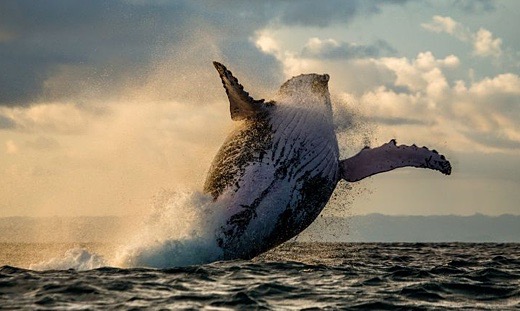
Image above: A humpback whale breaches the ocean surface. From (http://www.mnn.com/earth-matters/animals/blogs/weird-new-sound-heard-among-humpback-whales).
Humans might not be the only creatures that care about the welfare of other animals. Scientists are beginning to recognize a pattern in humpback whale behavior around the world, a seemingly intentional effort to rescue animals that are being hunted by killer whales.
Marine ecologist Robert Pitman observed a particularly dramatic example of this behavior back in 2009, while observing a pod of killer whales hunting a Weddell seal trapped on an ice floe off Antarctica.
The orcas were able to successfully knock the seal off the ice, and just as they were closing in for the kill, a magnificent humpback whale suddenly rose up out of the water beneath the seal.
This was no mere accident. In order to better protect the seal, the whale placed it safely on its upturned belly to keep it out of the water.
As the seal slipped down the whale's side, the humpback appeared to use its flippers to carefully help the seal back aboard. Finally, when the coast was clear, the seal was able to safely swim off to another, more secure ice floe.
Another event, involving a pair of humpback whales attempting to save a gray whale calf from a hunting pod of orcas after it had become separated from its mother, was captured by BBC filmmakers. You can watch the dramatic footage here:
Image above: From (https://youtu.be/-lw8_SAtX8o).
Perhaps the most stunning aspect of this behavior is that it's not just a few isolated incidents. Humpback whale rescue teams have been witnessed foiling killer whale hunts from Antarctica to the North Pacific. It's as if humpback whales everywhere are saying to killer whales: pick on someone your own size! It seems to be a global effort; an inherent feature of humpback whale behavior.
After witnessing one of these events himself back in 2009, Pitman was compelled to investigate further. He began collecting accounts of humpback whales interacting with orcas, and found nothing short of 115 documented interactions, reported by 54 different observers between 1951 and 2012. The details of this surprising survey can be found in the journal Marine Mammal Science.
In 89 percent of the recorded incidents, the humpbacks seemed to intervene only as the killer whales began their hunt, or when they were already engaged in a hunt. It seems clear from the data that the humpback whales are choosing to interact with the orcas specifically to interrupt their hunts. Among the animals that have been observed being rescued by humpback whales were California sea lions, ocean sunfish, harbor seals, and gray whales.
So the question is: Why are humpback whales doing this? Since the humpbacks seem to be risking their own well being to save animals of completely different species, it's hard to deny that this behavior seems altruistic.
There is also some reason to believe that the behavior isn't entirely selfless. Mature humpback whales are too large and too formidable to be hunted by orcas themselves, but their calves are vulnerable.
Orcas have been witnessed hunting humpback whale calves in much the same way that they hunt gray whale calves. So, by proactively foiling orca hunts, perhaps the humpbacks are hoping to make them think twice about messing with their own calves.
Then again, maybe it's just as simple as revenge. Even if it has more to do with revenge than altruism, though, the behavior would represent evidence of an intense and complicated emotional life among humpbacks that is unprecedented in the animal world, outside of primates.
One common feature among many humpback whale rescue efforts is that the humpbacks often work in pairs. Scientists will need to do more research into this behavior, though, to truly understand the significance of it.
Until then, these beautiful animals, which are perhaps best known for their majestic songs, have certainly earned some additional respect. They might just be the ocean's most ferocious and selfless first-responders.
.
By Bryan Nelson on 30 July 2016 for Mother Nature Network -
(http://www.mnn.com/earth-matters/animals/stories/humpback-whales-around-globe-are-mysteriously-rescuing-animals-orcas)
Image above: A humpback whale breaches the ocean surface. From (http://www.mnn.com/earth-matters/animals/blogs/weird-new-sound-heard-among-humpback-whales).
Humans might not be the only creatures that care about the welfare of other animals. Scientists are beginning to recognize a pattern in humpback whale behavior around the world, a seemingly intentional effort to rescue animals that are being hunted by killer whales.
Marine ecologist Robert Pitman observed a particularly dramatic example of this behavior back in 2009, while observing a pod of killer whales hunting a Weddell seal trapped on an ice floe off Antarctica.
The orcas were able to successfully knock the seal off the ice, and just as they were closing in for the kill, a magnificent humpback whale suddenly rose up out of the water beneath the seal.
This was no mere accident. In order to better protect the seal, the whale placed it safely on its upturned belly to keep it out of the water.
As the seal slipped down the whale's side, the humpback appeared to use its flippers to carefully help the seal back aboard. Finally, when the coast was clear, the seal was able to safely swim off to another, more secure ice floe.
Another event, involving a pair of humpback whales attempting to save a gray whale calf from a hunting pod of orcas after it had become separated from its mother, was captured by BBC filmmakers. You can watch the dramatic footage here:
Image above: From (https://youtu.be/-lw8_SAtX8o).
Perhaps the most stunning aspect of this behavior is that it's not just a few isolated incidents. Humpback whale rescue teams have been witnessed foiling killer whale hunts from Antarctica to the North Pacific. It's as if humpback whales everywhere are saying to killer whales: pick on someone your own size! It seems to be a global effort; an inherent feature of humpback whale behavior.
After witnessing one of these events himself back in 2009, Pitman was compelled to investigate further. He began collecting accounts of humpback whales interacting with orcas, and found nothing short of 115 documented interactions, reported by 54 different observers between 1951 and 2012. The details of this surprising survey can be found in the journal Marine Mammal Science.
In 89 percent of the recorded incidents, the humpbacks seemed to intervene only as the killer whales began their hunt, or when they were already engaged in a hunt. It seems clear from the data that the humpback whales are choosing to interact with the orcas specifically to interrupt their hunts. Among the animals that have been observed being rescued by humpback whales were California sea lions, ocean sunfish, harbor seals, and gray whales.
So the question is: Why are humpback whales doing this? Since the humpbacks seem to be risking their own well being to save animals of completely different species, it's hard to deny that this behavior seems altruistic.
There is also some reason to believe that the behavior isn't entirely selfless. Mature humpback whales are too large and too formidable to be hunted by orcas themselves, but their calves are vulnerable.
Orcas have been witnessed hunting humpback whale calves in much the same way that they hunt gray whale calves. So, by proactively foiling orca hunts, perhaps the humpbacks are hoping to make them think twice about messing with their own calves.
Then again, maybe it's just as simple as revenge. Even if it has more to do with revenge than altruism, though, the behavior would represent evidence of an intense and complicated emotional life among humpbacks that is unprecedented in the animal world, outside of primates.
One common feature among many humpback whale rescue efforts is that the humpbacks often work in pairs. Scientists will need to do more research into this behavior, though, to truly understand the significance of it.
Until then, these beautiful animals, which are perhaps best known for their majestic songs, have certainly earned some additional respect. They might just be the ocean's most ferocious and selfless first-responders.
.
