Showing posts with label Mauna Kea. Show all posts

Hawaiians fight Mauna Kea telescope

SUBHEAD: Native Hawaiians say "If not now, when will we stand to protect our sacred lands?" 

By Amy Goodman on 22 July 2019 for Democracy Now!-
(https://www.democracynow.org/2019/7/22/mauna_kea_thirty_meter_telescope_resistance#transcript)
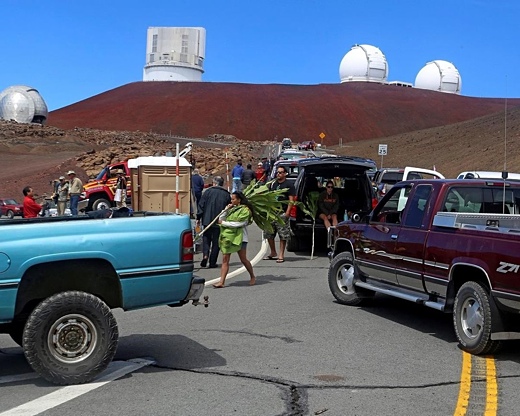

Image above: From the Honolulu newspaper The Star labeled "Hawaiian activists prepare convoys ton convoys to proposed telescope site. From (https://images.thestar.com/nOL4rf4iZSFiR1QqCmEx-tahjR8=/1086x869/smart/filters:cb(1563118201053)/https://www.thestar.com/content/dam/thestar/news/world/us/2019/07/14/hawaiian-activists-prepare-for-mauna-kea-telescope-convoys/HIHIO301-413_2018_164051.jpg).

A historic indigenous resistance is unfolding on the Big Island of Hawaii, where thousands have descended on Mauna Kea, a sacred Native site, to defend it from the construction of a $1.4 billion telescope.

Scientists say the Thirty Meter Telescope will help them peer into the deepest corners of space, but indigenous resisters say the construction was approved without their consent and will desecrate their sacred lands.

Last week, police arrested 33 people — most of them Hawaiian elders — as they blocked a road to prevent work crews from reaching the site of the telescope being planned atop Mauna Kea.

And on Sunday, demonstrators reported that more than 2,000 people had gathered at the access road to stop construction. We speak with Pua Case, an indigenous organizer and activist defending Hawaii’s Mauna Kea.

TRANSCRIPT

AMY GOODMAN: The Filipino-Hawaiian musician Kalani Pe’a, who’s been at the protests that we’ll be talking about now. This is Democracy Now!

I’m Amy Goodman, as we go to Hawaii’s Big Island, where growing protests are heading into a second week against the construction of a massive telescope on top of Mauna Kea, a dormant volcano, sacred Native site, that’s become a flashpoint of indigenous resistance.

On Sunday, demonstrators reported more than 2,000 people had gathered at an access road to stop construction on Hawaii’s highest peak from starting.

Last week, police arrested 33 people, most of them Hawaiian elders, as they blocked a road to prevent work crews from reaching the site of the Thirty Meter Telescope being planned atop Mauna Kea.
HAWAIIAN ELDER: We have a right to worship god in the environment of our belief. Respect it!
AMY GOODMAN: Just hours after the arrests, Hawaii’s Democratic Governor David Ige signed an emergency order granting police more power to clear the way for construction equipment.
GOV. DAVID IGE: This afternoon, I signed an emergency proclamation for the situation on Mauna Kea. Since Monday, protesters have illegally occupied roads and highways. … We do believe that this emergency proclamation gives law enforcement the additional tools that they need to continue to work to keep the people safe.
AMY GOODMAN: Activists say construction of the telescope was approved without consulting the local Native community. The protests build on decades of indigenous resistance in Hawaii. This week, the Hawaii County Council plans to vote on a resolution, quote, “strongly urging” Governor Ige and Mayor Harry Kim to honor a request for a 60-day moratorium on the construction.

For more, we go to Hawaii’s Big Island, where we’re joined by Pua Case, an indigenous organizer, one of the leading activists defending Hawaii’s Mauna Kea.

Welcome to Democracy Now! It’s great to have you with us, Pua. If you can describe for us where you are and just tell us what is happening? Who is building, or attempting to build, this telescope? And why are the indigenous people of Hawaii so concerned?

PUA CASE: Aloha Mai Kako. ‘O Pua Case ko’u inoa. ‘O Mauna a Wakea ko’u mauna.Aloha, everyone. My name is Pua Case. Mauna Kea is my mountain. I’m reporting from a hunter’s check-in station, at a place called Pu’u Huluhulu, which is right across the street of the access road leading up to Mauna Kea.

Mauna Kea is a sacred mountain for us here in Hawaii. Mauna Kea is genealogically linked to the Native people of these lands. Mauna Kea is known as our kupuna, our ancestor, our teacher, our protector, our corrector and our guide.

And so, for the last 10 years, we have held off the project of the building of an 18-story telescope on the top of our mountain, near the summit, on a pristine area called the northern plateau, over our water aquifer and the source of water for much of this island.
Those who are partnering in this project are Canada, China, India, Japan and the United States in the area of California, with the largest single donor being the Gordon and Betty Moore Foundation in Palo Alto.

So, why we are standing for this mountain is quite simple, Amy. And thank you for having me on the show. If I could put it very simply, I would say, if we don’t stand for the most sacred, what will we stand for? And if not now, when will we stand?

So, we are making a stand as not just Native people and not just the local community, but really a worldwide community, because there are so many similarities. There are Native people everywhere around the world standing for their mountaintops, for their waters, for their land bases, their oceans and their life ways. We are no different than them.

But because Mauna Kea is the highest mountain in the world from seafloor, and, spiritually speaking, there are reasons that Mauna Kea is connected to many different mountains around the world, and the integrity and the essence of water in our spirituality, is why we must not allow 18 stories to be built on the northern plateau of our mountain.

It is the one too many and the one too big. And we have said no for the last 10 years and have been successful so far in stopping the project.

AMY GOODMAN: Now, the foundation gave money to Caltech, is that right, Pua?

PUA CASE: Yes, it is.

AMY GOODMAN: And who was consulted? Why do they have rights to this mountain?
PUA CASE: The university —

AMY GOODMAN: There are other telescopes there, is that right?

PUA CASE: Yes, there are other telescopes on the summit of the mountain. The University of Hawaii has the lease on the summit of the mountain until 2033. So, from the late 1960s, there have been smaller telescopes built on the mountain. And, you know, Amy, you have to understand, and I’m explaining to the world community right now, it would take a whole semester course to try to explain why 13 telescopes are now sitting at the top of the mountain.

What I can say is that for many of our people, my grandparents’ generation and my parents’, as well, you know, there comes — in that time period, you don’t even know if you have the ability to stop something like that. We were in a time period where people would say, “Oh, they’re just going to build it anyway.”

And a lot of times, we were not even aware that building was occurring on the summit. And so, for a lot of different reasons, 13 telescopes sit on the summit of Mauna Kea.

The 18-story Thirty Meter Telescope cannot possibly fit on the mountain. The desecration, the construction and the destruction of the northern plateau is just something that cannot be allowed on our sacred mountain. As I said before, it’s the one too many and the one too big.

So, what I will say is, the University of Hawaii initiated the permit on behalf — the permit application on behalf of the countries, because most of the countries are already up on the mountain in those 13 other telescopes. Only China and India are not on the mountain at this time.

AMY GOODMAN: We heard that the National Guard might be called in. You have the Hawaii governor, David Ige, issuing an emergency order granting police more power to clear the way for construction equipment. He says that the protesters are dangerous. Can you talk about what you expect to happen today? First, I want to go to an activist speaking last week during a news conference.

PUA CASE: Sure.
KAHO’OKAHI KANUHA: And I reaffirm to each and every maka’i, each and every police officer, each and every individual who’s going to come and attempt to get us out of the way, we will stand, and we will stand in Kapu Aloha. We are committed. We are absolutely committed to peace, peaceful protest, nonviolent action. We are not wavering from that. And so, to the maka’i, I ask you folks to make that same commitment, because you guys are not my enemy. None of you are my enemy. Our enemy is this illegal occupying state, that continues to deny the rights of Kanaka, who continue to treat us as a nonexistent, dead people. Eka Lahui, are we dead?
PROTESTERS: A’ole
KAHO’OKAHI KANUHA: Are we dead?
PROTESTERS: A’ole!
KAHO’OKAHI KANUHA: We’re alive.
AMY GOODMAN: That, an activist at a news conference last week. So, talk about the governor’s charges and also where the Honolulu mayor stands.

PUA CASE: That young activist is one of our organizers. That’s Kaho’okahi Kanuha. And his words exemplify the stance that we were taking on the day that the law enforcement came in to the access road area.

And what I want to preference — preface this with is, who would ever think — and that’s what I spoke to the maka’i, or the law enforcement, about as they stood there, some of them in full riot gear with their batons, many of them either our relatives or Native Hawaiians, who are put in a very difficult position to have to stand there and possibly arrest us, and, certainly, the possibility of harm.

So, what I said to them that day was, who would ever think — who would ever think that in Hawaii, I, as a middle school teacher and just the daughter of ranchers that come from this area — and many of us, you know, we are just — we are mothers and fathers. We are aunties and uncles. We are elders, and we are youth.

And being so passionate about what is left of our culture, our sacred places and our life ways — that we would find ourselves standing in the middle of the street facing armed officers with only our Kapu Aloha, or the manner in which we stand, our code of conduct, integrity, standing in the way that our ancestors would expect and command of us, in nonviolence, no resistance, facing our relatives. And so that that in itself is very difficult.

So, Governor Ige, our governor, did issue a state of emergency at the end of that day, after 33 of our elders were arrested because they had made a stand, and they are still sitting in those chairs ’til today, make a stand to block that access road, because that is the only way that the machinery will be able to go up the mountain. So, what I want to —

AMY GOODMAN: Pua, I wanted to —

PUA CASE: — have — yes?

AMY GOODMAN: I wanted to read from the Honolulu Star-Advertiser, the local paper.
PUA CASE: Sure.

AMY GOODMAN: It says, “The Gordon and Betty Moore Foundation in 2007 committed $200 million to the California Institute of Technology and the University of California toward TMT’s construction. Gordon Moore is a leader in the semiconductor industry and co-founder of Intel Corp., creator of the world’s first microprocessor.”

You have what happened yesterday at Standing Rock, the Standing Rock Sioux tribal members gathering at the epicenter of the Dakota Access pipeline to show solidarity with you, with Native Hawaiians, who are opposing the construction of this huge telescope at Mauna Kea. Can you compare what’s happening right now to what took place in Standing Rock? Do you see similarities?

PUA CASE: You know, I certainly can, because I was at Standing Rock twice. And so were a large number of our people here. When Standing Rock occurred, we already had a relationship with the leadership of both Sacred Stone Camp and Standing Rock. And, in fact, the first day, when we took that stance, when the elders sat there and chose to block the road, the first caller that we had that morning to bless our day was LaDonna Brave Bull Allard.

So, we have a very close relationship to our relatives, because we are both standing for what is sacred: water. We are standing for the water from our mountain, and they, of course, are standing for their water.

The similarities are astounding, some of them being you have a small space with a large amount of people that cannot help themselves but be there, because for those of us who are either struggling, who have lost so much, when we see the opportunity to assist and support relatives who are going through the same thing, we will do everything in our power to either be there or assist in some way from afar.

So, many, many of our relatives from Standing Rock have pledged to be here, if we put the call out. So, the camaraderie, the alliances, the networking and the relationships that you create when you stand on each other’s front lines is something that is binding. We make a commitment to each other.

Right now we have not put out that call, because we went from 30 people, when we started last Friday — we are up to about 3,000 people. So, at this point, we have not put a call out to anyone anywhere other than Hawaii. However, we are finding each day that relatives from all around the world are finding their way here, even though that call out has not been made.

AMY GOODMAN: And do you expect the National Guard to come out today?

PUA CASE: The National Guard is here, yes. When Governor Ige did issue the state of emergency that allowed for the deployment of the National Guard, we know that they have been flying in. We know that they are housed very close to where we are, because the Pohakuloa military base is just miles down the road.

I can’t tell you what will happen today, to be quite honest. It changes every second of the day. I’m not sure we are aware of what is going to happen. We just remain on alert. We remain vigilant, 24 hours.
We are actually located in a parking lot, which has become a sanctioned sanctuary and safe place for us, and along the sides of a road in lava fields.

So, that’s where we differ from Standing Rock. We don’t have the kind of infrastructure here to create a large camp, except to be right in the elements, in the lava, and in the parking lot across from the access road.

We know that the National Guard is here. We know that a large amount of law enforcement is here, as well. And again, I have to emphasize that we are people, just people. We are not trained. We are not armed. We come from all walks of life. We are Native people. We are local residents. We are visitors. But we have made a commitment.So, what I would like to share, just as an example of how it is here —

AMY GOODMAN: We just have 30 seconds, Pua.

PUA CASE: Oh, I’m sorry. So, what I would like to say, in ending, if we have 30 seconds left, is I want to thank the worldwide community for standing with us. And so, what we are asking is that you go to Actions for Mauna Kea Facebook page.

You can find all the information about us. Thank you to everyone around the world, and to you, Amy, for allowing us to voice what is happening here in Hawaii. We are proud people. We are standing for what we have left. And —

AMY GOODMAN: Pua —

PUA CASE: Mahalo.

AMY GOODMAN: Pua, I want to say thank you for joining us. I’d like to ask you to stay to the top of the hour to do Part 2 of this interview, where you can explain further why you are taking this stand. I want to thank you, Pua Case, indigenous organizer defending Hawaii’s Mauna Kea.

She is there at the access road with so many others, who are trying to prevent the Thirty Meter Telescope, or TMT, from being built at the summit of Mauna Kea, the largest mountain in the world, a volcano. Thank you so much for being with us from Hawaii.

See also:
Mauna Kea telescope protest - Ea O Ka Aina 2 April 2014
Ige listens to Hawaii - Ea O Ka Aina 8 April 2015
Education and the Mountain - Ea O Ka Aina 15 April 2015
Eight arrested on Mauna Kea - Ea O Ka Aina 10 September 2015
No permit for TMT on Mauna Kea - Ea O Ka Aina 3 December 2015

.
No permit for TMT on Mauna Kea

SOURCE: Jonathan Jay (jjkauai@gmail.com)
SUBHEAD: The permit allowing the Thirty Meter Telescope on Mauna Kea has been thrown out by the Hawaii Supreme Court.


By Staff on 2 December 2015 for Big Island Video News -
(http://www.bigislandvideonews.com/2015/12/02/tmt-permit-for-mauna-kea-vacated-by-hawaii-supreme-court/)


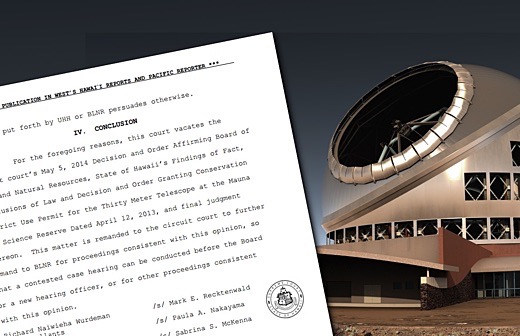
Image above: Page of the Hawaii Supreme Court's judgement against the Thirty Meter Telescope proposed on Mauna Kea From original article.

The permit allowing the Thirty Meter Telescope to be built and operated on Mauna Kea has been thrown out by the Hawaii Supreme Court.

In the conclusion of a 58 page opinion written by Chief Justice Mark E. Recktenwald, the court vacated the lower circuit court’s “May 5, 2014 Decision and Order Affirming Board of Land and Natural Resources, State of Hawaii’s Findings of Fact, Conclusions of Law and Decision and Order Granting Conservation District Use Permit for the Thirty Meter Telescope at the Mauna Kea Science Reserve Dated April 12, 2013, and final judgment thereon.”

The Supreme Court remanded the matter to the circuit court “to further remand to BLNR for proceedings consistent with this opinion, so that a contested case hearing can be conducted before the Board or a new hearing officer, or for other proceedings consistent with this opinion.”

As many predicted after hearing the court’s questions during the oral arguments presented on August 27 (video below), the court found that the Board of Land and Natural Resources “acted improperly when it issued the permit prior to holding a contested case hearing.” The court says BLNR’s February 25, 2011 approval violated Hawaii’s constitutional guarantee of due process.

The appellants who contested the permit and appealed the land board decision – Mauna Kea Anaina Hou, Clarence Kukauakahi Ching, Flores-Case Ohana, Deborah J. Ward, Paul K. Neves, And Kahea: The Hawaiian Environmental Alliance – were represented in court by attorney Richard Naiwieha Wurdeman.

On its Facebook page, the Thirty Meter Telescope wrote that “this is not a judgement against TMT, but rather against the State’s process in granting the permits. We’ll have an official statement for you shortly.”

Associate Justice Richard W. Pollack wrote this concurring opinion, which was joined by Associate Justice Michael D. Wilson:
V. Conclusion
This case illustrates the interweaving nature of the various provisions of our constitution. When rights as integral as the exercise of Native Hawaiian customs and traditions are implicated by a proposed action, our constitution provides several safeguards that combine to preserve those rights.

In this case, the Board was asked to grant a permit to UH for the construction of an astronomical observatory on the summit of Mauna Kea, an area sacred to Native Hawaiians. Because the project could infringe upon the constitutional right of Native Hawaiians to exercise their customs and traditions, the guarantees of Article XII, Section 7, the public trust obligations of the State under Article XI, Section 7, and the due process protections encompassed by Article I, Section 5 were all triggered to constitutionally safeguard the continued practice of Native Hawaiian customs and traditions.

Under the foregoing constitutional provisions and the precedents of this court, the Board’s obligations were to protect Native Hawaiian customs and traditions to the extent feasible, to effectuate the values of the public trust, and to provide a procedure befitting the compelling interests at stake. To perform these obligations, the Board was required to decide UH’s application pursuant to a decision-making process that incorporates the rights, values, and duties embodied by the constitutional provisions involved. Instead, the Board failed to conduct a contested case hearing before deciding the merits of UH’s application and summarily granted the requested permit without duly accounting for the constitutional rights and values implicated. The Board acted in contravention of the protections of Native Hawaiian customs and traditions provided by Article XII, Section 7; Article XI, Section 7; and Article I, Section 5. Accordingly, as a matter of constitutional law, the permit issued by the Board must be invalidated.


Video above: TMT Case - Due process argued at Hawaii Supreme Court. From (https://youtu.be/-EC1daUFjmQ).


Video above:TMT Case -  Cumulative Conservation District impacts of TMT. From (https://youtu.be/m7s6dwHI_eU).

.

Eight arrested on Mauna Kea

SUBHEAD: TMT protesters arrested on Mauna Kea while attempting to stop construction atop mountain considered sacred.

By AP Staff on 9 September 2015 for the Guardian -
(http://www.theguardian.com/us-news/2015/sep/09/eight-arrested-hawaii-protests-thirty-meter-telescope)


Image above:  The base camp for protesters of the Thirty Meter Telescope project occupies a site near the summit of Mauna Kea on Hawaii’s Big Island. Photograph by Caleb Jones-AP. From original article.

Seven women and one man were arrested early on Wednesday in the latest round of arrests in the ongoing battle against building a giant telescope atop a mountain many native Hawaiians consider sacred.

The state department of land and natural resources said 20 of its officers arrested the protesters on Mauna Kea at about 1am. They were enforcing an emergency rule created to stop people from camping on Mauna Kea.

The land board approved the rule in July, which restricts access to the mountain during certain nighttime hours and prohibits certain camping gear. It was prompted by protesters’ around-the-clock presence to prevent construction of the Thirty Meter Telescope (TMT).

Protesters say officers hauled them away while they were praying. In video footage provided by the state, officers are seen walking toward a group of people huddled in a circle and chanting. A man’s voice is heard saying: “Eh, they’re praying you guys, they’re praying.”

The footage shows officers putting plastic handcuffs on women and putting them into the back of a vehicle. “Why do I have to have my hands behind my back,” a woman asked. “Because you’ll be placed in restraints, ma’am,” an officer responded.

The emergency rule, in place for 120 days, is intended to make the mountain safe for protesters, visitors and workers of the 13 telescopes already on the mountain, the state said.

Attorney general Doug Chin told the land board that even though camping is already prohibited on the mountain, a targeted rule is necessary because of bad behavior by some protesters – ranging from putting boulders in the road to threats and harassment – created unsafe conditions.

The nonprofit company building the Thirty Meter Telescope hasn’t indicated when there will be another attempt to resume construction. Workers weren’t able reach the site during two previous attempts when they were blocked by hundreds of protesters, including dozens who were arrested.

This was the fourth time telescope opponents have been arrested on the mountain.

University of Hawaii law school professor Williamson Chang has filed a lawsuit seeking to repeal the rule, arguing it prevents telescope opponents from legally exercising their rights to peacefully protest.

.

State restricts Mauna Kea access

SUBHEAD: Hawaii Governor David Ige signs DLNR rule to restrict access to Mauna Kea telescope site.

By Mileka Lincoln on 14 July 2015 for Hawaii News Now -
(http://www.hawaiinewsnow.com/story/29549333/ige-signs-emergency-rule-restricting-mauna-kea-access)


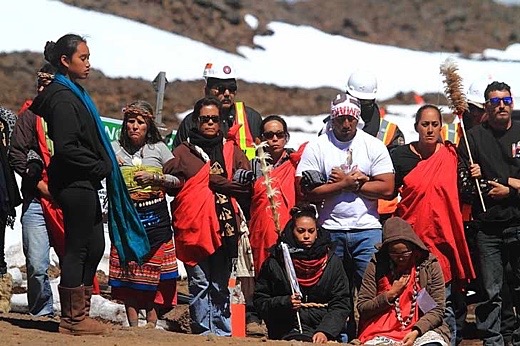
Image above: Hawaiians and others gather to protect Mauna Kea from construction assault. From original article. Many more photos of activities and arrests there.

Gov. David Ige signed the state's Board of Land and Natural Resources emergency rule Tuesday afternoon, further limiting access to Mauna Kea in an attempt to restore safety to the mountain following months of protests over the controversial Thirty Meter Telescope project.

The 120-day emergency rule will restrict access at night between the hours of 10 p.m. and 4 a.m. to anyone not traveling in a vehicle and will prohibit camping on the mountain within 1 mile of the summit road at all times.

The emergency rule will go into effect as soon as it is filed with the Lt. Governor's office.

Gov. Ige released the following statement soon after signing the emergency rule: "My administration believes firmly in the right of free expression. At the same time we cannot let some people put others at risk of harm or property damage. This temporary rule helps strike that balance. I respectfully ask everyone using the road to exercise caution and obey the law."

Sources say Department of Land and Natural Resources Division of Conservation and Resource Enforcement officers will be stationed on the mountain nightly between the hours of 10 p.m. and 4 a.m. to ensure the public is aware of the new rule and abiding by it.

Opponents of the Thirty Meter Telescope project argue the rule was designed to criminalize their peaceful protest. Native Hawaiians say it violates their constitutional protected right to cultural and religious practice. Hunters have expressed concern the restrictions would prevent them from putting food on their tables.

State officials say the regulations are needed to ensure the safety of everyone who wishes to use the mountain. They say quick action was needed to regain order and safety after reported incidents of violence, harrassment and vandalism that had created an environment in which people did not feel safe enough to report to work on the mountain.

Last Friday, the board voted 5-2 to pass the emergency rule, citing "imminent peril to the public health or natural resources."

Mauna Kea summit access road reopened Monday, July 13 after closing on June 24 when 750 opponents of the $1.4 billion Thirty Meter Telescope gathered to protest the project and block construction crews from reaching their site.

The protesters, who say they're standing in protection of the mountain as a sacred Native Hawaiian place, successfully prevented TMT crews from reaching the summit -- but not without controversy. Rocks and boulders were moved onto the roadway and DLNR agents were forced to turn everyone around out of concern for public safety.

Protesters voluntarily removed the rocks and boulders -- including two 'ahu or altars that were obstructing access -- the following day, however state officials kept the road closed for more than two weeks -- citing hazardous conditions caused by the movement of rocks along the steep and unpaved portion of the roadway.

TMT protesters have been staying overnight near the Visitor's Center for the last 111 days. The group, which calls itself Aloha 'Aina advocates, say they're holding vigil in defense of Mauna Kea as a culturally sacred and significant place and are prepared to block TMT workers from reaching their construction site on the summit.

Last week, state officials released activity logs filed by the Office of Mauna Kea Management Rangers and staff of the University of Hawai'i's Mauna Kea Visitor Information Center that detail a number of hostile incidents on the mountain which they say supports the need for the emergency rule. The incidents include a reported bomb threat on social media and other threats of violence against TMT workers, along with allegations of visitors and staff members being harrassed by protesters.

Leadership of the TMT opposition group that has been staying on the mountain denies many of the accusations and described the logs as an inaccurate portrayal of the behavior of the vast majority of Aloha 'Aina advocates who have taken a pledge of kapu aloha that dictates they treat everyone -- even those with differing beliefs -- with respect and compassion.

After performing remedial work and grading for the last two weeks, the University of Hawai'i reopened the Mauna Kea summit road above Halepohaku to four-wheel drive vehicles only. Officials say two-wheel drive vehicles will not be allowed past the end of the paved road at Halepohaku. The Visitor Information Station and its restroom facilities remain closed.

See also:
Ea O Ka Aina: Mauna Kea "Emergency Rule" 7/7/15
Ea O Ka Aina: Sierra Club on Mauna Kea 7/1/15
Ea O Ka Aina: Mauna Kea TMT Standoff 6/25/15
Ea O Ka Aina: TMT construction to resume  6/21/15
Ea O Ka Aina: TMT Star Wars - Hawaii Style  4/29/15
Ea O Ka Aina: Mauna Kea Hui responds to OHA 4/25/15
Ea O Ka Aina: UH walkout over Mauna Kea TMT  4/13/15
Ea O Ka Aina: Ige listens to Hawaii 4/8/15
Ea O Ka Aina - Mauna Kea telescope protest 10/21/14

.

Mauna Kea "Emergency Rule"

SOURCE: Rayne Ragush (RayneRaygush@aol.com)
SUBHEAD: Rule passage will allow DLNR to deny Hawaiians overnight access to Mauna Kea summit.

By Staff on 7 July 2015 for Kahea.org  -
(http://kahea.org/blog/testify-against-proposed-emergency-rules-for-mauna-kea-on-july-10)


Image above: Hawaiians concerned with TMT construction on Mauna Kea damaging the sacred site face DLNR and Hawaii County police. From original article where there are many more great photos.

"Emergency” rules proposed for Mauna Kea could authorize Department of Land and Natural Resources (DLNR) to severely restrict public access to the mauna and impose severe penalties for violations. These emergency rules are separate from the Office of Mauna Kea Management’s rules, which they held "open houses” on in late June 2015. 

WHAT:
Testify against proposed "emergency” rules for Mauna Kea. First, there is no emergency - no one has placed natural resources in "imminent peril.” Second, but more importantly, the "emergency rules” are pretextual. Their aim is rather to stifle legitimate, political speech to protect Mauna Kea against the Thirty-Meter Telescope (TMT).

WHEN:
July 10, 2015, 1:00pm (or later). Testimony signups from 8:45am-1:00pm.

WHERE:
Kalanimoku Building, 1151 Punchbowl Street
Land Board Room 132,
Honolulu, Hawaii

WHY: 
We need to tell the Board of Land and Natural Resources (BLNR) NOT to approve "emergency” rules for Mauna Kea in order to support the Kū Kia‘i Mauna, constitutional rights to assembly and political free speech, Hawaiian cultural practitioners in their vital practices, and public access, recreation, and enjoyment of the pristine environs of Mauna Kea.

DLNR’s proposed "emergency” rule follows:


Hawaii Administrative Rule
(HAR) §13-123-21.2 Prohibited activities.

(a) The area covered by this rule is described as any lands within one mile of the Mauna Kea Observatory Access Road and referred to in this rule as the "restricted area.”

(b) No person shall at any time bring in to the restricted area or possess or control in the restricted area any of the following items: backpack, tents, blankets, tarpaulins, or other obvious camping paraphernalia.

(c) No person shall enter or remain in the restricted area during the hours of 8:00 p.m. to 5:00 a.m., except to the extent the person is transiting through the restricted area in a motor vehicle on the Mauna Kea Observatory Access Road.


Impacts of the Rule
The Access Road is 14 miles long, which means 28 square miles or 18,000 acres will be "restricted areas.” No one will be able to "camp” or even have a backpack in this 18,000 acre area. This area would cover 13,500 football fields.

Most troubling are the enforceable penalties for violating this emergency rule, which include: $2,500 civil fine (first offense) to $10,000 civil fine (third offense) (HRS §171-6.4), petty misdemeanor criminal liability (HRS §171-31.6), minimum $500 criminal fine (first offense) to $2,000 (third offense within 5 years) (HRS §171-31.6), up to 30 days jail (HRS §171-31.6), asset forfeiture of cars, etc. used in violation of the prohibitions (HAR §13-123-22 and HRS §171-31.5), and the loss of your hunting license.

How could this happen?
Agencies can do "emergency rulemaking” if it finds "an imminent peril to the public health, safety, or morals, to livestock and poultry health, or to natural resources” and that rule could only be effective for a maximum of 120 days, but BLNR could renew it. HRS §91-3(b).

DLNR offered the vague rationale that the rules are proposed "to address impacts to natural resources that are occurring [in [areas within one mile of the Access Road] due to the presence of permanent encampments and their associated structures, facilities, activities, and impacts, as well as to eliminate the risks posed to public safety that result from the presence of numerous individuals that remain in those areas after dark[.]”

IB Publisher's note: Below is testimony on this issue submitted by Jonathan Jay, a Kauai resident and a host of KPCC's radio show Out of the Box.


Aloha no Administrator Ku`ulei Moses.

I write you to respectfully oppose Item C.2 proposed 'emergency' administrative rule changes for the Mauna Kea access road region in your Friday July 10 2015 meeting.

There is no 'emergency' or 'imminent peril' to the natural resources or public safety within this conservation zone. 'Backpacks' are not a threat to public safety.

Instead, these proposed rule changes are a transparent effort to contain and muzzle politically protected free speech, lawful public assembly and traditional and customary access and cultural practices. This proposed rule-making is a tragic blunder.

A public relations challenge is no excuse to unlawfully dismantle fundamental components of our civil society. The Mauna belongs to everyone.

I strongly urge you to reject these 'emergency' rules.
This kind of unsound action will only create more pilikia.
Instead, I strongly urge you to accept Ho`oponopono.
This is the kind of wise leadership I expect from you.

Please show me the respect and kindness of responding to my testimony, that you have read and understood my words. Mailing address included below.
Mahalo for your time and consideration.

me ke aloha,

Jonathan Jay
Kapa`a Kauai
Hawaii 96746

What do you think of DLNR’s reasons? Well, this is what we think:

Talking Points
We need to press BLNR to scrutinize the necessity of proposed rules and to assess the real impacts of these rules and the procedures through which these "emergency rules” gained traction.

What evidence does DLNR have of "imminent peril” consequent to encampments near roads to Mauna Kea? Kū Kia‘i Mauna camps have remained by Hale Pōkahu, far from sensitive summit environments - how is their presence more of a threat than the 100,000 visitors and over 32,000 vehicles every year (i.e. over 270 people per day)? Kū Kia‘i Mauna have provided their own portable sanitation facilities, trashbags, and transported their waste away from the Mauna.

How can DLNR justify a need for "emergency” rules when there is a long history of actual natural resource threats and concerns from the lack of management and enforcement in the summit area that continue to remain unaddressed?

The state’s attempts to limit Kānaka Maoli rights to care for (un)ceded lands or to observe cultural practices in a sacred space violate the spirit of the 1993 Apology Resolution and rights guaranteed to Native Hawaiians under article XII, section 7 of the Hawai’i constitution.

Protecting Mauna Kea and holding it in reverence as a sacred, spiritual realm are traditional and customary practices that are constitutionally protected.

Would prohibiting and penalizing any activity near the Access Way prevent peril to "natural resources”? DLNR failed to identify the "peril” to natural resources that initiated their proposed emergency rule.

The Kū Kia‘i Mauna have been an excellent conduit for the many and varied political and spiritual protective energies that have been brought to the mauna. How would forcibly removing this peaceful, organized force ensure the protection of public safety and natural resources?

DLNR lacks documentation of imminent and serious threats to public safety and natural resources consequent to "camping” alongside the summit access road. "Campers” have rather sought to exercise significant constitutional and due process rights relating to the First Amendment and the right to assembly.

DLNR’s proposed arbitrary declaration of "public safety” is a thin and illegal veil for its primary purpose in dispersing people working to protect a place sacred to Kanaka Maoli, in accordance with HRS 711-1107 on desecration and U.S. Public Law 95-341, the American Indian Religious Freedom Act, which includes Native Hawaiians.

DLNR’s submittal did not explain how existing laws were not sufficient to address the alleged threats to public safety or natural resources.

What's Next?

We submit testimony on Item C.2 on the BLNR agenda, at least by Thursday 7/9 at 9am (needs to be 24 hours in advance). You can email DLNR administrator Ku`ulei Moses at: (kuulei.n.moses@hawaii.gov)

And we show up at the Honolulu BLNR meeting as early as 1:00 PM (or earlier if you want to sign up for public testimony). See you there!

Me ke aloha,
KAHEA: The Hawaiian-Alliance, Sacred Summits Committee

See also:
Ea O Ka Aina: Sierra Club and Mauina Kea 7/1/15
Ea O Ka Aina: Mauna Kea TMT standoff 6/25/15
Ea O Ka Aina: TMT construction to resume 6/22/15
Ea O Ka Aina: TMT permit goes to Supreme Court 6/6/15
Ea O Ka Aina: TMT Star Wars - Hawaii Style 4/29/15
Ea O Ka Aina: Mauna Kea Hui responds to OHA 4/25/15
Ea O Ka Aina: Education and the Mountain 4/15/15
Ea O Ka Aina: UH walkout over Mauna Kea TMT 4/13/15
Ea O Ka Aina: Ige listens to Hawaii 4/8/15
Ea O Ka Aina: Mauna Kea telescope protest 4/2/15

.

Sierra Club on Mauna Kea

SUBHEAD: Significant scarring and erosion of the Mauna Kea summit as well as threats to delicate habitats.

By Nelson Ho on 1 July 2015 for Malama i ka Honua -
(http://sierraclubhawaii.org/pdf/Sierra%20Club%20Newsletter%20JULY%202015%20Email.pdf)


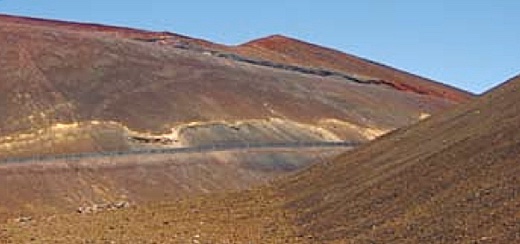
Image above: Current scarring of summit ridge by erosion along access roadway to observatory sites. From original article.

Mauna Kea has garnered significant media and celebrity attention over the past few months, but the Sierra Club has had its eyes focused on the summit for decades.The controversy over telescope development atop Mauna Kea actually began with the first University of Hawaii facility in the 1968. From the start, the Sierra Club and the broader environmental community were key critics of development on and around the summit.

It was Club member Mae Mull, a Volcano resident and energetic environmentalist, who brought her concerns to this author’s attention, back in 1980. She was recruiting anyone who could make the arduous trip to the summit and speak for the Hawaii Audubon Society or Sierra Club.

Through numerous meetings, Mull made allies among the hunters concerned about access to hunting areas, which the Honolulu-based Institute for Astronomy attempted to limit. Mull kept boxes of newspaper clippings and documents from the many DLNR hearings back then. She was very vocal
about the urbanization of the summit as telescopes began sprouting up like weeds.

Her opinion was shared by many islanders upset with the proliferation of domes. Even Hawaii County Mayor Herbert Matayoshi called them “pimples” blemishing the beauty of the mountain.

During the late1970s Mauna Kea’s upper slopes were the testing ground for a series of moon vehicles. The field activities were reported in a 1979 issue of Science magazine. The article claimed that the volcano’s harsh stone environment was as bare and lifeless as the surface of Mars. Three Hawaii biologists scoffed at that superficial pronouncement and began their own field surveys to see what biology actually was on Mauna Kea.


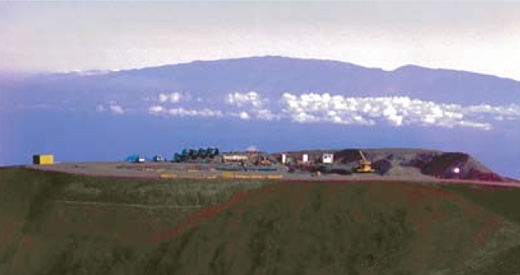
Image above: Excavation in 1986 for the Keck facility on of Mauna Kea required 40 foot deep removal of summit material to make large enough area for construction. From original article.

Dr. Frank Howarth was an entomologist working at the Bishop Museum who specialized in cave biology. Dr. Wayne Gagne was an entomologist and a key volunteer leader on the Sierra Club of Hawaii’s Chapter Executive Committee. Dr. Steve Montgomery was the third entomologist in this group and was also very active on the Executive Committee. Howarth, Gagne, and Montgomery were friends of Bill and Mae Mull.

Together this volunteer team explored the alpine, aeolian (wind-driven) stone desert ecosystem. In 1979, they discovered a complex web of life, finding 15 species of native arthropods, including the endemic wekiu bug, nysius wekiucola, found nowhere else on the planet.

The wekiu bug is adapted to a habitat limited to the upper reaches of the Mauna Kea conservation district. This complex ecosystem, to this day, has not been studied, monitored nor protected from the industrial changes to the summit region.

Howarth and Dr. Fred Stone conducted an entomology study for the proposed Keck telescope area in 1982, and by the next year they were disturbed by the damage done to the summit habitat. They made recommendations for biological inventory, habitat mitigation, and monitoring. The wekiu bug habitat is easily altered by vehicular traffic and construction activity, as tephra cinders preferred by the bug are easily crushed into dust-sized particles, which fill their living spaces.

Prime habitat can be quickly degraded to compacted silt and mud by use of off-road vehicles. wekiu habitat may also be altered by dust blown up from road grading and other construction activities. Concerns about the urbanization and industrialization of the summit prompted the University to prepare a master plan in 1983. The University has still not fulfilled some of the promises made in that plan two decades ago.

Club members Deborah J. Ward and the author accompanied Dr. Fred Stone on a visit to the summit. The Japanese Subaru facility had seriously altered the top and inner cinder slopes of Puu Hauoki and was that day trenching, with heavy machinery, into the outer slopes of the cone (high-quality wekiu bug habitat) for optical and electrical cables. The DLNR had no idea this industrial activity was going on, let alone in prime wekiu habitat.


Image above: Excavation into cinder slope for construction of Japan's Subaru facility. From original article.

Was this the kind of activity and lack of oversight that Gov. David Ige and UH President Dave Lassner apologized for on May 26, 2015?

In 1996, the Sierra Club of Hawaii adopted a policy calling for;
“a moratorium on any further development in the Mauna Kea Science Reserve until... [certain] conditions, designed to re-establish a prudent balance between astronomy and the cultural, religious, biological, eological, and recreational attributes of the mountain, are met...”
To date, most of the conditions have not been satisfactorily met.

The Sierra Club’s concerns back then—and today—include the visual impact of construction on sensitive cultural view planes from both the summit and the lowlands, the industrialization of conservation district land, the impact on cultural resources and historic sites, the impact on wekiu habitat, and the failure of the State to collect the fair market value of lease rents from foreign and mainland entities thatuse public trust lands.

The Sierra Club of Hawaii intervened in two contested case hearings: expansion of the Keck telescope facilities and the UH Comprehensive Management Plan.

For decades, Sierra Club has worked side by side with the Conservation Council for Hawaii and KAHEA: The Hawaiian-Environmental Alliance to correct bad land-use management practices for this vulnerable land. It also challenged the acceptance of the latest management plan.

.

Mauna Kea TMT standoff

SUBHEAD: Update as  as protesters continue stoppage of Thirty-Meter-Telescope construction.

By Mileka Lincoln on 25 June 2015 for Hawaii News Now -
(http://www.hawaiinewsnow.com/story/29393022/tmt-construction-set-to-resume-as-protesters-gather-at-mauna-kea-summit)


Image above: Hawaiian activist Walter Ritte (center) and others hear DLNR officer apologize to protesters of the construction of the $1.4billion Thirty Meter Telescope planned for Mauna Kea. He informs those present that today construction equipment will not try to reach the site. From original article.

After a seven-hour demonstration, Hawaii DLNR (Department of Land and Natural Resources) agents just informed the hundreds of protesters on Mauna Kea that officers and TMT workers will turn around and no longer ask anyone to leave. No further arrests will be made today, they say.

Protesters began lining up early Wednesday morning to prevent construction of the Thirty Meter Telescope on the on the summit of Mauna Kea. A total of 11 people were arrested, and the TMT crews made it about 1.5 miles up the seven-mile road.

In all, more than 700 people gathered to stand in what they say is protection of a sacred Native Hawaiian space.

When it became clear that agents with the Department of Land and Natural Resources would no longer allow the protesters to assemble on the road, they took a new tactic to block the TMT construction workers. Someone began pulling rocks down from the side of the road, further restricting access.


By Mileka Lincoln on 24 June 2015 for Hawaii News Now -


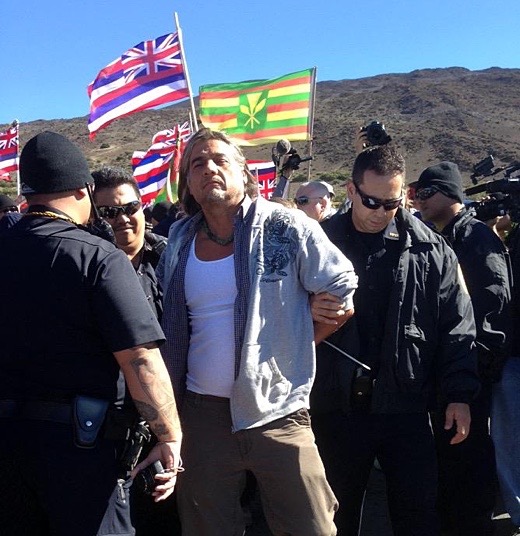
Image above: Unidentified man being arrested by Hawaii County police officers on Mauna Kea mountain for blocking way for Thirty Meter Telescope construction crews. From original article.

Hawaii County police have made at least one arrest on Mauna Kea as protesters continued to stand in protection of Native Hawaiian sacred space before construction of the Thirty Meter Telescope set to resume Wednesday morning.

It's unclear what time construction will begin Wednesday, but according to a statement released by the TMT International Observatory Board on Saturday, crews will be returning the the site.
Approximately 350 peaceful protesters were on site Wednesday morning following a group prayer at the Mauna Kea Visitor's Center.

Hawaii County police presence, along with agents from the Department of Land and Natural Resources, is expected throughout the day. However, officials say there are currently no plans to close any roads or restrict public access.

There is only one road up the mountain and any interruption of traffic will affect the other observatories at the summit.

“We're going to scale back our operations a bit today,” said Rich Matsuda, director of operations and infrastructure for Keck Observatory. “It's what we normally do if the weather is bad at the summit.”

The larger observatories can operate with a handful of people each, or more than a dozen, depending on what work is being done that day. Most observatory employees work from nerve centers: Keck is headquartered in Waimea (Kamuela), for example, while the Gemini observatory has its operations center in Hilo.

Officials say work crews first intend on inspecting the telescope site and equipment, much of which has been there since protests began in March, before installing a fence around the designated construction zone.

The $1.4 billion dollar TMT project has been on hold for nearly three months when aloha aina advocates, who say they're protecting a culturally sacred site, blocked construction vehicles and workers from accessing the summit. 31 people were arrested and since then, non-violent protests have grown in size.

“We look forward to a positive relationship with all Hawaiians, while we understand that the majority of Hawai‘i's people are supporting the TMT project," said Henry Yang, Chair of the TMT International Observatory Board. "We deeply respect and are mindful of those who have concerns, and yet, we hope they will permit us to proceed with this important task while reserving their right to peaceful protest."

In April, in response to the demonstrations, the Thirty Meter Telescope team informed Governor David Ige that construction would be postponed until telescope board members, state officials and Native Hawaiian activists had an opportunity to discuss the issue. Late last month, Governor Ige announced that he had given his official support to the project.

He released this statement on Wednesday:
It is our belief that there will be mutual respect and aloha on Wednesday and in the days ahead as TMT restarts construction of the Thirty Meter Telescope.


TMT has the approvals needed to proceed with construction. We respect those who oppose the project and their right to peaceably assemble and to protest in an orderly and civil manner.


The State of Hawai'i's primary concern is the health and safety of its people. The state and Hawai'i County are working together to uphold the law and ensure safety on roadways and on Mauna Kea, while allowing the people their right to peacefully and lawfully protest.

.

TMT construction to resume

SUBHEAD: The construction of the 30 meter telescope to resume on Mauna Kea on 6/24/15 .

By Dan Joling on 21 June 2015 for Huffington Post -
(http://www.huffingtonpost.com/2015/06/21/tmt-telescope-construction_n_7633256.html)


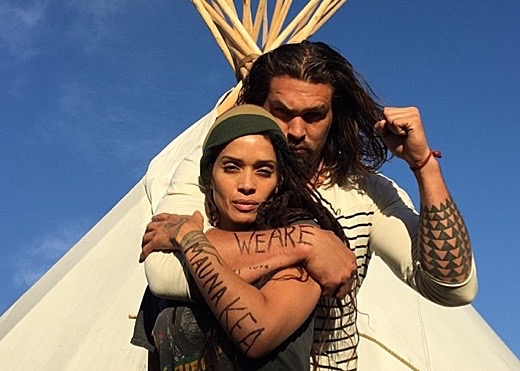
Image above: Two actors, Jason and Lisa,  from "Game of Thrones" join We Are Mauna Kea demonstration. From (http://blog.sfgate.com/hawaii/2015/04/09/game-of-thrones-stars-bumgarner-join-growing-mauna-kea-protest/).

The construction of a $1.4 billion telescope on land considered sacred by some Native Hawaiians will resume Wednesday, according to the nonprofit company behind the project.

Henry Yang, chairman of the Thirty Meter Telescope Observatory Board, in a statement said the board decided to move forward after more than two months of consultations.

"Our period of inactivity has made us a better organization in the long run," Yang said. "We are now comfortable that we can be better stewards and better neighbors during our temporary and limited use of this precious land, which will allow us to explore the heavens and broaden the boundaries of science in the interest of humanity."

The telescope is planned for the summit of Mauna Kea on Hawaii's Big Island. It would be one of the world's largest telescopes.

The company suspended construction in April after law enforcement arrested protesters for blocking the road to the summit and refusing to leave the construction site.

Kealoha Pisciotta, one of the protesters, and one of six plaintiffs challenging the telescope's construction permit, said Sunday that she was shocked by Yang's announcement.

"I believe that it demonstrates a lack of good faith," she said by phone from Seattle, where she was on her way to give a talk on sacred Hawaii sites. The telescope is receiving major funding from the Gordon & Betty Moore Foundation in San Francisco. The announcement came a day after the Supreme Court of Hawaii announced it will hear oral arguments Aug. 27 on the case challenging the telescope permit, she said.

"I'm sorry to say that Mr. Moore and the Thirty Meter Telescope board are demonstrating their lack of willingness to follow the law," she said.

Yang in his statement said most of Hawaii's people support the TMT project.

"We deeply respect and are mindful of those who have concerns, and yet, we hope they will permit us to proceed with this important task while reserving their right to peaceful protest," he said.

Pisciotta said protests will continue. Yang's announcement triggered an island-wide alert for protesters, she said.

"It means that our people are going to have to be arrested, and arrested for actually trying to get the TMT to follow the law, not arrested for disobeying the law," she said.

The Mauna Kea site provides a clear view of the sky for 300 days a year, with little air and light pollution.

The telescope project was developed as a collaboration between U.S. and Canada universities and the national institutes of Japan, China and India.

Gov. David Ige in April said the Thirty Meter Telescope board is legally entitled to "use its discretion to proceed with construction." He said he respected the rights of protesters to appeal in court.

Telescope proponents spent seven years planning and seeking permits, a process that included public hearings, Ige said.

.

TMT permit goes to Supreme Court

SOURCE: Kerri Marks (occupyhilomedia@yahoo.com)
SUBHEAD: The transfer signals the court believes the TMT Conservation District Use Permit deserves the utmost scrutiny.

By  Kealoha Piscotta on 5 June 2015 for Mauna Kea Hui -
(http://islandbreath.blogspot.com/2015/06/tmt-permit-goes-to-supreme-court.html)


Image above: Mauna Kea with fresh snow in the light of sunset, 12 Jan 2011. From (http://darkerview.com/darkview/index.php?/archives/2142-Wordless-Wednesday-Sunset-and-Snow.html).

Today, the Hawaii Supreme Court issued its order granting the Mauna Kea Hui’s application for transfer of their case concerning the construction of a Thirty-Meter Telescope (TMT) on the sacred summits of Mauna Kea from review by the state Intermediate Court of Appeals (ICA).

Mauna Kea Hui members, Kealoha Pisciotta of Mauna Kea Anaina Hou, Deborah J. Ward, Clarence K ū Ching, the Flores-Case ʻOhana (E. Kalani Flores and Pua Case), Paul Neves, and KAHEA: The Hawaiian-Environmental Alliance, are appealing the state Third Circuit’s affirmation of the state Board of Land and Natural Resources’ (BLNR) decision to grant a conservation district use permit (CDUP) to the University of Hawaiʻi at Hilo (UHH) for TMT construction.

Richard Naiwieha Wurdeman, attorney for the Mauna Kea Hui, said that his clients are encouraged by the Hawaii Supreme Court’s decision to grant the application for transfer.

One of the criteria that the Supreme Court considers in granting an application for transfer is whether the matter involves a question of imperative or fundamental public importance.

Wurdeman said UHH, on behalf of TMT, had strenuously objected to his clients’ application for transfer of the appeal from the ICA to the Hawaii Supreme Court for review.

The grant of transfer comes in the wake of UH’s public concessions of its mismanagement of Mauna Kea and agreements to Governor Ige’s plans for purported “improvements” on Mauna Kea, all of which fall short because they were premised on continued support of the TMT project. “These are interesting, to say the least,” said Wurdeman, “given the University’s vigorous opposition in legal battles.”

In a separate case, the ICA had earlier ruled against the Kilakila o Haleakala’s similar appeal concerning the University ’s CDUP for an Advanced Technology Solar Telescope (ATST) to be constructed on the Haleakala summit.

The Hawaii Supreme Court subsequently granted a request for review and oral arguments were held in April in that case. Now, appeals from both the TMT and ATST CDUPs are under review by the Hawaii Supreme Court. The Supreme Court has not yet issued an order on whether oral arguments will be held in the Mauna Kea case.

Deborah Ward said the court’s decision to hear the case is “heartening” and Kealoha Pisciotta stated, “This is good news and recognizes the importance of our case for all of Hawaii.”

 Both cases may bear on the ways conservation districts islandwide will be treated. CDUPs are essentially variances for construction in conservation districts and can be granted only if a project meets eight criteria, including an absence of substantial adverse impact, preservation of natural beauty, and consistency with conservation district purposes.

“The transfer signals that the Hawaii Supreme Court, in unanimity, believes that the so-called TMT Conservation District Use Permit deserves the utmost legal scrutiny and priority,” stated K ū Ching.

.

TMT Star Wars - Hawaii Style

SUBHEAD: Indigenous Hawaiian activists take on Northern Hemisphere’s biggest telescope planned for Mauna Kea.

By Ed Rampell on 26 April 2015 for Earth Island Journal -
(http://www.earthisland.org/journal/index.php/elist/eListRead/star_wars_hawaiian_style/)


Image above: Demonstrators protest the building of the TMT on Mauna Kea. From original article.

The Big Island of Hawaii is often in the news because of the active Kilauea volcano. However, an eruption of another sort at the dormant 13,796 foot-high Mauna Kea is thrusting Hawaii back into the headlines. This explosion of activism has been triggered not by TNT, but by “TMT,” the proposed Thirty Meter Telescope, the Northern Hemisphere’s largest, most advanced optical telescope, which is slated to be built on the summit of the Aloha State’s highest peak.

This 184 foot-tall, 18 story-high, eight acre, $1.4 billion construction project has sparked a wave of occupations and protests by Native Hawaiians, environmentalists, and their allies, stretching from Hawaii to California.

Opponents have flocked to Mauna Kea to stop construction of the telescope and adjacent conservatory, staging acts of civil disobedience and causing a PR nightmare that has taken the TMT International Observatory LLC, a multinational conglomerate, by surprise. Last October, protesters disrupted the star-crossed project’s groundbreaking ceremony atop Mauna Kea.

Across the Pacific, demonstrators gathered in Palo Alto, CA, outside the Gordon and Betty Moore Foundation, which has pledged $200 million to fund the controversial project.

Later, protesters setup roadblocks to prevent equipment and machinery from reaching Mauna Kea’s summit to continue construction. On April 2, 31 protesters, known as the Mauna Kea 31, were reportedly arrested for trespassing, blocking work vehicles, and disobeying an officer. Those arrested included longtime campaigners Moanikeala Akaka, 70, a former trustee with the Office of Hawaiian Affairs (a State agency overseeing indigenous matters), and James Albertini, 68.

So far, the protests have been successful. “[As of] April 21, we are in ‘stand down,’” Sandra Dawson, TMT Manager of Hawaii Community Affairs, said via a conference call to Hilo, Hawaii (with a Honolulu-based Becker Communications publicist on the line).

“TMT has agreed to halt construction temporarily while stakeholders are talking about different ideas for moving forward…. Governor [David] Ige asked if we would halt construction for a period and we agreed. Then we met with him again and we said we’d continue the construction halt for a period of time while people pursued conversations.” According to Dawson, only one-and-a-half days of construction have been done since the project started in April.

It is unclear how long these tête-à-têtes between various concerned parties will continue — the postponement is for an unspecified amount of time. On April 17, Governor Ige, a Democrat, issued a statement asserting, “The TMT team is legally entitled to use its discretion to proceed with construction.”

Interviewed by phone on the Big Island, Kealoha Pisciotta, a Native religious practitioner and spokeswoman for the Mauna Kea activists who was raised on the Big Island, told EIJ that over 100 TMT opponents from throughout the archipelago were still occupying the mountain, operating “the ‘Aloha Checkpoint,’ at the 9,000-foot level, where they’re primarily stationed.”

Since the length of this construction suspension is uncertain and up to TMT, “we cannot stand down,” maintained Pisciotta, who had just returned from meeting with Governor Ige at Oahu, presenting him with an anti-TMT petition containing 53,000 signatures and encouraging him to “drop the charges against the ‘Mauna Kea 31.’”

Pisciotta described herself as having worked in the astronomy industry for 12 years and having been involved in litigation against observatory interests for years. She indicated TMT includes entities she’s fought in the courts in the past.

On April 19, 75 demonstrators, many wearing tattoos, Aloha shirts, and flip flops, waving Hawaiian flags and signs, and reciting slogans and Polynesian chants, gathered on the four corners of the intersection outside TMT’s headquarters in Pasadena, CA, near the 110 Freeway exit.


Image above: Artist's rendering of the TMT (lower left) on Mauna Kea. From original article.

What is TMT?

This 30 meter-wide telescope project, which began in 2003, has become a joint effort by the Association of Canadian Universities for Research in Astronomy, the California Institute of Technology and the University of California, as well as the governments of the US, China, India, Japan, and Canada. Dawson dubbed it “the first real pan-Pacific observatory.”

The TMT conglomerate subleases land from the University of Hawaii (UH), which leases 11,000 acres on Mauna Kea from the State of Hawaii, in exchange for “observing time on some of the best telescopes in the world, somewhere between 7.5 and 15 percent of observing time on all the telescopes,” explained Dawson. The Moore Foundation’s funding started circa 2006. The state’s Board of Land and Natural Resources, which oversees state land, approved the TMT undertaking.

TMT’s purpose is to study the “Milky Way and its neighboring galaxies,” according to its website. “[TMT] will see further back in space and thus in time … within 400,000 years of the Big Bang … and get a sense of what happened when galaxies and stars were first forming,” Dawson said. “That’s very, very exciting.” She added that the telescope will also find and observe new planets and solar systems, including, perhaps, other worlds showing signs of life, as well as a black hole at the center of the Milky Way galaxy and dark matter.

Sacred Sites?

Meanwhile, back on Earth, the proposed TMT project spurred opposition because of cultural and ecological concerns. According to Pasadena demonstration spokeswoman Mikilani Young, “First, we’re protecting our aina [land], Mauna Kea is the most sacred place on the Hawaiian Islands, where we believe [the pre-Christian deities] Papa and Wakea came together and made all our islands…. It’s not only about protecting Mauna Kea but sacred lands around the world.” Pisciotta shared similar concerns. “TMT is located right in a ring of cultural shrines,” she said. “Mauna Kea is a burial ground.”

Locals also assert that UH has poorly managed previous telescope projects. “UH was allowed essentially control of the Mauna Kea area. They have been allowing the building of these telescopes and there have been a number of court cases” said Rosa Rivera Furumato, a professor of Chicano Studies at California State University, Northridge, who identified herself as a US-born Chicana indigenous person of Yaqui and Cora ancestry, and part of Young’s Hula Halau (traditional Hawaiian dance school and troupe).

“UH has not done a good job with it. For example, there’s runoff there, waste from [the] construction site, so there’s destruction of … sacred family altars and sites…. Some of the most high-ranking ancients of Hawaii are buried up there. There’s been all this desecration and they have not consulted very well with Native Hawaiians to be able to share use of that place. Now, the idea of building this additional observatory is just the last straw…. You don’t have to be indigenous to understand this issue — we need to take care of our sacred sites.”

But Dawson disagrees. “On the TMT site, it was chosen, specifically, because there are no archaeological artifacts there … no heiaus [pre-Christian temples], no burials — it’s a basalt lava field,” she said. “It’s been looked at very closely and determined by the State Historic Preservation [Division] and others, no, there is nothing like that on our site.” However, Dawson demurred from saying whether or not there were culturally significant sites elsewhere at the summit, admitting, “I’m not the expert on Mauna Kea” outside the TMT site.

Eco-Anxieties

Local communities are also worried about potential impacts to the ecosystem on islands that have already been beset by overdevelopment. “Environmentally it will affect our islands. There are aquifers on the bottom — no one can 100 percent guarantee it won’t destroy the environment. What little we have we don’t want destroyed,” said Young, who is originally from Honolulu, but now lives in LA’s San Fernando Valley and is a kumu hula (Hawaiian dance school teacher/leader). “They’re saying they’re going to be building containers underneath to store chemicals. If anybody knows Hawaii, we have earthquakes and that’s where [volcano goddess] Madame Pele lives. If she decides to erupt, nobody can 100 percent guarantee those [containers] won’t be destroyed and affect the rest of the island”

Mikilani’s wife, Nanea Young, added, “It may seep into the ground and affect the whole island.” According to a leaflet by Kahea, the Hawaiian-Environmental Alliance, disbursed at the rally these containers will be “5,000 gallon underground tanks for waste storage, including hazardous chemicals” and “construction will impact fragile habitats of native plants and animals,” As an example, Pasadena protesters cited the endangered silversword flower.

Waving a sign in front of TMT’s HQ, Moka Kaehuaea added Mauna Kea “is an essential part of the ecosystem because that’s where lots of the snow is gathered and it trickles down and is kind of feeding the rest of the mountain. Definitely, if you’re going to dig into the mountain, there’s potential of affecting the groundwater below.”

Dawson disputed these contentions, asserting that there are no silverswords or other endangered species on the TMT site, and that, “In TMT’s Environmental Impact Statement, hydrologists said there’s no way [any water] from the top of Mauna Kea gets into any aquifer.” She added that Mauna Kea was specially selected “for its clear skys and stable air,” and that activists haven’t proposed any other locations.

In addition to potential environmental impacts of the TMT telescope, activists say there are several other observatories on the mountain that have been decommissioned, but not yet removed, and which continue to impact the land.

Big Island Benefits?

Dawson stated that TMT is making major contributions to the state and Big Island economy, including paying $1 million a year lease rent; $1 million a year for education; plus $1 million a year to develop workers for high-tech jobs, including IT, engineers and astronomers, for TMT and other observatories. TMT also claims that during the 8-10 year building period, up to 300 construction jobs will be created, and that once opened the observatory will employ 140 people. Dawson added that while there is currently a standstill on construction, TMT will proceed with its contentious plans.

TMT opponents insist they are not “anti-science.” Since time immemorial, ancient Polynesians have been superb stargazers, charting their course across the Pacific by following the constellations. Contemporary Hawaiians, such as Hokule’a voyaging canoe navigator Nainoa Thompson, continue this scientific tradition. And although Hawaiians are world-renowned for their hospitable “aloha spirit,” indigenous activists remain steadfast in their opposition to TMT, demanding that it leave Mauna Kea. Demonstrations will continue, including a protest during an April 29 meeting at Cal Tech in LA. Kealoha Pisciotta declared, “The protests are going global.”

As Professor Furumoto put it, “Environmentalists should be concerned because they care about the Earth, and I hope they also care about humanity, about sacred sites. But even if all they cared about was that little insect and the silversword, then that would be a cool reason for them to want to protect Mauna Kea.”

See also:
Ea O Ka Aina: Mauna Kea Hui responds to OHA 4/24/15
While the Mauna Kea Hui will continue to litigate in the courts, and has been adjudicated to have standing.

Ea O Ka Aina: UH walkout over Mauna Kea TMT 4/13/15
University wide walkout planned over construction of TMT on Mauna Kea sacred ground.

Ea O Ka Aina: Ige listens to Hawaii 4//8/15
The recent DLNR Chair selection and current Muana Kea TMT resistance have shown Governor hears the people.

Ea O Ka Aina: Mauna Kea telescope protest 4/2/15Update on Mauna Kea protest by kanaka maoli warriors protecting sacred mountain from desecration.

Ea O Ka Aina: Education and the Mountain  4/15/15
There are 13 other telescopes at the top of the mountain but the 14th desecration of Mauna Kea.


.

Mauna Kea Hui responds to OHA

SOURCE: Kerri Marks (occupyhilomedia@yahoo.com)
SUBHEAD: OHA, our beloved Mauna Kea is NOT for sale! In Aloha we remain Mauna Kea Hui.

By Members on 24 April 2015 for Mauna Kea Hui -
(http://islandbreath.blogspot.com/2015/04/mauna-kea-hui-responds-to-oha.html)


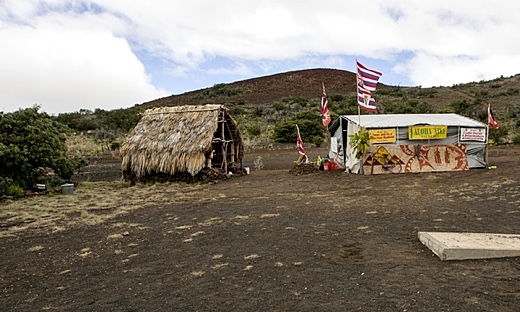
Image above: TMT opponents build a Mauna Kea hale, courtesy Occupy Hilo Media. From (http://www.allhawaiinews.com/2015/04/board-of-regents-plans-public-meeting.html).

To be clear, the Mauna Kea Hui, was not invited to this meeting until only yesterday and only after OHA had released its Press Statement claiming we would be in attendance. So we have produced this statement in response.

It is the position of the Hui that we will to uphold the wishes of our Kupuna, those who came before us, such as Uncle Genesis Leeloy, Aunty Leina’ala Apiki McCord, Aunty Kamakahukilani Von Oelhoffen and so many more…because they are who moved us to stand for Mauna Kea so many years ago– their message was clear -- enough is enough—there shall be no further development on Mauna Kea!

While the Mauna Kea Hui will continue to litigate in the courts, and has been adjudicated to have standing to do so, there is also a higher court here and we stand with our Kupuna in asserting the following positions for the protection of Mauna Kea:

  1. The TMT construction shall be halted and any new leases and/or subleases previously issued by BLNR allowing the TMT to be built and that are currently being challenged must be revoked and/or rescinded forever.
  2. The observatories currently operating on Mauna Kea shall pay fair market lease rent now and until the end of the general lease in 2033.
     
  3. No further development shall be allowed in any way, shape, or form and upon the decommissioning of observatories or the current general lease has ended there must be complete clean-up and restoration of the Mauna to its original state and condition as the general lease requires. There shall be no rocks, soils or other materials displaced or removed from the Mauna.
  4. We will consider working with State Official to help find solutions for: the protection of Mauna Kea waters and aquifers, clean-up, and restoration of the Mauna, to insure the “right-holders” (those who the laws are written to protect such as Native Hawaiians and the General Public) have a seat at the table of decision making and lastly we are committed to help to ensure educational opportunities and funds for all the children of Hawai`i are upheld and protected.

OHA … our beloved Mauna Kea is NOT for sale! In Aloha We Remain,

Paul K. Neves, Clarence Ku Ching, Debbie J. Ward, Mauna Kea Anaina Hou, Kealoha Pisciotta, and the Flores-Case ‘Ohana and KAHEA: The Hawaiian Environmental Alliance.

.