Showing posts with label Legalization. Show all posts

Senate endangers GMO labeling

SUBHEAD: Victory in Vermont, where GMO label requirements went into effect Friday, may be 'fleeting'.

By Deidre Fulton on 3 July 2016 for Common Dreams -
(http://www.commondreams.org/news/2016/07/03/fate-vermonts-historic-gmo-labeling-law-us-senates-hands)


Image above: PepsiCo’s Frito-Lay group began making label changes on a nationwide basis a couple of months in advance of the July 1 deadline. Photo by Consumerist. From original article.

As the nation's first GMO labeling law takes effect, food policy experts are warning that its benefits could be "fleeting," should the U.S. Senate pass a so-called "compromise" bill this week that would nullify Vermont's historic law as well as other state efforts in the works.

Vermont's law (pdf) requiring food manufacturers to clearly state whether a product is "produced with genetic engineering" went into effect Friday.

"Vermont had the courage to say, 'If it's the right thing to do, what are we waiting for,'" Democratic Gov. Peter Shumlin told a rally of about 150 people on the Statehouse steps. He asked supporters of the law to celebrate on social media under the hashtag #WeLabeledGMOS.

“But this victory may be fleeting," cautioned Wenonah Hauter, executive director of Food & Water Watch. "The Senate will vote next week on a federal bill that would nullify Vermont's law, and other state labeling efforts percolating, thanks to the heavy hand the ag-biotech industry wields over our congressional representatives."

Republican chairman of the Senate Agriculture Committee Pat Roberts, of Kansas, and ranking Democrat Debbie Stabenow, of Michigan, announced the so-called "compromise" bill—which has less stringent requirements—last month. Food safety advocates have decried the legislation (pdf) as anti-consumer, inadequate, and "inherently discriminatory."
As Hauter wrote in an op-ed on Friday:
Advocates of GMO labeling have pushed for clear, on-package language, just like what’s required under the Vermont law. But the Senate bill would allow manufacturers to post “call for more information” phone numbers or even smart phone “QR codes” if they so desire—meaning that if you have a phone with the right app installed, a steady hand and a solid data connection you’ll be able to access a website that will tell you what’s in the food you’re buying.

That’s not a label—that’s a hassle.
Sen. Bernie Sanders (I-Vt.) last week called it "bad federal legislation" and vowed to do what he can do defeat the bill, which is expected to come up for a vote this week. He tweeted to that effect on Sunday:

The Minneapolis Star Tribune notes: "If the new bill passes the Senate, it must still pass the House, which earlier voted for a bill that places a national ban on on-package GMO disclosure."

It's a race against the clock, one industry lobbyist told Capital Press. "If Congress does not pass this bill by the 15th [when it goes on recess until after Labor Day], it won’t get taken up until September, which is much, much, much too late," said Roger Lowe, executive vice president of strategic communications for the Grocery Manufacturers Association.

.

Hawaii hemp legislation pending

SUBHEAD: Senate Bill 2787 to further encourage the state Department of Agriculture to license farmers to grow industrial hemp.

By Staff on 1 February 2016 for NORML -
(http://salsa3.salsalabs.com/o/51046/p/dia/action3/common/public/?action_KEY=18208)


Image above: Immature hemp plant and field it's to be planted in. From article on tips to grow hemp. (http://toneag.com/wp/2009/08/24/hemp-production/).

Legislation is pending, Senate Bill 2787, to further encourage the state Department of Agriculture to license farmers to grow industrial hemp for “research and development purposes.”
Additional legislation, Senate Bill 2757, is pending to authorize the department of agriculture to establish a three-year industrial hemp research program to investigate the viability of industrial hemp as a building material for housing in the State.

In 2014, lawmakers previously approved legislation, Senate Bill 2175, establishing a two-year pilot program at the University of Hawaii at Manoa to study the potential use of industrial hemp as a phytomediator (a plant capable of removing toxins from the soil) and as a biofuel.

Hemp is a distinct variety of the plant species cannabis sativa L. that contains minimal amounts of tetrahydrocannabinol (THC), the primary psychoactive ingredient in marijuana. Various parts of the plant can be utilized in the making of textiles, paper, paints, clothing, plastics, cosmetics, foodstuffs, insulation, animal feed and other products. The crop is commercially cultivated throughout the world. 
Members of Congress recently approved language (Section 7606) in the omnibus federal Farm Bill explicitly authorizing states to sponsor hemp research absent federal reclassification of the plant. Presently, 24 states have enacted legislation permitting licensed hemp cultivation in a manner that is compliant with this statute.

The Senate Committee on Commerce, Consumer Protection and Health and the Senate Committee on Water, Land, and Agriculture have scheduled a public hearing for Senate Bill 2787 on February 5th at 2:45PM in conference room 224.  
Please go tp original article and fill out form to contact your lawmakers and urge them to support this pending legislation.


.

Big Island to appeal GMO ruling

SUBHEAD: Dru Kanuha was the only man who voted for Hawaii County to support its GMO ban.

By Shannon Rudolph on 18 December 2014 in Island Breath -
(http://islandbreath.blogspot.com/2014/12/big-island-ro-appeal-gmo-ruling.html)


Image above: Council members who voted for Hawaii County to appeal overturning of their GMO ban with supporters. From Shannon Rudolph.

Aloha! GREAT NEWS!
MAHALO to all who Showed up!!!  This may not have happened without you!

Today, the Hawaii Island Council voted 5/4 to APPROVE the APPEAL of Federal Judge  Barry Kurren's ruling that invalided the Hawaii County GMO ban! This ruling could also invalidate our 2008 ban on GMO taro and Kona Coffee as well.

Pray our GMO Ban WILL be upheld on appeal! Stay tuned!

Five YES Votes 
The Hawaii County Council members supporting the GMO Ban
Karen Eoff, Maile David, Val Poindexter, Margaret Wille, and Dru Kanuha.

Please send them a quick email "Mahalo Nui Loa!"
margaret.wille@hawaiicounty.gov, karen.eoff@hawaiicounty.gov, maile.david@hawaiicounty.gov, valerie.poindexter@hawaiicounty.gov, dru.kanuha@hawaiicounty.gov


Image above: Council member Dru Mamo Kanuha was the only man who voted for Hawaii County to appeal overturning of their GMO ban. From (http://kaunewsbriefs.blogspot.com/2011_10_13_archive.html).

[IB Editor's note: Is this about nurturing versus exploiting? Thank you Dru Kanuha for leaving the Man Cave!]

Four NO Votes
The Hawaii County Council members against the GMO Ban
Aaron Chung, Greggor Ilagan, Dennis Onishi, Daniel Paleka

Their emails:
greggor.ilagan@hawaiicounty.gov, dennis.onishi@hawaiicounty.gov, daniel.paleka@hawaiicounty.gov, aaron.chung@hawaiicounty.gov

.

Congress protects medical marijuana

SUBHEAD: Congress passes historic medical marijuana protections for states that legalized it.

[IB Publisher's note: A small silver lining to the $1.1 trillion dollar spending bill that included poison pills of FDIC guarantees for bankster ponzi schemes and almost unlimited political dollar donations for elites. I guess even elites smoke marijuana too.]

By Matt Ferner on 14 December 2014 for Huffington Post -
(http://www.huffingtonpost.com/2014/12/14/congress-medical-marijuana_n_6317866.html)


Image above: George Soros, a supporter of pot legalization, with marijuana leaf poster. From (http://www.washingtontimes.com/news/2014/apr/2/billionaire-george-soros-turns-cash-into-legalized/).

Congress dealt a historic blow to the United States' decades-long war on drugs Saturday with the passage of the federal spending bill, which contains protections for medical marijuana and industrial hemp operations in states where they are legal.

The spending bill includes an amendment that prohibits the Department of Justice from using funds to go after state-legal medical cannabis programs. If the bill is signed into law, it will bring the federal government one step closer to ending raids on medical marijuana dispensaries, as well as stopping arrests of individuals involved with pot businesses that are complying with state law.

“When the House first passed this measure back in May, we made headlines; today we made history," Rep. Sam Farr (D-Calif.), who in May introduced the medical marijuana protections amendment with co-sponsor Rep. Dana Rohrabacher (R-Calif.), told The Huffington Post regarding the bill's passage.

"The federal government will finally respect the decisions made by the majority of states that passed medical marijuana laws," Farr added. "This is great day for common sense because now our federal dollars will be spent more wisely on prosecuting criminals and not sick patients.”

The bill protects medical marijuana programs in the 23 states that have legalized marijuana for medical purposes, as well as 11 additional states that have legalized CBD oils, a non-psychoactive ingredient in marijuana that has shown to be beneficial in some severe cases of epilepsy.

“Congress has finally initiated a drawdown in the federal government’s war on medical marijuana,” said Mason Tvert, director of communications for the Marijuana Policy Project, in a statement. “This legislation makes it clear that the DEA has no business interfering in states’ medical marijuana laws. Taxpayer money should not be used to punish seriously ill people who use medical marijuana and the caregivers who provide it to them.”

Under the Obama administration, the DEA and several U.S. attorneys have raided marijuana dispensaries and sent people to prison, even though they complied with state laws. According to a report released last year by advocacy group Americans for Safe Access, the Obama administration has spent nearly $80 million each year cracking down on medical marijuana, which amounts to more than $200,000 per day.

Under the Controlled Substances Act, marijuana is still classified as a Schedule I substance with "no currently accepted medical use," alongside heroin and LSD. Since that doesn't change with the passage of the omnibus package, it's not entirely clear how the protections will work in practice.

"This isn't finely written policy yet," Farr said in June after the amendment first passed in the House, Forbes' Jacob Sullum reported. “This is a statement of congressional intent that [the] DEA [should] back off on these issues. We will have to continue to reconcile federal policy with state policy.”

A statement issued by Americans for Safe Access following the spending bill's passage Saturday called the measure "historic" and said patients' rights advocates believe it "will dramatically impact DOJ enforcement, including ending federal medical marijuana raids, arrests, criminal prosecutions, and civil asset forfeiture lawsuits."

Industrial hemp also received new protections from DEA intervention under the spending bill. The same plant species as marijuana, cannabis sativa, hemp contains little to no THC, the psychoactive ingredient in marijuana associated with the "high" sensation. The farm bill, which President Barack Obama signed into law in February, legalized industrial hemp production in states that permit it.

Eighteen states have legalized industrial hemp production, and more than a dozen others have introduced legislation that would authorize research into the plant, set up a regulatory framework or legalize growing it.

Earlier this year, the DEA made headlines when it seized hemp seeds intended to be used in the launch of Kentucky's legal hemp research pilot program. A month later, the hemp seeds were released, and the state began planting its research crop.

It wasn't all victories for marijuana in the spending bill -- the legalization of recreational marijuana in Washington, D.C., which nearly 70 percent of voters approved, appears to be blocked. However, several members of Congress have taken issue with the language used in bill, arguing that law may still be able to move forward.

See also:
Ea O Ka Aina: Congress looting the Commons 12/11/14
Ea O Ka Aina: Bank derivative losses 12/9/14
.

'Bout time brother

SUBHEAD: Baby steps. Five years into his presidency Obama says marijuana not more dangerous than alcohol.

By Reuters on 19 January 2014 in The Guardian -
(http://www.theguardian.com/world/2014/jan/19/obama-marijuana-bad-habit-minorities)


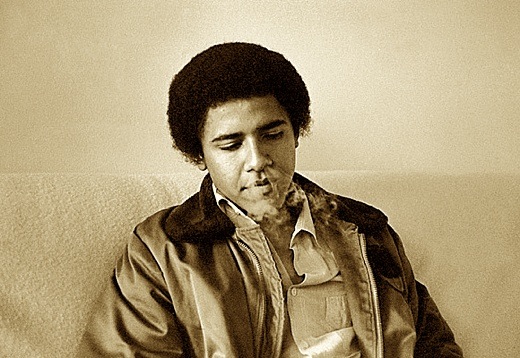
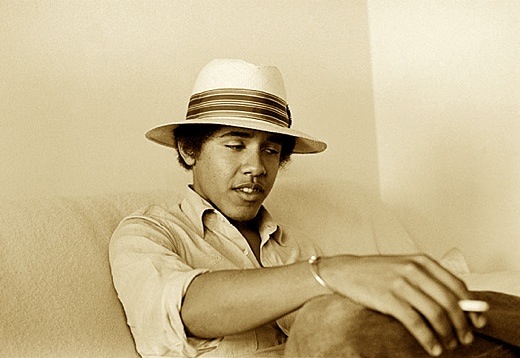
Image above: Barack Obama smoking in 1980. From (http://centerforiiit.wordpress.com/2010/11/16/barack-obama-1980-dont-miss/).

President Barack Obama believes smoking marijuana is a "bad habit" but thinks legal penalties now fall disproportionately on minorities and that states legalising pot should go ahead with their plans, he said in a profile released on Sunday.

"As has been well documented, I smoked pot as a kid, and I view it as a bad habit and a vice, not very different from the cigarettes that I smoked as a young person up through a big chunk of my adult life," he is quoted as saying in a New Yorker magazine article. "I don't think it is more dangerous than alcohol."

The president said he has told his two daughters that smoking marijuana is "a bad idea, a waste of time, not very healthy".

However, he said he is concerned that marijuana-related arrests fall far more heavily on minorities than on others. Legalisation of pot should go forward in the states of Colorado and Washington because "it's important for society not to have a situation in which a large portion of people have at one time or another broken the law and only a select few get punished," he said.

Marijuana remains illegal in the United States under federal law, but 21 US states allow or are about to allow medical marijuana use, and Colorado and Washington have decriminalised use of pot entirely. Alaska and the District of Columbia are considering following suit.

The Obama administration said last year that federal law enforcement will not target users in Colorado and Washington, as long as they comply with their respective states' laws. The Department of Justice says it will not interfere with states' efforts to regulate and tax marijuana provided they are able to meet a set of requirements, including keeping it from children and restricting its flow into other states.


Image above: Barack Obama smoking in 1980. From (http://centerforiiit.wordpress.com/2010/11/16/barack-obama-1980-dont-miss/).


The president also said he believes that those who argue that legalising marijuana will solve a number of social problems "are probably overstating the case". Legalisation in Colorado and Washington will probably be a challenge, he said.

In the lengthy profile, the president also muses over race, the Middle East and criticism of his efforts to woo Congress, among other topics. Discussing race, he said that he believes some people will never accept having a black president.

The president said that the three sets of negotiations involving Iran, Israel and the Palestinians, and Syria each have less than a 50-50 chance of succeeding, but are necessary steps toward achieving stability in a volatile region.

“If we were able to get Iran to operate in a responsible fashion … you could see an equilibrium developing between Sunni, or predominantly Sunni, Gulf states and Iran in which there's competition, perhaps suspicion, but not an active or proxy warfare," he said.

On the question of whether Obama will write a memoir, former adviser David Axelrod called it a "slam dunk" that the president will. A literary agent estimated publishers will pay between $17m and $20m.

Obama said narrowing the gap between rich and poor would be a key part of his legacy. "I will measure myself at the end of my presidency in large part by whether I began the process of rebuilding the middle class and the ladders into the middle class and reversing the trend toward economic bifurcation in this society," he said.
.