Showing posts with label Demand Destruction. Show all posts

How to Survive the Future

SUBHEAD: Surviving the Future: Culture, Carnival and Capital in the Aftermath of the Market Economy.

By Shaun Chamberlin on 28 July 2017 in Resilience -
(http://www.resilience.org/stories/2017-07-28/podcast-future-survive-shaun-chamberlin/)


Image above: Photo-illustration of "Desfile Portela 2014" by Fernando Frazão at Agência Brasil. From original article and (https://commons.wikimedia.org/w/index.php?curid=47101809).

Transition Towns founder Rob Hopkins describes the late historian and green economist David Fleming as “one of the most original, brilliant, urgently-needed, under-rated and ahead-of-his-time thinkers of the last 50 years.”

Fleming thought the globalised market economy would, in the not too distant future, begin to fail as it faces limits to growth from resource depletion, and said: “Localization stands, at best, at the limits of practical possibility.

But it has the decisive argument in its favor that there is no alternative.” And his work explores how we can create rich local cultures and economies as an alternative to global capitalism.

Fleming died suddenly in 2010, but his good friend, Shaun Chamberlin has recently turned a manuscript Fleming left behind, into two books: his magnum opus, Lean Logic: A Dictionary for the Future and How to Survive It, and a smaller introductory text, Surviving the Future: Culture, Carnival and Capital in the Aftermath of the Market Economy.


Greening the Apocalypse Podcast
SUBHEAD:  We speak to Shaun Chamberlin by Skype from his home in Devon.

 By Adam Crubb on 18 July 2017 for Greening the Apocalypse -
(http://rrrfm.libsyn.com/the-future-and-how-to-survive-it-with-shaun-chamberlin


Shaun’s is behind the website darkoptimism.org where you can read his rather impressive bio, which includes co-founding Transition Town Kingston, and authoring the Transition movement’s second book The Transition Timeline.

You can find out more about the books at the Fleming Policy Institute.

We also mention the Dark Mountain Project and Mark Boyle, the Moneyless Man.
The podcast contains a slightly extended interview than what went to air.
.

Priorities and what's really important

SUBHEAD: Knowing about and acting against over consumption, ecocide, and world war are at the top of the list for me.

By Juan Wilson on 29 October 2016 for Island Breath -
(http://islandbreath.blogspot.com/2016/10/priorities-and-whats-really-important.html)


Image above: An illustration of what some see as America. An obese American gorges on fast food in the middle of an oil field during a war. It is labeled "Made by USA and NATO" and can be found almost exclusively on Russian language websites. In this case from an English language site (http://bread-circuses-today.blogspot.com/2014/07/the-silence-of-american-hawks-about.html).

If you read this website regularly you probably have seen a lot of articles recently about the fight against the North Dakota Access Pipeline (DAPL). You might also have noted a lot of concentration on military strife around the world that might lead to wider war as well as articles on environmental degradation.

Needless to say those are import subjects, but were never meant to be the center of our conversation. We hope first to be talking about positive subjects. IslandBreath.org's front page states.
There will be focus on...
Peace • Environment • Justice • Regionalism • Activism • Culture

In the relation to...
Industrialism • Militarism • Corporatism • Collapse • Peak Oil • Climate Change
 
Those words were written years ago, and I hope we can get back to more  of a focus on  peace, environment, justice, regionalism, activism and culture. But priorities being what they are (things that are regarded as more important than other thing), I think we all need to focus on a few vital issues.

PRIORITY NUMBER ONE -  PEACE
The push back on the War Hawks, especially Hillary Clinton and the NeoCons and NeoLiberals who see a need to engage Russia and China in proxy wars throughout the Middle East, North Africa and soon the South China Sea.

many of America's hidden governing agents in and out of government are in sync with hawk Hillery Clinton advocating among other things:
  • Pushing NATO missile sites and war games into Eastern Europe. 
  • Overthrowing the Ukraine government with a regime unfriendly to Russia.
  • Threatening a no-fly zone in Syria leading to shooting Russian jets.
  • Getting into a shooting war in Yemen with partner Saudi Arabia to engage Iran.
These activities are raising the likelihood of starting another world war... This one with electromagnetic-pulse weapons and nuclear bombs as icing on the cake.

PRIORITY NUMBER TWO - WILDERNESS
The struggle by indigenous people to succeed in pushing back corporate, government and military invasion of their land for resources, development, and strategic advantage.

Recently we republished an article (http://islandbreath.blogspot.com/2016/10/wildlife-loss-of-58-since-1970.html) that noted that since 1970 almost 60% of all wildlife has perished on planet Earth. The wilder less developed places on Earth are where many of the indigenous people live and they are on the front line of climate destruction.

This is through resource extraction (shale oil, natural gas, coal, timber, etc.) waste disposal (mountaintop removal, radioactive waste, fracking pools) and fossil fuel transport (pipelines, freight trains, long haul tanker trucks).

The Standing Ridge Sioux tribe's battle against the the North Dakota Access Pipeline is such a struggle. Besides those that have joined the Sioux in standing in the way of those construction bulldozers there is no one else between us and the ecological destruction of mining the shale oil, burning the oil and ultimately the spilling of the oil from the failure of the pipeline.

Defend the Arctic, the Amazon, the Congo and the non-gmo Breadbasket.
PRIORITY NUMBER THREE - SUSTAINABILITY
Over consumption is more than an activity that can lead to being overweight and be buried in crappy consumer products with short life cycles. It is a desired means to continue "growth" for our economy. And growth is life for those that depend on it (like mold and cancer).

Forth the most part we are totally dependent on and addicted to the distribution of mass produced crappy food, products, clothing and tools. "Demand Destruction" is not on the agenda. We continue to drive to Walmart, Costco, Home Depot and McDonalds. This is literally eating the planet Earth alive and most of us see no way nor have the will to stop.

Advertising, our mass media and culture celebrate consumption and promote self-denial. A steady state low consumption world economy in balance with resource replacement and recycling seems unobtainable - but will come about regardless - with or without humans.

SOLUTIONS
Keep on keepin' on! So we keep pounding on these priorities on this site while we try and get further of the grid for dependence for food, water, energy and entertainment.

I don't think the System can hold much longer. An adjustment to uncountable debt approaches. The universal availability of gmo high fructose corn syrup, gmo soybean, and gmo animal feed will fail. The fossil fuel driven nation wide telecommunication and electric power grid will begin failing and we will begin to find our way home. The sooner the better. 

We hope we can get back to publishing more "How To", "Do it yourself", "Home Recipes", "Sustainability" and "Permaculture" articles...  Maybe that will be with a typewriter and mimeograph machine (yes we have two Royal typewriters and an A. B. Dick mimeograph machine in storage).

 In the meantime read us here trying to fight for PEACE, WILDERNESS, SUSTAINABILITY!
.

Big Oil in Retreat?

SUBHEAD: Could we, in fact, be witnessing a fundamental shift in the energy industry? 

By Michael T. Klare on 13 August 2015 for Tom Dispatch -
(http://www.tomdispatch.com/post/176035/tomgram:_michael_klare,_big_oil_in_retreat/)


Image above: Pump jacks and wells are seen in an oil field on the Monterey Shale formation where gas and oil extraction using hydraulic fracturing, or fracking, is taking place near McKittrick, California. photo by David McNew/Getty Images. From (https://www.washingtonpost.com/opinions/the-retreat-of-peak-oil/2015/06/14/76a24ae4-1124-11e5-9726-49d6fa26a8c6_story.html).

The plunge of global oil prices began in June 2014, when benchmark Brent crude was selling at $114 per barrel. It hit bottom at $46 this January, a near-collapse widely viewed as a major but temporary calamity for the energy industry.

Such low prices were expected to force many high-cost operators, especially American shale oil producers, out of the market, while stoking fresh demand and so pushing those numbers back up again.

When Brent rose to $66 per barrel this May, many oil industry executives breathed a sigh of relief.  The worst was over.  The price had “reached a bottom” and it “doesn’t look like it is going back,” a senior Saudi official observed at the time.

Skip ahead three months and that springtime of optimism has evaporated.  Major producers continue to pump out record levels of crude and world demand remains essentially flat. The result: a global oil glut that is again driving prices toward the energy subbasement.  In the first week of August, Brent fell to $49, and West Texas Intermediate, the benchmark for U.S. crude, sank to $45.

 On top of last winter’s rout, this second round of price declines has played havoc with the profits of the major oil companies, put tens of thousands of people out of work, and obliterated billions of dollars of investments in future projects.

While most oil-company executives continue to insist that a turnaround is sure to occur in the near future, some analysts are beginning to wonder if what’s underway doesn’t actually signal a fundamental transformation of the industry.

Recently, as if to underscore the magnitude of the current rout, ExxonMobil and Chevron, the top two U.S. oil producers, announced their worst quarterly returns in many years.  Exxon, America’s largest oil company and normally one of its most profitable, reported a 52% drop in earnings for the second quarter of 2015.

Chevron suffered an even deeper plunge, with net income falling 90% from the second quarter of 2014.  In response, both companies have cut spending on exploration and production (“upstream” operations, in oil industry lingo).  Chevron also announced plans to eliminate 1,500 jobs.

Painful as the short-term consequences of the current price rout may be, the long-term ones are likely to prove far more significant.  To conserve funds and ensure continuing profitability, the major companies are cancelling or postponing investments in new production ventures, especially complex, costly projects like the exploitation of Canadian tar sands and deep-offshore fields that only turn a profit when oil is selling at $80 to $100 or more per barrel.

According to Wood Mackenzie, an oil-industry consultancy, the top firms have already shelved $200 billion worth of spending on new projects, including 46 major oil and natural gas ventures containing an estimated 20 billion barrels of oil or its equivalent.

 Most of these are in Canada’s Athabasca tar sands (also called oil sands) or in deep waters off the west coast of Africa.  Royal Dutch Shell has postponed its Bonga South West project, a proposed $12 billion development in the Atlantic Ocean off the coast of Nigeria, while the French company Total has delayed a final investment decision on Zinia 2, a field it had planned to exploit off the coast of Angola.  “The upstream industry is winding back its investment in big pre-final investment decision developments as fast as it can,” Wood Mackenzie reported in July.

As the price of oil continues on its downward course, the cancellation or postponement of such mega-projects has been sending powerful shock waves through the energy industry, and also ancillary industries, communities, and countries that depend on oil extraction for the bulk of their revenues.

Consider it a straw in the wind that, in February, Halliburton, a major oil-services provider, announced layoffs of 7% of its work force, or about 6,000 people.  Other firms have announced equivalent reductions.

Such layoffs are, of course, impacting whole communities.  For instance, Fort McMurray in Alberta, Canada, the epicenter of the tar sands industry and not so long ago a boom town, has seen its unemployment rate double over the past year and public spending slashed.

Families that once enjoyed six-digit annual incomes are now turning to community food banks for essential supplies.  “In a very short time our world has changed, and changed dramatically,” observes Rich Kruger, chief executive of Imperial Oil, an Exxon subsidiary and major investor in Alberta’s tar sands.

A similar effect can be seen on a far larger scale when it comes to oil-centric countries like Russia, Nigeria, and Venezuela.

All three are highly dependent on oil exports for government operations.  Russia’s government relies on its oil and gas industry for 50% of its budget revenues, Nigeria for 75%, and Venezuela for 45%.  All three have experienced sharp drops in oil income.  The resulting diminished government spending has meant economic hardship, especially for the poor and marginalized, and prompted increased civil unrest.

In Russia, President Vladimir Putin has clearly sought to deflect attention from the social impact of reduced oil revenue by ­whipping up patriotic fervor about the country’s military involvement in Ukraine.  Russia's actions have, however, provoked Western economic sanctions, only adding to its economic and social woes.

No Relief in Sight
What are we to make of this unexpected second fall in oil prices?  Could we, in fact, be witnessing a fundamental shift in the energy industry?  To answer either of these questions, consider why prices first fell in 2014 and why, at the time, analysts believed they would rebound by the middle of this year.

The initial collapse was widely attributed to three critical factors: an extraordinary surge in production from shale formations in the United States, continued high output by members of the Organization of the Petroleum Exporting Countries (OPEC) led by Saudi Arabia, and a slackening of demand from major consuming nations, especially China.

According to the Energy Information Administration of the Department of Energy, crude oil production in the United States took a leap from 5.6 million barrels per day in June 2011 to 8.7 million barrels in June 2014, a mind-boggling increase of 55% in just three years.

The addition of so much new oil to global markets -- thanks in large part to the introduction of fracking technology in America’s western energy fields -- occurred just as China’s economy (and so its demand for oil) was slowing, undoubtedly provoking the initial price slide.  Brent crude went from $114 to $84 per barrel, a drop of 36% between June and October 2014.

Historically, OPEC has responded to such declines by scaling back production by its member states, and so effectively shoring up prices.  This time, however, the organization, which met in Vienna last November, elected to maintain production at current levels, ensuring a global oil glut.  Not surprisingly, in the weeks after the meeting, Brent prices went into free fall, ending up at $55 per barrel on the last day of 2014.

Most industry analysts assumed that the Persian Gulf states, led by Saudi Arabia, were simply willing to absorb a temporary loss of income to force the collapse of U.S. shale operators and other emerging competitors, including tar sands operations in Canada and deep-offshore ventures in Africa and Brazil.

A senior Saudi official seemed to confirm this in May, telling the Financial Times, “There is no doubt about it, the price fall of the last several months has deterred investors away from expensive oil including U.S. shale, deep offshore, and heavy oils.”

Believing that the Saudi strategy had succeeded and noting signs of increasing energy demand in China, Europe, and the United States, many analysts concluded that prices would soon begin to rise again, as indeed they briefly did.  It now appears, however, that these assumptions were off the mark.  While numerous high-cost projects in Canada and Africa were delayed or cancelled, the U.S. shale industry has found ways to weather the downturn in prices.

Some less-productive wells have indeed been abandoned, but drillers also developed techniques to extract more oil less expensively from their remaining wells and kept right on pumping.  “We can’t control commodity prices, but we can control the efficiency of our wells,” said one operator in the Eagle Ford region of Texas.  “The industry has taken this as a wake-up call to get more efficient or get out.”

Responding to the challenge, the Saudis ramped up production, achieving a record 10.3 million barrels per day in May 2014.  Other OPEC members similarly increased their output and, to the surprise of many, the Iraqi oil industry achieved unexpected production highs, despite the country’s growing internal disorder.

Meanwhile, with economic sanctions on Iran expected to ease in the wake of its nuclear deal with the U.S., China, France, Russia, England, and Germany, that country’s energy industry is soon likely to begin gearing up to add to global supply in a significant way.

With ever more oil entering the market and a future seeded with yet more of the same, only an unlikely major boost in demand could halt a further price drop.  Although American consumers are driving more and buying bigger vehicles in response to lower gas prices, Europe shows few signs of recovery from its present austerity moment, and China, following a catastrophic stock market contraction in June, is in no position to take up the slack.  Put it all together and the prognosis seems inescapable: low oil prices for the foreseeable future.

A Whole New Ballgame?
Big Energy is doing its best to remain optimistic about the situation, believing a turnaround is inevitable. “Globally in the industry $130 billion of projects have been delayed, deferred, or cancelled,” Bod Dudley, chief executive of BP, commented in June.  “That’s going to have an impact down the road.”

But what if we’ve entered a new period in which supply just keeps expanding while demand fails to take off?  For one thing, there’s no evidence that the shale and fracking revolution that has turned the U.S. into “Saudi America” will collapse any time soon.  Although some smaller operators may be driven out of business, those capable of embracing the newest cost-cutting technologies are likely to keep pumping out shale oil even in a low-price environment.

Meanwhile, there’s Iran and Iraq to take into account.  Those two countries are desperate for infusions of new income and possess some of the planet’s largest reserves of untapped petroleum.  Over the decades, both have been ravaged by war and sanctions, but their energy industries are now poised for significant growth.  To the surprise of analysts, Iraqi production rose from 2.4 million barrels per day in 2010 to 4 million barrels this summer.

Some experts are convinced that by 2020 total output, including from the country’s semiautonomous Kurdistan region, could more than double to 9 million barrels.  Of course, continued fighting in Iraq, which has already lost major cities in the north to the Islamic State and its new “caliphate,” could quickly undermine such expectations.  Still, through years of chaos, civil war, and insurgency, the Iraqi energy industry has proven remarkably resilient and adept first at sustaining and then boosting its output.

Iran’s once mighty oil industry, crippled by fierce economic sanctions, has suffered from a lack of access to advanced Western drilling technology.  At about 2.8 million barrels per day in 2014, its crude oil production remains far below levels experts believe would be easily attainable if modern technology were brought to bear.

Once the Iran nuclear deal is approved -- by the Europeans, Russians, and Chinese, even if the U.S. Congress shoots it down -- and most sanctions lifted, Western companies are likely to flock back into the country, providing the necessary new oil technology and knowhow in return for access to its massive energy reserves.

While this wouldn’t happen overnight -- it takes time to restore a dilapidated energy infrastructure -- output could rise by one million barrels per day within a year, and considerably more after that.

All in all, then, global oil production remains on an upward trajectory.  What, then, of demand?  On this score, the situation in China will prove critical.   That country has, after all, been the main source of new oil demand since the start of this century.  According to BP, oil consumption in China rose from 6.7 million barrels per day in 2004 to 11.1 million barrels in 2014.

As domestic production only amounts to about 4 million barrels per day, all of those additional barrels represented imported energy.  If you want a major explanation for the pre-2014 rise in the price of oil, rapid Chinese growth -- and expectations that its spurt in consumption would continue into the indefinite future -- is it.

Woe, then, to the $100 barrel of oil, since that country’s economy has been cooling off since 2014 and its growth is projected to fall below 7% this year, the lowest rate in decades.  This means, in turn, less demand for extra oil.

China’s consumption rose only 300,000 barrels per day in 2014 and is expected to remain sluggish for years to come.  “[T]he likelihood now is that import growth will be minimal for the next two or three years,” energy expert Nick Butler of the Financial Times observed.  “That in turn will compound and extend the existing surplus of supply over demand.”

Finally, don’t forget the Paris climate summit this December.  Although no one yet knows what, if anything, it will accomplish, dozens of countries have already submitted preliminary plans for the steps they will pledge to take to reduce their carbon emissions.

These include, for example, tax breaks and other incentives for those acquiring hybrid and electric-powered cars, along with increased taxes on oil and other forms of carbon consumption.  Should such measures begin to kick in, demand for oil will take another hit and conceivably its use will actually drop years before supplies become scarce.

Winners and Losers
The initial near collapse of oil prices caused considerable pain and disarray in the oil industry.  If this second rout continues for any length of time, it will undoubtedly produce even more severe and unpredictable consequences. Some outcomes already appear likely: energy companies that cannot lower their costs will be driven out of business or absorbed by other firms, while investment in costly, “unconventional” projects like Canadian tar sands, ultra-deep Atlantic fields, and Arctic oil will largely disappear.  Most of the giant oil companies will undoubtedly survive, but possibly in downsized form or as part of merged enterprises.

All of this is bad news for Big Energy, but unexpectedly good news for the planet. As a start, those “unconventional” projects like tar sands require more energy to extract oil than conventional fields, which means a greater release of carbon dioxide into the atmosphere.

Heavier oils like tar sands and Venezuelan extra-heavy crude also contain more carbon than do lighter fuels and so emit more carbon dioxide when consumed. If, in addition, global oil consumption slows or begins to contract, that, too, would obviously reduce carbon dioxide emissions, slowing the present daunting pace of climate change.

Most of us are used to following the ups and downs of the Dow Jones Industrial Average as a shorthand gauge for the state of the world economy.  However, following the ups and downs of the price of Brent crude may, in the end, tell us far more about world affairs on our endangered planet.

• Michael T. Klare, a TomDispatch regular, is a professor of peace and world security studies at Hampshire College and the author, most recently, of The Race for What’s Left. A documentary movie version of his book Blood and Oil is available from the Media Education Foundation. Follow him on Twitter at @mklare1.

.

The BDI can't Lie

SUBHEAD: Supply and Demand. One last look at the real economy before it implodes - Part One.

By Brandon Smith on 4 March 2015 for Alt-Market -
(http://alt-market.com/articles/2528-one-last-look-at-the-real-economy-before-it-implodes-part-1)


Image above: The largest ship breaking yard at Alang in Gujarat, India. From (http://gcaptain.com/cargo-ships-shipbreaking-environmental-impact-jacob-sterling/).

We are only two months into 2015, and it has already proven to be the most volatile year for the economic environment since 2008-2009.

We have seen oil markets collapsing by about 50 percent in the span of a few months (just as the Federal Reserve announced the end of QE3, indicating fiat money was used to hide falling demand), the Baltic Dry Index (BDI) losing 30 percent since the beginning of the year, the Swiss currency surprise, the Greeks threatening EU exit (and now Greek citizens threatening violent protests with the new four-month can-kicking deal), and the effects of the nine-month-long West Coast port strike not yet quantified.

This is not just a fleeting expression of a negative first quarter; it is a sign of things to come.

Stock markets are, of course, once again at all-time highs after a shaky start, despite nearly every single fundamental indicator flashing red.

But as Zero Hedge recently pointed out in its article on artificial juicing of equities by corporations using massive stock buybacks, this is not going to last much longer, simply because the debt companies are generating is outpacing their ability to prop up the markets.

This conundrum is also visible in central bank stimulus measures. As I have related in past articles, the ability of central banks to goose the global financial system is faltering, as bailouts and low-interest-rate capital infusions now have little to no effect on overall economic performance.

The fiat fuel is no longer enough; and when this becomes apparent in the mainstream, all hell will indeed break loose.

The argument that banks can prop up the system forever is now being debunked. In this series of articles, I will cover the core reasons why this is happening, starting with the basis of all economics: supply and demand.

The BDI has been a steadfast indicator of the REAL economy for many years. While most other indexes and measures of fiscal health are subject to direct or indirect manipulation, the BDI has no money flowing through it and, thus, offers a more honest reflection of the world around us.

In the past two months, the index measuring shipping rates and international demand for raw goods has hit all-time historical lows, plummeting 57 percent over the course of the past 12 months and 30 percent for the year to date.

The dwindling lack of demand for shipping presents obvious challenges to mainstream talking heads who contend that the overall economic picture indicates recovery. That’s because if demand for raw goods has fallen so far as to produce a 57 percent rate drop over the past year, then surely demand for the consumer goods that those raw goods are used to produce must be collapsing as well.

The establishment machine has used the same broken-record argument against this conclusion, despite being proven wrong over and over again: the lie that fleet size is the cause of falling shipping rates, rather than a lack of demand for ships.

This is the same argument used by pundits to distract from the problems inherent in the severe drop in oil prices: that oversupply is the issue, and that demand is as good as it ever was. Forbes has even attempted to outright dismiss the 29-year low of the BDI and alternative economic analysts in the same lazily written article.

First, let’s address the issue of global demand for goods. Does the BDI represent this accurately? Well, as most of you know, the real picture on manufacturing and export numbers is nearly impossible to come by considering most, if not all indexes fail to account for monetary devaluation and inflation in costs of production.

For instance, mainstream propagandists love to argue that manufacturing (like retail) generally posts at least small to modest gains every year. What they fail to mention or take into account is the added costs to the bottom line of said manufacturers and retailers, as well as the added costs to the end consumer. Such costs are often not addressed in the slightest when final numbers are tallied for the public.

In manufacturing, some numbers are outright falsified, as in the case of China, where officials are forcing plant managers to lie about output.

In my view, any decline made visible in the false numbers of the mainstream should be multiplied by a wide margin in order to approximate what is going on in the real economy.

China, the largest exporter and importer in the world, continues to suffer declines in manufacturing “expansion” as it’s PMI suggests orders remain steadily stagnant.

“Official” statistics show a 3.3 percent decline in Chinese exports in January from a year earlier, while imports slumped 19.9 percent. Exports slid 12 percent on a monthly basis while imports fell 21 percent according to the Customs Administration.

In Japan, despite the falling Yen which was expected to boost overseas demand, export growth declined for last year, certainly in terms of export volume. The recent “jump” in January does nothing to offset the steady erosion of Japanese exports over the past five years and the flat demand over the past two years.

Japan’s manufacturing expansion has slowed to the slowest pace in seven months. 

In Germany, the EU’s strongest economic center, industrial output has declined to the lowest levels since 2009, and factory orders have also plunged to levels not seen since 2009. 

Despite the assumptions in the mainstream media that lower oil prices would result in high retails sales, this fantasy refuses to materialize. Retail sales continue the dismal trend set during the Christmas season of 2014,with the largest decline in 11 months in December, and continued declines in January. 

Oil is certainly the most in-our-face undeniable indicator of imploding demand. Volatility has skyrocketed while pump prices have dropped by half in many places. One may be tempted to only see the immediate benefits of this deflation.

But they would be overlooking the bigger picture of global demand. Oil is the primary driver of economic productivity. Dwindling demand for oil means dwindling productivity which means dwindling consumption which means a dwindling economy. Period.

OPEC reports announce downgraded global demand for oil above and beyond expectations. Oil demand has fallen to levels not seen since 2002.

Beyond the issue of real global demand for raw goods, the argument that the BDI is being gutted only due to an oversupply of cargo vessels also does not take into account the fact that Shipping companies often SCRAP extra ships when demand falters.  I find it rather amusing that mainstream economists seem to think that dry bulk companies would continue a trend of fielding cargo ships they don't use causing an artificial drop in freight rates.

As far as I know, such companies are not in the habit of undermining their own profits if they can help it.  When an oversupply of ships occurs, companies remove unused vessels either through scrap or dry dock in an attempt to drive freight rates back up to profitable levels.  This often works, unless, it is DEMAND for cargo shipping that is the issue, not the supply of ships.

Ship scrapping boomed in 2013 and has not stopped since.  In fact, dry bulk mover COSCO dismantled at least 17 ships in the month of January alone and has been dismantling ships consistently since at least 2013.

The trend of scrapping is often glossed over by shippers as a "modernization effort", but the fact remains that cargo companies are always removing ships from supply in order to maximize rates and profits.

Finally, global shipping giant Maersk Line now openly admits that the primary detriment to shipping rates, the reason the BDI is falling to historic lows, is because of falling demand in nearly every market; ship supply is secondary.

Does falling demand result in a lack of fleet use and thus "oversupply"?  Of course.  However, this chicken/egg game that establishment economists play with the BDI needs to stop.  Falling demand for goods came first, the number of unused ships came second.  This is the reality.

A rather cynical person might point out that all of the stats above come from the propaganda engine that is the mainstream, so why should they count? I would suggest these people consider the fact that the propaganda engine is constantly contradicting itself, and in-between the lines, we can find a certain amount of truth.

If manufacturing is in “expansion”, even minor expansion, then why are exports around the world in decline? If the BDI is dropping off the map because of a “supply glut of ships”, then why are other demand indicators across the board also falling, and why are major shipping agencies talking about lack of demand?

You see, this is what alternative analysts mean by the “real economy”; we are talking about the disconnect within the mainstream’s own data, and we are attempting to discern what parts actually present a logical picture.

The media would prefer that you look at the economy through a keyhole rather than through a pair of binoculars.

Beyond this lay the true beneficiaries of public oblivion; international corporate moguls, banking financiers, and political despots. Corporations and governments only do two things relatively well — lying and stealing. One always enables the other.

The establishment has done everything in its power to hide the most foundational of economic realities, namely the reality of dying demand.

Why? Because the longer they can hide true demand, the more time they have to steal what little independent wealth remains within the system while positioning the populace for the next great con (the con of total globalization and centralization). I will cover the many advantages of an economic collapse for elites at the end of this series.

For now I will only say that the program of manipulation we have seen since 2008 is clearly changing. The fact of catastrophic demand loss is becoming apparent. Such a loss only ever precedes a wider fiscal event.

The BDI does not implode without a larger malfunction under the surface of the financial system. Oil and exports and manufacturing do not crumble without the weight of a greater disaster bearing down. These things do not take place in a vacuum. They are the irradiated flash preceding the deadly fallout of a financial atom bomb.

Energy Descent Scenarios

SUBHEAD: This is Part 2 of Holmgren's new essay Crash on Demand: Welcome to the Brown Tech Future.

By David Holmgren on 24 January 2014 for Resilence -
(http://www.resilience.org/stories/2014-01-24/crash-on-demand-energy-descent-scenarios)

http://www.islandbreath.org/2014Year/01/140124gaiabig.jpg
Image above: Painting of Gaia by Alex Gray, 1989 showing naturaland industrial world. From (http://alexgrey.com/art/paintings/soul/gaia/).Click to embiggen.

Is time running out for powerdown?

Many climate policy professionals and climate activists are now reassessing whether there is anything more they can do to help prevent the global catastrophe that climate change appears to be.

The passing of the symbolic 400ppm CO2 level certainly has seen some prominent activists getting close to a change of strategy. As the Transition Town movement founder and permaculture activist Rob Hopkins says, the shift in the mainstream policy circles from mitigation to adaptation and defence is underway (i.e. giving up).[1]

While political deadlock remains the most obvious obstacle, I believe at least some of that deadlock stems from widespread doubt about whether greenhouse gas emissions can be radically reduced without economic contraction and/or substantial wealth redistribution. Substantial redistribution of wealth is not generally taken seriously perhaps because it could only come about through some sort of global revolution that would itself lead to global economic collapse. On the other hand, massive economic contraction seems like it might happen all by itself, without necessarily leading to greater equity.

The predominant focus in the “climate professional and activist community” on policies, plans and projects for transition to renewable energy and efficiency has yet to show evidence of absolute reductions in greenhouse gas emissions that do not depend on rising greenhouse gas emissions in other parts of the global economy.

For example, the contribution of renewable technology installation to reduced GGE in some European countries appears to be balanced by increased GGE in China and India (where much of the renewable technologies are manufactured).

The Jevons’ paradox[2] suggests than any gains in efficiency or tapping of new sources of energy will simply expand total consumption rather than reduce consumption of resources (and therefore GGE).

Richard Eckersley in his article ‘Deficit Deeper Than Economy’ identifies the improbability of ever decoupling economic growth from resource depletion and green house gas emissions. He states “Australia's material footprint, the total amount of primary resources required to service domestic consumption (excludes exports and includes imports) was 35 tonnes per person in 2008, the highest among the 186 countries studied. Every 10 per cent increase in gross domestic product increases the average national material footprint by 6 per cent.

By 2050, a global population of 9 billion people would require an estimated 270 billion tonnes of natural resources to fuel the level of consumption of OECD countries, compared with the 70 billion tonnes consumed in 2010.”[3]

Time seems to be running out for any serious planned reductions in GGE adequate to prevent dangerous climate change without considering a powerdown of the growth economy.

The ideas of degrowth[4] are starting to get an airing, mostly in Europe, but the chances of these ideas being adopted and successfully implemented would require a long slow political evolution if not revolution. We don’t have time for the first, and the second almost certainly crashes the financial system, which in turn crashes the global economy.

Is time running out for bottom up alternatives?

Like many others, I have argued that the bottom up creation of household and community economies, already proliferating in the shadow of the global economy, can create and sustain different ways of well-being that can compensate, at least partly, for the inevitable contraction in centralised fossil fuelled economies (now well and truly failing to sustain the social contract in countries such as Greece and Egypt).

When the official Soviet Union economy collapsed in the early ‘90s it was the informal economy that cushioned the social impact. Permaculture strategies focus on the provision of basic needs at the household and community level to increase resilience, reduce ecological footprint and allow much of the discretionary economy to shrink. In principle, a major contraction in energy consumption is possible because a large proportion of that consumption is for non-essential uses by more than a billion middle class people.

That contraction has the potential to switch off greenhouse gas emissions but this has not been seriously discussed or debated by those currently working very hard to get global action for rapid transition by planned and co-ordinated processes. Of course it is more complicated because the provision of fundamental needs, such as water, food etc., are part of the same highly integrated system that meets discretionary wants.

However, the time available to create, refine and rapidly spread successful models of these bottom-up solutions is running out, in the same way that the time for government policy and corporate capitalism to work their magic in converting the energy base of growth from fossil to renewable sources.[5] If the climate clock is really so close to midnight what else could be done?

Economic crash as hell or salvation

For many decades I have felt that a collapse of the global economic systems might save humanity and many of our fellow species great suffering by happening sooner rather than later because the stakes keep rising and scale of the impacts are always worse by being postponed.

 An important influence in my thinking on the chances of such a collapse was the public speech given by President Ronald Reagan following the 1987 stock market crash.

He said “there won’t be an economic collapse, so long as people don’t believe there will be an economic collapse” or words to that effect. I remember at the time thinking; fancy the most powerful person on the planet admitting that faith (of the populace) is the only thing that holds the financial system together.

Two decades on I remember thinking that a second great depression might be the best outcome we could hope for. The pain and suffering that has happened since 2007 (from the more limited “great recession”) is more a result of the ability of the existing power structures to maintain control and enforce harsh circumstances by handing the empty bag to the public, than any fundamental lack of resources to provide all with basic needs.

 Is the commitment to perpetual growth in wealth for the richest the only way that everyone else can hope to get their needs met? The economy is simply not structured to provide all with their basic needs. That growth economy is certainly coming to an end; but will it slowly grind to a halt or collapse more rapidly?

The fact that the market price for carbon emissions has fallen so low in Europe is a direct result of stagnating growth. Past economic recessions and more serious economic collapses, such as faced by the Soviet Union after its oil production peaked in the late 1980’s,[6] show how greenhouse gas emissions can and have been reduced, then stabilizing at lower levels once the economy stabilized without any planned intention to do so.

The large number of oil exporters that have more recently peaked has provided many case studies to show the correlation with political upheaval, economic contraction and reductions in GGE. Similarly many of the countries that have suffered the greatest economic contraction are also those with the greatest dependence on imported energy, such as Ireland, Greece and Portugal.

The so-called Arab Spring, especially in Egypt, followed high food and energy prices driven by collapsed oil revenues and inability to maintain subsidies. The radical changes of government in Egypt have not been able to arrest the further contraction of the economy.

The effects of peak oil and climate change have combined with geopolitical struggles over pipeline routes to all but destroy the Syrian economy and society.[7]

Slow Contraction or Fast Collapse

The fragility of the global economy has many unprecedented aspects that make some sort of rapid collapse of the global economy more likely. The capacity of central banks to repeat the massive stimulus mechanism in response to the 2008 global financial crisis, has been greatly reduced, while the faith that underpins the global financial system has weakened, to say the least.

 Systems thinkers such as David Korowicz[8] have argued that the inter-connected nature of the global economy, instantaneous communications and financial flows, “just in time” logistics, and extreme degrees of economic and technological specialisation, have increased the chances of a large scale systemic failure, at the same time that they have mitigated (or at least reduced) the impact of more limited localised crises.

Whether novel factors such as information technology, global peak oil and climate change have increased the likelihood of more extreme economic collapse, Foss and Keen have convinced me that the most powerful and fast-acting factor that could radically reduce greenhouse gas emissions is the scale of financial debt and the long-sustained growth of bubble economics stretching back at least to the beginnings of the “Thatcherite/Reaganite revolution” in the early 1980s.

 From an energetics perspective, the peak of US oil production in 1970, and the resulting global oil crises of 73 and 79, laid the foundations for the gigantic growth in debt that super accelerated the level of consumption, and therefore GGE.

Whatever the causes, all economic bubbles follow a trajectory that includes a rapid contraction, as credit evaporates, followed by a long-sustained contraction, where asset values decline to lower levels than those at the beginning of the bubble.

After almost 25 years of asset price deflation in Japan, a house and land parcel of 1.5ha in a not too isolated rural location can be bought for $25,000. A contraction in the systems that supply wants are likely to see simultaneous problems in the provision of basic needs. As Foss explains, in a deflationary contraction, prices of luxuries generally collapse but essentials of food and fuel do not fall much.

Most importantly, essentials become unaffordable for many, once credit freezes and job security declines. It goes without saying that deflation rather inflation is the economic devil that governments and central banks most fear and are prepared to do almost anything to avoid.

Giving credence to the evidence for fast global economic collapse may suggest I am moving away from my belief in the more gradual Energy Descent future that I helped articulate. John Michael Greer has been very critical of apocalyptic views of the future in which a collapse sweeps away the current world leaving the chosen few who survive to build the new world.

In large measure I agree with his critique but recognise that some might interpret my work as suggesting a permaculture paradise growing from the ashes of this civilisation. To some extent this is a reasonable interpretation, but I see that collapse, as a long drawn-out process rather than resulting from a single event.[9]

I still believe that energy descent will go on for many decades or even centuries. In Future Scenarios I suggested energy descent driven by climate change and peak oil could occur through a series of crises separating relatively stable states that could persist for decades if not centuries.

The collapse of the global financial system might simply be the first of those crises that reorganise the world. The pathways that energy descent could take are enormously varied, but still little discussed, so it is not surprising that discussions about descent scenarios tend to default into ones of total collapse.

As the language around energy descent and collapse has become more nuanced, we start to see the distinction between financial, economic, social and civilisational collapse as potential stages in an energy descent process where the first is fast changing and relatively superficial and the last is slow moving and more fundamental.

http://www.islandbreath.org/2014Year/01/140124descentbig.jpg
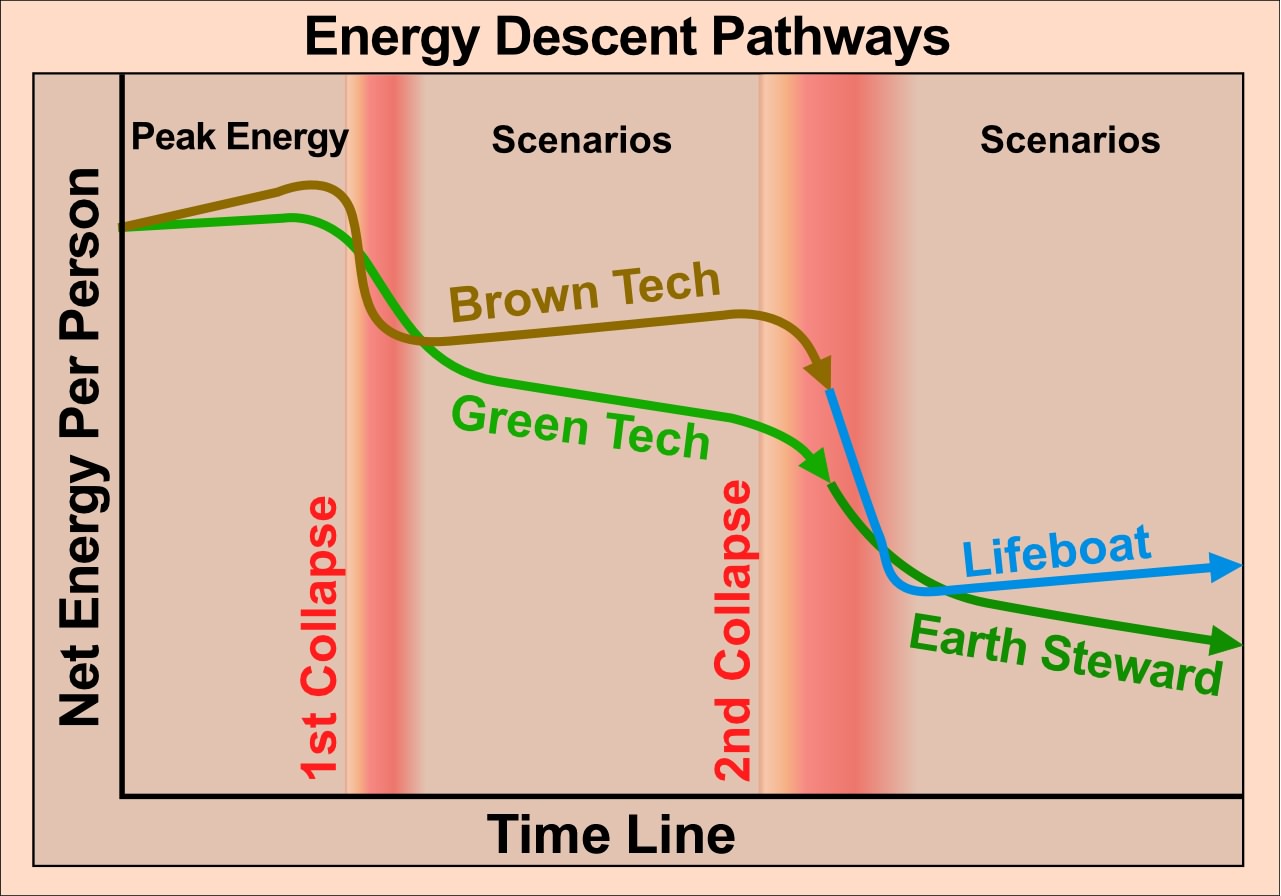
Image above: Chart of Energy Descent Pathways by David Holmgren redrawn by Juan Wilson. Click to embiggen.

In Future Scenarios I suggested the more extreme scenarios of Earth Steward and Lifeboat could follow Green Tech and Brown Tech along the stepwise energy descent pathway.

If we are heading into the Brown Tech world of more severe climate change, then as the energy sources that sustain the Brown Tech scenario deplete, and climate chaos increases, future crises and collapse could lead to the Lifeboat Scenario.

In this scenario, no matter how fast or extreme the reductions in GGE due to economic collapse, we still end up in the climate cooker, but with only the capacity for very local, household and communitarian organisation.

If the climate crisis is already happening, and as suggested in Future Scenarios, the primary responses to the crisis increase rather than reduce GGE, then it is probably too late for any concerted effort to shift course to the more benign Green Tech energy descent future.

Given that most of the world is yet to accept the inevitability of Energy Descent and are still pinning their faith in “Techno Stability” if not “Techno Explosion”, the globally cooperative powerdown processes needed to shift the world to Green Tech look unlikely.

More fundamental than any political action, the resurgent rural and regional economies, based on a boom for agricultural and forestry commodities, that structurally underpins the Green Tech scenario, will not eventuate if climate change is fast and severe. Climate change will stimulate large investments in agriculture but they are more likely to be energy and resource intensive, controlled climate agriculture (greenhouses), centralised at transport hubs.

 This type of development simply reinforces the Brown Tech model including the acceleration of GGE.

While it may be too late for the Green Tech Scenario, it still may be possible to avoid more extreme climate change of a long drawn out Brown Tech Scenario before natural forcing factors lock humanity into the climate cooker of 4-6 degrees and resource depletion leads to a collapse of the centralised Brown Tech governance and a rise of local war lords (Lifeboat Scenario).

The novel structural vulnerabilities highlighted by David Korowicz, and the unprecedented extremity of the bubble economics highlighted by Nicole Foss suggest the strong tendencies towards a Brown Tech world could be short lived.

 Instead, severe global economic and societal collapse could switch off GGE enough to begin reversing climate change; in essence the Earth Steward scenario of recreated bioregional economies based on frugal agrarian resources and abundant salvage from the collapsed global economy and defunct national governance structures.

See also:
Ea O Ka Aina: Crash on Demand 12/30/13
Ea O Ka Aina: Response to Holmgren's scenarios 1/1/14
Ea O Ka Aina: Response to Holmgren's scenarios 1/10/14

[1] See  Why I’m marking passing 400ppm by getting back on an aeroplane by Rob Hopkins published on Transition Culture on 16 May, 2013
http://transitionculture.org/2013/05/16/why-im-marking-passing-400-ppm-by-getting-back-on-an-aeroplane/

[2] During the early stages of the industrial revolution English economist William Stanley Jevons noticed that a doubling in the efficiency of steam engine technology led to an increase rather than a halving of coal consumption as businesses found more uses for the available power. See the Coal Question (1865).

[3] See Deficit Deeper Than Economy http://www.canberratimes.com.au/federal-politics/political-opinion/deficit-deeper-than-economy-20130929-2umd3.html#ixzz2js46nGBp

[4] See Wikipedia article for overview of movement http://en.wikipedia.org/wiki/Degrowth

[5] Of course true believers in global capitalism’s capacity to reduce GGE in time, still abound. See for example Christian Parenti’s piece from Dissent, reposted at Resilience.org, which is amusingly titled A Radical Approach to the Climate Crisis which is actually a plea for activists to forget trying to reform, let alone build systems based on sustainability principles, in favour of getting behind the power of corporations and governments to make big changes quickly (to get GGE falling fast enough).

[6] See for example, Peak oil and the fall of the Soviet Union by Douglas B. Reynolds on The Oil Drum.

[7] See Guardian article by Nafeez Ahmed.
http://www.guardian.co.uk/environment/earth-insight/2013/may/13/1?INTCMP=SRCH

[8] See Trade-Off, Metis Risk Consulting & Feasta, 2012 http://www.feasta.org/wp-content/uploads/2012/06/Trade-Off1.pdf

[9] leaving aside the issue of whether the energy descent future will be a permaculture paradise or not.

Acknowledgements
Thanks to Rick Tanaka, Maureen Corbett and Daryl Taylor for comments and corrections

.

Kauai Power Down - Round II

SUBHEAD: Results for Round I. Now inspire others to take action in Round II by spreading the word.  

By Jonathan Jay on 13 January 2012 for Island Breath - 
  (http://islandbreath.blogspot.com/2012/01/kauai-power-down-round-ii.html)
   
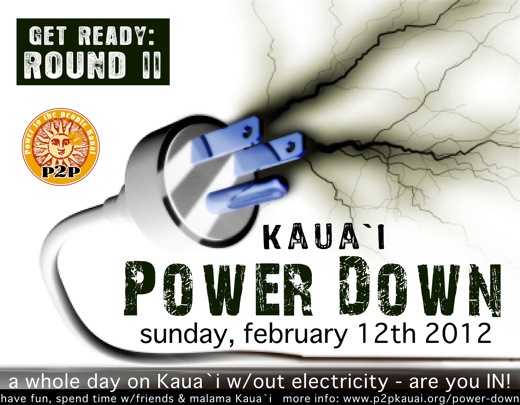
Image above: Power Down - Round Two graphic fro Jonathan Jay.

And the first reports ore just coming in from our very successful Inaugural Kaua`i Power Down Challenge. Something over 100 people participated - congratulations Kaua`i! The goal in this first Power Down was fairly straightforward - for just one day, use as little grid power as you could muster. And participating in Power Down is as easy as doing - nothing at all! On average folks seemed to use something less than half their normal power consumption.

Not bad, for the first time trying to Power Down! If you powered down, but have not made your PD! report yet about your experience, please send email to jjkauai@gmail.com and your excerpts of your story will be posted on the P2P website www.p2pKauai.org

Hopefully, as we all share our insights and lessons learned, we can all learn from our experiences. Perhaps with one round under our belt, next time we can POWER DOWN that much further! How low can we go? Until we ALL try, weʻll never know! Your assignment if you accept it: find 10 people who missed Power Down I, and plug them into Power Down II Sunday February 12.

The objective of Power Down Round One, was simple - just to test-drive a new concept. Many people pulled their plug off the grid for that one day, and are helping clear a new path forward. Away from mindlessly hyper-consumptive lifestyles, and toward a wise integration with our environment. However, for some people, Power Down I snuck up too fast - maybe you wanted to, but just forgot... well have no fear - we do it again! The goal this time is apply lessons learned from Round One, and to get the word out and inspire more people to jump into the fun in: POWER DOWN II Sunday February 12.  

WHAT: Pawer Down: Round II - spreading the word - growing the movement  

WHEN: Sunday, February 12 all day  

WHO: You - your Ohana and friends  

WHERE: Start in the comfort of your very one home.  

WHY: Unplug from the grid; plug into the world  

INFO: On the web visit www.p2pKauai.org on FaceBook search: "Power Down" or "P2PKauai"
"In the experience of emptiness... we realize the ungraspable nature of reality and let go of our illusions; our sense of separation from what we want vanishes -- and with it our desires." - Edwin Bernbaum, The Way to Shambala
And speaking of inspiring, here is one such PD! report from Kauai journalist Joan Conrow. Way to Power Down Joan!  

By Joan Conrow on 9 January 2012 for Kauai Eclectic - 
  (http://kauaieclectic.blogspot.com/2012/01/musings-reclaiming-life.html)

 Reclaiming Life
The approximate time was last evening, and we were sitting on the beach, preparing to eat a picnic dinner, or more accurately, I already was; my friend was fiddling with a phone app, trying to figure out exactly where Mahina would rise. “Don't worry about it,” I said. “I'm always perfectly situated, just intuitively. Look!” And I pointed to the pale white orb ascending, directly in front of us, through the blue-pink smear that sits upon the horizon at sunset, and as it rose, it turned soft gold, then deep orange, and finally, white-gold, casting a shimmering path upon the sea. The moon was only part of the show, though admittedly the most dramatic.

Above us, Jupiter was reigning brightly over the sky, and beyond that, at the end of the arc, was Venus, slipping lower as the moon climbed higher. Returning home, I flipped on the circuit breakers and the moon-planet glow was replaced by the blinking green numbers of the clock on the stove. I certainly hadn't missed that, with its constant reminder of the passing of time, when I “powered down” yesterday, and I hadn't missed the hum and chug of the fridge, though I did miss its cooling effect, which is why it had been turned back on earlier, before the food inside could go bad.

 I've lived without refrigeration, and it can be done without a sense of great deprivation, it just requires a different way of eating, which isn't easily adapted to one day off. I did feel a sense of giddy joy when I unplugged in the office — the wi-fi, the computer, the back up hard drive — and that told me something; namely, I might be happier if I spend less time working, or at least, the kind of working that keeps me hooked to the Internet. I've got a smart phone, which I can tether to my laptop, which has a good battery supply, and so I can use my computer and access the Internet without being directly plugged in, and briefly yesterday, I did.

But using batteries, whether they're charged by the sun or KIUC, isn't really “getting off the grid” because those batteries are shipped in here from someplace else and toxic substances are generated when they're produced and recycled, or tossed in the landfill. The same goes for wind and hydro turbines, solar panels, liquid propane and backup generators. They've all got impacts, so ain't nobody truly pure or off the grid, which I define as the military-industrial-corporate complex, in their consumption of electricity. But tethering the phone to the laptop was a bit more cumbersome than simply flipping the lid and letting wi-fi kick in, which made me stop and think, and that's a good thing, because breaking habits — addictions — is all about bringing unconscious behavior into consciousness.

And make no mistake, energy is an addiction. On Saturday night, thinking about the next day's “power down event,” my mind went through the same litany of excuses it drags out whenever it's told it cannot have something it wants: no one will know if you keep on doing it, what does it really matter, you're not hurting anyone. Or as Neil Young sang, “Seemed like the easy thing/To let it go for one more day.” So no, I didn't kick the habit, but I did think about ways I can reduce my electrical use, and the morality of doing so, even if I can afford to pay my KIUC bill.

Overall, it was a good exercise in mindfulness, which I always welcome, and my garden benefitted greatly from the attentions I lavished upon it, rather than a keyboard and screen. But beyond that, choosing to unplug for a day, as opposed to having the electricity go off, gave me an unexpected sense of freedom, of power, of reclaiming my life in some small way. And I got to thinking, so how much has electricity — all technology, really — functioned primarily to enslave us, to enmesh us in an artificial, manmade world (at the expense of the natural world), even as we worship it and the convenience it provides? .

BP Macondo Well still leaking

SUBHEAD: BP admits to “Investigating” new sheen in the Gulf as boats lay boom near Deepwater Horizon site.  

By Stuart Smith on 17 August 2011 for StuartSmithBlog - 
 (http://www.stuarthsmith.com/bp-admits-to-investigating-new-sheen-in-the-gulf-as-reports-surface-of-boats-laying-boom-near-deepwater-horizon-site)

 
Image above: Painting of oil sheen by unknown artist. From (http://www.valleynewslive.com/story/15289901/bp-looks-into-new-oil-sheen).

Oil from the Macondo Well site is fouling the Gulf anew – and BP is scrambling to contain both the crude and the PR nightmare that waits in the wings. Reliable sources tell us that BP has hired 40 boats from Venice to Grand Isle to lay boom around the Deepwater Horizon site – located just 50 miles off the Louisiana coast. The fleet rushed to the scene late last week and worked through the weekend to contain what was becoming a massive slick at the site of the Macondo wellhead, which was officially “killed” back in September 2010.

The truly frightening part of this development, as reported in a previous post (see below), is the oil may be coming from cracks and fissures in the seafloor caused by the work BP did during its failed attempts to cap the runaway Macondo Well – and that type of leakage can’t be stopped, ever.
Catch up on how this could possibly be happening – again – by reading or re-reading my July 25 post below. Stay tuned as we will be all over this story as it continues to develop.

Is BP’s Macondo Well Site Still Leaking? Fresh Oil on the Gulf Raises Concerns and Haunting Memories 

Fresh oil is surfacing all over the northern quadrant of the Gulf of Mexico. Reports of slicks that meander for miles and huge expanses of oil sheen that look like phantom islands are becoming common, again. Fresh oil, only slightly weathered, is washing ashore in areas hit hardest by last year’s massive spill, like Breton Island, Ship Island, the Chandeleurs and northern Barataria Bay. BP has reactivated its Vessels of Opportunity (VoO) program to handle cleanup. It’s a sickeningly familiar scene that has fishermen, researchers and public officials searching for answers, as haunting memories of last year’s calamity come roaring back.

The fifty-thousand-dollar question, of course, is where is all the new oil coming from?
One theory: The Macondo Well site, located just 40 miles off the Louisiana coast, is still leaking untold amounts of oil into the Gulf. Some argue that the casing on the capped well itself is leaking. Others believe oil is seeping through cracks and fissures in the seafloor caused by months of high-impact work on the site, including a range of recovery activities (some disclosed, some not) as well as the abortive “top kill” effort.

In January 2011, a prominent “geohazards specialist” wrote an urgent letter to two members of Congress – U.S. Reps. Fred Upton, chairman of the House Committee on Energy and Commerce and John Shimkus, chairman of the Subcommittee on Environment and Economy – suggesting that the Macondo site is leaking oil like a sieve. Here’s an excerpt from that letter (see it in its entirety at link below):

There is no question that the oil seepages, gas columns, fissures and blowout craters in the seafloor around the Macondo wellhead… have been the direct result of indiscriminate drilling, grouting, injection of dispersant and other undisclosed recover activities. As the rogue well had not been successfully cemented and plugged at the base of the well by the relief wells, unknown quantities of hydrocarbons are still leaking out from the reservoir at high pressure and are seeping through multiple fault lines to the seabed. It is not possible to cap this oil leakage.
BK Lim, the letter’s author, has more than 30 years of experience working inside the oil and gas industry for companies like Shell, Petronas and Pearl Oil.
More from Mr. Lim’s letter:

The continuing hydrocarbon seepage would have long term, irreversible and potentially dire consequences in the GOM (Gulf of Mexico)…
The letter is dated Jan. 14, 2011 – and we’ve been seeing more and more evidence that the scenario Mr. Lim describes is indeed taking place deep below the Gulf’s surface.

For example, on March 28, 2011, Paul Orr and his team from the Lower Mississippi Riverkeeper – an organization I’ve worked with frequently over the course of the last year – conducted a 50-mile boat patrol and sampling tour of Breton Sound, which lies just off the southeast coast of Louisiana. The excursion was prompted by multiple, increasingly frantic, reports of oil in the area by fishermen and others, including On Wings of Care pilot Bonny Schumaker, who has dozens of Gulf flyovers under her belt.

Mr. Orr took a sample from the southern end of Breton Island National Park – and sure enough, lab-certified tests results established a fingerprint match to BP’s Macondo Well (see link to my previous post and test results below).

The most alarming part of the finding was not simply that the Breton Island sample had BP’s fingerprint on it, but that the test results were nearly identical to those from the fresh oil seen in the early days of the BP spill – instead of the heavily weathered and degraded oil we’ve come to expect in recent weeks and months.

Those test results seem to disprove the other theory surrounding this spate of recent “fresh oil” reports. That is: All the oil BP strategically sunk to the seafloor with nearly 2 million gallons of toxic dispersant is beginning to break free and rise to the surface en masse, and in turn, blacken the coastline with fresh oil. According to civil engineer and petroleum expert, Marco Kaltofen, oil that has been lying on the seafloor for several months would be much significantly more weathered than the fresh oil we’re seeing more and more of.

As you’ll notice from the histograms, the Breton Island sample mirrors the submerged oil sampled from Pensacola Bay on Nov. 5, 2010 (see link to original post with histograms below) and a sample taken from Panama City Beach on July 14, 2010. You don’t have to be a marine biologist to see that this is the same oil with nearly identical weathering.

So we had fresh oil with BP’s signature on it coming ashore in March – more than eight months after the Macondo Well was capped. And since then, members of my team and other researchers have reported fresh oil, of the “only slightly weathered” variety from Grand Isle to Pensacola. One charter boat fishing captain, who frequents the waters around Louisiana’s barrier islands, is describing the current, hauntingly familiar situation on the Gulf as the “second wave” of the BP disaster.
 
Read my entire July 25 post (with referenced documents) here: http://www.stuarthsmith.com/is-bps-macondo-well-site-still-leaking-fresh-oil-on-the-gulf-raises-concerns-and-haunting-memories

.

Over the Edge Lies Fear

SUBHEAD: The demand artificially brought forward during the boom years must be repaid with years of falling demand for almost everything. By Ilargi & Stonleigh on 10 August 2011 for the Automatic Earth - (http://theautomaticearth.blogspot.com/2011/08/august-10-2011-over-edge-lies-fear.html) Image above: painting "The Promised Land" by Mark Bryan 2003. From (http://www.artofmarkbryan.com/promised%20land.html). Ilargi: Amidst another entire slew of bad news in the markets, the claim to fame for story of the day must go to French bank Société Générale, and the over 22% drop in share price it had at a certain point today - though it was pushed up back to (only?!)-14%-, and the persistent rumors of major trouble and even a potential bankruptcy that have been making the rounds for a few days now. President Sarkozy cut short his holidays to address the situation (other French banks joined the plunge, and France itself may be downgraded). The best part of it all, however, if you ask me, was this from Bloomberg:
Société Générale "categorically denies all market rumors," Emmanuelle Renaudat, a spokeswoman for the French bank said in an interview. She declined to be more specific.
Well, hey, Emmanuelle, sorry I asked... But wouldn't you want to know what rumors you're denying exactly, before denying them? This is going to sound to a lot of people like you're admitting your company is in trouble. Just saying... Wall Street, and its banks in particular, once again and still, have their own rumors to deal with. And most of all, they now have to deal with encroaching fear. A fear that is starting to look like it might be very hard to shake. The Dow closed down 520 points today. 520, or 4.63%! Citi, Bank of America and Goldman Sachs all lost over 10%. It's like we've shifted into a whole new mindset. And Stoneleigh explains why that is: Stoneleigh: The nature of markets has long been a major focus here at The Automatic Earth. Whereas most commentators treat markets as being driven in some kind of rational fashion by external events, we have concentrated on the irrational endogenous dynamics and the role of sentiment in creating the perceptions that drive positive feedback loops - either virtuous or vicious circles. Sentiment, and therefore perception, can change very abruptly, with far-reaching effects. The events of this past week or so have been a prime example. The rally of the past two and a half years continued longer than we had anticipated, but on balance of probabilities it is now over, and we are entering the next phase of the credit crunch - the period where a majority begins to appreciate what a credit crunch really means. The first phase, from October 2007 to March 2009, was little more than a mild introduction for many, although even that was enough to push a large number of casualties silently over the edge. With the dramatic end to the rally (and a loss of over $7.8 trillion in mere days) comes the end of the complacency it engendered. Fear is in the ascendancy once again, and fear is extremely catching. We are already seeing it spread like wildfire and begin to feed upon itself, creating self-fulfilling prophecies. The fundamentals have not changed materially, but the perception of them has, and that is the game changer. When markets are rising, thanks to optimism and hope, people develop a false sense of predictability, as if events were somehow proceeding as they were meant to, and that they should, by rights, continue to do so. Under such circumstances, market volatility is typically low. In contrast, when markets decline, as fear tightens its grip, that comforting sense of pseudo-certainty evaporates very quickly. Fear breeds extreme volatility as investors try to second guess rapidly unfolding moves, and also each other. The best measure of this volatility is the VIX index.
Initially investors look to buy the dips, on the assumption, born of three decades of expansion, that every decline represents a buying opportunity. Later that assumption will falter, and then fail, but residual optimism takes time to dissipate completely. Every temporary upswing all the way down will rekindle echoes of it. The only relative safety is to be found on the sidelines in cash. While there is money in volatility for some aggressive (and lucky, or well-connected) traders, there will be far more opportunities to lose a fortune than to make one for those who cannot stop playing the game. Going forward, we can expect more of the stomach-churning market declines we have seen over the past week, but also apparently rocket-fueled, yet short-lived rallies. The sharpest and largest upswings happen in bear markets, interspersed with cascading movements to the downside. We advise our readers to proceed with great caution and to ignore rationalizations and spurious causation discussed in the mainstream media. In extrapolating past trends forward, failing to anticipate discontinuities, and propagating the smoke-and-mirrors posturing of central authorities desperate to obscure what is happening for as long as possible, they will be arriving at completely incorrect conclusions as to the financial consequences we are facing and what actions we may be able to take in order to protect ourselves. They will also be unhelpfully fanning the flames of fear. Global commentators have focused recently on the pure political theatre of the rise in the debt ceiling in the US, and subsequently on the downgrade of the US by a single credit-rating agency, but these events do not presage what mainstream opinion has suggested at all. Quite the opposite in fact. The debt ceiling debate was merely a staged game of brinkmanship, softening up the US population for austerity measures and coming cuts in entitlement programmes targeting the weakest members of society. Imminent default was never a risk. The real risk is the acceleration of the wealth and power grab that has been going on under the guise of quantitative easing for the duration of the rally. The coverage of the ratings downgrade likewise obscures the real threat. Commentators boldly assert that the US will inevitably have to pay more to borrow, that treasuries are increasingly risky, that the US dollar is doomed and that inflation is an imminent threat. The Automatic Earth has long held diametrically opposed opinions with respect to the next few years, and those are already being vindicated by events. Our position has long been that the US will benefit from a flight to safety as the least worst option, initially at Europe's expense. Money will flood from where the fear is to where the fear is not, and one look at bond rates and credit default swap spreads is all it takes to see that the fear is concentrated in Europe, while the US is seen as a safe haven. When fear rules, small relative differences are enormously amplified, leading eventually to record spreads between debts and debtors perceived to be risky and those perceived not to be, even if that perception is distorted or outright incorrect. As we have said, fear generates self-fulfilling prophecies. As interest rates spiral higher for supposedly risky borrowers, they become less and less able to pay, and default becomes a certainty. Imposing austerity measures only makes the situation worse, as it forces a contraction that further impairs ability to pay. This is the situation the European periphery finds itself in, and the fear is spreading to include the centre. Today France is in the crosshairs, and even German bond rates are rising. In contrast rates in the US are falling into negative territory, reflecting the desperation of investors looking for a safe haven and prepared to pay for the privilege. Yields are low because the market is not asking for higher returns, but for a means to preserve capital. The market sets interest rates, not central bankers or governments who only chose a rate to defend, and not ratings agencies without a shred of real credibility left after their performance of recent years. Interest rates on short term US government debt should stay low throughout the coming period of deleveraging. Short term treasuries represent one of the safest options available, as they are highly liquid, and liquidity will matter more than almost anything else in the depression we are rapidly descending into. Longer term debt may well be a different story, as that has the added risk of having to wait far too long to be repaid, or selling into the secondary market. Asserting that US treasuries are risky deters ordinary people from seeking the relative safety they offer, even while the insiders take full advantage of it. Similarly, warning people away from US dollars while telling them to hold their nerve in the markets, benefits only those insiders who seek to keep the bubble inflated for long enough to extract their own wealth from a collapsing system. The US dollar (and other safe haven currencies such as the Swiss franc) is set to benefit, during the period of deleveraging, from the same flight to safety that treasuries will enjoy. It is still the reserve currency, and is likely to stay that way for several years at least. As dollar denominated debt (of which there is more than any other kind worldwide) deflates, demand for dollars, from those seeking to pay down that debt, will push up their value. The inflation obsession, which central bankers are only too pleased to encourage, also continues to deter people from protecting themselves. Those who are afraid of inflation or hyperinflation will not address the threat of debt or hold the cash that will remain king as the debt bubble bursts and deleveraging aggravates the credit crunch. It is deflation - the collapse of a pyramid of excess claims to underlying real wealth - that we are facing. That is the inevitable result of a bursting bubble. Widening credit spreads will send the interest rates payable on the debts of ordinary people, companies, banks and lower levels of government through the roof, even as the rate payable on the debts perceived to be safest falls and remains low. At the same time, monetary contraction, credit destruction, spiking unemployment, benefit cuts and skyrocketing bankruptcies will increase the burden that debt represents. Actual cash will be scarce and few will have access to much of it. Under such circumstances, people will be forced to sell assets for pennies on the dollar to those who still have purchasing power. This is a recipe for extreme wealth concentration, and that, as we are already seeing around the world, leads to increasing social unrest. People need to protect themselves while they still can, but listening to the mainstream media and central authorities is emphatically not the way to do so. The effect of the US downgrade is ironically far more likely to be felt in Europe than in America. Other triple-A sovereign debtors perceived to be riskier than the US are now at risk of being downgraded, and where fear has already a foothold with respect to sovereign debt default, such moves are likely to aggravate it. Attempts to restore confidence are likely to backfire badly, as existing adverse risk perception merely makes such moves appear desperate, so that they tend to be interpreted as evidence of major problems rather than as reassurance. Failure is likely to be followed by overtly defensive moves such as the reimposition of capital controls and increasing protectionism, which will only encourage greater fear and greater capital flight. Confidence is ephemeral, and once damaged it can be almost impossible to revive until the underlying imbalance has been resolved, and we are years of deleveraging away from that point. It is clear the the European Financial Stability Fund, recently increased but still obviously insufficient to cover even the sovereign debt problems already admitted to, cannot solve the rapidly escalating crisis. The scope of this is increasing dramatically as financial contagion spreads to larger states with more intractable debt problems. The European Stability Mechanism, intended to be implemented as a permanent solution in 2013, will never have a chance, as monetary union will long since have been overtaken by events before it can be established. The European centre has no mandate for further integration, bought, as it would have to be, through the centre agreeing to shoulder far more financial risk than it has done so far. That will likely prove to be politically impossible. The countries of the periphery, caught in a downward spiral of increasingly severe austerity measures and exploding debt, will ultimately resist, perhaps violently, the enormous loss of sovereignty greater integration would involve. The goodwill necessary to build consensus or render burden-sharing acceptable does not exist, and acrimony is increasing as the situation continues to deteriorate. Larger political accretions become fissile as there is not enough to go around and divisions grounded in history become accentuated anew. This is clearly the risk for Europe. While rallies are kind to policy makers, casting them in a gloss of apparent competence and effectiveness, declines abruptly strip away the comforting illusion of central control. Policy makers appear increasingly incompetent and out of touch with reality as events unfold far more rapidly than they can be responded to. In reality there is little they can do faced with a bubble blown over at least three decades. Once blown, bubbles always implode. The demand artificially brought forward during the boom years must be repaid with years of falling demand for almost everything, as difficult as that is to imagine from the top of the pyramid. That is the last thing people are expecting, but it is already underway. Even commodities appear to have topped on speculation going into reverse, and falling demand will accentuate falling prices. The growth dynamic is going into reverse, and with it many of our preconceived and deeply held notions. .