Showing posts with label Tactics. Show all posts

Shutdown of all tar sands pipelines

SUBHEAD: Ten activists are in jail for shutting down all tar sands pipelines entering the United States.

By Lauren McCauley on 11 October 2016 for Common Dreams -  
(http://www.commondreams.org/news/2016/10/11/my-act-love-climate-activists-shut-down-all-us-canada-tar-sands-pipelines)
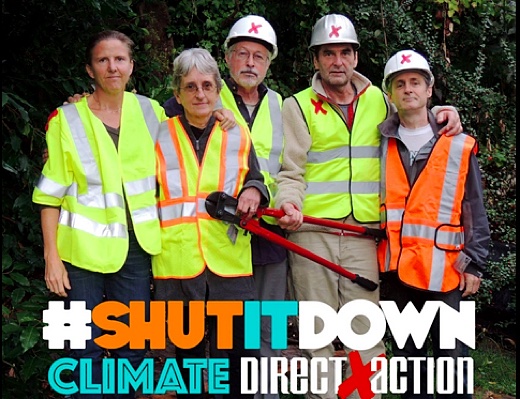

Image above: Some of the activists involved with shutting down the tar sands pipelines for #ShutItDown. From original article.

Five activists shut down all the tar sands pipelines crossing the Canada-U.S. border Tuesday morning, in a bold, coordinated show of climate resistance amid the ongoing fight against the Dakota Access

The activists employed manual safety valves to shut down Enbridge's line 4 and 67 in Leonard, Minnesota; TransCanada's Keystone pipeline in Walhalla, North Dakota; Spectra Energy's Express pipeline in Coal Banks Landing, Montana; and Kinder-Morgan's Trans-Mountain pipeline in Anacortes, Washington.

The activists, who planned the action to coincide with the International Days of Prayer and Action With Standing Rock, expressed feeling "duty bound to halt the extraction and combustion of fossil fuels...in the absence of any political leadership" to address the withering goal of keeping global temperature increase beneath the 2°C climate threshold.

"I have signed hundreds of petitions, testified at dozens of hearings, met with most of my political representatives at every level, to very little avail," said 64-year-old mother Annette Klapstein of Bainbridge Island, Washington, who was arrested just before publication.

"I have come to believe that our current economic and political system is a death sentence to life on earth, and that I must do everything in my power to replace these systems with cooperative, just, equitable and love-centered ways of living together. This is my act of love."

Fifty-nine-year-old Ken Ward of Corbette, Oregon, who was also arrested, said, "There is no plan of action, policy or strategy being advanced now by any political leader or environmental organization playing by the rules that does anything but acquiesce to ruin.

Our only hope is to step outside polite conversation and put our bodies in the way. We must shut it down, starting with the most immediate threats—oil sands fuels and coal."

The action comes two days after a U.S. federal court of appeals lifted an injunction on the Dakota Access project, to the dismay of the Indigenous water protectors and their supporters across the U.S. and Canada.

"Because of the climate change emergency, because governments and corporations have for decades increased fossil fuel extraction and carbon emissions when instead we must dramatically reduce carbon emissions; I am committed to the moral necessity of participating in nonviolent direct action to protect life," added activist Leonard Higgins, 64, from Eugene, Oregon.

The activists are all members of the group Climate Direct Action, which is providing live updates on the coordinated shut-downs on its website and Facebook page. Others shared statements in support, as well as images and videos of the actions on social media with the hashtag #shutitdown.

Tim DeChristopher's Climate Disobedience Action Fund is also supporting the action and has set up a legal fund for the activists' defense.
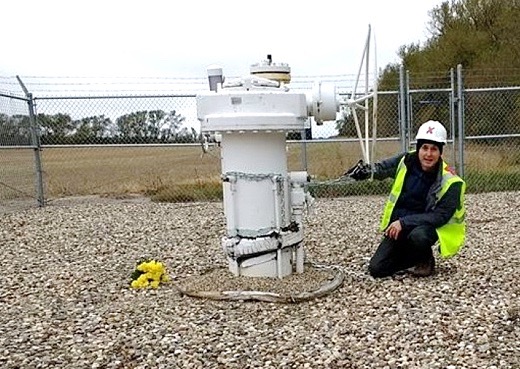

Image above: Michael Foster, 52, pictured here, said, "All of our climate victories are meaningless if we don’t stop extracting oil, coal and gas now." From original article.

See also:
Ea O Ka Aina: Time for Direct Action on CO2 10/12/16
Ea O Ka Aina: Why Standing Rock is test for Obama 10/8/12
Ea O Ka Aina: Why we are Singing for Water 10/8/16
Ea O Ka Aina: Labor's Dakota Access Pipeline Crisis 10/3/16
Ea O Ka Aina: Standing Firm for Standing Rock 10/3/16
Ea O Ka Aina: Contact bankers behind DAPL 9/29/16
Ea O Ka Aina: NoDAPL demo at Enbridge Inc 9/29/16
Ea O Ka Aina: Militarized Police raid NoDAPL 9/28/16
Ea O Ka Aina: Stop funding of Dakota Access Pipeline 9/27/16
Ea O Ka Aina: UN experts to US, "Stop DAPL Now!" 9/27/16
Ea O Ka Aina: No DAPL solidarity grows 9/21/16
Ea O Ka Aina: This is how we should be living 9/16/16
Ea O Ka Aina: 'Natural Capital' replacing 'Nature' 9/14/16
Ea O Ka Aina: The Big Difference at Standing Rock 9/13/16
Ea O Ka Aina: Jill Stein joins Standing Rock Sioux 9/10/16
Ea O Ka Aina: Pipeline temporarily halted 9/6/16
Ea O Ka Aina: Native Americans attacked with dogs 9/5/16
Ea O Ka Aina: Mni Wiconi! Water is Life! 9/3/16
Ea O Ka Aina: Sioux can stop the Pipeline 8/28/16
Ea O Ka Aina: Officials cut water to Sioux 8/23/16   

.
Prevention - Mitigation - Adaptation

SUBHEAD: "Resilience" is the 2012 Word of the Year, but the pursuit of resilience can be seen as the equivalent of throwing in the towel.

By David Bergman on 31 December 2012 for EcoOptimist -
(http://ecooptimism.com/?p=552)


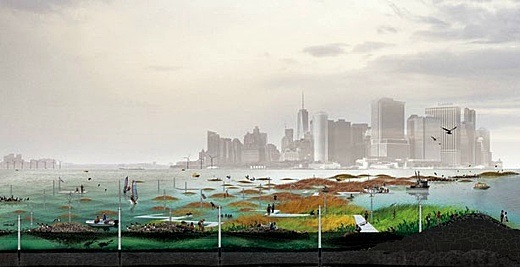
Image above: “Oyster-tecture” reefs  as "mitigation" proposed by Scape/Landscape Architecture for storm surge protection in NY harbor. From original article.

Even before Hurricane Sandy, the word ‘resilience’ was on its way to becoming a meme. Then, when a “natural disaster” struck the political and financial powers of New York City – along with countless others – the idea started to take on some urgency.

Ironically, urgency is not a typical approach to resilience. The idea of resilience, in short, is to have the ability to survive and bounce back from “bad things,” whether they be natural or man-made. The reason urgency often doesn’t apply is that, as many have observed, we humans are not well equipped to plan for future possibilities. Especially ones that seem less than imminent or less likely to affect you personally.

Sandy both proved the immediacy of a formerly more or less theoretical threat and showed that it can bring a major American city to its knees. (Katrina’s hit on New Orleans should have accomplished that, but it didn’t, perhaps because NOLA has long lived with the possibility of flooding or because Wall Street is not in New Orleans.) Enough so that resilience is now even a US Senate topic in the form of the STRONG (Strengthening the Resiliency of Our Nation on the Ground) Act introduced post-Sandy by senators from NY, NJ and Massachusetts.

Increasing resilience has long been a reaction to natural disasters such as earthquakes. Building codes are updated; procedures for the aftermath are put in place (though never adequate for a worse-than-the-previous event). They tend, though, to lose out to complacency. In some of the areas devastated by the tsunami that hit Japan, there were century-old stone markers placed after a previous tsunami warning people not to build closer to the shore. But when no tsunamis occurred for a while, the stones were ignored and forgotten. Resilience itself may not be resilient, at least not to the effects of time.

Hurricane Sandy-type disasters are not likely to fade with time. Earthquakes, tsunamis, volcanos and the like generally don’t have patterns to their frequency or scale. And it used to be that climate disasters like drought or flooding didn’t either. But where the former are truly natural – “acts of God” – we can no longer say the same is true of the latter.

Don’t get me wrong. I’m not claiming that Sandy or the Midwest drought wouldn’t have occurred were it not for our environmental “sins.” (Hmm, there must be a religion somewhere that believes these events were indeed acts of God in response to those sins.) But without several anthropocenic multipliers, their effects would certainly have been less. And as there is no foreseeable diminishment of those influences (CO2 levels are not falling, marshes and mangroves are not being re-established, shore development is not abating), it’s apparent that, unlike truly natural disasters, the frequency and scale of climate-related disasters will only escalate.

Which brings us back to resilience and the question of how we deal with the prospect of future disasters. The EcoOptimist in me has somewhat mixed feelings about emphasizing resilience. My reservations derive from two related issues. The first is that the pursuit of resilience can be seen as the equivalent of throwing in the towel and conceding defeat to the inevitability of climate disruption. The second is that, in our binary either-or thought process, an emphasis on resilience is all too likely to occur at the expense of actions and investments that might diminish the causes of climate disruption (thus in fact leading to that same defeat). The costs of adapting cities will surely divert funds from programs to curtail CO2 emissions.

In a recent talk, I divided climate actions into three categories: prevention, mitigation and adaptation. Prevention is the primary path we’ve been pursuing. Though there’ve been some successes (for example, acid rain), there have been far more failures, mostly in the form of opportunities not taken. This is highly unfortunate because, aside from the obvious reasons, virtually every study has shown that prevention is the least costly approach. It’s going to cost a fortune to build seawalls to protect NYC. If we (or had we) spent that kind of money on cutting greenhouse gases, we’d be far ahead of the game – especially since that investment would provide future returns that seawalls don’t.
Unfortunately, there’s a fundamental question now of whether it’s too late for prevention. If we somehow found the political resolve, could we actually obviate the need for remedial steps? In other words, could the train of global warming be stopped in time? There is a built in lag factor, a delay between the time greenhouse gases are released and its impacts are felt. So the warming of the next bunch of years or decades is preordained.

Hence the need to turn to the next steps: mitigation and adaptation. Mitigation is finding ways to diminish the impact (versus preventing it). In the case of flooding events like Sandy and Katrina, mitigation would involve efforts such as preservation or recreation of wetlands that can absorb the water. Even oysters, it turns out, can have a role. In addition to their ability to cleanse polluted waters, oyster beds can also slow tidal surges.
Mitigation can also involve less natural methods ranging from porous pavement to the further extreme of storm-surge barriers or seawalls. Here in NY, the stage is being set for a classic environmental battle, with a group led by Governor Cuomo promoting construction of a many-billion dollar barrier and opposition led by Mayor Bloomberg questioning the feasibility of a seawall. (The third camp, deniers, holds little sway here.) The Bloomberg camp points out that, even if the barrier worked when needed, it would have very large environmental impacts of its own and would also merely deflect the water elsewhere, perhaps increasing the damage in neighboring areas. Stalemate.

Hierarchically, mitigation is the path necessitated by the failure of prevention. Adaptation, then, is required when both prevention and mitigation fail. Focusing again on Sandy and NYC, adaptation responses range from elevating buildings (or at least their necessary services) to abandonment of low-lying areas. It would include making our electricity supply better able to endure partial interruptions and our transit systems able to stop flooding or at least recover faster (and cheaper) from it. In larger terms, we’d make our food supply less dependent on transport over long distances. It’s making our human support system more resilient, in short.

It also is pretty much writing off the idea of returning our planet – and us – to some semblance of sustainability. Andrew Zolli, often called a futurist, wrote recently “Where sustainability aims to put the world back into balance, resilience looks for ways to manage in an imbalanced world.” The problem with resorting to resilience is that, if the world is still imbalanced, you have to keep moving the goal posts. If we don’t stop global warming, how high will sea levels rise and will the barriers we construct in this part of the century be adequate for the future? Similar questions arise concerning food supplies (or food security, as it’s coming to be known) or, say, infectious diseases spread by climate-driven insect migrations. And those are only some of the impacts that we can try to foresee; how many other side effects might we not have the smarts to anticipate?

EcoOptimism, with its implicit assumption that solutions are available, would have us focus on prevention. It’s much smarter to spend money on ‘front of tailpipe’ solutions — actions that nip the problem before it occurs — than on much more expensive and likely less predictable end of tailpipe reactions. But at this stage in our non-committal response to climate disruption, we’ve almost certainly committed ourselves, by default, to a mix of both positive actions, ideally taken by choice, and necessary involuntary reactions: an all of the above combination of prevention, mitigation and adaptation.

That’s a key point; resilience is undertaken when we realize we have no options left. The seas are going to rise. Crops are going to be disrupted. Storms are going to get stronger. We will have to take responsive measures. (We may call them precautionary, but there’s no “pre” involved. We’re past that.)

Not that resilience is bad. It’s just unfortunate that we’ve come to the point in terms of climate disruption where there’s a strong case to be made for it: for adaptation rather than prevention. We’re talking about building the bomb shelters instead of defusing the bombs. And those bunkers were never going to help much in a post-nuclear war world.

EcoOptimistic solutions are ones that deliver benefits both ecologically and economically, and leave us in a better place than we started. Carbon fees are a perfect example. Assuming the fees are revenue-neutral, we end up with a productive reallocation in which we tax and disincentivize the “bads” while promoting the goods.

Multi-billion dollar seawalls that play catch up with ever-rising oceans are not optimistic endeavors in any sense. Nor is diverting Missouri River waters to the west. These are last ditch efforts that only provide temporary fixes. Zolli writes “Combating those kinds of disruptions isn’t just about building higher walls — it’s about accommodating the waves.” Resilience, by this description, incorporates both mitigation and adaptation. But it assumes the waves and ignores prevention. I despise metaphors (it always seems there’s a metaphor to prove any point), but it’s the equivalent of adding life preservers rather than making the boat more seaworthy. Or, better yet, altering course to avoid the storm. More life preservers might make sense if you’re already in the storm. We’re probably encountering the outer rings of the storm, and it may or may not be too late to change course. The smart thing to do is choose a new heading, while there are still some choices available, and while holding drills and battening down the hatches just in case..

There's no ER for Eaarth

SUBHEAD: You can begin the healing, but what’s the right thing to do when restoring our little patches of Earth?

By Barath Raghavan on 2 November 2012 for Contraposition -
(http://contraposition.org/blog/2012/10/31/theres-no-emergency-room-for-a-planet/)


Image above: Erik Bendl rolling giant globe across US in honor of diabetic mother. From (http://news2.onlinenigeria.com/index.php?news=70305).

"There is no emergency room available for the planet Earth." 
 (The quote from Rep. Ed Markey, who I’d never heard of before, speaking today about the need for political action on climate change.)

The metaphors in that statement really hit home for me: most of us living in wealthy nations know, somewhere deep-down, that if something bad happens to us that there’ll be something and/or someone to take care of us—not just a long-term safety net, though there’s that to a greater or lesser extent in various nations, but a short-term safety net. An emergency room is the most fundamental of these.

I of course have my preferred policy (the clean energy dividend), but almost any action is good at this point. But what action, and by whom? Large-scale political action is ultimately needed, but there’s a certain paralysis that’s taken over as a result of national and international dysfunction on climate action.

So that brings me back to what I remember reading about as a kid in the 1980s—how someday soon we’d have space expeditions to visit and then to terraform Mars and other planets for human settlement. Not knowing better, I thought it’d happen, but it seems pretty unlikely at this point.

But the thing I’ve never understood is why there hasn’t been a similar sentiment about terraforming Earth. Maybe it’s that it’s literally too grounded and prosaic. It’s not one big dream for humankind. It’s a thousand thousand thousand little dreams for individual humans and the animals and plants and fungi that surround them.

terraform |ˈterəˌfôrm| verb [ trans. ]
(esp. in science fiction) transform (a planet) so as to resemble the earth, esp. so that it can support human life.
Wouldn’t it be strange if now that we live on Eaarth, as Bill McKibben aptly puts it, we need to terraform our new planet so as to resemble Earth?

My dream is for each of us, and our friends and family and local communities, to restore some little patch of Earth that is dear to us, and if not dear to us, then at least near to us. That restoration might look like trying to help return it to the state it was in before it was razed for paving or construction or mining a (few) hundred years ago.

But since it’s hard to know what it was like once, and since we have to accept that at this point we’re changing the planet in massive ways, improving the biodiversity and true sustainability of the local ecosystem is more important in my mind than returning it to some past state that can’t ever be recovered.

What such restoration will look like will vary depending on the local climate, the local ecosystem, the local community, and of course the people doing the restoration. I’m not even sure restoration is the right term for it. But what I do know is that not only is it gratifying work, but also that it provides an opportunity to build a connection with the land where one lives.

Recently I’ve been trying to do this in small ways. There’s quite a bit of dead, compact soil filled with construction debris and trash between the sidewalk and the curb next to the apartment where I live. Getting a shovel to go into it more than a centimeter required chiseling at it like it was rock. So my first goal was to restore the soil, and to do that I dug several small holes and planted comfrey (roots) in them a few months ago.

Along with the comfrey I scattered local wildflower seeds and clover seeds (to eventually help fix nitrogen). It’s been a bit of a challenge getting the seeds to grow, though they are now, but the comfrey really took to it and has been doing well. The next step, probably in the Spring, will be to plant oak saplings I’m going to be growing over the Winter. And maybe some fruit trees as well, though I’m not sure which yet.

What’s the difference between massive geoengineering efforts, such as the recent effort to seed the ocean in an attempt to trigger a plankton bloom and sequester carbon, and smaller-scale efforts? And what’s the right thing to do when restoring our little patches of Earth? Should only natives be planted? Food-bearing trees? Some mix? Should more diversity of plants be introduced than naturally exist in the region?

 I’m not sure that there’s a good answer to these questions, but that’s no barrier to doing something anyway.

 See also:
Ea O Ka Aina: Genesis in Reverse 4/23/10
Ea O Ka Aina: "Eaarth" by Bill McKibben 4/6/10

.

Urban Tactics

SOURCE: Eliel Starbright (elielstarbright@gmail.com)
SUBHEAD: Occupy Portland outsmart police, creating blueprint for other urban occupations.  

By Lester Macgurdy on 15 December 2011 for Portland Occupier-   
(http://www.portlandoccupier.org/2011/12/15/occupy-portland-outsmarts-police-creating-blueprint-for-other-occupations/)


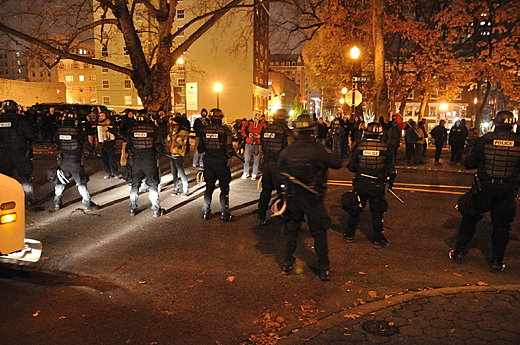
Image above: Portland swat and riot police face off with Occupy forces in a what turns out to be a losing battle. From original article.
 
The Portland Occupation stumbled upon a tactical innovation regarding occupying public spaces. This evolution in tactics was spontaneous, and went unreported in the media. On December 3rd, we took a park and were driven out of it by riot police; that much made the news. What the media didn’t report is that we re-took the park later that same evening, and the police realized that it would be senseless to attempt to clear it again, so they packed up their military weaponry and left. Occupy Portland has developed a tactic to keep a park when the police decide to enforce an eviction.

The tactical evolution that evolved relies on two military tactics that are thousands of years old- the tactical superiority of light infantry over heavy infantry, and the tactical superiority of the retreat over the advance.

Heavy infantry is a group of soldiers marching in a column or a phalanx that are armed with weaponry for hand to hand, close quarters combat. Heavy infantry function as a unit, not individual soldiers. Their operational strength is dependent upon maintaining the integrity of that unit. Riot police are heavy infantry. They will always form a line and advance as a unit.

Light infantry are armed with ranged weapons for assault from a distance. Light infantry operate as individuals that are free to roam at a distance and fire upon the opposition with ranged weapons. Cops firing tear gas, rubber bullets, water cannons, bean bag rounds, etc. are light infantry. They remain to the rear of the phalanx of riot cops (heavy infantry) and depend upon the riot cops maintaining a secure front and flanks to provide them a secure area of operations.

Protesters function fluidly as either light or heavy infantry. Their mass, because it is lacking in organization, functions as a phalanx, having no flanks or rear. Lack of organization gives that mass the option of moving in whichever direction it feels like, at any given time. If protesters all move to the right, the entire group and supporting officers has to shift to that flank.

While the protesters can retreat quickly, the police can only advance as fast as their light infantry, supporting staff can follow and maintain a secure rear (if the mass of protesters were to run to the next block over and quickly loop around to the rear of the riot cops, the organization of the cops would be reduced to chaos). If that police cannot assemble with a front to oppose protesters, they are useless. The integrity of that tactic is compromised, and unable to maintain internal organization, the cops revert to individuals engaging in acts of brutality, which eventually winds up on the evening news and they lose the battle regardless of whether they clear the park or not.

Because of the lack of organization in a crowd of protesters, light infantry cops firing tear gas, etc. has little effect because it just serves to disorganize a group that relies upon disorganization in the first place. All it really does is disorganize the riot cops, who then resort to brutality.

The lack of weaponry on the part of the protesters grants them the luxury of opposing riot cops at close quarters, or remaining at long range in a refusal to engage the heavy infantry riot police at all. They have the advantage of the retreat, they can quickly move away, or in any direction, and the heavy infantry riot cops lack the swiftness to respond.

So far, all the occupations have, in a grave tactical error, agreed to engage the riot cops when they march in to clear parks. This has been a show of bravado that has the tactical benefits of providing media coverage of the brutal methods of police and the benefit of draining the resources of the oppressor by forcing them to incur the expense of arresting and prosecuting people for trivial offenses.

Now, to move on to the actual application of these tactical principles (that evolved by accident rather than conscious thought), we can take the example of Shemanski park on the 3rd. We occupied the park and set up a few tents and facilities to serve food and coffee. The police soon declared an emergency closure of the park and came out in force, with full riot gear and all the weaponry. The line of riot cops soon forced us out of the park, so someone decided that we ought to march to City Hall. It was about 9 pm on a Saturday night, so City Hall was closed, but we marched there anyway, 800 of us blocking traffic the whole way.

Once there, the riot cops once again lined up to disperse the crowd. However, since City Hall was closed and there was no point in staying there anyway, someone had the idea to march down to the area of town where all the clubs were, so we took off marching again. The riot cops were trailing behind us, as was the truck with the giant speakers on the top repeatedly announcing “This street is open to traffic, individuals blocking traffic will be subject to arrest.” Announcing this repeatedly was useless. One principle of non-violent resistance is this: one person has to walk on the sidewalk, 500 people can walk wherever they please. The riots cops had no place to form a line, so they were crippled.

Since we had no clear destination, the police were unable to get ahead of us and set up roadblocks. They were helpless to do anything but trail along as an escort to the march. The only other response they could have had was for the riot cops to charge into the marching crowd and attempt to disperse it by brutality, which would have been mayhem that could have only resulted in a PR loss by the police department as the images of beatings and brutality hit the airwaves the next day.

The march, having no clear destination, marched wherever it willed through the downtown area, blocking traffic and light rail at will and growing larger as onlookers joined in. One of the participants of the march had a three-wheeled bike with a loud amplifier hooked up to batteries with which to hook up an iPod and blast party music the whole time. This kept the atmosphere enthusiastic and energized and served to motivate onlookers to join.

The ability of music to raise morale can’t be understated. Slayer, Metallica, etc. wouldn’t be good music for this because it would induce aggression. Rhythmic music that’s usually danced to or played in clubs works best. If a DJ would play it as the ball drops on New Year ’s Eve, then it’s perfect.

After marching for 3-4 hours, we eventually found ourselves a block away from the park that we’d been forced out of, so we took it again. The riot police lined up and prepared to take the park again, but the attempt was called off and the police just left. They realized that they would have to go through the standard military procedure of clearing the park inch by inch, only to have us go back out into the streets and march again while they, one more time, trailed along helplessly- their entourage functioning as a part of the march, creating an even larger disruption to traffic (the marchers covered a city block, the trailing police took up another city block, effectively doubling the size of the obstruction to traffic).

In summary: when the cops come to clear the park, don’t resist. As they are preparing for their military maneuver and use of force that the Occupiers cannot reasonably be expected to resist, the occupiers should be packing up their tents and baggage and loading them into wagons, bicycles, backpacks, etc.

Force the cops to clear the park inch by inch, but try to avoid arrest in so doing. Once they have cleared the park, rouse the crowd through loud amplification announcing that you intend to march (any destination will do). Get the music blaring and then march aimlessly, blocking traffic the whole way, for hours. The crowd will be energized and willing to march for a long time, being spurred on by energetic music and chants.

The police will eventually trim down their entourage because they realize that they are helpless. Eventually, work your way back to the park. Or, if the police have fenced off the park, head to another park. If the police force you out, march again and they will be forced to follow. Eventually, they will inevitably come to the conclusion that they would rather have you in a park than disrupting traffic.

The police have no response to this tactic, other than resorting to brutality. And if they do that, we win whether they clear the park or not.
.