Showing posts with label Tar Sands. Show all posts

'Necessity Defense' to save Earth

SUBHEAD: Those arrested argue saving the planet justified illegal sand pipeline shutdown.

By Jessica Corbitt on 5 October 2018 for Common Dreams -
(https://www.commondreams.org/news/2018/10/05/landmark-necessity-defense-trial-valve-turners-will-argue-saving-planet-justified)
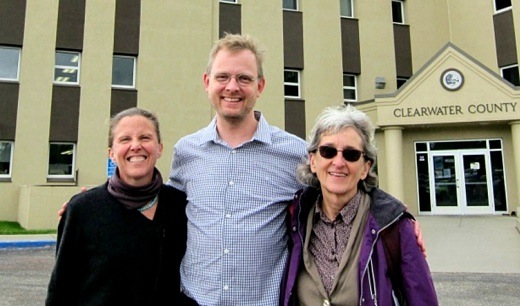

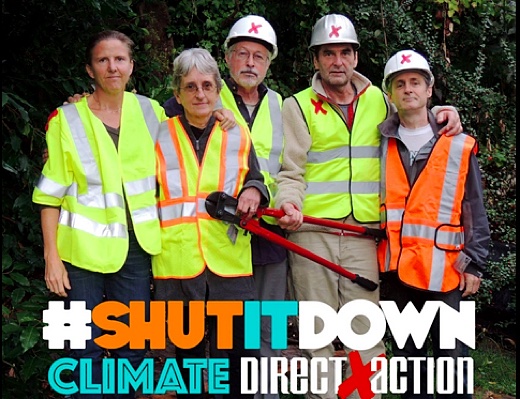
Image above: A trial for (from left) Emily Nesbitt Johnston, Benjamin Joldersma, and Annette Klapstein regarding their participation in a 2016 multi-state protest begins on Monday. From original article.
"If we really go out there and sit down in front of the machine, eventually they can no longer operate it. And at this point, that is our only option."
Three activists whose landmark trial is set to begin in Minnesota state court on Monday for their 2016 multi-state #ShutItDown action—which temporarily disabled all tar sands pipelines crossing the U.S.-Canada border—will argue the action was necessary because of the threat that fossil fuels pose to the planet.

Rejecting a challenge from state prosecutors in April, an appeals court ruled that the "valve turners" can present a "necessity defense"—and bring in top climate experts to testify. In June, the Minnesota Supreme Court denied prosecutors' petition to appeal that ruling.

The necessity defense "is a plea that, yes technically we committed a crime, but we did it to prevent a greater harm," explained Annette Klapstein, a retired attorney from the Seattle area and one of the valve turners on trial.

"We cannot work through our political system, because its values are nothing but profit," she told The Nation. "We live in an oligarchy, not a democracy."

"It's very much in the interest of the capitalist political system to make us feel powerless, to make us feel that we can't do anything," she added, but "ultimately, they cannot win if we do not consent.

If we really withdraw our consent, if we really go out there and sit down in front of the machine, eventually they can no longer operate it. And at this point, that is our only option."

Klapstein and Emily Nesbitt Johnston are facing felony charges under Minnesota law for shutting down Enbridge Energy's Line 4 and Line 67.

While Benjamin Joldersma, who assisted them, also faces charges in the case, the state has dropped trespassing charges against videographer Steve Liptay.

The Nation reports that Princeton political scientist Martin Gilens and Harvard Law School's Lawrence Lessig are among the expert witnesses slated to testify.

Dr. James Hansen, a former NASA scientist who has been called "the father of modern climate change awareness," and 350.org co-founder Bill McKibben will also testify in case, according to the activist group Climate Direct Action.

"These people deserve our respect and support," McKibben said on Twitter about the valve turners in Minnesota on Friday.

This will be the first of the valve turner cases where those on trial can present a necessity defense, as judges in three states have barred fellow activists from doing so.

In Washington, Ken Ward was found guilty of second degree burglary after his first trial ended with a hung jury. The judge used a "first-time offender waiver" to sentence him to two days in jail, which was fulfilled by time in custody after he was arrested for the 2016 action.

In North Dakota, Michael Foster was convicted of two felonies and a misdemeanor, and sentenced to three years in prison, though he only served six months and was released in August.

Sam Jessup, who livestreamed Foster's action, was convicted of a felony and a misdemeanor, and received a two-year deferred sentence with supervised probation. In Montana, Leonard Higgins was found guilty of a felony and misdemeanor. He received a three-year deferred sentence.

See also:
Ea O Ka Aina: The futility of Big Green activism 3/29/18
Ea O Ka Aina: Being green is being a terrorist 2/20/18
Ea O Ka Aina: DAPL battle not over 6/15/17
Ea O Ka Aina: Defense contractors fought NoDAPL 5/27/17
Ea O Ka Aina: Tribes divest DAPL Bankers 2/13/17
Ea O Ka Aina: Veterans defending NoDAPL 2/11/17
Ea O Ka Aina: Army Corps okays DAPL Easement  2/8/17
Ea O Ka Aina: Trump orders go on DAPL EIS 2/3/17
Ea O Ka Aina: Water Protectors pipeline resistance 2/1/17 
Ea O Ka Aina: Force a full EIS on DAPL 1/27/17
Ea O Ka Aina: Missile launcher at Standing Rock 1/19/17
Ea O Ka Aina: Lockdown at Trans-Pecos Pipeline 1/10/17
Ea O Ka Aina: Standing Rock has changed us 12/9/16
Ea O Ka Aina: As Standing Rock celebrates... 12/5/16
Ea O Ka Aina: Army Corps denies easement 12/4/16
Ea O Ka Aina: My Whole Heart is With You 12/2/16
Ea O Ka Aina: The Loving Containment of Courage 12/1/16
Ea O Ka Aina: The Beginning is Near 12/1/16
Ea O Ka Aina: Feds to shutdown NoDAPL Camp 11/25/16
Ea O Ka Aina: NoDAPL people are going to die 11/23/16
Ea O Ka Aina: Hundreds of vets to join NoDAPL 11/22/16
Ea O Ka Aina: Obama must support Standing Rock 11/21/16
Ea O Ka Aina: Trump's pro oil stance vs NoDaPL 11/15/16
Ea O Ka Aina: Kauai NoDAPL Demonstration 11/12/16
Ea O Ka Aina: Obama to Betray Standing Rock 11/12/16
Ea O Ka Aina: Trump impact on Standing Rock 11/12/16
Ea O Ka Aina: Ann Wright on Standing Rock 11/8/16
Ea O Ka Aina: Turning Point at Standing Rock 11/6/16
Ea O Ka Aina: Jackson Browne vs DAPL owner 11/5/16
Democracy Now: Boycott of DAPL Owner's Music Festival
Ea O Ka Aina: World responds to NoDAPL protests 11/5/16
Ea O Ka Aina: NoDAPL victory that was missed 11/5/16
Ea O Ka Aina: DAPL hid discovery of Sioux artifacts 11/5/16
Ea O Ka Aina: Dakota Access Pipeline will leak 11/5/16
Ea O Ka Aina: Route of the Dakota Access Pipeline 11/4/16
Ea O Ka Aina: Sanders calls for stopping DAPL 11/4/16
Ea O Ka Aina: Obama hints at DAPL rerouting 11/3/16
Ea O Ka Aina: New military attack on NODAPL 11/3/16
Ea O Ka Aina: How to Support NoDAPL 11/3/16
Unicorn Riot: Tweets from NoDAPL 11/2/16
Ea O Ka Aina: Standing Rock & the Ballot Box 10/31/16
Ea O Ka Aina: NoDAPL reclaim new frontline 10/24/16
Ea O Ka Aina: How far will North Dakota go? 10/23/16
Ea O Ka Aina: Amy Goodman "riot" charge dropped 10/17/16
Ea O Ka Aina: Amy Goodwin to face "Riot Charge" 10/16/16
Ea O Ka Aina: Shutdown of all tar sand pipelines 10/11/16
Ea O Ka Aina: Why Standing Rock is test for Oabama 10/8/16
Ea O Ka Aina: Why we are Singing for Water 10/8/16
Ea O Ka Aina: Labor's Dakota Access Pipeline Crisis 10/3/16
Ea O Ka Aina: Standing Firm for Standing Rock 10/3/16
Ea O Ka Aina: Contact bankers behind DAPL 9/29/16
Ea O Ka Aina: NoDAPL demo at Enbridge Inc 9/29/16
Ea O Ka Aina: Militarized Police raid NoDAPL 9/28/16
Ea O Ka Aina: Stop funding of Dakota Access Pipeline 9/27/16
Ea O Ka Aina: UN experts to US, "Stop DAPL Now!" 9/27/16
Ea O Ka Aina: No DAPL solidarity grows 9/21/16
Ea O Ka Aina: This is how we should be living 9/16/16
Ea O Ka Aina: 'Natural Capital' replacing 'Nature' 9/14/16
Ea O Ka Aina: The Big Difference at Standing Rock 9/13/16
Ea O Ka Aina: Jill Stein joins Standing Rock Sioux 9/10/16
Ea O Ka Aina: Pipeline temporarily halted 9/6/16
Ea O Ka Aina: Native Americans attacked with dogs 9/5/16
Ea O Ka Aina: Mni Wiconi! Water is Life! 9/3/16
Ea O Ka Aina: Sioux can stop the Pipeline 8/28/16
Ea O Ka Aina: Officials cut water to Sioux 8/23/16
Ea O Ka Aina: Environmentalist going to jail  3/3/11

.

Reporting pipeline shutdown a felony

SUBHEAD: Filmaker Deia Schlosberg was arrested and charged with felonies with up to 45 years in prison.

By Nika Knight on 15 October 2016 for Common Dreams -
(http://www.commondreams.org/news/2016/10/15/filmmaker-faces-45-years-prison-reporting-dakota-access-protests)


Image above: Deia Schlosberg accepting Emmy Awaard in 2014. Photo by Danny Moloshok. From original article.

In an ominous sign for press freedom, documentary filmmaker and journalist Deia Schlosberg was arrested and charged with felonies carrying a whopping maximum sentence of up to 45 years in prison—simply for reporting on the ongoing Indigenous protests against fossil fuel infrastructure.

Schlosberg was arrested in Walhalla, North Dakota on Tuesday for filming activists shutting down a tar sands pipeline, part of a nationwide solidarity action organized on behalf of those battling the Dakota Access Pipeline.

The filmmaker was held without access to a lawyer for 48 hours, her colleague Josh Fox wrote in the Nation, and her footage was confiscated by the police.

Schlosberg was then charged Friday with three felonies, the Huffington Post reported: "conspiracy to theft of property, conspiracy to theft of services and conspiracy to tampering with or damaging a public service. Together, the charges carry 45 years in maximum prison sentences."

"They have in my view violated the First Amendment," Fox told the Huffington Post, referring to the state's Pembina County Sheriff's Department. “It’s fucking scary, it knocks the wind of your sails, it throws you for a loop. They threw the book at Deia for being a journalist."

NSA whistleblower Edward Snowden observed that Schlosberg faces more years in prison than he does for leaking secret documents about the NSA's mass surveillance program in 2013 tweeting 
"This reporter is being prosecuted for covering the North Dakota oil protests. For reference, I face a mere 30 years."
"Deia isn't alone," observed Fox in an op-ed in the Nation. "The arrest of journalists, filmmakers, and others witnessing and reporting on citizen protests against fossil-fuel infrastructure amid climate change is part of a worrisome and growing pattern."

Indeed, the news of Schlosberg's arrest followed Democracy Now's Amy Goodman announcement earlier this week that she will return to North Dakota to combat charges she faces as a result of reporting on the Dakota Access Pipeline protest last month.

"Goodman, whose camera crew filmed a private security team attacking peaceful Native American protesters with dogs and pepper spray, faces charges of criminal trespassing—which many have said amounts to an assault on press freedom," as Common Dreams reported.

It also emerged late Saturday that a North Dakota state prosecutor has dropped the trespassing charge and is seeking instead to charge Goodman with participating in a "riot," Democracy Now reported.
"I came back to North Dakota to fight a trespass charge. They saw that they could never make that charge stick, so now they want to charge me with rioting," said Goodman. "I wasn't trespassing, I wasn't engaging in a riot, I was doing my job as a journalist by covering a violent attack on Native American protesters."

A warrant for Goodman's arrest was issued September 8th.

Meanwhile, actor Shailene Woodley was arrested Monday while live-streaming a prayer action at a Dakota Access construction site. "She was singled out, the police told her, because she was well-known and had 40,000 people watching live on her Facebook page," Fox wrote. "Other filmmakers shooting protest actions along the pipeline have also been arrested."
"Journalism is not a crime; it is a responsibility," Fox said in a press statement about this pattern of arrests. "The actions of the North Dakota Police force are not just a violation of the climate, but a violation of the constitution." 

Supporters have created a petition calling on the authorities in North Dakota to drop charges against Schlosberg, Goodman, and other journalists arrested for doing their work and reporting on the protests against Dakota Access.

Neil Young, Mark Ruffalo, Daryl Hannah, and other celebrities have also signed an open letter to President Barack Obama and North Dakota Governor Jack Dalrymple, calling on the leaders to intervene and for Schlosberg's charges to be dropped. The charges were "unfair, unjust, and illegal," the letter said, according to Reuters.

"This is not only about reporting on the climate-change movement," Fox argued in the Nation. "Journalists have also been arrested reporting on Black Lives Matter, the movement for Native rights, and many other important movements the corporate media fails to cover. The First Amendment and the Constitution are at stake in this case. If we lose it, we lose America too."

See also:
Ea O Ka Aina: Amy Goodwin to face "Riot Charge" 10/16/16
Ea O Ka Aina: Shutdown of all tar sand pipelines 10/11/16
Ea O Ka Aina: Why Standing Rock is test for Oabama 10/8/16
Ea O Ka Aina: Why we are Singing for Water 10/8/16
Ea O Ka Aina: Labor's Dakota Access Pipeline Crisis 10/3/16
Ea O Ka Aina: Standing Firm for Standing Rock 10/3/16
Ea O Ka Aina: Contact bankers behind DAPL 9/29/16
Ea O Ka Aina: NoDAPL demo at Enbridge Inc 9/29/16
Ea O Ka Aina: Militarized Police raid NoDAPL 9/28/16
Ea O Ka Aina: Stop funding of Dakota Access Pipeline 9/27/16
Ea O Ka Aina: UN experts to US, "Stop DAPL Now!" 9/27/16
Ea O Ka Aina: No DAPL solidarity grows 9/21/16
Ea O Ka Aina: This is how we should be living 9/16/16
Ea O Ka Aina: 'Natural Capital' replacing 'Nature' 9/14/16
Ea O Ka Aina: The Big Difference at Standing Rock 9/13/16
Ea O Ka Aina: Jill Stein joins Standing Rock Sioux 9/10/16
Ea O Ka Aina: Pipeline temporarily halted 9/6/16
Ea O Ka Aina: Native Americans attacked with dogs 9/5/16
Ea O Ka Aina: Mni Wiconi! Water is Life! 9/3/16
Ea O Ka Aina: Sioux can stop the Pipeline 8/28/16
Ea O Ka Aina: Officials cut water to Sioux 8/23/16   

.

Shutdown of all tar sands pipelines

SUBHEAD: Ten activists are in jail for shutting down all tar sands pipelines entering the United States.

By Lauren McCauley on 11 October 2016 for Common Dreams -  
(http://www.commondreams.org/news/2016/10/11/my-act-love-climate-activists-shut-down-all-us-canada-tar-sands-pipelines)


Image above: Some of the activists involved with shutting down the tar sands pipelines for #ShutItDown. From original article.

Five activists shut down all the tar sands pipelines crossing the Canada-U.S. border Tuesday morning, in a bold, coordinated show of climate resistance amid the ongoing fight against the Dakota Access

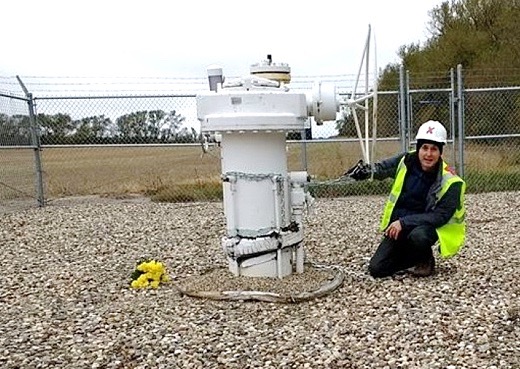
The activists employed manual safety valves to shut down Enbridge's line 4 and 67 in Leonard, Minnesota; TransCanada's Keystone pipeline in Walhalla, North Dakota; Spectra Energy's Express pipeline in Coal Banks Landing, Montana; and Kinder-Morgan's Trans-Mountain pipeline in Anacortes, Washington.

The activists, who planned the action to coincide with the International Days of Prayer and Action With Standing Rock, expressed feeling "duty bound to halt the extraction and combustion of fossil fuels...in the absence of any political leadership" to address the withering goal of keeping global temperature increase beneath the 2°C climate threshold.

"I have signed hundreds of petitions, testified at dozens of hearings, met with most of my political representatives at every level, to very little avail," said 64-year-old mother Annette Klapstein of Bainbridge Island, Washington, who was arrested just before publication.

"I have come to believe that our current economic and political system is a death sentence to life on earth, and that I must do everything in my power to replace these systems with cooperative, just, equitable and love-centered ways of living together. This is my act of love."

Fifty-nine-year-old Ken Ward of Corbette, Oregon, who was also arrested, said, "There is no plan of action, policy or strategy being advanced now by any political leader or environmental organization playing by the rules that does anything but acquiesce to ruin.

Our only hope is to step outside polite conversation and put our bodies in the way. We must shut it down, starting with the most immediate threats—oil sands fuels and coal."

The action comes two days after a U.S. federal court of appeals lifted an injunction on the Dakota Access project, to the dismay of the Indigenous water protectors and their supporters across the U.S. and Canada.

"Because of the climate change emergency, because governments and corporations have for decades increased fossil fuel extraction and carbon emissions when instead we must dramatically reduce carbon emissions; I am committed to the moral necessity of participating in nonviolent direct action to protect life," added activist Leonard Higgins, 64, from Eugene, Oregon.

The activists are all members of the group Climate Direct Action, which is providing live updates on the coordinated shut-downs on its website and Facebook page. Others shared statements in support, as well as images and videos of the actions on social media with the hashtag #shutitdown.

Tim DeChristopher's Climate Disobedience Action Fund is also supporting the action and has set up a legal fund for the activists' defense.


Image above: Michael Foster, 52, pictured here, said, "All of our climate victories are meaningless if we don’t stop extracting oil, coal and gas now." From original article.

See also:
Ea O Ka Aina: Time for Direct Action on CO2 10/12/16
Ea O Ka Aina: Why Standing Rock is test for Obama 10/8/12
Ea O Ka Aina: Why we are Singing for Water 10/8/16
Ea O Ka Aina: Labor's Dakota Access Pipeline Crisis 10/3/16
Ea O Ka Aina: Standing Firm for Standing Rock 10/3/16
Ea O Ka Aina: Contact bankers behind DAPL 9/29/16
Ea O Ka Aina: NoDAPL demo at Enbridge Inc 9/29/16
Ea O Ka Aina: Militarized Police raid NoDAPL 9/28/16
Ea O Ka Aina: Stop funding of Dakota Access Pipeline 9/27/16
Ea O Ka Aina: UN experts to US, "Stop DAPL Now!" 9/27/16
Ea O Ka Aina: No DAPL solidarity grows 9/21/16
Ea O Ka Aina: This is how we should be living 9/16/16
Ea O Ka Aina: 'Natural Capital' replacing 'Nature' 9/14/16
Ea O Ka Aina: The Big Difference at Standing Rock 9/13/16
Ea O Ka Aina: Jill Stein joins Standing Rock Sioux 9/10/16
Ea O Ka Aina: Pipeline temporarily halted 9/6/16
Ea O Ka Aina: Native Americans attacked with dogs 9/5/16
Ea O Ka Aina: Mni Wiconi! Water is Life! 9/3/16
Ea O Ka Aina: Sioux can stop the Pipeline 8/28/16
Ea O Ka Aina: Officials cut water to Sioux 8/23/16   

.

Nebraskans resist Keystone XL

SUBHEAD: TransCanada took land in Texas through eminent domain. It will so in Nebraska as a last resort.

By Jennifer Oldham on 30 January 2014 for Bloomberg News -
(http://www.bloomberg.com/news/2014-01-31/nebraskans-resist-keystone-spurning-transcanada-s-checks.html)


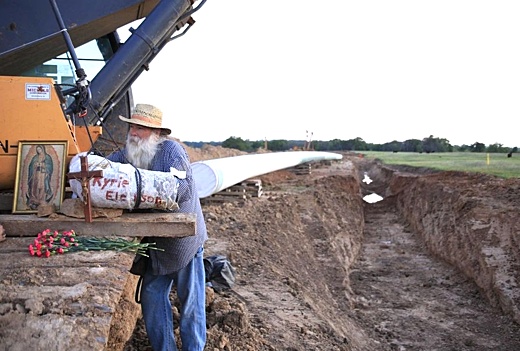
Image above: Protester of XL Pipeline cements himself to construction site in Oklahoma. From (http://www.krmg.com/news/news/local/protestors-cement-themselves-keystone-xl-pipeline-/nXqrd/).

An icy wind rattles a metal warehouse in York, Nebraska, as farmers and ranchers inside vow not to sign easements with a Canadian company to bury the Keystone XL oil pipeline on their land.

“I think TransCanada has been surprised we country bumpkins gathered,” said Bonny Kilmurry, one of about 145 landowners meeting here, about 100 miles (160 kilometers) west of Omaha, who have declined the company’s overtures. “I think we do have hope in sticking together.”

While Calgary-based TransCanada Corp. has signed agreements with property owners in Montana and South Dakota along the pipeline’s proposed 1,179-mile route from Alberta, some families along the path through eastern Nebraska are holding out. They hope staying united will give them leverage to negotiate deals with stricter safety controls to protect their water supply.

The U.S. State Department, which is reviewing the project because it crosses an international border, is set to release an environmental report in coming weeks. The analysis comes amid debate over the safety of moving oil by rail after accidents including a deadly derailment in Quebec last July.

Federal agencies will have 90 days to comment on whether the 36-inch (90-centimeter) diameter pipeline is in the national interest. President Barack Obama has said he won’t approve Keystone XL if it’s found to substantially boost carbon-dioxide emissions.

Revised Route
TransCanada revised the route through Nebraska in 2012 after Governor Dave Heineman, a Republican, voiced concern that an oil leak could foul the environmentally sensitive Sandhills region or the Ogallala Aquifer beneath it that provides drinking water to 1.5 million people and is essential to agriculture.

The refusal of Nebraska land owners to yield ground that in some cases has been in their families for generations is the second challenge the maverick prairie state has posed to the $5.4 billion project.

A push by the company to negotiate easements with property owners along the new path intensified in recent months, as some farmers turned down payments in excess of $285,000 for use of their land.

TransCanada, which wants to build Keystone XL to link the oil sands of Alberta with refineries on the Gulf of Mexico, has “reached agreements with about 73 percent of landowners along the revised Nebraska route,” Davis Sheremata, a company spokesman, said by e-mail. “We are pleased with the progress we have been making there.”

Federal Review
As the federal review of what some call the most scrutinized pipeline in U.S. history continues, Nebraskans are joining environmentalists in a push to get the attention of Congress and ordinary Americans.

“What we’re doing is very different from what other landowners have done,” said Jane Kleeb, executive director of Bold Nebraska, a Hastings-based nonprofit. “Instead of negotiating on price, we’re saying we’re not going to negotiate until they get a permit. It’s changed the rules for TransCanada.”

The State Department report on the pipeline will go to President Barack Obama, who will make the final decision.

“If the State Department finds what it already found in its draft -- that there would be no increase in carbon pollution from tar sands -- then the Nebraska landowners could come into play in his decision because there’s another component that the pipeline needs, and that’s to be in the national interest of the United States,” said Daniel J. Weiss, director of climate strategy at the Center for American Progress, a Washington group typically aligned with Democrats.

Constitutional Challenge
Landowners in Nebraska have also filed a lawsuit against the state challenging the constitutionality of the law that allowed Heineman to approve the new route, rather than leave it to the Nebraska Public Service Commission.

Whoever loses is likely to appeal to the state Supreme Court, potentially leaving the alignment in flux, said David Domina, an Omaha attorney representing the landowners.

Nebraska holdouts are using Google Inc.’s YouTube to keep their concerns about the pipeline’s potential impact on their rural life, and the world’s climate, in the public eye.

The movement gained momentum in September, when Bold Nebraska and environmental groups used $65,000 in contributions from more than 1,300 donors to buy a kit for a barn powered by renewable energy, then recruited volunteers to build it in the path of the proposed pipeline.

Jenni Harrington provided part of a soybean field on her family farm, 15 miles northwest of York, for the building.

From Great-Great-Grandfather
“My great-great-grandfather homesteaded this land in 1864,” Harrington said in an interview in the barn as a windmill screeched outside and dust filtered under the door.

“If this gives them the land we inherited from our father, it won’t be the same to hand over to our children,” she said. “Our big concern is if there was some sort of leak that got to our wells.”

TransCanada said it has agreed to use thicker-walled steel, increased shut-off valves and other techniques to lay the pipeline.

“The Final Environmental Impact Statement on Keystone XL extensively evaluated the impacts of a spill or release from the pipeline, including on the aquifer,” said Sheremata, the company spokesman. “Even in areas where a spill might reach groundwater, the impacts would be localized to an area measured in hundreds of feet.”  

Red Herring
Brigham McCown, former administrator of the U.S. Pipeline and Hazardous Materials Safety Administration under President George W. Bush, called concerns about damage to the aquifer a “red herring.”

“There are thousands of miles of pipeline in the Ogallala Aquifer,” he said.

McCown said Nebraskans have managed to hold out longer than landowners in Texas and Oklahoma who opposed the southern leg of the pipeline. That route, known as the Gulf Coast line, became operational Jan. 22 and transports crude oil regionally.

TransCanada took some land from Texas property owners through eminent domain, an action it says it will only use in Nebraska as “a last resort.”

Eminent domain is the right of governments to take private property for the public good, so long as the landowner is compensated. In Texas, operators of pipelines that qualify as common carriers can condemn property for easements, a form of taking.

Disturb Soil
About 110 miles north of the Harrington farm, near Neligh, Art Tanderup said he’s concerned that the pipeline, which would run 600 feet from a house built in 1921 by his wife’s grandfather, would disturb the topsoil, making it difficult for him to grow soybeans profitably.

“We would lose almost 50 acres of ground during construction,” said the former high school teacher, who retired in 2011 to run the farm with his wife, Helen. “They say they will make it just like it was, but I’m concerned it will be difficult to raise anything.”

Tanderup’s dog, Penny, trotted alongside as the farmer steered his pickup over uneven ground littered with dried corn husks. Pipeline construction, he said, could disturb artifacts left by the Ponca Indians in the 1870s during a forced relocation from Nebraska to Oklahoma known as the Trail of Tears.

Unstable Area
About 75 miles further north, in Holt County, Terry and Diana Steskal said the pipeline would be buried in unstable soil along the proposed route, which would cut their 480-acre farm in half.

“There’s very little difference between the Sandhills in sand and texture of sand on my property,” said Terry Steskal, whose father bought the farm near Atkinson in the 1940s for $5.15 an acre, leaving the family so broke he shingled the outbuildings with tobacco cans. “If there was a leak it would go through that sand fast. Our number one concern is liability.”

Nebraskans who’ve negotiated easements along the Keystone XL route said the thousands of miles of pipeline that already exist in the state haven’t had major problems.

“There’s a lot of a pipeline in Nebraska,” said Bill Tielke, a Holt County supervisor who signed an easement with TransCanada to use land on his farm near the Steskal homestead.

“They were offering a pretty good sum of money -- if they are going to offer that kind of money, why would you not accept it? Unless you absolutely don’t owe debt to anyone.”

.

Keystone XL on Trial

SUBHEAD: Susan Dunavan has been fighting to keep foreign corporation TransCanada from crossing her 80 Nebraskan acres.

By Ted Genoways on 27 september 2013 for On Earth -
(http://www.onearth.org/articles/2013/09/the-property-rights-case-that-could-block-the-keystone-xl-pipeline)


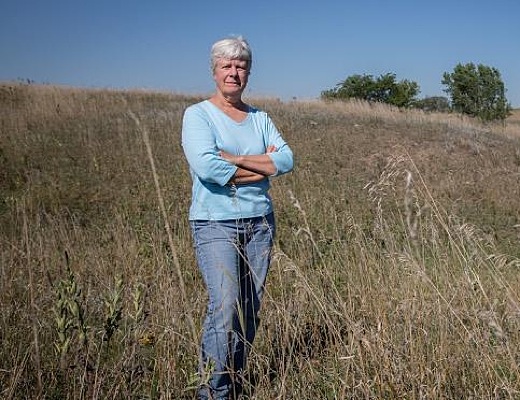
Image above: Dunavan stands among native prairie grasses on her property in McCool Junction, Nebraska. From original article.

Susan Dunavan has stacks of white binders, piled high on a side table in her farmhouse near McCool Junction, Nebraska. There are the binders filled with clipped newspaper and magazine articles about plans to build the Keystone XL pipeline. There are the binders of letters and notices from TransCanada officials—their easement offers, their threats to use eminent domain to condemn Dunavan’s property. And there are the binders of legal briefs and pretrial motions relating to Dunavan’s lawsuit against Governor Dave Heineman and the State of Nebraska.

For more than five years, she has been fighting to keep TransCanada, the pipeline’s corporate owner, from crossing her 80 acres here. And for the last 18 months, while national attention has focused on trying to divine which way Secretary of State John Kerry and President Barack Obama might be leaning on TransCanada’s request to build the northern portion of the Keystone XL pipeline—which would extend nearly 1,200 miles from the Alberta tar sands to the so-called Cushing extension in Oklahoma—Dunavan and two co-plaintiffs have been awaiting their day in court on a lawsuit that could be activists’ best chance of blocking the project.

Nebraska Attorney General Jon Bruning has twice tried to have the citizen lawsuit thrown out. But in January, Lancaster County District Court Judge Stephanie Stacy issued a ruling upholding five of the six original counts—and two months later allowed citizens to amend the suit to include new accusations of unconstitutional behavior by the state.

According to Brian Jorde of the Domina Law Group, the attorneys representing the citizen complaint, if Judge Stacy rules in favor of the plaintiffs, it would effectively nullify any route previously approved across Nebraska—even if that route already has a State Department permit—and would force TransCanada to start from scratch on matters relating to siting and approval.

Privately, pipeline opponents in Nebraska acknowledge that, were it to lose in district court, the state would almost certainly appeal to the Nebraska Supreme Court (and might, in the meantime, attempt to cram through legislation approving the route). “But a ruling here is likely to take months—with an s,” Jorde told me earlier this week. “An appeal might take years. This suit is a wrench in the works, and buys time for turning public opinion.”

Today, at the courthouse in Lincoln, that suit finally comes to trial—and Dunavan admits to feeling apprehensive. “I’m normally a very quiet person,” she says. “I don’t usually speak out. I stand up for what I believe in, but I’m not an activist-type person.

So to have a spotlight on me is just very intimidating.” She says she did everything she could to avoid taking legal action, but was forced to file suit when it became clear that none of the elected officials she had contacted in Nebraska would listen to her concerns.

So she turned over her binders of documentation to Domina Law and braced for the day that public attention would inevitably fall on her. She dislikes talking to the press, she admits, but she made up her mind early last year that this issue was too important to allow her to sit quietly. “This is millions and millions of dollars, this is people’s livelihoods, this is people’s heritage, this is the future of our state—and nobody is doing anything.”

Susan Dunavan walks through waist-deep prairie grass, pinching seeds between her fingers and scattering them as she goes. She points up the ridge to a group of cattle, a neighbor’s tiny herd that she and her husband allow to graze here. “This has been pastureland for a long time,” she says. “But much of it is native prairie. It’s so rare now that land like this hasn’t been turned into cropland. When we moved here in 1979, our dream was to restore this to its native state.”

Dunavan’s property is part of a narrow ribbon of tallgrass prairie that stretches from southern Canada to eastern Oklahoma. It sustains a surprising amount of biodiversity, she says, and the varied insects, frogs, and rodents are critical to supporting the migration of numerous birds. As if on cue, a pair of migrating broad-winged hawks circles out from a stand of cottonwoods in the creek bottoms, riding the stiff wind in search of prey.

Dunavan and her husband met when they were natural resource majors at Humboldt State University in northern California and later spent three years in Lesotho in southern Africa, helping to establish local agriculture in an area stricken by drought.

When they returned to the United States, they and their three children moved to Nebraska and had an old farmhouse loaded onto a flatbed trailer and trucked in from 16 miles away. (“I’ve always been into recycling,” Dunavan jokes.) But she says that the effort was worthwhile, because this acreage was special.

“There were a lot of invasives. So the first few years we cut thistles and made an inventory of the native species we had, and over-seeded with more native plants.” So far she has identified more than 100 native grasses and plants on the property.
“This is millions and millions of dollars, this is people’s livelihoods, this is people’s heritage, this is the future of our state—and nobody is doing anything.”

In October of 2009, however, when TransCanada sent its initial easement offer, the company made no acknowledgment of the rare condition of Dunavan’s land. The draft agreement promised that TransCanada would perform several “restoration activities” after trenching and installing the pipeline, including “reseeding,” but, Dunavan says, “when I asked them for more details—and when you go through the Department of State Environmental Impact Statement—you find that their idea of restoring tallgrass prairie covers six species.”

So Dunavan sent a list of the 21 native grasses and more than 80 native plants that she had documented on the property. TransCanada sent an engineer to conduct a one-day survey and declared that the property was home to only seven species of grass and a few flowering plants. Dunavan began mailing TransCanada photographs as each native plant flowered throughout June and July of 2010.

At the end of July, TransCanada appeared to have had enough. Tim M. Irons, senior land coordinator on the Keystone project, sent a third easement agreement—with all language regarding reseeding identical to the original—accompanied by a letter informing Dunavan that this was “Keystone’s final offer.” If she did not sign, Irons wrote, “we will be forced to invoke the power of eminent domain and will initiate condemnation proceedings against the property.”

Dunavan says she knew that TransCanada hadn’t been granted such power by the state, so she wrote to Attorney General Bruning to ask whether it was legal to threaten use of eminent domain in order to secure a contract, when the company had no such power in the state. Dunavan was advised to find her own legal representation. She did exactly that.

In April of 2011, she received her fourth easement agreement, this one allowing that because “of certain re-seeding considerations required by the landowner, the landowner may provide for his own contractor to provide special seeding and Keystone Pipeline will pay.” However, the agreement also stipulated that “Keystone shall not be held responsible in any way if the reseeding does not meet the landowner’s expectations.” For the second time, Irons included a letter threatening to use eminent domain if Dunavan didn’t agree to his terms.

But instead of agreeing, Dunavan wrote again to Bruning; citing specific Nebraska statutes against “frightening someone to do something against his or her will” and “coercion by implying authority such as impersonation of a sovereign,” she asked for the attorney general to investigate TransCanada for “fraudulent and deceptive business practices.” She received no reply.

“People talk about poverty and how much money this pipeline is going to bring to the state,” Dunavan says. She looks out over the sweep of her property, the tall grass whipping as the wind picks up again. “But the people in Nebraska right now are experiencing a huge poverty of morals.”

A casual observer could easily mistake today’s proceedings for a typical eminent domain case. In such litigation, one side usually argues that the project in question serves the common good and should be allowed to go forward, while the other side argues that not enough good is served to merit abridging the rights of an individual landowner whose property may be adversely affected.

But even as a version of that familiar argument rages in the court of public opinion, the central legal issue for Judge Stacy to weigh in this case will be a different one: who, within the Nebraska state government, gets to determine that the seizure of private property based on the principle of eminent domain is appropriate.

As I reported back in April, a review of county records by the Nebraska Easement Action Team (or NEAT) found that only about 60 percent of landowners whose property would be crossed by Keystone XL had signed easement agreements—well below TransCanada’s stated target of 98 percent voluntary participation.

And so, the lawsuit alleges, TransCanada enlisted allies on the Nebraska legislature’s Natural Resources committee to draft and approve a bill transferring the power to approve pipeline siting from the five elected members of the Nebraska Public Service Commission (which had already held public hearings and instituted comment periods) to the Nebraska Department of Environmental Quality, political appointees of the governor.

More significantly, the bill vested ultimate approval of the pipeline route in that same governor, Dave Heineman—who, as it happens, was forced in 2010 to return campaign contributions made by TransCanada amid allegations that the gifts violated state law against receiving donations from foreign corporations.

But most troublingly, perhaps, the same proposed legislation authorized Governor Heineman to grant the power of eminent domain to TransCanada. Despite the seeming outrageousness of a law that would allow a foreign corporation to condemn the properties of hundreds of Nebraska landowners, the bill was brought to the floor in the final hours of the state’s 2012 legislative session.

Susan Dunavan says she was appalled by what the legislature did next. “It was the very end of the session—the last ten minutes,” she says, now back at her kitchen table, her white binders of clippings and correspondence laid out before her. Legislators hastily tacked on some amendments, she recalls. “I don’t think the bill even had a final reading” before it passed.

After a NEAT meeting in Albion, Nebraska, Brian Jorde approached Dunavan about joining two of her fellow local landowners, Randy Thompson and Susan Luebbe, in a citizens’ lawsuit against the state. Dunavan agreed. Their formal complaint argues that the legislature had no authority to seize the right of approval from the Public Service Commission, nor to transfer it to the governor, nor to allow him to delegate that power to any third-party, much less to a clearly interested party like TransCanada.

This law, they say, violates the Nebraska Constitution—first by transferring a power reserved by the legislative branch (the Public Service Commission) to the executive branch (the governor), and second by eliminating the opportunity for judicial review, which had been allowed under previous legislation governing the siting of pipelines.

Today, Judge Stacy will finally hear these arguments in open court. After such a long wait, the judge has scheduled only one hour to take statements from both sides. Most analysts believe that a ruling is unlikely before the end of the year. When it does come, the losing side—whichever side that is—will appeal to the Nebraska Supreme Court, further delaying a final decision. Jorde sees these delays as a net positive. “The groundswell of support and opposition and questioning and critical thinking going on is huge,” he told me. The more time that passes, the greater the opportunity there is to turn public opinion against the pipeline in his home state.

But the years of uncertainty and fear have taken their toll on landowners like Dunavan. “It’s exhausting,” she says. “You never get away. Every day I’m on the Internet, looking up the latest article, finding out who said what.” She looks at the open binders spread out before us, now covering most of her kitchen table. Out the open window, the cicadas are ratcheting in the trees. “They not only want to steal my land,” she says, “but they’ve stolen five-and-a-half years of my life.”

.

Unburnable Carbon Bubbles

SUBHEAD: Uncertainties in the carbon industry will be enough to leave a lot of carbon unburnable.

By Raul Ilargi Meijer on 29 April 2013 for the Automatic Earth -
(http://theautomaticearth.com/Finance/unburnable-carbon-bubbles.html)


Image above: Illustration for original article by author.

A report came out in Britain 10 days ago that deserves more attention than it got. If only because it uses the great term "unburnable carbon", great even before it's defined. It makes me ponder the popular and somewhat crazy claims about shale and fracking leading to US energy independence, the holy grail du jour.

It promises much vaunted freedom from outsiders, but what exactly does it consist of? Does it mean the ability to burn ever more carbon-based energy sources without having to buy them abroad? And does "abroad" include Canada, or do we think of this as an "energy Nafta"? Guys, if you would just waste a bit less of the stuff, you'd have been energy independent ages ago without having to inject tons of toxic concoctions into your land. What on earth are you thinking?

"Unburnable carbon" also makes me think of Professor Kenneth Deffeyes, who stated that "Crude oil is much too valuable to be burned as a fuel" , in reference to the long list of products, some of which are very beneficial to us (think medicine), that are made with oil carbons.

Deffeyes also said: "Thirty years from now, oil will be little used as a source of energy. Our grandchildren will say, 'you burned it? All those beautiful molecules? You burned it?'"

Will we ever understand this? Not very likely. We don't even think about it. We just want to find more of the stuff and then burn it. Give any organism access to an energy surplus, and it will use it up as fast as possible. Man is no exception.

But first, that report. Which claims that national and international climate targets risk leaving huge amounts of oil and gas stranded. The risk alone should be enough to inject so much uncertainty into the markets that they could plunge into a huge crisis. Damian Carrington for The Guardian:

The world could be heading for a major economic crisis as stock markets inflate an investment bubble in fossil fuels to the tune of trillions of dollars, according to leading economists.
"The financial crisis has shown what happens when risks accumulate unnoticed," said Lord (Nicholas) Stern, a professor at the London School of Economics. He said the risk was "very big indeed" and that almost all investors and regulators were failing to address it.

The so-called "carbon bubble" is the result of an over-valuation of oil, coal and gas reserves held by fossil fuel companies. According to a report published on Friday, at least two-thirds of these reserves will have to remain underground if the world is to meet existing internationally agreed targets to avoid the threshold for "dangerous" climate change. If the agreements hold, these reserves will be in effect unburnable and so worthless – leading to massive market losses . But the stock markets are betting on countries' inaction on climate change.

The stark report is by Stern and the thinktank Carbon Tracker. Their warning is supported by organisations including HSBC, Citi, Standard and Poor's and the International Energy Agency. The Bank of England has also recognised that a collapse in the value of oil, gas and coal assets as nations tackle global warming is a potential systemic risk to the economy, with London being particularly at risk owing to its huge listings of coal.

Stern said that far from reducing efforts to develop fossil fuels, the top 200 companies spent $674bn (£441bn) in 2012 to find and exploit even more new resources, a sum equivalent to 1% of global GDP, which could end up as "stranded" or valueless assets. Stern's landmark 2006 report on the economic impact of climate change – commissioned by the then chancellor, Gordon Brown – concluded that spending 1% of GDP would pay for a transition to a clean and sustainable economy.

The world's governments have agreed to restrict the global temperature rise to 2C, beyond which the impacts become severe and unpredictable. But Stern said the investors clearly did not believe action to curb climate change was going to be taken. "They can't believe that and also believe that the markets are sensibly valued now."[..]

Paul Spedding, an oil and gas analyst at HSBC, said: "The scale of 'listed' unburnable carbon revealed in this report is astonishing. This report makes it clear that 'business as usual' is not a viable option for the fossil fuel industry in the long term. [The market] is assuming it will get early warning, but my worry is that things often happen suddenly in the oil and gas sector."
HSBC warned that 40-60% of the market capitalisation of oil and gas companies [is] at risk from the carbon bubble, with the top 200 fossil fuel companies alone having a current value of $4 trillion, along with $1.5 trillion debt. [..]
 
The report calculates that the world's currently indicated fossil fuel reserves equate to 2,860 billion tonnes of carbon dioxide, but that just 31% could be burned for an 80% chance of keeping below a 2C temperature rise. For a 50% chance of 2C or less, just 38% could be burned.
Carbon capture and storage technology, which buries emissions underground, can play a role in the future, but even an optimistic scenario which sees 3,800 commercial projects worldwide would allow only an extra 4% of fossil fuel reserves to be burned. There are currently no commercial projects up and running. The normally conservative International Energy Agency has also concluded that a major part of fossil fuel reserves is unburnable. [..]
Jeremy Grantham, a billionaire fund manager who oversees $106bn of assets, said his company was on the verge of pulling out of all coal and unconventional fossil fuels, such as oil from tar sands. "The probability of them running into trouble is too high for me to take that risk as an investor." He said: "If we mean to burn all the coal and any appreciable percentage of the tar sands, or other unconventional oil and gas then we're cooked. [There are] terrible consequences that we will lay at the door of our grandchildren."

And it's of course not just the US that is involved. All major energy producers (and consumers) are. Nor is it just oil and gas: coal could get hit hard. Damian Carrington had this on Australia over the weekend:

Australia's huge coal industry is a speculative bubble ripe for financial implosion if the world's governments fulfil their agreement to act on climate change, according to a new report. The warning that much of the nation's coal reserves will become worthless as the world hits carbon emission limits comes after banking giant Citi also warned Australian investors that fossil fuel companies could do little to avoid the future loss of value.
Australia is already the globe's biggest coal exporter and "mega-mine" plans in Queensland for more extraction are identified as the world's second biggest "carbon bomb" threatening runaway global warming.
"Investments in Australian coal rest on a speculative bubble of climate denial, indifference or dreaming," said John Connor, one of the new report's authors and CEO of The Climate Institute, an independent research organisation based in Sydney. "Investors, governments and even some coal companies say they take climate change seriously, but this report shows they do not or are taking risky gambles."
James Leaton, at thinktank Carbon Tracker and also another of the report's authors, said: "Investors need to challenge the assumption that coal demand will continue to rise in China and elsewhere, otherwise billions of dollars of taxpayer, superannuation and shareholder funds will be wasted in assets linked to unburnable carbon."
Carbon Tracker's recent global report found that at least two-thirds of existing fossil fuel reserves will have to remain underground if the world is to meet existing internationally agreed targets to avoid the threshold for "dangerous" climate change. The new report shows Australian coal reserves owned by listed companies alone are equivalent to 25% of the global carbon budget for the fuel to 2050.
However, far from cutting back on exploration for new coal reserves, Australian listed companies spent AU$6 billion on developing new deposits. If only half of potential future reserves were exploited, Australian coal would use up 75% of the global carbon budget for the fuel.
Earlier in April, Citi banking group issued a warning to investors in fossil fuel companies. "We see limited potential for engagement to alter the outcome in this case," concluded its report. "If the unburnable carbon [scenario] does occur – even with carbon capture and storage technology – it is difficult to see how the value of fossil fuel reserves can be maintained."
Leaton said China has indicated its coal use will peak in the next five years, but that this had not been priced by markets. "I don't know why the market does not believe China. When it says it is going to do something, it usually does." Yet Australia is banking on selling coal to China: "That doesn't add up."

Still, you could argue that governments will try to find a way to ignore climate treaties. Once they start painting a picture of plunging economies and lifestyles for their people, the hope will be that the treaties can be watered down to facilitate business as usual. Given the strength and broad appeal of climate activism, that won't be as easy as some might think.

For the Canadian government and economy, climate issues may not be the biggest headache going forward. Ottawa faces a growing and steadily better organized resistance from Indigenous peoples. Who, if they resist being divided and bought off, can be a major pain in the government butt, not least of all because they still have many elders who remember being raised on notions of keeping the land fit to pass on to multiple generations. Large scale exploitation of carbon resources doesn't seem to fit that bill. Martin Lukacs for the Guardian in December last year:


Canada's placid winter surface has been broken by unprecedented protests by its aboriginal peoples. In just a few weeks, a small campaign launched against the Conservative government's budget bill by four aboriginal women has expanded and transformed into a season of discontent: a cultural and political resurgence.

It has seen rallies in dozens of cities, a disruption of legislature, blockades of major highways, drumming flash mobs in malls, a flurry of Twitter activity under the hashtag #IdleNoMore and a hunger strike by Chief Theresa Spence, in a tepee minutes from Ottawa's parliament. Into her tenth day, Spence says she is "willing to die for her people" to get the prime minister, chiefs and Queen to discuss respect for historical treaties.

[..] What remains unspeakable in mainstream politics in Canada was recently uttered, in a moment of rare candour, by former Prime Minister Paul Martin:
"We have never admitted to ourselves that we were, and still are, a colonial power."
[..] While Canada has the world's largest supply of fresh water, more than 100 aboriginal communities have tapwater so foul they are under continual boil alert. Aboriginal peoples constitute 3% of Canada's population; they make up 20% of its prisons' inmates. In the far north, the rate of tuberculosis is a stunning 137 times that of the rest of the country. And the suicide rate capital of the world? A small reserve in Ontario, where a group of school-age girls once signed a pact to collectively take their lives.
Such realities have not stopped politicians and pundits from prattling on about the sums supposedly lavished on aboriginal peoples. [..] Billions have indeed been spent – not on fixing housing, building schools or ending the country's two-tiered child aid services, but on a legal war against aboriginal communities. 

Every year, the government pours more than $100 million into court battles to curtail aboriginal rights – and that figure alone went to defeating a single lawsuit launched by two Alberta First Nations trying to recover oil royalties essentially stolen by bureaucrats.

Despite such odds, the highest courts of the land have ruled time and again in favour of aboriginal peoples. Over the last three decades, they have recognized that aboriginal nations have hunting, fishing and land rights, in some cases even outright ownership, over vast areas of unceded territory in British Columbia and elsewhere.

Parliament will soon debate a bill that would break up reserves – still, mostly, collectively held – into individual private property that can be purchased by non-native speculators. The undeclared agenda of government policy is the same as it was a century ago: a grab for resource-rich lands, and the assimilation of aboriginal nations.

The Canadian federal and provincial governments act on a "shoot first, talk later" basis. As in many other places in the world, government policy is based on bullying citizens into compliance with what are labeled "democratic policies", which actually hugely benefit both the government and its corporate backers financially, but leave those citizens with mere scraps off the table.

In Canada, the situation is far less simple than the government would like, because aboriginal - land - claims that have been ratified in various treaties, and on many occasions confirmed by its own Supreme Court, numerous times, can't just be ignored without trampling both democracy itself and the rule of law.

In a very cynical move, Ottawa spends $100 million per year in legal fees to fight these aboriginal claims in courts across the country. Cynical because one might argue that this stunning amount of money rightfully belongs to the aboriginal population in the first place: hence, their own money is being used to keep them poor. Lukacs again:


In a boardroom in a soaring high-rise on Wall Street, Indigenous activist Arthur Manuel is sitting across from one of the most powerful financial agents in North America.

It's 2004, and Manuel is on a typical mission. Part of a line of distinguished Indigenous leaders from western Canada, Manuel is what you might call an economic hit-man for the right cause. A brilliant thinker trained in law, he has devoted himself to fighting Canada's policies toward Indigenous peoples by assailing the government where it hurts most – in its pocketbook.

Which is why he secured a meeting in New York with a top-ranking official at Standard & Poor's, the influential credit agency that issues Canada's top-notch AAA rating. That's what assures investors that the country has its debts covered, that it is a safe and profitable place to do business.

This coveted credit rating is Manuel's target. His line of attack is to try to lift the veil on Canada's dirty business secret: that contrary to the myth that Indigenous peoples leech off the state, resources taken from their lands have in fact been subsidizing the Canadian economy. 

In their haste to get at that wealth, the government has been flouting their own laws, ignoring Supreme Court decisions calling for the respect of Indigenous and treaty rights over large territories. Canada has become very rich, and Indigenous peoples very poor.

In other words, Canada owes big. Some have even begun calculating how much. According to economist Fred Lazar, First Nations in northern Ontario alone are owed $32 billion for the last century of unfulfilled treaty promises to share revenue from resources. Manuel's argument is that this unpaid debt – a massive liability of trillions of dollars carried by the Canadian state, which it has deliberately failed to report – should be recognized as a risk to the country's credit rating.

How did the official who could pull the rug under Canada's economy respond? Unlike Canadian politicians and media who regularly dismiss the significance of Indigenous rights, he took Manuel seriously. It was evident he knew all the jurisprudence. He followed the political developments. He didn't contradict any of Manuel's facts.

He no doubt understood what Manuel was remarkably driving at: under threat of a dented credit rating, Canada might finally feel pressure to deal fairly with Indigenous peoples. But here was the hitch: Standard & Poor's wouldn't acknowledge the debt, because the official didn't think Manuel and First Nations could ever collect it. Why? As author Naomi Klein, who accompanied Manuel at the meeting, remembers, his answer amounted to a realpolitik shoulder shrug.

"Who will able to enforce the debt? You and what army?"

[..] The movement confronts a Conservative Canadian government aggressively pursuing $600 billion of resource development on or near Indigenous lands. That means the unbridled exploitation of huge hydrocarbon reserves, including the three-fold expansion of one of the world's most carbon-intensive projects, the Alberta tar sands. Living closest to these lands, Indigenous peoples are the best and last defence against this fossil fuel scramble. 

No surprise, then, about the government's basic approach toward First Nations: "removing obstacles to major economic development." Hence the movement's next stage – a call for defiance branded Sovereignty Summer – is to put more obstacles up. The assertion of constitutionally-protected Indigenous and treaty rights – backed up by direct action, legal challenges and massive support from Canadians – is exactly what can create chronic uncertainty for this corporate and government agenda. [..]

The "Lord Stern report" focuses on the carbon bubble caused by the discrepancy between climate targets and the exploitation of carbon resources.

But there's another potential bubble in carbon that the report does not address: a large part of the resources will simply never become economically viable.

Even before you run into climate related limits, a lot of carbon will prove unburnable not primarily because of climate change legislation, but because of either one of two issues: 1) physics meets monetary limits, i.e. developing the asset makes no sense economically, or 2) physics meets physics, i.e. developing the asset makes no sense in energy terms because it costs more energy than it delivers.

In connection with these two issues, at present a substantial part of America's unconventional oil and gas only looks financially interesting because of the fortunes being made in speculation, for instance in land and land rights (in true Enron spirit, Aubrey McClendon and Chesapeake Energy have blown a huge market distorting bubble there).

Far more money is spent on the promise of oil and gas plays than on the actual product. The result is a carbon related land (rights) bubble, and a typical case of something that looks good; until it doesn't.

But there's more. A large part of the money that is being lavished on the carbon bubble is zombie money. If that money were not available, there would be no bubble. Every single debt that is not properly recognized, and restructured or defaulted upon, leaves zombie money present in a financial system. And every single asset this zombie money is invested in is by definition in a bubble.

If people had a more profound understanding of what occurs when debts are not cleansed the way they should be, there would be no zombie money. As it stands, accounting standards in nations hit by the 2007-08 crisis have become running jokes, all in order to hide the real state of both governments and financial institutions.

Hiding debt means hiding reality. Neither can remain hidden forever. Which, come to think of it, sets them apart from a lot of carbon resources. Which will never see the light of day.

The point to take away from all this is that a storm cloud of uncertainties is taking shape above the carbon industry. And that alone will be enough to leave a lot of carbon unburnable. Which may not be such a bad thing.
.

Obama considers Climate Change

SUBHEAD: Obama administration will use Nixon-Era law to fight climate change, but may cave on XL Pipline.

By Michael Scherer on 16 March 2013 for Time Swampland -
(http://swampland.time.com/2013/03/16/white-house-keystone-xl-pipeline-not-a-climate-change-cure/)


Image above: Obama descending from Air Force One onto tarmac under hazy polluted sky. From (http://theenterprisereport.typepad.com/news/2009/05/openness-obama-style-screen-the-bad-the-pr.html).

Barack Obama has seen protesters from his motorcade for years: McCain and Romney campaign supporters, health care reform opponents and all manner of Tea Party acolytes. But when he left Argonne National Laboratory in a cold rain outside Chicago on Friday, there was another breed altogether: environmentalists bearing bright hand-painted signs with messages like, “No XL Pipeline.”

In a matter of months, the Obama Administration will have to decide whether to permit the Keystone XL pipeline, a 2,000 mile conduit for Canadian oil seeking ports on the Gulf of Mexico. Environmentalists have made stopping the pipeline their number one priority, saying it will encourage the development of a particularly dirty type of oil at a time when America should be leading the world in reducing greenhouse gases.

White House aides are clearly uncomfortable with the current campaign from their left, a fact that quickly became clear on the flight to Chicago. “Thousands of miles of pipeline have been built since President Obama took office, and that hasn’t had a measurable impact on climate change,” said Deputy Press Secretary Josh Earnest, on board Air Force One. “The truth is what we need to do is take an all of the above approach.”

When I asked if he was saying that further green energy investment was more important to fighting climate change than stopping the new pipeline, he did not hesitate. “There is no question about that,” he said.

White House officials say no final decision has been made about the fate of the pipeline, but for environmentalists reading the tea leaves, such rhetoric is not a positive sign. Repeatedly in recent weeks, Obama’s aides have tried to distance the President from the process. “When there is a decision that is ready to be announced by the State Department, they will go ahead and make that announcement,” said Earnest. Notably, when Obama rejected a previous plan for the pipeline during the election year, he said his concern was focused only on the rushed permit process. “This announcement is not a judgement on the merits of the pipeline,” the President said in a statement at the time.

For senior administration officials, the protests over the pipeline have distracted from the more important fights, and recent accomplishments, in the fight to reduce carbon pollution, which the president has again elevated to a priority since winning the election. At the Argonne National Laboratory, Obama praised recent government funded research to develop electric cars, and announced plans for a new $2 billion, 10-year National Energy Trust, which would provide new research funding for electric and low-emissions vehicles.

He also boasted of a recent Environmental Protection Agency study that showed significant increases in fuel economy of U.S. cars, in part because of new standards instituted during Obama’s first term. After the speech, Obama aides sent reporters an email titled “How We Shift America Off Oil” that did not mention the pipeline, but rather pointed to the importance of new funding for energy research that would reduce American dependence on fossil fuels.

On Capitol Hill, Republicans have also made the Keystone XL pipeline a cause celeb. As the President flex to Chicago, Michigan Republican Congressman Ted Upton introduced a bill Friday that would give Congress the power to approve the pipeline directly, though its passage is far from certain in the Senate. Congressional Republicans raised the topic of the pipeline on Wednesday in a meeting with Obama. Reports from the room, which have been confirmed by the White House, described Obama as neither embracing nor rejecting the project.

Obama to use Nixon Era Law

By
Mark Drajem on 15 March 2013 for Bloomberg News -
(http://www.bloomberg.com/news/2013-03-15/obama-will-use-nixon-era-law-to-fight-climate-change.html)


Image above: Pipeline Keystone XL construction worker. From original article.

Similar analyses could be made for the oil sands that would be transported in TransCanada Corp.’s Keystone XL pipeline, and leases to drill for oil, gas and coal on federal lands, such as those for Arch Coal Inc. and Peabody Energy Corp.

President Barack Obama is preparing to tell all federal agencies for the first time that they should consider the impact on global warming before approving major projects, from pipelines to highways.

The result could be significant delays for natural gas- export facilities, ports for coal sales to Asia, and even new forest roads, industry lobbyists warn.

“It’s got us very freaked out,” said Ross Eisenberg, vice president of the National Association of Manufacturers, a Washington-based group that represents 11,000 companies such as Exxon Mobil Corp. (XOM) and Southern Co. (SO) The standards, which constitute guidance for agencies and not new regulations, are set to be issued in the coming weeks, according to lawyers briefed by administration officials.

In taking the step, Obama would be fulfilling a vow to act alone in the face of a Republican-run House of Representatives unwilling to pass measures limiting greenhouse gases. He’d expand the scope of a Nixon-era law that was first intended to force agencies to assess the effect of projects on air, water and soil pollution.

“If Congress won’t act soon to protect future generations, I will,” Obama said last month during his State of the Union address. He pledged executive actions “to reduce pollution, prepare our communities for the consequences of climate change, and speed the transition to more sustainable sources of energy.”

Illinois Speech
The president is scheduled to deliver a speech on energy today at the Argonne National Laboratory in Lemont, Illinois. He is pressing Congress to create a $2 billion clean-energy research fund with fees paid by oil and gas producers.

While some U.S. agencies already take climate change into account when assessing projects, the new guidelines would apply across-the-board to all federal reviews. Industry lobbyists say they worry that projects could be tied up in lawsuits or administrative delays.

For example, Ambre Energy Ltd. is seeking a permit from the Army Corps of Engineers to build a coal-export facility at the Port of Morrow in Oregon. Under existing rules, officials weighing approval would consider whether ships in the port would foul the water or generate air pollution locally. The Environmental Protection Agency and activist groups say that review should be broadened to account for the greenhouse gases emitted when exported coal is burned in power plants in Asia.

Keystone Pipeline
Similar analyses could be made for the oil sands that would be transported in TransCanada Corp. (TRP)’s Keystone XL pipeline, and leases to drill for oil, gas and coal on federal lands, such as those for Arch Coal Inc. (ACI) and Peabody Energy Corp. (BTU)

If the new White House guidance is structured correctly, it will require just those kinds of lifecycle reviews, said Bill Snape, senior counsel at the Center for Biological Diversity in Washington. The environmental group has sued to press for this approach, and Snape says lawsuits along this line are certain if the administration approves the Keystone pipeline, which would transport oil from Canada’s tar sands to the U.S. Gulf Coast.

“The real danger is the delays,” said Eisenberg of the manufacturers’ group. “I don’t think the answer is ever going to be ‘no,’ but it can confound things.”

Lawyers and lobbyists are now waiting for the White House’s Council on Environmental Quality to issue the long bottled-up standards for how agencies should address climate change under the National Environmental Policy Act, signed into law by President Richard Nixon in 1970.
Environmental Impact

NEPA requires federal agencies to consider and publish the environmental impact of their actions before making decisions. Those reviews don’t mandate a specific course of action. They do provide a chance for citizens and environmentalists to weigh in before regulators decide on an action -- and to challenge those reviews in court if it’s cleared.

“Each agency currently differs in how their NEPA reviews consider the climate change impacts of projects, as well as how climate change impacts such as extreme weather will affect projects,” Taryn Tuss, a Council on Environmental Quality spokeswoman, said in an e-mail. “CEQ is working to incorporate the public input we received on the draft guidance, and will release updated guidance when it is completed.”

Major Shakeup
The new standards will be “a major shakeup in how agencies conduct NEPA” reviews, said Brendan Cummings, senior counsel for the Center for Biological Diversity in San Francisco.

The White House is looking at requiring consideration of both the increase in greenhouse gases and a project’s vulnerability to flooding, drought or other extreme weather that might result from global warming, according to an initial proposal it issued in 2010. Those full reports would be required for projects with 25,000 metric tons of carbon dioxide equivalent emissions or more per year, the equivalent of burning about 100 rail cars of coal.

The initial draft exempted federal land and resource decisions from the guidance, although CEQ said it was assessing how to handle those cases. Federal lands could be included in the final standards.

The White House guidance itself won’t force any projects to be stopped outright. Instead, it’s likely to prompt lawsuits against federal projects on these grounds, and increase the probability that courts will step in and order extensive reviews as part of the “adequate analysis” required in the law, said George Mannina, an attorney at Nossaman LLP in Washington.

Next Administration
“The question is: Where does this analysis take us?” he said. “Adequate analysis may be much broader than the agency and applicant might consider.”

While the Obama administration’s guidance could be easily rescinded by the next administration, the court rulings that stem from these cases will live on as precedents, Mannina said.

Lobbying groups such as the U.S. Chamber of Commerce, American Petroleum Institute and the National Mining Association weighed in with the White House against including climate in NEPA, a law initially aimed at chemical leaks or air pollution.

“Not only will this result in additional delay of the NEPA process, but will result in speculative and inaccurate modeling that will have direct impacts on approval of specific projects,” the National Mining Association in Washington wrote in comments to the White House in 2010.

Leases Challenged
The group represents Arch Coal (ACI) and Peabody, both based in St. Louis. Leases that the Department of Interior issued for those companies to mine for coal in Wyoming are facing lawsuits from environmental groups, arguing that the agency didn’t adequately tally up the effect on global warming from burning that coal.

Given Obama’s pledge to address global warming, “this is a massive contradiction,” said Jeremy Nichols, director of climate at WildEarth Guardians in Denver, which filed lawsuits against the leases.

Arch Coal referred questions to the mining group.

Beth Sutton, a Peabody spokeswoman, said in an e-mail, “We believe the current regulatory approach to surface mine permits is appropriate and protects the environment.”

Since CEQ first announced its proposal, more than three dozen federal approvals were challenged on climate grounds, including a highway project in North Carolina, a methane-venting plan for a coal mine in Colorado, and a research facility in California, according to a chart compiled by the Center for Climate Change Law at Columbia University.

Next Target
The next target is TransCanada (TRP)’s application to build the 1,661-mile (2,673-kilometer) Keystone pipeline. The Sierra Club and 350.org drew 35,000 people to Washington last month to urge Obama to reject the pipeline. Meanwhile, the NEPA review by the State Department included an initial analysis of carbon released when the tar sands are refined into gasoline and used in vehicles.

It stopped short, however, of saying the project would result in an increase in greenhouse gas emissions. With or without the pipeline, the oil sands will be mined and used as fuel, the report said. That finding is likely to be disputed in court if the Obama administration clears the project.

“Keystone is ground zero,” said Snape, of the Center for Biological Diversity. “Clearly this will come into play, and it will be litigated.”

Any actions by the administration now on global warming would pick up on a mixed record over the past four years.

Cap-and-Trade
While Obama failed to get Congress to pass cap-and-trade legislation, the EPA reversed course from the previous administration and ruled that carbon-dioxide emissions endanger public health, opening the way for the agency to regulate it.

Using that finding, the agency raised mileage standards for automobiles and proposed rules for new power plants that would essentially outlaw the construction of new coal-fired power plants that don’t have expensive carbon-capture technology.

Environmentalists such as the Natural Resources Defense Council say the most important action next will be the EPA’s rules for existing power plants, the single biggest source of carbon-dioxide emissions. The NEPA standards are separate from those rules, and will affect how the federal government itself is furthering global warming.

“Agencies do a pretty poor job of looking at climate change impacts,” Rebecca Judd, a legislative counsel at the environmental legal group Earthjustice in Washington. “A thorough guidance would help alleviate that.”
.