Showing posts with label Green. Show all posts

Futility of "Big Green" activism

SUBHEAD: To minimize human suffering and protect ecosystems, working locally to build resilience is the best strategy.

By Richard Heinberg & Tim DeChristopher on 29 March 2018 for Resilience -
(http://www.resilience.org/stories/2018-03-29/getting-past-trump-part-3-the-futility-of-big-green-activism-a-conversation-with-tim-dechristopher/)


Image above: Still image from film Bidder 70 of Tim DeChristopher . In 2008 the environmental activist made bogus bids for 22,000 acres of federal land up for auction. Some people found his actions inspiring, but after the courts finished with him, he found himself in jail. The film Bidder 70 follows DeChristopher’s growth as an outspoken activist even as the criminal case against him intensified. From (http://radiowest.kuer.org/post/through-lens-bidder-70-0).

If environmentalists hope to have any real success in the age of Trump, they will have to change strategies and tactics in response to a transformed political and social context.

Back in the long-ago, hard-to-recall days before Trump became president, environmental (as well as peace and human rights) nonprofit organizations engaged in a routine, ritualized two-part dance of raising money from contributors, and then trying to convince policy makers to do something to save the world — or at least reduce the scale of harms being done.

What was actually accomplished was never enough to actually turn society in the direction of sustainability, but the effort was in some respects its own reward: Activists felt useful, and in some cases, fundraising produced enough to pay salaries. And there were occasional victories to celebrate.

Now the United States is led by an authoritarian who is steadily undermining our democratic norms and institutions, and a Congress that is either bought and paid for by moneyed interests, or is too scared to challenge them meaningfully.

It’s clear that no amount of cajoling, wheedling, imploring, threatening or explaining will convince Congress or the executive branch of the federal government to do anything whatsoever to address the panoply of do-or-die problems confronting us. Why even bother asking them?

Recall it was the failure of elites to address real underlying problems that contributed to the advent of Trump in the first place. Now, of course, at least from environmentalists’ perspective, Trump is making everything much, much worse: It’s probably fair to say that the Trump administration has never met an environmental regulation it didn’t want to kill.

What should environmentalists do under these changed circumstances? What strategies should environmental organizations pursue?

In order to get some helpful perspective, I recently corresponded with activist Tim DeChristopher, cofounder of Climate Disobedience Center. I respect DeChristopher for two important reasons: He has a good understanding of the range of overshoot issues humanity currently faces, and he has the courage of his convictions (he spent nearly two years in federal prison for a creative act of civil disobedience recounted in the documentary film Bidder 70).

What follows is a lightly edited transcript of my conversation with DeChristopher.

I first asked Tim what he thought about the actions of the big mainstream environmental organizations in the context of the new Trump administration.

Tim DeChristopher:
I really don’t think that most mainstream climate environmental organizations are operating with any kind of intentional strategy in which they think that what they are doing will lead to positive change.

When groups are mobilizing their members to “send a message” or “make their voices heard” to [US Secretary of the Interior Ryan] Zinke, [Environmental Protection Agency Administrator Scott] Pruitt or Trump, I doubt any staffers in those groups actually think that what they are doing has any potential of working.

I think they are hemmed-in by the norms of social movement organizing. Those norms demand relentless optimism and positivity, so there is very little room for open reflection on our mistakes, changing direction or acknowledging that certain goals are no longer possible. Those norms also define leadership around knowing what to do and giving people tangible and immediate things to do.

I think most organizations and leaders would feel extremely nervous about saying to their community, “I don’t know what needs to be done in this unprecedented situation.” There is a mainstream assumption that they would no longer be justified in their leadership position if they expressed that uncertainty. But I think one of our most critical needs for a future of climate chaos is to develop a model of uncertain leadership.

This is a kind of leadership that can hold space for sitting with uncertainty and empower a broader community of people to actively think and work in that space of vulnerability. Such leadership is embodied not in one’s ability to control a situation, but in one’s courage to engage with and relate to the situation.

Richard Heinberg: 
Historically, nonviolent protest and civil disobedience have developed as successful strategies for social change mostly within the context of liberal democracies. For example, there has been some discussion about whether [Mahatma] Gandhi’s efforts would have been as successful if Britain had not had a free press and other democratic institutions.

Without a free press, regimes can simply imprison and kill protesters with minimal public awareness of either the protest or its repression. How do you think protest might evolve if the US continues its trajectory toward authoritarianism?

Tim DeChristopher:
I think that Trump has certainly changed the dynamics of civil disobedience at the federal level. It’s worth noting that Erica Chenoweth’s research has shown that nonviolent civil resistance is often more effective under authoritarian regimes, but I think Trump represents a very rare kind of power.

Part of the efficacy of civil disobedience is often that it pulls back the facade of decency or democracy to reveal power that is actually rooted in violence.

The police violence at Standing Rock was an embarrassment to Obama because he had hinged his authority on lofty ideals, but in fact his real power was the state’s monopoly on violence. Even Bush Jr. ran on a platform of being a “compassionate conservative.” It was a lie, but he needed that lie.

Trump, however, never tried to project a facade of compassion or even decency. His power is based on ruthlessness and the breaking of taboos. If he is put into a position in which he has to violently repress nonviolent dissent, it may actually strengthen his power rather than undermine it.

In terms of media, I think our trajectory is not one of outright suppression of a free press to the point of avoiding public awareness, but rather a bifurcation of the press and social media to the point that no one has to accept anything they don’t want to believe.

This is a serious challenge not only for civil disobedience, but for all social change efforts regardless of strategy. It is further exacerbated by new video manipulation technologies. It is very hard to see how we avoid either nihilism or civil war.

Richard Heinberg:  
So, what to do?

Tim DeChristopher:
My current thinking is that our best bet to overcome these challenges is making protest far more diffuse and widespread. With the lack of a central narrative or even a consensus reality, big iconic protests with famous people will likely continue to become less effective.

But we all have a small circle of people whom we can influence in ways that are not dependent on media. Because our current culture has such justifiable skepticism of manipulation, one’s own willingness to sacrifice is more critical than ever for using our influence effectively, so I think civil disobedience will continue to play an important role for that.

So perhaps this is to say that protest needs to follow the path that needs to be followed for so many other changes we need to make: more localized, more diverse, more people involved, more experimentation. No goddamn mono-crop social movements!

Richard Heinberg:
How is your own organization, the Climate Disobedience Center, dealing with these issues and challenges? What concrete actions are your taking that different from the strategies of the ‘Big Green’ groups?

Tim DeChristopher: The Climate Disobedience Center began as a resource and support center for folks doing civil disobedience against the fossil fuel industry.  At the time, a certain brand of safe and limited civil disobedience was being increasingly embraced by the mainstream of the climate movement.

We felt that there was an opportunity to work with those folks who were engaging in direct action and help them manifest the full potential of vulnerable and transformative civil disobedience. We primarily ended up filling the particular void in the movement around supporting folks after the point of arrest as they engage with the court system.

Over time, we realized that rather than providing a plug-in service that could easily interface with a mainstream model, we were approaching this work with a fundamentally different paradigm that demanded a holistic structure.

So we refocused our efforts on building small praxis groups of holistic support, like a cross between an affinity group and a small group ministry. These are groups of folks who support one another to live with integrity in a time of climate crisis.

One piece of that is the moral responsibility to act to mitigate whatever harms can still be avoided, but we believe that work cannot be detached from the need to build resilient communities as well as grieve for that which is already being lost.

As these are largely unprecedented challenges, we are trying to create the practices of mutual support that allow for as much experimentation and creativity as possible.


DeChristohper emphasizes that simply getting rid of Trump as first priority will not solve the environmental crisis. If the system wasn’t sufficiently self-correcting before, and if the status quo is irreparably broken, then it’s clear that some other change in strategy is needed.

He also calls for more local and experimental activism and civil disobedience, warning that large-scale protests could simply become indiscernible components of the noise being generated by the implosion of the US political system.

My own tendency is to look at the big picture. In that regard, my gut and intellect both tell me that the Trump interval is best understood as a stage in societal collapse. Each stage of that process will no doubt follow its own internal logic.

As the stages progress, larger scales of societal organization (international institutions, then nation states) will tend to fail first. Therefore the usefulness of national and global strategies for resistance and repair will tend to gradually diminish.

If we want to minimize human suffering and protect ecosystems, then working locally to build community resilience is probably the best strategy available. The reasons are plentiful and the rationale only grows stronger as our context evolves.

.

Being Green is being a Terrorist

SUBHEAD: Environmentalists say they’re averting climate disaster. Conservatives say it’s terrorism.

By Alexander C. Kaufman on 20 February 2018 for Huffington Post -
(https://www.huffingtonpost.com/entry/pipeline-environmentalist-terrorism_us_5a85c2ede4b0058d55672250)


Image above: Illustration by Ji Sub Jeong of "pollution" in the form of Donald Trump going after environmental activists. From original article.

Michael Foster, 53, is a mild-mannered mental health counselor and father of two from Seattle, with short-cropped silver hair and soft features.

But in a North Dakota court last October, prosecutors painted Foster as a ruthless killer and agent of chaos.

The prosecution team compared him to the 9/11 hijackers who killed 2,996 people in the worst terror attack in history, and warned that he envisioned an anarchic future under Islamic religious law. Prosecutors even put him in a league with Ted Kaczynski, the so-called Unabomber whose 17-year bombing spree left three dead and injured 23.

Foster hadn’t killed anyone. He didn’t even injure anyone when, on Oct. 11, 2016, he put on a white hard hat and neon-yellow safety vest, grabbed some bolt cutters, and clipped the chain locking a fenced section of the Keystone Pipeline in Walhalla, North Dakota. Once inside the fence, Foster cranked a giant wheel-like valve until it closed, temporarily stopping the flow of tar sands oil.

“In order to preserve life as we know it, and civilization, and give us a fair chance and our kids a fair chance, I’m taking action as a citizen,” Foster told another activist, Sam Jessup, who live-streamed the action. “I am duty-bound.”

Foster’s action was part of a protest in solidarity with the indigenous activists fighting to stop construction of the Dakota Access Pipeline, which runs through a sacred water source at the Standing Rock Sioux Reservation on the other side of the state.

Foster and Jessup did so in coordination with “valve turners” in four other states, timing their break-ins across the country to temporarily halt 15 percent of U.S. oil consumption.

Then came the legal crackdown.

In October, a judge convicted Foster and Jessup of felonies ― including criminal mischief and conspiracy to commit criminal mischief ― carrying maximum sentences of 11 to 26 years in prison. Earlier this month, the judge sentenced Foster to three years in prison; Jessup received two years of probation. (Other valve turners have faced up to 10 years in prison and $20,000 in fines.)

“They hit the trifecta: 9/11, the Unabomber, and that somehow our action was going to lead to Sharia law,” said Emily Johnston, 51, who is set to stand trial in May for turning a pipeline valve in Minnesota. “The theory being that if everyone just acted on what they believed in, it would be anarchy.”

That theory is now gaining some traction in Washington.

In October, 84 members of Congress, including four Democrats, sent Attorney General Jeff Sessions a letter urging him to find out whether the Department of Justice could prosecute pipeline saboteurs as terrorists.

The Justice Department has yet to announce a decision, but said in November that it was “committed to vigorously prosecuting those who damage this critical energy infrastructure in violation of federal law.” Doing so would be a break from the Obama administration’s decision to let states handle such cases, rather than treating them as federal crimes.
The purpose of this law isn’t to wrap everybody up and send them to federal prison. It’s to scare people, to create fear. - Will Potter, author of ‘Green Is The New Red’
But policymakers are sharpening their knives on the state level, too. Late last year, the conservative American Legislative Exchange Council drafted model legislation calling for severe punishments for anyone caught trespassing on or tampering with an oil, gas or chemical factory. The Critical Infrastructure Protection Act even includes a clause that any “conspirator” organization would be fined 10 times more than a trespasser, opening the door to crippling penalties for environmental groups.

Lawmakers in Ohio and Iowa are now considering bills based on the proposal. The Iowa bill is backed by Energy Transfer Partners, the company behind the Dakota Access Pipeline. In all, 31 states have considered 58 bills to crack down on protesters since November 2016, according to a database maintained by the International Center for Not-for-Profit Law. Eight have been enacted, and 28 are pending.

At a moment when the Trump administration is waging all-out war on environmentalism, macheting away regulations and gearing up for a massive pipeline construction spree, “eco-terrorism” is re-emerging as a boogeyman in a way it hasn’t since right after 9/11.

There are already laws in place to send environmentalists who tamper with fossil fuel infrastructure to jail, as Foster’s case demonstrates. But if conservative lawmakers get their way, new laws could undermine the environmental movement ― just as scientists say the humans are running out of time to make the changes needed to stave off the worst effects of climate change.


Image above: A screenshot frok video of Michael Foster turning the valve on the Keystone Pipeline. Shot by Sam Jessup. From original article.

Protesting After The Patriot Act

Targeting environmentalists as domestic security threats goes back nearly two decades. Radical environmental groups experienced their heydays in the 1990s, but became victims of their own success as concerns over pollution and animal cruelty went mainstream.

But even as the influence of these groups waned, a scorched-earth crackdown loomed. President George W. Bush signed the USA Patriot Act in October 2001, just over a month after the 9/11 attacks. The law expanded the government’s view of domestic terror suspects and granted law enforcement sweeping new powers to investigate organizations and individuals, including by seizing assets without any prior hearing or criminal charges.

“It’s about installing fear so they don’t go out and protest in the first place,” said Will Potter, author of the book Green Is The New Red, while comparing ALEC’s recent bill to the actions taken after 9/11. “The purpose of this law isn’t to wrap everybody up and send them to federal prison. It’s to scare people, to create fear.”

Potter would know. In 2002, when he was a reporter working on the Chicago Tribune’s metro desk, two FBI agents arrived at his home to question him about an animal rights protest he and his girlfriend had participated in months earlier.

Both had been arrested and charged with misdemeanor disorderly conduct after leaving flyers in a neighborhood where an insurance executive whose company covered animal laboratory testing lived.

He says FBI agents, armed with new powers under the Patriot Act, threatened to add him to a domestic terror list if he didn’t become an informant on the group with which he protested.

The officers threatened him, telling him they could “make your life very difficult for you,” having secured “more authority now to get things done and get down to business” after 9/11, Mother Jones reported in 2011.
Is this about just protecting some businesses? Or is this about this larger idea that the radical left is threatening America? - Cas Mudde, Dutch political scientist
In 2005, John Lewis, then the FBI official in charge of domestic terrorism, ranked “eco-terrorism and animal-rights movement” activists ahead of radical Islamic extremists as the nation’s top domestic terror threat.

The agency began investigating Eric McDavid, a self-declared green anarchist, that same year. In a now-infamous case, the FBI recruited a mole to get close to McDavid and coax him into plotting a C4 bomb attack. He was arrested in January 2006, and spent a decade in prison.

Congress also quietly passed the Animal Enterprise Terrorism Act in 2005, a sweeping law that classified many forms of animal rights protest as terrorism. It was used to prosecute Lauren Gazzola, the U.S. coordinator for a campaign against an animal product testing, on six felony charges that included conspiracy to violate an earlier law meant to protect businesses from protestors.

The crackdown was at odds with any realistic threat these environmentalists might have posed. Less than 10 percent of all radical environmental and animal rights actions from 2003 to 2010 even included criminal activity, according to a study published in 2014 in the journal Studies in Conflict & Terrorism. Of those acts, 66 percent were vandalism, less than 15 percent were house visits, and just over 12 percent involved freeing animals from cages. About 4 percent were arsons, and 1.4 percent involved explosives. There were no assassinations.

Protesting Post-Trump

Cas Mudde, a Dutch political scientist who co-authored the study on criminal activity amongst activists, points out that the attacks on environmentalists came at a time when many political protesters were speaking out against the Iraq War ― meaning environmentalists served as a sort of proxy for other left-leaning protest movements.

This is not unlike what we’re seeing now, Mudde said, noting that overlap between leftist activists and radical environmentalists makes it easy for conservatives to demonize both equally.

For example, Fox News hosts Tucker Carlson and Sean Hannity spent months inveighing against the so-called “antifa” and “alt left” movements, terms they use to refer to certain anti-fascist protester groups that rose up in response to increasingly vocal white nationalists in the U.S. Researchers who study extremists say “alt left” does not describe a real phenomenon.

This New World

The current capitalist system is broken. Get updates on our progress toward building a fairer world.

Mudde said it could be especially telling to see how Republicans frame the laws to criminalize fossil fuel protest.

“Is this about just protecting some businesses?” he said. “Or is this about this larger idea that the radical left is threatening America?”

The surprise election of President Donald Trump in 2016 dashed any hopes that the so-called green scare was a thing of the past. Trump, who dismisses climate change and installed an EPA administrator who shares his ideological antagonism toward science, reversed regulations and announced plans to withdraw from the Paris climate accord.

The conditions primed the rise of a more militant environmental movement ― and for an even more militant crackdown.

In a provocative essay published in September in Foreign Policy, think tank scholar Jamie Bartlett argued that “formal, peaceful political activism — that all-important route to redress — isn’t working” to address pollution and that “the signs of growing radicalism in green circles are already there, if you know where to look.” He noted that hard-line environmental organizations are seeing a membership surge, and that local anti-fracking groups are growing faster than ever before.

In April, the Department of Homeland Security warned of attacks by eco-terrorists who “believe violence is justified” to stop the planned Diamond Pipeline from Oklahoma to Tennessee. But the report admitted that no current intelligence suggested any attack had actually been planned.

The oil and gas industry is fueling fears of impending eco-terrorist attacks. In October, the American Petroleum Institute disclosed that it was “working with the Trump administration on this issue, including the DOJ, the Federal Bureau of Investigation and the Pipeline and Hazardous Materials Safety Administration,” according to the trade publication Natural Gas Intelligence.

API indicated that its lobbyists met with the FBI and other agencies to discuss “efforts related to pipeline security,” according to its final-quarter disclosure report from 2017.

The ALEC model bill is perhaps the clearest indication that “eco-terrorism” is back as a boogeyman on the right. When ALEC began shopping the bill around to state legislatures, it included a letter signed by a consortium of fossil fuel corporations and chemical manufacturers urging lawmakers to introduce bills based on the legislation to curtail the “growing and disturbing trend” of environmentalists attacking infrastructure.

The letter, which HuffPost obtained, listed five examples to back up the trend. One was the valve turners case. The others did not actually involve environmentalists. Instead, they were loosely bound by common threads of mental illness or workplace grievance:
  • In August 2011, Daniel Wells Herriman heard voices in his head, which convinced him to plant a crude bomb near a gas pipeline in Oklahoma. He turned himself in, pleaded insanity, and was sentenced the next year to more than five years in prison.

  • In June 2012 ― after spending months writing fawning prison letters to the Unabomber and posting enraged videos about having to pay taxes ― Anson Chi decided to live out his fantasies by blowing up a homemade explosive near a natural gas pipeline in Plano, Texas. He was sentenced to 20 years in prison.

  • Just after midnight on April 16, 2013, a sniper fired more than 100 rounds of .30-caliber rifle ammunition into the radiators of 17 electricity transformers in Metcalf, California. The attacker, believed to “an insider” who worked at the utility PG&E, was never found.

  • In October 2017, vandals believed to be recently furloughed employees ransacked a wastewater plant in Crow Agency, Montana, igniting a fire and firing off guns.

.

No Degrowth without Climate Justice

SUBHEAD: To develop meaningful strategies for political change, degrowth should become more confrontational.

By Matthias Schmelzer on 10 February 2017 for Uneven Earth -
(http://www.unevenearth.org/2017/02/no-degrowth-without-climate-justice/)


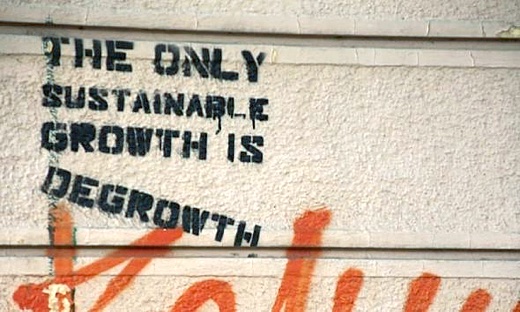
Image above: Degrowth Graffiti stating "The Only Sustainable Growth is Degrowth" . From (https://newint.org/blog/2015/05/14/degrowth-federico-demaria/).

Since the 2014 Leipzig Degrowth Conference, the argument that climate justice cannot exist without degrowth has repeatedly been made.

In a keynote at the Degrowth conference in Budapest, in September 2016, I developed this line of thinking further and argued that the opposite is equally important: There is no degrowth without climate justice.

My argument, which I presented as someone involved not only at the theoretical level, but also in concrete efforts to bring degrowth and climate justice together in terms of practices and people, is presented here in a concise way.

After the degrowth conference in Leipzig two years ago, people in the organizational committee were considering next steps that would allow the degrowth community to move forward.

Our analysis was that if we want degrowth to leave the ivory towers of academia and lecture halls, we need to enter into alliances with other social movements; and if we want degrowth to move beyond lofty visions for future societies and towards intervention and action, we need to enter into a conflictual political arena, thus forcing degrowth to take clear stances.

Even though a vision of transformation and a good life for all is important, if degrowth is worth anything, it should make a difference by intervening in political struggles.

Based on this analyses we decided to organize a degrowth summer school in 2015 in cooperation with the Rhineland climate camp. We thus entered a political field, in which concrete opponents – coal companies and their lobbies on the one hand and local communities and climate justice activists on the other – were struggling about the future of coal in the coming years.

The summer school drew 500 people from around Germany and Europe who discussed degrowth and its relations to climate change, extractivism, justice, power, and capitalism.

After the summer school, many participants took part in one of the hitherto largest actions of civil disobedience against lignite coal mining, in which more than 1000 people entered an open cast coal mine and blocked the operation of the huge diggers in Europe’s largest CO2 emitter.

In 2016, Ende Gelände was repeated in Lusatia, and the 3000-participant strong blockade lasted two days. There was again a degrowth summer school under the title “Skills for System Change.”

The summer of 2017 will see another degrowth-inspired summer school and a set of actions in the Rhineland that includes Ende Gelände, but will be much broader and possibly even bigger.

The climate summit Truman show

This decision to enter into alliances with the climate justice movement and into the conflicts around coal already illustrates much of our stance on the Paris Agreement reached at the COP in Paris in 2015.

First, that it proved a disaster precisely because it did not address the real problems, mainly that fossil fuels must largely stay underground and that we need a deep socio-ecological transformation.

Second, that the Paris Agreement could not address these issues, because it largely stayed within the framework of economic growth, extractivism, and accumulation – albeit in a new form.

And finally, that real change must come from stopping the drivers of climate change through concrete policies, public opposition, the building of alternatives, and direct action.

From the perspective of degrowth and climate justice movements, the Paris Agreement was a deceitful spectacle with potentially disastrous effects. What actually happened in Paris in November last year has been adequately described as the climate summit Truman Show: around the world, media headlines were enthusiastically celebrating the deal as ‘historic’ and ‘successful’, as the miracle of Paris, or even as  “31 pages of a recipe for revolution.”

Cameras were showing the chief negotiator French foreign minister Laurent Fabius in tears, the climate advocate Al Gore enthusiastically clapping, and the room of delegates seemed to be in a collective delirium – and with it the entire media circus.

Even many larger NGOs did not want to disturb this picture with their gentle statements, and the online campaigning platform avaaz described it as a “massive turning point in human history.”

Through the technocratic prism of the framework laid out by the UN climate convention, the summit achieved much more than has otherwise been accomplished during the last 20 years and far more than most observers had expected: 195 states actually achieved an agreement; and to the surprise of many in the last minute the 1,5 degree target was included in the final text.

However, this enthusiasm is highly misleading. It only makes sense from a narrow perspective that only focuses on the UN framework of negotiations and not on the broader political and economic context.

One can ignore reality, but this does not make it disappear. Diplomacy and a perfectly staged show do not save the climate – this can only be done by leaving the greater part of fossil fuel reserves in the ground, stopping deforestation, and ending industrialized agriculture. And all of this needs to happen quickly, which requires a set of effective measures and policies.

But the Paris Agreement does not include mechanisms and measures to ensure that this target is met. In fact, the Paris Agreement cements and strengthens the illusion of decoupling growth and emission and of green growth through a new level of utopian technocratic optimism – negative emissions.

In fact, the agreement willingly accepts missing the 1.5-degree target, and it contains many recipes for a new wave of neo-colonialism in the name of green capitalism.

Instead of redefining and changing the economy and the mode of production and consumption that cause climate change, it redefines nature by turning it into a tradable commodity.


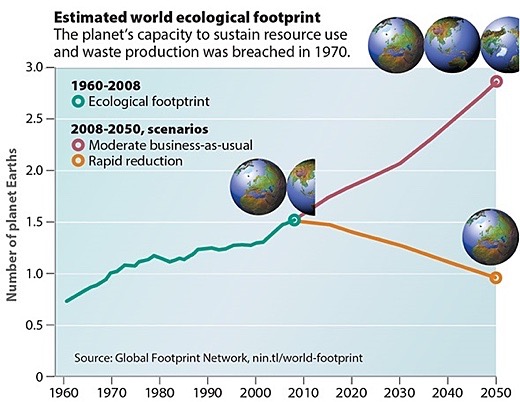
Image above: Graph of how many "Earth's" humanity will need for resources if we continue with moderate growth or attempt a rapid reduction in consumption. Note, the last time we were living within the budget of needing only one Earth was back in 1970. From (https://newint.org/features/2015/12/01/alternatives-to-growth/).

The market mechanisms embedded in the agreement serve to enable the continuation of high consumption lifestyles in rich countries, while offsetting this overconsumption in the Global South and thus continuing colonial exploitation.

Beyond green capitalism

Degrowth stands in stark opposition not just to the continuation of a “brown” – fossil fuels-based and extractivist – capitalism, but also to the institutionalization of what seems the most likely alternative – a “green” capitalism based on the massive investment in renewable energies, global carbon trading regimes, and the economization of nature.

For many of us, the belief that there is “no climate justice without degrowth” is a fundamental motivation to engage in the degrowth community or movement. The climate justice perspective can inspire an understanding of degrowth that might be more appealing to some – an understanding of degrowth  as the democratically-led transformation to societies that are not based on the extraction or import of disproportionate amounts of resources and on the disproportionate use of sinks.

Nevertheless, it seems to me that this is only one side of the coin, since it stipulates that degrowth is more fundamental and the necessary precondition to achieve climate justice.

Of course, there is great potential for cooperation and alliances between the two movements.

But in the spirit of what was termed “alliances without subordination” at the Budapest conference in 2016, I want to turn this around and argue that the other side is equally important: There is no degrowth without climate justice, or – more comprehensively – ecological justice or even global justice.

If degrowth is not built on a comprehensive vision for global justice and fails to incorporate key elements that are clearer and more prominent in the climate justice movement than in degrowth discourses, it will not be the emancipatory project many wish it to be. What can the degrowth community learn from the climate justice movement? I want to highlight three key lessons.

Changing structures

First lesson, the focus on deep structural transformations, transformations in the economic, political, mental, and social structures of our societies. Of course, much has been written and said on this in the degrowth discussion – but it could move further. Beatrice Rodriguez Labajos said that activists in the global South generally think that degrowth is not radical enough, because it is not anti-capitalist and mainly focuses on individual lifestyle-change.

Based on the discussions at the recent conferences, a consensus seems to be emerging that degrowth is indeed a proposal to overcome capitalism, and not just a new packaging for business as usual.

Similarly, degrowth could be clearer on how to change political structures (for example in the discussions about global trade regimes such as TTIP and CETA, degrowth is largely absent), mental structures such as extractivism in all its forms, and social structures.

If degrowth is understood as a heterogeneous and evolving social movement in the making, one can understand the great variety of approaches taken by degrowth actors in terms of its main critiques, proposed alternatives and transformational practices – ranging from sufficiency-oriented adepts of voluntary simplicity to social-reformists, anti-capitalists and feminists.

The climate justice perspective can help in strengthening those parts of the degrowth community that are not blind to issues of structural transformations.

Opposing hierarchies

Second, the climate justice movement is very strong in articulating and opposing hierarchies and power. Degrowth could learn that opposing all forms of power and domination is key if we want to achieve a more just society.

And because the degrowth community is so strongly homogenous – just look around at the degrowth conferences –, it really needs to listen to and learn from others, both in the North and the South. In fact, climate justice is a movement of some of the least privileged people resisting the immediate loss of their livelihoods.

The term goes back to the notion of environmental justice, and the origin of this term is highly illuminating.

When the largely white and privileged American environmental activists resisted the dumping of industrial waste in the 1960s, they basically only cared about their own communities.

This resulted in pushing the environmental costs down the social ladder, onto communities of color and the poor. In opposing this, these communities used the term “environmental racism” and “demanded environmental justice.” And in the 1990s, the term was then also used for the global problem of climate change.

In contrast to this, degrowth is a concept largely supported by some of the most privileged people on this planet – largely white, well-educated, middle-class people with Western passports  (on this, see a forthcoming study on the participants of the Leipzig Degrowth conference). It can even be conceptualized as the self-problematization of privileges in the context of what Ulrich Brand and Markus Wissen have called “the imperial mode of living”.

Because of this privileged homogeneity, degrowth needs to be particularly careful not to reproduce hierarchies, unequal distribution of power, and domination.

We do not only need a decolonization of the economic imaginary – on which degrowth focuses – but, since they are all connected, we also need this decolonization in terms of sex and gender, race, class, sexual orientation, and all other forms of division and exclusion.

How these and other hierarchies of the current capitalist, patriarchal, and (post)colonial societies can be overcome in a degrowth alternative and what they imply for degrowth strategies should be at the center of future degrowth and post-growth debates.

To do this, degrowth needs to listen to and build alliances with the less privileged, not only in the global South, but also in the global North. In short, degrowth needs to become more intersectional and diverse.

Let’s look at two examples: In a recent project called “Degrowth in movements” we collaborated with protagonists from more than 30 other social movements and alternative economic approaches to discuss their relation to degrowth and how from their perspective degrowth should develop.

The resultant essays provide fascinating insights – for example from the perspective of refugee movements, queer-feminism, trade unions, care, or food sovereignty -, which provide some entry points for degrowth to enter into broader alliances, reach out to new social groups, and strengthen its own critique of power and hierarchies.

In another project – which was actually one of the outcomes of the degrowth summer schools in 2015 and 2016 – the Konzeptwerk Neue Ökonomie will be organizing a conference together with the transnational refugee activist network Afrique-Europe-Interact that will bring degrowth and refugee activists together in October 2017 to discuss the connections between flight and migration, self-determined development, and ecological crises from a practical and political perspective.

Embracing struggles

The third lesson seems to me to be the most important one. Degrowth can learn from climate justice the struggle. So far, degrowth is largely an academic endeavor to formulate and debate about alternatives, and grassroots efforts to strengthen low-impact lifestyles here and now.

Both are vitally important.

However, degrowth sometimes appears to be somewhat vague on key political questions, in particular in terms of what the necessary struggles that need to be fought to achieve degrowth are, what this would entail, and who are allies and enemies.

To develop meaningful strategies for political change, degrowth should become more confrontational. Degrowth should not shy away from but rather face and embrace the conflicts that are necessary to achieve its goals.

One very concrete situation that the degrowth-climate justice alliance needs to organize against is that, while global carbon majors – the largest oil, gas, and coal companies worldwide – own 5 times more reserves of fossil fuels that are still in the ground than those that can be burned if humanity wants to achieve only the less ambitious 2 degree target, these reserves have largely already been turned into financial assets that are owned by companies and traded on international markets.

Thus, alleviating climate change – and thus achieving one key basis for a degrowth transformation – is only possible if these companies are expropriated of these assets. They’ll do anything to avoid this. What does this mean for degrowth strategies? Also in this regard, the climate justice movement is showing the way.

One great example is the Break Free campaign in May 2016, in which tens of thousands of people on 6 continents did something that politicians did not: they took bold, courageous action to keep fossil fuels in the ground. Degrowth should strive to engage more with on-the-ground struggles.

.

Kauai County "Keep Kauai Rural!"

SUBHEAD: The County of Kauai and its consultants have forsaken "Rural" Kauai in lieu of "Suburban" development

By Juan Wilson on 17 November 2016 for Island Breath - 
(http://islandbreath.blogspot.com/2016/11/kauai-county-keep-kauai-rural.html)

http://www.islandbreath.org/2016Year/11/161117limaolabig.jpg
Image above: Looks like mainland suburbs to me! Aerial rendering of Lima Ola development with Eleele Iluna housing Phase I & II to the left, Eleele to the upper left and A&B land to the right. Click to enlarge. From (http://limaolakauai.net/).

"If you build it they will come." Field of Dreams movie, 1989


COMMENT DEADLINE UPDATE

Comments on the update of the Kauai General Plan will be taken up to 16 December 2016. This is an extension of the previous date of 12/2/16.

HOW TO COMMENT
Comments to the draft can be emailed to plankauai@kauai.gov

or snail-mailed to:
Kauai County Planning Department,
Attention: Long Range Division
4444 Rice Street, Suite A473, Līhue, HI 96766.

See more at (http://plankauai.com/)


MY THOUGHTS IN A NUTSHELL
This issue of growth is our "Standing Rock". I recommend that the County instruct the Planning Department to abandon the current process of updating the Kauai General Plan 2000. It primarily dictates assigning Agriculture land as Urban in order to provide land for suburban development. The Kauai General Plan 2020-2035 should look to have that Agricultural land designated Rural land to meet the needs of self reliance in the future. It would also follow the will of the people: "KEEP KAUAI RURAL!"

Moreover, schemes like that of the Kauai Division of Housing to build Lima Ola as an automobile- centric bedroom community with no stores, shops or places of employment will only force people into their cars to buy a quart of milk or to make the money to pay for it.  There will be a great increase in traffic, both to the Big Save plaza to shop, and to Lihue for jobs.  As "Urban" land  it will also not allow people to live a rural, self reliant lifestyle.

BACK IN THE DAY
When I first came to Kauai in 1971 the population of the island was less than half of what it is today. I even don't remember where there were traffic light stops, but then all the cane fields were operating and there were plenty of orange cane haul truck crossing lights.

Back in the early 1970's there was little highway traffic. Tourists often did not need a rental car and spent time at destination resorts which provided entertainment and coordinated site seeing bus tours. Most people did not have to do a daily commute across the island for work. Many sugar cane and pineapple workers lived in housing adjacent to or embedded in the fields. 

And those cane truck roads were a highway for locals to many places you cannot get to today, like beaches and waterfalls, and hiking trails. Most Kauai people over sixty could reach a number of beaches, waterfalls, slippery slides, campsites and trails that are now off limits due to private residential development.

Now local people are pretty much confined to be in there home, at school, at work or in a county beach park. The tourists are pretty much regulated to commercial zip-lines, river tubing and ATV adventures.

It was the rural nature and charm of Kauai that made living here worthwhile and special. The natural beauty of the island makai (ocean side) and mauka (mountain side) allowed playing, fishing, farming, hunting. People didn't live on Kauai for its nightlife and unless you were to include camping.

The only major shopping plaza stood where the Kauai County offices are today. It had a supermarket and Liberty House department store and not much more. There was no Kukui Grove mall. The Coconut Marketplace was still in the planning stage.

As was demonstrated in the 1960s in places like Nassau County in New York and Orange County in California, there was big money to be made paving over potato farms and orange groves for ticky-tacky suburbia. Agriculture was subsumed into Car Culture. 

As the pressure to suburbanize Kauai was getting underway the county put together a plan with the purpose of steering "development" in a direction that the people on the island wanted.

The County of Kauai General Plan released in 2000 was done in 1998-99 was produced to guide the future of Kauai into the 21st century. It was developed with a good deal of local community interaction. The most important message the people of Kauai had for the County Government was "KEEP KAUAI RURAL". The Kauai General Plan was progressive and ambitious.

RURAL LIVING ON KAUAI
I live in Hanapepe and am most familiar with the south and west side of Kauai. West of Hanapepe most privately owned land is Robinson Family Property and east of Hanapepe is mostly Alexander & Baldwin properties. In the past both were mostly sugarcane plantations sprinkled with small residential communities known as camps.

Only a small relic of those communities persist in places like Kamakani and Pakala. They have been fairly self sustaining with vegetable gardens, chicken coops, dog kennels, and pigs styes, with access to fishing, hunting and horse riding. That is rural living.

There are also areas of rural living in valleys like Hanapepe, Makaweli and Waimea as well. But overall communities like Eleele, Hanapepe Heights, Waimea Town and Kekaha are suburban - not rural. In fact many rural activities mentioned above are now prohibited.

FAILURE OF COMMERCIAL AGRICULTURE
Unfortunately, within the time frame of that plan the sugar and pineapple plantations were faltering across the state. The big agland owners on Kauai like Grove Farms and Alexander & Baldwin realized that the land they controlled was no longer as profitable.

Over a decade ago I was privileged to see several of Alexander & Baldwin's annual corporate reports that were provided to corporate shareholders. It was clear reading them what the long range plan was. A&B holds over 3,000 acres along the south shore of Kauai stretching from Poipu to Hanapepe that is designated for Agriculture use. A&B has working to redesignate that property as Urban and that is the only way to convert that land into Suburbia.  

Selling out the land as either the most expensive real estates acreage, or densest housing development possible, was the most profitable liquidation plan for them. After taking the cue from Dole on Oahu they began suburbanization with zest. They began the high-end development of Kukuiula between Poipu and Laui Valley. One thing got in the way - the Great Recession of 2007-2008 when the housing bubble burst.
 
But how to recover and accomplish the goal now with the current restrictions land usage in Hawaii? Convert Agriculture land into Urban land and fill it with small parcels on cul-de-sacs.

PERMITTED LAND USE ON KAUAI
As of now the Hawaii State Land Use Commission (LUC) designates only four approved State Land Uses (SLU) on Kauai (followed by percent of island land areas) - Conservation (48.8% or 194,720 acres), Agricultural (47.4% 190,391 acres), Urban (3.5% 14,865 acres) and Rural (.3% 1,374acres).
CONSERVATION SLU DISTRICT
Conservation lands are comprised primarily of lands in existing forest and water reserve zones and include areas necessary for protecting watersheds and water sources, scenic and historic areas, parks, wilderness, open space, recreational areas, habitats of endemic plants, fish and wildlife, and all submerged lands seaward of the shoreline. The conservation District also includes lands subject to flooding and soil erosion.
Conservation Districts are administrated by the State Board of Land and Natural Resources and uses are governed by rules promulgated by the State Department of Land and Natural Resources.

AGRICULTURAL SLU DISTRICT
The Agricultural District includes lands for the cultivation of crops, aquaculture, raising livestock, wind energy facility, timber cultivation, agriculture-support activities (i.e., mills, employee quarters, etc.) and land with significant potential for agriculture uses. Golf courses and golf-related activities approved by a county before July 1, 2005, may be allowed in this district, otherwise such new facilities would be prohibited.

Uses permitted in the highest productivity agricultural categories are governed by statute. Uses in the lower-productivity categories – C, D, E or U – are established by the Commission and include those allowed on A&B lands as well as those stated under Section 205-4.5, Hawaii Revised Statutes.

URBAN SLU DISTRICT
The Urban District generally includes lands characterized by “city-like” concentrations of people, structures and services. This District also includes vacant areas for future development.
Jurisdiction of this district lies primarily with the respective counties. Generally, lot sizes and uses permitted in the district area are established by the respective county through ordinances or rules.
RURAL SLU DISTRICT
Rural Districts are composed primarily of small farms intermixed with low-density residential lots with a minimum size of one-half acre. Jurisdiction over Rural Districts is shared by the Commission and county governments.

Permitted uses include those relating or compatible to agricultural use and low-density residential lots. Variances can by obtained through the special use permitting process.
Conservation SLU is sacrosanct and won't be easily converted to suburban development. Suburban development can go on Urban SLU but there is not much left undeveloped. Because only a small percentage of land on Kauai is designated  Rural SLU,  not much development could go there.

Moreover, the Rural SLU designation requires at least half acre parcels and allows activities unacceptable to suburbanites like chicken coops, hunting dog kennels, goat or sheep pens, or manure piles. 

But Agricultural SLU covers almost half the island of Kauai. And its the large land owners like Grove Farms and A&B that own much of that land. 

As an architect-planner my experience with the Kauai Planning Department is that they are working to transform Kauai into what is in effect an outlying suburb of Oahu -  Think another Mililani (pop. 48,000) and Kaneohe (pop. 34,000) here on Kauai. What could possibly be less sustainable on the most isolated landmass in the world?

http://www.islandbreath.org/2016Year/09/160904hanapepebig.jpg
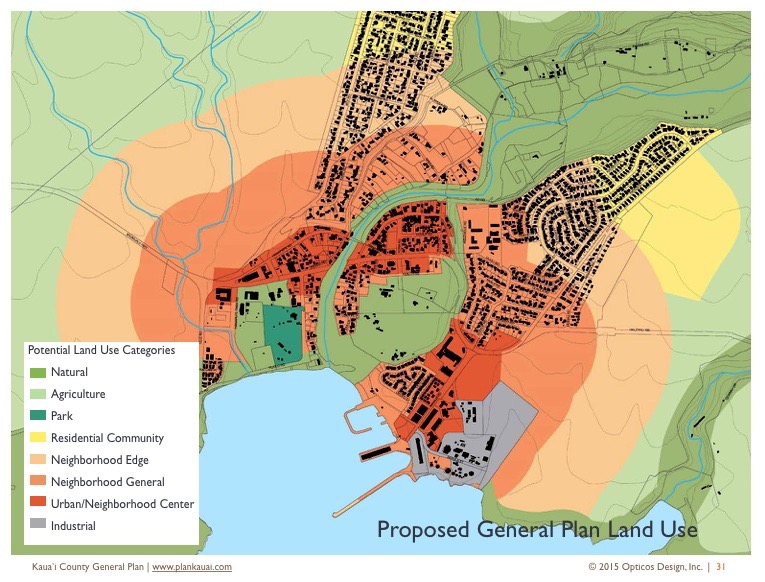
Image above: Page 37 from Kauai Plan Closing Workshop on Hanapepe-Eleele showing the expansion of the Urban Neighborhood center, Neighborhood General, Neighborhood Edge and Residential Community "doubling" in area. Note the proposed Lina Ola project is the yellow area in the upper right down through the light orange down to Route 540 about 2/3 down this image. From (http://plankauai.com/wp-content/uploads/2015_1104_HanapepeEleeleClosing-1.pdf).

THE UPDATED GENERAL PLAN 2020-2035
As you probably know if you live on Kauai, the big land owners and County government are hell bent to resume the hyper development that was on track a decade ago and went bust in the financial crackup in 2007-08.

The Kauai County Planning Department is working with Opticos Design Inc, a mainland California design firm, to conduct community meetings and produce a newly updated Kauai General Plan for 2020-2035 to guide us into the future.

From what I can see there is nothing more to this plan to date than spreading more suburbia across the island.

The Introduction to the proposed General Plan update begins with the subtitle:

"Kauai is at a Crossroads"
... The island is at a crossroads on an array of issues, and many attribute this overwhelming sense of vulnerability and insecurity to a common source: growth.

Let's agree about that but the next subhead reads:

"Growth is Happening Whether We Like It or Not"
... The desire for and need to manage growth is the primary driver behind long range planning.
I take exception to every word of that. We live on a finite isolated island on a finite and isolated planet. We can stop growth with a steady state population on a local and planetary level or go extinct soon.

What the plan proposes in new development is not Rural and not Urban but actually suburban and it will go on land that is currently capable of supporting food, fiber and timber production. Converting it to suburbia will only increase our dependency of failing mainland agriculture.

HABITAT, LIMA OLA & SPRAWL
Last night I attended a meeting of the Hanapepe-Eleele Community Association. Jerry Mackler, Kauai Planner presented the Kauai County Housing Division plan for Lima Ola. The Housing Division has bought 75 acres of land adjacent to the the recent Habitat for Humanity self-built housing project on the south side of Kaumaalii Highway in Eleele from A&B.  They plan to spend over $50 million to develop it.

That land that is now growing coffee. The Housing Division intends to build single and multifamily residential buildings there once they get approval to change the SLU from Agricultural to Urban.

When I mentioned that the planned housing was not within a walkable distance for most residents of Lima Ola to the nearest commercial area at Eleele Shopping Plaza and that people were likely to drive there and back to home for a pint of milk or a candy bar, Mr. Mackler agreed.

When I mentioned that Lima Ola could have included a few small corner retail stores or shops to substantially cut back on need to drive to nearby Eleele, Mr. Mackler  said that was not possible because Alexander & Baldwin would not permit that as a condition of the sale of the Lima Ola land.

When I asked Mr. Mackler if that because Alexander & Baldwin has plans to build commercial mall on adjacent Agriculture fields converted to Urban use he agreed that was the reason. 

Mr. Mackler spoke highly of Habitat for Humanity and their self-built affordable home sites in Eleele and  Eleele Ilima, a new affordable housing project  now currently under construction by Habitat but being expedited by contractors, adjacent just to the northeast of the Lima Ola site. He mentioned that the Lima Ola planning coordinated with the Habitat site for continuity of easements and other features.


Image above: On top are the 18 units of sweat equity Habitat for Humanity housing in Phase One of Eleele Iluna. Below are the additional single family homes built by contractors in Phase Two. Click to enlarge. From (http://kauaihabitat.org/about-us/our-builds/eleele-iluna/).

You can see the pattern. Start small and get bigger.
  • Begin on the west end of the A&B agricultural land near the industrial section of Port Allen. Habitat for Humanities has future owners put in sweat equity to build 18 homes has a first phase Eleele Iluna, a new affordable housing near Eleele existing low cost housing south of the Kaumalii Highway.
  • Next have contractors frame out and roof Phase II of the Eleele Iluna project next door with 48 units and a end goal of of 107 single family homes.
  • Next have Lima Ola through the County of Kauai, raise $50 million dollars to build 550 units of multi-family and single-family dwellings next to Eleele Iluna Phase II.
  • Next have A&B roll out a few thousands of acres of sprawl with a mall. 
THE LONG EMERGENCY
Oh yeah. That! James Kunstler wrote the book in 2005. In it he perceived collapse in a way few had. That collapse began in 2007-08 under the leadership of George W. Bush. It played out a the pop of a huge housing bubble.

Since then it has taken many trillions of dollars to paper over that hole. Many of the people whose thoughts I respect most are feeling the next shoe drop. Nothing really got fixed. The USA printed money and charged nothing to banks to dip their beaks. The USA gave people no interest on their savings. The USA pretended their was no unemployment.

Now that Donald Trump is taking over his experience with bankruptcy should prove useful as we enter the next peak on this roller coaster.

Living in communities that provide their own useful work, food, energy, recreation and entertainment will be a requirement after the barges and jets stop delivery for Amazon and Ebay. Lima Ola and the A & B sprawl would be better off rural - just like the people of Kauai envisioned.  "KEEP KAUAI RURAL!"  

See also:
Kauai County General Plan 2000-2020 x
Ea O Ka Aina: Kauai General Plan Update 9/3/16
Ea O Ka Aina: Kauai Plan Disappoints 12/9/15
Ea O Ka Aina: Tax Donkey Purgatory - Lima Ola 7/18/14
Ea O Ka Aina: Lihue Loss of Vision 9/5/14
Ea O Ka Aina: Kilauea Development on Agland 4/9/11
Ea O Ka Aina: If a tyrant developed Kauai 3/24/11
Ea O Ka Aina: Potash King's Palace 6/24/10
Ea O Ka Aina: Kauai Farm Worker Housing 7/14/09
Ea O Ka Aina: Let Moloaa farmers farm 4/2/09
Ea O Ka Aina: Kauai General Plan 4/2/09
Ea O Ka Aina: Peak Oil Planning 1/29/09
Island Breath: Kauai Sustainable Land Use Plan 11/1/07
Island Breath: LEGS Sustainability Conference 10/13/07