Showing posts with label Climate. Show all posts

Living in a Shitstorm

SUBHEAD: Get over despair. The big problems won't be fixed. A planetary adjustment is at hand.

By Chris Jordan on 17 October 2018 for Huffington Post -
(https://www.huffingtonpost.com/entry/despair-environment-politics_us_5bc5d910e4b0a8f17ee5d240)


Image above: Man hanging onto "Caution" sign as braking storm wave breaks. From internet.

[IB Publisher's note: My advise to the author of this piece... Get over the despair. The big problems won't be fixed. A planetary adjustment is at hand. There is much work to be done by the survivors. Some places will be much safer than others. If you are not in one, find such a spot. Abandon your dependence on "The System" to a degree you never imagined (ditch the car,  the grid, discount retailing and the  information cloud as soon as possible. Hunker down with people you trust and can work or trade with. Entertain each other until the new dawn. P.S. This is the 7,000th post to this blog. Where does the time go?] 

Like all of you, I pay close daily attention to the increasingly grotesque environmental and political shitshow we are witnessing unfold before our astonished eyes. The question is how to respond.

I have never at the same time felt such a strong desire to make a positive difference and less empowered to do so.

In my own psyche, something has shifted on a foundational level.

Most conversations now, even among my wisest and most engaged friends, lead down familiar rabbit holes that end in shrugged shoulders, dumb jokes that mask disempowerment and worn out memes about “solutions” that are infinitesimal in proportion to the scale of the problems.

Ask young people what two words most characterize our future and the response is as instant as it is ubiquitous: “We’re fucked.”

The most relevant internet comment people seem to be able to muster is “vote,” which raises a whole separate conversation, but the crux for me is, “Of course ― and what else?” Politics is an increasing disaster that can be seen as both a cause and a symptom.

I try to step back to a meta-perspective in the hope of achieving a clearer-headed view, but the wide-angle picture becomes even more chaotic. The panopticon turns out to be a Halloween hall of mirrors.

And in this space I find myself steeped in the familiar feeling of dread that I had before going to Midway Island to photograph dead albatrosses whose stomachs are filled with plastic.

To take the next step forward, I know I must face something dark that lies inside of myself, but I can’t quite make out what it is ― something so taken for granted that I don’t see it, like the water we swim in, right in front of our nose but invisible.

Yet its presence is just strong enough to swing the needle of my internal compass in its direction.

The abyss I went to encounter on Midway was grief, which at the time I knew little about and thought was the scariest feeling there is to bear.

Now the form of a new monster emerges through the mist, a hundred times more frightening than grief, a lurking layer in the psyche that possesses the horrible power to drain individual and collective life force. It carries such strong cultural taboos that even naming it risks a kind of social suicide.

But I can no longer deny its residency in my consciousness, like a new roommate who showed up uninvited and now sleeps in my bed next to me and walks with me everywhere I go. I wonder if it accompanies you too. It is that state of mind we call despair.

On uttering the awful term, I realize I know barely anything about it. In my 14 years of individual and group therapy, I don’t recall any of the therapists or clients ever mentioning it, and I have rarely if ever read anything about it or heard discussion of it.

One thing I can observe about it right away is, in the same way I was grief averse, I am exponentially more despair averse. Admitting despair feels like surrendering the game for lost. An abhorrent kind of giving up seems to lie at its core.

At least grief expresses itself in the cathartic flow of tears, with the possibility of moving through to the other side.

Despair presents as an existential energy sink, like bleeding from an artery, a black hole that if approached pulls inescapably toward implosion and emotional collapse.

Acknowledging despair may amplify it, but denying it may feed it even more. The unconscious defense mechanism is avoidance:

Keep up a hopeful facade, say something positive, focus on trivia, talk about solutions, point to some small evidence of improvement somewhere, quote a self-help one-liner, any old cliche will do.

I wonder what it would mean to allow for some measure of despair as a natural response to the ever more fucked-up realities of our world.

Can despair be held and contained as a natural human experience alongside fear, anger, rage, grief, joy, beauty and love?

Or does it somehow diminish or cancel out everything else?

Perhaps there is something empowering and transformative that comes from standing in despair’s crucible.

Given we may create the very depression we fear by holding despair at bay, I want to know what happens if we take the risk of looking all the way into that darkness.

Let us consider the possibility that there may be value in exploring the territory of despair together, embracing it not as an exercise in negativity or capitulation but as a liberating doorway we can step through toward the healing of our relationship with each other and the world.

.

Climate, Energy, Economy - Pick two

SUBHEAD: Investments of time, energy, and money in resilience will become increasingly valuable.

By Nelson Lebo on 5 July 2016 for the Automatic Earth -
(https://www.theautomaticearth.com/2016/07/climate-energy-economy-pick-two/)


Image above: Painting of futuristic view of Eaarth from the North Pole after peak anthropomorphic climate change. From (http://www.worlddreambank.org/D/DUBIA.HTM).

Introduction by Raul Ilargi Meijer

We used to have this saying that if someone asks you to do a job good, fast and cheap, you’d say: pick two. You can have it good and cheap, but then it won’t be fast, etc. As our New Zealand correspondent Dr. Nelson Lebo III explains below, when it comes to our societies we face a similar issue with our climate, energy and the economy.

Not the exact same, but similar, just a bit more complicated. You can’t have your climate nice and ‘moderate’, your energy cheap and clean, and your economy humming along just fine all at the same time. You need to make choices. That’s easy to understand.

Where it gets harder is here: if you pick energy and economy as your focus, the climate suffers (for climate you can equally read ‘the planet’, or ‘the ecosystem’). Focus on climate and energy, and the economy plunges. So far so ‘good’.

But when you emphasize climate and economy, you get stuck. There is no way the two can be ‘saved’ with our present use of fossil fuels, and our highly complex economic systems cannot run on renewables (for one thing, the EROEI is not nearly good enough).

It therefore looks like focusing on climate and economy is a dead end. It’s either/or. Something will have to give, and moreover, many things already have. Better be ahead of the game if you don’t want to be surprised by these things. Be resilient.

But this is Nelson’s piece, not mine.


Article by Nelson Lebo


There appear to be increasing levels of anxiety among environmental activists around the world and in my own community in New Zealand. After all, temperature records are being set at a pace equal only to that of Stephen Curry and LeBron James in the NBA Finals. A recent Google news headline said it all: “May is the 8th consecutive month to break global temperature records.”

In other words, October of last year set a record for the highest recorded global monthly temperature, and then it was bettered by November, which was bettered by December, January, and on through May. The hot streak is like that of Lance Armstrong’s Tour De France dominance, but we all know how that turned out in the end.

Making history – like the Irish rugby side in South Africa recently – is usually a time to celebrate. Setting a world record would normally mean jubilation – not so when it comes to climate.

Responses to temperature records range from sorrow, despair, anger, and even fury.

Anyone with children or grandchildren (and even the childless) who believes in peer review and an overwhelming scientific consensus has every right to feel these emotions. So why do I feel only resignation?

We are so far down the track at this point that we are damned if we do and damned if we don’t. Remember the warnings 30 years ago that we needed 30 years to make the transition to a low carbon economy or else there would be dire consequences? Well, in case you weren’t paying attention, it didn’t happen.

While these warnings were being issued by scientists much of the world doubled down – Trump-like – on Ford Rangers, Toyota Tacomas, and other sport utility vehicles. The same appears to be happening now, with the added element that we are experiencing the dire consequences as scientists issue even more warnings and drivers buy even more ‘light trucks’. Forget Paris, the writing was on the wall at Copenhagen.

The bottom line is that most people will (and currently do) experience climate change as a quality of life issue, and quality of life is related to a certain extent to disposable income. Acting or not acting proactively or reactively on climate change is expensive and gets more expensive every day.

If the international community ever takes collective action on climate change it will make individuals poorer because the cost of energy will rise significantly. If the international community fails to act, individuals will be made poorer because of the devastating effects of extreme weather events – like last year’s historic floods where I live as well as in northern England, etc – shown to be on the increase over the last 40 years in hundreds of peer-reviewed papers with verifiable data.

And here is the worst part: most economies around the world rely on some combination of moderate climate and cheap fossil fuels. For example, our local economy is heavily dependent on agriculture and tourism, making it exceptionally vulnerable to both acting AND not acting on climate change.

Drought hurts rural economies and extreme winds and rainfall can cost millions in crop damage as well as repairs to fencing, tracks and roads. As a result, both farmers and ratepayers have fewer dollars in their pockets to spend on new shoes, a night out, or a family trip. This is alongside living in a degraded environment post-disaster. The net result is a negative impact on quality of life: damned if we don’t.

On the other hand, tourism relies on inexpensive jet fuel and petrol to get the sightseers and thrill seekers to and around the world with enough dollars left over to slosh around local economies.

Think about all of the service sector jobs that rely on tourism that in turn depend entirely on a continuous supply of cheap fuel. (This is not to mention peak oil and the lack of finance available to fund any long and expensive transition to an alternative energy world.) I’m told 70% of US jobs are in the service sector, most of which rely on inexpensive commuting and/or a highly mobile customer base.

Any significant approach to curbing carbon emissions in the short term will result in drastic increases to energy prices.

The higher the cost of a trip from A to Z the less likely it is to be made. As a result, business owners and ratepayers at Z will have fewer dollars in their pockets to spend on new shoes, a night out, or a family vacation of their own.

The net result is a negative impact on their quality of life: damned if we do.

I suppose it deserves repeating: most OECD economies and the quality of life they bring rely on both moderate climate and cheap fossil fuels, but these are mutually exclusive. Furthermore, regardless of emissions decisions made by the international community, we are already on track for decades of temperature records and extreme weather events that will cost billions if not trillions of dollars.

The response in many parts of the world has been to protest. That’s cool, but you can’t protest a drought – the drought does not care.

You can’t protest a flood – the flood does not care. And even if the protests are successful at influencing government policies – which I hope long-term they are – we are still on track for decades of climatic volatility and the massive price tags for clean up and repair.

Go ahead and protest, people, but you better get your house in order at the same time, and that means build resilience in every way, shape and form.

Resilience is the name of the game, and I was impressed with Kyrie Irving’s post NBA game seven remarks that the Cleveland Cavaliers demonstrated great resilience as a team.

As I wrote here at TAE over a year ago, Resilience Is The New Black. If you don’t get it you’re not paying attention.

This article received a wide range of responses from those with incomplete understandings of the situation as well as those in denial – both positions dangerous for their owners as well as friends and neighbours.

The double bind we find ourselves in by failing to address the issue three decades ago is a challenge to put it mildly. Smart communities recognize challenges and respond accordingly. The best response is to develop resilience in the following areas: ecological, equity, energy and economic.

The first two of these I call the “Pope Index” because Francis has identified climate change and wealth inequality as the greatest challenges facing humanity. Applying the Pope Index to decision making is easy – simply ask yourself if decisions made in your community aggravate climate change and wealth inequality or alleviate them.

For the next two – energy and economics – I take more of a Last Hours of Ancient Sunlight (credit, Thom Hartmann) perspective that I think is embraced by many practicing permaculturists.

Ancient sunlight (fossil fuels) is on its way out and if we do not use some to build resilient infrastructure on our properties and in our communities it will all be burned by NASCAR, which in my opinion would be a shame.

As time passes, everything that is not resilient to high energy prices and extreme weather events will become economically unviable and approach worthlessness.

On the other hand, investments of time, energy, and money in resilience will become more economically valuable as the years pass.

Additionally, the knowledge, skills and experience gained while developing resilience are the ultimate in ‘job security’ for an increasingly volatile future.

If you know it and can do it and can teach it you’ll be sweet. If not, get onto it before it’s too late.

See also:
Ea O Ka Aina: The Solution Space - Part 1 8/15/15
The cost of capital will be very high and solutions which need it will lie outside solution space.

Ea O Ka Aina: The Solution Space - Part 2 8/16/15
If solutions depend on cooperation at a large scale, they will not be part of solution space.

Ea O Ka Aina: The Solution Space - Part 3 8/17/15
Proposed solutions which depend on energy-intensivity will lie outside the solution space.

Ea O Ka Aina: The Solution Space - Part 4 8/18/15
The shift to lower consumption will be imposed on us. The choice will be only in how we face it.

Ea O Ka Aina: The Solution Space - Part 5 8/19/15
The solution space will be inexpensive, small-scale, simple, low-energy, and community-based.

Ea O Ka Aina: From Here on Down 8/4/15
Keep your head down, your nose clean and your hands busy! Get used to it and thrive!

Ea O Ka Aina: Oases on a future Eaarth 6/28/15
It may seem like slow motion, but the unraveling is happening as quick as it can go.

Ea O Ka Aina: Food, Water, Energy & Shelter 1/31/13
As things seem to be degrading or coming apart you will have to step in to provide for yourself.

Ea O Ka Aina: Embrace the Change 7/24/12
Considering the alternatives, there really isn't that much choice.
.

Dark skin - Blue eyes

SUBHEAD: Light skin genes evolved more recently than previously thought. Related to agriculture not latitude.

By Tia Ghose on 27 January 2014 for Huffington Post -
(http://www.huffingtonpost.com/2014/01/27/light-skin-genes-dna_n_4673328.html)


Image above: A progression of sketches shows how a skull and genetic clues were combined to come up with the look of a 7,000-year-old hunter-gatherer who lived in Spain. From (http://www.nbcnews.com/science/dark-skin-blue-eyes-genes-paint-picture-7-000-year-2D11996418).

In ancient European hunter-gatherer man had dark skin and blue eyes, a new genetic analysis has revealed.

The analysis of the man, who lived in modern-day Spain only about 7,000 years ago, shows light-skin genes in Europeans evolved much more recently than previously thought.

The findings, which were detailed today (Jan. 26) in the journal Nature, also hint that light skin evolved not to adjust to the lower-light conditions in Europe compared with Africa, but instead to the new diet that emerged after the agricultural revolution, said study co-author Carles Lalueza-Fox, a paleogenomics researcher at Pompeu Fabra University in Spain.

Sunlight changes
Many scientists have believed that lighter skin gradually arose in Europeans starting around 40,000 years ago, soon after people left tropical Africa for Europe's higher latitudes. The hunter-gatherer's dark skin pushes this date forward to only 7,000 years ago, suggesting that at least some humans lived considerably longer than thought in Europe before losing the dark pigmentation that evolved under Africa's sun.

"It was assumed that the lighter skin was something needed in high latitudes, to synthesize vitamin D in places where UV light is lower than in the tropics," Lalueza-Fox told LiveScience.

Scientists had assumed this was true because people need vitamin D for healthy bones, and can synthesize it in the skin with energy from the sun's UV rays, but darker skin, like that of the hunter-gatherer man, prevents UV-ray absorption.

But the new discovery shows that latitude alone didn't drive the evolution of Europeans' light skin. If it had, light skin would have become widespread in Europeans millennia earlier, Lalueza-Fox said.
 
Mysterious find

In 2006, hikers discovered two male skeletons buried in a labyrinthine cave known as La BraƱa-Arintero, in the Cantabrian Mountains of Spain. [Images of the Ancient Skeletons]

At first, officials thought the skeletons may have been recent murder victims. But then, an analysis revealed the skeletons were about 7,000 years old, and had no signs of trauma. The bodies were covered with red soil, characteristic of Paleolithic burial sites, Lalueza-Fox said.

At the time of the discovery, genetic techniques weren't advanced enough to analyze the skeletons. Several years later, the team revisited the skeletons and extracted DNA from a molar tooth in one skeleton. (The other skeleton had been sitting in water for millennia, so his DNA was more degraded, Lalueza-Fox said.)
 
Blue eyes, dark skin

 The new analysis of that DNA now shows the man had the gene mutation for blue eyes, but not the European mutations for lighter skin.

The DNA also shows that the man was more closely related to modern-day northern Europeans than to southern Europeans.

The discovery may explain why baby blues are more common in Scandinavia. It's been thought that poor conditions in northern Europe delayed the agricultural revolution there, so Scandinavians may have more genetic traces of their hunter-gatherer past — including a random blue-eye mutation that emerged in the small population of ancient hunter-gatherers, Lalueza-Fox said.

Skin changes

The finding implies that for most of their evolutionary history, Europeans were not what many people today would call 'Caucasian', said Guido Barbujani, president of the Associazione Genetica Italiana in Ferrara, Italy, who was not involved in the study.

Instead, "what seems likely, then, is that the dietary changes accompanying the so-called Neolithic revolution, or the transition from food collection to food production, might have caused, or contributed to cause, this change," Barbujani said.

In the food-production theory, the cereal-rich diet of Neolithic farmers lacked vitamin D, so Europeans rapidly lost their dark-skin pigmentation only once they switched to agriculture, because it was only at that point that they had to synthesize vitamin D from the sun more readily.


Image above: A contemporary dark skinned blue eyed boy from Sembehun in Sierra Leone who is deaf and mute. From (http://ngm.nationalgeographic.com/ngm/photo-contest/2011/entries/112262/view/).

.

Bioclimatic buildings in the tropics

SUBHEAD: Home built of indigenous materials, without walls, in northern Columbia is a beachside paradise.

 By Paula Alvarado on 20 September 2011 for TreeHugger -  
(http://www.treehugger.com/files/2011/09/bioclimatic-no-walls-house-in-northern-colombia-is-caribbean-paradise.php)  
Image above: Photo by Sergio Gomez. From original article.
 
World renewed for their work in Medellin, especially with the Orchid House at the Botanical Garden, Colombian firm Plan B Architects is busy and keeps coming up with great projects.

One of their latest is this wall-less house in Rio Cedro, a city located by the Caribbean Sea, 200 miles north from Medellin.


No Walls Bioclimatic Wooden House In Northern Colombia By Plan B Photo

The house (spotted at Inhabitat) was built with certified wood from reforested sources as a way to respect the surrounding native vegetation that has been hit with deforestation due to the expanding livestock industry.

Instead of coming up with a structure that can resist efforts and loads, they came up with one that can be traversed by the environment that surrounds it. As the climate in the area is warm all year long, they decided on an open, permeable design that has passive cooling trough through solar orientation (main facades point to north and south) and crossed ventilation.

No Walls Bioclimatic Wooden House In Northern Colombia By Plan B Photo

For the ceiling, they chose a local construction technique with branches of the Palma Amarga (sabal mauritiiformis) and palmata (Bactris guineensis) stems, as stated in Plataforma Arquitectura.

About 30 centimeters (12 inch) thick, the roof is impermeable to rain and helps control temperature. Concrete was only used to secure the base of the building and accessories like a sofa, stairs and a table on the lower level.

No Walls Bioclimatic Wooden House In Northern Colombia By Plan B Photo

The upper level was designed for day activities and the lower level is thought for more intimate, night activities. All facilities have modular installations that can be arranged to accommodate more or less people.

Undoubtedly this is a paradise beach house in no way thought for practical applications in places less perfect than the Caribbean, but it's always interesting to see projects conceived especially for local conditions and carefully carried away with local materials.


No Walls Bioclimatic Wooden House In Northern Colombia By Plan B Photo

Breaking Costly Nitrogen Addiction

SUBHEAD: We must move quickly to revolutionize agricultural systems and greatly reduce the amount of nitrogen we put into the planet's ecosystems.

By Fred Pearce 5 November 2009 in Environment 360 -
(http://e360.yale.edu/content/feature.msp?id=2207)


Image above: The natural cycle fixes nitrogen in the soil from the atmosphere. From http://ossperc.wordpress.com/2009/02/04/soil-nutrients-and-sandhills  

A single patent a century ago changed the world, and now, in the 21st century, Homo sapiens and the world we dominate have an addiction. Call it the nitrogen fix. It is like a drug mainlined into the planet’s ecosystems, suffusing every cell, every pore — including our own bodies. In 1908, the German chemist Fritz Haber discovered how to make ammonia by capturing nitrogen gas from the air. In the process he invented a cheap new source of nitrogen fertilizer, ending our dependence on natural sources, whether biological or geological. Nitrogen fertilizer fixed from the air confounded the mid-century predictions of Paul Ehrlich and others that global famine loomed.

Chemical fertilizer today feeds about three billion people. But the environmental consequences of the massive amounts of nitrogen sent coursing through the planet’s ecosystems are growing fast. We have learned to fear carbon and the changes it can cause to our climate. But one day soon we may learn to fear the nitrogen fix even more. A major international survey published in September in Nature listed the nitrogen cycle as one of the three “planetary boundaries” that human interventions have disturbed so badly that they threaten the future habitability of the Earth. The others — according to the study by Johann Rockstrom, of the Stockholm Environment Institute, and 27 other environmental scientists – are climate change and biodiversity loss.

Nitrogen affects more parts of the planet’s life-support systems than almost any other element, says James Galloway of the University of Virginia, who predicts: “In the worst-case scenario, we will move towards a nitrogen-saturated planet, with polluted and reduced biodiversity, increased human health risks and an even more perturbed greenhouse gas balance.” The problem is that we waste most of Haber’s fertilizer. Of 80 million tons spread onto fields in fertilizer each year, only 17 million tons gets into food.

The rest goes missing. This is partly because the fertilizer is wastefully applied, and partly because the new green-revolution crops developed to grow fat on nitrogen fertilizer are also wasteful of the nutrient. The nitrogen efficiency of the world’s cereals has fallen from 80 percent in 1960 to just 30 percent today. Artificial nitrogen washes in drainage water from almost every field in the world.

It is as ubiquitous in water as man-made carbon dioxide is in the air. It is accumulating in the world’s rivers and underground water reserves, choking waterways with algae and making water reserves unfit to drink without expensive clean-up. Most of the man-made nitrogen fertilizer ever produced has been applied to fields in the last quarter-century.

Nature has some ability to reverse man-made fixing of nitrogen, converting it back into an inert gas — a process called denitrification. But last year, Patrick Mulholland of the Oak Ridge National Laboratory in Tennessee reported that the system is being overwhelmed. Many rivers in the U.S. are now so nitrogen-saturated that they are losing their ability to denitrify pollution. Most of this excess nitrogen ends up in the oceans, where it is killing whole ecosystems. Excess nitrogen is the cause of the growing number of oxygen-depleted “dead zones” in the oceans, says Mulholland.

Why should a fertilizer kill?

 It is just too much of a good thing. It over-fertilizes the water, producing such large volumes of algae and other biomass that it consumes all the oxygen in the water, causing the ecosystem to crash. Coastal bays, inlets and estuaries around the world are succumbing. A study earlier this year found that algal blooms dump domoic acid, a neurotoxin, onto the ocean floor, where it persists for weeks.

“The first signs are often birds washing up on the shore or seals acting funny, aggressive and twitching, looking as if they were drunk,” says Claudia Benitez-Nelson of the University of South Carolina. Notoriously, fertilizer running down the Mississippi-Missouri river system creates a “dead zone” in the Gulf of Mexico.

Typically, around 20,000 square kilometers of ocean forms a layer without oxygen or fish – killed by the nitrogen fix. The number of dead zones has “spread exponentially since the 1960s,” says Robert Diaz of the Virginia Institute of Marine Science in Gloucester Point. He counted more than 400 in a study for Science last year. They now cover a quarter of a million square kilometers, usually where rivers discharge large amounts of fertilizers and sewage into relatively enclosed oceans.

You find these dead zones in the waters between Japan and Korea; in the Black Sea, where an invasion of alien jelly fish in the 1980s wiped out most native species; off the tourist beaches of the northern Adriatic; in Chesapeake Bay and the ocean waters off Oregon; and in the semi-enclosed Baltic Sea, the largest dead zone in world.

 Nitrogen is a vital nutrient in soils, essential for growing crops. Soils recycle nitrogen in organic waste, including animal dung. But before Haber’s discovery, the only way of adding more atmospheric nitrogen to soils was through capture by the bacteria that live in a small number of nitrogen-fixing plants, including legumes like clover and beans. In the 19th century, densely-packed countries like Germany and Britain began to improve the fertility of their soils by importing nitrogen in the form of guano from the Pacific islands of Peru, and saltpetre mined in Chile.

Geological nitrogen was a geopolitical resource as vital as oil today. Appeals were made for science to come up with a new method of producing nitrogen in a form that plants could absorb. Haber won the race, filing his patent for fixing ammonia, a molecule made of nitrogen and hydrogen atoms, from the inert nitrogen gas that makes up 70 percent of the air. Now, ammonia could readily be turned into chemical fertilizer and added to the world’s fields as easily as cow dung.

German industrialist Carl Bosch opened the first factory near Ludwigshafen in 1913. It was in the nick of time for Germany. During the First World War, unable to receive shipments of guano from South America because of a British naval blockade, Germany would quickly have starved but for the Haber-Bosch process.

Outside Europe, few initially took up chemical fertilizers to intensify their farming. It was usually cheaper and easier to expand farming — draining marshes, ploughing prairies and clearing forests. But by the 1960s, as world population soared, fertilizer manufacture took off, and plant breeders developed new lines of high-yielding crops that responded best to the nitrogen fix. During this “green revolution,” there was an eight-fold increase in global production of nitrogen fertilizer from the 1960s to the 1980s.

Today, of 175 million tons of nitrogen applied to the world’s croplands in a year, almost 50 percent is from chemical fertilizer. It has raised the “carrying capacity” of the world’s soils from 1.9 people per hectare of farmland to 4.3 — and 10 in China, where applications reach twice anything seen in Europe. This is a profound change to the biochemistry of life on Earth — and to our own bodies. Today, much of the nitrogen in our bodies comes not from biological sources but from giant chemical factories. We are, in a real sense, as much chemistry as biology. Vaclav Smil, the distinguished Canadian researcher into food and the environment at the University of Manitoba, calls the nitrogen fix “an immense and dangerous experiment.”

Besides fertilizer, we are also making biologically available nitrogen by burning fossil fuels. Power stations emit nitrogen oxides that create acid rain, the environmental scourge of industrialized countries in the 1980s and 1990s. Nitrogen oxides in the air are also potent greenhouse gases, adding to global warming, and even reach the stratosphere, where they join chlorine and bromine compounds in eating up the protective ozone layer.

“Most of the world’s biodiversity hotspots are receiving doses of nitrogen from the air and in water at levels known to damage many species,” according to Gareth Phoenix of the University of Sheffield in England. Yet the issue has never been addressed by the UN Convention on Biological Diversity. In temperate lands, this is turning heaths into grasslands, while grasslands typically lose a quarter of their species richness. Within nitrogen-flooded ecosystems, aggressive outside species outperform most natives. So nitrogen is the hidden force behind invasions of alien species around the world. The prognosis is not good.

The scientists who wrote the Nature paper on planetary boundaries argued that human nitrogen releases to the natural environment should be cut by three quarters, to around 35 million tons. But on current trends, global nitrogen use on farmland is set to double to 220 million tons a year by 2050 – more than six times the safe threshold. The danger is that nature’s ability to process this excess nitrogen and return it to the atmosphere will be overwhelmed, and we will end up inhabiting a nitrogen-saturated planet, with nitrogen driving global warming, acidifying air, eating the ozone layer, reducing biodiversity, and killing the oceans. What can be done? To meet the target cited in the Nature study requires a transformation of the world’s agriculture as profound as the transformation of energy industries needed to meet targets for cutting greenhouse gases.

There is an urgent need, says Smil, to breed crops that are far more efficient at absorbing the nitrogen in fields, and for developing farming systems that manage nitrogen far better. Luckily the potential is considerable. In China, where nitrogen application to fields is among the highest in the world, a study by a group of scientists led by Wilfried Winiwarter and Tatiana Ermolieva of the International Institute for Applied Systems Analysis found that better on-farm management of nitrogen could cut nitrous oxide emissions to the environment by 25 percent without damaging farm output. Galloway says the flow of nitrogen through the environment can also be reduced by decreased emissions from burning fossil fuels — perhaps as a byproduct of efforts against climate change. And better sewage treatment in cities could convert nitrates that have passed through the human gut into safe gaseous nitrogen.

If anything exemplifies humanity’s growing impact on the planet’s life-support systems, it is the way we are overwhelming the nitrogen cycle. There are solutions. But for now we are hooked. As Smil put it: “In just one lifetime, humanity has developed a profound chemical dependence.”

Acid test results - a post mortem

SUBHEAD: What happened to change? We are either in the hands of conspirators or idiots or both. Image above: Detail from Obama campaign poster for 2008. From http://thesituationist.wordpress.com/2008/11/22/what-does-an-obama-victory-mean By George Mobus on 17 November 2009 in Question Everything - http://questioneverything.typepad.com/question_everything/2009/11/acid-test-results-a-post-mortem-.html

When Obama was inaugurated I posted my thoughts about the likelihood of the Obama administration doing the right things: This is the acid test. In it I said "If Obama can't pull it off, I suspect no one can."

Obama was clearly a different kind of politician, or at least seemed so in contrast to the other candidates and the previous administration. I think a large majority of us looked upon his election as a real relief. My own thoughts were that now we might have someone who would dare to tell the truth about climate change and energy depletion and would use the bully pulpit to promote real action.

Of course I realized that the vast majority of people who supported Obama had something a little different in mind. For them the issue was getting the economy going again, ending the wars, and basically returning to that seemingly prosperous time of the late 1990s. The majority wanted and believed in business as usual (BAU) only colored green somehow.

I just wanted him to address the fact that we would never go back to BAU, even green. The days of cheap energy were over and the sooner this was acknowledged the sooner we start to take actions that might spare us the worst possible outcomes. I reserved the right to be skeptical, of course. That is why I called it the 'acid test'.

In February I revisited the situation in The acid test revisited. There I gave the President good marks for choosing the right problems to tackle, but had to slam him for his objectives. My greatest fears were being rekindled by his appointments to key economic positions. As is now all too apparent the positions taken by, Treasury Secretary Geithner, National Economic Council Director Lawrence Summers, and the other White House minions, along with keeping Federal Reserve Chairman Ben Bernanke in place have led to a crises in the real American economy — not the bankers and Wall Street jockeys mind you — with real unemployment at something close to 17% (the government statistics ignore those who have given up looking for jobs).

Actually I reported the final results of the acid test back in August: Is Obama passing the acid test? I pretty much wrote him off since the stimulus package was clearly designed to help the fat cats and not very geared toward the would-be working stiffs who were losing their homes. Now some thoughts on the post mortem of American politics and governance

Broken political process, broken governance process

The skill set needed to win elections isn't the same skill set needed to govern. That is the great flaw in the American political framework. Whereas partisan politics are useful for sorting out the issues and debating the qualities of candidates during primaries, bringing the same partisanship (based on pure ideology) to the Senate floor is completely wrong. Governors need to be more like scientists, look at and use the best evidence available to debate legislation.

Then there is the situation with lobbyists. Once upon a time, lobbyists sort of did provide legislators with information. Unfortunately as TV campaigning became more expensive and lobbyists started providing more than information the whole process broke down. Getting elected meant collecting lots of money. And it was the monied interests who could field the best promoters/lobbyists. Now the game the politicians have to play is completely different from what it should have been.

One of Obama's campaign promises was to do something about K Street. He could certainly ban the lobbyists from the White House. That would be a start. But it never happened. Indeed what we've witnessed in the on-going saga of health care reform is an elevated role for lobbyists in the process. Sure Obama may argue that looking for a compromise on multiple issues, like the public option, will require all parties cooperation and he would, perhaps, assert that he has to invite the various business interests to the table to hash things out. But is that really true, or is it just convenient?

Obama promised change; change we could believe in. Today there are quite a few dissatisfied folks who have yet to see any results of change. Right now it still looks like the fat cats rule and are going to increase the disparity in incomes between the rich and everybody else.

I suspect it is all part of an intentional illusion, designed to lull the public into waiting just a few more years until the real shit hits the fan. We have been fed the story that if we can just get the economy going again, all will be well. But it is crap.

Trying to restore to a growth-oriented, consumer-based economy is impossible. Growth and consumption depend on cheap energy flowing through. And we have long passed the point at which net energy flow is growing faster than we can produce assets. Indeed, for all we know net energy flow could now be in decline. We don't measure it in any meaningful way. Everyone in the energy business has focused on gross oil production and oil prices.

But it is the net flow that powers the economy, that drives the production of wealth. And with the peaking of net energy from all sources without a substantial and expensive crash build-out of an alternative energy infrastructure, we will never be able to recover the flowthroughs needed. Ever.

The old economy is never coming back. We might restore some segments of the old economy, as now the bankers and Wall Streeters seem to be doing OK. But it will be very spotty and short-lived. The financial system is ultimately based on the real asset economy even if it has become over abstracted from its basis. So even if the banks are reporting profits now, even if the stock market is up, it won't be for long. You can't create wealth without increasing energy flow. It is just that simple.

And Obama seems oblivious to this. All of his financial advisors are oblivious. The majority of citizens are oblivious. The corporate giants are oblivious. Or maybe instead of going to regular school and learning some basic science all of these people went to Hogwarts and learned magic. Maybe I and my colleagues are the only ones who don't know that you really can have a free lunch; that you really can make something out of nothing.

An alternative hypothesis, one that keeps the illusion of hope alive, is that Obama IS aware and is blocked by potent forces that prevent him from telling the people the truth. It is easy to imagine the power brokers (Bilderberg conspiracy anyone?) using Obama as a perfect puppet, keeping the people filled with hope while all of the remaining wealth is confiscated by the rich and powerful. Because some of these power brokers must know the truth. It is just high school physics for god's sake.

What would you do if you were a master of the universe and if you knew the world as we've known it was coming to an end; that all the wealth that would ever be created would soon be all there was? If word got out there would be a concerted attempt to hoard. There would be violent competition for the spoils. The only way to prevent that would be to keep everybody hoping for a better outcome by telling them that such an outcome was still feasible. Then by the time it became clear to all that it wasn't, it would be too late.

These ideas are floating around even now. It is pretty damn hard to explain the failures of governance and the disappointment in Obama without invoking some kind of conspiracy theory. Most people already succumb to the feeling that their lives are fated (ill in this case).

Personally I don't know. I don't have an explanation. I just know that we are still headed at pellmell speed toward a gigantic cliff and there is no attempt to even test the brakes let alone push the brake peddle to the floor. We are either in the hands of conspirators or the hands of idiots (or as I fear, idiotic conspirators!) But then, I'm the one who has been claiming all along that humans are just not very sapient after all.

Time to Quit Fibbing and Spinning

SUBHEAD: Obama punts. Copenhagen climate session will be nothing more than a gab fest. We need more now! Image above: Group protested the Pittsburgh International Coal Conference days before the G-20 arrived in the city. From http://www.actforclimatejustice.org/2009/09/actions-spreading-across-the-u-s-against-corporate-climate-policy By Bill McKibben on 16 November 2009 in Mother Jones - http://www.motherjones.com/environment/2009/11/mr-president-time-quit-fibbing-and-spinning

Two caveats. First, early in the primary season, when I was asked to join Environmentalists for Obama, I signed on immediately. I knocked on doors, made phone calls, gave money, and celebrated his victory—I think he’s the best president of my lifetime.

Second, Obama has done much that’s right about climate, including surround himself with a stellar staff of advisers. From auto mileage to green stimulus spending, he’s done more to deal with global warming than all of the presidents combined in the 20 years that it’s been an issue.

But that’s a pretty low bar. And the announcement yesterday from the APEC meeting in Singapore that next month’s Copenhagen climate talks will be nothing more than a glorified talking session makes it clear that he has, at least for now, punted on the hard questions around climate. The world won’t be able to get started on solving our climate problem, and the obstacle is—as it has been for the last two decades—the United States.

And in fact none of this should come as a surprise to anyone paying attention. For a year now it’s been clear that the president is not particularly focused on applying the political pressure that would have been necessary to reach any kind of pact, much less one that approaches what the science demands. Despite the deadline of the Copenhagen conference, Obama placed energy second on his priority list, guaranteeing that health care would occupy most of the year. He talked very little about climate, tending instead to talk about green jobs and energy security, and in the process left the door open for climate deniers to have a field day.

And then—as with health care—he left it pretty much entirely up to Congress to write the necessary legislation. That kept him from having to bear the blame for a byzantine bill, but it also meant that the Senate—the body from which he came, and whose culture he had to know—could work in its usual style, without White House pressure. Which at the moment means that Joe Lieberman and Lindsey Graham are essentially rewriting the legislation, to what end no one really knows.

The real tip-off of Obama’s unwillingness to lead, however, has been the endless spinning of his climate negotiators. For 12 months they have been fibbing about the science—reiterating over and over again that their goal is the “scientific standard” of 450 parts per million of CO2 in the atmosphere. That’s no longer scientifically accurate—in the last two years, since the rapid Arctic melt in the summer of 2007, scientists have made it clear that a treaty that aimed at 450 ppm would be a treaty that left the planet free of ice, a planet where many current nations would disappear beneath the waves. We’re at 390 now—we’re already too high.

The 450 number came from the various graphs and tables of the 2007 report of the Intergovernmental Panel on Climate Change—but Rajendra Pachauri, who chairs the IPCC, has said repeatedly in the last year that that science is out of date. Recently, asked why he’d endorsed a 350 target instead, he said, “As a human being, I just couldn’t keep quiet in the face of all this overwhelming evidence. I know it’s probably not right for me to take a position such as this, but on the other hand, I think it would be totally immoral on my part not to take a position, so I came out and said so.”

By contrast, the Obama administration’s position has been that a tough treaty is politically unrealistic—that the Senate would never pass it. That’s certainly true, at least for the moment. But the White House is starting to use the Senate in the same way that the Bush administration used China—as a scapegoat for doing too little. You don’t get to blame the Senate if you haven’t pushed the Senate as hard as you possibly can. It would take a huge commitment of presidential leadership, the sacrifice of large amounts of political capital, to change political reality.

It would also take a movement of citizens—which we’ve tried hard to build. Three weeks ago we at 350.org organized what CNN called “the most widespread day of political action in the planet’s history.” Many prime ministers, environmental ministers, and foreign ministers participated—heck, the president of the Maldives convened an underwater Cabinet meeting to make the point about how desperate the situation was. We asked the White House if anyone—some spare undersecretary of something—might come to one of the 2,000 demonstrations across the United States. They couldn’t find a soul.

They’ll have another chance. With groups around the world, 350.org will help organize candlelight vigils across the planet on the weekend of December 12. Many will take place at American embassies and consulates. Not because anyone is anti-American. Because everyone remains hopeful that America will finally help lead to solve the problem that it, far more than any other nation, caused.

None of this is easy. (I haven’t even mentioned the obscenely low amounts of money the administration and Congress are talking about appropriating for the foreign aid that will be required to help developing countries adapt to the global warming America has caused.) But all of it is easier than trying to deal with the world that’s coming at us faster every day we don’t act. Pressuring Senate Republicans (or coal-fired Democrats) is hard; pressuring physics and chemistry is harder still. In fact, it’s impossible. That’s why this is different than health care reform or financial re-regulation. You have to actually meet the scientific standard, not just do better than George Bush.

And of course, politically, Obama doesn’t need to do it. He doesn’t need to worry about environmentalists abandoning him for someone else—he’ll always be the preferable choice, and I’ll always be out there knocking on doors for him. But his legacy won’t depend on the shiny medal the Norwegians hang around his neck next month; it will depend, more than anything else, on whether or not he really tackles the biggest problem the planet faces.

There is still time for him to make the crucial difference, but not if his administration continues in fib-and-spin mode. At the same meeting in Singapore where he made it clear that Copenhagen would not negotiate a new climate treaty, he invited all the other APEC leaders to meet in 2011 in Hawaii, adding, “I look forward to seeing you all decked out in flowered shirts and grass skirts.” Whatever—that sounds more like his giggly, sophomoric predecessor than the leader we desperately need.

See also: Ea O Ka Aina: 350 Rally on Kauai 10/24/09

Desdemona at 1

SUBHEAD: Climate conundrums we have created and have no solutions for. Leave all hope behind. By Jim on 13 November 2009 in Desdemona Despair - http://desdemonadespair.blogspot.com/2009/11/desdemona-at-1.html Image above: Detail of Pandora releasing the demons on the world. By John William Waterhouse.

When Zeus filled Pandora’s jar with the evils of the world, he saved Delusional Hope for last – to prevent humans from committing mass suicide as they were overcome by the other evils.

A year of blogging Desdemona has helped me to overcome the curse of delusional hope. Hope prevents us from seeing things as they are; hope immobilizes us. It is vital that we, as a species, abandon all hope for the world that birthed us. We have destroyed the Holocene biosphere, and it can never be rebuilt. We have inadvertently terra-formed Earth into a different planet. This act cannot be undone; it is thermodynamically irreversible. Desdemona’s message: Deal with it.

What have we learned in the last year? Here are some highlights:

Because “God” will not spontaneously remove a trillion tons of excess carbon from the atmosphere and oceans, there are only three strategies that humanity can pursue: (1) gain control of the global carbon cycle; (2) learn how to colonize the much more desolate Earth, or (3) choose extinction.

The first option requires controlling diffuse carbon fluxes on the scale of many gigatons per year. I would like to believe that human ingenuity is up to it, but the immensity of the task is overwhelming: we need to pull 1 teraton of carbon from the atmosphere-ocean system to return to the geochemistry in which humans evolved, while simultaneously preventing the emission of another 1 teraton of carbon from melting permafrost and who knows how many gigatons of methane from undersea clathrates. There are no technologies on the drawing board that begin to achieve that scale.

Choosing extinction is the default option, which humans are embracing with gusto. Because there is no reason to think Homo sapiens sapiens is exempt from the accelerating Holocene megafaunal extinction event, it’s entirely likely that humans will follow elephants, rhinos, whales, and most of the other Cenozoic species into oblivion. In some tens of millions of years, other organisms will evolve to fill the empty niches.

Finally, if humanity doesn’t have the wherewithal to develop planetary climate-control technology, we may undertake a desperate effort to colonize the Wasteland Earth. This will be a much less hospitable biosphere than the one in which humans evolved, characterized by extremely limited freshwater, H2S-poisoned atmosphere and oceans, severe ozone depletion, and droughts lasting centuries that are punctuated by destructive flooding events.

Desdemona counsels that we weigh everything against these realities. Most human concerns pale to invisibility against this looming background of doom. Grieve for the world, certainly. But then move on to acceptance. Desdemona has helped me to understand the truth of Woody Allen’s immortal words: “I felt much better after I gave up hope.”

See also: Island Breath: Welcome to the Dead Zone 2/7/06

The New Dust Bowl

SUBHEAD: In the 1930s, Okies saw California's Central Valley as a Garden of Eden. Now it's dying of thirst.  

By Josh Harkinson on 9 November 2009 in Mother Jones -
http://www.motherjones.com/environment/2009/11/new-dust-bowl

 
Image above: Dying fruit orchard along Highway 5 in Great Central Valley of California. From http://beetlebabee.wordpress.com/2009/06/01/dead-and-dying-californias-central-valley-dust-bowl
 
When I meet Javier Vaca on a dusty strip of blacktop, he's been walking for three days. The skinny 18-year-old is being carried along in a procession of 7,000 farmworkers and farmers as it crosses California's Central Valley, his baggy jeans and hoodie standing out amid the work boots and button-downs. He's been told only one thing that matters: Marching 50 miles might earn him a job.

"I don't want to jack nobody," Vaca says, as though the thought had crossed his mind. When the housing boom imploded last year, he lost a $14-an-hour construction job, a job that had allowed this son of farmworkers to drop out of high school, buy a car, and rent an apartment for his young wife and baby in Fresno. It took him a month to find more work, this time picking peaches at less than half his previous wage.

Then the worst drought in more than a decade hit, a court order to protect an endangered fish cut off water to the valley's farmers, and an area larger than Los Angeles went fallow. Vaca now works one day a week while his family survives on welfare and food stamps. "It's hard, man," he says. "Everybody's broke."

The spring morning chill becomes a broil as Vaca and his fellow marchers slowly follow a two-lane road through parched hills. A man squatting next to an ice chest on the median doles out carne asada burritos. "I'm hungry," Vaca says with a wan smile as he stuffs one into his pants pocket and bites into another. He passes an ATV draped in an American flag, where Sharon Wakefield, an almond farmer, is resting her feet.

She says she believes that the Mexicans and Central Americans who have joined the California March for Water are basically no different from her mother, who fled Oklahoma during the Great Depression to earn a pittance harvesting hay and cotton in the valley. Except this time, the state has even less to offer them: "We've got no water, no food, no future," she says.

The Central Valley, the thin, fertile band running down the middle of California, has long boasted the world's richest agricultural economy, reliably producing more than a quarter of the nation's fruits, nuts, and vegetables. But it's done so in defiance of ecological reality. The 70-year-old irrigation system that has pumped water into the otherwise arid valley is proving increasingly vulnerable to shifting weather patterns.

It now appears that water rich, 20th century California was an anomaly - a relatively wet period in the midst of a historical cycle of severe drought. And the changing climate will only magnify the problem. By the end of the century, scientists predict, Central California could experience temperatures rivaling Death Valley's and face the loss of 90 percent of the Sierra Nevada snowpack, the region's main water source.

"Business as usual won't work in the future," says Eike Luedeling, an expert in plant sciences at the University of California-Davis, whose research shows that higher temperatures will likely decimate the state's $10 billion fruit and nut industry. "Especially for tree crops, adapting will require huge investments that probably a lot of small guys can't make anymore."

The sudden collapse of the Central Valley's economy illustrates how climate change can push a fragile region over the edge. Already vulnerable from rampant housing speculation and a dependence on industrial agriculture, the valley never prepared for a prolonged spate of bad weather. In 2008, local bankruptcy filings jumped 74 percent—from about 15,300 to 27,000—a rate of increase twice the national average.

Three of the valley's counties were among the nation's six worst for foreclosures, with nearly 85,000 houses lost. The drought is expected to dry up a billion dollars in income and 35,000 jobs, adding to a statewide unemployment rate that recently hit 11.9 percent—the highest since the eve of World War II. Gov. Arnold Schwarzenegger has asked the federal government to declare the region a disaster area.

On the west side of the valley, which is often last in line for deliveries from federal water projects, farmers are selling prized almond trees for firewood, fields are reverting to weed, and farmworkers who once fled droughts in Mexico are overwhelming food banks. In short, the valley is becoming what an earlier generation of refugees thought they'd escaped: an ecological catastrophe in the middle of a social and economic one—a 21st century Dust Bowl.

 
Image above: Space photo of Central Valley with snow in Sierra Nevada Mts., and fog in the San Joaquin Valley.
 
If one community can illustrate all that's going wrong in the Central Valley, it's Mendota, a town of 9,000 midway up its west side. In the past year, its unemployment rate hit 41 percent, very close to being the highest in the nation.

In Hacienda Gardens, a subdivision on the edge of town, farmworkers and truck drivers once jumped at cheap credit and moved into brand-new $250,000 houses. On a block where about a third of those houses are vacant, I step past a pile of shattered auto glass and enter a well-kept yard where a young girl is playing. Her father, a truck driver named JosƩ Quinteros, tells me he hasn't worked for three months for lack of produce to haul. He doesn't know how he'll make his $1,675 house payments.

Yet he can't stand to sell his home for what it's currently worth—half what he paid for it three years ago—much less abandon it to the local gangs, which have been gutting the street's empty houses. "I can't say anything to them," he says. "They might shoot something—my house or my car."

Until recently, Mendota's building boom was a small bright spot amid decades of hard times. The town calls itself the "Cantaloupe Center of the World," though the packing plant downtown went bust about 10 years ago when growers began boxing melons in the fields using cheaper migrant labor. During the melon, tomato, and almond harvests, farmhands used to pack into backyard shacks and threadbare motels.

"The conditions weren't good, so we felt we'd go out and push for development," Mayor Robert Silva explains as we drive in his pickup through cookie-cutter neighborhoods of new single-family homes—more than 100 were built in the town since 2007. "All this used to be cotton." Now it is driveways and front yards overgrown with weeds.

Silva turns down Mendota's main drag, where men mill about on every street corner, waiting for work. The most desperate will accept as little as $2 an hour. "These people are hurting big time," says Terry Ince, an unemployed forklift operator who lives in a mobile home across the street from the old sugar-beet plant, which shut down in January.

He and his girlfriend have been making ends meet by selling off their furniture and eating wild boar shot by a neighbor. "What do we have to do, put an Ethiopian baby out there with a distended tummy?" he asks. "We are in dire straits."

The sidewalk is as crowded as the stores are empty. Silva heads into Westside Grocery, where owner and former mayor Joseph RiofrĆ­o tells me, "I need to get bailed out, man." RiofrĆ­o's general store, which has been in his family since the 1940s, has become little more than an occasional stoop for penniless mariachis and a collection agency for the electric company.

He pulls out a stack of energy bills that customers have brought to his register and says, "Look at what they owe, and look at what they are paying." On a $1,000 bill, $300 had been paid; on $1,200, nothing.

Late that night, RiofrĆ­o, affectionately called "El Güero"—"Whitey"—by the farmworkers, leads me down the alley behind his store, using an open cell phone to light the way. Large dogs yelp at us through backyard fences as he points out clusters of sheds and garages—rented units, "all illegal," with as many as 20 boarders crammed inside. He waves his hand in a circle, his voice rising in frustration: "Every block in Mendota! Every single block."

Down the street from Westside Grocery is a boxing gym, a brick building filled with old punching bags. When I visit the next morning, volunteers have moved aside the ring to make room for 800 frozen chickens. West Side Youth, the local charity that runs the gym, is one of the only sources of free food for the western valley's undocumented immigrants—many of whom came north to escape water scarcity and crop failure back in Mexico. Today, the monthly giveaway is scheduled for 2:oo p.m. By 12:30, a line of people is wrapped around the building and halfway down the block.

The wait for a chicken, a small bag of potatoes, and some vegetables is about three hours. West Side Youth's director, Nancy Daniel, tries to shift the elderly and disabled into a shorter line—at the last giveaway, a frail man collapsed. Her move sets off a war of elbows and shouts: "We belong over there!" "You don't have any right to be there!" Two months earlier, a hungry crowd broke the front door in a jostle to get inside before supplies ran out.

Farther down the treeless sidewalk, Rito Sanchez waits patiently. The 30-year-old hasn't worked since January but doesn't have the papers to qualify for unemployment, welfare, or food stamps. And yet life was harder back in Acapulco, where "there's no hope of anything to eat."

Standing nearby in a tight blue-jean skirt, Marina Calixto says that picking grapes in the valley pays more than 10 times what she earned at a maquiladora near Mexico City, where she manufactured bras and underwear that she later saw for sale at Costco and Wal-Mart on this side of the border. She's worked only two weeks in the past six months and can no longer send money home to her five daughters. "I don't want anything but to work," she says.
Farmworkers like Calixto and Sanchez "don't want to realize that where an employer used to hire fifty, they are now only gonna hire five," explains Candie Caro, service center manager for Proteus Inc., a state-funded nonprofit that assists farmworkers with food and rent while they're retrained in trades such as truck driving. Yet most farmworkers can't even qualify for Caro's programs because they don't have papers.
The most she can give them is about $300 in subsidized food and rent—the only source of direct government assistance to Fresno County's undocumented farmhands other than the Community Food Bank, where demand has more than doubled this year. "Someone who comes into the office and cries because they don't know where their next meal is going to come from or how they are going to feed their kids—I've seen that," Caro says.
"You don't know what to do. I wish we had more."
By five in the afternoon, West Side Youth is down to its last few boxes of food. Daniel shuts the front door, cutting off 15 people still in line. A few minutes later, a haggard man in a snakeskin belt emerges with the last box and climbs into a crowded van.

That night, a West Side Youth food box sits in Alejandro Roman's rented home, a converted barbershop on the main street where he lives with his wife, Marta, and their two teenagers. In their tiny living room, Alejandro gnaws at a toothpick as Marta knits. She is recovering from breast cancer and can't work; he's lost 15 percent of his hours at an almond orchard. After paying rent, utilities, and medical bills, the family lives on less than $125 a week.

The orchard will probably lay off the rest of its workers if its wells fail. But the Romans, who obtained green cards several years ago, remain hopeful. "This country has given us a lot," Marta says, setting down her needles and clasping her heart as her voice trembles. "This country, the future it has given us, is beautiful."
 
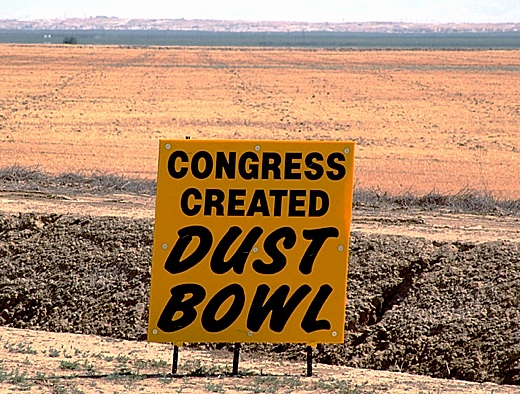
Image above: Sign on Highway 5 south of Mendota in Central Valley, California. From http://beetlebabee.wordpress.com/2009/06/01/dead-and-dying-californias-central-valley-dust-bowl
 
A few miles south of Mendota, a sign along the freeway proclaims, "Congress Created Dust Bowl." The land around it had been green with wheat sprouts before the spring rains petered out. Then pumping restrictions put a stop to water deliveries from the federal Central Valley Project, and farmer Joe Martini gave up on harvesting a once fertile 2,300-acre hillside.

Now it is nothing but powdery dirt. Martini blames the government, which has cut off water to farmers while still supplying coastal cities and maintaining water levels in the Sacramento River Delta, home to the federally protected delta smelt. "We're not gonna survive," he says. "We're gonna collect some insurance this year, and then maybe next year there is no insurance and we're done. We'll just let it die."

Farmers on the valley's west side have long known that their water supply could disappear at any time, but counted on it anyway. "The dollar signs overwhelmed the warning signs," says Richard Walker, an economic geography professor at the University of California-Berkeley and an expert on the Central Valley's economy. "It's the phenomenon of collective madness, collective belief, which is no different from Wall Street or American car companies."

Some farmers cling to the hope that an ever drier California will be forced back into the business of building massive water projects. "With California's booming population, and with the impact that global warming will cause to our snowpacks, we need more infrastructure," Gov. Schwarzenegger said in 2007, announcing a $4.5 billion proposal for new canals, dams, and reservoirs that he claimed would help restore the ailing Sacramento delta.

This summer, Democratic lawmakers sponsored a package of water bills that emphasized conservation over construction. The governor criticized the bills, even though they would allow him to appoint a panel with the authority to approve a controversial canal that would carry more water to the Central Valley and Southern California.

Standing in front of the bathtub rings of the shockingly empty San Louis Reservoir oustide Mendota, the governor quiets a cheering crowd of 10,000 at the conclusion of the four-day California March for Water. He was invited by the California Latino Water Coalition, the group of farmers and Latino politicians who organized the march to create pressure for new water projects.

"Cesar Chavez knew the power of a good march," Schwarzenegger declares, not mentioning that the United Farm Workers, which Chavez founded, boycotted the march, calling it a front for anti-union growers. "He led by example and he never stopped trying until he found a way. And this is exactly what we are going to do."

The desperate men and women who marched for days through the dust and heat see a quick solution to their woes: an executive order by Schwarzenegger or a deal with the Obama administration to create a to-hell-with-the-smelt exemption from the Endangered Species Act that would flood the fields again. There is little talk of the thirsty years ahead or what will have to be done to prepare for them.

Someone holds a sign that says, "Don't be a girlie man, be a governor—turn the pumps on." Cheers break out as Schwarzenegger proclaims that he will "not quit until we get the water," though he stops short of saying how he'll make it happen fast enough to stave off the drought. (The State Water Project has said it will provide farmers with 40 percent of their normal water allotment for the rest of the year; the federal Bureau of Reclamation has been providing just 10 percent.)

Afterward, Joseph RiofrĆ­o shakes the governor's hand and presses him for more details, but comes away discouraged. "I was expecting something bigger," the former mayor admits. "But it doesn't appear that a switch is going to be turned on."


We only have months, not years

SUBHEAD: International agreements take too long. We need a mobilization not seen since World War II. image above: Painting of shell factory in Detroit during early World War II. From http://www.history.army.mil/html/artphoto/pripos/earlyyears1.html By Lester Brown on 3 November 2009 in the Guardian - http://www.guardian.co.uk/environment/cif-green/2009/nov/03/lester-brown-copenhagen

For those concerned about global warming, all eyes are on December's UN climate change conference in Copenhagen. The stakes could not be higher. Almost every new report shows that the climate is changing even faster than the most dire projections of the Intergovernmental Panel on Climate Change (IPCC) in their 2007 report.

Yet from my vantage point, internationally negotiated climate agreements are fast becoming obsolete for two reasons. First, since no government wants to concede too much compared with other governments, the negotiated goals for cutting carbon emissions will almost certainly be minimalist, not remotely approaching the bold cuts that are needed.

And second, since it takes years to negotiate and ratify these agreements, we may simply run out of time. This is not to say that we should not participate in the negotiations and work hard to get the best possible result. But we should not rely on these agreements to save civilization.

Saving civilization is going to require an enormous effort to cut carbon emissions. The good news is that we can do this with current technologies, which I detail in my book, Plan B 4.0: Mobilizing to Save Civilization.

Plan B aims to stabilise climate, stabilize population, eradicate poverty, and restore the economy's natural support systems. It prescribes a worldwide cut in net carbon emissions of 80% by 2020, thus keeping atmospheric CO2 concentrations from exceeding 400 parts per million (ppm) in an attempt to hold temperature rise to a minimum. The eventual plan would be to return concentrations to 350 ppm, as agreed by the top US climate scientist at Nasa, James Hansen, and Rajendra Pachauri, head of the IPCC.

In setting this goal we did not ask what would be politically popular, but rather what it would take to have a decent shot at saving the Greenland ice sheet and at least the larger glaciers in the mountains of Asia. By default, this is a question of food security for us all.

Fortunately for us, renewable energy is expanding at a rate and on a scale that we could not have imagined even a year ago. In the United States, a powerful grassroots movement opposing new coal-fired power plants has led to a de facto moratorium on their construction. This movement was not directly concerned with international negotiations. At no point did the leaders of this movement say that they wanted to ban new coal-fired power plants only if Europe does, if China does, or if the rest of the world does. They moved ahead unilaterally knowing that if the United States does not quickly cut carbon emissions, the world will be in trouble.

For clean and abundant wind power, the US state of Texas (long the country's leading oil producer) now has 8,000MW of wind generating capacity in operation, 1,000MW under construction, and a huge amount in development that together will give it more than 50,000MW of wind generating capacity (think 50 coal-fired power plants). This will more than satisfy the residential needs of the state's 24 million people.

And though many are quick to point a finger at China for building a new coal-fired power plant every week or so, it is working on six wind farm mega-complexes with a total generating capacity of 105,000 megawatts. This is in addition to the many average-sized wind farms already in operation and under construction.

Solar is now the fastest growing source of energy. A consortium of European corporations and investment banks has announced a proposal to develop a massive amount of solar thermal generating capacity in north Africa, much of it for export to Europe. In total, it could economically supply half of Europe's electricity.

We could cite many more examples. The main point is that the energy transition from fossil fuels to renewables is moving much faster than most people realise, and it can be accelerated.

The challenge is how to do it quickly. The answer is a wartime mobilization, not unlike the US effort on the country's entry into the Second World War, when it restructured its industrial economy not in a matter of decades or years, but in a matter of months. We don't know exactly how much time remains for such an effort, but we do know that time is running out. Nature is the timekeeper but we cannot see the clock.

Climate Generation Gap

SUBHEAD: Meeting of the Elders, of 20th Century leaders, acknowledge failure on tackling climate issue.

By Sebnem Arsu & James Kanter 0n 31 October 2009 in New York Times -


Image above: Jimmy Carter with two grandsons at Elder conference. From NYT.  

Archbishop Desmond Tutu’s 3-year-old granddaughter, Onalenna, was puzzled. Her older cousin, Mungi, had just deflated a large, blow-up globe to demonstrate the imminent danger of climate change.

“Are we going to go the moon then?” Onalenna asked her grandfather.

“I don’t know, I will not be here,” Archbishop Tutu, 78, whispered in his granddaughter’s ear.

The rapid march of climate change up the global agenda has prompted a new, and often poignant, conversation between the generations and, in public, among a self-appointed elite.

At its core, that conversation is about whether some of the first beneficiaries of the wonders developed during the past century — like electricity at the flick of a switch — have the means, or the will, to help their descendants with the consequences of burning vast quantities of fossil fuels.

The conversation also is playing itself out across the planet as leaders, industrialists and citizens confront issues too costly for any single nation or generation to tackle alone.

For a group of 20th-century leaders called the Elders — whose members include Archbishop Tutu of South Africa, former President Jimmy Carter and Mary Robinson, a former Irish president — it also was a conversation with their families that they felt would be most usefully conducted before the cameras.

On Thursday, seeking to highlight the responsibility that older generations bear for climate change, members of the group traveled to Istanbul for a symbolic photo shoot accompanied by young relatives.

“This is a rather late wake-up call for all humanity to behave in a more responsible manner,” said Lakhdar Brahimi, 75, a veteran United Nations envoy who helped broker an agreement ending civil war in Lebanon, and who was accompanied by his grandchildren, Balthazar, 5, and Basile, 3. “It is the responsibility of today’s generations to act,” he said.

The Elders group was founded in 2007 with the help of Nelson Mandela. Its chairman, Archbishop Tutu, acknowledged that his generation bore the blame for not making tough choices sooner.

“We should have long ago used recyclable energy,” said Archbishop Tutu, who danced on a lawn as he entertained his grandchildren before the cameras.

“If we had used solar energy or wind power, we wouldn’t have been in this predicament.”

Bjorn Lomborg, a Danish political scientist who found fame as the author of the provocative book “The Skeptical Environmentalist,” said that by campaigning for swift agreement at a global climate conference in December in Copenhagen, the Elders risked backing expensive and ineffective solutions that might divert money from more effective measures to save lives and protect the planet.

“I have no doubt the Elders care deeply about their grandchildren,” Mr. Lomborg said, “but we should be concerned about all the other grandchildren who were not at the event and who run the risk of dying tomorrow from lack of sanitation, starvation and disease.”

Ms. Robinson, 65, said she sympathized with that view, but she added that coming generations would not have a planet to enjoy unless action was taken now to resolve the problem.

“Living in New York, I can see the preoccupation with issues like the health care debate, Afghanistan and Iraq, so it’s difficult to keep the issue on the front burner,” she said. “However, we should make it absolutely clear that it is the supreme political issue of our time.”

The Elders have in the past sought to raise consciousness about conflicts in the Middle East and in Sudan by using their access to high-level figures and staging publicity events.

“We are not restrained by timidity or political niceties or diplomatic propriety,” said Mr. Carter, 85. Many of the Elders praised the virtues of hybrid cars and, paradoxically for such a mobile group, they described advantages of using technology for virtual conferences rather than using airplanes to attend meetings.

Mr. Carter recounted the story of his wearing a sweater during the energy crisis of the 1970s, an act that prompted mockery from critics, who accused him of ineffectiveness in the face of rising energy prices. But from the perspective of a new generation, wearing the sweater looked prescient, he said.

“It got people to register thermostats in their homes and save electricity,” Mr. Carter said. “I never have been very afraid of people making fun. I do what I think is right, and I was right in the end.”