Showing posts with label Bailout. Show all posts

Central banks ARE the Crisis

SUBHEAD: We shouldn't let them conjure up trillions out of nothing, and use that power as a political tool.

By aul Ilargi Meijer on 25 uly 2017 for the Automatic Earth -
(https://www.theautomaticearth.com/2017/07/central-banks-are-the-crisis/)


Image above: The men who brought it down - Richard Reich, Alan Greenspan and Larry Somers.  From (https://www.dailymaverick.co.za/article/2014-02-24-how-close-we-were-to-a-global-financial-meltdown-in-2008-now-we-know/#.WXomwIqQxE4).

If there’s one myth -and there are many- that we should invalidate in the cross-over world of politics and economics, it‘s that central banks have saved us from a financial crisis. It’s a carefully construed myth, but it’s as false as can be. Our central banks have caused our financial crises, not saved us from them.

It really should -but doesn’t- make us cringe uncontrollably to see Bank of England governor-for-hire Mark Carney announce -straightfaced- that:
“A decade after the start of the global financial crisis, G20 reforms are building a safer, simpler and fairer financial system. “We have fixed the issues that caused the last crisis. They were fundamental and deep-seated, which is why it was such a major job.”
Or, for that matter, to see Fed chief Janet Yellen declare that there won’t be another financial crisis in her lifetime, while she’s busy-bee busy building that next crisis as we speak. These people are now saying increasingly crazy things, and that should make us pause.

Central banks don’t serve people, or even societies, as that same myth claims. They serve banks. Even if central bankers themselves believe that this is one and the same thing, that doesn’t make it true. And if they don’t understand this, they should never be let anywhere near the positions they hold.

You can pin the moment central banks went awry at any point in time you like. The Bank of England’s foundation in 1694, the Federal Reserve’s in 1913, the ECB much more recently. What’s crucial in the timing is where and when the best interests of the banks split off from those of their societies.

Because that is when central banks will stop serving those societies. We are at such a -turning?!- point right now. And it’s been coming for some time, ‘slowly’ working its way towards an inevitable abyss.

Over the past few years the Automatic Earth has argues repeatedly, along several different avenues, that American society was at its richest between the late 1960s and early 1980s. Yet another illustration of this came only yesterday in a Lance Roberts graph:

Anyone see a recovery in there? Lance uses 1981 as a ‘cut-off’ date, but the GDP growth rate as represented by the dotted line doesn’t really begin to go ‘bad’ until 1986 or so.

At the tail end of the late 1960s to early 1980s period, as the American economy was inexorably getting poorer, Alan Greenspan took over as Federal Reserve governor in 1987.

A narrative was carefully crafted by and for the media with Greenspan as an ‘oracle’ or even a ‘rock star’, but in reality he has been instrumental in saddling the economy with what will turn out to be insurmountable problems.

Greenspan was a major driving force behind the repeal of Glass-Steagall, which was finally established through the Gramm-Leach-Bliley act of 1999. This was an open political act by the Federal Reserve governor, something that everyone should have then protested, and still should now, but didn’t and doesn’t.

Central bankers should be kept far removed from politics, anywhere and everywhere, because they represent a small segment of society, banks, not society as a whole.

Because of the ‘oracle’ narrative, Greenspan was instead praised for saving the world. But all that Greenspan and his accomplices, Robert Rubin and Larry Summers, actually did in getting rid of the 1933 Glass-Steagall act separation between investment- and consumer banking was to open the floodgates of debt, and even more importantly, leveraged debt.

All part of the ‘financial innovations’ Greenspan famously lauded for saving and growing economies. It was all just more debt on top of more debt.

Greenspan et al ‘simply’ did what central bankers do: they represent the best interests of banks. And the world’s central bankers have never looked back. That most people still find it hard to believe that America -and the west- has been getting poorer for the past 30-40 years, goes to show how effective the narratives have been.

The world looks richer instead of poorer, after all. That this is exclusively because of rising debt numbers wherever you look is not part of the narratives. Indeed, ruling economic models and theories ignore the role played by both banks and credit in an economy, almost entirely.

Alan Greenspan left as Fed head in 2006, after having wreaked his havoc on America for almost two decades, right before the financial crisis that took off in 2007-2008 became apparent to the world at large. The crisis was largely his doing, but he has escaped just about all the blame for it. Good PR.

With Ben Bernanke, an alleged academic genius on the Great Depression, as Greenspan’s replacement, the Fed just kept going and turned it up a notch. It was no longer possible in the financial world to pretend that banks and people had the same interests, so the former were bailed out at the expense of the latter.

The illusionary narrative for the public, however, remained intact. What do people know about finance, anyway? Just make sure the S&P goes up. Easy as pie.

The narrative has switched to Bernanke, and Yellen after him, as well as Mario Draghi at the ECB and Haruhiko Kuroda at the Bank of Japan, saving the world from doom. But once again, they are the ones who are creating the crisis, not the ones saving us from it. They are saving the banks, and saddling the people with the costs.

In the past decade, these central bankers have purchased $20-$50 trillion in bonds, securities and stocks. The only intention, and indeed the only result, is to keep banks from falling over, increase their profits, and maintain the illusion that economies are recovering and growing.

They can only achieve this by creating bubbles wherever they can. Apart from the QE programs under which they bought all those ‘assets’, they used -and still do- another tool: lowering interest rates to the point where borrowing money becomes so cheap everyone can do it, and then do it some more.

It has worked miracles in blowing stock market valuations out of all realistic proportions, and in doing the same for housing markets in locations all over the globe.

The role of China’s central bank in this is interesting too, but it is such an open and obvious political tool that it really deserves its own discussion and narrative. Basically, Beijing did what it saw Washington do and thought: why hold back?

Fast forward to today and we see that we’ve landed in a whole new, and next, phase of the story. The world’s central banks are all stuck in their own – self-created – bubbles and narratives. They all talk about how they solved all the issues, and how they will now return to normal, but the sad truth is they can’t and they know it.

The Fed stopped purchasing assets through its QE program a while back, but it could only do that because Frankfurt and Japan took over. And now they, too, talk about quitting QE. Slowly, yada yada, because of control, yada yada, but they know they must.

They also know they can’t. Because the entire recovery narrative is a mirage, a fata morgana, a sleight of hand.

And that means we have arrived at a point that is new and very dangerous for the entire global economy and all of its people.

That is, the world’s central bankers now have an incentive to create the next crisis. This is because they know this crisis is inevitable, and they know their masters and protégés, the banks, risk suffering immensely or even going under.

‘Tapering’, or whatever you might call the -slow- end to QE and the -slow- hiking of interest rates, will prick and blow up bubbles one by one, and often in violent fashion.

When housing bubbles burst, economies lose the primary ingredient for maintaining -let alone increasing- their money supply: banks creating money out of thin hot air. Since the money supply is one of the key components of inflation, along with velocity of money, there will be fantastic outbursts of debt deflation. You’ve never seen -let alone imagined- anything like it.

The worst part of it is not government debt, though that, when financed with bond sales, is not not an instrument to infinity and beyond either. But the big hit to economies will be private debt.

Where in many bubble areas, and they’re too numerous too mention, eager potential buyers today fret over affordable housing supply, it’ll all turn on a dime and owners won’t be able to sell without being suffocated by crippling losses.

Pension funds, which have already suffered perhaps more than any other parties because of low interest ZIRP and NIRP policies, have switched en masse to riskier assets like stocks. Well, another whammy, and a bigger one, is waiting just outside the door. Pensions will be so last century.

That another crisis is waiting to happen, and that politics and media have made sure that just about no-one at all is aware of it, is one thing. We already knew this, a few of us. That the world’s main central bankers have an active incentive to bring about the crisis, if only by sitting on their hands long enough, is new. But they do.

Yellen, Draghi and Kuroda may opt to leave before pulling the trigger, or be fired soon enough. But whoever is in the governor seats will realize that unleashing a crisis sooner rather than later is the only option left not to be blamed for it.

Let the house of dominoes crumble now, and they can say “nobody could have seen this coming”, while at the same time saving what they can for the banks and bankers they serve. That option will not be on the table for much longer.

We should have never given them, let alone their member/master banks, the power to conjure up trillions out of nothing, and use that power as a political tool. But it is too late now.

.

Union pension will need bailout

SUBHEAD: Teamsters' Central States Pension Fund is under funded and won't meet obligations required by government.

By Tyler Durden on 12 May 2016 for Zero Hedge -
(http://www.zerohedge.com/news/2016-05-12/here-come-lot-angry-teamsters-one-americas-largest-pension-funds-demands-taxpayer-ba)


Image above: Teamsters protesting failure of pension funding. From original article.

Over the past few months, we have covered the unfolding saga (here and here) of the Central States Pension Fund, which handles retirement benefits for current and former Teamster union truck drivers across various states including Texas, Michigan, Wisconsin, Missouri, New York, and Minnesota, and is one of the largest pension funds in the nation, all the way through Kenneth Feinberg's rejection of the proposal to cut benefits on behalf of the Treasury.

When the proposal was rejected, we said that the final resolution will be in the form of an inevitable taxpayer-funded bailout
If the Treasury won't allow any pension cuts, and the government created safety net won't be there to keep the benefits flowing, how will the cash continue to flow to members? With the precedent now set by the Treasury that no cuts will be allowed, the answer will likely come in the form of a massive bailout.
As it turns out, that is precisely what fund director Thomas Nyhan believes as well. Nyhan said the rejection means the CSPF likely won't be able to offer another proposed fix without getting funding from Congress, either directly or through the Pension Benefit Guaranty Corp.

However with the PBGC also on its way to insolvency, and unable to shoulder the additional burden in world of zero and negative rates, that leaves us with... drum roll please... the US taxpayers, aka Congress, footing the bill.
"There are only two solutions. Either the plan receives more money or has to have fewer benefits. I'm hopeful that come probably 2017, we can actually all get to work on something that can provide a solution. If there is no legislation at any time, we're going to end up going to insolvency." Nyhan said. 
The full-court press is now on, as now everyone involved is calling on congress to step in. Visitors to CSPF's website this morning were greeed with a banner directing to a rescue plan website.

Before you could enter the rescue site a pop-up message is shown, simply saying that since congress effectively shut down the proposal, they can now stand up and pass legislation to bail the fund out.
"Central States strongly urges these members to act now to pass legislation that protects the pension benefits of the over 400,000 participants of Central States Pension Fund"
With the Treasury denying the possibility of pension cuts, the ball is now in Congress' court to initiate a bailout.

When it does, because it will, the flood gates will be open for the rest of the insolvent funds to come knocking with their hands out, and we can formally welcome the arrival of helicopter money - whether Yellen wants it or not - in the United States.

What follows is Tom Nyhan testifying before congress back in 2013, laying it out in very plain terms that without funding, or significant benefit cuts, the game is over.

"Unless the fund substantially reduces its liabilities, or receives a large influx of assets, it's projected become insolvent within ten or fifteen years, and at this point our options are very limited."
Nobody listened, and now - in this bold new age of pension fund crushing zero and negative interest rates - it is game over.


Image above: Thomas Nyham testimony egards to the Central States Pension Fund before the House Subcommittee on Health, Employment, Labor, and Pensions. From (https://youtu.be/xWJAmJFcWC0).

.

The War on Cash has begun

SUBHEAD: The war on paper money has been launched by the banks who want to deny you cash while charging you to hold your assets.

By Tyler Durden on 16 February 2016 for Zero Hedge  -
(http://www.zerohedge.com/news/2016-02-16/larry-summers-launches-war-us-paper-money-its-time-kill-100-bill)


Image above: A lot of $100 bills. From (http://www.dreamstime.com/royalty-free-stock-photo-cash-100-bills-image4599575).

[IB Publisher's note: As you are probably aware, electronic transactions are the rage - and the banks take a percentage from each credit card purchase. Wouldn't it be great fro them if the cash economy simply disappeared? They could get a cut of all sales. The argument that cash is the safe haven for criminal activities ignores that the biggest robber barons are the banksters themselves. Down with cash means down with freedom - and god forbid if the grid (matrix) goes down you'll find your plastic cards are worthless. This assault on private transactions is occurring worldwide. Along with Negative Interest Rate Policy (NIRP) and a credit only transactions it would seem the Bank Bubble is about to blow.]

Yesterday we reported that the ECB has begun contemplating the death of the €500 EURO note, a fate which is now virtually assured for the one banknote which not only makes up 30% of the total European paper currency in circulation by value, but provides the best, most cost-efficient alternative (in terms of sheer bulk and storage costs) to Europe's tax on money known as NIRP.

That also explains why Mario Draghi is so intent on eradicating it first, then the €200 bill, then the €100 bill, and so on.

We also noted that according to a Bank of America analysis, the scrapping of the largest denominated European note "would be negative for the currency", to which we said that BofA is right, unless of course, in this global race to the bottom, first the SNB "scraps" the CHF1000 bill, and then the Federal Reserve follows suit and listens to Harvard "scholar" and former Standard Chartered CEO Peter Sands who just last week said the US should ban the $100 note as it would "deter tax evasion, financial crime, terrorism and corruption."

Well, not even 24 hours later, and another Harvard "scholar" and Fed chairman wannabe, Larry Summers, has just released an oped in the left-leaning Amazon Washington Post, titled "It’s time to kill the $100 bill" in which he makes it clear that the pursuit of paper money is only just starting.

Not surprisingly, just like in Europe, the argument is that killing the Benjamins would somehow eradicate crime, saying that "a moratorium on printing new high denomination notes would make the world a better place."

Yes, for central bankers, as all this modest proposal will do is make it that much easier to unleash NIRP, because recall that of the $1.4 trillion in total U.S. currency in circulation, $1.1 trillion is in the form of $100 bills. Eliminate those, and suddenly there is nowhere to hide from those trillions in negative interest rate "yielding" bank deposits.

So with one regulation, the Fed - if it listens to this Harvard charlatan, and it surely will as more and more "academics" get on board with the idea to scrap paper money - could eliminate the value of 78% of all currency in circulation, which in effect would achieve practically the entire goal of destroying the one paper alternative to digital NIRP rates, in the form of paper currency.

That said, it would still leave gold as an alternative to collapsing monetary system, but by then there will surely be a redux of Executive Order 6102 banning the possession of physical gold and demanding its return to the US government.

Here is Summers' first shot across the bow in the upcoming war against U.S. paper currency, first posted in the WaPo:
It’s time to kill the $100 bill

Harvard's Mossavar Rahmani Center for Business and Government, which I am privileged to direct, has just issued an important paper by senior fellow Peter Sands and a group of student collaborators. The paper makes a compelling case for stopping the issuance of high denomination notes like the 500 euro note and $100 bill or even withdrawing them from circulation.

I remember that when the euro was being designed in the late 1990s, I argued with my European G7 colleagues that skirmishing over seigniorage by issuing a 500 euro note was highly irresponsible and mostly would be a boon to corruption and crime. Since the crime and corruption in significant part would happen outside European borders, I suggested that, to paraphrase John Connally, it was their currency, but would be everyone’s problem. And I made clear that in the context of an international agreement, the U.S. would consider policy regarding the $100 bill. But because the Germans were committed to having a high denomination note, the issue was never seriously debated in international forums.

The fact that — as Sands points out — in certain circles the 500 euro note is known as the “Bin Laden” confirms the arguments against it. Sands’ extensive analysis is totally convincing on the linkage between high denomination notes and crime. He is surely right that illicit activities are facilitated when a million dollars weighs 2.2 pounds as with the 500 euro note rather than more than 50 pounds as would be the case if the $20 bill was the high denomination note. And he is equally correct in arguing that technology is obviating whatever need there may ever have been for high denomination notes in legal commerce.

What should happen next? I’d guess the idea of removing existing notes is a step too far. But a moratorium on printing new high denomination notes would make the world a better place. In terms of unilateral steps, the most important actor by far is the European Union. The €500 is almost six times as valuable as the $100. Some actors in Europe, notably the European Commission, have shown sympathy for the idea and European Central Bank chief Mario Draghi has shown interest as well. If Europe moved, pressure could likely be brought on others, notably Switzerland.

I confess to not being surprised that resistance within the ECB is coming out of Luxembourg, with its long and unsavory tradition of giving comfort to tax evaders, money launderers, and other proponents of bank secrecy and where 20 times as much cash is printed, relative to gross domestic, compared to other European countries.

These are difficult times in Europe with the refugee crisis, economic weakness, security issues and the rise of populist movements. There are real limits on what it can do to address global problems. But here is a step that will represent a global contribution with only the tiniest impact on legitimate commerce or on government budgets. It may not be a free lunch, but it is a very cheap lunch.

Even better than unilateral measures in Europe would be a global agreement to stop issuing notes worth more than say $50 or $100. Such an agreement would be as significant as anything else the G7 or G20 has done in years. China, which is hosting the next G-20 in September, has made attacking corruption a central part of its economic and political strategy. More generally, at a time when such a demonstration is very much needed, a global agreement to stop issuing high denomination notes would also show that the global financial groupings can stand up against “big money” and for the interests of ordinary citizens.


Image above: A 500euro bill with escaping bankers. From original article.

And then there was this from Bloomberg:
Lawrence Summers urged countries around the world to agree to stop issuing high-denomination banknotes, adding his voice to intensifying criticism of a practice alleged by police to abet crime and corruption.

“Even better than unilateral measures in Europe would be a global agreement to stop issuing notes worth more than say $50 or $100,” Summers said on his blog on Tuesday. “Such an agreement would be as significant as anything else the G-7 or G-20 has done in years.”

The 500-euro note has been in circulation since the paper currency went live in 2002. British banks and money-exchange services stopped distributing the bills in 2010 after a report showed that 90 percent of demand for them came from criminals. ECB Executive Board member Yves Mersch said earlier this month that his institution still wanted to see “substantiated evidence” that the notes facilitate illegal activity.

For now, “I’d guess the idea of removing existing notes is a step too far,” Summers wrote. “But a moratorium on printing new high-denomination notes would make the world a better place.”

First they came for the $100 bill and nobody said anything...

.

Congress looting the Commons

SUBHEAD: Spending bill to continue government to have FDIC cover Big Bank gambling and ponzi schemes.

By Heidi Przybyla on 11 December 2014 for Bloomberg News -
(http://www.bloomberg.com/politics/articles/2014-12-10/congress-deal-to-avoid-shutdown-includes-victory-for-banks-2)

[IB Publisher's note: This bill passed the House late 12/11/14 and is in the hands of the Senate. The Banksters are in the driver's seat but many passengers are jumping off the bus about to plunge.]


Image above: Bankers looting Main Street illustration by Victor Juhasz. From (http://www.rollingstone.com/politics/news/looting-main-street-20100331).

The U.S. House is set to pass a $1.1 trillion spending bill that includes a banking provision opposed by many Democrats as a giveaway to large institutions.

Current funding for the government ends today, and the measure would finance most of the government through September 2015. The House also plans to pass a two-day stopgap spending bill to give the Senate until Dec. 13 to vote on the measure and avoid a government shutdown.

The banking language, insisted upon by Republicans, would ease rules enacted to protect taxpayers against bank losses after souring derivatives trades helped cause the 2008 financial crisis. The dispute over the banking rule is a preview of Republican plans to roll back other business regulations when they take control of both chambers in 2015.

The provision would put “taxpayers back on the hook for Wall Street’s riskiest behavior,” House Minority Leader Nancy Pelosi, a California Democrat, said yesterday.

Though Pelosi opposes the banking provision, she stopped short of urging fellow House Democrats to vote against the bill, said a leadership aide who sought anonymity.

A deal on the measure was announced Dec. 9 after Senate Democratic negotiators accepted the banking rule changes and Republican demands on other policy provisions. Republicans oppose changes to the measure and said they’re not reopening negotiations.

Democratic Votes 

House Republicans say they will have the votes to pass the bill without support from Pelosi because other Democrats, including retiring Representative Jim Moran of Virginia, are willing to back it.

House Speaker John Boehner told reporters yesterday he looks “forward to it passing with bipartisan majorities in the House and the Senate in the coming days.”

Senate opponents led by Elizabeth Warren of Massachusetts aren’t threatening to hold the bill up. Chief negotiator Barbara Mikulski of Maryland, the Senate Appropriations chair, is standing by the deal.

The banking provision would let JPMorgan Chase & Co., Citigroup Inc. and other lenders keep swaps trading in units with federal backstops.

“This is about reckless behavior,” Warren said at a news conference. “It’s about a giveaway to the largest financial institutions in this country.”

Horrible Choice
Second-ranking Senate Democrat Richard Durbin of Illinois said he didn’t know if he would vote for the spending bill with the banking changes.

“It is just an invitation for another financial disaster,” Durbin said. “It is a horrible choice between a bill of over a trillion dollars in spending, with a lot of very important provisions in it, and some absolutely awful language put in by special interests in the House.”

Though Democrats including Mikulski aren’t pleased about the policy changes, they said they beat back dozens of other provisions that Republicans had sought. Those proposed revisions focused on environmental and labor protections.

While President Barack Obama will maintain the power of his veto pen, Republicans are likely to try to force anti-regulation measures by attaching them to must-pass spending bills and other legislation.
White House spokesman Josh Earnest said yesterday, “We are going to give this piece of must-pass legislation the thorough attention and review it deserves.”

“The president does have a veto power,” Earnest said.

Immigration Fight

The deal puts off a confrontation over immigration until early 2015. The Department of Homeland Security, responsible for immigration policy, would be financed only through Feb. 27. Republicans want to use the agency’s spending bill to block Obama from easing deportation rules for millions of undocumented immigrants.

Last year, Republican efforts to defund Obama’s health care law led to a 16-day partial government shutdown.

In addition to the Dodd-Frank measure on swaps trading, the funding measure would allow exceptions to clean-water laws for agricultural refuse, and block the District of Columbia from spending money to legalize marijuana following a voter-approved measure allowing possession of as much as 2 ounces for personal use.

The plan would roll back safety rules on rest for truck drivers, ignoring the pleas of consumer activists and Transportation Secretary Anthony Foxx.

Congested Roads

The provision would temporarily suspend rules while a study is conducted about the number of trucks driven on congested roads. Under the change, truckers would be able to work as many as 82 hours a week.

The spending bill would allow a tenfold increase in donations that individuals can make to national political parties each year, to $324,000 from $32,400, according to a statement by Fred Wertheimer, president of Democracy 21. The group advocates for changes to campaign finance laws.

Donors would be able to give $97,200 a year to each of three party committees for conventions, to pay for building funds and to finance the expenses for recounts and legal challenges to election results, Wertheimer said in a statement.

The bill would bar the Department of Housing and Urban Development from starting a program to reduce mortgage-insurance premiums for borrowers who attend housing counseling sessions. It would stop HUD from funding increased oversight of mortgage originations by charging a new fee to lenders.

Gun Manufacturers 

 The plan includes a proposal sought by the National Rifle Association that lets gun manufacturers use lead to produce ammunition, and a labor provision exempting claim adjusters from overtime requirements during major disasters.

The measure would seek to shore up the Pension Benefit Guaranty Corp. by allowing some underfunded multiemployer pension plans to reduce benefits. The provision reflects an agreement by House Education and the Workforce Committee Chairman John Kline, a Minnesota Republican, and senior Democrat George Miller, a California Democrat.

The measure also includes an extension until Oct. 1, 2015, of a ban on taxing Internet access. It would provide $5.4 billion in emergency funds to respond to the Ebola outbreak.

The bill would require the Postal Service to continue delivering on Saturdays and to keep all post offices open.

Export-Import Bank

The Export-Import Bank would be allowed to continue financing overseas coal-fired power projects. As part of Obama’s effort to combat climate change, Ex-Im had revised its guidelines to bar such funding for plants that lack carbon-capture technology.

Republican proposals omitted from the bill include revisions to District of Columbia gun laws and six other Dodd-Frank-related policy proposals, according to a Democratic aide who sought anonymity.

The aide said Democrats also headed off 25 changes to environmental regulations, including those governing greenhouse gases, fish and wildlife and ceiling fans as well as one blocking climate research.


Congress puts coal in your stocking

SUBHEAD: Congress makes subsidizing coal plant construction overseas to goose coal production in US.

By Kate Sheppard on 10 December 2014 for Huffington Post - 
(http://www.huffingtonpost.com/2014/12/10/omnibus-coal-financing_n_6304622.html)

The 1,000-page omnibus spending package released Tuesday night is reigniting a fight over rules for U.S. financing of coal plants abroad.

In October 2013, the Treasury Department announced that it would stop providing funding for conventional coal plants abroad, except in "very rare" cases. And in December 2013, the Export-Import Bank announced a new policy that would restrict financing for most new coal-fired power plants abroad. The bank, often called Ex-Im, exists to provide financial support to projects that spur the export of U.S. products and services. The change in coal policy aligned with President Barack Obama's June 2013 call to end U.S. funding of fossil fuel energy projects abroad unless the products include carbon capture technology.

But the language in the omnibus blocks both Ex-Im and the Overseas Private Investment Corporation (OPIC), the U.S.'s development finance institution, from using any funds in the bill to enforce these new restrictions on coal projects.

Rep. Hal Rogers (R-Ky.), chair of the House Committee on Appropriations, touted this prohibition in his statement on the spending package. He said the measure would help "to increase exports of U.S. goods and services." Rogers told The Hill that coal exports "are just about the only bright light in the coal business these days."

Environmental groups have fought for years to get the government's financial institutions to stop funding fossil fuel projects abroad, including a number of coal-fired power plants, mines, pipelines and natural gas export terminals. Friends of the Earth President Erich Pica said in a statement that including this rider in the omnibus "undercuts one of the most important contributions President Obama has made to climate policy internationally."

"This continued desperate attempt by Republicans to prop up the moribund coal industry is a fools errand," Justin Guay, associate director of the international climate program at the Sierra Club, told The Huffington Post. "The coal industry is a dead man walking; it's time to align our economy with an industry that actually has a future."See also:
Ea O Ka Aina: Derivative Losses 12/9/14

.

Bank Derivative Losses

SUBHEAD: Among other things the rapidly plunging price of oil could potentially mean gigantic losses for the big banks.

By Michael Snyder on 7 December 2014 for Economic Collapse-
(http://theeconomiccollapseblog.com/archives/new-law-make-taxpayers-potentially-liable-trillions-derivatives-losses)


Image above: Illustration by Victor Juhasz of bankster holding world hostage. From (http://www.rollingstone.com/politics/news/gangster-bankers-too-big-to-jail-20130214).

If the quadrillion dollar derivatives bubble implodes, who should be stuck with the bill?

Well, if the “too big to fail” banks have their way it will be you and I. 

Right now, lobbyists for the big Wall Street banks are pushing really hard to include an extremely insidious provision in a bill that would keep the federal government funded past the upcoming December 11th deadline.

This provision would allow these big banks to trade derivatives through subsidiaries that are federally insured by the FDIC.  What this would mean is that the big banks would be able to continue their incredibly reckless derivatives trading without having to worry about the downside.

If they win on their bets, the big banks would keep all of the profits.  If they lose on their bets, the federal government would come in and bail them out using taxpayer money.  In other words, it would essentially be a “heads I win, tails you lose” proposition.

Just imagine the following scenario.  I go to Las Vegas and I place a million dollar bet on who will win the Super Bowl this year.  If I am correct, I keep all of the winnings.  If I lose, federal law requires you to bail me out and give me the million dollars that I just lost.
Does that sound fair?

Of course not!  In fact, it is utter insanity.  But through their influence in Congress, this is exactly what the big Wall Street banks are attempting to pull off.  And according to the Huffington Post, there is a very good chance that this provision will be in the final bill that will soon be voted on…
According to multiple Democratic sources, banks are pushing hard to include the controversial provision in funding legislation that would keep the government operating after Dec. 11. Top negotiators in the House are taking the derivatives provision seriously, and may include it in the final bill, the sources said.
Sadly, most Americans don’t understand how derivatives work and so there is very little public outrage.

But the truth is that people should be marching in the streets over this.  If this provision becomes law, the American people could potentially be on the hook for absolutely massive losses…
The bank perks are not a traditional budget item. They would allow financial institutions to trade certain financial derivatives from subsidiaries that are insured by the Federal Deposit Insurance Corp. — potentially putting taxpayers on the hook for losses caused by the risky contracts.
This is not the first time these banks have tried to pull off such a coup.  As Michael Krieger of Liberty Blitzkrieg has detailed, bank lobbyists tried to do a similar thing last year…
Five years after the Wall Street coup of 2008, it appears the U.S. House of Representatives is as bought and paid for as ever. We heard about the Citigroup crafted legislation currently being pushed through Congress back in May when Mother Jones reported on it. Fortunately, they included the following image in their article:

http://www.islandbreath.org/2014Year/12/141209wordingbig.jpg
Click to enlarge image above.

Unsurprisingly, the main backer of the bill is notorious Wall Street lackey Jim Himes (D-Conn.), a former Goldman Sachs employee who has discovered lobbyist payoffs can be just as lucrative as a career in financial services. The last time Mr. Himes made an appearance on these pages was in March 2013 in my piece: Congress Moves to DEREGULATE Wall Street.
Fortunately, it was stopped in the Senate at that time.

But that is the thing with bank lobbyists.  They are like Terminators – they never, ever, ever give up.
And they now have more of a sense of urgency then ever, because we are moving into a period of time when the big banks may begin losing tremendous amounts of money on derivatives contracts.

For example, the rapidly plunging price of oil could potentially mean gigantic losses for the big banks. 

Many large shale oil producers locked in their profits for 2015 and 2016 through derivatives contracts when the price of oil was above $100 a barrel.  As I write this, the price of oil is down to $65 a barrel, and many analysts expect it to go much lower.

So guess who is on the other end of many of those trades?

The big banks.

Their computer models never anticipated that the price of oil would fall by more than 40 dollars in less than six months.  A loss of 40, 50 or even 60 dollars per barrel would be catastrophic.
No wonder they want legislation that will protect them.

And commodity derivatives are just part of the story.  Over the past couple of decades, Wall Street has been transformed into the largest casino in the history of the world.  At this point, the amounts of money that these “too big to fail” banks are potentially on the hook for are absolutely mind blowing.
As you read this, there are five Wall Street banks that each have more than 40 trillion dollars in exposure to derivatives.  The following numbers come from the OCC’s most recent quarterly report (see Table 2)…
JPMorgan Chase
Total Assets: $2,520,336,000,000 (about 2.5 trillion dollars)
Total Exposure To Derivatives: $68,326,075,000,000
(more than 68 trillion dollars)

Citibank

Total Assets: $1,909,715,000,000 (slightly more than 1.9 trillion dollars)
Total Exposure To Derivatives: $61,753,462,000,000
(more than 61 trillion dollars)

Goldman Sachs

Total Assets: $860,008,000,000 (less than a trillion dollars)
Total Exposure To Derivatives: $57,695,156,000,000
(more than 57 trillion dollars)

Bank Of America

Total Assets: $2,172,001,000,000 (a bit more than 2.1 trillion dollars)
Total Exposure To Derivatives: $55,472,434,000,000
(more than 55 trillion dollars)

Morgan Stanley

Total Assets: $826,568,000,000 (less than a trillion dollars)

Grand Total
Total Exposure To Derivatives: $44,134,518,000,000
(more than 44 trillion dollars)
Those that follow my website regularly will note that the derivatives exposure for the top four banks has gone up significantly since I last wrote about this just a few months ago.

Do you want to be on the hook for all of that?

Keep in mind that the U.S. national debt is only about 18 trillion dollars at this point.

So why in the world would we want to guarantee losses that could potentially be far greater than our entire national debt?

Only a complete and utter fool would financially guarantee these incredibly reckless bets.
Please contact your representatives in Congress and tell them that you do not want to be on the hook for the derivatives losses of the big Wall Street banks.

When this derivatives bubble finally implodes and these big banks go down (and they inevitably will), we do not want them to take down the rest of us with them.

.

We are the Pea

SUBHEAD: The pea under the walnut shell can’t see much outside, but it can certainly feel the earth tremble.

By James Kunstler on 1 Jul 2013 for Kunstler.com -
(http://kunstler.com/clusterfuck-nation/we-are-the-pea/)


Image above:The classic shell game with walnut shells hiding the pea. From (http://www.soxfirst.com/50226711/deutsche_banks_accounting_shell_games.php).

The political air lies thick and heavy upon us, like the subtropical wedge of atmospheric sludge that has bogged down the northeast USA for weeks of soupy gray days when there is nothing to do but wonder when things will become unstuck. If the world is an organism, something is wrong with its blood. That blood is money, which allows the “developed” nations to run their advanced techno-industrial economies. 

Only the “money” is not exactly what we suppose it is, that is, colored paper coupons representing claims on future work or tangible collateral. The “money” is a matrix of counterparty entanglements so abstruse and impenetrable that all the vicars of Christendom (plus the mullahs of Islam, the monks of  Mahayana, and the Op-Ed flunkies at The New York Times) would not avail to describe its metaphysical substance. Rather, a cosmic shell game is being played and we are the pea.

Unlike other commentators, I don’t see this as a conspiracy of one-percenters, Rothschilds, Bilderbergers, and United Nations intriguers. Rather, it is just a sticky pass in world history. Things have gone a certain way for us for a long time, and now they can’t, and the inertia from all those decades of doing and being what we were persists in the illusion of motion, like the sound of a truck that still rings in your ears after it has passed by. 

So we, the pea, sit in the dark under our cosmic walnut shell, waiting to see what happens next.

When the Great Bernanke spoke not long ago, an ominous rattling was heard throughout the banking system as of things shaking loose. Even if nobody quite understood exactly what money was anymore, an intimation wafted on the still, muggy air that there was liable to be less of it, at least in the form that The Wall Street Journal pretended to understand — a particular digital carry-trade between the US Treasury and the Federal Reserve. 

Markets puked at Bernanke’s mild utterances as though he was Thor flinging a thunderous hammer at them. The gold market, already punch-drunk, went reeling into the roadside weeds, covered indecorously in its own vomit — leading many to suppose that gold would soon be as precious as sheetrock. 

Then, the Great Bernanke, via subordinates, tapered his tapering talk and a nervous, tentative, march forward resumed into the summer pea soup of events. Here we are, waiting, waiting in the murk, for the sound of shoes dropping.

If you listen carefully enough, you can hear a few things in motion distantly. The mobs roistering in surprising places — Sweden, Turkey, Brazil — ought to unnerve even the quants immersed in their charts and auguries. Something wicked this way emanates from Japan. It has the outline of a political death-wish and is being played out with the sharp instruments of capital. The Japanese, I suspect, have at least had enough of uncertainty and have elected to move toward resolution, whatever that may hold. 

One thing it will mean is that the hands of bankers elsewhere around the world will be forced by what Japan does. Interest rates, for example, do not exist in exquisite isolation but only in relation to other things, most particularly that money earlier alluded to, of which nobody knows the value. The answer to that may lie in the riddle wrapped in a mystery inside an enigma known as derivatives.

My own guess is that we’ll discover the value of gold is not equivalent to its weight in sheetrock. The third quarter of 2013 might go down in history as the great moment of price re-discovery in a world that thought — for a while — that the price of things can be whatever you say it is. Historians of the future, squatting in the plastic and silicon midden-heaps of bygone technocracy, may note that FASB Rule 157 provoked a four-year psychotic episode of worldwide accounting fraud in which anything could mean anything. 

That only goes on so long until civilizations shudder and fall. 

The pea under the walnut shell can’t see much outside, but it can certainly feel the earth tremble.

.

The music will stop before 2014

SUBHEAD: Hope you have a chair picked out. The Fed indicates when goosing the financial market will end.

By Staff of Phoenix Capital Research on 13 May 2013 -
(http://www.zerohedge.com/contributed/2013-05-13/fed-signals-music-will-stop-2014)


Image above: Students play musical chairs during Students Week 2009 at Pir Mehr Ali Shah Arid Agriculture University, in Rawalpindi, India. From (http://www.onlineschools.org/education-debate/separating-learning-gimmicks-from-the-scientifically-sound/).

After the market’s close last Friday, Jon Hilsenrath at the Wall Street Journal released an article implying that the Fed might remove or reduce its QE programs before the year end.

The reason this matters is because Hilsenrath is thought to be an unofficial mouthpiece for the Fed. Time and again he’s released articles hinting at the Fed’s future policies in advance. And many believe senior Fed officials such as Bernanke will personally leak ideas to him to test the public’s response to said ideas in advance.

So many believe that Hilsenrath’s Friday article was indeed the Fed preparing the markets for a tapering or removal of QE before the year end. Given that the entire US market is moving lockstep with Fed activity (the Fed’s balance sheet has literally reflated the NYSE tick for tick post 2009) this is a huge deal.

This supports our view that the Fed is aware stocks are in a bubble and is attempting to prep the market in advance for less liquidity.

Since QE 2, the negative effects of QE (higher costs of living) have outweighed the positive effects (higher stock prices) by a wide margin. Only 52% of US households own stocks… but everyone is paying for higher food and higher energy prices.

On a deeper level, QE is a drug for the market. There is no evidence in history that QE creates jobs or growth Both Japan and the UK have launched QE equal to over 20% of their GDP, neither have experienced a significant pickup in jobs or GDP growth as a result.

So QE was always about one thing only: pushing the market higher. But now the market is completely detached from economic realities. There is a word for this… it’s “bubble.”

The Fed knows this and is now trying to prepare the market for withdrawal. But the market is on total life support from the Fed. Take away the Fed punchbowl and the party stops.

Between this, rampant insider selling (makes you wonder if the people running the companies know something about the economy the Fed is ignoring), the downturn in economic data in the US, and the ongoing disaster that is the US jobs market, the market is priced for a total collapse.

.

No Mo' PoMo

SUBHEAD: The world is about to find out that you really can't get something for nothing. It will be a harsh lesson.

By Jame Kunstler on 13 May 2013 for Kunstler.com -
(http://kunstler.com/blog/2013/05/no-mo-pomo.html)


Image above: From (http://williambanzai7.blogspot.com/2010/09/wall-street-kleptocracy-game.html).

Whenever the Federal Reserve wants to tweak the dials of the economy -- or pretend that it can -- it turns first to its sock puppet at The Wall Street Journal, John Hilsenrath, and "leaks" a rumor of policy change (here). They like to do this late on Fridays when financial markets are about to close, so that market players will have a whole weekend to ponder the Fed's actions like medieval viziers reading goat entrails.

Last Friday's puddle of steaming guts was a supposed preview of the Fed's "exit strategy" from its reckless policy of "quantitative easing" or "money" creation (or "liquidity," if you like). In other words, they supposedly intend to stop juicing the financial markets with fake wealth, i.e. capital not accumulated from real productive activity, but just fictively created on computer hard drives.

For the past year they have been doing this to the tune of $85 billion a month, "buying" US Treasury bonds and bills and an assortment of miscellaneous securities (mostly trash that can't be pawned off on anyone else) through their so-called "primary dealer" bank cohorts, the too-big-to-fail usual suspects, who "earn" hefty transaction fees in the process of conveying all these pixels from Point A to Point B. These interventions are called Permanent Open Market Operations, or PoMo.

The theory all along has been that this $85 billion a month would seep down to Main Street to provoke spending (increasing the "velocity of money) and therefore "jump start" the economy. The theory has proven itself to be complete horseshit, of course. All it has done is suppress interest rates on bonds, depriving old people of income off their savings by so doing. It also artificially jacked up reckless lending on loans for houses, cars, and college degrees, juiced the share price of stocks, and boosted food prices.

Meanwhile, an increasingly former middle class languishes in a purgatory of foreclosure, penury, and desperation. The Fed can't really do anything to help them. It can only burden them with more easy-credit debt, especially their college-age children. But ours is a financialized economy and finance is too abstruse for most ordinary people to understand, so they just muddle along in a fog of dashed hopes and repossession.

Lately, though, the financial markets at the heart of the financialized economy -- that is, an economy based on buying and selling increasingly dubious "paper" assets rather than on capital formation through producing things of value -- are sending distress signals. The aforesaid efforts at economic dial-tweaking have only produced distortions and perversions in the basic functioning of the markets they're designed to tweak.

  • They pervert the "price discovery" mechanism by dumping "free money" into equity markets.
  • They distort "risk premiums" by steering money out of savings, where it earns less than nothing, into riskier investments subject to the vagaries of everything from weather (commodity markets) to control fraud (bank stocks) to geopolitics (Toyota stock).
  • They debauch market expectations in general by implying permanent artificial life-support.
  • They promote market gaming such as front-running equity prices via high frequency trading on computers, naked shorting (pretending to borrow shares that, in fact, do not exist) and the abuse of futures markets -- lately illustrated in the ongoing smash of paper gold and silver contracts, with the side effect of driving yet more money into stock markets.
  • Finally, they undermine the meaning and value of money itself, which is the most dangerous game of all because when people lose confidence in their national currency, nations dissolve in political chaos.
Despite the aura of control, Fed officials (and casual observers) may sense things spinning out of control. Of course, hyper-fragility is exactly the effect that all the Fed's own actions would predictably lead to. When you divorce truth from reality, strange things are bound to happen. The Fed ventriloquists who speak through Hilsenrath at The Wall Street Journal suggest they would accomplish their exit from the current $85billion-a-month QE policy in a set of "halting steps" by irregularly dialing down QE issuance month-by-month to fine-tune the results on-the-fly, as markets may require.

This is also complete horseshit because they could only accomplish controlled tweakings by somehow signaling their intentions beforehand through some lackey like Hilsenrath. Otherwise, they could not pretend to control the results of their actions. They might as well just throw spaghetti at the wall to see if it sticks. Unfortunately, the "halting steps" idea would only provide even more opportunities for selective, complex front-running, shorting, and gaming -- which is to say setting up more dangerous behavior with more uncertain and possibly destructive outcomes.

Anyway, there's no evidence at this moment that anyone believes what was leaked to Hilsenrath. It could easily be more smoke and mirrors aimed at concealing the fact that the Federal Reserve has no idea what it has been doing and fears the consequences.

There is one thing that we know for sure in this strange period when bankers have tried to manage reality in the absence of truth: that advanced industrial-technological economies designed to run on $20-a-barrel oil can't run on $100-a-barrel oil, and that is why the US economy was subject to financialization in the first place -- to offset declining productive activity by an attempt to get something for nothing.

Notice that this macro-trend coincided exactly with the rise of legalized gambling all over America. That is how the idea that you could get something for nothing got to be normal.

The world is about to find out that you really can't get something for nothing. It will be a harsh lesson.

.

Cyprus Seizure of Savings

SUBHEAD: Panicked Europeans rush ATMs as leaders move to seize funds directly from bank account holders.

SATURDAY

By Mac Slavo on 16 March 2013 for SHTF Plan -
(http://www.shtfplan.com/headline-news/confiscation-european-leaders-move-to-seize-funds-directly-from-bank-account-holders_03162013)


Image above: Detail of painting of Pandora by Jules Joseph Lefebvre (1836-1911).  From (http://www.scanopia.com/jules-joseph-lefebvre/pandora-2.html).

Over the last few years political and financial leaders in Europe and the United States have implemented policies, regulations and bailouts costing global taxpayers trillions of dollars with the promise that these measures would lead to economic growth and recovery.

What happened in Europe today is yet further proof that nothing they’ve done has fixed the underlying fundamental issues surrounding the events that led to the crash of 2008.

For those who don’t believe the government is prepared to take extreme measures that may include the seizing of retirement accounts, cash savings or even gold, look no further than Cyprus, the latest recipient of bank bailouts.

As of right now, citizens of Cyprus are scrambling to withdraw funds from their bank accounts after the EU, with agreement from the Cypriot government, announced they will decimate funds held in personal bank accounts to the tune of up to 10% of existing deposits.

You read that right.

The European Union has made the determination that the people of Cyprus are now responsible for the hundreds of billions of dollars in bad bets made by their government and bank financiers, and they are moving to confiscate money directly from the bank accounts of every citizen in the country.
Restrictions have been imposed to stop people emptying their accounts or moving their money out the country after the Cypriot government announced that up to ten per cent of deposits will be seized and used to bailout the island’s crisis-hit banking system.
The deal with other eurozone finance ministers is the first time that ordinary citizens’ deposits have been directly raided in this way.
…
One furious expat said: ‘This is plain theft. I’d love to hear someone explain to me why it isn’t.’
…
Under the deal, all bank deposits over €100,000 will be hit with a levy of 9.9 per cent. Those with smaller savings will pay 6.75 per cent.
…
The move sparked panic and violent protests yesterday as crowds desperately tried to withdraw their money at cash machines. 
…
‘Why would you risk putting your money in Greek, Spanish or Portuguese banks after this?’
British expats were stunned by the news, with many left high and dry by the restrictions on accounts.
Cash machines had been working, but many ran out of notes because of the panic withdrawals.
…
But financial experts said the raid – designed to stop Cyprus crashing out of the euro, potentially destroying the currency – would send shock waves through the eurozone.
If savers in other troubled nations fear their accounts might be next, they could withdraw their money and spark a catastrophic run on the  banks.
Source: Daily Mail
They’re calling it a “tax.”

As Market Ticker’s Karl Denninger notes, “Like hell that’s a tax. That’s direct confiscation of the funds of people who did nothing wrong!”

It should now be obvious. There is no recovery. There never was.

No matter where you live, your government is likely preparing measures to deal with the coming financial and economic collapse. This means they are going to be coming for anything of value that they can get their hands on.

If you have the majority of your net worth allocated in bank accounts, money market funds, retirement plans, stock markets or the host of other ‘safe’ assets recommended by your financial adviser, then you are playing Russian roulette.

And in this version there’s a bullet in every chamber.

When they come, they will take everything they can.


As Cyprus goes so goes Europe

SUNDAY


By Raul Ilargi Meijer on 17 March 2013 for Automatic Earth -
(http://theautomaticearth.com/Finance/the-cyprus-deal-is-already-under-threat-of-course.html)

One day after it was agreed on and announced by the Eurogroup and Cyprus president Nicos Anastasiades, the deal that would turn the Eurozone into a Pandora's box like no other EU measure to date has done looks like it may never reach the finish line. The Cypriot parliament, in which freshly elected Anastasiades holds just 20 of 56 seats, has pushed a vote on the deal forward until Monday, a clear sign that the president's political adversaries will not easily be locked into an agreement that is obviously and for good reason hugely unpopular.

As I wrote yesterday in Bank Run In Cyprus; Who's Next?, this very curious looking deal has the potential to kill off confidence in the EU banking sector practically overnight. If bank deposits in Cyprus are not guaranteed (even if only up to a maximum), there is no reason for people in other Eurozone countries to trust their deposits will be treated any differently. In Cyprus, if the deal is voted through parliament, depositors will lose between 6.75% and 9.99% of their money, but there is nothing to keep the EU/IMF/ECB troika from imposing 20% or 40% (or you name it cuts) on deposits in Italy, Spain, France, take your pick.

There are reports that Anastasiades accepted the "agreement" because Germany made it a do or die deal, but that still doesn't explain why Berlin would take such an obvious risk with the entire EU banking sector. Although I have to admit the risk apparently wasn't recognized yesterday by 95% or more of the international press, so you might be tempted to believe that neither Germany nor the rest of the Eurogroup saw it either. But that would be excessively stupid. And incompetent as they are, even I don't think they're that far gone.

I would think it's more likely that the 37% of deposits in Cyprus banks that are "foreign", i.e. largely Russian, have pushed European politicians into a crowdpleasing mode - punish the criminals! - that made them overlook broader consequences. But, really, that doesn't totally convince me either. Though I was greatly amused to read that Britain will compensate the 3500 troops it has stationed on Cyprus that have bank accounts there.

Still, when you see things happening that seem this far out of field, there's often an ulterior motive behind them. Like if the Eurogroup counted all along on Cyprus not accepting the terms of the deal forced upon it. Or Anastasiades counting on the fact that the deal would never be ratified by parliament.

Meanwhile, I'm curious to know who the Cypriot politicians on all sides of the aisle are talking to today. And yes, Beppe Grillo comes to mind again, Niall Farage perhaps. Who else can they expect any support from?

More tomorrow (the vote coincides with a national carnival holiday) and Tuesday. Let’s be clear on one thing in the meantime: the deal as it is on the table is an unmitigated disaster for Europe, and the effects will spill to at least the rest of the western world. At the same time, if Cyprus says no, the implied threat is that Europe will let it fall like a stone, bankrupt the banks, and throw it out of the Eurozone.

And that would be the end of the Eurozone; if Cyprus leaves, so will others. Are they really going to take that risk after 5 years, 500 emergency meetings and €5 trillion in bailouts? Hell no, you kidding?, but they still threaten to do it, and in such a transparent fashion? Why would Anastasiades, or anyone else for that matter, fall for that? Something doesn't add up here.


The Deeper Meaning of Cyprus

MONDAY

By John Hugh Smith on 18 March 2013 for Of Two Minds - 

(http://www.oftwominds.com/blogmar13/cyprus3-13.html)

The deposit-confiscation "bailout" of Cyprus reveals much about the Eurozone's fundamental neocolonial, neofeudal structure.

At long last, Europe's flimsy facades of State sovereignty, democracy and free-market capitalism have collapsed, and we see the real machinery laid bare: the Eurozone's political-financial Aristocracy will stripmine every nation's citizenry to preserve their power and protect the banks and bondholders from absorbing losses.

The deposit-confiscation "bailout" of Cyprus confirms the Eurozone's fundamental neocolonial, neofeudal structure and the region's political surrender to financialization.

The E.U., Neofeudalism and the Neocolonial-Financialization Model (May 24, 2012)

Let's list what Cyprus reveals about the true state of financial-political power in Europe:
  1. The Core-Periphery terminology masks the real structure: the E.U. operates on a neocolonial model. In the old Colonialism 1.0 model, the colonizing power conquered or co-opted the Power Elites of the periphery regions, and proceeded to exploit the new colonies' resources and labor to enrich the Imperial core.

    In Neocolonialism, the forces of financialization (debt and leverage controlled by State-enforced banking cartels) are used to indenture the local Elites and populace to the financial core: the peripheral "colonials" borrow money to buy the finished goods manufactured in the core economies, enriching the Imperial Elites with A) the profits made selling goods to the debtors B) interest on credit extended to the peripheral colonies to buy the core economies' goods and "live large", and C) the transactional skim of financializing peripheral assets such as real estate and State debt.

    In essence, the core banks of the E.U. colonized the peripheral nations via the financializing euro, which enabled a massive expansion of debt and consumption in the periphery. The banks and exporters of the core exacted enormous profits from this expansion of debt and consumption.

    Now that the financialization scheme of the euro has run its course, the periphery's neocolonial standing is starkly revealed: the assets and income of the periphery are flowing to the core as interest on the private and sovereign debts that are owed to the core's central bank and its crony money-center private banks.

    This is not just the perfection of neocolonialism but of neofeudalism as well. The peripheral nations of the E.U. are effectively neocolonial debtors of the core (quasi-Imperial) banks, and the taxpayers of the core nations (now reduced to Germany and The Netherlands) are now feudal serfs whose labor is devoted to making good on any bank loans to the periphery that go bad.

    Though we can term the E.U. a plutocracy or oligarchy, the neofeudal structure compels us to distinguish a class of those holding wealth and political power that is not limited to national border: this is an Aristocracy.

    Serving the Aristocracy is a well-paid technocrat class of factotums, lackeys, toadies and enforcers. Below this well-compensated caste of technocrats is the larger class of debt-serfs, enslaved to interest payments on either their own debts or the debts of others, and bound by their class powerlessness to protecting banks and bondholders from losses.

    Cyprus merely adds an expropriation twist to this well-oiled plunder: deposits will be expropriated directly to insure no Imperial (core) banks or bond holders lose money on their absurdly risky loans to periphery nations and serfs.

  2. This is a supranational plunder. While commentators can wile away years debating how much Germany benefited from the euro, the real core is not national, it is supranational banks and the political machinery of the E.U. the banks have effectively captured.

    The citizenry of Germany may approve or disapprove of the Cyprus expropriation, but it doesn't matter either way: their own serfdom to banks and bondholders is simply being masked: the bailouts of periphery nations are transparently bailouts of core banks and bondholders.

    The nation-states of the neocolonial periphery are simply convenient propaganda placeholders, useful misdirections aimed at the naive and sentimental, hollowed-out national structures propped up to mask the ugly neocolonial reality of servitude and plunder.

  3. Democracy is a fiction when no matter who you vote for, the banks and bondholders win control of the national income stream and private wealth. Democracy in Europe is a travesty of a mockery of a sham, an absurd play which is acted out as a form of blood-sport circus to distract the masses from their powerlessness and debt-serfdom.

    Democracy is a fiction when the policies protecting banks and bondholders from losses remain in place regardless of which political party, coalition or politico is nominally in power.

    The German taxpayers' private wealth is being expropriated via taxes to bail out core banks and bondholders; how is this any different from the blatant expropriation of private assets in Cyprus?

    It is only a difference in technique; the result is the same: the forced transfer of wealth from those who earned it from their labor to banks and bondholders which in a truly capitalist economy would be immediately forced to absorb the losses of their leveraged, highly risky bets.

  4. The ideological fiction of capitalism is dead in Europe. Capitalism is a fiction if capital that is placed at risk for a return cannot be lost.

  5. Cyprus is a test to see how blatant the expropriation of private assets can become without triggering overthrow and revolution. If the furor dies down soon enough, then the same technique of expropriation will be imposed elsewhere. If the reaction is sustained and threatening to the Aristocracy, other less blatant expropriations will be tested in other neocolonies.

  6. Divide and conquer is the propaganda order of the day. The Power Elites are attempting to set the serfs of the periphery against the serfs of the core, the goal being to keep both sets of serfs from realizing they are equally indentured to the core's pathological political-financial Aristocracy.
.

Not Even Trying

SUBHEAD: Bernanke And Draghi are not trying to save the economies of America and Europe.

By Raul Ilargi Meijer on 17 September 2012 for the Automatic Earth -
(http://theautomaticearth.com/Finance/bernanke-and-draghi-are-not-trying-to-save-our-economies.html)


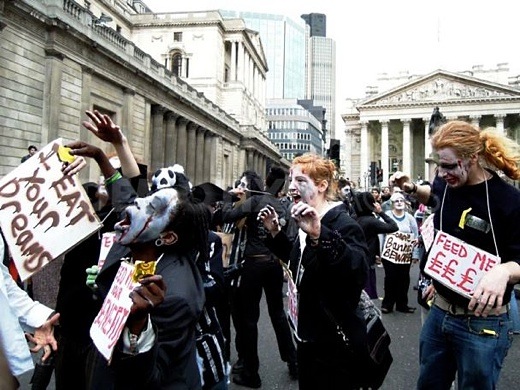
Image above: "I Eat Your Dreams" sign at zombie Occupy London Zombie Bank Run demonstration. From (http://occupylsx.org/?p=673).

Obviously, after a week of big-time announcements, the German Supreme Court, Mario Draghi's bond buying scheme and Ben Bernanke's QE3 (both virtually unlimited - or presented as such), it's tempting to think the western world is well on its way to tackling its financial crises. Looking at the stock markets one might even presume all's fine out there already.

Still, that is - or indeed, seems - only true if you focus solely - blinders and all - on the world of finance. If, on the other hand, you would like to know where the world at large is going, that focus is simply too narrow. As central banks increase their balance sheets ever more, it would already take a huge leap of faith to have real confidence in the idea that what various previous European financial operations, as well as the entire alphabet soup of US bail-outs, could not achieve, now will be accomplished by what is basically more of the same, just more.

You only need to recall where all of those previous schemes ended up after the initial market exhilaration: that's right, they necessitated subsequent bail-outs. The narrow focus also tends to blind everybody to who's supposed to be paying for the bail-outs. Which is everybody. In essence, all that has been achieved, and that to a far lesser degree than ostensibly intended, is that banks haven't yet been toppled by their debts, and stock exchange numbers look - sort of - presentable.

The question then becomes: is it worth it? The answer to that is a resounding YES if you're a banker or a stock investor or an incumbent politician (Bernanke announced QE3 a comfortable 7 weeks before the US presidential elections). The answer is an equally resounding, if not outright debilitating, NO if you're not part of that small world where politics and money meet and live in relative splendor. Those who are not invited to that party will be called upon to foot the bill, without having anything to show for it.

It becomes clearer all the time that the financial world is not the world, the whole world and nothing but the world; it's merely a vanishingly small part of it. Yet it is the only part that most of those who follow finance and the economy seem to be watching, under the stubborn illusion that if markets go up, everyone goes up; all boats rise with the tide. Which is a big boatload of delusional nonsense.

The markets have so far only been able to keep up their look-good appearance because they have had, and continue to have - through the world's central banks - access to everyone else's cash, even the cash that everyone, no-one, hasn't even made yet. And all that is going to run off the tracks in spectacular fashion, be it tomorrow or the day after, because you can't run an economy forever on money that no-one has worked for.

Bernanke is willing to throw in another trillion or so - or two- dollars in taxpayer money, allegedly to create jobs, whereas he's already thrown far more at that same slippery wall (and for that same slippery purpose), and nothing much stuck before; so why would it this time around? Because he labeled it "unlimited"? There's no such thing, of course. Just because he can throw in $3 trillion doesn't mean he could just as easily do the same with $30 trillion (the bond markets would have him for breakfast).

Draghi wants to purchase sovereign bonds, that are not worth anything near their face value, at that same face value. But are we still clear on why he claims he wants to do that? Here's why: simply so Spain and Italy can continue to borrow more and more on the international markets. Which they can't and they won't, as Draghi knows as well as those same markets do.

That's not some unfortunate turn of events, it's all part of the plan; it will drive the countries into the very demanding hands of the IMF and ECB, who will hand out more bail-outs, but this time under the same conditions that Greece is facing: fire hundreds of thousands of civil servants, cut pensions, cut benefits, cut wages, longer working days, longer working weeks, and sell anything not bolted down to foreign investors at fire-sale prices.

Bernanke facilitates for international banks to dump their mortgage backed securities stateside and get paid far more than they're worth, with the only "condition" that he "hopes" this will create US jobs. Draghi facilitates for those same banks to get rid of their EU periphery sovereign bonds, so they'll allow for the periphery to stay inside the eurozone. There is nothing in either plan that puts the people first. There is always only that one focus: banks. But banks are not the economy, or rather: not your economy.

In the end, the economy is all people. But Bernanke and Draghi's schemes do not target all people, other than perhaps in very vague allusions: Bernanke pays far too much for worthless mortgage backed securities so the banks whose hands he takes them off have room to lend money into the economy (create more debt), which could hypothetically create jobs.

Well, that would, for one thing, depend on how much more banks have in their vaults in worthless and/or questionable "assets", obviously. But even as Ben spends - future - American tax revenues to buy the paper, that last bit is not revealed: how much more is there left where that last batch came from? Yeah, we‘ve been playing this game for five years now. And we still don't have an answer to that question.

It's sort of become the new normal: there's some unelected guy in a suit who speaks in language that's supposed to make us think he knows what he's talking about, who pledges trillions in additional debt, in whatever currency he deals in, to ostensibly make life better for the very people who are on the hook for those pledges, whether they're successful or not, and they haven't so far; unless someone would like to defend the success of US QE1 and QE2 - viewed from the man in the street's perspective -.

It's funny, I know, that they have been successful, in a sense (just not the one we're consistently and falsely told they're aimed at): they have saved banks from bankruptcy, and the S&P from sinking into triple or double digits. But the man in the street who's losing his home, his job or a large part of his paycheck, benefits, pension, doesn't care about whether the S&P is at 15 or 15000.

It's time to get this through our heads once and for all: Bernanke And Draghi Are Not Trying To Save Our Economies. Perhaps they would if they could, but the question is moot: they know they can't. Instead, they're trying to save the financial system by stealing our remaining wealth while making us believe that the economy and the financial system - a.k.a. the banking industry - are one and the same thing. They are not, and that's why we see our jobs and benefits and homes go up in thin air and smoke while the S&P looks rosy.

Those last two things are connected. The first are not, no matter that so far most people fall for the sleight of hand. Which is sad today, and will turn to tragedy tomorrow.
.

Rant on Deception

SUBHEAD: We must view everything they say or do from the standpoint of being DECEIVED.  

By Ashvin Pandurangi on 27 June 2012 for the Automatic Earth -  
(http://theautomaticearth.com/Finance/rant-on-deception.html)


 Image above: Advice on deception can be deceptive. From orignal article.
 
It's the middle of yet another week in which yet another round of European wealth extraction (bloody rape) is underway... and yet another gaggle of speculating geese prove that they have no idea what the hell they're talking about or what the hell is going on around them... so... I'm just gonna take this opportunity to rant a little bit.

When the politicians, media pundits, corporate analysts and others start squirting out their verbal diarrhea about the economy, the financial system, the environment, energy trends, the political climate, the geopolitical situation, social issues and everything else that makes its way onto their teleprompters and scripts and reports, there is one common element throughout all of the incessant blather - deception.

That's not just a descriptive noun or verb I'm talking about, either - it's a Theory of Conduct. We must view everything they say or do from the standpoint of being DECEIVED with a capital D-E-C-E-I-V-E and D. None of those scoundrels can be trusted, because they either have a nefarious agenda of their own or are themselves being deceived by someone else with a nefarious agenda - call it a global circle jerk of deceivers and deception.

What these sheisters do is convince you that everything you thought you knew to be true can be substituted with their own MYTHS conjured up in corporate board rooms and hotel suites, bought and paid for with YOUR money. That's right - just like Joe the Dumbass and Jane the Lazy TOOL pay 100 bucks a month to watch no-talent ass clowns on America's Got an Infinite Number of Degrading Reality TV Shows every evening, they pay thousands of bucks every year to be convinced that their collective torture and rape is JUST ACES.
  • You thought that taking on debt was bad and should generally be avoided - THEY told you that accumulating debt is the ONLY way to become successful and respected in this world.
  • You thought that it was wrong to punish the victims and reward the perpetrators of a Class A Felony - THEY told you that it's the ONLY way to prevent an economic apocalypse and save your pension or your job.
  • You thought that austerity for the struggling masses and bailouts for the filthy rich bankers would destroy the local economy - THEY told you that local economies MUST be destroyed for the long-term greater good of humanity.
  • You thought that it was important for people to have sovereignty over their bodies and their own communities through elected and accountable representatives - THEY told you that sovereignty and democracy are obsolete artifacts of a stagnant civilization; a naive remembrance of things past.
You see, anything that you think is true about this world and your life in it can be snatched up like a glop of silly putty, deformed and reshaped into something that is 100% untrue. The only pre-condition to these timeless acts of deception is that your BELIEFS have to be flexible and undefined like... a fucking glop of silly putty. Your worthless brain has to be so mushy and so atrophied that a couple of douche bags in Sweden can tell you that Barack Obama deserves a Nobel Peace Prize, and you believe them!

A couple of Eurotrash Ministers can tell you that they have come up with yet another bailout plan to avert financial meltdown and fill your life back up with rainbows and happy thoughts, while emptying out your pockets and your bank account, and you immediately go back into a culturally-induced coma. That is, of course, until your 9 to 5 Boss tells you to pack up your shit and go home for good, or your financial advisor tells you that your net worth just cratered by 25%, or your trusted bank sends you a polite letter saying you're in default on your mortgage and the roof over your kids' heads has already been scheduled for auction to the lowest scumbag.

Then you wake up and realize the better part of your life has just been one pack of deceptions after another, all setting you up to ultimately do whatever you are told by your Slave Masters and accept your miserable fate without so much as a peep. And it's not just you who will end up SUFFERING for your lack of even ONE freaking ounce of critical thinking and due diligence in that malignant brain of yours - it will be everyone around you, including your family and your closest friends.

So take a deep breath... and re-learn how to read, and to comprehend, and to think critically and to be motivated for the Truth. Tell your family and friends that there is more to life than being endlessly DECEIVED, and more to life than being used like square of toilet paper by the DECEIVERS who just finished taking a massive dump on their heads. Take a shower... use a lot of shampoo and soap... scrub yourself down... towel off... and THEN get your mind right. And get very comfortable too... because the Truth can only win out over the Deceptions over the long-haul, and WE - me, you... all of us - are only just getting started here.

.

Dancing Shoes

SUBHEAD: When the central banks finish destroying he meaning of money altogether you'll be paying $25,000 for a Little Debbie snack cake.  

By James Kunstler on 20 May 2012 forKunstler.com - 
  (http://kunstler.com/blog/2012/05/dancing-shoes.html)


Image above: Opening dance scene in a bank from "Pennies From Heaven" set during 1930's Depression. From (http://www.nicksflickpicks.com/2005/11/picked-flick-73-pennies-from-heaven.html).


So many shoes are dropping out there that reality is starting to look and sound like the tap-line in a Busby Berkeley production number. The meme-scape, too, is humming with viral transmissions of dire doings. Is JP Morgan unwinding like a 1911 knitted woolen Yale varsity sweater? Did it booby-trap the credit default swap universe in the process, and is that getting ready to blow? The whole world is hanging by its fingernails, refusing to be dragged into the future.

That future is all about contraction. We could navigate our way into it but we don't want to. We want to stay right where we are with all our stuff and no need to make new arrangements and we are trying every last trick to do that. Can you not sense a terrible tidal surge of implacable forces under the headlines' placid surface? I do offer Mark Zuckerberg best wishes on his nuptials, but I think he set himself up for one of fate's great pranks as FB stock goes to 99 cents while he's still on his honeymoon (playing Frogger in a super deluxe hotel suite).

Does anybody really believe that the European money problem has any other ending except massive repudiation of obligations and epic political realignment? Or that the USA isn't caught in the undertow. The only real question now is how the civilized world might remain civilized while it rebuilds its money system. Money, after all, is a representative of reality and the representations by nations and person and institutions have been so false for so long that, for practical purposes, there is no consensual reality anymore.

By the way, it was a nice gag at the time, but Karl Rove was wrong. We are not creating our own reality.

Reality's theme going forward is changing from liquidity to liquidation. The European LTRO (quantitative easing) was a nice fairy tail, and the mild buzz lasted a few months, but its flimsy spell is broken. An awful lot of parties may be liquidating gold and silver, too, this week but under the circumstances I've got to think there will be plenty of counterparties looking to buy, since uncertainty is crushing all other media of exchange.

The process begins to look like a mass metamorphic conversion of winners to losers and vice-versa. In a giant unwinding of paper assets the result may be that precious metals go sideways while all other assets tank - and then once everything's in the tank, PMs tank, too, because nobody is left standing with that kind of cash.

Of course, in the event just a little bitty bit of gold will still buy a lot of stuff. The other possibility is that the rumored global coordinated central bank QE (quantitative easing) doomsday machine goes off destroying the meaning of cash money altogether. Surely that sort or stunt will not cast the same spell as the LTRO, a more measured act of desperation, but will call into question the very meaning of dollars, euros, yen, and pounds sterling. That's when you'll be paying $25,000 for a Little Debbie snack cake.

Let me be first of the non-right-wing in the blogster corps to venture the somewhat un-PC idea that Barack Obama turned out to be the first black schmuck elected President of the US. He didn't do the one thing that would have mattered most: put an end to government sponsored control fraud. Control fraud at that level is so pernicious because it destroys the legitimacy of institutions. It can only make a nation cynical, by which I don't mean given to malicious humor, which is different, but just always thinking the worst of your fellow man and the very idea that the human race ever produced anything fine and durable.

And on top of that malfeasance, to try to suspend due process of law in Section 1021 of the NDAA bill (military budget) - smacked down by federal judge Katherine Forrest last week - was an amazing transgression that the mainstream press greeted four months ago with barely a shrug. Can't we just start a movement to go down to Charlotte, NC, this summer and levitate the convention center into outer space? It nearly worked with the Pentagon forty odd years ago.

What do you suppose Obama and the other feckless schmucks of the G-8 were telling each other this weekend at Camp David between weenie roasts and ping-pong round robins? It must have been the emptiest dumb show of mere protocol; an exchange of tie-tacks in the national colors, the playing of many anthems and flying of flags, issuance of bland assurances and platitudes. Nobody believes any of them anymore, even poor Mr. Hollandaise, who has been on the job a few days. Angela Merkel must be good and goddam sick of even showing up at the office.

Well, perhaps its best that the world will go where it has to go without leadership. After all, human history is emergent and improvisation suits us. Forceful leaders often only leave a big mess behind. But imagine a world where nobody gets paid. That might be our world by the end of the week.
.