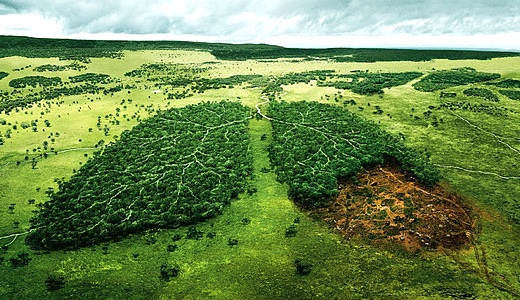
Neoconservatives destroyed peace

SUBHEAD: Whatever chance there was of peace with the Russia, China or the Middle East.

By  Paul Craig Roberts on 18 Apriol 2016 for PaulCraigRoberts.org -
(http://www.paulcraigroberts.org/2016/04/18/how-the-american-neoconservatives-destroyed-mankinds-hopes-for-peace-paul-craig-roberts-2/)


Image above: Hillary Clinton engaged with John McCain. From (http://www.salon.com/2014/08/30/dont_do_it_hillary_joining_forces_with_neocons_could_doom_democrats/).

[IB Publisher's note: We were no fans of the Reagan or G. H.W. Bush administrations. But at least Reagan had the sense to leave the war in Lebanon and Bush exited Iraq after defeating Saddam Hussein. The second Bush, Obama and now Clinton have been neo-con nitwits in the Middle East.]

When Ronald Reagan turned his back on the neoconservatives, fired them, and had some of them prosecuted, his administration was free of their evil influence, and President Reagan negotiated the end of the Cold War with Soviet President Gorbachev. The military/security complex, the CIA, and the neocons were very much against ending the Cold War as their budgets, power, and ideology were threatened by the prospect of peace between the two nuclear superpowers.

I know about this, because I was part of it. I helped Reagan create the economic base for bringing the threat of a new arms race to a failing Soviet economy in order to pressure the Soviets into agreement to end the Cold War, and I was appointed to a secret presidential committee with subpeona power over the CIA.

The secret committee was authorized by President Reagan to evaluate the CIA’s claim that the Soviets would prevail in an arms race. The secret committee concluded that this was the CIA’s way of perpetuating the Cold War and the CIA’s importance.

The George H. W. Bush administration and its Secretary of State James Baker kept Reagan’s promises to Gorbachev and achieved the reunification of Germany with promises that NATO would not move one inch to the East.

The corrupt Clintons, for whom the accumulation of riches seems to be their main purpose in life, violated the assurances given by the United States that had ended the Cold War. The two puppet presidents—George W. Bush and Obama—who followed the Clintons lost control of the US government to the neocons, who promptly restarted the Cold War, believing in their hubris and arrogance that History has chosen the US to exercise hegemony over the world.

Thus was mankind’s chance for peace lost along with America’s leadership of the world. Under neocon influence, the United States government threw away its soft power and its ability to lead the world into a harmonious existance over which American influence would have prevailed.

Instead the neocons threatened the world with coercion and violence, attacking eight countries and fomenting “color revolutions” in former Soviet republics.

The consequence of this crazed insanity was to create an economic and military strategic alliance between Russia and China. Without the neocons’ arrogant policy, this alliance would not exist. It was a decade ago that I began writing about the strategic alliance between Russia and China that is a response to the neocon claim of US world hegemony. http://www.rense.com/general77/tus.htm
The strategic alliance between Russia and China is militarily and economically too strong for Washington.

China controls the production of the products of many of America’s leading corporations, such as Apple. China has the largest foreign exchange reserves in the world. China can, if the government wishes, cause a massive increase in the American money supply by dumping its trillions of dollars of US financial assets.

To prevent a collapse of US Treasury prices, the Federal Reserve would have to create trillions of new dollars in order to purchase the dumped financial instruments. The rest of the world would see another expansion of dollars without an expansion of real US output and become skeptical of the US dollar. If the world abandoned the US dollar, the US government could no longer pay its bills.

Europe is dependent on Russian energy. Russia can cut off this energy. There are no alternatives in the short-run, and perhaps not in the long run. If Russia shuts off the energy, Germany industry shuts down. Europeans freeze to death in the winter. Despite these facts, the neocons have forced Europe to impose economic sanctions on Russia. What if Russia responded in kind?

NATO, as US military authorities admit, has no chance of invading Russia or withstanding a Russian attack on NATO. NATO is a cover for Washington’s war crimes. It can provide no other service.

Thanks to the greed of US corporations that boosted their profits by offshoring their production to China, China is modernized many decades before the neocons thought possible. China’s military forces are modernized with Russian weapons technology. New Chinese missiles make the vaunted US Navy and its aircraft carriers obsolete.

The neocons boast how they have surrounded Russia, but it is America that is surrounded by Russia and China, thanks to the incompetent leadership that the US has had beginning with the Clintons.
Judging from Killary’s support in the current presidential primaries, many voters seem determined to perpetuate incompetent leadership.

Despite being surrounded, the neocons are pressing for war with Russia which means also with China. If Killary Clinton makes it to the White House, we could get the neocon’s war.

The neocons have flocked to the support of Killary. She is their person. Watch the feminized women of America put Killary in office. Keep in mind that Congress gave its power to start wars to the president.

The United States does not have a highly intelligent or well informed population. The US owes its 20th century dominance to World War I and World War II which destroyed more capable countries and peoples. America became a superpower because of the self-destruction of other countries.

Despite neocon denials that their hubris has created a powerful alliance against the US, a professor at the US Navy War College stresses the reality of the Russian-Chinese strategic alliance.

http://sputniknews.com/world/20160414/1037981155/russia-china-cooperation.html
Last August a joint Russian-Chinese sea and air exercise took place in the Sea of Japan, making it clear to America’s Japanese vassal that it was defenceless if Russia and China so decided.

The Russian defense minister Sergey Shoigu said that the joint exercise illustrates the partnership between the two powers and its stabilizing effect on that part of the world.

Chinese Foreign Minister Wang Yi said that Russian-Chinese relations are able to resist any international crises.

The only achievements of the American neoconservatives are to destroy in war crimes millions of peoples in eight countries and to send the remnant populations fleeing into Europe as refugees, thus undermining the American puppet governments there, and to set back the chances of world peace and American leadership by creating a powerful strategic alliance between Russia and China.

This boils down to extraordinary failure. It is time to hold the neoconservatives accountable, not elect another puppet for them to manipulate.

.
The SYRIZA Experience

SUBHEAD: Entering the ominous battlefield of the 21st century, the left will either be relevant or it will be obsolete.

By Andreas Karitzis on 17 march 2106 for Open Democracy -
(https://www.opendemocracy.net/can-europe-make-it/andreas-karitzis/syriza-experience-lessons-and-adaptations-0)


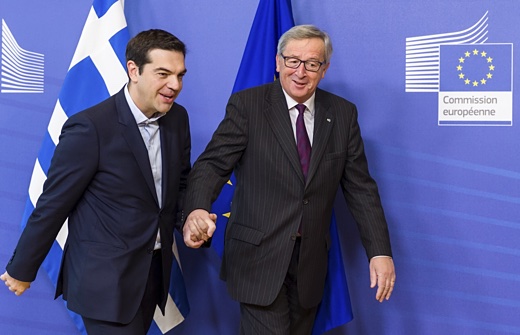
Image above: During the sovereign debt crisis European Commission President Jean-Claude Juncker leads Greek Prime Minister Alex Tsipras by the hand to his unhappy ending. From original article.

The impact of the strategic defeat of last year is still very strongly shaping various reactions within the Greek left. Some people seem content with superficial explanations of what happened and return to habitual ways of thinking and acting; others sense the strategic depth of the defeat and turn inwards to disappointment and demoralization.

Still others are trying to learn from the “SYRIZA experience” in order to make themselves more useful to people in the future. All of us sense the dangers lurking in front of us but we are far from having a common and feasible strategy.

In a situation like this, political priorities change and ‘novel’ tasks emerge. For example, people far beyond those affiliated with the traditional left are scattered and in disarray, but also full of energy, determination and skills. What should they do?

Another urgent task is how to transmit the 'SYRIZA experience' abroad, facilitating the left in other countries in the fight against neoliberalism and increased hostility of the elites. ‘Novel’ tasks require a different mentality and operational qualities from the ones we used to deploy through traditional political action.

But first we need: (i) a thorough understanding of the positive and negative aspects of the 'SYRIZA experience', and (ii) an open, bold and innovative process of arriving at the new conditions of doing politics. These are some preliminary thoughts in this direction.

The failure

SYRIZA failed to stop austerity and neoliberal transformation in Greece. One could argue that SYRIZA also betrayed the hopes and aspirations of the popular classes and those fighting against financial despotism. It chose to remain in power, thereby ‘normalizing’ the coup we witnessed last summer and accepting neoliberal coordinates that shape governmentality today in Europe.

SYRIZA's choice deprived the people of a crucial ‘tool’ in this fight by its painful defeat: the political representation of non-compliance with financial despotism. SYRIZA eliminated the chance of a ‘tactical withdrawal’, a collective process of reassembling our forces that could take into account the escalation of the fight provoked by elites - and forming a more effective and resilient ‘popular front’ that would build its resources to challenge neoliberal orthodoxy in the future.

The experience of the SYRIZA government in the months after the agreement, shows that there is no middle ground between financial despotism and democracy and dignity; if you try to reach such middle ground, you are quickly converted into an organic component of the biopolitical machine aimed at dehumanizing our societies. Arguing that the implementation of the agreement is the only way out of the present situation is just a reformulation of the neoliberal core-argument that There Is No Alternative; no strategy for continuing the fightback against financial despotism.

However, there is a danger of underestimating the brutal strategic defeat that we all suffered in 2015, hiding from ourselves the extent of our current impotence as regards any serious challenge to financial despotism. We must dare to perform an extensive reassessment of our methodology and tools if we want to be relevant in these new conditions.

And to do so, we should not preoccupy ourselves with the self-evident negative nature of SYRIZA's choice and comfort ourselves that this is the source of our  problems. The choice SYRIZA made is – among other things – a symptom of the deeper, structural weaknesses of the left.

Today in Greece a ‘Left government’ is implementing austerity, leftwing people are confused and ‘The Left’ is turning into a pro-memorandum political force in people's minds. Nationalists and fascists have remained the only "natural hosts" of popular rage and resentment, the expected emotional outcomes of the burial of hope we witnessed last summer. Greeks are sensing that the future of their society is severely compromised.

The majority of Greeks have been sentenced to misery and despair through the imposition of newer harder austerity measures without any real hope for the future. If we add to the economic and social disaster that austerity is inflicting on us the huge waves of refugees that are entering Greece - especially the complex and contradictory ways in which their drama impacts on the abused psychic economy of the Greek population - and add also the fear of increased geopolitical instability in the region, then it seems certain that prosperity, stability and peace has left Greece for the identifiable future.

These are exactly the suffocating conditions that prevail in a society before it explodes – due to a random incident – deepening even further the decline, and plunging existential depths. It is like we are walking on thin ice from now on in Greece. In moments like this we have to remain calm and think clearly if we want to arrive at what is needed to adapt and to be effective.

The sad case of Europe

The neoliberal EU and Eurozone has transferred a bundle of important policies and powers that once appeared to belong to the nation state out of the reach of the people. At the same time, a vast array of neoliberal regulations and norms govern the function of the state. In the EU and Eurozone today, the elected government is no longer the major bearer of political power. In the case of Greece, democratically electing a government is like electing a junior partner in a wider government in which the lenders are the major partners.

The junior partner is not allowed to intervene and disturb decisions on such crucial economic and social issues as fiscal policy, banks, privatizations, pensions etc. If it does intervene and demand a say on these issues, then the people who appoint it are going to suffer the consequences.

The elites – by extracting important powers and decisions on crucial issues from the democratically structured institutions of the bourgeois state – have managed to gain unchecked control over the basic functions of the society. It is up to their anti-democratic institutions to decide whether a society will have a functional banking system and sufficient liquidity to run or not.

That's what happened to Greece; that's the core argument of the president of Portugal behind his initial decision to appoint a pro-austerity minority government: ‘I am preventing unnecessary pain.’ Pain that will be caused by the naivety and dangerous ignorance of the people and political powers that still insist on people's right to have access to crucial decisions, while at the same time they do not have the power to shape these decisions.

It is evident today that the EU is an openly anti-democratic institutional structure. The left must embrace the crude reality: in Europe a new kind of despotism is emerging fast.

The time lag of the left

In western societies, the left, but not only the left, of a robust democratic constitution has been trained to do politics within the coordinates of a post-war institutional configuration. We assumed that the elites were committed to accepting the democratically shaped mandate of an elected government.

If they did not like the policies that it promoted, they had to engage in a political fight; opposition parties must convince the people that this policy is neither desirable nor successful and use the democratic processes for a new government of their preference to be elected.

But was this ever truly the case even for western societies after the Great War? This is surely a debatable issue. However, it is sufficient to assume that this was at least the dominant conception of political functioning that shaped the methodology and strategy of political agency over the last decades, even if it does not correspond fully to reality.

According to this conception, the post-war global balance of forces inscribed in state institutions a considerable amount of popular power, so that people without considerable economic power nevertheless have access to crucial decisions. Of course, the quality and the range of the access was a constant issue of class struggle.

The elites were obliged to fight according to the rules (or at least to appear to do so) and at the same time they were working deliberately to diffuse a kind of institutional configuration contaminated by popular power. In recent decades (not accidentally after the fall of the Soviet Union) they made decisive steps towards diffusing this kind of power and hence limiting the ability of the popular classes to influence crucial decisions. Today the elites feel confident enough to openly defy democracy. Democracy is no longer a sine qua non.

Based on the premise that the framework in which politics is being performed hasn't changed significantly, SYRIZA did what the traditional way of doing politics dictates: supported social movements, built alliances, won a majority in the parliament, formed a government. We all know the results of such a strategy now. The real outcome was totally different. There was virtually no change of policy.

Prepare for landing

A strategy that wishes to be relevant to the new conditions must take on the duty of acquiring the necessary power to run basic social functions.

Mo matter how difficult or strange this may sound in light of the traditional ways of doing politics, it is the only way to acquire the necessary power to defy the elites' control over our societies.

Is this feasible? My hypothesis is that literally every day human activity – both intellectual and practical – is producing experiences, know-how, criteria and methods, innovations etc. that inherently contradict the parasitic logic of profit and competition. Moreover, for the first time in our evolutionary history, we have so many embodied capacities and values from different cultures within our reach that we are bound to progress our collective intelligence in this regard if we put our minds to it.

Of course we are talking about elements that are not developed sufficiently yet. Elements that may indeed have been nurtured in liberal or apolitical contexts often functionally connected to the standard economic orthodoxy. However, the support of their further development, their gradual absorption in an alternative, coherent paradigm governed by a different logic and values, and finally their functional articulation in alternative patterns of performing the basic functions of our societies is just a short description of the duty of any left that wishes to take up a clear, systematic and strategically broadbased orientation.    

Based on people's capacities, proper alignment, connection and coordination it is possible to acquire the necessary power to at least be in a position to assume the basic functions if needed. We can do this by ‘extracting’ the embodied capacities of the people and putting them into use for the liberation of society.

For those who are frankly skeptical of the possibility of laying the groundwork for such a process, let's see the potential in the stark case of Greece.

SYRIZA at its peak had approximately 35,000 members, the various solidarity networks included thousands of people and from experience we know that plenty of people were available to help SYRIZA with their expertise if there had been suitable processes to “extract” their embodied capacities in an efficient way (which was not the case).

Furthermore, massive unemployment provides us with huge numbers of people who would be willing to participate in networks of a different nature as long as we can build and expand processes of this kind in a systematic way. So, it is possible to pursue such a path as long as we apply the proper methodological and organizational principles in our way of doing politics.

In the worst case scenario, we will achieve some degree of resilience; people will be more empowered to defend themselves and hold their ground. In the best case, we will be able to regain the hegemony needed: people could mobilize positively, creatively and massively, even decisively to reclaim their autonomy.

Redesign the 'operating system' of the left

We know that the popular power once inscribed in various democratic institutions is exhausted. We do not have enough power to make the elites accept and tolerate our participation in crucial decisions. More of the same won’t do it. If the ground of the battle has shifted, undermining our strategy, then it's not enough to be more competent on the shaky battleground; we need to reshape the ground. And to do that we have to expand the solution space by shifting priorities: from political representation to setting up an autonomous network of production of economic and social power (NESP).

We must modify the balance between representing people's beliefs and demands and coordinating, facilitating, connecting, supporting and nurturing people's actions. Instead of being mainly the political representative of the popular classes in a toxic anti-democratic European political environment designed to be intolerant to people's needs, we must contribute heavily to the formation of a strong 'backbone' for resilient and dynamic networks of social economy and co-operative productive activities, alternative financial tools, local cells of self-governance, democratically functioning digital communities, community control over functions such as infrastructure facilities, energy systems and distribution networks. These are ways of gaining the degree of autonomy necessary to defy the control of elites over the basic functions of our society.

It is not only in Greece that there is a growing exclusion of people from having a job or a bank account, having a ‘normal life’. Modern society in general is in decline. From history we know that societies in decline tend to react in order to survive. It is up to us to grasp this and start building networks that can perform basic social functions in a different way – one that is democratic, decentralized and based on the liberation of people's capacities.

First, this would allow people who are being excluded today to survive.
Second, this could begin a transition towards a better and more mature society.

And last but not least, there are no empty spaces in history, so if we do not do this, the nationalists and the fascists – with their own militarized ways of performing these basic functions – may step in to conclude the decline.

Shifting the battlefield

Our opponents have already spotted the shifting nature of the battlefield and have moved to new unclassified ways of organizing and acting. They develop new kinds of institutions (a Greek example http://www.corallia.org/en/) compatible with the emerging environment of fast flows of information, digital frameworks of action and production etc.

They also explore new methods and models; for example, “open innovation” models have emerged in the last few years to enable the R&D departments of big multinational companies to cope with the current distributed nature of knowledge and expertise that exceeds past means of control and usurpation of human intellectual creativity and innovation.

We have to create new popular power if we want to bring about substantial change or make ourselves resilient instead of just handling the remaining, seriously depleted if not already exhausted popular power inscribed in the traditional institutions.

The question is what does it look like to do politics in order to produce popular power without presupposing traditional democratic functioning – to restore it by newly transforming it? In other words, what are the modifications needed in our political practice for the constitution and expansion of NESPs?

What about political representation?

The function of political representation is a fundamental one in complex societies. It's the function that political parties mostly perform and that shapes everyday thinking regarding what ‘politics’ is about. The task here is not to revive neglected aspects of politics - like building popular power - or to reinvent collective and individual qualities; the aim is to explore novel ways of performing the function of political representation in order to upgrade significantly the political leverage of the people.

Of course, building popular power will also invigorate and possibly transform the institutional framework, giving substantial meaning back to political representation. But, the expansion of a network of the sort we are discussing here and the changes it could generate at various levels of the social configuration must be reflected on the function of political representation itself. We need to evaluate and explore concepts like the “commons”. Advancing a project to shape political representation as “commons” could give us valuable insights into new ways of performing vital functions that transcend the traditional, institutional framework of representative democracy.

Democratising the state?

The left talks too much about the democratic transformation of the state. In practice, the driving concept is the restoration of state functions as they were before the neoliberal transformation. But the expansion of a network of economic and social power under people's control could unlock our imagination towards more advanced and better targeted reforms of state institutions. In theory this is an old idea: the transformation of the state is a complementary move to the self-organized collectivities of the people outside it, driven by these forms of self-governance.

These modifications may be classified in three categories: political imagination, methodology and organizing principles. From my experience, the very same people who energetically claim that we need to be more innovative, better adapted and more efficient, when they actually do politics, reproduce priorities, mental pictures, methods and organizational habits that they already know are insufficient or inadequate.

There are ingrained norms in terms of methodological guidelines that decisively shape the range of our collective actions, rhetoric, decisions and eventually strategy. In the same vein, we believe in and fight for the promotion of the logic of cooperation and democracy against the logic of competition, but in practice our organizations suffer severely in terms of cooperation and democracy on the operational/organizational level.

We need to recognize these blind spots and set up a process of identifying best practices, methods and regulations – both from the experience of our collectivities and from expertise in management, leadership, organizational complexity and network systems theory etc. – in order to operationally upgrade our forces.

Furthermore, our actions and initiatives are not properly connected up, but fragmented and isolated, destined to face the same difficulties again and again. We need to upgrade our operational capacities through appropriate nodes of connection, facilitating smooth flows of know-how and information, transferring best practices, building databases and accumulating knowledge and expertise in an easily retrievable and useful way.

Actually, this is the advantage of multinational and large corporations in general, in comparison to others: they have a vast social network and powerful databases that gives them the necessary tools to plan and pursue their goals while their smaller competitors seem in disarray in a global environment of rapid changes. We need these qualities if we want to be really useful today.

Actually, this is exactly what our opponents did consistently and persistently during the last decades: they were designing and implementing reforms in various levels of state institutions based on the methods, the criteria and the functioning of their own “social agents”, namely the corporations and their own understanding of the nature of public space, namely the market. This is exactly the “mechanics” of transformation that various intellectuals and leaders of the left described in detail a long time ago. Perhaps, by shifting our priorities we will be able to revive old but useful ideas that have been forgotten in practice.

Mind the gap

The “SYRIZA experience” will be worthless if we do not resist the temptation to replace one mistake with another. The failure of SYRIZA - the failure of focusing solely on traditional electoral politics to radically change the dominant neoliberal framework - creates favorable conditions for notions like “self-referential alternativism” and “vanguard isolationism” to emerge and preoccupy the minds and hearts of those who are willing to continue fighting.

But choices like these just repeat what SYRIZA did, justifying fully the threat of our opponents: either you will be marginal or you will become like us! The existential threats and crucial questions regarding their future that our societies face today have nothing to do with a strategy of building “arcs” that aim to safeguard the “Left” or any other identity.

Entering the ominous battlefield of the twenty-first century, the left will either be relevant and useful for the defense of human societies, or it will be obsolete.


.

The Elephant Cometh

SUBHEAD: The finance racket will go down first and all the other rackets currently running will go up in a vapor.

By James Kunstler on 18 April 2016 for Kunstler.com -
(http://kunstler.com/clusterfuck-nation/the-elephant-cometh/)


Image above: Painting "The Fire Breathers" by Mark Bryan. Oil on canvas, 30x48", 2008. From (http://www.artofmarkbryan.com/circus/).

The elephant’s not even in the room, which is why the 2016 election campaign is such a soap opera. 

The elephant outside the room is named Discontinuity

That’s perhaps an intimidating word, but it is exactly what the USA is in for. It means that a lot of familiar things come to an end, stop, don’t work the way they are supposed to — beginning, manifestly, with the election process now underway in all its unprecedented bizarreness.

One reason it’s difficult to comprehend discontinuity is because so many operations and institutions of daily life in America have insidiously become rackets, meaning that they are kept going only by dishonest means. 

If we didn’t lie to ourselves about them, they couldn’t continue.

For instance the automobile racket. Without a solid, solvent middle-class, you can’t sell cars. Americans are used to paying for cars on installment loans. 

If the middle class is so crippled by prior debt and the disappearance of good-paying jobs that they can’t qualify for car loans, well, the answer is to give them loans anyway, on terms that don’t really pencil out — such as 7-year loans at 0 percent interest for used cars (that will be worth next to nothing long before the loan expires).

This will go on until it can’t, which is what discontinuity is all about. 

The car companies and the banks (with help from government regulators and political cheerleaders) have created this work-around by treating “sub-prime” car loans the same way they treated sub-prime mortgages: they bundle them into larger packages of bonds called collateralized loan obligations. These, in turn, are sold mainly to big pension fund and insurance companies desperate for “yield” (higher interest) on “safe” investments that ostensibly preserve their principal. 

The “collateral” amounts to the revenue streams of payments that are sure to stop because the payers are by definition not credit-worthy, meaning it was baked in the cake that they would quit making payments — especially when they go “under water” owing ever more money for junkers that have lost all value.

It’s easy to see how that ends in tears for all concerned parties, but we “buy into it” because there seems to be no other way to a) boost the so-called “consumer” economy and b) keep the matrix of car-dependant suburban sprawl in operation. We took what used to be a fairly sound idea during a now-bygone phase of history, and perverted it to avoid making any difficult but necessary changes in a new phase of history.

Health care is now such a blatant, odious, and ruinous racket that it is a little hard to believe that it hasn’t ignited an outright revolution or, at least, a workplace massacre in some insurance company C-suite. 

It is a well-known fact that most Americans don’t even have $500 to pay for a car repair. How are they supposed to cope with a $5,000 deductible health insurance incident? Answer: they can’t. Their mental health is destroyed in the process of attempting to fix their physical health. Not uncommonly, they have to declare bankruptcy after a routine appendectomy or a visit to the emergency room to set a broken arm. 

Sometimes, they don’t even bother to go to the doctor, seeing clearly how this plays out. The pharmaceutical industry has, of course, been allowed to convert itself into a simple extortion racket.  

Got an unusual kind of cancer? We have something that might help. Oh, it costs $43,000 a month….

What kind of a polity allows this cruel and indecent grift to go on? Why, the Obama administration, which allowed the health insurance company lobbyists and their colleagues in Big Pharma to “craft” the Affordable Care Act — the name of which must be the biggest public lie ever floated.

It’s interesting to see how a parallel fraud is playing out in higher education. 

I submit the reason that college presidents are not pushing back against the Maoist coercions of the undergraduate social justice warriors is because the marvelous theater of the gender, race, and “privilege” melodrama is a potent distraction from the sad fact that college has turned into a grotesquely top-heavy and high-paying administrative racket offering boutique courses in fake fields
in order to pander to their young customers (students) conditioned to tragic “oppression” sob stories. 

Note: see (Dartmouth College: WGSS 65.06 Radical Sexuality: Of Color, Wildness, and Fabulosity… Harvard University: WOMGEN 1424:  American Fetish

All this in the service of paying huge salaries + perqs to the dynamic executives running these places.

Then there is banking, a.k.a. the financial system, certainly the greatest racket of rackets, since the fumes it’s running on — combinations of ZIRP, QE, and “forward guidance” (happy talk) — is all that there is to maintain the illusion that “money” remains a reliable gauge of value. 

Finance is the racket that will go down first and hardest, and when it does, all the other rackets currently running will go up in a vapor. 

That elephant will storm into the room before the political conventions, and when it does, it will usher in the recognition that nothing can go on as before.

.

GMO labeling issue over?

SUBHEAD: How the struggle for GMO product labeling may may be won by a small minority.

By Kurt Cobb on 17 April 2016 for Resource Insights -
(http://resourceinsights.blogspot.com/2016/04/why-fight-for-gmo-labeling-is-possibly.html)


Image above: A legal challenge in December of 2015 to Vermont labeling law was defeated. From (http://wamc.org/post/rider-challenging-vermont-gmo-labeling-law-removed-budget-bill#stream/0).

Ever since it became clear that Vermont's law for mandatory labeling of foods containing genetically engineered ingredients would actually go into force this summer, the big question has been how many food companies would choose to label their products and how many would choose simply not to sell in Vermont.

There is a third choice which purveyor of canned fruits and vegetables, Del Monte Foods, announced recently. The company will eliminate all genetically engineered ingredients from its foods, obviating the need for special labeling.

This won't be too difficult since there are very few genetically engineered fruits and vegetables.

While the Vermont law is huge victory for the proponents of labels, the U.S. Congress could still pre-empt state labeling laws, something it failed to do earlier this year.

But as more and more of the public demands to know which products have so-called genetically modified organisms or GMOs in them and as the number of products on grocery shelves with non-GMO verified labels increases, growers and processors may have no choice but to acquiesce.

They may be forced by circumstances either to label their products (or automatically be suspected of trying to hide something for not doing so) or to eliminate GMO crops and ingredients for fear of losing customers regardless of what happens in Congress or in other states.

Nassim Nicholas Taleb, author of The Black Swan and other books on risk, explains why this is so in a draft chapter of an upcoming book called Skin in the Game. His investigation begins with why nearly every packaged drink in the United States is labeled certified kosher.

The answer is surprisingly simple and leads to counterintuitive conclusions about how certain practices spread far and wide.

Even though people adhering to kosher food consumption represent only three-tenths of one percent of the U.S. population, those people are spread throughout the United States rather than being confined to any geographic area. In such a case it is impractical to segregate packaged drinks that are certified kosher from those that are not. It's simply more cost-effective to make them all kosher.

This phenomenon has to do with one obvious and simple truth: Kosher eaters will not eat or drink non-kosher products. But non-kosher eaters have no problem consuming kosher products.

One group has a strong and uncompromising preference, and the other group doesn't really care. This, Taleb explains, is how tiny minorities can enforce standards on the rest of the population.

This holds true if the cost differential between two types of the same product are minimal. Where the differential is substantial, as is the case with organic versus non-organic foods, companies do, in fact, set up two food streams for customers.

Taleb points to the transition from manual-shifting vehicles to automatic shifting vehicles. This didn't occur initially because people preferred automatics. Rather, both those who preferred automatics and those who preferred manual-shifting vehicles could drive automatics. So, the small minority of those wanting automatic transmissions won the day.

As more and more people come to prefer non-GMO food, it will simply become easier to entertain mixed groups by assuring everyone that all the food and drink available is non-GMO. Bloomberg reports that candymaker Hershey recently announced that it is now buying only cane sugar - which means the company no longer uses sugar derived from genetically engineered sugar beets. The company's website lists GMO-free products and promises more to come.

It turns out that a stubborn minority is overcoming a broader majority that is content to eat non-GMO food if that is the preference of the minority.

This is the crux of the problem for companies selling GMO seeds and foods. They can talk all they want about the so-called rejection of science by consumers. In the end, food companies and farmers are obliged to sell people what they want; and where the preference of a minority is very strong, the majority will simply acquiesce.

As Taleb observes:
Big Ag (the large agricultural firms) did not realize that this is the equivalent of entering a game in which one needed to not just to win more points than the adversary, but win ninety-seven percent of the total points just to be safe.
The fight over labeling products containing GMOs has been one of the most potent forces in changing consumer preferences. We will soon find out whether there are now enough stubborn consumers insisting on non-GMO foods to bring the rest of the population with them.

In order to reverse the tide, the GMO industry would have to persuade at least as large a group of stubborn people not merely to tolerate GMO foods, but to insist on eating them. It's hard to see how the industry is going to do that if it continues to oppose labeling and if, as it insists, GMO foods are no different in taste and nutrition than non-GMO foods.

How did the industry end up in this fix? In the early 1990s when the U.S. Food and Drug Administration (FDA) was reviewing the safety of GMO crops, FDA scientists wrote that GMO crops involve unique risks and recommended that the crops be tested for safety in the same way that new drugs are.

The cost of doing this would be enormous for each genetically engineered plant variety and would result in long delays before such varieties could be sold and grown.

The industry had another plan. It got the Bush administration to place one of the industry's own lawyers in the FDA and created a position for him that allowed him to stifle the FDA scientists' concerns. The industry lobbied heavily and showered politicians with campaign cash.

The FDA abandoned its own scientists' recommendation and ruled that GMO crops are "substantially equivalent" to non-GMO crops. (This makes industry accusations that those who oppose GMOs are anti-science all the more a galling.)

But, by insisting that there is essentially no difference between GMO and non-GMO foods, the industry made what will turn out to be one of the biggest marketing mistakes of all time. For if you insist to consumers for more than two decades that your products are no different from your competitors' products, how can you later come back and say that they are different.

And, if you say that they are different, you risk serious regulation of your product by the FDA. So, if there is no difference, then consumers have little basis for preferring GMO foods which the industry admits generally have no advantages when it comes to taste, nutrition, appearance or shelf life. Otherwise, they would surely be touting these advantages on store shelves and in advertisements.

With the industry insisting for so long that there are no differences between GMO foods and non-GMO foods, it is now stuck in a messaging loop from which it cannot escape. That loop will make it ever more likely that consumers will just go with the flow. And that flow is decidedly in the direction of the stubborn minority who want nothing to do with GMO products.

The industry does claim that GMO crops reduce the use of pesticides, reduce the need to till the soil for weed control, and can be more profitable for farmers than non-GMO strains.

All these may be selling points for farmers, but have little impact on the preferences of consumers. Claims about increased yields have been largely debunked. Almost all of the increase in agricultural yields has come from traditional breeding and better agricultural practices.

Claims about increases in nutrition are usually couched in terms of what crops are in development rather than available today.

The one notable exception is so-called Golden Rice which produces beta-carotene, a pre-cursor to Vitamin A, often deficient in Asian diets dependent on rice. A simpler fix would be to encourage a greater variety of crops to include vegetables which are rich in beta-carotene rather than encourage more extensive monocrop farming.

Simpler still would be the free or low-cost distribution of cheap and widely available beta-carotene supplements.
Moreover, since GMO crops require no special testing to determine their safety, there is no definitive proof that they are safe. T

o simply state that foods containing GMO ingredients have been eaten for more than two decades and everything seems to be fine is not the same as long-term feeding studies using control groups done by unbiased, neutral researchers using widely accepted procedures that meet rigorous drug testing standards.

Instead, we are all guinea pigs in a worldwide uncontrolled experiment. My main concern about GMO safety, however, is not the possible danger to human health, but rather the potential to create catastrophic failures in the agricultural system via hidden risks.

Still, all of this is beside my point in the piece above. Apparently, the GMO industry does not believe in the free market and consumer choice. Consumers are increasingly telling the industry that they don't want GMO foods. Does the industry wish to legislate that we all be tricked into consuming them without our knowledge and consent? Lack of transparency has been the strategy from the onset, and it doesn't seem to be working anymore.

•  Kurt Cobb is an author, speaker, and columnist focusing on energy and the environment. He is a regular contributor to the Energy Voices section of The Christian Science Monitor and author of the peak-oil-themed novel Prelude. In addition, he has written columns for the Paris-based science news site Scitizen, and his work has been featured on Energy Bulletin (now Resilience.org), The Oil Drum, OilPrice.com, Econ Matters, Peak Oil Review, 321energy, Common Dreams, Le Monde Diplomatique and many other sites. He maintains a blog called Resource Insights and can be contacted at kurtcobb2001@yahoo.com.

.

Obsession, Addiction, and the News

SUBHEAD: This Article is not about Donald Trump (and if you believe that, you’ll believe anything).

By Ton Engelhart  on 17 April 2016 for Tom Dispatch -
(http://www.tomdispatch.com/post/176129/tomgram%3A_engelhardt%2C_obsession%2C_addiction%2C_and_the_news/#more)


Image above: Trump at GOP debate on CNN with Ted Cruz. From (http://trailblazersblog.dallasnews.com/2016/01/donald-trump-says-hell-skip-fox-news-debate-blasts-ted-cruz.html/).

Think of the 2016 presidential campaign as the political equivalent of Batman v. Superman: Dawn of Justice.  It’s loud; there are plenty of abusive special effects; the critics hate it, but the crowds turn out; a media company or three rake in the dough; and foreigners can’t get enough of this new vision of the American way of life -- or is it of a Bizarro world?

If you prefer, you could think of Campaign 2016, the never-ending blockbuster, as an affirmation that, whatever the hell this country is, it’s still, like Hollywood, at the top of the heap.  When it comes to gluing eyeballs, it remains the “sole superpower” on Planet Earth.  Think of it, in fact, any way you like, but just notice that the only thing you can’t do is not think about it.

This came to my mind recently on my daily trip to the gym.  A TV is always on in the anteroom you pass through to reach the men’s locker room.  A couple of weeks ago, I started to jot down what was onscreen.  So let me give you a rundown of one week’s worth of my comings and goings.

Monday.
This proved the oddball news day of my exercise week.

As I arrived, CNN was reporting from a “locked down” Capitol -- shots of people running hither and yon -- and it was still doing so with remarkably similar shots an hour and 40 minutes later when I left.  It turned out that some madman -- and I mean that quite literally since, on an earlier occasion, the same fellow was arrested for shouting that he was “a prophet of God” from the gallery of the House of Representatives -- had pulled out a pellet gun in the Capitol’s visiting area and been shot by the police.

In the new American media world in which 24/7 obsession is the definition of news, that minor story played nonstop for the rest of the day and I caught it again leading NBC Nightly News with Lester Holt (“Gunman at U.S. Capitol Shot by Police”).

Tuesday as I walked in, CNN was focused on the arrest of Donald Trump’s campaign manager, Corey Lewandowski, for an “assault” on Breitbart News reporter Michelle Fields in Jupiter, Florida (the American version of outer space).

As I left, Governor John Kasich on MSNBC was just “weighing in” on -- you guessed it -- Lewandowski’s “alleged battery,” with a Washington Post reporter on deck, ready to offer crucial analysis on the same subject, while a Donald Trump tweet was also under discussion.

Wednesday as I arrived, MSNBC was reporting that a new Hillary Clinton ad had just blasted -- you guessed it again -- Donald Trump for “xenophobia” and that she was four percentage points behind Bernie Sanders in the latest Wisconsin poll.  On the crawler at the bottom of the screen, Trump’s campaign manager was said to have declared himself “absolutely innocent” of the battery charge.

On my way out, I found correspondent Katy Tur “awaiting” Trump’s arrival at a stop in Wisconsin.  And oh yes, women, I learned, disliked Trump for his “some form of punishment” abortion comment.

Thursday as I came in, MSNBC was showing a Jimmy Kimmel Live! clip in which Ted Cruz half-jokingly told the nighttime host that, were he to see -- yes, you guessed it yet again! --

The Donald through his rearview mirror in a parking lot as he was backing up, he wasn’t quite sure which pedal he’d hit, the gas or the brake.  On leaving, I wandered past a crew of Washington Post writers discussing -- yep! -- Donald Trump’s first meeting with his foreign policy advisers in Washington.  He was, I was fascinated to learn, “huddling” with them.

Friday I arrived just as the CNN Newsroom with Brooke Baldwin was revving up under the logo “America’s Choice 2016.”  “Wisconsin,” Baldwin was saying, “is the next big primary for both Democrats and Republicans, but on the GOP side frontrunner Donald Trump is also focusing his attention on the party’s convention in July and how the delegate process will play out.”

As I left, she was still yakking away, this time over a caption that read: “Backing off pledge could cost Trump delegates.”

On a split screen with her was a Republican National Committee member -- “an expert on GOP nominating processing,” she told us -- discussing the significance of Trump’s recent meeting with Republican Party head Reince Priebus.  (Not much, it turned out.)

And that was one week’s exercising news for me.  I can’t for a second claim it didn’t keep me in decent shape, but the rest of America?

Now, let me try to sum up that week in American “news” glimpsed in passing at the gym and then watched as it repeated itself at dinner time and other moments.

Here goes:
Donald Trump.  Donald Trump.  Donald Trump.  Ted Cruz.  Donald Trump. Donald Trump.  Donald Trump.  Hillary Clinton.  Donald Trump.  Donald Trump.  Donald Trump.  (Bernie Sanders.)

The previous week, it would, of course, have been Brussels, Brussels, Brussels, Donald Trump, Brussels, Brussels, Brussels, Donald Trump, etc., etc.

There.  Satisfied?  Now, turn off that TV, put down that screen in your hand, I’ve got something to tell you about the news.

The News Zone
It goes without saying that I’m not talking about the news as it once was.  Think of it now as a kind of obsessive onscreen activity, sometimes humdrum, remarkably repetitive, yet often riveting.  Think of it mainly as something most of us live with but have yet to come to grips with or really define.

With the ever-present screens in all our lives, no one can help but tune in these days in one way or another to various versions of what we still call “the news.”  In doing so, we largely leave the real world and any sense of balance or perspective behind.

Otherwise a startling percentage of Americans wouldn’t be convinced that terrorism of the Islamic variety -- yes, terrorism! -- is America’s number one problem; this in a country in which you’re more likely to be killed or wounded by a toddler with a gun than an Islamic terrorist with the same.

In other words, from Brussels, Brussels, Brussels to Trump, Trump, Trump, this is not in any previously understood sense news at all.  It may actually be the opposite of news.  Believe it or not, there is still a world out there filled with problems that we know so much less about than we should because we’re all immersed in the same Trump soup.

Here’s what often dominates the news zone these days:
  • The Donald, The Hillary, and the others crisscrossing the country, shouting at and insulting each other, and giving more or less the same speeches (or, in the case of Trump, narcissistic rambles).
  • Blood-curdling accounts of the latest terror attacks in Europe or the U.S.
  • Photogenically weepy or stoic Americans bemoaning the loss of houses, schools, and lives in what the news now regularly refers to as “extreme weather” (without a hint -- 99% of the time -- of why that weather might be increasingly extreme).
  •  And let’s not forget those remarkably ever-present American “lone wolf” killers who take out their fellow citizens with numbing regularity in workplaces, movie theaters, military bases, schools, etc.
  • All of this and more, of course, becomes the essential adrenalizing fodder of the 24/7 attention machine.  Sometimes, when the story’s just right, its drumbeat lasts nonstop for days, or even weeks (see: San Bernadino), with whole corps of “experts” mobilized by the network news and cable outfits to... well, you know... say whatever it is experts say.
As newspapers shrink and collapse, as local investigative reporting all but disappears, the above has become the repetitive norm for the paperless world most of us inhabit.  And keep in mind that, in an age of shrinking reportorial staffs, on TV as well as in print, it’s of obvious economic advantage to pool your resources and focus audience attention on just one (or a few) magnetic events/horrors/nightmares -- stories guaranteed to glue eyeballs.

Some of these stories have become so common in our onscreen lives that, as with a mass killing or “violence” at a Trump rally, a formulaic way of reporting them has fallen comfortably into place, making the all-hands-on-deck moment so much easier to organize and handle.

So, for instance, from the initial shock of a terror attack in Europe or the U.S. (but not, say, Iraq or Libya) to the funerals of the victims, from the early parade of counterterrorism “experts” to the last grief counselors, there is now a pattern of coverage that normalizes such events for the news zone.

The Comb-Over in the Mirror
So much of this, of course, is about money, ratings, and the coffers of those who own TV networks.  Gluing eyeballs to screens (and ads) is, of course, the real news about the news.

CBS CEO Leslie Moonves couldn’t have been blunter on how the present system works.  At a Morgan Stanley investors’ conference last month, speaking of the Trump campaign, he said, “It may not be good for America, but it’s damn good for CBS.”  And then he added, “The money’s rolling in and this is fun.  I’ve never seen anything like this, and this [is] going to be a very good year for us.  Sorry.  It’s a terrible thing to say.  But, bring it on, Donald. Keep going.”

We know, roughly speaking, what Moonves and his ilk make of the frenetic onscreen world their employees present us with -- a world of relative inconsequence that is often, at one and the same moment, horrifying, fascinating, stupefying, shocking, terrifying, enervating, saddening, and even, if you happen to like Donald or Ted or Hillary or Bernie, sometimes uplifting or hopeful.  The question is: What are we to make of it?

The most obvious thing that can be said is that it leaves us painfully unprepared to face, or grasp, or begin to deal with the actual world as it actually is.  What’s left out?

Well, more or less everything that truly matters much of the time:
  • Any large, generally unphotogenic process, for instance, like the crumbling of America’s infrastructure (unless cameras can fortuitously zoom in on a bridge collapsing or a natural gas pipeline in the process of blowing up in a neighborhood -- all so much more likely in an age in which no imaginable situation lacks its amateur video)
  • Poverty (who the hell cares?); the growing inequality gap locally or globally  almost anything that happens in the places where most of the people on this planet actually live (Asia and Africa);
  • Rise of the national security state and of militarism in an era of permanent war and permanent (in)security in the “homeland”; and don’t even get me started on climate change...
But why should I go on when you can do this perfectly well yourself?  After all, just about everything that matters much of the time means... well, just about everything that really makes a difference in your life, or national life, or planetary life.

What you can see on your screen right now is plenty of Donald Trump, but what you can’t see when it comes to the United States is, for example, the increasingly undemocratic, unrepresentative, semi-demobilized country with a new, informal constitution and new power centers that he -- or some other candidate -- will head in 2017.  It’s largely MIA.

The menu of the news, as presently defined, lowers your chance of understanding the world.  It is, however, likely to raise your blood pressure and your fears on a planet in which there is plenty of reason to be afraid, but seldom of what’s on screen.  In a sense, at its best, what the all-day obsession that’s still called “the news” really provides is the kind of rush that we might normally associate with a drug or an addiction rather than reportage or analysis.

The news -- no matter your screen of choice -- increasingly does several things:
  • It creates its own heightened, insular world to replace the world we actually live in.
  • At its most effective, it’s like a recurrent floodtide washing over you.
  • It has an obsessional quality, with single stories engulfing everything else, inducing a deeply skewed view of the world, no matter what event or events are being followed.
Who can doubt that the Internet, social media, email, and the rest of the package are the signature addictive activities of our age?  Anyone who can put away that iPhone without resistance, or not check one last time to see if the email you weren’t expecting has arrived, should join the short line now forming at the exit.  For the rest of us, let’s face it, we’re trapped here.

The “news” is a key part of this addictive package.  In a sense, in an age of electronic obsession, onscreen news purveyors like Moonves may have little choice but to make it so.  It’s that or, assumedly, watch your cable network or key news programs die a grim financial death.

And of course Donald Trump, he of the trademark bouffant comb-over -- yes, I’m back to him -- is certainly sui generis and regularly admired for the deft way he plays the news and the media.  He’s less commonly thought of as the creature of the news and the media.

In a sense, though, he’s their ultimate creation of this moment, the top-of-the-line drug on offer so far.  If he’s also the ultimate narcissist without filters, then perhaps what we still call “the news” is itself a new form of narcissism.  W

hen you look in the mirror it holds up, it’s not you or the world that’s reflected.  Just tell me, I’m curious: Whose hairdo do you see?

• Tom Engelhardt is a co-founder of the American Empire Project and the author of The United States of Fear as well as a history of the Cold War, The End of Victory Culture. He is a fellow of the Nation Institute and runs TomDispatch.com. His latest book is Shadow Government: Surveillance, Secret Wars, and a Global Security State in a Single-Superpower World.

.

It looks bleak. Big deal.

SUBHEAD: An interview with Joanna Macy on how to deal with the Sixth Mass Extinction.

Interview with Joanna Macy on 2 April 2014 in Ecological Buddhism
(http://www.ecobuddhism.org/wisdom/interviews/jmacy)


Image above: Human driven extinctions due to climate change will have a greater impact in the tropics than the northern regions. From (http://www.foresightusa.com/#!Earth%E2%80%99s-Sixth-Mass-ExtinctionCaused-by-Human-Driven-Climate-Change-/c1s4d/9A020B5D-FB87-4A56-8C4A-ACC6A245B882).

Ecobuddhism: How do you feel about the Sixth Mass Extinction?

Joanna Macy: It’s happening. It’s combined with so much else that promises wholesale collapse. How do we begin to deal with the plastic in the ocean that covers areas the size of countries? What are cell phones and microwaves doing to our biological rhythms? What exactly is in our food? How do we address genetic modification of crops? We are so hooked on all of this, on every level. How do we begin to contain it?

The most immediate level of crisis concerns the Earth’s carrying capacity. Many civilizations prior to ours, starting with Mesopotamia, could no longer support themselves because they exhausted their natural resources. Carrying capacity is the level most people talk about. It’s a defining aspect of the climate crisis. How will we grow the food we need given huge variations and extremities of weather? How will we handle the natural disasters and famines that will result from a chaotic climate?

The second and deeper level is that consequences will extend far beyond the collapse of this civilization. We are creating a lack of possibility for future generations and civilizations, because we are using up mineral and petroleum resources without a thought for them. When this civilization collapses, the future will have largely Stone Age possibilities.

The third level of crisis is the enormous increase in the rate of extinctions—shredding the fabric of life, creating a loss of biodiversity so extreme that we can glimpse the doom of complex life forms. It takes highly differentiated and integrated and diverse systems to produce life forms complex enough for consciousness.

The fourth level of crisis would be the destruction of everything more complex than anaeorobic life forms, because of the loss of our oxygen production in the oceans and on land.

At any rate, I take all of these crises seriously and don’t argue with them. At the same time, I spend my life and breath to open our minds, and to change our heart-minds.

Sunsets are beautiful too, not just sunrises

EB: From where do you derive the psychic resources to bear witness to all this, while keeping in touch with joy?

JM: There’s a lot of joy in it. I find myself very buoyed by the work I do. I call it the work that re-connects. It involves speaking the truth about what we are facing. I think it’s very hard for people to do that alone, so this work thrives and requires groups.

It needs to be done in groups so we can hear it from each other. Then you realize that it gives a lie to the isolation we have been conditioned to experience in recent centuries, and especially by this hyper-individualist consumer society. People can graduate from their sense of isolation, into a realization of their inter-existence with all.

Yes, it looks bleak. But you are still alive now. You are alive with all the others, in this present moment. And because the truth is speaking in the work, it unlocks the heart. And there’s such a feeling and experience of adventure. It’s like a trumpet call to a great adventure. In all great adventures there comes a time when the little band of heroes feels totally outnumbered and bleak, like Frodo in Lord of the Rings or Pilgrim in Pilgrim’s Progress. You learn to say “It looks bleak. Big deal, it looks bleak.”

Our little minds think it must be over, but the very fact that we are seeing it is enlivening. And we know we can’t possibly see the whole thing, because we are just one part of a vast interdependent whole–one cell in a larger body. So we don’t take our own perceptions as the ultimate. My world view has been so interwoven between the Buddhist teachings and living systems theory. They inform each other so powerfully.

“Beings are numberless, I vow to liberate them all”. This may be the last gasp of life on Earth, and what a great last gasp, if we realize we have fallen in love with each other. If you are really in the moment of experiencing our reality, you don’t say “Oh I won’t experience this because it’s not going to last forever!” You’ve got this moment. It’s true for now. We can have a reasoned concern about what is down the track, without necessarily getting hooked on something having to endure.

EB: Even in Buddhism, where impermanence is a matter of course, there are no obvious concepts to deal with super-impermanence, in the sense that humans are now bringing an end to the Cenozoic era. In the best case, there may be an Ecozoic era to follow it. Continuing on our “business-as-usual” trajectory will acidify the oceans and trigger runaway global heating, epic mass extinction and a completely new cycle of geological time. A few climate scientists consider we may have already entered into runaway climate change.

JM: I suspect that they are right. Logically they are right: we don’t have a snowball’s chance in hell. At my last workshop, people were saying “It’s too late” in the Truth Mandala that we do. And then they went out and got arrested at the White House, chained to the fence to protest the wars. So our acting with passionate dedication to life doesn’t seem to be affected. I would just as soon live that way. What keeps you going? Are you not fed by your work?

EB: Yes, it’s a powerful personal evolutionary demand that has to be lived. There is no choice.

JM: How lucky we are to be alive now—that we can measure up in this way.

EB: In the film about Jung’s life, A Matter of Heart, Marie-Louise van Franz reveals some visions he had towards the end of his life, where a large part of the planet was destroyed, but a small part endured.

JM: Certain Tibetan predictions and prophecies also indicate there will not be a total extinction of humans.

EB: James Lovelock asserts that America and China will continue to use fossil fuels and compete for the last resources till it is too late. Civilization and most of the great ecosystems will collapse. A human population of a few million might survive around the Arctic Circle.

JM: These are what the Buddha would call “views”. They are based on a lot of scientific evidence, so I take them very seriously. But what it comes down to is that we are here now. So the choice is how to live now. With the little time left, we could wake up more. We could allow this whole experience of the planet, which is intrinsically rewarding, to manifest through our heart-minds—so that the planet may see itself, so that life may see itself. And we can bless it in some way. So there is some source of blessing on us, even as we die. I think of a Korean monk who said “Sunsets are beautiful too, not just sunrises.” We can do it beautifully. If we are going to go out, then we can do it with some nobility, generosity and beauty, so we do not fall into shock and fear.

The work that I do we call The Work that Reconnects. I sensed from the time that I started it a little over 30 years ago, that on one level it was to help people be better activists – more resilient, more creative, more responsible, more effective. And on a more ultimate level, I recognized I was doing it so that when things fall apart, we won’t turn on each other.

EB: Lovelock considers humanity could become a disorganized rabble led by competing war lords.

JM: That is already happening! Look at America. We are at each other’s throat. We are steeped in delusion and lies.

EB: And that could well be a strategy of Disaster Capitalism. Perhaps a transpersonal movement in the collective unconscious could bring about a social tipping point.

JM: Or even in the collective consciousness. We can never say from our little point of view that it’s too late for that.

The Privatization of Practice

EB: In The Corporation, Joel Bakan asked a leading psychiatrist to examine corporate behaviour (externalizing all costs onto society) using standard diagnostic criteria. The doctor found he was looking at the profile of a psychopath. The dominant institution of our time has been created in the image of a psychopath, and it is legally mandated to behave as such.

JM: That’s right, they are required to! And no system where you try to maximize just one variable can avoid runaway. Indeed the bad news has gotten overwhelmingly bad since a majority of the U.S. Supreme Court gave corporations the right to make unlimited, secret political donations in Citizens United vs the FEC.

EB: We have a conjunction of “corporate psychopathy” with the immense power of fossil fuels–the most profitable business in human history. And though it’s potentially fatal for our species, it’s so difficult to hear the story. The American broadcast media is thoroughly controlled by corporate ownership or advertising revenue.

JM: They have reduced the population to a state of such stupidity. I don’t even watch TV. I suppose I should, if only to see what is happening to my country. It’s a terrible degeneration, a cultural nausea. Even listener-supported radio, which provides some oxygen, is under assault. In America now we live in a “national security state” with a debilitating element of mental servitude or mind control.

And as far as Buddhism is concerned, I find that Western Buddhists tend to privatize their practice, and look for what I call premature equanimity. They go for peace of mind and that is such an inadequate response.

EB: Spiritual practice as anaesthetic? If we can put a name to certain things, there’s a possibility of opening new space up for spiritual creativity. Just as the Australian Zen teacher Susan Murphy named something important when she wrote about The Untellable Non-story of Global Warming. Every week Australian farmers commit suicide because their land and their lives have been completely ruined by drought, while large mining corporations corrupt its politics and export its coal to heat China's blast furnaces.

Uncertainty, Despair & Positive Disintegration

JM: I find a lot of what I am drawn to in the teaching I do, the experiential work, is to help people make friends with uncertainty, and reframe it as a way of coming alive. Because there are never any guarantees at any point in life. Perhaps it’s more engrained in the American citizen that we feel we ought to know, we ought to be certain, we ought to be in control, we ought to be upbeat, we ought to be smiling, we ought to be sociable. That cultural cast has tremendous power to keep us benumbed and becalmed. So it’s been central to my life and my work to make friends with our despair, to make friends with our pain for the world. And thereby to dignify it and honour it. That is very freeing for people.

EB: I suppose it is to embrace the shadow as well.

JM: Yes, and it’s a big shadow. I find certain science fiction, the imagination, very helpful here. I like to be stretched. Olaf Stapledon wrote in the 1930s, before the nuclear age, with an incredible imagination that was also profoundly spiritual. In The Star Maker, the human mind of Earth in the head of a particular man starts to voyage through space/time and sees the drama that we are involved in here, recognizing our mutual belonging before we kill each other. He sees this basic drama in many different forms, and it’s so rich. Of course, there are planets where consciousness came that just failed. But the adventure as a whole is so big.

Living systems theory has been so helpful to me. I think there is a drive within living systems to complexify, to wake up—there is an evolutionary movement. I speak out of the love and excitement generated by my little work, which many people are doing with me. It does require being able to experience pain. It does require tears and outrage. It does require positive disintegration. Our whole culture needs positive disintegration. It has to die to itself. So my Christian upbringing is relevant there: Good Friday and Easter, the necessity for death and rebirth. We are going to die as a culture, and it’s better for us to do it consciously, so we don’t inflict it on everyone else.

The Death Wish & the Fourth Gem

EB: Are we going to die as a species too? Would the ego-death of our species precede or modify an extinction of our species?

JM: Well, I suppose one could make a deep ecology/activist case for a species-specific poison to be put into the system, to get rid of the humans for the sake of non-humans. But it’s too late for that because we have poisoned the planet with our radioactive materials and all our other toxins. Only we can know what they are, so we need to stay around to keep them out of the biosphere to the extent that we can. We don’t have the luxury of committing suicide as a species.

EB: Yet the famous evolutionary biologist Edward Wilson wrote that remarkable article, Is Humanity Suicidal?

JM: Well we are acting that way. We are acting as if we had a colossal death wish.

EB: Your workshops are obviously coming from the experiential side. If we look at Eco-psychology, all that Rozsak and colleagues have done, I wonder if there is a case to develop a certified practical training. Would that be useful?

JM: Oh my goodness, yes. But the academic institutions are not friendly to something that eludes the control of narrowly-defined disciplines. So there are probably some other places you can go.

Wherever I go with workshops, I find the readiness to experience a collective awakening. I’m astonished by how explicit this is. It’s a sense of wanting to belong to the Earth, aching for reverence for the Earth. Again and again, I believe that people would be ready to die for our world, to save the life process. There is something pressing within the heart-mind that is just huge. It’s happening very fast.

That’s one nice thing about being as old as I am. I am 81 and I’ve been watching the mindset of people through the 40s, 50s, 60s, 70s, 80s, 90s and the first decade of this century. I was doing doctoral work as late as the 70s. The changes since then are staggering.

A major change is the relevance people are now finding in native American teachings. There’s a deep respect for the wisdom that is there, and for the nobility of character that it fostered. I think that it is a precious addition to our triple gem—this fourth gem of our time—that the native peoples are speaking out.

• Eco-philosopher Joanna Macy (b 1929) is a scholar of Buddhism, general systems theory & deep ecology. A respected voice in movements for peace, justice, and ecology, she interweaves her scholarship with four decades of activism. She has created a ground-breaking theoretical framework for personal & social change, as well as a powerful workshop methodology for its application. Her wide-ranging work addresses psychological and spiritual issues of the nuclear age, the cultivation of ecological awareness & the fruitful resonance between Buddhist thought and contemporary science. The many dimensions of this work are explored in her 10 books. Many thousands of people around the world have participated in her workshops, which help people transform despair and apathy, in the face of overwhelming social and ecological crises, into constructive and collaborative action. They elicit a new way of seeing the world as our larger living body, that frees us from the assumptions and attitudes that now threaten the continuity of life on Earth. Joanna travels widely giving lectures, workshops & trainings in the Americas, Europe, Asia, and Australia. She lives in Berkeley, California, near her children and grandchildren.
.

Two Ways of Knowing

SUBHEAD: Robin Wall Kimmerer speaks on Scientific and Native American views of the natural world.

Interview of Robin Kimmerer by Leath Tonino on 15 April 2106 for the Sun -
(http://thesunmagazine.org/issues/484/two_ways_of_knowing)


Image above: People are doing more now than ever to uncover the connections between science, religion, and psychedelia in the search for a deeper understanding of our existence. From (http://timewheel.net/Tome-The-Hidden-Link-Between-Psychedelics-And-The-Religious-Experience).

Robin Wall Kimmerer has a PhD in botany and is a member of the Citizen Potawatomi Nation, a Native American people originally from the Great Lakes, with a reservation today in Oklahoma. She describes herself as a “traveler between scientific and indigenous ways of knowing,” but there is little about her writing, public speaking, or teaching that suggests movement back and forth. Rather she seems to be standing still, looking simultaneously through two lenses, expressing two worldviews. Trees, for her, are photosynthesizing beings as well as teachers. A forest is an ecosystem and a home at once.

Born in 1953, Kimmerer was raised in upstate New York. The federal government had forced her grandfather, as a boy, to leave his home on the Potawatomi reservation in Oklahoma and attend the Carlisle Indian Industrial School in Pennsylvania. The school’s purpose was to assimilate Native American children, even against their will, and its founder’s motto was “Kill the Indian, and save the man.” 

Over time her family rekindled tribal connections, which she says had been “frayed by history, but never broken.” 

She did her graduate studies at the University of Wisconsin, where she focused on how plants reclaim abandoned zinc and lead mines, healing the damage of a destructive industry.

For a decade Kimmerer taught college biology in Kentucky, establishing herself as a leading expert on mosses. In 1993 she returned to upstate New York — which she calls “Maple Nation” — where she’s currently a Distinguished Teaching Professor in the Department of Environmental and Forest Biology at the State University of New York, Syracuse.

Eight years ago she founded the Center for Native Peoples and the Environment, whose mission is to promote sustainability through programs that draw on both indigenous knowledge and science. The Center also works to increase opportunities for Native American students in the environmental sciences. 

“Science is often perceived to be at odds with indigenous values,” she writes. “The result is that Native Americans are barely present in the scientific community, where their unique cultural perspectives on environmental stewardship are greatly needed.”

Kimmerer’s first book, Gathering Moss, won the John Burroughs Medal in 2005, and her second, Braiding Sweetgrass, received the Sigurd F. Olson Nature Writing Award in 2014. 

 Last year she addressed the General Assembly of the United Nations for the commemoration of International Mother Earth Day, and the year before that, she was a keynote speaker at the National Bioneers Conference.

I talked to Kimmerer on a bright summer morning at her farmhouse in Fabius, New York, where she raised her two daughters, both of whom are now grown. Before beginning the interview, we ate a brunch of quiche and green salad with strawberries at a picnic table in her yard. 

Kimmerer was warm and welcoming, with long, graying hair and dangling porcupine-quill earrings. She spoke with assurance, rarely pausing, her voice and her thoughts always clear.

After two hours we got up to stretch our legs and walked down a mowed trail, past a vegetable garden, and around a small pond. I mentioned a slug I’d recently seen that used a thread of slime to rappel off a ledge, as a rock climber might, and Kimmerer responded by pointing out the place where, a few days prior, she had encountered a wriggling green nematode: “It was a four-inch-long thread of a creature, a species I’d never seen before, living right here in the yard.”

The two of us continued trading small wonders in a kind of ping-pong match. “Isn’t it all fantastic?” she finally said, the comment less a question than an exclamation.

Tonino: You’ve always loved plants, but your relationship to them has transformed over time.

Kimmerer: I would describe my journey as a circle, moving out into academia but coming back to the way that I knew plants as a child. I grew up in a rural area much like where we’re sitting today, and I was interacting every day with plants in the garden, the woods, or the wetlands. I couldn’t go outside without being surprised and amazed by some small green life.

I suppose it was their great diversity of form that first drew my interest: that on a small patch of ground there could be so many different ways to exist. Each plant seemed to have its own sense of self, yet they fit together as a community. And each had a home, a place where I knew I could find it. This inspired my curiosity.

From as far back as I can remember, I had this notion of plants as companions and teachers, neighbors and friends. Then, when I went to college, a shift occurred for me.

As an aspiring botany major, I was pressured to adopt the scientific worldview; to conceive of these living beings as mere objects; to ask not, “Who are you?” but, “How does it work?” This was a real challenge for me. But I was madly in love with plants, so I worked hard to accommodate myself to this new approach.

Later in my career, after I’d gotten my PhD and started teaching, I was invited to sit among indigenous knowledge holders who understood plants as beings with their own songs and sensibilities.

In their presence, and in the presence of the plants themselves, I woke from the sleep I’d fallen into. I was reminded of what I’d always known in my core: that my primary relationship with plants was one of apprenticeship. I’m learning from plants, as opposed to only learning about them.

I was especially moved by an elderly Diné woman who told the biographies of each plant in her valley: its gifts, its responsibilities, its history, and its relationships — both friendships and animosities. 

As a scientist I had learned only about plants’ physical attributes. Her stories reminded me of how I had encountered plants as a young person. That’s why I say I’m coming full circle after all these years — because I’m able to stop speaking of plants as objects.

Let me add that my appreciation of plants has been greatly enriched by knowing the beauty of chlorophyll and photosynthesis and hormones and cellular biology. Ideally the two ways of knowing can reinforce one another.

Tonino: Writer Vine Deloria Jr. has called indigenous knowledge the “intellectual twin to science.” Is that what you’re talking about?

Kimmerer: Yes. Both Western science and traditional ecological knowledge are methods of reading the land. That’s where they come together. But they’re reading the land in different ways. Scientists use the intellect and the senses, usually enhanced by technology. They set spirit and emotion off to the side and bar them from participating.

Often science dismisses indigenous knowledge as folklore — not objective or empirical, and thus not valid. But indigenous knowledge, too, is based on observation, on experiment. The difference is that it includes spiritual relationships and spiritual explanations. Traditional knowledge brings together the seen and the unseen, whereas Western science says that if we can’t measure something, it doesn’t exist.

Tonino: What are some other differences between the traditional indigenous approach and the Western scientific tradition?

Kimmerer: When we use the scientific method in an experiment, we look at one variable at a time. In order to really understand how something works, science says, we must exclude all else. We’re not going to talk about relationships. We’re going to limit ourselves to cause and effect. This notion that you can rigorously exclude all factors save one, and in so doing find the cause, is not part of traditional knowledge.

In the traditional way of learning, instead of conducting a tightly controlled experiment, you interact with the being in question — with that plant, with that stream. And you watch what happens to everything around it, too. The idea is to pay attention to the living world as if it were a spider’s web: when you touch one part, the whole web responds. Experimental, hypothesis-driven science looks just at that one point you touched.

Another important difference is that science tends to want to make universal statements, whereas to the indigenous way of thinking, what’s happening between two organisms is always particular and localized, unique in space and time.

Take the example of a bee landing on a flower for a sip of nectar. To the indigenous observer, it’s not some idealized Bee meeting some idealized Flower. There isn’t an attempt to generalize to pollinator ecology, or to say that it’s all being driven by certain physical principles. Those principles may be real, but they aren’t any more real than this bee on this flower at this time on this day with this weather.

Tonino: But how do you get beyond that isolated moment in space and time to develop a broader understanding? It can’t be that you have to start over with every bee and flower. Don’t the observations pile up?

Kimmerer: You’re asking: Is there an equivalent in traditional knowledge to what science calls a theory? Absolutely. But it’s a different kind of theory, one that centers on the idea of responsibilities. All bees, for example, have a responsibility to pollinate. The indigenous observer is asking the bee, How are you living out your responsibility? And what about you, flower?

The individual observer brings findings back to the community to share. He might talk about what happened when he was setting his trapline that day, and someone else might say, “Oh, a few falls ago I saw that same thing, and the consequence was this or that.”

And then maybe somebody else chimes in that she saw the same thing, too, but the consequence was a little different. The information isn’t published in a professional journal, but it’s shared with the community and vetted by that community’s collective intelligence. I think of it as the equivalent of peer review.

Tonino: You say that indigenous observers interact with the world they’re studying. They participate. Why is that so important?

Kimmerer: Western science explicitly separates observer and observed. It’s rule number one: keep yourself out of the experiment.

But to the indigenous way of thinking, the observer is always in relationship with the observed, and thus it’s important that she know herself: As I watch that bee and flower, as I study how water moves, as I observe the growth of the grass in this meadow, I understand that the kind of being I am colors how I see and feel and know. Furthermore, my presence might even be influencing how the world is working around me.

It’s important to recognize the relationship that exists between the observer and the observed. In Western science we believe our technologies and how we frame our hypotheses will eliminate our bias. A traditional perspective instead celebrates the relationship. A young person is going to see things differently than an old person.

A daughter and a mother and a grandmother will see in different ways. All of these perspectives should be brought to bear. Rather than isolate them, we can incorporate them into the learning process.

Tonino: Do you think there’s an analogy between Native American oral traditions and long-term scientific research projects?

Kimmerer: Let me back up and say that paying attention to natural data has evolutionary value for a culture. If you don’t pay attention to the circumstances under which the salmon return to the rivers to spawn, you will fail at fishing.

So there has always been great impetus to make meaning from data.

That data might not be quantitative, though. It’s not as if a thousand years ago on the Pacific coast people were measuring and weighing fish.

But they were cleaning hundreds of fish, so their hands knew the size and weight and relative health of these beings. And their hands remembered “data” from the previous year and the year before.

I can imagine a conversation that went something like: “You know what else was happening that year when the fish were so fat? There was a great hatch of mosquitoes,” or, “We had a really long winter,” or, “Water temperatures were up.” We search for connections. It’s what we do as a species.

The ecological history of a place is passed down through foodways, through stories around the campfire, through ceremonies performed on certain dates in honor of the cycles — such and such natural event tends to occur around such and such a date. And this knowledge has adaptive significance.

If you don’t pay attention, you’re going to go hungry, or you won’t be able to find the medicine you need. It’s imperative that you collect and safeguard knowledge over the years. Western science — or, at least, ecology — has a growing appreciation for this basic truth: if we don’t have a handle on our fisheries and forests, we’re in huge trouble.

Tonino: Long-term studies, whether conducted by Western scientists or indigenous peoples, strike me as an effort to prevent amnesia.

Kimmerer: Yes, forgetfulness. I think of my friends just a few miles over the hill here at Onondaga Nation. They’re trying to restore their sacred lake, which has been horribly polluted by industrial dumping and sewage. They want to bring it back to the state described in the prayer of gratitude that opens and closes all their group meetings. They call it the Thanksgiving Address, and it’s an ancient description of how the world once was and can be again. They’re not using the EPA’s standards of allowable parts per million of some toxic chemical. They’re saying that lakes are places where eagles can come and feed and breed.

Lakes are places where people can gather their medicines. Lakes are places where all kinds of creatures can drink and be refreshed.

Ceremony is often said to be how we remember to remember. The great orations, such as the Thanksgiving Address, reach back through time and say, “These are the relationships that have existed and should exist. With that in mind, let’s go forward and restore our environment.”

Tonino: That’s a lovely thought: ceremonies are how we remember to remember.

Kimmerer: Ceremony also reminds us of our responsibilities to creation. When you have ceremonies of gratitude, you understand how much the world gives to you, and you remember your dependency. Through the ceremony itself — the food, the regalia, the time spent in preparation — you are giving back. You’re putting energy back into both the material and the spiritual world. The two are inseparable. Ceremonies are as much about reciprocity as they are about gratitude.

Tonino: You’ve said that an indigenous elder might see the scientific method, which asks a direct question, as disrespectful. Why?

Kimmerer: Because the organism being questioned has its own intentions, its own agency in the world. It is rude of us to prod this sovereign being and ask: How come you’re doing that? How come you’re living that way? How come you’re that color? How come you’re that tall? How come you die in the winter? To someone who views each organism as a potential teacher, this type of pushy questioning is just plain rude.

It has also been explained to me that scientists’ interest in how things work leads us out of our place and into the Creator’s realm. We don’t need to know how something works. We need to know that it works to keep natural systems intact. We should remember that our curiosity exists in the human realm. It’s sometimes said that we humans are the “youngest brothers of creation.” We haven’t been around very long, and we should be humble and pay attention.

My personal view, as a Native American scientist, is that, while I honor this traditional perspective and acknowledge that science sometimes overreaches, I also understand that knowledge of underlying mechanisms can provide us with the tools for positive intervention in ecological systems.

Knowing how something works can also be a source of wonder. At the same time, I appreciate the traditional perspective, which cautions against hubris and arrogance and the sense that we are “controlling” nature, as if it were a machine.

Tonino: If asking a direct question of the natural world is disrespectful, what’s the alternative?

Kimmerer: We can find creative ways of pursuing inquiry that are courteous and delicate and don’t demand information but instead search for it. I like to think of my own research as an interview process, a conversation.

Let’s say we want to know how a particular species of moss responds to drought. Some people would take samples into the lab and drought-stress them, but that’s pretty crude, in my opinion. If I want to know how water is important to moss, I’m going to go to wet places and be with the moss, and I’m going to go to dry places and be with the moss, and I’m going to discover whatever I can. I will say to the moss, “I’m not going to snatch you from your home and grind you up to learn your secrets.

Instead I will sit at your feet and wait for you to tell me what I need to know.” And I’ll do so joyfully, appreciating the experience regardless of what data might come from it. A way of learning that’s not destructive, that minimizes interference — that’s my goal.

Patience and commitment are the key to learning from a being or a place. Unfortunately the institutions of science don’t commonly make room for the slow, steady approach.

I want to be careful here to separate the institutions of science from scientific inquiry itself. They shouldn’t be conflated. The institutions of science dictate that your grant lasts only three years and must produce a report. This propels a reductive, mechanistic approach. And the sad truth is that scientists have no choice but to follow the money. If you can’t secure the funding to do your research the way you want, you devise a project that you can get funded.

Tonino: What are the chief virtues of scientific inquiry?

Kimmerer: The first that comes to mind is repeated measurement as a way of seeing. I can think of instances in which the observations of native peoples could lead them astray. We can’t separate the observer from the observed, but we can avoid imposing our human perspective on the facts. Measurement can help with this.

Science also offers us many lenses for viewing the world. Technology can help us get outside of our human perceptions. When we look at a flower, we don’t see it the way a bee sees it. Advanced technologies can help us to see the flower from the bee’s perspective and get beyond the limitations of our five senses.

Tonino: That reminds me of an essay by Gary Snyder in which he makes the point that our bipedal, binocular, 150-pound, mostly hairless way of experiencing the world can get us only so far, and we need to try to go beyond it, if only imaginatively.

Kimmerer: This is especially true with plants. As a society we are plant-blind. It’s just green wallpaper to most of us. We don’t distinguish one species from the next, let alone appreciate that there’s a reason the leaf of this plant differs from the leaf of that plant; that a tree’s leaves change shape as it grows from a seedling to maturity; that bark can be thick or thin, smooth or rough. We hardly notice plants’ sophistication. We believe they don’t exhibit intentional behavior, but really they just behave very slowly.

Although plants don’t have a nervous system like ours, there is good evidence that they can recognize other species around them and adjust their chemistry, growth patterns, and so on accordingly. Plants are interacting with one another all the time.

Tonino: Do they communicate? Collaborate? Wage war?

Kimmerer: Plants certainly do communicate, primarily through the exchange of chemical signals. They inform one another of insect and pathogen attacks, for example, which allows them to mount defenses.

And there is evidence of collaboration as well as antagonism between plants. To my mind, plants meet any definition of intelligence. They have the ability to perceive, sense, respond to, and communicate about the environment. They create and maintain relationships with other beings. And they adjust their behavior in ways that benefit survival and reproduction.

Tonino: Why do most people resist the idea of plant intelligence?

Kimmerer: We tend to view the world through an anthropocentric lens. Plants are radically different from us, and we tend to see “others” as inferior. Since most plants don’t exhibit rapid motion, we assume they do not exhibit behaviors. Because they do not have the same sensory organs and nervous systems that animals do, we assume that they have no sensation.

Yet they sense the world in ways that are completely beyond us, such as perceiving very long and short wavelengths of light. We don’t understand plant intelligence very well, so we tend to dismiss it as nonexistent or primitive. But we also used to think that the world was flat.

If we would embrace the possibility of plant intelligence and investigate it without any anthropocentric bias, we might be surprised by what we learn.

Then there’s the philosophical barrier to acknowledging plant intelligence: it would mean including plants within our circle of ethical responsibility. If we assume that plants are just objects, we are free to treat them however we please — they are of no moral consequence.

If, however, we acknowledge the intelligence of plants, it would have significant implications for how we use them.

Tonino: Has your scientific work led you to feel greater empathy for the species you’re studying?

Kimmerer: Absolutely. I’d go so far as to say that if you can’t get to the point of feeling empathy, it’s not worth doing the work. I want to know what it’s like to be an oak or a birch or an ash.

Tonino: There’s a poem by Mary Oliver that begins: “Have you ever tried to enter the long black branches / of other lives … ?”

Kimmerer: Yes, I’ve tried. It’s an ability that can be learned — or relearned, as the case may be. Our ancestors understood this as quite normal and natural, whereas in our modern era we have forgotten what this kind of wordless communication is like.

Tonino: You’ve said that both science and traditional knowledge can be pathways to kinship. Does it matter which path we take, as long as we arrive at kinship eventually?

Kimmerer: No, I don’t think it matters how you get there. The scientist peering through binoculars and the native hunter studying tracks in the mud both experience kinship with the living world.

Tonino: So what is kinship?

Kimmerer: It has to do with the realization that we are all beings on the same earth, and that we all need the same things to flourish. Water, for example. When I pay attention to how birds interact with water, or how mosses interact with water, or how lichens interact with water, I feel a kinship with them. I know what a cold drink of water feels like, but what would it be like to drink water over my entire body, as a lichen does?

Kinship also comes from our reciprocal relationship with other species. Sitting here, you can get a whiff of ripe wild strawberries off the hillside. They are fulfilling their responsibility to us, and we will fulfill our responsibility to them. Those berries provide us with food and medicine, and in reciprocity, we perhaps unwittingly disperse their seeds and tend their habitat so they can continue to thrive. It’s like a family: we help each other out.

Tonino: Is that what you mean when you write that all flourishing is mutual?

Kimmerer: Yes. What’s good for life is good for all life, whether it’s green or two-legged or any other kind. Obviously there are trade-offs: the individual fish doesn’t flourish when it’s being eaten by the fisherman. But human flourishing and fish flourishing must be mutually reinforcing, or we wouldn’t both still be here, right?


Videoe above: Robin Kimmerer speaks of Mishkos Kenomagwen, The Teachings of Grass for Bioneers. From (https://youtu.be/cumEQcRMY3c).

.