British plans for death of Euro

SOURCE: Brad Parsons (mauibrad@hotmail.com)
SUBHEAD: Treasury is considering plans to restrict the flow of money in the event of a full-blown euro break-up.  

By patrick Aldrick on 26 December 2011 for the Telegraph - 
(http://www.telegraph.co.uk/finance/financialcrisis/8976204/Treasury-plans-for-euro-failure.html)
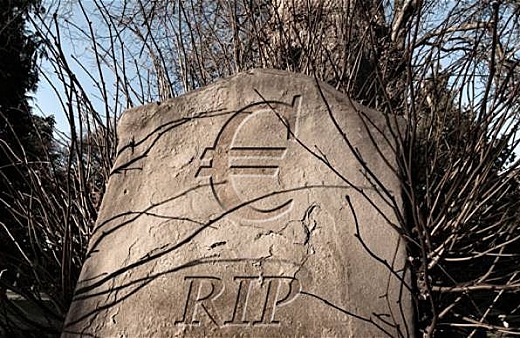
 
Image above: Tombstone of Euro currency. From original article.
 
The Treasury is working on contingency plans for the disintegration of the single currency that include capital controls.
The preparations are being made only for a worst-case scenario and would run alongside similar limited capital controls across Europe, imposed to reduce the economic fall-out of a break-up and to ease the transition to new currencies.
Officials fear that if one member state left the euro, investors in both that country and other vulnerable eurozone nations would transfer their funds to safe havens abroad. Capital flight from weak euro nations to the UK would drive up sterling, dealing a devastating blow to the Government’s plans to rebalance the economy towards exports.
Earlier this year, Switzerland was forced to peg its currency to the euro to protect the economy after a massive appreciation in the Swiss franc due to spiralling fears over Europe.
The plans emerged as Spain’s new finance minister Luis de Guindos warned the country’s economy was set for negative growth in the last quarter.
Speaking yesterday he warned the next two months “are not going to be easy”.

Britain’s response to a euro meltdown would reflect measures taken by Argentina when it dropped the dollar peg in 2002 and by Czechoslovakia after the country broke in two in 1993, according to sources. Faced with a massive capital inflow, the Czech Republic temporarily imposed taxes on foreign inflows to banks and capped the amount of overseas credit domestic banks could use.

In addition to the risk of an appreciating currency, dealing with potential UK corporate exposures to the euro poses a considerable challenge for the Treasury.

Britain’s top four banks have about £170bn of exposure to the troubled periphery of Greece, Ireland, Italy, Portugal and Spain through loans to companies, households, rival banks and holdings of sovereign debt. For Barclays and Royal Bank of Scotland, the loans equate to more than their entire equity capital buffer.

Under European Union rules, capital controls can only be used in an emergency to impose “quantitative restrictions” on inflows, which would require agreement of the majority of EU members. Controls can only be put in place for six months, at which point an application would have to be made to renew them.

Capital controls form just one part of a broader response to a euro break-up, however. Borders are expected to be closed and the Foreign Office is preparing to evacuate thousands of British expatriates and holidaymakers from stricken countries.

The Ministry of Defence has been consulted about organising a mass evacuation if Britons are trapped in countries which close their borders, prevent bank withdrawals and ground flights.

Treasury officials would not comment on the specifics of any plans but said the Government always had contingency plans that cover a full range of eventualities.

A break up of the euro would have a devastating impact on the UK. HSBC economists have warned that it could trigger a global depression and forecasters at the Centre for Economic & Business Research reckon it would knock about a percentage point off UK growth – plunging the country into a full-blown recession in 2012.

The scale of economic problems alongside the existing debt burden would leave the Government with little in its armoury to combat the collapse, making capital controls one of the few viable options.
There is a glimmer of good news for the global economy with upbeat figures expected today from the US. Reports from America suggested US consumer confidence figures out today could rise to a five month high as house prices stabilise.
.

GoDaddy support of SOPA hurting

SUBHEAD: Wikipedia's to ditch GoDaddy domain service over its support of internet censorship legislation.  

By Bianca Bosker on 26 December 2011 for Huffington Post -  
(http://www.huffingtonpost.com/2011/12/26/wikipedia-godaddy-sopa_n_1170034.html)

 
Image above: When someone thinks your company needs a logo-promoting NASCAR paint job its time to reevaluate your goals. From (http://www.rfactorcentral.com/painters_profile.cfm?ID=NeXuS.TeaM).

Wikipedia founder Jimmy Wales announced that domain names belonging to Wikipedia and Wikia would be transferred off of GoDaddy, an Internet domain registrar, to protest GoDaddy's support for the proposed Stop Online Piracy Act, a controversial anti-piracy bill under consideration by Congress.

"I am proud to announce that the Wikipedia domain names will move away from GoDaddy. Their position on #sopa is unacceptable to us," Wales wrote in a tweet. He later added, "Wikia is also moving several hundred domains from godaddy. Which registrar has quality and price right?"

GoDaddy has been hemorrhaging domains in a backlash against the company's endorsement of SOPA. Though GoDaddy said in a blog published December 20 that it was withdrawing its support for SOPA, GoDaddy CEO Warren Adelman acknowledged in a subsequent interview with TechCrunch that the company had not yet officially registered with Congress its plans to switch sides.

According to VentureBeat, GoDaddy has lost more than 37,000 domains in total. Other companies that have joined in the exodus include the Cheezburger Network, which runs popular sites such as FAIL Blog, Failbook and I Can Has Cheezburger. Cheezburger Network CEO Ben Huh tweeted, "Not happy with @godaddy. Emailed CEO, asking for clear, unequivocal dropping of SOPA support. Still planning on moving off." Commenters on Reddit have also called for a GoDaddy boycott and one Reddit user suggested December 29 should be "move your domain away from GoDaddy day."

The Next Web writes that GoDaddy has been "calling customers, begging them to stay," noting that one customer shared an anecdote about a conversation with a GoDaddy representative in which the company's rep attempted to clarify GoDaddy's stance on SOPA.

Wales previously contemplated protesting SOPA with a Wikipedia blackout that would have seen many or all English-language Wikipedia pages taken offline.

"A few months ago, the Italian Wikipedia community made a decision to blank all of Italian Wikipedia for a short period in order to protest a law which would infringe on their editorial independence. The Italian Parliament backed down immediately.

As Wikipedians may or may not be aware, a much worse law going under the misleading title of 'Stop Online Piracy Act' is working its way through Congress on a bit of a fast track," Wales wrote on Wikipedia.

"My own view is that a community strike was very powerful and successful in Italy and could be even more powerful in this case." .

Drones used to save whales

SUBHEAD: Whale conservation group has an advantage they never had before — drone eyes in the sky.  

By Staff on 26 December 2011 for MSNBC -  
(http://www.msnbc.msn.com/id/45790766/ns/world_news-world_environment/t/drones-deployed-against-japans-whaling-fleet/#.TvoVTEpfW2A)

 
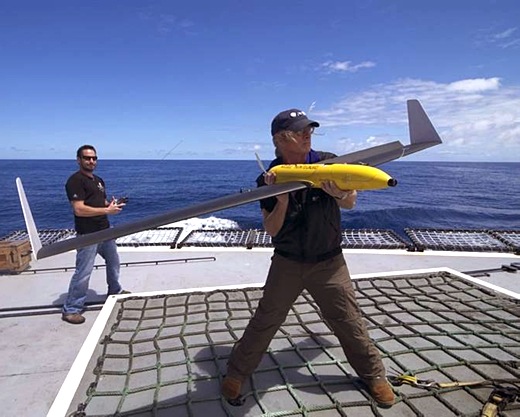
Image above: Sea Shepherd activist Peter Brown prepares to launch a drone from the Steve Irwin on Saturday. From original article.
 
Whaling opponents attempting to stop Japan's annual whale hunt in the Southern Ocean off Antarctica have deployed a new weapon: pilotless drone aircraft that have already spotted its whaling fleet.

The Sea Shepherd Conservation Society, whose campaigns are showcased on the Discovery Channel's Animal Planet, said it located the Japanese factory ship Nisshin Maru off Australia's western coast on Saturday using the drones, the first time this season it has made contact with the whalers.

Other Japanese ships shielded the vessel "to allow it to escape" as the Sea Shepherd's Steve Irwin ship approached on Christmas Day, Sea Shepherd said in a statement.

"This time, however, the Japanese tactic of tailing the Steve Irwin and the Bob Barker will not work because the drones, one on the Steve Irwin and the other on the Bob Barker, can track and follow the Nisshin Maru and can relay the positions back to the Sea Shepherd ships," the group stated.

"We caught them due west of Perth," founder Paul Watson told Reuters by satellite phone from the Steve Irwin. "For the next few days we will be chasing them. We are heading south."

On Monday, Watson posted on the group's Facebook page that "The chase is on. Three Sea Shepherd ships and seven ships for the whaling fleet all bound for the Southern Ocean Whale Sanctuary on opposite missions."

Watson earlier said that the two drones are equipped with cameras and detection equipment and allow Sea Shepherd to monitor the whaling fleet from a distance.

"Thanks to these drones, we now have an advantage we have never had before — eyes in the sky," Watson added.

Watson said Sea Shepherd's three ships were well outside Antarctic waters when the Japanese vessel was seen. The Sea Shepherd waited for the Nisshin Maru after hearing from fishermen it had sailed through the Lombok Strait in Indonesia on its voyage to Antarctic waters.

The Sea Shepherd society's annual attempts to stop the Japanese whale hunt by "direct action" have been widely criticized by Japan.

However, it also has influential supporters and the two drones were provided by two companies based in New Jersey.

An international moratorium on whaling has been in place since 1986, but Japan uses a provision that allows whaling for scientific purposes to justify its hunts and sale of whale meat to local markets.
.

The most tragic species ever

SUBHEAD: We’ll fight each other, even our children, over the last few scraps falling off the table.  

[IB Publisher's note: The following is the end portion of a long article from the Automatic Earth. Follow link below for the whose piece.]  

By Ilargi on 25 December 2011 for the Automatic Earth -
(http://theautomaticearth.blogspot.com/2011/12/december-25-2011-most-tragic-species.html)


Image above: "Dogs Fighting in a Wooded Clearing" by Frans Snyder (1579-1657). From (http://en.wikipedia.org/wiki/File:Snyders_Dogs_fighting.jpg).

Yes, it's not just generation versus generation, not just parents against their children. The problem is much more perverted. We no longer have a functioning financial system, a functioning banking system, or a functioning political system for that matter.

All these systems died on the same battlefield. Credit. When Richard Nixon threw out the gold standard in 1971, the younger baby boomers were getting their first jobs and buying their first homes. Happy Days! It took an entire generation, actually a bit more than 25 years, for the inevitable outcome of that decision to reach the high point of its devastating glory.

But here we are now. We've all been had. All but 1% of the people. When it's no longer the fruits of his labor that determine a man's wealth, but the fruits of his wagers, when our leaders are those who are best connected to the moneylenders in the temple, instead of those that throw them out, there is no way we could not have ended up where we have. Still, pitted against each other we will be.

Whether in our own countries, or in skirmishes between countries -Europe-, or a WWIII over energy resources that keep the cattle at home docile, we will fall for it all again. We haven't learned much. But then again, maybe it isn't about learning after all. We are ready and willing to destroy our societies, and eventually our planet, over a few scraps falling off the big table, like a Mac Mansion, an iPod, an SUV, because that is who we really are.

Because we can make ourselves believe those are not scraps, that we are indeed kings now, seated at the table, and heaven knows we have lived better than ancient kings of any age over the past decades. And most of all because we are no good at all at planning long-term. We can pay into a pension plan, that seems long-term, but at the very same time we can't figure out that if at some point there's less new contributors than older ones, that plan must and will implode.

We all will swear we love our children above anything in the world, and most would give their lives for their kids. And we honestly mean it when we say it. The reality, however, is that we leave our children with a world that is polluted beyond recognition, in which species disappear at a rate 1000 times faster than before, and in which everything we’ve trained our kids for is vanishing right before their eyes.

Our "leaders" are psychopath lackeys of a long bankrupt financial system that uses its servants to gobble up the yet to be earned wealth of our progeny, and we just sit by and watch it happen. We never noticed what happened to our financial systems when Nixon pulled his trick in '71, after all, we got richer, right, so who's to complain?

We never noticed how the increasing fake wealth drove our societies and families apart, we wanted more space, more individualism, more things to buy and possess. We never noticed how our energy supplies started to run out; hey, we're driving more than ever, so there must be more oil than ever... We have done exactly the same that any primitive life form would do when faced with a surplus, of food, energy, and in our case credit, cheap money. We spent it all as fast as we can. Lest less abundant times arrive.

It's an instinct, it comes from our more primitive brain segments, not our more "rational" frontal cortex. It's not that we're in principle, or talent, more devious or malicious than more primitive life forms. It's that we use our more advanced brains to help us execute the same devastation our primitive brain drives us to, but much much worse. That's what makes us the most tragic species imaginable.

We’ll fight each other, even our children, over the last few scraps falling off the table, and kill off everything in our path to get there. And when we're done, we’ll find a way to rationalize to ourselves why we were right to do so. We can be aware of watching ourselves do what we do, but we can't help ourselves from doing it. Most. Tragic. Species. Ever.

 .

Monk seals murdered on Molokai

SOURCE: Surfrider Foundation Kauai (surfriderkauai@gmail.com)
SUBHEAD: Walter Ritte, "These seals are not invasive; they are like the Hawaiian people who are struggling to survive in their own lands."

 By Walter Ritte on 23 December 2011 for Na Mea Hulu -  
(http://us2.campaign-archive1.com/?u=41dec0ab667265182a9e2a07a&id=cdd083bb90&e=02cd9398f0)


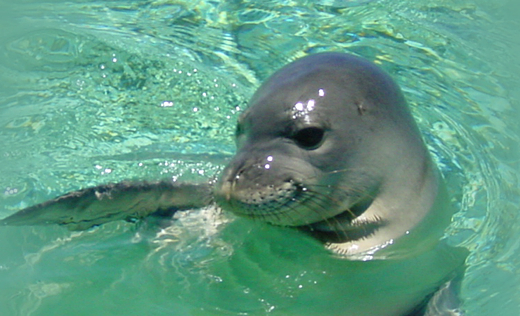
Image above: Monk seal pup swimming in ocean. From (http://nameahulu.org
).  

[IB Editor's note: Walter Ritte is a Hawaiian and sovereignty activist who has fought against GMO. tourism and speculative development ruining Molokai for a generation.]

 The death of these Hawaiian Monk Seals on Molokai is an indication of a dangerous trend that must be stopped. Our elders are saying that these seals are not Hawaiian. Our young people are calling these seals an invasive species brought in by government. The seals are now the easy targets of blame for the many ills of our depleting fisheries. We need to stand up for the truth: These seals are not only Hawaiian, but have been here longer than the Hawaiians. These seals are not invasive; they are like the Hawaiian people who are struggling to survive in their own lands. Hawaiians need to see themselves when they see a Hawaiian Monk Seal. How we treat the seals, is how we can be expected to be treated as Hawaiians in Hawaii.

Background: Kaunakakai, Molokai
The National Oceanic and Atmospheric Administration (NOAA), in cooperation with the Department of Land and Natural Resources, is investigating the deaths of two Hawaiian monk seals on the south shore of Molokai.

A young female was found dead this past week. This follows the death of an adult male seal in mid-November. Necropsies indicate that both seals appear to have died under suspicious circumstances and that foul play cannot be ruled out as the cause of death in either case.

“I was saddened to hear of these two incidents, especially the loss of a young female who would have helped restore the diminished seal population.” said William J. Aila, Jr., DLNR Chairperson. “Monk seals are an important part of the Hawaiian ecosystem and need to be respected as a valued part of our natural and cultural environment. The harm to one is a blow to Hawaii,” he said.

In June 2010, the Legislature passed Act 165*, specifically to increase penalties for taking (which is defined to include harassing or killing) a monk seal. It’s a Class C felony (up to 5 years imprisonment). Someone convicted under this law could face a fine of up to $50,000. It is also against federal law to kill or harm a Hawaiian monk seal.

Anyone having information related to these deaths should call the NOAA OLE hotline at 1-800-853-1964 or Division of Conservation and Resources Enforcement (DOCARE) at (808) 873-3990 or after hours call 643-DLNR.

See also:
Ea O Ka Aina: Mediterranean Monk Seal Secret 1/10/11
Ea O Ka Aina: Endangered Monk Seal in Turkey 1/23/11
Ea O Ka Aina: Loss of Monk Seals on Kauai 5/27/09 .

A Christmas Carol 2011

SUBHEAD: For Christmas around $600 billion US dollars (in zero interest loans) flowed to over 200 Euro banks.

 By James Kunstler on 26 December 2011 for Kunstler.com -  
(http://kunstler.com/blog/2011/12/a-christmas-carol-2011.html)

 
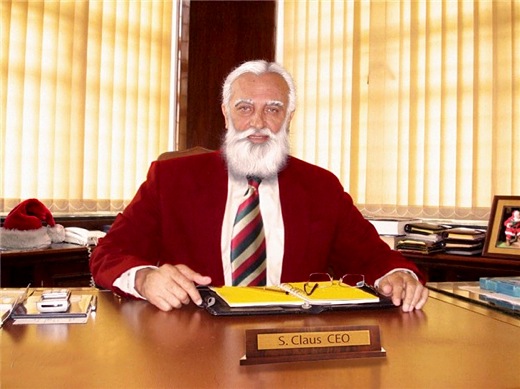
Image above: CEO of Santa Corp in his corner office. From (http://www.alienrobotzombies.com/2010/12/santa-corp-factsheet.html).

Slouched in woe beside the Christmas tree, a lot of Americans missed the point of 2011: Santa Claus had already emptied his goodie sack before the night of wonders and miracles arrived and was back at the North Pole checking the balance sheet to see if he could raise a little cash selling some remaining assets off to the Blackstone Group or maybe work a leveraged buyout deal with Kohlberg Kravis Roberts.

A few elves would have to join the unemployment line, but they could probably get by on half-rations of food stamps. Or maybe Henry Kravis could feed them reindeer steaks... at a discount, as long as they last.

It's remarkable how the year's great mega-holiday blowout suspends time and circumstance.

I didn't see how the European banks were going to make it to December 25, but then, heading into the shopping frenzy home-stretch, swap lines opened up between the US Federal Reserve and the European Central Bank and around $600-odd billion at zero Interest ZIRP loans flowed to over 200 Euro banks.

Maybe that will cover the next two weeks of aggregate debt rollovers, and then what? They can't even look forward to President's Day over there - unless we rented out the George Washington and Abe Lincoln brands to them.
Who is still not impressed with the ability of these central banks, and their owner-operators, to keep re-circulating immense loads of notional money? Alas, every wash-rinse repeat cycle leaves the certificates a little paler and thinner, and it won't be long before they just appear to be blank paper.

But rackets as grand and insolent as these would not be possible, except in a culture so estranged from truth that anything goes over without notice. I wonder about that scene around the American Christmas tree, though - the empty space between the floor and the lowest boughs where the gaily-wrapped presents used to appear.
I reckon it will take a few weeks, perhaps through the whole winter, for a sense of swindle to set in among the rooked. You may notice a pervasive undertone of grumbling in the background - and winter is the right time for that - like the eerie, ominous chords of ice groaning in the darkness on a still night around the frozen lake.

But eventually come the tumults and torrents of spring. I suppose what baffles many of us in the ethers of bloggery is the apparent failure of that demographic slice acquainted with thinking to register any objection to the travesties and organized brigandages of these times.

At any other time in the life of this republic, such folk with active frontal lobes would have identified arrant criminal activity for what it is. Apparently, the nostrums of Paul Krugman are as powerfully narcotic as the raptures of Nascar.
I'm afraid events are a little too far gone now. There was some hope that Mr. Obama would restore the rule of law, but he has gone even farther in the opposite direction by disabling even the levers of truth - and in so genial a style that nobody noticed that, either. That thinking demographic slice of the public I averred to must have mortgaged their souls the past three years just to keep on keeping on.

Hence, when the truly rooked wake from their zombie sleepwalk, there will be hell to pay for sure. Sometimes an intellectual governor on events no longer even avails, as was the case in the French Revolution. When the lawyers, political theorists, and philosophers got into the act, the blood really flowed.
Will that happen here, in the months and years ahead? I do think so. We've grown ourselves a toxic aristocracy of privilege and mega-wealth as cheeky (or worse) than the fops and strumpets of Versailles. I confess, I feel a bit lusty for some Grand Guignol action myself.

There are stock figures in The New York Observer's weekly "Shindigger" column who I would enjoy seeing treated after the manner of Vlad III, Prince of Wallachia, the celebrated "impaler." And what better place for it than Zuccotti Park, a much more intimate venue than the agoraphobia-inducing Place de la Concord. You see what happens: in the absence of the rule of law even prudent men turn to the reptile agencies of mind.
The truly interesting thing about America's romance with our Wild West was that there was always an Unwild East to return to - if you survived adventuring in one piece.

Well, first the frontier closed about 100 years ago, and now we wake on Christmas morning to discover that the whole land, from sea to shining sea, has gone feral with rot. Enjoy this nebulous week of suspended animation while it lasts.

I'll be back next Monday with the 2012 forecast.

.

Frito-Lay claims GMOs natural

SUBHEAD: Frito-Lay sued for labeling GMO ingredients as "All Natural" while Monsanto insists they are not.  

By Deniza Gertsberg on 23 December 2011 for GM Watch -  
(http://www.gmwatch.org/index.php?option=com_content&view=article&id=13573:new-consumer-lawsuit-over-not-so-natural-gmo-food) 

   
Image above: A variety of Frito-Lay "All Natural" Sun Chips with GMO ingredients. From product promo at (http://www.hornallanderson.com/casestudy/going-au-natural).
 
Frito-Lay, a wholly owned subsidiary of Pepsico, was recently sued for the labeling of certain lines of Tostitos and SunChips products. In a December 14, 2011 complaint filed with the Central District Court of California, the class action plaintiff, Julie Gengo, alleges that certain of the Tostitos and SunChips lines, marketed as being “made with ALL NATURAL” ingredients, are misleading because they are made of genetically modified ingredients.

The products that are the focus of the lawsuit are made with mostly corn and vegetable oil. In fact, corn and vegetable oil “constitute the first two ingredients listed on the nutritional label of each of these products…” According to the latest statistics from the U.S. Department of Agriculture, 88% percent of corn and 94% of soybeans grown in America is genetically modified. Soybean and corn oils are commonly used in processed foods such as chips.

Plaintiff alleges that Frito-Lays’ advertising misleads consumers with product labeling prominently announcing “all natural” ingredients as well as claims on the company’s website. These products, claims the plaintiff, are not “all natural” as they are made from genetically modified ingredients–just ask Monsanto, which defines GMOs as follows:
Plants or animals that have had their genetic makeup altered to exhibit traits that are not naturally theirs. In general, genes are taken (copied) from one organism that shows a desired trait and transferred into the genetic code of another organism.
And Monsanto is not alone, says plaintiff, in defining GMO as something other than nature-made. The World Health Organization and a laboratory that works with agricultural clients also define GMOs as plants altered to express traits in a way that does not naturally occur.

The lawsuit against Frito-Lay is brought by the same law firm that earlier this year sued ConAgra for its Wesson oil line’s “all natural” labeling. After that lawsuit was filed, ConAgra moved to dismiss the case, arguing, among other things, that issues raised by plaintiff were the regulatory territory of Food and Drug Administration (FDA), whose tasks include maintaining and regulating uniformity and consistency in labeling. ConAgra argued that since FDA decided that GMOs are not meaningfully different from foods developed through traditional plant breeding, no label notifying a consumer about the presence of GMOs was required. The Court found that ConAgra has misstated the issue and said, among other things, that:
[Plaintiff's] primary argument is not that ConAgra was require d to state whether its products were made from genetically modified plants. Rather, he contends that ConAgra’s affirmative decision to label its products “100% Natural” was misleading, given that the products were made from genetically modified plants
Furthermore, the Court stated:
Here, for example, in the face of silence from ConAgra, a consumer of Wesson Oil who wished to know whether genetically modified plants were used in the product would have had to look beyond the label, because it is not information that the FDA requires be disclosed. Assuming that consumers would reasonably understand the term 100% Natural to mean that no genetically modified plants were used, however, ConAgra’s affirmative representation that the product was 100% Natural would have dissuaded an interested consumer from conducting an investigation. Consequently, it could be found to have been material.
While the complaint was dismissed for other errors, they were not fatal and the Court provided plaintiffs an opportunity to correct those deficiencies. In an email to GMO Journal, the attorney representing the plaintiffs, Andrei Rado, was optimistic about the outcome. “[T]he first round is a victory for plaintiffs.”


Stop War for Christmas

SUBHEAD: President Obama could declare Christmas as a day of peace for US troops in Afghanistan.  

By Robert Naiman on 24 December 2011 for Truthout - 
(http://www.truth-out.org/stop-war-christmas-cease-fire-afghanistan/1324745394)

Image above: Tribute to "Twas the Night Before Christmas in Afghanistan". From (http://www.173rdairborne.com/Xmas-afghanistan.htm).
Shouldn't Americans of every faith tradition band together to stop the war on Christmas? Let us call on President Obama to announce that on December 24 and 25, the United States will observe an offensive cease-fire in Afghanistan and urge others to join the cease-fire as a goodwill gesture to promote peace talks.

This proposal is far from utopian. I claim that it is a pragmatic political proposal, with little cost and significant potential benefits; indeed, according to recent press reports, a US-initiated Christmas truce would complement peace efforts that the Obama administration is already pursuing.

The political cost would be negligible. Would Mitt Romney, Newt Gingrich and John McCain denounce President Obama for announcing that US forces in Afghanistan will stand down to mark the birth of the Prince of Peace? If they did, would anyone take them seriously?

This is a decision that President Obama can make unilaterally as commander in chief. He does not need the permission of Lindsay Graham, the Heritage Foundation, the American Enterprise Institute, or the Washington Post editorial board. If President Obama decides that US forces in Afghanistan will not take offensive military actions on Christmas, so shall it be.

Already, Reuters reports, the Obama administration is contemplating confidence-building measures to promote peace talks with the Afghan Taliban, including transferring Afghan prisoners at Guantanamo to Afghan government custody and supporting the establishment by the Afghan Taliban of a political office in Qatar for the purpose of participating in peace talks.

Therefore, a Christmas truce would be totally consistent with measures that the administration is already pursuing. However, it would have the advantage that a cease-fire wouldn't just be an olive branch to the Afghan Taliban; it would also be an olive branch to the Afghan people. In particular, an offensive cease-fire would mean a pause in US Special Forces night raids into Afghan homes, night raids that kill civilians and violate the most basic tenets of human decency, night raids which are the object of universal loathing in Afghanistan.

Consider what we just learned from the US military withdrawal in Iraq. According to the reporting of The New York Times and The Washington Post, the key reason that the Pentagon could not win permission to stay in Iraq was: 1) The Pentagon killed too many Iraqi civilians; and 2) no one was held accountable for the killings.

Liz Sly reported in The Washington Post:
In the accounting of what was won and lost in America's Iraq war, [Haditha] will rank as a place where almost everything was lost ... in dueling [Iraqi and American] perceptions, over the killings in Haditha and others nationwide, lay the undoing of the U.S. military's hopes of maintaining a long-term presence here. When it came to deciding the future of American troops in Iraq, the irreconcilable difference that stood in the way of an agreement was a demand by Iraqi politicians for an end to the grant of immunity that has protected on-duty U.S. soldiers from Iraqi courts.
"The image of the American soldier is as a killer, not a defender. And how can you give a killer immunity?" said Sami al-Askari, a lawmaker who is also a close aide to Prime Minister Nouri al-Maliki.
Michael Schmidt reported in The New York Times:
Charges were dropped against six of the accused Marines in the Haditha episode, one was acquitted and the last remaining case against one Marine is scheduled to go to trial next year.
That sense of American impunity ultimately poisoned any chance for American forces to remain in Iraq, because the Iraqis would not let them stay without being subject to Iraqi laws and courts, a condition the White House could not accept.
The significance of these reports for the war in Afghanistan cannot be overemphasized. A key objective of the Pentagon in the invasion of Iraq was to establish a permanent military garrison in Iraq. But the Pentagon failed in this objective because of the Pentagon's own failure characterized by the killing of Iraqi civilians, as well as its failure to take responsibility for those killings.

Now the Pentagon is pursuing in Afghanistan the same objective that it was pursuing in Iraq: trying to establish a permanent military garrison. In the long run, the Pentagon is likely to face the same paradox in Afghanistan that it faced in Iraq: the Pentagon is intervening in a civil war, and it's the intervention in the civil war that creates the opportunity for the Pentagon to be in Afghanistan; meanwhile, it is US policy to try to end the civil war, but as soon as the civil war ends and the current government is replaced by a government that includes representation for all the people now fighting, it is extremely likely that that government will kick the Pentagon out, just as happened in Iraq. Meanwhile, the more civilians the Pentagon kills, injures and abuses as long as the war continues, the more certain it is that an Afghan government that ends the war will kick the Pentagon out.

Since this is the likely future, why dally? The sooner we can get the Pentagon kicked out of Afghanistan, the more American and Afghan lives will be saved and the fewer tax dollars we'll have to waste on a doomed enterprise that isn't supported by the majority of Americans and isn't in the interests of the majority of Americans.

A Christmas cease-fire will be the camel's nose under the tent. It will introduce the concept of "cease-fire" into the center of discourse on Afghanistan, where it belongs. After ten years of Rube Goldberg efforts to bring peace to Afghanistan by the acquisition of some other objective have failed, it is time to work towards peace directly, by silencing the guns.

There are precedents in Afghanistan for a cease-fire. The United Nations (UN) has successfully negotiated cease-fires to conduct vaccinations. There were cease-fires in the past for elections.

Some will object that Christmas is a Christian holiday and Afghanistan is a Muslim country, and what do the Afghan Taliban know from Christmas?

But we have to start somewhere, and the principal political obstacle to a cease-fire is the Pentagon, and the best way to intimidate the Pentagon from resisting a cease-fire is to announce one on Christmas. If we can get a cease-fire on Christmas, then a cease-fire on a Muslim holiday will surely be next.

The Christmas truce has a rich history, one that we should seek to revive. In December 1914, as war raged in Europe, Pope Benedict XV called for a Christmas cease-fire.

The pope's initiative was rebuffed by political leaders, but in one of the most compelling acts of mass civil disobedience in the 20th century, rank-and-file troops carried out the action that the Pope had called for, negotiating local Christmas cease-fires on the Western Front. Christmas 2014 will mark the hundred-year anniversary of the Christmas truce of 1914.

Maybe, if we get busy, by Christmas 2014, the guns in Afghanistan will be silenced for good.


.

Obama's civil rights failure

SUBHEAD: By signing the 'anti-terror' bill the president could end up being worse than George Bush on civil liberties.

 By Mehdl Hasan on 23 December 2011 for the Guardian - 
  (http://www.guardian.co.uk/commentisfree/cifamerica/2011/dec/23/obama-abysmal-record-civil-liberty)

 
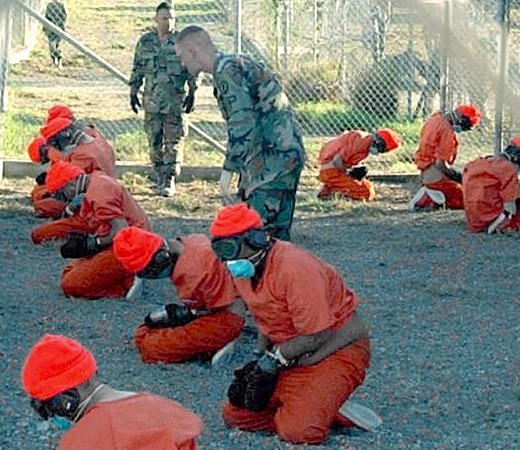
Image above: Camp X-Ray at the US Navel Base at Guantanamo, Cuba. From (http://pbd.blogspot.com/2011_04_01_archive.html).
 
Here we are. More than 10 years after the 9/11 attacks, more than six months since the killing of Osama bin Laden and less than a year away from the next presidential election, Barack Obama is about to sign into law the National Defence Authorisation Act (NDAA). It authorises the indefinite detention in military custody of US citizens who are suspected of having "substantially supported" al-Qaida, the Taliban or "associated forces" – and makes such detention mandatory for foreign nationals who are accused of having links to al-Qaida.

In fact, say civil liberties lawyers and human rights groups, this pernicious and Orwellian piece of legislation doesn't only enshrine in US law (in sections 1021 and 1022) indefinite military imprisonment without trial for terror suspects, but also makes it much easier for the government to transfer – or "render" – US citizens to foreign regimes for interrogation or incarceration, (also section 1021) and much more difficult to close the prison camp at Guantánamo Bay(sections 1023, 1026, 1027, and 1028).

Obama and the Democrats have a great deal to answer for. This brazen militarisation of US civilian justice and law enforcement cannot just be laid at the door of dastardly Republicans in Congress. In the Senate, the bill was co-sponsored by a Democratic senator, Carl Levin; in the House of Representatives, it sailed through with the support of 93 Democrats, including the minority leader, Nancy Pelosi (despite being opposed by, among others, the directors of the FBI and the CIA, the attorney general and the defence secretary).

The president has the power to veto the bill and, initially, his aides had suggested he would do so. However, citing vague "changes" to the language of the bill, Obama – the most veto-shy president since James Garfield in the 1880s – made a U-turn this month and withdrew his veto threat in what a New York Times editorial called "a complete political cave-in, one that reinforces the impression of a fumbling presidency".

But this isn't about the president's political incompetence or abject weakness. It is, above all, yet another example of Obama's refusal to stand up for civil liberties and the rule of law. Over the past three years, the former constitutional law professor has failed to close Guantánamo Bay, expanded the detention facility at Bagram airbase in Afghanistan, defended the use of warrantless surveillance and military tribunals, and – shockingly – asserted the right to assassinate, via drone strike and without due process, US citizens he deems to be terrorists. As the leading US legal scholar Jonathan Turley has argued, "the election of Barack Obama may stand as one of the single most devastating events in our history for civil liberties".

It is hard not to like or admire Obama as a person: the president is intelligent, reasonable, eloquent and witty. But presidents should be judged on their policies, not personalities; their records, not their rhetoric. Obama, however, has been handed a pass on indefinite military detention by the same liberals, progressives and Democrats who were so outraged and disgusted by the Bush administration's much milder Patriot Act. Liberals have to ask themselves: do civil liberties and human rights only matter when a Republican is sitting in the Oval Office?

A few weeks ago, at a private dinner, I was assailed by a senior state department official for echoing Turley's critique of the president and for daring to compare Obama to his Republican predecessor. In fact, I now regret saying Obama was similar to Bush. When it comes to civil liberties, once he signs the NDAA into law, he will be worse.
 .

Tepco faking Fukushima fix

SUBHEAD: Absolutely no progress being made at Fukushima nuclear plant, undercover reporter says.  

By Robert Irvine on 16 December 2011 for Mainichi Daily News
  (http://mdn.mainichi.jp/mdnnews/news/20111216p2a00m0na002000c.html)

 
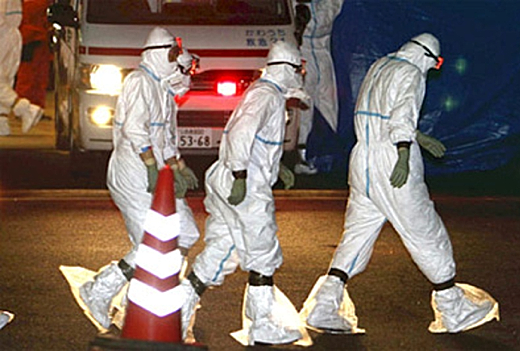
Image above: Tepco contract workers enter Fukushima nuclear plant to work with plastic bags taped over footwear. From (http://www.tokyoprogressive.org/content/dying-tepco-fukushima%E2%80%99s-nuclear-contract-workers-genpatsu-gypsies).
 
Conditions at the Fukushima No. 1 nuclear plant are far worse than its operator or the government has admitted, according to freelance journalist Tomohiko Suzuki, who spent more than a month working undercover at the power station.

"Absolutely no progress is being made" towards the final resolution of the crisis, Suzuki told reporters at a Foreign Correspondents' Club of Japan news conference on Dec. 15. Suzuki, 55, worked for a Toshiba Corp. subsidiary as a general laborer there from July 13 to Aug. 22, documenting sloppy repair work, companies including plant operator Tokyo Electric Power Co. (TEPCO) playing fast and loose with their workers' radiation doses, and a marked concern for appearances over the safety of employees or the public.

For example, the no-entry zones around the plant -- the 20-kilometer radius exclusion zone and the extension covering most of the village of Iitate and other municipalities -- have more to do with convenience that actual safety, Suzuki says.

"(Nuclear) technology experts I've spoken to say that there are people living in areas where no one should be. It's almost as though they're living inside a nuclear plant," says Suzuki. Based on this and his own radiation readings, he believes the 80-kilometer-radius evacuation advisory issued by the United States government after the meltdowns was "about right," adding that the government probably decided on the current no-go zones to avoid the immense task of evacuating larger cities like Iwaki and Fukushima.

The situation at the plant itself is no better, where he says much of the work is simply "for show," fraught with corporate jealousies and secretiveness and "completely different" from the "all-Japan" cooperative effort being presented by the government.

"Reactor makers Toshiba and Hitachi (brought in to help resolve the crisis) each have their own technology, and they don't talk to each other. Toshiba doesn't tell Hitachi what it's doing, and Hitachi doesn't tell Toshiba what it's doing."

Meanwhile, despite there being no concrete data on the state of the reactor cores, claims by the government and TEPCO that the disaster is under control and that the reactors are on-schedule for a cold shutdown by the year's end have promoted a breakneck work schedule, leading to shoddy repairs and habitual disregard for worker safety, he said.

"Working at Fukushima is equivalent to being given an order to die," Suzuki quoted one nuclear-related company source as saying. He says plant workers regularly manipulate their radiation readings by reversing their dosimeters or putting them in their socks, giving them an extra 10 to 30 minutes on-site before they reach their daily dosage limit. In extreme cases, Suzuki said, workers even leave the radiation meters in their dormitories.

According to Suzuki, TEPCO and the subcontractors at the plant never explicitly tell the workers to take these measures. Instead the workers are simply assigned projects that would be impossible to complete on time without manipulating the dosage numbers, and whether through a sense of duty or fear of being fired, the workers never complain.

Furthermore, the daily radiation screenings are "essentially an act," with the detector passed too quickly over each worker, while "the line to the buzzer that is supposed to sound when there's a problem has been cut," Suzuki said.

Meanwhile much of the work -- like road repairs -- is purely cosmetic, and projects directly related to cleaning up the crisis such as decontaminating water -- which Suzuki was involved in -- are rife with cut corners, including the use of plastic piping likely to freeze and crack in the winter.

"We are seeing many problems stemming from the shoddy, rushed work at the power plant," Suzuki says.

Despite the lack of progress and cavalier attitude to safety, Suzuki claims the cold shutdown schedule has essentially choked off any new ideas. The crisis is officially under control and the budget for dealing with it has been cut drastically, and many Hitachi and Toshiba engineers that have presented new solutions have been told there is simply no money to try them.

In sum, Suzuki says what he saw (and photographed with a pinhole camera hidden in his watch) proves the real work to overcome the Fukushima disaster "is just beginning." He lost his own inside look at that work after it was discovered he was a journalist, though officially he was fired because his commute to work was too long.

"The Japanese media have turned away from this issue," he laments, though the story is far from over.

• A book by Tomohiko Suzuki detailing many of his experiences at the plant and connections between yakuza crime syndicates and the nuclear industry, titled "Yakuza to genpatsu" (the yakuza and nuclear power), was published by Bungei Shunju on Dec. 15.

Fukushima Update Day 280  

By Staff on 16 December 2011 for Fukushima Update - 
  (http://fukushimaupdate.com/fukushima-update-day-280/)  

Independent: Giant concrete ‘diaper’ to be built under Fukushima plant in effort to stop radioactive substances leaking into ground -Nuclear experts / via ENEnews.com / December 16, 2011 /
Battle to control Fukushima has just ‘stored up’ dangers – Asia – World – The Independent
  • The rush to bring the plant under control is storing up complex problems, according to Tomohiko Suzuki, who spent a month working at the plant during the summer and has released a book this week about his experiences.
  • “The question is, can they maintain this temperature for years and years? I believe the problems there are just starting”.
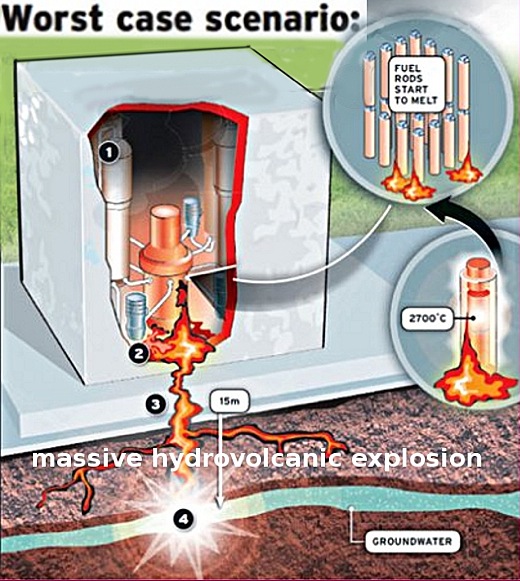
  • Nuclear experts say the state of the molten fuel is still uncertain, with some speculating that the government is preparing to build a giant concrete “nappy” underneath the complex to stop radioactive substances leaking into the ground.

Image above: Illustration of "China Syndrome" dangers at Fukushima. From original article. 
 
See also:
NISA Declares No Contaminated Water Leak in the Past, Now, and the Future – ex-SKF Decommissioning Fukushima plant to take max. 40 years – Mainichi Daily
Yakuza involved in Fukushima clean-up: reporter – Japan Today

.

Superferry vessels go to Navy

SOURCE: Dick Mayer (dickmayer@earthlink.net) SUBHEAD: The Navy to buy the two Hawaiian Superferry vessels from MARAD for $35-million.

By Robert McCabe on 23 December 2011 for Hampton Roads - (http://hamptonroads.com/2011/12/navy-gets-ok-buy-two-hawaiian-superferries)


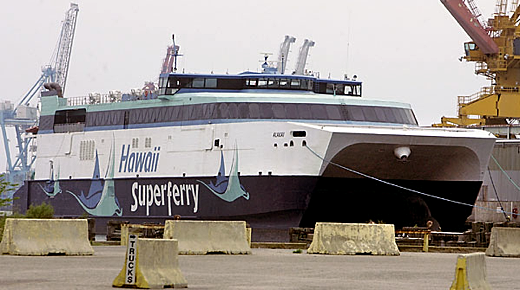
Image above:The Alakai, shown moored at Lamberts Point Dock in Norfolk on July 16, 2009 From original article.

Congress has given the Navy the green light to spend up to $35 million to acquire two Hawaiian superferries from the U.S. Maritime Administration (MARAD).
A provision in the recently approved defense authorization bill will allow the transfer of the Huakai and the Alakai to the Navy, where they will become Department of Defense sealift vessels.
The Navy declined to discuss the matter on Thursday because President Barack Obama had not yet signed the bill.

"The Navy does not comment on pending legislation," said Lt. j.g. Lauryn Dempsey, a spokeswoman.
No date for the transfer has been set, said Cheron Wicker, a Maritime Administration spokeswoman, in an email.

The ferries are docked at Lamberts Point in Norfolk, where they have been in financial limbo for roughly 2-1/2 years.

The Navy has been interested in the vessels since July 2009, after a bankruptcy judge ruled that the owner - Hawaii Superferry Inc. - could abandon them to lenders, who at the time were owed nearly $159 million.

The administration, which guaranteed the loans, moved them to Norfolk, where it bought the vessels at an auction on Sept. 30, 2010, on the steps of Norfolk's federal courthouse.
Built to move cars and people among the islands of Hawaii, the ferries can cruise at 35 knots. Between 320 and 340 feet long, they each can carry 836 passengers and 282 cars.
One of the ferries, the Huakai, was used in the military's relief efforts after the earthquake in Haiti in January 2010.

In June, the Maritime Administration put the two vessels up for sale on an "as is, where is" basis and eventually received four bids.
In September, the administration said it was "working expeditiously with bidders and other interested parties in evaluating its options, with a goal of maximizing the government's return from these vessels."
.

Are we turning the corner?

SUBHEAD: The winter solstice celebrates the return of the light. Is the feeble US economic recovery a sign of good times to come?  

By George Mobus on 21 December 2011 for Question Everything - (http://questioneverything.typepad.com/question_everything/2011/12/winter-solstice-are-we-turning-a-corner.html)


Image above: Smile like everything is OK.. From (http://psych-your-mind.blogspot.com/2011/04/smile-like-you-mean-it-emotion.html).
 
The economic news has seemed to be a little better of late, at least on the home front in the USA. The Eurozone crisis is still flaming, so markets are still unresolved. But a few numbers here in the US economy have given some people renewed hope that this so-called jobless recovery is happening. Is economic spring just around the corner?

The Winter Solstice is a celebration of the fact that from here on, the days will be getting longer. There will be more light each day. And for those of us who live in higher latitudes that is meaningful. I've heard a few comments to the effect that just like the solstice, we may have reached a turning point in the economy and each day there will be a little more “light”.

I don't think so. There are several things to remember about cycles like the seasons. Most of all they go round and round. There will be a Summer Solstice in June. The economy has its cycles too and the real question is, over the long run, is it a simple cycle, or is it a spiral? And if so, which way is it going.

West Texas Intermediate crude prices are still north of $90/barrel. Tapis and Brent have been running $100 plus for a long time. Many more traditional economists are finally coming to realize what the biophysical economists have been saying all along, that the price of oil has a direct impact on the direction of the economy in terms of GDP growth. High oil prices lead to a drag on the general economy in all sectors.

Today the only way governments have to appear to be countering this fact is to create more fiat money (e.g. quantitative easing) to make it seem as if there is more actual wealth available and GDP looks like it is still growing (albeit at a pathetic pace compared with what is considered robust!) They are hoping that sooner or later the whole thing will turn around, just like the Winter Solstice, and we will get back to the old normal of growth and “prosperity”. They are, of course, just aggravating the situation. The only time we might expect the price of oil to diminish is when the economy goes into a clear recession and demand goes down.

The ups and downs in the economy, reflected in the price of oil and the stock markets, reminds me of the preditor-prey population dynamics models based on the Lotka-Volterra equations. The equations describe two interacting populations that affect each other's sizes with time delays. One goes up, the other follows but as it does so it negatively impacts the size of the other, which then goes down and the other one follows. Rabbit populations expand; foxes eat rabbits and with more of them the fox population goes up accordingly; then there are more foxes and they eat more rabbits so the latter population declines; and the foxes go hungry. Something like that.

The price of oil, however, is only a symptom. It tends to reflect the fact that the net energy we get from what oils we are producing is going down. Right now there is a hubbub going on about how the US is awash in oil and natural gas. What the MSM doesn't mention, or fails to analyze, is the fact that this new oil is terribly expensive to harvest. In reality, it simply takes more energy to extract tar sand oil, or shale oil (and gas) than it did extracting conventional oil (and gas). Ergo, it is more expensive even if the supply seems to be going up. By the ordinary laws of standard economic theory, greater supply should push the price of a commodity down. Or, at least, it should not trend upward, as has been the case since 2005.

Of course, energy is not like any other commodities. The Second Law of Thermodynamics rules the day. So, as we are seeing, even if supplies (actually we refer to “potential supplies”, or proved reserves) seem to be up the “purchasing power” of our money with respect to real physical work goes down.

So, unfortunately, this seeming turn around is not like the Winter Solstice. There will come an effective Summer Solstice before anything like a Spring Equinox is seen in the economy. We're in a permanent winter! In other words we are on a downward spiral that will not halt until or unless we discover some incredible source of high power energy. The likelihood of that is looking slimmer every day. Meanwhile the population continues to grow, the wealthy continue to burn up resources at a phenomenal rate, the oil continues to decline in value, and the natives are growing restive. All you pagans out there had better get in touch with the spirits. See if you can convince them that the economy really ought to be more like the annual cycle we celebrate at this time of the year.

 .

Identity Crisis

SUBHEAD: What to do? Too old to die young, too poor to start anew and the industrial era is nearing its end.

By Guy McPherson on 23 December 2011 for Nature Bats Last - 
  (http://guymcpherson.com/2011/12/identity-crisis/)

   
Image above: The woodcut shows a pilgrim who, after a long and fruitless spiritual quest for a terrestrial and heavenly paradise, is on his knees. Finally he realizes his helplessness; he now understands Gurdjieff′s dictum, ‟Do all that you can, and then ask God for mercy.″ It is then, at his wits′ end, that the pilgrim may be allowed to see through the shell of appearances, to arrive at an understanding of the fundamental mechanism that lies behind them. He may finally find what he′s been looking for at a place where heaven and earth meet: a power behind and beyond all duality. From (http://www.satrakshita.be/the_quest.htm).

Self-indulgence is only one of many advantages associated with having a blog of my own. In a rare attempt to avoid drawing further attention to myself, I’ll not list the others.

At least, not now.
As regular readers know by now, I’m a lifelong educator. In fact, the most common insult hurled my way by anonymous online commentators is “lifelong academic.”
Ouch. That hurts.

In the hallowed halls, ego is everything. Indeed, it’s difficult for me to imagine a profession that selects, to a greater extent than academia, for a huge ego. Shepherding a single refereed journal article through the process of publication builds more callus tissue than swinging a pick and shovel for two years.

Multiply by dozens of articles, hundreds of public presentations, and a handful of books, and you can begin to understand why the average academic has an ego slightly larger than hell and half of Asia.

Thirty months into a new life devoid of regular interaction with inmates and honors students, I’m having the sort of identity crisis described by Dmitry Orlov in his excellent book, Reinventing Collapse. According to Orlov, middle-aged men — specifically those aged 45 to 55, nicely bracketing the age I departed the ivory tower (49) and my current age (51) — experienced the highest rate of mortality as the Soviet Union collapsed.

The two most common causes: suicide and suicide by alcohol. I doubt I’ll go either route, but it’s easy to understand why Family Providers would experience suicidal depression when their ability to provide for their families slips away like a cat-burglar in the dead of night.

The issue of identity (i.e., ego) is far worse in the United States than the situation described by Orlov in the Soviet Union.

As becomes apparent this time of year, when casual conversation is on the menu during every seasonal festivity, our identities are completely bundled with how we earn money. What do you think people mean when they ask, “What do you do?” In every case with which I’m familiar, they are inquiring how I earn money.

Knowing where the entire enterprise of generating cash is headed, I tell people I’m a sharecropper and organic gardener. Oh, and by the way, that right hand of mine, the one you just shook, milked two goats this morning. Then I ask people what they love.

I can suck the air out of room — any room, regardless of size or number of people present — in a matter of seconds.

I’m a sharecropper, organic gardener, and milker of goats, as well as a democrat, a republican, a liberal, a conservative, a radical, an idealist, a pragmatist, a teacher, a mentor, a scientist, a writer, a skeptic, a scholar, a cheese-maker, a son, a brother, a husband, a lover, and a human animal. I’m comfortable with my beliefs and personal philosophy.

I’ve thought deeply about my tiny place in this enormous universe, and I’ve come to value humility over hubris. And still I’m having an identity crisis. A crisis of confidence.

An ego-crushing moment. The longer the industrial economy lasts, the more my identify is pummeled, along with my hope for the living planet. Every day under the rule of Athena drives me further into despair. It’s as if my ego were a proxy for the planetary rate of extinction.

Considering the effort I’ve put into defining myself and my place in the universe, I can only imagine the difficulty ahead for the typical American drone. He values his imperial role and fails to recognize the empire for what it is.

He gets his news from the television and affiliated media outlets and fails to recognize that form of propaganda for what it is. His sense of entitlement is exceeded only by his ignorance of the role nature plays in his survival. And yet, he’s ahead of me.

After all, unlike the American drone, I’m clueless about what to do. I’ve invested heavily in a reasonably sane set of living arrangements, only to have nature call me further down her path. I’m attempting to serve as a witness, and occasionally a warrior, as the living planet tries to survive the insults of industry.

I’m trying to show another — hence, contrarian — way, for a world gone mad. And in return, I’m unappreciated as never before in memory (including even my final decade at the university as viewed through the lens of my dean and department head).

I recognize the necessity of total revolution, but I don’t yet see it. The wisdom of activist spiritual teacher Vimala Thakar surfaces in my mind: “In a time when the survival of the human race is in question, to continue with the status quo is to cooperate with insanity, to contribute to chaos. When darkness engulfs the spirit of the people, it is urgent for concerned people to awaken, to rise to revolution.”

Obviously, Thakar was an optimist. I love her inclusive approach. And although darkness has engulfed the spirit of the people, I fail to see the awakening at a scale relevant to the task at hand. Impatience grows within me.

With the exception of plunging into the wild or continuing to serve as an unappreciated model immersed in agrarian anarchy, my options are limited. I’m too old to die young, and it’s very late to start anew.

Returning to the civilized life of an educator has limited appeal and prospects that are even more limited, considering the general perspective on my sanity (or lack thereof). And then there’s the moral imperative I feel, well expressed by social reformer and statesman Frederick Douglass: “I prefer to be true to myself, even at the hazard of incurring the ridicule of others, rather than to be false, and to incur my own abhorrence.”

Where does this lead? In my case, to utter confusion. As was recently pointed out to me by somebody a little older than me, and a lot a wiser, “in the end it doesn’t matter who you’re with if you can’t unlock the contents of your own skull.”
Which takes us right back to me and my sel
f-indulgence. What to do, in the limited time left at my disposal? The temporal limitations come in two forms: (1) I’m too old to die young (and also too poor to start anew) and (2) the industrial era is nearing its end. Without fuel at the filling stations and water coming out the taps, paid positions at small, selective, liberal-arts colleges will be hard to come by (and meaningless).

The day is coming far sooner than most people think. With luck, the forthcoming Lehman-on-steroids moment will make the decision on my behalf, and soon. If this latter statement reveals my cowardice, then it also indicates the extreme nature of my indecision.
.

The wolf in the woods

SUBHEAD: Poor little Red Riding Hood, the economic forest seems denser and darker all the time.  

By Ilargi on 21 December 2011 for the Auomatic Earth - 
  (http://theautomaticearth.blogspot.com/2011/12/december-21-2011-forest-feels-denser.html)

 
Image above: A contemporary Red Riding Hood and the big bad wolf. From (http://superpunch.blogspot.com/2010/03/red-riding-hood-and-very-big-bad-wolf.html).

Haven't we been here before?  

Fairy Tales
It's the sort of question you would expect a child to ask in one of those Grimm Brothers fairy tales, a young girl walks so far into the woods that she gets lost. She begins to leave a trail of breadcrumbs behind her but takes another wrong turn and then another while the forest feels denser and darker all the time. She may have circled and crossed her own path but doesn't know it, because the breadcrumbs have been eaten by the animals. And then the night decends.

That's how I increasingly picture our financial situation. We march forward full of feigned faith and innocence into uncharted territory, telling ourselves we will and must find a way out of this mess, boosted by the high priests of our economic belief systems, the media, economists and politicians. The children in the fairy tales always escape from the darkness in the end, but we're not those children. Ignoring the warnings and getting lost in the woods is not an act of bravery, but one of stupidity.

Characters in fairy tales serve to teach their young listeners a lesson about the morals of their societies; these characters don’t perish, they get saved because they see the errors of their ways in time. A morality tale. But whereas the children in these fairy tales go gently into a good night, we go blindly into a bad one.  

Euro woes
Perhaps it's fitting that this time around the economic rally came before instead of after the announcement by Mario Draghi, president of the European Central Bank (ECB) the offer of €489 billion in cheap loans for European banks. It fits right in with all the other things we get totally the wrong way around. About 60% of those loans, by the way, are just regurgitated old stuff. Looking even briefly at what they have come up with in 1001st episode of the bailout drama, there's one conclusion and one only: what they say is not what they think. The ECB claims that it "hopes" the banks will use the money to purchase peripheral debt, but the ECB knows they won't - and what sort of €489 billion deal depends on "hope" alone? The ECB knows, because the ECB itself, along with other parties, has refused to guarantee that debt.  

Return on Risk
It may be presented as a good deal, but borrowing at 1% to get a 5% return is not all that attractive when you have a 50% chance of an 80% haircut. Or something along those lines. The ECB also said they hope banks will use the money to loan out to consumers. That's just as big a pile of dog doo-doo. Banks are shedding assets like they're fleas, because they need reserves. That points to a solvency issue. But being able to borrow at ever cheaper rates while handing out ever more doubtful collateral addresses what is a liquidity issue.

There are a few things that this sort of lending will indeed achieve. It will gobble up bad assets from private banks and transfer them to the risk of the public coffer. Nothing new there. The child just gets deeper into the forest, and the light starts fading. A step by step process perceived as progressing so slowly, it raises no alarm. It's still morally repugnant, but whoever is in charge of this thing doesn't have any morals left anyway.

Another effect of that €489 billion in loans is that it will widen the divide between the ECB and Germany, in particular its central Bundesbank - and substantially so. This effect endangers the entire Eurozone project. Whatever plan Europe comes up with, be it the European Financial Stability Facility or the European Stability Mechanism, or this latest one from the ECB, there are only two countries left to carry the vast majority of the risk. One of those countries, France, will soon be downgraded. So will its banks. This will lead to a downgrade of the EFSF and, if there's still time, the ESM.  

Germany alone At that point there will be only Germany left to carry the entire burden on its shoulders. Germany's allies and relatively strong partners, Holland, Finland, are way too small to do any heavy lifting. Moreover, Holland is on the verge of a housing collapse. The EFSF needs to be funded; it can only spend what it has received.

Europe has been unable to agree on expanding the Facility. Which is why the ECB now comes with its loan plan. Which did lead to a market rally, but that rally fizzled as soon as the plan was announced, even though it was at least €100 billion larger than expected. So France soon will no longer be a net contributor to the EFSF. Which is one of the main reasons the expansion didn't materialize.

Hence, it's all Germany's responsibility, and Germany is smart enough to understand it's not strong enough to bear that responsibility. And then out of left field comes Mario Draghi handing out half a trillion euros in loans to 523 different European banks that on average are just about to draw their last breath.

Those banks are selling off their profitable assets because that's all buyers are interested in. The lousy assets they couldn't sell they now can pledge to the ECB, with a huge chunk of the risk involved landing squarely on the shoulders of the German citizenry. The chance that Berlin will now look more seriously at cutting its losses while it can has become much bigger after Mr. Draghi's first substantial act as ECB president. It's deceptively simple, really. Germany can't guarantee Greek and Italian and Spanish debt while France awaits slumping badly in the wings. Germany would be risking its own wealth, and its own coherence as a society, in the process.  

Meeting the wolf
 Staying in the metaphor of the child lost in the darkening forest (and yes, the Grimm brotheres were German), it's like the young girl, after taking yet another wrong turn, has stumbled upon a big bad wolf. And though it's already getting almost too dark to see, the last thing the child does notice is that the wolf looks nothing like its sweet old grandmother.

.