Porno-Scanner X-Ray Danger

SUBHEAD: Review of the TSA X-ray backscatter body scanner safety report: hide your kids, hide your wife.

By Jason Bell on 22 November 2010 in My Helical Tryst - 
(http://myhelicaltryst.blogspot.com/2010/11/tsa-x-ray-backscatter-body-scanner.html)



 [IB Editor's note: We were informed, by Garrett Spaulding, on 5/4/12 that the blog that this article originally was linked to has been removed by its author. Garrett has written a thoughtful piece on the subject here (http://www.travelinsurance.org/tsas-body-scanner-technology-health-risks/)]
 
I am a biochemist working in the field of biophysics. Specifically, the lab I work in (as well as many others) has spent the better part of the last decade working on the molecular mechanism of how mutations in the breast cancer susceptibility gene, BRCA2, result in cancer.

The result of that work is that we now better understand that people who have a deficient BRCA2 gene are hypersensitive to DNA damage, which can be caused by a number of factors including: UV exposure, oxidative stress, improper chromosomal replication and segregation, and radiation exposure. The image below shows what happens to a chromosome of a normal cell when it is exposed to radiation. It most cases, this damage is repaired; however, at high doses or when there is a genetic defect, the cells either die or become cancerous.
Quite some time ago, I posted a short educational video that describes how BRCA1 and BRCA2 mutations cause cancer. In short, when a person who has a mutation in one of these genes is exposed to environmental factors that cause DNA damage, they simply don't repair the damage with the same efficiency as the general population.

Over the course of their lifetime, the incremental exposures to relative small and seemingly safe doses of ionizing radiation (which is everything from UV light to X-rays to gamma radiation) statistically accumulate damage (or the effects of damage and improper repair) until the probability of developing cancer becomes almost certain.

This is because BRCA1 and BRCA2 are both part of a molecular process that is very similar to the spell-check on your word processor (in oncology parlance, these genes are known as caretakers of the genome for this specific reason). When these genes don't work, mutations accumulate faster and eventually results in cancer. Its because of my interest in this aspect of cancer biology that I felt compelled to review the safety reports released on the TSA website here.

However, my interest is not only professional, but also personal. My grandmother died of breast cancer in 2005 after being in remission for 20+ years. While she was never tested for either BRCA1 or BRCA2, her family history indicates that there is a strong probability of one of these mutations running in my family. Including my grandmother, at least four of her siblings developed cancer: two died of breast cancer, one developed a rare form of leukemia and another died of skin cancer. All of her female siblings had cancer, and its noteworthy that her mother died of a very young age (maybe 30's or early 40's) of an unknown (to me) cause.

 For these reasons, I fear that inadequate safety evaluation of these machines could unduly expose my family (and myself) to levels of radiation that might be harmful should this high familial cancer rate in fact be hereditary. Last spring, a group of scientists at the University of California at San Francisco (UCSF) including John Sedat Ph.D., David Agard Ph.D., Robert Stroud, Ph.D. and Marc Shuman, M.D. sent a letter of concern to the TSA regarding the implementation of their 'Advanced Imaging Technology', or body scanners as a routine method of security screening in US airports. Of specific concern is the scanner that uses X-ray back-scattering. In the letter they raise some interesting points, which I've quoted below:
  • "Our overriding concern is the extent to which the safety of this scanning device has been adequately demonstrated. This can only be determined by a meeting of an impartial panel of experts that would include medical physicists and radiation biologists at which all of the available relevant data is reviewed."
  • "The X-ray dose from these devices has often been compared in the media to the cosmic ray exposure inherent to airplane travel or that of a chest X-ray. However, this comparison is very misleading: both the air travel cosmic ray exposure and chest X-rays have much higher X-ray energies and the health consequences are appropriately understood in terms of the whole body volume dose. In contrast, these new airport scanners are largely depositing their energy into the skin and immediately adjacent tissue, and since this is such a small fraction of body weight/vol, possibly by one to two orders of magnitude, the real dose to the skin is now high."
  • "In addition, it appears that real independent safety data do not exist."
  • "There is good reason to believe that these scanners will increase the risk of cancer to children and other vulnerable populations. We are unanimous in believing that the potential health consequences need to be rigorously studied before these scanners are adopted."
In order to really understand these concerns, I think its important to consider the type of radiation used in these scanners, which the TSA has described as 'soft' and 'safe'. First, we need to clarify the definition of 'soft' vs 'hard' X-rays. 

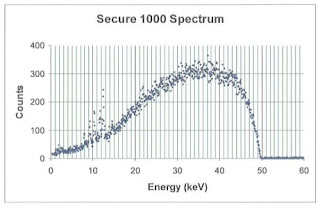
The TSA has been stating that the X-rays used in the back scatter machines use 'soft' X-rays, which are defined as radiation between 0.12-12 keV (or kilo electron volts) and are generally stopped, or absorbed, by soft tissue or low density matter. 'Hard' X-rays are between 12-128 keV and are absorbed by dense matter like bone. According to the TSA safety documents, AIT uses an 50 keV source that emits a broad spectra (see adjacent graph from here).


Essentially, this means that the X-ray source used in the Rapiscan system is the same as those used for mammograms and some dental X-rays, and uses BOTH 'soft' and 'hard' X-rays.

Its very disturbing that the TSA has been misleading on this point. Here is the real catch: the softer the X-ray, the more its absorbed by the body, and the higher the biologically relevant dose! This means, that this radiation is potentially worse than an a higher energy medical chest X-ray. With that being said, because the scanners have both a radiation source AND a detector in the front AND back of the person in the scanner, it is actually possible for the hardware to conduct a classic, through-the-body X-ray.

The TSA claims that the machines are not currently being used in that way; however, based on the limited engineering schematics released in the safety documents, they could be certainly be easily reconfigured to do so by altering the aluminum-plate (or equivalent) filter or by changing the software. So the hardware has the capability to output quite high doses of radiation, however a biological dose is a function of the time of exposure as well as the proximity to the source and the power of the power of the source.

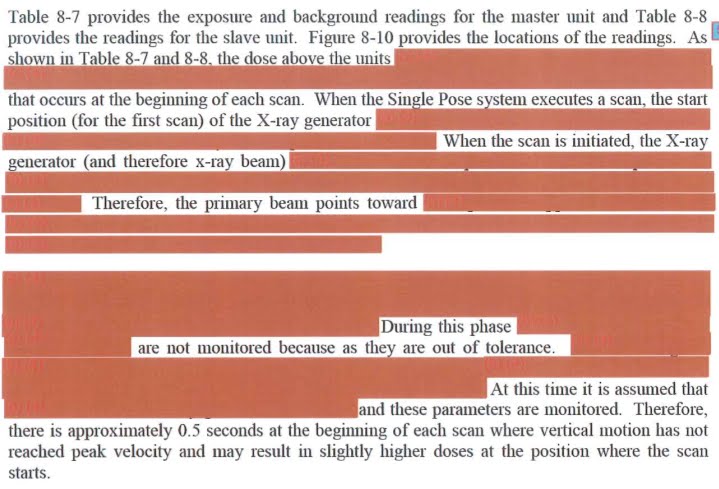
Unfortunately, it is difficult to determine which zones in the scanner are 'hottest' because that information is masked in the document. An excerpt of the safety evaluation from Johns Hopkins is shown below to give you sense of how much other information is being withheld. Ultimately my point is this: even though the dose may actually be low, these machines are capable of much higher radiation output through device failure or both unauthorized or authorized reconfiguration of either hardware or software.

Which brings me to how the scanner works. Essentially, it appears that an X-ray beam is rastered across the body, which highlights the importance of one of the specific concerns raised by the UCSF scientists... what happens if the machine fails, or gets stuck, during a raster. How much radiation would a person's eye, hand, testicle, stomach, etc be exposed to during such a failure.

What is the failure rate of these machines?
What is the failure rate in an operational environment?
Who services the machine? What is the decay rate of the filter?
What is the decay rate of the shielding material?
What is the variability in the power of the X-ray source during the manufacturing process?

This last question may seem trivial; however, the Johns Hopkins Applied Physics Laboratory noted significant differences in their test models, which were supposed to be precisely up to spec.

It's also interesting to note that the Johns Hopkins Applied Physics Laboratory criticized other reports from NIST (the National Institute of Standards and Technology) and a group called Medical and Health Physics Consulting for testing the machine while one of the two X-ray sources was disabled (citations at the bottom of the page). These questions have not been answered to any satisfaction and the UCSF scientists, all esteemed in their fields and members of the National Academy of Sciences have been dismissed based on a couple of reports seemingly hastily put together by mid-level government lab technicians.

The documents that I have reviewed thus far either have NO AUTHOR CREDITS or are NOT authored by anyone with either a Ph.D. or a M.D., raising serious concerns of the extent of the expertise of the individuals and organizations evaluating these machines. Yet, the FDA and TSA continue to dismiss some of the most talented scientists in the country...

With respect to errors in the safety reports and/or misleading information about them, the statement that one scan is equivalent to 2-3 minutes of your flight is VERY misleading. Most cosmic radiation is composed of high energy particles that passes right through our body, the plane and even most of the earth itself without being absorbed or even detected. The spectrum that is dangerous is known as ionizing radiation and most of that is absorbed by the hull of the airplane. So relating non-absorbing cosmic radiation to tissue absorbing man-made radiation is simply misleading and wrong.

Furthermore, when making this comparison, the TSA and FDA are calculating that the dose is absorbed throughout the body. According the simulations performed by NIST, the relative absorption of the radiation is ~20-35-fold higher in the skin, breast, testes and thymus than the brain, or 7-12-fold higher than bone marrow. So a total body dose is misleading, because there is differential absorption in some tissues.

Of particular concern is radiation exposure to the testes, which could result in infertility or birth defects, and breasts for women who might carry a BRCA1 or BRCA2 mutation. Even more alarming is that because the radiation energy is the same for all adults, children or infants, the relative absorbed dose is twice as high for small children and infants because they have a smaller body mass (both total and tissue specific) to distribute the dose. Alarmingly, the radiation dose to an infant's testes and skeleton is 60-fold higher than the absorbed dose to an adult brain!

There also appears to be unit conversion error in the Appendix of the report, which was recently cited by the FDA in response to the UCSF scientist's letter of concern, which might mean that the relative skin dose is 1000-fold higher than the report indicates (pg Appendix B, pg ii, units of microSv are used in an example calculation, when it appears that units of milliSv should have been used).

I attempted to contact the author, Frank Cerra, to query whether this was a computational mistake or an unexplained conversion; however, none of his web-published email addresses are valid and there was no answer by phone. I cannot rule out that a conversion factor was used that was not described in the methods, and would welcome confirmation or rebuttal of this observation.

Finally, I would like to comment on the safety of the TSA officers (TSO) who will be operating these machines, and will be constant 'bystanders' with respect to the radiation exposure. The range of exposure estimates is a function of where an officer stands during their duty, what percentage of that duty is spent in the same location and how often the machine is running. A TSO could be exposed to as much as 86-1408 mrem per year (assuming 8 hours per day, 40 hours a week, 50 weeks per year and between 30-100% duty and 25-100% occupancy, as defined by the Johns Hopkins report), which is between 86%-1410% of the safe exposure of 100 mrem.

At the high end, if for example a TSO is standing at the entrance of the scanner when it is running at maximum capacity, then that officer could hit their radiation exposure limit in as few as 20 working days (assuming an 8 hour shift). While we may not be very happy with our TSOs at the moment as the face of these policies, we need to keep in mind that they really should be wearing radiation badges in order to know their specific exposure (especially for those officers who may also have to receive radiation exposure for medical reasons).

As far as I'm concerned, the jury is still out on whether these machines are safe or even could be made safe for this application. Until then, I suggest keeping your family out of these machines and as vile as it is, either submit to a physical search or just don't fly. Safety reports that should be considered invalid due to the fact that one of the two X-ray sources was disabled during testing:
  1. Medical and Health Physics Consulting, Radiation Report on Rapiscan Systems Secure 1000 (March 21, 2006).
  2. Medical and Health Physics Consulting, Radiation Report on Rapiscan Systems Secure 1000 (June 5, 2008).
  3. Medical and Health Physics Consulting, Supplement to Report dated June 5, 2008 (October 28, 2008).
  4. National Institute of Standards and Technology Assessment of Radiation Safety and Compliance with ANSI N43.17-2002 Rapiscan Dual Secure 1000 Personnel Scanner (July 9, 2008).
UPDATE Just to clarify, I am not a radiation biologist, radiologist, health physicist, etc... my expertise is actually in single molecule biophysics and the biochemistry of DNA repair. This article is simply my review of the safety reports published by the TSA on their website, and not the result of any independent evaluation or experimentation. Also, all views and comments are my opinion (professional and unprofessional) and are not endorsed or representative of the University of California or any affiliated departments or colleges.

Jason Bell, "a molecular biologist and biophysicist... a Ph.D. candidate in Steve Kowalczykowski's lab at UC Davis," has posted a detailed critique of the research on the safety of airport backscatter radiation scanners. His specialty is the "molecular mechanism of how mutations in the breast cancer susceptibility gene, BRCA2, result in cancer," and he's posted a detailed, lay-friendly explanation of the scientific concerns expressed by the UCSF team that believes that they are unsafe for use.
Which brings me to how the scanner works. Essentially, it appears that an X-ray beam is rastered across the body, which highlights the importance of one of the specific concerns raised by the UCSF scientists... what happens if the machine fails, or gets stuck, during a raster. How much radiation would a person's eye, hand, testicle, stomach, etc be exposed to during such a failure.
What is the failure rate of these machines?
|What is the failure rate in an operational environment?

Who services the machine?

What is the decay rate of the filter?

What is the decay rate of the shielding material?

What is the variability in the power of the X-ray source during the manufacturing process?
This last question may seem trivial; however, the Johns Hopkins Applied Physics Laboratory noted significant differences in their test models, which were supposed to be precisely up to spec. Its also interesting to note that the Johns Hopkins Applied Physics Laboratory criticized other reports from NIST (the National Institute of Standards and Technology) and a group called Medical and Health Physics Consulting for testing the machine while one of the two X-ray sources was disabled (citations at the bottom of the page).
These questions have not been answered to any satisfaction and the UCSF scientists, all esteemed in their fields and members of the National Academy of Sciences have been dismissed based on a couple of reports seemingly hastily put together by mid-level government lab technicians.
The documents that I have reviewed thus far either have NO AUTHOR CREDITS or are NOT authored by anyone with either a Ph.D. or a M.D., raising serious concerns of the extent of the expertise of the individuals and organizations evaluating these machines. Yet, the FDA and TSA continue to dismiss some of the most talented scientists in the country...
Furthermore, when making this comparison, the TSA and FDA are calculating that the dose is absorbed throughout the body. According the simulations performed by NIST, the relative absorption of the radiation is ~20-35-fold higher in the skin, breast, testes and thymus than the brain, or 7-12-fold higher than bone marrow. So a total body dose is misleading, because there is differential absorption in some tissues.
Of particular concern is radiation exposure to the testes, which could result in infertility or birth defects, and breasts for women who might carry a BRCA1 or BRCA2 mutation. Even more alarming is that because the radiation energy is the same for all adults, children or infants, the relative absorbed dose is twice as high for small children and infants because they have a smaller body mass (both total and tissue specific) to distribute the dose. Alarmingly, the radiation dose to an infant's testes and skeleton is 60-fold higher than the absorbed dose to an adult brain!

Hooser for BLNR Chair!

SUBHEAD: Now is the time to lobby Governor elect Abercrombie to appoint Hooser as the Board of Land and Natural Resources Chairperson.  
Image above: Gary Hooser speaks at Clean Energy Rally in Honolulu 4/27/09. From (http://www.flickr.com/photos/14746243@N04/3654807823/in/photostream/).  

By Linda Pascatore on 27 November 2010 -

After the primary election, we published a call to lobby Neil Abercrombie, then candidate for governor, to consider Gary Hooser for BLNR chairperson. Now that Abercrombie is governor-elect, it is time to pump up our campaign. Please write to Neil Abercrombie and ask him to appoint Hooser as BLNR chair, at his Transition website (http://newdayhawaii.org/contact) Here is a sample letter:
Dear Mr. Abercrombie, Now that you are governor elect, I ask again that you consider appointing Gary Hooser as the new Chairperson of the Board of Land and Natural Resources.
Gary Hooser has an integrated, long term vision of a self-sufficient and sustainable Hawaii, and as Chairman of BLNR, he would be in a position to further this goal. Gary has been an outstanding advocate for the aina. He has supported land and shoreline conservation, preservation of agricultural lands, and public access to our natural treasures for the people of Hawaii. He has an impeccable environmental record, and has been endorsed by the Sierra Club and other environmental organizations.
Since you are also a champion for the environment who is looking forward to a more sustainable future, I am sure you can appreciate Gary’s skills in this area. Please consider Gary Hooser for this important position. Congratulations on your Election! Sincerely Yours,
See also: Ea O Ka Aina: Hooser for BLNR Chair 9/27/10 .

The Mother of all WikiLeaks

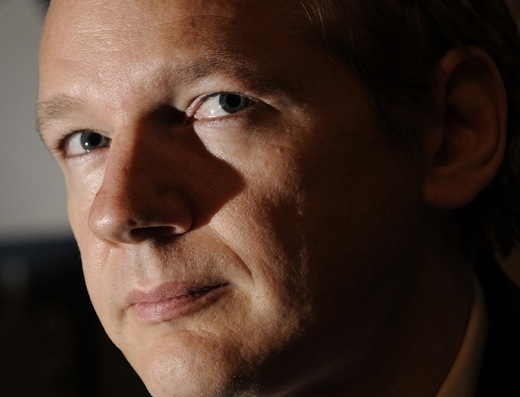
SUBHEAD: Official Washington worries the WikiLeak will reveal extremely embarrassing details of US diplomacy and reshape world events. Image above: Close-up photo of Julien Assange, founder of WikiLeaks.org. By John Nichols on 26 November 2010 for The Nation - (http://www.thenation.com/blog/156684/official-washington-worries-wikileak-will-reveal-inconsistent-approach-terror)
Usually, when a WikiLeaks document dump is in the offering, U.S. officials play like it could not possibly matter. "More of the same," "nothing new," "just a repeat of what everyone was already aware of": these have been the standard lines. But not this time. Washington is abuzz with Holiday weekend talk about how officials at the White House, the Department of Defense and the State Department are "holding their breath" in troubled anticipation of an imminent release of thousands of classified documents by the controversial website. WikiLeaks is tweeting that officials in Washington are "hyperventilating again over fears of being held to account.". That's not hype. They really are worried this time. Why so? Because this release of documents could pull back the curtain on how the U.S. practices international diplomacy. To understand why this matters, consider two related realities: 1. Many, if not all, of the U.S. officials who deal on the international stage tend to like secrecy, as it allows them to play by different rules when dealing with countries that are deemed "allies" or "rogues." In other words, despite the blunt official talk about how the "war of terror" is a universal endeavor, the U.S. sometimes casts a blind eye toward -- or even works with -- groups that are identified as practicing terrorism. 2. These powerful players often feel threatened by transparency, as it reveals when they are allow allied states to act like rogue states. This gets especially messy when "friendly" governments are allowed to get away with actions that the U.S. otherwise identifies as being so serious that might justify economic sanctions or even a military response. Understand these facts and you will understand why official Washington is worried by this particular WikiLeak. Reportedly, the next leak -- which could come this weekend -- will include "hundreds of thousands of classified State cables that detail private diplomatic discussions with other governments, potentially compromising discussions with dissidents, and even, reportedly, corruption allegations against foreign governments." Among other things, international press accounts suggest, the new WikiLeak will include a military report revealing that the U.S. officials were aware that the Turkish government allowed its citizens to aid al-Qaeda in Iraq. An additional document will, according to London's Al-Hayat newspaper, reveal that the U.S. aided Kurdish separatist rebels whose group, the PKK, is listed by the State Department as a foreign terrorist organization. Turkey is a complex country located at a critical crossroads for the United States. It is no secret that U.S. officials have always applied different sets of rules when dealing with it. The problem is that the public revelation of the differences between U.S. treatment of Turkey and, say, Iran, could be more than embarrassing. It could call into question whether U.S. officials are consistent in their condemnation of terrorism and of countries that condone terrorism. Of course, that's not what State Department officials are saying publicly. They're talking about protecting diplomatic secrecy. "When this confidence is betrayed and ends up on the front pages of newspapers or lead stories on television and radio it has an impact," says spokesperson P.J. Crowley. "We decry what has happened. These revelations are harmful to the United States and our interests. They are going to create tension in our relationships between our diplomats and our friends around the world. We wish that this would not happen. But we are, obviously, prepared for the possibility that it will." What should U.S. citizens make of such revelations? Don't expect an outcry. Americans will not be shocked to learn that their government is inconsistent in its relations with other countries. We don't yet know what exactly this WikiLeak will reveal. But these sorts of revelations, which so unsettle official Washington, could well improve the domestic debate. No one wants to see the world become a more dangerous place; nor is there anyone who wants to play fast and loose with the safety of U.S. troops, diplomats or innocents abroad. With those provisions, however, a case can certainly be made that transparency brings nuance to the discussion of how the U.S. engages with other countries, and to debates about the standards that are applied with regard to supposedly "terrorist" activity and supposedly "terrorist" groups. A broader consciousness of these realities could make it tougher for the White House, the Pentagon and the State Department to suggest that the United States faces only black-and-white choices, that this country's only options are absolutes, and that America cannot possibly negotiate with countries or groups that engage in actions that the U.S. offically condemns. In other words, this WikiLeak might just make it harder for officials in Washington to "sell" hardline responses, covert actions and military interventions. Washington insiders might be bothered by that prospect. But the citizens of the United States can handle diplomatic reality -- and transparency.

Feign Before The Storm
By Nadim Kobeissi on 26 November 2010 - (http://log.nadim.cc/?p=17)
As dawn breaks over the greatest declassification in history, the world awakens to a radiant truth: WikiLeaks is winning. The looming WikiLeaks release, which promises to declassify almost three million documents, has already sent the world’s most prominent governments into a political frenzy. The United States is orchestrating a dozen-stringed political mission, sending diplomats ranging from aides to Norway, to ambassadors to Canada, to Hillary Clinton herself to Australia in order to mitigate a possible relational disaster. The US seems very well aware that the world will not like it quite as much after WikiLeaks exposes its unvarnished truth – according to the Israeli Haaretz, the Americans are “viewing the leak very seriously”, believing it might contain diplomatic cables – internal US communications that detail the real, US opinions on international political matters.

Admittedly, it is interesting to see how all U.S. efforts to mitigate the imminent WikiLeaks crisis have been directed at foreign governments, and not at their own people.

The UK government hasn’t bothered to conceal its panic as well as the United States, recently issuing a class 1 and class 5 that reprehensibly asks the British press to censor “military operations, plans, capabilities” and “security and intelligence special services” that may be contained in the next WikiLeak. The UK government’s blind, censoring fear may be understandable, what with the whistle-blower organization promising to redefine the entire world’s history very, very soon. What is incomprehensible, however, is how the UK is seemingly expecting to circumvent the Internet’s free flow of information with a simple censorship order. Russia is concerned. Italy’s Berlusconi is scared. The United States has already “slammed” the leak with woefully unconvincing arguments, having one ambassador call it an “absolutely awful impediment to [his] business”, which raises the question as to what kind of business it is that transparency is likely to hurt. According to WikiLeaks, this political fiasco began when the New York Times briefed the White House on the contents of the embargoed leak this Monday. WikiLeaks has since predicted to its Twitter followers to watch as “every tinpot dictator in the world briefed prior to release”, and was right: in less than two days, Norway, Iraq, Turkey, Israel, Canada, Russia, Denmark, Iceland, Australia and the UK have been briefed by US diplomats over the contents of a leak that may render the world’s superpower internationally red-faced. In what may be a matter of days, or even hours, many are expecting nothing short of a political revolution. Reuters is quoting sources that claim the leak contains corruption allegations that may very well cause an international uproar, calling the leak more revealing than both the Afghanistan and Iraq war logs combined. The more politicians cower, the more the public sits on the edge of its seat, awaiting the next leak from an organization that so far has delivered more unvarnished truth in the last year than all of the world’s governments and press combined.

WikiLeaks is winning at the UN, convincing it and the European Union to launch a full Afghanistan torture investigation, and is losing only with parties that have some, or many, embarrassing truths to cover. But with the people, WikiLeaks is winning all the same – for while lies may blind from the truth, they cannot and do not hold as the truth shines.

.

Three Life Saving Books

SUBHEAD: These books will help making a livable future even as the civilization we have known crumbles around us. Image above: Permaculture garden from "Heroes of the Environment"film series (http://www.humanisthall.net/Cal-Nov09-FilmSeries.html). By George Mobus on 21 November 2010 in Question Everything - (http://questioneverything.typepad.com/question_everything/2010/11/three-books-that-could-save-your-life.html)

In this blog I want to rekindle my theme from an earlier series of posts regarding the future of a sapient society — the village of the future (see: “What is a feasible living situation for future humans?”).

The world is at or near the peak of fossil fuel energy extraction. The modern industrial civilization is run primarily using those fossil fuels. Hydroelectric and nuclear generated electricity run as very distant runners up. Alternatives, like solar and wind, are barely perceptible. Even though their rates of growth had been substantial prior to the impacts of the global recession, the base from which they started was so small that even a 100% year-to-year growth still produces an insubstantial amount of energy from those sources, compared with demand (see: Euan Mearns, “Renewables to the rescue?”).

There are many reasons to believe that the industrial economy based on free market capitalism is coming to an end (c.f. “Peak Energy - Peak Economy” and “The Future of Capitalism - Profits and Growth”). There is, also, evidence that that same economic system has been instrumental in causing the acceleration of resource depletion (not just fossil fuels). It must share responsibility (or blame) with two other major factors that have caused depletion, which is population growth (my essay: “The Hardest Moral Dilemma of All”) and the general lack of wisdom (sapience, c.f. my series of working papers on this subject) in the population. The latter factor shows up in the greed-is-good mentality that supports capitalism today.

My own conclusion is that there is a very high likelihood that global industrial civilization is going to collapse as the flows of fossil fuel-based energy declines, quite likely at an accelerating rate in the decades to come (e.g. see my book review of William Catton's, “Bottleneck: Humanity's Impending Impasse”).

If this is true, then we should be asking questions about how will society react to such a collapse, and how will whatever society emerges find ways to survive. It is unfortunately extremely likely that there will be a significant decline in the population. From many different studies on the issue of ecological footprint analysis (space, resource, and energy-based) the general consensus is that there are far too many people on the planet compared to the planet's natural capacity to produce life-support services (such as food). What has made this overpopulation (overshoot) possible is the tremendous power gained from fossil fuels, especially in the last 200 years. The worst-case scenario is an evolutionary bottleneck in which the global population may crash significantly. In that case there will be a tremendously smaller population facing possibly extreme challenges just to survive (e.g. the impacts of climate change on food production).

Are there people wise enough to prepare for this possibility? What would they do to prepare? For one thing I would guess that they would consider the kind of knowledge and skills they will really need to survive and possibly, eventually, thrive in that future world.

The wise, who tend to also be somewhat meek(!), shall inherit the Earth.

What are the Most Fundamental Needs of People?

Human life is not about individuals; it starts with families. And as the fuel-based mechanisms of transportation become increasingly constricted, it is likely that we will once again be looking at extended families vs. the extant nuclear family model that dominates now. Indeed we are already seeing the trend toward increases in extended family units as younger people are not finding meaningful employment and staying with parents further into young adulthood. We are seeing more senior adult (parents/grandparents) care being provide in private homes as those seniors are unable to afford to live in adult care facilities.

What does a family absolutely need? Food, of course. And it has to be nutritious to support the general health of the family members. What happens when the grocery stores can no longer get shipments of processed foods? How will people feed their families?

Clothing is essential in the temperate climates. What happens when the clothing retail stores no longer have clothing to sell. Of course, many families are already strapped for cash to buy clothing so what happens when most people no longer have employment?

Shelter is necessary too. Building and even maintaining a house requires energy. It requires energy for extracting and modifying the natural resources (wood, concrete, etc.), delivering them to the site, labor for construction, and so on. As the energy supplied gets more expensive houses and their maintenance will also get more expensive. The energy needed to keep the interiors of houses warm enough for human activity will become increasingly expensive.

Transportation is currently a crucial part of the developed world's societies. People have to get to their jobs (if they have one). They have to travel to get food from the markets. In the US and Canada suburban sprawl means that people living far from work and services need to drive (usually in single-occupant cars) longer distances to survive. When the gasoline gets above a certain threshold price, many of those people will be unable to afford to even get to work.

And these are just the basics. This does not include the play time, entertainment, aesthetics, etc. that make life more enjoyable. It doesn't dig too deeply into the problems associated with just having these basics available in the first place (my last blog, “The Economy is Energy” dug more deeply).

Systems Science Applied to Meeting Those Needs

Most regular readers know that I am an advocate of systems science as the basis for knowing and understanding the world and how it works. I advocate it as the modern version of liberal studies for providing both a breadth of view and the means to conduct deep critical thinking in all areas of human endeavor.

Systems science, or systems thinking, has been around a long time in various dilute forms. I even claim it is inherent in the way the human brain works (see the sapience series, esp. “Components of Sapience Explained”), even if only weakly. Over the last fifty years or so, systems science has become more formal and, well, systematic. Today there is a coherent body of knowledge that is meta to all of the sciences. That is, systems science is actually applied to all other sciences and has even shown up is some aesthetic fields.

This brings me to the three books that I have found extremely valuable for their perspectives on the application of systems science to the human condition and especially that condition in a possible future. All three, two by one major author, show how systems thinking can be applied to economics and, in particular, to the support of human life in balance with the non-human Ecos in a world where we no longer have the advantages of powerful fossil fuels to drive machines. I think these books represent the kind of knowledge that wise people will heed in making a livable future even as the civilization we have known crumbles around us.

BOOK ONE Howard T. Odum (1924-2002) is considered the father of systems ecology. He had spent his life studying the subsystems of ecological systems, and in particular the flows of energy through those systems. He identified numerous important principles of energy, work, efficiency, cycles, etc. Today, systems ecologists are still finding verification in their field studies of models suggested by Odum's theories. Some of the best advances in understanding ecological systems has come from those theories. Then Odum turned his attention to human social systems as another form of ecology. Indeed he showed how to understand human systems as embedded in and supported by the non-human Ecos, or what we have called the natural ecosystem. One of his many must-read books that summarizes his thinking along these lines is “Environment, Power, and Society for the Twenty-First Century: The Hierarchy of Energy” (2007, Columbia University Press).

BOOK TWO The second book by Odum, along with his wife, Elisabeth C. Odum, is “A Prosperous Way Down: Principles and Policies” (2001, University Press of Colorado). In this book he and Elisabeth take on the situation regarding social ecology under the conditions of diminishing energy flows. Taking principles from systems ecology involving systems suffering from the decline of energy (e.g. deciduous forests in fall), showing how such systems have adapted or respond to those conditions, they have applied these to the human social system. The Odums argued that if we humans were wise enough to apply these principles through policy decisions to ourselves, we might find similar ways to adapt with much less suffering than is potentially implied by sudden and drastic social collapse.

I'm afraid I do not share the optimism of the Odums', that we humans will, in fact, adopt any of these policies as sociopolitical bodies. I have a much more cynical view of human behavior based on what I think is a general lack of sufficient sapience in the average human brain to be able to understand and act on the situation we put ourselves in. However, I do feel there are a fair number of very sapient individuals in the world who are developing much greater wisdom, especially in a world so full of challenges and lessons to learn. The knowledge of systems ecology and general systems science that Odum has explicated can still be of value to those who are able to grasp it and turn it into actionable ideas for the future.

BOOK THREE Which leads me to the third book I think you should read, “Permaculture: Principles & Pathways Beyond Sustainability”, by David Holmgren. The ‘culture’ in permaculture is often misunderstood to refer to the growing of food, as some kind of variation on organic gardening. In fact it means culture as in the total culture we adopt to support human life. That is, everything we do to provide for a sustainable but aesthetically pleasing living situation. I began exploring the permaculture concept after think about what that feasible living situation for sapient beings (the village) might look like. After digging into David Holmgren's book I see that permaculture and the feasible situation are along parallel paths.

Indeed, once I recognized the essence of permaculture as developed by David I was inspired to write about a possible plan to solve two problems at once. I proposed the creation of a new Civilian Conservation Corps (CCC) devoted to redeeming our depleted agricultural soils up to the standards of permaculture applied to food production. This goes way beyond simply plowing manure and compost into the soils. It requires systems thinking and a lot of science to do the job right.

Permaculture is the application of systems science, and in particular the systems ecology principles that Howard Odum wrote about, to the design and construction of human habitats, meaning not just food, but shelters, clothing and all of the essential necessities (see above). Permaculture is not a regression to how the farms of the 1800s were managed, though some appropriate low-energy technologies developed in that era may be adopted in the future. It fully supports the use of technology at an appropriate scale and complexity in order to make life more than just subsistence living. This is exactly some of the ideas I tried to promote in my series on feasible living (see: “Toward a Better Understanding of a Feasible Living Situation”, which contains links to the other posts in that series).

Having now seen how the concepts and principles of permaculture are the application of systems ecology (and general systems science) to the organization of human society I am more convinced than ever that the wisest among us may yet find ways to find one another and aggregate in locales where their chances of surviving the bottleneck are greatly enhanced. The coming selective forces will favor only those who are prepared. And unlike so many scenarios that people generally argue (when thinking about collapse) involving the survival of the most brutal, or most aggressive, of essentially a devolution of Homo sapiens, I suspect that these forces will favor cooperation rather than competition. A permaculture based on the cooperation among a smaller group of very sapient human beings has the best chances to survive and adapt to whatever climate changes take place (if any living species have such capacity). I have no doubts that there will be brutality as part of the collapse itself. But once the availability of energy declines past a certain point those who rely on technologically sophisticated weapons and modes of transportation to go after the isolated pockets of human resources will be stuck and unprepared to deal with what nature metes out.

My Ideology!

I have trashed the way blind ideologies have destroyed critical thinking and political thought throughout history and the world. So I might be a bit chagrined to admit that I have an ideological stance! I have to believe that knowledge and understanding will trump mindless reactivity. Humans evolved to be knowledge generating machines as well as life experiencing beings. That evolution worked out pretty well until our capacity to generate usable knowledge overtook our capacity to use knowledge wisely.

The link between wisdom and knowledge is understanding. That is individuals and society need to understand the consequences of using knowledge for various purposes, say, of economic importance. That has been sadly lacking. But given that there are potentially some members of our species who carry the mental machinery for both generating new knowledge and understanding that knowledge in context, then it seems to me that evolution hasn't finished with humanity.

Typically, ideologies develop not as scientific theories do, based on evidence and attempts to disprove hypotheses, but based on what ‘feels’ right to an individual. Ideologies grow in strength within the individual mind because of the way confirmation bias works. I have tried to be vigilant in this regard (as the blog claims, I do try to question everything) and not only look for confirmation of a pet theory (i.e. that humanity has a chance to evolve to a more sapient species). But, of course, I am only human! So while I believe that I have amassed evidence without bias I remain open to the possibility that it isn't so.

I welcome reader comments on this. But please make sure you have done your homework before blasting me with your opinions. I have now, over 200 posts in which I have provided the evidence I look at when trying to ask and answer questions about our human condition. Those who want to engage in debate might want to make sure they have examined that evidence and then bring on their own if they think it differs. Thanks to all readers for their considered comments.

.

TSA Threatens Tourism

SUBHEAD: Even before these new security procedures were implemented potential tourists were already staying home. Image above: Empty airport baggage carousels. By Staff on 22 November 2010 for End of the American Dream - (http://endoftheamericandream.com/archives/will-tsa-groping-destroy-tourism-in-the-united-states)
One of the things that has not been considered in the debate over the horrific new TSA security procedures is the economic impact that all of this is going to have. The rest of the world is watching what is going on, and millions of people are going to decide that they simply do not want to go through the hassle of flying to the United States. There are some cultures where allowing a strange person to touch your private areas is unthinkable. In 2009, 54.9 million tourists visited the United States, and those tourists spent approximately 93 billion dollars. That doesn't even count all of the internal tourism in the United States which is far greater. Tourism is the first, second or third biggest employer in 29 U.S. states. So what happens if a significant chunk of tourists decide that they are simply not going to fly because of the new full body scanners and the new "enhanced pat-downs"?

In our obsession with "underwear bombers", we could literally kill the goose that laid the golden egg. The United States is still one of the favorite destinations in the world for tourists, and many areas of the country are highly dependent on tourist dollars. So are we willing to take a hit to our economy that could reach into the tens of billions of dollars just so that we can all feel slightly safer from "underwear bombers"?

Even before these new security procedures were implemented a lot of tourists were already staying home or avoiding having to fly because of our ridiculous air security system.

According to a 2008 survey, air travelers in the United States avoided 41 million trips because of perceived problems with the air travel system. The U.S. Travel Association says that those avoided trips cost U.S. airlines 9.4 billion dollars.

So how damaging to our economy will all of these new security procedures be?

The truth is that the rest of the world is watching what we are doing.

They are watching as little boys are being strip-searched at U.S. airports.

They are hearing the reports that TSA officials are actually reaching up the skirts of female passengers and slamming their hands into their private areas.

Thanks to the Internet, they are reading all of the worst TSA horror stories. For example, one 61-year-old retired special education teacher was left humiliated, crying and covered with his own urine after an "enhanced pat-down" went badly.

That doesn't exactly scream "welcome to America" now does it?

The TSA is literally taking a sledgehammer to our tourism industry. They are going to cost us tens of billions of travel dollars. These are tourist dollars that our economy desperately needs.

But even more horrifying is what all of this says about how far America has fallen. We are rapidly becoming a Big Brother police state where average citizens are routinely treated like dehumanized prison inmates...

Unless the American people stand up right now and refuse to accept these ridiculous new security procedures the rest of the world will never look at us the same way again.

China & Russia Quiting Dollar

SUBHEAD: The two countries will now use only their own currencies for bilateral trade. Image above: Vladimir Putin and Wen Jiabao shake in currency trade deal. From article. By Su Qiang and Li Xiaokun on 24 November 2010 in China Daily - (http://www.chinadaily.com.cn/china/2010-11/24/content_11599087.ht)
China and Russia have decided to renounce the US dollar and resort to using their own currencies for bilateral trade, Premier Wen Jiabao and his Russian counterpart Vladimir Putin announced late on Tuesday. Chinese experts said the move reflected closer relations between Beijing and Moscow and is not aimed at challenging the dollar, but to protect their domestic economies.

"About trade settlement, we have decided to use our own currencies," Putin said at a joint news conference with Wen in St. Petersburg.

The two countries were accustomed to using other currencies, especially the dollar, for bilateral trade. Since the financial crisis, however, high-ranking officials on both sides began to explore other possibilities.

The yuan has now started trading against the Russian rouble in the Chinese interbank market, while the renminbi will soon be allowed to trade against the rouble in Russia, Putin said.

"That has forged an important step in bilateral trade and it is a result of the consolidated financial systems of world countries," he said.

Putin made his remarks after a meeting with Wen. They also officiated at a signing ceremony for 12 documents, including energy cooperation.

The documents covered cooperation on aviation, railroad construction, customs, protecting intellectual property, culture and a joint communique. Details of the documents have yet to be released.

Putin said one of the pacts between the two countries is about the purchase of two nuclear reactors from Russia by China's Tianwan nuclear power plant, the most advanced nuclear power complex in China.

Putin has called for boosting sales of natural resources - Russia's main export - to China, but price has proven to be a sticking point.

Russian Deputy Prime Minister Igor Sechin, who holds sway over Russia's energy sector, said following a meeting with Chinese representatives that Moscow and Beijing are unlikely to agree on the price of Russian gas supplies to China before the middle of next year.

Russia is looking for China to pay prices similar to those Russian gas giant Gazprom charges its European customers, but Beijing wants a discount. The two sides were about $100 per 1,000 cubic meters apart, according to Chinese officials last week.

Wen's trip follows Russian President Dmitry Medvedev's three-day visit to China in September, during which he and President Hu Jintao launched a cross-border pipeline linking the world's biggest energy producer with the largest energy consumer.

Wen said at the press conference that the partnership between Beijing and Moscow has "reached an unprecedented level" and pledged the two countries will "never become each other's enemy".

Over the past year, "our strategic cooperative partnership endured strenuous tests and reached an unprecedented level," Wen said, adding the two nations are now more confident and determined to defend their mutual interests.

"China will firmly follow the path of peaceful development and support the renaissance of Russia as a great power," he said.

"The modernization of China will not affect other countries' interests, while a solid and strong Sino-Russian relationship is in line with the fundamental interests of both countries."

Wen said Beijing is willing to boost cooperation with Moscow in Northeast Asia, Central Asia and the Asia-Pacific region, as well as in major international organizations and on mechanisms in pursuit of a "fair and reasonable new order" in international politics and the economy.

Sun Zhuangzhi, a senior researcher in Central Asian studies at the Chinese Academy of Social Sciences, said the new mode of trade settlement between China and Russia follows a global trend after the financial crisis exposed the faults of a dollar-dominated world financial system.

Pang Zhongying, who specializes in international politics at Renmin University of China, said the proposal is not challenging the dollar, but aimed at avoiding the risks the dollar represents.

Wen arrived in the northern Russian city on Monday evening for a regular meeting between Chinese and Russian heads of government.

He left St. Petersburg for Moscow late on Tuesday and is set to meet with Russian President Dmitry Medvedev on Wednesday.

.

No Time for Lullabies

SUBHEAD: Daydreams about nonexistent lifeboat ecovillages share a common purpose, as lullabies disguised as solutions. Image above: Architect's rendering of Dubai's 2009 proposed "Food City" self-sustainable ecotopia. From (http://inhabitat.com/a-utopian-vision-for-food-city-dubai). By John Michael Greer on 24 November 2010 in ArchdruidReport - (http://thearchdruidreport.blogspot.com/2010/11/no-time-for-lullabies.html) At this point we’ve covered the core techniques of backyard food gardening, one of the three basic ingredients in the bubbling cauldron of green wizardry. Those core techniques are far from the only things that can usefully be added to the pot, of course, but I don’t propose to go into the other options in any detail. First, and to my mind the most crucial, is the need for dissensus. It’s impossible to know in advance what particular set of tools and skills will be the one best suited to squeak past the mess taking shape around us – and by this I mean to include both the short-term mess defined by the implosion of America’s debt economy and its overseas equivalents, and the long-term and even more daunting mess defined by the head-on collision between a civilization and technostructure predicated on limitless expansion and the hard limits of a finite planet. Green wizardry, as I’ve already discussed here, is only one option, and even within green wizardry there needs to be plenty of room for different paths, new inventions, local traditions, and a good helping of outright eccentricity. Those of my readers who took me up on last week’s challenge and sat down with a copy of Darwin’s The Origin of Species and a tall beverage of choice already have some sense of the importance of variation in evolution; that’s what provides the raw material that gets sorted out by natural selection. There’s no shortage of natural selection piling up for us in the not too distant future, that’s for sure, but it’s up to us to provide the variation. That’s part of what’s behind my recommendation that aspiring green wizards haunt used book stores and go digging for obscure pieces of information, and it’s also part of the reason why I’ve focused almost monomaniacally on a very specific version of backyard food gardening – the version that evolved in the 1970s energy crises – when there are many other options out there. The logic here is straightforward: a pretty fair fraction of green wizards who didn’t grow up during that decade are bound to get irritated by the deliberately annoying Seventies-centric approach, and that irritation will send them looking for other options. Another important reason, though, was brought home to me by a book that arrived on my doorstep not too long ago. I’m not going to name the author, the publisher, or even the subject matter, because it could have been any of a hundred books; these days they’re as interchangeable, as forgettable, and as inescapable as American politicians at election time. I’m not sure why it was mailed to me, as it came unannounced; I have to assume that since I blog about the crisis of industrial society, and this book claims to offer a solution to that crisis, the author or the publisher’s marketing department decided that I probably ought to know about it. You already know the kind of book I’m discussing. It begins with several chapters of potted history that combines an overheated version of the mess we’re in – slanted, naturally, toward those aspects of the mess that the proposed solution is supposed to solve – and an equally colorful account of the prehistory of the solution that traces it back to an exotic and currently fashionable source. It goes on to talk about the proposed solution with the kind of overhyped enthusiasm and rose-tinted assumptions more often associated with the press releases of small tech startups that will be bankrupt within the year. It spares a brief chapter or two to mention criticisms directed at the proposed solution in order to dismiss them out of hand, and then finishes up with a vision of the glorious Utopian future that awaits once the Party’s latest five year plan – er, excuse me, once the proposed solution gets the universal acceptance and ample funding the author hopes to attract. What isn’t in books of this kind is as important, and as worth mentioning, as what is in them. You won’t find any substantive discussion of the limits of the proposed solution – what dimensions of the crisis of industrial civilization it can’t solve, which bioregions or human societies can’t use it effectively, what resource requirements, environmental effect, or economic factors place constraints on its use, and so on. You won’t find any substantive discussion of the downside of the proposed solution – what burdens it will place on already stressed resource supplies, ecosystems, or economies. Equally, you won’t find meaningful comparisons between the proposed solution and other ways of accomplishing the same thing. Since there are always limits, costs, and alternatives, and a reasoned approach to any kind of decision needs to take these three things into account, their exclusion from such books is not exactly a minor point. Still, there’s another factor left out in the sort of book I’m discussing: there’s nothing the reader is supposed to do in response. Until recently, if you picked up a book that took some current crisis, painted it in the most apocalyptic terms available, then trotted out some solution dolled up in glowing colors for your approbation, you could safely bet any sum you like to name that the final chapters would try to sell the reader on a product to buy, a service to pay for, a movement to join, or something similar. That sort of snake oil sales pitch is as old as the hills of Iowa and twice as corny, but at least it’s relatively straightforward. The books I have in mind are anything but straightforward. Like the sales pitches just mentioned, they work overtime making whatever crisis concerns their authors look as dire as possible, and gild their proposed solutions with a glitter of infallibility as glorious as anything a carnival pitchman ever claimed for Doctor Fox’s Genuine Arkansas Snake Oil, but they’re not written to sell. It finally occurred to me, while reading the example mentioned earlier in this essay, what their actual purpose is: they’re written to soothe. This sort of lullaby literature is very popular just now. Shorter pieces humming the same tunes can be found all through what passes for news media in America these days. The New York Times is particularly fond of such things; my adopted kid sister Sharon Astyk neatly eviscerated one example from that source in a recent blog post, but it’s a safe bet that neither the author nor the intended audience of the piece will notice. They are paying attention to something else. Especially but not only in America, an awareness is spreading through the crawlspaces of society that the current round of troubles might not just be a speedbump on the road to the shiny future our society’s myths promise us. The sense that something has truly, deeply, desperately gone wrong, right down at the core of the world we’ve created for ourselves, has made itself the background to most of the collective conversations that define our culture. The popularity of soothing narratives about the future just now is, if anything, a marker for just how pervasive that background has become; it’s only when fears are inescapable that efforts at mass reassurance find a market. Still, there’s another dimension to all this, and it bears directly on the Green Wizards project. One of the things that makes our predicament so difficult for so many people to face just now, and especially for so many Americans, is that every available option for the future includes the certainty of massive impoverishment. The five per cent of us who live in the United States have gotten used to living on a quarter of the world’s energy supply and around a third of its raw materials and industrial products. Even if the world wasn’t facing the rapid depletion of its readily accessible fossil fuel reserves, the equally rapid depletion of many other nonrenewable resources essential to the economy, a global climate tipping toward critical instabilities, a dizzying array of local, regional, and global ecological shifts, and the inevitable feedback loops and synergistic effects these changes are going to cause – and of course the world is facing all these things, and will be facing more of them with every passing year – even if these things weren’t happening, the arrangements that provide Americans with so huge a share of the world’s resources are not going to last much longer. Those arrangements were the product of a particular set of historical conditions. A century ago, those conditions didn’t exist; back then, it was Britain that received a disproportionate share of the world’s wealth, as the beneficiary of an imperial system that directly ruled a quarter of the world’s land surface and also dominated the world’s oceans and, by that fact, most of its international trade. America in those days was a rising power, to be sure, but wasn’t even close to the world’s biggest economy; it had to shelter its industries from the impact of the British colossus by exactly the sort of trade barriers the Chinese are using against us today. (Yes, British economists criticized the US in much the same terms our economists now use to denounce the Chinese; we didn’t listen and neither will they.) It didn’t take a hundred years for the British empire to be replaced by ours, and it won’t take a hundred years for ours to be replaced by someone else’s. Since we can’t rely on the unusual historical circumstances that allowed Britain to maintain a few shreds of its imperial dignity and some of its privileged economic standing – they were basically able to rent their island out to the American military as an unusually large aircraft carrier conveniently anchored right off the shores of Europe; we don’t have that geopolitical advantage – the aftermath of the American empire is almost certain to be much more like the aftermath of most other empires: economic collapse, massive political dislocations, and a long period of turmoil and contraction until the bottom is reached and recovery can finally start to take shape. The global empire that preceded Britain’s, the Spanish Empire, may provide a more accurate model: that empire imploded in the early nineteenth century in the wake of Britain’s rise to global power, and it wasn’t until the late twentieth century that Spain finally managed to pull itself out of the long nightmare of impoverishment and political chaos that followed. Again, this is what we would be able to expect if the global economy was entirely based on sustainable resources and the global ecology wasn’t redefining itself in the face of a couple of centuries of fossil fuel-powered abuse. Factor in the impact of energy and resource depletion, climate change, and environmental instability, and the very high likelihood of an increasingly desperate and violent scramble for remaining resources on the way down, and the effects of the end of American empire are likely to be more drastic than anything we’ve seen in the western world since the fall of Rome. I suspect most Americans these days know this, or at least sense it. These days, when I give a talk on the future to an audience outside the peak oil community, I can begin it like this – “Remember all those scientists a few decades back who warned that if we didn’t make some drastic changes in the very near future, we’d be in deep trouble in the early twenty-first century? Well, guess what.” – and far more often than not, nobody argues. Some of them, at least to judge by the comments and questions I field, are already beginning to try to fit their minds around a future in which nearly all of us are desperately poor by today’s standards; many more are hoping that the worst of it will miss them somehow, or that they’ll be lucky enough to die before it hits – I’ve had people, not all of them elderly, express this latter hope to me in so many words. Even among those who insist that it won’t happen – those who claim that the center of the Earth really is full of limitless oceans of oil, or that holding hands in a circle and singing “Kum Ba Ya” is a viable strategy for an age of imperial decline and global overshoot, or that the Rapture or the Singularity or 2012 or some other deus ex machina will annihilate history and save them from the future – I have to question how many people actually believe what they claim to believe. I know far too many people who insist the world will end in 2012, for example, who are still putting money into their retirement accounts, and it’s been an open secret for the last decade that the vast majority of people who like to imagine living in a lifeboat ecovillage have not been willing to lift a finger or spend a dime to bring such a project into being. I’d like to suggest that this is because daydreams about nonexistent lifeboat ecovillages and planet-ending catastrophes two years from now that weren’t actually predicted by the ancient Mayans at all share a common purpose, one that’s also shared by abiotic oil, fusion power, and a dime store’s worth of other lullabies disguised as solutions. Their purpose is to give people something more pleasant to think about than the future that’s breathing down our necks. Yes, planet-ending catastrophes are more pleasant to think about than a couple of centuries of ragged decline, impoverishment, and population loss; if we all get blown to kingdom come in one vast fireball, at least it’s over quickly, and you can probably get some consolation in the few seconds before you’re vaporized by reminding yourself that, after all, it wasn’t your fault. The irony here, and it’s a rich one, is that potentially workable projects can be turned into lullabies just as effectively as the most dubious daydream. I’m not exactly a fan of the lifeboat ecovillage concept, but it’s always possible that one or more of the handful of voluntary communities that have adopted this role might turn out to have had the right idea all along; it’s the ones that haven’t been built, will never be built, and function primarily as lullaby fodder that are guaranteed to be useless. Equally, some of the other approaches that have become the focus of soothing pronouncements that the solution has been found might actually do some good – and in some cases, quite a bit of good – if they’re treated as projects needing immediate hard work by anyone who wants to see them happen, rather than as props for the fantasy that somebody else is going to do everything that’s necessary. Green wizardry is vulnerable to exactly the same process. That’s one reason why I don’t intend to present a nice neat all-encompassing plan for saving the world in these essays, or the book for which they form the very rough initial draft. Green wizardry can’t save the world, if by “saving the world” is meant finding some way to allow Americans to keep on living some semblance of a lifestyle that requires a third of the world’s economic activity to support it; but it won’t even accomplish those modest but useful tasks that it could potentially do if it gets treated primarily as raw material for lullabies. We don’t have time for lullabies. With the United States government openly covering its debts by printing money, food and commodity prices spiking, the number of permanently unemployed people soaring across the industrial world, and China cutting deals with its other major trading partners to price goods and handle exchanges in yuan and local currencies rather than dollars, we face a high risk of serious discontinuities in the relatively near future. That’s why I hope to goad those people already involved in the Green Wizards project to get going; it may be winter here in the northern hemisphere, but that’s a good time to plan those garden beds, order seeds, keep the compost going, and put some tools on the list of holiday presents. Next week’s post will push the envelope a bit further by talking about the value of some bits of the old appropriate tech toolkit that have been consigned to the fringes. In the meantime, I’d encourage any of my readers who might have been using these posts as lullaby fodder to think again. If you’re going to be desperately poor by today’s standards, and you are, you might as well learn how to handle that with a certain amount of skill, and maybe even a bit of grace. Knowing how to grow some of your own food, keep your home comfortable with minimal energy inputs, and do the other things green wizards can do will help with that; listening to lullabies won’t. .

The IEA’s new Peak Oil

SUBHEAD: The new report is a blend of dodging and weaving, and having it both ways. Peak Oil without consequences. Image above: At the top of a runaway rollercoaster. From (http://www.freepicturesfreepictures.com/free_pictures_roller_coaster_superman.htm). By Tom Whipple 24 November 2010 in Post Carbon Institute - (http://www.postcarbon.org/blog-post/188071-the-iea-s-new-peak#)

For two weeks now the peak oil portion of cyberspace has been abuzz with commentary on the International Energy Agency’s (IEA) newly released World Energy Outlook 2010. Without missing a beat and without much explanation, the world’s leading compiler of everything about energy has gone from denying that conventional oil production will peak in our lifetime to saying it happened four years ago. Will wonders never cease!

The Agency, of course, did not predict an immediate cataclysm, as it managed to conjure up enough undiscovered, undeveloped, lousy quality, and very-expensive-to produce oil to keep the world sort of growing for another 25 years. Needless to say the conjuring was met with much derision from those who believe they can discern the possible from the impossible.

Before getting into the implications of all this, it is well to remind ourselves that, in the case of this particular publication and set of forecasts, the IEA has a nearly impossible mission. Although in theory independent of the 28 national governments that support the Agency, in reality it has many political masters none of which are as yet ready to grapple with the myriad of problems that will occur when their peoples recognize that significant economic contraction is the only possible course ahead.

On the other side of the equation are a growing host of sophisticated IEA watchers who are ready to pounce on any inconsistencies and tear at the Agency’s credibility. Just last year, a whistleblower made headlines by asserting in the British press that the IEA understood that world conventional oil production had peaked, but were under pressure from the “Americans” not to say so.

Thus the new document is a blend of dodging and weaving, writing around issues, and having it both ways – oil has peaked, yet it will not peak for another 25 years. There is something – and nothing – for everybody. Kjell Aleklett, the President of ASPO-International, sees this year’s release as a cry for help. The Agency wants to tell the truth, but is constrained by its masters. The answer is to continue its tradition of predicting future demand for oil that permits some semblance of economic growth (although highly constrained) without really making the case that it will ever be possible to fulfill this demand.

Last year the Agency foresaw global oil production reaching 106 million b/d by 2030. This year it forecasts only 99 million b/d by 2035. Aleklett points out that we can interpret this drop as saying that global economic growth is no longer possible. Kenneth Deffeyes, one of the early writers to describe the peak oil phenomenon, points out that the IEA is trying to say “look, oil production peaked five years ago and nothing catastrophic happened” – that is if you ignore the worst global recession in 80 years which certainly was helped along by the $147 a barrel oil we had two years ago.

There are really only two overridingly important questions the IEA has to answer today:

  1. How soon will world oil production and the production of other fossil fuels peak and what will their rates of decline be?
  2. How many parts per million of carbon are going to make it into our atmosphere, in what time frame? The answers to these questions will determine what global economic activity will look like in the years ahead, and perhaps even more important whether human life can survive.

This year the IEA focuses much attention on limiting greenhouse gas emissions as the central issue in what the global energy situation will look like 25 years hence. By developing a “New Policies” scenario and a 450 (ppm of carbon in atmosphere) scenario, the agency attempts to show that the world will be quite different depending on the outcomes of concerns about carbon emissions.

The IEA tells us that even if governments live up the pledges made in 2009 at Copenhagen, which does not seem likely at the minute, the resulting emissions are likely to raise global temperatures by at least 3.5o C. This of course is getting close to the 6o C increase at which some believe life on earth ends.

The key part of the document, however, which has come in for much criticism, is the agency’s scenario for replacing the 54 million b/d of conventional oil production from existing oil fields that will be lost to depletion in the next 25 years. To its credit the Agency is now projecting that conventional oil production will drop off from the current 70 million b/d to 16 million b/d in the next 25 years. The problem comes with from where and how is this drop in production going to be replaced, so that with some heavy oil from Canada and Venezuela and some more natural gas liquids, global production continues to climb, albeit slowly.

The usual suspects are trotted out. The Saudis will produce 5 million b/d more; the Iraqi’s 4.5 million more; Brazil 3.5 million; Kazakhstan 2.5 million more; and the UAE, Kuwait, Iran, Qatar, Nigeria, Libya, and Nigeria anywhere from 500,000 to 1 million b/d more than they currently produce. In the heavy oil department, Venezuela and Canada are projected as coming up with 1.5 million and 2 million b/d increases in production respectively. While all this does not add up to the missing 54 million barrels, when you throw in the oil we will discover in the next 20 years you are off to a good start.

Does all this make sense, given what we know about how oil is currently produced and used and what we can sense about the future? The staff over at The Oil Drum has given some thought to constraints that will impede the IEA’s New Policies scenario of slowly increasing energy production over the next decade from actually happening.

The IEA does not seem to consider net energy or the increasing amounts of energy it is taking to produce more energy. There is also the type and quality of energy issue. There may be more natural gas, but this will not run planes, ships, cars, and trucks without massive rebuilding of our transportation infrastructure.

Oil prices are nearing the point that, based on what we saw in 2008, they will do serious to devastating economic damage to the global economy. The idea that oil prices will remain below economically damaging levels for the next 25 years seems far-fetched. The idea that there will be trillions of dollars around to invest in very expensive sources of energy also seems a reach.

Then there are the dubious estimates of the reserves that are still around to be discovered and produced. We know that much of OPEC official reserves are political fiction and even the 10-year old USGS estimates of undiscovered reserves are not wearing well as time goes on.

An important, yet unaddressed by the IEA, issue is peak exports. We know that producers will be using an increasing share of their own production and that the oil available for export will drop faster than actual production. This is bound to have a major impact on the OECD countries.

The list of holes in the IEA’s “we can continue to grow” scenario goes on and on. Shale gas may not turn out to be all that is hoped or hyped. All the hoped-for benefits of the smart grids may not be there. Will more energy efficient devices from airplanes to light bulbs come in time to make a difference? What of resources – water, food, rare earths?

What about forecasts that there are simply not enough new oil productions projects currently underway to prevent global production from falling in about three or four years resulting in economy-killing higher prices?

The bottom line is that simply listing where barrels of oil might come from 20 years from now will no longer do it.

As a document, WEO 2010 breaks some significant new ground both in calling the peak of conventional oil and the attention it focuses on the impact of carbon emissions. At the same time it offers succor to those who insist on denying the reality of the 21st century.

.

Everything and Nothing

SUBHEAD: The returns on wasting expensive oil are insufficient to service the loans required to enable the waste! Image above: Painting by Viktor Visnetsov of "The Flying Carpet". A magic carpet or golden goose are examples of something for nothing. They share being unreal. From (http://lukemcreynolds.com/wallpaper/images/viktor_vasnetsov_-_the_flying_carpet). By Steve Ludlum on 24 November 2010 in Economic Undertow - (http://economic-undertow.blogspot.com/2010/11/everything-and-nothing_24.html)
"Happy families are all alike; every unhappy family is unhappy in its own way." - Tolstoy
This may be so at home with the sorrowing wife, screaming kids and angry dog but passing the world's unhappy economies through a TSA scanner reveals that all share the same rot at the center. This being the failure of waste-based economies to pay for themselves regardless of how hard the participants cheat. This is a fact that is self-evident. If economies could support their own input costs, they would. There would be no recession. That they avoid doing so by every available means indicates they cannot! In Europe, the Key Man strategy to prop up failing systemically important institutions is running into trouble. The strategy's purpose has been to prevent a single-entity failure from triggering a cascading deflationary collapse: dreaded 'Contagion'. Supporting Key Men unconditionally implies that failure of any particular Key Man is fatal to all. A robust economy takes failure in stride. It is the central feature of capitalism, that success is rewarded and blunder is not. The Key Man Strategy denies failure and by doing so insures its inevitability. Frederick the Great suggested that, "He who defends everything defends nothing!" The scope of Key Man's 'everything and nothing' folly is now heaving into (x-ray) view. Beginning in 2008, the initial rounds of bailouts and creative accounting practices were aimed at banks -- and at a remove hedge funds and participants in the Shadow Banking empire: SIVs, investment house trading desks and private money managers writing or holding swaps and other derivatives. Shadow banking had to be bailed out because they held the entire finance universe hostage. The money- center banks and their minions were the first-order Key Men. Private risk was shopped to the sovereigns whose feeble balance sheets soon groaned with the added dead weight of impaired loans and zombie institutions. Fast forward eighteen months: and these second-tier Key Men require rescue. What now? The answer is that the means to bail at such high levels does not exist in any real sense. 'Stimulus' and 'Easing' are reasonable at the € billion level or even $ trillion level but quadrillions are absurd and pointless. The amounts offered so far in the form of future tax revenues are unsupportable by fact. The establishment has painted itself into yet another corner. Output cannot grow because of long-running resource constraints. Administrative interest rates are already at zero. Bailout funds cannot be increased because the countries are broke. Fiscal policy is stymied because of the austerity political fad. Assets that can be sold to others are losing value rapidly. Putting all the 'rescue and reform' resources into the Key Man effort has left the finance establishment with no strategic reserve. It has shot its bolt: if (when) QE fails, what's next Mr. Bernanke? What is needed is a 'Plan B' and there is no such thing. The world's economies cannot support their input costs. Consequently, Key Man has failed. Ireland is at the Icelandic crossroads of rejecting the EU/IMF bail. The European Financial Stability Facility (EFSF) is funded by the entities it is supposed to support which means it's effectively bankrupt. Euro-bond traders are fleeing Portuguese and Spanish debt. European The Key Men cannot feed themselves. If When they default they take the euro ... and god knows what else ... with them:
THE INCREDIBLE SHRINKING EFSF One of the many flaws in the EFSF bailout mechanism is that it is funded by the very problem children that it is intended to save. A good way to think of the fund is to imagine California, New Jersey, Nevada, Illinois, Texas, New York and Pennsylvania coming together to create a bailout fund. Of course, several of these states are financial disasters. When a country applies for aid to the EFSF they no longer contribute to the fund. So what’s going on as the dominoes fall is that the fund is actually shrinking (via FT Alphaville):
… it now looks something like this: (all figures in euros)
Germany 119,390.07
France 89,657.45
Italy 78,784.72
Spain 52,352.51
Netherlands 25,143.58
Belgium 15,292.18
Greece 12,387.70
Austria 12,241.43
Portugal 11,035.38
Finland 7,905.20
Ireland 7,002.40
Slovakia 4,371.54
Slovenia 2,072.92
Luxembourg 1,101.39
Cyprus 863.09
Malta 398.44
Total 404,143.20
So you can see the sad math here. Italy and Spain are vitally important contributors to the fund. And ultimately, it’s Germany and France that are shouldering the majority of the burden here with almost half of the funding coming from those two countries alone. So we have failing austerity and no central treasury that can actually bailout the states. Ultimately, the markets are likely to continue attacking these countries as the austerity measures fail to lead to prosperity and in fact worsens the crisis across Europe.
Key Man strategy worked only as long as the vulnerable were scattered across markets where the propaganda supporting 'growth' could not be effectively scanned. The Key stooges that were propped to a point were Dubai/Dubai World, AIG, General Motors/Chrysler, state of California, Fannie Mae, etc. Out of sight, out of mind! Coagulating default risk within a single market or region quickly escapes the reach of effective policy. As more Key Men fall into the drain, risk explodes tilting the entire enterprise. There is simply insufficient real output to bail out the whole of Europe's deadbeats. One or two smaller Key Men can be propped up, not all of them. The same Key Man approach has the US establishment holding the economy together with bailing wire and duct tape. The unemployed are abandoned to their fates as funding is funneled into the different banking and finance Key Men ratholes. Despite the funneling exercise the banks teeter; nobody can tell precisely how much exposure the banks have. As in Europe the real output of business -- manufacturing and extractive enterprises, excluding finance and retail -- shrinks. Business can only approximate 'growth' by holding off desperately needed deleveraging. American Key Men can only succeed by jeopardizing other Key Men elsewhere! It's more 'borrowing your way out of debt' or building a successful company by firing the entire workforce. Here is the abject failure of critical thinking. Intellectual reductio ad absurdum has reached its limit as platitudes and bromides that have been undressed as demonstrable failures are trotted out again and again. We have the growth -- or China has it -- and the result is failure. Minus the growth and the result is failure. Where is the beef? Critical thinking admits the possibility of thermodynamics as being something other than a long word that sissies use. Thermodynamics does not allow energy and resource waste to pay for itself. The only reason it has appeared to do so is because of a one-time state of resource bounty, rapidly undone by economic rationalizations that allowed the mispricing of that bounty. Here is the Tom Friedman critical thinking singularity in action:
... just as the world was getting flattened by globalization, technology went on a rampage — destroying more low-end jobs and creating more high-end jobs faster than ever. What computers, hand-held devices, wireless technology and robots do in aggregate is empower better-educated and higher-skilled workers to be more productive — so they can raise their incomes — while eliminating many lower-skilled service and factory jobs altogether. Now the best-educated workers, capable of doing the critical thinking that machines can’t do, get richer while the least-educated get pink slips. (We used to have a receptionist at our office. She was replaced by a micro-chip. We got voice mail.) Finally, just when globalization and technology were making the value of higher education greater than ever, and the price for lacking it more punishing than ever, America started slipping behind its peers in high school graduation rates, college graduation and global test scores in math and critical thinking.
Where is the critical thinking? Just about every remark in Mr. Friedman's paragraph is wrong. What "computers, hand-held devices, wireless technology and robots" do in aggregate is empower a handful of financiers, 'entrepreneurs' and venture capitalists. The waste-based items that are this group's products are time- and energy wasting toys that are supported by legacy output derived from simpler machines such as vacuum cleaners, diesel trains and sewing machines. Unlike the foregoing, neither TVs and video games -- nor their hand held cousins -- pay for themselves! Business automation is self-defeating as it strips final demand and reduces the overall skill level of the population. Viewed as such the machines are not assets but liabilities. The use of gadgets does not represent any net increase in aggregate output but instead, strip- mines output from other, more productive sectors. Computers and cell phones are convenient, but are functionally little different from dial telephones and typewriters. These were machines that cost much less and did not require massive amounts of cheap electricity or gargantuan infrastructures to function. Workers who used the typewriters and telephones earned good wages that enabled them to purchase labor-saving tools for their own use such as washing machines and flush toilets. What do the unemployed buy? Automation of management jobs has Friedman's, "better-educated and higher-skilled workers" milling alongside "lower-skilled service and factory workers" in the food-stamp line. If this is progress, the world needs less of it! The rich get richer and the rest get screwed. Modernity has ossified into religious dogma. The happenstance of big box-like buildings and automobiles have become representatives of an idea rather than useful things on their own account. Their abjectness -- as unsupportable liabilities -- is ignored. Modernity cannot pay its own way, it pimps the novelty of its own appearance and nothing else. Underneath modernity's shiny exterior is the waste pumping process which efficiently undermines itself. The throughput of the shiny thing carries resources from mine to processor to landfill ... or to the ocean or atmospheric dumping grounds. Automobiles do not make people or the world 'better' in any meaningful sense of the term. For auto users the use/non- use is a trade off of conflicting balance sheet entities smeared onto a spam crafted fantasy of 'speed' and 'convenience'. Like Tom Friedman's evanescent 'highly paid managers' the speed fantasies are lies. Expanding consumption makes sense if you reside at the top of the economic pyramid: it is ruin for everyone else. Where ruin beckons are Key Men far away? Here, David Leonhart's 'Growth' dogma creates China as a Key Man due for a bailout:
To continue growing rapidly, China needs to make the next transition, from sweatshop economy to innovation economy. This transition is the one that has often proved difficult elsewhere. Once a country has turned itself into an export factory, it cannot keep growing by repeating the exercise. It can’t move a worker from an inefficient farm to a modern factory more than once. It cannot even retain its industrial might forever. As a country industrializes, workers will demand their share of the bounty, as has started happening in China, and some factories will start moving to poorer countries. Eventually, a rising economy needs to take two crucial steps: manufacture goods that aren’t just cheaper than the competition, but better; and create a thriving domestic market, so that its own consumers can pick up the slack when exports inevitably slow. These steps go hand in hand. Big consumer markets become laboratories where companies know that innovations will be tested and the successful ones richly rewarded. Those products can then expand into countries with less mature consumer markets. Look at the telephone, the personal computer and the iPhone and iPad, all of which were designed in the United States and are now sold around the world.
Leonhart paints endless growth as the same promised land that industrialists have been promoting since 1710. Where is it, already? Leonhart should know better when he suggests iGadgets as successors to China's primary industries in ransacking the world's resources along with their their own overseas customers. Meanwhile, the various markets are repricing inputs to reflect both scarcity AND actual final value. In the process they are pricing waste- based consumption into bankruptcy. China can only succeed long term by succeeding where America and the West have failed: by somehow suppressing input prices. In this effort, China's growth imprimatur works against itself. It's industries' colossal demand drives input prices to levels where labor cannot afford the industries' products. As in the US, rising input prices punish labor which becomes expendable. What is left is theft. Theft is profitable -- ask Goldman Sachs -- but not sustainable. Risk emerges from all the usual and unusual hiding places. Investors make ready to abandon the markets, when this happens there is little left to steal:
Nearly everyone is underestimating the likelihood of a significant selloff in corporate bonds, especially junk, not because of a strengthening economy, but because of a weakening economy and rising default risk.
This is Mike Shedlock writing about the rising yields in various corporate bonds since the QE Key Man gambit was launched. You can take out the word 'corporate' and insert 'Irish', 'Greek', 'Spanish' or any other euro- using country. Given enough time you can insert 'US Treasury' in that paragraph as well. The rise in US government and municipal issues is starting to reflect the increase in risk the establishment has taken on. The time for effective remedial action is running out. Only restructuring and conservation will work. Here's Ambrose Evans- Pritchard:
The eurozone will face its moment of existential danger the day that (Key Man) Portugal is forced to tap the EU bail-out fund. A third rescue in months will push the combined bill towards €300bn (£257bn) and risk exhausting the political capital of EMU, leaving little left for (Key Man) Spain even if the European Financial Stability Facility can in theory handle one more domino. Chancellor Merkel was assured in May that words would be enough to chase away speculators and restore calm to Europe’s bond markets, that the "shock and awe" effect of a €750bn safety-net would conjure away the crisis without the need for real money. This bluff is now being called. What happens if Spain tips back into recession in 2011, and or when Spanish banks start coming clean on the true scale of their property losses, and Spanish companies have trouble rolling over foreign loans? What happens if Spanish 10-year bond yields creep above 5pc? Can Mrs Merkel go back to the Bundestag and request fresh money to boost the collateral of the EFSF in order to cope with the next casualty? A reader asked me this week whether there is any graceful way to avoid this coming chain of disasters. Yes, there are two options, neither entirely graceful. The European Central Bank can print money like a drunken sailor, flood the bond markets with €2 trillion, and tank the euro against China’s yuan for good measure. If the Germans refuse to accept this, they should abandon EMU at once, leaving France and southern Europe with the residual euro and the institutions of monetary union. Existing euro debt contracts would be upheld. Germany would revalue – alone or with Finns, Dutch, etc - so holders of Bunds would enjoy a windfall gain. France could revive the Latin Union of the late 19th Century, a more benign venture than the Máquina Infernal now asphyxiating Portugal, and deflating Spain. Any better ideas out there?
Not really, since growth is structurally limited there is little maneuvering room. Notice how any times the price of crude elevates to $80 and above risk appears and Key Men crumble? It's not coincidence. Here's a chart from TFC commodities charts of the front month Brent contract. The current price is an economy-annihilating $85 per barrel.
  • The world's economies were reeling from the Great Price Spike [1]
  • The Green Shoots period occurred when oil prices were below $40 per barrel.
The average price for crude oil in 2008 was $97. This particular year saw a world flush with excess credit, high stock prices, a growing Eurozone and a China pouring funds into its economy. There were trillion$ looking for a home. Even so, the world could only support $97 oil for a little while and prices collapsed. Plus-$80 oil insures the unavailability of credit! Why? Because the returns on wasting expensive oil are insufficient to service the loans required to enable the waste! The 2010 world is a lot poorer. Credit is unavailable. Plus-$80 oil insures the unavailability of credit! Why? Because the returns on wasting expensive oil are insufficient to service the loans required to enable the waste! It is this simple and easy-to-understand economic dynamic that escapes 'pros' like Eurozone money managers, the various central bankers, the Chinese authorities, Tom Friedman, David Leonhart, Paul Krugman, thousands of highly-paid finance analysts and just about every single economist which hops, flies, crawls or slithers over, under or above the surface of the Earth! Good grief, people! What is so hard to understand? Just as non-existent credit cannot support a price higher than an average $97 price neither can output support an $97 price. Why? Because any return on output -- after ordinary business expenses -- does not allow a profit! No profit, no business. Raise prices to gain a profit and customers -- who cannot afford the higher price -- vanish. No customers, no business. Lower prices to gain more customers and costs overrun profits. (This is the slippery slope both Wal- Mart and China itself finds themselves on). Send expensive labor overseas to allow business to afford higher fuel prices and you send your customers overseas at the same time. No customers, no business. You'll notice that none of the foregoing has anything to do with the pump price of gasoline. The failures and rot at the center of the world's economies are at the business level. The cost structure that is unique to modernity is 'sticky'. In fact, costs tend to expand. The TSA scanners are a good example. The scanners represent a 'new' cost that is added to all the other air travel costs alongside increasing real fuel costs. Who pays the added costs? Air travelers. Believe it or not, costs are subtracted from the airlines' bottom lines. TSA is another dead weight on the air-transport industry. What it cannot pay for itself is shifted by the sovereign tax regime to those who would not fly. This cost shifting by itself cannot support the airlines. As fuel costs rise the airlines will have to choose between operating and supporting the TSA. The TSA becomes the mechanism by which various phantom and hobgoblin 'Terrorists' destroy the airlines. Meanwhile, any argument that TSA prevents air calamities is impossible to make. TSA cannot be credited for any calamity that does not happen, the same way the president cannot be credited for jobs that are not lost. Meanwhile, an aircraft 'incident' would be the sole fault of the TSA and its 'growth' strategy of ever-widening responsibility. From a logic standpoint the Homeland Security chief Janet Napolitano should resign right now because of the inevitable security failure that will be her fault. This is all part of the dynamic of expanding costs that underlies all the unhappy economic families and fuels their laments. These won't end until modernity and its diabolical set of unsatisfiable demands is lured into the airlock then jettisoned into the deep space of obsolete ideas. The +$80 price is a throttle on business, on 'growth', upon modernity and on wishful thinking. At bottom all the unhappy families are unhappy for the same reason. They know they must waste no more. .