Energy collapse is upon us

SUBHEAD: This is your chance to engage with and become an agent of a new paradigm for humanity.

By Nafeez Ahmed on 28 December 2018 for Medium
(https://medium.com/insurge-intelligence/brexit-stage-one-in-europes-slow-burn-energy-collapse-1f520d7e2d89)


Image above: Van on fire in Paris after violent Yellow Vest protests. From original article.

Everyone’s talking about Brexit. Some about the French riots. But no one’s talking about why they are happening, and what they really mean. They might think they are, but they are usually missing the point.

On 6th May 2010, the Conservative Party took the reins of power for the first time since 1992, propped up with some help from the Liberal Democrats.

Hours before the election result, I warned in a blog post that whichever government was elected, it would be the first step in a dramatic shift toward the far-right that would likely sweep across the Western world within 10 years.

I wrote, describing the failure of all three political parties to understand why the heyday of economic growth was unlikely to return.
“The new government, beholden to conventional wisdom, will be unable or unwilling to get to grips with the root structural causes of the current convergence of crises facing this country, and the world...” 
“This suggests that in 5–10 years, the entire mainstream party-political system in this country, and many Western countries, will be completely discredited as crises continue to escalate while mainstream policy solutions serve largely to contribute to them, not ameliorate them.  
The collapse of the mainstream party-political system across the liberal democratic heartlands could pave the way for the increasing legitimization of far-right politics by the end of this decade…”
My prediction was astonishingly prescient. The global shift to the far-right began within exactly five years of my forecast, and has continued to accelerate before the decade is even out.

In 2014, far-right parties won 172 seats in the European Union elections — just under a quarter of all seats in the European Parliament.

In 2015, David Cameron was re-elected as Prime Minister with a parliamentary majority, a victory attributed in part to his promise to hold a referendum on Britain’s membership of the European Union.

Unbeknownst to many, the Tories had quietly established wide-ranging links with many of the same far-right parties that were now capturing seats in the EU.

The following year in June, the ‘Brexit’ referendum shocked the world with its result: a majority vote to leave the EU.

Six months later, billionaire real estate guru Donald Trump shocked the world again when he became president of the world’s most powerful country. Like the Conservatives in the UK, the Republicans too had forged trans-Atlantic connections with European parties and movements of the extreme-right.

Since then, far-right parties have made continued electoral gains across Europe in Italy, Sweden, Germany, France, Poland and Hungary.

We are on the cusp of a tidal wave, that looks poised to accelerate into a tsunami. Exactly as I had anticipated, far-right politics is no longer the province of the fringe, but is becoming increasingly normalised.

This not an accident. It is the result of a system that is failing — and the efforts of a network of far-right groups to exploit the fractures emerging from this system-failure to tear everything down, and erect a new order of their own fashioning.

My prediction of the resurgence of the far-right was based on analysing the probable consequences of a long-term ‘system-failure’ in which we are unable to return to the levels of economic growth we had become accustomed to in the heyday of the 1980s and 90s.

That system-failure, I explained, is rooted in the economics of the energy production that enables economic growth:
“…. a full and lasting recovery… is likely to be impossible in the constraints of the current system, because we’re running short on the physical basis of the last few decades of exponential (and fluctuating) ‘growth’ — and that is cheap, easily available hydrocarbon energies, primarily oil, gas and coal.

The turning point has arrived, and without that global cheap energy source in abundant supply, we cannot continue growing, no matter what we do. Something has to give. Our economies need to be fundamentally, structurally, transformed. 


We need to transition to a new, clean, renewable energy system on which to base our economies. 

We need to transform the way money is created, so that it’s not linked to the systematic generation of debt. We need to transform our banking system on the same grounds. 

Whitehall, and the three political parties, recognize only facets of the picture, but they don’t see it as a whole.”

Turning Point

The energy turning point is unequivocal. In the years preceding the historic Brexit referendum, and the marked resurgence of nationalist, populist and far-right movements across Europe, the entire continent has faced a quietly brewing energy crisis.

Europe is now a ‘post-peak oil’ continent. Currently, every single major oil producer in Western Europe is in decline. According to data from BP’s 2018 Statistical Review of Energy, Western European oil production peaked between 1996 and 2002. Since then, production had declined while net imports have gradually increased.

In a two-part study published in 2016 and 2017 in the Springer journal, BioPhysical Economics and Resource Quality, Michael Dittmar, Senior Scientist at the ETH Zurich Institute for Particle Physics and CERN, developed a new empirical model of oil production and consumption.

The study provides perhaps one of the most empirically-robust models of oil production and consumption to date, but its forecast was sobering.

Noting that oil exports from Russia and former Soviet Union countries are set to decline, Dittmar found that Western Europe will find it difficult to replace these lost exports. As a result,
“total consumption in Western Europe is predicted to be about 20 percent lower in 2020 than it was in 2015.”
The only region of the world where production will be stable for the next 15 to 20 years is the OPEC Middle East.

Everywhere else, concludes Dittmar, production will decline by around 3 to 5 percent a year after 2020. And in some regions, this decline has already started.

Not everyone agrees that a steep decline in Russia’s oil production is imminent. Last year, the Oxford Institute for Energy Studies argued that Russian production could probably continue to grow out to at least 2020. How long it would last thereafter was unclear.

On the other hand, the Russian government’s own energy experts are worried. In September 2018, Russia’s energy minister Alexander Novak warned that Russia’s oil production might peak within three years due to mounting production costs and taxes.

In the ensuing two decades, Russia could lose almost half its current capacity. This sobering assessment is still broadly consistent with the Oxford study.

The following month, Dr Kent Moor of the Energy Capital Research Group, who has advised 27 governments around the world including the US and Russia, argued that Russia is scraping the bottom of the barrel in its prize Western Siberia basin.

Moor cited internal Russian Ministry of Energy reports from 2016 warning of a “Western Siberia rapid decline curve amounting to a loss of some 8.5 percent in volume by 2022. Some of this is already underway.”

Although Russia is actively pursuing alternative strategies, wrote Moor, these are all “inordinately expensive”, and might produce only temporary results.

It’s not that the oil is running out. The oil is there in abundance — more than enough to fry the planet several times over.

The challenge is that we are relying less on cheap crude oil and more on expensive, dirtier and unconventional fossil fuels. Energetically, this stuff is more challenging to get out and less potent after extraction than crude.

The bottom line is that as Europe’s domestic oil supplies slowly dwindle, there is no meaningful strategy to wean ourselves off abject dependence on Russia; the post-carbon transition is consistently too little, too late; and the impact on Europe’s economies — if business-as-usual continues — will continue to unravel the politics of the union.

While very few are talking about Europe’s slow-burn energy crisis, the reality is that as Europe’s own fossil fuel resources are inexorably declining, and as producers continue to face oil price volatility amidst persistently higher costs of production, Europe’s economy will suffer.

In September, I reported exclusively on the findings of an expert report commissioned by the scientific group working on the forthcoming UN’s Sustainability Report.

The report underscored that cheap energy flows are the lifeblood of economic growth: and that as we shift into an era of declining resource quality, we are likely to continue seeing slow, weak if not declining economic growth.

This is happening at a global scale. EROI is already beginning to approach levels seen in the nineteenth century — demonstrating how constrained global economic growth might be due to declining net energy returns to society.

End of energy growth

Britain, which is due to leave the European Union on 29th March 2019, is a poster boy for this brewing energy-economic crisis.

In January 2017, the Centre for Climate Change Economics and Policy run by the University of Leeds and London School of Economics, produced a startling analysis of Britain’s declining net energy problem.

The study attempted to develop a methodology to examine national-level figures for Energy Return on Investment (EROI) — the amount of energy one uses to extract a particular quantity of energy.

The goal of the study was to pinpoint the EROI value as much as possible using Britain as a prime case-study. The concept of EROI fleshes out the recognition that a significant surplus of energy is required to fuel economic activity, separate to energy that is consumed precisely to extract energy in the first place.

The less energy we use to get new energy out, the more energy we have left to invest in the wider goods and services of economic activity. But if we keep using more energy just to get energy out, the amount of net energy we have left to fuel our economies decreases.

According to the study authors, Lina Brand-Correa, Paul Brockway, Claire Carter, Tim Foxon, Anne Owen and Peter Taylor:
“The higher the EROI of an energy supply technology, the more ‘valuable’ it is in terms of producing (economically) useful energy output. In other words, a higher EROI allows for more net energy to be available to the economy, which is valuable in the sense that all economic activity relies on energy use to a greater or lesser extent.”
The verdict on the UK predicament is stark. They find that “the UK as a whole has had a declining EROI in the first decade of the 21st century, going from 9.6 in 2000 to 6.2 in 2012.

These initial results show that more and more energy is having to be used in the extraction of energy itself rather than by the UK’s economy or society.”

Citing the work of French economists Florian Fizaine and Vincent Court, which estimates a minimal societal EROI of 11 for continuous economic growth, the paper concludes:
“… the UK is below that benchmark.”

In other words, early last year, a major scientific study found that for the last two decades and beyond, Britain’s economic growth is fundamentally constrained by domestic net energy decline. But this groundbreaking news did not make the ‘news’.

Break-up

At the close of 2010, in my book A User’s Guide to the Crisis of Civilization, I predicted that large trans-national state structures like the European Union are likely to face challenges to their territorial integrity as a side-effect of these processes.

The failure to address the systemic causes behind the 2008 financial crash, the incapacity to recognise it as a symptom of a system in decline, would lead to an increasingly authoritarian politics.

The integrity of large trans-national structures depends on the abundance of cheap energy flows to sustain them. If those flows come at greater cost and lower quality, then those structures will become increasingly strained and potentially even begin to break down.

Costs to keep the system going increase while returns are squeezed, meaning that the surplus to invest in core social goods to maintain such structures declines.

That is why despite the so-called ‘recovery’ — tepid as it is and based on accelerating debt levels (in biophysical terms borrowing from the Earth today with promise of paying it back tomorrow with what has already been over consumed today) — in real terms, peoples’ purchasing power continues to decline.

The failure to understand and engage with the root, systemic causes of the crisis also means that policymakers put themselves in a position where they can only address surface-symptoms.

All too often, that means short-term, reactionary responses.

And so in France, instead of addressing the question of how to galvanise a third industrial revolution to speed a post-carbon transition and infrastructure revival, Macron’s response to the climate crisis was to protect fossil fuel and nuclear producers while hiking up fuel taxes.

He didn’t want to tackle the horrendous supply chains of big French corporations. He didn’t want to penalise the powerful oil, gas and nuclear lobbies that he hopes might help him get re-elected, and did next to nothing to speed a viable post-carbon transition that might transform economic prosperity on more sustainable foundations.

And so by placing the burden almost exclusively on French workers and consumers, Macron triggered the spiral of rage and riots.

Protestors have set fire to banks, smashed and looted shops, and even targeted the Arc de Triomphe. They demand an end to corporate freeloading, along with nationalist demands such as ‘Frexit’ - France’s departure from the EU, and preventing migration.

It is telling that while some demands are compelling, there is no semblance of understanding the real planetary crisis beyond banal tropes about Big Banks. The French state has responded with its own violence, firing water cannons and tear gas on protestors, arresting over a thousand people, and threatening to bring in the French Army.

This is a microcosm of what can happen when states and peoples both fail to understand the deeper dynamics of a failing system: everyone responds to what is in front of them. Protestors blame Macron. The French state cracks down on violence. Politics becomes militarised, while scepticism of the liberal incumbency across the political spectrum finds vindication.

France’s riots therefore did not come out of the blue. They are part and parcel of a wider process of slow-burn EROI decline in which the returns to society from economic activity are being increasingly constrained by the higher energetic costs of that activity and productivity declines of the ageing centralised industrial-era infrastructure and technology.

It was only a matter of time before the average person began to feel the impact of that squeeze in their day to day lives. Macron’s tax hikes were not the cause, but the trigger. They lit the match, but the tinder box was already fuming.

Brexit

But we’ve been here before, in Syria and beyond.

Brexit was triggered in the context of global system dynamics which remain poorly understood. Over the decade preceding the 2008 financial crisis, Britain’s economic growth was being undermined not merely by a debt-bubble in the housing markets, but by an ailing fossil fuel dependent energy system.

That ailing system was indelibly linked to the European migrant crisis, which saw over a million refugees from the Middle East and North Africa seeking sanctuary across Europe, including the UK and France, that fuelled the surge in nationalist populism sweeping across the continent.

The migrant crisis, too, did not come out of the blue, but followed hot on the heels of the turbulence of the Arab Spring. The destabilisation of Syria, Egypt, Yemen and beyond was a long time coming — but it was triggered by a perfect storm of crises.

Domestic oil production declines which pulled the rug out from beneath oil-export dependent state revenues conspired with global oil price spikes thanks to the plateauing in world production of cheap conventional oil. A string of climate crises across the world’s major food basket regions led to crop failures and droughts which boosted food price spikes.

Global systemic crisis interacted with the breakdown in local national systems. As I’d reported in 2013, a natural drought cycle in Syria was massively worsened due to climate change, devastating agriculture and driving hundreds of thousands of Sunni farmers into Alawite-dominated coastal cities.

As Syrian oil revenues plummeted, its domestic conventional oil production having peaked in the mid-1990s, the government’s slashing of critical fuel and food subsidies just as prices were spiking globally was the last straw. People could not even afford bread, so they hit the streets.

Bashar al-Assad responded with escalating brutality, including shooting civilians in the streets. When protestors picked up arms in response, the cycle of violence kicked in.

Outside powers intervened to coopt their favoured sides, Russia and Iran backing Assad, the West backing various rebel groups — neither particularly interested in supporting Syrian civil society. The conflict escalated, devastating the country, and fuelling an unprecedented refugee crisis.

When NATO intervened in Libya, when the US and UK backed Saudi Arabia’s indiscriminate aerial bombardment of Yemen, it only destabilised the region further. The arc of collapse across the Middle East and North Africa resulted from a fatal combination: an earth system crisis, compounded by short-sighted and self-serving responses from human systems.

When families and children began turning up in their droves on European shores, the earth system crisis ‘out there’ came home.

The West could not shield itself from the long-range consequences of the unsustainability of the very postwar system it had nurtured since the Second World War: structural dependence on fossil fuels, a patchwork of alliances with regional despotic regimes, laying the groundwork for converging climate change, crude oil depletion and the resulting domino effect of food and economic crises.

The earth system crisis that erupted in Syria triggered a wave of human system destabilisation of which Brexit was merely the first eruption.

And so the Syria crisis is indeed a taste of things to come. Europe is already a post-peak oil continent, whose domestic fossil resources are in decline.

Most credible studies of Europe’s shale gas potential show that it is extremely weak and not similar to the American situation. If we are hell-bent on maintaining dependence on fossil fuels, we will be forced to import.

But as I showed in my scientific monograph for Springer Energy Briefs, Failing States, Collapsing Systems: BioPhysical Triggers of Political Violence (2017), if demand growth increases at current rates, it is unlikely that Central Asian and Russian suppliers will be capable of meeting that demand at costs we can cope with in coming decades.

Meanwhile, certain climate impacts are already locked in. Between 2030 and 2045, large parts of the Middle East and North Africa (MENA) are likely to become increasingly uninhabitable due to climate change. This is the same period in which oil production across the MENA region has been forecast to begin plateauing and declining.

As the energy costs of fossil fuel production and imports increases, and as the EU is likely hit again by the challenge of large-scale migration from the Middle East due to climate devastation, the challenges to the EU’s territorial integrity will not go away.

Brexit is merely a ripple on the surface of deeper currents. It is a symptom of the great civilisational phase-shift to life after fossil fuels.

In this sense, the Brexit fiasco is an example of how distant we are as a species from the conversations we need to be having.

Talking about being in or out of Europe and in what way is not unimportant, but it’s also a massive distraction from the deeper systemic crisis that is unfolding beneath the very issues driving our immediate concerns about Brexit.

Earth system disruption does not inevitably result in destabilisation of human systems. But if human systems refuse to engage and adapt to those disruptions, then they will be destabilised.

As long as Britain, Europe and their citizens continue to obsess myopically on the symptoms rather than the causes, we will be incapable of responding meaningfully to those causes.

Instead, we will fight with each other manically about the symptoms, while the ground beneath our feet continues to unravel.

The crisis of Brexit and the eruption of the riots in France are symptoms of a great unfolding civilizational transition, in which an old reductionist paradigm of materialist self-maximation is dying.

Citizens and policymakers, activists and business leaders, need to wake up to what is actually happening to have the conversations that can kick-start meaningful approaches to systemic transformation.

This is not a far-flung crisis that is going to happen years in the future. This is now. This is happening and it is affecting you, your children, and those you love the most. And it will affect their children, and their children.

This is your legacy. This is your choice. This is your chance to engage with and become an agent of a new paradigm, one that speaks for all humans, all species, and the Earth itself.

Maybe we don’t know exactly what the emerging paradigms will look like. But we know that it’s time to ask ourselves:Where do we stand? With the old, or with the new?

.

A Very 1960's Christmas

SUBHEAD: Fifty years ago, Christmas in New York came with dead bodies, fringes, patchouli and Jimi Hendrix.

By Staff on 25 December 2018 for Alternet.org -
(https://www.alternet.org/2018/12/very-1960s-christmas/)


Image above: Jimi Hendrix living in the Drake Hotyel in NYC in 1968.  From (https://www.thatericalper.com/jimi-hendrix-at-the-drake-hotel-in-new-york-city-1968/).

Christmas in 1968 was the first I would spend apart from my family. I was a cadet at West Point, and my parents and sisters lived in Hawaii, and I couldn’t afford to fly there for the holidays, so I called a woman I had been seeing in the city and asked if I could stay with her. To my great relief, she said yes.

She was a nurse who worked nights and lived on a bombed-out block of East 2nd Street, between Avenues A and B, as I recall. I took the bus to Port Authority, grabbed the shuttle to Grand Central and took the Lex to Bleecker Street and walked east. It was around freezing, and a stiff wind was blowing.

The further east I walked, the more deserted the streets were. Her block faced husks of deserted buildings and empty lots with Houston Street just beyond. It felt like a landscape out of some kind of post-apocalypse movie — boarded-up doors and blown-out windows, a few cars up on cinder blocks with missing wheels and tires, empty lots piled with derelict mattresses and broken furniture and plain old garbage.

Even in the bitter cold, the street stank.

But not as much as the entryway of her building. I smelled it the minute I pushed open the door: that sickly, sweet, somehow thick odor of death. It mixed with the smells of frying grease and garlic and peppers and onions and got stronger as I went up the stairs.

I turned onto the third floor and knew there was a body behind one of the doors. Her place was on the fourth floor, and when she opened the door, I asked her, don’t you smell that? I know, she said. The Puerto Ricans are always cooking stuff in this building.

I threw open a window to flush the smell out of the apartment and looked up the number for the Fifth Precinct and called them. A couple of beat cops showed up an hour or so later, and after them came a truck from the morgue. They hauled out the body of an old man who had died alone in his apartment a few days previously.

After they left, I went downstairs and propped open the front doors, and over the next day or so, the smell of death was gradually overtaken by the odors of fried food and cheap wine that had been spilled by winos trying to escape the cold. It was four days until Christmas.

She was a few years older than me, and we didn’t have a relationship as much as an arrangement. In the afternoons, we would lie around on her narrow bed in the front room watching a black and white TV until she had to put on her uniform for work, then we would venture out into the cold and dark New York winter and meet up again when she came back sometime after midnight.

I’d usually pick up something from one of the bodegas on First or Second Avenue, and we’d eat a late dinner in her kitchen and drink some wine and go back to bed.

The temperature dropped into the 20s on the day before Christmas, and with the wind blowing through the cracks around the old tenement windows, the radiators in her place struggled to keep up. We huddled under a pile of blankets and quilts until she had to go to work.

She had a later shift that night, so it was 9:00 by the time we bundled up and hit the street. I walked her over to the bus she took up First Avenue to Bellevue Hospital. I had read in the Voice that there would be a Christmas eve poetry reading at St. Marks in the Bowery, so I headed up Second Avenue.

Inside the church, it was a real old-fashioned beatnik scene. The place was crowded with long-haired East Village characters wearing long woolen overcoats and their old ladies in raccoon coats they’d picked up in the second hand shops on St. Marks Place. Someone was passing out cups of red wine at the door, and everyone was in a festive mood.

Up on the altar at the front of the room were several real beatniks: Hubert Huncke, known as “Huncke the junkie,” who was famous for his ability to scrounge up the scratch to feed his habit while staying out of jail; Gregory Corso, a diminutive pinch-faced guy with a cloud of curly hair and a mischievous smile; Ed Sanders, famous as an “investigative poet” and one of the Fugs, who ran the Peace Eye Bookstore, where he published “Fuck You: A Magazine of the Arts.”

I took a seat on one of the pews several rows back from the front. They began playing a tape Allen Ginsberg had sent from somewhere upstate for the occasion, reading his poetry in his distinctive cadences, cheerful no matter the subject matter. Ginsberg’s chant was filling the church when I smelled a woosh of patchouli oil to my right.

I turned just as Jimi Hendrix slid in and sat down next to me. He was wearing a black hat with a wide brim and a fancy hat-band and a furry fringed vest and feather boas and a big silver belt that rode low on the hips of his bellbottoms. With him was an entourage of gorgeous young women chattering excitedly. Jimi sshhhed them.

We sat there for the next hour listening as East Village poets cried out in political protest and in celebration of sex and pot and Buddhism and the vegetarian lifestyle. Gregory Corso read a poem that managed to be angry and funny at once, and Ron Padgett read, and from Warhol’s factory Gerard Malanga read, and then there was an intermission.

Hendrix and his crew stood up and left, and I thought they were gone for good, but they came back and sat where they had been before, and Jimi shhhhed his entourage again when Ed Sanders took the mic and read a bawdy poem about a motel room.

Then Ed read a poem he had published in the Voice earlier that year when one of the Voice’s best writers, Don McNeill, had died unexpectedly. It was a sad, beautiful poem that captured something about that year, 1968, in its celebration of the death of a man who had covered the descent of hippiedom from pot and rock and roll and be ins into speed and smack and murders on Avenue B.


Image above: IslandBreath publisher Juan Wilson lived in a 4th floor walk-up apartment at 620 East Sixth Street between Avenue B and C in NYC in 1968 while attending the Cooper Union School of Architecture. 

Ed finished reading, and everyone sat silently for a moment, and then it was over. Hendrix stood, and in a rush of boas and fringe and patchouli, he was gone. He had sat there listening to poetry for at least two hours, and he never said a word.

After that night, I never listened to his music the same way again because I heard in his lyrics the rhythms of that night, his beat allusions to “happiness staggering down the street footprints dressed in red,” while “the wind whispers Mary.” I mean, how could you not hear his debt to the Beats amongst his brilliant guitar licks?

Hendrix was a poet who went out on a frigid New York Christmas eve to listen to poetry. He would be dead in London a year and a half later, but on that night in 1968, at the end of a year of protests and turmoil and war and assassinations, he was happy.
.

The Darkest Hour

SUBHEAD: We're now into Winter, but at least we're heading into increasing light as we enter the New Year.

By Juan Wilson on 24 December 2018 for Island Breath -
(https://islandbreath.blogspot.com/2018/12/the-darkest-hour.html)


Image above: Image of light through the trees in winter.  From (https://www.mnn.com/earth-matters/climate-weather/stories/8-things-know-about-winter-solstice).

Linda and I have been off the KIUC grid for over five years now. The first few winters (beginning about this time of year) we were so low on stored battery energy from our solar panels  that we were reduced to playing chess at night by candlelight once the sun went down.

Over the least several years we've added panels, new batteries and what ever else was necessary to get through the winter. We now can do it.

But that means careful shepherding of the use of power through the day and evening so that there is still some juice left after finishing dinner and watching some news and some online entertainment to get through the dark nights of winter.

To me, from my experience sailing in the Great South Bay and Long Island Sound,  living with solar energy is like sailing a boat. You have to be on watch 24/7. With a boat it's about the wind -  as it relates to strength and direction.

With solar panels it relates to the charge and depth the batteries. We are finally at the point where we can sail through the night.

As we turn from the darkest hour and into the light, heading towards Spring, Linda and I wish you all a Merry Christmas, Happy Solstice, a Blessed New Year, or whatever it is you do in these pivotal days away from the dark.

Hunker down and enjoy the ones you love!

See also:
Ea O Ka Aina: Get Off the Grid Now! 8//19/18
Ea O Ka Aina: Christmas Story 12/25/17
Ea O Ka Aina: Mistakes to avoid going off-grid 1/9/16
Ea O Ka Aina: Failing to live Off-Grid 1/3/16
Ea O Ka Aina: Living off-grid becoming illegal 11/7/15
Ea O Ka Aina: Off Grid living is illegal 1/26/15
Ea O Ka Aina: Kicking the KIUC habit 5/1/14
Ea O Ka Aina: Hawaii utilities fighting customers 1/6/14
Ea O Ka Aina: Off-grid handcrafted life 12/5/13
Ea O Ka Aina: KIUC afraid of residential PV 10/8/13
Ea O Ka Aina: Fracking Hawaii 1/31/13
Ea O Ka Aina: And to All a Good Night
12/22/10
Ea O Ka Aina: Island Breath is off the Grid 7/6/12
Ea O Ka Aina: A Christmas Carol 2011 12/26/11
Ea O Ka Aina: Stop War for Christmas 12/24/11
Ea O Ka Aina: All I Want for Xmas Is the Truth 12/23/10
Ea O Ka Aina: A Doomer's Christmas Carol
12/24/09
Ea O Ka Aina: Merry Christmas 2009 12/24/09

Ea O Ka Aina: Blue Christmas
12/21/09
Ea O Ka Aina: A Christmas Wish 12/16/09
Ea O Ka Aina: Poor Rich People at Xmas 12/24/09
Ea O Ka Aina: Off-Grid Night Lighting 8/14/09
Ea O Ka Aina: Rural, not Suburban, Kauai 4/2/09
Island Breath: Solar Energy - A case study 5/12/04
.

The Big Picture

SUBHEAD: Each day of relative normalcy that remains is an occasion for opportunity and action.

By Richard Heinberg on 17 December 2018 for Resilience -
(https://www.resilience.org/stories/2018-12-17/the-big-picture/)


Image above: This Hubble Space Telescope image by NASA of the cluster Westerlund 2 and its surroundingswas been released in 2015 to celebrate Hubble's 25th year in orbit. From (http://time.com/3833015/hubble-telescope-photo/).

Humanity has a lot of problems these days. Climate change, increasing economic inequality, crashing biodiversity, political polarization, and a global debt bubble are just a few of our worries.

None of these trends can continue indefinitely without leading to a serious failure of our civilization’s ability to maintain itself. Taken together, these metastasizing problems suggest we are headed toward some kind of historic discontinuity.

Serious discontinuities tend to disrupt the timelines of all complex societies (another name for civilizations—that is, societies with cities, writing, money, and full-time division of labor).

The ancient Roman, Egyptian, and Mayan civilizations all collapsed. Archaeologists, historians, and systems thinkers have spent decades seeking an explanation for this pattern of failure—a general unified theory of civilizational collapse, if you will.

One of the most promising concepts that could serve as the basis for such a theory comes from resilience science, a branch of ecology (the study of the relationship between organisms and their environments).

Why Civilizations Collapse: The Adaptive Cycle
Ecosystems have been observed almost universally to repeatedly pass through four phases of the adaptive cycle: exploitation, conservation, release, and reorganization. Imagine, for example, a Ponderosa pine forest.

Following a disturbance such as a fire (in which stored carbon is released into the environment), hardy and adaptable “pioneer” species of plants and small animals fill in open niches and reproduce rapidly.

This reorganization phase of the cycle soon transitions to an exploitation phase, in which those species that can take advantage of relationships with other species start to dominate. These relationships make the system more stable, but at the expense of diversity.

During the conservation phase, resources like nutrients, water, and sunlight are so taken up by the dominant species that the system as a whole eventually loses its flexibility to deal with changing conditions.

These trends lead to a point where the system is susceptible to a crash—a release phase. Many trees die, dispersing their nutrients, opening the forest canopy to let more light in, and providing habitat for shrubs and small animals. The cycle starts over.

Civilizations do roughly the same thing. In their early days, complex societies are populated with generalist pioneers (people who do lots of things reasonably well) living in an environment with abundant resources ready to be exploited. These people develop tools to enable them to exploit their resources more effectively.

Division of labor and trade with increasingly distant regions also aids in more thorough resource exploitation. Trading and administrative centers, i.e., cities, appear and grow. Money is increasingly used to facilitate trade, while debt enables a transfer of consumption from the future to the present. Specialists in violence, armed with improved weaponry, conquer surrounding peoples.

Complexity (more kinds of tools, more social classes, more specialization) solves problems and enables accumulation of wealth, leading to a conservation phase during which an empire is built and great achievements are made in the arts and sciences.

However, as time goes on, the costs of complexity accumulate and the resilience of the society declines. Tax burdens become unbearable, natural resources become depleted, environments become polluted, and conquered peoples become restless.

At its height, each civilization appears stable and invincible. Yet it is just at this moment of triumph that it is vulnerable to external enemies and internal discord. Debt can no longer be repaid. Conquered peoples revolt. A natural disaster breaks open the façade of stability and control.
Collapse often comes swiftly, leaving ruin in its wake.

But at least some of the components that made the civilization great (including tools and elements of practical knowledge) persist, and the natural environment has opportunity to regenerate and recover, eventually enabling reorganization and a new exploitation phase—that is, the rise of yet another civilization.

Energy Is Everything
Global industrial civilization shows significant signs of being in its conservation phase. Our accomplishments are mind-boggling, but our systems are overstretched, and problems (including climate change, inequality, and political dysfunction) are accumulating and worsening.

However, our civilization is different from any of its predecessors. Unlike the ancient Romans, Greeks, Egyptians, Shang Dynasty Chinese, Incas, Aztecs, and Mayans, we have built a civilization that is global in scope.

We have invented modes of transportation and communication previously unimaginable. Thanks to advances in public health and agriculture, the total human population has grown to many times its size when Roman armies marched across North Africa, Europe, and Britain. Have we perhaps outgrown the adaptive cycle and escaped natural checks to perpetual expansion?

In order to answer the question, we must first inquire why modern civilization has been so successful. The rise of technology, including advances in metallurgy and engineering, certainly played a part. These provided better ways of obtaining and harnessing energy.

But it’s the rapid shift in qualities and quantities of energy available to us that really made the difference.

Previously, people derived their energy from annual plant growth (food and firewood), and manipulated their environment using human and animal muscle power. These energy sources were inherently limited. But, starting in the 19th century, new technologies enabled us to access and harness the energy of fossil fuels. And fossil fuels—coal, oil, and natural gas—were able to provide energy in amounts far surpassing previous energy sources.

Energy is everything. All terrestrial ecosystems and all human societies are essentially machines for using (and dissipating) solar energy that has been collected and concentrated through photosynthesis. We like to think that money makes the world go ’round, but it is actually energy that enables us to do anything at all—from merely getting up in the morning to launching a space station. And having lots of energy available cheaply can enable us to do a great deal.

Fossil fuels represent tens of millions of years’ worth of stored ancient sunlight. They are energy-dense, portable, and storable sources of power. Accessing them changed nearly everything about human existence.

They were uniquely transformative in that they enabled higher rates of harvesting and using all other resources—via tractors, bulldozers, powered mining equipment, chainsaws, motorized fishing trawlers, and more.

Take just one example. In all previous agrarian civilizations, roughly three-quarters of the population had to farm in order to supply a food surplus to support the other 25 percent—who lived as aristocrats, traders, soldiers, artisans, and so on. Fossil fuels enabled the industrialization and automation of agriculture, as well as longer-distance distribution chains.
 Today only one or two percent of the U.S. population need to farm full-time in order to supply everyone else with food. The industrialization of food systems has freed up nearly all of the former peasant class to move to cities and take up jobs in manufacturing, marketing, finance, advertising, management, sales, and so on.

Thus urbanization and the dramatic expansion of the middle class during the 20th century were almost entirely attributable to fossil fuels.

But fossil fuels have been a bargain with the devil: these are depleting, non-renewable resources, and burning them produces carbon dioxide and other greenhouse gases, changing the climate and the chemistry of the world’s oceans.

These are not small problems. Climate change by itself is far and away the most serious pollution dilemma any human society has ever faced, and could lead to crashing ecosystems, failing food systems, and widespread forced human migration.human needs and desires can be satisfied by self-reproducing machines.

Denial comes in shades, some of them quite benign. Many thoughtful and informed people acknowledge the threats of climate change, species extinctions, soil depletion, and so on, and insist that we can overcome these threats if we just try harder. They are often on the right track when they propose changes.

Elect different, more responsible politicians. Donate to environmental nonprofit organizations. Drive an electric car.

Put solar panels on our roofs. Start solar co-ops or regional non-profit utility companies that aim to source all electricity from renewable sources. Eat organic food. Shop at local farmers markets.

These are all actions that move society in the right direction (that is, away from the brink of failure)—but in small increments. Perhaps people can be motivated to undertake such efforts through the belief that a smooth transition and a happy future are possible, and that renewable energy will create plentiful jobs and lead to a perpetually growing green economy.

There is no point in discouraging such beliefs and their related actions; quite the contrary: they should, if anything, be encouraged. Such practical efforts, however motivated or rationalized, could help moderate collapse, even if they can’t prevent it (a point we’ll return to below). But an element of denial persists nonetheless—denial, that is, of the reality that the overall trajectory of modern industrial society is beyond our control, and that it leads inexorably toward overshoot and collapse.

What to Do?
All of the above may help us better understand why the world seems to be running off the rails. But the implications are horrific. If all this is true, then we now face more-or-less inevitable economic, social, political, and ecological calamity. And since industrial civilization is now global, and human population levels are multiples higher than in any previous century, this calamity could occur on a scale never seen before.

Although no one can possibly predict at this point just how complete and awful collapse might actually be, even human extinction is conceivable (though no one can say with any confidence that it is likely, much less inevitable).

This is more than a fragile human psyche can bear. One’s own mortality is hard enough to contemplate. A school of psychology (“terror management theory”) proposes that many of our cultural institutions and practices (religion, values of national identity) exist at least in part to help us deal with the intolerable knowledge of our inevitable personal demise.

How much harder must it be to acknowledge signs of the imminent passing of one’s entire way of life, and the extreme disruption of familiar ecosystems? It is therefore no wonder that so many of us opt for denial and distraction.

There’s no question that collapse is a scary word.

When we hear it, we tend to think immediately of images from movies like Mad Max and The Road. We assume collapse means a sudden and complete dissolution of everything meaningful. Our reasoning shuts down. But this is just when we need it most.

In reality, there are degrees of collapse, and history shows that the process has usually taken decades and sometimes centuries to unfold, often in stair-steps punctuated by periods of partial recovery. Further, it may be possible to intervene in collapse to improve outcomes—for ourselves, our communities, our species, and thousands of other species.

After the collapse of the Roman Empire, medieval Irish monks may have “saved civilization” by memorizing and transcribing ancient texts. Could we, with planning and motivation, do as much and more?

Many of the things we could do toward this end are already being done in order to avert climate change and other converging crises.

Again, people who voluntarily reduce energy usage, eat locally grown organic food, make the effort to get to know their neighbors, get off the consumer treadmill, reduce their debt, help protect local biodiversity by planting species that feed or shelter native pollinators, use biochar in their gardens, support political candidates who prioritize addressing the sustainability crisis, and contribute to environmental, population, and human rights organizations are all helping moderate the impending collapse and ensure that there will be more survivors. We could do more.

Acting together, we could start to re-green the planet; begin to incorporate captured carbon not only in soils, but in nearly everything we make, including concrete, paper, and plastics; and design a new economic system based on mutual aid rather than competition, debt, and perpetual growth. All of these efforts make sense with or without the knowledge that civilization is nearing its sell-by date.

How we describe the goals of these efforts—whether as ways of improving people’s lives, as ways to save the planet, as fulfilling the evolutionary potential of our species, as contributing to a general spiritual awakening, or as ways of moderating an inevitable civilizational crash—is relatively unimportant.

However, the Big Picture (an understanding of the adaptive cycle, the role of energy, and our overshoot predicament) adds both a sense of urgency, and also a new set of priorities that are currently being neglected.

For example, when civilizations collapse, culturally significant knowledge is typically lost. It’s probably inevitable that we will lose a great deal of our shared knowledge during the coming centuries. Much of this information is trivial anyway (will our distant descendants really suffer from not having the ability to watch archived episodes of Let’s Make a Deal or Storage Wars?).

Yet people across the globe now use fragile storage media—computer and server hard drives—to store everything from music to books to instruction manuals. In the event that the world’s electricity grids could no longer be maintained, we would miss more than comfort and convenience; we could lose science, higher mathematics, and history.

It’s not only the dominant industrial culture that is vulnerable to information loss. Indigenous cultures that have survived for millennia are being rapidly eroded by the forces of globalization, resulting in the extinction of region-specific knowledge that could help future humans live sustainably.
Upon whom does the responsibility fall to curate, safeguard, and reproduce all this knowledge, if not those who understand its peril?

Act Where You Are: Community Resilience
We at Post Carbon Institute (PCI) have been aware of the Big Picture since the founding of the organization 15 years ago. We’ve been privileged to meet, and draw upon the insights of, some of the pioneering ecologists of the 1960s, ’70s, and ’80s who laid the basis of our current understanding of resilience science, systems thinking, climate change, resource depletion, and much more. And we’ve strived to convey that understanding to a younger generation of thinkers and activists.

Throughout this time, we have continually grappled with the question, “What plan for action makes the most sense in the context of the Big Picture, given our meager organizational resources?”
After protracted discussion, we’ve hit upon a four-fold strategy.
Encourage resilience building at the community level. 

Resilience is the capacity of a system to encounter disruption and still maintain its basic structure and functions. When it is in its conservation phase, a system’s resilience is typically at its lowest level throughout the entire adaptive cycle. If it is possible at this point to build resilience into the human social system, and ecological systems, then the approaching release phase of the cycle may be more moderate and less intense.

Why undertake resilience building in communities, rather than attempting to do so at the national or international level? It’s because the community is the most available and effective level of scale at which to intervene in human systems.

National action is difficult these days, and not only in the United States: discussions about nearly everything quickly become politicized, polarized, and contested. It’s at the community level where we most directly interact with the people and institutions that make up our society. It’s where we’re most affected by the decisions society makes: what jobs are available to us, what infrastructure is available for our use, and what policies exist that limit or empower us.

And critically, it’s where the majority of us who do not wield major political or economic power can most directly affect society, as voters, neighbors, entrepreneurs, volunteers, shoppers, activists, and elected officials.

PCI has supported Transition Initiatives since its inception as one useful, locally replicable, and adaptable model for community resilience building.

Leave good ideas lying around.
Naomi Klein, in her book The Shock Doctrine, quotes economist Milton Friedman, who wrote:
“Only a crisis—actual or perceived—produces real change. When that crisis occurs, the actions that are taken depend on the ideas that are lying around. That, I believe, is our basic function: to develop alternatives to existing policies, to keep them alive and available until the politically impossible becomes the politically inevitable.”
Friedman and other neoliberal economists have used this “shock doctrine” for decades to undermine regional economies, national governments, and indigenous cultures in order to further the project of corporate-led economic globalization. Klein’s point is that the key to taking advantage of crises is having effective system-changing plans waiting in the wings for the ripe moment.

And that’s a strategy that makes sense as society as a whole teeters on the brink of an immensely disruptive shift.
What ideas and skills need to be lying around as industrial civilization crumbles?

One collection of ideas and skills that’s already handily packaged and awaiting adoption is permaculture—a set of design tools for living created by ecologists back in the 1970s who understood that industrial civilization would eventually reach its limits. Another set consists of consensus group decision-making skills. The list could go on at some length.

Target innovators and early adopters.
Back in the 1960s, Everett Rogers, a professor of communications, contributed the theory of the Diffusion of Innovations, which describes how, why, and at what rate new ideas, social innovations, and technology spread throughout culture.

The key to the theory is his identification of different types of individuals in the population, in terms of how they relate to the development and adoption of something new: innovators, early adopters, early majority, late majority, and laggards.

Innovators are important, but the success of their efforts depends on diffusion of the innovation among early adopters, who tend to be few in number but exceptionally influential in the general population.

At PCI, we have decided to focus our communications on early adopters.

Help people grasp the Big Picture.
Discussions about the vulnerability of civilization to collapse are not for everyone. Some of us are too psychologically fragile. All of us need a break occasionally, and time to feel and process the emotions that contemplating the Big Picture inevitably evokes.

But for those able to take in the information and still function, the Big Picture offers helpful perspective. It confirms what many of us already intuitively know. And it provides a context for strategic action.

Pro-Social, Nonpartisan
I’m frequently asked if I have hope for the future. My usual reply is along these lines: hope is not just an expectation of better times ahead; it is an active attitude, a determination to achieve the best possible outcome regardless of the challenges one is facing. PCI Fellow David Orr summed this up best when he wrote, “Hope is a verb with its sleeves rolled up.”

However, if that’s as far as the discussion goes, merely redefining “hope” may seem facile and unsatisfying. The questioner wants and needs reasonable grounds for believing that an outcome is possible that is something other than horrific. There is indeed evidence along these lines, and it should not be ignored.

Steven Pinker, in his book The Better Angels of Our Nature, argues that we humans are becoming more peaceful and cooperative. Now, it could be argued that any decline in violence during the past few decades can be seen as yet another indication that civilization is in a conservation phase of the adaptive cycle: we have attained a balance of power, facilitated by the wealth flowing ultimately from fossil fuels; perhaps violence is simply being held in abeyance until the dam breaks and we head into the release phase of the cycle. Nevertheless, evolution is real, and for humans it occurs more rapidly via culture than through genes. It is entirely possible, therefore, that we humans are rapidly evolving to live more peacefully in larger groups.

Earlier I explained how the findings of neuroscience help us understand why so many of us turn to denial and distraction in the face of terrible threats to civilization’s survival. Neuroscience also offers good news: it teaches us that cooperative impulses are rooted deep in our evolutionary past, just like competitive ones.

Self-restraint and empathy for others are partly learned behaviors, acquired and developed in the same way as our capacity for language. We inherit both selfishness and the capacity for altruism, but culture generally nudges us more in the direction of the latter, as parents are traditionally encouraged to teach their children to share and not to be wasteful or arrogant.

Disaster research informs us that, in the early phases of crisis, people typically respond with extraordinary degrees of cooperation and self-sacrifice (I witnessed this in the immediate aftermath of wildfires in my community of Santa Rosa, California). But if privation persists, they may turn toward blame and competition for scarce resources.

All of this suggests that the one thing that is most likely to influence how our communities get through the coming meta-crisis is the quality of relationships among members. A great deal depends on whether we exhibit pro-social attitudes and responses, while discouraging blame and panic. Those of us working to build community resilience need to avoid partisan frames and loaded words, and appeal to shared values. Everyone must understand that we’re all in this together.

The Big Picture can help here, if it aids people in grasping that the collapse of civilization is not any one group’s fault. It is only by pulling together that we can hope to salvage and protect what is most intrinsically valuable about our world, and perhaps even improve lives over the long term.

Hard times are in store. But that doesn’t mean there’s nothing we can do. Each day of relative normalcy that remains is an occasion for thankfulness and an opportunity for action.

.

Life after economic growth

SUBHEAD: We are remembering how to build a world in which there will be time for music.

By Shaun Chamberland on 15 November 2018 for Tikkun -
(https://www.tikkun.org/nextgen/the-sequel-life-after-economic-growth)


Image above: From ().

As Simon Mont wrote in Tikkun’s recent issue on the New Economy, “capitalism is collapsing under the weight of itself, and it’s not pretty.”[i]

Our globalised world finds itself caught on the horns of a seemingly impossible dilemma – either cease growing, and so collapse the economy on which we all depend, or continue to grow until we overwhelm and destroy the ecosystems on which we all depend.

As my late mentor, the historian and economist David Fleming, put it,
It is certain that there are no simple answers to this—none that could be proposed without proposing at the same time a transformation in the whole of the way we think, work and order our lives.[ii]
And yet, faced with this fundamental systemic conundrum, our leaders hold tight to their simple answer – growth.  Having worked supporting people with drug addiction for several years, it is hard to escape the parallels to the more tragic cases.  The dire consequences of our choices are piling ever higher around us, threatening the very continuation of our lives and those around us.

And the response is to double down on the current path and turn a blind eye – to sink deeper into denial.  It is just too difficult, too brave, to undergo that dark night of the soul – to admit the problem, to seek a new paradigm.

So we hear it over and over – we must keep growth high, keep unemployment low.  Donald Trump’s recent Twitter boast that U.S. GDP growth (4.2%) was higher than unemployment (3.9%) for the first time in over a century was both inaccurate and bizarre, but it betrays his allegiance to these numbers.
And of course, he is far from alone.  All his peers are junkies too.

Most people – even most economists – never question the desirability of these measures, as if mastery of them could somehow heal an economy so violently contrary to our human instincts and desires that it leaves epidemics of depression, loneliness and suicide everywhere it goes.  That sparks not only economic and environmental devastation, but cultural and spiritual annihilation.

As if there were not something deeper, something larger, going on here.
~~~
So let’s step back for a minute.  First, “keep unemployment low”.  The appeal is easy to see, but what’s really going on here?

Consider the great economist John Maynard Keynes’ prediction, in 1930, that by the year 2000 the onward march of technology would lead to an average 15 hour working week in countries like the U.S. and U.K.  Naturally he saw this as progress – not a doom-laden prophecy of mass unemployment – and this fact begins to expose the inherent contradiction in the aim of maximising employment.

What economists see as wastefully underutilised ‘spare labour’ is what most of us might call spare time—time enjoyed outside the formal economy—a welcome part of a life well lived rather than a ‘problem of unemployment.’[iii]

Of course, modern life is not noted for the utopian, leisurely daily routines enjoyed by the bulk of the population.

 So why was Keynes wrong?  Certainly not because the rate of technological advance over the past century failed to live up to his expectations.  No, rather because our economic paradigm literally makes widely-shared leisure time impossible.

To see why, Fleming invites us to take a further step back.  He notes the startlingly extensive holidays (five months of each year, in some places) achieved in medieval Europe.  How were the good folk of the Middle Ages able to enjoy so much more leisure time than we are in our technologically-advanced society?  He explains,
In a competitive market economy a large amount of roughly equally-shared leisure time – say, a three-day working week, or less – is hard to sustain, because any individuals who decide to instead work a full week can produce for a lower price (by working longer hours than the competition they can produce a greater quantity of goods and services, and thus earn the same wage by selling each one more cheaply).
These more competitive people would then be fully employed, and would put the more leisurely out of business completely. This is what puts the grim into reality.[iv]
So in an economy like ours, a technological advance that doubles the amount of useful work a person can do in a day becomes a problem rather than a benefit. It tends to put half the workers out of work, turning them into a potential drain on the state (or simply leaving them destitute).

In theory all the workers could just work half-time and still produce all that is needed, as Keynes predicted, and as is promised all over again by today’s latest wave of automation techno-utopians.[v]

But in practice workers are often afraid of having their pay cut, or losing their jobs to a stranger who is willing to work longer hours.

In the absence of a sense of community or mutual trust, and having been taught to seek their security in a wage, people instead compete against each other for the right to perform the pointless tasks that anthropologist David Graeber memorably characterised as “bullshit jobs.”[vi]
 
Meanwhile, governments see that the only way to keep unemployment from rising to the point where the system breaks down is through endless economic growth, which thus becomes a non-negotiable obligation – a dogma.  Ah, here’s our second simple imperative, “keep growth high”…

The problem here is elementary, brutal math.  Economists tell us that 2-3% growth annually, give or take, is necessary to stop avoid recession or depression.  Arithmetic tells us that if something grows at 2% a year, it will double in size in 35 years.  At 3% a year it will double in 24 years.  At Trump’s claimed 4.2%?  17 years.
~~~
Can we seriously imagine our world in just two or three decades with twice the economic activity – twice the oil extraction, twice the intensive agriculture, twice the manufacturing, twice the pollution?

And then in two or three more decades doubling again, to four times the size of today’s economy…  Even superabundance like that of the natural world cannot indefinitely support an exponentially growing parasite.[vii]

It’s a remarkably straightforward point; just arithmetic.  And yet it remains respected mainstream opinion that we should just keep growing, quietly crossing our fingers that somehow Nature – the economy upon which all others depend – will defy both physics and math and continue to bail us out forever.  As Fleming put it,
Civilisations self-destruct anyway, but it is reasonable to ask whether they have done so before with such enthusiasm, in obedience to such an acutely absurd superstition, while claiming with such insistence that they were beyond being seduced by the irrational promises of religion.[viii]
In this context, then, it’s no surprise to be hearing increasingly shrill, desperate alarm from scientists around the world as they observe the natural world crumbling under the impossible, ever-growing pressure.

As I write, the latest report announced that 60% of mammals, birds, fish and reptiles have been annihilated since 1970.  Put starkly, most of the wild nature that was here fifty years ago is gone.  And still we seek to grow the human economy, and cheer when that growth accelerates.[ix]

Similarly, the inherently conservative Intergovernmental Panel on Climate Change released their Global Warming of 1.5ºC report, which makes it abundantly clear that the unfolding physical realities studied by climate science are dramatically outpacing the policies notionally intended to address them.

They find that we must halve emissions in the next twelve years, and so feel forced to call for “rapid and far-reaching … unprecedented” transformation in the economy.[x]

Hence it has become impossible to be simultaneously realistic about both the political climate and the science of climate.  The two stubbornly refuse to reconcile, so we are forced to decide which carries more weight, and then be profoundly unrealistic about the other.

To take present policy seriously demands a total rejection of the science.  To take the science seriously demands a total rejection of the policy on the table.  And so grassroots movements like the Extinction Rebellion and Climate Mobilization are emerging – the realists of a larger reality.

They recognise that the dominant politico-economic paradigm leads to nothing but a literal dead end.  We are on the cusp of a fundamental shift, for better or worse – either we change direction or we end up where we are headed.
~~~
It’s interesting then that a change of direction is exactly what electorates have been voting for, or at least trying to.  Globalisation and neoliberalism are not only destroying our collective future, but have also all-but-destroyed the present for many, as the neofeudalism termed ‘austerity’ continues to bite.

The common factor behind unexpected election results like Trump in the US, Brexit and Corbyn in the UK and Bolsonaro in Brazil appears to be desperate rejection of the establishment and the status quo.

Unfortunately, in such times, when more and more people are struggling to support their families, and losing faith in the dominant stories of what is important, the far right has a track record of providing simple answers.  It is important to remember that fascists like Mussolini and Hitler didn’t only consolidate power on the basis of lies and fear—they also raised wages, addressed unemployment and improved working conditions.

To effectively challenge the drift into fascism, then, we need to present an alternative politico-economic vision that can restore identity, pride and economic well-being. We need to tell a beautiful story of how we will make the future better for the desperate, rather than a fearful one.  To provide a grounded, compelling alternative to a future I have no desire to live through.

This is what Fleming devoted his life to developing.  Fifty years ago he saw the central dilemma of our times approaching, and devoted his life to facing the inevitable question – what might a life-sustaining, nourishing economy look like, after the impending end of economic growth?
This culminated in his posthumous 2016 book Surviving the Future: Culture, Carnival and Capital in the Aftermath of the Market Economy.

Therein, he reminds us of just how unusual today’s ‘ordinary’ is, and how profoundly unrealistic it is to pin our hopes on market capitalism – an economic system that has existed for less than 1% of recorded history and is already not only destroying its own foundations, but those of life on Earth.  In his words,
The Great Transformation has already happened. It was the revolution in politics, economics and society that came with the market economy, and which hit its stride in Britain in the late eighteenth century.

Most of human history had been bred, fed and watered by another sort of economy, but the market has replaced, as far as possible, the social capital of reciprocal obligation, loyalties, authority structures, culture and traditions with exchange, price and the impersonal principles of economics.[xi]
This historical context is critical.  The New Economy that we need is, in many ways, the Old Economy.  It is time to rediscover the ways human beings related to each other for hundreds of thousands of years before we were ripped into isolation by the brief historical anomaly of market capitalism, into which all of us alive today happened to be born.  As Mont put it:
[The New Economy] is a groundswell to relying on a memory harbored in our hearts to make real a vision of humans returning to deep relationships with earth, spirit, and each other, that is constantly evolving and changing, while staying acutely cognizant of the fact that we must relearn how to keep ourselves alive without capitalism and extraction.[xii]
Fleming took that dear memory harbored in our hearts and wrote it large across the page.  “We know what we need to do,” he writes, “We need to build the sequel, to draw on inspiration which has lain dormant, like the seed beneath the snow.”
~~~
His sparkling, tantalising writing has become a touch-stone for thousands of communities around the world who are putting it into practice, with his startling seven-point protocol for an economics based in trust, loyalty and local diversity one of the key factors in the birth of the now-global Transition Towns movement.

Drawing on the work of the likes of Edgar Cahn, Fleming provides the radical but historically-proven sequel to today’s capitalism: focusing neither on the growth nor de-growth of the market economy, but on huge expansion of the ‘informal’ or non-monetary economy—the ‘core economy’ that keeps our society alive, even today.  This is the economy of what we love: of the things we naturally do when not otherwise compelled, of music, play, family, volunteering, activism, friendship and home.

Refreshingly – uniquely perhaps, among modern economists – he argues that the key to sustaining a post-growth economy is culture and community.  Those extensive holidays of former times were far from a product of laziness.  Rather they were, in an important sense, what men and women lived for.  ‘Spare time’ spent in feasting, performing, collaborating and merrymaking together formed the basis of communal bonding, membership and trust.  As one of his readers put it – when productivity improves, “in our system you have a problem; in Fleming’s system you have a party.”

These shared cultural ties then bind people together in cooperation, support and solidarity, the essential foundations for the communities which have thrived throughout history in the absence of economic growth or full-time employment.  As Fleming writes,
The [future] economy will depend for its existence on a deep foundation in culture. It is possible to live without it, but only for a time, like holding your breath under water.[xiii]
This is a key lesson for our organising and our community work.  With its rare blend of charm and rigour, Fleming’s writing reminds us that nurturing the core economy back to health – getting to know people, enjoying time together and helping to provide for each other’s basic needs – is not merely some quaint and obsolete sharing longing, but an absolute practical priority.

Over the past couple of centuries, this core economy has been much weakened, as the ever-growing stresses of precarious employment and rising prices have left people with less time and energy for friends, family and fun.

But as we in communities around the world spend our days relearning how to seek our security in each other rather than in money, we notice that the unfolding collapse of the omnicidal growth economy becomes less something to fear, and more something to celebrate.

We think less about what we might stand to lose and far more about the joys we had already lost and are slowly learning to regain, together.  At long last we are remembering how to build a world in which, as David put it, “there will be time for music.”


[i] Mont, S. (2018). Introduction to the next economy. Tikkun, Volume 33, Number 3:16-17.
[ii] Fleming, D. (2016). Surviving the Future: Culture, Carnival and Capital in the Aftermath of the Market Economy (p. 129). White River Junction, VT: Chelsea Green Publishing.
[iii] Keynes, J. M. (1930). Economic Possibilities for our Grandchildren.  Available at: http://www.econ.yale.edu/smith/econ116a/keynes1.pdf
[iv] Fleming, D. (2016). Surviving the Future: Culture, Carnival and Capital in the Aftermath of the Market Economy (p. 75). White River Junction, VT: Chelsea Green Publishing.
[v] These claims have a long history.  The Democratic Review, impressed by the new technologies, predicted in 1853 that by 1900, “men and women will then have no harassing cares or laborious duties to fulfil.  Machinery will perform all work – automata will direct them.  The only task of the human race will be to make love, study and be happy”.
[vi] Graeber, D. (2013). On the Phenomenon of Bullshit Jobs: A Work Rant. STRIKE!, Issue 3.  Available at: http://strikemag.org/bullshit-jobs
[vii] In the words of Prof. Albert Bartlett, “The greatest shortcoming of the human race is our inability to understand the exponential function.”  His legendary ‘Arithmetic, Population and Energy’ lecture is one of the most important ever recorded and widely available online, e.g. at: https://www.albartlett.org/presentations/arithmetic_population_energy.html
[viii] Fleming, D. (2016). Surviving the Future: Culture, Carnival and Capital in the Aftermath of the Market Economy (p. 180). White River Junction, VT: Chelsea Green Publishing.
[ix] WWF (2018). Living Planet Report – 2018: Aiming Higher. Grooten, M. and Almond, R.E.A. (Eds). Gland, Switzerland.
[x] IPCC (2018). Global Warming of 1.5ºC, Summary for Policymakers (p.21).  Available at: http://report.ipcc.ch/sr15/pdf/sr15_spm_final.pdf
[xi] Fleming, D. (2016). Surviving the Future: Culture, Carnival and Capital in the Aftermath of the Market Economy (p. 179). White River Junction, VT: Chelsea Green Publishing.
[xii] Mont, S. (2018). Introduction to the next economy. Tikkun, Volume 33, Number 3:16-17.
[xiii] Fleming, D. (2016). Surviving the Future: Culture, Carnival and Capital in the Aftermath of the Market Economy (p. 40). White River Junction, VT: Chelsea Green Publishing.

Shaun Chamberlin  authored the Transition movement’s second book, The Transition Timeline, and has served as both chair of the Ecological Land Co-operative and a director of Global Justice Now.  He is the executive producer of 2019 film The Sequel: What Will Follow Our Troubled Civilisation? and editor of several books, including David Fleming’s posthumous Lean Logic and Surviving the Future.  His website is www.darkoptimism.org

.

The Failure of Farming

SUBHEAD: An excerpt from book “The Failures of Farming and the Necessity of Wildtending”

By Kollibri terre Sunnenblume on 6 Dec 2018 for Macska Mosshka -
(http://macskamoksha.com/2018/12/agriculture-as-wrong-turn)


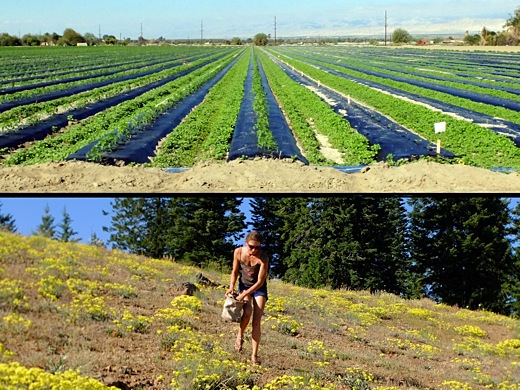
Image above: Contrast between modern agriculture in southern California and wild-tending a meadow in eastern Oregon. From original article and cover of book "The Failure of Farming g and the Necessity of Wildtending".
"The news here is that the lives of most of our progenitors were better than we think. We’re flattering ourselves by believing that their existence was so grim and that our modern, civilized one is, by comparison, so great." —John Lanchester[1]
The “Agricultural Revolution” is lauded as one of the greatest achievements in the history of the human race, proof positive of “Progress” and of our own exalted status “a little lower than angels.” Doubtless, it is among the most momentous changes that our species has experienced, on par with the utilization of fire, the development of language and the splitting of the atom.

However, a closer look, based on research and scholarship, reveals that the adoption of farming led to declines in human health, caused sharp social inequities, started a war on the environment, and put us on a road that’s headed towards extinction.

But wasn’t life before farming miserable? Notoriously “nasty, brutish and short?” Weren’t hunters and gatherers always on the edge of starvation, constantly focused on survival, and never able to enjoy free time? According to experts who study history: No.

Among those who investigate the Agricultural Revolution are archaeologists, anthropologists, paleopathologists, sociologists, geneticists, linguists, primatologists, botanists, climatologists and even economists. A survey of their literature from the last half century exhibits near consensus on the big picture: the Agricultural Revolution caused clear, measurable declines in quality of life, individually, communally and ecologically.

That this knowledge has not filtered out into mainstream culture is hardly surprising since these findings contradict cherished cultural beliefs that have religious origins and political value, to say nothing of personal appeal.
The fossil record reveal that life for agriculturalists was harder than it had been for hunter-gatherers. Their bones show evidence of dietary stress: they were shorter, they were sicker, their mortality rates were higher. Living in close proximity to domesticated animals led to diseases that crossed the species barrier, wreaking havoc in the densely settled communities.[2]
The diets of wildtenders and other gatherer-hunters were very diverse and their lifestyles were highly mobile. The variation in food, in kind and in season, supplied complete nutrition and lessened the chance of going hungry. Living in small, migratory groups virtually guaranteed that individuals were in good physical condition and disallowed certain diseases from becoming widespread.

Of course, gatherer-hunters were themselves diverse, and their diets and lifestyles differed with geography, but altogether they were more like each other than they are like the agricultural societies that largely replaced them.

The Agricultural Revolution radically reoriented the fundamentals of human culture. Some of its inventions were cities, property, writing, taxation and in the Near East, monotheistic religion. The transitions were not immediate.

First, humans settled into sedentary villages based on horticulture (aka, “stick agriculture”), which brought one set of changes. Then, after a few thousand years, agriculture proper emerged, driven by the plow and fed by irrigation, spurring more drastic transformations.

In most gatherer-hunter societies, the majority of the diet was the part that was gathered. Such was comprised of roots, seeds and nuts, berries and fruit, greens, and in some places, grubs and insects. All of these had their own seasons, stages and habitats that varied annually depending on natural cycles, the weather and other circumstances.

But food was not the only thing being gathered; the botanical world also provided fibers for weaving clothes and containers, colors for painting and dyeing, and teemed with medicinals for treating injuries, easing pain, tending to hygiene, improving vigor and—last but certainly not least!—controlling fertility.

Altogether, gatherers had knowledge of hundreds of plants and thousands of factors. This encyclopedic understanding was shared generationally for millennia through an oral tradition that conveyed not merely information but also wisdom. As a result, the practice of gathering was a highly consistent endeavor that dependably provided sustenance, crafting materials and medicines throughout the year.

Hunting meat, by contrast, yielded erratic results. Even when game was predictable—such as during an annual Salmon run or a Reindeer migration—the pattern of hunting as an activity was “feast-or-famine.” In some cultures, meat was preserved by smoking or drying it, but the amount that could be conveniently stored or carried was finite. In some parts of the world, gatherer-hunters would never have been daily meat eaters, and during particular times of the year, would have had a predominantly vegetarian diet.[3]

According to the archaeological and anthropological evidence, gathering was predominantly the sphere of women and hunting that of men. This division makes sense, since babies or small children could accompany gathering activities, but were likely to disrupt hunting. This division was also voluntary, says Gerda Lerner, author of The Creation of Patriarchy:
“The earliest sexual division of labor by which women chose occupations compatible with their mothering and child-raising activities were functional, hence acceptable to men and women alike”[4] [emphasis in original].
So, since Paleolithic survival depended on the contributions of both sexes, egalitarian societies were the norm. Roles within a group were based on “linking rather than ranking”[5] and relationships focused on cooperation rather than competition. These balanced forms of culture have also been called “partnership societies” as opposed to “dominator societies,” the latter of which are patriarchal.

The image of the caveman dragging his woman around by her hair is a mythical view of the past, although it’s a telling expression of our present day misogyny that this is what we project back in time. Clearly, we are trying to justify what we know is bad behavior.

From the contemporary viewpoint it seems impossible to imagine, but property—besides one’s personal articles—was a concept new to the Agricultural era; no one had owned land, animals or other humans in preceding times. But the first written records (dating to ~5100 years ago)[6] are mostly comprised of lists of property, primarily grains, slaves (tracked by sex) and heads of animals. For its first five centuries, writing’s exclusive use was accounting, not art.[7]

Art, it has often been claimed, flowered with the Agricultural Revolution because of extra leisure time, although, in actuality, such time was actually in shorter supply. Some scholars have suggested that art suffered from the transition. Says John Zerzan:
The pre-Neolithic [pre-Agricutlural] cave paintings, for example, are vivid and bold, a dynamic exaltation of animal grace and freedom. The neolithic art of farmers and pastoralists, however, stiffens into stylized forms; Franz Borkenau typified its pottery as a “narrow, timid botching of materials and forms.”
With agriculture, art lost its variety and became standardized into geometric designs that tended to degenerate into dull, repetitive patterns, a perfect reflection of standardized, confined, rule-patterned life… And where there had been no representation in Paleolithic art of men killing men, an obsession with depicting confrontation between people advanced with the Neolithic period, scenes of battles becoming common.[8]
Deeper still were shifts in how humans looked at themselves in relation to the natural world. James Suzman writes:
Where hunter-gatherers saw themselves simply as part of an inherently productive environment, farmers regarded their environment as something to manipulate, tame and control. But as any farmer will tell you, bending an environment to your will requires a lot of work. The productivity of a patch of land is directly proportional to the amount of energy you put into it. This principle that hard work is a virtue, and its corollary that individual wealth is a reflection of merit, is perhaps the most obvious of the agricultural revolution’s many social, economic and cultural legacies.[9] [my emphasis]
Here, then, are the roots of the “Protestant work ethic” and of the over-production that techno-industrial capitalism has taken to such ecocidal extremes.

No discussion of the Agricultural Revolution in the Near East would be complete without mentioning monotheism, which Gore Vidal called, “easily the greatest disaster to befall the human race.” This religious dogma was a logical expression of the agricultural lifestyle.

The new god was a man, entirely independent of women, with no mother, wife or daughter, a sharp contrast with gods in the existing pantheons. He did not live on the earth and was not present in its life, its form, or its elements, except on special occasions, e.g., when taking the form of a cloud or a fiery shrub. He declared that the planet and everything on it was the “dominion” of humans, for them to treat as they would like.

Clear hierarchies existed: God over humans, human men over human women, all humans over nature. Last but not least, humans themselves were born flawed, inherently unable to find true happiness in living.

By whatever justification, religious or otherwise, and through whatever mechanism, intentionally designed or not, during the Agricultural Revolution, men took the majority of social power from women and it has never been returned or retaken.

Or even honestly acknowledged. Modern liberal feminism has won only very minor reforms; the fundamental mode of oppression remains unshaken. That mode—patriarchy—is the domination not only of men over women but of those characteristics considered masculine over those considered feminine.

Dualism and domination are two of its hallmarks: the division of everything into opposites and the subsequent subordination of one to the other. On the grand scale, patriarchy is an expression of humanity splitting itself from nature and setting itself counter to it.

As domination over nature was exerted, respect for nature declined. How could it not? You cannot at once lash something and love it. That some people believe you can just shows how far down this “nasty, brutish” road we’ve traveled. But no: respect and domination don’t go together. Can not. They are mutually exclusive.

Ultimately, the breaking of our conscious, intentional connection with nature was the worst outcome of agriculture. Not content to merely abuse ourselves and each other, we extended our desecration to everyone else—animal, vegetable and mineral—and to the planet itself.

Currently, our survival is no less connected to nature and the world than at any other time, but we are now less aware of that connection than ever before. The cost of that break–of over fifty centuries of intense exploitation—is now weighing on us heavily.

Environmentally, the damage done to the planet by agriculture is severe and far-reaching.

First, farming’s footprint is enormous, taking up fully 40% of the earth’s land.[10] Every acre of that started out as wildlife habitat but is now disturbed to one degree or another. On ranchland, many of the original animals and plants might still live there, albeit with limitations. But in a field of corn, a rice paddy, or an almond orchard, nearly all other life has been wiped out, often completely.

City tourists might take a drive to admire the rolling hills of “wine country,” but what they are looking at is a former wilderness that was once home to flora, fauna, fungus and previous human populations, all since decimated. It’s no pretty picture at all. It’s a vision of ecocide.

You can’t farm without soil (hydroponics notwithstanding) but soil is the first casualty of agriculture. For abusing soil, nothing beats the plow, from the original ox-drawn and human-led tool of the Neolithic Era to the contemporary fuel-powered and unmanned GPS-coordinated behemoth of the 21st Century.

As it turns out, forcibly breaking down a soil’s structure with blades and removing the vegetative material that holds it together results in quite a lot of it eroding into waterways and blowing away in the wind.

The remainder rapidly loses its inherent fertility as irrigation washes out minerals and pesticides wipe out vitalizing micro-organisms. Currently, “a third of the planet’s land is severely degraded and fertile soil is being lost at the rate of 24bn tonnes a year.”[11]

Onto the cleared, drained and leveled lands of agriculture are applied poisons, hundreds of kinds, few of them tested and of these none of them thoroughly. Fertilizers taint the water, from aquifer to river to sea. Dead zones expand in the oceans, all over the world. Writes Jonathan Watts, in the Guardian:
The increased use of chemical fertilizers by the industrial agriculture sector over the past several decades… has prompted large-scale run-off of sewage and other byproducts entering ocean waters, causing deoxygenated dead zones to quadruple in size since 1950—now covering an area roughly the size of the European Union…. Low-oxygen dead zones make the ocean less inhabitable for marine life, suffocating creatures and reducing the area where they’re able to thrive.[12]
Pesticides are a nightmare. By dint of their particulate nature when sprayed, they are easily carried away by the wind and end up contaminating soil and water and poisoning other creatures. Only 1% hit their intended target. 1%! Subsequently, at the large scale they are used, they degrade habitat, reduce biodiversity and magnify extinction rates. Ironically, pollinators required for food production are frequent victims.
As with war, one can question whether non-target damage can honestly be described as “collateral”—”being aside from the main subject, target, or goal; tangential”—when it is inevitably, one could even say characteristically, a “subject” of nearly every attack, never truly “tangential.”

But nature can be resilient, and targeted plants can and do develop herbicide resistance over time, meaning they survive being sprayed. Unfortunately, the agriculture industry’s response is to jack up the amount of herbicide and develop new poisons.

Irrigation damages the environment from the points of source to delivery, and the bigger the project, the worse it is. Anytime water is diverted from one place to another, there is always at least one loser: the immediate locale from which it was taken.

Whether it is a spring, river or lake, the effects of use will make their mark, sooner or later. In many cases, the crop being irrigated isn’t even be food. In northern California, rivers have been running too low for the Salmon because of the wine and Cannabis industries.

In other words, we are prioritizing getting drunk and high over the lives of other creatures. Such trade-offs are emblematic of agriculture. That these acts are not considered theft or assault is demonstrative of mere cultural creed, not the honest administration of logic.

Dams built for agriculture are their own disasters. They drown entire areas, block fish migration, and interrupt previous patterns of seasonal flooding that brought fertility to the soil.

Agriculture is a major contributor to Climate Change due to the significant amount of greenhouse gases it produces. The majority of these gases come from four different sources:[13]
  • Deforestation for land-clearing. Forests are “carbon sinks”—that is, they store carbon dioxide (CO2)—so when the trees are cut down, much of the CO2 dissipates into the atmosphere. Tilling cleared land produces additional CO2, which the soil releases when it is disturbed.
  • Rice cultivation. The customary flooding of fields causes anaerobic decomposition, which produces methane (CH4). CH4 produces about 20 times more warming in the atmosphere than CO2 in the short term (a timeline of less than a century).
  • Enteric fermentation by cattle. CH4 is a natural byproduct of the digestive process of ruminant animals such as cows, who number in the millions.
  • Fertilizer application. Nitrous oxide (N20) is created when synthetic fertilizers react with the soil. 60-80% of all anthropogenic N20 emissions are agriculturally sourced. N20 is about 300 times more warming than CO2.
Farming is killing us. That’s no exaggeration. And we must stop doing it. That’s undeniable.

Of course that means drastic collective changes on a global scale, but in the service of survival, we must do what’s necessary. Drastic is not the same as “impossible.”

Unsurprisingly, the agricultural mind rejects the idea of ending agriculture, but its arguments deserve no hearing. The track record of the last 11,500 years is clear. Farming has been a failure.

“What else are we supposed to do?” is the wrong question. It’s not even a question, really. It’s a statement of insistence disguised with interrogatory punctuation.

The false claim being made is that “there is no alternative.” But without supporting evidence, this assertion of dogma has to hide behind a question mark. Beware those who speak this way. If you hear yourself saying it, stop and give yourself a sharp look.

The real question is: “What can we offer?”

What we have forgotten in agricultural societies is that life is all about reciprocity.

In an interview included in my new book, Jayesh Bear said: “It’s two different worldviews. One that is in fear of the natural world and one that strives to understand it and respect it and live in symbiosis with it.”

Inherent in wildtending, and in other gathering-hunting lifestyles, was such striving. Wildtending is reciprocal. Its actions, collectivity, and scope all exist as endless exchange.

Agriculture is the opposite: extractive; taking without giving. There’s only so long that can go on, and if the Americas hadn’t existed, it might very well have ended already. As it is, the monster was able to feed itself for another 500+ years, and has swollen into a bloated mess of tremendous size and ugliness. We’ll see how much longer it goes if left unattended. At some point it either runs out of fuel or is suffocated by its own toxic excretions.

Which returns us to the question: “What can we offer?”

Ultimately, reciprocity must again be our collective way of life, and by “ultimately” I mean today. Isolated, individual choices will not suffice. While there is nothing else to do, we will make them, and should make them as consciously as possible, of course.

But what that means, in part, is never forgetting that lifestyle choices are made primarily for ourselves, and the best they can do is to help us see and live more clearly. Gaining clarity is essential, of course, but we should not mistake it for significant material change. It is not.

Living in reciprocity with the other beings on this planet—human and non-human—is a necessity regardless of planetary outcome. The act of nurturing is a salve for all parties involved, even if we are merely comforting the dying.

[1] Lanchester, John. “The Case Against Civilization: Did our hunter-gatherer ancestors have it better?” New Yorker, September 18, 2017.
[2] ibid.
[3] Sahlins, Marshall. Stone Age Economics (Chicago and New York: Aldine·Atherton, 1972), p. 27.
[4] Lerner, Gerda. The Creation of Patriarchy (New York Oxford University Press, 1986), p. 42.
[5] Eisler, Rian. The Chalice and the Blade (New York: HarperCollins, 1987), p. 27.
[6] Wikipedia “History of Writing”
[7] Lanchester.
[8] Zerzan, John. “Agriculture.”
[9] Suzman, James. “How Neolithic farming sowed the seeds of modern inequality 10,000 years ago” Guardian, 5 December 2017.
[10] Owen, James. “Farming Claims Almost Half Earth’s Land, New Maps Show” National Geographic (Dec. 9, 2005).
[11] Conley, Julia. “New Study: Big Ag, Climate Crisis Key Drivers of Ocean ‘Dead Zones’ Quadrupling in Size Over Last 60 Years” Common Dreams, January 05, 2018.
[12] Watts, Jonathan. “Third of Earth’s soil is acutely degraded due to agriculture” Guardian, 12 September 2017.
[13] Intergovernmental Panel on Climate Change. “IPCC Special Report on Emissions Scenarios” section 3.5. “Agriculture and Land-Use Emissions,” 2000. | International Union for Conservation of Nature and World Business Council for Sustainable Development. “Ecosystems Facts and Trends,” 2008, p. 6. | Earth Journalism Network. “Climate Change and Agriculture” (9 June 2016).

.