Solar Up - Atomic Energy Down

SUBHEAD: Duke Energy's nuclear reactor shutdown plan shows shale gas sway over power generation.

By Julie Johnsson on 6 February 2013 for Bloomberg News -
(http://www.bloomberg.com/news/2013-02-06/duke-reactor-shutdown-plan-shows-shale-s-sway-over-power-energy.html)


Image above: Duke Energy's Crystal River nuclear plant control room. From original article.

Duke Energy’s decision to dismantle a Florida nuclear power plant rather than undertake the costliest- ever U.S. atomic repair shows how rapidly cheap natural gas is remaking the U.S. power industry, hastening a shift from traditional fuels such as coal and uranium.

Duke’s Crystal River Unit 3 plant in Florida joins Dominion Resources Inc.’s Kewaunee reactor in Wisconsin as the first to be shuttered in the U.S. because of growing shale gas supplies, serving as signposts for utilities from Japan to Belgium also considering decommissioning reactors. At least four other U.S. reactors are also at risk of early retirement due to new power market economics, said Julien Dumoulin-Smith, a New York City- based analyst with UBS Securities LLC, in a telephone interview.

“The fuel du jour is natural gas,” Florida Public Counsel J.R. Kelly, the state’s official advocate for utility customers, said yesterday in a telephone interview. “I personally believe in fuel diversity. I’m just afraid the costs of new nuclear are going to be prohibitive.”

The question for Duke, the largest U.S. utility-owner by market-value, is whether Florida regulators will allow it to charge the state’s consumers $1.65 billion for its failed investments in the reactor, while boosting the state’s already hefty reliance on gas to fuel its electricity plants.

Consumer Benefits
Florida’s Public Service Commission expects to hold hearings to determine whether Duke’s decision to retire the plant is prudent for customers, Cynthia Muir, a commission spokeswoman, said yesterday in a telephone interview.

Kelly said he will take “a very close look” at Duke’s funding request.

“We’re not going to leave our ratepayer in the lurch,” he said.

Duke’s Chief Executive Officer Jim Rogers is among utility executives who have warned that too much reliance on natural gas puts customers at risk of power price spikes should fuel costs rise, as they often did in years before producers learned to extract it from abundant shale beds in the U.S. and Canada.

“We view gas as the most viable short-term option,” Mike Hughes, a Duke spokesman, said yesterday in an interview. “The costs are low and we anticipate the cost of fuel for the foreseeable future will remain relatively low. Long term, we don’t think you should put all of your eggs in the gas basket.”

Gas Distortion
A shale-fed plunge in gas prices is tilting the power industry toward that fuel, lowering electricity prices and pressuring profits at coal and nuclear generators. At the same time, rising fuel prices and escalating safety repairs are making older, single-unit reactors like Crystal River increasingly difficult to operate profitably.

“Natural gas is really distorting the markets,” Margaret Harding, a nuclear industry consultant based in Wilmington, North Carolina, said in a telephone interview. “These old, small plants, if they get slapped with a lot of capital upgrades, they’re going to be tough to justify.”

Gas has become the cheapest source of power for much of the U.S. with prices that have tumbled 75 percent below the July 2, 2008 peak of $13.695 per million British thermal units.

The all-in cost to produce electricity during the fourth quarter, including operating and capital expenses, was $90.42 per megawatt-hour at a combined-cycle gas plant, $140.13 at a coal-fired plant and $143.29 at a nuclear plant, according to data compiled by Bloomberg New Energy Finance. A megawatt-hour can power about 800 average U.S. homes for an hour, according to the Energy Department in Washington.

No Competition
The trend has prompted utilities to build gas plants rather than a wave of new nuclear behemoths once predicted to follow Southern Co.’s $14 billion construction of reactors in Georgia.

“The market is telling us that right now, nothing can really compete with natural gas unless it’s renewables that are loaded with subsidies,” Samuel Brothwell, senior analyst with Bloomberg Industries, said in a telephone interview. “The challenge here is that natural gas can be a great power plant fuel, but it can’t be the only power plant fuel.”

Florida already uses gas for about two-thirds of its electricity generation and risks becoming overly reliant on a fuel whose price has swung from $2 to almost $15 per million Btus and back to $2 since the early 2000s, according to Brothwell. Florida’s dependence would rise to more than 70 percent later this decade if Duke builds new gas generation to replace the crippled Crystal River reactor and two coal units in central Florida, he said.

Humpty Dumpty
Florida regulators may still prefer relying on historically volatile gas to spending billions of dollars repairing a reactor nicknamed “Humpty Dumpty” for its cracked containment shell, with no guarantee the plant will ever run again. Crystal River’s federal license expires in 2016, and gaining a 20-year extension from the U.S. Nuclear Regulatory Commission isn’t assured even after repairs.

“I understand their decision,” said Kelly, Florida’s consumer advocate of Duke. “If they’d decided to repair it and it couldn’t be relicensed, ratepayers could have been on the hook for a lot more money.”

Duke acquired the 36-year-old reactor when it bought Progress Energy Inc. last year. Duke’s board ousted then-Chief Executive Officer Bill Johnson hours after acquiring his former company partly out of concern he was determined to repair Crystal River.

Cracking Up
The silo-shaped concrete building that houses the plant’s 860-megawatt reactor cracked in 2009 as crews replaced steam generators, huge pipe assemblies that transfer heat from the nuclear reactor to power-generating turbines. Once the damaged panel was patched, two other sections cracked after engineers tightened steel tendons intended to strengthen the structure.

A company report last year concluded fixing the reactor may cost $1.49 billion, which would be the largest-ever insurance claim for a U.S. reactor, and as much as $3.43 billion in a worst-case scenario that contemplated cracking spreading to its dome. Duke said it’s considering a new natural-gas fueled plant to replace the reactor’s output.

“Gas is the fuel and technology of choice right now,” Hughes, the Duke spokesman, said. “It was one of the very important factors considered in the financial implications of repair or retirement.”

Most investors had expected Duke to close Crystal River, so the announcement clearing away uncertainty “can be read positively for the company and the stock,” Daniel Ford, a New York-based analyst with Barclays Capital Inc., said in a research report yesterday. Duke declined 0.4% to $68.64 at 11:15 a.m. in New York.

Economic Reviews
Like Dominion’s Kewaunee plant, generators in greatest financial distress have a single reactor and sell electricity into deregulated markets where demand is unchanged, cheaper power sources are abundant and payments from end-users are too low to cover rising fuel and maintenance costs, said Dumoulin- Smith of UBS.

While Duke’s crippled reactor is owned by a regulated utility, enabling it to recapture costs through state-approved rate increases, the other plants are operated by Exelon Corp. and Entergy Corp. in competitive markets where capital spending is funded by power sales. Dumoulin-Smith says Exelon’s Clinton plant in Illinois and Ginna in upstate New York, and Entergy’s Fitzpatrick and Vermont Yankee plants are at greatest risk of being closed, and would almost certainly be replaced by gas.

“We are doing everything we can to continue to operate Clinton and we have made no decision to shut down the plant,” Joe Dominguez, a senior vice-president at Chicago-based Exelon, the largest U.S. nuclear operator, said in a telephone interview yesterday. “With that said, we do an analysis of every one of our plants on an annual basis to understand their continued economic viability.”

California Reactors
Edison International, which owns California’s second- largest regulated utility, is working with regulators to determine whether it can safely and cost-effectively restart two reactors at its San Onofre atomic station near Los Angeles, shut down for a year because of a leak stemming from unusual wear to its steam generators.

Entergy, based in New Orleans, believes that over time power markets will recover sufficiently to support nuclear plants outside regulated frameworks, Mike Burns, an Entergy spokesman, said in an e-mail.

“We think that nuclear plants will remain an important part of America’s generation portfolio,” he said.

Shuttering more reactors would leave generators and consumers even more dependent on shale drillers and the gas they produce, said David Herr, a managing director with investment bank Duff & Phelps.

“The risk is we’re putting all of our eggs into that one basket: the shale phenomenon and our ability to generate a tremendous amount of lower-cost fuel,” Herr, who heads the firm’s energy and mining practice, said in a telephone interview.


SUBHEAD: U.S. Solar voltaic energy production will eclipse wind in 2013.

By Ehren Goosens on 5 February 2013 for Bloomberg News -
(http://www.bloomberg.com/news/2013-02-05/u-s-solar-will-eclipse-wind-in-2013-says-duke-energy.html)

The U.S. will add more solar power in 2013 than wind energy for the first time as wind projects slump and cheap panels spur demand for photovoltaic systems, according to the head of Duke Energy Corp. (DUK)’s renewable-energy development unit.

The U.S. may install 3 gigawatts to 4 gigawatts of wind turbines this year, and solar projects will probably exceed that, said Gregory Wolf, president of Duke Energy Renewables. The U.S. added 13.1 gigawatts of wind power last year, beating natural gas for the first time.

U.S. wind projects have come to a near-standstill this year on uncertainty over the fate of a federal tax credit that was set to expire Dec. 31. Wolf anticipates more solar projects going into operation in 2013 than wind farms after panel prices fell more than 60 percent in the last two years.

“I would expect a lot of momentum still on solar,” Wolf said in an interview yesterday.

“We really ramped up our solar in 2010,” said Wolf. “Today most of the projects are half or less of the cost now than then.” Duke Renewables’ portfolio of renewable-energy projects exceeds 1.7 gigawatts.

The production tax credit, which provides 2.2 cents a kilowatt-hour for electricity from wind farms, was extended for a year on Jan. 1. With little information about whether it would be renewed, developers raced to complete wind farms by the end of last year and didn’t plan new ones.

The U.S. installed about 3.2 gigawatts of solar power last year and may reach 3.9 gigawatts this year, according to data compiled by Bloomberg. Cheap panels and lower construction costs have been aided by policy support that “has been a little more consistent and long-term,” Wolf said.
Green Halo
Duke invested more than its $500 million target in renewable energy last year, and more than $2.5 billion to date, Wolf said.

“We’re not in this business just because we want a green halo for Duke,” he said.

The largest U.S. utility owner by market value enters into long-term power purchase agreements for wind and solar plants that have “an attractive profile in terms of risk and returns,” Wolf said. “If we find really good projects, we’ll see if we can find a way to make them work.”
.

3D Printing Possibilities

SUBHEAD: 3D Printing - Make anything you want; including airplane and body parts.

[IB Editor's note: A techno-optimist's wet dream.]

By Bruce Jackson on 5 February 2013 for Google+ -
(https://plus.google.com/communities/117814474100552114108)


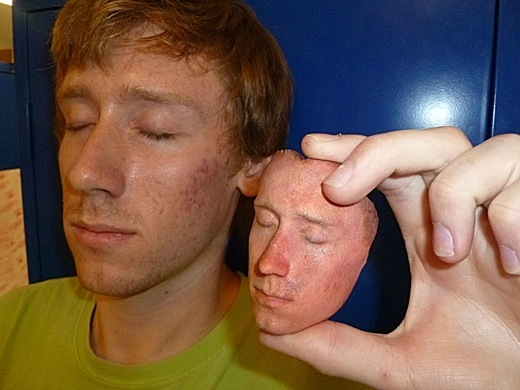
Image above: A 3D printed face and its host. From (http://imgur.com/gallery/yZOYq).

3D Printing: Make anything you want. Excellent video overview of the industry (medical, gun parts, etc). Imagine a world where you can make anything you want, just by pressing "print". 3D printers have arrived and they promise a fascinating future, depending on what we make. For more info, please go to http://www.globalnews.ca/3d+printing/6442792806/story.html


Video above: An overview of recent 3D printing yechnology efforts. From (http://youtu.be/G0EJmBoLq-g).


Video above: Anthony Atala on grpwing new organs. Filmed in 2009. From (http://www.ted.com/talks/anthony_atala_growing_organs_engineering_tissue.html)

.

Domestic Peace Force

SUBHEAD: Is that why Homeland Security purchased so many assault weapons and people killing ammo?

By Mac Slavo on 4 February 2013 for SHTF Plan -
(http://www.shtfplan.com/headline-news/are-all-those-guns-and-ammunition-for-obamas-civilian-national-security-force_02042013)


Image above: Detail of poster for Obama Domestic Peace Force. From original article and (http://daletoons.blogspot.com/).

Speculation abounds surrounding the 2 billion rounds of ammunition purchased by the Department of Homeland Security and other national alphabet agencies in recent years. Moreover, as the White House and their cohorts in Congress contemplate the disarming of American citizens, the very assault weapons purported to be so dangerous in the hands of law abiding gun owners are being purchased in mass quantities by local and federal law enforcement agencies.

So what is the purpose and motivation behind the government’s continued efforts to stockpile so much firepower? One frightening theory could explain what the President and his national security apparatus are up to.

The following excerpted From article by Joseph Farah 'Why is US stockpiling Guns & Ammo? 
Many of you will remember a story I broke a long time ago – about presidential candidate Barack Obama’s little-noticed announcement that, if elected in 2008, he wanted to create a “civilian national security force” [or domestic peace force] as big, as strong and as well-funded as the Defense Department.

Here’s what he actually said at a campaign stop in Colorado July 2, 2008:

“We cannot continue to rely only on our military in order to achieve the national security objectives we’ve set. We’ve got to have a civilian national security force that’s just as powerful, just as strong, just as well-funded.”

Could what we see happening now in the Department of Homeland Security be the beginning of Obama’s dream and our constitutional nightmare?

We never heard another mention of Obama’s “civilian national security force” again. Not in 2008, 2009, 2010, 2011 or 2012.

But that brings us up to 2013 and the highly unusual stockpiling of firearms and ammo by Homeland Security – firearms and ammo that Obama would like to deny to ordinary citizens who are not members of his domestic army.

Well, I hate to say it, but I may have predicted this, too.

In a Halloween column last fall, I stated that, if re-elected, Obama would “declare a full-scale war on his domestic opposition.”

I wasn’t joking. I was deadly serious – so serious, in fact, that I did something I pledged I would never do: Vote for Mitt Romney. It was a matter of self-defense and self-preservation. I said then that a second term of Obama might mean we would never see another free and fair election in America. (I’m not even sure we saw one in 2012.)
 
I suggested due process would go the way of the horse and buggy. I said I expected Obama would move to shut down or destroy all independent media. I even speculated that his biggest critics would eventually be rounded up in the name of national security.

Think about it.

Why does the civilian Department of Homeland Security need billions of rounds of ammunition?

This is the agency that is responsible for policing the border. But it doesn’t.

This is the agency that is responsible for catching terrorists. But it doesn’t.

So why does Homeland Security need so many weapons and enough hollow-point rounds to plug every American six times?

The official explanation? Target practice.  See this Fox News Story on ammo purchases:
As for concern about the type of bullets — hollow points, which expand upon impact — the statement said the type is “standard issue” and is used during “mandatory quarterly firearms qualifications and other training sessions.”
While the majority of Americans will take this explanation at face value, there are some key facts that suggest the Department of Homeland Security is mobilizing for a significant future action against the American people.
  • The US military has been actively war-gaming worst-case scenarios that include economic collapse and civil unrest, going so far as to simulate wide-scale food riots.

  • Just last month the military deployed gunships over Miami and executed a training exercise with local police departments. A few days later, similar exercises were held in Houston, TX. Last year these “exercises” also included ground forces, armored personnel carriers and tanks on the streets of St. Louis.

  • Despite overwhelming opposition, there is an overt and focused movement to disarm Americans of their right to bear semi-automatic personal defense rifles and any other firearms deemed dangerous to the public. Those calling for this disarmament qualify their positions by claiming these weapons are not necessary for sporting, hunting, or personal defense. As if this provision of the US Constitution doesn’t even exist, there is a total blackout on the fundamental intent of the Second Amendment, which allows for citizens to bear arms to protect themselves against tyrannical government.

  • Heavily armored vehicles have been spotted all over the country, and many local law enforcement agencies have taken possession of these vehicles, normally reserved for military engagements, and have put them to use in neighborhoods and communities around America.
  • Congress has authorized the deployment of some 30,000 surveillance drones in the skies of America, to be available for use by intelligence agencies by 2015.

  • The National Security Agency is building a massive spy center capable of recording, aggregating and analyzing every digital interaction on the planet – phones, internet, purchasing patterns, travel, and even what we say in the privacy of our own homes. A 30 year veteran of the NSA says the data mining program is so vast it will “create an Orwellian state.”

  • The US government, in the aftermath of the September 11th attacks, has created legislation that directly targets American citizens. The Patriot Act makes it possible for anyone who is identified as attempting to subvert government legitimacy as a terrorist, and also allows for the warrantless wiretapping of everyone for any reason. Under the Patriot Act and expanded government definitions, just about anyone now qualifies as a domestic terrorist.

  • The National Defense Authorization Act takes the Patriot Act even further, allowing the government to detain anyone suspected of being a terrorist indefinitely and without trial – this includes American citizens living in the United States.

  • And, as Joseph Farah points out, the President specifically claimed he would create a civilian national security police force as large as the US military. If he meant it, then we’re talking about 2 million or so civilians that will be armed, deputized and backed by the government. To do what? We’re not quite sure, but apparently we need these civilians for something important, or else the President wouldn’t have brought it up.
These are but a few examples of what our government has been up to. There are hundreds of others.

Now put all those together and the complete puzzle begins to emerge.

This surveillance infrastructure and control grid are being designed not for foreign terrorists or rogue nations that may do harm to America. They have been designed for you.

You, my fellow American, are the enemy.

See also:
Ea O Ka Aina: DHS to the Rescue 9/12/12
Ea O Ka Aina: Traing of supression of Americans 4/10/12
Ea O Ka Aina: Feds hunkering down for upheaval 3/19/12

.

Obama Drone Paper

SUBHEAD: Officials, other than Obama, can order killing of American citizens even without evidence of plot against the U.S.

By Ryan J. Reilly on 4 February 2013 for Huffngton Post -
(http://www.huffingtonpost.com/2013/02/04/doj-drones-paper_n_2619582.html)


Image above: Obama as 1930's Chicago gangster. From (http://www.washingtontimes.com/multimedia/image/b1-obama-gangster-ggjpg/).

A report Monday night on the nature of the administration's drone program has the potential to dramatically revamp the debate over President Barack Obama's foreign policy and the confirmation process for his incoming cabinet.

The report, by Michael Isikoff of NBC News, reveals that the Obama administration believes that high-level administration officials -- not just the president -- may order the killing of “senior operational leaders” of al Qaeda or an associated force even without evidence they are actively plotting against the U.S.

“A lawful killing in self-defense is not an assassination,” states the Justice Department white paper quoted by Isikoff.

The 16-page memo, given to Congress in June, is not the final Office of Legal Counsel memo that news organizations have sued to obtain. But it offers plenty of insight into the government’s justification for killing American citizens in overseas drone strikes.

The paper states that the U.S. would be able to kill a U.S. citizen overseas when "an informed, high-level official of the U.S. government" determines the target is an imminent threat, when capture would be infeasible and when the operation is "conducted consistent with applicable law of war principles."

The white paper suggests that such decisions would not be subject to judicial review and outlines a broad definition of what constitutes “imminent” threat.

Constitutional experts said the memo's definition doesn’t hold up to scrutiny. Administration critics immediately said the white paper is fresh evidence the president has abandoned his 2008 campaign pledge to recognize and respect the limits of executive power.


Jameel Jaffer of the American Civil Liberties Union called the document "pretty remarkable" and said some of its arguments "don't stand up to even cursory review." He said the paper “only underscores the irresponsible extravagance of the government's central claim.”

Hina Shamsi, director of the ACLU’s National Security Project, called the document “profoundly disturbing” and said it was “hard to believe that it was produced in a democracy built on a system of checks and balances.”

“It summarizes in cold legal terms a stunning overreach of executive authority –- the claimed power to declare Americans a threat and kill them far from a recognized battlefield and without any judicial involvement before or after the fact,” Shamsi said in a statement.

Watchdog groups and members of Congress have made repeated pleas for the administration to release internal documents outlining the rationale for the targeted killing program, especially when the target is an American citizen. NBC's report increases pressure on the administration to release additional documents.

The White House did not immediately return a request for comment.

Earlier on Monday, 11 senators signed a letter formally requesting that the administration provide its legal justification for drone strikes to Congress. Marcy Wheeler, a blogger who has closely tracked the requests, said it was at least the 12th time Congress had asked for such documents.

The Justice Department white paper's publication comes at an unfortunate time for the White House, shepherding several top cabinet nominees through confirmation in the Senate. The leak may pose hurdles for the confirmation of John Brennan, the nominee for CIA director.

Brennan, now a top White House adviser, is the architect of Obama’s drone policy. He has been a strong proponent of the expanded practice of targeted assassinations to kill suspected terrorists wherever they may be. It was under his watch that the Anwar al-Awlaki assassination was approved.

In the final months of Obama’s first term, Brennan joined other members of the national security team to codify procedures for determining the appropriate use of targeted killings into a so-called “playbook,” but much of the process remains opaque.

Nevertheless, it is likely that the legal backbone for the drone and killing program will emerge as a major controversy in Obama's second term as the death toll rises. In addition to Brennan, Obama’s pick for secretary of defense, Chuck Hagel, is a proponent of selective strikes, including drone kills, to maintain America’s edge in the war on terrorism without risking major troop deployments.
.

Hanamaulu Landfill Siting

SUBHEAD: Meeting on on Maalo Road landfill siting this Tuesday 6:00pm at King K Elementary.

By Nina Monasevitch on 4 February 2013 in Island Breath.
(http://islandbreath.blogspot.com/2013/02/hanamaulu-landfill-siting.html)


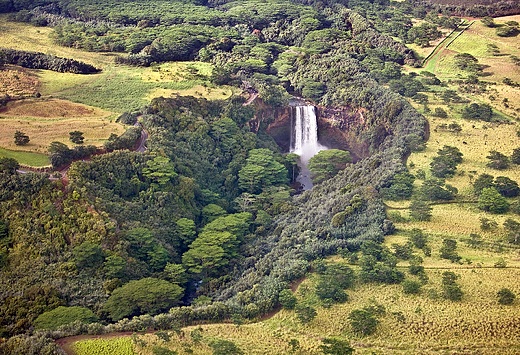
Image above: Aerial view of Wailua Falls at the end of Maalo Road. From (http://www.flickr.com/photos/ironrodart/3617887042/).

WHAT:
 Public county meeting on Hanamaulu landfill siting on Maalo Road in Hanamaulu

WHEN:
 Tuesday, February 5th at 6:00pm

WHERE:
King Kaumuali'i Elementary School
Hanamaulu, Kauai (off Kuhio Highway)

The county has chosen Ma'alo for the new landfill and Resource Recovery Park (RRP) http://www.kauai.gov/newlandfillsite/

We all need to show up at meeting this Tuesday, February 5th, 6:00pm at King Kaumuali'i Elementary School and say NO to this site!

Is the Ma’alo site for the next landfill a bad choice?

The Hawaiian word for water is wai. The Hawaiian word for wealth is waiwai. Unless we are mistaken, this roughly translates to mean that fresh water is the most precious resource. It is written that the people of old had Kapu, sacred with the implication of forbidden, on certain activities upstream. In this way, clean wai was available for farming, making medicines and drinking.

How could a rational person, with a Hawaiian heart and a scientific mind think of locating a landfill upstream in the vicinity of surface drinking water? Where is the wisdom in that?

What are the implications that the state is holding the land that was ceded by Queen Kamalu?

What will be the cost to future county engineers to bring fresh water to the people of Hanama’ulu, Kapaia, Lihu’e and lower Wailua?

How many years and how many big rains until the surface water is polluted? How many generations until the ground water is poisoned?

What will be the agricultural costs? It is said that the area proposed is arguably the best farmland in the ahupua’a, land division. How much food, for how many generations could be grown on that 160 acres? How many jobs and for how many generations could work that land? If there is a landfill, how soon will the land and the water be poisoned?

Strangely, in studying the location site map that the county prepared in the power point presentation, available online, the reservoirs are not shown.

Does this implicate the county engineers in condoning a site they know will pollute the surface water supply in the short term, and the ground water in the long term?

Does this put the county and the future taxpayer at risk of a major class action lawsuit for polluting the fresh water of future generations? Will the environmental assessment (EA) answer any of these questions? Will any journalists?

Primary concerns:
  • Contamination of fresh water supply.
  • Streamflow needs to be increased already for watershed restoration.
  • Ruin of the Hanamaulu Watershed. Total watershed Rating was 4 in 2008 Not good but potentially salvageable.
  • What will it be with land fill and horizontal well?
  • Loss of viable, rich agricultural land.
Secondary Concerns:
  • Traffic flow, sole artery Maalo Road.
  • Environmental Justice issue, mitigation due to minority and income make up of Hanamaulu area.
  • Kapaia Valley residents are not presently included in the mitigation conversation even though Hanamaulu River runs through front yard.
There are 8 other proposed sites. The County needs to pursue the others.

[IB Editor's note: Maalo Road is the only way to get to one of the premier visitor destinations on Lauai -Wailua Falls. These dramatic 80-foot waterfalls can be seen from the end Maalo Road and were used in the opening of the television series Fantasy Island. The cliff over the pool once served as a diving platform for the ali`i. After the landfill is sited on Maalo Road all tourists and Kauaians will have to vie with refuge trucks, broken open garbage bags and blowing paper debris to get to the falls.]
.

Cattle Drive

SUBHEAD: It is ZIRP foolishness that is putting the USA on the path of an epochal systemic collapse.

By James Kunstler on 4 February 2013 for Kunstler.com -
(http://kunstler.com/blog/2013/02/cattle-drive.html)


Image above: Detail of movie poster from "Cattle Drive" starring Joel McCrea, Dean Stockwell and Chill Wills, 1951. From (http://originalvintagemovieposters.com/cattle-drive-original-vintage-western-poster/).


How hilarious is the Federal Reserve's cattle drive of cash money (i.e. "liquidity") into the stock markets? I'll tell you: if that cash is outflow from bonds that pay ZIRP interest rates, then this attempt to stampede investment into the stock market is only going to succeed in ravaging the bond market and by extension the credibility of the dollar, the US banking cartel, and then the world financial system as a whole.

If bond-dumpers rush into stocks, then who are the next bond buyers at ZIRP? The USA can't keep going without continuous bond selling. Somebody has to buy the darn things. The Federal Reserve is now buying around 70 percent of US issue -- a lot of it via secondary market pass-thru shenanigans involving "Primary dealers" (a.k.a. Too Big To Fail banks, who get to cream off a premium when they flip bonds to the Fed -- tidy little racket).

If the other 30 percent of issue can't find willing buyers at ZIRP then interest rates will have to go up. If interest rates go up, then interest paid out on bonds (that is "debt service") by the US government will go up catastrophically, because the aggregate debt is so colossal and most of the debt is short term, meaning that in a post-ZIRP world the interest rate ratchets up automatically every 13 weeks as bonds roll over.

The US will then only be able to pretend that it can service the debt at higher interest rates. Everybody in the world will recognize this -- surely only increasing the velocity of the stampede away from bonds. The question is: how long can pretending to service debt go on before it is just called by it's real name: default? Or, if countered with additional furious computer "money" creation: hyperinflation? Either way, of course, you end up broke.

This cattle drive into stocks is strictly a political gambit. The cattle are being driven to the slaughterhouse. It's discretionary strategic national financial suicide. They're driving up the stock markets for cosmetic purposes, to make it appear that an economic recovery is going on, and with the aim of setting in motion a self-reinforcing financial feeding frenzy in this rush to "equities." By the way, in case my manner seems didactic today I am attempting to define my terms as I go along because most other financial bloggers seem to assume that ordinary people understand all their jargon, which I am quite sure they do not.

Returning to my point... the Fed and their auditors on Wall Street and in government, are jacking up the stock markets in the hopes of stirring up "animal spirits," as the financial psychologists say, to put over the story that it equals a vibrant economy -- which is nonsense, of course, to anyone who shoots a casual glance at the economic wreckage all around them. Anyway, since the stock market action these days is dominated by high frequency trading robots running on algorithms, where exactly would animal spirits even factor in?

If anything the absence of real animal spirits in this action also implies the absence of its counterpart, animal survival instinct, of which human intelligence is an order. What can come of stirring up animal spirits among robots? A train wreck is exactly what.

Now, I ask you: at a moment in history when vast interlinked global financial markets have never been so unstable, so primed for unintended consequences courtesy of the diminishing returns of technology, so ripe for a massive, cascading "accident," is it a prudent thing to fuck around with such crude PsyOps?

One other factor outside pure financials assures that US economic performance will remain impaired (that is, the kind of economic activity we regard as "normal" (suburban sprawl building, credit card "consumer" spending): the price of oil, which is inching up to the $100-a-barrel hashmark.

Apparently that shale oil bonanza we hear so much about has not left the USA swimming in cheap oil. As a general principle, it's probably safe to say that an oil price above $80 crushes the US economy. It drives up the cost structure of just about everything we make, do, or sell here, but of course the primary things that go up in price are food and motor fuel.

Hence, it's tragically ironic that -- getting back to official financial PsyOps -- that one of the primary motives for the Fed keeping interest rates super-low in the first place (apart from enabling wild fiscal irresponsibility in government) has been to promote the housing sector -- because in the reality of our time "housing" translates into building more suburban sprawl. How smart is it to promote more suburban sprawl at a moment in history when there's no more cheap oil?

It is this kind of stupendous foolishness that is putting the USA on the path of an epochal systemic collapse.

Superbowl addendum:
Did anyone notice how violent and psychotic the Superbowl advertising was this year? An Oreo commercial that depicted a mob of nerds destroying a library -- huh? The Doritos spot where "Daddy" and his male buddies transform themselves into an insane clown posse of cross-dressers.

The Fast and Furious 6 trailer featuring the destruction of every vehicle known to man and a few office buildings, too. The third-quarter power failure was a neat harbinger of things-to-come in the Most Exceptional United States of America. Party on, peeps!
.

Fleetwood Mac - Love & Chaos

SUBHEAD: The background story of Fleetwood Mac’s ‘Rumours’ album tells secrets of romance, jealousy, creativity and madness.

By Mark Beech on 2 February 2013 for Bloomberg News -
(http://www.bloomberg.com/news/2013-01-30/fleetwood-mac-s-rumours-spills-secrets-of-love-chaos.html)


Image above: Contents of the deluxe box set of "Rumours" by Fleetwood Mac, released for its 35th anniversary. From original article.

Fleetwood Mac’s nightly recording sessions in a cramped, windowless studio were fueled by booze and cocaine. The band’s complex romances left every member heartbroken. Shouting matches lasted longer than the songs.

Today, 35 years on, an anniversary box set of “Rumours” shows how the musical cocktail of two women and three men was shaken and stirred by their romantic splits. Newly released material shows the tracks getting endlessly reworked and improved as they squabbled.

It was a “crucifyingly difficult” process, drummer Mick Fleetwood notes. He was going through a divorce, with his wife dating his best friend. He never imagined the chaos would lead to a 40-million-selling LP: the best of 1977, according to the Grammy judges, and one of the finest efforts of the 1970s, maybe even of all time.

The American couple in the band added a pop edge to British blues. Californian Lindsey Buckingham had been inseparable from his singer girlfriend Stevie Nicks for five years. When Fleetwood asked him to join, Buckingham insisted she be included too. Now they were all arguing, and the frustrated guitarist started writing a bitter rant called “Strummer.”

On the box set, we hear how this evolved from a simple acoustic demo into a Celtic rag and finally a sleek piece of disco with hints of the Bee Gees, retitled “Second Hand News.” There’s a percussive roll which, it now turns out, was made by bashing an old Naughahyde chair near the mixing desk.

Romantic Links
Buckingham throws the opening words at his ex: “I know there’s nothing to say, someone has taken my place.” (Nicks was romantically linked to Don Henley of the Eagles, then Fleetwood himself.)

Her own breakup lyric “Dreams” is a swift rejoinder: “Now here you go again, you say you want your freedom.” The song’s first mix, nowhere near so radio-friendly, puts her voice starkly to the fore and buries its optimism.

This creative jousting inevitably leads to Buckingham replying, bluntly inviting her to “Go Your Own Way” because he was “Never Going Back Again.”

The band’s other couple, the McVies, were walking from the wreckage of an eight-year marriage. They were on such bad terms that they would only speak about music.

Christine McVie defiantly shows how she’s moved on with “Don’t Stop” about her on-tour romance with the band’s lighting director. “You Making Loving Fun” tells her husband that her new flame is much better.

Tender Songbird
Coproducer Ken Caillat recalls how huge rows in the Sausalito, California studio would be followed minutes later by the composition of sweet harmonies. He deserves credit for singling out the most tender ballad, “Songbird,” and taking it somewhere else -- more precisely, to the Zellerbach Auditorium, Berkeley, which had the right acoustic and a Steinway piano.

The younger Nicks had the tougher words, but McVie is outstanding with her performance here: “And I love you, I love you, I love you, like never before, like never before.”

When the LP came out, I was a very young punk bassist and hated it, of course. This expensively produced, sentimental mush was exactly the stuff we were rebelling against. Just a few years on and I got it. “Songbird” now moves me every time. The record’s soft rock has echoes in acts such as Sting, Heart, Kelly Clarkson and Neko Case, to name just four.

The creative madness which had threatened to sink records as varied as “Exile on Main Street,” “Pet Sounds” and “Station to Station” again resulted in an act coming out with its best. Miracles do happen. As the lyric has it, “thunder only happens when it’s raining.”
.

Netflix reinventing TV

SUBHEAD: With more technology than HBO and more original content that Amazon, Netflix is breaking new ground.

By Cliff Edwards on 1 February 2013 for Bloomberg News -
(http://www.bloomberg.com/news/2013-02-01/machiavelli-meets-math-as-netflix-bets-on-original-shows.html)


Image above: Poster of Kevin Spacey, who stars in new Netflix series "House of Cards". From (http://crave.cnet.co.uk/homecinema/house-of-cards-netflix-review-a-sinister-streaming-success-50010315/).

Netflix’s Hastings Says Viewer Data Underpins Programming
Netflix will test whether Machiavelli and math are a winning formula as the world’s largest subscription-video service debuts “House of Cards,” its most ambitious step yet into original online-TV programs.

Netflix will make the political thriller, starring Kevin Spacey, available today to its 33 million streaming subscribers worldwide. Chief Executive Officer Reed Hastings, looking to extend the company’s lead in online TV, likens the show to “West Wing,” the NBC series that ended in 2006, if it were done by Machiavelli.

“We’re on the cusp of something that will change television forever,” Hastings said in an interview at Bloomberg’s New York headquarters. “Our view is that over the next couple of years as Internet TV really grows, people will look back and say that this was the turning point.”

Hastings, 52, is placing big financial bets to secure Netflix’s future as the dominant player as more viewers move online. He says efforts like “House of Cards” and the revived “Arrested Development” cement relationships in Hollywood and help fend off competitors like Amazon.com. Netflix’s Silicon Valley roots analyzing viewer habits also give it an edge as cable channels like HBO move online, he said.

“Relative to HBO, we’re much deeper on the tech side, and relative to Amazon, we’re much deeper on the creative side,” Hastings said. “We’re able to do more and more calculations and big-data statistics so that what we do is represent Netflix more and more as a place where you come for relaxation, escape.”

90 Million
Hastings, whose company has 27.2 million U.S. subscribers, says Netflix can grow to as many as 90 million over the next two decades -- a challenge made harder as online competitors like Amazon, Hulu LLC and Redbox Instant by Verizon pile in, and traditional channels expand with digital offerings like HBO Go from the Time Warner Inc.-owned channel.

“If you look at the content gap over the last two years, it has closed to some degree,” said Michael Olson, an analyst with Piper Jaffray Cos. in Minneapolis, pointing out that movies from the Epix channel, which Los Gatos, California-based Netflix had exclusively online, are now with Seattle-based Amazon as well. “The game over the next couple of years is going to be about Amazon and maintaining a content gap.”

To stay ahead, Hastings is sacrificing short-term profit to spend more on original content. The company said this week it would borrow $500 million to refinance about $225 million in debt and spend more on original programming. The company has committed more than $5 billion to streaming content, including movies from DreamWorks Animation SKG Inc. (DWA), Epix and Walt Disney Co. (DIS)

Debt Hazard
There are risks. Standard & Poor’s changed its outlook on Netflix’s speculative BB-minus level debt to negative, citing cash flow levels this year and next, increasing debt leverage and “risks associated with original programming.”

The company’s content costs are rising faster than profit, said Michael Pachter, an analyst at Wedbush Securities in Los Angeles who has an underperform rating on the shares.

“Netflix will continue to generate negative cash flow going forward, driven by the company’s ever-increasing streaming commitments,” said Pachter.

This year, Netflix also will offer a new series by “Weeds” creator Jenji Kohan called “Orange Is the New Black,” the thriller “Hemlock Grove” and comedic actor Ricky Gervais’s “Derek,” slated for summer. “Arrested Development” brings back the canceled Fox show.

Subscriber Retention
“Lilyhammer,” about a gangster who goes into hiding in Norway, will return for a second season in the fall after a “warm-up run” last year that Netflix used to learn about financing and marketing original content, Hastings said.

The shows may help Netflix keep subscribers, Olson said.

“I don’t know whether it will drive new additions right out of the gate but it could over the longer term,” he said.

As it did with “Lilyhammer,” Netflix will offer immediate access to all 13 episodes of “House of Cards.” By contrast, networks like HBO roll out dramas such as “Game of Thrones” one episode a week to keep the viewer hooked.

While Hastings expects customers to find more that they like to keep them on the site, there’s a risk that they may take advantage of Netflix’s policies, which offer a free first month and make it easy to quit. A user could sign up, watch all of “House of Cards” or “Lilyhammer” and then quit.
“We just have amazingly broad content,” Hastings said.

Viewer Feedback
Hastings gains confidence from the number-crunching that went into choosing new shows. The company financed “House of Cards” after seeing many subscribers watched Oscar-nominated director David Fincher’s movies and that others are fans of its protagonist, Spacey. It resurrected the canceled series “Arrested Development” after similar analysis.

Netflix paid about $100 million for two seasons of “House of Cards,” Deadline.com reported. Netflix hasn’t discussed the cost publicly, said Jonathan Friedland, a spokesman.
The company will measure this and its other originals a success if a large percentage of subscribers watch entire seasons, Hastings said. Research also will reveal whether non- members hear about the original programming and are more likely to subscribe, he said.

“What they’re really doing is going, ‘What are the genetics of the shows, the types of shows that people want to use our platform to watch,’” said Richard Greenfield, co-head of fundamental equity with BTIG LLC in New York.

HBO Threat
Investors including Carl Icahn, who holds a 10 percent stake of Netflix stock and options, are showing confidence in the company’s strategy. The shares, which Icahn purchased for about $58 each in September and October, have almost tripled. They fell 0.3 percent to $164.80 at the close in New York.

Should its exclusive programming succeed, Netflix might in the future use its content clout to force Internet carriers to share a portion of their broadband-access revenue, Greenfield said. For now, HBO, which had about 39.5 million U.S. subscribers including its Cinemax channel at the end of 2011, doesn’t have to break itself off from the cable system.

.

A path through Climate Change

SUBHEAD: The Skolt Sámi are arctic people who are searching for ways to remain resilient in the face of global warming.

By Gleb Raygorodetsky on 1 February 2013 for OurWorld 2.0 -
(http://ourworld.unu.edu/en/the-skolt-sami-path-to-climate-change-resilience/)


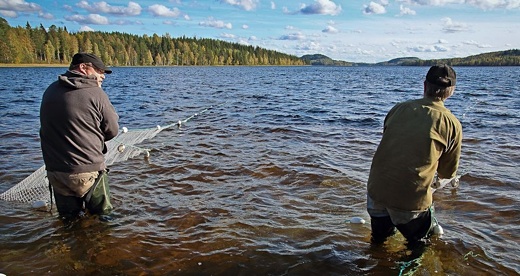
Image above: Tero Mustonen (left) and his neighbor Pekka Ikonen seine the waters of the Ylinen Lake for muikku or vendace, as European Cisco (Coregenus albula) is called here. Photo: © Gleb Raygorodetsky 2012.

This photo essay by United Nations University’s Traditional Knowledge Initiative (UNU-TKI) Research Fellow Gleb Raygorodetsky offers a glimpse of the challenges that climate change presents for indigenous and local communities in northern Europe.

An Arctic people of northern Finland whose livelihoods depend largely on their environment, the Skolt Sámi are searching for ways to remain resilient in the face of climate change. Recently, Raygorodetsky spent time with the Skolts, as part of a UNU-TKI project supporting a partnership between the Skolt Sámi and the Finnish Snowchange Cooperative focused on developing a climate change adaptation plan.


Image above: The land around Rautujärvi Lake, over 400 km above the Arctic Circle near the Norwegian and Russian borders, is home to the Skolt Sámi — reindeer herders and fishermen whose traditional ways are closely intertwined with the northern climate. Photo: © Gleb Raygorodetsky 2012.

The radiant disk of the Arctic sun hangs in the mid-September sky above northern Finland, like a ritual Sámi drum pinned to the wall inside a lavvu , a traditional Sámi dwelling. The sun’s reflection is floating gently on the still surface of Rautujärvi Lake, located over 400 km above the Arctic Circle near the Norwegian and Russian borders.

Come November, according to traditional calendars created and refined over generations by the Sámi people to track seasonal cycles on their land, the sunlight would be bouncing off the ice and snow of Sápmi , as the Sámi call their land.

But the flows of air and water over this landscape are no longer in sync with the ancestral calendars, and the sun’s reflection may continue to float on the water for several weeks longer, disrupting Sámi traditional winter travel, fishing, hunting, and reindeer herding activities.


Image above: Like every Skolt Sámi, Vladimir Feodoroff is as much an expert at steering his boat on a lake as he is at lassoing reindeer during a seasonal roundup. Photo: © Gleb Raygorodetsky 2012.

Vladimir Feodoroff is a Skolt Sámi, a very small, but culturally and linguistically distinct group of the Eastern Sámi. The Skolts are considered to be one of the most traditional Sámi reindeer herding and fishermen groups.

They still practice the centuries-old customary system of clan-based governance, where the community council sobbar represents the highest body of decision-making, while for over 130,000 Sámi living throughout the northern reaches of Finland, Norway, Sweden, and Russia, the dominant governance system is the Sámi Parliament.

Historically, the traditional lands of the Skolt Sámi, or Sä’mmlaž, spanned the vast territory, from Lake Inari eastward all the way to Kola Bay, the present-day location of the Russian city of Murmansk. Today, most of the Skolts live in a small pocket of the northern Lapland region of Finland, north of Lake Inari. They were relocated here when their homelands were seized by the Union of Soviet Socialist Republics after World War II.

The relocated Skolts eventually settled in the village of Sevettijärvi, where they continue to maintain their traditional practices and keep the endangered Skolt language alive. Most of the remaining 700 Skolts live around the Finnish municipality of Inari, some on the Norwegian side of the border, and only few families remain in Russia.


Image above: In Finnish Lapland, reindeer no longer roam freely, having to navigate their way throughout the growing network of primary and secondary roads. Photo: © Gleb Raygorodetsky 2012.

Before World War II, the Skolt families would move with their reindeer on foot, or by skis and sleds, depending on the season, along well-worn migration routes from winter pastures to summer fishing grounds across the boreal region of the Kola Peninsula. Once resettled in Finland, they had to nurture meaningful relationships with a less familiar landscape — a transition zone between the treeless fjels and boreal forest. Here, their movement and reindeer herding practices became constrained by a growing network of roads throughout the region.

Following the “snowmobile revolution” of the 1960s, there was also a rapid shift away from more traditional herding practices when families spent most of the year with their reindeer, towards a settled way of life. They came to rely more and more on mechanized transport, such as snowmobiles, small airplanes, and helicopters for gathering dispersed reindeer into herds during corralling season.

Despite these challenges and the dramatic societal shifts brought about by relocation and integration into the European Union’s (EU) economy, reindeer herding has remained at the heart of the Skolt Sámi culture and way of life, including their food, songs, clothes and art. Adapting to rapid change is nothing new to the Skolts, and they draw on this experience as they search for ways to adapt to their latest challenge — climate change.


Image above: At his all-season fishing camp in the upper reaches of the Näätämö River — his second home after his house in Sevettijärvi — Jouko Moshnikoff (right) and his friend Teijo Feodoroff are cutting up reindeer ribs for dinner before firing up the sauna (visible in the background, at the river’s edge). Photo: © Gleb Raygorodetsky 2012.

For the Skolts, reindeer meat is an important traditional food that is vital to their culture, helping ensure their food sovereignty in a changing landscape and climate. Skolts, like other Sámi groups, do not waste even a single hair of the slaughtered reindeer. The fine-fibered and lean reindeer meat is used for food and as a source of income; clothes are made from reindeer skins; and the antlers are carved into knife handles, various utensils, ornaments and souvenirs for tourists.

After Finland became an EU member in 1995, the Skolt Sámi must follow burdensome EU regulations and standards for meat processing if they want to sell reindeer meat on the EU market. To comply with the new regulations, the Finnish Reindeer Herders’ Association replaced the 200 old field slaughterhouses with 10 EU regulations-compliant abattoirs staffed with mangers and veterinarians who oversee the annual processing of 1,500 tons of reindeer meat destined to the EU market.

The Skolts feel that while the market regulations may be good for commerce, they are not good for the local people and their land. The new system has made looking after their reindeer more expensive for the Skolts, forcing them to change when and where they can gather their herds. According to Pauliina Feodoroff — former President of the Sámi Council and Vladimir Feodoroff’s daughter —  the traditional method of killing reindeer inside a corral was pollution-free, but now chemicals must be used daily to disinfect EU-certified abattoirs. Moreover, many traditional practices — such as leaving some spilled blood and rapamaha, or reindeer stomach contents, on the ground to help fertilize and renew the trampled soil inside the corral — are no longer part of the modern system.


Image above: The morning sun melts the night frost on blueberries (Vaccinium myrtillus) in the birch forest along the Näätämö River. Photo: © Gleb Raygorodetsky 2012.

Budding birch leaves are an important spring food for reindeer craving a boost of fresh nutrients after a long winter diet of desiccated lichen. In 1966, the colder microclimate in the river valley saved the birch forest from defoliation along the river during an outbreak of the autumnal moth ( Epirrita autumnata), a cold-intolerant forest pest. In the birch forests on the south-facing hills, however, the winter temperature did not dip below -35 °C, thus allowing the moth to survive.

“I remember going fishing with my mother then,” recalls Illep Jefremoff. “And it was like having a heavy snowfall in the middle of the summer. The fish ate up the moths that fell into the water, but the birch trees dried up and died later.”

A few occasional birch stumps is all that remains of the once lush birch forest that used to support a diverse wildlife community. Two new outbreaks of autumnal moth infestation have been reported in Norway since 2005.

The Skolt herders are concerned that as the climate warms, the moth outbreaks will become more frequent and spread widely, wiping out remaining birch forests and destroying an important spring food source for reindeer. The annual migration route of an individual reindeer herd is restricted to the territory of one of 56 reindeer cooperatives in Finland, limiting herders’ ability to move their reindeer away from affected areas of forest to find alternative sources of nutrient-rich spring food.

Image above: Tero Mustonen paddles across the Ylinen Lake, near his village of Selkie. Photo: © Gleb Raygorodetsky 2012.

Tero Mustonen’s personal quest, under the guidance of Elders, to revitalize land-based traditions of his Finnish ancestors led him to found the Snowchange Cooperative http://www.snowchange.org/ in 2000. The Cooperative works to advance the role of traditional knowledge in environmental policy and practice.

Headquartered in the village of Selkie, Finland — where Mustonen is a chief and a traditional seine fishing net master — Snowchange has grown into a respected international community-based network making important contributions towards global recognition of traditional knowledge in climate change adaptation and mitigation. Mustonen explains that Snowchange’s goal is, “To see our culture come back — complete rebirth on the land!”

Snowchange has made important contributions to the Arctic Climate Impacts Assessment, the Arctic Biodiversity Assessment, and the Fifth Assessment Report (AR5) of the Intergovernmental Panel on Climate Change (IPPC) due out in 2014. Reflecting on these accomplishments, Mustonen smiles and says, “It is exciting, but a bit of punk rock — in a sense that we [a community-based cooperative] can play with the big boys [international agencies], but we still keep our own unique way.”

In addition to a solid base of over a dozen villages in Finland, Snowchange membership spans the globe, embracing communities, organizations and individuals working on local traditional knowledge-based projects in New Zealand, Canada, Russia, and Australia. All members of the Snowchange Cooperative work on developing locally-appropriate culture-based solutions to the challenges of environmental degradation, development and climate change faced by indigenous peoples and local communities around the world.


Image above: Tero Mustonen (left) and his neighbor Pekka Ikonen seine the waters of the Ylinen Lake for muikku or vendace, as European Cisco (Coregenus albula) is called here. Photo: © Gleb Raygorodetsky 2012.

Summer and winter seining for vendace and other fish in the lakes surrounding their community has always been an important subsistence activity for Selkie villagers. But now they worry about the environmental impacts of climate change on their subsistence fishery.

Selkie residents have observed seasonal shifts in wind patterns, delays in freeze-up, increase in summer temperatures, earlier spring thaws and changes in the patterns of snow and rainfall. Ice leads — areas of open water that form when lake ice fractures and is kept open by the current — no longer occur in places well-known to local people, making winter travel on the ice a lot more treacherous.

Old residents of Selkie remember that the winter of 1986 was the last real winter when the lakes and rivers were frozen by mid-November. Today, the ice forms only in January when the temperature finally dips below -20°C for several nights in a row. Finland’s hottest daily temperature of 37 °C, was recorded in 2010 not far from Selkie. As summers become warmer, the fish seek cooler waters at the bottom of deeper lakes, which makes seining less reliable.


Image above: Like generations of Skolts before him, Jouko Moshnikoff welcomes guests at his fishing camp with salted and cold-smoked Atlantic salmon caught nearby. Photo: © Gleb Raygorodetsky 2012.

Fishing for Atlantic salmon ( Salmon salar) has always been an important part of Skolts’ subsistence and cultural heritage, and indeed, they consider themselves to be more fishermen than reindeer herders. Today, in addition to traditional delicacies, Moshnikoff can also offer his guests a few store-bought extras — like apples from Spain and vodka from Estonia — shipped to Finland from other EU countries. During the long winter evenings, after a skin-scalding sauna and a hearty meal, Moshnikoff would crank up a Honda generator from Japan to watch a show or a sports program on his Made in China TV.

While these changes add a great deal of convenience and comfort to their lives, Moshnikoff and other Skolt Sámi worry about the consequences and the real costs of such benefits of the global economy for local communities. They recognize that the changing climate is the price they are paying for the fossil fuel-infused food production and transportation system that, while delivering the goods to their homeland, makes their traditional livelihoods, such as the Atlantic salmon fishery on the Näätämö River, increasingly difficult to sustain. Feeling powerless to change the global economic model, the Skolts are nevertheless determined to find a way to sustain their traditional salmon fishery under changing conditions.


Image above: On the porch of Jouko Moshnikoff’s cabin — against the backdrop of one of the most significant spawning sites for Atlantic salmon on the Näätämö River — Illep Jefremoff, Vladimir Feodoroff and Tero Mustonen (left to right) examine the area map of the region. Photo: © Gleb Raygorodetsky 2012.

To describe their work last summer, Feodoroff shows Tero all the traditionally known spawning sites that he visited with Jefremoff as part of the project “Skolt Sámi Survival in the Middle of Rapid Change”. The goal of this collaboration between the Skolt Sámi, the Snowchange Cooperative and the United Nations University (UNU) Traditional Knowledge Initiative is to help the Skolts to develop a climate change adaptation plan. The project is part of the international Indigenous Peoples Climate Change Assessment (IPCCA) initiative that is being developed and coordinated by a Peru-based indigenous non-profit organization, ANDES, and supported by UNU.

By applying the IPCCA methodology of community-led self-reflection, evaluation, and future-visioning based on local worldviews and traditional knowledge, the Sevettijärvi Skolts are developing a community-based climate change adaptation plan. Out of this process a collective consensus has emerged that the climate change challenges faced by the reindeer, while significant, are manageable given the present-day nature of reindeer herding. Instead, the Skolt Sámi identified their customary salmon fishery, the other half of their traditional subsistence and cultural identity, as a much greater concern.

As a result, the Snowchange-Skolt partnership has chosen to focus their climate change adaptation efforts on enhancing the resilience of the Skolts’ traditional salmon fishery along the Näätämö River. After visiting all traditionally known spawning sites during the last summer and holding several community-based workshops and discussions, the Skolt-Snowchange partnership is planning on putting together an initial draft of the Atlantic salmon co-management plan for the Näätämö River in 2013, to begin discussions with other salmon users along the watershed, and the representatives of the state fisheries agency, about the future of the Näätämö salmon.


Image above: A late-September morning’s frosty air thickens into fog above the Näätämö River, enveloping birch trees on the riverbank. Photo: © Gleb Raygorodetsky 2012.

The Näätämö River is one of the few remaining free-flowing waterways in northern Europe that still supports wild populations of Atlantic salmon. The river meanders for 80 km from Lake Inari northward through Finland, until it reaches theSkoltefossen falls at the Norwegian border, 20 km from the Barents Sea. On average, out of eight tonnes of salmon caught annually along the river, only 20 percent comes from Finland the rest is caught in Norway. In addition to the Skolt Sámi and other locals, who are legally allowed to use fishing nets and rods to catch salmon, around 700 tourist anglers also descend on the Näätämö River every summer for the salmon run.

The Skolts feel that the significance of the Atlantic salmon fishery to their traditional culture has not been adequately recognized by the state fishery agencies. The Skolts have never had a real say in how the salmon fishery and the river are managed. The project partners are hopeful, however, that in the coming years their climate change adaptation project will help shift the balance of power and engage state officials and other stakeholders in a more equitable dialogue about the future of the Näätämö salmon fishery.


Image above: Over breakfast at Jouko Moshnikoff’s cabin, Tero Mustonen, Illep Jefremoff, and Vladimir Feodoroff (left to right) mull over the next steps in their climate change adaptation project. Photo: © Gleb Raygorodetsky 2012.

The Skolts realize that there is little they can do about the Norwegian Sydvaranger mine, an open pit iron ore mine that pollutes the fjord connected to the estuary of Näätämö River. Neither can they prevent an increase in risk of disease, breeding difficulties and genetic contamination in wild Atlantic salmon, caused by the farmed salmon escaping from Norwegian fish farms.

Still, based on the project’s first field season, the group is confident that they can do a lot to enhance the resilience of their traditional salmon fishery on the Finnish side of the border. Their main goal is to enhance spawning habitat and improve salmon survival along the Näätämö River. This includes restoring traditional salmon spawning grounds and reducing the predatory species like pike (Esox lucius), burbot (Lota lota) and mink (Neovison vison) that are hunting juvenile salmon or smolt.

The group also feels that instead of three nets that the local people are legally permitted to use during the salmon fishing season, no more than a single net or just lures should be permitted for catching salmon. “Getting ten salmon per person in the summer is enough for us, Skolts,” says Feodoroff, “Because we just use it for subsistence, not to sell.”

By putting forward a set of such specific recommendations, the Skolts feel they should be able to develop a dialogue with state fisheries officials about their needs and the value of their traditional knowledge about salmon. The project is also creating pathways for engaging other groups of fishermen who rely on salmon for subsistence, recreation, and tourism on both sides of the Finnish-Norwegian border.

The ultimate goal of this work is to develop a Näätämö River Atlantic Salmon Co-Management Plan that would create a more equitable governance structure for decision-making, compared to the existing rigid architecture based on trans-boundary bilateral agreements between Finland and Norway. The project partners hope that the envisioned co-management plan would help revamp the current rigid top-down regime through creating an equitable space for participation and contributions of all the groups who want their healthy relationships with the Näätämö River salmon to continue for generations.


Image above: In front of his house on the shore of Lake Sevettijärvi, Illep Jefremoff holds the Eastern Sámi Atlas open to the page with a picture of himself and his dog Kepu, checking fishing nets in the winter of 1993. Photo: © Gleb Raygorodetsky 2012.

Jefremoff contributed to the Eastern Sámi Atlas, sharing his knowledge and photographs of Skolt traditional activities, like setting fishing nets under the ice. The Skolts and the Snowchange Cooperative, with the support of UNU and the Nordic Council of Ministers, developed and published the Eastern Sámi Atlas as part of the Skolt climate change adaptation project. This comprehensive tome is a significant land-use document developed by any Sámi group. It shares several centuries of their history, through photographs and maps, describing how the Eastern Sámi, including the Skolt Sámi, lived on their traditional territory.

The real value of the volume, however, is in that it is truly a community effort to make their unseen histories visible. For their work on this project and the publication of the Atlas, the Snowchange Cooperative was honored with the Skolt of the Year Award in 2011, despite being a Finnish organization.

“Snowchange’s work with Sámi is very straightforward — it’s a peace-making plan,” explains Mustonen. Snowchange is trying to address the painful legacy of centuries of encroachment and assimilation by southern Finns on traditional Sámi territories. “All the work that Snowchange is doing with Sámi is about this, be it a nomadic school project or a climate change adaptation work or the Atlas. It is all about reconciliation,” says Mustonen. “If we can maintain a respectable relationship with Sámi and provide them with space and rights they ought to have, we are also healing ourselves,” he concludes.


Image above: To the unfamiliar eye, the lakes and forests of northern Finland look as pristine and unchanged as they have been for the last 9,000 years, after the glaciers retreated northward in this part of Europe. Photo: © Gleb Raygorodetsky 2012.

For the local people, the interdependencies between the sun, water, air, forest, fire, wildlife, fish and people are changing rapidly and in unfamiliar ways. “Who are these new winds?” ask local Elders. ”We do not know them, but we still try to greet them.” The changing climate alters the intricate relationships between the elements of the Skolt traditional territory. The future of the Skolts and their land in this time of climatic upheaval depends on their ability to find ways of maintaining the balance in their relationships with the land and water, forest and tundra, reindeer and salmon. This could be achieved, they feel, only through respectful collaboration with others who have a stake in the future of the region and its biocultural heritage, be they European anglers, Norwegian salmon farmers, or a Finnish NGO.

“It is the time to say goodbye to some things we’ll never see again,” says Mustonen of Snowchange. “But it is also time to build new knowledge. And this knowledge can only emerge through keeping strong connections with the traditional territory. We must be there on the land as it is changing, so that we can change with it.”

• The photo essay is part of Conversations with the Earth (CWE): Indigenous Voices on Climate Change initiative. To learn more about CWE, visit it on Facebook and Twitter.
.

True Survival Tale

SUBHEAD: Taking their possessions and some seeds, the family retreated ever deeper into the forest.

By Mac Slavo on 2 February 2013 for SHTF Plan -
(http://www.shtfplan.com/emergency-preparedness/a-true-survival-story-taking-their-possessions-and-some-seeds-they-had-retreated-ever-deeper-into-the-forest_02022013)


Image above: The Lykovs lived in this hand-built log cabin, lit by a single window “the size of a backpack pocket” and warmed by a smoky wood-fired stove. From original artile.

When Josef Stalin instituted a campaign of purging dissidents in the 1930′s, some 17 million people were left dead or missing by the time it was all said and done.
Had you been targeted for extermination during this Great Purge, your chances of survival very rapidly approached zero.

Most became victims when their government classified them as enemies of the state.

Some, however, and against all odds, found a way to survive.
The Lykovs had the clothes on their backs, some personal possessions, and some basic supplies when they fled the Purge.

They made it in one of the most inhospitable regions in the world for forty years.

Despite the challenges and regardless of the odds, humans are built to survive. See their story below.
Source: These excerpts have been made available by The Smithsonian Institution and shared for the increase and diffusion of knowledge
This forest [Russian Taiga] is the last and greatest of Earth’s wildernesses. It stretches from the furthest tip of Russia’s arctic regions as far south as Mongolia, and east from the Urals to the Pacific: five million square miles of nothingness, with a population, outside a handful of towns, that amounts to only a few thousand people…

Thus it was in the remote south of the forest in the summer of 1978. A helicopter sent to find a safe spot to land a party of geologists was skimming the treeline a hundred or so miles from the Mongolian border when it dropped into the thickly wooded valley of an unnamed tributary of the Abakan, a seething ribbon of water rushing through dangerous terrain. The valley walls were narrow, with sides that were close to vertical in places, and the skinny pine and birch trees swaying in the rotors’ downdraft were so thickly clustered that there was no chance of finding a spot to set the aircraft down. But, peering intently through his windscreen in search of a landing place, the pilot saw something that should not have been there. It was a clearing, 6,000 feet up a mountainside, wedged between the pine and larch and scored with what looked like long, dark furrows. The baffled helicopter crew made several passes before reluctantly concluding that this was evidence of human habitation—a garden that, from the size and shape of the clearing, must have been there for a long time.

It was an astounding discovery. The mountain was more than 150 miles from the nearest settlement, in a spot that had never been explored. The Soviet authorities had no records of anyone living in the district…

As the intruders scrambled up the mountain, heading for the spot pinpointed by their pilots, they began to come across signs of human activity: a rough path, a staff, a log laid across a stream, and finally a small shed filled with birch-bark containers of cut-up dried potatoes…

The sight that greeted the geologists as they entered the cabin was like something from the middle ages. Jerry-built from whatever materials came to hand, the dwelling was not much more than a burrow—”a low, soot-blackened log kennel that was as cold as a cellar,” with a floor consisting of potato peel and pine-nut shells. Looking around in the dim light, the visitors saw that it consisted of a single room. It was cramped, musty and indescribably filthy, propped up by sagging joists—and, astonishingly, home to a family of five.

Led by Pismenskaya, the scientists backed hurriedly out of the hut and retreated to a spot a few yards away, where they took out some provisions and began to eat. After about half an hour, the door of the cabin creaked open, and the old man and his two daughters emerged—no longer hysterical and, though still obviously frightened, “frankly curious.” 
Warily, the three strange figures approached and sat down with their visitors, rejecting everything that they were offered—jam, tea, bread—with a muttered, “We are not allowed that!” When Pismenskaya asked, “Have you ever eaten bread?” the old man answered: “I have. But they have not. They have never seen it.” At least he was intelligible. The daughters spoke a language distorted by a lifetime of isolation. “When the sisters talked to each other, it sounded like a slow, blurred cooing.”…

Slowly, over several visits, the full story of the family emerged. The old man’s name was Karp Lykov, and he was an Old Believer—a member of a fundamentalist Russian Orthodox sect, worshiping in a style unchanged since the 17th century. Old Believers had been persecuted since the days of Peter the Great, and Lykov talked about it as though it had happened only yesterday; for him, Peter was a personal enemy and “the anti-Christ in human form”—a point he insisted had been amply proved by Tsar’s campaign to modernize Russia by forcibly “chopping off the beards of Christians.” But these centuries-old hatreds were conflated with more recent grievances; Karp was prone to complain in the same breath about a merchant who had refused to make a gift of 26poods [940 pounds] of potatoes to the Old Believers sometime around 1900.

Things had only got worse for the Lykov family when the atheist Bolsheviks took power. Under the Soviets, isolated Old Believer communities that had fled to Siberia to escape persecution began to retreat ever further from civilization. During the purges of the 1930s, with Christianity itself under assault, a Communist patrol had shot Lykov’s brother on the outskirts of their village while Lykov knelt working beside him. He had responded by scooping up his family and bolting into forest…

That was in 1936, and there were only four Lykovs then—Karp; his wife, Akulina; a son named Savin, nine-years-old, and Natalia, a daughter who was only two. Taking their possessions and some seeds, they had retreated ever deeper into the taiga, building themselves a succession of crude dwelling places, until at last they had fetched up in this desolate spot. 
Two more children had been born in the wild—Dmitry in 1940 and Agafia in 1943—and neither of the youngest Lykov children had ever seen a human being who was not a member of their family. All that Agafia and Dmitry knew of the outside world they learned entirely from their parents’ stories. The family’s principal entertainment, the Russian journalist Vasily Peskov noted, “was for everyone to recount their dreams.”

The Lykov children knew there were places called cities where humans lived crammed together in tall buildings. They had heard there were countries other than Russia. But such concepts were no more than abstractions to them. Their only reading matter was prayer books and an ancient family Bible. Akulina had used the gospels to teach her children to read and write, using sharpened birch sticks dipped into honeysuckle juice as pen and ink.


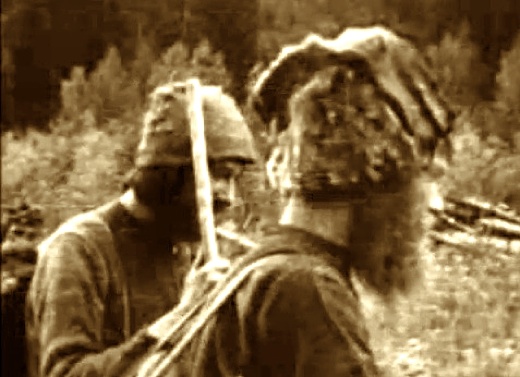
Image above: Dmitry (left) and Savin in the Siberian summer on their homestead. From original article.


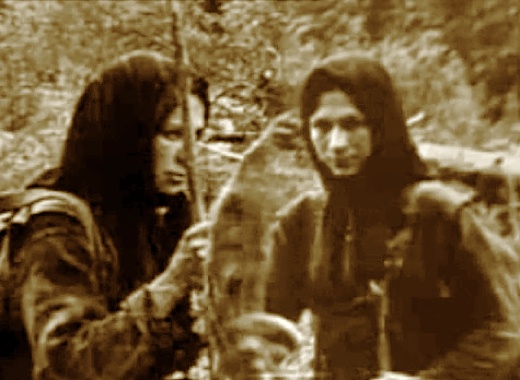
Image above: Agafia Lykova (left) with her sister, Natalia. From original article.

Isolation made survival in the wilderness close to impossible. Dependent solely on their own resources, the Lykovs struggled to replace the few things they had brought into the taiga with them. They fashioned birch-bark galoshes in place of shoes. Clothes were patched and repatched until they fell apart, then replaced with hemp cloth grown from seed…

The Lykovs had carried a crude spinning wheel and, incredibly, the components of a loom into the taiga with them—moving these from place to place as they gradually went further into the wilderness must have required many long and arduous journeys—but they had no technology for replacing metal. 
 A couple of kettles served them well for many years, but when rust finally overcame them, the only replacements they could fashion came from birch bark. Since these could not be placed in a fire, it became far harder to cook. By the time the Lykovs were discovered, their staple diet was potato patties mixed with ground rye and hemp seeds.

In some respects, Peskov makes clear, the taiga did offer some abundance: “Beside the dwelling ran a clear, cold stream. Stands of larch, spruce, pine and birch yielded all that anyone could take…. Bilberries and raspberries were close to hand, firewood as well, and pine nuts fell right on the roof.”

Yet the Lykovs lived permanently on the edge of famine. It was not until the late 1950s, when Dmitry reached manhood, that they first trapped animals for their meat and skins. Lacking guns and even bows, they could hunt only by digging traps or pursuing prey across the mountains until the animals collapsed from exhaustion. 
Dmitry built up astonishing endurance, and could hunt barefoot in winter, sometimes returning to the hut after several days, having slept in the open in 40 degrees of frost, a young elk across his shoulders. More often than not, though, there was no meat, and their diet gradually became more monotonous. Wild animals destroyed their crop of carrots, and Agafia recalled the late 1950s as “the hungry years.” She said,
"We ate the rowanberry leaf, roots, grass, mushrooms, potato tops, and bark, We were hungry all the time. Every year we held a council to decide whether to eat everything up or leave some for seed."
Famine was an ever-present danger in these circumstances, and in 1961 it snowed in June. The hard frost killed everything growing in their garden, and by spring the family had been reduced to eating shoes and bark. Akulina chose to see her children fed, and that year she died of starvation. 
he rest of the family were saved by what they regarded as a miracle: a single grain of rye sprouted in their pea patch. The Lykovs put up a fence around the shoot and guarded it zealously night and day to keep off mice and squirrels. At harvest time, the solitary spike yielded 18 grains, and from this they painstakingly rebuilt their rye crop…


Image above The Lykovs’ homestead seen from a Soviet reconnaissance plane, 1980. From original article.

Perhaps the saddest aspect of the Lykovs’ strange story was the rapidity with which the family went into decline after they re-established contact with the outside world. In the fall of 1981, three of the four children followed their mother to the grave within a few days of one another. 
 According to Peskov, their deaths were not, as might have been expected, the result of exposure to diseases to which they had no immunity. Both Savin and Natalia suffered from kidney failure, most likely a result of their harsh diet. But Dmitry died of pneumonia, which might have begun as an infection he acquired from his new friends.

His death shook the geologists, who tried desperately to save him. They offered to call in a helicopter and have him evacuated to a hospital. But Dmitry, in extremis, would abandon neither his family nor the religion he had practiced all his life. “We are not allowed that,” he whispered just before he died. “A man lives for howsoever God grants.”

When all three Lykovs had been buried, the geologists attempted to talk Karp and Agafia into leaving the forest and returning to be with relatives who had survived the persecutions of the purge years, and who still lived on in the same old villages. But neither of the survivors would hear of it. They rebuilt their old cabin, but stayed close to their old home.
.

Kahili horizontal well drilling

SOURCE: Ken Taylor (taylork021@hawaii.rr.com)
SUBHEAD: The Environmental Impact Statement Preparation Notice for Kahili Horizontal Directional Drilled Well is available.

By Staff on 2 February 2013 in Island Breath -
(http://islandbreath.blogspot.com/2013/02/kalhili-horizontal-well-drilling.html)


Image above: Detail of diagrammatic cross-section of Kauai showing drilling plan. From the EISPN pdf file.

[IB Publisher's note: Deadline for comments on this large scale and controversial water drilling project is March 11, 2013. Online comment submissions are here: http://kahili.oceanit.com/]

Environmental Document Review  
We are informing you that the Environmental Impact Statement Preparation Notice (EISPN) for the Kauai Water System Energy Conservation project, Job No. PLH-03, Kahili Horizontal Directional Drilled Well, is available for review as a PDF file from two online locations.
The EISPN is available for review and download from the Office of Environmental Quality Control website at:

http://oeqc.doh.hawaii.gov/Shared%20Documents/Environmental_Notice/current_issue.pdf

The document is also available for review and download at the Kahili Horizontal Drilling website at:

http://kahili.oceanit.com/files/Preparation%20Notice/Kahili%20Preparation%20Notice%20Feb%202013-Final.pdf
If you do not have access to the internet and require a hard copy, please call Joanne Hiramatsu of Oceanit Laboratories, Inc., Honolulu, Hawaii, at (808) 531-3017 to request a copy.

A printed version of the document will be sent to you. A public scoping meeting will be scheduled in the near future for the Draft EIS. The Office of Environmental Quality Control (OEQC) will publish a notice in the February 8, 2013 issue of the Environmental Notice.

Project Description 
[From Part 2 of the EISPN] The purpose of the Project is to drill a directionally drilled exploratory horizontal well that will have a sufficient sustainable yield to replace many of the existing wells and the surface water treatment plant and have the ability to conserve energy.

The project number from the Water Plan 2020 is PLH-03 to Drill and Develop a Horizontal Well in the Līhu‘e-Kapa‘a water system. The KDOW potable water supply system currently consists of surface water diversion, tunnels, and vertical wells. The existing average day demand for the Līhu‘e-Kapa‘a system is 6 million gallons a day (MGD) and the maximum day demand is 9 MGD.

The surface water in the Līhu‘e area is diverted from streams and treated at a water treatment facility near Līhu‘e. This project will look at sites within the Haiku, Hanamā‘ulu, and Wailua Ahupua‘a at the 800 to 1,200-foot elevation for a potential horizontally drilled exploratory well site.


Image above: Photo of Kahili mountainous area where drilling is being considered. From the EISPN pdf file.

Site Selection
Four potential sites have been preliminarily identified for new high level directionally drilled exploratory well so that the water can flow by gravity to the existing distribution system and possibly generate power through the construction of a hydroelectric plant. These four sites located near the 1,000-foot elevation. These sites are:
  1. Location south of Waikoko Stream 
  2. Location in the vicinity of Waiaka and Ili‘ili‘ula Streams 
  3. Location in the vicinity of Ê»Iole and Waiahi Streams 
  4. Location near KamoÊ»oloa and Haili Streams 
The Parties Involved
This Environmental Impact Statement Preparation Notice (EISPN) has been prepared:
 
by - Oceanit Laboratories, Inc.
828 Fort Street Mall, Suite 600
Honolulu, Hawaii 96813

for - County of Kauai Department of Water
PO Box 1706

Lihue, HI96766
(808)245-5400

Comments on proposal
Online comments regarding this project by the public can be made here until with deadline of 3/11/13: http://kahili.oceanit.com/

See also:
Ea O Ka Aina: This is for your own good 10/10/12


.