Earthquake & Tsunami hit Tourism

SUBHEAD: Shocked Hawaii tourism reps scramble as Japanese visits drop sharply. By Martin Barillas on 21 March 2011 for The Cutting Edge - (http://www.thecuttingedgenews.com/index.php?article=51612&pageid=37&pagename=Page+One) Image above: Waikiki tourist hotels blot out the landscape. This is the epicenter for Japanese tourism to Hawaii. The area would be devastated if that tourism collapses as a result of the recent disasters in Japan. Photo by Juan Wilson. [Editor's note: On the bright side - as climate change driven oceans rise these empty hotels may one day supply the foundation of artificial coral reefs as part of the restoration of our benthic habitat.]

Fears emerged in tourist-dependent Hawaii following the devastating earthquake and tsunami that hit Japan on March 11. Just hours after the monumental quake in Japan, tens of millions of additional dollars in damage to homes, businesses and boats crashed onto the national economy after a tsunami roared ashore last week. Tourism is the single biggest industry in the Hawaiian archipelago, and hotels, restaurants, tour operators and other businesses dependent on Japanese tourism were concerned that the devastation in Japan would also strike their pocketbooks.

Gov. Neil Abercrombie predicted the economic consequences would be severe for Hawaii, which is already dealing with a projected shortfall of nearly $1 billion over the next two years due to a bearish economy in the US generally. "It's going to be terrible. It's going to be rough," he said following the quake. "It's something that we have to come to grips with."

Some Hawaiian tourism representatives contacted by The Cutting Edge News seem ill-prepared and ill-equipped for the unexpected drop-off. A few were unable to even respond to inquiries.

Visitor arrivals from Japan, Hawaii's second-largest tourist market outside North America, dropped 86 percent immediately following the 9.0 temblor on March 11, according to worldwide media reports. Most of the cancellations came from group tourism, including business meetings and incentive travel.

Underscoring that Hawaii is heavily dependent on Japanese visitors, State Representative Marcus R. Oshiro, a Democrat from Honolulu, confirmed that in the short term, Hawaii will be severely affected by the earthquake and tsunami. "It may be anywhere from $15 to $20 million in state revenues lost just from that tourist market.”

Hawaii had been enjoying something of a rebound in tourism as hotels were reporting occupancy levels in the 90 percentile range.

But Japanese tourism is not what it once was: In 2010, 1.2 million Japanese visited Hawaii, almost half down from a peak of 2.2 million visitors in 1996. The downturn reflects the effects of the worldwide recession but also changing travel tastes of Japanese tourists. By any measure, howeveer, Japanese citizens are a critical part of the tourism industry, which is a fulcrum of the state’s economy. Yet, tourism officials have been slow to develop marketing campaigns to attract vacationers from other areas, including appealing to American travelers who don't happen to live on the West Coast. That may be because Americans spend less when they visit Hawaii.

A typical visitor from the Western United States spent $146 per day last year, while a Japanese tourist spent $274, state officials said. Indeed, while Japan ranks third in the number of visitors it sends to Hawaii, following the Western and Eastern United States mainland, Japanese tourists are much more aggressive spenders and thus contribute disproportionately to the economy. They spend far more money per day on food, hotels and shopping, particularly luxury goods. Visitors from Japan brought about $1.9 billion into Hawaii in 2010, or about 17 per cent of the $11.4 billion overall visitor receipts. There are 13 daily direct flights from Japan to Hawaii, bringing in between 3,000 to 5,000 tourists. Hawaiian Airlines just announced a robust new schedule of direct flights from the Pacific island chain to Japan.

Following statements by President Obama that the US had little to fear from radiation leaking from the Fukushima reactors in Japan, Gov. Abercrombie declared that Hawaii was “back in business,” reassuring potential tourists that no dangerous levels of radiation had been detected on the archipelago. However, two prominent hotels have been closed temporarily because of tsunami damage—the Four Seasons Resort Hualalai and Kona Village Resort. “In comparison with the incidents that happened in the past this is of course much more severe,” said David Uchiyama, vice president of brand management for the Hawaii Tourism Authority. “I anticipate we’ll see again some initial drop-off,” he added, lasting about three to six months, but predicted that the market will then gradually come back.

The Hawaiian people, aware of the cultural and economic connection to Japan, have been moved to respond to the island nation’s time of need as government and civic leaders have been engaged in fundraising for relief efforts. Japanese immigrants arrived first arrived in the Aloha State more than a century ago to work in the fields, while their children and grandchildren have since risen to prominence. About a quarter of the state's population identified themselves as being of Japanese descent, according to the 2000 Census. Telephone service providers are offering free phone calls to Japan. The US Navy's Pacific Fleet, based in Hawaii, is also helping in relief and rescue operations.

Cancellations from Japan after the quake were immediate, resulting in the loss of thousands of visitor arrivals. H.I.S. Hawaii, a travel agency that handles about a fifth of all Japanese travel to Hawaii, saw new bookings drop by half and cancellations triple in the first three days after the March 11 earthquake. However, the cancellation rate dropped to less than 10 per cent starting March 16. Tourist businesses are hopeful that the market will bounce back soon once life returns to some semblance of normality in Japan.

Hawaii similarly experienced sharp declines in the number of Japanese travelers following the deadly 1995 Kobe earthquake and the 9/11 terror attacks. While people of other cultures try to return to normal as soon as possible following a tragedy, travel industry experts say the Japanese tend not to travel or at least postpone in sympathy. So far, airlines are reporting that no significant drops of passengers from Japan have been noted. Japanese visitor arrivals to Hawaii dropped nearly 16 percent a month after the 6.8 magnitude Kobe quake in January 1995 but by year's end were up nearly 13 percent compared to 1994 levels, the Tourism Authority said.

CEO Mark Dunkerley of Hawaiian Airlines said cancellations have been "pretty modest." Bookings are mostly handled by travel partners in Japan and they "continue to demand the level of service that we've already been providing and intending to provide in the coming months." Hawaiian Airlines, which launched its first daily flight between Honolulu and Tokyo's Haneda International Airport in 2010, said it has no plans to change or delay its scheduled launch of daily nonstop service between Honolulu and Osaka in July 2010.

Japanese tourists are woven into the fabric of Hawaii’s economy. Menus are invariably printed in both English and Japanese. Packages of dried seaweed can be found next to potato chips in stores. Despite the concern on the part of business, there is uncertainty as to the duration and effects of a downturn in Japanese tourism, however. Tourism experts say that Hawaii will probably not know for at least a month before it can realistically gauge how severely Japanese travel plans have changed. Even before the Japanese earthquake, a decline in state revenues had been projected in a report to Gov. Abercrombie. The decline may increase the projected shortfall to $964 million, from $698 million. According to an article in the New York Times, Paul H. Brewbaker of the State Council on Revenues said, “Japan is an important market for us. And obviously a cataclysmic event has occurred,” but while Japanese are important, they not as critical as they once were here. “We love them,” he said. “But there’s just not as many as there used to be.”

Japanese visitor arrivals to Hawaii dropped nearly 16 percent a month after the 6.8 magnitude Kobe quake in January 1995 but by year's end were up by 12.6 percent compared to 1994 levels, a spokesman for the Hawaii Tourism Authority declared. The Hawaii Tourism Authority had projected about $2 billion in revenue from Japanese visitors in 2011, a figure that is expected to take a significant hit, said Uchiyama of the Hawaii Tourism Authority. Uchiyama fears that following the March 11 tsunami, he does not expect the industry to bounce back as it did in 1994. "This is definitely a larger catastrophe," in article in the Los Angeles Times stated.

While government and industry officials are stressing that Hawaii is “open for business,” the tourism industry is looking at various markets and alternatives. Jürgen Thomas Steinmetz, president of the privately held Hawaii Tourism Association (HiTA), has made some waves in Hawaii in recent years. He has continously criticized the government-run Hawaii Tourism Authority for not diversifying enough beyond traditional markets such as the U.S. West Coast and Japan. Steinmetz said that the tsunami and its aftermath should impel Hawaii to seek new markets in countries whose citizens are not required to bear a visa to enter the U.S., such as most of Europe, Singapore and Brunei. According to Forbes magzaine, Steinmetz believes that Europe is a particularly promising opportunity, “Europeans not only love to travel but get a lot of vacation time. Where Americans might stay for days, European tourists can afford to think in terms of weeks.” China and India are also promising markets in Steinmetz’s view.

This would mean that Hawaii would need to become more aggressive in touting its wares. According to Steinmetz, while Libya and Afghanistan were represented at the world’s biggest travel industry show, Hawaii did not have a presence comparable to France’s tiny Seychelles Islands, which had dozens of representatives. President Obama, Hawaii's native son, has returned frequently to the islands during his term. A shift in his geopolitical focus for the US towards Asian countries besides Japan could also serve to bring new visitors to the archipelago that has long served asa jumping-off point for the entire Pacific Basin.

.

KIUC 15 Years after the Crash

SUBHEAD: Without a clue our suburban power company drives into the future searching their rear view mirror. [Author's note: Mea culpa. Simply put 2023-2008 is 15 not 25. The original title of this article was "KIUC 25 Years after the Crash" and should be "KIUC 15 Years after the Crash". None the less, I don't think we have time time or finances to pull off their plan to keep the 21st century spinning.] By Juan Wilson on 27 March 2011 for Island Breath - (http://islandbreath.blogspot.com/2011/03/kiuc-25-years-after-crash.html) Image above: A Toyota truck crash on NASCAR circuit. From (http://www.autoracing1.com/). This week we learned the results of the Kauai Island Utility Cooperative board of directors election by coop members. On March 24th the Garden Island News ran an article titled "KIUC members vote to stay the course with board" (http://thegardenisland.com/news/local/article_c6ba5684-56ac-11e0-ad9d-001cc4c03286.html). By "stay the course" they meant that the incumbents were all reelected and those expressing a commitment to sustainability on Kauai were defeated. Those we supported who lost included Ken Stokes - 2,098 votes, Pat Gegen - 2,074 votes, and Kuleialoha Santos - 1,854 votes. What this means is that the lifestyle on this island will continue to be more of the same - until we can't be anymore... and then we'll be f#%ked up! We won't have a diverse, distributed, resilient, renewable energy system. We'll be caught in a hell of our own making. KIUC continues believe that our centralized grid will provide all the power we are now accustomed to 24 hrs a day, 7 days a week, 365 days a year, forever. In 2008 KIUC revealed a 15 year strategic plan to generate 50% of Kauai's electricity with renewable alternative sources by 2023. They think they have that much time. They don't. KIUC also thinks they'll have the ability to finance alternative sources (like solar, biomass and hydro), or be able to afford buying electricity from third party providers and then reselling it to KIUC members well into the future. They don't.
  • Long before 2023, and perhaps before 2012, the problems of turmoil against dictators in the Middle-East and Northern Africa will raise oil prices beyond the economy killing $147 we hit in 2008.
  • Long before 2023 the collapse of the Japanese industrialized economy (due to earthquake, tsunami and a nuclear reactor meltdown, there will be a general abandonment of nuclear energy by many countries in the "first" world. These events will put the kybosh on delivering cheap, abundant, safe power to the global economy.
  • Long before 2023 the extremes and irregularity of weather will reduce grain crops needed for an increasingly hungry and overpopulated world. Therefore we will have no ethanol or biofuel available for even the most wealthy economies to fill their tanks.
And long before 2023 the members of KIUC will have gone out on their own and bought small solar voltaic systems, or perhaps a small wind generators, just to fill in times of rolling blackouts that will be experienced by the KIUC community. America will be much impoverished in the next few years. States, including Hawaii, will have public jobs and services slashed just to accommodate the financial disaster of the Great Recession. In the next phase of our economic transformation we will not have $10 trillion dollars to throw at the problem. Thus the Great Retrenchment - all the way back to peak of pre-fossil fueled industrialized civilization. For the Americans and Europeans that would be a technology something like that found between 1750-1800. The corporate consumer sector will likely wither, unable to make money on this distant outpost in the ocean. What business there is will be done by those who are self-employed professionals, operate cottage industries, or provide neighborhood services. By 2023 it is likely that people will be using less than 25% of the energy they are using today - and that will be provided not by KIUC, but by burning renewables at a replaceable rate - wood for cooking and kukui nuts for light. There may even be a few well maintained backyard and neighborhood alternative energy generating systems put into place before the KIUC grid goes down. My advice is to take your federal tax refund and stock up on a few photovoltaic panels, a charge controller, some deep cycle batteries, heavy cables and a 11oVAC inverter. You don't have to set them up now. After the next crash you'll have to wait until the rubble stops bouncing and then get up on the roof. Then that PV system investment will be better than cash in the bank and may get you through some dark nights to see how the KIUC strategy finally works out in 2023. See also: Ea O Ka Aina: Kauai Hydro Projects Power Up 1/18/11 Ea O Ka Aina: KIUC Wailua Dam Plans 1/17/11 Ea O Ka Aina: Westside Solar Farm 2011 1/3/10 Ea O Ka Aina: KIUC $75 million GenX Plant 8/1/09 .

Protect Kauai's Resources

SUBHEAD: Kekaha shrimp farm is an environmental and economic disaster for the county.

In Our Opinon on 27 March 2011 in The Garden Island -  
(http://thegardenisland.com/news/opinion/editorial/article_63f6adc6-5842-11e0-97fa-001cc4c03286.html)

 
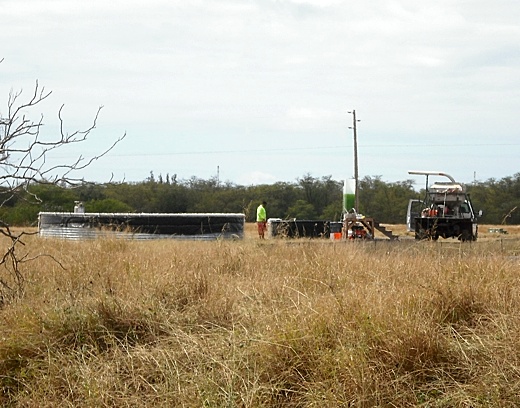
Image above: Sunrise Capital employee adding chemicals to test pit in March 2010. Photo by Juan Wilson.
 
As if flushing up to 20 million gallons a day of shrimp effluent into the ocean was not enough to cause a public uproar, Sunrise Capital has effectively muscled $250,000 from taxpayers to put toward the Kekaha facility.

We must do better to protect our limited resources — environmental and financial.
Sunrise Capital claims seabirds are to blame for the facility having to shut down twice in the last seven years due to shrimp infected with the untreatable white spot syndrome virus.

The Missouri-based company says the birds gorged themselves on contaminated shrimp dumped at the landfill, flew to the nearby farm, vomited the shrimp into the ponds and caused the outbreak.
That’s quite a tale. Some county officials think so too, but due to poor solid waste planning they found themselves in a bind.

County officials have said if they had not been racing the clock to expand the island’s sole landfill before it reaches capacity, there would have been sufficient time to fight these absurd claims.

They note that it would have cost millions of dollars — instead of hundreds of thousands — if the county would have gone through a lengthy contested case hearing. This is because the trash would have piled up on top of the space reserved for capping the landfill, requiring the county to re-handle the garbage after finally receiving the expansion permit.

The county should have made more of an effort to buy itself time to do what’s right by putting pressure on the state Department of Health, which administers the EPA permit the farm needs to operate.

There are certainly myriad reasons the county could have cited to effectively prolong the DOH’s permitting process while handling the contested case and figuring out what to do with all our rubbish.
For instance, county officials could have played the tourism card, arguing that hundreds of millions of gallons of shrimp waste in the water each week does not exactly nurture a recreational resource visitors would want to enjoy.

It would be nice if our government by the people, for the people, was already looking out for us based on those concerns, not to mention the impact to locals who routinely utilize the area for fun, fishing and cultural practices.

Instead, the county signed a settlement with Sunrise in October that will cost taxpayers a quarter-million bucks in exchange for the company withdrawing its contested case filing against the proposed landfill expansion.

Sometimes it costs more to do what’s right. We shouldn’t deplete our moral reserves to save paper.
For the sake of argument, let’s assume the county already had a materials recovery facility up and running and we were diverting more trash from the landfill than we were dumping into it. In essence, let’s assume we planned properly for our solid waste needs.

The county should still have spoken up on behalf of its residents and visitors who depend on the health of the island’s natural resources. And so should the state. At least the feds did in this case. The EPA provided a laundry list worth of issues the DOH should address before letting Sunrise pollute the Pacific.
Concerned citizens were basically left out to dry as the DOH in January approved the National Pollutant Discharge Elimination System permit.

Since we can’t undo what’s been done, we strongly urge the government entities tasked with monitoring this monstrosity to do so with all due diligence.

We can’t fathom there being no significant environmental impact with that amazing amount of output.
Even assuming all monitoring occurs as intended, do we really want to put such duress on a fragile ecosystem that takes years to recover?

While the DOH report on the permit says there will be no increased shark presence despite the billions of gallons of shrimp waste pouring into the Pacific each year, common sense says otherwise.
Wouldn’t the shrimp remains be eaten by the little fish who are in turn eaten by the bigger fish who are then shark bait?

In addition to logic, we tend to rely on the surfers out there every day who reported increased sightings and avoided the area entirely when it was operating a few years ago.

The bottom line is two-fold: the county should have stood up for what is right, despite the financial burden; and this facility should never have received a permit in the first place due to its likely environmental impacts.

While we absolutely want to bring new jobs to the island, we have an obligation to maintain high standards. Kaua‘i must be preserved as the special place it is for the sake of this generation and the next.

See also:
TGI: County agrees to $250K settlement with shrimp farm
(http://thegardenisland.com/news/local/article_27b20748-545a-11e0-9c2c-001cc4c03286.html)
 Ea O Ka Aina: Kekaha Shrimp Farm Discharge 9/3/10
Ea O Ka Aina: Kauai Shrimp Waste Dump 3/19/10
Ea O Ka Aina: Kauai Shrimp Effluent Problem 3/12/10
Island Breath: Kauai Shrimp to dump in ocean 8/21/06
 Island Breath: Kauai's Crustacean Crisis 4/23/04 .

Update on County Rules

SUBHEAD: Rule changes will be the subject of this Wednesday's County Council Meeting in Nawiliwili Harbor. By Ken Taylor and Linda Harmon in Island Breath - Image above: Public participation in "Townhall Meeting" by Norman Rockwell. From (http://www.westboylston.com/Pages/WBoylstonMA_AdminBlog/I0272F677). We think these changes will make Kauai government more democratic and encourage public participation. 1.Closed sessions should be scheduled. Often enough, mid way through the meeting the council will decide to break for a closed door session rather than dealing with the matter after or before the public meeting begins as is commonly done around the country. *2. Public comment period. Many councils around the country allow for public comment on matters relevant to the council that are not on the agenda. This is a method of addressing the council as a body and allowing the viewing public to hear both grievance or accolade that otherwise might never get aired. The council is there strictly to listen. The rule of courtesy would have to be met. Each person would be restricted to 3 min. and would take no more than 15 min. at the beginning of the meeting. *3. Consent Agenda. Council is proposing that housekeeping matters like communications from different dept. heads be bundled together and voted on summarily which would save sometimes hours of tedious council voting on one by one. However unlike when looked at individually where the public can ask for clarification and discussion the council wants to be able to pull a matter for further discussion and forbid anyone from the public from doing so. This is an infringement of the rights we now have when such matters are voted on one by one by the councilmembers. The public is now able to ask for clarification and ask questions and make suggestions before the councilmembers vote. 4. Live television broadcasts meetings. This is commonplace in cities and counties across the country and makes for government more accountable and accessible to the public. 5. Following agenda order with matters of greatest importance to the public coming first to allow more public participation. As it is now the council can choose to change the order and in some cases cause public consternation when having to wait out much of the day to testify about a matter that has been moved to the back on the agenda. The council is proposing to allow first come first serve 3 min. public testimony at the beginning ( up to 15 min) of the meeting but only on matter of the agenda. We consider this is a subversion of our proposed public comment period. *6. The posting of agenda with supporting documentation on the county web page. Although the county now posts the agenda at the same time it is posted to the council members it isn’t a rule. Along with the agenda the supporting documentation isn’t available to the public unlike to the council members. There is no good reason for keeping it from the public. Supporting documentation can just as easily be provided with a change of computer program. *most urgent See also: Ea O Ka Aina: County Council Rules Changes 3/18/11 .

Kauai Hindu Sustainability

SOURCE: Linda Harmon (lindaharmon@hawaiiantel.net) SUBHEAD: Kauai’s Hindu Temple - Our Sustainable Neighbors at Wailua-Kapaa Neighborhood Association Meeting.

 By Rayne Regush on 25 March 2011 for Wailua-Kapaa Neighborhood Association -

   
Image above: Meditation pavilion overlooking the Wailua River at Kauai Hindu Monastery. Photo by Juan Wilson.

 WHAT:
Presentation on sustainability of Kauai Hindu Monastery

 WHEN:
Saturday, March 26, 2011 - 2:00 to 4:00 p.m.  

WHERE:
Kapa‘a Library Meeting Room

Guest speakers Paramacharya Palaniswami and Sannyasin Yoginathaswami of Saiva Siddhanta Church, also known as Kauai’s Hindu Monastery, will discuss the important role of self-sufficiency within the monastery’s lifestyle of religious practice. The 353-acre spiritual sanctuary established in 1970 along the north fork of Wailua River, is an outstanding example of a community living sustainably. The monks grow about 80% of their food and tend a small herd of cows for milk.

Organic gardens, herbs, healing plants and hundreds of tropical fruit trees and hardwood trees are cultivated. They mill their own lumber as well. Much can be learned from their sustainable practices -- their exceptional green waste system and approach to soil building, construction techniques, and renewable energy solutions which provide electricity for two of their buildings so far.

The monastery’s initiatives set a compelling example for Kaua‘i in fostering food security and self-reliance, and managing natural resources. Meetings are free and open to the public. A portion will include updates on local issues. For information about W-KNA, to renew your membership or become a new member, please visit www.wkna.org or contact Sid Jackson at 821-2837. .

Radioactivity in Seawater Soars

SUBHEAD: Radioactivity levels in ocean water soars near Fukushima Dai Ichi as U.S. rushes fresh water to nuclear site. By Staff on 25 March 2011 on MSNBC - (http://www.msnbc.msn.com/id/42280076/ns/world_news-asiapacific) Image above: Wrecked reactor buildings #3 and #4 at Fukushima Dai Ichi. From (http://liberalironist.wordpress.com/2011/03/17/meltdown-at-fukushima-i-nuclear-power-plant). Japan's government revealed a series of missteps by the operator of a radiation-leaking nuclear plant on Saturday, including sending workers in without protective footwear in its faltering efforts to control a monumental crisis. The U.S. Navy, meanwhile, rushed to deliver fresh water to replace corrosive saltwater now being used in a desperate bid to cool the plant's overheated reactors.

Government spokesman Yukio Edano urged Tokyo Electric Power Co. to be more transparent, two days after two workers at the tsunami-damaged Fukushima Dai-ichi plant suffered skin burns when they stepped in water that was 10,000 times more radioactive than levels normally found near the reactors.

"We strongly urge TEPCO to provide information to the government more promptly," Edano said.

The Nuclear and Industrial Safety Agency, or NISA, said TEPCO was aware there was high radiation in the air at one of the plant's six units several days before the accident. And the two workers injured were wearing boots that only came up to their ankles — hardly high enough to protect their legs, agency spokesman Hidehiko Nishiyama said.

"Regardless of whether there was an awareness of high radioactivity in the stagnant water, there were problems in the way work was conducted," Nishiyama said.

NISA warned TEPCO to improve and ensure workers' safety, and TEPCO has taken measures to that effect, Nishiyama said, without elaborating.

TEPCO spokesman Hajime Motojuku declined to comment.

The government's admonishments came as workers at the plant struggled to stop a troubling rise in radioactivity and remove dangerously contaminated water from the facility, which has been leaking radiation since a massive earthquake and tsunami on March 11 knocked out the plant's key cooling systems. Officials have been using seawater to try to cool the plant, but fears are growing that the corrosive salt in the water could further damage the machinery inside the reactor units.

TEPCO is now rushing to inject the reactors with fresh water instead, and to begin extracting the radioactive water, Nishiyama said.

Defense Minister Yoshimi Kitazawa said late Friday that the U.S. government had made "an extremely urgent" request to switch to fresh water. He said the U.S. military was sending water to nearby Onahama Bay and that water injections could begin in the next few days.

The U.S. 7th Fleet confirmed that barges loaded with 500,000 gallons of fresh water supplies were on their way.

The situation at the crippled complex remains unpredictable, Edano said Saturday, adding that it would be "a long time" until the crisis ends.

"We seem to be keeping the situation from turning worse," he said. "But we still cannot be optimistic."

Suspected breach in plant Efforts to get the nuclear plant under control took on fresh urgency this week when nuclear safety officials said they suspected a breach in one or more of the plant's units — possibly a crack or hole in the stainless steel chamber around a reactor core containing fuel rods or the concrete wall surrounding a pool where spent fuel rods are stored.

Such a breach could mean a much larger release of radioactive contaminants.

Radioactivity was on the rise in some units, Nishiyama said Saturday.

"It is crucial to figure out how to remove contaminated water while allowing work to continue," he said, acknowledging that the discovery would set back delicate efforts to get the plant's cooling system operating again.

Workers have begun pumping radioactive water from one of the units, Masateru Araki, a TEPCO spokesman, said Saturday.

Plant officials and government regulators say they don't know the source of the radioactive water. It could have come from a leaking reactor core, connecting pipes, or a spent fuel pool. Or it may be the result of overfilling the pools with emergency cooling water.

But a breach in the chamber surrounding the reactor core seemed "more likely," Nishiyama said.

TEPCO said late Saturday that a trace of radioactive water had leaked from the Unit 2 reactor building into a sewage line. It was not clear if the source of the water was the same as the other leakage. TEPCO said officials were investigating.

Radiation has been seeping from the plant since the magnitude-9 earthquake and tsunami struck more than two weeks ago. Since then, it has made its way into milk, seawater and 11 kinds of vegetables, including broccoli, cauliflower and turnips.

Tap water in several areas of Japan, including Tokyo, has shown higher-than-normal levels of radiation. In the capital, readings were at one point two times higher than the government safety limit for infants, who are particularly vulnerable to radioactive iodine.

But levels have fallen steadily since peaking Wednesday, and Tokyo metropolitan officials said Saturday that tap water was safe for babies to drink.

Just outside a reactor at the coastal nuclear plant, radioactivity in seawater tested about 1,250 times higher than normal, Nishiyama said. He said the area is not a source of seafood and the contamination posed no immediate threat to human health.

However, tests conducted 18 miles (28 kilometers) offshore found radioactive iodine-131 at levels nearing the regulatory limit set by the Japanese government, the International Atomic Energy Agency said. The tests also detected another radioactive substance, cesium-137, at lower levels.

IAEA experts said the ocean will quickly dilute the worst contamination. Radioactive iodine breaks down within weeks but cesium could foul the marine environment for decades.

The nuclear crisis has added to the misery and uncertainty facing Japan in the wake of the disastrous earthquake and tsunami.

Japanese soldiers and U.S. Marines were clearing away debris so they could keep searching for bodies and bury the dead. The official death toll was 10,418 Saturday, with more than 17,000 listed as missing, police said. Those lists may overlap, but the final death toll was expected to surpass 18,000.

'Life is very difficult here' Overwhelmed by bodies along the coast, government officials conducted more mass burials Saturday. In Yamamoto, relatives wailed and yelled their farewells as the first 11 caskets were buried in one end of a long mass grave in a vegetable patch, with at least 400 more burials planned in the coming days.

In Higashimatsushima, soldiers lowered plywood coffins into a ditch dug at a recycling plant as freezing rain fell on mourners weeping quietly under umbrellas. Funerals in Japan are a highly formalized Buddhist ceremony, and the mass burials are yet another tragedy for the hard-hit coastal towns.

The misery has extended to the hundreds of thousands whose homes were destroyed, many of whom now sleep on crowded school gymnasium floors with few comforts. Those living within a 12-mile (20-kilometer) radius of the plant have been evacuated.

Life was also tough in the ghost towns inside a larger voluntary evacuation zone, with most residents choosing to flee and wary truckers refusing to deliver goods.

In Minamisoma, a city of 71,000 about 20 miles (30 kilometers) north of the plant, all but one or two shops shut their doors because of a lack of goods and customers, city official Sadayasu Abe said.

"Commercial trucks are simply not coming to the city at all due to radiation fears," he said.

Military troops and some private companies took up the task of delivering rice, instant noodles, bottled water and canned foods to eight central spots in the city, Abe said.

He said the city was urging the 10,000 or so still remaining to leave since the situation at the plant remains precarious.

"Life is very difficult here," he told The Associated Press by telephone. "We have electricity, gas and running water, but no food."

Muneyuki Munakata, a 58-year-old firefighter who was evacuated from his home near the plant, has been living in a shelter about 25 miles (40 kilometers) west of the nuclear complex for 15 days. Evacuees have plenty of instant noodles, but not enough rice or fuel for the stove, he said.

"People here are all exhausted," he said. "We all talk about when we can go home, but I don't know when because of uncertainty over the nuclear disaster."

Amazing Mechanical Seagull

SUBHEAD: By taking such a clear cue from nature's design, the SmartBird could help in the development more sustainable flight. By Stephen Messenger on 25 March 2011 for Tree Hugger - (http://www.treehugger.com/files/2011/03/amazing-mechanical-seagull-rivals-the-real-thing.php) Image above: Still from video below of mechanical seagull. It's a bird... It's a plane... Wait, it's both Mankind has long been fascinated with the idea of soaring through the sky like a bird, though oddly enough, many of the early flying contraptions were so bizarre as to seem plucked from thin air -- even though nature had conquered that realm eons earlier. Eventually, of course, we figured out how to achieve sustained flight, though achieving sustainable flight has been an entirely new challenge. One engineering firm, however, seems to have made a real breakthrough in efficient aviation -- by mimicking a design that had been over our noses the whole time. Video above: Mechanical seagull in flight. From (http://www.youtube.com/watch?v=nnR8fDW3Ilo).

If Mother Nature held patents on her designs, the engineers at the Festo Corporation would probably have a lawsuit on their hands. The group recently unveiled one of the most lifelike and natural-seeming flying machines that I have ever seen -- called the SmartBird, inspired by the flight dynamics of a common seagull.

mechanical-seagull2.jpg

The corporation's web site describes the inspiration behind the clever mechanical-gull:

This bionic technology-bearer, which is inspired by the herring gull, can start, fly and land autonomously - with no additional drive mechanism. Its wings not only beat up and down, but also twist at specific angles. This is made possible by an active articulated torsional drive unit, which in combination with a complex control system attains an unprecedented level of efficiency in flight operation. Festo has thus succeeded for the first time in creating an energy-efficient technical adaptation of this model from nature.

By taking such a clear cue from nature's design, Festo says that the SmartBird could help in the development more sustainable flight. "The minimal use of materials and the extremely lightweight construction pave the way for efficiency in resource and energy consumption," says Festo.

There's no telling quite yet if the nature-inspired technological advancement could be used towards improving designs on a larger scale -- but it's nice to know they're looking in the right place for ideas.

The Local Food Revolution

SUBHEAD: A revolution aimed at rebuilding food security and food sovereignty for all. By Michael Brownlee on 24 March 2011 in Boulder Weekly - (http://www.boulderweekly.com/article-4806-id-like-to-see-a-study-on-the-relative-cost-for-t.html) Image above: Boulder Belt Farm share. From (http://www.localharvest.org/blog/330/entry/boulder_belt_farm_share_inititiative16). Boulder, Colorado - Anyone living in the area could scarcely have escaped noticing some of the obvious first signs of this revolution: Farmers’ markets are popping up around the county, along with roadside farmstands. More restaurants are sourcing their ingredients from local farmers and ranchers. Municipalities have been compelled to change laws to accommodate the rapidly rising citizen demand to raise chickens, goats and bees in residential backyards. Backyard and frontyard gardens seem to be proliferating everywhere, and local fresh produce is now even being offered in many Boulder County school lunchrooms. Dozens of family farms are now offering CSAs (community supported agriculture), essentially prepaid subscriptions to a share in a season’s bounty. And plastic-covered “hoop houses” are springing up on farms and in yards as gardeners struggle to meet the challenge of extending the Front Range’s famously short growing season. But some of the signs of this revolution are far less visible. For instance, hundreds of people have been signing up for “reskilling” classes on forest gardening, food canning and preservation, composting, vermiculture (worm ranching), seed-saving, food fermentation, greenhouse construction, aquaponics (combining aquaculture with hydroponic plant production), along with rainwater harvesting. Even more have been taking instruction in seasonal eating and cooking, as well as basic nutrition. In addition, over the past four years more than 300 people in the area have graduated from an intense 72-hour permaculture design certification course, and about 50 have gone on to become certified permaculture instructors. Nonprofit organizations — including Everybody Eats!, Growing Gardens, Cultiva!, and Transition Louisville — have been working to stimulate demand for local food, as well as increasing local food production capacity. In 2007, Transition Colorado launched an ongoing countywide EAT LOCAL! Campaign, which now includes a 10 percent Local Food Shift Challenge and Pledge. The organization also publishes Boulder County’s EAT LOCAL! Resource Guide & Directory, and has hosted numerous films and high-profile speakers, conferences and an EAT LOCAL! Week. County government is also involved. In 2008, the Boulder County Commissioners formed a Food & Agriculture Policy Council, with a mandate to convert 10 percent of the 17,000 acres of county-owned open space agricultural land to food production for local consumption by 2012. Why local food? Why the growing interest in local food? The answers lie in understanding our “food predicament,” particularly our dependence on a fragile and increasingly unwieldy global food system. For perspective, it’s useful to know that the latest USDA data shows that Boulder County residents spent $947 million on food in 2010 (up from $662 million in 2007). But how much of this goes to Boulder County producers? Not much. While definitive numbers are still unavailable, it’s safe to say that no more than 1 to 2 percent of the food we consume in Boulder County is produced within the county. For an agricultural county with more than 137,000 acres of productive ag land, that’s surprising. This situation is roughly in line with the state as a whole — Colorado residents spend $12 billion annually on food, 97 percent of which is imported from outside the state. As in most places, since World War II agriculture has become primarily focused on producing exports. Conventional farmers have been told that their mission is “to feed the world.” Thus, 95 percent of all agricultural production in the county is exported. At the heart of the local food revolution is the realization that our ability to meet our basic food needs locally has been thoroughly undermined by big agribusiness, including the “value-added” food processors whose products have added considerable heft to our waistlines and contributed directly to a national health crisis of obesity, Type II diabetes and a host of food-related diseases. The real cost of this arrangement has been very high. Local food advocates are also acutely aware that the globalized food system is highly dependent on fossil fuels for inputs (synthetic fertilizers and pesticides), processing, storage, cooling and transportation. They see increasing signs that dependence on foreign oil — inevitably increasing in price as global oil production peaks — puts big agribusiness and “conventional” agriculture in a no-win situation, and that the misnamed “Green Revolution” (it was a coup!) is exhibiting signs of failure in the face of already devastating impacts of climate change. They also claim that widespread application of synthetic chemicals is jeopardizing long-term soil fertility. “The soil is a living thing, and we are murdering it,” says Carlo Petrini, founder of the Slow Food movement. “Industrial agriculture has embraced the idea of farming without farmers, but at this rate one day we’ll be forced to farm without land.” To complicate matters, as author Anna Lappé concludes in Diet for a Hot Planet: The Climate Crisis at the End of Your Fork and What You Can Do About It, the way we currently grow, process, ship, market and cook our food may be contributing more than 30 percent of all greenhouse gas emissions. All these factors have combined to make food one of the most unsustainable spheres of human activity. Feed the world, or feed our own? Meanwhile, the world population is apparently on the way to 9 billion people by mid-century, necessitating at least a doubling of current food production — at a time when a global food crisis looms on the horizon. While big agribusiness insists that the only way to continue to feed the world is to greatly increase the efficiency of industrialized agriculture (and towards that end to genetically engineer virtually all crops), a growing number of people are seeing this technological approach as not only unsustainable but a clear threat to human freedom and sovereignty. With the likely total deregulation of genetically modified organisms and the absence of appropriate food labeling, consumers and growers alike feel that their ability to exercise choice has been taken away. Meanwhile, even “natural” grocers like Vitamin Cottage admit that the majority of the products on their shelves probably contain GMOs. While GMO labeling is mandated in most EU nations, industry has mobilized to successfully prevent such practices in the United States. A U.N. report released in early March claims that support of small-scale farming using “agro-ecological” methods — i.e., mostly local and organic — could easily double food production in 10 years in critical regions. This study confirms what local food advocates have known for years, that we must begin making the shift to growing most of our own food locally, with bio-intensive methods that restore soil, rekindle connection with the land and rebuild community. Recent studies indicate that the benefits of food localization can be far-reaching. Returning to a fresh, seasonal, mostly organic local diet will significantly improve the health of our communities, especially our children, and dramatically reduce health care costs. Shrinking our foodshed will not only reduce food-miles, but bio-intensive cultivation methods will also sequester carbon in the soil, making food localization one of the most effective approaches to reducing greenhouse gas emissions. Surprisingly, rebuilding our local food system might also be the most important thing we can do to strengthen our local economies — to create new jobs and stem the leakage of dollars. Economist and food system researcher Michael Shuman recently completed a study for the greater Cleveland area that shows that moving to 25 percent food localization in that area by 2020 could produce 27,000 new jobs, generate $4.2 billion of economic activity each year, and produce $126 million in new local and state tax revenues. Shuman, who is director of research and economic development for BALLE (Business Alliance for Local Living Economies), is now conducting a similar study to quantify the potential economic upside for food localization in the Boulder County area. Commissioned by Transition Colorado, the study will identify gaps, challenges and opportunities, and will map the business initiatives, public policy shifts, and nonprofit programs to make 25 percent food localization achievable by 2020. Financing the revolution One of the impacts of the globalization of food has been the gradual erosion of the network of enterprises that once supported a robust local food and farming economy. According to retired Boulder attorney and former Food & Agriculture Policy Council member-at-large Jim England, at the turn of the 20th century Boulder County had six flour mills (three of them in or near the Boulder city limits), canning factories and other processing plants, commercially successful berry and small fruit operations, and thousands of fruit trees (Boulder’s Grove Street is named after the commercial apple and other fruit groves that grew there). There were butchers on Pearl Street, malt houses, a cheese factory in Hygiene and a number of working dairies. “A hundred years ago this was something of a locavore’s paradise,” says England. “And if it once was thus, my hope is it can again be that.” But crucial to achieving any significant level of food localization will be the rebuilding of Boulder County’s local food infrastructure — production, processing, distribution and storage — which will require an infusion of financial investments to underwrite the entrepreneurs and farmers who wish to be part of the local food revolution. In an era of shrinking budgets, where will that money come from? Woody Tasch, a frequent visitor to Boulder County, has an answer: “Slow Money,” which Entrepreneur Magazine dubbed “one of the top five trends in finance for 2011.” Weaving economic savvy with a poet’s penchant for language, Tasch explains that Slow Money represents “the creation of new forms of intermediation that catalyze the transition from a commerce of extraction and consumption to a commerce of preservation and restoration.” It’s a reversal of dependence on Wall Street markets and traditional investment vehicles, which parallels the shift from big agribusiness to local food economies. Tasch says that the recent economic crisis is exactly what one can expect when the relationships between money, community and the land are broken. The most appropriate way to begin building a restorative economy, he says, is to invest locally in sustainable, small-scale food enterprises. The Slow Money approach (www.SlowMoney.org) aims to bring together key stakeholders, investors and entrepreneurs, along with leaders in local food and progressive finance. Slow Money is just now beginning to take hold in Boulder County, with an commitment of $1.5 million from an anonymous donor to seed what promises to become a critical source of capital for local food and farming enterprises. That fund is currently under the stewardship of Transition Colorado, but will soon be established as an independent Slow Money entity. Catalyzing a local network Rebuilding production capacity and increasing consumer demand simultaneously is something of a chicken-and-egg challenge. Some farmers remain skeptical that the demand for locally produced food will continue to follow a supposed hockey-stick trajectory. They wonder: “If we are able to dramatically ramp up production, where will the infrastructure come from that can get our products processed and onto the tables of consumers?” One bright spot may be the recent emergence of a “foodshed alliance” known as the Boulder County Local Food Network, conceived as a cooperative membership organization joining farmers, food and agricultural leaders, local businesses, local governments and community residents in a united effort to stimulate and support the local food economy and to foster increasing localization of the regional food system. The group’s informal motto is “thinking like a foodshed.” Organized as a member of the national Business Alliance for Local Living Economies, the Local Food Network was first announced on Feb. 27 at the “Our Local Economy in Transition” conference, and the group is now recruiting charter members. Founding members include Everybody Eats!, Ollin Farms, Center for ReSource Conservation and Transition Colorado. The group hopes to grow to 200 members over the next two years, including farmers, ranchers, restaurants, retailers, food processors, distributors, food-related businesses, nonprofit and community organizations, county and municipal governments, as well as other local businesses that support the goals and values of the network. Making the transition to local food and farming In 2006, a food working group calculated that the then-current state of agriculture in Boulder County could only feed about 20,000 — less than 7 percent of the total population of 300,000. They then looked at the upside, estimating that with greatly expanded individual and community garden plots, greatly increased farming for food using bio-intensive methods, with reduced calorie intake and a simplified diet, this maybe could be increased to about 185,000 people — a daunting realization, but a useful benchmark of our vulnerability here. The group also learned that there were already about 34,000 food-insecure people — those without secure, reliable access to food — in Boulder County, and those numbers have been increasing dramatically with the recent economic turmoil. Boulder County is proud of its farmers’ markets, and more of them are coming up every year. Boulder’s own market is widely regarded as one of the top 10 in the country, and an estimated 14,000 people show up at the Boulder market on a Saturday. Yet, an entire season’s sales at the Boulder County Farmers’ Markets — Boulder and Longmont together — would meet Boulder County’s food needs for less than a day and a half. Given all this, it’s clear that one of the most important things we can all do together is to completely rebuild our local foodshed — from multiplying backyard and frontyard gardens, to raising chickens and keeping bees, to committing to only buying food that is local and organic, to converting our local agricultural lands to growing food for local consumption, to rebuilding local food storage and distribution systems, to demanding that our supermarkets stop importing food we could produce here ourselves, to training young people to learn farming as a wise and essential — and even sustainable — career choice. Of course, the transition to a re-localized, non-fossil-fuel food and farming system will take some time — because nearly every aspect of the process by which we feed ourselves must be redesigned and rebuilt. But if we do this right, we have an opportunity to build a localized food and farming system that is economically robust, environmentally sustainable, resilient and self-reliant, one that ensures food security and sovereignty for all, one that contributes to the health and happiness of our citizens, and that revitalizes our communities. If we do this right, not only can we reverse the destruction that industrial agriculture causes, but we can replace it with something far better, a way of growing and preparing food that heals our connection with the land and with each other. In the process, we may also find that we’re restoring the kind of democracy envisioned by Thomas Jefferson for his fledgling nation. .

Rally for Labeling GMOs

SUBHEAD: Rally on Saturday, April 26th, 12 to 2 pm at Lihue Airport Entrance.  

By Linda Pascatore on 25 March 2011 for Island Breath -
(http://islandbreath.blogspot.com/2011/03/rally-for-labeling-gmos.html)

 
Image above: Right to know GMO contents. From (http://organicconsumers.org/monsanto/index.cfm).  

WHAT:
Join our rally for labeling of GMO foods  

WHEN: Saturday, April 26th, 12 to 2 pm  

WHERE:
Corner at Entrance to Lihue Airport  

WHO:
Sponsored by GMO Free Kauai, in conjunction with the Institute for Responsible Technology (http://www.responsibletechnology.org/)

 MORE:
The following is from The Institute for Responsible Technology (http://www.responsibletechnology.org/rally-for-the-right-to-know):

Rally For The Right To Know

Genetically Modified Foods need to be labeled!

The national Millions Against Monsanto campaign staff is gearing up for a nationwide day of action on World Food Day, October 16, pledging to make it the biggest action on genetic engineering in US history. To help raise awareness for the campaign, Millions Against Monsanto activist Trish Wright has sent out a call for a demonstration at the White House on Saturday, March 26th and has urged other activists around the country to "Rally for the Right to Know" locally. The response has been tremendous. Millions Against Monsanto is spreading across the country!

Japan's Electric Bottleneck

SUBHEAD: Brownouts will continue. It is unlikely TEPCO can meet the power demand for Tokyo for several years. By John Ydstie on 24 March 2011 for National Public Radio - (http://www.npr.org/2011/03/24/134828205/a-country-divided-japans-electric-bottleneck) Image above: Buildings are seen without illumination in Tokyo's Shibuya district. Rolling blackouts are crippling the town. From original article. Even on a slow day, Tsukiji market, the largest fish market in the world, is a beehive of activity. Motorized carts buzz down narrow aisles carrying tuna carcasses. They're sawed into chunks and shipped to restaurants in Tokyo and around the world. Normally, these aisles would be jammed with buyers. But on a recent day, they're nearly empty. Mr. Kaoru, a wholesaler, blames the blackouts. "I predict one-third of the wholesalers in the market will close the shop, the business," he says. "[The] main reason is the power source." Rolling blackouts continue in the Tokyo area following the loss of power generation at the damaged nuclear plants in Fukushima. Tokyo Electric Power Co., the giant utility that serves the region, has lost 20 percent of its power capacity. Blackouts are crippling businesses from auto producers to fishmongers. The rolling blackouts are also reducing train service, making commuting unpredictable. So people don't stay downtown eating and drinking after work. The result is that fish sales at Tsukiji fish market are down about 50 percent. In the morning, the blackouts mean some rail commuters can't get to work on time. That's a problem for big auto manufacturer Nissan. "Electricity going down creates its own damage," says Andrew Palmer, a senior vice president at Nissan. He's trying to get the company's auto plants up and running. But he's plagued by power outages that shut down production lines and damage equipment. "Certainly the power outages are something we have to work with," Palmer says. "Obviously, it's partially a negotiation with the local authorities." But so far TEPCO, one of the biggest privately owned power companies in the world, says it can't guarantee power to anyone. "When blackouts are required we do not discriminate among our customers, whether industrial or residential," the company says. Blackouts That Could Continue For Years The problem is these rolling blackouts could continue for many months — even years. "This is a real problem for those factories which need uninterrupted supplies," says professor Tatsuo Hatta, president of the National Graduate Institute for Policy Studies in Tokyo. He says the situation might cause some companies to move. "It's clear that from their viewpoint they'd better move their plant to the western part of Japan where electricity is plenty." It might seem much easier to send the surplus power from one side of Japan to the other to ease the blackouts. But that's harder than you might think, Hatta says. "One major problem is that the east and west of Japan have different electric cycles and the capacity of the connectors are very much limited," he says. That's partly an accident of history. Eastern Japan followed the German model and has a 50-cycle electrical power grid. The western part of Japan used the American model and has a 60-cycle grid. Transferring power from one grid to another requires a very expensive facility. And there are only three connections between eastern and western Japan. That bottleneck means the power transfer is just a trickle, even during this national emergency. Creating more capacity would take years. Fear Of A Monopoly Hatta says, up until now, Japan's big utility companies, including TEPCO, liked the arrangement, because it protected their monopoly pricing and made them very powerful politically. "The users of electricity like Japan Steel wouldn't say anything against electric utility companies — they are so afraid," he says. "And also many politicians wouldn't touch those electric utility companies." Hatta says the situation must change to reduce the stranglehold the utilities have on the country's energy users. "One possibility is that on this occasion [the] Japanese government nationalize TEPCO," he says. The government could keep TEPCO's transmission lines and sell off its power plants to smaller producers who would compete to sell power to customers. For the time being, TEPCO says it's doing everything it can to secure more power. The stakes are incredibly high. Power consumption normally doubles during the heat of the summer. Right now it seems unlikely TEPCO will be able to meet the demand, threatening more disruption for Japanese companies and workers, and greater damage to Japan's fragile economy. .

Nuclear Myth Melts Down

SUBHEAD: Replacing coal and oil with nuclear power is like trading heroin for crack. By Chip Ward on 24March 2011 in TomDispatch - (http://www.tomdispatch.com/post/175371/tomgram%3A_chip_ward%2C_the_nuclear_myth_melts_down) Image above: "Buster Jangle" Atom bomb test at Nevada Proving grounds in 1951 that sought to determine effect of exposure on US fighting forces. Were these soldiers told of any potential harm to them? Did anyone have a clue or care? From (http://en.wikipedia.org/wiki/File:Buster-Jangle_shot_with_personnel.jpg).

When nuclear reactors blow, the first thing that melts down is the truth. Just as in the Chernobyl catastrophe almost 25 years ago when Soviet authorities denied the extent of radiation and downplayed the dire situation that was spiraling out of control, Japanese authorities spent the first week of the Fukushima crisis issuing conflicting and confusing reports. We were told that radiation levels were up, then down, then up, but nobody aside from those Japanese bureaucrats could verify the levels and few trusted their accuracy. The situation is under control, they told us, but workers are being evacuated. There is no danger of contamination, but stay inside and seal your doors.

The First Atomic Snow Job

The bureaucratization of horror into bland and reassuring pronouncements was to be expected, especially from an industry where misinformation is the rule. Although you might suppose that the nuclear industry’s outstanding characteristic would be its expertise, since it’s loaded with junior Einsteins who grasp the math and physics required to master the most awesomely sophisticated technology humans have ever created, think again. Based on the record, it’s most outstanding characteristic is a fundamental dishonesty. I learned that the hard way as a grassroots activist organizing opposition to a scheme hatched by a consortium of nuclear utilities to park thousands of tons of highly radioactive fuel rods, like the ones now burning at Fukushima, in my Utah backyard.

Here’s what I took away from that experience: the nuclear industry is a snake-oil culture of habitual misrepresentation, pervasive wishful thinking, deep denial, and occasional outright deception. For more than 50 years, it has habitually lied about risks and costs while covering up every violation and failure it could. Whether or not its proponents and spokespeople are dishonest or merely deluded can be debated, but the outcome -- dangerous misinformation and the meltdown of honest civic discourse -- remains the same, as we once again see at Fukushima.

Established at the dawn of the nuclear age, the pattern of dissemblance had become a well-worn rut long before the Japanese reactors spun out of control. In the early 1950s, the disciples of nuclear power, or the “peaceful atom” as it was then called, insisted that nuclear power would soon become so cheap and efficient that it would be offered to consumers for free. Visionaries that they were, they suggested that cities would be constructed with building materials impregnated with uranium so that snow removal would be unnecessary. Atomic bombs, they urged, should be used to carve out new coastal harbors for ships. In low doses, they swore, radiation was actually beneficial to one’s health.

Such notions and outright fantasies, as well as propaganda for a new industry and a new way of war -- even if laughable today -- had tragic results back then. Thousands of American GIs, for instance, were marched into ground zero just after above-ground nuclear tests had been set off to observe their responses to what military planners assumed would be the atomic battlefield of the future. Ignorance, it turns out, is not bliss, and thousands of those soldiers later became ill. Many died young.

Unwary civilians who lived downwind of America’s western testing grounds were also exposed to nuclear fallout and they, too, suffered horribly from a variety of cancers and other illnesses. Uranium miners exposed to radiation in the tunnels where they wrestled from the earth the raw materials for the nuclear age also became ill and died too soon, as did workers processing that uranium into weapons and fuel. Many of those miners were poor Navajos from my backyard in Utah where a new uranium boom, part of the so-called nuclear renaissance, was -- before Fukushima -- set to take shape.

How Unlikely Risks Become Inevitable

In the future, today’s low-risk claims from industry advocates will undoubtedly seem as tragically naïve as yesterday’s false claims. Yes, the likelihood that any specific nuclear power plant reactor will melt down may be slim indeed -- which hardly means inconceivable -- but to act as though nuclear risks are limited to the operation of power plants is misleading in the extreme. “Spent fuel” from reactors (the kind burning in Japan as I write) is produced as a plant operates, and that fuel remains super hot and dangerous for hundreds, if not thousands, of years. As we are learning to our sorrow at the Fukushima complex, such used fuel is hardly “spent.” In fact, it can be even more radioactive and dangerous than reactor cores.

Spent fuel continues to pile up in a nuclear waste stream that will have to be closely managed and monitored for eons, so long that those designing nuclear-waste repositories struggle with the problem of signage that might be intelligible in a future so distant today’s languages may not be understood. You might think that a danger virulent enough to outlast human languages would be a danger to avoid, but the hubris of the nuclear establishment is equal to its willingness to deceive.

A natural disaster, accident, or terrorist attack that might be statistically unlikely in any year or decade becomes ever more likely at the half-century, century, or half-millennium mark. Given enough time, in fact, the unlikely becomes almost inevitable. Even if you and I are not the victims of some future apocalyptic disturbance of that lethal residue, to consign our children, grandchildren, or great-grandchildren to such peril is plainly and profoundly immoral.

Nuclear proponents have long wanted to limit the discussion of risk to plant operation alone, not to the storage of dangerous wastes, and they remain eager to ignore altogether the risks inherent in transporting nuclear waste (often called “mobile Chernobyl” by nuclear critics). Moving those spent fuel rods to future repositories represents a rarely acknowledged category of potential catastrophe. Just imagine a trainload of hot nuclear waste derailing catastrophically along a major urban corridor with the ensuing evacuations of nearby inhabitants. It means, in essence, that one of those Fukushima “pools” of out-of-control waste could “go nuclear” anywhere in our landscape.

Risk is about more than likelihood; it’s also about impact. If I tell you that your chances of being bitten by a mosquito as you cross my yard are one in a hundred, you’ll think of that risk differently than if I give you the same odds on a deadly pit viper. As events unfold in Japan, it’s ever clearer that we’re talking pit viper, not mosquito. You wouldn’t know it though if you were to debate nuclear industry representatives, who consistently downplay both odds and impact, and dismiss those who claim otherwise as hysterical doomsayers. Fukushima will assumedly make their task somewhat more difficult.

Hidden Costs and Wasted Subsidies

The true costs of nuclear power are another subject carefully fudged and obscured by nuclear power advocates. From its inception in federally funded labs, nuclear power has been highly subsidized. A recent report by the Union of Concerned Scientists found that “more than 30 subsidies have supported every stage of the nuclear fuel cycle from uranium mining to long-term waste storage. Added together, these subsidies have often exceeded the average market price for the power produced.” When it comes to producing electricity, these subsidies are so extensive, the report concludes, that “in some cases it would have cost taxpayers less to simply buy the kilowatts on the open market and give them away.”

If the nuclear club in Congress, led by Senate Republican leader Mitch McConnell, gets its way, billions more in subsidies will be forthcoming, including massive federal loan guarantees to build the next generation of nuclear plants. These are particularly important to the industry, since bankers won’t otherwise touch projects that are notorious for mammoth cost overruns, lengthy delays, and abrupt cancellations.

The Obama administration has already proposed an additional $36 billion in such guarantees to underwrite new plant construction. That includes $4 billion for the construction of two new nuclear reactors on the Gulf Coast that are to be operated in partnership with Tokyo Electric Power Company -- that’s right, the very outfit that runs the Fukushima complex. Yet when I debate nuclear advocates, they always claim that, in cost terms, nuclear power outcompetes alternative sources of energy like wind and solar.

That government gravy train doesn’t just stop at new power plants either. The feds have long assumed the epic costs of waste management and storage. If another multi-billion dollar project like the now-abandoned Yucca Mountain repository in Nevada is built, it will be with dollars from taxpayers and captive ratepayers (the free market be damned). Industry spokesmen insist that subsidizing such projects will be well worth it, since they will create thousands of new jobs. Unfortunately for them, a definitive 2009 University of Massachusetts study that analyzed various infrastructure investments including wind, solar, and retrofitting buildings to conserve energy placed nuclear dead last in job creation.

Finally, the recently renewed Price-Anderson Nuclear Industries Indemnity Act limits the liability of nuclear utilities should a catastrophe like the one in Japan happen here in the United States. The costs of recovery from the Fukushima catastrophe will be astronomical. In the U.S., nuclear utilities would be off the hook for any of those costs and you, the citizen, would foot the bill. Despite their assurances that nothing can go wrong here, nuclear industry officials have made sure that in their business risk and reward are carefully separated. It’s a scenario we should all know well: private corporations take away profits when things go well, and taxpayers assume responsibility when shit happens.

Finally, nuclear power boosters like to proclaim themselves “green” and to claim that their industry is the ideal antidote to global warming since it produces no greenhouse gas emissions. In doing so, they hide the real environmental footprint of nuclear energy.

It’s quite true that no carbon dioxide comes out of power-plant smokestacks. However, maintaining any future infrastructure to handle the industry’s toxic waste is guaranteed to produce lots of carbon dioxide. So does mining uranium and processing it into fuel rods, building massive reactors from concrete and steel, and then behemoth repositories capable of holding waste for 1,000 years. Radiation from the Fukushima meltdown is now entering the Japanese food chain. How green is that?

The Watchdogs Play Dead

Over the course of nuclear power’s history, there have been scores of mishaps, accidents, violations, and problems that, chances are, you’ve never heard about. Beyond the unavoidable bad PR over the partial meltdown at Three Mile Island in 1979, the Chernobyl meltdown in 1986, and now the Japanese catastrophe, the industry has an excellent record -- of covering up its failures.

The co-dependent relationship between the nuclear corporations and the Nuclear Regulatory Commission (NRC), the federal agency charged with licensing and monitoring them, resembles the cozy relationship between the Securities Exchange Commission and Wall Street before the global economic meltdown of 2008. The NRC relies heavily on the industry’s own reports since only a small fraction of its activities can be inspected yearly.

A report by the Union of Concerned Scientists, “The NRC and Nuclear Power Plant Safety in 2010,” which highlights the NRC’s haphazard record of inspection and enforcement, makes clear just why the honor system that assumes utilities will honestly report problems has never worked. It describes 14 recent serious “near miss” violations that initially went unreported. At the Indian Point Nuclear Power Plant, only 38 miles north of the New York metropolitan area, for instance, NRC inspectors ignored a leaking water containment system for 15 years.

After a leaking roof forced the shutdown of two reactors at the Calvert Cliffs nuclear facility in Maryland, plant managers admitted that it had been leaking for eight years. When Honeywell hired temporary workers to replace striking union members at its uranium refinery in Illinois, they were slipped the correct answers to a test required for those allowed to work at nuclear plants, because otherwise they had neither the knowledge nor experience to pass.

The regulation of Japan’s nuclear industry mirrors the American model. Japan’s legacy of regulatory scandals, falsified safety records, underestimated risks, and cover-ups includes an incident in 1999 when workers mixed uranium in open buckets and exposed hundreds of coworkers to radiation. Two later died. Other scandals involved hiding cracks in steam pipes from regulators in 1989, lying about a fire and explosion at a plant near Tokyo in 1997, and covering up damage to a plant from an earthquake in 2007.

In the wake of the Fukushima catastrophe, we will no doubt discover how there, too, so-called watchdogs rolled over and played dead. In recent years, in fact, the Fukushima complex had the highest accident rate of any of the big Japanese nuclear plants. We’ve already learned that an engineer who helped design and supervise the construction of the steel pressure vessel that holds the melting fuel rods in Reactor No. 4 warned that it was damaged during production. He had himself initially orchestrated a cover-up of this fact, but revealed it a decade later -- only to be ignored. During the complex’s construction by General Electric some 35 years ago, Dale Bridenbaugh, a GE employee, resigned after becoming convinced that the reactors being built were seriously flawed. He, too, was ignored. The Vermont Yankee reactor in Vermont and 23 others around the U.S. replicate that design.

Stay tuned, since more examples of reckless management will surely come to light...

Risk Is Not a Math Problem

That culture of secrecy is a logical fit for an industry that is authoritarian by nature. Unlike solar or wind power, nuclear power requires massive investments of capital, highly specialized expertise, robust security, and centralized control. Any local citizen facing the impact of a uranium mine, a power plant, or a proposed waste depository will attest that the owners, operators, and regulators of the industry are remote, unresponsive, and inaccessible. They misinform because they have the power to get away with it. The absence of meaningful checks and balances enables them.

Risk, antinuclear advocates quickly learn, is not simply some complicated math problem to be resolved by experts. Risk is, above all, a question of who is put at risk for whose benefit, of how the rewards, costs, and liabilities of an activity are distributed and whether that distribution is fair. Those are political questions that citizens directly affected should be answering for themselves. When it comes to nuclear power, that doesn’t happen because the industry is undemocratic to its core. Corporate officers treat downwind stakeholders with the same contempt they reserve for honest accountings of the industry’s costs and dangers.

It may be difficult for the average citizen to unpack the technicalities of nuclear power, or understand the complex physics and engineering involved in splitting atoms to make steam to produce electricity. But most of us are good at detecting bullshit. We know when something like the nuclear industry doesn’t pass the smell test.

There is a growing realization that our carbon-based energy system is warming and endangering this planet, but replacing coal and oil with nuclear power is like trading heroin for crack -- different addictions, but no less unhealthy or risky. The “nuclear renaissance,” like the “peaceful atom” before it, is the energy equivalent of a three-card monte game, involving the same capitalist crooks who gave us oil spills, bank bailouts, and so many of the other rip-offs and scams that have plagued our lives in this new century.

They are serial killers. Stop them before they kill again. Credibility counts and you don’t need a PhD or a Geiger counter to detect it.

.

This is the Big One

SUBHEAD: Japan Fukushima Dai-Ichi nuclear crisis could dwarf the Chernobyl disaster. By Jan Lundberg on 24 March 2011 in Culture Change - (http://www.culturechange.org/cms/content/view/715/1) Image above: Chernobyl nuclear power station after explosion of reactor. From (http://www.our-energy.com/gallery/chernobyl_nuclear_reactor_after_explosion.html). Alex Smith of Radio Ecoshock has just produced a definitive interview with Dr. Helen Caldicott, the world's foremost anti-nuclear activist and authority. Listen to it now at Eco shock.net (http://209.217.209.33/~esnet/downloads/ES_110325_Show_LoFi.mp3) 14mb. Here are some notes I took from the broadcast:
• Smoke has been reported rising from the Fukushima unit number 3. If it's from fuel-cooling pools that contain plutonium, that's a major (to put it mildly) disaster. • One millionth of a gram of plutonium ingested causes cancer. • Geiger counter radiation levels have been reassuring for the West Coast of North America. But the real question for public health is "internal emitters" (e.g. Strontium attached to bone) -- that cause cancer and gene mutations -- versus external radiation measurements that cannot discern isotopes. • Long lived isotopes versus quickly degrading ones: the big question for our gene pool. • Fuel-cooling pools pose a far worse threat than reactors. In the U.S. the fuel pools are not backed up with cooling systems! • A large part of Japan is damaged permanently. • Random genetic engineering is being done for the rest of humanity's future. • A peaceful Egypt-kind of revolution is needed against the nuclear psychosis. • Caldicott commissioned a "Nuclear-free, carbon-free" study. She says "Renewable energy can supply all the energy America needs by 2040."
The last point reveals a weakness in the anti-nuclear movement as well as in the climate protection movement. When today's energy appetite is justified by cleaner energy -- as in an obese person's switching the source of calories instead of cutting way back on them and getting significant exercise -- little good can come of it. The "clean energy" vision has a lot of baggage, such as a petroleum infrastructure that is giving out.

A basic lack of understanding of energy plagues many intelligent people who haven't examined petroleum's attributes and role. There is no overall substitute possible for cheap petroleum and its many uses. Even more dangerous, the Holy Grail of abundant "clean energy" someday for a huge consumer economy's "needs" causes tragic delay in slashing energy use now. We must question the need for today's energy consumption by establishing much lower energy use -- lifestyle change -- that needs to happen so that mass curtailment and restructuring can begin now.

To begin to gear up to meet the 2040 goal that Dr. Caldicott called for is folly in that it is off-target, and ignores the realities of overpopulation. But because she is so right on some vital levels, she is able to make an uninformed statement such as the last one in the above list. I have met this wonderful activist, and am in agreement with her new statement that the Japan crisis may be positive for sinking the nuclear industry and then even getting on to the task of dealing with the weapons problem.

Alex Smith produced and offered an important show on March 21 on the nuclear crisis, not released on Culture Change. To make up for this lapse, we asked him for his next report. He has responded with an excellent must-listen show, referenced above. His website is ecoshock.org. Here is the note he sent Culture Change on March 23:

Hi Jan

Here is a hot one to send out to your list: this morning I interviewed Dr. Helen Caldicott about the Japanese nuclear crisis. This may be the first long interview she's given, or at least that I've seen or heard. And she is on fire!

The second part of this week's program is Kathy McMahon, the Peak Oil shrink, on digesting really bad news, plus the nuke problems in New England. She's one smart lady.

Plus a bit of news straight from NHK World today, as four reactors burn in Japan, with all workers evacuated. Hardly any bottled water left in Tokyo, and nurseries can't find what they need to feed babies, now that the tap water is radioactive.

Radiation found in fields 40 kilometers north of Fukushima runs 5 cm. deep, and an expert expects it will last at least 30 years. A big part of Japan is lost to agriculture, if not to human habitation. Certainly the tens of thousands of nuclear refugees from Fukushima itself and neighboring villages are not going home. Not in their lifetimes.

Caldicott says this is the big one. .

The Trouble with Vaporware

SUBHEAD: We need to start talking about how we can hold onto our humanity in bitter times; about how we can find reasons for hope and joy. By John Michael Greer on 23 March 2011 in The Archdruid Report - (http://thearchdruidreport.blogspot.com/2011/03/trouble-with-vaporware.html) Image above: Promo for videogame "Duke Nukem Forever" in 2008 that never made it past vaporware... Thank god! From (http://www.pcgameshardware.com/screenshots/original/2008/08/gc08_duke_nukem_02.JPG). Of all the fallacies that surround the contemporary crisis of industrial civilization, and have done so much to bring that crisis down on us, the most seductive is the assumption that it’s a technical problem that can be solved by technical means. That’s an easy assumption to make, for a variety of reasons, but it puts us in the situation of the drunkard in the old joke who looks for his keys under the streetlight half a block from the dark sidewalk where he dropped them, since under the streetlight he can at least see what he’s doing. The technical aspects of our predicament, though challenging, are the least of our worries; it’s the other aspects that have proven intractable. Consider the project of cutting US per capita energy consumption to a third of its present level. Given that the average European uses a third as much energy each year as the average American, and in many ways gets a better standard of living out of it, this is far from impossible; a great deal of the technology is sitting on the shelf only one continent away, in effect, and simply needs to be put to work. Now of course such a project would require a great deal of investment in railways, mass transit, urban redevelopment, and the like, but what’s been spent on recent military adventures in the Middle East would cover much of it – and let’s not even talk about what could be done with the funds being wasted right now to prop up Wall Street banks looted by their own executives in the final blowoff of an epoch of corporate kleptocracy. The return on the investment needed to cut our energy use to European levels, in turn, would be immense. Since the US still produces more than a third of the oil it uses, to name only one result, we would no longer be sending billions of dollars a year to line the pockets of Middle Eastern despots; we’d be a net exporter of oil – even, quite conceivably, a member of OPEC. So why isn’t so sensible a project being debated right now in the halls of Congress? Why, more broadly, has energy conservation through lifestyle change – arguably the single easiest and most cost effective option we have on hand in dealing with the end of the age of cheap oil – been entirely off the political and cultural radar screens since the end of the 1970s, so much so that most of those who have noticed that we’re running out of cheap abundant energy have framed the issue entirely in terms of finding some technical gimmick that will let us keep on living the way we live now? This is where the technical dimension of our predicament gives way to a region where the forces that matter are not the cut-and-dried facts of physics and engineering, but murkier factors – political, cultural, psychological, and (let’s whisper the word) spiritual – and what’s theoretically possible matters a great deal less than what’s culturally and emotionally acceptable. Most writers on peak oil, though not all, have tended to shy away from this unsettled and unsettling territory. This is quite understandable; industrial culture privileges technical knowledge and rewards those who can (or say they can) make the machinery of our daily life purr more smoothly and profitably, and shuts its ears against those who ask questions about the purposes the machines serve and the emotional drives that make those purposes seem to make sense. Still, this leaves us scrabbling around with the drunkard under the streetlight, searching for keys that are lying in the dark half a block away. It’s for this reason, among others, that I was pleased to get a copy of Carolyn Baker’s new book, Sacred Demise: Walking the Spiritual Path of Industrial Civilization’s Collapse. Those of my readers who are familiar with Baker’s blog and mine will probably be able to imagine, if they don’t happen to have followed, some of the lively disagreements we’ve had, and it will doubtless come as no surprise that some of the arguments made in Sacred Demise seem problematic to me. Still, those issues of detail are less important than what Baker has tried, with quite some success, to accomplish with this book. What Sacred Demise represents is the first really sustained effort to pull the debate over the future of industrial civilization out of the comfortable realm of technical questions, and force it to confront the deeper and fundamentally nonrational factors that have done so much to keep effective solutions out of reach. The title of the book may need some explanation, because Sacred Demise deals at least as much with psychology as with religion. Admittedly the line between these two has become blurred in recent years; as the modern West has redefined religion wholly in terms of personal relationships with the transcendent, and made its collective aspects increasingly hard to sustain, psychology has come to play the role in modern religious movements that theology still plays in their more traditional sisters. While this shift has had its share of dubious results, it has allowed some crucial religious themes – the imminence of death, the quest for meaning in human existence, and the challenge both these level at individuals and societies alike, among others – to remain live issues in a passionately secular age. These themes, in turn, frame Baker’s approach. She argues that we are long past the point at which the unraveling of the industrial age can be prevented, and our options at this point are limited to facing the difficult future ahead of us, on the one hand, or pretending it isn’t there until it overwhelms us, on the other. She dissects the logic of those who only want to hear about solutions, tracing it back into its deep roots in the fear of death and the attempt to cling to familiar patterns of meaning even when those no longer make sense of our experience, and she tackles the awkward but necessary issues all of us have to confront as decline and fall sets in: the need to mourn, to confront the reality of death, to find new narratives to make sense of a rapidly changing world. . For Baker, then, the core task of our time is not how to prevent collapse; decades of mishandled opportunities have put that hope out of reach. Nor does she embrace the futile strategy of trying to hide out in survivalist enclaves until the rubble stops bouncing. Instead, she calls us to face collapse squarely and personally, as a reality that is already shaping our lives, and will do so ever more forcefully in the years to come. Facing collapse, in turn, requires us to deal with the whole realm of personal baggage we each bring to the experience of decline and fall. That’s a crucial issue, for the unstated psychological and religious subtexts of the crisis of industrial civilization have played a huge role in confusing the already complex issues facing the world just now. Thus it’s vital to realize, when somebody insists that technological progress will inevitably lead our species to immortality among the stars, or when somebody else insists that contemporary civilization has become the ultimate incarnation of everything evil and will shortly be destroyed so that the righteous remnant can inhabit a perfect world, that what they’re saying has very little to do with the facts on the ground. Rather, these are statements of religious belief that coat mythic themes millennia old in a single coat of secular spraypaint. If, dear reader, one or the other of these is your religion, that’s fine – you have as much right to your faith as I have to mine – but please, for the love of Darwin, could you at least admit that it’s a religious belief, an act of faith in a particular constellation of numinous experience, rather than a self-evident truth that any sane and moral person must automatically accept? This last point, I have to admit, goes a little beyond what Baker has to say, and in fact my central criticism of Sacred Demise is precisely that it doesn’t quite manage to apply its sharpest insights to Baker’s own point of view. That view is perilously close to the latter of the religious viewpoints mentioned above; for Baker, the diverse and morally complex reality of the industrial world is flattened into a single vast and terrible abstraction labeled by turns Civilization and Empire, the exact equivalent of Babylon and the kingdom of Satan in her historical mythology. Psychologically, this might best be described in Jungian terms as a bad case of projecting the shadow; in religious terms, it represents a drastic confusion between the realms of being, mistakenly mapping one of the great themes of myth and religious vision onto the messy and prosaic realities of everyday existence. For all that, Sacred Demise is a crucially important book. It is not the last word on the subject, nor do I think Baker would want it to be; rather, it’s the first word in a conversation that we desperately need to start, as the high notes of economic crisis mingle with the basso-profundo of declining energy reserves, pushing us further and further away from the world of business-as-usual fantasy we have tried to inhabit for the last quarter century. We need to start talking about how we can hold onto our humanity in bitter times; about how we can find reasons for hope and sources of necessary joy as so many of our former certainties crumble to dust; about what stories we can use to bring meaning to the world when so many of our familiar meanings no longer make sense of anything. In order to face the realities of decline, in other words, we have to face ourselves, and Baker’s book is a significant contribution to that vital task. .