SUBHEAD: Mostly we're locked into unsustainability by being connected to the grid, driving cars and eating meat.
By Kris DeDecker on 5 July 2018 for Low Tech Magazine -
(http://www.lowtechmagazine.com/2018/07/we-cant-do-it-ourselves.html)
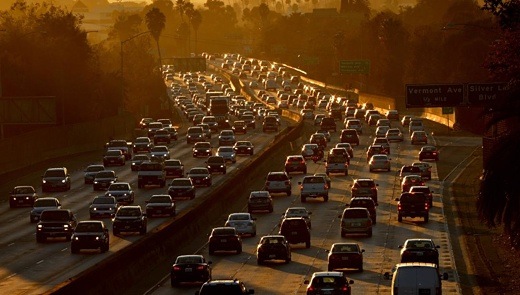
Image above: Evening rush hour interstate traffic jam in Los Angeles. From (https://www.cnn.com/2018/02/27/americas/los-angeles-traffic/index.html).
How to live a more sustainable life? This question generates a lot of debate that is focused on what individuals can do in order to address problems like climate change.
For example, people are encouraged to shop locally, to buy organic food, to install home insulation, or to cycle more often.
But how effective is individual action when it is systemic social change that is needed? Individuals do make choices, but these are facilitated and constrained by the society in which they live.
Therefore, it may be more useful to question the system that requires many of us to travel and consume energy as we do.
Climate Change Policies
Policies to address climate change and other environmental problems are threefold: decarbonisation policies (encouraging renewable energy sources, electric cars, heat pumps), energy efficiency policies (decreasing energy input/output ratio of appliances, vehicles, buildings), and behavioural change policies (encouraging people to consume and behave more sustainably, for instance by adopting the technologies promoted by the two other policies).
The first two strategies aim to make existing patterns of consumption less resource-intensive through technical innovation alone. These policies ignore related processes of social change, which perhaps explains why they have not led to a significant decrease in energy demand or CO2-emissions.
Advances in energy efficiency have not resulted in lower energy demand, because they don’t address new and more resource-intensive consumption patterns that often emerge from more energy efficient technologies. [1] [2]
Likewise, renewable energy sources have not led to a decarbonisation of the energy infrastructure, because (total and per capita) energy demand is increasing faster than renewable energy sources are added. [3]
Consequently, the only way to reduce greenhouse gas emissions is to focus more on social change. Energy efficiency and decarbonisation policies need to be combined with “social innovation” if we want energy use and carbon emissions to go down.
This is where behavioural change policies come in. The third pillar of climate change policy tries to steer consumer choices and behaviours in a more sustainable direction.
Behavioural Change Policies
Instruments and policy packages designed to achieve behaviour change vary greatly, but most can be categorised either as “carrots, sticks, or sermons”. [4]
They can be economic incentives (such as grants for “green” products, energy taxes, soft loans), standards and regulations (such as building codes or vehicle emission standards), or the provisioning of information (more detailed energy bills, smart meters, awareness campaigns).
All these policy instruments are focused on what are thought to be the determinants of individual behaviours. [5-9] They assume that either individuals take rational decisions based on product price and information (the homo economicus model), or that behaviours are the outcomes of beliefs, attitudes and values (various value-belief models).
According to these dominant social theories, people engage in pro-environmental behaviour for self-interested reasons (because it is enjoyable or saves money), or for normative reasons (because they think it’s the right thing to do).
However, many pro-environmental actions involve a conflict between self-interested and normative reasons. Pro-environmental behaviour is often considered to be less profitable, less pleasurable, and/or more time-consuming.
Consequently, people need to make an effort to benefit the environment, and this is why, according to behavioural change researchers, pro-environmental values and attitudes are not necessarily matched by individuals’ behaviours – a phenomenon they call the “value-action gap”.
To close this gap, two strategies are proposed.
The first is to make normative goals more compatible with self-interested goals, either by decreasing the costs of pro-environmental actions, or by increasing the costs of harmful actions.
The second strategy is to strengthen normative goals, in the hope that people will engage in pro-environmental behaviour even if it is more expensive or effortful. This is usually pursued through awareness campaigns.
Individual Choice
However, the results of behavioural change policies have been disappointing so far. Two decades of climate-change related awareness campaigns have not decreased energy demand and carbon emissions in a significant way. The reason for this limited success is that existing attempts to change behaviour rest on a very narrow view of the social world. [10]
Behavioural change policies are based on the widespread agreement that what people do is in essence a matter of individual choice. [4] [11] [12] For example, whether people pick one mode of travel or another, is positioned as a matter of personal preference. [4] It follows that agency (the power to change) and responsibility for energy demand, consumption, and climate change are ultimately thought to lie within individual persons.
It is this concept of choice that lies behind strategies of intervention (persuasion, pricing, advice). Given better information or more appropriate incentives, “badly behaving” individuals are expected to change their minds and choose to adopt pro-environmental behaviours. [11]
Obviously, individuals do make choices about what they do and some of these are based on values and attitudes. For example, some people don’t eat meat, while others don’t drive cars, and still others live entirely off-the-grid.
However, the fact that most people do eat meat, do drive cars, and are connected to the electric grid is not simply an isolated matter of choice. Individuals do not exist in a vacuum. What people do is also conditioned, facilitated and constrained by societal norms, political institutions, public policies, infrastructures, technologies, markets and culture. [10] [13] [14]
The Limits of Individual Choice
As individuals, we may have degrees of choice, but our autonomy is always limited. [13] [14]
For example, we can buy a more energy efficient car, but we can’t provide our own cycling infrastructure, or make car drivers respect cyclists.
The Dutch and the Danish cycle a lot more than people in other industrialised nations, but that’s not because they are more environmentally conscious.
Rather, they cycle in part because there’s an excellent infrastructure of dedicated cycle lanes and parking spaces, because it is socially acceptable to be seen on a bike, even in office wear, and because car drivers have the skills and culture to deal with cyclists.
For example, Dutch drivers are taught that when they get out of the car, they should reach for the door handle using their right hand – forcing them to turn around so that they can see if there is a cyclist coming from behind.
Furthermore, in case of an accident between a car driver and a cyclist, the car driver is always considered responsible, even if the cyclist made a mistake.
Obviously, an individual in the UK or the US can decide to go cycling without this supporting infrastructure, culture, and legal framework, but it is less likely that large numbers of people will follow their example.
People in industrialised countries are often locked into unsustainable lifestyles, whether they like it or not. Without a smartphone and always-on internet, for example, it is becoming difficult to take part in modern society, as more and more daily chores depend on these technologies.
Once the connected smartphone is established as a ‘necessity’, an individual can still choose to buy an energy efficient device, but he or she can’t do anything about the fact that it will probably stop working after three years, and that it cannot be repaired.
Neither do have individuals the power to change the ever increasing bit rates on the internet, which systematically add to the energy use in data centers and network infrastructure because content providers keep “innovating”. [15]
An individual can try to consume as little as possible, but he or she shouldn’t expect too much help because the dominant economic system requires growth in order to survive.
Blaming Each Other
In sum, individuals can make pro-environmental choices based on attitudes and values, and they may inspire others to do the same, but there are so many other things involved that focusing on changing individual “behaviour” seems to miss the point. [4]
Trying to persuade people to live sustainably through individual behaviour change programmes will not address the larger and more significant structures and ideas that facilitate and limit their options.
In fact, by placing responsibility – and guilt – squarely on the individuals, attention is deflected away from the many institutions involved in structuring possible courses of action, and in making some very much more likely than others. [11]
The discourse of sustainable “behaviour” holds consumers collectively responsible for political and economic decisions, rather than politicians and economic actors themselves.
This makes pro-environmental “behaviour” policies rather divisive – it is the other individuals (for example meat eaters or car drivers) who are at fault for failing to consume or behave in line with particular values, rather than politicians, institutions and providers which enable unsustainable food and transport systems to develop and thrive.
As this example makes clear, individual behaviour change is not just a theoretical position, it is also a political position. Focusing on individual responsibility is in line with neoliberalism and often serves to suppress a systemic critique of political, economic and tech
Beyond Individual Behaviour
If significant societal transformations are required, it makes more sense to decenter individuals from the analysis and look at the whole picture.
Other approaches in social theory suggest that rather than being the expression of an individual’s values and attitudes, individual behaviour is in fact the observable expression of the social world, including socially shared tastes and meanings, knowledge and skills, and technology, infrastructure and institutions.
As such, behaviour is just the “tip of the iceberg”, and the effects of intervening in behaviour are limited accordingly.
A much better target for sustainability is the socially embedded underpinning of behaviour – the larger part of the iceberg that is under water. [13]
This might entail focusing not on individuals and choices but on the social organisation of everyday practices such as cooking, washing, shopping, or playing sports. How people perform these practices depends not only on individual choice, but also on the material, social and cultural context. [10] [13]
If social practices are taken to be the core units of analysis, rather than the individuals who perform them, it becomes possible to analyse and steer social change in a much more meaningful way. [10] [13]
• This article was written for the UK's Demand Centre. Check out their movie series about the making and evolution of energy demand.
[2] Labanca, Nicola, and Paolo Bertoldi. "Beyond energy efficiency and individual behaviours: policy insights from social practice theories." Energy Policy 115 (2018): 494-502.
[3] De Decker, Kris. “How (not) to resolve the energy crisis.” Low-tech Magazine, 2009
[4] Shove, Elizabeth, Mika Pantzar, and Matt Watson. The dynamics of social practice: Everyday life and how it changes. Sage, 2012.
[5] Martiskainen, Mari. "Affecting consumer behaviour on energy demand." (2007).
[6] Steg, Linda, et al. "An integrated framework for encouraging pro-environmental behaviour: The role of values, situational factors and goals." Journal of Environmental Psychology 38 (2014): 104-115.
[7] Evans, Laurel, et al. "Self-interest and pro-environmental behaviour." Nature Climate Change 3.2 (2013): 122.
[8] Turaga, Rama Mohana R., Richard B. Howarth, and Mark E. Borsuk. "Pro‐environmental behavior." Annals of the New York Academy of Sciences 1185.1 (2010): 211-224.
[9] Kollmuss, Anja, and Julian Agyeman. "Mind the gap: why do people act environmentally and what are the barriers to pro-environmental behavior?." Environmental education research 8.3 (2002): 239-260.
[10] Hargreaves, Tom. "Practice-ing behaviour change: Applying social practice theory to pro-environmental behaviour change." Journal of consumer culture 11.1 (2011): 79-99.
[11] Shove, Elizabeth. "Beyond the ABC: climate change policy and theories of social change." Environment and planning A 42.6 (2010): 1273-1285.
[12] Southerton, Dale, Andrew McMeekin, and David Evans. International review of behaviour change initiatives: Climate change behaviours research programme. Scottish Government Social Research, 2011.
[13] Spurling, Nicola Jane, et al. "Interventions in practice: Reframing policy approaches to consumer behaviour." (2013).
[14] Mattioli, Giulio. "Transport needs in a climate-constrained world. A novel framework to reconcile social and environmental sustainability in transport." Energy Research & Social Science 18 (2016): 118-128.
[15] De Decker, Kris. "Why we need a speed limit for the Internet." Low Tech Magazine. (2015).
.
By Kris DeDecker on 5 July 2018 for Low Tech Magazine -
(http://www.lowtechmagazine.com/2018/07/we-cant-do-it-ourselves.html)
Image above: Evening rush hour interstate traffic jam in Los Angeles. From (https://www.cnn.com/2018/02/27/americas/los-angeles-traffic/index.html).
How to live a more sustainable life? This question generates a lot of debate that is focused on what individuals can do in order to address problems like climate change.
For example, people are encouraged to shop locally, to buy organic food, to install home insulation, or to cycle more often.
But how effective is individual action when it is systemic social change that is needed? Individuals do make choices, but these are facilitated and constrained by the society in which they live.
Therefore, it may be more useful to question the system that requires many of us to travel and consume energy as we do.
Climate Change Policies
Policies to address climate change and other environmental problems are threefold: decarbonisation policies (encouraging renewable energy sources, electric cars, heat pumps), energy efficiency policies (decreasing energy input/output ratio of appliances, vehicles, buildings), and behavioural change policies (encouraging people to consume and behave more sustainably, for instance by adopting the technologies promoted by the two other policies).
The first two strategies aim to make existing patterns of consumption less resource-intensive through technical innovation alone. These policies ignore related processes of social change, which perhaps explains why they have not led to a significant decrease in energy demand or CO2-emissions.
Advances in energy efficiency have not resulted in lower energy demand, because they don’t address new and more resource-intensive consumption patterns that often emerge from more energy efficient technologies. [1] [2]
Likewise, renewable energy sources have not led to a decarbonisation of the energy infrastructure, because (total and per capita) energy demand is increasing faster than renewable energy sources are added. [3]
Consequently, the only way to reduce greenhouse gas emissions is to focus more on social change. Energy efficiency and decarbonisation policies need to be combined with “social innovation” if we want energy use and carbon emissions to go down.
This is where behavioural change policies come in. The third pillar of climate change policy tries to steer consumer choices and behaviours in a more sustainable direction.
Behavioural Change Policies
Instruments and policy packages designed to achieve behaviour change vary greatly, but most can be categorised either as “carrots, sticks, or sermons”. [4]
They can be economic incentives (such as grants for “green” products, energy taxes, soft loans), standards and regulations (such as building codes or vehicle emission standards), or the provisioning of information (more detailed energy bills, smart meters, awareness campaigns).
All these policy instruments are focused on what are thought to be the determinants of individual behaviours. [5-9] They assume that either individuals take rational decisions based on product price and information (the homo economicus model), or that behaviours are the outcomes of beliefs, attitudes and values (various value-belief models).
According to these dominant social theories, people engage in pro-environmental behaviour for self-interested reasons (because it is enjoyable or saves money), or for normative reasons (because they think it’s the right thing to do).
However, many pro-environmental actions involve a conflict between self-interested and normative reasons. Pro-environmental behaviour is often considered to be less profitable, less pleasurable, and/or more time-consuming.
Consequently, people need to make an effort to benefit the environment, and this is why, according to behavioural change researchers, pro-environmental values and attitudes are not necessarily matched by individuals’ behaviours – a phenomenon they call the “value-action gap”.
To close this gap, two strategies are proposed.
The first is to make normative goals more compatible with self-interested goals, either by decreasing the costs of pro-environmental actions, or by increasing the costs of harmful actions.
The second strategy is to strengthen normative goals, in the hope that people will engage in pro-environmental behaviour even if it is more expensive or effortful. This is usually pursued through awareness campaigns.
Individual Choice
However, the results of behavioural change policies have been disappointing so far. Two decades of climate-change related awareness campaigns have not decreased energy demand and carbon emissions in a significant way. The reason for this limited success is that existing attempts to change behaviour rest on a very narrow view of the social world. [10]
Behavioural change policies are based on the widespread agreement that what people do is in essence a matter of individual choice. [4] [11] [12] For example, whether people pick one mode of travel or another, is positioned as a matter of personal preference. [4] It follows that agency (the power to change) and responsibility for energy demand, consumption, and climate change are ultimately thought to lie within individual persons.
It is this concept of choice that lies behind strategies of intervention (persuasion, pricing, advice). Given better information or more appropriate incentives, “badly behaving” individuals are expected to change their minds and choose to adopt pro-environmental behaviours. [11]
Obviously, individuals do make choices about what they do and some of these are based on values and attitudes. For example, some people don’t eat meat, while others don’t drive cars, and still others live entirely off-the-grid.
However, the fact that most people do eat meat, do drive cars, and are connected to the electric grid is not simply an isolated matter of choice. Individuals do not exist in a vacuum. What people do is also conditioned, facilitated and constrained by societal norms, political institutions, public policies, infrastructures, technologies, markets and culture. [10] [13] [14]
The Limits of Individual Choice
As individuals, we may have degrees of choice, but our autonomy is always limited. [13] [14]
For example, we can buy a more energy efficient car, but we can’t provide our own cycling infrastructure, or make car drivers respect cyclists.
The Dutch and the Danish cycle a lot more than people in other industrialised nations, but that’s not because they are more environmentally conscious.
Rather, they cycle in part because there’s an excellent infrastructure of dedicated cycle lanes and parking spaces, because it is socially acceptable to be seen on a bike, even in office wear, and because car drivers have the skills and culture to deal with cyclists.
For example, Dutch drivers are taught that when they get out of the car, they should reach for the door handle using their right hand – forcing them to turn around so that they can see if there is a cyclist coming from behind.
Furthermore, in case of an accident between a car driver and a cyclist, the car driver is always considered responsible, even if the cyclist made a mistake.
Obviously, an individual in the UK or the US can decide to go cycling without this supporting infrastructure, culture, and legal framework, but it is less likely that large numbers of people will follow their example.
People in industrialised countries are often locked into unsustainable lifestyles, whether they like it or not. Without a smartphone and always-on internet, for example, it is becoming difficult to take part in modern society, as more and more daily chores depend on these technologies.
Once the connected smartphone is established as a ‘necessity’, an individual can still choose to buy an energy efficient device, but he or she can’t do anything about the fact that it will probably stop working after three years, and that it cannot be repaired.
Neither do have individuals the power to change the ever increasing bit rates on the internet, which systematically add to the energy use in data centers and network infrastructure because content providers keep “innovating”. [15]
An individual can try to consume as little as possible, but he or she shouldn’t expect too much help because the dominant economic system requires growth in order to survive.
Blaming Each Other
In sum, individuals can make pro-environmental choices based on attitudes and values, and they may inspire others to do the same, but there are so many other things involved that focusing on changing individual “behaviour” seems to miss the point. [4]
Trying to persuade people to live sustainably through individual behaviour change programmes will not address the larger and more significant structures and ideas that facilitate and limit their options.
In fact, by placing responsibility – and guilt – squarely on the individuals, attention is deflected away from the many institutions involved in structuring possible courses of action, and in making some very much more likely than others. [11]
The discourse of sustainable “behaviour” holds consumers collectively responsible for political and economic decisions, rather than politicians and economic actors themselves.
This makes pro-environmental “behaviour” policies rather divisive – it is the other individuals (for example meat eaters or car drivers) who are at fault for failing to consume or behave in line with particular values, rather than politicians, institutions and providers which enable unsustainable food and transport systems to develop and thrive.
As this example makes clear, individual behaviour change is not just a theoretical position, it is also a political position. Focusing on individual responsibility is in line with neoliberalism and often serves to suppress a systemic critique of political, economic and tech
Beyond Individual Behaviour
If significant societal transformations are required, it makes more sense to decenter individuals from the analysis and look at the whole picture.
Other approaches in social theory suggest that rather than being the expression of an individual’s values and attitudes, individual behaviour is in fact the observable expression of the social world, including socially shared tastes and meanings, knowledge and skills, and technology, infrastructure and institutions.
As such, behaviour is just the “tip of the iceberg”, and the effects of intervening in behaviour are limited accordingly.
A much better target for sustainability is the socially embedded underpinning of behaviour – the larger part of the iceberg that is under water. [13]
This might entail focusing not on individuals and choices but on the social organisation of everyday practices such as cooking, washing, shopping, or playing sports. How people perform these practices depends not only on individual choice, but also on the material, social and cultural context. [10] [13]
If social practices are taken to be the core units of analysis, rather than the individuals who perform them, it becomes possible to analyse and steer social change in a much more meaningful way. [10] [13]
By shifting the focus away from individual choice, it becomes clear that individual behaviour change policies only represent incremental, minimal or marginal shifts at the level of a practice. At the same time, it reveals the extent to which state and other actors configure daily life.
For example, the idea that a car equals personal freedom is a recurrent theme in car advertisements, which are much more numerous than campaigns to promote cycling.
And because different modes of transport compete for the same roadspace, it is governments and local authorities that decide which forms get priority depending on the infrastructures they build.
When the focus is on practices, the so-called “value-action gap” can no longer be interpreted as evidence of individual ethical shortcomings or individual inertia. Rather, the gap between people’s attitudes and their “behaviour” is due to systemic issues: individuals live in a society that makes many pro-environmental arrangements rather unlikely.
The New Normal
In conclusion, although individual behavioural change policies purport to address social and not just technological change, they do so in a very limited way.
As a result, they have exactly the same shortcomings as the other strategies, which are focused on efficiency and innovation. [2] Like energy efficiency and decarbonisation policies, behaviour change policies don’t challenge unsustainable social conventions or infrastructures.
They don’t consider wider-ranging system level changes which would radically transform the way we live – and that could potentially achieve much more significant reductions in energy use and greenhouse gas emissions.
For example, recycling garbage does not question the production of waste in the first place, and even legitimizes it. By diverting attention away from systemic issues that drive energy demand, behavioural change policies frequently reinforce the status quo. [11-13]
In contrast to policies aimed at individuals, policies that frame sustainability as a systemic, institutional challenge can bring about the many forms of innovation that are needed to address problems like climate change.
Relevant societal innovation is that in which contemporary rules of the game are eroded, in which the status quo is called into question, and in which more sustainable practices take hold across all domains of daily life. [11]
Social change is about transforming what counts as “normal” – as in smoke-free pubs or wearing seat belts. We only need to look back a few decades to see that practices are constantly and often radically changing. A systemic approach to sustainability encourages us to imagine what the “new normal” of everyday sustainability might look like. [13]
A sustainability policy that focuses on systemic issues reframes the question from “how do we change individuals’ behaviours so that they are more sustainable?” to “how do we change the way society works?”. This leads to very different kinds of interventions.
Addressing the sociotechnical underpinnings of “behaviour” involves attempting to create new infrastructures and institutions that facilitate sustainable lifestyles, attempting to shift cultural conventions that underpin different activities, and attempting to encourage new competences that are required to perform new ways of doing things. As a result of these changes, what we think of as individual “behaviours” will also change.
For example, the idea that a car equals personal freedom is a recurrent theme in car advertisements, which are much more numerous than campaigns to promote cycling.
And because different modes of transport compete for the same roadspace, it is governments and local authorities that decide which forms get priority depending on the infrastructures they build.
When the focus is on practices, the so-called “value-action gap” can no longer be interpreted as evidence of individual ethical shortcomings or individual inertia. Rather, the gap between people’s attitudes and their “behaviour” is due to systemic issues: individuals live in a society that makes many pro-environmental arrangements rather unlikely.
The New Normal
In conclusion, although individual behavioural change policies purport to address social and not just technological change, they do so in a very limited way.
As a result, they have exactly the same shortcomings as the other strategies, which are focused on efficiency and innovation. [2] Like energy efficiency and decarbonisation policies, behaviour change policies don’t challenge unsustainable social conventions or infrastructures.
They don’t consider wider-ranging system level changes which would radically transform the way we live – and that could potentially achieve much more significant reductions in energy use and greenhouse gas emissions.
For example, recycling garbage does not question the production of waste in the first place, and even legitimizes it. By diverting attention away from systemic issues that drive energy demand, behavioural change policies frequently reinforce the status quo. [11-13]
In contrast to policies aimed at individuals, policies that frame sustainability as a systemic, institutional challenge can bring about the many forms of innovation that are needed to address problems like climate change.
Relevant societal innovation is that in which contemporary rules of the game are eroded, in which the status quo is called into question, and in which more sustainable practices take hold across all domains of daily life. [11]
Social change is about transforming what counts as “normal” – as in smoke-free pubs or wearing seat belts. We only need to look back a few decades to see that practices are constantly and often radically changing. A systemic approach to sustainability encourages us to imagine what the “new normal” of everyday sustainability might look like. [13]
A sustainability policy that focuses on systemic issues reframes the question from “how do we change individuals’ behaviours so that they are more sustainable?” to “how do we change the way society works?”. This leads to very different kinds of interventions.
Addressing the sociotechnical underpinnings of “behaviour” involves attempting to create new infrastructures and institutions that facilitate sustainable lifestyles, attempting to shift cultural conventions that underpin different activities, and attempting to encourage new competences that are required to perform new ways of doing things. As a result of these changes, what we think of as individual “behaviours” will also change.
• This article was written for the UK's Demand Centre. Check out their movie series about the making and evolution of energy demand.
References:
[1] Shove, Elizabeth. "What is wrong with energy efficiency?." Building Research & Information (2017): 1-11.[2] Labanca, Nicola, and Paolo Bertoldi. "Beyond energy efficiency and individual behaviours: policy insights from social practice theories." Energy Policy 115 (2018): 494-502.
[3] De Decker, Kris. “How (not) to resolve the energy crisis.” Low-tech Magazine, 2009
[4] Shove, Elizabeth, Mika Pantzar, and Matt Watson. The dynamics of social practice: Everyday life and how it changes. Sage, 2012.
[5] Martiskainen, Mari. "Affecting consumer behaviour on energy demand." (2007).
[6] Steg, Linda, et al. "An integrated framework for encouraging pro-environmental behaviour: The role of values, situational factors and goals." Journal of Environmental Psychology 38 (2014): 104-115.
[7] Evans, Laurel, et al. "Self-interest and pro-environmental behaviour." Nature Climate Change 3.2 (2013): 122.
[8] Turaga, Rama Mohana R., Richard B. Howarth, and Mark E. Borsuk. "Pro‐environmental behavior." Annals of the New York Academy of Sciences 1185.1 (2010): 211-224.
[9] Kollmuss, Anja, and Julian Agyeman. "Mind the gap: why do people act environmentally and what are the barriers to pro-environmental behavior?." Environmental education research 8.3 (2002): 239-260.
[10] Hargreaves, Tom. "Practice-ing behaviour change: Applying social practice theory to pro-environmental behaviour change." Journal of consumer culture 11.1 (2011): 79-99.
[11] Shove, Elizabeth. "Beyond the ABC: climate change policy and theories of social change." Environment and planning A 42.6 (2010): 1273-1285.
[12] Southerton, Dale, Andrew McMeekin, and David Evans. International review of behaviour change initiatives: Climate change behaviours research programme. Scottish Government Social Research, 2011.
[13] Spurling, Nicola Jane, et al. "Interventions in practice: Reframing policy approaches to consumer behaviour." (2013).
[14] Mattioli, Giulio. "Transport needs in a climate-constrained world. A novel framework to reconcile social and environmental sustainability in transport." Energy Research & Social Science 18 (2016): 118-128.
[15] De Decker, Kris. "Why we need a speed limit for the Internet." Low Tech Magazine. (2015).
.