Showing posts with label Landscape. Show all posts

Fragile

SUBHEAD: To recover from ecological crisis, we must transform our who we are in relation to the Earth.

By Peter Reason on 31 May 2017 for Dark Mountain -
(http://dark-mountain.net/blog/fragile/)
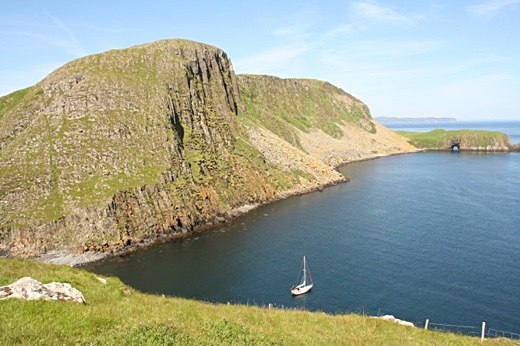

Image above: A small sailboat anchored in the lee of a small island east of Ireland. From original article.

[Dark Mountain Editor's note: ‘To recover from ecological crisis, we humans must transform our sense of who we are in relation to the Earth.’ In 2011 Peter Reason sailed his little yacht Coral from the south coast of England to the west coast of Ireland, a journey recorded in his book Spindrift: A Wilderness Journey at Sea. This week we bring you an excerpt from his latest book In Search of Grace: An Ecological Pilgrimage, which follows the further voyages of Coral to the far north of Scotland.]
 
I steered my little yacht Coral through the confused water of the tidal stream that poured out between Garbh Eilean and Eilean Mhuire. The calm pool opened in front of me, littered with specks of white as if some giant had cast handfuls of torn up paper across the surface.

Soon Coral was surrounded by puffins, with their startling white breasts, the distinctive markings around their eyes and brightly coloured beaks. The air was full of puffins too, so full they seemed more like a cloud of mosquitoes than a flock of birds.

I was in the final stages of my travels, which over two summers had taken me and Coral from the south coast of England, round the west coast of Ireland and through the Western Isles to the far north of Scotland, mainly single handed.

As I turned southward, I made for the small archipelago of the Shiant Islands, an isolated group, separated from Lewis by the Sound of Shiant, notorious for its strong tides, overfalls and underwater hazards.


I saw my travels as an ecological pilgrimage. There is a longstanding tradition in most human societies of making a journey, more or less arduous, away from the comforts of home in search of new insights and deeper understandings.

This practice may be as old as the human species: Mesolithic peoples in Europe certainly made long journeys to the sacred sites marked by stone circles; the Aboriginal people of Australia take extended walks along ‘songlines’, re-enacting the journeys of ‘creator-beings’ during the Dream Time.

The idea and practice of pilgrimage developed in a religious context. One thinks of the requirement of good Muslims to undertake the Hajj at least once in their lives; of the Christian pilgrimages of the Middle Ages and the continuing contemporary practices; of the vast numbers of Hindu devotees who travel to sacred sites on the River Ganges; and of Buddhists who walk the difficult path to circumnambulate Mount Kailash.

In its fullest sense, pilgrimage entails a long journey in search of qualities of moral or spiritual significance, a journey across both outer physical and inner spiritual landscapes. Pilgrims separate themselves from home and familiars, maybe joining a group of like-minded seekers and wearing special clothes or other marks to indicate their pilgrim status.

The pilgrimage journey offers a fluid and imaginative space between the everyday and the eternal, a liminal zone between body and soul, heaven and Earth, humanity and divinity. For it is not easy to move across the boundaries between these worlds when locked in the familiarity of the everyday.

Religious pilgrimages are taken to sacred sites in order to encounter a holy realm for worship and the affirmation of faith, in search of illumination and for healing.

As I conceive it, the ecological pilgrimage seeks a primal, heartfelt connection with the Earth itself and the community of life that has evolved on Earth.

It is also a celebration and an act of homage, honouring the Earth as the more-than-human world of which we are a part, existing for itself rather than for human use.

By taking the pilgrim away from the habits of civilization and by disrupting the patterns of everyday life, pilgrimage offers an opening to a different view of the Earth of which we are a part.


Before I left for Scotland, I read about the Shiant Islands and studied the sailing directions. I learned to pronounce the name properly, in one softened syllable: ‘Shant’.

The little archipelago is made up of three rugged islands: to the west Garbh Eilean and Eilean an Tighe are joined by a natural boulder isthmus; across an open pool to the northeast lies Eilean Mhuire.

Adam Nicolson, whose family have owned the islands for many years writes; 
‘The rest of the world thinks there is nothing much to them. Even on a map of the Hebrides the tip of your little finger would blot them out. But the Shiants… are not modest. They stand out high and undoubtable.’ 
Although keen to visit, I doubted whether it would be possible, for they are very exposed and offer little shelter. But it seemed I was lucky: the weather was quiet, with a smooth sea yet enough wind to sail.

Nevertheless, I approached them with caution, keeping an eye on the tidal streams and carefully noting landmarks.

Once I was safely in the pool and had got over the thrill of seeing so many puffins, I turned my attention to getting Coral settled.

The recommended anchorage is by the isthmus that connects Garbh Eilean and Eilean an Tighe.
This is protected from the prevailing westerly winds, but open to the light easterlies blowing that morning.

Since these volcanic islands rise abruptly from the seabed, the bottom shoals steeply and consists of boulders, so there is sediment of mud or sand into which the anchor can sink and get a good grip.

It took a little while before I was happy that the anchor was holding, with Coral tucked into the corner between the isthmus and the precipitous cliffs of Eilean an Tighe.

With Coral safely anchored, I could look around. I soon realised that there were nearly as many razorbills as puffins in the pool.

They are also auks, but rather bigger, distinguished by a black beak with a white line across it, joining a similar line across the face to the eye.

The razorbills seem on the whole less nervous than the puffins: I watched one swimming within a couple of yards of Coral, quite undisturbed as I moved about the deck.

When it decided to dive I was able to watch it turn tail up and, once underwater, open its wings to fly down beneath Coral’s keel, the bubbles of air around its feathers gleaming as they caught the sunlight.

Looking up again across the pool, I realized that there were tens of thousands of puffins and razorbills, for this is one of the major nesting places in the North Atlantic.

There were, of course, other birds: shags, black-backed gulls, kittiwakes, fulmars, guillemots, and the odd gannet.

For me the most impressive were the skuas, big, heavily built seabirds, brown, with two white stripes on their wing. Skuas are known as ‘kleptoparasites’ because of their habit of stealing food from other birds: I watched one attack a gull, hanging onto its wing as they tumbled together to the water to make it regurgitate its meal.

I am sure that given half a chance they would snatch a puffin chick, as would the big gulls. I imagined the links in the local food chain: marine plankton feeding sand-eels, sand-eels feeding baby birds and baby birds feeding skuas and gulls.

I spent the afternoon sitting in the cockpit watching the birds and enjoying the changing light. A few yachts visited, but none stayed for long; a couple of fishing boats chugged through the pool.

As the long northern evening drew in I began preparations for the night. The weather was calm enough for it to be safe to stay overnight at the islands, but I wanted to move to a more secure anchorage.

The dark cliffs and the stony isthmus looked too close, and if the anchor were to drag Coral would soon be ashore. Even if the light winds persisted through the night, it felt unseamanlike to sleep while she was anchored off a lee shore where there was poor holding.

So I hauled up the anchor and motored round the end of Eilean an Tighe to the western side of the isthmus. This anchorage is open to the swell of the Little Minch and disturbed by the tidal movement through the Sound of Shiant.

Despite this, with the light wind blowing Coral away from the islands, she felt safer. Two Danish yachts had already taken the best positions but I was able to find a spot where the anchor held closer inshore.

In the early evening the crews of the Danish yachts returned from their expeditions ashore, and soon there was a whiff of diesel and rattle of anchor chains as they left the anchorage and disappeared north round the end of Garbh Eilean.

With their departure I felt suddenly alone and vulnerable. I checked the forecast on my iPhone yet again, even though that meant waiting ages for the weak signal to load the page.

I looked again at the anchor chain – it was hanging almost vertical, I had plenty of scope out, so all was well there. I looked about me and consulted the chart to see how I would leave the anchorage in the dark if I needed to – there was sea room to the southwest.

There was no rational reason why I should not stay safely overnight, so I took myself in hand, sat down quietly, made myself breath properly and look out at the world around me rather than inwards to my anxieties. I might feel exposed, just a speck in a vast sky and expanse of sea, but I could relax and appreciate it.

The evening wore on, the light faded and I became enveloped in the quiet mystery of twilight. Coral pitched gently on the light swell. Little waves rolled continuously up to the stony shore and broke with a hollow crash on the boulders.

The mound of Garbh Eilean loomed above me, dark against the evening sky, the details of the basalt columns obscured. Nicolson’s little cottage on Eilean an Tighe stood out ghostly white, then, as the light faded away, merged with the hillside behind.

 Looking over Coral’s stern, past the line of rocks and islets that stretches toward the mainland, I searched the surface of the Sound for a glimpse of the flashing green light on the buoy that marks Damhag. All I could see was the grey sea and the distant hazy line of Lewis.

Through the evening the inexhaustible stream of puffins flew overhead; the skuas and black-backed gulls continued their patrols around the cliff tops. If I peered out to sea I could just make out the white flash of gannets on a late search for fish. I sat out late, enchanted by my surroundings while still feeling strangely vulnerable, reluctant to go to bed.


The word that keeps coming to my mind to describe this evening is ‘fragile’. It captures both the strength and the vulnerability of my situation, of the puffins and of the islands themselves. The Shiants are the nesting ground of one of the last flourishing populations for puffins: huge populations in Iceland and elsewhere have quite suddenly disappeared as climate change has brought warm waters that have disturbed the delicate ecological balance on which they depend.

The basalt columns that form the Shiant Islands appear strong and stable, but are weakly jointed; over time, wind and waves penetrate the joints, allowing large chunks to break away. And indeed of all of us, despite the veneer of civilization, are at root unprotected in a wild world and the wild universe.

Our attention has been drawn to the fragility of Planet Earth by the space program. Ever since the early Apollo missions, pictures of planet Earth from space have been widely available, starting with the most famous ‘Earth Rising’, taken as Apollo 8 emerged from behind the moon.


Image above: Earthrise on Christmas Eve 1968. This photo was taken in black and white from the Apollo Command Module orbiting the Moon. NASA has colorized it from available data. From (https://earthobservatory.nasa.gov/IOTD/view.php?id=82693).

This has been called ‘the most influential environmental photograph ever taken’. For, it is argued, now that humanity can see the Earth alone within the vast reaches of space, we will realise her beauty, fragility and significance and band together to protect and preserve her as our home.

Astronauts report that they spend much of their spare time on missions simply ‘Earthgazing’.

NASA engineer Nicole Stott tells us;
‘I think you start out with this idea of what its going to be like, and then when you do finally look at the Earth for the first time you’re overwhelmed by how much more beautiful it really is…’
Shuttle astronaut Jeff Hoffman goes further;
'Earth looks like a living, breathing organism, but it also at the same time looks extremely fragile’. 
And Ron Garon, who served on the International Space Station, remembers;
 ‘When we look down on the Earth from space we see this amazing, indescribably beautiful planet… It’s really striking and its sobering to see this paper thin layer and to realize that that little paper thin layer is all that protects every living thing on Earth from death’.
Edgar Mitchell, who was the Lunar Module pilot on Apollo 14 and the sixth person to walk on the moon, is one of many astronauts to reflect deeply on their experience. His view is that it is not just that you get see the beauty and fragility from space, but there is also a shift in consciousness which he describes a close to the ancient accounts of savikalpa samādhi.

There is as a direct experience of interconnection:
‘You see things as you see them with your eyes but you experience them emotionally and viscerally as ecstasy and a sense of total unity and oneness…
It’s rather clear to me as I studied this that is was not anything new, but was something that was very important to the way we humans were put together’.
I wonder if the experience of the astronauts was so very far from my own as I sat in the long northern twilight off the Shiant Islands: it was just this kind of direct interconnection that I was seeking on my ecological pilgrimage.

Of course, I am not among those who first saw Earth rising from behind the moon; I have not watched the shadow of night move across the face of the Earth; nor I have experienced the thin blue line of the biosphere clinging to the curve of the planet.

And yet, as Mitchell points out, the astronauts’ experience of oneness is nothing new. I think we may idealize their experience and in doing so see the capability of experiencing oneness as something special, something extraordinary, something for which we have to go outside the planet.

Maybe it is better to see it as a dimension of human consciousness that we modern humans have neglected and marginalised, rather than something only available from outer space.

Maybe a better way to celebrate the astronauts’ experience, the way that ‘Earth Rising’ might change human consciousnesses, the way it might kick-start a true environmental movement, is realise our own capacity for such experiences.

Zen masters teach us not to seek the extraordinary, not to look for special or ‘sacred’ places. To seek that seeking prevents us from seeing what is before our eyes – the specialness of the everyday, how everything rolls together in being and nonbeing, how we are every moment part of a living planet.

These are capabilities that we must bring back to ourselves, and not just to our pilgrimages into the wild, but into our homes, our gardens, our cities, the everyday world around us and our relationships with other humans.


As the darkness finally gathered off the Shiants and day finally rolled into night, my long watch was rewarded by the waxing crescent moon rising, a deep red, between the two dark humps of the islands. The overhead stream of puffins ceased, and I too was at last content to climb down the companionway and sleep.

[Dark Mountain Editor's note: In Search of Grace is the story of an ecological pilgrimage undertaken by the author from the south coast of England, round the west coast of Ireland to the far north of Scotland. It explores themes of pilgrimage, the overall pattern of separation from the everyday, venturing forth and returning home. It tells of meeting wildlife, visiting sacred places, confronting danger, expanding and deepening the experience of time, of silence, of fragility.
It will be published in October 2017 by Earth Books. You can read pre-publication reviews, more excerpts from the book and watch a video describing the journey here.]


.
Landspeak

SUBHEAD: Words which do not simply label a place but in some mysterious and beautiful way become part of it.

By Robert Macfarlane on 15 May 2015 for Orion Magazine -
(https://orionmagazine.org/article/landspeak/)


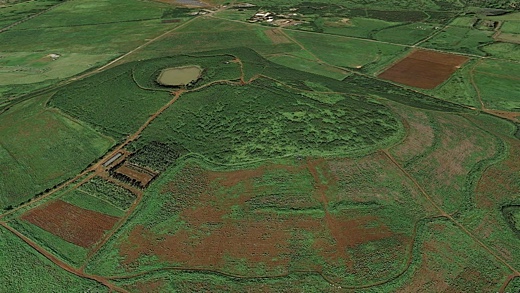
Image above: The Hawaiian language is rich with place names; all with multiple meanings. "Puu" is a Hawaiian word for a conical land formation of a volcano that also implies a throat or pump (http://www.wehewehe.org). Pictured here (from GoogleEarth) is a "Puu" in Koloa, Kauai, Hawaii named Puuhi, where the ahupuaa (districts) of Weliweli, Paa and Mahaulepu join.  Puu formations are often places where Hawaiians districts meet and are sometimes locations where water can be distributed from one district to another. Puuhi became a reservoir for the first sugarcane plantation in Hawaii. In the distance is the site of the Koloa Sugar Mill.  When "Puu" is combined with the word "Wai", as in the word "Puuwai", they create the word for "heart". "Wai"  means fresh water (or any organic fluid not from salt water; such as honey, sap, semen or blood). The only "town" on the Hawaiian island of Niihau is called Puuwai (or Heart). It is the only place in Hawaii where all the residence speak the language. 

For over a decade I have been collecting place-words: gleaned singly from conversations, correspondences, or books, and jotted down in journals or on slips of paper. Now and then I have hit buried treasure in the form of vernacular dictionaries or extraordinary people—troves that have held gleaming handfuls of coinages.

One such trove turned up on the moors of the Outer Hebridean island of Lewis in 2007. There, I was shown a “Peat Glossary”: a word-list of the hundreds of Gaelic terms for the moorland that stretches over much of Lewis’s interior. Some of the language it recorded was still spoken—but much had fallen into disuse.

The same year I first saw the Peat Glossary, a new edition of the Oxford Junior Dictionary was published. A sharp-eyed reader noticed that there had been a culling of words concerning nature. Under pressure, Oxford University Press revealed a list of the entries it no longer felt to be relevant to a modern-day childhood.

The deletions included acorn, adder, ash, beech, bluebell, buttercup, catkin, conker, cowslip, cygnet, dandelion, fern, hazel, heather, heron, ivy, kingfisher, lark, mistletoe, nectar, newt, otter, pasture, and willow.

The words introduced to the new edition included attachment, block-graph, blog, broadband, bullet-point, celebrity, chatroom, committee, cut-and-paste, MP3 player, and voice-mail.

The substitutions made in the dictionary—the outdoor and the natural being displaced by the indoor and the virtual—are a small but significant symptom of the simulated life we increasingly live. Children are now (and valuably) adept ecologists of the technoscape, with numerous terms for file types but few for differ-ent trees and creatures.

A basic literacy of landscape is falling away up and down the ages. And what is lost along with this literacy is something precious: a kind of word magic, the power that certain terms possess to enchant our relations with nature and place.

As the writer Henry Porter observed, the OUP deletions removed the “euphonious vocabulary of the natural world—words which do not simply label an object or action but in some mysterious and beautiful way become part of it.”

Consider ammil, a Devon term meaning “the sparkle of morning sunlight through hoar-frost,” a beautifully exact word for a fugitive phenomenon I have several times seen but never before been able to name. Shetlandic has a word, pirr, meaning “a light breath of wind, such as will make a cat’s paw on the water”; and another, klett, for “a low-lying earth-fast rock on the seashore.”

On Exmoor, zwer is the onomatopoeic term for the sound made by a covey of partridges taking flight. Smeuse is a Sussex dialect noun for “the gap in the base of a hedge made by the regular passage of a small animal”; now that I know the word smeuse, I will notice these signs of creaturely movement more often.

The variant English terms for icicle—aquabob (Kent), clinkerbell and daggler (Wessex), cancervell (Exmoor), ickle (Yorkshire), tankle (Durham), shuckle (Cumbria)—form a tinkling poem of their own. Blinter is a northern Scots word meaning “a cold dazzle,” connoting especially “the radiance of winter stars on a clear night,” or “ice-splinters catching low light.”

Instantly the word opens prospects: walking sunwards through snow late on a midwinter day, with the wind shifting spindrift into the air such that the ice-dust acts as a prismatic mist, refracting sunshine into its pale and separate colors; or out on a crisp November night in a city garden, with the lit windows of houses and the orange glow of street light around, while the stars blinter above in the cold high air.

I would not have guessed at the existence of quite so many terms for animal dung, from crottle (a foresters’ term for hare excrement) to doofers (Scots for horse shit) to the expressive ujller (Shetlandic for the “unctuous filth that runs from a dunghill”) and turdstool (West Country for a very substantial cowpat).

Nor did I know that a dialect name for the kestrel, alongside such felicities as windhover and bell-hawk, is wind-fucker. Once learnt, never forgotten—it is hard now not to see in the pose of the hovering kestrel a certain lustful quiver.

In The History of the Countryside, the great botanist Oliver Rackham describes four ways in which “landscape is lost”: through the loss of beauty, the loss of freedom, the loss of wildlife and vegetation, and the loss of meaning. I admire the way that aesthetics, human experience, ecology, and semantics are given parity in his list. Of these losses the last is hardest to measure.

I do not, of course, believe that such words will magically summon us into a pure realm of harmony and communion with nature. Rather that they might offer a vocabulary that is “convivial” as the philosopher Ivan Illich intended the word—meaning enriching of life, stimulating to the imagination, and “encouraging creative relations between people, and people and nature.”

And, perhaps, that the vibrancy of perception evoked in these glossaries may irrigate the dry metalanguages of modern policymaking (the Department for Environment, Food and Rural Affairs, for instance, offers such tautological aridities as “Land use: the use to which a piece of land is put”).

For there is no single mountain language, but a range of mountain languages; no one coastal language, but a fractal of coastal languages; no lone tree language, but a forest of tree languages.

As I have traveled, I have come to under­stand that although place-words are being lost, they are also being ­created. I met a painter in the Hebrides who used landskein to refer to the braid of blue horizon lines in hill country on a hazy day; and a five-year-old girl who concocted honeyfur to describe the soft seeds of grasses held in the fingers.

John Constable invented the verb to sky, meaning “to lie on one’s back and study the clouds.” We have forgotten ten thousand words for our landscapes, but we will make ten thousand more, given time.

Of course there are experiences of landscape that will always resist articulation, and of which words offer only a remote echo—or to which silence is by far the best response. Nature does not name itself.

Granite does not self-identify as igneous. Light has no grammar. Language is always late for its subject. Sometimes on the top of a mountain I just say, “Wow.”

• Robert Macfarlane lives in Cambridge and is author of The Wild Places and The Old Ways. The text that appears here is adapted from his book Landmarks, forthcoming from Trafalgar in
.

Beauty in a Landscape

SUBHEAD:  The post-modern American hedgerow, a landscape form that offers benefits to humans and nature.

By Adrian Ayres Fisher on 18 November 2014 for Ecological Gardening -
(http://www.ecologicalgardening.net/2014/11/where-do-we-find-beauty-in-landscape.html)


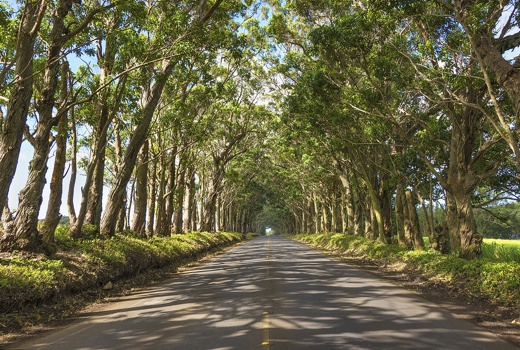
Image above: Separating agland from the road are hedgerows of eucalyptus creating the Tree Tunnel on the way to Poipu, Kauai, Hawaii. Photo by Brian Harig. From (http://fineartamerica.com/featured/eucalyptus-tree-tunnel-kauai-hawaii-brian-harig.html).

Part one of a series on the post-modern American hedgerow, a landscape form that offers benefits to humans and nature.

Before we get to hedgerows’ multifaceted functionality and usefulness, and why and how we should plant them, let’s start with beauty, a quality not often associated with the mundane, anthropocentric landscapes, whether urban, suburban or rural, of many parts of the Midwest—or elsewhere in the US, for that matter. Beauty—deep, profound, emerging through complexity, impossible to quantify—matters immensely.

As Aldo Leopold and a host of others, most recently Courtney White in Land, Soil, Hope, have pointed out, though there is struggle, suffering and disease, predation and often early death among the wild denizens, enmeshed in the food web as they are, nevertheless, an ecologically sound landscape—wherever it is, however lush, arid or in between—is beautiful in a way a degraded one can never be.

Beauty’s necessity is a fact of life for indigenous peoples and for us moderns who have lived close to the land in regenerative fashion, who’ve been worked on by it until we have become re-enchanted, until we’ve have become naturalized citizens of our home ecosystems. Artists, writers, poets, composers and musicians have always known and celebrated this fact, as have certain religious writers, philosophers and scientists.

I believe even the most urbanized, nature-phobic among us recognize and understand this necessity, though they may be unaware of it, or may have suppressed this knowledge to the detriment of their own psychic health and much else.

Because of the extreme degradation of so many human-occupied landscapes, some people might only associate beauty with a manicured corporate campus, or Disney-fied theme park, with the neat and tidy in general.

 Some of these landscapes might be pretty, but they have none of the deep mystery and complexity—and delight—that beauty entails. Others might only associate wild nature’s beauty—and ecosystem health—with nature reserves, national parks, and places of spectacular scenery well away from cities.

This camp includes people, even respected conservationists and scientists, who hold the ethos that true ecosystem health and beauty depend on a lack of humans in the landscape, where nature can do its thing free of our interference.

This attitude is important and necessary: it is why we need and have our great national parks and nature reserves and must continue to set aside land where other species can live and humans can visit without the threat of shopping malls apartment complexes, industrial farming and, worse, extractive industries, ruining the land.

However, and this is where hedgerows and other forms of greenways such as wildlife corridors come in, human-occupied landscapes can also be ecologically sound, full of a beauty not imposed according to strictly human rules and principles.

While an overly controlled landscape or one managed only for short-term gain, function or appearances never can be beautiful, a working landscape will be beautiful if it is managed with close attention to natural processes and room for the messy complexity of wild nature.

Unless there is room for wild nature, there will be no beauty or health—and there will be no life, in the sense of all the processes and cycles of living and dying that form that landscape.

There will only be that tendency toward cessation, toward depletion, degradation and impoverishment—toward death in its guise of “nevermore,” that is, of finality, of entropy, of extinction, of the dissolution of complexity that is the ruin of any piece of land.

As far as I know, the first peoples understood that humans can be part of an eco-system without destroying it, and that human influence is not necessarily negative.  I’m pretty sure that those original settlers of my part of the world never thought about the question of belonging or not in the terms set forth here.

Often the question was, and is, one of how humans can fit in properly, can earn the right to partake of the gifts our ecosystem offers, and of what we will give back. This is obvious if you read any of the old creation myths and stories about life on our continent, sometimes called Turtle Island. Humans belong here.

The wilderness that Europeans “settled” was actually land that had been lived in and managed by its peoples since the Laurentide ice sheet retreated 10,000 years ago.

We humans, if we live and work, think, plan and do as citizens of the biotic community, can actually be of benefit to an ecosystem, but only if we make an effort to follow the rules, sometimes called the “original operating instructions.”

This ancient, vital knowledge is only now being redeployed. Combining it with modern ecological science forms a powerful hybrid that can lead to truly regenerative land management practices.


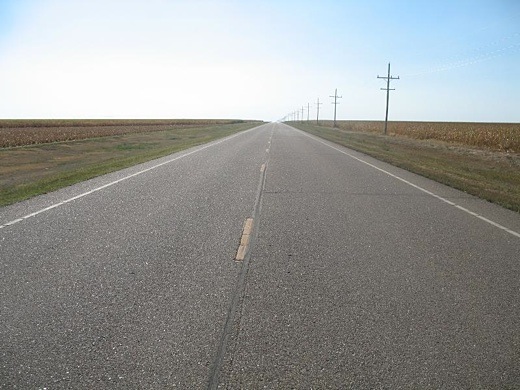
Image above: Endless GMO soy and corn fields in Kansas stretch to the horizon. Photo by Galen Maly. From (http://www.imbikingacrossthecountry.com/?p=692).

Some caveats
Now it’s true that some farmers, the ones who grow commodity crops like soybeans and corn on vast fields, don’t like hedgerows. Nor do many developers, park districts, or conventional landscaping firms.

Hedgerows are inappropriate in large prairie areas, whether remnant or restored, where grassland birds require vast, treeless areas on the order of 10,000 acres or so to feel comfortable enough to nest and start families. They are shaggy, messy, unkempt looking. They require effort to put in, nurturance while young, and regular maintenance thereafter. We have fences.

I would never promote use of hedgerows in areas of the country where they’d be inappropriate, such as the desert southwest, or arid grasslands (except possibly where trees and shrubs might occur naturally, such as riparian areas) or large public lands managed for restoration. They have their own beauty and ecosystem complexity.

My aim during this series of posts will be to talk about how, in temperate areas of our country that are already built on or farmed, that can’t be restored or set aside, hedgerows can be used to help heal the land. They can be an important component of green infrastructure, complementing bioswales and raingardens.

Further, as our climate changes, hedgerows and greenways could be crucial not only for their carbon-storage properties, but also for their ability to serve as corridors linking larger, wilder areas so that animals and even plants can migrate to more favorable habitats.

Some of the plant migration could even be human-assisted, though that is controversial. In all, they are a prime example of reconciliation ecology, the practice of designing human-centered landscapes to accommodate the needs of other species.

Unless you’ve visited places with thriving hedgerows and have seen how they can positively impact a landscape, you may not understand why they are so vitally important.

This is partly a case of shifting baselines. You can’t appreciate or miss a type of landscape that nurtures all the creatures that live in an area unless you experience it, and beyond that, have the cultural understanding to value it.

In England, enough hedgerows have continued to exist and enough people and organizations have kept the cultural and historical knowledge alive to enable hedgerows as a concept to remain viable, and as a landscape feature to be to be saved and resuscitated.

Here in the US, both the concept and the reality are having to be reinvented. A friend of mine, who has been studying hedgerows and advocating their use for twenty years, calls these new efforts “post-modern hedgerows.”

Gardeners, conservationists, permaculturalists and organic farmers are already practicing hedgerow making, particularly in California.

By so doing they are reinvigorating ancient art and utilizing modern science that could, if practiced widely enough, help knit back together many of our fractured landscapes, providing habitat for pollinators, other beneficial insects, birds, and other animals while simultaneously providing food, materials, and shelter—in the form of privacy and microclimate enhancement—for humans.

Properly planned and maintained, they can increase bio-diversity, store carbon, help manage rainwater, and add beauty and livability for all.

When a farmer plants and manages a wide, ecologically diverse hedgerow, or enriches an old fencerow, or a government agency does the same along a road, they might say they are creating a pollinator reserve, wildlife corridor, game bird habitat, micro-climate enhancer, even a carbon sequestration system.

The same goes for those of us who have smaller pieces of land to work with in suburbs or city, whose small yards can link together in beneficial ways. But what we all really are doing is co-creating beauty.


.

Programmable Permaculture

SUBHEAD: How can a gardener create different sorts of microclimates of soil, air, and water?

By Barath Raghaven on 28 February 2013 for Contraposition -
(http://contraposition.org/blog/2013/02/28/programmable-permaculture/)


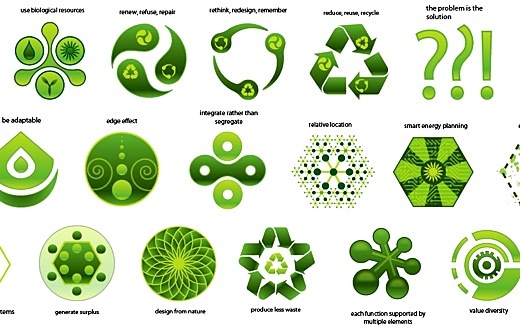
Image above: Computer designed icons for permaculture metatools. From (http://podcollective.com/fora/viewtopic.php?p=9900).

There’s a cultural phenomenon, one that has been growing for the past decade, of hobbyist hackers exemplified by Make Magazine and TechShop. These hackers want to have the experience of building something in the physical world while still applying the tools and techniques of computing. With the rise of open hardware platforms like Arduino—even whole systems like the Raspberry Pi for $25—it’s surprisingly affordable for people to program their own electronics.

The key to design when working on such projects is to decompose a problem into its constituent actions, to figure out what can be done by the programmable hardware vs. what must be done using other (e.g., more conventionally mechanical) components, and then to assemble the pieces into a working whole. While I can’t say I have any deep experience working on such projects, for some time I’ve been wondering whether the same ideas can be applied in a direction of more interest and perhaps of more importance.

How can we solve a problem (in a garden, say), with permaculture tools, by decomposing the problem and coming up with a set of interlocking pieces that solves it? Framing the problem in this way is very much applying an engineering mindset, something that might irk those who insist on thinking holistically about any and all ecological settings. 
And I can relate to that sentiment, because too much has been done in engineering and science more broadly to stop holistic thinking and to employ scientific reductionism in its place.

But for the moment I want to consider something small scale: employing the vocabulary and tools of permaculture to specific tasks in a garden. Here are the stated principles of permaculture:
  1. Observe and interact: By taking time to engage with nature we can design solutions that suit our particular situation.
  2. Catch and store energy: By developing systems that collect resources at peak abundance, we can use them in times of need.
  3. Obtain a yield: Ensure that you are getting truly useful rewards as part of the work that you are doing.
  4. Apply self-regulation and accept feedback: We need to discourage inappropriate activity to ensure that systems can continue to function well.
  5. Use and value renewable resources and services: Make the best use of nature’s abundance to reduce our consumptive behavior and dependence on non-renewable resources.
  6. Produce no waste: By valuing and making use of all the resources that are available to us, nothing goes to waste.
  7. Design from patterns to details: By stepping back, we can observe patterns in nature and society. These can form the backbone of our designs, with the details filled in as we go.
  8. Integrate rather than segregate: By putting the right things in the right place, relationships develop between those things and they work together to support each other.
  9. Use small and slow solutions: Small and slow systems are easier to maintain than big ones, making better use of local resources and producing more sustainable outcomes.
  10. Use and value diversity: Diversity reduces vulnerability to a variety of threats and takes advantage of the unique nature of the environment in which it resides.
  11. Use edges and value the marginal: The interface between things is where the most interesting events take place. These are often the most valuable, diverse and productive elements in the system.
  12. Creatively use and respond to change: We can have a positive impact on inevitable change by carefully observing, and then intervening at the right time.
I don’t know about you, but while I agree with this list, it’s all a little vague. And so what I’d like to look at is specific techniques that have broadly become part of the permaculture bag of tricks that somewhat adhere to this thinking.

To make the goal concrete, let’s focus on one question: how can a gardener create different sorts of microclimates of soil, air, and water for the diversity of plants one might want to include in a garden? While I could have considered other goals like water purification, fertilization, composting, water transport, etc. 
I’ve found myself trying to figure out microclimates a lot lately so it seems like a good place to start. It seems to me that many challenges I’ve run into while gardening have to do with the environment not being right for what I’m trying to grow, something that’s inevitable given that most of the food-bearing crops we eat today are not native to the places we live.

I’m often reminded of Sepp Holzer’s citrus gardens in the Alps as a sign that it’s possible to do amazing things with microclimates, but very few people have Holzer’s level of skill and experience. This is where programmable permaculture comes in. To make the analogy concrete, here the hardware is permaculture, which is capable of being used to do perform certain actions towards a goal, and the software is the creative combination of instructions for the hardware to achieve that goal. 
The certain actions the hardware can execute is its instruction set, and usually hardware is relatively minimalist (and the challenge is to make it complete at the same time), so it’s the combination of steps that makes it powerful. In addition to the microclimate aspect we want to adjust (soil, air, water, etc.) there’s the question of scale—how big is the microclimate? Are the techniques that help when building an herb spiral the same as when building an impoundment lake? That is, is there a subroutine in common between the two?

Let’s say we’re trying to grow avocados in a flat garden in a suboptimal climate. Avocados (the tasty cultivars, anyway) require well-drained fertile soil, nearly zero days of frost in the winter and relatively warm summer days, no shallow-root competition, and lots of direct sun. While we’re probably not going to be growing avocados in Portland, Maine (anytime soon, that is), we might be able to grow them in Portland, Oregon with the right microclimate. So let’s decompose it:

Soil: 
the soil in the Willamette Valley is plenty fertile, though throughout the winter it’s probably too wet for an Avocado tree. Here we might apply the principle of self-regulation, and dig a shallow French drain near the tree, and direct the water from it to a pond. Since the garden is flat in this example, the tree would have to be on a raised bed.

Frost: 
Portland has over 30 days of frost a year and even a few days with highs below freezing annually. (To give you a sense of the challenge that presents, consider that the California Master Gardener Handbook lists Santa Cruz County as the furthest North one can reliably grow avocados, and Santa Cruz gets something like 3 days of mild frost per year.) 
Here we clearly want to catch and store energy. The key is that the average (over a 24 hour period) is typically above freezing, and so buffers are key. We want to store a lot of heat and release it slowly, and conveniently water has the highest specific heat capacity of any common substance. 
That suggests that digging a pond near the tree—perhaps the same pond that was used for drainage—would help store heat during the day and re-radiate it at night. Add warm wastewater from a house to the pond and we apply the principle “produce no waste” while giving the tree-pond system a margin of safety for those days that don’t go above freezing. Stones placed in and around the tree and pond can add to the pond’s heat buffering.

Sun: 
The Pacific Northwest isn’t known for its sunshine. It’s likely that the directly incident rays in Portland would be insufficient for a tropical / sub-tropical tree like an avocado. Conveniently, water reflects light, and by placing the pond at the correct angle for the winter sun, we can provide a bit of extra sunshine to the tree via pond reflection. But what if the sky is just gray and the sun’s rays diffuse? While there isn’t much we can do, we can build a small parabolic reflector that redirects the sun’s rays at the tree from another spot in the garden. (One technique I’ve heard of is to pick up a discarded satellite dish and cover it in something reflective like aluminum foil.)

The other microclimate needs—such as warm summer days—are probably already met here.

While this application of principles was fun, it wasn’t as, well, programmable as I would have liked. Ideally it’d be possible to take a setting, describe the constraints / objectives within some dimensions, and then directly apply techniques that are derived from the principles to achieve the goal. In another post I’ll try to develop what we might consider an instruction set for permaculture and also, separately, what might differentiate permaculture from geoengineering.

See also:
Ea O Ka Aina: Permaculture - Growing Zones 3/22/10

.

It Pays to Stay Home

SUBHEAD: Staying home has to be one of the most unpopular ideas in America, where travel is king.  

By Gene Logsdon on 25 Aoril 2012 for The Contrary Farmer -  
(http://thecontraryfarmer.wordpress.com/2012/04/25/it-pays-to-stay-home/)

 
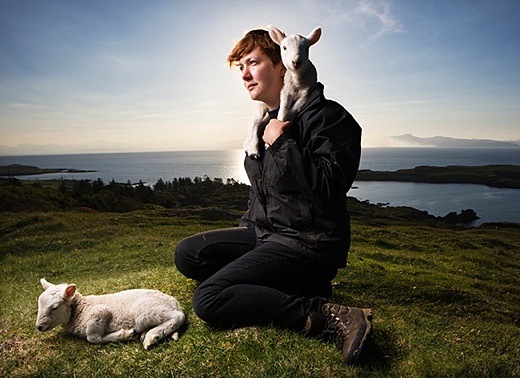
Image above: Photo of Sara Boden with lambs in "Back to the Land". From (http://www.guardian.co.uk/lifeandstyle/gallery/2011/aug/12/farming-on-eigg#/?picture=377809720).
 
One of the unsung advantages of being in love with a garden or a farm is that the lover doesn’t mind staying home and by doing so, saving gobs of money. In fact most of us land lovers much prefer to stay home. A back forty even as small as an acre can be an exciting, fascinating adventure into the farthest reaches of the earth.

The great entomologist, Jean Henri Fabre, spent much of his life making amazing discoveries about bugs on the few brushy acres behind his house and writing about them. With 30 acres, I never want for a changing world to travel through, a journey not far in miles but almost infinite in terms of material wonders and splendors deep down into the earth and high up into the ever-changing beauty of the sky.

Staying home has to be one of the most unpopular ideas in America where the whole culture embraces faraway travel as essential to happiness. Many of us don’t really have homes that can provide as much enjoyment as travel promises. Rather than spending our money to acquire such a property, we are taught to buy such enjoyment with far away travel.

Perhaps what we need is proper publicity. To advertise traveling at home, a documentary could open with unbelievable close-ups of ants herding and milking aphids on an apple tree, a raccoon destroying a bluebird house, a hawk dive-bombing a mouse, a flint arrowhead sticking out of a creek-side cliff. Then a roll of drums and a voice sonorously introduces the docudrama: “Today we are going where no explorer has gone before— YOUR BACK FORTY.”

Also, in earlier times, a home could not electronically provide all the connections with the outer world that now make travel almost obsolete. You can visit just about everything now in your living room. It may be true that nothing beats seeing a tourist attraction in person, but today you can get really close-up and intimate sights and insights into such attractions on the Internet without being strip-searched.

Just this Sunday, my dear friend, Wendell Berry, was speaking in the National Cathedral in Washington D.C. and will be receiving at the John F. Kennedy Center today (Monday), as I write this, the National Endowment For The Humanities Award, the highest honor given by the government in this field. I was able to watch and listen to him from our living room, closer and more vividly on our computer screen than if I had been there in the audience.

Another advantage of being a farmer, if not a gardener, is that you can often use your work as an excuse not to attend meetings and social affairs you do not want to attend anyway. We used to have big, loud family gatherings at my grandparents’ house on holidays.

Along about four o’clock in the afternoon, I would assume my standard, long-suffering countenance and with a sigh say that I had to go home and milk the cows. Everyone understood. The cows had to be milked. Poor Gene. Poor Gene would then shuffle, downcast, out the door but with a big inward smile. At least I knew the cows were not going to get in an argument over politics.

Another time, not so many years ago, I politely declined an invitation to give a speech faraway. I hate to give speeches and am not very good at it anyway. The fellow who was inviting me protested. “You aren’t going to give me that guff about how airplanes are environmentally destructive, are you?” he said. “That plane is going to fly here whether you are on it or not.”

“I can’t come because we will be lambing at that time,” I said, which happened to be the truth.

“Oh!” he said, much more contritely. “I understand.”

Even pulling lambs has its advantages.


.

It all turns on affection

SUBHEAD: Our connection to the land is based on affection and sticking to it. Unconnected both are lost. By Wendell Berry on 25 April 2012 for NEH - (http://www.neh.gov/about/awards/jefferson-lecture/wendell-e-berry-lecture) Image above: Painting by Mark Bryan "Odalique", oil on canvas, 37'x60", 2012. From (http://www.artofmarkbryan.com/odalisque.html).

One night in the winter of 1907, at what we have always called “the home place” in Henry County, Kentucky, my father, then six years old, sat with his older brother and listened as their parents spoke of the uses they would have for the money from their 1906 tobacco crop. The crop was to be sold at auction in Louisville on the next day. They would have been sitting in the light of a kerosene lamp, close to the stove, warming themselves before bedtime. They were not wealthy people. I believe that the debt on their farm was not fully paid, there would have been interest to pay, there would have been other debts. The depression of the 1890s would have left them burdened. Perhaps, after the income from the crop had paid their obligations, there would be some money that they could spend as they chose. At around two o’clock the next morning, my father was wakened by a horse’s shod hooves on the stones of the driveway. His father was leaving to catch the train to see the crop sold.

He came home that evening, as my father later would put it, “without a dime.” After the crop had paid its transportation to market and the commission on its sale, there was nothing left. Thus began my father’s lifelong advocacy, later my brother’s and my own, and now my daughter’s and my son’s, for small farmers and for land-conserving economies.

#

The economic hardship of my family and of many others, a century ago, was caused by a monopoly, the American Tobacco Company, which had eliminated all competitors and thus was able to reduce as it pleased the prices it paid to farmers. The American Tobacco Company was the work of James B. Duke of Durham, North Carolina, and New York City, who, disregarding any other consideration, followed a capitalist logic to absolute control of his industry and, incidentally, of the economic fate of thousands of families such as my own.

My effort to make sense of this memory and its encompassing history has depended on a pair of terms used by my teacher, Wallace Stegner. He thought rightly that we Americans, by inclination at least, have been divided into two kinds: “boomers” and “stickers.” Boomers, he said, are “those who pillage and run,” who want “to make a killing and end up on Easy Street,” whereas stickers are “those who settle, and love the life they have made and the place they have made it in.”2 “Boomer” names a kind of person and a kind of ambition that is the major theme, so far, of the history of the European races in our country. “Sticker” names a kind of person and also a desire that is, so far, a minor theme of that history, but a theme persistent enough to remain significant and to offer, still, a significant hope.

The boomer is motivated by greed, the desire for money, property, and therefore power. James B. Duke was a boomer, if we can extend the definition to include pillage in absentia. He went, or sent, wherever the getting was good, and he got as much as he could take.

Stickers on the contrary are motivated by affection, by such love for a place and its life that they want to preserve it and remain in it. Of my grandfather I need to say only that he shared in the virtues and the faults of his kind and time, one of his virtues being that he was a sticker. He belonged to a family who had come to Kentucky from Virginia, and who intended to go no farther. He was the third in his paternal line to live in the neighborhood of our little town of Port Royal, and he was the second to own the farm where he was born in 1864 and where he died in 1946.

We have one memory of him that seems, more than any other, to identify him as a sticker. He owned his farm, having bought out the other heirs, for more than fifty years. About forty of those years were in hard times, and he lived almost continuously in the distress of debt. Whatever has happened in what economists call “the economy,” it is generally true that the land economy has been discounted or ignored. My grandfather lived his life in an economic shadow. In an urbanizing and industrializing age, he was the wrong kind of man. In one of his difficult years he plowed a field on the lower part of a long slope and planted it in corn. While the soil was exposed, a heavy rain fell and the field was seriously eroded. This was heartbreak for my grandfather, and he devoted the rest of his life, first to healing the scars and then to his obligation of care. In keeping with the sticker’s commitment, he neither left behind the damage he had done nor forgot about it, but stayed to repair it, insofar as soil loss can be repaired. My father, I think, had his father’s error in mind when he would speak of farmers attempting, always uselessly if not tragically, “to plow their way out of debt.” From that time, my grandfather and my father were soil conservationists, a commitment that they handed on to my brother and to me.

#

It is not beside the point, or off my subject, to notice that these stories and their meanings, have survived because of my family’s continuing connection to its home place. Like my grandfather, my father grew up on that place and served as its caretaker. It has now belonged to my brother for many years, and he in turn has been its caretaker. He and I have lived as neighbors, allies, and friends. Our long conversation has often taken its themes from the two stories I have told, because we have been continually reminded of them by our home neighborhood and topography. If we had not lived there to be reminded and to remember, nobody would have remembered. If either of us had lived elsewhere, both of us would have known less. If both of us, like most of our generation, had moved away, the place with its memories would have been lost to us and we to it—and certainly my thoughts about agriculture, if I had thought of it at all, would have been much more approximate than they have been.

Because I have never separated myself from my home neighborhood, I cannot identify myself to myself apart from it. I am fairly literally flesh of its flesh. It is present in me, and to me, wherever I go. This undoubtedly accounts for my sense of shock when, on my first visit to Duke University, and by surprise, I came face-to-face with James B. Duke in his dignity, his glory perhaps, as the founder of that university. He stands imperially in bronze in front of a Methodist chapel aspiring to be a cathedral. He holds between two fingers of his left hand a bronze cigar. On one side of his pedestal is the legend: INDUSTRIALIST. On the other side is another single word: PHILANTHROPIST. The man thus commemorated seemed to me terrifyingly ignorant, even terrifyingly innocent, of the connection between his industry and his philanthropy. But I did know the connection. I felt it instantly and physically. The connection was my grandparents and thousands of others more or less like them. If you can appropriate for little or nothing the work and hope of enough such farmers, then you may dispense the grand charity of “philanthropy.”

After my encounter with the statue, the story of my grandfather’s 1906 tobacco crop slowly took on a new dimension and clarity in my mind. I still remembered my grandfather as himself, of course, but I began to think of him also as a kind of man standing in thematic opposition to a man of an entirely different kind. And I could see finally that between these two kinds there was a failure of imagination that was ruinous, that belongs indelibly to our history, and that has continued, growing worse, into our own time.

#

The term “imagination” in what I take to be its truest sense refers to a mental faculty that some people have used and thought about with the utmost seriousness. The sense of the verb “to imagine” contains the full richness of the verb “to see.” To imagine is to see most clearly, familiarly, and understandingly with the eyes, but also to see inwardly, with “the mind’s eye.” It is to see, not passively, but with a force of vision and even with visionary force. To take it seriously we must give up at once any notion that imagination is disconnected from reality or truth or knowledge. It has nothing to do either with clever imitation of appearances or with “dreaming up.” It does not depend upon one’s attitude or point of view, but grasps securely the qualities of things seen or envisioned.

I will say, from my own belief and experience, that imagination thrives on contact, on tangible connection. For humans to have a responsible relationship to the world, they must imagine their places in it. To have a place, to live and belong in a place, to live from a place without destroying it, we must imagine it. By imagination we see it illuminated by its own unique character and by our love for it. By imagination we recognize with sympathy the fellow members, human and nonhuman, with whom we share our place. By that local experience we see the need to grant a sort of preemptive sympathy to all the fellow members, the neighbors, with whom we share the world. As imagination enables sympathy, sympathy enables affection. And it is in affection that we find the possibility of a neighborly, kind, and conserving economy.

Obviously there is some risk in making affection the pivot of an argument about economy. The charge will be made that affection is an emotion, merely “subjective,” and therefore that all affections are more or less equal: people may have affection for their children and their automobiles, their neighbors and their weapons. But the risk, I think, is only that affection is personal. If it is not personal, it is nothing; we don’t, at least, have to worry about governmental or corporate affection. And one of the endeavors of human cultures, from the beginning, has been to qualify and direct the influence of emotion. The word “affection” and the terms of value that cluster around it—love, care, sympathy, mercy, forbearance, respect, reverence—have histories and meanings that raise the issue of worth. We should, as our culture has warned us over and over again, give our affection to things that are true, just, and beautiful. When we give affection to things that are destructive, we are wrong. A large machine in a large, toxic, eroded cornfield is not, properly speaking, an object or a sign of affection.

#

My grandfather knew, urgently, the value of money, but only of such comparatively small sums as would have paid his debts and allowed to his farm and his family a decent prosperity. He certainly knew of the American Tobacco Company. He no doubt had read and heard of James B. Duke, and could identify him as the cause of a hard time, but nothing in his experience could have enabled him to imagine the life of the man himself.

James B. Duke came from a rural family in the tobacco country of North Carolina. In his early life he would have known men such as my grandfather. But after he began his rise as an industrialist, the life of a small tobacco grower would have been to him a negligible detail incidental to an opportunity for large profits. In the minds of the “captains of industry,” then and now, the people of the land economies have been reduced to statistical numerals. Power deals “efficiently” with quantities that affection cannot recognize.

It may seem plausible to suppose that the head of the American Tobacco Company would have imagined at least that a dependable supply of raw material to his industry would depend upon a stable, reasonably thriving population of farmers and upon the continuing fertility of their farms. But he imagined no such thing. In this he was like apparently all agribusiness executives. They don’t imagine farms or farmers. They imagine perhaps nothing at all, their minds being filled to capacity by numbers leading to the bottom line. Though the corporations, by law, are counted as persons, they do not have personal minds, if they can be said to have minds. It is a great oddity that a corporation, which properly speaking has no self, is by definition selfish, responsible only to itself. This is an impersonal, abstract selfishness, limitlessly acquisitive, but unable to look so far ahead as to preserve its own sources and supplies. The selfishness of the fossil fuel industries by nature is self-annihilating; but so, always, has been the selfishness of the agribusiness corporations. Land, as Wes Jackson has said, has thus been made as exhaustible as oil or coal.

#

There is another difference between my grandfather and James B. Duke that may finally be more important than any other, and this was a difference of kinds of pleasure. We may assume that, as a boomer, moving from one chance of wealth to another, James B. Duke wanted only what he did not yet have. If it is true that he was in this way typical of his kind, then his great pleasure was only in prospect, which excludes affection as a motive.

My grandfather, on the contrary, and despite his life’s persistent theme of hardship, took a great and present delight in the modest good that was at hand: in his place and his affection for it, in its pastures, animals, and crops, in favorable weather.

He did not participate in the least in what we call “mobility.” He died, after eighty-two years, in the same spot he was born in. He was probably in his sixties when he made the one longish trip of his life. He went with my father southward across Kentucky and into Tennessee. On their return, my father asked him what he thought of their journey. He replied: “Well, sir, I’ve looked with all the eyes I’ve got, and I wouldn’t trade the field behind my barn for every inch I’ve seen.”

In such modest joy in a modest holding is the promise of a stable, democratic society, a promise not to be found in “mobility”: our forlorn modern progress toward something indefinitely, and often unrealizably, better. A principled dissatisfaction with whatever one has promises nothing or worse.

James B. Duke would not necessarily have thought so far of the small growers as even to hold them in contempt. The Duke trust exerted an oppression that was purely economic, involving a mechanical indifference, the indifference of a grinder to what it grinds. It was not, that is to say, a political oppression. It did not intend to victimize its victims. It simply followed its single purpose of the highest possible profit, and ignored the “side effects.” Confronting that purpose, any small farmer is only one, and one lost, among a great multitude of others, whose work can be quickly transformed into a great multitude of dollars.

Corporate industrialism has tended to be, and as its technological and financial power has grown it has tended increasingly to be, indifferent to its sources in what Aldo Leopold called “the land-community”: the land, all its features and “resources,” and all its members, human and nonhuman, including of course the humans who do, for better or worse, the work of land use.3 Industrialists and industrial economists have assumed, with permission from the rest of us, that land and people can be divorced without harm. If farmers come under adversity from high costs and low prices, then they must either increase their demands upon the land and decrease their care for it, or they must sell out and move to town, and this is supposed to involve no ecological or economic or social cost. Or if there are such costs, then they are rated as “the price of progress” or “creative destruction.”

But land abuse cannot brighten the human prospect. There is in fact no distinction between the fate of the land and the fate of the people. When one is abused, the other suffers. The penalties may come quickly to a farmer who destroys perennial cover on a sloping field. They will come sooner or later to a land-destroying civilization such as ours.

And so it has seemed to me less a choice than a necessity to oppose the boomer enterprise with its false standards and its incomplete accounting, and to espouse the cause of stable, restorative, locally adapted economies of mostly family-sized farms, ranches, shops, and trades. Naïve as it may sound now, within the context of our present faith in science, finance, and technology—the faith equally of “conservatives” and “liberals”—this cause nevertheless has an authentic source in the sticker’s hope to abide in and to live from some chosen and cherished small place—which, of course, is the agrarian vision that Thomas Jefferson spoke for, a sometimes honored human theme, minor and even fugitive, but continuous from ancient times until now. Allegiance to it, however, is not a conclusion but the beginning of thought.

#

The problem that ought to concern us first is the fairly recent dismantling of our old understanding and acceptance of human limits. For a long time we knew that we were not, and could never be, “as gods.” We knew, or retained the capacity to learn, that our intelligence could get us into trouble that it could not get us out of. We were intelligent enough to know that our intelligence, like our world, is limited. We seem to have known and feared the possibility of irreparable damage. But beginning in science and engineering, and continuing, by imitation, into other disciplines, we have progressed to the belief that humans are intelligent enough, or soon will be, to transcend all limits and to forestall or correct all bad results of the misuse of intelligence. Upon this belief rests the further belief that we can have “economic growth” without limit.

Economy in its original—and, I think, its proper—sense refers to household management. By extension, it refers to the husbanding of all the goods by which we live. An authentic economy, if we had one, would define and make, on the terms of thrift and affection, our connections to nature and to one another. Our present industrial system also makes those connections, but by pillage and indifference. Most economists think of this arrangement as “the economy.” Their columns and articles rarely if ever mention the land-communities and land-use economies. They never ask, in their professional oblivion, why we are willing to do permanent ecological and cultural damage “to strengthen the economy?”

In his essay, “Notes on Liberty and Property,” Allen Tate gave us an indispensable anatomy of our problem. His essay begins by equating, not liberty and property, but liberty and control of one’s property. He then makes the crucial distinction between ownership that is merely legal and what he calls “effective ownership.” If a property, say a small farm, has one owner, then the one owner has an effective and assured, if limited, control over it as long as he or she can afford to own it, and is free to sell it or use it, and (I will add) free to use it poorly or well. It is clear also that effective ownership of a small property is personal and therefore can, at least possibly, be intimate, familial, and affectionate. If, on the contrary, a person owns a small property of stock in a large corporation, then that person has surrendered control of the property to larger shareholders. The drastic mistake our people made, as Tate believed and I agree, was to be convinced “that there is one kind of property—just property, whether it be a thirty-acre farm in Kentucky or a stock certificate in the United States Steel Corporation.” By means of this confusion, Tate said, “Small ownership . . . has been worsted by big, dispersed ownership—the giant corporation.”4 (It is necessary to append to this argument the further fact that by now, owing largely to corporate influence, land ownership implies the right to destroy the land-community entirely, as in surface mining, and to impose, as a consequence, the dangers of flooding, water pollution, and disease upon communities downstream.)

Tate’s essay was written for the anthology, Who Owns America? the publication of which was utterly without effect. With other agrarian writings before and since, it took its place on the far margin of the national dialogue, dismissed as anachronistic, retrogressive, nostalgic, or (to use Tate’s own term of defiance) reactionary in the face of the supposedly “inevitable” dominance of corporate industrialism. Who Owns America? was published in the Depression year of 1936. It is at least ironic that talk of “effective property” could have been lightly dismissed at a time when many rural people who had migrated to industrial cities were returning to their home farms to survive.

In 1936, when to the dominant minds a thirty-acre farm in Kentucky was becoming laughable, Tate’s essay would have seemed irrelevant as a matter of course. At that time, despite the Depression, faith in the standards and devices of industrial progress was nearly universal and could not be shaken.

#

But now, three-quarters of a century later, we are no longer talking about theoretical alternatives to corporate rule. We are talking with practical urgency about an obvious need. Now the two great aims of industrialism—replacement of people by technology and concentration of wealth into the hands of a small plutocracy—seem close to fulfillment. At the same time the failures of industrialism have become too great and too dangerous to deny. Corporate industrialism itself has exposed the falsehood that it ever was inevitable or that it ever has given precedence to the common good. It has failed to sustain the health and stability of human society. Among its characteristic signs are destroyed communities, neighborhoods, families, small businesses, and small farms. It has failed just as conspicuously and more dangerously to conserve the wealth and health of nature. No amount of fiddling with capitalism to regulate and humanize it, no pointless rhetoric on the virtues of capitalism or socialism, no billions or trillions spent on “defense” of the “American dream,” can for long disguise this failure. The evidences of it are everywhere: eroded, wasted, or degraded soils; damaged or destroyed ecosystems; extinction of species; whole landscapes defaced, gouged, flooded, or blown up; pollution of the whole atmosphere and of the water cycle; “dead zones” in the coastal waters; thoughtless squandering of fossil fuels and fossil waters, of mineable minerals and ores; natural health and beauty replaced by a heartless and sickening ugliness. Perhaps its greatest success is an astounding increase in the destructiveness, and therefore the profitability, of war.

In 1936, moreover, only a handful of people were thinking about sustainability. Now, reasonably, many of us are thinking about it. The problem of sustainability is simple enough to state. It requires that the fertility cycle of birth, growth, maturity, death, and decay—what Albert Howard called “the Wheel of Life”—should turn continuously in place, so that the law of return is kept and nothing is wasted. For this to happen in the stewardship of humans, there must be a cultural cycle, in harmony with the fertility cycle, also continuously turning in place. The cultural cycle is an unending conversation between old people and young people, assuring the survival of local memory, which has, as long as it remains local, the greatest practical urgency and value. This is what is meant, and is all that is meant, by “sustainability.” The fertility cycle turns by the law of nature. The cultural cycle turns on affection.

#

That we live now in an economy that is not sustainable is not the fault only of a few mongers of power and heavy equipment. We all are implicated. We all, in the course of our daily economic life, consent to it, whether or not we approve of it. This is because of the increasing abstraction and unconsciousness of our connection to our economic sources in the land, the land-communities, and the land-use economies. In my region and within my memory, for example, human life has become less creaturely and more engineered, less familiar and more remote from local places, pleasures, and associations. Our knowledge, in short, has become increasingly statistical.

Statistical knowledge once was rare. It was a property of the minds of great rulers, conquerors, and generals, people who succeeded or failed by the manipulation of large quantities that remained, to them, unimagined because unimaginable: merely accountable quantities of land, treasure, people, soldiers, and workers. This is the sort of knowledge we now call “data” or “facts” or “information.” Or we call it “objective knowledge,” supposedly untainted by personal attachment, but nonetheless available for industrial and commercial exploitation. By means of such knowledge a category assumes dominion over its parts or members. With the coming of industrialism, the great industrialists, like kings and conquerors, become exploiters of statistical knowledge. And finally virtually all of us, in order to participate and survive in their system, have had to agree to their substitution of statistical knowledge for personal knowledge. Virtually all of us now share with the most powerful industrialists their remoteness from actual experience of the actual world. Like them, we participate in an absentee economy, which makes us effectively absent even from our own dwelling places. Though most of us have little wealth and perhaps no power, we consumer–citizens are more like James B. Duke than we are like my grandfather. By economic proxies thoughtlessly given, by thoughtless consumption of goods ignorantly purchased, now we all are boomers.

#

The failure of imagination that divided the Duke monopoly and such farmers as my grandfather seems by now to be taken for granted. James B. Duke controlled remotely the economies of thousands of farm families. A hundred years later, “remote control” is an unquestioned fact, the realization of a technological ideal, and we have remote entertainment and remote war. Statistical knowledge is remote, and it isolates us in our remoteness. It is the stuff itself of unimagined life. We may, as we say, “know” statistical sums, but we cannot imagine them.

It is by imagination that knowledge is “carried to the heart” (to borrow again from Allen Tate).5 The faculties of the mind—reason, memory, feeling, intuition, imagination, and the rest—are not distinct from one another. Though some may be favored over others and some ignored, none functions alone. But the human mind, even in its wholeness, even in instances of greatest genius, is irremediably limited. Its several faculties, when we try to use them separately or specialize them, are even more limited.

The fact is that we humans are not much to be trusted with what I am calling statistical knowledge, and the larger the statistical quantities the less we are to be trusted. We don’t learn much from big numbers. We don’t understand them very well, and we aren’t much affected by them. The reality that is responsibly manageable by human intelligence is much nearer in scale to a small rural community or urban neighborhood than to the “globe.”

When people succeed in profiting on a large scale, they succeed for themselves. When they fail, they fail for many others, sometimes for us all. A large failure is worse than a small one, and this has the sound of an axiom, but how many believe it? Propriety of scale in all human undertakings is paramount, and we ignore it. We are now betting our lives on quantities that far exceed all our powers of comprehension. We believe that we have built a perhaps limitless power of comprehension into computers and other machines, but our minds remain as limited as ever. Our trust that machines can manipulate to humane effect quantities that are unintelligible and unimaginable to humans is incorrigibly strange.

As there is a limit only within which property ownership is effective, so is there a limit only within which the human mind is effective and at least possibly beneficent. We must assume that the limit would vary somewhat, though not greatly, with the abilities of persons. Beyond that limit the mind loses its wholeness, and its faculties begin to be employed separately or fragmented according to the specialties or professions for which it has been trained.

#

In my reading of the historian John Lukacs, I have been most instructed by his understanding that there is no knowledge but human knowledge, that we are therefore inescapably central to our own consciousness, and that this is “a statement not of arrogance but of humility. It is yet another recognition of the inevitable limitations of mankind.”6 We are thus isolated within our uniquely human boundaries, which we certainly cannot transcend or escape by means of technological devices.

But as I understand this dilemma, we are not completely isolated. Though we cannot by our own powers escape our limits, we are subject to correction from, so to speak, the outside. I can hardly expect everybody to believe, as I do (with due caution), that inspiration can come from the outside. But inspiration is not the only way the human enclosure can be penetrated. Nature too may break in upon us, sometimes to our delight, sometimes to our dismay.

As many hunters, farmers, ecologists, and poets have understood, Nature (and here we capitalize her name) is the impartial mother of all creatures, unpredictable, never entirely revealed, not my mother or your mother, but nonetheless our mother. If we are observant and respectful of her, she gives good instruction. As Albert Howard, Wes Jackson, and others have carefully understood, she can give us the right patterns and standards for agriculture. If we ignore or offend her, she enforces her will with punishment. She is always trying to tell us that we are not so superior or independent or alone or autonomous as we may think. She tells us in the voice of Edmund Spenser that she is of all creatures “the equall mother, / And knittest each to each, as brother unto brother.”7 Nearly three and a half centuries later, we hear her saying about the same thing in the voice of Aldo Leopold: “In short, a land ethic changes the role of Homo sapiens from conqueror of the land-community to plain member and citizen of it.”8

We cannot know the whole truth, which belongs to God alone, but our task nevertheless is to seek to know what is true. And if we offend gravely enough against what we know to be true, as by failing badly enough to deal affectionately and responsibly with our land and our neighbors, truth will retaliate with ugliness, poverty, and disease. The crisis of this line of thought is the realization that we are at once limited and unendingly responsible for what we know and do.

#

The discrepancy between what modern humans presume to know and what they can imagine—given the background of pride and self-congratulation—is amusing and even funny. It becomes more serious as it raises issues of responsibility. It becomes fearfully serious when we start dealing with statistical measures of industrial destruction.

To hear of a thousand deaths in war is terrible, and we “know” that it is. But as it registers on our hearts, it is not more terrible than one death fully imagined. The economic hardship of one farm family, if they are our neighbors, affects us more painfully than pages of statistics on the decline of the farm population. I can be heartstruck by grief and a kind of compassion at the sight of one gulley (and by shame if I caused it myself), but, conservationist though I am, I am not nearly so upset by an accounting of the tons of plowland sediment borne by the Mississippi River. Wallace Stevens wrote that “Imagination applied to the whole world is vapid in comparison to imagination applied to a detail”9—and that appears to have the force of truth.

It is a horrible fact that we can read in the daily paper, without interrupting our breakfast, numerical reckonings of death and destruction that ought to break our hearts or scare us out of our wits. This brings us to an entirely practical question: Can we—and, if we can, how can we—make actual in our minds the sometimes urgent things we say we know? This obviously cannot be accomplished by a technological breakthrough, nor can it be accomplished by a big thought. Perhaps it cannot be accomplished at all.

#

Yet another not very stretchable human limit is in our ability to tolerate or adapt to change. Change of course is a constant of earthly life. You can’t step twice into exactly the same river, nor can you live two successive moments in exactly the same place. And always in human history there have been costly or catastrophic sudden changes. But with relentless fanfare, at the cost of almost indescribable ecological and social disorder, and to the almost incalculable enrichment and empowerment of corporations, industrialists have substituted what they fairly accurately call “revolution” for the slower, kinder processes of adaptation or evolution. We have had in only about two centuries a steady and ever-quickening sequence of industrial revolutions in manufacturing, transportation, war, agriculture, education, entertainment, homemaking and family life, health care, and so-called communications.

Probably everything that can be said in favor of all this has been said, and it is true that these revolutions have brought some increase of convenience and comfort and some easing of pain. It is also true that the industrialization of everything has incurred liabilities and is running deficits that have not been adequately accounted. All of these changes have depended upon industrial technologies, processes, and products, which have depended upon the fossil fuels, the production and consumption of which have been, and are still, unimaginably damaging to land, water, air, plants, animals, and humans. And the cycle of obsolescence and innovation, goaded by crazes of fashion, has given the corporate economy a controlling share of everybody’s income.

The cost of this has been paid also in a social condition which apologists call “mobility,” implying that it has been always “upward” to a “higher standard of living,” but which in fact has been an ever-worsening unsettlement of our people, and the extinction or near-extinction of traditional and necessary communal structures.

For this also there is no technological or large-scale solution. Perhaps, as they believe, the most conscientiously up-to-date people can easily do without local workshops and stores, local journalism, a local newspaper, a local post office, all of which supposedly have been replaced by technologies. But what technology can replace personal privacy or the coherence of a family or a community? What technology can undo the collateral damages of an inhuman rate of technological change?

The losses and damages characteristic of our present economy cannot be stopped, let alone restored, by “liberal” or “conservative” tweakings of corporate industrialism, against which the ancient imperatives of good care, homemaking, and frugality can have no standing. The possibility of authentic correction comes, I think, from two already-evident causes. The first is scarcity and other serious problems arising from industrial abuses of the land-community. The goods of nature so far have been taken for granted and, especially in America, assumed to be limitless, but their diminishment, sooner or later unignorable, will enforce change.

A positive cause, still little noticed by high officials and the media, is the by now well-established effort to build or rebuild local economies, starting with economies of food. This effort to connect cities with their surrounding rural landscapes has the advantage of being both attractive and necessary. It rests exactly upon the recognition of human limits and the necessity of human scale. Its purpose, to the extent possible, is to bring producers and consumers, causes and effects, back within the bounds of neighborhood, which is to say the effective reach of imagination, sympathy, affection, and all else that neighborhood implies. An economy genuinely local and neighborly offers to localities a measure of security that they cannot derive from a national or a global economy controlled by people who, by principle, have no local commitment.

#

In this age so abstracted and bewildered by technological magnifications of power, people who stray beyond the limits of their mental competence typically find no guide except for the supposed authority of market price. “The market” thus assumes the standing of ultimate reality. But market value is an illusion, as is proven by its frequent changes; it is determined solely by the buyer’s ability and willingness to pay.

By now our immense destructiveness has made clear that the actual value of some things exceeds human ability to calculate or measure, and therefore must be considered absolute. For the destruction of these things there is never, under any circumstances, any justification. Their absolute value is recognized by the mortal need of those who do not have them, and by affection. Land, to people who do not have it and who are thus without the means of life, is absolutely valuable. Ecological health, in a land dying of abuse, is not worth “something”; it is worth everything. And abused land relentlessly declines in value to its present and succeeding owners, whatever its market price.

But we need not wait, as we are doing, to be taught the absolute value of land and of land health by hunger and disease. Affection can teach us, and soon enough, if we grant appropriate standing to affection. For this we must look to the stickers, who “love the life they have made and the place they have made it in.”

By now all thoughtful people have begun to feel our eligibility to be instructed by ecological disaster and mortal need. But we endangered ourselves first of all by dismissing affection as an honorable and necessary motive. Our decision in the middle of the last century to reduce the farm population, eliminating the allegedly “inefficient” small farmers, was enabled by the discounting of affection. As a result, we now have barely enough farmers to keep the land in production, with the help of increasingly expensive industrial technology and at an increasing ecological and social cost. Far from the plain citizens and members of the land-community, as Aldo Leopold wished them to be, farmers are now too likely to be merely the land’s exploiters.

I don’t hesitate to say that damage or destruction of the land-community is morally wrong, just as Leopold did not hesitate to say so when he was composing his essay, “The Land Ethic,” in 1947. But I do not believe, as I think Leopold did not, that morality, even religious morality, is an adequate motive for good care of the land-community. The primary motive for good care and good use is always going to be affection, because affection involves us entirely. And here Leopold himself set the example. In 1935 he bought an exhausted Wisconsin farm and, with his family, began its restoration. To do this was morally right, of course, but the motive was affection. Leopold was an ecologist. He felt, we may be sure, an informed sorrow for the place in its ruin. He imagined it as it had been, as it was, and as it might be. And a profound, delighted affection radiates from every sentence he wrote about it.

Without this informed, practical, and practiced affection, the nation and its economy will conquer and destroy the country.

#

In thinking about the importance of affection, and of its increasing importance in our present world, I have been guided most directly by E. M. Forster’s novel, Howards End, published in 1910. By then, Forster was aware of the implications of “rural decay,”10 and in this novel he spoke, with some reason, of his fear that “the literature of the near future will probably ignore the country and seek inspiration from the town. . . . and those who care for the earth with sincerity may wait long ere the pendulum swings back to her again.”11 Henry Wilcox, the novel’s “plain man of business,” speaks the customary rationalization, which has echoed through American bureaus and colleges of agriculture, almost without objection, for at least sixty years: “the days for small farms are over.”12

In Howards End, Forster saw the coming predominance of the machine and of mechanical thought, the consequent deracination and restlessness of populations, and the consequent ugliness. He saw an industrial ugliness, “a red rust,”13 already creeping out from the cities into the countryside. He seems to have understood by then also that this ugliness was the result of the withdrawal of affection from places. To have beautiful buildings, for example, people obviously must want them to be beautiful and know how to make them beautiful, but evidently they also must love the places where the buildings are to be built. For a long time, in city and countryside, architecture has disregarded the nature and influence of places. Buildings have become as interchangeable from one place to another as automobiles. The outskirts of cities are virtually identical and as depressingly ugly as the corn-and-bean deserts of industrial agriculture.

What Forster could not have foreseen in 1910 was the extent of the ugliness to come. We still have not understood how far at fault has been the prevalent assumption that cities could be improved by pillage of the countryside. But urban life and rural life have now proved to be interdependent. As the countryside has become more toxic, more eroded, more ecologically degraded and more deserted, the cities have grown uglier, less sustainable, and less livable.

#

The argument of Howards End has its beginning in a manifesto against materialism:

It is the vice of a vulgar mind to be thrilled by bigness, to think that a thousand square miles are a thousand times more wonderful than one square mile . . . That is not imagination. No, it kills it. . . . Your universities? Oh, yes, you have learned men who collect . . . facts, and facts, and empires of facts. But which of them will rekindle the light within?14

“The light within,” I think, means affection, affection as motive and guide. Knowledge without affection leads us astray every time. Affection leads, by way of good work, to authentic hope. The factual knowledge, in which we seem more and more to be placing our trust, leads only to hope of the discovery, endlessly deferrable, of an ultimate fact or smallest particle that at last will explain everything.

The climactic scene of Forster’s novel is the confrontation between its heroine, Margaret Schlegel, and her husband, the self-described “plain man of business,” Henry Wilcox. The issue is Henry’s determination to deal, as he thinks, “realistically” with a situation that calls for imagination, for affection, and then forgiveness. Margaret feels at the start of their confrontation that she is “fighting for women against men.”15 But she is not a feminist in the popular or political sense. What she opposes with all her might is Henry’s hardness of mind and heart that is “realistic” only because it is expedient and because it subtracts from reality the life of imagination and affection, of living souls. She opposes his refusal to see the practicality of the life of the soul.

Margaret’s premise, as she puts it to Henry, is the balance point of the book: “It all turns on affection now . . . Affection. Don’t you see?”16

In a speech delivered in 2006, “Revitalizing Rural Communities,” Frederick Kirschenmann quoted his friend Constance Falk, an economist: “There is a new vision emerging demonstrating how we can solve problems and at the same time create a better world, and it all depends on collaboration, love, respect, beauty, and fairness.”17

Those two women, almost a century apart, speak for human wholeness against fragmentation, disorder, and heartbreak. The English philosopher and geometer, Keith Critchlow, brings his own light to the same point: “The human mind takes apart with its analytic habits of reasoning but the human heart puts things together because it loves them . . .” 18

#

The great reassurance of Forster’s novel is the wholeheartedness of his language. It is to begin with a language not disturbed by mystery, by things unseen. But Forster’s interest throughout is in soul-sustaining habitations: houses, households, earthly places where lives can be made and loved. In defense of such dwellings he uses, without irony or apology, the vocabulary that I have depended on in this talk: truth, nature, imagination, affection, love, hope, beauty, joy. Those words are hard to keep still within definitions; they make the dictionary hum like a beehive. But in such words, in their resonance within their histories and in their associations with one another, we find our indispensable humanity, without which we are lost and in danger.

No doubt there always will be some people willing to do anything at all that is economically or technologically possible, who look upon the world and its creatures without affection and therefore as exploitable without limit. Against that limitlessness, in which we foresee assuredly our ruin, we have only our ancient effort to define ourselves as human and humane. But this ages-long, imperfect, unendable attempt, with its magnificent record, we have virtually disowned by assigning it to the ever more subordinate set of school subjects we call “arts and humanities” or, for short, “culture.” Culture, so isolated, is seen either as a dead-end academic profession or as a mainly useless acquisition to be displayed and appreciated “for its own sake.” This definition of culture as “high culture” actually debases it, as it debases also the presumably low culture that is excluded: the arts, for example, of land use, life support, healing, housekeeping, homemaking.

I don’t like to deal in categorical approvals, and certainly not of the arts. Even so, I do not concede that the “fine arts,” in general, are useless or unnecessary or even impractical. I can testify that some works of art, by the usual classification fine, have instructed, sustained, and comforted me for many years in my opposition to industrial pillage.

But I would insist that the economic arts are just as honorably and authentically refinable as the fine arts. And so I am nominating economy for an equal standing among the arts and humanities. I mean, not economics, but economy, the making of the human household upon the earth: the arts of adapting kindly the many human households to the earth’s many ecosystems and human neighborhoods. This is the economy that the most public and influential economists never talk about, the economy that is the primary vocation and responsibility of every one of us.

#

My grandparents were fortunate. They survived their debts and kept their farm—finally, and almost too late, with help from my father, who had begun his law practice in the county seat. But in the century and more since that hard year of 1907, millions of others have not been so fortunate. Owing largely to economic constraints, they have lost their hold on the land, and the land has lost its hold on them. They have entered into the trial of displacement and scattering that we try to dignify as “mobility.”

Even so, land and people have suffered together, as invariably they must. Under the rule of industrial economics, the land, our country, has been pillaged for the enrichment, supposedly, of those humans who have claimed the right to own or exploit it without limit. Of the land-community much has been consumed, much has been wasted, almost nothing has flourished.

But this has not been inevitable. We do not have to live as if we are alone.

Textual Notes:

  1. Everyman’s Library, Alfred A. Knopf, New York, 1991, page 355.
  2. Where the Bluebird Sings to the Lemonade Springs, Random House, New York, 1992, pages xxii & 4.
  3. A Sand County Almanac, Oxford University Press, New York, 1966, pages 219–220.
  4. Who Owns America? edited by Herbert Agar and Allen Tate, ISI Books, Wilmington, DE, 1999, pages 109–114. (First published by Houghton Mifflin Company, Boston, 1936.)
  5. “Ode to the Confederate Dead,” Collected Poems, 1919–1976, Louisiana State University Press, Baton Rouge, 1989, page 22.
  6. Last Rites, Yale University Press, New Haven and London, 2009, pages 31 and 35.
  7. The Faerie Queene, VII, vii, stanza XIV.
  8. A Sand County Almanac, pages 219–220.
  9. Opus Posthumous, edited, with an Introduction by Samuel French Morse, Alfred A. Knopf, New York, 1957, page 176.
  10. Howards End, page 15.
  11. Ibid., page 112.
  12. Ibid., page 214.
  13. Ibid., page 355.
  14. Ibid., page 30.
  15. Ibid., page 303.
  16. Ibid., page 304.
  17. In Cultivating an Ecological Conscience, Counterpoint, Berkeley, 2011, pages 329–330.
  18. The Hidden Geometry of Flowers, Floris Books, Edinburgh, 2011, page 39.
.