Showing posts with label Doomster. Show all posts

Are we Doomed?

SUBHEAD: For those considering the reality of it, threats of doom or promises of utopia are distractions.

By Richard Heinberg on 27 July 2017 for Post Carbon Institute -
(http://www.postcarbon.org/are-we-doomed-lets-have-a-conversation/)


Image above: Product artwork for video game "Doom II: Hell on Earth".  From (https://thexknights.wordpress.com/2015/04/26/the-games-that-changed-us-part-1/).

My most recent essay, in which I discussed a highly publicized controversy over the efficacy of plans for a comprehensive transition to an all-renewable energy future, garnered some strong responses. “If you are right,” one Facebook commenter opined, “we are doomed.

Fortunately you are not right.” (The commenter didn’t explain why.) What had I said to provoke an expectation of cataclysmic oblivion?

Simply that there is probably no technically and financially feasible energy pathway to enable those of us in highly industrialized countries to maintain current levels of energy usage very far into the future.

My piece happened to be published right around the same time New York Magazine released a controversial article titled “The Uninhabitable Earth,” in which author David Wallace Wells portrayed a dire future if the most pessimistic climate change models turn to reality. “It is, I promise, worse than you think,” wrote Wells.

“If your anxiety about global warming is dominated by fears of sea-level rise, you are barely scratching the surface of what terrors are possible, even within the lifetime of a teenager today.”

Wells’s article drew rebukes from—of all people—climate scientists, who pointed out a few factual errors, but also insisted that scaring the public just doesn’t help.

“Importantly, fear does not motivate,” responded Michael Mann with Susan Joy Hassol and Tom Toles, “and appealing to it is often counter-productive as it tends to distance people from the problem, leading them to disengage, doubt and even dismiss it.”

It’s true: apocalyptic warnings don’t move most people. Or, rather, they move most people away from the source of discomfort, so they simply tune out. But it’s also true that people feel a sense of deep, unacknowledged unease when they are fed “solutions” that they instinctively know are false or insufficient.

Others came to Wells’s defense. Margaret Klein Salamon, a clinical psychologist and founder of the climate action group The Climate Mobilization, which advocates for starting a “World War II-scale” emergency mobilization to convert from fossil fuels, writes;
“It is OK, indeed imperative, to tell the whole, frightening story. . . . [I]t’s the job of those of us trying to protect humanity and restore a safe climate to tell the truth about the climate crisis and help people process and channel their own feelings—not to preemptively try to manage and constrain those feelings.”
So: Are we doomed if we can’t maintain current and growing energy levels? And are we doomed anyway due to now-inevitable impacts of climate change?

First, the good news. With regard to energy, we should keep in mind the fact that today’s Americans use roughly twice as much per capita as their great-grandparents did in 1925. While people in that era enjoyed less mobility and fewer options for entertainment and communication than we do today, they nevertheless managed to survive and even thrive.

And we now have the ability to provide many services (such as lighting) far more efficiently, so it should be possible to reduce per-capita energy usage dramatically while still maintaining a lifestyle that would be considered more than satisfactory by members of previous generations and by people in many parts of the world today.

And reducing energy usage would make a whole raft of problems—climate change, resource depletion, the challenge of transitioning to renewable energy sources—much easier to solve.

The main good news with regard to climate change that I can point to (as I did in an essay posted in June) is that economically recoverable fossil fuel reserves are consistent only with lower-emissions climate change scenarios.

As BP and other credible sources for coal, oil, and natural gas reserves figures show, and as more and more researchers are pointing out, the worst-case climate scenarios associated with “business as usual” levels of carbon emissions are in fact unrealistic.

Now, the bad news. While we could live perfectly well with less energy, that’s not what the managers of our economy want. They want growth. Our entire economy is structured to require constant, compounded growth of GDP, and for all practical purposes raising the GDP means using more energy. While fringe economists and environmentalists have for years been proposing ways to back away from our growth addiction (for example, by using alternative economic indices such as Gross National Happiness), none of these proposals has been put into widespread effect. As things now stand, if growth falters the economy crashes.

There’s bad climate news as well: even with current levels of atmospheric greenhouse gases, we’re seeing unacceptable and worsening impacts—raging fires, soaring heat levels, and melting icecaps.

And there are hints that self-reinforcing feedbacks maybe kicking in: an example is the release of large amounts of methane from thawing tundra and oceanic hydrates, which could lead to a short-term but steep spike in warming.

Also, no one is sure if current metrics of climate sensitivity (used to estimate the response of the global climate system to a given level of forcing) are accurate, or whether the climate is actually more sensitive than we have assumed. There’s some worrisome evidence the latter is case.

But let’s step back a bit. If we’re interested in signs of impending global crisis, there’s no need to stop with just these two global challenges. The world is losing 25 billion tons of topsoil a year due to current industrial agricultural practices; if we don’t deal with that issue, civilization will still crash even if we do manage to ace our energy and climate test.

Humanity is also over-using fresh water: ancient aquifers are depleting, while other water sources are being polluted. If we don’t deal with our water crisis, we still crash.

Species are going extinct at a thousand times the pre-industrial rate; if we don’t deal with the biodiversity dilemma, we still crash. Then there are social and economic problems that could cause nations to crumble even if we manage to protect the environment; this threat category includes the menaces of over-reliance on debt and increasing economic inequality.

If we attack each of these problems piecemeal with technological fixes (for example, with desalination technology to solve the water crisis or geo-engineering to stabilize the climate) we may still crash because our techno-fixes are likely to have unintended consequences, as all technological interventions do.

Anyway, the likelihood of successfully identifying and deploying all the needed fixes in time is vanishingly small.

Many problems are converging at once because society is a complex system, and the challenges we have been discussing are aspects of a systemic crisis. A useful way to frame an integrated understanding of the 21st century survival challenge is this: we humans have overshot Earth’s long-term carrying capacity for our species.

We’ve been able to do this due to a temporary subsidy of cheap, bountiful energy from fossil fuels, which enabled us to stretch nature’s limits and to support a far larger overall population than would otherwise be possible.

But now we are starting to see supply constraints for those fuels, just as the side effects of burning enormous amounts of coal, oil, and natural gas are also coming into view.

Meanwhile, using cheap energy to expand resource-extractive and waste-generating economic processes is leading to biodiversity loss; the depletion of soil, water, and minerals; and environmental pollution of many kinds. Just decarbonizing energy, while necessary, doesn’t adequately deal with systemic overshoot.

Only a reduction of population and overall resource consumption, along with a rapid reduction in our reliance on fossil fuels and a redesign of industrial systems, can do that.

Economic inequality is a systemic problem too. As we’ve grown our economy, those who were in position to invest in industrial expansion or to loan money to others have reaped the majority of the rewards, while those who got by through selling their time and labor (or whose common cultural heritage was simply appropriated by industrialists) have fallen behind.

There’s no technological fix for inequality; dealing with it will require redesigning our economic system and redistributing wealth. Those in wealthy nations would, on average, have to adjust their living standards downward.

Now, can we do all of this without a crash? Probably not. Indeed, many economists would regard the medicine (population reduction, a decline in per-capita energy use, and economic redistribution) as worse than whatever aspects of the disease they are willing to acknowledge.

Environmentalists and human rights advocates would disagree. Which is to say, there’s really no way out. Whether we stick with business as usual, or attempt a dramatic multi-pronged intervention, our current “normal” way of life is toast.

Accepting that a crash is more or less inevitable is a big step, psychologically speaking. I call this toxic knowledge: one cannot “un-know” that the current world system hangs by a thread, and this understanding can lead to depression.

In some ways, the systemic crisis we face is analogous to the individual existential crisis of life and death, which we each have to confront eventually. Some willfully ignore their own mortality for as long as possible; others grasp at a belief in the afterlife.

Still others seek to create meaning and purpose by making a positive difference in the lives of those around them with whatever time they have. Such efforts don’t alter the inevitability of death; however, contributing to one’s community appears to enhance well-being in many ways beyond that of merely prolonging life.

But is a crash the same as doom?

Not necessarily. Our best hope at this point would seem to be a controlled crash that enables partial recovery at a lower level of population and resource use, and that therefore doesn’t lead to complete and utter oblivion (human extinction or close to it).

Among those who understand the systemic nature of our problems, the controlled crash option is the subject of what may be the most interesting and important conversation that’s taking place on the planet just now. But only informed people who have gotten over denial and self-delusion are part of it.

This discussion started in the 1970s, though I wasn’t part of it then; I joined a couple of decades later. There is no formal membership; the conversation takes place through and among a patchwork of small organizations and scattered individuals.

They don’t all know each other and there is no secret handshake. Some have publicly adopted the stance that a global crash is inevitable; most soft-pedal that message on their organizational websites but are privately plenty worried.

During the course of the conversation so far, two (not mutually exclusive) strategies have emerged.

The first strategy envisions convincing the managers and power holders of the world to invest in a no-regrets insurance plan. Some systems thinkers who understand our linked global crises are offering to come up with a back-pocket checklist for policy makers, for moments when financial or environmental crisis hits: how, under such circumstances, might the managerial elite be able to prevent, say, a stock market crash from triggering food, energy, and social crises as well?

A set of back-up plans wouldn’t require detailed knowledge of when or how crisis will erupt. It wouldn’t even require much of a systemic understanding of global overshoot. It would simply require willingness on the part of societal power holders to agree that there are real or potential threats to global order, and to accept the offer of help.

At the moment, those pursuing this strategy are working mostly covertly, for reasons that are not hard to discern.

The second strategy consists of working within communities to build more societal resilience from the ground up. It is easier to get traction with friends and neighbors than with global power holders, and it’s within communities that political decisions are made closest to where the impact is felt.

My own organization, Post Carbon Institute, has chosen to pursue this strategy via a series of books, the Community Resilience Guides; the “Think Resilience” video series; and our forthcoming compendium, The Community Resilience Reader.

Rob Hopkins, who originated the Transition Towns movement, has been perhaps the most public, eloquent, and upbeat proponent of the local resilience strategy, but there are countless others scattered across the globe.

Somehow, the work of resilience building (whether top-down or bottom-up) must focus not just on maintaining supplies of food, water, energy, and other basic necessities, but also on sustaining social cohesion—a culture of understanding, tolerance, and inquiry—during times of great stress.

While it’s true that people tend to pull together in remarkable ways during wars and natural disasters, sustained hard times can lead to scapegoating and worse.

Most people are not party to the conversation, not aware that it is happening, and unaware even that such a conversation is warranted. Among those who are worried about the state of the world, most are content to pursue or support efforts to keep crises from occurring by working via political parties, religious organizations, or non-profit advocacy orgs on issues such as climate change, food security, and economic inequality.

There is also a small but rapidly growing segment of society that feels disempowered as the era of economic growth wanes, and that views society’s power holders as evil and corrupt.

These dispossessed—whether followers of ISIS or Infowars—would prefer to “shake things up,” even to the point of bringing society to destruction, rather than suffer the continuation of the status quo. Unfortunately, this last group may have the easiest path of all.

By comparison, the number of those involved in the conversation is exceedingly small, countable probably in the hundreds of thousands, certainly not millions. Can we succeed? It depends on how one defines “success”—as the ability to maintain, for a little longer, an inherently unsustainable global industrial system? Or as the practical reduction in likely suffering on the part of the survivors of the eventual crash?

A related query one often hears after environmental lectures is, Are we doing enough? If “Enough” means “enough to avert a system crash,” then the answer is no: it’s unlikely that anyone can deliver that outcome now. The question should be, What can we do—not to save a way of life that is unsalvageable, but to make a difference to the people and other species in harm’s way?

This is not a conversation about the long-term trajectory of human cultural evolution, though that’s an interesting subject for speculation. Assuming there are survivors, what will human society look like following the crises ensuing from climate change and the end of fossil fuels and capitalism?

David Fleming’s Surviving the Future and John Michael Greer’s The Ecotechnic Future offer useful thoughts in this regard.

My own view is that it’s hard for us to envision what comes next because our imaginations are bounded by the reality we have known. What awaits will likely be as far removed from from modern industrial urban life as Iron-Age agrarian empires were from hunting-and-gathering bands.

We are approaching one of history’s great discontinuities. The best we can do under the circumstances is to get our priorities and values straight (protect the vulnerable, preserve the best of what we have collectively achieved, and live a life that’s worthy) and put one foot in front of the other.

The conversation I’m pointing to here is about fairly short-term actions. And it doesn’t lend itself to building a big movement. For that, you need villains to blame and promises of revived national or tribal glory.

For those engaged in the conversation, there’s only hard work and the satisfaction of honestly facing our predicament with an attitude of curiosity, engagement, and compassion. For us, threats of doom or promises of utopia are distractions or cop-outs.

Only those drawn to the conversation by temperament and education are likely to take it up. Advertising may not work. But having a few more hands on deck, and a few more resources to work with, can only help.

.
Beyond Climate Doomsday News

SUBHEAD: A proposal to avoid the problems with reporting on climate change and move beyond them.

By James Witt on 12 July 2017 for DeSmog Canada -
(https://www.desmog.ca/2017/07/12/problem-climate-doomsday-reporting-and-how-move-beyond-it)


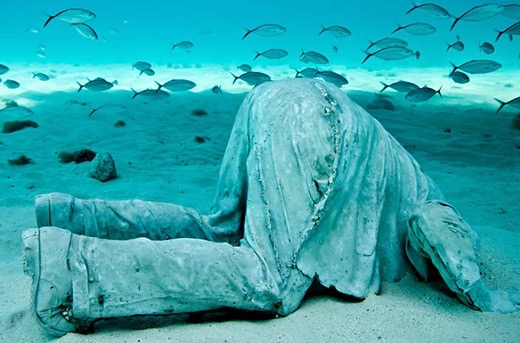
Image above: A man buries his head in the sand, seemingly unaware that he is underwater from rising seas due to global warming due to CO2 emissions. Could self delusion play a part. From original article.

[IB Publisher's note: We published "The Uninhabitable Earth" on July 10th. Jame Will is was correct in  quoting Jamelle Bouie's take in his article. This is  is “something that will haunt your nightmares.” Witt's take on Will's article is that the truth is so depressing that people reading it will be powerless to do anything about Climate Change after they read it. They will simply despair - I might add while binge watching Netflix and eating Haagen Daz. Our response is not to come up with some magical fix for going on with 21st Century living - as we do in Europe, Japan, much of America and a few enclaves in Asia and the Middle East. No... the response should be to get away from the droning media, get way from our electric-grid and car dependent culture and hunker down to producing and gathering local food, water and energy. There is no fixing this sucker any more than fixing the punctured Titanic. There is only adapting to the new reality. That probably includes me not spending so much of every morning on this blog.]

It’s not often that an article about climate change becomes one of the most hotly debated issues on the internet — especially in the midst of a controversial G20 summit.

But that exact thing happened following the publication of a lengthy essay in New York Magazine titled “The Uninhabitable Earth: Famine, Economic Collapse, a Sun that Cooks Us: What Climate Change Could Wreak — Sooner Than You Think.”

In the course of 7,200 words, author David Wallace-Wells chronicled the possible impacts of catastrophic climate change if current emissions trends are maintained, including, but certainly not limited to: mass permafrost melt and methane leaks, mass extinctions, fatal heat waves, drought and food insecurity, diseases and viruses, “rolling death smog,” global conflict and war, economic collapse and ocean acidification.

Slate political writer Jamelle Bouie described the essay on Twitter as “something that will haunt your nightmares.”

It’s a fair assessment. Reading it feels like a series of punches in the gut, triggering emotions like despair, hopelessness and resignation.

But here’s the thing: many climate psychologists and communicators consider those feelings to be the very opposite of what will compel people to action.

“Based on my research on climate communications, this article is exactly what we don’t need,” says Per Espen Stoknes, Norwegian psychologist and author of "What We Think About When We Try Not to Think About Global Warming: Toward a New Psychology of Climate Action", in an interview with DeSmog Canada.

“It only serves to further alarm the already alarmed segment of people.”

Climate Psychologists Recommends ‘Positivity Ratio’ of 3:1

Let’s get one thing out of the way.

Critics of the New York Magazine article — and other instances of doomsday journalism — are not anti-science. These are all people who firmly recognize the severity of catastrophic climate change, and are certainly not petitioning for a bury-your-head-in-the-sand approach, shielding the public from the potential horrors.

Rather, they suggest that most people will only process such facts about climate change if it’s framed in an appropriate way that acknowledges how individuals and societies respond to potentially traumatic threats.

“It’s really important to understand that it’s not just about facts and numbers, but having a way for people to interpret them and know there’s something they can do,” says Kari Marie Norgaard, associate professor of sociology and environmental studies at the University of Oregon and author of "Living in Denial: Climate Change, Emotions, and Everyday Life", in an interview with DeSmog Canada.

Stoknes notes there’s a well-known “positivity ratio” for optimal engagement of a 3:1 ratio of opportunities to threats. He says the New York Magazine piece was around nine threats to every one proposed solution.

In other words, a tripling of the ratio in the wrong direction.

Article Sticks to Hard Science, Ignoring Role of Social Science


The author of the New York Magazine article has already responded to a series of criticisms on Twitter, including on the scientific merit of some of his claims.

A rather revealing moment was when Wallace-Wells replied to a critique from renowned futurist Alex Steffen — who had described the article as “one long council of despair” — by suggesting that “my own feeling is that ignorance about what's at stake is a much bigger problem.”

The clear implication is that Wallace-Wells assumes a confronting of ignorance about scientific facts could help compel people to action and avoid the most dangerous manifestations of climate change.

But Daniel Aldana Cohen — assistant professor of sociology at the University of Pennsylvania and author of the response piece in Jacobin titled “New York Mag’s Climate Disaster Porn Gets It Painfully Wrong” — suggests in an interview with DeSmog Canada that Wallace-Well’s approach indicates a failure to engage with any questions about broader sociopolitical systems.

“I think in the politics of climate change, a narrow idea of climate science is fetishized,” says Cohen, adding that even the Intergovernmental Panel on Climate Change largely fails to include social sciences in working group reports.

“It feels like the most realistic, the most unvarnished truth is what the science predicts,” he continues. “But the thing is that in some way, climate science registers the impact of human activity, but it’s not actually an integrated account of the dynamic feedback between social and political activities and physical events in the atmosphere.”

In other words, Wallace-Wells’ article sketches out a narrative of catastrophic climate change that assumes people don’t act on the knowledge of the situation.

But in a cruel twist, by only focusing on the science without any attempt to contextualize it in society or political systems, it could well have the reverse effect by making readers feel even more powerless.

This isn’t a new problem: Stoknes notes that as identified by James Painter of Oxford University’s Reuters Institute for the Study of Journalism, about 80 per cent of media coverage on the last Intergovernmental Panel on Climate Change assessment report used “catastrophe framing,” with less than 10 per cent using “opportunity framing.”

“It’s not just about pointing your fingers at the climate skeptics and saying that’s the problem,” Norgaard says.

“Of course, it’s a major problem. But the apathy or acquiescence of the majority of people who are aware and do care is a larger problem. It’s about how we mobilize those people.”
If Framed Correctly, Idea of Apocalypse Can Help People Imagine Alternatives

Stoknes argues that thinking about such a sobering subject as apocalypse or death, if done correctly, can actually help people conceptualize new ways of thinking and being.

“This psychological approach to the apocalypse is very important, and I found it completely absent in the article,” he says. “It is not about predicting a certain year in the future of linear time, when everything will be collapsing. Maybe this notion is more like a call in the here and now, calling attention to the urgent need for a deep rethink of where we are and letting go of some cherished Western notions that we’ve been stuck in over the last century.”

Such a sentiment is echoed by climate psychologist Renee Lertzman and author of Environmental Melancholia: Psychoanalytic Dimensions of Engagement, who emphasizes in an interview with DeSmog Canada that predictable fault lines have formed in the wake of the New York Magazine piece.

A key factor for her is how humans actually process information that may be challenging and bring up difficult feelings. She says the consensus is that we can become “cognitively impaired” when the brain’s limbic system becomes activated, resulting in reduced capacity to have functions for strategy, foresight, collaboration and tolerance.

“That goes out the window when your limbic system is activated, which arguably articles like this are going to do,” she says. “The best way to deal with that reality is to address how we can soothe and disarm our defences.”

We Need to Also Be Engaged in Collective Political Action

That’s certainly not going to be an easy feat. But there are plenty of initiatives out there that are embracing a bit more nuance.

Lertzman points to Project Drawdown — an attempt to compile the 100 top solutions to climate change — as a powerful initiative, although she suggests “even that is missing the emotional taking stock of where we are.” Cohen shouted out the work of the Yale Program on Climate Change Communication and Texas Tech climate scientist Katharine Hayhoe.

But central to progressing beyond the gridlock of current climate discourse is likely via bringing it closer to the local level, where people feel they can actually influence things.

CBC’s new podcast 2050: Degrees of Change is a good example of this. While it paints a dramatic picture of life in B.C. under climate change, it also uses a scenario under which the world has drastically decreased greenhouse gas emissions.

“We wanted listeners to end off realizing this is a middle of the road scenario and things could be worse and they could be better depending on what we choose to do now,” Johanna Wagstaffe, podcast host and CBC senior meteorologist, told DeSmog Canada.

Norgaard says engaging with issues on a local level can give people a leverage point into even greater engagement.

“We really need to on the one hand be aware that it’s something we need to respond to as a collective,” she says. “Riding your bike is great, but we need to also be engaged in collective political action and solutions. That’s part of what helps people to do something proactive that’s real.”

See also:
Ea O Ka Aina: The Uninhabitable Earth 7/10/17
.

About that Bugout Hideaway...

SUBHEAD: The remote cabin in the woods has the problem that "remote" and "secret" are not the same thing.

By Charles Hugh Smith on 8 April 2017 for Of Two Minds -
(http://www.oftwominds.com/blogapr17/bug-out4-17.html)


Image above: Your bugout retreat in the woods may be occupied when you finally get there. From (http://www.survivalistdaily.com/finding-the-ultimate-bug-out-property-or-survival-retreat/#sthash.sH0muLTx.dpbs).

A flurry of recent headlines has highlighted the financial elites’ interest in secure retreats (a.k.a. bug-out locations) should the "trucks stop rolling". That those with the most money and access to expertise are preparing safe havens has moved the conversation about bug-out plans from the alt-media to the mainstream, however briefly.

The basic idea is to develop some measure of security in an increasingly insecure world, and pursue some measure of independence in an increasingly fragile system of global supply chains.

The intuitive solution to many, from the super-wealthy on down, is some version of a hideaway in the woods: a remote locale known only to the owner, where the owner can burrow safely away until the storm passes.

It turns out security and independence are tricky qualities, and surprising reversals are not just possible but likely: what appears to be secure at first glance might be highly insecure, and independence turns out to be highly relative.

Remote Cabin : A Perfect Target for Theft

The first problem with the remote cabin in the woods (RCITW) bug-out plan is that “remote” and “secret” are two different things. As I explained in my 2008 essay The Art of Survival, Taoism and the Warring States, the local residents have a much different view of what’s remote and secret than outsiders.

Simply put, if humans are settled anywhere nearby, nothing is remote or secret. I have come across guys on foot in extremely remote logging roads miles from any paved road, much less a settlement. I’ve been startled by hunters on family-owned wooded acreage far from neighbors or towns.

Throw in drones, Internet access to terrain photography that was once the domain of spy satellites, and humans’ healthy curiosity, and “remote” and “secret” just got even scarcer.

A local news story some years ago illustrated the point: some luckless outsider’s entire bug-out cabin was stolen: not the contents, the entire cabin.  The “owner” returned to a bare concrete slab.
“Remote and secret” means “easy to steal”: nobody around, plenty of time to take the whole darn thing.

I put quotation marks around “owner” because “owner,” “possessor” and “occupant” are different things.

Consider the broken window problem.  A kid tosses a rock through the window of an unoccupied house, and people notice the window doesn’t get fixed. So somebody has the bright idea of breaking in and looking around.

Next, some unsavory characters discover the back door is open, and they start using the place as a crash pad and drug haven.  Now the property is occupied—by squatters.

“Squatter’s rights” have a long history, and the rights of possession could once be transformed into outright ownership back in the day. Evicting squatters can require quite a bit of legal work and money, and of course squatters being evicted tend not to be overly respectful of the house or its contents.

Lest you reckon this possibility is out of the question: a surprising number of abandoned homes in middle-class neighborhoods slide into becoming squatters’ druggie havens.

It turns out security is less a function of “remote and secret” and more a function of eyes on the street community and full-time occupancy.

About That “Rugged Individualism”…

There’s a whole other set of problems with the remote cabin in the woods (RCITW) bug-out plan: the owner of the RCITW is typically as dependent on the fragile supply chain as any urban dweller.

The proud “rugged individual” on the remote homestead may have his own well, a solar panel and a garden, but if we observe him closely we find he drives his hugely inefficient vehicle into town weekly to fuel up at the gas station, fill his propane tank, pick up his medications, cash his government/ institutional check (Social Security, SSI, pension, etc.), buy 98% of his food calories, get spare parts for his water pump, and so on.

This “rugged individual” is as dependent on the trucks rolling as any city dweller. He is dead in the water without abundant cheap fossil fuels, functioning supply chains for industrial-manufactured parts, constant delivery of cheap food calories, and money from the state or some financial institution.

If the homestead is remote, he’s actually more dependent than the city dweller, because he absolutely needs abundant, affordable, consistently available fuel for his private vehicle to get the essentials of life. The town dweller is just as dependent on the global supply chain, but at least he can walk to the store.

Does a remote rural location add to one’s independence from the global supply chain?

Not necessarily.

It can actually increase dependency and fragility by increasing consumption of fossil fuels (both to drive into town and also to transport goods to distant rural stores) and by positioning oneself at the most costly and least profitable end of already long supply chains.

The idea that Nature is bountiful is largely illusory. Most woods and untilled fields are food deserts to humans. A normal person can walk all day and find nothing remotely edible—and even foragers would be hard-pressed to locate 2,000 calories a day, day after day, week and after week, month after month.

As for growing one’s own food: it’s remarkably difficult to raise tons of calorie-dense food on a small plot of land.  The ground water might be deep, or taste bad; the soil might be depleted or rocky, and the weather might not cooperate at all times. One storm at the wrong moment can decimate a crop that’s been carefully tended for months.

It turns out “independence” is relative, and may well decrease the farther one gets from agriculture, energy sources and communities.

Dependence and independence are not just measured by reliance on global supply chains of food, energy and manufactured goods. Consider the “rugged individual” who keeps himself to himself, holed up in his hideaway. How likely are you to ask him for help? How likely are you to offer him some share of your bounty?

Or would you rather ask the friendly fellow who is out in his garden, who drops by to share some fresh produce or baked goods, a person you see at church or in town chatting with friends?

The productive relationship is the one with a productive person. Not only is the remote “rugged individual” unlikely to offer anyone help, he may have little in the way of resources to offer.

“Independence” of the completely self-sufficient sort is relative: most homesteaders still depend on the global supply chain for fossil fuels, manufactured parts, bulk food calories, and so on.

Independence may be more properly defined as inter-dependence: the greater the reliance on local interdependent productive networks of makers/growers/doers, the greater the independence.
It isn’t just where the goods and services come from, and from how far away; the level of consumption is the critical factor.

The lower the consumption of fossil fuels, manufactured goods and bulk food calories shipped from far away, the greater the relative independence. The household that only consumes a gallon of fuel a week (i.e. 35 miles driven in a compact car) is considerably less dependent than the household that consumes 30 gallons of fuel a week.

About Those Wealthy Islands Of Security…

The financial elites who reckon they can buy everything they want, including security and independence, might be in for some surprises.

Those private security details might be fine for dodging kidnappers, but how about dealing with dozens of hungry squatters?

How long will the jet fuel last if you’re flying in literally everything?

An island built on the promise of unlimited supply of distant goodies is actually an island of fragile dependence, an artificial construct built on shifting sand.

Also take into account that if things are so bad to merit escaping to a private retreat location, conditions may also be stressed there, too. Locals there may well view a rich outsider suddenly showing up as an interloper, one who's hoarding valuable local resources (food, water, tools, money, etc).

If times get even tougher, what's to prevent folks from deciding to target the only person in the area whom no one has any relationship with? Very little.

Doing 'Retreat' Right

But all the above warnings notwithstanding, it is possible to develop a retreat that's far more sustainable (and likely more enjoyable) than the costly islands of financial elites.
This essay was first published on peakprosperity.com, where I am a contributing writer, under the title "Having a 'Retreat' Property Comes With Real Challenges". 

In Part 2: Doing 'Retreat' Right, we lay out the core strategies of developing a retreat that takes into consideration the realities of security, fragility and dependence.

Community and regional resources are key to the selection process of a workable retreat location. Learning what to look for in each is essential to making the right decision for your needs.

Click here to read the report (free executive summary, enrollment required for full access)

.

The Senility of the Elites

SUBHEAD: In Paul Krugman’s eyes we must pursue limitless economic growth on a finite planet.

By John Michael Greer on 23 September 2014 for the Archdruid Report -
(http://thearchdruidreport.blogspot.com/2014/09/dark-age-america-senility-of-elites.html)


Image above: Paul Krugman during a passing instant of doubt. From (http://www.businessweek.com/articles/2013-09-12/paul-krugman-won-the-crisis-and-lost-the-argument).

Regular readers of this blog will no doubt recall that, toward the beginning of last month, I commented on a hostile review of one of my books that had just appeared in the financial blogosphere.

At the time, I noted that the mainstream media normally ignore the critics of business as usual, and suggested that my readers might want to watch for similar attacks by more popular pundits, in more mainstream publications, on those critics who have more of a claim to conventional respectability than, say, archdruids.

Such attacks, as I pointed out then, normally happen in the weeks immediately before business as usual slams face first into a brick wall of its own making.

Well, it’s happened. Brace yourself for the impact.

The pundit in question was no less a figure than Paul Krugman, who chose the opinion pages of the New York Times for a shrill and nearly fact-free diatribe lumping Post Carbon Institute together with the Koch brothers as purveyors of “climate despair.” PCI’s crime, in Krugman’s eyes, consists of noticing that the pursuit of limitless economic growth on a finite planet, with or without your choice of green spraypaint, is a recipe for disaster.

Instead of paying attention to such notions, he insists, we ought to believe the IMF and a panel of economists when they claim that replacing trillions of dollars of fossil fuel-specific infrastructure with some unnamed set of sustainable replacements will somehow cost nothing, and that we can have all the economic growth we want because, well, because we can, just you wait and see!

PCI’s Richard Heinberg responded with a crisp and tautly reasoned rebuttal pointing out the gaping logical and factual holes in Krugman’s screed, so there’s no need for me to cover the same ground here. Mind you, Heinberg was too gentlemanly to point out that the authorities Krugman cites aren’t exactly known for their predictive accuracy.

The IMF in particular has become notorious in recent decades for insisting that austerity policies that have brought ruin to every country that has ever tried them are the one sure ticket to prosperity—but we can let that pass, too.

What I want to talk about here is what Krugman’s diatribe implies for the immediate future.

Under normal circumstances, dissident groups such as Post Carbon Institute and dissident intellectuals such as Richard Heinberg never, but never, get air time in the mainstream media. At most, a cheap shot or two might be aimed at unnamed straw men while passing from one bit of conventional wisdom to the next.

It’s been one of the most interesting details of the last few years that peak oil has actually been mentioned by name repeatedly by mainstream pundits: always, to be sure, in tones of contempt, and always in the context of one more supposed proof that a finite planet can too cough up infinite quantities of oil, but it’s been named.

The kind of total suppression that happened between the mid-1980s and the turn of the millennium, when the entire subject vanished from the collective conversation of our society, somehow didn’t happen this time.

That says to me that a great many of those who were busy denouncing peak oil and the limits to growth were far less confident than they wanted to appear.

You don’t keep on trying to disprove something that nobody believes, and of course the mere fact that oil prices and other quantitative measures kept on behaving the way peak oil theory said they would behave, rather than trotting obediently the way peak oil critics such as Bjorn Lomborg and Daniel Yergin told them to go, didn’t help matters much.

The cognitive dissonance between the ongoing proclamations of coming prosperity via fracking and the soaring debt load and grim financial figures of the fracking industry has added to the burden.

Even so, it’s only in extremis that denunciations of this kind shift from attacks on ideas to attacks on individuals. As I noted in the earlier post, one swallow does not a summer make, and one ineptly written book review by an obscure blogger on an obscure website denouncing an archdruid, of all people, might indicate nothing more than a bout of dyspepsia or a disappointing evening at the local singles bar.

When a significant media figure uses one of the world’s major newspapers of record to lash out at a particular band of economic heretics by name, on the other hand, we’ve reached the kind of behavior that only happens, historically speaking, when crunch time is very, very close.

Given that we’ve also got a wildly overvalued stock market, falling commodity prices, and a great many other symptoms of drastic economic trouble bearing down on us right now, not to mention the inevitable unraveling of the fracking bubble, there’s a definite chance that the next month or two could see the start of a really spectacular financial crash.

While we wait for financiers to start raining down on Wall Street sidewalks, though, it’s far from inappropriate to continue with the current sequence of posts about the end of industrial civilization—especially as the next topic in line is the way that the elites of a falling civilization destroy themselves.

One of the persistent tropes in current speculations on the future of our civilization revolves around the notion that the current holders of wealth and influence will entrench themselves even more firmly in their positions as things fall apart. A post here back in 2007 criticized what was then a popular form of that trope, the claim that the elites planned to impose a “feudal-fascist” regime on the deindustrial world.

That critique still applies; that said, it’s worth discussing what tends to happen to elite classes in the decline and fall of a civilization, and seeing what that has to say about the probable fate of the industrial world’s elite class as our civilization follows the familiar path.

It’s probably necessary to say up front that we’re not talking about the evil space lizards that haunt David Icke’s paranoid delusions, or for that matter the faux-Nietzschean supermen who play a parallel role in Ayn Rand’s dreary novels and even drearier pseudophilosophical rants. What we’re talking about, rather, is something far simpler, which all of my readers will have experienced in their own lives.

Every group of social primates has an inner core of members who have more access to the resources controlled by the group, and more influence over the decisions made by the group, than other members.

How individuals enter that core and maintain themselves there against their rivals varies from one set of social primates to another—baboons settle such matters with threat displays backed up with violence, church ladies do the same thing with social maneuvering and gossip, and so on—but the effect is the same: a few enter the inner core, the rest are excluded from it. That process, many times amplified, gives rise to the ruling elite of a civilization.

I don’t happen to know much about the changing patterns of leadership in baboon troops, but among human beings, there’s a predictable shift over time in the way that individuals gain access to the elite. When institutions are new and relatively fragile, it’s fairly easy for a gifted and ambitious outsider to bluff and bully his way into the elite. As any given institution becomes older and more firmly settled in its role, that possibility fades.

What happens instead in a mature institution is that the existing members of the elite group select, from the pool of available candidates, those individuals who will be allowed to advance into the elite.

The church ladies just mentioned are a good example of this process in action; if any of my readers are doctoral candidates in sociology looking for a dissertation topic, I encourage them to consider joining a local church, and tracking the way the elderly women who run most of its social functions groom their own replacements and exclude those they consider unfit for that role.

That process is a miniature version of the way the ruling elite of the world’s industrial nations select new additions to their number. There, as among church ladies, there are basically two routes in. You can be born into the family of a member of the inner circle, and if you don’t run off the rails too drastically, you can count on a place in the inner circle yourself in due time.

Alternatively, you can work your way in from outside by being suitably deferential and supportive to the inner circle, meeting all of its expectations and conforming to its opinions and decisions, until the senior members of the elite start treating you as a junior member and the junior members have to deal with you as an equal. You can watch that at work, as already mentioned, in your local church—and you can also watch it at work in the innermost circles of power and privilege in American life.

Here in America, the top universities are the places where the latter version of the process stands out in all its dubious splendor. To these universities, every autumn, come the children of rich and influential families to begin the traditional four-year rite of passage. It would require something close to a superhuman effort on their part to fail.

If they don’t fancy attending lectures, they can hire impecunious classmates as “note takers” to do that for them.  If they don’t wish to write papers, the same principle applies, and the classmates are more than ready to help out, since that can be the first step to a career as an executive assistant, speechwriter, or the like.

The other requirements of college life can be met in the same manner as needed, and the university inevitably looks the other way, knowing that they can count on a generous donation from the parents as a reward for putting up with Junior’s antics.

Those of my readers who’ve read the novels of Thomas Mann, and recall the satiric portrait of central European minor royalty in Royal Highness, already know their way around the sort of life I’m discussing here. Those who don’t may want to recall everything they learned about the education and business career of George W. Bush.

All the formal requirements are met, every gracious gesture is in place:  the diploma, the prestigious positions in business or politics or the stateside military, maybe a book written by one of those impecunious classmates turned ghostwriter and published to bland and favorable reviews in the newspapers of record.

It’s all there, and the only detail that nobody sees fit to mention is that the whole thing could be done just as well by a well-trained cockatiel, and much of it is well within the capacities of a department store mannequin—provided, of course, that one of those impecunious classmates stands close by, pulling the strings that make the hand wave and the head nod.

The impecunious classmates, for their part, are aspirants to the second category mentioned above, those who work their way into the elite from outside. They also come to the same top universities every autumn, but they don’t get there because of who their parents happen to be. They get there by devoting every spare second to that goal from middle school on.

They take the right classes, get the right grades, play the right sports, pursue the right extracurricular activities, and rehearse for their entrance interviews by the hour; they are bright, earnest, amusing, pleasant, because they know that that’s what they need to be in order to get where they want to go.

Scratch that glossy surface and you’ll find an anxious conformist terrified of failing to measure up to expectations, and it’s a reasonable terror—most of them will in fact fail to do that, and never know how or why.

Once in an Ivy League university or the equivalent, they’re pretty much guaranteed passing grades and a diploma unless they go out of their way to avoid them.

Most of them, though, will be shunted off to midlevel posts in business, government, or one of the professions. Only the lucky few will catch the eye of someone with elite connections, and be gently nudged out of their usual orbit into a place from which further advancement is possible.

Whether the rich kid whose exam papers you ghostwrote takes a liking to you, and arranges to have you hired as his executive assistant when he gets his first job out of school, or the father of a friend of a friend meets you on some social occasion, chats with you, and later on has the friend of a friend mention in passing that you might consider a job with this senator or that congressman, or what have you, it’s not what you know, it’s who you know, not to mention how precisely you conform to the social and intellectual expectations of the people who have the power to give or withhold the prize you crave so desperately.

That’s how the governing elite of today’s America recruits new members. Mutatis mutandis, it’s how the governing elite of every stable, long-established society recruits new members. That procedure has significant advantages, and not just for the elites. Above all else, it provides stability.

Over time, any elite self-selected in this fashion converges asymptotically on the standard model of a mature aristocracy, with an inner core of genial duffers surrounded by an outer circle of rigid conformists—the last people on the planet who are likely to disturb the settled calm of the social order.

Like the lead-weighted keel of a deepwater sailboat, their inertia becomes a stabilizing force that only the harshest of tempests can overturn. Inevitably, though, this advantage comes with certain disadvantages, two of which are of particular importance for our subject.

The first is that stability and inertia are not necessarily a good thing in a time of crisis. In particular, if the society governed by an elite of the sort just described happens to depend for its survival on some unsustainable relationship with surrounding societies, the world of nature, or both, the leaden weight of a mature elite can make necessary change impossible until it’s too late for any change at all to matter.

One of the most consistent results of the sort of selection process I’ve sketched out is the elimination of any tendency toward original thinking on the part of those selected; “creativity” may be lauded, but what counts as creativity in such a system consists solely of taking some piece of accepted conventional wisdom one very carefully measured step further than anyone else has quite gotten around to going yet.

In a time of drastic change, that sort of limitation is lethal. More deadly still is the other disadvantage I have in mind, which is the curious and consistent habit such elites have of blind faith in their own invincibility.

The longer a given elite has been in power, and the more august and formal and well-aged the institutions of its power and wealth become, the easier it seems to be for the very rich to forget that their forefathers established themselves in that position by some form of more or less blatant piracy, and that they themselves could be deprived of it by that same means.

Thus elites tend to, shall we say, “misunderestimate” exactly those crises and sources of conflict that pose an existential threat to the survival of their class and its institutions, precisely because they can’t imagine that an existential threat to these things could be posed by anything at all.

The irony, and it’s a rich one, is that the same conviction tends to become just as widespread outside elite circles as within it. The illusion of invincibility, the conviction that the existing order of things is impervious to any but the most cosmetic changes, tends to be pervasive in any mature society, and remains fixed in place right up to the moment that everything changes and the existing order of things is swept away forever.

The intensity of the illusion very often has nothing to do with the real condition of the social order to which it applies; France in 1789 and Russia in 1917 were both brittle, crumbling, jerry-rigged hulks waiting for the push that would send them tumbling into oblivion, which they each received shortly thereafter—but next to no one saw the gaping vulnerabilities at the time. In both cases, even the urban rioters that applied the push were left standing there slack-jawed when they saw how readily the whole thing came crashing down.

The illusion of invincibility is far and away the most important asset a mature ruling elite has, because it discourages deliberate attempts at regime change from within. Everyone in the society, in the elite or outside it, assumes that the existing order is so firmly bolted into place that only the most apocalyptic events would be able to shake its grip.

In such a context, most activists either beg for scraps from the tables of the rich or content themselves with futile gestures of hostility at a system they don’t seriously expect to be able to harm, while the members of the elite go their genial way, stumbling from one preventable disaster to another, convinced of the inevitability of their positions, and blissfully unconcerned with the possibility—which normally becomes a reality sooner or later—that their own actions might be sawing away at the old and brittle branch on which they’re seated.

If this doesn’t sound familiar to you, dear reader, you definitely need to get out more. The behavior of the holders of wealth and power in contemporary America, as already suggested, is a textbook example of the way that a mature elite turns senile. Consider the fact that the merry pranksters in the banking industry, having delivered a body blow to the global economy in 2008 and 2009 with worthless mortgage-backed securities, are now busy hawking equally worthless securities backed by income from rental properties.

Each round of freewheeling financial fraud, each preventable economic slump, increases the odds that an already brittle, crumbling, and jerry-rigged system will crack under the strain, opening a window of opportunity that hostile foreign powers and domestic demagogues alike will not be slow to exploit. Do such considerations move the supposed defenders of the status quo to rein in the manufacture of worthless financial paper? Surely you jest.

It deserves to be said that at least one corner of the current American ruling elite has recently showed some faint echo of the hard common sense once possessed by its piratical forebears.

Now of course the recent announcement that one of the Rockefeller charities is about to move some of its investment funds out of fossil fuel industries doesn’t actually justify the rapturous language lavished on it by activists; the amount of money being moved amounts to one tiny droplet in the overflowing bucket of Rockefeller wealth, after all.

< For that matter, as the fracking industry founders under a soaring debt load and slumping petroleum prices warn of troubles ahead, pulling investment funds out of fossil fuel companies and putting them in industries that will likely see panic buying when the fracking bubble pops may be motivated by something other than a sudden outburst of environmental sensibility.

Even so, it’s worth noting that the Rockefellers, at least, still remember that it’s crucial for elites to play to the audience, to convince those outside elite circles that the holders of wealth and power still have some vague sense of concern for the survival of the society they claim the right to lead.

Most members of America’s elite have apparently lost track of that. Even such modest gestures as the Rockefellers have just made seem to be outside the repertory of most of the wealthy and privileged these days. 

Secure in their sense of their own invulnerability, they amble down the familiar road that led so many of their equivalents in past societies to dispossession or annihilation.

How that pattern typically plays out will be the subject of next week’s post.
.

Embracing Apocalypse

SUBHEAD: We have to embrace apocalypse if we're going to get serious about sticking around on this planet.

By Robert Jensen 9 July 2013 for AlterNet -
(http://www.alternet.org/books/we-have-embrace-apocalypse-if-were-going-get-serious-about-sticking-around-planet)

[Editor's note: The following is an excerpt from We Are All Apocalyptic Now: On the Responsibilities of Teaching, Preaching, Reporting, Writing, and Speaking Out, in print at  Amazon.com and on  Kindle (CreateSpace Independent Publishing Platform, 2013)]


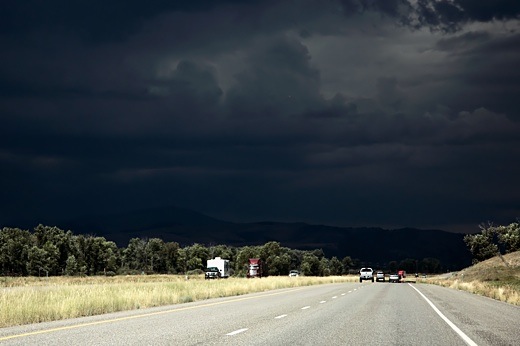
Image above: Detail of photo of a coming storm on the highway. From (http://rockyourwriting.com/2011/12/2012-embracing-apocalypse/).

Here’s my experience in speaking apocalyptically about the serious challenges humans face: No matter how carefully I craft a statement of concern about the future of humans, no matter how often I deny a claim to special gifts of prognostication, no matter now clearly I reject supernatural explanations or solutions, I can be certain that a significant component of any audience will refuse to take me seriously.

Some of those people will make a joke about “Mr. Doom and Gloom.” Others will suggest that such talk is no different than conspiracy theorists’ ramblings about how international bankers, secret cells of communists, or crypto-fascists are using the United Nations to create a one-world government. Even the most measured and careful talk of the coming dramatic change in the place of humans on Earth leads to accusations that one is unnecessarily alarmist, probably paranoid, certainly irrelevant to serious discussion about social and ecological issues.

In the United States, talk of the future is expected to be upbeat, predicting expansion and progress, or at least maintenance of our “way of life.”

Apocalyptic thinking allows us to let go of those fanciful visions of the future. As singer/songwriter John Gorka puts it: “The old future’s gone/We can’t get to there from here.” The comfortable futures that we are comfortable imagining are no longer available to us because of the reckless way we’ve been rolling the dice; there is nothing to save us from ourselves.

Our task is to deal with our future without delusions of deliverance, either divine or technological. This planet is not a way station in a journey to some better place; it is our home, the only home we will know. We will make our peace with ourselves, each other, and the larger living world here.

The first step in thinking sensibly about the future, of course, is reviewing the past. The uncertainty of our future will be easier to accept and the strength to persevere will be easier to summon if we recognize:
  • We are animals. For all our considerable rational capacities, we are driven by non-rational forces that cannot be fully understood or completely controlled. Even the most careful scientist is largely an emotional creature, just like everyone else.

  • We are band/tribal animals. Whatever kind of political unit we live in today, our evolutionary history is in small groups; that’s how we are designed to live.

  • We are band/tribal animals living in a global world. The consequences of the past 10,000 years of human history have left us dealing with human problems on a global scale, and with 7 billion people on the planet, there’s no point in fantasizing about a retreat to Eden.
With that history in mind, we should go easy on ourselves. As Wes Jackson said, we are a species out of context, facing the unique task of being the first animals who will have to self-consciously impose limits on ourselves if we are to survive, reckoning not just with what we do in our specific place on the planet but with what other people are doing around the world. This is no small task, and we are bound to fail often.

We may never stop failing, and that is possibly the most daunting challenge we must face: Can we persevere in the quest for justice and sustainability even if we had good reasons to believe that both projects ultimately will fail? Can we live with that possibility? Can we ponder that and yet still commit ourselves to loving action toward others and the non-human world?

Said differently:
What if our species is an evolutionary dead end? 
What if those adaptations that produced our incredible evolutionary success -- our ability to understand certain aspects of how the world works and manipulate that world to our short-term advantage -- are the very qualities that guarantee our human systems will degrade the life-sustaining systems of the world? 
What if that which has allowed us to dominate will be that which destroys us? 
What if humanity’s story is a dramatic tragedy in the classical sense, a tale in which the seeds of the hero’s destruction are to be found within, and history is the unfolding of the inevitable fall? 
We love stories of individual heroes, and collectively we tend to think of ourselves as the heroic species. The question we might ask, uncomfortably, about those tales of heroism: Is Homo sapiens an epic hero or a tragic one?

Literature scholars argue over the specific definitions of the terms “epic” and “tragedy,” but in common usage an epic celebrates the deeds of a hero who is favored by, and perhaps descended from, the gods. These heroes overcome adversity to do great things in the service of great causes. Epic heroes win.

A tragic hero loses, but typically not because of an external force. The essence of tragedy is what Aristotle called “hamartia,” an error in judgment made because of some character flaw, such as hubris. That excessive pride of protagonists becomes their downfall. Although some traditions talk about the sin of pride, most of us understand that taking some pride in ourselves is psychologically healthy. The problem is excessive pride, when we elevate ourselves and lose a sense of the equal value of others.

When we fall into hubris individually, the consequences can be disastrous for us and those around us. When we fall into that hubris as a species -- when we ignore the consequences of the exploitation on which our “lifestyle” is based -- the consequences are more dramatic.

What if our task is to give up the dream of the human species as special? And what if the global forces set in motion during the high-energy/high-technology era are beyond the point of no return? Surrounded by the big majestic buildings and tiny sophisticated electronic gadgets created through human cleverness, it’s easy for us to believe we are smart enough to run a complex world.

But cleverness is not wisdom, and the ability to create does not guarantee we can control the destruction we have unleashed. It may be that there is no way to rewrite this larger epic, that too much of the tragedy has already been played out.

But here’s the good news: While tragic heroes meet an unhappy fate, a community can learn from the protagonist’s fall. Even tragic heroes can, at the end, celebrate the dignity of the human spirit in their failure. That may be our task, to recognize that we can’t reverse course in time to prevent our ultimate failure, but that in the time remaining we can recognize our hamartia, name our hubris, and do what we can to undo the damage.

That may be the one chance for us to be truly heroic, by learning to leave center stage gracefully, to stop trying to run the world and to accept a place in the world. We have to take our lives seriously but take Life more seriously.

We certainly live in a dangerous time, if we take seriously the data that our vast intellectual enterprises have produced. Ironically, the majority of intellectuals who are part of those enterprises prefer to ignore the implications of that data. The reasons for that will of course vary, and there is no reason to pretend these issues are simple or that we can line up intellectuals in simple categories of good/bad, brave/cowardly, honest/dishonest. Reasonable people can agree on the data and disagree on interpretation and analysis.

Again, my argument is not that anyone who does not share my interpretation and analysis is obviously wrong or corrupt; many of the assertions I have made require more lengthy argument than available in this space.

But I hold to one point without equivocation: When the privileged intellectuals subsidized by the institutions of the dominant culture look away from the difficult issues that we face today, they are failing to meet their moral obligations. The more privileged the intellectual, the greater the responsibility to use our resources, status, and autonomy to face these issues.

There is a lot riding on whether we have the courage and the strength to accept that danger, joyfully. This harsh assessment, and the grief that must accompany it, is not a rejection of joy. The two, grief and joy, are not mutually exclusive but, in fact, rely on each other, and define the human condition. As Wendell Berry puts it, we live on “the human estate of grief and joy.”

This inevitably leads to the question: where can we find hope? My short answer: Don’t ask someone else where to find it. Create it through your actions. Hope is not something we find, but is something we earn. No one has the right to be hopeful until they expend energy to make hope possible. Gorka’s song expresses this: “The old future’s dead and gone/Never to return/There’s a new way through the hills ahead/This one we’ll have to earn/This one we’ll have to earn.”

Berry speaks repeatedly of the importance of daily practice, of building a better world in a practical ways that nurture real bonds in real communities that know their place in the world. He applies this same idea to a discussion of hope:
[Y]ou’re not under any obligation to construct a hope for the whole human race. What you are required to do is to be intelligent. And that means you’ve got to have an array of examples you want more or less to understand. Some are not perfect, and others are awful, and to be intelligent you’ve got to know why some are better than the others.
If people demand that intellectuals provide hope -- or, worse, if intellectuals believe it is their job to give people hope -- then offering platitudes about hope is just another way of avoiding the difficult questions. Clamoring for hope can be a dangerous diversion. But if the discussion of hope leads to action, even in the face of situations that may be hopeless, then we can hold onto what Albert Camus called a “stubborn hope”:
Tomorrow the world may burst into fragments. In that threat hanging over our heads there is a lesson of truth. As we face such a future, hierarchies, titles, honors are reduced to what they are in reality: a passing puff of smoke. And the only certainty left to us is that of naked suffering, common to all, intermingling its roots with those of a stubborn hope.
I would call this a hope beyond hope, the willingness not only to embrace that danger but to find joy in it. The systems that structure our world have done more damage than we can understand, but no matter how dark the world grows, there is a light within. That is the message of the best of our theological and secular philosophical traditions, a recurring theme of the best of our art. Wendell Berry has been returning to this theme for decades in essays, fiction, and poetry, and it is the subject of one of his Sabbath poems: 
It is hard to have hope. It is harder as you grow old,
for hope must not depend on feeling good
and there is the dream of loneliness at absolute midnight.
You also have withdrawn belief in the present reality
of the future, which surely will surprise us,
and hope is harder when it cannot come by prediction
any more than by wishing. But stop dithering.
The young ask the old to hope. What will you tell them?
Tell them at least what you say to yourself.
This is what I say to myself: Whatever our chances of surviving, we define ourselves in the present moment by what we do. There are two basic tasks in front of us. First, we should commit some of our energy to movements that focus on the question of justice in this world, especially those of us with the privilege that is rooted in that injustice. As a middle-class American white man, I can see plenty of places to continue working, in movements dedicated to ending white supremacy, patriarchy, capitalism, and U.S. wars of domination.

I also think there is important work to be done in experiments to prepare for what will come in this new future that we can’t yet describe in detail. Whatever the limits of our predictive capacity, we can be pretty sure we will need ways of organizing ourselves to help us live in a world with less energy and fewer material goods. We all have to develop the skills needed for that world (such as farming and gardening with fewer inputs, food preparation and storage, and basic tinkering), and we will need to recover a deep sense of community that has disappeared from many of our lives.

This means abandoning a sense of ourselves as consumption machines, which the contemporary culture promotes, and deepening our notions of what it means to be humans in search of meaning. We have to learn to tell different stories about our sense of self, our connection to others, and our place in nature. The stories we tell will matter, as will the skills we learn.

Berry’s basis for hope begins with a recognition of where we are and who we are, at our best:
Found your hope, then, on the ground under your feet.
Your hope of Heaven, let it rest on the ground
underfoot. Be lighted by the light that falls
freely upon it after the darkness of the nights
and the darkness of our ignorance and madness.
Let it be lighted also by the light that is within you,
which is the light of imagination. By it you see
the likeness of people in other places to yourself
in your place. It lights invariably the need for care
toward other people, other creatures, in other places
as you would ask them for care toward your place and you.
In my own life, I continue to work on those questions of justice in existing movements, but I have shifted a considerable amount of time to helping build local networks that can create a place for those experiments. Different people will move toward different efforts depending on talents and temperaments; we should all follow our hearts and minds to apply ourselves where it makes sense, given who we are and where we live.

After offering several warnings about arrogance, I’m not about to suggest I know best what work other people should do. If there is any reason for hope, it will be in direct proportion to our capacity for humility and seeing ourselves as part of, not on top of, the larger living world. Berry ends that Sabbath poem not with false optimism but a blunt reminder of how easy it is for us to fall out of right relation with ourselves, others, and the larger living world:
No place at last is better than the world. The world

is no better than its places. Its places at last

are no better than their people while their people

continue in them. When the people make

dark the light within them, the world darkens.
The argument I have made rests on an unsentimental assessment of the physical world and the life-threatening consequences of human activity over the past 10,000 years. We would be wise not to plan on supernatural forces or human inventions to save us from ourselves. It is unlikely that we will be delivered to a promised land by divine or technological intervention. Wishing the world were less harsh will not magically make it less harsh. We should not give into the temptation to believe in magic.

As James Howard Kunstler puts it, we should stop “clamoring desperately for rescue remedies that would allow them to continue living exactly the way they were used to living, with all the accustomed comforts.”

But we should keep telling stories. Our stories do not change the physical world, but they have the potential to change us. In that sense, the poet Muriel Rukeyser was right when she said, “The universe is made of stories, not of atoms.”

Whatever particular work intellectuals do, they are also storytellers. Artists tell stories, but so do scientists and engineers, teachers and preachers. Our work is always both embedded in a story and advancing a story. Intellectual work matters not just for what it discovers about how the world works, but for what story it tells about those discoveries.

To think apocalyptically is not to give up on ourselves, but only to give up on the arrogant stories we modern humans have been telling about ourselves. Our hope for a decent future -- indeed, any hope for even the idea of a future -- depends on our ability to tell stories not of how humans have ruled the world but how we can live in the world. The royal must give way to the prophetic and the apocalyptic.

The central story of power -- that the domination/subordination dynamic is natural and inevitable -- must give way to stories of dignity, solidarity, equality. We must resist not only the cruelty of repression but the seduction of comfort.

The songs we sing matter at least as much as the machines we build. Power always assumes it can control. Our task is to resist that control. Gorka offers that reminder, of the latent power of our stories, in the fancifully titled song “Flying Red Horse”:
They think they can tame you, name you and frame you,

Aim you where you don’t belong.

They know where you’ve been but not where you’re going,

And that is the source of the songs.
Robert Jensen is a journalism professor at the University of Texas at Austin and board member of the Third Coast Activist Resource Center. His latest book is 'All My Bones Shake: Radical Politics in the Prophetic Voice' (Soft Skull Press). He is also the author of 'Getting Off: Pornography and the End of Masculinity' (South End Press).

.

Imperfect Storms

SUBHEAD: History councils that we are not facing either Heaven or Hell but a gnarly combination of both.

By John Michael Greer on 26 June 2013 for the Archdruid Report -
(http://thearchdruidreport.blogspot.com/2013/06/imperfect-storms.html)


Image above: "Heaven and Hell" by Jay-Peg. From (http://jay-peg.deviantart.com/art/Heaven-and-Hell-28596560).

Last week’s post on the need to check our narratives against the evidence of history turned out to be rather more timely than I expected. Over the weekend, following hints and nods from the Fed that the current orgy of quantitative easing may not continue, stock and bond markets around the globe did a swan dive. In response, with the predictability of a well-oiled cuckoo clock, the usual claims that total economic collapse is imminent have begun to spread across the peak oil blogosphere.

As I write these words, the slump seems to have stabilized, but it’s a safe bet that if it resumes—and there’s reason to think that it will—the same claims will get plenty of air time, as they did during the last half dozen market slumps If that happens, it’s an equally safe bet that a year from now, those who made and circulated those predictions will once again have egg on their faces, and the peak oil movement will have suffered another own goal, inflicted by those who have forgotten that the ability to offer accurate predictions about an otherwise baffling future is one of the few things that gives the peak oil movement any claim on the attention of the rest of the world.

Mind you, worries about the state of the world economy are far from misplaced just now. In the wake of the 2008 crash, financial authorities in the US—first the Department of the Treasury, backed by Congressional appropriations, and then the Federal Reserve, backed by nothing but its own insistence that it had the right to spin the presses as enthusiastically as it wished—flooded markets in the US and overseas with a tsunami of money, in an attempt to forestall the contraction of the money supply that usually follows a market crash and ushers in a recession or worse.

The theory behind that exercise was outlined by Ben Bernanke in his famous “helicopter speech” in 2002: keep the money supply from contracting in the wake of a market crash, if necessary by dumping money out of helicopters, and the economy will recover from the effects of the crash and return to robust growth in short order.

That theory was put to the test, and it failed. Five years after the 2008 crash, the global economy has not returned to robust growth. Across America and Europe, in the teeth of quantitative easing, hard times of a kind rarely seen since the Great Depression have become widespread. Official claims that happy days will be here again just as soon as everybody but the rich accepts one more round of belt-tightening (also a feature of the Great Depression, by the way) are increasingly hard to sustain in the face of the flat failure of current policies to bring anything but more poverty.

Meanwhile, the form taken by quantitative easing in the present case—massive purchases of worthless securities by central banks—has national governments drowning in debt, central banks burdened with mountains of the kind of financial paper that makes junk bonds look secure, and no one better off except a financial industry that has become increasingly disconnected from political and economic realities.

Thus the boom is coming down. On the 18th of this month, Obama commented in a media interview that Bernanke had been at the Fed’s helm “longer than he wanted,” an unsubtle way of announcing that the chairman would not be appointed to a third term in 2014.

Shortly thereafter, the Fed let it be known that the ongoing quantitative easing program would be tapered off toward the end of the year, and the general manager of the Bank of International Settlements (BIS), one of the core institutions of global finance, gave a speech noting that central banks had gone too far in spinning the presses, and risked problems as bad as the ones quantitative easing was supposed to cure.

Markets around the world panicked, and for good reason. Most of the cash from quantitative easing in the US and elsewhere got paid out to large banks, on the theory that it would go to borrowers and drive another round of economic growth. That didn’t happen, because borrowing at interest only makes sense when growth can be expected to exceed the interest rate.

Whether it’s 18-year-olds taking out student loans to go to college, business owners issuing corporate paper to finance expansion, or what have you, the assumption is that the return on investment will be high enough to cover the cost of interest and still yield a profit.

In the stagnant economy of the last five years, that assumption has not fared well, and where government guarantees didn’t distort the process—as happened with student loans in the US, for example—the result was a dearth of new loans, and thus a dearth of new economic activity.

Unused money in a bank’s coffers these days is about as secure as it is in the pocket of your average eight-year-old, though, and for most of the last five years, the world’s speculative markets were among the standard places for banks to go and spend it. That helped drive a series of boomlets in various kinds of speculative paper, and pushed some market indices to all-time highs. The end of the quantitative easing gravy train very likely means the end of that process, and for an assortment of other fiscal gimmicks that have been surfing the waves of cheap money pouring out of the Fed and other central banks in recent years. A prolonged bear market is thus likely.

Could that bear market trigger a run on the investment banks that, under the cozy illusion that they’re still too big to fail, have become too arrogant to survive? Very possibly. The twilight of “Helicopter Ben” and his spin-the-presses policies also marks the end of the line for a coterie of economists and bankers, most of them associated with Goldman Sachs, who came to power after the 2008 crisis insisting that they knew how to fix the broken economy. They didn’t, and they are now in the process of discovering—as the neoconservatives found out before them—that while the American political class has almost limitless patience with corruption and venality, it has no tolerance at all for failure.

 I expect to see a fair number of prominent figures in the nation’s financial bureaucracies headed back to the same genteel obscurity that swallowed the neocons, and it’s by no means unlikely that Goldman Sachs or some other big financial firm may be allowed to crash and burn as part of the payback.

And beyond that? One way or another, the end of quantitative easing bids fair to trigger a wave of harsh economic readjustments, government defaults, corporate bankruptcies, and misery for all. An immense overhang of unpayable debt is going to have to be liquidated in one way or another, and there’s no way for that to happen without a lot of pain. That may well involve a recession harsh enough that the D-word will probably need to be pulled out of cold storage and used instead.

Will the remaining scraps of democratic governance in Europe and America, and the increasingly fragile peace among the world’s military powers, survive several years of that? That’s a good question, to which history offers mostly unencouraging answers.

Still, these deeply troubling possibilities aren’t the things you’ll hear aired across the more apocalyptic end of the peak oil scene, if recent declines in global stock markets continue. Rather, if experience is any guide, we can expect a rehash of the claims that the next big economic crisis will cause a total implosion of global financial systems, leading to a credit collapse that will prevent farmers from buying seed for next year’s crops, groceries from stocking their shelves, factories from producing anything at all, and thus land us all plop in the middle of the Dark Ages in short order.

It’s here that the issue discussed in last week’s post becomes particularly relevant, because there’s a difference—a big one—between the imaginary cataclysms that fill so much space on the doomward end of the blogosphere and what actually happens. Financial history is full of markets that imploded, economies that plunged into recession and depression, currencies that became worthless, and all the other stage properties of current speculations concerning total economic collapse, and it also has quite detailed things to say about what followed each of these crises.

Without too much trouble, given access to the internet or a decently stocked library, you can find out what happens when a highly centralized economic system comes apart at the seams, no matter what combination of factors do the deed. The difference between what actually happens and the whole range of current fantasies about instant doom can be summed up in a single phrase: negative feedback.

That’s the process by which a thermostat works: when the house gets cold, the furnace turns on and heats it back up; when the house gets too warm, the furnace shuts down and lets it cool off. Negative feedback is one of the basic properties of whole systems, and the more complex the system, the more subtle, powerful, and multilayered the negative feedback loops tend to be.

The opposite process is positive feedback, and it’s extremely rare in the real world, because systems with positive feedback promptly destroy themselves—imagine a thermostat that responded to rising temperatures by heating things up further until the house burns down. Negative feedback, by contrast, is everywhere.

That’s not something you’ll see referenced in any of the current crop of fast-crash theories, whether those fixate on financial markets, global climate, or what have you. Nearly all those theories make sweeping claims about some set of hypothetical positive feedback loops, while systematically ignoring the existence of well-documented negative feedback loops, and dismissing the evidence of history.

The traditional cry of “But it’s different this time!” serves its usual function as an obstacle to understanding: no matter how many times a claim has failed in the past, and no matter how many times matters have failed to follow the predicted course, believers can always find some reason or other to insist that this time isn’t like all the others.

It happens that I’ve been doing plenty of thinking about negative feedback recently, because I’ve fielded yet another flurry of claims that my theory of catabolic collapse must be false because it doesn’t allow for the large-scale crises that we’re evidently about to experience.

Mind you, I have no objection to having my theory critiqued, but it would be helpful if those who did so took the time to learn a little about the theory they think they’re critiquing. In point of fact—I encourage doubters to read a PDF of the original essay—the theory of catabolic collapse not only assumes but requires large-scale crises. What it explains is why those crises aren’t followed by a plunge into oblivion but by stabilization and partial recovery.

The reason is negative feedback. A civilization on the way down normally has much more capital—buildings, infrastructure, knowledge, population, and everything else a macroeconomist would put under this label—than it can afford to maintain. Crisis solves this problem by wrecking a great deal of excess capital, so that it no longer requires maintenance, and resources that had been maintaining it can be put to more immediate needs. In addition, much of the wrecked capital can be stripped for raw materials, cutting expenditures further.

Since civilizations in decline are by and large desperately short of uncommitted resources, and are also normally squeezed by rising costs for resource extraction, both these windfalls make it possible for a crumbling society to buy time and stave off collapse for at least a little longer; that’s what drives the stairstep process of crisis, stabilization, partial recovery, and renewed crisis that shows up in the last centuries of every historically documented civilization.

That sequence is so reliable that Arnold Toynbee could argue, with no shortage of evidence, that there are usually three and a half rounds of it in the fall of any civilization—the last half-cycle being the final crisis from which the recovery is somebody else’s business. Our civilization, by the way, has already been through its first cycle, the global crisis of 1914-1954 that saw Europe stripped of its once-vast colonial empires and turned into a battleground between American and Russian successor states.

We’re just about due for the second, which will likely be at least as traumatic as the first; the third, if our civilization follows the usual pattern, should hit a battered and impoverished industrial world sometime in the 22nd century, and the final collapse will follow maybe fifty to a hundred years after that.

Now of course there are plenty of people these days insisting that industrial civilization can’t possibly take that long to fall, just as there are plenty of people who insist that it can’t fall at all. In both cases, the arguments normally rest on the blindness to negative feedback discussed above.

Consider the currently popular notion, critiqued in one of last month’s posts, that humanity will go extinct by 2030 due to runaway climate change. The logic here follows the pattern I sketched out earlier—extreme claims about hypothetical positive feedback loops, combined with selective blindness to well-documented negative feedback loops that have put an end to greenhouse events in the past, propped up with the inevitable claim that the modest details that distinguish the present situation from similar events in the past mean that the lessons of the past don’t count.

Current rhetoric aside, greenhouse events driven by extremely rapid CO2 releases are anything but rare in Earth’s history. The usual culprits are large-scale volcanic releases of greenhouse gases, which boosted CO2 levels in the atmosphere up above 1200 ppm—that’s four times current levels—and thus drove what geologists, not normally an excitable bunch, call “super-greenhouse events.”

 If massive CO2 releases into the atmosphere were going to exterminate life on Earth, these would have done the trick—and super-greenhouse events have happened many times already, just within the small share of the planet’s history that geologists have enough evidence to study.

What stops it? Negative feedback. The most important of the many negative feedback loops that counter greenhouse events is the shutdown of the thermohaline circulation, the engine that drives the world’s ocean currents. The thermohaline circulation also puts oxygen into the deep oceans, and when it shuts down, you get an oceanic anoxic event.

Ocean waters below 50 meters or so run out of oxygen and become incapable of supporting life, and the rain of carbon-rich organic materials from the sunlit levels of the ocean, which normally supports a galaxy of deepwater ecosystems, falls instead to the bottom of the sea, taking all its carbon with it.

It’s an extremely effective way of sucking excess carbon out of the biosphere: around 70% of all known petroleum reserves, along with thick belts of carbon-rich black shale found over much of the world, were laid down in a handful of oceanic anoxic events in the Jurassic and Cretaceous periods.

Oceanographers aren’t sure yet of the mechanism that shuts off the thermohaline circulation, but it doesn’t require the steamy temperatures of the Mesozoic to do it. At least one massive oceanic anoxic event happened in the Ordovician period, in the middle of a glaciation, and there’s tolerably good evidence that a brief shutdown was responsible for the thousand-year-long Younger Dryas cold period at the end of the last ice age.

Not that long ago, global warming researchers were warning about the possibility of a shutdown of the thermohaline circulation in the near future, and measurements of deepwater formation have not been encouraging to believers in business as usual.

Meanwhile, other patterns of negative feedback are already under way. Across much of the tropical world, increased CO2 levels in the atmosphere are helping to drive bush encroachment—the rapid spread of thorny shrubs and trees across former grasslands.

Western media coverage so far has fixated on the plight of cheetahs—is there any environmental issue we can’t reduce to sentimentality about cute animals?—but the other side of the picture is that shrubs and trees soak up much more carbon than grasslands, and in many areas, the shrubs involved in bush encroachment make cattle raising impossible, cutting into another source of greenhouse gases.

Meanwhile, the depletion of fossil fuels imposes its own form of negative feedback; as petroleum geologists have been pointing out for quite a while now, there aren’t enough economically recoverable fossil fuels in the world to justify even the IPCC’s relatively unapocalyptic predictions of climate change.

Apply the same logic to the economic convulsions I mentioned earlier and the same results follow. The reason a financial collapse won’t result in bare grocery shelves, deserted factories, fallow fields, and mass death is, again, negative feedback.

The world’s political, economic, and military officials have plenty of options for preventing such an outcome, most of them thoroughly tested in previous economic breakdowns, and so these officials aren’t exactly likely to respond to crisis by wringing their hands and saying, “Oh, whatever shall we do?”

 For that matter, ordinary people caught in previous periods of extreme economic crisis have proven perfectly able to jerry-rig whatever arrangements might be necessary to stay fed and provided with other necessities.

Whether the crisis is contained by federal loan guarantees and bank nationalizations that keep farms, factories, and stores supplied with the credit they need, by the repudiation of debts and the issuance of a new currency, by martial law and the government seizure of unused acreage, or by ordinary citizens cobbling together new systems of exchange in a hurry, as happened in Argentina, Russia, and other places where the economy suddenly went to pieces, the crisis will be contained.

The negative feedback here is provided by the simple facts that people are willing to do almost anything to put food on the table, governments are willing to do even more to stay in power, and in hundreds of previous crises, their actions have proven more than sufficient to stop the positive feedback loops of economic crisis in their tracks, and stabilize the situation at some level.

None of this means the crisis will be easy to get through, nor does it mean that the world that emerges once the rubble stops bouncing and the dust settles will be anything like as prosperous, as comfortable, or as familiar as the one we have today. That’s true of all three of the situations I’ve sketched out in this post.

While the next round of crisis along the arc of industrial civilization’s decline and fall will likely be over by 2070 of so, living through the interval between then and now will probably have more than a little in common with living through the First World War, the waves of political and social crises that followed it, the Great Depression, and the rise of fascism, followed by the Second World War and its aftermath—and this time the United States is unlikely to be sheltered from the worst impacts of crisis, as it was between 1914 and 1954.

In the same way, the negative feedback loops that counter greenhouse events in the Earth’s biosphere don’t prevent drastic climate swings, with all the agricultural problems and extreme weather events that those imply; they simply prevent those swings from going indefinitely, and impose reverse swings that could be just as damaging.

If the thermohaline circulation shuts down, in particular, there’s a very real possibility that the world could be whipsawed by extreme weather in both directions—too hot for a few more decades, and then too cold for the next millennium—as happened around the beginning of the Younger Dryas period 12,800 years ago.

Our species survived then, and on several other similar occasions, and the Earth as a whole has been through even more drastic climate shifts many times; still, it’s a sufficiently harsh prospect for those of us who may have to live through it that anything that can be done to prevent it is well worth doing.

It’s only the contemporary fixation on “perfect storms” of various imaginary kinds that leads so many people to forget that imperfect storms can cause quite a bit of damage all by themselves.

Yet it’s the imperfect storms, the ones we can actually expect to get in the real world, that ought to feature in predictions of the future—if those predictions are meant to predict the future, that is, rather than serving as inkblots onto which to project emotionally charged fantasies, excuses for not abandoning unsustainable but comfortable lifestyles, or what have you.

.