Goldman upside = Your downside

SUBHEAD: Goldman Sachs' job description is to "make money"; system stability is someone else's job.

Image above: Goldman CEO Lloyd Blankfein warns congress on nationalizing banks 2/11/09. From (http://www.welt.de/english-news/article3335498/Goldman-Sachs-CEO-warns-against-nationalization.html)

By Simon Johnson on 30 March 2010 in Huffington Post - (http://www.huffingtonpost.com/simon-johnson/geely-buys-volvo-goldman_b_518162.html)

Geely Automotive has acquired Volvo from Ford. This is a risky bet that may or may pay off for the Chinese auto maker - after first requiring a great deal of investment.

Goldman Sachs' private equity owns a significant stake in Geely, with the explicit goal of helping that company expand internationally. Remember what Goldman is - or rather what Goldman became when it was saved from collapse by being allowed to transform into a Bank Holding Company in September 2008 (which allowed access to the Federal Reserve's discount window, among other advantages). Goldman's funding is cheaper on all dimensions because it is perceived to be Too Big To Fail, i.e., supported by the US taxpayer; this allows Goldman to provide more support to Geely (and others).

Our Too Big To Fail banks stand today at the heart of global capital flows. People around the world - including from China - park their funds in the biggest US banks because everyone concerned believes these banks cannot fail; they were, after all, saved by the Bush administration and put completely - gently and unconditionally - back on their feet under President Obama. These same banks now spearhead lending to risky projects around the world.

What is the likely outcome?

We know that risk-management at the megabanks breaks down in the face of a boom (remember Chuck Prince of Citigroup in July 2007: "as long as the music is playing, you've got to get up and dance. We're still dancing"). We know there is a growing boom in emerging markets - including through the overseas expansion of would-be multinationals from those countries. This is most notably true of state-backed firms from China, but there is also a more general pattern (think India, Brazil, Russia, and more).

The big global banks, US and European, are charging hard into this space - Citigroup is expanding fast in China and India (areas where they claim great expertise); and the CEO of HSBC has moved to Hong Kong. Many investment advisors are adamant that China will power global growth (never mind that it is less than 10 percent of the world economy), that renminbi appreciation is around the corner, and that the value of investments in or connected to that country can only go up.

There is a very good reason why, between the 1930s and the 1980s, large US commercial banks were severely constrained in their risk-taking activities. By the 1930s US policymakers had learned the very hard way that we do not want the banks that run our payments system (with the implicit or explicit backing of the government, depending on how you look at it) to be engaged also in high risk equity-type investments - this is really asking for trouble.

The problem is not that all such banking-based risky investments go bad. Far from it - we'll first get an apparently great boom, which will suck in all kinds of financial institutions, our future Chuck Princes. As long as the market goes up, the executives and traders involved will do very well - lauded as geniuses and paid accordingly.

And if some of them fail, so what - failure is essential to a market economy. But here's the key problem with having so much of our economy in the hands of financial firms that are Too Big To Fail. When the next emerging market crash comes, we'll have to make the 2008-2009 decision all over again: should we rescue our big troubled financial institutions, or should we let them fail - and cause great damage to the economy?

Image above: The Goldman Sachs building on Broad Street in the New York financial district. From (http://www.welt.de/english-news/article3335498/Goldman-Sachs-CEO-warns-against-nationalization.html)

In our assessment (13 Bankers: The Wall Street Takeover and The Next Financial Meltdown, out today), based on the details of financial deregulation over the past 30 years, the prevailing belief system of top bankers, and the big banks' incentives to take risk, we are all heading for trouble. The "financial reform" legislation currently before Congress and still prevailing pro-banker attitudes at the top of the Obama administration are really not helpful. The country's course was set by a fateful meeting at the White House last March; a resurrected, unreformed, and still crazy system - symbolized by 13 bankers - is in the driving seat now.

At best, this will be another very nasty boom-bust-bailout cycle. At worst, we are heading towards a situation in which our banks are so massive that when they fail, there is no way the government (or anyone else) can offset the damage that causes.

This time our government debt (held by the private sector) will roughly double - increasing by 40 percentage points of GDP - as a direct result of what the banks did. We've lost more than 8 million jobs since December 2008 - for what good reason? Next time could easily be worse.

You can disagree with our analysis - provide your own facts and figures, and we'll have that debate here or elsewhere; the more public, the better from our perspective. And you should certainly want to improve on our policy prescriptions. We put forward some simple ideas that can be implemented and would help - our versions can also be communicated and argued widely: if banks are too big to fail, making them smaller is surely necessary (although likely not sufficient).

But don't ignore the question. Don't assume that this time Goldman and its ilk will avoid getting carried away - they are just doing their jobs, after all, and their job description says "make money"; system stability is someone else's job.

And also don't presume that, just because the big banks and their friends seem to hold all the cards, they will necessarily prevail in the future.

In all previous confrontations between elected authority and concentrated financial power in the United States, the democratic element has prevailed (see chapter 1 in 13 Bankers; also Monday's WSJ, behind the paywall). This can happen again - but only if you stay engaged, argue this out with everyone you know (including your elected representatives), and help change the mainstream consensus on banking definitively and irrevocably.

.

KIUC Election Results

SOURCE: Kenneth Taylor (taylork021@Hawaii.rr.com) SUBHEAD: The Kauai Island Utility Cooperative board election results are complete. Image above: Victorious new KIUC board member Jan TenBruggencate. Photo by Dennis Fujimoto for Garden Island News. [Publisher's note: We congratulate those who won... especially Jan Tenbruggencate, who we endorsed, and who is the only new progressive voice to join the board of KIUC.] By Coco Zickos on 27 March 2010 in The Garen Island News- (http://thegardenisland.com/business/local/article_de4f04b8-3a45-11df-a047-001cc4c03286.html) Carol Bain, Allan Smith and Jan TenBruggencate were elected to the Kauai Island Utility Cooperative Board of Directors late Saturday afternoon.

The new board members will serve three-year terms which end March 2013.

Governing the “business and affairs of KIUC,” the board is responsible for certain activities such as “approving annual operating budget, construction work plans, compensation plans and capital expenditure budgets,” according to KIUC’s Board Policy.

“I’m humbled and very eager to serve again,” said Smith, who was re-elected to another term on the nine-member board.

During the next three years as director, Smith said he wants to “continue on our track in moving ahead as a co-op and do what we can to make a difference” and “make things sustainable.”

Harnessing the sun’s energy is one way Smith said the island could move forward in its quest to decrease its dependency on fossil fuels, especially when it comes to photovoltaic systems because the “technology is there.”

“I’m very pleased to win,” said Bain, also an incumbent. “There is work I feel I need to complete.”

Bain, who said she will push for renewable energies, noted the “great” team of directors has “a lot of work ahead.”

TenBruggencate could not be reached for comment by press time.

Though first-time candidates Pat Gegen and Carol Medeiros were not elected to the board, both said they felt like they put in their best efforts.

“It’s more disappointing for the people who voted for me,” Medeiros said, adding she will not be running again next time around.

“The forum was very stressful,” she said when asked what some of her reasons were for choosing not to run again.

Planning to “keep his pulse” on the co-op’s activities, Gegen said he will continue to regularly attend KIUC board meetings and will “try to influence the direction of the co-op in renewable” sources from his position as a community member.

Gegen — who alone touted more than a decade of work experience in the energy field, from renewables to oil — said he is unsure at this point whether he will run again.

Of the more than 24,000 KIUC members, around 6,700 voted in the election.

The newly elected board members will be inaugurated at noon, Tuesday, in the KIUC Main Conference room, 4463 Pahee Street, Lihue. The board will then hold its regularly scheduled meeting at 1:30 p.m.

The official results of the 2010 Board of Directors Election are as follows: Allan A. Smith 4,323 votes or 21.34% Jan TenBruggencate 4,126 votes or 20.36% Carol Bain 3,240 votes or 15.99% Pat Gegen 2,671 votes or 13.18% Carol Medeiros 2,422 votes or 11.95% .

America's yearning for Fascism

SUBHEAD: Our country has been hijacked. And we have to take the country away from those who have hijacked it. Image above: Mash-up of Sara Palin wrapped in flag carrying a cross. From (http://www.arguewitheveryone.com/general-political-discussion/96564-can-you-speak-tea-bag-4.html)
"When Fascism comes to America it will be wrapped in a flag and carrying a cross" - Sinclair Lewis , 1935
By Chris Hedges on 29 March 2010 in Truthdig - (http://www.truthdig.com/report/item/is_america_yearning_for_fascism_20100329)

The language of violence always presages violence. I watched it in war after war, from Latin America to the Balkans. The impoverishment of a working class and the snuffing out of hope and opportunity always produce angry mobs ready to kill and be killed.

A bankrupt, liberal elite, which proves ineffectual against the rich and the criminal, always gets swept aside, in times of economic collapse, before thugs and demagogues emerge to play to the passions of the crowd. I have seen this drama. I know each act. I know how it ends. I have heard it in other tongues in other lands. I recognize the same stock characters, the buffoons, charlatans and fools, the same confused crowds and the same impotent and despised liberal class that deserves the hatred it engenders. Cynthia McKinney, who ran for president on the Green Party ticket, told me.

"We are ruled not by two parties but one party. It is the party of money and war. Our country has been hijacked. And we have to take the country away from those who have hijacked it. The only question now is whose revolution gets funded."

The Democrats and their liberal apologists are so oblivious to the profound personal and economic despair sweeping through this country that they think offering unemployed people the right to keep their unemployed children on their nonexistent health care policies is a step forward.

They think that passing a jobs bill that will give tax credits to corporations is a rational response to an unemployment rate that is, in real terms, close to 20 percent. They think that making ordinary Americans, one in eight of whom depends on food stamps to eat, fork over trillions in taxpayer dollars to pay for the crimes of Wall Street and war is acceptable. They think that the refusal to save the estimated 2.4 million people who will be forced out of their homes by foreclosure this year is justified by the bloodless language of fiscal austerity.

The message is clear. Laws do not apply to the power elite. Our government does not work. And the longer we stand by and do nothing, the longer we refuse to embrace and recognize the legitimate rage of the working class, the faster we will see our anemic democracy die.

The unraveling of America mirrors the unraveling of Yugoslavia. The Balkan war was not caused by ancient ethnic hatreds. It was caused by the economic collapse of Yugoslavia. The petty criminals and goons who took power harnessed the anger and despair of the unemployed and the desperate. They singled out convenient scapegoats from ethnic Croats to Muslims to Albanians to Gypsies.

They set in motion movements that unleashed a feeding frenzy leading to war and self-immolation. There is little difference between the ludicrous would-be poet Radovan Karadzic, who was a figure of ridicule in Sarajevo before the war, and the moronic Glenn Beck or Sarah Palin. There is little difference between the Oath Keepers and the Serbian militias. We can laugh at these people, but they are not the fools. We are.

The longer we appeal to the Democrats, who are servants of corporate interests, the more stupid and ineffectual we become. Sixty-one percent of Americans believe the country is in decline, according to a recent NBC News/Wall Street Journal poll, and they are right. Only 25 percent of those polled said the government can be trusted to protect the interests of the American people. If we do not embrace this outrage and distrust as our own it will be expressed through a terrifying right-wing backlash.

McKinney also told me:

"It is time for us to stop talking about right and left. The old political paradigm that serves the interests of the people who put us in this predicament will not be the paradigm that gets us out of this. I am a child of the South. Janet Napolitano tells me I need to be afraid of people who are labeled white supremacists but I was raised around white supremacists. I am not afraid of white supremacists. I am concerned about my own government. The Patriot Act did not come from the white supremacists, it came from the White House and Congress. Citizens United did not come from white supremacists, it came from the Supreme Court. Our problem is a problem of governance. I am willing to reach across traditional barriers that have been skillfully constructed by people who benefit from the way the system is organized."

We are bound to a party that has betrayed every principle we claim to espouse, from universal health care to an end to our permanent war economy, to a demand for quality and affordable public education, to a concern for the jobs of the working class. And the hatred expressed within right-wing movements for the college-educated elite, who created or at least did nothing to halt the financial debacle, is not misplaced.

Our educated elite, wallowing in self-righteousness, wasted its time in the boutique activism of political correctness as tens of millions of workers lost their jobs. The shouting of racist and bigoted words at black and gay members of Congress, the spitting on a black member of the House, the tossing of bricks through the windows of legislators' offices, are part of the language of rebellion. It is as much a revolt against the educated elite as it is against the government. The blame lies with us. We created the monster.

When someone like Palin posts a map with cross hairs on the districts of Democrats, when she says "Don't Retreat, Instead-RELOAD!" there are desperate people cleaning their weapons who listen. When Christian fascists stand in the pulpits of megachurches and denounce Barack Obama as the Antichrist, there are messianic believers who listen. When a Republican lawmaker shouts "baby killer" at Michigan Democrat Bart Stupak, there are violent extremists who see the mission of saving the unborn as a sacred duty. They have little left to lose. We made sure of that. And the violence they inflict is an expression of the violence they endure.

These movements are not yet full-blown fascist movements. They do not openly call for the extermination of ethnic or religious groups. They do not openly advocate violence. But, as I was told by Fritz Stern, a scholar of fascism who has written about the origins of Nazism:

"In Germany there was a yearning for fascism before fascism was invented."
It is the yearning that we now see, and it is dangerous. If we do not immediately reincorporate the unemployed and the poor back into the economy, giving them jobs and relief from crippling debt, then the nascent racism and violence that are leaping up around the edges of American society will become a full-blown conflagration.

Left unchecked, the hatred for radical Islam will transform itself into a hatred for Muslims. The hatred for undocumented workers will become a hatred for Mexicans and Central Americans. The hatred for those not defined by this largely white movement as American patriots will become a hatred for African-Americans. The hatred for liberals will morph into a hatred for all democratic institutions, from universities to government agencies to the press. Our continued impotence and cowardice, our refusal to articulate this anger and stand up in open defiance to the Democrats and the Republicans, will see us swept aside for an age of terror and blood.

.

The tree that changed the world

SUBHEAD: Two planets diverged in a solar system, and the successful one took a path more wooded. Image above: A dense forest of fern-leafed trees from Devonian epoch absorbed CO2. From (http://www.bertsgeschiedenissite.nl/geschiedenis%20aarde/devoon_planten.htm) By John Perlin on 29 March 2010 in Miller- McCune - (http://www.miller-mccune.com/science-environment/the-tree-that-changed-the-world-11656) The author of "A Forest Journey: The Story of Wood and Civilization", begins a series of articles on the world’s first energy crisis: peak wood.

Astronomers for the longest time have regarded Venus as the planet most resembling Earth. Having almost the exact size as Earth and being almost as close to the sun has led many to call it Earth’s twin.

The clouds always covering the Venusian landscape are another compelling example of Venus’ affinity to Earth. Pioneering astronomer Svante Arrhenius hypothesized great rains pouring from these clouds nurtured lush rain forests below. But when various space probes penetrated the Venusian atmosphere, this belief burst. Astronomers found an inferno rather than a tropical paradise.

Here they discovered the ultimate greenhouse effect: Although the carbon dioxide-laden atmosphere allowed sunlight to pass through, when the solar rays hit the surface of Venus and changed into heat waves, they could not escape the carbon dioxide cover. So the heat had nowhere to go and accumulated at the surface, where temperatures exceed 800 degrees Fahrenheit.

Earth has as much carbon dioxide as Venus. But instead of the gas blanketing the sky as happened on Venus, much of the carbon dioxide on Earth has been locked up inside and on the surface. This has made all the difference in the story of the two planets — one, a heaven bountiful with life, the other a hellish place where nothing animate as we understand it can survive.

Credit much of this carbon dioxide transfer from the atmosphere to the land to the rapid global spread 400 million years ago of the first (or among the first) true trees, Archaeopteris.

Its dense canopy photosynthetically absorbed carbon dioxide. As its fernlike leaves shed, they would have given back the carbon dioxide to the air — had the tree’s deep and powerful root system not broken down rock through which it dug into soil, where chemical reactions eventually locked the carbon dioxide into sediment. Mud buried much of the remaining dead leaves, branches, twigs, trunks and roots.

With the passing of millions of years under great pressure deep in the bowels of the earth, the plant material ended up as rich beds of fossils and coal. Once again, natural forces denied returning to the atmosphere what the trees had devoured.

Archaeopteris prepared the soil for smaller plants to flourish and assist in removing carbon dioxide from the air. Its root system turned rock into rich, soft earth. Their leaves shielded the newly formed soil from erosive rain and wind, and fertilized it as they fell and decomposed. Debris from the growing number of plants filled waterways, promoting plankton, which also feeds on atmospheric carbon dioxide.

Buried by sediments these consumers of carbon dioxide could not release this greenhouse gas to the air. The plunging carbon dioxide levels in the atmosphere caused temperatures on land to drop. The change made it possible for large creatures to amble about the land without overheating. They no longer had to remain immersed in water — which heats more slowly than land surfaces, and which also better conducts heat away from animals than does air — to maintain healthy body temperatures.

At the same time, declining amounts of atmospheric carbon dioxide enlarged the ozone layer above the Earth. Such protection shields land animals from lethal doses of ultraviolet radiation. Previously, creatures of any significant size had to remain underwater for protection from the unfiltered sun’s harmful rays. Of equal importance, the injection of more oxygen into the air by Archaeopteris and smaller plants provided enough of the life-giving gas to make it possible for animals to breathe.

Scientists find charcoal for the first time during the reign of Archaeopteris, suggesting that with the trees’ appearance came sufficient amounts of oxygen to support combustion.

As logs and large branches started to clutter the bottom of shallow waterways, fishlike creatures with limbs could better propel themselves through the plant debris than those with fins. The increasing organic debris finding its way into waterways would rob them of their oxygen as it decomposed. Creatures that could breathe as well as walk could escape sure death by making their ascent to land where a relatively mild climate, sufficient oxygen, protection from ultraviolet radiation, and plenty of food provided by plants made survival possible.

So began the chain of events that has permitted vertebrates to flourish on land so that 400 million years later I can write this, and you can read it.

While Archaeopteris is now extinct, nature kept buried the remains of ancient organic debris of algae, plankton, plants and trees. Their entombment helped keep the carbon dioxide they captured through photosynthesis out of the atmosphere.

But people started to dig up and burn the early trees, ancient plants and plankton first as coal and then as oil and natural gas. The seemingly unlimited availability of long-buried organic material, aptly named fossil fuels, ushered in a new technological era qualitatively separating those living since the middle of the 19th century from the rest of history. This new age of unprecedented growth, the Industrial Revolution, also accelerated the rate of deforestation as growing markets and population require more and more clearing for agriculture, livestock and biofuels, and the consumption of trees for fuel and for timber.

True, deforestation has occurred throughout world history. Plato, for example, saw deforestation turn a fertile piece of Attica into rock. He compared this butchered slice of earth to a carcass stripped of all its meat with only the bones remaining.

“What now remains compared with what then existed is like the skeleton of a sick man, all fat and soft earth having wasted away, and only the bare framework of the land being left,” he wrote in Critias. “… There are some mountains which have nothing but food for bees, but they had trees not very long ago …”

Since the beginning of the Industrial Revolution, Plato’s compelling description of a particular place in Greece has become universal.

The growing loss of trees has allowed ever increasing amounts of carbon dioxide to return the to atmosphere. So have the engines of commerce and industry by burning fossil fuels. Scientific investigations have proven that since the beginning of the industrial revolution carbon dioxide levels have increased as well as the temperature of the Earth.

Unless drastic changes occur socially and technologically, increasing amounts of carbon dioxide will enter the atmosphere as the burning of fossil fuels continues to accelerate along with deforestation. Deforestation alone accounts for the release of more greenhouse gases than do all the vehicles throughout the world!

Bad forestry practices help hasten the pace of carbon released into the atmosphere. Following a clear-cut, for example, the formerly forested soil releases tremendous amounts of carbon dioxide into the atmosphere.

In North America, for example, 60 percent of all carbon resides within the earth of the forest floor. Replanting does capture carbon dioxide as new organic matter grows. The losses of carbon dioxide to the atmosphere continue to exceed the removal of carbon in the replanted clear-cut for 15 to 25 years depending on the type of tree, climate and soil. Then the trees and the soil underneath start to store more carbon dioxide than released.

Conversely, forests can become a weapon in our arsenal to break global warming if foresters practice enlightened stewardship. Sustainable forestry will need to become the standard on all forest lands globally. Replanting formerly forested land helps if trees are not selectively harvested until the seedlings reach an age where they have taken in more carbon dioxide than has been exhaled. Trees cut down in cycles of 50, 75 and 100 years store only 38 percent, 44 percent and 51 percent, respectively, of the carbon that an old-growth stand retains.

Indeed, trees can play a vital role in reducing atmospheric carbon dioxide. A recent study shows that saving the Amazon can be a cheaper and faster way to mitigate the consequences of global warming than replacing coal-fired power plants with renewable energy.

Permaculture - Multiple Functions

SUBHEAD: Part 2 of a 6 part series on Permaculture Design Guidelines. Each garden element has multiple functions.

By Birgit Bradtke in Tropical Permaculture in 2010 -  
(http://www.tropicalpermaculture.com/permaculture-design-principles-2.html) 

  Image above: Archeological site in Poipu where permaculture was practiced 1000 years ago. Rock walls trace a history of mixed agriculture and aquaculture defined by the flow of water. Photo by Juan Wilson.

 The permaculture design principle of multiple functions is the best way for beginners to start thinking (and understanding) the "permaculture way". But before we get to the examples let's understand the background: No living being can function on its own. It's true for you and for everything in your garden. You need food, shelter, other human beings, an interesting and challenging job and a whole lot of other things in your life to be happy.

Plants need water, food, light, (those are obvious), but also pollination, pruning, transplanting and other things to be happy. In a conventional garden you would be the one who has to satisfy all the needs. A permaculture design is a bit smarter. A good permaculture design outsources or eliminates many tasks (especially boring, repetitive tasks) and that way saves you a lot of time and work. To understand the multiple functions of each element in your garden is one vital step on your way to such a smart permaculture design.

Once you understand the functions of each element, you can place elements together that mutually benefit each other. It's easily done. Still, many gardeners never take advantage of these possible connections, where one plant or element looks after the needs of another plant... This may still sound confusing, so let's look at some examples: The easiest way for permaculture design beginners to get started is to try to think of three uses for every element in your garden. I can usually come up with about five, but three is enough for beginners:
  • A tree can provide fruit, provide shade, and act as a windbreak. 
  • Dill can be used as a herb, the flowers attract beneficial insects, and add visual appeal to your garden. 
  • A hedge can provide fruit, privacy, and shelter for wildlife. 
  • A pond can grow aquatic plants, hold fish, and attract birds and other wildlife. 
  • A wall can give privacy, support climbing plants, and store heat (for growing tropical plants in cooler areas). Look at what every element can provide, and what it needs.
Once you understand that you can then put elements together so they support each other. Let's look at a compost pile in my permaculture garden: So what does a compost pile do? The obvious function is, it turns weeds and dead leaves and other things from my garden into compost, chock full of nutrients and growth factors and other stuff that makes plants happy. That are two functions already: taking care of garden waste and producing plant food. What else? Come on, I said at least three. Ok, here's what I can think of:
  • It is a great breeding place for earth worms. 
  • With all the critters in it, it's a source for those lizards and birds that eat critters. 
  • The surrounding frame supports climbing plants.
  • The compost tea from it provides liquid fertilizer.
And now let's look at how the multiple functions of the different elements, and of that particular compost pile, are put together.

See Also:
Ea O Ka Aina: Permaculture 1 - Growing Zones 3/22/10
Ea O Ka Aina: Permaculture 2 - Multiple Functions 3/29/10
Ea O Ka Aina: Permaculture 3 - Relative Location 5/24/12
Ea O Ka Aina: Permaculture 4 - Problems into Solutions 5/24/12
Ea O Ka Aina: Permaculture 5 - Design Diversity 5/24/12
Ea O Ka Aina: Permaculture 6 - Use of Space 5/24/12
.

What Works - Food

SUBHEAD: The time to plant a garden is not when you’re hungry. Image above: A rusted tractor found in the near-empty town of Panna Maria, Texas. From (http://www.pbase.com/cellnav/image/38116938) By Guy McPherson on 26 March 2010 in Nature Bats Last - (http://guymcpherson.com/2010/03/what-works-food)

As I described in my prior post, water is a big deal for humans, as it is for all life on Earth. But food is pretty important, too. Currently, most Americans store large quantities of food in the form of body fat. The primary storage facility for unconsumed food is right down the street, in the nearest grocery store.

I think we’re nearing the end of the line for both classically American storage facilities, and that it’s time to start making the recently proverbial other arrangements. Even business leaders recognize the irrationality of not preparing for peak oil and its economic implications, but there are many other reasons for growing your own, including purging the high-fructose corn syrup and other industrial toxins from your grocery list. This post describes our systems for producing and processing food at the mud hut.

Production

Perennial plants are much easier to work with than their annual cousins. After the perennials are established, there is no need to weed, and watering is a breeze. Fertilizer is still necessary, and woody plants need the occasional pruning. But in general, I prefer the lazy nature of perennial plants over the back-straining events of tending a garden.

The mud hut has gardens, not farms. After all, Eden was a garden, not a farm. The difference is primarily one of scale. We have no interest in developing an empire, although we’ll barter with neighbors.

Our perennial plants include about three dozen fruit and nut trees, including cherries, apples, pears, peaches, plums, apricots, nectarines, pluots, pecans, and Asian pears (i.e., Asian apples). We have a fig, a pomegranate, and several citrus trees. Trees are fertilized with humanure from the composting toilets I mentioned a few days ago.

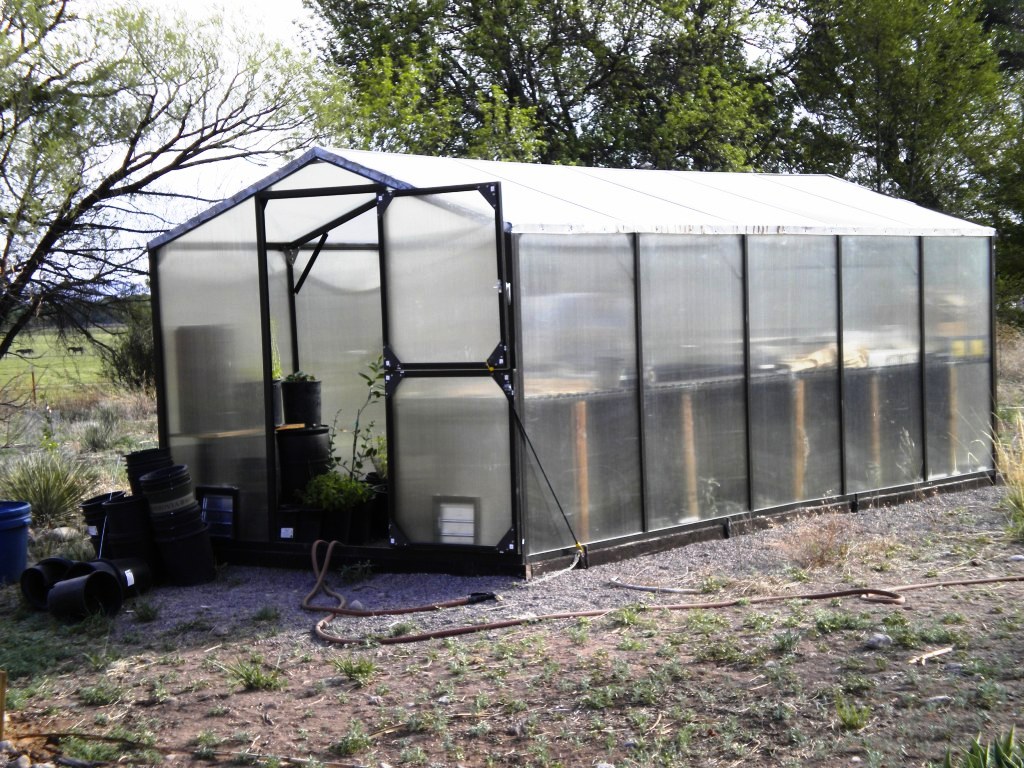
Unprotected citrus will not survive the cold winters here, so we have four dwarf varieties growing in a greenhouse (lemon, lime, orange, grapefruit). The greenhouse is filled with 55-gallon drums brimming with water, which keeps nighttime temperatures about 25 F warmer inside than out.

At two years of age, the citrus are already bursting out the greenhouse, so I am building a partially subterranean straw-bale greenhouse to ameliorate temperatures and give the citrus trees room to grow. It should also allow production of tomatoes year around. When the new greenhouse is finished, we will use the existing greenhouse to grow greens in the winter, start peppers and tomatoes in early spring, and dry various fruits and vegetables during the summer.

In addition to the trees, we have several varieties of fruiting shrubbery: raspberries, blackberries, table grapes, kiwis, blueberries, and native rose (for tea). Blueberries thrive in acidic soils, so we amended their beds heavily with compost made from pine trees. Non-shrubby perennials include asparagus, horseradish, artichokes, and rhubarb. All plants are protected from pocket gophers with hardware cloth. Roots of woody plants are protected by the three-foot cone of hardware cloth around the roots, and herbaceous perennials and all annual plants are planted into beds surrounded by a “basket” of hardware cloth, as I described early last year.

Because the honeybees of the world, and especially those in North America, are suffering from colony collapse disorder, we have our own bee box. We aren’t not particularly interested in their honey. We just want reliable pollinators.

We have two cold frames (also known as hot boxes). They produce abundant greens during the winter, and we will use them for summer vegetables, too. I didn’t slant the roof enough to allow sufficient light, so I cut gaps in the front of the cold frames, covered the gaps with plexiglass, and added shiny insulation on the inside walls of the cold frames. And I was wise enough to leave a few bags of concrete mix outside during a rainstorm; these serve as counter-weights for the extremely heavy windows comprising the roofs of the cold frames (shown below without the new gaps in front or the insulation).

In addition to the gopher-proof beds, we have two large areas protected only from large animals such as javelina. We grow large quantities of potatoes in these areas and, starting this year, Valencia peanuts. We simply give up some of the plants to the greedy mouths of the omnipresent pocket gophers (last year we lost 3% of the potato plants). We will eat the goobers and feed the aboveground portion of the plants to the goats.

We have two adult females and a kid housed in a fully insulated shed. They spend their days lounging in a nice paddock, and they provide about a gallon of milk each day in addition to considerable entertainment. We drink the extremely high-fat milk, make yogurt, and we’ve been trying our hand at a few different kinds of cheese, so far including soft chevre, Colby, cheddar, Monterey Jack, and Parmesan. The aging process precludes grand proclamations of success, so far.

Fowl include eight Khaki Campbell ducks and ten chickens. The six duck hens produce, on average, five eggs each day. They require no special accommodations besides a poultry-netting subfloor beneath their house to keep the skunks from digging for supper. The ducks spend most of their time in the nearby irrigation ditch, so they are easy to keep and inexpensive to feed. We’re transitioning to Red Star chickens, which are weather-hardy and reliable layers. We have successfully incubated eggs and kept birds alive through the adult stage. We installed into the chicken coop a corrugated roofing tin subfloor that slopes away from the entry door, into a gutter, and then into a drain pipe that empties into a shallow basin the chicken excrement (i.e., fertilizer). So far, this arrangement has been more trouble than it’s worth. In total, we produce a dozen eggs each day, which gives us plenty of barter material for our neighbors who prefer humanely treated, free-range, healthy fowl.

Storage

A deep-chest freezer holds a wide variety of foods with considerable convenience. We can a lot of the harvest and stack the jars in the pantry. Finally, we store much of the bounty in three root cellars, one dry and two humid (because no combination of apples, onions, and potatoes should be stored together, according to the books and articles we’ve read). The dry cellar is a cargo container surrounded by cinder-block walls and buried beneath a couple feet of soil. The humid cellars are relatively simple holes in the ground, marginally protected from critters with hardware cloth, pressure-treated lumber, and snap traps.

When I write “simple,” I mean conceptually. Digging the holes and constructing the cellars has been anything but simple for my old, worn-out bones.

Processing

We have an outdoor kitchen complete with dining area, wood-fired cook stove, two double sinks, plenty of scavenged counter tops, orno (Earth oven), and a hand-cranked mill. General sloth forced me to add a motor from an evaporative-cooling fan to power the mill.

While we have grid-tied electricity, we continue to use the electric oven in the mobile home, particularly during the winter months. We have a microwave oven in the off-grid, straw-bale house, too. We often ignore these newfangled electric-powered ovens and the two ovens in the outdoor kitchen, opting instead for cooking with the power of direct sunlight.

When we started this endeavor, about two years ago, I could barely distinguish between a screwdriver and a zucchini. And that tells you all you need to know about my construction skills as well as my gardening skills. As I’ve pointed out many times before, if I can do this, I can hardly imagine somebody who can’t. But you’d better get cracking. The time to plant a garden is not when you’re hungry.

.

What Works - Water

SUBHEAD: Securing a potable supply of water is fundamental to life.
 
By Guy McPherson on 24 March 2010 in Nature Bats Last -
(http://guymcpherson.com/2010/03/what-works-water)


Image above: Water is hauled by a network of donkey cart in Mogadishu. From (http://ipsnews.net/africa/nota.asp?idnews=43548)

 
Securing a potable supply of water is fundamental to life, including human life. Human members of industrialized societies have grown accustomed to water delivery in every home. Contrary to a vast majority of the human experience, we simply take for granted water coming out every tap when we turn the handle.

Adding to the absurdity, I will continue making the same assumption for properly prepared properties. At the mud hut, we have designed and constructed a water extraction and delivery system to keep the water flowing well into the post-carbon era. Annual average precipitation on this particular site is about 35 cm (14 inches), so gardening is aided by supplemental water.
We have two wells on the property. The first has been here for years, and is tied to the grid in conventional fashion.

The local well inspector found this well clogged with roots or other undetermined nasties, and the cost of rectifying the situation would have approached the cost of a new well. We continue to use the old grid-tied well, but only periodically, while we transition to a recently drilled, solar-powered well.

The new well is drilled to a depth of 31 m (102 ft). The water table is at 6 m (20 ft), and lenses of sandy soil provide abundant water down to 20 m (65 ft) or so, at which point a conglomerate layer dominates.

This layer is characterized by very sweet, high-quality water tucked into the cracks of the conglomerate. The solar pump sits at 27 m (90 ft), and we have a hand pump at 14 m (45 ft) down the same well pipe. We use the hand pump quite frequently because it is conveniently located near the goat shed.


The solar pump feeds water into a 3,000-gallon cistern (behind the hand pump, and protected by a block wall on three sides). We simply turn a mechanical switch to the “on” position every week or so to fill the cistern. From the cistern, gravity feeds the water into a pressure pump, which supplies a pressure tank, which pressurizes the water lines throughout the property.

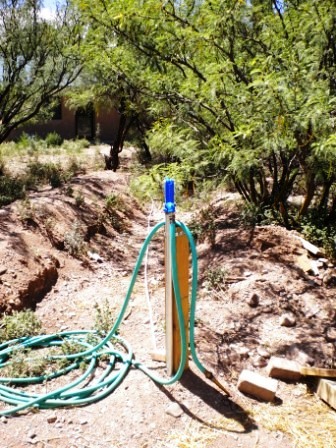
We installed several hundred feet of 3/4” water lines. These lead to both houses (the old mobile home and the new straw-bale house, and from the latter to the outdoor kitchen), as well as to eight frost-free hydrants strategically located near garden beds, greenhouses, cold frames, the orchard, and animal pens.

We made a minor error when we ran a 1/2” water line off the 3/4″ line for a short run to one of the frost-free hydrants. The combination of narrower pipe buried only 18 inches deep and located on the north side of the straw-bale house where the sun fails to hit the ground all winter led to a burst water line where the 1/2″ line tees off the 3/4″ line. We fixed the line with new pipe and buried it deeper.

Had we not been able to buy an inexpensive piece of PVC at the hardware store, we’d have had no water throughout the property from that day forward. I’ve stocked up on those inexpensive pieces of PVC — tees, ball valves, plugs, and so on — and this spring, after the ground thaws, I’ll move the line over a few meters so it will receive morning sun.

Domestic water is pre-heated by passive solar water heaters adjacent to the east and west sides of the straw-bale house. Each water heater contains a 42-gallon tank painted black within an insulated box.

The pre-heated water from each tank goes directly into a six-gallon electric water heater within the house. We considered on-demand electric water heaters, but the pulse of electricity would have required a PV solar system about three times the size of the too-expensive one we installed, so the passive solar pre-heaters and small electric water heaters represent a relatively durable, low-cost compromise. And we’ll have hot showers long after the industrial age ends.


All the fixtures in the straw-bale house were selected with durability in mind. I’ll not provide free advertising by revealing the brand online, but let me know via email if you’d like to learn the “best” brand (according to the contractors with whom we corresponded). Here’s a hint: It’s not American Standard.

Although the mobile home has a septic system (a remnant from earlier years), trees are watered by all water leaving the straw-bale house (from two kitchen sinks, two bathroom showers, and sinks in the kitchens and bathrooms). No “blackwater” leaves the house because we use composting toilets. Water departing the straw-bale house spills into French drains adjacent to trees.

Another minor error warrants description: The initial French drains were too shallow, so they were hand-dug twice.

The second version filled in with sediment, and one line was clogged with a pack rat, so I dug it again.

This time, I dug a gihugic hole and filled the hole with large used tires; then I ran the drainpipe into the top of a large hole within the stacked tires, and covered the entire contraption with roofing tin before covering it with soil.

I think this arrangement will deter all but the wiliest rats, and sediment should not fill the French drain for a couple decades. I’ll be long dead by then, indifferent to wily rats and sediment.

A 3,000-gallon cistern is filled by runoff from each of the two houses. We use this water for plants, although it would be potable with minimal treatment. The water is sieved before entering the cisterns. At some point, we probably will use this rainwater for making soap because rainwater’s inherent softness is perfect for handmade soap.

We also harvest rainwater from surface runoff. The property slopes at about 5% from north to south, and the richest soils are located on the south side of the property, so we “steer” the south-bound runoff with berms that direct the overland flow into large gardens.

Finally, the nearby river serves as a final source of water, if needed. Near our property, the river is perennial during most years, which explains the shallow groundwater on the property we occupy. If the other sources of water fail to keep us satiated in the years ahead, we’ll carry water from the river just as people did during the previous Stone Age.
.

Grow Our Own on Kauai

SUBHEAD: An answer to future rising food costs, and current depleted soils on Kauai. Image above: Modified poster for Comedy Central's 'Home Grown" show. From (http://www.twistysdownload.com/forums/movies/14726-comedy-centrals-home-grown-2008-dvdrip-xvid-document.html) By Arius Hopman on 28 March 2010 in The Garden Island News - (http://thegardenisland.com/news/opinion/guest/article_868b14c0-3a2b-11df-a9cf-001cc4c002e0.html)

Kaua‘i is 90 percent dependent on imported food, and in the middle of the Pacific Ocean, it is vulnerable to increasing energy costs and a faltering tourist income.

Hawai‘i’s food prices have soared over the past few years. And they’re likely to go higher in the coming months, thanks to a major drought in California’s central valley,” according to an article by Alan Mcnaire called “Relying on California for Food.”

Our produce is often ten days old from Mainland farm to Kaua‘i table. The dollars we spend on imports are lost from our currency pool and can no longer be used to support our local economy. Easy tourist dollars have made us dangerously complacent.

Agroecology has many answers to the problem of unsustainable industrial farming, that has resulted in the loss of about 50 percent of agricultural soil world wide and depleted/polluted much of the remaining soil to virtual uselessness. Industrial farming is energy, water and chemical intensive, but agroecology works with the forces of nature, not against them.

“… human induced erosion and desertification [is] affecting 250 million people. In the first — and still most comprehensive — study of soil misuse, scientists at the International Soil Reference and Information Centre in the Netherlands estimated in 1991 that humankind has degraded more than 7.5 million square miles of land. Our species, in other words, is rapidly trashing an area the size of the United States and Canada combined,” according to the September 2008 issue of National Geographic Magazine.

About one billion people go hungry daily and thousands die each day of starvation. By definition, our unsustainable practices in all lifestyles will not last. We urgently need to research sustainable alternatives as we enter this new phase of history that has been called “the cascade of crises.” We are now approaching, or have already passed the peak of oil, the peak of cultivated food, peak of wild food (especially fish), peak of ground water, peak of soil fertility, peak of timber, peak of the ability of the environment to absorb our waste and toxicity etc. Now finally we may have the motivation to change our ways. The Kahili Agroecology Research Center is helping to pioneer a better way on Kaua‘i.

Based in science as well as years of experience of two main partners, KARC is launching an up-to-date series of tests to discover the optimal soil amendments, species, micro-organisms (including beneficial fungi and fertilizer-chelating bacteria) and intentional ecological relationships. The result of this research will be made available to other farmers and the public through a Web site, hands-on workshops, videos, presentations and a how-to manual. KARC is part of a word-wide pioneering effort toward not just sustainability but the ecological restoration of land fertility.

In Hawai‘i, import substitution has been identified as an important factor in the economic health of Hawai‘i, and food is the single most likely product to be developed for sale on Kaua‘i. At $2 billion/year of food imports, there is opportunity for an organic food market expansion.

Agroecology is a rapidly evolving system that blends permaculture, organic farming and French intensive raised-bed gardening with several new discoveries in soil fertility. “Terra Preta” or bio-char, that boosts soil fertility while permanently sequestering carbon, is an example. KARC will test just how effective biochar is. An innovation we add is to pre-inoculate the bio-char with several known beneficial microorganisms and fungi.

KARC, affiliated with Kaua‘i Community College, has a mission to discover how to restore soil fertility and optimize the organic farming of nutritious food plants and animals. With access to college level information and training, KARC is well positioned to contribute to Kaua‘i’s immediate farming needs. A proposal is available on request. We, who live in the middle of the Pacific, are especially vulnerable to global economic and energy fluctuations. We urgently need to diminish our dependency on imports. With four growing seasons per year and adequate sources of soil amendments and water, we have no serious physical obstructions to our quest. Our only limitation is our collective will to overcome the threshold of habit and (often institutional) inertia.

This new path is a creative risk that requires courage, initiative and financial support, so we can forge a new, safer, healthier and more sustainable way to produce our food. KARC will need about $70,000 to successfully launch this vital research project. We are at the cusp of a paradigm shift in sustainable food production. This investment in research is expected to have a strong multiplier effect on Kaua‘i, and possibly Hawai‘i and other tropical farming areas.

This project has been initiated with $10,000 and roughly five months of planning and hands-on work. Clearing of two acres is well under way, a water source is secured, live gliricidia fence posts have been planted and an electric fence purchased. The next step is the construction of a nursery and the installation of the test plots.

• Arius Hopman is a teacher for the food industry program at Kaua‘i Community College and is a certified permaculturist. He can be reached at ahopman@earthlink.net.

.

Earth Out of Sync

SUBHEAD: Rising temperatures throwing off seasonal timing off between interdependent species. Image above: Townsend Warbler in Japanese cherry blossom 2/9/09. From (http://trailhiker.smugmug.com/gallery/6971485_UrC5L/2/480811785_eeKA6/Large) By Janet Larsen on 25 March 2010 in Earth Policy Institute - (http://www.earth-policy.org/index.php?/plan_b_updates/2010/update88)

A newly hatched chick waits with hungry mouth agape for a parent to deliver its first meal. A crocus peaks up through the snow. Rivers flow swiftly as ice breaks up and snows melt. Sleepy mammals emerge from hibernation, and early frog songs penetrate the night. Spring awakening has long provided fodder for poets, artists, and almanac writers. Even for a notoriously fickle time of sunshine, rain, and temperature swings, some old-fashioned seasonal wisdom was consistent enough to be passed down through generations. The first blooming of a specific flower, for example, could traditionally signal when to find certain fish running the rivers, when to hunt for mushrooms, or when to plant crops. The timing of such seasonal events is coordinated in an intricate dance—a dance underappreciated, perhaps, until something jolts it out of step. With global average temperatures up 0.5 degrees Celsius since the 1970s, springtime warming is coming earlier across the earth’s temperate regions. A number of organisms have responded to the warming temperatures by altering the timing of key life-cycle events. The problem, however, is that not all species are adjusting at the same rate or in the same direction, thus disrupting the dance that connects predator and prey, butterfly and blossom, fish and phytoplankton, and the entire web of life. The timing of seasonal biological events, otherwise known as phenology, has been tracked in some places for centuries. Japan’s much-feted cherry tree blossoming has been carefully recorded since before 1400. The trees showed no clear trend in timing until the early 20th century, when they began to bloom earlier, with a marked advancement since around 1950. The meticulous records of Henry David Thoreau help us gauge how spring has changed in Concord, Massachusetts, since the mid-1800s. Comparing his notes on over 500 species and subspecies of plants with modern surveys and records in between, researchers found that springtime blooming advanced by an average of one week over the past 150 years as local springtime temperatures rose. The plant varieties that advanced their timing appear to have thrived over the years, while others declined in numbers. The varieties left behind include asters, mints, orchids, lilies, and violets.

Some native plants advanced their blossoming dramatically: the highbush blueberry by three weeks and the yellow wood sorrel herb by a month. Yet these native plants may be the exception rather than the rule; on average, non-native invasive plants advanced their bloom by 11 days more than natives. With exotic invasives appearing to adapt more quickly to warming temperatures, the concern is that they could outcompete some native plants, leading to their disappearance. Earlier springs and later autumns mean longer growing seasons—as long as plants do not succumb to a surprise late cold snap or wilt in the peak summer heat. In Germany, apricot and peach trees now bloom more than half a month earlier than in 1961. Apple trees in the northeastern United States moved up flowering by eight days between 1965 and 2001; apple trees require chilling time before they flower, and warmer winters have been tied to smaller harvests. Earlier spring blooming has lengthened pollen seasons in some places by weeks. Allergy sufferers beware: this trend is likely to get worse as the planet gets warmer. A longer growing season could benefit some crops like the sugar beet. For other foods, however, including important cereals like rye, the increased early-season temperatures could hurt yields by pushing plants to devote more energy to vegetative growth than to the seed that we eat. The premature warming also elevates the risk of damage from late frosts. In 2007, for example, a warm March in prime U.S. agricultural regions pushed spring into gear early, only to be followed by unusual cold in April. The damage to the nascent crops exceeded $2 billion.

Exactly how these changing plant communities will interact with pollinators and foragers that may or may not be changing at the same pace remains unanswered. Members of the animal kingdom are responding to warming in different ways. A quintessential early bird, the American robin, now sometimes makes an even earlier springtime debut. In the Colorado Rocky Mountains, where robin migration is not just south-to-north but also up to higher elevations, the birds have responded to warming in their wintering grounds by traveling to their high-altitude summer breeding grounds two weeks earlier in 2009 compared to the early 1980s. In some years the robins arrive long before the snow has melted—making it far more difficult for this early bird to catch the worm. For pied flycatchers that breed in the Netherlands, migration timing from their West African wintering grounds has not changed, but earlier spring warming has caused the birds to breed about as soon after their arrival as possible. Unfortunately, their caterpillar food has been able to respond even more strongly, advancing hatching in one woodland by an average of 15 days over two decades, while the birds only advanced by 10 days. At sites where the caterpillar populations still peak somewhat late, flycatcher populations have dropped by 10 percent, but where the caterpillars have advanced hatching the most, flycatcher populations have plummeted about 90 percent. Across Europe as a whole, populations of birds that did not advance their migration time along with earlier spring warming have shrunk since 1990. Short-distance migrants seem to be faring better than those traveling long ways. Milder winters have even prompted growing numbers of some birds, like the Pacific brant and Canada goose, to skip migration altogether. Like the early crops, however, the birds that stay are in danger of being wiped out by a sudden cold spell. As evidenced by the caterpillars in the Netherlands, short-lived insects have some of the fastest life-cycle responses to global warming. In Central Europe, where almost every summer since 1980 has been hotter than the long-term average, warming has allowed some species of butterflies and moths to become active earlier and actually add an extra generation in the year—something not seen among those species in records dating back to the 1850s. If predation does not increase, a population explosion could overstress the plants that the butterfly and moth caterpillars eat.

High-altitude mountain pine beetles in western North America present a similar case. In warmer weather they can complete their life cycles in one year instead of two. Insects that once were active for just two weeks a year now can be found flying for up to six months, leaving devastated forests in their wake. Earlier springs and milder winters are also linked to an increased incidence of tick-borne encephalitis and other diseases spread by insects that do well in the warmer conditions. In addition to or instead of adjusting life-cycle timing, some organisms have responded to warming temperatures by shifting their geographical ranges, often poleward or upward. Bird and butterfly range shifts averaging 6 kilometers per decade have already been observed, with some species moving quite faster. There are, of course, limitations to all these adaptations. Even more-mobile species can gain only so much altitude before running out of mountain or can travel only so far before becoming blocked by pervasive human development. Some wildlife take their timing cues from environmental factors other than temperature. The snowshoe hare, for instance, appears to rely on changes in day length to signal when to transform its coat color from winter white to summer brown. While day-length patterns are the same from year to year, snow in the hare’s Montana wilderness habitat now melts up to a month early. If hares are not able to speed up their coat change, they will be in trouble: a stark white hare on bare ground is a remarkably easy target. And as go the hares, so go the lynxes that feed almost exclusively on them. Tinkering with an incredibly complex and interconnected system is fraught with risk. These mismatches are just some examples of how a hotter world is a world unlike any we have known. It is still too early in this global experiment to tell which creatures will be the climate winners and losers, but the signs indicate that the losers will be the majority. Turning down the global thermostat by cutting greenhouse gas emissions is the only way to avoid the risk of throwing nature further out of sync.

Wood burning cars

SUBHEAD: During the Second World War, almost every motorized vehicle in continental Europe was converted to use firewood.  

By Kris De Decker on 18 January 2010 in Lo-Tech Magazine -  
(http://www.lowtechmagazine.com/2010/01/wood-gas-cars.html)

 
Image above: A 1940 Peugot 402 Gazogene Adventure. From (http://www.passionautomobile.com/retromobile/aventure-peugeot-retromobile-2009.html)  

[IB Editor's note: The original article is richly illustrated with examples of this technology and worth the visit.]

During the Second World War, almost every motorised vehicle in continental Europe was converted to use firewood.

Wood gas cars (also known as producer gas cars) are a not-so-elegant but surprisingly efficient and ecological alternative to their petrol (gasoline) cousins, whilst their range is comparable to that of electric cars.

Rising fuel prices and global warming have caused renewed interest in this almost-forgotten technology: worldwide, dozens of handymen drive around in their home-made woodmobiles.

Wood gasification is a process whereby organic material is converted into a combustible gas under the influence of heat - the process reaches a temperature of 1,400 °C (2,550 °F). The first use of wood gasification dates back to 1870s, when it was used as a forerunner of natural gas for street lighting and cooking.

The first use of wood gasification dates back to 1870s, when it was used as a forerunner of natural gas for street lighting and cooking. In the 1920s, German engineer Georges Imbert developed a wood gas generator for mobile use.

The gases were cleaned and dried and then fed into the vehicle's combustion engine, which barely needs to be adapted. The Imbert generator was mass produced from 1931 on. At the end of the 1930s, about 9,000 wood gas vehicles were in use, almost exclusively in Europe.  
 
In the 1920s, German engineer Georges Imbert developed a wood gas generator for mobile use. The gases were cleaned and dried and then fed into the vehicle's combustion engine, which barely needs to be adapted. The Imbert generator was mass produced from 1931 on. At the end of the 1930s, about 9,000 wood gas vehicles were in use, almost exclusively in Europe.

Second World War The technology became commonplace in many European countries during the Second World War, as a consequence of the rationing of fossil fuels. In Germany alone, around 500,000 producer gas vehicles were in operation by the end of the war.

A network of some 3,000 "petrol stations" was set up, where drivers could stock up on firewood. Not only private cars but also trucks, buses, tractors, motorcycles, ships and trains were equipped with a wood gasification unit. Some tanks were driven on wood gas, too, but for military use the Germans preferred the production of liquid synthetic fuels (made out of wood or coal).

In 1942 (when the technology had not yet reached the height of its popularity), there were about 73,000 producer gas vehicles in Sweden, 65,000 in France, 10,000 in Denmark, 9,000 in both Austria and Norway, and almost 8,000 in Switzerland. Finland had 43,000 "woodmobiles" in 1944, of which 30,000 were buses and trucks, 7,000 private vehicles, 4,000 tractors and 600 boats. (source)

Woodmobiles also appeared in the US, Asia and, particularly, Australia, which had 72,000 vehicles running on woodgas (source). Altogether, more than one million producer gas vehicles were used during World War Two. After the war, with gasoline once again available, the technology fell into oblivion almost instantaneously. At the beginning of the 1950s, the then West-Germany only had some 20,000 woodmobiles left.  

Research programme in Sweden
 Rising fuel prices and global warming have resulted in renewed interest in firewood as a direct fuel. Dozens of amateur engineers around the world have converted standard production cars into producer gas vehicles, with most of these modern woodmobiles being built in Scandinavia. In 1957, the Swedish government set up a research programme to prepare for a fast transition to wood gas cars in case of a sudden oil shortage. Sweden has no oil reserves, but it does have vast woodlands it can use for fuel.

The goals of this research was to develop an improved, standardised installation that could be adapted for use in all kinds of vehicles. This investigation, supported by car manufacturer Volvo, led to a great deal of theoretical knowledge and hands-on experience with several road vehicles (one seen above) and tractors over a total distance of more than 100,000 kilometres (62,000 miles). The results are summarized in a FAO document from 1986, which also discusses some experiments in other countries.

Swedish (overview) and, particularly Finnish amateur engineers have used this data to further develop the technology (overview, below a vehicle of Juha Sipilä). A wood gas generator - which looks like a large water heater - can be placed on a trailer (although this makes the vehicle difficult to park), in the boot (trunk) of a car (although this uses up nearly all the luggage space), or on a platform at the front or the back of the vehicle (the most popular option in Europe). In the case of an American pickup, the generator is placed in the truck bed.

During WWII, some vehicles were equipped with a built-in generator, entirely hidden from view.

 Fuel
Dave nichols woodgas car The fuel for a wood gas car consists of wood or wood chips (see picture on the left). Charcoal can also be used, but this leads to a 50 percent loss in the available energy contained in the original biomass. On the other hand, charcoal contains more energy, so that the range of the car can be extended. In principle, any organic material can be used. During the Second World War, coal and peat were also used, but wood was the main fuel.


One of the more successful wood gas cars was built last year by Dutch John. While many recent producer gas vehicles seem to come straight out of Mad Max, the Dutchman's Volvo 240 is equipped with a very modern-looking system made of stainless steel. "Producing wood gas is not that hard", says John. "Producing clean wood gas is another thing. I have objections to some woodmobiles. Often, the produced gas is as clean as the appearance of the construction".

Dutch John strongly believes in wood gas generators, mainly for stationary uses such as heating, electricity generation or even the production of plastics. The Volvo is meant to demonstrate the possibilities of the technology. "Park an Italian sports car next to a wood gas car and the crowd gathers around the woodmobile. Nevertheless, wood gas cars are only for idealists and for times of crisis."  

Range
The Volvo reaches a maximum speed of 120 kilometres per hour (75 mph) and can maintain a cruising speed of 110 km/h (68 mph). The "fuel tank" can contain 30 kilograms (66 pounds) of wood, good for a range of 100 kilometres (62 miles), comparable to that of an electric car. If the back seat is loaded with sacks of wood, the range is extended to 400 kilometres (250 miles).

Again, this is comparable to the range of an electric car if the passenger space is sacrificed for a larger battery, as is the case with the Tesla Roadster or the electric Mini Cooper. The difference is, of course, that John has to stop regularly to grab a sack of wood from the back seat and refill the tank.  

Trailer
As is the case with other cars, the range of a wood gas car is also dependent on the vehicle itself. This is shown by the different cars that were converted by Vesa Mikkonen. The Fin places all his generators on a trailer. His most recently-converted car is a 1979 Lincoln Continental Mark V, a large, heavy American coupe. It consumes 50 kilograms (110 pounds) of wood every 100 kilometres (62 miles) and is thus considerably less efficient than John's Volvo.

Mikkonen has also converted a Toyota Camry, a much more efficient car. This vehicle only consumes 20 kilograms (44 pounds) of wood over the same distance. However, the trailer is almost as large as the car itself. The range of electric cars can be considerably improved by making them smaller and lighter. However, this is not an option with their wood gas cousins because of the weight and the volume of the machinery. The smaller cars from World War Two only had a range of 20 to 50 kilometres (12 to 31 miles), in spite of their much lower speed and acceleration.

 Freedom
Enlarging the "fuel tank" is the only option to improve the range further (except for reducing one's speed, of course, but that is another story). American Dave Nichols (the man who shows the wood on one of the pictures above) can load 180 kilograms (400 pounds) of wood into the back of his 1989 Ford pickup truck. This takes him 965 kilometres (600 miles) far, a range that is comparable to a fossil fuel powered car.

The merit of this is discussable, of course, as to do this Nichols has to stop regularly to refill the tank: if he loaded the back of his pickup with gasoline, then he could drive even further. According to Nichols, one pound of wood (half a kilogram) is sufficient to drive 1 mile (1.6 kilometres), which tallies with the Volvo's 30 kilograms of wood per 100 kilometres.

The American has set up a company (21st Century Motor Works) and plans to sell his technology on a larger scale. When he arrives home, he uses his truck to heat his house and generate electricity. His story has caught on in the US, and the reason can be summed up by his license plate: "Freedom". "You can go around the world with a saw and an axe", as John Dutch puts it.

His compatriot, Joost Conijn, grabbed this opportunity to take a two-month trip throughout Europe, without worrying about the proximity of the closest of gas stations (which are not always easy to find in a country like Romania). The locals gave him wood to continue his journey - with the supply stored on a trailer. Conijn not only used wood as a fuel, but also as a construction material for the car itself (picture above - video here). For another trip with a wood gas car, see "Around Sweden with wood in the tank".  

Does the woodmobile have a future?
During the 1990s, hydrogen was seen as the alternative fuel of the future. Then, biofuels and compressed air took over its mantle role, whilst today all the attention is focused on electric cars. If this technology fails, too (and we have expressed our doubts about it several times), can we go back to the wood gas car?

Despite its industrial appearance, a wood gas car scores rather well from an ecological viewpoint when compared to other alternative fuels. Wood gasification is slightly more effiicient than wood burning, as only 25 percent of the energy content of the fuel is lost. The energy consumption of a woodmobile is around 1.5 times higher than the energy consumption of a similar car powered by gasoline (including the energy lost during the pre-heating of the system and the extra weight of the machinery). If the energy required to mine, transport and refine oil is also taken into account, however, then wood gas is at least as efficient as gasoline. And, of course, wood is a renewable fuel. Gasoline is not.  

The advantages of wood gas cars
The greatest advantage of producer gas vehicles is that an accessible and renewable fuel can be used directly without any previous treatment. Converting biomass to a liquid fuel like ethanol or biodiesel can consume more energy (and CO2) than the fuel delivers. In the case of a wood gas car, no further energy is used in producing or refining the fuel, except for the felling and cutting of the wood. This means that a woodmobile is practically carbon neutral, especially when the felling and cutting is done by hand.

Moreover, a wood gas car does not require a chemical battery, and this is an important advantage over an electric car. All too often, the embodied energy of the latter's enormous battery is forgotten. In fact, in the case of a producer gas vehicle, the wood behaves like a natural battery. There is no need for high-tech recycling: the ash that remains, can be used as a fertilizer. A properly-operating wood gas generator also produces less air pollution than a gasoline or diesel powered car.

Wood gasification is considerably cleaner than wood burning: emissions are comparable to those of burning natural gas. An electric car has the potential to do better, but then the energy it uses should be generated by renewable sources, which is not a realistic scenario.  

The drawbacks of wood gas cars
In spite of all these advantages, it takes just one look at a woodmobile to realize that it is anything but an ideal solution. The mobile gas factory takes up a lot of space and can easily weigh a few hundred kilograms - empty. The size of the equipment is due to the fact that wood gas has a low energy content. The energetic value of of wood gas is around 5.7 MJ per kg, compared to 44 MJ/kg for gasoline and 56 MJ/kg for natural gas (source).

Furthermore, the use of wood gas limits the output of the combustion engine, which means that the speed and acceleration of the converted car are cut. Wood gas consists roughly of 50 percent nitrogen, 20 percent carbon monoxide, 18 percent hydrogen, 8 percent carbon dioxide and 4 percent methane. Nitrogen does not contribute to the combustion, while coal monoxide is a slow burning gas. Because of this high nitrogen content, the engine receives less fuel, which leads to a 35 to 50 percent lower output. Because the gas burns slowly, a high number of revolutions is not possible. A producer gas vehicle is no sports car.

 Even though some smaller cars have been equipped with wood gas generators (see for instance this Opel Kadett), the technology is better suited to a larger, heavier car with a powerful engine. If not, engine output and range might not be sufficient. Even though the installation can be made smaller for a smaller vehicle, its size and weight do not decrease proportionately with the decreasing size and weight of the car. Some have built wood gas-powered motorcycles, but their range is limited (a motorcycle with sidecar does better, though).

Of course, the weight and size of the mobile gas factory is less an issue with buses, trucks, trains or ships.  

Ease of use
Another problem of wood gas cars is that they are not particularly user-friendly, although this has improved compared to the technology used in the Second World War. See the second part of this pdf document (page 17 and further) for a description of what it was like to drive a wood gas car back then: "...experience at the Wurlitzer organ could be a distinct advantage". Still, in spite of the improvements, even a modern woodmobile requires up to 10 minutes to get up to working temperature, so you cannot jump in your car and drive away immediately.

Furthermore, before every refill, the ashes of the last gasification process have to be shovelled out. The forming of tar in the installation is less problematic than it was 70 years ago, but the filters still have to be cleaned regularly. And then there is the limited range of the vehicle. All in all, it is a far cry from the familiar ease of use of a gasoline car.

The large amount of (deadly) carbon monoxide produced calls for some precautions, too, since a leak in the piping is not impossible. If the machinery is placed in the trunk, the instalment of a CO-detector in the passenger compartment is by no means a luxury. Moreover, a wood gas car must not be parked in an enclosed space unless the gas is flared first (picture above).  

Mass-produced woodmobiles
VW beetle woodgas Of course, all the vehicles described above are built by amateur engineers. If we built cars especially designed to be powered by wood, and produce them in factories, chances are that the drawbacks would become somewhat less significant and the advantages would become even greater. Such woodmobiles would also look more elegant. The Volkswagen Beetles that rolled off the assembly line during World War Two had the whole wood gasification mechanism built in (sources: 1 / 2 / 3). From the outside, the wood gas generator and the rest of the installation was invisible. Refilling was done through a hole in the bonnet (hood).  

Deforestation
Woodgas station Unfortunately, wood gas shares an important disadvantage with other biofuels. Mass producing woodmobiles would not solve this. Quite the contrary, in fact: if we were to convert every vehicle, or even just a significant number, to wood gas, all the trees in the world would be gone and we would die of hunger because all agricultural land would be sacrificed for energy crops.

Indeed, the woodmobile caused severe deforestation in France during the Second World War (source). Just as with many other biofuels, the technology is not scalable. Yet, while biofuel-powered car is as user-friendly as a gasoline rival, wood gas has to be the most user-unfriendly alternative fuel that exists. This can be an advantage: a switch to wood gas cars can only mean that we would drive less, and that would of course be a good thing from an environmental viewpoint.

If you need to preheat your car for 10 minutes, chances are you will decide not to use it to drive a few miles to pick up some groceries. A bicycle would do the job faster. If you had to cut wood for three hours just to make a trip to the beach, you would probably decide to take the train.  

Refilling a woodgas car
 In any case, the woodmobile demonstrates (again) that the modern car is a product of fossil fuels. Whatever alternative fuel you believe in, none of them comes even close to the convenience of gasoline or diesel. If, one day, the availability of (cheap) oil comes to an end, the omnipresence of the automobile will be history. But the individual vehicle will never die.

 .

Horse-Drawn Hummer

SUBHEAD: This Horse Drawn Hummer is equipped with chrome "CEO" badges on the roof rack to remind the starving masses of your status. Image above: Mashup of horse drawn Hummer in the tropics. From (http://www.theequinest.com/photoshop-horses-pt-2) By Wes Siler on 28 March 2010 in Jalopnik - (http://jalopnik.com/5502804/the-inside-story-of-the-horse+drawn-hummer)

In Jeremy's post-apocalyptic America, the wealthy will still crave ownership of all things desirable and scarce, but they'll be unable to drive traditional cars because Wall Street's greed will have caused a collapse permanently destroying our economy and ability to buy oil from the Middle East. So what do you do if you still want to lord it over the little people with the ultimate symbol of consumerism gone wrong? You commission your mechanic to convert your Hummer to horse power.

This Horse Drawn Hummer is equipped with chrome "CEO" badges on the roof rack to remind the starving masses of your status, tinted windows so they can't look at you with their shifty eyes and three interior flat screen televisions to distract you from their misery.

To debut the vehicle, which he built in Florida, Jeremy loaded it on to a flat bed trailer and dropped it off in New York's Central Park where he rendezvoused with a couple of draft horses from Connecticut. Turns out the Hummer isn't approved for use of as a Horse Cart in the park and a couple of very angry cops, likely acting on orders from The Man, kicked them out after a single lap. Still, that was enough time to prove the Hummer's merit as a wagon. Most central park horse carts weigh 1,800 Lbs and are pulled by a single horse. Chopped up like this, the Hummer weighs just under 2,000 Lbs and accommodates two horses. It's bigger, more comfortable and requires more resources than a standard wagon, just like the car it's based on.

Why an H2? "For me the symbol that best personifies the arrogant, unsustainable, indulgence of the last era and the inevitable downfall, is the Hummer H2," says Jeremy. "This military vehicle turned 9 MPG grocery getter has been called ‘An indictment of the American psyche on wheels,' and is clearly consumerism at its peak."

But Jeremy isn't pointing a finger at GM or the car industry for producing wasteful excess, saying, "they were after all giving us what we wanted." But he is using the car industry as a symbol of the collapse of the American Dream.

"As the country began to emerge from the Depression, Americans were obsessed with making grandiose predictions about the future," writes Jeremy. "At the 1939 World's Fair in NYC GM unveiled their exhibit entitled ‘The Futurama' which was a large scale model of their vision of the future world we would all inhabit and how the automobile would make it all possible. And in a way, they were right. After WWII the automobile made this country. Massive government investment in the highway interstate system (which was basically the largest subsidy ever handed out to business) created suburbia, and led to the very American Dream of a two car family, the house, picket fence, dog named Spot. At one point the 1950's 1 in 7 jobs were directly related to the auto industry. AAAAhhhh the golden age of America. In 1953 the slogan ‘As General Motors goes, so goes America' was said with pride."

Jeremy has cut a video from that Futurama exhibition together with the Ludachris video and displayed it on the in-cart monitors to highlight the journey from idealized consumerism to its ultimate reality.

"As the current economic crisis has unfolded, GM, Ford and Chrysler have run their companies into the ground by producing these cars, yet they requested billions of taxpayer dollars in bailouts. When GM rolled out its new 2009 line up of cars, it still includes the HUMMER at 9 MPG and the Cadillac Escalade at 12 MPG. HUMMER has since been sold to the Chinese (no small irony there) and GM is in bankruptcy. ‘As GM goes, so goes America.'"

The Inside Story of the Horse-Drawn Hummer

The idea to convert a car into a cart came from The Great Depression, which saw many Americans add horses to their cars because they were unable to afford gasoline. The resulting contraptions were called "Hoover Carts" after President Hoover who was largely blamed for the depression.

To realize his project, Jeremy bought a used Hummer H2 for $15,000, drove it straight into a borrowed Florida garage and started cutting pieces off of it. The resulting vehicle is actually surprisingly well made. All the modifications have been made out of converted parts already on the car. The bottom of the driver's area is the upside down hood, the vertical piece behind that is a section of the roof, complete with yellow running lights. Jeremy fitted electric trailer brakes to prevent the horses from running out of control and the horses steer the front wheels through a tow bar connected to fabricated A-arms. When the economy does collapse, Jeremy could be one of the lucky few to find a job, he could build vehicles like these for the rich and powerful.

The Horse Drawn Hummer was displayed at the Pulse NYC art show and will likely make future appearances here in New York. We'd love to see it roll through next week's New York Auto Show and even asked if it could be the official Jalopnik staff car. Alas, no, it was not to be.