SUBHEAD: The Wall occupied blip in the Dead’s history, though it remains a touchstone for sound systems of all shapes and sizes.
By Brian Anderson on 5 July 2015 for Motherboard -
(http://motherboard.vice.com/read/the-wall-of-sound)

Image above: The Wall’s vocal cluster at the center of the speaker array. Photo: Richard Pechner. From original article. Click to embiggen.
Three-fifths of the Dead’s original lineup were holed up in Novato, California, at the band’s practice space in a Pepto-Bismol colored warehouse located behind a pizza shop. Bob Weir, Jerry Garcia, and Phil Lesh, then just in their twenties, were joined by a small circle of gear heads, audiophiles, and psychonauts who’d become instrumental to the band’s growing popularity.
It’s unclear who called the meeting, why it was even arranged, or what, if anything, was supposed to come of it.
They brainstormed over “the technical, the musical, and the exploratory,” remembered Rick Turner, an instrument and amplifier designer among the Dead kin gathered that day in Novato. “There were no constraints.”
It was a signal moment in the history of sound that set in motion a years-long work in progress that would culminate in what’s arguably the largest and technologically innovative public address system ever built, and it started not with a bang, but with something of a casual, stoned proposition.
This singular work of engineering would come to weigh over 70 tons, comprise dozens and then hundreds of amps, speakers, subwoofers, and tweeters, stand over three-stories tall and stretch nearly 100 feet wide. Its name could only be the Wall of Sound.
The Wall of Sound, or simply the Wall, would occupy only a blip on the long horizon of the Dead’s history, though it remains a touchstone for sound systems of all shapes and sizes, from boutique disco PAs to the massive PAs deployed at any of today’s mega festivals and at 61,500-seat stadiums like Soldier Field in Chicago, where the four surviving members of the Dead, including Weir and Lesh, wrapped up a string of farewell shows this weekend to commemorate the band’s 50th anniversary.
Back at the pink warehouse, they were about to revolutionize sound engineering, acoustic theory, and the way people experienced live music for decades to come, and they likely didn’t even know it. Someone lit a joint.
It was 1969. It seemed the sounds of San Francisco’s Haight-Ashbury, the psychedelic rock Holy Land to which the Dead were revered almost as gods, had beamed to the Moon and beyond. Compared to virtually all electrified musical output to that point, music was louder and more urgent than ever before. Perhaps the drugs had something to do with it, but there was a vitality to music, something unprecedented that resonated for those who believed their generation’s moment had come.
There was just one problem. Even the day’s leading edge of amplification technology carried bands only to a point, before the mixes muddled. Put frankly, Garcia or Jimi Hendrix live, at their loudest, sounded chaotic—in a not-so-good way.
Today, defenders of How Things Sounded in 1969 must face critics who argue that everything back then sounded unsound on account of these gear constraints. That’s not necessarily to question the pure, unbridled daring of baby boomer bands like the Dead, at least not in their prime. The point is that amp tech just wasn’t keeping up with their sonic ambitions.
Conventions like using on-stage monitors (speakers pointed back at performers so they could hear themselves) were still in their infancy. This confined sound techs at both indoor clubs and outdoor venues to jury-rigged public address systems, which rebroadcast the noise of a band toward the audience—at the time, PAs were positioned level with, if not slightly in front of the musicians, and were distinct from the musicians’ backline speakers and amp.
The result was that a performer’s chops often were undercut by blistering volumes, roiling echoes, harsh distortion, and feedback. Unstable audio frequencies skipped over audiences, ricocheted between walls, and decayed into space.
This meant it was hard for Weir, Garcia, Lesh, Ron “Pigpen” McKernan, and Bill Kreutzmann—the rest of the Dead’s founding lineup—to hear themselves individually as well as their bandmates while playing live.
This noise crisis that confronted musicians who went electric at the height of the war in Vietnam is a dissonant truth routinely snuffed from the annals of modern music history, a poignant example of technical difficulties being overlooked in favor of a higher narrative.
The sounds that so radically realigned the arc of history, musical and otherwise, were not perfect, and this imperfection was largely due to rudimentary PAs. From a highly discerning, or modern sonic perspective, live music in 1969 sounded bearable at best, and messy at worst. That was about to change.
If the meeting had an adviser, it was one Augustus Owsley “Bear” Stanley III, the renowned LSD chemist and audio visionary who’d been financing the Dead and recording the band live since some of their earliest shows.
Bear, a Kentucky-born craftsman and former ballet dancer, was obsessed with sound as both a concept and a physical thing. Mickey Hart, the Dead’s on-again, off-again second drummer, told Rolling Stone about one night in 1974 before a Dead show at the former Winterland Ballroom in San Francisco, when he caught Bear in an intimate moment of sonic communion with some of the band’s speakers. Bear was alone, as Hart remembered. Sobbing, he spoke tenderly to the electronics as if they were people.
“I love you and you love me,” Bear wooed the speakers. “How could you fail me?”
Bear had a good ear and money. He had already established himself as the point source for mass quantities of high-grade LSD that flooded the Bay Area and beyond. He was a natural fit as the Dead’s audio guru and benefactor, and if anyone was poised to see the band up and over its noise troubles it was him.
Bear knew the band could sound better—clearer, more robust—during the winding live shows that any seasoned Deadhead would now consider part of the band’s most important block of work. Bear had been quiet at the pink warehouse meeting, Turner said, when suddenly he chimed in.
Video above: Owsley talks about the Watts Acid TestFrom original article and (https://youtu.be/c_4IBpkTgsY).
“You know, the solution is the PA system has to be behind the band,” Bear said.
His thinking was that this configuration, which positioned the band and the audience to hear the same thing, would eliminate feedback, the result of an output signal directed (fed back) to an input. Bear envisioned the band and crowd experiencing the same thing.
This would close the gap between performer and audience, who would both hear the exact same mix shot horizontally from a unified backline “as though everyone was playing acoustically,” said Turner, who told me Bear was one of the only attendees at that meeting who didn’t think the band would drown in feedback if their vocal microphones were pointed back toward their amps and speakers.
Put the PA behind the band? It was a crazy idea at the time—and precisely what made the notion of positioning the whole band in front of all their amplification reverberate with such prescient foresight.
Turner told me Bear’s motion was “filed away” after the meeting, but the idea of having all of the band members play in front of their PA would begin to seep into the forefront of the collective mindset of the Dead and its expanding crew.
Video above: Grateful Dead before the Wall with PA behind them at Iowa State Fairgrounds, Des Moines, IA - Hes Gone - Truckin 5-13-73. From original article and (https://www.youtube.com/watch?t=896&v=ej6iggaAigk).
A crackling, albeit brief stretch of experimentation, ending in 1974, forged a PA that was placed behind the band and effectively served as its own self-contained monitor system. It separated the vocals from all the other instruments, which each got their own dedicated PA. This produced a striking clarity in the Dead’s live mix and gave way to an almost primal audio-visual continuity.
The system also pioneered the use of line arrays—columns of speakers (literally one speaker stacked on top another) designed to control the dispersion of sound across the frequency range—as well as a unique noise-cancelling microphone system meant to reduce backing bleed into the vocals.
There had been nothing quite like it. The Wall’s scientific base was seemingly so far ahead of its time that everyone interviewed for this story, including some of the Wall’s many original engineers and crew members, said that most everything about this particular system has gone virtually unmatched ever since.
“The tones of the instruments—the clarity of the instruments—has not been matched,” said Turner, who co-founded Alembic, a custom electric guitar, bass, and preamp company whose close working relationship with the Dead proved indispensable in conceptualizing and building the Wall from the ground up. “It’s just as simple as that.”
THE FOUNDATION
The Grateful Dead clocked nearly 150 shows in 1969. They played through pretty much whatever amplification gear they could get their hands on at the time, a true working band capable of pulling off only so much, sonically. The art of broadcasting reproduced noise was limited then to whatever frequency ranges those amplifiers, speakers, subwoofers, and configurations thereof had been set to, to say nothing of the shape of a performance space and its PA.

Image above:The “Alembic PA” at the Boston Music Hall, November 30, 1973 was the proto-Wall. Photo courtesy Richard Pechner. Click to embiggen.
To muddle the mix even further, the prevailing, default operating mode among live sound techs in 1969 was seemingly the louder, the better.
The Dead were obsessed with their sound to compulsive degrees—they were one of the first bands, if not the first band to use 16-track recordings in a recording studio. They strove to replicate that same technical precision and command on stage, and yet they couldn’t hear much of anything while performing live beyond the distorted sound waves blasted from whichever PA they happened to be playing through on any given night. It was a technological quandary of decidedly existential proportions, and it hung over the band and their confidantes like a faint haze.
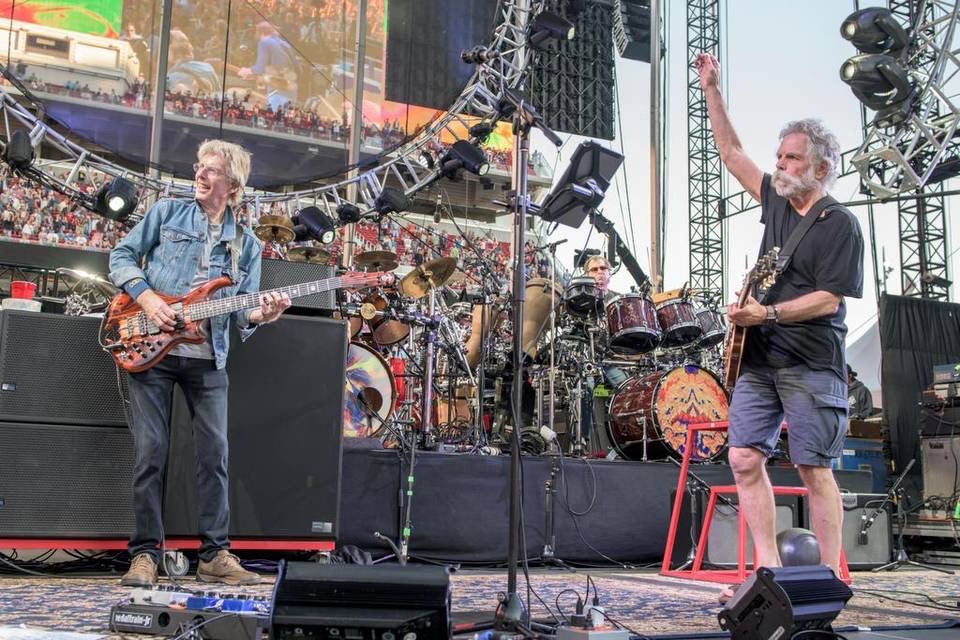
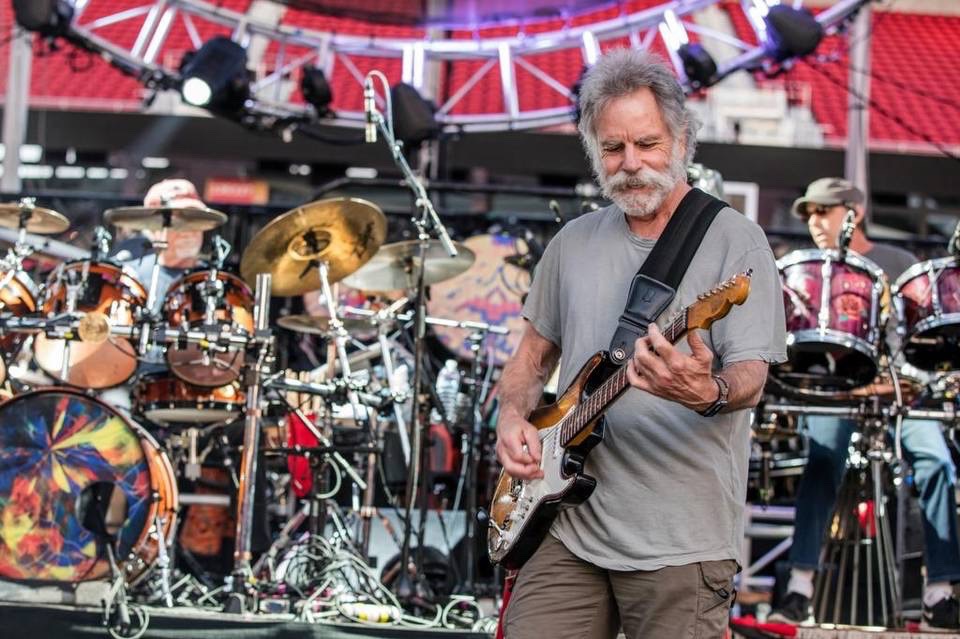
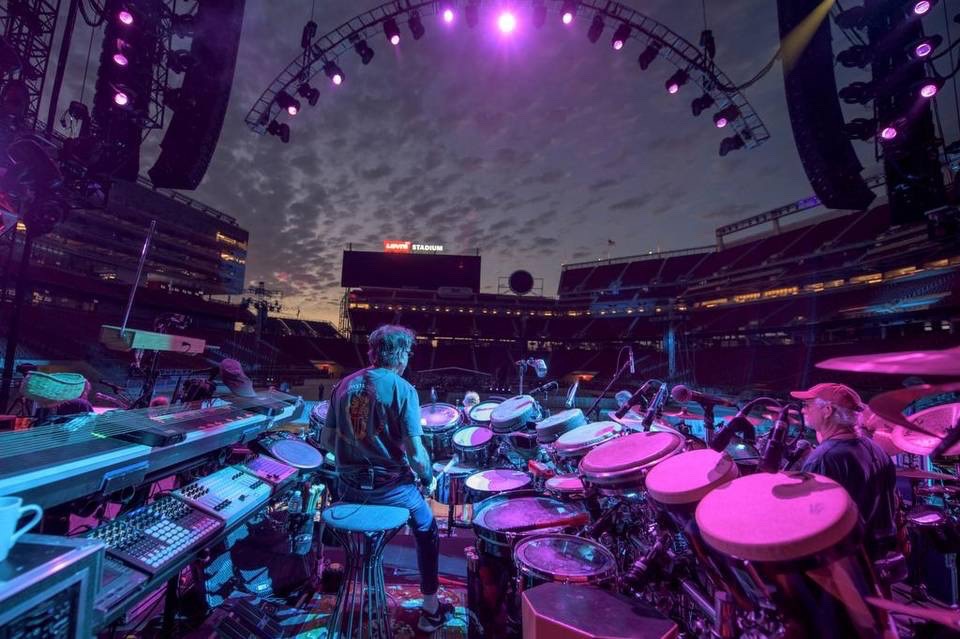
The Wall was always a work in progress, an exercise in iterative hacking. Richard Pechner, a carpenter who helped build speaker cabinets for the Wall (and whose behind-the-scenes photographs of the band and PA, seen here, are considered iconic), told me it was an untiring “experiment by committee.”
This is why it can be risky to say the first proper Wall show happened on such and such a date, say March 23, 1974, at the Cow Palace, just outside San Francisco, which some consider the first Dead show to utilize the “complete” Wall of Sound.
A seminal moment happened at the Boston Music Hall in November 1973, Turner told me. Four years had passed since Bear chimed in at the pink warehouse. The Dead were playing more shows at larger venues, and simultaneously pushing their live sets into exciting, if challenging territory.
A half-hour version of “Dark Star,” a crowd favorite, could be harsh stuff for even the most devout Deadheads who’d grown frustrated, along with the band and crew, with the Dead’s sound woes.
“There was no technology for electric instruments,” Lesh told Rolling Stone in 2011. “We started talking about how to get around distortion and get a pure musical tone. [Bear] did some research and said, ‘Let’s use Altec speakers and hi-fi amps and four-tube-amps, one for each instrument, and put them on a piece of wood.’ Three months later we were playing through Bear’s sound system.”
Bear had rented a house in Watts, Los Angeles. He opened his doors to the band, who found the place “festooned with studio-quality speakers that were standard for movie theatres,” Weir told Rolling Stone. “One day, [Bear] announced, ‘Well, we’re surely doing the Devil’s work here!’ He was kind of right about that—the music, the chemical involvement, the social involvement. You have to have a pretty accepting view of things to not get upset by that.”
Meanwhile, Turner, Ron Wickersham, Bob Matthews (Alembic’s other co-founders), and the rest of the Wall’s expanding inner circle had become increasingly preoccupied with breaking down the difference between the microcosmic environment of the stage and the macrocosmic environment of the auditorium. Gradually, the means to eliminate differences between the on-stage monitors, which the Dead were using, and the audience crystallized.
“It started making pieces of sense in terms of having the audience hear what the band heard,” Turner told me.
The Dead were playing through a sort of proto Wall by the time they hit the Boston Music Hall in the fall of 1973. It was a somewhat haphazard PA that was still a conventional stereo system, according to Turner. Its on-stage speakers formed columns, saplings of the towering line arrays to come.
Cobbled together with JBL speakers and ElectroVoice tweeters, all in Alembic cabs and driven by McIntosh amps, the “Alembic PA,” as this predecessor system was known, had grown so large, Turner said, that when it was loaded into the Music Hall there simply wasn’t enough room to put it in the usual stage left/stage right positions.
“So it went on the scaffolding basically with the back line behind the band,” Turner said, just as Bear had foreseen. “That was the major leap forward in proving that the Wall of Sound could work.”
That’s when things really got going.
“We started hacking through and figuring it out,” Turner told me. They started to make all their own cables and audio snakes, he explained, because higher-quality gear just wasn’t available at the time. They re-coned speakers that had blown or torn.
They replaced tweeter diaphragms as needed. “It was all just one gigantic experiment,” Turner told me, “but it wasn’t willy nilly.” There was solid reasoning behind every one of the system’s parts, all the way down to the banana jacks and plugs they used as speakers connectors. “We were working with what was available, and also working with some pre-scientific underpinnings to it all.”
Most of those underpinnings could be found in the writings of the late RCA audio engineer Harry Olson. The UC-Berkeley physics library had a copy of a then out-of-print handbook of acoustics written by Olson, who perfected the ribbon microphone and did pioneering work with loudspeaker and array dispersion, among other things.
When the Dead got their hands on the manual by way of John Curl, an engineer with Alembic, they made photocopies to share among the Wall’s committee.
“We each had Harry Olson’s Bible,” Turner said.
It’s not clear if one of those photocopies made it to Dan Healy, who’d become the Dead’s long-running sound tech. I was unable to reach Healy for comment, but he has previously said that by the early 1970s he had “bottomed out all the research” that had been done in the 1920s by Bell Laboratories, which was founded in 1928.
The Dead had no choice but to set out into uncharted territory with the Wall, something Healy believes exponentially advanced more than just the group’s understanding of sound.
"It caused major, major changes … that are still going on in the sound industry today,” Healy told Jym Fahey in 1992. “We debunked so much stuff that you'd be amazed. And we verified so much stuff. In the period from 1969 to 1974, the entire audio industry completely turned upside down and the Grateful Dead was at the hub of it.”
At its apex, the Wall of Sound comprised nearly 600 JBL speakers (15-, 12-, and 5-inch) and over 50 ElectroVoice tweeters, all powered by around 50 McIntosh MC3500 and MC2300 tube amps, one of the most efficient amps of its time.

Image above: Detailed schematic of the Wall at the Hollywood Bowl, California, 1974. Photo by Mary Ann Mayer. From original article. Click to embiggen.
It took a full day to build the Wall at that peak, including its custom staging, scaffolding, and lighting rig. The system itself, which changed month to month, according to Turner, was transported in a 40-foot semi truck.
There were two identical sets of scaffolding, each carted in a 18-wheeler flatbed semi. (Bear claimed there were actually three sets of scaffolding.) The stage lights were hauled in a 24-foot van. Two road crews were assembled to keep the band on schedule while touring, leapfrogging the spectacle from show to show.
When Crew A arrived with the Wall in a given city, Crew B would have already assembled one of the two scaffolds. This allowed enough time for all hands to then get everything up and running by showtime.
This contradicts claims that the Dead amassed a second, identical Wall of Sound, although the upkeep wasn’t any less grueling. The system, staging, scaffolding, and lighting weighed a combined 75 tons at its peak. It all proved too unwieldy, finicky, and plain expensive for the Dead to support for more than a couple years. The band only brought out versions of the Wall on stateside tours between roughly 1972 and 1974.
“It was basically wonderful, but it created a tantamount situation,” said Dennis “Wiz” Leonard, an audio engineer who worked closely on the Wall. “It was pretty impractical.”
The Wall, not to be confused with the Phil Spector-perfected, layered studio-recording technique of the same name, was short lived, but still cuts above the noise. Beside towering over the musical record on sheer size alone, the Wall pushed the art and science of live amplification to precipitous new heights. This is perhaps the system’s lasting legacy.

Image above: Members of the Grateful Dead and the Wall of Sound, shot during sound check at P.N.E. Coliseum in Vancouver, British Columbia, May 17, 1974. Photo by Richard Pechner. Click to embiggen.
The Wall was loud, though it’s not the loudest sound system ever built. Today, DFA Records’ chief and former LCD Soundsystem maestro James Murphy’s nightclub sound system, Despacio, thumps at a whopping 50,000 watts. Which is nothing compared to the sound system housed at the Large European Acoustic Facility in the Netherlands, which would kill you if you heard it.
till, at nearly 28,800 watts of continuous power in its loudest iteration, the Wall was the most powerful sound system built to that point by a considerable margin. On-stage Wall levels once registered around 127 decibels. That’s about as loud as a military jet taking off at a standing distance of 50 feet.
But few people who caught a Wall show, or who were involved in designing and perfecting the system as it evolved, would say the system roared like an F-16. The Wall emitted such a clear mix—this August 1974 recording of a Wall show in Jersey City, New Jersey, is a prime example—that it simply didn’t seem loud. The fidelity was that high.
“It was just incredible with the full system,” said Turner. He recalled an outdoor gig in Santa Barbara, California, sometime around 1971 or 1972, with the Wall still in its infancy, when he’d walked a good half-mile from the stage as the band sound checked through the system.
Turner could hear it all the way out there, clear as glass, corroborating Bear’s claim that sound from the Wall could travel a half-mile before it started to degrade. “It was just phenomenal,” Turner said. “It was really quite amazing.”
Wiz remembered a similar Wall experience, this one in 1973 at Roosevelt Stadium, just outside New York City. There Wiz stood, at the far end of the parking lots. The band, who by this point could draw in thousands of people to an outdoor show, was set up on top of what would’ve been home plate, and their sound check beamed over the outfield bleachers. By his estimation, a good 100,000 people could’ve filled the space between the Wall and his ear canals.
“Although the wind was playing with the sound—it would kind of blow it away—it was crystal clear all the way out there,” said Wiz, who joined up with the Dead in 1971 while working for Alembic. “The coherence of the waves as it propagated was really incredible.”
They didn’t know each other yet, but my parents happened to be at the same outdoor early Wall show at the state fairgrounds in Des Moines, Iowa, on May 13, 1973.
My mom, who’d later bake chocolate chip cookies for the band while working for Howard Stein, a legendary Chicago-based rock promoter, was on stage. My dad, who later did occasional stagehand work like handling the oriental rugs the band played on at Dead shows in the Midwest, was about 20 people back from the front of stage left.
“Given how long ago it was and my positioning in the audience—close, on one side—it's difficult to recall many specifics,” my dad told me, “but I do know that the sound was fine given it was an outdoor show.”
While some of the niceties of the Wall are lost on him over four decades on, he said that “the sound was clear enough that near the end of the second set of a three set show (pretty unusual), during ‘Here Comes Sunshine’ on a very threatening day, the Sun came out!”
hese moments of hyper-purity, suspended in time like an endless note, strike at the core of what made the thinking and engineering behind the Wall “so tremendously forward for live sound itself,” Wiz said.
“The future was lower distortion,” he added, which at the dawn of the 1970s meant controlling the dispersion of sound across all frequencies. A coherent-sounding live rock show was then a matter of horizontally concentrating frequencies at the audience, rather than blowing different amounts of different frequencies around a space.
This was the basic idea behind the Wall from the very beginning, according to Turner. He said it came down to fine-tuning what remains the most widely adopted method for boosting noise signals: stereo.
The easiest way to conceptualize stereo is to think of it as the reproduction of sound waves that seem to come from different locations despite sharing an origin, or point source.
This produces a bouncing effect, with some noises seemingly coming at a listener from the left, the right, the center, and so on, when really all these rebroadcasted sounds focalize at one point in the amplifier (used as a general term) or network of amplifiers, the PA. In a word, stereo is inherently deceitful.
This was Bear’s big gripe with live vocals that didn’t appear to originate from a singer’s mouth, with licks that didn’t seem to noodle directly out of a guitar, and so forth with drums and bass and piano. Turner can remember Bear ranting about how “stereo doesn’t work” for this reason: In theory and practice, stereo is an illusion.
Two key innovations forged through the Wall—noise-cancelling microphones and speaker line arrays—would shatter stereo’s illusion, bringing the Dead to life.
Few believed Bear when he said the Dead wouldn’t whip up waves of feedback if the band played with all their gear at their backs.

Image above: Garcia, Weir, and Kreutzmann during a Wall sound check at P.N.E. Coliseum in Vancouver, British Columbia, May 1974. Photo: Richard Pechner. Click to embiggen.
But it was Bear’s contention, to which Turner said Ron Wickersham agreed, that if the vocal microphones and the speakers at which they were aimed both carried truly “flat” responses, meaning they reproduced sounds from input sources with a high level of accuracy, then feedback wouldn’t be an issue.
Turner told me this proved truer than anyone expected, though not as true as Bear and Wickersham had hoped. Hence the main reason for the Wall’s pioneering noise-cancelling microphone system, Turner added, was to “cancel out anything picked up equally.”
Look at any footage or photos of the Dead playing through the Wall and it’s hard to miss the pairs of low-grade omni-directional microphones stacked at the vocal modules that each ran out of phase, meaning they cancelled each other out.
Whoever was singing, let’s say Weir, sang into the top mic, which was set three inches above the bottom mic, which picked up stage ambience. The two signals were fed into a special amp that combined the signals, effectively cancelling out the Wall’s sound, which was really just the mics’ common sound. All that came through, and clear, were Weir’s amplified vocals.
If any of the Dead’s vocalists weren’t pressed right up against their respective mic capsules they’d run into phase issues that produced a nasally, cartoonish vocal effect.
Rob Jaczko, chairman of the Music Production and Engineering Department at Berklee College of Music, told me over email that these noise-cancelling mics were not only ineffective for recording. Jaczko, who was not involved with the Wall and could speak only based on anecdotal information, said the noise-cancelling mics “sounded poorly.”
Regardless, the Wall’s noise-cancelling microphone system dampened backing bleed into the vocal mics from what had grown by 1973 into monolithic line arrays designed to control dispersion at all frequencies. The physics of it worked by matching the height of the speaker columns with acoustical wavelengths, and made for exceptionally low intermodulation distortion. It’s a quality Turner remembered as having the effect of a large pipe organ.
“Whatever you wanted in the PA was what was in the PA,” he said. “What you didn’t want in the PA wasn’t there.”
That’s because the Wall was a PA of PAs—six independent PAs, one for each instrument. Lead guitar, rhythm guitar, vocals, bass, drums, and piano each had a dedicated PA, according to the official Deadheads Newsletter No. 19, published in December 1974. This did away with having to mix everything through a single set of speakers.
The “single biggest thing besides the true line array aspect” of the Wall, as Wiz told me, was how there was no need for panning, or adjusting various sound levels on a mixing console.
The Wall was the first sound system of its kind to eliminate the need for front-of-house mixers, who adjusted the sound levels of the various on-stage monitors pointed at the band. Each of the Wall’s vocal microphones had a volume control function, so the band was able to mix vocal sounds on-stage as they played.
Each individual band member also had total control of his own sonic environment, being able to tweak the levels of not only his stage monitors that played back the instruments of all the other musicians but also of his own instrument.
“As far as I’m concerned, the soundman should be as superfluous as tits of a boar hog,” Bear wrote years later. “All he should do is make sure things run and don’t break down; plug the wires in and unplug them.
All the control of what’s going to the audience should be fully in the hands of the performing artists themselves. That’s the only way you’ll ever get close to true art.”
And so, behind each player, let’s say Garcia, stood a column of speakers. This was his system, a single-point source with only one program in it: his guitar.
“All of his sound, except for a couple of fill-in speakers that only the band could hear, came from that,” Wiz said. “You localized on it—you saw Jerry on the stage—and the sound was coming from where he was. Likewise with Bobby, likewise with the piano, likewise with the drums.”
This audio-visual continuity was arguably the hallmark of the Wall of Sound experience. It created nothing short of what Turner called a “macro-acoustic event.” It tapped a deeply primal chord, at least for those in the audience nearer to the front of the stage. Sound localization is one of humankind’s oldest and fine-tuned hearing mechanisms, after all.
“It’s one of those things that as hunter-gatherers we depended on for survival,” said Wiz. There are pre-cognitive connections between our inner ears and neck muscles, he explained, that fire when we hear transient sounds so that we can’t help but turn our heads toward auditory stimuli. “It’s very powerful,” Wiz said. “The essence of the Wall of Sound was that the panorama was real, and uncorrupted.”
In other words, a member of the audience at a Wall show believed the voices she heard actually came from the singers’ mouths. She believed that low-end bass bombs actually discharged from Lesh’s custom Alembic four-string bass; that Weir’s vast repertoire of chords actually slid out from his Gibson 335; that Kreutzmann’s martial rolls actually sparked when drumstick met drumhead like flint and striker; that Garcia’s licks actually wept from his custom Doug Irwin/Alembic guitar.
Imagine the mind games this played with everyone at Wall shows, band included, who’d dropped a tab or two of what could’ve been Bear’s legendary acid.
The titanic sound system would’ve been hard to miss, if only it hadn’t been kept almost completely in the dark as the band performed with it indoors. The Wall’s lighting scheme obscured the system. There was something to be said for not making the PA the center of attention.
“The way you know things are really working is when people are not focusing on the gear, they’re focusing on the music,” Turner told me. “And so really, the best equipment disappears.”
It was an intimate experience. “The flowing light becomes more liquid; spreads into molten fingers; reaches far out into space,” as one early print feature described being overcome by the Wall.
“Droplets crystallize into musical notes and fall back at your feet.”
The Wall allowed the band “to play super-loud without killing ourselves or frying those in the front—to get loud, clean sound at the back of the huge hall, and supreme musical control, because we run everything from stage,” Phil Lesh told the told the San Francisco Chronicle on the eve of that March 1974 show at the Cow Palace that some consider the first appearance of the “complete” Wall. “For me, it’s like piloting a flying saucer. Or riding your own wave.”
That’s not to say total stability wasn’t a nightly test for the band and crew. There were always cracks in the Wall. Components of the system regularly acted up and broke down.
“When it worked, it worked fantastically well,” Turner admitted. “When it didn’t it was a problem. But we were the ones out there figuring it out.”
THE FALL
It would come at a price. Pechner, the Wall carpenter, once told Audio Junkies that he remembered overhearing someone at a Wall-era band meeting put the total for one year’s worth of designing, experimenting, and road testing the system at $275,000. (I could not confirm what year that meeting took place, but adjusted for inflation $275,000 in 1974 comes out to over $1.3 million today.)
“I’m sure it cost more,” Pechner said. Whatever the true cost of the Wall, with all its associated expenses, like paying the crew, it nearly bankrupted the band.
“I think from sort of a broader, historical view of the Grateful Dead phenomenon, you can’t get away from the fact that the Wall basically broke them financially,” Nicholas Meriwether, head curator of the official Grateful Dead Archive at University of California—Santa Cruz, told me. “It stretched them too thin.”
By the end of 1974 the Wall had hit the proverbial ceiling. Then it all but disappeared.
“I hear the rumors,” Turner said. “There’s a warehouse here, there’s a warehouse there. There’s a pile of this, there’s a pile of that. Who knows? I don’t know. Entropy, you know? It melted away.”
This is where the mix can get muddled.
“What I know is probably what you know,” Meriwether told me. “Which is, Bob Weir gave an interview at the end of the Wall of Sound era in which he said, ‘We’re gonna sell off parts of it, and we’ll keep parts of it.’ As far as I know that’s correct.”
That’s the kind of information Meriwether said the archive, a crowdsourced collection of images, posters, and assorted Dead-related ephemera, “doesn’t really reflect.” He did recently acquire a cache of materials, saved by an unknown Dead office employee, that included some of the band’s original sketches from when they were first imagining the Wall in the early 1970s.
“That part is very, very cool,” Meriwether said, even if it underscores the fact that “a lot of the Wall gets documented happenstancesically.”
I asked him if he could elaborate on where the pieces of the Wall possibly fell, and subsequently who got what. Meriwether qualified everything he told me as hearsay, but he said the Wall, which was modular, was constructed in a way that would’ve been easy for whole portions of the PA to be disassembled and sold off, or as legend has it, bequeathed to Hot Tuna, Jefferson Airplane, and other bands in the Dead’s extended family.
It was a system built almost entirely of top-of-the-line gear, Meriwether said, including speaker elements like drivers (the transducers that convert electrical energy into sound waves) and all those McIntosh MC2300 tube amps.
“Those were state of the art,” Meriwether said. “Everyone wanted them.”
It seems other features of the Wall, such as the noise-cancelling mic system, would’ve been much harder for the band to salvage. Meriwether said he imagines there were likely certain components of the PA that simply were not able to be recycled, however he does know for a fact the Dead did repurpose parts of the Wall.
“Just because the Wall itself was dismantled, doesn’t mean that they didn’t continue to use drivers, elements, and components of the Wall for years afterward,” Meriwether said.
There was a five-day run at the Kaiser Convention Center in Oakland, California, in September 1979, for example, when the Dead dusted off the Wall’s original vocal cluster for a sort of victory lap. The Dead had been touring with the Wall’s original piano cluster, a honeycomb aluminum cabinet designed by Bear and insulated with a special rubber damping, as a left-right midrange component to “a small PA that was doing, like, 3,000-capacity venues,” as Wiz told me. Kaiser fit that range, and Wiz said the venue’s location brought together “everyone in the Bay Area that had ever done anything with PA.”
The vocal cluster, which apparently sat unused in an area warehouse, was retrofitted with 12-inch speakers, and then patched into the Kaiser PA. It was a fun, one-off pairing with 16 custom subwoofers that Wiz told me were originally built for Apocalypse Now, which formed the subcomponent of the Kaiser system.
There was also a run of New Year’s shows at the Oakland Auditorium a few months later, which again used a slimmed-down PA comprised partly of old Wall gear. But that was it.
“I think that was the last time any of that stuff saw life,” according to Wiz, who said the Wall of Sound proper fell silent by the end of 1974. The Dead was a band-business by that point, with operations and ambitions that had taken on an ouroboros-like quality. They decided to take a break from touring until 1976. They were worn out.
Over time, that far-flung cast of characters that held up the Wall had become “balkanized,” Turner told me. Cohesion splintered among the committee around the time Alembic started breaking away on its own, having to do less and less with the Dead, according to Turner.
“Everyone had their own little piece of turf,” said Turner, who left Alembic in 1978. “It was really tough.”
Wiz remembers it differently. The Wall crew, he said, “was a really, really well-oiled machine.” The Wall was so impractical that only the Dead could use it. There were really no opening acts because the sound system simply didn’t lend itself to conventional use. In pursuit of a greater sonic good, to see the Dead regain their sonic destiny, it would seem crew members had to set aside any quibbling and just crank.
Wiz, who is now a supervisor and re-recording mixer at Skywalker Sound, said he still listens to the block of work the Dead released between 1972 and 1978, during which he served as the band’s touring manager. He’s held onto a pair of three-way cabinets that he built years ago with 12-inch drivers and speakers that were in the original Wall of Sound.
“It’s kind of cool to have that,” Wiz said.
There are ravenous collectors who’d spend thousands of dollars to own that sort of ephemera. At AAA auction houses and on online forums, there is an intense clamor over what could be called Wall shake.
In 2007, two “distressed” speaker boxes from the Wall, each riddled with stickers and band graffiti and allegedly some of the last in existence, went up at Bonhams, the privately owned British auction house that bills itself “one of the world’s oldest and largest auctioneers of fine art and antiques.” Together, the two boxes sold for $2,800.
Five years later, again at Bonhams, two speakers from Garcia’s portion of the Wall went for $12,500.
Also in 2007, Simon Babbs (whose dad, Ken, participated in the original Dead-scored Kool-Aid Acid Tests) sold for an unknown sum of money what he claimed was a Wall-era speaker cabinet. In early 2013, a pair of aging speaker cabinets allegedly sold on eBay. I’ve been unable to track down any record of this sale or contact the seller, who apparently claimed the cabinets came from the Wall.
A reliable source informed me Dan Healy was likely behind the sale, and that Healy fetched a cool $3,100 for the cabs.
Over four decades on, and a short-lived, 75-ton mass of electronics still tickles the fascinations of not just devout Deadheads but audiophiles, engineers, and historians, some of whom could not care less for the Dead’s music. It’s testament to the Wall’s groundbreaking physics, it seems, that a busted pair of Garcia’s speakers, used during only a sliver of the 2,318 shows played in the band’s initial 30-year run, can fetch over $10,000 at a high-end auction house. That even reputed Wall components are sought after like shards of a sonic Holy Grail.
But for others, even verifiably authentic Wall parts do nothing nowadays but take up space. Meriwether said he doesn’t see much value in exhibiting old parts, let alone hunting the stuff down, when it comes to building a corpus of knowledge around the Wall.
“I don’t know if I would ever really look for pieces of the Wall,” Meriwether told me. He’d rather look into pictures, schematics, and correspondence about the PA, in addition to concert riders that describe the logistical challenge of mounting a Wall show. As far as he is concerned, it’s this sort of software, not hardware, that will help a scholar in 200 years understand what the Wall of Sound truly represented.
Which is? I asked.
“The Wall of Sound represented the first real culmination of the band’s dedication to perfecting the means of their live performance,” Meriwether said, “of controlling their live sound to the degree and precision they’d learned to control their studio recording.”
ECHOES
John Klett doesn’t particularly care for the Dead. But in no small way is he indebted to the band, their far-flung crew, and the restless sonic ambitions that shot through the outfit’s ethos, especially during the Wall years.
If it weren’t for them, Klett’s 50,000-watt mid-tempo sound system, which he designed and built alongside James Murphy, would probably look and sound much different than it does today, as it fills discotheques around the world to critical acclaim.
I even got the impression from Klett that Despacio, as his and Murphy’s boutique PA is dubbed, might have never made it beyond the drawing board if not for the work the Dead and crew put into the Wall decades ago.
“The Grateful Dead started entire industries, if you think about it,” Klett told me. “Those guys were nuts.”
It was 1997. Two years had passed since the Grateful Dead proper fizzled out, after the drugs, endless touring, and the demons of fame finally got the best of Garcia. James Murphy, a young DJ and producer living in New York City, wanted to build a studio in Brooklyn, and somehow knew that Klett could help.
“I’m not sure who gave James my number,” Klett, a New York City-based audio tech, studio consultant, and recording engineer, told me. “But he found me. He called me up and said, ‘I’m gonna do a studio.’”
The two went on to build that studio, forging a working partnership that continues to this day. Together with 2ManyDJs’ David and Stephen Dewaele, Murphy and Klett spent two years hacking on Despacio, which is Spanish for “slow.” It’s a fitting name for a PA that plays 45 rpm 7-inch vinyl records at a sultry 33 rpm. Despacio makes any club banger sound like it’s sunk into a K-hole.
If there was one sound system that popped up in their initial scheming, before the four audiophiles began building Despacio from the ground up, Klett explained, it was the Richard Long-designed hi-fi PA at West SoHo’s former Paradise Garage, arguably the most important underground discotheque in the history of contemporary pop and dance music.
But even that was just a loose reference point for Despacio, which Klett said is “kind of its own thing.”
There really is no high-end sound system going, past or present, quite like Despacio. Picture it stacked next to the Wall, and Despacio is positively miniature. It weighs 7.5 tons and is made up of seven 3.5-meter-tall McIntosh speaker arrays and a pair of 21-inch subwoofers, all of which are held in place by a custom, wood-encased metal frame.
When it debuted in 2013 at the Manchester International Festival, Despacio hit 150db—about as loud as a jet takeoff from a standing distance of 25 feet, capable of rupturing eardrums.
That is significantly louder than the Wall ever was, yet it’s only 20 percent of Despacio’s total capacity, as David Dewaele told Wired UK. The point is not to bludgeon clubgoers with noise, but to put them in tune with a full, equalized range of audio dynamics precisely by not pushing Despacio even remotely near its full capacity.
“There is tons of headroom,” as Klett told Wired, remarking on Despacio’s clean, relaxed timbre.
He very well could’ve been talking about the Wall. The two PAs share quite a bit of sonic DNA, in the sense that the thinking behind Despacio leans heavily on the thinking that first went into the Wall.
Like the Wall before it, Despacio is designed to control the dispersion of noise across all frequencies. It’s this basic approach to sound design that Klett considers to be one of the Wall’s key innovations.
“That’s sort of the ethos we had,” he told me, “which is to say, keep things as simple as possible. Put some efficient speakers into simple cabinets, and give the cab enough volume for its respective speaker to work.
Let’s not have a lot of processing, let’s not spend a year computer designing a cabinet and doing a lot of digital processing in order to make that really work.”
“Amplifier, speaker, and box. Simple crossover, done.
Nothing else,” Klett went on, almost breathlessly. “It’s all physically aligned. It’s a maximal solution to a minimal set of design criteria.”
This explains the Plexiglass covers on Despacio’s amplifier racks, a simple hack that Klett said prevents all the energy blown through the system’s 12-inch cabs from ricocheting around rooms.
Beyond design, Despacio’s frequency spectrum is also divvied up similarly to how Bear and the Dead divided the Wall’s spectrum, the idea being to not cram undue bandwidth into individual cabinets and speakers. There is effectively no stress in the mix. It’s an approach to spectrum optimization that really hadn’t been seen before the Dead came along, according to Klett.
Both systems are built with the same analog amplification technology, as well. When I asked Klett about the original vision he and Murphy and the brothers Dewaele had in mind for Despacio, he said they pictured a large vented cabinet along the lines of the cabs used in the Wall.
“It had the same speaker,” he said, referring generally to McIntosh. Klett said he has to wonder if McIntosh, which now supplies Despacio with speakers, would’ve balked at a potential partnership had the Dead not been so taken with the MC2300 as the heart of the Wall.
“That thing had a short run, like Despacio will,” Klett admitted. “Despacio is not going to last that long. It’s just a horrifically impractical thing.”
HIGH NOTES
Bear had apocalyptic visions. He started to warn everyone about nuclear winds, and as the 1970s wore on he became “absolutely convinced that nuclear disaster and earthquakes were going to happen sooner or later,” as Sam Cutler, a friend and former Dead tour manager, told Rolling Stone.
Bear resolved to leave America. He would settle in Australia, where he died in a car crash in 2011. He was 76.
There has been “tremendous” change within the post-Wall music industry, Turner said, and he can’t think of another band besides the Dead “that would’ve allowed and financed the kind of experimentation that we were left to get away with” in the late 1960s and early 1970s.
One of the greater ironies of that historical moment, steeped as it was in the reclamation of some modicum of populist control, is that it came with considerable losses of artistic control. Rock and roll was drowning itself out, and the Wall offered the first big breath of clean air.
For the first time, a group of musicians could hear themselves think because they could hear themselves playing their instruments. That bar is still set about as high as anyone holed up at the pink warehouse that one day in 1969.
These days, Turner wishes there was a more cooperative spirit of experimentation among musicians and sound technicians. He said there is a lot that can be done with phased array technology in which sound techs can have isolated time delays adjusted for every speaker within a PA system, so long as each of those speakers draw power from their own dedicated amplifiers.
It’s the same technology used to aim a phased array radar system, so that the radar antennae don’t need to physically move in order to sweep the sky.
Sometimes Turner thinks about what would’ve come next. He said the logical step, had the Wall stood longer than it ultimately did, would’ve been to lock together all the cabinets and “just give up on humans” altogether. “Just say, ‘OK, this thing has to be fork lifted,’” Turner said, adding that the idea would’ve been to have the Wall double as its own scaffolding. With the exception of maybe the light rig, there would’ve been no need for a stage frame separate from the PA system.
A Wall-equivalent sound system, albeit a much more portable one, could also be made today. But the physics of matching acoustic wavelengths with line array height—the physics that defined the Wall—really can’t be beat, at least not yet. As Wiz put it, “We’re still reaching for that sound.”
.
By Brian Anderson on 5 July 2015 for Motherboard -
(http://motherboard.vice.com/read/the-wall-of-sound)
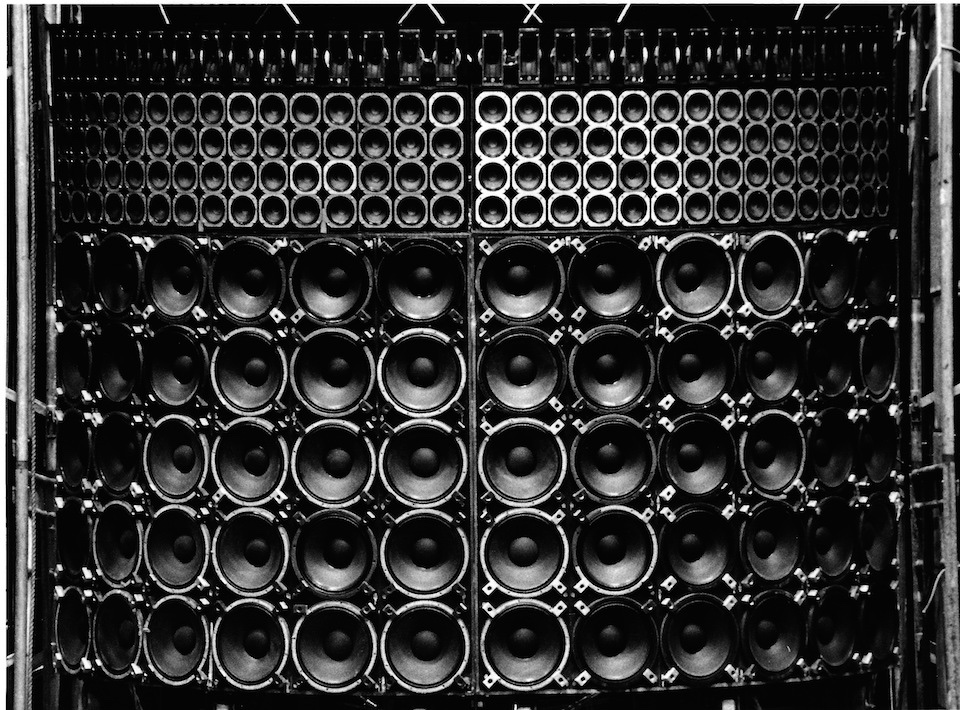
Image above: The Wall’s vocal cluster at the center of the speaker array. Photo: Richard Pechner. From original article. Click to embiggen.
Three-fifths of the Dead’s original lineup were holed up in Novato, California, at the band’s practice space in a Pepto-Bismol colored warehouse located behind a pizza shop. Bob Weir, Jerry Garcia, and Phil Lesh, then just in their twenties, were joined by a small circle of gear heads, audiophiles, and psychonauts who’d become instrumental to the band’s growing popularity.
It’s unclear who called the meeting, why it was even arranged, or what, if anything, was supposed to come of it.
They brainstormed over “the technical, the musical, and the exploratory,” remembered Rick Turner, an instrument and amplifier designer among the Dead kin gathered that day in Novato. “There were no constraints.”
It was a signal moment in the history of sound that set in motion a years-long work in progress that would culminate in what’s arguably the largest and technologically innovative public address system ever built, and it started not with a bang, but with something of a casual, stoned proposition.
This singular work of engineering would come to weigh over 70 tons, comprise dozens and then hundreds of amps, speakers, subwoofers, and tweeters, stand over three-stories tall and stretch nearly 100 feet wide. Its name could only be the Wall of Sound.
The Wall of Sound, or simply the Wall, would occupy only a blip on the long horizon of the Dead’s history, though it remains a touchstone for sound systems of all shapes and sizes, from boutique disco PAs to the massive PAs deployed at any of today’s mega festivals and at 61,500-seat stadiums like Soldier Field in Chicago, where the four surviving members of the Dead, including Weir and Lesh, wrapped up a string of farewell shows this weekend to commemorate the band’s 50th anniversary.
Back at the pink warehouse, they were about to revolutionize sound engineering, acoustic theory, and the way people experienced live music for decades to come, and they likely didn’t even know it. Someone lit a joint.
It was 1969. It seemed the sounds of San Francisco’s Haight-Ashbury, the psychedelic rock Holy Land to which the Dead were revered almost as gods, had beamed to the Moon and beyond. Compared to virtually all electrified musical output to that point, music was louder and more urgent than ever before. Perhaps the drugs had something to do with it, but there was a vitality to music, something unprecedented that resonated for those who believed their generation’s moment had come.
There was just one problem. Even the day’s leading edge of amplification technology carried bands only to a point, before the mixes muddled. Put frankly, Garcia or Jimi Hendrix live, at their loudest, sounded chaotic—in a not-so-good way.
Today, defenders of How Things Sounded in 1969 must face critics who argue that everything back then sounded unsound on account of these gear constraints. That’s not necessarily to question the pure, unbridled daring of baby boomer bands like the Dead, at least not in their prime. The point is that amp tech just wasn’t keeping up with their sonic ambitions.
Conventions like using on-stage monitors (speakers pointed back at performers so they could hear themselves) were still in their infancy. This confined sound techs at both indoor clubs and outdoor venues to jury-rigged public address systems, which rebroadcast the noise of a band toward the audience—at the time, PAs were positioned level with, if not slightly in front of the musicians, and were distinct from the musicians’ backline speakers and amp.
The result was that a performer’s chops often were undercut by blistering volumes, roiling echoes, harsh distortion, and feedback. Unstable audio frequencies skipped over audiences, ricocheted between walls, and decayed into space.
This meant it was hard for Weir, Garcia, Lesh, Ron “Pigpen” McKernan, and Bill Kreutzmann—the rest of the Dead’s founding lineup—to hear themselves individually as well as their bandmates while playing live.
This noise crisis that confronted musicians who went electric at the height of the war in Vietnam is a dissonant truth routinely snuffed from the annals of modern music history, a poignant example of technical difficulties being overlooked in favor of a higher narrative.
The sounds that so radically realigned the arc of history, musical and otherwise, were not perfect, and this imperfection was largely due to rudimentary PAs. From a highly discerning, or modern sonic perspective, live music in 1969 sounded bearable at best, and messy at worst. That was about to change.
If the meeting had an adviser, it was one Augustus Owsley “Bear” Stanley III, the renowned LSD chemist and audio visionary who’d been financing the Dead and recording the band live since some of their earliest shows.
Bear, a Kentucky-born craftsman and former ballet dancer, was obsessed with sound as both a concept and a physical thing. Mickey Hart, the Dead’s on-again, off-again second drummer, told Rolling Stone about one night in 1974 before a Dead show at the former Winterland Ballroom in San Francisco, when he caught Bear in an intimate moment of sonic communion with some of the band’s speakers. Bear was alone, as Hart remembered. Sobbing, he spoke tenderly to the electronics as if they were people.
“I love you and you love me,” Bear wooed the speakers. “How could you fail me?”
Bear had a good ear and money. He had already established himself as the point source for mass quantities of high-grade LSD that flooded the Bay Area and beyond. He was a natural fit as the Dead’s audio guru and benefactor, and if anyone was poised to see the band up and over its noise troubles it was him.
Bear knew the band could sound better—clearer, more robust—during the winding live shows that any seasoned Deadhead would now consider part of the band’s most important block of work. Bear had been quiet at the pink warehouse meeting, Turner said, when suddenly he chimed in.
Video above: Owsley talks about the Watts Acid TestFrom original article and (https://youtu.be/c_4IBpkTgsY).
“You know, the solution is the PA system has to be behind the band,” Bear said.
His thinking was that this configuration, which positioned the band and the audience to hear the same thing, would eliminate feedback, the result of an output signal directed (fed back) to an input. Bear envisioned the band and crowd experiencing the same thing.
This would close the gap between performer and audience, who would both hear the exact same mix shot horizontally from a unified backline “as though everyone was playing acoustically,” said Turner, who told me Bear was one of the only attendees at that meeting who didn’t think the band would drown in feedback if their vocal microphones were pointed back toward their amps and speakers.
Put the PA behind the band? It was a crazy idea at the time—and precisely what made the notion of positioning the whole band in front of all their amplification reverberate with such prescient foresight.
Turner told me Bear’s motion was “filed away” after the meeting, but the idea of having all of the band members play in front of their PA would begin to seep into the forefront of the collective mindset of the Dead and its expanding crew.
Video above: Grateful Dead before the Wall with PA behind them at Iowa State Fairgrounds, Des Moines, IA - Hes Gone - Truckin 5-13-73. From original article and (https://www.youtube.com/watch?t=896&v=ej6iggaAigk).
A crackling, albeit brief stretch of experimentation, ending in 1974, forged a PA that was placed behind the band and effectively served as its own self-contained monitor system. It separated the vocals from all the other instruments, which each got their own dedicated PA. This produced a striking clarity in the Dead’s live mix and gave way to an almost primal audio-visual continuity.
The system also pioneered the use of line arrays—columns of speakers (literally one speaker stacked on top another) designed to control the dispersion of sound across the frequency range—as well as a unique noise-cancelling microphone system meant to reduce backing bleed into the vocals.
There had been nothing quite like it. The Wall’s scientific base was seemingly so far ahead of its time that everyone interviewed for this story, including some of the Wall’s many original engineers and crew members, said that most everything about this particular system has gone virtually unmatched ever since.
“The tones of the instruments—the clarity of the instruments—has not been matched,” said Turner, who co-founded Alembic, a custom electric guitar, bass, and preamp company whose close working relationship with the Dead proved indispensable in conceptualizing and building the Wall from the ground up. “It’s just as simple as that.”
THE FOUNDATION
The Grateful Dead clocked nearly 150 shows in 1969. They played through pretty much whatever amplification gear they could get their hands on at the time, a true working band capable of pulling off only so much, sonically. The art of broadcasting reproduced noise was limited then to whatever frequency ranges those amplifiers, speakers, subwoofers, and configurations thereof had been set to, to say nothing of the shape of a performance space and its PA.
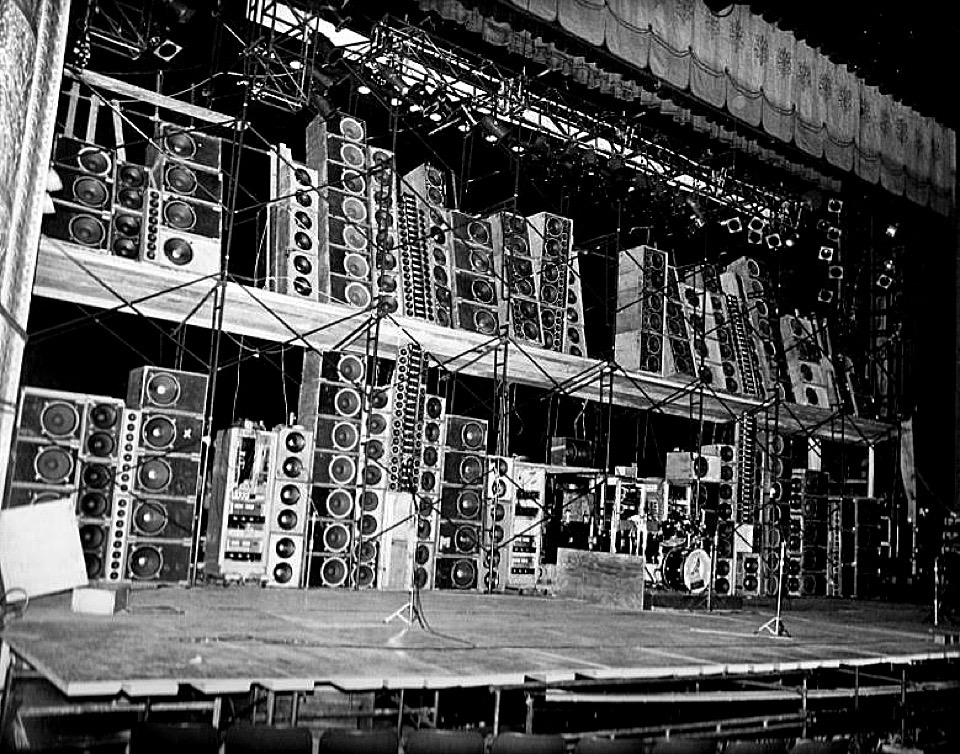
Image above:The “Alembic PA” at the Boston Music Hall, November 30, 1973 was the proto-Wall. Photo courtesy Richard Pechner. Click to embiggen.
To muddle the mix even further, the prevailing, default operating mode among live sound techs in 1969 was seemingly the louder, the better.
The Dead were obsessed with their sound to compulsive degrees—they were one of the first bands, if not the first band to use 16-track recordings in a recording studio. They strove to replicate that same technical precision and command on stage, and yet they couldn’t hear much of anything while performing live beyond the distorted sound waves blasted from whichever PA they happened to be playing through on any given night. It was a technological quandary of decidedly existential proportions, and it hung over the band and their confidantes like a faint haze.
The Wall was always a work in progress, an exercise in iterative hacking. Richard Pechner, a carpenter who helped build speaker cabinets for the Wall (and whose behind-the-scenes photographs of the band and PA, seen here, are considered iconic), told me it was an untiring “experiment by committee.”
This is why it can be risky to say the first proper Wall show happened on such and such a date, say March 23, 1974, at the Cow Palace, just outside San Francisco, which some consider the first Dead show to utilize the “complete” Wall of Sound.
A seminal moment happened at the Boston Music Hall in November 1973, Turner told me. Four years had passed since Bear chimed in at the pink warehouse. The Dead were playing more shows at larger venues, and simultaneously pushing their live sets into exciting, if challenging territory.
A half-hour version of “Dark Star,” a crowd favorite, could be harsh stuff for even the most devout Deadheads who’d grown frustrated, along with the band and crew, with the Dead’s sound woes.
“There was no technology for electric instruments,” Lesh told Rolling Stone in 2011. “We started talking about how to get around distortion and get a pure musical tone. [Bear] did some research and said, ‘Let’s use Altec speakers and hi-fi amps and four-tube-amps, one for each instrument, and put them on a piece of wood.’ Three months later we were playing through Bear’s sound system.”
Bear had rented a house in Watts, Los Angeles. He opened his doors to the band, who found the place “festooned with studio-quality speakers that were standard for movie theatres,” Weir told Rolling Stone. “One day, [Bear] announced, ‘Well, we’re surely doing the Devil’s work here!’ He was kind of right about that—the music, the chemical involvement, the social involvement. You have to have a pretty accepting view of things to not get upset by that.”
Meanwhile, Turner, Ron Wickersham, Bob Matthews (Alembic’s other co-founders), and the rest of the Wall’s expanding inner circle had become increasingly preoccupied with breaking down the difference between the microcosmic environment of the stage and the macrocosmic environment of the auditorium. Gradually, the means to eliminate differences between the on-stage monitors, which the Dead were using, and the audience crystallized.
“It started making pieces of sense in terms of having the audience hear what the band heard,” Turner told me.
The Dead were playing through a sort of proto Wall by the time they hit the Boston Music Hall in the fall of 1973. It was a somewhat haphazard PA that was still a conventional stereo system, according to Turner. Its on-stage speakers formed columns, saplings of the towering line arrays to come.
Cobbled together with JBL speakers and ElectroVoice tweeters, all in Alembic cabs and driven by McIntosh amps, the “Alembic PA,” as this predecessor system was known, had grown so large, Turner said, that when it was loaded into the Music Hall there simply wasn’t enough room to put it in the usual stage left/stage right positions.
“So it went on the scaffolding basically with the back line behind the band,” Turner said, just as Bear had foreseen. “That was the major leap forward in proving that the Wall of Sound could work.”
That’s when things really got going.
“We started hacking through and figuring it out,” Turner told me. They started to make all their own cables and audio snakes, he explained, because higher-quality gear just wasn’t available at the time. They re-coned speakers that had blown or torn.
They replaced tweeter diaphragms as needed. “It was all just one gigantic experiment,” Turner told me, “but it wasn’t willy nilly.” There was solid reasoning behind every one of the system’s parts, all the way down to the banana jacks and plugs they used as speakers connectors. “We were working with what was available, and also working with some pre-scientific underpinnings to it all.”
Most of those underpinnings could be found in the writings of the late RCA audio engineer Harry Olson. The UC-Berkeley physics library had a copy of a then out-of-print handbook of acoustics written by Olson, who perfected the ribbon microphone and did pioneering work with loudspeaker and array dispersion, among other things.
When the Dead got their hands on the manual by way of John Curl, an engineer with Alembic, they made photocopies to share among the Wall’s committee.
“We each had Harry Olson’s Bible,” Turner said.
It’s not clear if one of those photocopies made it to Dan Healy, who’d become the Dead’s long-running sound tech. I was unable to reach Healy for comment, but he has previously said that by the early 1970s he had “bottomed out all the research” that had been done in the 1920s by Bell Laboratories, which was founded in 1928.
The Dead had no choice but to set out into uncharted territory with the Wall, something Healy believes exponentially advanced more than just the group’s understanding of sound.
"It caused major, major changes … that are still going on in the sound industry today,” Healy told Jym Fahey in 1992. “We debunked so much stuff that you'd be amazed. And we verified so much stuff. In the period from 1969 to 1974, the entire audio industry completely turned upside down and the Grateful Dead was at the hub of it.”
At its apex, the Wall of Sound comprised nearly 600 JBL speakers (15-, 12-, and 5-inch) and over 50 ElectroVoice tweeters, all powered by around 50 McIntosh MC3500 and MC2300 tube amps, one of the most efficient amps of its time.
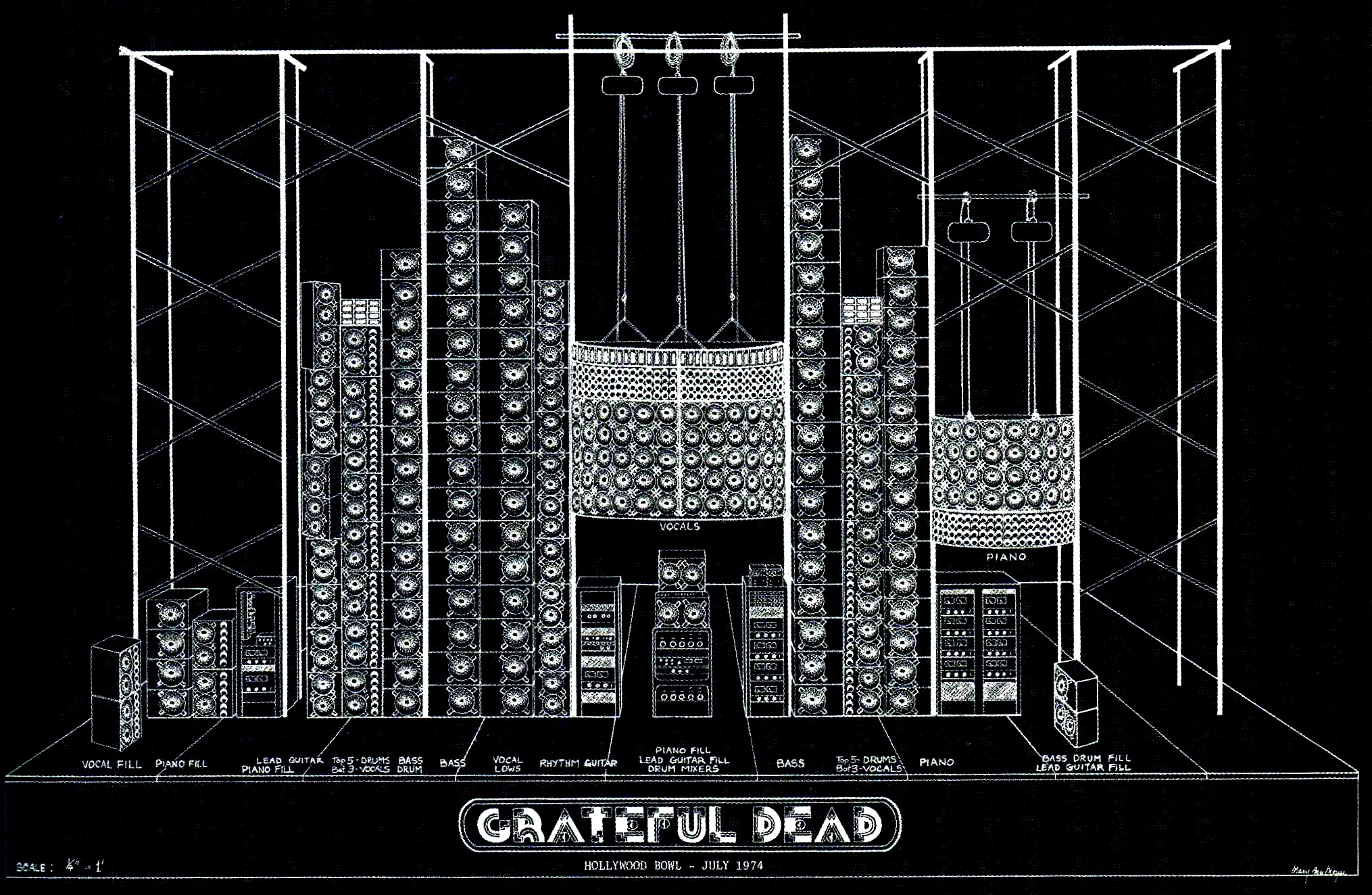
Image above: Detailed schematic of the Wall at the Hollywood Bowl, California, 1974. Photo by Mary Ann Mayer. From original article. Click to embiggen.
It took a full day to build the Wall at that peak, including its custom staging, scaffolding, and lighting rig. The system itself, which changed month to month, according to Turner, was transported in a 40-foot semi truck.
There were two identical sets of scaffolding, each carted in a 18-wheeler flatbed semi. (Bear claimed there were actually three sets of scaffolding.) The stage lights were hauled in a 24-foot van. Two road crews were assembled to keep the band on schedule while touring, leapfrogging the spectacle from show to show.
When Crew A arrived with the Wall in a given city, Crew B would have already assembled one of the two scaffolds. This allowed enough time for all hands to then get everything up and running by showtime.
This contradicts claims that the Dead amassed a second, identical Wall of Sound, although the upkeep wasn’t any less grueling. The system, staging, scaffolding, and lighting weighed a combined 75 tons at its peak. It all proved too unwieldy, finicky, and plain expensive for the Dead to support for more than a couple years. The band only brought out versions of the Wall on stateside tours between roughly 1972 and 1974.
“It was basically wonderful, but it created a tantamount situation,” said Dennis “Wiz” Leonard, an audio engineer who worked closely on the Wall. “It was pretty impractical.”
The Wall, not to be confused with the Phil Spector-perfected, layered studio-recording technique of the same name, was short lived, but still cuts above the noise. Beside towering over the musical record on sheer size alone, the Wall pushed the art and science of live amplification to precipitous new heights. This is perhaps the system’s lasting legacy.
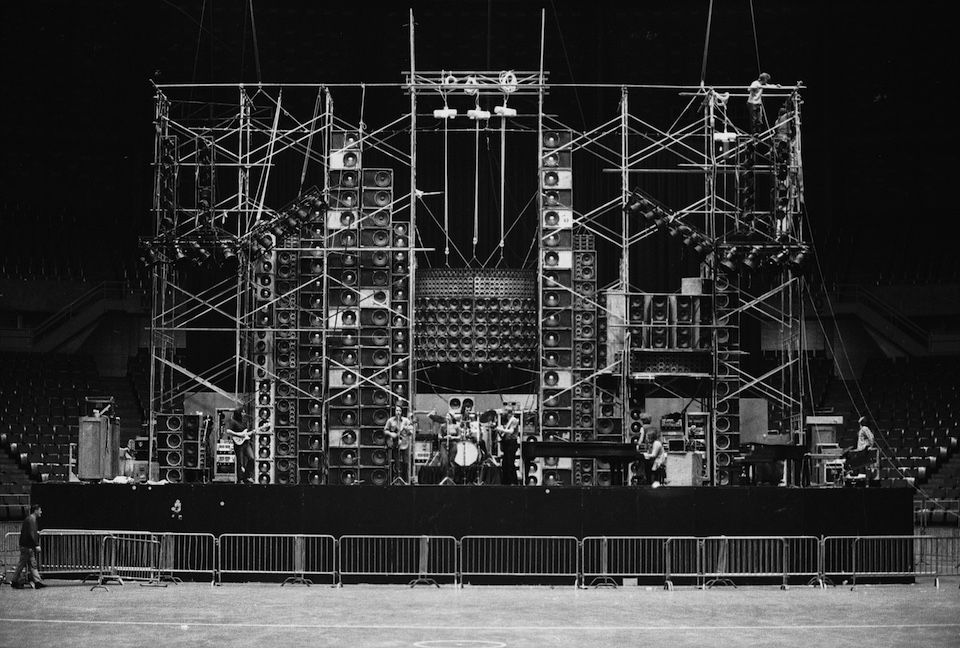
Image above: Members of the Grateful Dead and the Wall of Sound, shot during sound check at P.N.E. Coliseum in Vancouver, British Columbia, May 17, 1974. Photo by Richard Pechner. Click to embiggen.
The Wall was loud, though it’s not the loudest sound system ever built. Today, DFA Records’ chief and former LCD Soundsystem maestro James Murphy’s nightclub sound system, Despacio, thumps at a whopping 50,000 watts. Which is nothing compared to the sound system housed at the Large European Acoustic Facility in the Netherlands, which would kill you if you heard it.
till, at nearly 28,800 watts of continuous power in its loudest iteration, the Wall was the most powerful sound system built to that point by a considerable margin. On-stage Wall levels once registered around 127 decibels. That’s about as loud as a military jet taking off at a standing distance of 50 feet.
But few people who caught a Wall show, or who were involved in designing and perfecting the system as it evolved, would say the system roared like an F-16. The Wall emitted such a clear mix—this August 1974 recording of a Wall show in Jersey City, New Jersey, is a prime example—that it simply didn’t seem loud. The fidelity was that high.
“It was just incredible with the full system,” said Turner. He recalled an outdoor gig in Santa Barbara, California, sometime around 1971 or 1972, with the Wall still in its infancy, when he’d walked a good half-mile from the stage as the band sound checked through the system.
Turner could hear it all the way out there, clear as glass, corroborating Bear’s claim that sound from the Wall could travel a half-mile before it started to degrade. “It was just phenomenal,” Turner said. “It was really quite amazing.”
Wiz remembered a similar Wall experience, this one in 1973 at Roosevelt Stadium, just outside New York City. There Wiz stood, at the far end of the parking lots. The band, who by this point could draw in thousands of people to an outdoor show, was set up on top of what would’ve been home plate, and their sound check beamed over the outfield bleachers. By his estimation, a good 100,000 people could’ve filled the space between the Wall and his ear canals.
“Although the wind was playing with the sound—it would kind of blow it away—it was crystal clear all the way out there,” said Wiz, who joined up with the Dead in 1971 while working for Alembic. “The coherence of the waves as it propagated was really incredible.”
They didn’t know each other yet, but my parents happened to be at the same outdoor early Wall show at the state fairgrounds in Des Moines, Iowa, on May 13, 1973.
My mom, who’d later bake chocolate chip cookies for the band while working for Howard Stein, a legendary Chicago-based rock promoter, was on stage. My dad, who later did occasional stagehand work like handling the oriental rugs the band played on at Dead shows in the Midwest, was about 20 people back from the front of stage left.
“Given how long ago it was and my positioning in the audience—close, on one side—it's difficult to recall many specifics,” my dad told me, “but I do know that the sound was fine given it was an outdoor show.”
While some of the niceties of the Wall are lost on him over four decades on, he said that “the sound was clear enough that near the end of the second set of a three set show (pretty unusual), during ‘Here Comes Sunshine’ on a very threatening day, the Sun came out!”
hese moments of hyper-purity, suspended in time like an endless note, strike at the core of what made the thinking and engineering behind the Wall “so tremendously forward for live sound itself,” Wiz said.
“The future was lower distortion,” he added, which at the dawn of the 1970s meant controlling the dispersion of sound across all frequencies. A coherent-sounding live rock show was then a matter of horizontally concentrating frequencies at the audience, rather than blowing different amounts of different frequencies around a space.
This was the basic idea behind the Wall from the very beginning, according to Turner. He said it came down to fine-tuning what remains the most widely adopted method for boosting noise signals: stereo.
The easiest way to conceptualize stereo is to think of it as the reproduction of sound waves that seem to come from different locations despite sharing an origin, or point source.
This produces a bouncing effect, with some noises seemingly coming at a listener from the left, the right, the center, and so on, when really all these rebroadcasted sounds focalize at one point in the amplifier (used as a general term) or network of amplifiers, the PA. In a word, stereo is inherently deceitful.
This was Bear’s big gripe with live vocals that didn’t appear to originate from a singer’s mouth, with licks that didn’t seem to noodle directly out of a guitar, and so forth with drums and bass and piano. Turner can remember Bear ranting about how “stereo doesn’t work” for this reason: In theory and practice, stereo is an illusion.
Two key innovations forged through the Wall—noise-cancelling microphones and speaker line arrays—would shatter stereo’s illusion, bringing the Dead to life.
Few believed Bear when he said the Dead wouldn’t whip up waves of feedback if the band played with all their gear at their backs.
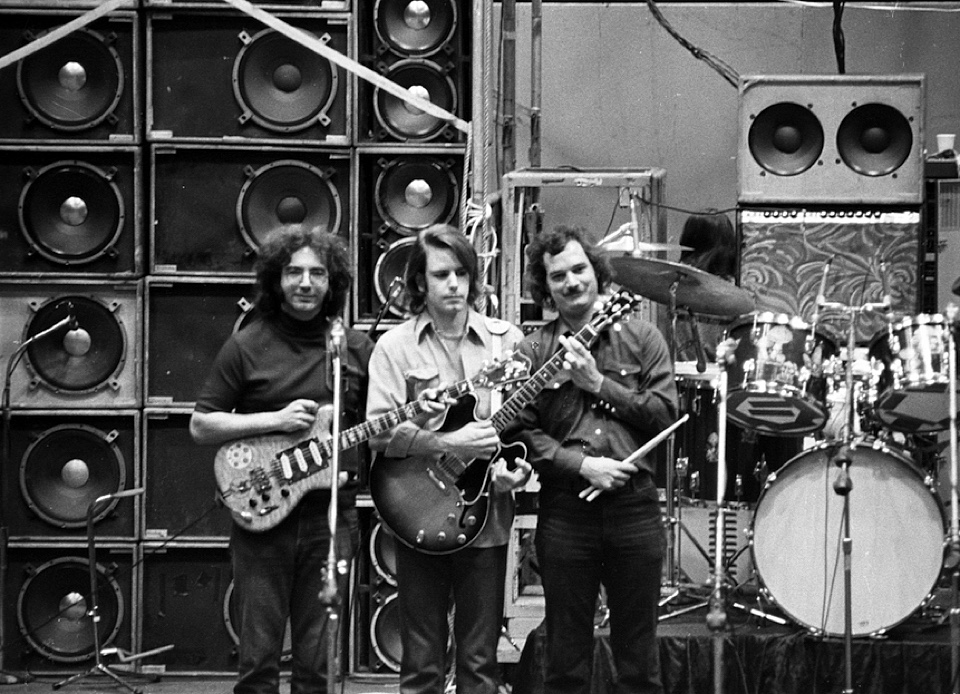
Image above: Garcia, Weir, and Kreutzmann during a Wall sound check at P.N.E. Coliseum in Vancouver, British Columbia, May 1974. Photo: Richard Pechner. Click to embiggen.
But it was Bear’s contention, to which Turner said Ron Wickersham agreed, that if the vocal microphones and the speakers at which they were aimed both carried truly “flat” responses, meaning they reproduced sounds from input sources with a high level of accuracy, then feedback wouldn’t be an issue.
Turner told me this proved truer than anyone expected, though not as true as Bear and Wickersham had hoped. Hence the main reason for the Wall’s pioneering noise-cancelling microphone system, Turner added, was to “cancel out anything picked up equally.”
Look at any footage or photos of the Dead playing through the Wall and it’s hard to miss the pairs of low-grade omni-directional microphones stacked at the vocal modules that each ran out of phase, meaning they cancelled each other out.
Whoever was singing, let’s say Weir, sang into the top mic, which was set three inches above the bottom mic, which picked up stage ambience. The two signals were fed into a special amp that combined the signals, effectively cancelling out the Wall’s sound, which was really just the mics’ common sound. All that came through, and clear, were Weir’s amplified vocals.
If any of the Dead’s vocalists weren’t pressed right up against their respective mic capsules they’d run into phase issues that produced a nasally, cartoonish vocal effect.
Rob Jaczko, chairman of the Music Production and Engineering Department at Berklee College of Music, told me over email that these noise-cancelling mics were not only ineffective for recording. Jaczko, who was not involved with the Wall and could speak only based on anecdotal information, said the noise-cancelling mics “sounded poorly.”
Regardless, the Wall’s noise-cancelling microphone system dampened backing bleed into the vocal mics from what had grown by 1973 into monolithic line arrays designed to control dispersion at all frequencies. The physics of it worked by matching the height of the speaker columns with acoustical wavelengths, and made for exceptionally low intermodulation distortion. It’s a quality Turner remembered as having the effect of a large pipe organ.
“Whatever you wanted in the PA was what was in the PA,” he said. “What you didn’t want in the PA wasn’t there.”
That’s because the Wall was a PA of PAs—six independent PAs, one for each instrument. Lead guitar, rhythm guitar, vocals, bass, drums, and piano each had a dedicated PA, according to the official Deadheads Newsletter No. 19, published in December 1974. This did away with having to mix everything through a single set of speakers.
The “single biggest thing besides the true line array aspect” of the Wall, as Wiz told me, was how there was no need for panning, or adjusting various sound levels on a mixing console.
The Wall was the first sound system of its kind to eliminate the need for front-of-house mixers, who adjusted the sound levels of the various on-stage monitors pointed at the band. Each of the Wall’s vocal microphones had a volume control function, so the band was able to mix vocal sounds on-stage as they played.
Each individual band member also had total control of his own sonic environment, being able to tweak the levels of not only his stage monitors that played back the instruments of all the other musicians but also of his own instrument.
“As far as I’m concerned, the soundman should be as superfluous as tits of a boar hog,” Bear wrote years later. “All he should do is make sure things run and don’t break down; plug the wires in and unplug them.
All the control of what’s going to the audience should be fully in the hands of the performing artists themselves. That’s the only way you’ll ever get close to true art.”
And so, behind each player, let’s say Garcia, stood a column of speakers. This was his system, a single-point source with only one program in it: his guitar.
“All of his sound, except for a couple of fill-in speakers that only the band could hear, came from that,” Wiz said. “You localized on it—you saw Jerry on the stage—and the sound was coming from where he was. Likewise with Bobby, likewise with the piano, likewise with the drums.”
This audio-visual continuity was arguably the hallmark of the Wall of Sound experience. It created nothing short of what Turner called a “macro-acoustic event.” It tapped a deeply primal chord, at least for those in the audience nearer to the front of the stage. Sound localization is one of humankind’s oldest and fine-tuned hearing mechanisms, after all.
“It’s one of those things that as hunter-gatherers we depended on for survival,” said Wiz. There are pre-cognitive connections between our inner ears and neck muscles, he explained, that fire when we hear transient sounds so that we can’t help but turn our heads toward auditory stimuli. “It’s very powerful,” Wiz said. “The essence of the Wall of Sound was that the panorama was real, and uncorrupted.”
In other words, a member of the audience at a Wall show believed the voices she heard actually came from the singers’ mouths. She believed that low-end bass bombs actually discharged from Lesh’s custom Alembic four-string bass; that Weir’s vast repertoire of chords actually slid out from his Gibson 335; that Kreutzmann’s martial rolls actually sparked when drumstick met drumhead like flint and striker; that Garcia’s licks actually wept from his custom Doug Irwin/Alembic guitar.
Imagine the mind games this played with everyone at Wall shows, band included, who’d dropped a tab or two of what could’ve been Bear’s legendary acid.
The titanic sound system would’ve been hard to miss, if only it hadn’t been kept almost completely in the dark as the band performed with it indoors. The Wall’s lighting scheme obscured the system. There was something to be said for not making the PA the center of attention.
“The way you know things are really working is when people are not focusing on the gear, they’re focusing on the music,” Turner told me. “And so really, the best equipment disappears.”
It was an intimate experience. “The flowing light becomes more liquid; spreads into molten fingers; reaches far out into space,” as one early print feature described being overcome by the Wall.
“Droplets crystallize into musical notes and fall back at your feet.”
The Wall allowed the band “to play super-loud without killing ourselves or frying those in the front—to get loud, clean sound at the back of the huge hall, and supreme musical control, because we run everything from stage,” Phil Lesh told the told the San Francisco Chronicle on the eve of that March 1974 show at the Cow Palace that some consider the first appearance of the “complete” Wall. “For me, it’s like piloting a flying saucer. Or riding your own wave.”
That’s not to say total stability wasn’t a nightly test for the band and crew. There were always cracks in the Wall. Components of the system regularly acted up and broke down.
“When it worked, it worked fantastically well,” Turner admitted. “When it didn’t it was a problem. But we were the ones out there figuring it out.”
THE FALL
It would come at a price. Pechner, the Wall carpenter, once told Audio Junkies that he remembered overhearing someone at a Wall-era band meeting put the total for one year’s worth of designing, experimenting, and road testing the system at $275,000. (I could not confirm what year that meeting took place, but adjusted for inflation $275,000 in 1974 comes out to over $1.3 million today.)
“I’m sure it cost more,” Pechner said. Whatever the true cost of the Wall, with all its associated expenses, like paying the crew, it nearly bankrupted the band.
“I think from sort of a broader, historical view of the Grateful Dead phenomenon, you can’t get away from the fact that the Wall basically broke them financially,” Nicholas Meriwether, head curator of the official Grateful Dead Archive at University of California—Santa Cruz, told me. “It stretched them too thin.”
By the end of 1974 the Wall had hit the proverbial ceiling. Then it all but disappeared.
“I hear the rumors,” Turner said. “There’s a warehouse here, there’s a warehouse there. There’s a pile of this, there’s a pile of that. Who knows? I don’t know. Entropy, you know? It melted away.”
This is where the mix can get muddled.
“What I know is probably what you know,” Meriwether told me. “Which is, Bob Weir gave an interview at the end of the Wall of Sound era in which he said, ‘We’re gonna sell off parts of it, and we’ll keep parts of it.’ As far as I know that’s correct.”
That’s the kind of information Meriwether said the archive, a crowdsourced collection of images, posters, and assorted Dead-related ephemera, “doesn’t really reflect.” He did recently acquire a cache of materials, saved by an unknown Dead office employee, that included some of the band’s original sketches from when they were first imagining the Wall in the early 1970s.
“That part is very, very cool,” Meriwether said, even if it underscores the fact that “a lot of the Wall gets documented happenstancesically.”
I asked him if he could elaborate on where the pieces of the Wall possibly fell, and subsequently who got what. Meriwether qualified everything he told me as hearsay, but he said the Wall, which was modular, was constructed in a way that would’ve been easy for whole portions of the PA to be disassembled and sold off, or as legend has it, bequeathed to Hot Tuna, Jefferson Airplane, and other bands in the Dead’s extended family.
It was a system built almost entirely of top-of-the-line gear, Meriwether said, including speaker elements like drivers (the transducers that convert electrical energy into sound waves) and all those McIntosh MC2300 tube amps.
“Those were state of the art,” Meriwether said. “Everyone wanted them.”
It seems other features of the Wall, such as the noise-cancelling mic system, would’ve been much harder for the band to salvage. Meriwether said he imagines there were likely certain components of the PA that simply were not able to be recycled, however he does know for a fact the Dead did repurpose parts of the Wall.
“Just because the Wall itself was dismantled, doesn’t mean that they didn’t continue to use drivers, elements, and components of the Wall for years afterward,” Meriwether said.
There was a five-day run at the Kaiser Convention Center in Oakland, California, in September 1979, for example, when the Dead dusted off the Wall’s original vocal cluster for a sort of victory lap. The Dead had been touring with the Wall’s original piano cluster, a honeycomb aluminum cabinet designed by Bear and insulated with a special rubber damping, as a left-right midrange component to “a small PA that was doing, like, 3,000-capacity venues,” as Wiz told me. Kaiser fit that range, and Wiz said the venue’s location brought together “everyone in the Bay Area that had ever done anything with PA.”
The vocal cluster, which apparently sat unused in an area warehouse, was retrofitted with 12-inch speakers, and then patched into the Kaiser PA. It was a fun, one-off pairing with 16 custom subwoofers that Wiz told me were originally built for Apocalypse Now, which formed the subcomponent of the Kaiser system.
There was also a run of New Year’s shows at the Oakland Auditorium a few months later, which again used a slimmed-down PA comprised partly of old Wall gear. But that was it.
“I think that was the last time any of that stuff saw life,” according to Wiz, who said the Wall of Sound proper fell silent by the end of 1974. The Dead was a band-business by that point, with operations and ambitions that had taken on an ouroboros-like quality. They decided to take a break from touring until 1976. They were worn out.
Over time, that far-flung cast of characters that held up the Wall had become “balkanized,” Turner told me. Cohesion splintered among the committee around the time Alembic started breaking away on its own, having to do less and less with the Dead, according to Turner.
“Everyone had their own little piece of turf,” said Turner, who left Alembic in 1978. “It was really tough.”
Wiz remembers it differently. The Wall crew, he said, “was a really, really well-oiled machine.” The Wall was so impractical that only the Dead could use it. There were really no opening acts because the sound system simply didn’t lend itself to conventional use. In pursuit of a greater sonic good, to see the Dead regain their sonic destiny, it would seem crew members had to set aside any quibbling and just crank.
Wiz, who is now a supervisor and re-recording mixer at Skywalker Sound, said he still listens to the block of work the Dead released between 1972 and 1978, during which he served as the band’s touring manager. He’s held onto a pair of three-way cabinets that he built years ago with 12-inch drivers and speakers that were in the original Wall of Sound.
“It’s kind of cool to have that,” Wiz said.
There are ravenous collectors who’d spend thousands of dollars to own that sort of ephemera. At AAA auction houses and on online forums, there is an intense clamor over what could be called Wall shake.
In 2007, two “distressed” speaker boxes from the Wall, each riddled with stickers and band graffiti and allegedly some of the last in existence, went up at Bonhams, the privately owned British auction house that bills itself “one of the world’s oldest and largest auctioneers of fine art and antiques.” Together, the two boxes sold for $2,800.
Five years later, again at Bonhams, two speakers from Garcia’s portion of the Wall went for $12,500.
Also in 2007, Simon Babbs (whose dad, Ken, participated in the original Dead-scored Kool-Aid Acid Tests) sold for an unknown sum of money what he claimed was a Wall-era speaker cabinet. In early 2013, a pair of aging speaker cabinets allegedly sold on eBay. I’ve been unable to track down any record of this sale or contact the seller, who apparently claimed the cabinets came from the Wall.
A reliable source informed me Dan Healy was likely behind the sale, and that Healy fetched a cool $3,100 for the cabs.
Over four decades on, and a short-lived, 75-ton mass of electronics still tickles the fascinations of not just devout Deadheads but audiophiles, engineers, and historians, some of whom could not care less for the Dead’s music. It’s testament to the Wall’s groundbreaking physics, it seems, that a busted pair of Garcia’s speakers, used during only a sliver of the 2,318 shows played in the band’s initial 30-year run, can fetch over $10,000 at a high-end auction house. That even reputed Wall components are sought after like shards of a sonic Holy Grail.
But for others, even verifiably authentic Wall parts do nothing nowadays but take up space. Meriwether said he doesn’t see much value in exhibiting old parts, let alone hunting the stuff down, when it comes to building a corpus of knowledge around the Wall.
“I don’t know if I would ever really look for pieces of the Wall,” Meriwether told me. He’d rather look into pictures, schematics, and correspondence about the PA, in addition to concert riders that describe the logistical challenge of mounting a Wall show. As far as he is concerned, it’s this sort of software, not hardware, that will help a scholar in 200 years understand what the Wall of Sound truly represented.
Which is? I asked.
“The Wall of Sound represented the first real culmination of the band’s dedication to perfecting the means of their live performance,” Meriwether said, “of controlling their live sound to the degree and precision they’d learned to control their studio recording.”
ECHOES
John Klett doesn’t particularly care for the Dead. But in no small way is he indebted to the band, their far-flung crew, and the restless sonic ambitions that shot through the outfit’s ethos, especially during the Wall years.
If it weren’t for them, Klett’s 50,000-watt mid-tempo sound system, which he designed and built alongside James Murphy, would probably look and sound much different than it does today, as it fills discotheques around the world to critical acclaim.
I even got the impression from Klett that Despacio, as his and Murphy’s boutique PA is dubbed, might have never made it beyond the drawing board if not for the work the Dead and crew put into the Wall decades ago.
“The Grateful Dead started entire industries, if you think about it,” Klett told me. “Those guys were nuts.”
It was 1997. Two years had passed since the Grateful Dead proper fizzled out, after the drugs, endless touring, and the demons of fame finally got the best of Garcia. James Murphy, a young DJ and producer living in New York City, wanted to build a studio in Brooklyn, and somehow knew that Klett could help.
“I’m not sure who gave James my number,” Klett, a New York City-based audio tech, studio consultant, and recording engineer, told me. “But he found me. He called me up and said, ‘I’m gonna do a studio.’”
The two went on to build that studio, forging a working partnership that continues to this day. Together with 2ManyDJs’ David and Stephen Dewaele, Murphy and Klett spent two years hacking on Despacio, which is Spanish for “slow.” It’s a fitting name for a PA that plays 45 rpm 7-inch vinyl records at a sultry 33 rpm. Despacio makes any club banger sound like it’s sunk into a K-hole.
If there was one sound system that popped up in their initial scheming, before the four audiophiles began building Despacio from the ground up, Klett explained, it was the Richard Long-designed hi-fi PA at West SoHo’s former Paradise Garage, arguably the most important underground discotheque in the history of contemporary pop and dance music.
But even that was just a loose reference point for Despacio, which Klett said is “kind of its own thing.”
There really is no high-end sound system going, past or present, quite like Despacio. Picture it stacked next to the Wall, and Despacio is positively miniature. It weighs 7.5 tons and is made up of seven 3.5-meter-tall McIntosh speaker arrays and a pair of 21-inch subwoofers, all of which are held in place by a custom, wood-encased metal frame.
When it debuted in 2013 at the Manchester International Festival, Despacio hit 150db—about as loud as a jet takeoff from a standing distance of 25 feet, capable of rupturing eardrums.
That is significantly louder than the Wall ever was, yet it’s only 20 percent of Despacio’s total capacity, as David Dewaele told Wired UK. The point is not to bludgeon clubgoers with noise, but to put them in tune with a full, equalized range of audio dynamics precisely by not pushing Despacio even remotely near its full capacity.
“There is tons of headroom,” as Klett told Wired, remarking on Despacio’s clean, relaxed timbre.
He very well could’ve been talking about the Wall. The two PAs share quite a bit of sonic DNA, in the sense that the thinking behind Despacio leans heavily on the thinking that first went into the Wall.
Like the Wall before it, Despacio is designed to control the dispersion of noise across all frequencies. It’s this basic approach to sound design that Klett considers to be one of the Wall’s key innovations.
“That’s sort of the ethos we had,” he told me, “which is to say, keep things as simple as possible. Put some efficient speakers into simple cabinets, and give the cab enough volume for its respective speaker to work.
Let’s not have a lot of processing, let’s not spend a year computer designing a cabinet and doing a lot of digital processing in order to make that really work.”
“Amplifier, speaker, and box. Simple crossover, done.
Nothing else,” Klett went on, almost breathlessly. “It’s all physically aligned. It’s a maximal solution to a minimal set of design criteria.”
This explains the Plexiglass covers on Despacio’s amplifier racks, a simple hack that Klett said prevents all the energy blown through the system’s 12-inch cabs from ricocheting around rooms.
Beyond design, Despacio’s frequency spectrum is also divvied up similarly to how Bear and the Dead divided the Wall’s spectrum, the idea being to not cram undue bandwidth into individual cabinets and speakers. There is effectively no stress in the mix. It’s an approach to spectrum optimization that really hadn’t been seen before the Dead came along, according to Klett.
Both systems are built with the same analog amplification technology, as well. When I asked Klett about the original vision he and Murphy and the brothers Dewaele had in mind for Despacio, he said they pictured a large vented cabinet along the lines of the cabs used in the Wall.
“It had the same speaker,” he said, referring generally to McIntosh. Klett said he has to wonder if McIntosh, which now supplies Despacio with speakers, would’ve balked at a potential partnership had the Dead not been so taken with the MC2300 as the heart of the Wall.
“That thing had a short run, like Despacio will,” Klett admitted. “Despacio is not going to last that long. It’s just a horrifically impractical thing.”
HIGH NOTES
Bear had apocalyptic visions. He started to warn everyone about nuclear winds, and as the 1970s wore on he became “absolutely convinced that nuclear disaster and earthquakes were going to happen sooner or later,” as Sam Cutler, a friend and former Dead tour manager, told Rolling Stone.
Bear resolved to leave America. He would settle in Australia, where he died in a car crash in 2011. He was 76.
There has been “tremendous” change within the post-Wall music industry, Turner said, and he can’t think of another band besides the Dead “that would’ve allowed and financed the kind of experimentation that we were left to get away with” in the late 1960s and early 1970s.
One of the greater ironies of that historical moment, steeped as it was in the reclamation of some modicum of populist control, is that it came with considerable losses of artistic control. Rock and roll was drowning itself out, and the Wall offered the first big breath of clean air.
For the first time, a group of musicians could hear themselves think because they could hear themselves playing their instruments. That bar is still set about as high as anyone holed up at the pink warehouse that one day in 1969.
These days, Turner wishes there was a more cooperative spirit of experimentation among musicians and sound technicians. He said there is a lot that can be done with phased array technology in which sound techs can have isolated time delays adjusted for every speaker within a PA system, so long as each of those speakers draw power from their own dedicated amplifiers.
It’s the same technology used to aim a phased array radar system, so that the radar antennae don’t need to physically move in order to sweep the sky.
Sometimes Turner thinks about what would’ve come next. He said the logical step, had the Wall stood longer than it ultimately did, would’ve been to lock together all the cabinets and “just give up on humans” altogether. “Just say, ‘OK, this thing has to be fork lifted,’” Turner said, adding that the idea would’ve been to have the Wall double as its own scaffolding. With the exception of maybe the light rig, there would’ve been no need for a stage frame separate from the PA system.
A Wall-equivalent sound system, albeit a much more portable one, could also be made today. But the physics of matching acoustic wavelengths with line array height—the physics that defined the Wall—really can’t be beat, at least not yet. As Wiz put it, “We’re still reaching for that sound.”
.