An ugly dance - The Asian Pivot

SUBHEAD: The Asian Pivot has so far been a feeble attempt by USA to outplay Asia in the game of who can destroy the planet the fastest. 

By Juan Wilson on 5 December 2013 for Island Breath -
(http://islandbreath.blogspot.com/2013/12/an-ugly-dance-asian-pivot.html)

http://www.islandbreath.org/2013Year/12/131205pacificbig.jpg
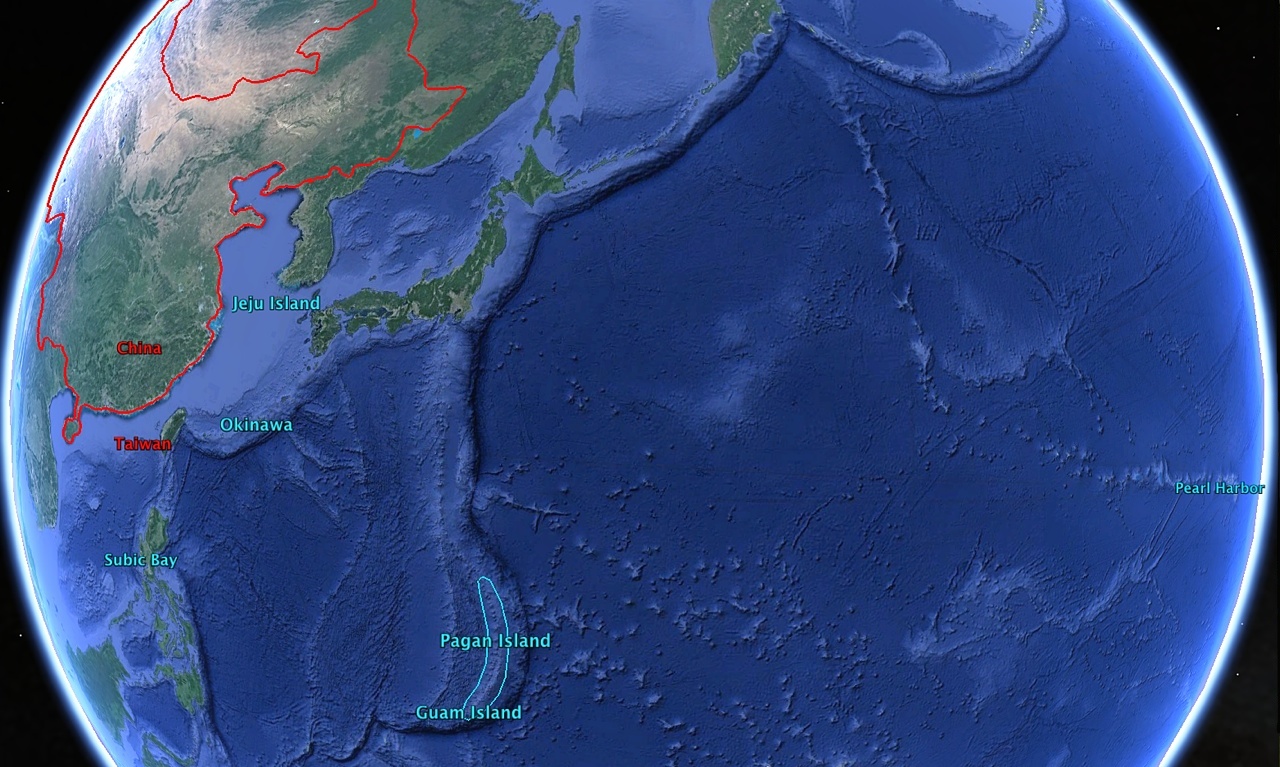
Image above: Overview of western Pacific showing how distant Pearl Harbor (far right) is from the "action" (far left). It's halfway around the world. From GoogleEarth by Juan Wilson.

Who are the most destructive bastards in the Pacific - WE ARE!

Needless to say, after dropping nuclear bombs on Japan in 1945, we held the lead and kept a lap ahead of the field with our hundreds of a-bomb and h-bomb tests in the 50's. We left Russia and France in the dust (laced with Strontium 90). We followed up with a grinding war against South East Asia through the 60s and 70s. In terms of "big wars" after that America simply coasted through the next couple of decades.

We got a wake-up call on September 11th, 2001. That temporarily diverted our attention from destroying the Pacific Ocean full time. We've spent two decades shredding the Middle East over 911 and Al Qaeda.

Oh sure, we kept up pretenses. We went through the obligatory biennial RIMPAC (Rim of the Pacific) War Games, but our hearts weren't in it. The Japanese and others were strip-mining the ocean mega-fauna faster than we could kill them with sonar and weapons tests.

It was only when the environmental destructiveness of China's industrial expansion started to eclipse our own that President Obama admitted we we falling behind. Now we had some real competition.

Our response?  - "The Asian Pivot". It was announced on April Fools Day 2009.The idea was that America would turn its strategic might towards the western Pacific and China.

In over our heads
The Asian Pivot has so far been a feeble attempt by USA to outplay Asia in the game of who can destroy the planet the fastest.

We had no idea what we were up against. On March 11th, 2011 An earthquake and tsunami devastated the eastern coast of Japan. Significantly, it destroyed the Fukushima Nuclear Power Plant and in the process melted down the cores of three boiling water reactors.

This amounted to 350 tons of melted "corium"consisting mostly of uranium and plutonium. Enough for about 50,000 nuclear bombs yielding 40 kilotons of energy each. And this trove didn't include the much vaster amounts of nuclear material in the sites other two reactors and seven "spent" fuel cooling ponds.

Curses, outdone again!
Immediately the Japanese began cooling the ravaged reactors with Pacific Ocean water that, to this day, has been recycled back into the sea at a rate of about 300 to 400 tons a day - this was, of course, along with incalculable amounts of radioactive Cesium 137, Iodine 131 and Strontium 90. Simply stir and serve.

With the entire Pacific threatened the Japanese had moved into first place in planetary destruction.

Certainly China was not to be deterred. The Chinese had their own plans. They announced territorial rights on the entire South China Sea as well its undersea petroleum exploitation rights. Drill baby drill! They have recently extended claims of airspace control of areas hitherto not in their jurisdiction.

America will not to be deterred by these Johny-Come-Latelys. We have been working on our own plans.

A bit of backgound
Our Navy is the most deadly and destructive force in the world. The Pacific Ocean is almost 40% of the Earth's surface. At one time the strategic control of our Navy was centered in San Diego.

America realized, late in the 19th century that if it wanted to dominate the Pacific it would have to take down the Spanish Navy. Before the Spanish American War we overthrew the Hawaiian government and made Pearl Harbor our safe haven in the Pacific.

In 1898 we fought the Spanish over Cuba and the Philippines. Since 1907 United States Pacific Fleet headquarters has been at Pearl Harbor on Oahu, Hawaii. It has since become the strategic center of operations for the US Navy throughout the Pacific.

http://www.islandbreath.org/2013Year/12/131205pivotbig.jpg
Image above: A closer look at the western Pacific near the South China Sea showing our Strategic Islands, including Guam and the Marianas; Subic Bay, the Philippines; Okinawa, Japan; and Jeju Island, South Korea. Click to enlarge. From GoogleEarth by Juan Wilson.
 
Westward Ho!
With the Pacific Pivot the US Navy strategic center is moving farther West - Or that is East by going over the international dateline. How far are we talking about? Some 5,000 miles. That's about twice the distance from San Diego to Pearl Harbor.

It is my opinion you will see continued pressure on South Korea and Japan to "step-up" and support our saber rattling. There will be pressure on Japan to let our bases on Okinawa not only remain, but get beefed up.

We will likely see renewed some arm twisting of the Philippines. In June 1991, the second largest volcanic eruption of the twentieth century took place on the island of Luzon in the Philippines, a mere 55 miles northwest of the capital city Manila. Following their near complete destruction, two of the largest American military bases in the world were abandoned - Clark Air Force Base and the Navy's base in Subic Bay.

Back in 1991 Bill Clinton was president and those distant and our interests were in Eastern Europe and the Middle East. We simply abandoned the Philippine bases. In my opinion we will see renewed interest in those bases attached to offers of aide to the Philippine government in the aftermath of typhoon Yolanda (Haiyan).

The costs be damned!
Needless to say, trying to face down China halfway around the world will be hideously expensive. A lot of that cost is the maintenance of about a dozen Carrier Strike Groups (CSG). CSGs comprise the principal element of U.S. power projection capability.They include nuclear aircraft carriers, cruisers; destroyers, submarines and other specialized ships. Weapons platforms include fighter/bomber and anti-tank aircraft; heliccopters; long range sea-to-surfaceguided missiles; air-to-air short range missles; etc. Nuclear weapons are a key element of their armament.

The number of CSGs varies of the years between ten and fifteen. You can bet the CSGs will play a party in the Pacific Pivot on Jeju and Gaum islands in the western Pacific Ocean and Diego Garcia in the Indian Ocean.

The idea is that you steam one or two CSG anywhere in the world and you establish full-spectrum dominance. 

How will the Pacific Pivot be paid for? Most likely by continued reduction of support for the lower and middle classes. It will take the form of cuts in Social Security payments; reduced unemployment benefits; cuts in food supplements, infrastructure maintenance, disaster relief and anything else you can think of.

The Real Enemies
The sad part is that the Carrier Strike Group is an obsolete system. It was what we successfully fought the Japanese with in WWII, and what could not win the long war in South East Asia or the Middle East. It is likely the defenses of the CSGs will be overcome with a variety of technologies in the next decade or so. That could include electromagnetic pulses; GPS satellite intereference; electronic hacking and other tactics. The CSG are lumbering dinosaurs with no real enemy or mission.

The real enemies today are the spread of radioactive poison throughout the Pacific; climate induced ocean levels rising; acidification, and global warming. The Pacific is also being ravaged by over fishing; gigantic gyres of floating plastic waste; reef dieoff; and, of course, the US Navy's own war games.

Asian Pivot my ass. It's an ugly dance of death!

See also:
Ea O Ka Aina: Help save Mariana Islands 11/13/13
Ea O Ka Aina: Moana Nui Confereence 11/1/13
Ea O Ka Aina: Okinawa breathes easier 4/27/12
Ea O Ka Aina: Navy Next-War-Itis 4/13/12
Ea O Ka Aina: Hawaii - Start of American Empire 2/26/12
Ea O Ka Aina: Military schmoozes Guam & Hawaii 3/17/11
Ea O Ka Aina: In Search of Real Security - One 8/31/10
Ea O Ka Aina: Peace for the Blue Continent 8/10/10
Ea O Ka Aina: Pacific Resistance to U.S. Military 5/24/10
Ea O Ka Aina: Shift in Pacific Power Balance 8/5/10
Ea O Ka Aina: RIMPAC to Return in 2010 5/2/10
Ea O Ka Aina: Living at the Tip of the Spear 4/5/10
Ea O Ka Aina: Guam Land Grab 11/30/09
Ea O Ka Aina: Guam as a modern Bikini Atoll 12/25/09
Ea O Ka Aina: GUAM - Another Strategic Island 11/8/09
Ea O Ka Aina: Diego Garcia - Another stolen island 11/6/09
Ea O Ka Aina: DARPA & Super-Cavitation on Kauai 3/24/09
Island Breath: RIMPAC 2008 - Navy fired up in Hawaii 7/2/08
Island Breath: RIMPAC 2008 uses destructive sonar 4/22/08
Island Breath: Navy Plans for the Pacific 9/3/07
Island Breath: Judge restricts sonar off California 08/07/07
Island Breath: RIMPAC 2006 - Impact on oceani 5/23/06
Island Breath: RIMPAC 2004 - Whale strandings on Kauai 9/2/04
Island Breath: PMRF Land Grab 3/15/04


.

Off-grid handcrafted life

SUBHEAD: Schulz models much of what he builds on the Japanese aesthetic - make everything in life not just functional, but beautiful.

By Kirsteen Dirksen on 25 November 2013 for Fair Companies -
(http://faircompanies.com/videos/view/off-grid-handcrafted-life-on-oregon-farm-workshop/)


Image above: Front entrance of 200sf structure built from local materials. Still from video below.

Brian is an "obsessive craftsman" who believes he can build most anything in his life. On his Oregon farm he has built, or renovated, five tiny structures. After being told by the county that he couldn't erect a yurt, he built a code-approved main house "to give us a place to legally stay".

Once the main house was built, he created several smaller structures (less than 200 square feet) on the property from 90% local materials.

The farm is completely off the grid and Schulz points out that this doesn't mean they rely on propane or lots of photovoltaics. Nearly all their tools for living have been adapted to fit the off-grid lifestyle.
For his prototype solar-powered bathhouse Schulz used recycled solar hot water panels, salvaged hot water tanks (from the dump), a solar thermal window and a recycled soaking tub.

Indoors, Schulz has adapted a chest freezer to create a low-consuming refrigerator (using a tenth of the electricity of a regular fridge) and a 1940s wood-fired cookstove to cook, heat and as a heat-exchanger, harvesting waste heat and thermo-syphoning water to heat up the home's hot water.

They do have a limited number of photovoltaic panels which produce about 1000 watts of electricity when the sun is shining (for the entire farm), as well as a micro hydro generator in the creek and solar thermal panels.


Image above: Hand-crafted kayak frame on rafter ties below ceiling of structure above. Still from video below. 

Schulz models much of what he builds on the Japanese aesthetic and tries to make everything in his life not just functional, but beautiful (e.g. his bathhouse was designed not just as a shower, but as a way to de-stress).

Schulz is an avid kayaker and for his day job, he builds skin-on-frame kayaks (as well as teach others to build their own).


Video above: Tour of off-grid Oregon organic farm, kayak workshop and home. From (http://youtu.be/7DSQ0W2lwtw).

Cape Falcon Kayak: http://capefalconkayak.com/

More info on original story: http://faircompanies.com/videos/view/...


.

Man - Conquerer of Nature - Dead

SUBHEAD: The medical examiner’s office confirmed this morning he was 408 and died of a petroleum overdose.

By John Michael Greer on 4 December 2013 for Archdruid Report -
(http://thearchdruidreport.blogspot.com/2013/12/man-conqueror-of-nature-dead-at-408.html)


Image above: Detail of painting "Greed" by Jose Brand. From (http://www.josebrand.com/projects/man-vs-nature/).

Man, the conqueror of Nature, died Monday night of a petroleum overdose, the medical examiner’s office confirmed this morning. The abstract representation of the human race was 408 years old.

The official announcement has done nothing to quell the rumors of suicide and substance abuse that have swirled around the death scene since the first announcement yesterday morning, adding new legal wrinkles to the struggle already under way over Man’s inheritance.

Man’s closest associates disagree about what happened. His longtime friend and confidant Technology thinks it was suicide. “Sure, Man liked to have a good time,” he said at a press conference Tuesday evening, “and he was a pretty heavy user, but it wasn’t like he was out of control or anything. No, I’m sure he did it on purpose.

Just a couple of weeks ago we were hanging out at his place, looking up at the moon and talking about the trips we made out there, and he turned to me and said, ‘You know, Tech, that was a good time—a really good time. I wonder if I’ll ever do anything like that again.’

He got into moods like that more and more often in the last few years. I tried to cheer him up, talking about going to Mars or what have you, and he’d go along with it but you could tell his heart wasn’t in it.”

Other witnesses told a different story. “It was terrifying,” said a housekeeper who requested that her name not be given. “He was using more and more of the stuff every day, shooting it up morning, noon and night, and when his connections couldn’t get him as much as he wanted, he’d go nuts. You’d hear him screaming at the top of his lungs and pounding his fists on the walls.

Everybody on the staff would hide whenever that happened, and it happened more and more often—the amount he was using was just unbelievable. Some of his friends tried to talk him into getting help, or even just cutting back a little on his petroleum habit, but he wouldn’t listen.”

The medical examiner’s office and the police are investigating Man’s death right now. Until their report comes out, the tragic end of humanity’s late self-image remains shrouded in mystery and speculation.

A Tumultuous Family Saga

“He was always a rebel,” said Clio, the muse of history, in an exclusive interview in her office on Parnassus this morning. “That was partly his early environment, of course. He was born in the household of Sir Francis Bacon, remember, and brought up by some of the best minds of seventeenth-century Europe; an abstract image of humanity raised by people like that wasn’t likely to sit back and leave things as they were, you know. Still, I think there were strong family influences too. His father was quite the original figure himself, back in the day.”

Though almost forgotten nowadays, Man’s father Everyman, the abstract representation of medieval humanity, was as mediagenic in his own time as his son became later on.

The star of a wildly popular morality play and the subject of countless biographies, Everyman was born in extreme poverty in a hovel in post-Roman Europe, worked his way up to become a wealthy and influential figure in the Middle Ages and Renaissance, then stepped aside from his financial and political affairs to devote his last years to religious concerns.

Savage quarrels between father and son kept the broadsheet and pamphlet press fed with juicy stories all through the seventeenth and eighteenth centuries, and eventually led to their final breach over Darwin’s theory of evolution in 1859.

By that time Man was already having problems with substance abuse. “He was just using coal at first,” Technology reminisced;
 “Well, let’s be fair, we both were. That was the hot new drug in those days. It was cheap, you could get it without too much hassle, and everybody on the cutting edge was using it. I remember one trip we took together—it was on one of the early railroads, at thirty miles an hour. We thought that was really fast. Were we innocent back then, or what?”
Clio agreed with that assessment;
“I don’t think Man had any idea what he was getting into, when he started abusing coal. It was an easy habit to fall into, very popular in avant-garde circles just then, and nobody yet knew much about the long term consequences of fossil fuel abuse. Then, of course, he started his campaign to conquer Nature, and he found out very quickly that he couldn’t keep up the pace he’d set for himself without artificial help. That was when the real tragedy began.”
The Conquest of Nature 
It’s an open question when Man first decided to conquer Nature. “The biographers all have their own opinions on that,” Clio explained, gesturing at a shelf loaded with books on Man’s dramatic and controversial career. “Some trace it back to the influence of his foster-father Francis Bacon, or the other mentors and teachers he had in his early days. Others say that the inspiration came from the crowd he ran with when he was coming of age in the eighteenth and nineteenth centuries.

He used to tell interviewers that it was a family thing, that everyone in his family all the way back to the Stone Age had been trying to conquer Nature and he was just the one who finally succeeded, but that won’t stand up to any kind of scrutiny. Examine the career of Everyman, for example, and you’ll find that he wasn’t interested in conquering Nature; he wanted to conquer himself.”

“The business about conquering Nature?” Technology said. “He got into that back when we were running around being young and crazy. I think he got the idea originally from his foster-father or one of the other old guys who taught him when he was a kid, but as far as I know it wasn’t a big deal to him until later.

Now I could be wrong, you know. I didn’t know him that well in those days; I was mostly just doing my thing then, digging mines, building water mills, stuff like that. We didn’t get really close until we both got involved in this complicated coal deal; we were both using, but I was dealing, too, and I could get it cheaper than anybody else—I was using steam, and none of the other dealers knew how to do that.

So we got to be friends and we had some really wild times together, and now and then when we were good and ripped, he’d get to talking about how Nature ought to belong to him and one of these days he was going to hire some soldiers and just take it.

“Me, I couldn’t have cared less, except that Man kept on bringing me these great technical problems, really sweet little puzzles, and I’ve always been a sucker for those. He figured out how I was getting the coal for him so cheap, you see, and guessed that I could take those same tricks and use them for his war against Nature. For me, it was just a game, for Nature, against Nature, I couldn’t care less. Just give me a problem and let me get to work on it, and I’m happy.

“But it wasn’t just a game for him. I think it was 1774 when he really put me to work on it. He’d hired some mercenaries by then, and was raising money and getting all kind of stuff ready for the war. He wanted steam engines so, like the man said, it was steam engine time—I got working on factories, railroads, steamships, all the rest.

He already had some of his people crossing the border into Nature to seize bits of territory before then, but the eighteenth century, that’s when the invasion started for real. I used to stand next to him at the big rallies he liked to hold in those days, with all the soldiers standing in long lines, and he’d go into these wild rants about the glorious future we were going to see once Nature was conquered. The soldiers loved it; they’d cheer and grab their scientific instruments and lab coats and go conquer another province of Nature.”

The Triumphant Years 

 It was in 1859, Technology recalled, that Man first started using petroleum. “He’d just had the big spat with his dad over this Darwin dude: the worst fight they ever had, and in fact Man never spoke to the old man again.

Man was still steaming about the fight for days afterwards, and then we heard that this guy named Edwin Drake over in Pennsylvania could get you something that was an even bigger rush than coal. Of course Man had to have some, and I said to myself, hey, I’ll give it a try—and that was all she wrote, baby. Oh, we kept using coal, and a fair bit of it, but there’s nothing like petroleum.

“What’s more, Man figured out that that’s what he needed to finish his conquest of Nature. His mercs had a good chunk of Nature by then, but not all of it, not even half, and Man was having trouble holding some of the territory he’d taken—there were guerrillas behind his lines, that sort of thing.

He’d pace around at headquarters, snapping at his staff, trying to figure out how to get the edge he needed to beat Nature once and for all. ‘I’ve gotta have it all, Tech,’ he’d say sometimes, when we were flopped on the couch in his private quarters with a couple of needles and a barrel of petroleum, getting really buzzed. ‘I’ve conquered distance, the land, the surface of the sea—it’s not enough. I want it all.’ And you know, he got pretty close.”

Petroleum was the key, Clio explained. “It wasn’t just that Man used petroleum, all his soldiers and his support staff were using it too, and over the short term it’s an incredibly powerful drug; it gives users a rush of energy that has to be seen to be believed. Whole provinces of Nature that resisted every attack in the first part of the war were overrun once Man started shipping petroleum to his forces. By the 1950s, as a result, the conquest of Nature was all but complete.

Nature still had a few divisions holed up in isolated corners where they couldn’t be gotten at by Man’s forces, and partisan units were all over the conquered zone, but those were minor irritations at that point. It was easy enough for Man and his followers to convince themselves that in a little while the last holdouts would be defeated and Nature would be conquered once and for all.

“That’s when reality intervened, though, because all those years of abusing coal, petroleum, and other substances started to catch up with Man. He was in bad shape, and didn’t know it—and then he started having problems feeding his addiction.”

On and Off the Wagon

“I forget exactly how it happened,” Technology recounted. “It was some kind of disagreement with his suppliers—he was getting a lot of his stuff from some Arab guys at that point, and he got into a fight with them over something, and they said, ‘Screw you, man, if you’re going to be like that we’re just not going to do business with you any more.’

So he tried to get the stuff from somebody else, and it turned out the guy from Pennsylvania was out of the business, and the connections he had in Texas and California couldn’t get enough. The Arab guys had a pretty fair corner on the market. So Man went into withdrawal, big time. We got him to the hospital, and the doctor took one look at him and said, ‘You gotta get into rehab, now.’ So me and some of his other friends talked him into it.”

“The records of his stays in rehab are heartbreaking,” Clio said, pulling down a tell-all biography from her shelf. “He’d start getting the drug out of his system, convince himself that he was fine, check himself out, and start using again almost immediately.

Then, after a little while, he’d have problems getting a fix, end up in withdrawal, and find his way back into rehab. Meanwhile the war against Nature was going badly as the other side learned how to fight back effectively. There were rumors of ceasefire negotiations, even a peace treaty between him and Nature.”

“I went to see him in rehab one day,” said Technology. “He looked awful. He looked old—like his old man Everyman. He was depressed, too, talking all the time about this malaise thing. The thing is, I think if he’d stuck with it then he could have gotten off the stuff and straightened his life out. I really think he could have done it, and I tried to help. I brought him some solar panels, earth-sheltered housing, neat stuff like that, to try to get him interested in something besides the war on Nature and his petroleum habit. That seemed to cheer him up, and I think all his friends had high hopes for a while.

“Then the next thing I heard, he was out of rehab. He just couldn’t hack it any longer. I went to his place, and there he was, laughing and slapping everybody’s back and full of big ideas and bigger plans, just like before. That’s what it looked like at first, but the magic was gone. He tried to do a comeback career, but he just couldn’t get it back together, and things went downhill from there.”

The Final Years 

The last years of Man’s career as representation of the human race were troubled. “The war against Nature wasn’t going well by then,” Clio explained. “Man’s forces were holding onto the most important provinces and cities, but insurgencies were springing up all over—drug-resistant microbes here, herbicide-tolerant weeds there.

Morale was faltering, and a growing fraction of Man’s forces in the struggle against Nature no longer believed in what they were doing. They were in it for the money, nothing more, and the money was running out. Between the costs of the war, the costs of Man’s lavish lifestyle, and the rising burden of his substance abuse problem, Man was in deep financial trouble; there’s reason to believe that he may have been engaged in outright fraud to pay his bills during the last few years of his life.”

Meanwhile, Man was becoming increasingly isolated.

“He’d turned his back on most of his friends,” said the anonymous housekeeper quoted earlier. “Art, Literature, Philosophy—he stopped talking to any of them, because they kept telling him to get off the stuff and straighten out his life. I remember the last time Science came to visit—she wanted to talk to Man about the state of the atmosphere, and Man literally threw her out of the house and slammed the door in her face."

She added; " I was working downstairs in the laundry, where you usually can’t hear much, but I could hear Man screaming, ‘I own the atmosphere! I own the planet! I own the solar system! I own the goddam stars! They’re mine, mine, mine—how dare you tell me what to do with my property?’ He went on like that for a while, then collapsed right there in the entry. A couple of us went up, carried him into his bedroom, and got him cleaned up and put to bed. We had to do that pretty often, the last year or so.”

His longtime friend Technology was apparently the last person to see Man alive. “I went over to his place Monday afternoon,” Technology recalled. “I went there pretty often, and we’d do some stuff and hang out, and I’d start rapping about all kinds of crazy stuff, omniscient supercomputers, immortal robot bodies, stuff like that.

I told him, ‘Look, Man, if you want to get into stuff like omniscience and immortality, go talk to Religion. That’s her bag, not mine.’ But he didn’t want to do that; he had some kind of falling out with her a while back, you know, and he wanted to hear it from me, so I talked it up. It got him to mellow out and unwind, and that’s what mattered to me.

“Monday, though, we get to talking, and it turns out that the petroleum he had was from this really dirty underground source in North Dakota. I said to him, ‘Man, what the frack were you thinking?’ He just looked at me and said, ‘I’ve gotta have the stuff, Tech. I’ve gotta have the stuff.’

Then he started blubbering, and I reached out to, like, pat his shoulder—and he just blew up at me. He started yelling about how it was my fault he was hooked on petroleum, my fault the war against Nature wasn’t going well, my fault this and that and blah blah blah. Then he got up and stormed out of the room and slammed the door behind him.

I should have gone after him, I know I should have, but instead I just shook my head and left. Maybe if I’d gone and tried to talk him down, he wouldn’t have done it.”

“Everything was quiet,” the housekeeper said. “Too quiet. Usually we’d hear Man walking around, or he’d put some music on or something, but Monday night, the place might as well have been empty. Around ten o’ clock, we were really starting to wonder if something was wrong, and two of us from the housekeeping staff decided that we really had to go check on Man and make sure he was all right.

We found him in the bathroom, lying on the floor. It was horrible—the room stank of crude oil, and there was the needle and all his other gear scattered around him on the floor. We tried to find a pulse, but he was already cold and stiff; I went and called for an ambulance anyway, and—well, you know the rest.”

The Troubled Aftermath
Man’s death leaves a great many questions unanswered. “By the time Everyman died,” Clio explained, “everyone knew who his heir would be. Man had already taken over his father’s role as humanity’s idealized self-image. That hasn’t happened this time, as you know.

Man didn’t leave a will, and his estate is a mess—it may be years before the lawyers and the accountants finish going through his affairs and figure out whether there’s going to be anything at all for potential heirs to claim.

In the wings there are at least half a dozen contenders for the role of abstract representation of the human race, and none of them is a clear favorite. It may be a long time before all the consequences are sorted out.”

Meanwhile, one of the most important voices in the debate has already registered an opinion.

Following her invariable habit, Gaia refused to grant any personal interviews, but a written statement to the media was delivered by a spokesrabbit on Tuesday evening.
“Please accept My sympathy for the tragic demise of Man, the would-be conqueror of Nature. I hope it will not be out of place, though, to suggest that whomever My human children select as their new self-image might consider being a little less self-centered—not to mention a little less self-destructive.”
.

Madness engulfs Japan

SUBHEAD: The tragedy of 3/11/11 and the horrors of Fukushima Daiichi has unhinged the Japanese mind.

By Juan Wilson on 4 December 2013 for Island Breath -
(http://islandbreath.blogspot.com/2013/12/madness-engulfs-japan.html)


Image above: Zaha Hadid Architects' proposal for Japan's new national stadium to be built for the 2020 Tokyo Olympics. From (http://damoncoulter.photoshelter.com/image/I0000qQkANyZU7NU).

It has been my opinion that the terrorist attacks on America on 9/11/01 that destroyed the World Trade Center in New York and seriously damaged the Pentagon drove the United Stated to madness.

The ramifications are still roiling through our bloodstream - an endless war against the Middle East and Fascist security measures at home that include spying on every communication Americans make and a militarization of our police and transportation systems.

Well we are not alone. The tragic events in Japan two-and-one-half years ago have driven Japan into a madness that leads straight to Fascism. Officials will often argue that they are only trying to keep the public calm and avoid panic, but it is more likely officials want to protect themselves (or their handlers) by "saving face".

In Asia the cultural attribute of "saving face" still has a powerful hold. Japan is no exception. With regards to the government and industry handling of the Fukushima Daiichi disaster this is proving to compound the problems.
The Daily Beast: Jake Adelstein, Nov. 29, 2013: [...] even politicians inside the ruling bloc are saying, “It can’t be denied that another purpose is to muzzle the press, shut up whistleblowers, and ensure that the nuclear disaster at Fukushima ceases to be an embarrassment before the Olympics.” [...] And most tellingly, Masako Mori, the Minister of Justice, has declared that nuclear related information will most likely be a designated secret. For the Abe administration this would be fantastic way to deal with the issue of tons of radiated water leaking  [...] There seems to be no end to stopping the toxic waste leaks there but the new legislation would allow the administration to plug the information leaks permanently. As [it] continues to pour into the ocean and our food supply, it is an ominous sign that the Japanese government refuses to disclose information about the levels of pollution [...]  
Bloomberg’s William Pesek, Dec. 2, 2013: The entire process has echoes of George Orwell. [...] if I grab a beer with a bureaucrat and ask the wrong question, could I end up in handcuffs? Ambiguity reigns. Last week, the No. 2 official in [Prime Minister Shinzo] Abe’s Liberal Democratic Party, Shigeru Ishiba, issued a dark warning to anyone like me who might dare to question the bill. In a Nov. 29 blog post, the LDP secretary-general likened any such challenge to “an act of terrorism.” He’s since stood by his ominous statement. [Update: Read Ishiba's apology here] [...] “How can the government respond to growing demands for transparency from a public outraged by the consequences of the Fukushima nuclear accident if it enacts a law that gives it a free hand to classify any information considered too sensitive as a ‘state secret’?” Reporters Without Borders asked in a Nov. 27 statement. Essentially, the group argued, Japan “is making investigative journalism illegal [...]
Japan Times, Dec. 3, 2013: With the contentious state secrets bill slated to clear the Upper House this week, citizens have been holding daily protests in front of the Diet building, denouncing the law as emblematic of the “rise of fascism.” [...] Atsuko Ikegami, 45, also decried what she viewed as the state tightening its grip on citizen access to critical information, including about nuclear crises. [...] “When those (anti-nuclear) rallies happened, I thought, ‘Well, the Japanese people finally learned to stand up and make their voice heard,’ ” Ikegami said. “But the bill could subject these activists to constant spying by the state [...]”
Control of information and spying are only one aspect of the problem. Coverups and denial of the dangers have lead directly harming the public. Reassurances on the safety of food grown and fish caught in areas impacted by radioactive plumes are one aspect. Another are the faked reports of low radiation distribution where topsoil has been removed before testing for radiation. See (http://enenews.com/concerns-japanese-govt-is-manipulating-radiation-readings-levels-much-higher-than-monitoring-stations-indicate). Self-delusion and xenophobia, and paranoia are rampant as well: 
PNAS scientific journal published by Japanese scholars, Oct. 5, 2011: about 20 percent of Japanese land, including Tokyo, is contaminated with highly toxic radiation. It is obvious that agricultural products are also contaminated as the land is polluted with radioactive materials. The contamination on land will last approximately 300 years.
EXSKF, Nov. 28, 2013: The 33rd Ministry of Justice human rights essay contest for junior high school students has been won by a student in Miyagi Prefecture who wrote not buying Fukushima’s peaches because of radiation fear was the same as him being “discriminated” against by his classmate for being a Chinese national. Refusing the Fukushima produce because of radiation fear is tantamount to racial discrimination, according to the student and the Ministry of Justice who selected his essay as the best of the best this year. [...] Not buying Fukushima produce, as the government tells you to? You’re racist [...]
Korea Times, Dec. 2, 2013: More than two and a half years have passed since the “meltdown” at Fukushima nuclear power plant but the exact extent of the damage remains uncertain. Worse, it has been left unrepaired. Thus, experts and citizens worry about the catastrophic impacts on health and safety. [...] Kim Ik-joong, a biology professor from Dongguk University, said that radiation at Fukushima nuclear power plant was at least seven times as much as that at Chernobyl [...]
The Japanese government effort made to presented Tokyo as the best venue in the world to host the 2020 Olympics is one sign of the self-delusion of the country. There is little doubt now that Japan will never return to business as usual. Fuskushima Daiichi is a festering wound that cannot be "healed". It is merely a question of how bad will it be... and that won't be known even by our great-grand-children.

Japan is not alone in its madness. The US government is in denial and obscuring the risks to health of the Pacific Ocean and the West Coast. So is Canada.

Even the United Nations' International Atomic Energy Agency (IAEA) cannot be trusted. According to itself, the IAEA "serves as the world's central intergovernmental forum for scientific and technical co-operation in the nuclear field." As a referee to protect the public and the environment one has to wonder when it has spent over half a century encouraging the development of the peaceful applications of nuclear technology.

If you want to know how intense the madness can be in Japan see The Cove. It was the winner of the Audience Award for Best Documentary at the 2009 Sundance Film Festival, The Cove follows a high-tech dive team on a mission to discover the truth about the dolphin trade as practiced in Taiji, Japan. This movie uncovers how this small seaside village serves as a horrifying microcosm of massive ecological crimes happening worldwide.


Video above: Trailer for "The Cove", 2009. Horrific secret slaughter of dolphins uncovered in Japan. From (http://youtu.be/4KRD8e20fBo).

See also:
Mission Impossible: What future Fukushima? 8/30/13

Japan government engaged in a vast, duplicitous and fruitless campaign to decontaminate Fukushima Prefecture..

The Uprising on Molokai

SUBHEAD: A meeting on What’s Happening to the Health of the People, Keiki and Aina of Molokai?

By Staff on 30 November 2013 for Shaka Movement -
(http://islandbreath.blogspot.com/2013/12/the-uprising-on-molokai.html)


Image above: Poster for Ritte meeting and presentation. From (www.SHAKAmovement.org).

WHAT:
A meeting and presentation on Maui to discuss GMOs on Molokai

WHEN:
Wednesday, December 4th 2013 at 7:00pm

WHERE:
Paia Community Center
Maui, Hawaii

Presentation by Walter Ritte and Mercy Ritte

Uncle Walter Ritte will share his wisdom and observations about how Monsanto’s massive GMO seed production on the island of Moloka‘i is affecting the health of its people and its environment.  He speaks from a lifetime of service and activism helping to protect the people and ‘aina of Hawai‘i.

Mercy Ritte, his daughter-in-law, will speak about her organizing other moms and organizations to educate and protect themselves from the chemicals and poisonous fugitive dust issues not only on Moloka‘i but the other islands as well.

A Short General Meeting of Shaka Movement will follow presentation followed by break-out groups into sectors.

Walter Ritte Bio:
  • A leader in banning GMO taro in the state of Hawaii.
  • A leader in stopping the bombing of Kahoolawe.
  • A leader in stopping ramped tourist development on Molokai.
  • A leader in the anti GMO movement in Hawaii.
Mercy Ritte Bio:
  • Founder of “Molokai Mom on a Mission”
  • Founder of “The MOM Hui”
Mercy Ritte, the daughter-in-law of Walter, will speak about her child getting sick from fugitive pesticide dust from GMO fields on the island of Molokai.  Her passion led her to start “Molokai Mom on a Mission” and then later “The MOM Hui”, a support group to empower and encourage other moms to connect with their community and educate others on environmental and human health issues with GMOs/pesticides being the current focus.  There are MOM Hui reps on Kauai, Maui, Oahu and Kona.  We will watch her mini-documentary on what one mom can do to make a difference.

SHAKA message:
Please spread the word about this meeting. There is a lot for all of us to learn about GMO farming practices and their effects on our health, ecosystems and future. There’s a lot to learn about our rights and how we can peacefully and effectively assert them. Coming together on this issue is crucial for success.

In the meantime, please visit www.SHAKAmovement.org and see what peaks your interest. Even if you only have 15 minutes per day, the website is a place for you to be able to educate yourself and your family. Spread the word to friends and community. Ask them to learn about GMOs and show them how they can make a difference. There are many areas and many ways for everyone to plug in.

.

Between a rock and a squishy place

SUBHEAD: Overlooked in this equation is the ongoing destruction of ordinary citizens (a.k.a. the “middle class”).

By James Kunstler on 2 December 2013 for Kunstler.com -
(http://kunstler.com/clusterfuck-nation/between-a-rock-and-a-squishy-place/)


Image above: Obama celebrating with the banksters. From (http://www.silverbearcafe.com/private/02.13/libor.html).

The rock is reality. The squishy place is the illusion that pervasive racketeering is an okay replacement for an economy. The essence of racketeering is the use of dishonest schemes to get money, often (but not always) employing coercion to make it work. Some rackets can function on the sheer cluelessness of the victim(s).
 
Is it fair to suppose that money management is at the heart of the sort of advanced, complex economy that developed early in the 20th century? I think so. 

Money is the lifeblood of trade and of investment in productive activities that support trade. Of course, in order for money to have meaning, to function in such transactional relations, the people must be convinced that it legitimately represents its face value. 

 Otherwise, money must be labeled “money” — that is, a medium of exchange suspected of false value. An economy that uses “money” — especially an economy of rackets — is an economy in a lot of trouble, and that is where ours is in December 2013.

The trouble reached escape velocity in the fall of 2008 when a particular brand of racket among the Wall Street kit-bag of rackets got badly out-of-hand, namely the business of selling securitized bundled mortgages and their “innovative” derivative “products” to dupes unaware that they were booby-trapped for failure which would, perversely, hugely reward the seller of such trash paper. 

These were, in the immortal words of Senator Carl Levin (D-Mich), 
the “really shitty deal[s]” propagated by the likes of the Goldman Sachs crypto-bank — so-called collateralized debt obligations — pawned off on credulous pension fund managers and other “marks” around the world greedy for “yield.”
 It turned out that all the large banks trafficking in such booby-trapped contracts ended up choking on them when “the music stopped” — that is, when the derivative “swaps” payoffs at the heart of this particular racket began to fail, sending up a general alarm that all such “products” were primed to blow up the entire “banking” system. 

By the way, the quotation marks I so liberally resort to are necessary to denote that in such a matrix of rackets things are not what they appear to be but only what they pretend to be.

The failure of Bear Stearns followed by the implosion of Lehman Brothers and the near-death experience of AIG alerted “civilians” outside Wall Street that the banks were linked in a web of fraud and insolvency and had to be “rescued” in order for the rest of America to keep its “way of life” going. 

The rescue remedy proved to be several new layers of fraud that have now matured into institutionalized rackets. The best known are the Siamese twins of “Quantitative Easing” and zero interest rate policy (ZIRP). 

The lesser-known racket was the 2009 rule change by the Financial Accounting Standards Board that allowed banks to make up whatever numbers they felt like in reporting the value of their holdings (“assets”).

Hence, these dishonest, regularized operations can be labeled a hostage racket with coercion at their core. The coercion comes in the form of the threat that any let-up in the stream of QE “money” enjoyed by the banks in the form of carry-trade “loans” and “primary dealer” premium cream-offs will send the economy back to the stone age. 

Overlooked in this equation is the ongoing destruction of ordinary citizens (a.k.a. the “middle class”) who have already lost their grip on the emblematic “way of life” Wall Street is working so tirelessly to defend. Politicians are, of course, deeply implicated and indeed directly involved in all these rackets, since these hired handmaidens make and execute the laws protecting Wall Street’s looting operations.

The catch to all this, lately, lies in the cognitive dissonance between the symptomatic euphoria of record stock market indexes versus the conviction of a few hardcore skeptical observers that the rackets are now so reckless and impudent as to be beyond any hope of control and on a trajectory to bring about hardships orders of magnitude above anything imagined in 2008.

So-called “health care” is also a hostage racket, since sick people are hardly in a position to bargain for anything, but it is only a sub-system of the larger matrix of rackets that have made this such an unusually dishonest society. My guess is that ObamaCare is sure to make it worse, and pretty quickly too, since the rules for ObamaCare were written by the hireling lobbyists of the industries that benefit from the racketeering.

The big mystery in all this remains: where are the people with some institutional power who might stand up and denounce all this perfidy? What has made us such a culture of cowards and cravens that the best we can do is produce a couple of comedians who speak truth to power in the form of jokes. Most of this is not that funny.

By the way, one reason for the vulgar orgy of “consumerism” that, in recent years, has turned the Thanksgiving holiday into a sort of grotesque sporting event, is to mount a crude demonstration that our “money” is a viable medium of exchange. The dumbest people in the land are induced to swarm through the merchandise warehouse stores and fight to exchange their “money” for hard goods offered at false “bargains.” I wonder how much of it is a dress rehearsal for what happens in a hyper-inflation?

.

KIUC Special Public Meeting

SOURCE: Ken Taylor (taylork021@hawaii.rr.com)
SUBHEAD: A Spe­cial Pub­lic Meet­ing with the KIUC Board of Direc­tors has been sched­uled for Mon­day evening, Decem­ber 9th at 5pm.

By Jonathan Jay on 2 December 2013 for P2PKauai -
(http://p2pkauai.org/special-public-meeting-kiuc-dec-9th-5pm/)


Image above: Palatial headquarters of KIUC in Lihue. From (http://www.shioihawaii.com/commercial-industrial-portfolio).

WHAT:
KIUC Special Public Meeting on Fairness in Billing

WHEN:
Monday, December 9th, 2013 at 5:00pm

WHERE:
KIUC Headquarters
4463 Pahee Street, Suite 1
Lihue, Hawaii

A Spe­cial Pub­lic Meet­ing with the KIUC Board of Direc­tors has been sched­uled for Mon­day evening, Decem­ber 9th at 5pm. Mark your cal­en­dars for this impor­tant date! We need to flood this meet­ing with sup­port­ers for fair­ness in coop billing will­ing to testify!

Today, the spe­cific issue is fair­ness in billing for all mem­bers of our coop­er­a­tive, but the sub­text is a bat­tle for the heart and soul of the demo­c­ra­tic member-driven coop­er­a­tive YOU want to see on Kauai! Think it is only a dream that we could one day have a healthy func­tion­ing coop­er­a­tive that involves mem­bers in strate­gic deci­sions and respects the rights of all indi­vid­ual mem­bers? You can help make this dream come true! Plug into P2P today!

The stated pur­pose of this meet­ing is for mem­bers to respond and com­ment on the word­ing for the bal­lot lan­guage so KIUC can hear from the pub­lic what YOU think. KIUC needs to hear from mem­bers of the com­mu­nity that we want to see the indi­vid­ual prices of these new fees shown explic­itly on the ballot!

These NEW fees include a one-time set-up fee — rang­ing from $50.64 for res­i­den­tial accounts to $138.80 for busi­ness accounts — as well as a re-occurring monthly fee of $10.27 from all accounts to read the older meters! VOTE “NO” ON NEW FEES !! Mahalo for your participation!!

Click below for a map and direc­tions on how to get to:
KIUC HQ 4463 Pahee Street Suite 1, Lihue, Hawaii:

THE STATE'S ATTORNEY GENERAL
We shall be seeking clarification from the State's Attorney General about the legal accuracy of public statements made by KIUC CEO David Bissell, regarding the impact of the challenge of the board action, and the point of the election itself. 

Does the PUC ruling allow or require KIUC Management to charge these new monthly fees?  Bissell claims that KIUC is bound by law by the PUC to charge the re-occurring monthly fee of $10.27 to traditional meter holders, and is unable to suspend them even though the cooperative is presently re-evaluating whether or not this shall be co-op policy. 

If this is true, does Bissell then assert this would also still hold true after the successful outcome of the election where membership votes down the new surcharges?  If that is the case, then what is the election even for!??  Is KIUC management determined to move forward with the policy of charging new fees for old meters regardless of what the membership says?  The question then looms, who ultimately runs this co-op, the Membership or David Bissell? 

We should seek a statement from Bissell asking if the election doesn't go his way, does he intend to respect the wishes of the membership and stand down on the new surcharges, or will he continue to go it alone and continue charging the Membership?  Where does the buck stop?

Today the three 'Committee Members' of the petition met with a Committee from KIUC to discuss ballot language for the upcoming member-wide vote on the new fees for old meters, and a time-table for the special election which will be sometime in January, exact dates TBD.

Going in, we wanted ballot language that was simple, easy to understand, narrowly focused on the action the board took to approve new fees, and to say what those new fees were.  After about an hour of back and forth, we got three out of four.  Here is what we presently have:
"This ballot allows members of Kaua`i Island Utility Cooperative to approve or reject an action by KIUC Board of Directors.

On October 1st, the board of directors voted to charge service fees to those customers who chose not to use KIUC's "smart meter"

As a member of KIUC, do you approve of the board action?

Yes or No"
"As you can see, there is no mention of just how much the new fees are.  This is a problem.  KIUC management needs to hear from the public on this error of omission.  How can members be expected to vote on new fees if they don't know what they are?"

"KIUC needs to hear from members of the community that we want to see the individual prices of these new fees shown explicitly on the ballot. I hope many members of the community will come to the special public meeting and tell KIUC just that"

See also:
Ea O Ka Aina: KIUC Non-standard meter charge 12/2/13

.

KIUC Non-standard meter charge

SUBHEAD: Charging users of standard meters extra for readings they never had to pay for before.

By Larry Arruda on 1 December 2013 in the Garden Island -
(http://thegardenisland.com/news/opinion/mailbag/letters-for-sunday-dec/article_4bf2e58e-5a4a-11e3-953c-0019bb2963f4.html)


Image above: Truly an ugly business. From (http://commons.wikimedia.org/wiki/File:Utility_pole_transformers.jpg).

KIUC wants to impose a fee on those 3,000 members that chose to opt out of the smart meter program. The board claims that it costs the membership $340,000 per year to now read the meters of those 3,000 members. They are calling it an “extra cost.”

That is a very deceitful term being used by the board, and by the writers for The Garden Island newspaper.

The cost to read the meters has always been included in the price we pay for our electricity. Therefore, the cost to read fewer meters is not an extra cost. Now that they have found a way to allegedly save some of that cost, it is arrogant and deceptive to try to make 3,000 co-op members pay for reading their meters again.

We already pay for it in our outrageous electrical rates. I don’t believe anyone has seen a decrease in their rates after the installation of the 27,000 smart meters. In fact, I would suggest, rather than make the 3,000 members pay “extra” for reading their old style meters, why not give a “discount” to those that allowed KIUC to install the “smart” meters on their homes and businesses.

Now that would be fair.

$63,000 to have an election to let 30,000 members vote on whether or not the $340,000 annual cost is to be shared equally amongst all 30,000 members or to be paid for entirely by just the 3,000 members. Now, doesn’t that seem a little unfair? Is that not a “vote by the majority to impose a burden on the minority?” Unconstitutional?

By the way, why didn’t we have an election to decide on whether we should spend $11 million on a “smart meter” program to begin with?

Perhaps a good business plan would have been to first explain and demonstrate the advantages of the smart meter and then offering the membership the option of accepting the installation of a smart meter, in return for a discount on their electric rates, rather than offering the option to decline.

In closing, I must once again ask, what happened to the $3.4 million per year that it was costing KIUC to read the old meters ?


SUBHEAD: This is a letter I am preparing for KIUC regarding charges for reading the meter on my house.

By Juan Wilson on 1 December 2013 in Island Breath -
(http://thegardenisland.com/news/opinion/mailbag/letters-for-sunday-dec/article_4bf2e58e-5a4a-11e3-953c-0019bb2963f4.html)

Aloha KIUC Customer Service;

I have been told my next KIUC bill will include a charge of $10.27 for a "Non-Standard Meter Monthly Charge". You stated to the Hawaii PUC that the cost of a non-standard meter reading. I urged KIUC not to move to Smart Meters and chose not to have a Smart Meter installed on my house. I will not pay that portion of my future KIUC bills.

One reasonable alternative might be that I read the meter myself every month and send you the information (on a form of your choosing - like HECO has done). You can come once a year to verify the meter reading and charge me $10.27.

There is another alternative.

A little research indicates that it cost on average about $350 to buy and install one Smart Meter. As I understand it, without a vote by your co-op members, you spent $11million (with 30,000 meters that would be $366 per installed meter). To me that indicates KIUC is $366 ahead on costs generated by my not having a Smart Meter.

My alternative to reading the meter myself is this:

When I get a bill with a $10.27 "Non-Standard Meter Monthly Charge"  I will do the following.

I will deduct the $10.27 charge from the approximately $366 KIUC saved by not providing me with a meter and not having to install it. I intend to deduct that charge from my bill until $366 "credit" exhausted. That will approximately 36 months from now.

When that $366 balance is exhausted I request that KIUC shut off power to my residence.

When the power is shut off I insist that KIUC remove its meter from my home as well as the transmission cable attached to the house.

Mahalo for your time and attention to this matter.

See also:
Ea O Ka Aina: KIUC Special Public Meeting 12/2/13

.

Horticultural Traditions

SUBHEAD: Societies grow great when old men plant trees  whose shade they  know they will never sit in.

By Andy Russell 28 November 2013 for Autonomy Acres -
(http://autonomyacres.wordpress.com/2013/11/28/horticultural-traditions/)


Image above: An example of genetic diversity within the indiginous crop of potatoes in the Andes mountains  From original article.

Long before the rise of annual grain based industrial agriculture, and the dismantling of our food and cultural traditions, humans lived in ways much closer to the earth. In some places hunting and gathering remained a viable option (even up to the present day), and in other places this relationship with the earth manifested itself through horticulture and various forms of animal husbandry. In many places it was a mix of these two ways of procuring food that shaped and defined a culture and/or a region.

For untold millennia (until relatively recently), humans had been able to provide for their basic needs through a combination of these two actions: Hunting/Fishing/Shepherding/Husbanding and the cultivation/gathering of plants for all of their dietary needs. These ways of life are not mutually exclusive, but rather a complementary set of skills and traditions that have formed the long and diverse history of humans, the food we eat, and how we inhabit, impact, and transform our landscapes.

The transition from hunter/gatherers to industrial agricultural farmers did not happen overnight. It has been a long drawn out story that has seen countless empires and kingdoms rise and fall, climate and weather patterns change, landscapes transformed, and cultural practices (some good, and some bad) that have led up to the present day. The part of this story that really interests me, and what this essay is going to explore, are some of the horticultural practices that came between the gulf of the hunting and gathering lifestyle and the transition to the industrial agricultural paradigm, and how the ultimate survival of the human species rests in reconnecting with these horticultural traditions.

For the last ten thousand years humans have undergone a transformation that has slowly eroded our abilities to be self reliant as communities. Year by year, and season by season unseen and unnoticed by most of those living through these changes, we have become more dependent on others to grow, raise, and process our food for us. But even as this has occurred, and continues to happen to this day, there are examples of resistance to the transition of mass produced food that is based on annual grain agriculture.

The kitchen garden, which in many regards is the original resistor to monocrop agriculture, is the heart of any homestead. They provide us with an abundance of fruits and vegetables, culinary and medicinal herbs, flowers, forage, liquid gold from honey bees, fodder for livestock and pollinators, beauty, a sense of well being, and a bit of self reliance. The kitchen garden, whether it is covering thousands of square feet as part of a rural homestead, or is an intensively managed set of raised beds in an urban neighborhood, has traditionally provided us with a majority of our essential vitamins, nutrients, and minerals that we need each day to remain healthy.

The kitchen garden has been the difference of merely surviving on a subsistence diet of staple grains or other forms of cheap industrial grown carbs, and thriving because of a diet consisting of healthy leafy greens, fruits, berries, legumes, stems, nuts, tubers, roots, and different forms of animal protein. It is the kitchen gardens, allotments, community gardens, urban farms, and small scale polycultural farms found throughout the world and its history that have helped to feed the civilian population in times of war and peace, economic prosperity and downturns, and periods of climate change and stability.

As far back as ancient Rome, before it was an empire dominated by politicians and imperial armies, citizen farmers worked the land as families. Their farms were small, diverse operations worked by hand that provided all the food a family needed to survive. David R. Montgomery, the author of Dirt – The Erosion of Civilisations, sums up early Roman horticultural practices in this passage -
“Early Roman farms were intensively worked operations where diversified fields were hoed and weeded manually and carefully manured. The earliest Roman farmers planted a multistory canopy of olives, grapes, cereals, and fodder crops referred to as cultura promiscua. Interplanting of understory and overstory crops smothered weeds, saved labor, and prevented erosion by shielding the ground all year. Roots of each crop reached to different depths and did not compete with each other. Instead, the multicrop system raised soil temperatures and extended the growing season. In the early republic, a Roman family could feed itself working the typical plot of land by hand. (And such labor – intensive farming is best practiced on a small scale.) Using an ox and plow saved labor but required twice as much land to feed a family. As plowing became standard practice, the demand for land increased faster than the population.”

This passage highlights a few points that are well worth looking at in more detail. First, the description of the crops grown illustrates the importance of genetic diversity. While the Romans did not have the word Permaculture, the fact that their horticultural choices included tree crops, vines, ground covers and annuals shows that they understood the importance of genetic variation within their farmsteads. Genetic diversity within a particular crop selection almost always insures a harvest of some kind, and by designing this resilient feature into our farms, we can avoid complete famine in a bad year.

Second, these early Roman farmers knew the importance of a healthy, living soil even if the finer details of microorganisms and soil life were not fully understood. By returning manure and organic matter back to the fields, and growing a diverse selection of perennial food crops (along with some annuals), the soil health was maintained and continually improved upon. But gradually throughout the empire the Roman family farm began to be replaced with annual grain production that depended on the tilling and plowing of the fields to support an elite urban empire. Once this occurred the resilience of these small horticultural farms was lost to the history books.

At this point in Roman history, absentee land ownership took over, soil was lost to water and wind erosion, and farm labor moved in the direction of slavery. These are all signs, still seen today to some extent, of what happens when our horticultural traditions are replaced with annual monocrop grain production to feed the cities. This transition does not happen overnight, and is almost invisible to those living through it. Only in hindsight and with an accurate historical narrative can we see the effects of what annual mono-crop based agriculture does to a once thriving, self reliant culture.

Moving on to another example of a multi species, horticultural society, we find ourselves in pre-industrial China. While China has suffered many famines, environmental degradations, and massive amounts of soil loss due to poor farming practices and land stewardship, not everything in this ancient culture’s history is doom and gloom. Focusing solely on southern China, there is a roughly 10,000 year old agricultural tradition of growing rice along with fish and ducks.

This polyculture of rice, fish, and ducks provided a substantial part of southern China’s diet on land that was marginal at best. Through intensive land management of irrigation ditches and rice paddies, and the continual addition of human and animal manures to these areas, the pre-industrial Chinese farmers were able to work these same lands for millennia without degrading the soil. This technique of multi-species farming was so successful that the population would balloon in times of prosperity and occasionally overshoot the carrying capacity of the landbase, leading to isolated periods of collapse, famine, and death.

In addition to the rice, fish, and ducks, Chinese farmers also raised chickens and pigs, and cultivated amaranth, asian beans, barley, brassicas, leeks, melons, millet, turnips, and many other old world annual vegetables that added richness to their cuisine and health. Fungi and herbs that have traditionally been used in Chinese medicine have now gained notoriety throughout the world, and as far as perennial contributions from their horticultural traditions, apricots, apples, bamboo shoots, citrus, lotus roots, and peaches also played large roles in feeding the pre-industrial farmers of China.

Like the example of the Romans, as ancient China grew and added more and more urban areas, the population increased and demanded more from the land. As this happens, shortcuts are taken and eventually people start to change the way they grow their food. Demand dictates efficiencies, so rather than keeping age old methods of growing and raising food for small communities using proven sustainable methods, new ways are invented to grow and export more food to the ever growing urban areas. As this happens land stewardship ceases to matter, and as a consequence soil is lost, and civilizations fail.

An example of genetic diversity within the indiginous crop of the Andes mountains – potatoes!

Moving along to one last pre-industrial horticultural society, we find ourselves across the two great oceans in pre-European North, Central, and South America. While this land mass is huge and contained many diverse cultures, there was a shared, underlying similarity displayed by many of these first nations of the Americas. While it is true that the Americas’ had its own agricultural revolutions with crops like maize and potatoes (and flourishing kingdoms and urban centers that were supported by these crops), the pre European Americas were highly managed landscapes overflowing with an abundance of useful plants and animals despite what the first Europeans thought was an untouched, virgin wilderness.

One major difference that set the Americas apart from Europe and Asia is that there were no domesticated animals aside from the dog that were a part of their horticultural systems. While it could be argued that the guinea pig and possibly the turkey were partially domesticated, there were no beasts of burden prior to the arrival of the Europeans (and the animals they brought with them) that aided in the transformation of the landscape, thus giving it its wild appearance.

This fact alone sets the stage for the reasons that the original inhabitants of the Americas managed the land the way they did. With no domesticated animals to keep track of or feed, there were no fences or pastures in the landscape. Therefore all meat and animal products were procured from undomesticated sources. The work of clearing fields was done first with semi controlled fires, and then using wood and bone hand tools to finish removing charred stumps and other debris, fields were then planted in any number of indigenous crops. The same way manure adds nutrients and minerals to the soil, so too does fire from the (semi)annual burnings.

Fire not only cleared out fields where they grew the Three Sisters (maize, beans, and squash – Roughly Mexico north through Minnesota ), potatoes in the central and southern American highlands, and manioc root in the tropics, but fire was also used to keep undergrowth in the forests (continents wide) from getting out of control. The great savannas in the Eastern and Central United States, described by Lewis and Clark in their journals that contained American Chestnuts, oaks, maples, and many other trees were not wild tracts of land, but highly managed food forests that provided a variety of nuts, fruits, greens, medicinal herbs, and meat protein from the animals that also called these forests home.

Variations on this theme of the food forest could be found throughout the Americas. From the northern climes all the way down to the tropics and beyond; each region had its own diverse set of species that flourished with the help of the native populations and the fire they used to shape the land. Even the tropics and the great Amazonian rainforests are now thought to have been food forests and gardens that were managed by the local populations whose numbers are now believed to have been much larger than first thought. The evidence of terra preta, a mixture of charcoal, fired clay, manure, and other organic matter that is highly fertile that is found throughout huge swaths of Amazonian soil, is now thought to be evidence of a very hands on approach to the management of land that was once considered to be virgin wilderness.

With the arrival of the Europeans to the Americas, the world changed forever. Disease spread like wildfire and decimated native and imperial populations alike (this included non human species as well). Plants and animals from all corners of the globe began their international migrations. Maize, potatoes, and tomatoes from the Americas, wheat and barley from Europe and the Middle East, and apples, citrus, melons, and rice from Asia all became global crops. Honey bees, horses, cows, chickens, and pigs all became global animals and farming practices around the globe began to radically change, which in turn affected how communities prospered or failed, and how landscapes were altered. So while it can be said that monocrop grain agriculture started well over 10,000 years ago, it was with the advent of the Columbian exchange that it took on a new global approach that has altered our planet radically.

Today our kitchen gardens and small scale farms are made up of global plant immigrants. Whether you are in Africa, America, or Australia, the joy of a garden fresh cucumber, tomato, or onion is now a shared experience. And while the globalization of plants and animals has had downsides such as the spread of pests, disease, and “invasive” species, it has also provided us with many new opportunities to help feed ourselves and heal the land after so much abuse and mismanagement at the hands of modern civilization and the agriculture that has made it possible.

Having this plethora of plants (and animals) at hand to work with can now be considered an asset and another tool for us to use as we adapt to our new living arrangements. As Bill Mckibben has so eloquently wrote about (see his book Eaarth), we no longer live on the planet that we grew up on. The realities of climate change are real, and when combined with peak oil, habitat loss, and nuclear contamination humans have been backed into a corner that will be hard to get out of alive.

The horticultural traditions from the global past may now be our best shot for the survival of the human race along with all the good parts of our collective culture – i.e. – music, art, poetry, community, family, etc. When we can all become producers again, rather than just blindly consuming, we begin to occupy one of our historical roles as land stewards. Since so few of us have any connection with the Earth anymore, we no longer know what it needs or how to care for it. When we no longer live with the Earth, we no longer know its rhythms and fall out of balance with our evolutionary roles as caretakers. Every year more soil is lost to erosion, aquifers are drained and contaminated, wild habitat is plowed under for field crops and development, and human culture moves further away from our evolutionary roots. This has been our fate, but now is the time to free ourselves from the shackles of civilization and move onto the next stage of evolution.

Our shared horticultural traditions, whether that be from the terraced slopes of China to the food forests of pre-Columbian America are examples of what is possible. While we may never be able to recreate some of these systems as they once were, the lessons they have to teach us are timeless and offer real solutions for our journey into the future. The ecological design science of Permaculture gives us an opportunity to take all of these diverse traditions and blend them into a new, adaptable way for us to inhabit the Earth. As we begin this journey, we will see that modern, industrial grain based agriculture is incompatible will our ultimate survival on this planet. Only when we begin to think long term and include future generations into our plans will we be able to affect real, positive change.

So while planting biodiverse gardens with fruit and nut trees in and of itself is not the answer to all of the problems we face, it is a big part of the solution. The challenges we are up against are compounded by so many factors, but food is one of the underlying commonalities that ties everything together. When we begin to rethink how we grow our food and look to the past for examples, that is when we can truly move forward and begin the healing process of ourselves and our one planet. I leave you with one final thought, a favorite quote of mine that sums up our journey thus far. “Societies grow great when old men plant trees whose shade they know they will never sit in.” It is not too late for us, lets do something epic and grow old together as one human culture! Peace and Cheers.
.

Upside to Fukushima

SUBHEAD: Here on Kauai there will be long term impacts from the Japanese nuclear disaster - some may be positive.

By Juan Wilson on 30 November 2013 for Island Breath -
(http://islandbreath.blogspot.com/2013/12/upside-to-fukushima.html)


Image above: Illustration of Godzilla suit #5 with tropical island background for 1967 movie "The Son of Godzilla". From (http://www.historyvortex.org/GodzillaEvolution.html).

The Downside
It is becoming clear to most observers that the reactor meltdowns at the Fukushima Daiichi Nuclear Power Plant on 11 March 2011 constitute the worst industrial disaster in human history. It also is a daunting engineering problem that may be beyond human capacity to "solve".

Fukushima will be a problem that at best will outlast almost everybody alive today. The shortest, most optimistic timeframe that Tepco has estimated it needs for clearing the site of uncontrolled radioisotope releases is 40 years. And that's if nothing goes wrong. It is more likely that its effects  will outlast your great-grandchildren.

Even under the best circumstances, it is pretty much unavoidable that the Fukushima valley riverbed and aquifer will be fouled with radioactive elements for a very long time and that water flowing into the ocean will carry with it Cesium 137 (half-life of 30 years) for decades, if not centuries or even millennia. 

The question is: Can the Pacific Ocean survive that assualt?

The answer is: Yes, but it will be a different ocean.

So what are the upsides?

Nuclear Power is Dead
The disaster at Fukushima will prove itself be the end for any Nuclear Power Renaissance that was warming up. Even the techno-optimists who want to keep Western Civilization running at any cost (including depending on nuclear power) will have to let go of this hot poker. Nuclear power, as a technology under human control, is a proven failure. And for us to realize that is real progress.

The industry simply cannot be maintained operationally with its continual need for a massive supporting grid of power, transportation, high-tech replacement parts, engineering expertise, skilled technicians, etc.

Even past their useful life (of about 40 years) nuclear plants will continue to need vast resources for many decades after they are off-line. There has never been a complete planned decommissioning of a nuclear plant and it's spent fuel. The US still has no place or technique designated to handle the all the ensuing radioactive waste.

Moreover, who would chose a career in nuclear engineering merely to watch over retired plants that continue to need tender loving care. Who will even pay for that?

Fukushima has been made the embarrassing poster child for the nuclear power industry. The nuclear power industry is at a dead-end!

And that is real progress.

The Pacific Ocean will live
Yes, the largest body of liquid surface water in the known Universe has gotten the shit kicked out of it. Before my time, from here in Hawaii, it was the taking of every whale that could be squeezed into an oil lamp. Peak Whale was about 1840.

In my lifetime the Pacific has suffered the devastation of World War II and the paranoia-based atmosphere testing by France, Russia and America of hundreds of nuclear bombs - one as close as 800 miles from Honolulu.

Since the Cold War days the Pacific Ocean has been strip mined of fish. Ninety percent of the large edible fish have been consumed. The reefs are being raked clean of ever smaller fish.

Cesium 137 will be concentrated in the larger fish as it passes up the food chain. Yes, there will be mutations and even extinctions in the ocean. But some of those events will lead to new opportunities for some species both new and old. This won't be on a timescale that humans can sense or plan for. It's just the way Nature works.

One thing Fukushima's leaking Cesium 137 will do is make Pacific fish much less unappetizing for humans to eat. As terrible as that may be, it will be a better fate than staying so appetizing so as to be fished into extinction in the dragnet of a Japanese or Alaskan trawler.

I predict that commercial fishing in the Pacific, as we know it, will collapse shortly.

There won't be so many successful high-end sushi restaurants in Honolulu offering the catch of the day from the Pacific Ocean within a another year or two.

And that's a good thing!

Fewer Suburban Newbies
Some of the biggest problems we face here on Kauai relate to over-development. To date we have been fortunate.
  1. We were able to hold of the Superferry in 2007.  It would have brought hundreds of cars, trucks and people every day to the outer islands from overcrowded Oahu. Whatever secret beaches, surf spots, opihi, and sunrise shells here would be gone by now with the Superferry sailing.
  2. America experienced a nationwide financial collapse in 2008. The housing bubble burst and with it the fortunes of the speculators and house flippers.

The result has been that Kauai has not been paved over with suburban cul-de-sacs leading to retail plazas the way Oahu and Maui have been.

Here about 90% of the plans for thousands of units in the Koloa-Poipu area alone were snuffed.
Fortunately, the speculative growth economy has not recovered and Kauai has not been suburbanized.

The disaster at Fukushima will further delay the time large land holders like Alexander & Baldwin, Grove Farms and others can pave over paradise.

And that's a life saver!

Fewer MacMansions for Billionaires

The rich on the mainland have been bailing out of the Southwest and other enclaves because they smell the smoke of disasters to come from Climate Change: firestorms; tornadoes; droughts; hurricanes - you name it. In recent years some inordinately rich have "discovered" Hawaii - like Larry Ellison (who bought Lanai); Pierre Omidyar (rescaping Hanalei Bay); Bill Porter (taking over Kilauea's soul).

You may be a retiring investment banker on Wall Street and are looking for a sweet spot to park your money and build a MacMansion. How about on 20 acres of prime Agricultural Land on Kauai that you can grow a putting green on? The word is that it's easy to blow smoke up the skirts of the local officials for a variance or just to look the other way - for a favor.

I've been afraid that beyond the new-agey glamor and altruistic claptrap much of the effect of the super-rich moving to Kauai will be that some professionals, consultants, independent contractors, and personal assistants may be enriched but a new kind of plantation mentality will begin that serves the wealthy through intern positions, apprenticeships, wwoof roles, and other forms of modern serfdom. 

But with Fukushima in the picture many banksters may pass on Kauai and have their people look at properties in Brazil or Argentina instead.

Forget the rich. A better system for Kauai will be for its citizens to barter and trade the products, food and services we can provide for ourselves.

And that's means it's a better place to do your own business!

Less Tourists in Vacation Rentals
Yes, it is the bulwark of the Hawaiian economy today, but tourism from across the Pacific Ocean is an unreliable industry build our Kauai economy on. It depends on a public relations blitz that pretends to offer the "tropical magic of an ocean paradise". But it could just as easily be Cancun, Puerto Rico, or Costa Rica. 

The traffic on our only main highway can be ridiculously clogged. Tourism on Kauai requires lots of rental cars, illegal transient vacation rentals, and subservient jobs.

Tourism on Kauai actually does not deliver to tourists a lot of great shopping opportunities, much night life, or many safe life-guard protected beaches. The increase of private upscale development, as well as access restrictions, have closed off many places where tourists used to go; Paapa Bay Beach, Kipu Falls, Lepeuli Beach, Waipahee Slippery Slide, Ooiki Falls, Wahiawa Beach, etc.

With that and the discomforts of post 911 flying (TSA humiliations, astounding fuel costs, nasty in-flight service) the attraction of  tourism to Hawaii might be wearing thin. But now the potential tourist might have pause when they hear that besides the traffic problems, there are record levels of radioisotopes breaking in the surf at Kealia County Beach Park. Maybe it will have to be be New Zealand this year.

The point is that Fukushima radiation should get us off our butts to get as self-sufficient, self-reliant on renewable energy and food as soon as possible.

And that's a real incentive!

The island of Kauai
Undoubtedly there will be many unwanted and disturbing effects on Kauai by the ongoing increase of radioisotopes pouring from Japan into and across the Pacific Ocean. We cannot easily change that. But we can change how we live on Kauai and work towards the best outcome of these events.

As I said... there is an Upside.


.