SUBHEAD: It’s delusional and ultimately dangerous to expect to maintain our current industrial lifestyles when fossil-energy depletion accelerates off the coming cliff.
By Dan Allen on 2 March 2010 in Energy Bulletin -
(http://www.energybulletin.net/51797)

Image above: Detail of sci-fi "Ringworld" illustration by Alexander Preuss from 2006. From (http://www.mlgpro.com/forum/showthread.php?p=6363581) Click to enlarge.
SUMMARY:
What if we suddenly had access to unlimited clean energy? Would that be a good thing, or would we simply use it to complete the biocidal program of industrial civilization? This little thought experiment suggests that our problem as a civilization is not lack of energy – it is lack of imagination, humility, and empathy. The core is rotten. We must find a better way.
LEVELING WITH THE KIDS ABOUT OUR ENERGY PREDICAMENT
In the course of my high school Chemistry classes, I eventually steer the discussion around to our civilization’s energy predicament. I tell them that (1) energy input is THE cornerstone of any civilization; (2) we get our massive quantities of energy primarily from a finite planetary supply of fossil fuels formed millions of years ago; (3) our industrial economy requires annual growth in this already-huge energy input to function ‘properly’; (4) despite our best efforts, this fossil-energy input has leveled-off and has likely begun its permanent decline; (5) no combination of renewables or unconventional energy sources will be able to stabilize this decline; and (6) we better start getting ready for non-optional, lower-energy lifestyles in the not-too-distant future.
As the ever-prescient Chris Martenson says (www.chrismartenson.com), the next 20 years will be VERY different from the past 20 years. Guaranteed.
Most of my students – usually really-clever 17 and 18-year olds – have had little or no exposure to such ideas. They know gasoline is too expensive sometimes, that the Middle-East has some sinister (and ‘unfair’) control over oil supplies, and that some people are starting to talk more about fossil fuel alternatives like solar and wind. But not much else.
And even when exposed to such resource-depletion ideas, they are not terribly alarmed. They have mostly been indoctrinated with the ‘technology will save us’ mindset, and thus respond predictably: “Yea, maybe there’s a problem, but somebody will think of something.” Almost across-the-board, the 21st century is foreseen by them as merely a continuation of 20th century standard-of-living trends – with maybe a few sci-fi highlights thrown in for spice. Our current troubles are seen (as the mainstream media instructs them to) as an unfortunate-but-temporary blip in the steady march of economic growth and 'progress.'
THE QUEST FOR THE INFINITE ENERGY MACHINE
Upon hearing my ‘pessimistic’ news, many of my students immediately begin to formulate ideas to ‘save us.’
With optimism as their default setting, and perhaps unimpressed by my sobering evidence, they cheerily refuse to see our energy issue as what it is: an unsolvable predicament requiring adaptation to a new lower-energy reality. They want to see it as a solvable problem. And in the bold spirit of our industrial fore-bearers who bonked every problem on the head with technology (usually creating many more future problems in the process), they seek to find some technological way out of this energy jam. Lifestyle change is simply not a thinkable option.
Thus begins the annual quest for the mythical ‘infinite energy machine’!
Their energy-solution ideas are all over the place. And having usually not reached the thermodynamics unit yet, almost all the early ideas contain some gross violation of multiple Thermodynamic Laws. ‘Something-for-nothing’ ideas abound, and a handful of elaborate perpetual-motion machines are proposed every year.
But their ideas aren’t all clunkers. In the course of these anything-goes approaches, they have ‘invented’ various types of clever fuel cells, thermal solar devices, and a number of interesting ways to combine several already-existing renewable technologies. The next time you see a car featuring a wind turbine, a photovoltaic array, a small nuclear reactor, a parabolic solar-collection mirror…and perhaps a waterfall – it’s probably one of my kids driving. …You should get out of the way.
A THOUGHT EXPERIMENT: WHAT IF...?
So despite my students’ enthusiasm and the efforts of our best engineers, it’s becoming patently clear that there are simply no technological solutions to our larger energy predicament. I agree that we should work on renewable technologies (and I encourage my students to do so), but it’s delusional and ultimately dangerous to expect them to maintain our current industrial lifestyles when fossil-energy depletion accelerates off the coming cliff.
But what if…?
What if some super-smart-techno-wizard genius DID ‘save the day?’ What if our scientists nailed it? What if we discovered the ‘perfect’ energy technology – super-cheap, super-abundant, portable, carbon-neutral, non-polluting, no onerous infrastructure requirements, no significant use of ancillary resources such as water, metals, land, etc.?
In other words, what if we found an utterly game-changing energy source? What would happen then? Would it be good news or bad news for our civilization; for our species; for the biosphere? Would it elevate us to earthly heaven or cast us into the pits of earthly hell?
(Now, before I proceed, I want to point out that I view such a game-changing energy source as almost certainly not possible and definitely not desirable. I’m just using it as a thought experiment to point out the fundamental flaws at the core of industrial civilization – and how we might move forward from here.)
THE SEDUCTIVE PROMISES OF 'GREEN ENERGY NIRVANA'
I think it’s fair to generalize that most Americans see the promise of unlimited clean energy as a good thing. Fossil energy has brought us so many technological wonders and absolved us from so much physical work that an overwhelming majority of people are understandably enamored with its perceived benefits. If these benefits could be obtained without the well-documented environmental drawbacks (ex: mining damage, CO2 emissions), I think you’d get close to 100% in favor of the promise of ‘unlimited clean energy.’
The theoretical up-side potential of such an energy device would obviously be significant. It would certainly be hyped as the savior of industrial civilization – promising to usher in some sort of ‘green-energy nirvana’. I’ll briefly break down some of these theoretical benefits below – keeping in mind that they are, in fact, ONLY theoretical. (As I’ll discuss later, I have little faith that even a few of these seductive promises would ever be realized in a significant way.)
The promised environmental benefits would be huge. Energy intensive removal of CO2 from the atmosphere could become possible, allowing the decrease of atmospheric CO2 below the 350 ppm ‘safe’ level, perhaps stabilizing the climate, saving the ice caps and preventing acidification of the oceans. Energy-intensive hydroponic agriculture could ease the destructiveness of conventional soil-based industrial agriculture with its soil loss, eutrophication, and toxicity; and there would be no need to mine the ocean fisheries to the point of collapse. Energy-intensive scrubbers could be installed on all industrial waste outputs, reducing toxic emissions of every kind. Energy-intensive desalination could become commonplace, thus easing pressure on fresh water resources. Dams could be removed from rivers. Seawater could be energy-intensively mined for metals, putting an end to rapacious mining on the land.
The promised economic implications would also be profound. The global recession would be over immediately, and economic growth would resume. In fact, access to unlimited energy would initially repeal so many material limits to growth (metals, fresh water, fertilizer, toxic emissions, soil, etc.) that the perpetual-growth economy of free-market economists would cease to appear as an absurd fantasy (for a time at least).
Economic globalization would resume its creeping spread to every remote corner of the globe, and the industrialization of all ‘undeveloped’ counties would accelerate. Material standards of living (in the industrial sense) for many ‘poverty-stricken’ rural people on all continents would rise as they adopted industrial lifestyles and became ‘consumers‘. Industrial production of every form would become hyper-automated, leaving most employment in the technical, management, and service sectors. Most hard physical labor would become essentially optional or for punishment.
The promised social changes would be no less monumental. The infiltration of technology into our social relations would accelerate in the developed world and spread rapidly to the undeveloped regions. Communication of every form would increasingly become electronic – as would commerce and entertainment.
The ‘global community’ would become more of a reality as convenient, instantaneous visual communication and rapid, long-distance travel was made possible to more and more people. Family units would become more physically separated throughout the world. Values related to individualism would continue their ascension over values related to the family-unit and local community. Population would continue to rise as growing industrial areas attracted citizens from rural areas and expanded to envelop formerly-rural communities. Megalopolises would multiply world-wide.
The promised egalitarian political implications of unlimited clean energy would be compelling indeed to a general public increasingly denied any meaningful political voice. The proponents of such infinite-energy technology would advance a Google-ishous techno-democratic fantasy world that would go something like this: The saturation of global electronic communication for most of the world’s population would allow true participatory democracy to become a reality. Political decisions could be made truly democratically in ‘real-time.’ Dictatorships and other forms of overt repression would become non-viable as rapid 21st century communication subverted their crude 20th century control techniques. (Note: It's painful for me to even write that obvious bullsh*t, but it's no doubt what they'd tell us.)
THE GRIM REALITY: FRUITION OF THE INDUSTRIAL PROGRAM
The scenario painted above is perhaps a good summary of how the benefits of unlimited cheap energy would be cheerily imagined by the general public – with considerable prodding from the corporate sponsors of ‘infinite energy machine’. It’s how we’d like to think we’d use all that energy – bringing modern industrial civilization to its glorious fruition.
But would it really play out this way? Does the scenario described above REALLY represent the fruition of the industrial program?
A more realistic look at the actual history of economic/social/political/ environmental trends during the industrial age and their ideological underpinnings leads to much different conclusions – polar opposite in most respects. If the industrial age were to just continue onward in a more high-octane form – as I think it would – the changes would be best predicted from an extrapolation of the basic tenets of today’s industrial civilization. And that’s not a pretty picture.
Let’s start with the political implications, since they will color the rest of our discussion. The fundamental tenet of industrial politics is that the political realm is subservient to the economic realm – particularly the wishes and whims of the ever-larger, ever-fewer corporate entities. There are countless examples of how utterly perverted our national government has become under the iron thumb of these corporations – see the movie “Food, Inc.” for one example regarding our industrial food system.
Would these (in the words of Wendell Berry) ‘piles of money with the sole intention of becoming bigger piles of money’ gleefully relinquish the reins of power just because energy was now ‘too cheap to meter’? Ha! They would wield every brutal ounce of their considerable power – strengthened and hardened now by super-abundant resources – to further consolidate their stranglehold of the planet. To pretend some sort of ‘uber-democratic fantasy world’ would suddenly be allowed to blossom is sheer absurdity. Neither energy nor technology is inherently democratic; either can, in fact, be used far more efficiently in crushing democracy. See entire 20th century as an example.
The fundamental relationship of industrial civilization with the natural world to date has been one of conquest, rape, and destruction. (A space traveler might understandably conclude that industrial civilization hated the living planet.) I see no reason why a higher-powered version of industrial civilization should be any different. Despite the theoretically-beneficial environmental effects of cheap energy (described above), I strongly suspect these would be short-lived at best. In fact, I highly doubt many (or any) of these environmental improvements would be enacted at all. With an eye ONLY on short-term profits, and the same shrewd means to manipulate public opinion into believing ‘black is white’, what impetus would these corporations have to save the world? None. The destruction of the biosphere would continue unabated – and probably accelerated.
The dominant social program of industrial civilization has been the destruction of the local community, followed by atomization of individuals as isolated consumers. Participants in strong local communities are just too darn self sufficient to be good industrial consumers. They depend on each other for too much and on the industrial economy for too little. They’re bad for business. And anything that’s bad for business has a very short half-life in an industrial economy. I would expect the super-charged, ultra-cheap-energy version of industrial civilization to be even more merciless in crushing any vestige of community remaining in our already-shredded social fabric. The trend towards complete social atomization – well advanced even now – would be completed in earnest. Huxley’s Brave New World would arrive in full force.
And so in the presence of ‘unlimited energy’ and the absence of any popular resistance, the full economic program of industrial civilization – of the corporation(s) – could finally become a reality. Maximization of short-term gain to the exclusion of every other non-economic consideration – social or environmental – would remain paramount. The commodification of the Earth would march onward – only faster now. Literally every living and non-living object on earth would be cynically reduced to its utility in maximizing short-term profits – to be bought, sold, or discarded at the whim of the ‘free markets’. All social and environmental considerations not essential for the continued organizational function of the ruling corporate entities – or entity, as it would likely become – would be dismantled, dismembered, and degraded to pulp.
The grimness of the likely outcome here cannot be exaggerated. Little of value would remain after being squeezed through the hyper-entropic digestive system of the 'hopped-up', super-charged industrial monster. I have little doubt the very biosphere would be extinguished before too long.
So -- instead of ushering in a green-energy nirvana, that miraculous ‘infinite energy machine’ of my students’ dreams would likely usher in simply…‘The End’.
A CIVILIZATION ROTTEN TO THE CORE
So I have an admission to make: I pray to God we don’t find a cheap energy source.
This admission is embarrassing because, as a high school chemistry teacher, I’m charged with helping kids become capable of finding a cheap energy source. And this admission is unsettling because, as a card-carrying member of industrial civilization, the coming energy-starved convulsions may very well ravage my community to bits.
But a close examination of the past and present trajectories of our civilization leads only to this conclusion: Surely nothing but further tragedy would result from a prolonging the industrial experiment one second longer than it would otherwise last. Another bonanza supply of cheap energy would only lead to a more rapid and more thorough destruction of the biosphere.
The well-chronicled devastation wrought by industrial civilization can be traced in a direct line back to key flaws at its very core. The basic philosophical underpinnings on which the structure of our civilization rests are profoundly and tragically defective. These flaws have perverted both the manner in which we relate to each other and how we relate to the Earth. They are the seeds of earthly hell; the seeds of apocalypse. And it's worth breaking them down briefly -- as I will below -- so that we can consciously attempt to move away from them.
One tragic flaw of industrial civilization is a lack of imagination. The industrial mind has become utterly incapable of holistic thinking – of being able to see the big picture; of seeking to understand how the parts of anything interact in a complex manner to form the whole; of seeing that the whole is much more than the sum of its parts. The abject failures of our civilization to even ACKNOWLEDGE the realities of resource depletion and climate change, let alone address them, are two large scale examples of this deficit.
A smaller-scale example comes from a recent New York Times article describing industrial agriculture’s efforts towards making pigs neurologically incapable of feeling pain (?!) -- as a way to ‘fix’ the depredations of industrial hog ‘farming’. The mind reels. Thought of this absurdly-narrowed nature can scarcely be called human – it is the ultra-reductionist ‘thinking’ of a computer program. We can and must do better.
A second industrial flaw is a tragic lack of humility. Is there anything more absurd than the industrial mind’s bumbling attempts to replicate the form and function of the natural world – while at the same time dismantling the functioning model? Every ballyhooed engineering ‘success’ breeds scores of off-shoot problems -- which the best industrial minds then scramble to ‘solve’ again.
It would be hilarious if the mounting stakes were not the very biosphere itself. One particularly egregious example will suffice: The ‘miracles’ of industrial agriculture – the ‘Green Revolution’ – have begotten the horrors of soil loss, hypoxic dead zones, fossil-aquifer depletion, agrochemical poisoning, obesity and diabetes epidemics, death of a knowledgeable American farming culture, squalid and sprawling megalopolises throughout the world, massive global ecological overshoot, species extinctions, and climate change.
Good God! And the Green Revolution is still hailed in the industrial press as a ‘success’ that needs to be scaled up in the years ahead! Indeed, the ‘arrogance of humanism’ (see D. Ehrenfeld) has been industrial civilization’s only exponentially-increasing resource.
A third basic industrial flaw is a lack of empathy. For all its much-hyped cleverness, the industrial mind has become incapable of feeling love in the most basic sense. It has detached itself so completely from the biological foundations of our species that industrial civilization now displays the same affection and empathy for any life as it does for any machine – namely, none. The industrial mind sees no intrinsic value in anything outside the crude, wildly-variable monetary value assigned to it by the ‘free’ market.
Again, one example will suffice here: Anyone who has ever watched, horrified and mesmerized, as a bulldozer – industrial civilization’s foot-soldier -- ‘cleans up’ a treasured patch of woodland for suburban development has seen this chilling lack of empathy first-hand. A mind not completely colonized by the industrial virus recoils daily at such industrial atrocities committed all around us. We live, as Aldo Leopold says, in a world of wounds.
I could go on, but that is perhaps enough to make my case: Industrial civilization is rotten to its very core. There is no reforming it. It must be replaced in its entirety.
RECONFIGURING THE CORE
I am reduced to tears by the epic failure of my species. Our crowning achievement, industrial civilization, is an unmitigated disaster in every sense. Most shamefully, it has become a biological catastrophe at even the geologic scale -- and it may well extinguish the very biosphere itself.
But, of course, all is not yet lost. There may still be hope for a new beginning. But it is incumbent on us to start imagining and planning for a new civilization right now. Much work has, of course, already been done in this vein. A few examples include the writings of Wendell Berry and Aldo Leopold; the work of the permaculturalists and Wes Jackson’s The Land Institute; and the heroic struggles of anti-industrialists everywhere trying to preserve or re-establish ecosystems, communities, and basic human dignity.
But we need to do more. And we need to do it now.
The cores of our future civilizations – whatever follows this industrial nightmare -- must be fashioned anew. And they must be fashioned within the parameters of what the Earth allows – not the cold, arrogant, reductionist fantasies of the industrial mind.
We will desperately need to nurture empathetic, humble, holistic minds in order to reconfigure a livable civilization from the ashes of the present one. We will need to foster what Wendell Berry calls the ‘agrarian mind’ – polar opposite to the ‘industrial mind’. And if you haven’t already, I would highly recommend checking out Berry’s essays, poetry, and fiction – all of which center around the cultivation of this enlightened consciousness.
A FEW PRACTICAL STEPS IN THE RIGHT DIRECTION
So no big deal, huh? All we need to do is reconfigure the core of an entire civilization in perhaps a few years to a few decades – and do it as our doomed industrial civilization crashes in pieces all around us. No problem.
But we can try and we must try. And there are clear, practical steps we can take to get started on the narrow path required of us. I’ll recommend a few here. The recommendations are intended to help re-instill the key qualities tragically missing from the industrial program: imagination, humility, and empathy.
And in the spirit of humility, I’d like to acknowledge the unavoidable incompleteness of such a list. It’s my small contribution to the necessary conversation – one that desperately needs to expand in scope and intensity as we near the crucial inflection points of collapse.
So first, how might we regain our imagination as a species? The absurdly low bar set by the industrial paradigm will, of course, not be hard to top. But so much more is required of us. One step would be perhaps to fashion a concise guiding document in the spirit of the Declaration of Independence that sets forth lofty and expansive goals to be met by the new civilization as we break from our corporate oppressors.
On a more personal level, a solid grounding in the science of ecology would be a most useful tool in cultivating imagination – as a way to expand our awareness of complexity and subtle patterns from the narrow human sphere outward to the tangled web of interactions playing out, mostly unnoticed, all around us. The discipline of Steady-state Economics further expands this awareness to the economic sphere. And on an even more practical path, the widespread study and practice of permaculture would go far in accomplishing this expansion of consciousness the Earth requires of us.
And how might we regain our humility? We can do this by cultivating what Wendell Berry and Wes Jackson term an ‘ignorance-based’ worldview – one which seeks knowledge but accepts and plans for the fundamental truth that, no matter how much we know, ignorance is a basic fact of the human condition. We are not now, nor will we ever be, able to completely understand and control our surroundings. We must therefore work WITH Nature -- and continually be re-informed by it.
Rather than forcefully and clumsily trying to remake the Earth in the image of the machine (as we have been attempting), Wes Jackson asks us to constantly “seek the genius of the place” before carrying out any human endeavor. The widespread application of an ecologically-informed ‘Precautionary Principle’ to every organizational entity – from the national scale down to the family scale – would be a great place to start.
And, finally, how might we regain our empathy? How do we re-learn how to love ourselves, the biosphere, and the Earth? A great place to start would be learning the names and habits of all organisms in your local area – birds, trees, flowers, mushrooms, frogs, food crops, salamanders, spiders, mammals, etc. And after you do that, invite them into your moral/ethical sphere along with humans – and let that expanded morality guide your actions. This is essentially Aldo Leopold’s Land Ethic. Our citizen’s should be steeped in Leopold’s Land Ethic and basic morality from the time they are born to their last breath. And heed this: such expanded morality is not ancillary or optional to refashioning a livable civilization – it is paramount.
For ultimately, it is only by learning again to love each other and love the Earth that our species has a future on this planet.
.
By Dan Allen on 2 March 2010 in Energy Bulletin -
(http://www.energybulletin.net/51797)
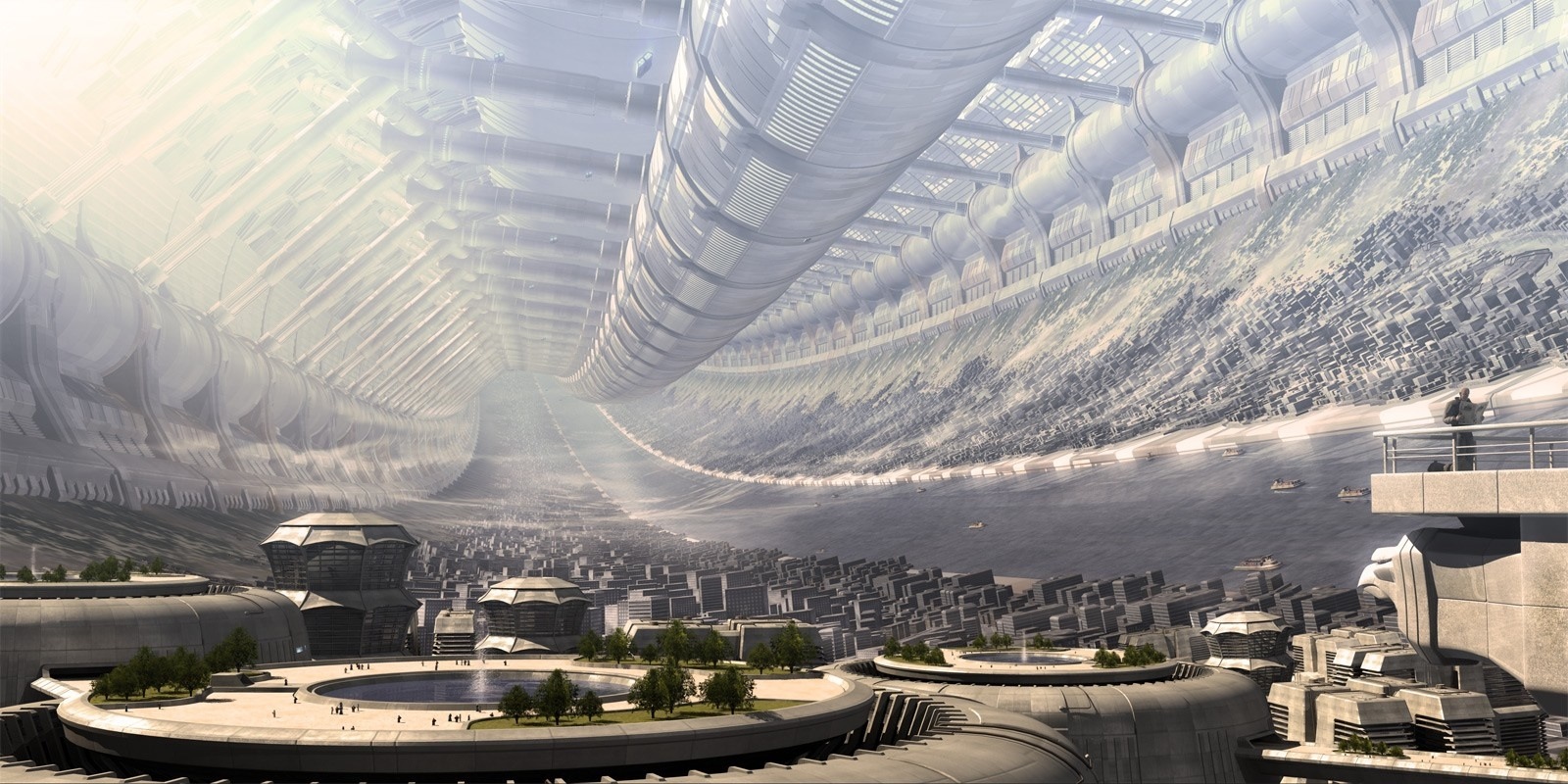
Image above: Detail of sci-fi "Ringworld" illustration by Alexander Preuss from 2006. From (http://www.mlgpro.com/forum/showthread.php?p=6363581) Click to enlarge.
SUMMARY:
What if we suddenly had access to unlimited clean energy? Would that be a good thing, or would we simply use it to complete the biocidal program of industrial civilization? This little thought experiment suggests that our problem as a civilization is not lack of energy – it is lack of imagination, humility, and empathy. The core is rotten. We must find a better way.
LEVELING WITH THE KIDS ABOUT OUR ENERGY PREDICAMENT
In the course of my high school Chemistry classes, I eventually steer the discussion around to our civilization’s energy predicament. I tell them that (1) energy input is THE cornerstone of any civilization; (2) we get our massive quantities of energy primarily from a finite planetary supply of fossil fuels formed millions of years ago; (3) our industrial economy requires annual growth in this already-huge energy input to function ‘properly’; (4) despite our best efforts, this fossil-energy input has leveled-off and has likely begun its permanent decline; (5) no combination of renewables or unconventional energy sources will be able to stabilize this decline; and (6) we better start getting ready for non-optional, lower-energy lifestyles in the not-too-distant future.
As the ever-prescient Chris Martenson says (www.chrismartenson.com), the next 20 years will be VERY different from the past 20 years. Guaranteed.
Most of my students – usually really-clever 17 and 18-year olds – have had little or no exposure to such ideas. They know gasoline is too expensive sometimes, that the Middle-East has some sinister (and ‘unfair’) control over oil supplies, and that some people are starting to talk more about fossil fuel alternatives like solar and wind. But not much else.
And even when exposed to such resource-depletion ideas, they are not terribly alarmed. They have mostly been indoctrinated with the ‘technology will save us’ mindset, and thus respond predictably: “Yea, maybe there’s a problem, but somebody will think of something.” Almost across-the-board, the 21st century is foreseen by them as merely a continuation of 20th century standard-of-living trends – with maybe a few sci-fi highlights thrown in for spice. Our current troubles are seen (as the mainstream media instructs them to) as an unfortunate-but-temporary blip in the steady march of economic growth and 'progress.'
THE QUEST FOR THE INFINITE ENERGY MACHINE
Upon hearing my ‘pessimistic’ news, many of my students immediately begin to formulate ideas to ‘save us.’
With optimism as their default setting, and perhaps unimpressed by my sobering evidence, they cheerily refuse to see our energy issue as what it is: an unsolvable predicament requiring adaptation to a new lower-energy reality. They want to see it as a solvable problem. And in the bold spirit of our industrial fore-bearers who bonked every problem on the head with technology (usually creating many more future problems in the process), they seek to find some technological way out of this energy jam. Lifestyle change is simply not a thinkable option.
Thus begins the annual quest for the mythical ‘infinite energy machine’!
Their energy-solution ideas are all over the place. And having usually not reached the thermodynamics unit yet, almost all the early ideas contain some gross violation of multiple Thermodynamic Laws. ‘Something-for-nothing’ ideas abound, and a handful of elaborate perpetual-motion machines are proposed every year.
But their ideas aren’t all clunkers. In the course of these anything-goes approaches, they have ‘invented’ various types of clever fuel cells, thermal solar devices, and a number of interesting ways to combine several already-existing renewable technologies. The next time you see a car featuring a wind turbine, a photovoltaic array, a small nuclear reactor, a parabolic solar-collection mirror…and perhaps a waterfall – it’s probably one of my kids driving. …You should get out of the way.
A THOUGHT EXPERIMENT: WHAT IF...?
So despite my students’ enthusiasm and the efforts of our best engineers, it’s becoming patently clear that there are simply no technological solutions to our larger energy predicament. I agree that we should work on renewable technologies (and I encourage my students to do so), but it’s delusional and ultimately dangerous to expect them to maintain our current industrial lifestyles when fossil-energy depletion accelerates off the coming cliff.
But what if…?
What if some super-smart-techno-wizard genius DID ‘save the day?’ What if our scientists nailed it? What if we discovered the ‘perfect’ energy technology – super-cheap, super-abundant, portable, carbon-neutral, non-polluting, no onerous infrastructure requirements, no significant use of ancillary resources such as water, metals, land, etc.?
In other words, what if we found an utterly game-changing energy source? What would happen then? Would it be good news or bad news for our civilization; for our species; for the biosphere? Would it elevate us to earthly heaven or cast us into the pits of earthly hell?
(Now, before I proceed, I want to point out that I view such a game-changing energy source as almost certainly not possible and definitely not desirable. I’m just using it as a thought experiment to point out the fundamental flaws at the core of industrial civilization – and how we might move forward from here.)
THE SEDUCTIVE PROMISES OF 'GREEN ENERGY NIRVANA'
I think it’s fair to generalize that most Americans see the promise of unlimited clean energy as a good thing. Fossil energy has brought us so many technological wonders and absolved us from so much physical work that an overwhelming majority of people are understandably enamored with its perceived benefits. If these benefits could be obtained without the well-documented environmental drawbacks (ex: mining damage, CO2 emissions), I think you’d get close to 100% in favor of the promise of ‘unlimited clean energy.’
The theoretical up-side potential of such an energy device would obviously be significant. It would certainly be hyped as the savior of industrial civilization – promising to usher in some sort of ‘green-energy nirvana’. I’ll briefly break down some of these theoretical benefits below – keeping in mind that they are, in fact, ONLY theoretical. (As I’ll discuss later, I have little faith that even a few of these seductive promises would ever be realized in a significant way.)
The promised environmental benefits would be huge. Energy intensive removal of CO2 from the atmosphere could become possible, allowing the decrease of atmospheric CO2 below the 350 ppm ‘safe’ level, perhaps stabilizing the climate, saving the ice caps and preventing acidification of the oceans. Energy-intensive hydroponic agriculture could ease the destructiveness of conventional soil-based industrial agriculture with its soil loss, eutrophication, and toxicity; and there would be no need to mine the ocean fisheries to the point of collapse. Energy-intensive scrubbers could be installed on all industrial waste outputs, reducing toxic emissions of every kind. Energy-intensive desalination could become commonplace, thus easing pressure on fresh water resources. Dams could be removed from rivers. Seawater could be energy-intensively mined for metals, putting an end to rapacious mining on the land.
The promised economic implications would also be profound. The global recession would be over immediately, and economic growth would resume. In fact, access to unlimited energy would initially repeal so many material limits to growth (metals, fresh water, fertilizer, toxic emissions, soil, etc.) that the perpetual-growth economy of free-market economists would cease to appear as an absurd fantasy (for a time at least).
Economic globalization would resume its creeping spread to every remote corner of the globe, and the industrialization of all ‘undeveloped’ counties would accelerate. Material standards of living (in the industrial sense) for many ‘poverty-stricken’ rural people on all continents would rise as they adopted industrial lifestyles and became ‘consumers‘. Industrial production of every form would become hyper-automated, leaving most employment in the technical, management, and service sectors. Most hard physical labor would become essentially optional or for punishment.
The promised social changes would be no less monumental. The infiltration of technology into our social relations would accelerate in the developed world and spread rapidly to the undeveloped regions. Communication of every form would increasingly become electronic – as would commerce and entertainment.
The ‘global community’ would become more of a reality as convenient, instantaneous visual communication and rapid, long-distance travel was made possible to more and more people. Family units would become more physically separated throughout the world. Values related to individualism would continue their ascension over values related to the family-unit and local community. Population would continue to rise as growing industrial areas attracted citizens from rural areas and expanded to envelop formerly-rural communities. Megalopolises would multiply world-wide.
The promised egalitarian political implications of unlimited clean energy would be compelling indeed to a general public increasingly denied any meaningful political voice. The proponents of such infinite-energy technology would advance a Google-ishous techno-democratic fantasy world that would go something like this: The saturation of global electronic communication for most of the world’s population would allow true participatory democracy to become a reality. Political decisions could be made truly democratically in ‘real-time.’ Dictatorships and other forms of overt repression would become non-viable as rapid 21st century communication subverted their crude 20th century control techniques. (Note: It's painful for me to even write that obvious bullsh*t, but it's no doubt what they'd tell us.)
THE GRIM REALITY: FRUITION OF THE INDUSTRIAL PROGRAM
The scenario painted above is perhaps a good summary of how the benefits of unlimited cheap energy would be cheerily imagined by the general public – with considerable prodding from the corporate sponsors of ‘infinite energy machine’. It’s how we’d like to think we’d use all that energy – bringing modern industrial civilization to its glorious fruition.
But would it really play out this way? Does the scenario described above REALLY represent the fruition of the industrial program?
A more realistic look at the actual history of economic/social/political/ environmental trends during the industrial age and their ideological underpinnings leads to much different conclusions – polar opposite in most respects. If the industrial age were to just continue onward in a more high-octane form – as I think it would – the changes would be best predicted from an extrapolation of the basic tenets of today’s industrial civilization. And that’s not a pretty picture.
Let’s start with the political implications, since they will color the rest of our discussion. The fundamental tenet of industrial politics is that the political realm is subservient to the economic realm – particularly the wishes and whims of the ever-larger, ever-fewer corporate entities. There are countless examples of how utterly perverted our national government has become under the iron thumb of these corporations – see the movie “Food, Inc.” for one example regarding our industrial food system.
Would these (in the words of Wendell Berry) ‘piles of money with the sole intention of becoming bigger piles of money’ gleefully relinquish the reins of power just because energy was now ‘too cheap to meter’? Ha! They would wield every brutal ounce of their considerable power – strengthened and hardened now by super-abundant resources – to further consolidate their stranglehold of the planet. To pretend some sort of ‘uber-democratic fantasy world’ would suddenly be allowed to blossom is sheer absurdity. Neither energy nor technology is inherently democratic; either can, in fact, be used far more efficiently in crushing democracy. See entire 20th century as an example.
The fundamental relationship of industrial civilization with the natural world to date has been one of conquest, rape, and destruction. (A space traveler might understandably conclude that industrial civilization hated the living planet.) I see no reason why a higher-powered version of industrial civilization should be any different. Despite the theoretically-beneficial environmental effects of cheap energy (described above), I strongly suspect these would be short-lived at best. In fact, I highly doubt many (or any) of these environmental improvements would be enacted at all. With an eye ONLY on short-term profits, and the same shrewd means to manipulate public opinion into believing ‘black is white’, what impetus would these corporations have to save the world? None. The destruction of the biosphere would continue unabated – and probably accelerated.
The dominant social program of industrial civilization has been the destruction of the local community, followed by atomization of individuals as isolated consumers. Participants in strong local communities are just too darn self sufficient to be good industrial consumers. They depend on each other for too much and on the industrial economy for too little. They’re bad for business. And anything that’s bad for business has a very short half-life in an industrial economy. I would expect the super-charged, ultra-cheap-energy version of industrial civilization to be even more merciless in crushing any vestige of community remaining in our already-shredded social fabric. The trend towards complete social atomization – well advanced even now – would be completed in earnest. Huxley’s Brave New World would arrive in full force.
And so in the presence of ‘unlimited energy’ and the absence of any popular resistance, the full economic program of industrial civilization – of the corporation(s) – could finally become a reality. Maximization of short-term gain to the exclusion of every other non-economic consideration – social or environmental – would remain paramount. The commodification of the Earth would march onward – only faster now. Literally every living and non-living object on earth would be cynically reduced to its utility in maximizing short-term profits – to be bought, sold, or discarded at the whim of the ‘free markets’. All social and environmental considerations not essential for the continued organizational function of the ruling corporate entities – or entity, as it would likely become – would be dismantled, dismembered, and degraded to pulp.
The grimness of the likely outcome here cannot be exaggerated. Little of value would remain after being squeezed through the hyper-entropic digestive system of the 'hopped-up', super-charged industrial monster. I have little doubt the very biosphere would be extinguished before too long.
So -- instead of ushering in a green-energy nirvana, that miraculous ‘infinite energy machine’ of my students’ dreams would likely usher in simply…‘The End’.
A CIVILIZATION ROTTEN TO THE CORE
So I have an admission to make: I pray to God we don’t find a cheap energy source.
This admission is embarrassing because, as a high school chemistry teacher, I’m charged with helping kids become capable of finding a cheap energy source. And this admission is unsettling because, as a card-carrying member of industrial civilization, the coming energy-starved convulsions may very well ravage my community to bits.
But a close examination of the past and present trajectories of our civilization leads only to this conclusion: Surely nothing but further tragedy would result from a prolonging the industrial experiment one second longer than it would otherwise last. Another bonanza supply of cheap energy would only lead to a more rapid and more thorough destruction of the biosphere.
The well-chronicled devastation wrought by industrial civilization can be traced in a direct line back to key flaws at its very core. The basic philosophical underpinnings on which the structure of our civilization rests are profoundly and tragically defective. These flaws have perverted both the manner in which we relate to each other and how we relate to the Earth. They are the seeds of earthly hell; the seeds of apocalypse. And it's worth breaking them down briefly -- as I will below -- so that we can consciously attempt to move away from them.
One tragic flaw of industrial civilization is a lack of imagination. The industrial mind has become utterly incapable of holistic thinking – of being able to see the big picture; of seeking to understand how the parts of anything interact in a complex manner to form the whole; of seeing that the whole is much more than the sum of its parts. The abject failures of our civilization to even ACKNOWLEDGE the realities of resource depletion and climate change, let alone address them, are two large scale examples of this deficit.
A smaller-scale example comes from a recent New York Times article describing industrial agriculture’s efforts towards making pigs neurologically incapable of feeling pain (?!) -- as a way to ‘fix’ the depredations of industrial hog ‘farming’. The mind reels. Thought of this absurdly-narrowed nature can scarcely be called human – it is the ultra-reductionist ‘thinking’ of a computer program. We can and must do better.
A second industrial flaw is a tragic lack of humility. Is there anything more absurd than the industrial mind’s bumbling attempts to replicate the form and function of the natural world – while at the same time dismantling the functioning model? Every ballyhooed engineering ‘success’ breeds scores of off-shoot problems -- which the best industrial minds then scramble to ‘solve’ again.
It would be hilarious if the mounting stakes were not the very biosphere itself. One particularly egregious example will suffice: The ‘miracles’ of industrial agriculture – the ‘Green Revolution’ – have begotten the horrors of soil loss, hypoxic dead zones, fossil-aquifer depletion, agrochemical poisoning, obesity and diabetes epidemics, death of a knowledgeable American farming culture, squalid and sprawling megalopolises throughout the world, massive global ecological overshoot, species extinctions, and climate change.
Good God! And the Green Revolution is still hailed in the industrial press as a ‘success’ that needs to be scaled up in the years ahead! Indeed, the ‘arrogance of humanism’ (see D. Ehrenfeld) has been industrial civilization’s only exponentially-increasing resource.
A third basic industrial flaw is a lack of empathy. For all its much-hyped cleverness, the industrial mind has become incapable of feeling love in the most basic sense. It has detached itself so completely from the biological foundations of our species that industrial civilization now displays the same affection and empathy for any life as it does for any machine – namely, none. The industrial mind sees no intrinsic value in anything outside the crude, wildly-variable monetary value assigned to it by the ‘free’ market.
Again, one example will suffice here: Anyone who has ever watched, horrified and mesmerized, as a bulldozer – industrial civilization’s foot-soldier -- ‘cleans up’ a treasured patch of woodland for suburban development has seen this chilling lack of empathy first-hand. A mind not completely colonized by the industrial virus recoils daily at such industrial atrocities committed all around us. We live, as Aldo Leopold says, in a world of wounds.
I could go on, but that is perhaps enough to make my case: Industrial civilization is rotten to its very core. There is no reforming it. It must be replaced in its entirety.
RECONFIGURING THE CORE
I am reduced to tears by the epic failure of my species. Our crowning achievement, industrial civilization, is an unmitigated disaster in every sense. Most shamefully, it has become a biological catastrophe at even the geologic scale -- and it may well extinguish the very biosphere itself.
But, of course, all is not yet lost. There may still be hope for a new beginning. But it is incumbent on us to start imagining and planning for a new civilization right now. Much work has, of course, already been done in this vein. A few examples include the writings of Wendell Berry and Aldo Leopold; the work of the permaculturalists and Wes Jackson’s The Land Institute; and the heroic struggles of anti-industrialists everywhere trying to preserve or re-establish ecosystems, communities, and basic human dignity.
But we need to do more. And we need to do it now.
The cores of our future civilizations – whatever follows this industrial nightmare -- must be fashioned anew. And they must be fashioned within the parameters of what the Earth allows – not the cold, arrogant, reductionist fantasies of the industrial mind.
We will desperately need to nurture empathetic, humble, holistic minds in order to reconfigure a livable civilization from the ashes of the present one. We will need to foster what Wendell Berry calls the ‘agrarian mind’ – polar opposite to the ‘industrial mind’. And if you haven’t already, I would highly recommend checking out Berry’s essays, poetry, and fiction – all of which center around the cultivation of this enlightened consciousness.
A FEW PRACTICAL STEPS IN THE RIGHT DIRECTION
So no big deal, huh? All we need to do is reconfigure the core of an entire civilization in perhaps a few years to a few decades – and do it as our doomed industrial civilization crashes in pieces all around us. No problem.
But we can try and we must try. And there are clear, practical steps we can take to get started on the narrow path required of us. I’ll recommend a few here. The recommendations are intended to help re-instill the key qualities tragically missing from the industrial program: imagination, humility, and empathy.
And in the spirit of humility, I’d like to acknowledge the unavoidable incompleteness of such a list. It’s my small contribution to the necessary conversation – one that desperately needs to expand in scope and intensity as we near the crucial inflection points of collapse.
So first, how might we regain our imagination as a species? The absurdly low bar set by the industrial paradigm will, of course, not be hard to top. But so much more is required of us. One step would be perhaps to fashion a concise guiding document in the spirit of the Declaration of Independence that sets forth lofty and expansive goals to be met by the new civilization as we break from our corporate oppressors.
On a more personal level, a solid grounding in the science of ecology would be a most useful tool in cultivating imagination – as a way to expand our awareness of complexity and subtle patterns from the narrow human sphere outward to the tangled web of interactions playing out, mostly unnoticed, all around us. The discipline of Steady-state Economics further expands this awareness to the economic sphere. And on an even more practical path, the widespread study and practice of permaculture would go far in accomplishing this expansion of consciousness the Earth requires of us.
And how might we regain our humility? We can do this by cultivating what Wendell Berry and Wes Jackson term an ‘ignorance-based’ worldview – one which seeks knowledge but accepts and plans for the fundamental truth that, no matter how much we know, ignorance is a basic fact of the human condition. We are not now, nor will we ever be, able to completely understand and control our surroundings. We must therefore work WITH Nature -- and continually be re-informed by it.
Rather than forcefully and clumsily trying to remake the Earth in the image of the machine (as we have been attempting), Wes Jackson asks us to constantly “seek the genius of the place” before carrying out any human endeavor. The widespread application of an ecologically-informed ‘Precautionary Principle’ to every organizational entity – from the national scale down to the family scale – would be a great place to start.
And, finally, how might we regain our empathy? How do we re-learn how to love ourselves, the biosphere, and the Earth? A great place to start would be learning the names and habits of all organisms in your local area – birds, trees, flowers, mushrooms, frogs, food crops, salamanders, spiders, mammals, etc. And after you do that, invite them into your moral/ethical sphere along with humans – and let that expanded morality guide your actions. This is essentially Aldo Leopold’s Land Ethic. Our citizen’s should be steeped in Leopold’s Land Ethic and basic morality from the time they are born to their last breath. And heed this: such expanded morality is not ancillary or optional to refashioning a livable civilization – it is paramount.
For ultimately, it is only by learning again to love each other and love the Earth that our species has a future on this planet.
.